





Introduction
Community pharmacists are a critical provider of primary care through dispensing, prescribing, administering, and monitoring drug therapies to varying degrees depending on jurisdiction (Raiche et al., Reference Raiche, Pammett, Dattani, Dolovich, Hamilton, Kennie-Kaulbach and McCarthy2020). In Canada, many community pharmacies are operated as for-profit independent or corporate businesses (Raiche et al., Reference Raiche, Pammett, Dattani, Dolovich, Hamilton, Kennie-Kaulbach and McCarthy2020); however, some are still operated by health authorities. The COVID-19 pandemic had varying impacts on community pharmacy practice including changes in remuneration for non-dispensing services, managerial decisions to support health system resilience (e.g., scheduling, pharmacy hours), and use of technology. Some of these changes had impacts on the workload and stress levels of community pharmacists (Elbeddini et al., Reference Elbeddini, Botross, Gerochi, Gazarin and Elshahawi2020; Gregory and Austin, Reference Raiche, Pammett, Dattani, Dolovich, Hamilton, Kennie-Kaulbach and McCarthy2020; Austin and Gregory, Reference Austin and Gregory2021). Canadian decision-makers introduced numerous policies to protect patients and providers from COVID-19 infection while facilitating access to primary care services. Primary care policies included heightened infection prevention and control strategies, the use of virtual care, COVID-19 immunizations, and changes to scope of practice (Mathews et al., Reference Mathews, Meredith, Ryan, Hedden, Lukewich, Marshall, Moritz, Spencer, Xiao, Brown, McKay, Wong and GIll2023a). Globally, community pharmacists provided primary care in community pharmacies, interprofessional clinics, and other settings while taking on numerous pandemic-related tasks such as implementing infection prevention and control strategies, offering virtual care, triaging patients to COVID-19 services, educating patients, and offering COVID-19 vaccines (Pantsari, Reference Pantasri2022; Elnaem and Nuffer, Reference Elnaem and Nuffer2022; Hess et al., Reference Hess, Bach, Won and Seed2022). As one of the most accessible primary care providers (Hayden and Parkin, Reference Hayden and Parkin2020; Hess et al., Reference Hess, Bach, Won and Seed2022; Isenor et al., Reference Isenor, Cossette, Murphy, Breton, Mathews, Moritz, Buote, McCarthy, Woodill, Morrison, Guenette and Marshall2023), the scope of community pharmacists’ practice increased over the course of the pandemic as other aspects of the health system were closed and placed under strain (Hurley-Kim et al., Reference Hurley-Kim, Babish, Chen, Diaz, Hahn, Evans, Seed and Hess2022; Isenor et al., Reference Isenor, Cossette, Murphy, Breton, Mathews, Moritz, Buote, McCarthy, Woodill, Morrison, Guenette and Marshall2023).
On May 5, 2023, the World Health Organization declared that COVID-19 was no longer considered a public health emergency of international concern (WHO, 2023a), and health systems transitioned to a “recovery stage” (Mathews et al., Reference Mathews, Meredith, Ryan, Hedden, Lukewich, Marshall, Buote, Moritz, Spencer, Asghari, Brown, Freeman, Gill, McCracken, McKay, Ryan, Sibbald, Wetmore and Wong2023b; WHO, 2023b). In primary care, the recovery stage involved managing increased demand for services from patients who delayed or forewent care, increased need for mental health services, and controlling referrals to hospital-based care as hospitals managed demand for deferred services (Mathews et al., Reference Mathews, Meredith, Ryan, Hedden, Lukewich, Marshall, Buote, Moritz, Spencer, Asghari, Brown, Freeman, Gill, McCracken, McKay, Ryan, Sibbald, Wetmore and Wong2023b). As health systems move to a post-pandemic, recovery stage, and resume “normal” primary care practice, the evolving roles of community pharmacists in primary care are being considered (Isenor et al., Reference Isenor, Cossette, Murphy, Breton, Mathews, Moritz, Buote, McCarthy, Woodill, Morrison, Guenette and Marshall2023). The aim of our study was to understand how routine pharmacy practice was impacted during the COVID-19 pandemic, and the consequences for patient access.
Methods
This investigation was part of a larger study on the impacts of the pandemic on access to primary care for patients with and without a regular primary care provider. We interviewed community pharmacists who practiced in community pharmacies in Nova Scotia, Canada, to understand their experiences providing care before and during the pandemic for these patients (Marshall et al., Reference Marshall, Breton, Cossette, Isenor, Mathews, Ayn, Smithman, Stock, Frymire, Edwards and Green2021). Experienced qualitative interviewers used a semi-structured interview guide (Appendix A) informed by overall research objectives and input from knowledge users including pharmacists.
Setting and recruitment
Most of Canada and Nova Scotia have a publicly funded healthcare system and the administration and delivery of primary care services. While primary care services are broadly limited to family physicians and nurse practitioners, community pharmacists in Nova Scotia had a broad scope of practice prior to the COVID-19 pandemic, compared to other provinces. Pharmacists in Nova Scotia had authority to administer injections and immunizations, prescribe continued drug therapy renewals for up to 180 days, and to assess and prescribe for several conditions including minor ailments, contraception management, uncomplicated cystitis, and herpes zoster (Grant et al., Reference Grant, Rowe, Kennie-Kaulbach, Bishop, Kontak, Stewart, Morrison, Sketris, Rodrigues, Minard, Whelan, Woodill, Jeffers, Fisher, Ricketts and Isenor2023). Community pharmacists were also authorized to perform adaptations (e.g., adapting aspects of prescriptions such as dose and regimen to better suit the patients’ needs) and therapeutic substitutions (Province of Nova Scotia, 2011). During the pandemic, community pharmacists were further authorized to offer virtual prescribing (Department of Health and Wellness, 2020), renew prescriptions for up to one year, and provide renewals for controlled substances (Health Canada, 2020; Nova Scotia College of Pharmacists, 2020a). Funding supports were provided for these initiatives. In the early stages of the pandemic (between March 18 and May 12, 2020), a 30-day supply limit was briefly imposed on all drug dispensations to protect drug supply, unless a longer day supply was necessary based on professional judgement (Nova Scotia College of Pharmacists, 2020b; Nova Scotia College of Pharmacists 2020c).
We used multiple strategies to reach community pharmacists, including through pharmacy association newsletters, social media (e.g., Twitter and Facebook), team member networks, and snowball sampling (Marshall et al., Reference Marshall, Breton, Cossette, Isenor, Mathews, Ayn, Smithman, Stock, Frymire, Edwards and Green2021). Potential participants contacted the research team via email or telephone, whereupon they were invited to take part in a screening call to ensure participants were eligible to participate and to collect demographic information (e.g., gender, years in practice, rurality). Participants were invited to take part in an interview depending on maximum variation in demographic characteristics and eligibility (i.e., we sought to collect data on pharmacist with different demographic profiles with respect to age, gender, race/ethnicity, years in practice, and income).
Only licensed pharmacists who worked in the community setting (e.g., an independent, franchise, or grocery/department store setting) were eligible to participate. We only sought to collect data from community pharmacists who were legally eligible to work and provide services that supported primary care during the COVID-19 pandemic.
Data collection
Interviews took place between September 2020 and January 2021 by telephone or Zoom. We obtained informed consent prior to each interview. Participants were not known to the interviewer. Using the interview guide, we elicited narratives about how the pandemic impacted regular pharmacy practice. Interviews were audio-recorded and transcribed verbatim. Transcripts were de-identified. To achieve thematic saturation, interviews were conducted until no new themes were identified (Saunders et al., Reference Saunders, Sim, Kingstone, Baker, Waterfield, Bartlam, Burroughs and Jinks2018).
Analysis
A qualitative analyst (LR) and the nominated principal investigator (EGM) developed an initial codebook of codes and definitions. The codebook was created inductively, as each transcript was reviewed, and was modified as new codes were identified. Codes included: (1) accessibility/availability of non-pharmacy health services and impacts on pharmacy practice, (2) services requested by patients, (3) personal impacts on providers, (4) observations of patient impacts, and (5) recommendations. A qualitative analyst (LR) conducted a thematic framework analysis on coded data. Framework analysis involves the creation of a ‘matrix’ of cases (columns) and themes (rows) with cells’ holding quotations and summaries of the quote (Gale et al., Reference Gale, Heath, Cameron, Rashid and Redwood2013). The senior author (JEI) and qualitative analyst (LR) refined themes through discussion. Final themes were agreed upon by all authors.
Ethical approval
This study was approved by the Nova Scotia Health Research Ethics Board (File #1024979).
Results
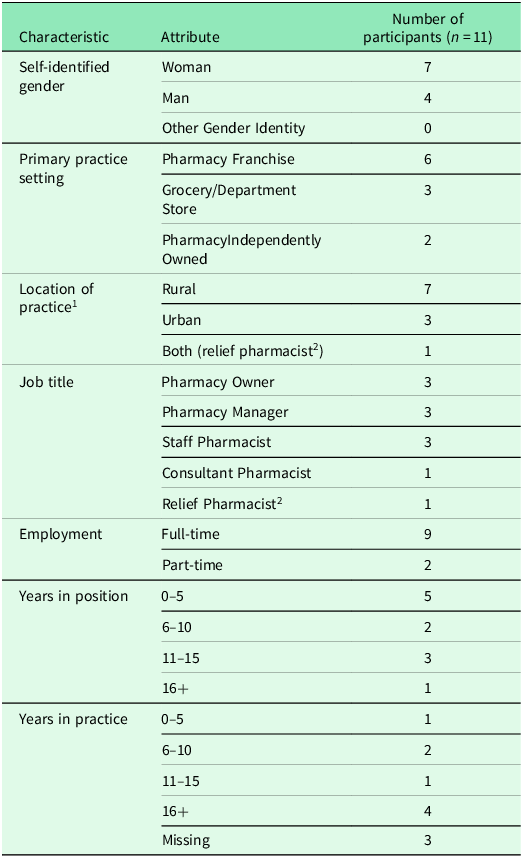
Eleven community pharmacists were interviewed, with diverse demographic attributes (Table 1).
Attributes of pharmacist participants

Table 1. Long description
The table presents the attributes of eleven pharmacist participants, detailing their self-identified gender, primary practice setting, location of practice, job title, employment status, years in their current position, and years in practice. The table has seven rows for self-identified gender, four rows for primary practice setting, three rows for location of practice, five rows for job title, two rows for employment status, four rows for years in position, and five rows for years in practice. Key attributes include seven women and four men, six pharmacists working in pharmacy franchises, seven practicing in rural areas, three pharmacy owners, nine employed full-time, and four with over sixteen years in practice. Notable trends include a higher number of women participants and a significant portion of pharmacists with extensive experience in their roles.
1 Location rurality asked as an open-ended question.
2 A relief pharmacist temporarily fills in for a regular community pharmacist.
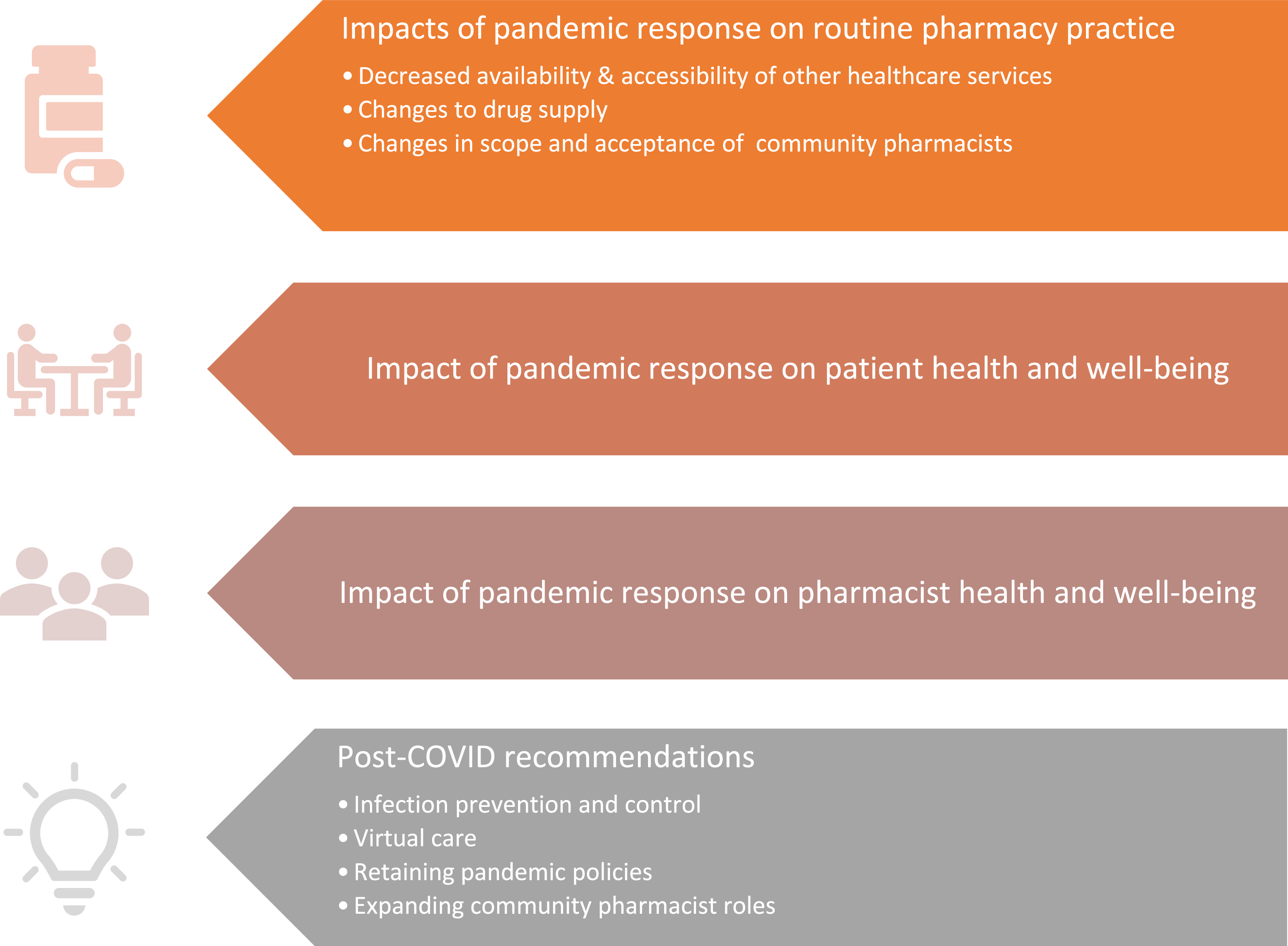
From interview data, four key themes about pandemic impacts on traditional community pharmacists’ practice were identified: 1) Impacts of the pandemic response on pharmacy practice, 2) Impact of pandemic response on patient health and well-being, 3) Impact of pandemic response on pharmacists’ health and well-being, and 4) Post-COVID recommendations (Figure 1).
Summary of themes.

Figure 1. Long description
The image presents a visual summary of the impacts of the pandemic response on various aspects of pharmacy practice and health. It includes three main sections: the impacts on routine pharmacy practice, patient health and well-being, and pharmacist health and well-being. The first section highlights decreased availability and accessibility of other healthcare services, changes to drug supply, and changes in the scope and acceptance of community pharmacists. The second section addresses the impact on patient health and well-being. The third section focuses on the impact on pharmacist health and well-being. Additionally, the image provides post-COVID recommendations, including infection prevention and control, virtual care, retaining pandemic policies, and expanding community pharmacist roles.
Impacts of pandemic response on pharmacy practice
Participants in this study described many ways the pandemic changed pharmacy practice, including changes in access to other healthcare services, lab services, and specialists; changes to drug supply; changes in demand for pharmacy services; and greater scope and greater acceptance of community pharmacists by the public.
Increased demand of pharmacist services due to decreased availability and accessibility of other healthcare services
During the pandemic, access to primary care and acute care services (e.g., physician and nurse practitioner run clinics and emergency rooms) was limited to curb the spread of COVID-19. Participants felt that community pharmacists were more accessible for patients than other primary care providers during the pandemic:
‘Not to criticize physicians… they were taking safety precautions the same as everybody else. But it’s just kind of like everyone went off the grid…. But the pharmacy’s open 9:00[AM] to 9:00[PM]. So that’s where the people would come.’ (NS8, woman, consultant, rural, 11–15 years in practice)
As a result of limited access to primary care due to the pandemic, pharmacists described difficulty reaching other primary care providers:
‘During COVID, because of the rules that came out and the risks that were there, a lot of primary care practitioners, such as physicians, dentists… weren’t working in their usual offices or usual setting, it was a lot tougher to reach them… So, the communication between other health care professionals definitely took a hit during… the initial first wave of COVID’ (NS5, man, manager, rural, 6–10 years in practice)
Participants felt they were more accessible than other providers, resulting in increased pressure and responsibility:
‘There’s actually a whole lot of bitterness right now between pharmacy and docs (doctors) because through March and April and May [2020], pharmacists …worked like crazy… that level of responsibility is like no one else took on… Everyone else went into hiding, and then we came out of hiding. Like we were full tilt. … there were times at work when I’m sure my staff went home and thought what in the name of God are we doing this for when nobody else is doing it, really? But for anybody just to be able to walk in the door at any given time, sick or not sick, really…’ (NS1, woman, staff, rural, 16+ years in practice)
Although there were challenges in accessing other primary care providers, there were some positive aspects for participants such as increased rapport with patients:
‘Doing the extra services and renewals for these patients who couldn’t get a hold of their physicians helped us really get to know them a bit better because we’d have… lengthier conversations… I really feel like the care the patients are getting is better.’ (NS2, woman, manager, rural, 11–15 years in practice)
Participants shared that lab services were less available during the pandemic for non-COVID-19 testing. Participants would typically review lab results before refilling prescriptions but were unable to during the pandemic due to lab restrictions.:
‘We’ve seen… our hypothyroid patients wondering why they can’t just get a refill on their [thyroid medication] that they’re going to need forever… you don’t have a recent lab work, we can only go so far.’ (NS6, man, owner, rural, 16+ years in practice)
Patients received less routine monitoring from specialists, who were limiting the patients they saw due to the pandemic. This left some patients seeking reassurance and information from pharmacists.:
‘Our diabetics that are no longer being monitored by the diabetic educator… they’re approaching us. And unfortunately, other than the… self-monitoring glucose values that they’re bringing in, we’re kind of limited in what we can do.’ (NS6, man, owner, rural, 16+ years in practice)
Changes to drug supply
Participants described increased workload due to patient fears about drug shortages: ‘in and amongst all that COVID was the rush of filling double, triple prescriptions because people were panicking’(NS1, woman, staff, rural, 16+ years in practice).
The government of Nova Scotia put a restriction of 30 days on all prescription refills early in the COVID-19 lockdown to protect drug supply during shortages:
‘During the first wave of COVID, we saw a reduction in the supply of medication from our wholesalers… Our college… the Nova Scotia College of Pharmacists, had put a restriction on the supply of medication to 30 days at a time unless it was in our professional judgment that a patient should receive more.’ (NS5, man, manager, rural, 6–10 years in practice)
Although some participants were ‘supportive’ of the 30-day limit (NS11, man, manager, rural, 16+ years in practice), others shared challenges associated with the policy. Participants described being ‘burned out’ as ‘the workload tripled’ (NS7, woman, owner, rural, 6–10 years in practice) due to more frequent dispensations. The work to find alternatives to medications was also not remunerated:
‘And it’s really, really, really a lot of work… right now we’re dealing with [thyroid medication] which is like a medication that like everybody’s on, and a bunch of doses are short. And the time it takes to pretty much fix it is just so much. And… We don’t get reimbursed for that’ (NS4, woman, relief, both urban and rural, 0–5 years in practice)
A participant also described how drug shortages and policies to protect supply ‘fractured’ their relationship with patients:
‘I think the intention was… to try and protect the drug supply. But what it did was kind of fracture some of our relationships with our patients because they’re based on trust… it was eroding that really important relationship. And the government… they put this in place but then didn’t defend us because it was their decision. Didn’t allow us the autonomy… in making decisions for what was in the best interests of our patients… those who can’t afford to bill [pay the dispensing fee] every month, or those who can’t come in every month. It felt like we were just kind of, ‘Here, you’re going to do 30 days at a time,’ and then ‘Sayonara,’ once the chips all fell.’ (NS7, woman, owner, rural, 6–10 years in practice)
Changes in scope and acceptance of community pharmacists
During the pandemic, pharmacists were able to renew prescriptions for a longer time (expanding from 180 days limit up to a year):
‘So our prescription renewal service… we could do up to six months for regular maintenance medications… And then suddenly, no, there’s not really a hard stop on that. As long as it’s in the best interest of the patient, just keep going.’ (NS11, man, manager, rural, 16+ years in practice).
Participants found that requests for prescribing increased, saying ‘It’s probably triple, quadruple [what] it was… before COVID’ (NS1, woman, staff, rural, 16+ years in practice). This increase in prescribing was sometimes due to patients transferring their prescriptions from pharmacies near their workplace to pharmacies near their home: ‘During the first wave, we had a big influx of transfers from [large chain pharmacies] and whatnot in the city because people who were working in the city… would get their prescriptions there when they were in the city. But now they weren’t.’ (NS9, woman, staff, rural, 6–10 years in practice). Other times, this was due to patients not seeing their primary care provider: ‘we definitely did… a lot more prescribing services during COVID for patients with doctors… That was the main increase or change that I saw.’ (NS9, woman, staff, rural, 6–10 years in practice).
During the pandemic, some pharmacists found they were doing fewer injections, particularly travel-related immunizations: ‘We used to do other travel-related immunizations, but that has certainly not been as prominent since COVID.’(NS5, man, manager, rural, 6–10 years in practice).
Other pharmacists found there was increased demand for injections, particularly contraceptive injections and immunizations. Patients wished to update other vaccinations before the COVID-19 vaccine became available: ‘We’ve seen requests for more injections… People are looking to get the full slate of immunizations, knowing that they want to get it done before a COVID immunization is available. (NS6, man, owner, rural, 16+ years in practice). A participant shared that patients who were previously hesitant to get the influenza vaccine were motivated to get it early in the pandemic: it was the beginning of COVID. So, all these people who are really hesitant to get a flu shot were now like, Okay, I should probably get the flu shot. So, we did so many vaccines at that point.’ (NS4, woman, relief, urban and rural, 0–5 years in practice).
Participants spoke positively about expansions on the injections they could administer:
‘We’ve kind of almost got a set list of what we’re able to inject and what we’re not able to inject. And then around April or May, [Nova Scotia College of Pharmacists, the pharmacy regulator in the province] just said, no, pretty much if it’s intramuscular, you can inject it…If it fits in the best interest of the patient, go for it.’ (NS11, man, manager, rural, 16+ years in practice)
However, a participant shared that some changes were not well-supported by additional training: ‘pharmacists could always inject people aged five and older. But during COVID they lowered the age to two… I think it was a COVID-related change. Which we got no extra training on.’ (NS9, woman, staff, rural, 6–10 years in practice)
Despite challenges during the pandemic, several participants found that a ‘silver lining’ was that the pandemic ‘gave us that extra push’ (NS2, woman, manager, rural, 11–15 years in practice) in terms of role expansion and acceptance that was ‘way overdue’ (NS8, woman, consultant, rural, 11–15 years in practice):
‘Since the pandemic, I felt much more useful in my role. I feel like I play a pivotal role in primary care now. And I did before, but COVID I think really pushed it ahead for a lot of people in terms of who they were going to turn to for advice or for care or for follow-up.’ (NS8, woman, consultant, rural, 11–15 years in practice)
Some of the outcomes of expanded roles also meant community pharmacists were happier about the work they were doing.
‘you get a bit more job satisfaction out of it. Because you’ve got patients you can help where you couldn’t help them before.’ (NS11, man, manager, rural, 16+ years in practice)
Impact of pandemic response on patient health and well-being
Participants described concerns about changes in their patients’ health:
‘you talk to people and they’re different than before. They’re distant. They’re alone. They’re fighting with their spouses…. And they’re not being healthy. They’re not exercising. They’re not going to the gym. They’re not doing all those things. They’re not playing hockey or whatever it was in the summertime that the majority would normally do.’ (NS1, woman, staff, rural, 16+ years in practice)
Participants especially noted impacts on mental health and increased prescribing for antidepressants: ‘[Class of antidepressant medication] prescriptions have increased. And… dose increases. And it’s not necessarily in just the young population that people always assume. I think it’s everybody.’ (NS4, woman, relief, both urban and rural, 0–5 years in practice)
Patients also struggled to pay for their medications due to job loss:
‘We definitely have more patients [at pharmacy that requires social worker referral] because of people who have lost their jobs and stuff like that. So, we’re getting more referrals, for sure. So more maybe low to middle income patients that didn’t have trouble paying for their medications before, but now do.’ (NS2, woman, manager, rural, 11–15 years in practice)
Impact of pandemic response on community pharmacists’ health and well being
Participants described increased burnout during the pandemic, and fear of COVID-19 infection.
Burnout
Participants described increased workload and burnout during the pandemic:
‘It was hard on mental health, for sure. Sometimes you would feel so overworked and under-staffed. Just the day-to-day activities really got to you. You’d get home and you’d just be worn out, completely exhausted. And after doing that for several months in a row, that takes a toll on your mental health.’ (NS5, man, manager, rural, 6–10 years in practice)
Fear of COVID-19 infection
Participants felt at risk of contracting COVID-19 and did not feel well protected despite staying open during the initial stages of the pandemic. This was exacerbated by people who were sick going to pharmacies as patients and community pharmacists did not have access to personal protective equipment (PPE) during the initial stages of the pandemic. Participants shared that they were in a unique situation compared to other primary care providers because they were expected to remain available for in-person care, whereas many other primary care providers switched to virtual care:
‘More sick people every day walk into a pharmacy than any doctor’s office… So, it is a place that needs to be protected. If you’re going to have community spread somewhere like a grocery store, you could just as easily have it in a pharmacy. So, our staff need to be protected. We were being asked to do triple the work… be there to fix all these situations in health care while everyone else is being told to stay at home and being praised.’ (NS7, woman, owner, rural, 6–10 years in practice)
Participants conveyed COVID-19 infection concerns. The initial stages of the pandemic were especially problematic for participants as not much was known about COVID-19, how the disease was transmitted, and what portion of the population was more at risk of complications. Furthermore, there was a lack of access to PPE and patients were going into the pharmacy to seek medication and PPE.
‘We couldn’t get masks, We couldn’t get hand sanitizer. You’re just worried about your own safety. And I have a young family. So, I was worried about that – coming home and spreading whatever to them… it’s basically impossible to socially distance in the pharmacy from your co-workers… you’re doing everything you can in your power to keep yourself safe. But someone else that you’re working beside may not be. So that was stressful as well.’ (NS9, woman, staff, rural, 6–10 years in practice)
Post COVID recommendations
Infection prevention and control
Participants recommended that some aspects of the infection prevention and control guidelines remain post-pandemic, as patients visiting pharmacies for treatment are more likely to be ill, and having PPE and proper sanitation measures in pharmacies could reduce exposure and spread of communicable diseases to pharmacists and other patients. ‘I kind of hope we are more conscientious in terms of illness, and people maybe choose to wear a mask when they’re not feeling well.’ (NS2, woman, manager, rural, 11–15 years in practice).
Virtual care
Several participants wished to retain virtual care modalities post-pandemic. The ease of communication with patients and convenience of synchronous virtual care options appealed to community pharmacists:
‘I will do a UTI (assessment to prescribe with or without resulting in a prescription) over the phone. And I would love to continue to do that. Renewals over the phone.’ (NS1, woman, staff, rural, 16+ years in practice)
Retaining pandemic scope of practice
Participants described the value in maintaining roles that were expanded during the pandemic, particularly around prescription renewals and renewing or prescribing controlled substances:
‘I do like the fact that physicians and nurse practitioners can phone in prescriptions for narcotics and controlled substances now. I think they would probably tell you they find it easier… I do believe other provinces don’t require duplicate or triplicate prescriptions for narcotics, and it’s worked out fine for them.’ (NS5, man, manager, rural, 6–10 years in practice)
Expanding community pharmacist roles and supports
Policy shifts occurred during the pandemic that allowed community pharmacists to provide more care within their scope of practice. Participants recommended expanding the role of pharmacists in the recovery stage and beyond. As one participant explained, ‘I can contribute so much more but you have to untie my hands’ (NS8, woman, consultant, rural, 11–15 years in practice).
Several participants wished to expand their roles further by getting involved in ‘the Bloom program’ [a community pharmacy initiative geared towards increasing and improving mental health and addictions care] (NS2, woman, manager, rural, 11–15 years in practice patients).
A participant also recommended the ability for pharmacists to refer patients to specialists:
‘Somebody didn’t have a family doctor, and they have diabetes and kidney disease and heart disease. Well, sure, I can maybe request blood work, but in reality maybe they should be seen by an endocrinologist or a heart specialist. So, the ability to make those kind of referrals would be nice.’ (NS5, man, manager, rural, 6–10 years in practice)
Participants also demonstrated a need for funding mechanisms to support the work they do helping patients navigate the health system:
‘Trying to help people navigate… the silos that health care functions in, there’s a lot of time spent on that. There isn’t a monetary value there. I think it’s valuable service to the patients… I think that we should be able to bill MSI (Medical Service Insurance, Nova Scotia’s publicly funded health insurance plan) for every phone call that triages a patient in or out of the emergency room.’ (NS3, woman, staff, urban, 6–10 years in practice)
Others echoed this sentiment, and felt that their work should be further supported through remuneration by the government:
‘You have disease states that are well within the means of pharmacists maintaining and supervising. You have a push for collaborative health. Well, you’re leaving one aspect of it kind of in the shadows. And you have, you know, processes that they could do to save the system money. Yes, there will be a financial contribution that will have to be made and will have to be reimbursed for some of these services. But overall, you’re going to have a better outcome at a cheaper price.’ (NS6, man, owner, rural, 16+ years in practice)
To support these roles, a participant also recommended greater communication between providers through a communication portal such as One Patient, One Record (a patient record which is accessible to health practitioners that will make it easier and more efficient for healthcare practitioners to deal with patients issues that has been discussed, but not yet implemented in Nova Scotia):
‘It would just all make sense if we were all on…like the whole One Patient, One Record, and everybody had access. So, if you’re a health care provider and you’re within the circle of care, there are some basic things that you should be able to access.’ (NS8, woman, consultant, rural, 11–15 years in practice)
Discussion
Participants shared numerous ways the COVID-19 pandemic response impacted routine pharmacy practice, including reduced access to other primary care providers, reduced access to laboratory services, drug shortages, increased demand for certain services, and expansion and acceptance of the scope of practice of pharmacists in community pharmacies. Participants detailed impacts on patient health and wellbeing, reporting an increase in physical and mental health concerns during this time. Participants also described increased burnout and stress among community pharmacists. Looking to the pandemic recovery period, participants recommended retaining some of the changes implemented during the pandemic and expanding their primary care roles post-pandemic to further support patients.
Community pharmacists reported a perceived reduction of access to other primary care providers (e.g., family physicians and laboratory services) during the pandemic. Similar findings were reported by Gleeson et al. (Reference Gleeson, Ludlow, Clyne, Ryan, Argent, Barlow, Mellon, De Brun, Pate, Kirke, Moriarty and Flood2022), where due to pandemic restrictions, family physicians could only carry out telephone consultations (Gleeson et al., Reference Gleeson, Ludlow, Clyne, Ryan, Argent, Barlow, Mellon, De Brun, Pate, Kirke, Moriarty and Flood2022). As pharmacies stayed open for in-person visits and medication pick-ups, pharmacists may have felt that they were more physically accessible. The availability of medications during the pandemic, especially in the initial phases, decreased and this may have been attributed to increased demand of certain medications (e.g., analgesics and vitamin C) (Romano et al., Reference Romano, Galante, Figueira, Mendes and Rodrigues2021). Community pharmacists often had to ration medication supply to be able to cope with the demands of their patients who may have felt they needed to hoard medication (Lee et al., Reference Lee, Watson and Al Hamarneh2021) due to the uncertainty surrounding the pandemic and its duration.
Community pharmacists experienced an expansion of their roles during the pandemic (Lee et al., Reference Lee, Watson and Al Hamarneh2021), and had to adopt additional responsibilities (e.g., education about the prevention of COVID-19) to fulfill the needs of their patients. Funding support for some assessment and prescribing (e.g., renewals) was also made available to assist in role expansion. This was especially important as community pharmacists were frontline primary care providers offering face-to-face services when other primary care providers were perceived to be unavailable (Gleeson et al., Reference Gleeson, Ludlow, Clyne, Ryan, Argent, Barlow, Mellon, De Brun, Pate, Kirke, Moriarty and Flood2022). While this may have been necessary to support patients and was perceived by community pharmacists as offering more autonomy in their work, questions remain on whether these responsibilities should be adopted under the normal purview of community pharmacists post-pandemic and how to adequately train and compensate community pharmacists. For example, although pharmacists in our study reported trying to alleviate anxiety concerns in patients with respect to the pandemic, all pharmacists may not have had enough training on providing additional supports for patients’ mental health. Despite this, a recent study conducted in Canada demonstrated that pharmacists were able to provide mental health supports such as medication management, non-pharmacologic approaches and supportive conversations, and identification of resources (e.g., referrals, wellness checks, consulting with physicians) (Ashcroft et al., Reference Ashcroft, Mathers, Gin, Lam, Donnelly, Brown, Kourgiantakis, Mehta, Rayna, Sur, Adamson, Kirvan and Dolovich2024). Additionally, although pharmacists in our study reported seeing increased prescribing of antidepressants to try and alleviate some of the mental health issues patients may have been facing, previous studies showed that dispensation rates of antidepressants reduced slightly in 2020 and returned to previous levels (Uthayakumar et al., Reference Uthayakumar, Tadrous, Vigod, Kitchen and Gomes2022).
An expansion of roles and responsibilities of community pharmacists occurred during the pandemic. Understanding the impact the adoption of these additional responsibilities may have on other primary care providers (e.g., family physicians and nurse practitioners) under their normal scope of practice is important. Family physicians, nurse practitioners, and community pharmacists are all autonomous professions, and while they cannot dictate each other’s practices, integrating community pharmacists into primary care teams and having more collaborative frameworks to address patient needs could help address challenges in primary care (Jorgenson et al., Reference Jorgenson, Laubscher, Lyons and Palmer2013; Khaira et al., Reference Khaira, Mathers, Benny Gerard and Dolovich2020). Knowing that community pharmacists could use their knowledge and skills during a public health emergency to meet the needs of patients highlights how valuable community pharmacists are to the delivery of primary care.
Some community pharmacists in our study noted an increase in job satisfaction with the expansion of roles. This contrasted with the findings of a previous study where increased workloads, which could result from the expansion of scope, resulted in reduced job satisfaction and higher stress (Lea et al., Reference Lea, Corlett and Rodgers2012) Approximately 80% and 51% of pharmacists surveyed reported having a history of burnout or secondary traumatic stress, respectively (Lea et al., Reference Lea, Corlett and Rodgers2012). During the pandemic, stress and burnout may have increased due to anxiety caused by the uncertainty regarding COVID-19, pharmacists’ personal safety, the safety of patients visiting the pharmacies, and additional workload. Therefore, while pandemic recovery and future pandemic response policies and plans should cater to the expansion in roles of community pharmacists, measures must also be taken to ensure the wellbeing of community pharmacists (Elbeddini et al., Reference Elbeddini, Wen, Tayefehchamani and To2020a, Reference Elbeddini, Botross, Gerochi, Gazarin and Elshahawi2020b) is maintained for them to effectively practice, serve the needs of their patients, and prevent community pharmacy attrition due to burnout (O’Donnell et al., Reference O’Donnell, Hayden, Quigley, Adamis, Gavin and McNicholas2024). Resources such as additional personnel, appropriate remuneration, appreciation, involvement in decision-making, and leadership training for skilled clinicians can help to address burnout as community pharmacists are taking on increased workload and complexity following the pandemic (Reed, Reference Reed2023; Canadian Pharmacists Association, 2023).
Moving to the recovery stage of the pandemic, health systems will need to address the backlog in patient care (Mathews et al., Reference Mathews, Meredith, Ryan, Hedden, Lukewich, Marshall, Moritz, Spencer, Xiao, Brown, McKay, Wong and GIll2023b). Pharmacists have a key role to play in the pandemic recovery stage in continuing to provide important primary care services, as well as opportunities to expand services that might not have been accessed or available during the pandemic. The COVID-19 pandemic altered primary care, introducing innovations and expanding scope of practice (Hayden and Parkin, Reference Hayden and Parkin2020). We also saw greater acceptance of pharmacists by patients (Canadian Pharmacists Association, 2023; Hoti et al., Reference Hoti, Jakupi, Hetemi, Raka, Hughes and Desselle2020). As health services resume normal provision of primary care, community pharmacists could play a larger role in supporting patients, including those who have no other primary care providers following them (Hayden and Parkin, Reference Hayden and Parkin2020). Given community pharmacists are accessible (Tsuyuki et al., Reference Tsuyuki, Beahm, Okada and Al Hamarneh2018; Yang and Son, Reference Yang and Son2023), optimally utilizing community pharmacists’ expertise within primary care may help reduce pressures faced by other primary care providers, if they were able to offer a larger array of publicly funded services. At the time of writing, publicly funded and delivered services in Nova Scotia, such as community pharmacy primary care clinics (CPPCC), provide extended pharmacy primary care services at no charge (i.e. publicly funded) in Nova Scotia. These services include assessment and prescribing for common ailments, chronic disease management (diabetes, asthma, COPD), prescription adaptation and therapeutic substitution and provision of additional public health funded vaccines beyond COVID-19 and influenza vaccines (Pharmacy Association of Nova Scotia, 2023). Many of these services, when provided outside of the CPPCC, still require additional fees for some or all patients including medication reviews; minor ailment assessment and prescribing; smoking cessation programs; and several vaccinations and injections such as human papilloma virus, hepatitis A and B, vitamin B12, and injectable hormonal contraception (Pharmacy Association of Nova Scotia, 2023).
Limitations
For this study, we interviewed community pharmacists in one Canadian province during early waves of the COVID-19 pandemic. Community pharmacists in Nova Scotia have a broader scope of practice than many other provinces. Findings may not resonate with those in other jurisdictions and may not account for policy changes that emerged since the time of data collection. However, findings may still hold relevance in other jurisdictions where regular pharmacy practice was similarly impacted. The results may also be of benefit to jurisdictions considering the expansion of the role of pharmacists in primary care in providing support around the care that can be provided.
Conclusion
The COVID-19 pandemic response had a major impact on community pharmacy practice and community pharmacists. As health systems have moved to the pandemic recovery stage, there will be an increase in demand for health services that were delayed during the pandemic, and higher acuity of patient needs. Community pharmacists are vital to primary care provision and should be enabled to provide expanded care to support pandemic recovery efforts and beyond.
Supplementary material
The supplementary material for this article can be found at https://doi.org/10.1017/S1463423626101303.
Data availability statement
The datasets generated and analyzed during the current study are not openly available to maintain the anonymity and confidentiality of participants.
Acknowledgements
We are grateful to the pharmacists we interviewed in this study for sharing their time and lived experiences with us during the ongoing COVID-19 pandemic.
Author contributions
EGM and JEI designed the study. EGM supervised the study’s implementation. JEI and LR led the analysis of this data and preparation of the manuscript. LR interviewed patients, analyzed the data, and was a major contributor in writing the manuscript. All authors were involved in designing and implementing the study, assisted in preparation of the manuscript, and read and approved the final version of the manuscript.
Funding statement
Funding was provided by the Canadian Institutes of Health Research COVID-19 Rapid Funding Opportunity Grant (Grant #447605) and the Nova Scotia Health Authority Research Fund (Grant # 893771).
Competing interests
The authors declare that they have no competing interests.
Ethical standards
Ethical approval for this study was granted on January 17, 2020, by the Nova Scotia Health Research Ethics Board (File #1024979). Participation in the study was voluntary, and participants understood that they could withdraw at any point up until their data were combined with other participants’. Written, informed consent was obtained prior to data collection and kept confidentially.
Consent for publication
Not applicable.


 Open access

