





1 Introduction
Let $\mathcal {A}$
be a mathematical structure such as a group, graph, or linear order. For this article, we will be solely interested in the case where
$\mathcal {A}$
be a mathematical structure such as a group, graph, or linear order. For this article, we will be solely interested in the case where $\mathcal {A}$
is the linear order
$\mathcal {A}$
is the linear order ${(\omega ,<)}$
though the definitions can be made in general. Let R be an additional relation on
${(\omega ,<)}$
though the definitions can be made in general. Let R be an additional relation on $\mathcal {A}$
not in the signature of
$\mathcal {A}$
not in the signature of $\mathcal {A}$
. Typical examples are the relation of linear independence on a vector space or the successor relation on a linear order.
$\mathcal {A}$
. Typical examples are the relation of linear independence on a vector space or the successor relation on a linear order.
What is the intrinsic complexity of R? One way to measure this is to look at how the complexity of R behaves under isomorphisms. In particular, we consider all computable copies $\mathcal {B}$
of
$\mathcal {B}$
of $\mathcal {A}$
(isomorphic presentations of
$\mathcal {A}$
(isomorphic presentations of $\mathcal {A}$
where all of the functions and relations are computable) and look at the Turing degree of R in
$\mathcal {A}$
where all of the functions and relations are computable) and look at the Turing degree of R in $\mathcal {B}$
. The collection of all such Turing degrees is the degree spectrum of R. In other words, the degree spectrum measures the possible complexity of R while fixing the complexity of the presentation of the underlying structure.
$\mathcal {B}$
. The collection of all such Turing degrees is the degree spectrum of R. In other words, the degree spectrum measures the possible complexity of R while fixing the complexity of the presentation of the underlying structure.
Definition 1.1. Given a computable structure $\mathcal {A}$
and a relation R on
$\mathcal {A}$
and a relation R on $\mathcal {A}$
, we define the degree spectrum of R,
$\mathcal {A}$
, we define the degree spectrum of R, $\text {DgSp}_{\mathcal {A}}(R)$
, to be the set of Turing degrees
$\text {DgSp}_{\mathcal {A}}(R)$
, to be the set of Turing degrees
 $$\begin{align*}\{ \deg_T (\varphi(R)) \colon \mathcal{B} \text{ is a computable copy of } \mathcal{A} \text{ and } \varphi:\mathcal{A}\cong\mathcal{B}\},\end{align*}$$
i.e., the images of R in all computable copies of $\mathcal {A}$
under all isomorphisms.
$\mathcal {A}$
under all isomorphisms.
In this article we follow a series of papers [Reference Bazhenov, Kalociński, Klin and Pimentel5–Reference Bazhenov, Kalociński and Wrocławski7, Reference Downey, Khoussianov, Miller and Yu9–Reference Knoll11, Reference Wright17] studying the degree spectra of computable relations on the structure ${(\omega ,<)}$
. The successor relation S plays a particularly important role in this structure. There is one copy of
${(\omega ,<)}$
. The successor relation S plays a particularly important role in this structure. There is one copy of ${(\omega ,<)}$
, the standard copy, where S is computable. In any other computable copy
${(\omega ,<)}$
, the standard copy, where S is computable. In any other computable copy ${\mathcal {L}} = (L,\prec )$
we have the successor relation
${\mathcal {L}} = (L,\prec )$
we have the successor relation $S^{{\mathcal {L}}} \subseteq L^2$
on
$S^{{\mathcal {L}}} \subseteq L^2$
on $\mathcal {A}$
.
$\mathcal {A}$
. $S^{{\mathcal {L}}}$
is always a co-c.e. set, and hence of c.e. degree, and in fact the degree spectrum of S is exactly the c.e. degrees.
$S^{{\mathcal {L}}}$
is always a co-c.e. set, and hence of c.e. degree, and in fact the degree spectrum of S is exactly the c.e. degrees.
In any computable copy $\mathcal {L}$
there is a unique isomorphism
$\mathcal {L}$
there is a unique isomorphism $f_{{\mathcal {L}}} \colon {\mathcal {L}} \to {(\omega ,<)}$
, and the Turing degree of this isomorphism is exactly the Turing degree of
$f_{{\mathcal {L}}} \colon {\mathcal {L}} \to {(\omega ,<)}$
, and the Turing degree of this isomorphism is exactly the Turing degree of $S^{{\mathcal {L}}}$
. Given any other computable relation R on
$S^{{\mathcal {L}}}$
. Given any other computable relation R on ${(\omega ,<)}$
, we obtain its image in
${(\omega ,<)}$
, we obtain its image in ${\mathcal {L}}$
by
${\mathcal {L}}$
by $R^{{\mathcal {L}}} = f(R)$
, and so
$R^{{\mathcal {L}}} = f(R)$
, and so ${\mathcal {R}}^{{\mathcal {L}}} \leq _T f_{{\mathcal {L}}} =_T S^{{\mathcal {L}}} \leq _T \varnothing '$
. For many relations R, we also always have
${\mathcal {R}}^{{\mathcal {L}}} \leq _T f_{{\mathcal {L}}} =_T S^{{\mathcal {L}}} \leq _T \varnothing '$
. For many relations R, we also always have $R^{{\mathcal {L}}} \geq _T S^{{\mathcal {L}}}$
, so that the degree spectrum of R is the same as the degree spectrum of S, that is, all of the c.e. degrees. This is the case, for example, for the double-successor relation. Given
$R^{{\mathcal {L}}} \geq _T S^{{\mathcal {L}}}$
, so that the degree spectrum of R is the same as the degree spectrum of S, that is, all of the c.e. degrees. This is the case, for example, for the double-successor relation. Given $x < y$
, we have that y is the successor of x if and only if there is
$x < y$
, we have that y is the successor of x if and only if there is $z> y$
such that z is the double-successor of x. Thus the degree spectrum of the double-successor relation—a d.c.e. relation—is only the c.e. degrees, rather than the d.c.e. degrees as one might expect. (A more general version of this argument shows that the degree spectrum of any intrinsically n-c.e. relation on
$z> y$
such that z is the double-successor of x. Thus the degree spectrum of the double-successor relation—a d.c.e. relation—is only the c.e. degrees, rather than the d.c.e. degrees as one might expect. (A more general version of this argument shows that the degree spectrum of any intrinsically n-c.e. relation on ${(\omega ,<)}$
will be the c.e. degrees; see Section 4 of [Reference Harrison-Trainor10].Footnote
1
)
${(\omega ,<)}$
will be the c.e. degrees; see Section 4 of [Reference Harrison-Trainor10].Footnote
1
)
There are also examples of computable relations on ${(\omega ,<)}$
whose degree spectra are only the computable degree (such as an empty relation, or the identity function) and all
${(\omega ,<)}$
whose degree spectra are only the computable degree (such as an empty relation, or the identity function) and all $\Delta ^0_2$
degrees (such as an infinite and co-infinite unary relation). Because
$\Delta ^0_2$
degrees (such as an infinite and co-infinite unary relation). Because ${(\omega ,<)}$
is
${(\omega ,<)}$
is $0'$
-categorical, every degree spectrum of a computable relation on
$0'$
-categorical, every degree spectrum of a computable relation on ${(\omega ,<)}$
is contained within the
${(\omega ,<)}$
is contained within the $\Delta ^0_2$
degrees.
$\Delta ^0_2$
degrees.
Wright showed that for any computable relation R on ${(\omega ,<)}$
, the degree spectrum is either just the computable degree, or must contain all of the c.e. degrees.Footnote
2
Thus no degree spectrum could be intermediate between the computable degree and the c.e. degrees. Wright left open the question of which degree spectra intermediate between the c.e. degrees and the
${(\omega ,<)}$
, the degree spectrum is either just the computable degree, or must contain all of the c.e. degrees.Footnote
2
Thus no degree spectrum could be intermediate between the computable degree and the c.e. degrees. Wright left open the question of which degree spectra intermediate between the c.e. degrees and the $\Delta ^0_2$
degrees were possible, and in particular, he left open the question of the existence of a degree spectrum strictly intermediate between the c.e. degrees and the
$\Delta ^0_2$
degrees were possible, and in particular, he left open the question of the existence of a degree spectrum strictly intermediate between the c.e. degrees and the $\Delta ^0_2$
degrees.
$\Delta ^0_2$
degrees.
In [Reference Bazhenov, Kalociński and Wrocławski6], Bazhenov, Kalociński, and Wroclawski showed that there is a unary function whose degree spectrum is intermediate. However this relation is unnatural in the sense that it is built via a complicated priority argument and diagonalization. It is not canonical because what relation one obtains by the construction depends on, e.g., the particular choice of Gödel coding for c.e. sets. While computability theory is full of such unnatural counterexamples, such examples are unlikely to show up in the normal course of mathematics.
In this article we consider degree spectra of natural relations on ${(\omega ,<)}$
. Of course what it means for a relation to be natural is not well-defined and so we use the “on a cone” formalism to capture this notion. This formalism originated with Martin’s conjecture (see [Reference Montalbán15]) and there has been a recent program, first suggested by Montalbán, of studying computable structure theory on a cone (e.g., [Reference Andrews, Harrison-Trainor and Schweber1, Reference Csima and Harrison-Trainor8, Reference Harrison-Trainor10, Reference Montalbán14]). Degree spectra on a cone were first studied in the second author’s monograph [Reference Harrison-Trainor10], where relations on
${(\omega ,<)}$
. Of course what it means for a relation to be natural is not well-defined and so we use the “on a cone” formalism to capture this notion. This formalism originated with Martin’s conjecture (see [Reference Montalbán15]) and there has been a recent program, first suggested by Montalbán, of studying computable structure theory on a cone (e.g., [Reference Andrews, Harrison-Trainor and Schweber1, Reference Csima and Harrison-Trainor8, Reference Harrison-Trainor10, Reference Montalbán14]). Degree spectra on a cone were first studied in the second author’s monograph [Reference Harrison-Trainor10], where relations on ${(\omega ,<)}$
were specifically considered.Footnote
3
There the second author asked the on-a-cone version of Wright’s question: Is there a relation on
${(\omega ,<)}$
were specifically considered.Footnote
3
There the second author asked the on-a-cone version of Wright’s question: Is there a relation on ${(\omega ,<)}$
whose degree spectrum is intermediate on a cone? At the time an answer to Wright’s original question, not on a cone, was still not known. While [Reference Bazhenov, Kalociński and Wrocławski6] resolved Wright’s question, it did not resolve the on-a-cone version: the degree spectrum of their relation is the c.e. degrees on a cone.
${(\omega ,<)}$
whose degree spectrum is intermediate on a cone? At the time an answer to Wright’s original question, not on a cone, was still not known. While [Reference Bazhenov, Kalociński and Wrocławski6] resolved Wright’s question, it did not resolve the on-a-cone version: the degree spectrum of their relation is the c.e. degrees on a cone.
In this article we resolve the on-a-cone version of Wright’s question.
Theorem 3.7. There are relations on ${(\omega ,<)}$
whose degree spectrum is strictly between the c.e. degrees and the
${(\omega ,<)}$
whose degree spectrum is strictly between the c.e. degrees and the $\Delta ^0_2$
degrees on a cone.
$\Delta ^0_2$
degrees on a cone.
In particular, there are computable examples where the cone is the trivial cone, that is, computable relations R on ${(\omega ,<)}$
such that relative to any degree
${(\omega ,<)}$
such that relative to any degree $\mathbf {d}$
, the degree spectrum of R relative to
$\mathbf {d}$
, the degree spectrum of R relative to $\mathbf {d}$
is strictly between the
$\mathbf {d}$
is strictly between the $\mathbf {d}$
-c.e. degrees and the degrees
$\mathbf {d}$
-c.e. degrees and the degrees $\Delta ^0_2$
relative to
$\Delta ^0_2$
relative to $\mathbf {d}$
. Such examples are natural relations of intermediate degree spectrum. To illustrate how natural these examples are, we describe our example. As was the example in [Reference Bazhenov, Kalociński and Wrocławski6], our example will be a unary function f. An initial segment of f is as follows:
$\mathbf {d}$
. Such examples are natural relations of intermediate degree spectrum. To illustrate how natural these examples are, we describe our example. As was the example in [Reference Bazhenov, Kalociński and Wrocławski6], our example will be a unary function f. An initial segment of f is as follows:

One can see that the domain of f is divided up into blocks, and in each block f is a loop. We write $L_n$
for the loop of length n, i.e., for the block
$L_n$
for the loop of length n, i.e., for the block

with n nodes. Then f consists of the following blocks:
 $$\begin{align*}L_1 L_1 L_2 L_1 L_3 L_2 L_4 L_1 L_5 L_2 L_6 L_3 L_7 L_1 L_8 \ldots.\end{align*}$$
The pattern here is that the blocks in odd positions follow the pattern $L_1 L_2 L_3 L_4 \ldots $
enumerating the natural numbers in increasing order, while the blocks in even positions
$L_1 L_2 L_3 L_4 \ldots $
enumerating the natural numbers in increasing order, while the blocks in even positions $L_1 L_1 L_2 L_1 L_2 L_3 \ldots $
are an enumeration of all of the natural numbers such that each number occurs infinitely many times. Thus every block appears infinitely many times, but any pair of blocks appears adjacent to each other at most once.
$L_1 L_1 L_2 L_1 L_2 L_3 \ldots $
are an enumeration of all of the natural numbers such that each number occurs infinitely many times. Thus every block appears infinitely many times, but any pair of blocks appears adjacent to each other at most once.
While we can describe our example simply, the example of [Reference Bazhenov, Kalociński and Wrocławski6] does not have a simple description but is actually the result of a complicated priority construction. Moreover, what relation one gets from the priority construction depends on certain non-canonical choices that one makes, such as the choice of Gödel encoding of the partial computable functions. Finally, their example does not relativize, i.e., the computable relation R produced does not have intermediate degree spectrum relative to $0'$
.
$0'$
.
When Montalbán first suggested studying computable structure theory on a cone, the hope was that one might find more structure in an area of mathematics that generally involved non-structure theorems. Though this is sometimes true (e.g., in [Reference Csima and Harrison-Trainor8]) it seems to not always be the case; e.g., we know that there are incomparable degree spectra on a cone [Reference Harrison-Trainor10]. The second half of this article is dedicated to showing that even for relations on ${(\omega ,<)}$
, one of the simplest non-trivial examples, it seems hard to find structure in the degree spectra on a cone. One of the mains results here is the following theorem.
${(\omega ,<)}$
, one of the simplest non-trivial examples, it seems hard to find structure in the degree spectra on a cone. One of the mains results here is the following theorem.
Theorem 4.17. Fix $\alpha \geq 6$
even. There is a unary function f on
$\alpha \geq 6$
even. There is a unary function f on ${(\omega ,<)}$
whose degree spectrum on a cone contains all of the
${(\omega ,<)}$
whose degree spectrum on a cone contains all of the $\beta $
-c.e. degrees for
$\beta $
-c.e. degrees for $\beta < \alpha $
and does not contain all of the
$\beta < \alpha $
and does not contain all of the $\alpha $
-c.e. degrees.
$\alpha $
-c.e. degrees.
Thus there are uncountably many different degree spectra on a cone. We also prove in Theorem 4.4 that the degree spectra on a cone of these functions are not contained in the $\beta $
-c.e. degrees for any
$\beta $
-c.e. degrees for any $\beta $
; that is, for any
$\beta $
; that is, for any $\beta $
, the degree spectrum on a cone contains a non-
$\beta $
, the degree spectrum on a cone contains a non- $\beta $
-c.e. degree.
$\beta $
-c.e. degree.
2 Preliminaries
2.1 Cones and Martin’s measure
Given a set $A \subseteq 2^\omega $
, we say that A is degree-invariant if whenever
$A \subseteq 2^\omega $
, we say that A is degree-invariant if whenever $X \in A$
and
$X \in A$
and $Y \equiv _T X$
,
$Y \equiv _T X$
, $Y \in A$
. If A is degree invariant, we can identify it with the corresponding set of Turing degrees
$Y \in A$
. If A is degree invariant, we can identify it with the corresponding set of Turing degrees $\{ \deg _T(X) \; \mid \; X \in A\}$
.
$\{ \deg _T(X) \; \mid \; X \in A\}$
.
Definition 2.1. Given $X \subseteq \omega $
, the cone above X is
$X \subseteq \omega $
, the cone above X is
 $$\begin{align*}C_X = \{ Y \; \mid \; Y \geq_T X \}.\end{align*}$$
As a consequence of Martin’s proof of Borel determinacy [Reference Martin13], one gets the following theorem.
Theorem 2.2 (Martin, [Reference Martin12]).
Every degree-invariant Borel subset of $2^\omega $
either contains a cone or is disjoint from a cone.
$2^\omega $
either contains a cone or is disjoint from a cone.
With more determinacy (e.g., analytic determinacy) this can be extended to more complicated degree-invariant sets. For this article, Borel determinacy will be sufficient.
Thinking of cones as large sets, one can define the $\{0,1\}$
-valued Martin’s measure on Borel degree-invariant sets by setting
$\{0,1\}$
-valued Martin’s measure on Borel degree-invariant sets by setting $\mu (A) = 1$
if A contains a cone, and
$\mu (A) = 1$
if A contains a cone, and $\mu (A) = 0$
if A is disjoint from a cone. Note that the intersection of countably many cones contains a cone, which makes Martin’s measure countably additive.
$\mu (A) = 0$
if A is disjoint from a cone. Note that the intersection of countably many cones contains a cone, which makes Martin’s measure countably additive.
2.2 Degree spectra on a cone
We begin by relativizing degree spectra to an oracle.
Definition 2.3. If $\mathcal {A}$
is X-computable, we define the degree spectrum of R relative to X,
$\mathcal {A}$
is X-computable, we define the degree spectrum of R relative to X, $\text {DgSp}^X_{\mathcal {A}}(R)$
, to be the set of degrees
$\text {DgSp}^X_{\mathcal {A}}(R)$
, to be the set of degrees
 $$\begin{align*}\text{DgSp}^X_{\mathcal{A}}(R) = \{ \deg_T (\varphi(R) \oplus X) \colon \mathcal{B} \text{ is an } X\text{-computable copy of } \mathcal{A} \text{ and } \varphi:\mathcal{A}\cong\mathcal{B}\}.\end{align*}$$
There is some discussion in Section 2.3 of [Reference Harrison-Trainor10] of why we use $\deg _T (\varphi (R) \oplus X)$
rather than just
$\deg _T (\varphi (R) \oplus X)$
rather than just $\deg _T (\varphi (R))$
include in this definition.
$\deg _T (\varphi (R))$
include in this definition.
Let R and S be relations on $\mathcal {A}$
and
$\mathcal {A}$
and $\mathcal {B}$
, respectively. The set of Y such that
$\mathcal {B}$
, respectively. The set of Y such that $\text {DgSp}^Y_{\mathcal {A}}(R) = \text {DgSp}^Y_{\mathcal {B}}(S)$
is a degree-invariant Borel set,Footnote
4
and so by Theorem 2.2, either contains a cone or is disjoint from a cone. If it contains a cone, then we think of the degree spectra of R and S being equal for most degrees Y. Otherwise, there is a cone on which
$\text {DgSp}^Y_{\mathcal {A}}(R) = \text {DgSp}^Y_{\mathcal {B}}(S)$
is a degree-invariant Borel set,Footnote
4
and so by Theorem 2.2, either contains a cone or is disjoint from a cone. If it contains a cone, then we think of the degree spectra of R and S being equal for most degrees Y. Otherwise, there is a cone on which $\text {DgSp}^Y_{\mathcal {A}}(R) \neq \text {DgSp}^Y_{\mathcal {B}}(S)$
and we think of their degree spectra as being different for most degrees Y.
$\text {DgSp}^Y_{\mathcal {A}}(R) \neq \text {DgSp}^Y_{\mathcal {B}}(S)$
and we think of their degree spectra as being different for most degrees Y.
Definition 2.4. Let R and S be relations on $\mathcal {A}$
and
$\mathcal {A}$
and $\mathcal {B}$
, respectively. We say that the degree spectrum of R is equal to the degree spectrum of S on a cone if there is some X such that for all
$\mathcal {B}$
, respectively. We say that the degree spectrum of R is equal to the degree spectrum of S on a cone if there is some X such that for all $Y \geq _T X$
,
$Y \geq _T X$
, $\text {DgSp}^Y_{\mathcal {A}}(R) = \text {DgSp}^Y_{\mathcal {B}}(S)$
. The degree spectrum of R on a cone is the equivalence class for R modulo this equivalence relation.
$\text {DgSp}^Y_{\mathcal {A}}(R) = \text {DgSp}^Y_{\mathcal {B}}(S)$
. The degree spectrum of R on a cone is the equivalence class for R modulo this equivalence relation.
We can also define what it means for the degree spectrum of R to be contained in the degree spectrum of S on a cone: if there is some X such that for all $Y \geq _T X$
,
$Y \geq _T X$
, $\text {DgSp}^Y_{\mathcal {A}}(R) \subseteq \text {DgSp}^Y_{\mathcal {B}}(S)$
. Sometimes we also want to talk about the contents of the degree spectrum of R on a cone without reference to some other relation, as in the following definition.
$\text {DgSp}^Y_{\mathcal {A}}(R) \subseteq \text {DgSp}^Y_{\mathcal {B}}(S)$
. Sometimes we also want to talk about the contents of the degree spectrum of R on a cone without reference to some other relation, as in the following definition.
Definition 2.5. Let R be a relation on $\mathcal {A}$
. We say that the degree spectrum of R is equal to the c.e. degrees on a cone if there is some X such that for all
$\mathcal {A}$
. We say that the degree spectrum of R is equal to the c.e. degrees on a cone if there is some X such that for all $Y \geq _T X$
,
$Y \geq _T X$
, $\text {DgSp}^Y_{\mathcal {A}}(R)$
is the set of Y-c.e. degrees above Y. Similarly, we can define what it means for a degree spectrum to be equal to the computable degree or the
$\text {DgSp}^Y_{\mathcal {A}}(R)$
is the set of Y-c.e. degrees above Y. Similarly, we can define what it means for a degree spectrum to be equal to the computable degree or the $\Delta _2^0$
degrees on a cone.
$\Delta _2^0$
degrees on a cone.
We also sometimes use the following terminology: R is intrinsically computable on a cone if the degree spectrum of R is the computable degree on a cone, and R is intrinsically of c.e. degree on a cone if the degree spectrum of R is contained within the c.e. degrees on a cone. These are just the on-a-cone version of being intrinsically computable or intrinsically of c.e. degree.
Note that throughout this article, the relations and structures need not be computable. This is because for any structure and relation there is a cone on which that structure and relation are computable. Thus we may essentially behave as if all structures and relations are computable.
2.3 Notation and definitions
Recall that Wright [Reference Wright17] showed that given a computable relation R on ${(\omega ,<)}$
, either the degree spectrum of R is the computable degree
${(\omega ,<)}$
, either the degree spectrum of R is the computable degree $\{\mathbf {0}\}$
or the degree spectrum of R contains all of the c.e. degrees. For specific types of relations, more is known. For example, Wright showed that if R is unary, then the degree spectrum is either the computable degree
$\{\mathbf {0}\}$
or the degree spectrum of R contains all of the c.e. degrees. For specific types of relations, more is known. For example, Wright showed that if R is unary, then the degree spectrum is either the computable degree $\{\mathbf {0}\}$
or all the
$\{\mathbf {0}\}$
or all the $\Delta ^0_2$
degrees.
$\Delta ^0_2$
degrees.
In the process of showing that there is a relation of intermediate degree spectrum, Bazhenov, Kalociński, and Wroclawski [Reference Bazhenov, Kalociński and Wrocławski6] introduced the following class of relatively simple unary functions on ${(\omega ,<)}$
.
${(\omega ,<)}$
.
Definition 2.6. We say that a function $f: {(\omega ,<)} \to {(\omega ,<)}$
is a block function if for each n there is some interval
$f: {(\omega ,<)} \to {(\omega ,<)}$
is a block function if for each n there is some interval $[a, b]$
, containing n, that is closed under f and
$[a, b]$
, containing n, that is closed under f and $f^{-1}$
. We call the minimal such interval the f-block, or simply the block if f is understood, containing n. Distinct f-blocks cannot have any overlap, and so the domain of f can be divided into blocks.
$f^{-1}$
. We call the minimal such interval the f-block, or simply the block if f is understood, containing n. Distinct f-blocks cannot have any overlap, and so the domain of f can be divided into blocks.
Note that the function need not be a cycle on a block. For example, the following forms a block:

The example constructed by Bazhenov, Kalociński, and Wroclawski, as well as the examples that we construct in this article, will be block functions.
Each block is finite, so we can list out all of the possible isomorphism types of blocks. We call these isomorphism types the block types or simply types. We say that f realises or has a block type if that block type is the type of an f-block. We denote the nth block type in this enumeration by $I_n$
and will use this to provide an alternate way to represent an arbitrary block function.
$I_n$
and will use this to provide an alternate way to represent an arbitrary block function.
Definition 2.7. Given a block function f, we define a sequence $\alpha _f$
of natural numbers, called the string corresponding to f, by
$\alpha _f$
of natural numbers, called the string corresponding to f, by $\alpha _f(i) = n$
where
$\alpha _f(i) = n$
where $I_n$
is the type of the ith block that occurs in f.
$I_n$
is the type of the ith block that occurs in f.
The string $\alpha _f$
completely determines f.
$\alpha _f$
completely determines f.
We note that the example of Bazhenov, Kalociński, and Wroclawski of an intermediate degree spectrum relies on not only the string $\alpha _f$
corresponding to f being non-computable, but the counting function
$\alpha _f$
corresponding to f being non-computable, but the counting function $c_f (n) = \#\{i : \alpha _f (i) = n\}$
being non-computable. In our examples, both
$c_f (n) = \#\{i : \alpha _f (i) = n\}$
being non-computable. In our examples, both $\alpha _f$
and
$\alpha _f$
and $c_f$
will be computable together with any other reasonable information that one might ask for.
$c_f$
will be computable together with any other reasonable information that one might ask for.
Given two f-blocks, we say that one embeds into the other if there is an order-preserving and f-preserving map from the one block to the other. Given block types I and J, we say that I embeds into J if there is an order-preserving and f-preserving map from any block of type I to any block of type J.
Frequently in this article we will build a computable linear order $(\mathcal {A},<_{\mathcal {A}}) \cong {(\omega ,<)}$
(possibly relative to some oracle) by stages. At each stage, we will define a finite linear order
$(\mathcal {A},<_{\mathcal {A}}) \cong {(\omega ,<)}$
(possibly relative to some oracle) by stages. At each stage, we will define a finite linear order $\mathcal {A}_s$
whose domain is a subset of
$\mathcal {A}_s$
whose domain is a subset of $\omega $
. At each stage
$\omega $
. At each stage $s+1$
, we may add new elements to
$s+1$
, we may add new elements to $\mathcal {A}_s$
to obtain
$\mathcal {A}_s$
to obtain $\mathcal {A}_{s+1}$
, saying where they are in relation to all of the elements of
$\mathcal {A}_{s+1}$
, saying where they are in relation to all of the elements of $\mathcal {A}_s$
, so that
$\mathcal {A}_s$
, so that $\mathcal {A}_{0} \subseteq \mathcal {A}_{1} \subseteq \mathcal {A}_{2} \subseteq \cdots $
. We build
$\mathcal {A}_{0} \subseteq \mathcal {A}_{1} \subseteq \mathcal {A}_{2} \subseteq \cdots $
. We build $\mathcal {A} = \bigcup _{s} \mathcal {A}_{s}$
.
$\mathcal {A} = \bigcup _{s} \mathcal {A}_{s}$
.
For clarity, we will always denote by $A = \{a_0,a_1,a_2,\ldots \}$
the domain of
$A = \{a_0,a_1,a_2,\ldots \}$
the domain of $\mathcal {A}$
to distinguish it from the particular isomorphism type
$\mathcal {A}$
to distinguish it from the particular isomorphism type ${(\omega ,<)}$
. At each stage s, we have a guess at an isomorphism
${(\omega ,<)}$
. At each stage s, we have a guess at an isomorphism $\mathcal {A} \to {(\omega ,<)}$
:
$\mathcal {A} \to {(\omega ,<)}$
: $0$
corresponds to the first element of
$0$
corresponds to the first element of $\mathcal {A}_s$
,
$\mathcal {A}_s$
, $1$
to the second element, and so on. We write
$1$
to the second element, and so on. We write $\pi _s \colon \mathcal {A}_s \to {(\omega ,<)}$
for the guess at stage s at this partial isomorphism: Given
$\pi _s \colon \mathcal {A}_s \to {(\omega ,<)}$
for the guess at stage s at this partial isomorphism: Given $a \in \mathcal {A}_s$
, we write
$a \in \mathcal {A}_s$
, we write $\pi _s(a)$
for the corresponding element of
$\pi _s(a)$
for the corresponding element of ${(\omega ,<)}$
, that is,
${(\omega ,<)}$
, that is, $\pi _s(a) = n$
where n is the number of elements less than a in
$\pi _s(a) = n$
where n is the number of elements less than a in $\mathcal {A}_s$
.Footnote
5
For a tuple
$\mathcal {A}_s$
.Footnote
5
For a tuple $\bar {a} = (a_1,\ldots ,a_n)$
, we write
$\bar {a} = (a_1,\ldots ,a_n)$
, we write $\pi _s(\bar {a})$
for the corresponding tuple
$\pi _s(\bar {a})$
for the corresponding tuple $(\pi _s(a_1),\ldots ,\pi _s(a_n))$
. We also write
$(\pi _s(a_1),\ldots ,\pi _s(a_n))$
. We also write $\pi $
for the isomorphism
$\pi $
for the isomorphism $\pi \colon \mathcal {A} \to {(\omega ,<)}$
, and so write
$\pi \colon \mathcal {A} \to {(\omega ,<)}$
, and so write $\pi (a) = n$
for the corresponding element of
$\pi (a) = n$
for the corresponding element of ${(\omega ,<)}$
at the end of the construction. Think of
${(\omega ,<)}$
at the end of the construction. Think of $\pi _s(a)$
as a stage-by-stage approximation of the final value
$\pi _s(a)$
as a stage-by-stage approximation of the final value $\pi (a)$
. At each stage
$\pi (a)$
. At each stage $s+1$
, new elements may be added to
$s+1$
, new elements may be added to $\mathcal {A}$
. If they are added above
$\mathcal {A}$
. If they are added above $a \in \mathcal {A}_s$
, then
$a \in \mathcal {A}_s$
, then $\pi _{s+1}(a) = \pi _s(a)$
. But if they are added below
$\pi _{s+1}(a) = \pi _s(a)$
. But if they are added below $a \in \mathcal {A}_s$
, then
$a \in \mathcal {A}_s$
, then $\pi _{s+1}(a)> \pi _s(a)$
.
$\pi _{s+1}(a)> \pi _s(a)$
.
While in some constructions we will build a copy $\mathcal {A}$
of
$\mathcal {A}$
of ${(\omega ,<)}$
as described above, at other times we will be diagonalizing against all computable copies of
${(\omega ,<)}$
as described above, at other times we will be diagonalizing against all computable copies of ${(\omega ,<)}$
. Let
${(\omega ,<)}$
. Let $(\mathcal {A}_e)_{e \in \omega }$
be a list of the computable orderings, or more precisely the (possibly partial)
$(\mathcal {A}_e)_{e \in \omega }$
be a list of the computable orderings, or more precisely the (possibly partial) $<$
-structures
$<$
-structures $\mathcal {A}_e$
computed by the eth partial computable function. Generally if
$\mathcal {A}_e$
computed by the eth partial computable function. Generally if $\mathcal {A}_e$
is not a linear order we recognize this at some finite stage and so can ignore it, and since we are only concerned with linear orders isomorphic to
$\mathcal {A}_e$
is not a linear order we recognize this at some finite stage and so can ignore it, and since we are only concerned with linear orders isomorphic to ${(\omega ,<)}$
we can effectively assume that
${(\omega ,<)}$
we can effectively assume that $\mathcal {A}_e$
is infinite. So, morally speaking, we can think of each
$\mathcal {A}_e$
is infinite. So, morally speaking, we can think of each $\mathcal {A}_e$
as being an infinite computable linear order. At each stage s, we have computed finite linear order
$\mathcal {A}_e$
as being an infinite computable linear order. At each stage s, we have computed finite linear order $\mathcal {A}_{e,s}$
. We can make definitions, like
$\mathcal {A}_{e,s}$
. We can make definitions, like $\pi _{e,s}(a)$
, similar to the definitions above. We will usually omit the e, writing
$\pi _{e,s}(a)$
, similar to the definitions above. We will usually omit the e, writing $\pi _s(a)$
when the structure
$\pi _s(a)$
when the structure $\mathcal {A}_e$
is understood. Note that if
$\mathcal {A}_e$
is understood. Note that if $\mathcal {A}_e$
is not actually isomorphic to
$\mathcal {A}_e$
is not actually isomorphic to ${(\omega ,<)}$
then it is possible that
${(\omega ,<)}$
then it is possible that $\lim _{s \to \infty } \pi _s(a) = \infty $
as infinitely many elements are added to
$\lim _{s \to \infty } \pi _s(a) = \infty $
as infinitely many elements are added to $\mathcal {A}_s$
below a; but if
$\mathcal {A}_s$
below a; but if $\mathcal {A}_e$
really is isomorphic to
$\mathcal {A}_e$
really is isomorphic to ${(\omega ,<)}$
then
${(\omega ,<)}$
then $\lim _{s \to \infty } \pi _s(a)$
will exist and be the isomorphic image of a in
$\lim _{s \to \infty } \pi _s(a)$
will exist and be the isomorphic image of a in ${(\omega ,<)}$
.
${(\omega ,<)}$
.
Given $\bar {a} = (a_1,\ldots ,a_\ell )$
and
$\bar {a} = (a_1,\ldots ,a_\ell )$
and $\bar {b} = (b_1,\ldots ,b_\ell )$
in
$\bar {b} = (b_1,\ldots ,b_\ell )$
in ${(\omega ,<)}$
, we say that
${(\omega ,<)}$
, we say that $\bar {a}$
extends to
$\bar {a}$
extends to $\bar {b}$
if
$\bar {b}$
if $b_1 \geq a_1$
and, for each i,
$b_1 \geq a_1$
and, for each i, $b_{i+1} - b_i \geq a_{i+1} - a_i$
. Then
$b_{i+1} - b_i \geq a_{i+1} - a_i$
. Then $\bar {a}$
extends to
$\bar {a}$
extends to $\bar {b}$
if and only if when
$\bar {b}$
if and only if when $\bar {u} \in \mathcal {A}_s$
, and
$\bar {u} \in \mathcal {A}_s$
, and $\pi _s(\bar {u}) = \bar {a}$
, it is possible to add elements to
$\pi _s(\bar {u}) = \bar {a}$
, it is possible to add elements to $\mathcal {A}_s$
to produce
$\mathcal {A}_s$
to produce $\mathcal {A}_{s+1}$
with
$\mathcal {A}_{s+1}$
with $\pi _{s+1}(\bar {u}) = \bar {b}$
. Also, given a tuple
$\pi _{s+1}(\bar {u}) = \bar {b}$
. Also, given a tuple $\bar {a} = (a_1,\ldots ,a_\ell ) \in {(\omega ,<)}$
and
$\bar {a} = (a_1,\ldots ,a_\ell ) \in {(\omega ,<)}$
and $n \in \mathbb {Z}$
we write
$n \in \mathbb {Z}$
we write $\bar {a} + n$
for
$\bar {a} + n$
for $(a_1 + n,\ldots ,a_\ell +n)$
.
$(a_1 + n,\ldots ,a_\ell +n)$
.
If f is a unary function on ${(\omega ,<)}$
, then we write
${(\omega ,<)}$
, then we write $f^{\mathcal {A}_s}$
for the guess at stage s at the values of f on the elements of
$f^{\mathcal {A}_s}$
for the guess at stage s at the values of f on the elements of $\mathcal {A}_s$
. We define
$\mathcal {A}_s$
. We define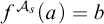 $f^{\mathcal {A}_s}(a) = b$
if and only if
$f^{\mathcal {A}_s}(a) = b$
if and only if $f(\pi _s(a)) = \pi _s(b)$
. Note that
$f(\pi _s(a)) = \pi _s(b)$
. Note that $f^{\mathcal {A}_s}$
might not be a total function, as there might not be enough elements in
$f^{\mathcal {A}_s}$
might not be a total function, as there might not be enough elements in $\mathcal {A}_s$
. However if f is a block function, then there are initial segments of
$\mathcal {A}_s$
. However if f is a block function, then there are initial segments of ${(\omega ,<)}$
which are closed under f, and so by making some small adjustments we can assume that
${(\omega ,<)}$
which are closed under f, and so by making some small adjustments we can assume that $f^{\mathcal {A}_s} \colon \mathcal {A}_s \to \mathcal {A}_s$
is total.
$f^{\mathcal {A}_s} \colon \mathcal {A}_s \to \mathcal {A}_s$
is total.
3 Intermediate degree spectrum
In this section we will construct an example of a unary function whose degree spectrum on a cone is intermediate between the c.e. degrees and the $\Delta ^0_2$
degrees. First, we will give a general characterization for when the degree spectrum on a cone of a block function strictly contains the c.e. degrees. This is the easiest part, and is essentially adapting Section 3 of [Reference Harrison-Trainor10] to the setting of block functions. Second, we will give a general condition for when the degree spectrum of a block function is all
$\Delta ^0_2$
degrees. First, we will give a general characterization for when the degree spectrum on a cone of a block function strictly contains the c.e. degrees. This is the easiest part, and is essentially adapting Section 3 of [Reference Harrison-Trainor10] to the setting of block functions. Second, we will give a general condition for when the degree spectrum of a block function is all $\Delta ^0_2$
degrees. This is where most of the work is done. Finally, we give an example and prove that it meets the first condition but not the second condition and thus strictly contains the c.e. degrees and is strictly contained within the
$\Delta ^0_2$
degrees. This is where most of the work is done. Finally, we give an example and prove that it meets the first condition but not the second condition and thus strictly contains the c.e. degrees and is strictly contained within the $\Delta ^0_2$
degrees.
$\Delta ^0_2$
degrees.
3.1 Containing a non-c.e. degree
We take from [Reference Harrison-Trainor10] a sufficient condition for the degree spectrum of a relation R on an arbitrary structure to strictly contain the c.e. degrees on a cone. Properly re-interpreted in the specific case of a block function on ${(\omega ,<)}$
, this will give us a condition which is both necessary and sufficient.
${(\omega ,<)}$
, this will give us a condition which is both necessary and sufficient.
Definition 3.1. Let R be an additional relation on a structure $\mathcal {A}$
. We say that
$\mathcal {A}$
. We say that $\bar {a}$
is difference-free (or d-free) over
$\bar {a}$
is difference-free (or d-free) over $\bar {c}$
if for any tuple
$\bar {c}$
if for any tuple $\bar {b}$
and quantifier-free formula
$\bar {b}$
and quantifier-free formula $\varphi (\bar {c},\bar {u},\bar {v})$
true of
$\varphi (\bar {c},\bar {u},\bar {v})$
true of $\bar {a},\bar {b}$
there are
$\bar {a},\bar {b}$
there are $\bar {a}',\bar {b}'$
satisfying
$\bar {a}',\bar {b}'$
satisfying $\varphi (\bar {c},\bar {u},\bar {v})$
such that (1) R restricted to
$\varphi (\bar {c},\bar {u},\bar {v})$
such that (1) R restricted to $\bar {c},\bar {a}'$
is not the same as R restricted to
$\bar {c},\bar {a}'$
is not the same as R restricted to $\bar {c},\bar {a}$
and (2) for any existential formula
$\bar {c},\bar {a}$
and (2) for any existential formula $\psi (\bar {c},\bar {u},\bar {v})$
true of
$\psi (\bar {c},\bar {u},\bar {v})$
true of $\bar {a}',\bar {b}'$
, there are
$\bar {a}',\bar {b}'$
, there are $\bar {a}"$
and
$\bar {a}"$
and $\bar {b}"$
satisfying
$\bar {b}"$
satisfying $\psi (\bar {c},\bar {u},\bar {v})$
and such that R restricted to
$\psi (\bar {c},\bar {u},\bar {v})$
and such that R restricted to $\bar {c},\bar {a}",\bar {b}"$
is the same as R restricted to
$\bar {c},\bar {a}",\bar {b}"$
is the same as R restricted to $\bar {c},\bar {a},\bar {b}$
.Footnote
6
$\bar {c},\bar {a},\bar {b}$
.Footnote
6
This is a freeness notion in the style of those appearing in, e.g., Chapters 11 and 16 of [Reference Ash and Knight2] in the proofs of theorems of Ash and Nerode [Reference Ash and Nerode3] and Barker [Reference Barker4]. The definition is somewhat technical, but we will attempt to give some explanation. The best way to think of d-freeness is in terms of constructing a computable copy $\mathcal {B} \cong \mathcal {A}$
while having in mind a
$\mathcal {B} \cong \mathcal {A}$
while having in mind a $\Delta ^0_2$
isomorphism
$\Delta ^0_2$
isomorphism $\mathcal {B} \to \mathcal {A}$
. Since we are constructing
$\mathcal {B} \to \mathcal {A}$
. Since we are constructing $\mathcal {B}$
computably, while we can change the isomorphism
$\mathcal {B}$
computably, while we can change the isomorphism $\mathcal {B} \to \mathcal {A}$
, we cannot change our mind about which atomic facts are true of elements of
$\mathcal {B} \to \mathcal {A}$
, we cannot change our mind about which atomic facts are true of elements of $\mathcal {B}$
. Along the way, we will consider how
$\mathcal {B}$
. Along the way, we will consider how $R^{\mathcal {B}}$
changes. Suppose that at some point, we have elements
$R^{\mathcal {B}}$
changes. Suppose that at some point, we have elements $\bar {x},\bar {y}$
of
$\bar {x},\bar {y}$
of $\mathcal {B}$
which our isomorphism currently maps to elements
$\mathcal {B}$
which our isomorphism currently maps to elements $\bar {c},\bar {a}$
with
$\bar {c},\bar {a}$
with $\bar {a}$
being d-free over
$\bar {a}$
being d-free over $\bar {c}$
. One should think of
$\bar {c}$
. One should think of $\bar {u} \mapsto \bar {c}$
as being unchangeable due to higher-priority requirements. Now at some point later in the construction, we might like to cause
$\bar {u} \mapsto \bar {c}$
as being unchangeable due to higher-priority requirements. Now at some point later in the construction, we might like to cause $R^{\mathcal {B}}$
to change on
$R^{\mathcal {B}}$
to change on $\bar {x},\bar {y}$
. Since
$\bar {x},\bar {y}$
. Since $\mathcal {B}$
must be computable, we have at this point committed to certain facts about
$\mathcal {B}$
must be computable, we have at this point committed to certain facts about $\mathcal {B}$
, say a quantifier-free
$\mathcal {B}$
, say a quantifier-free $\varphi (\bar {x},\bar {y},\bar {z})$
where
$\varphi (\bar {x},\bar {y},\bar {z})$
where $\bar {z}$
are further elements that we have added to
$\bar {z}$
are further elements that we have added to $\mathcal {B}$
at this point, with the isomorphism mapping
$\mathcal {B}$
at this point, with the isomorphism mapping $\bar {z} \mapsto \bar {b}$
. Note that
$\bar {z} \mapsto \bar {b}$
. Note that $\varphi (\bar {c},\bar {a},\bar {b})$
is true in
$\varphi (\bar {c},\bar {a},\bar {b})$
is true in $\mathcal {A}$
. Thus we can find
$\mathcal {A}$
. Thus we can find $\bar {a}',\bar {b}'$
as above. Since
$\bar {a}',\bar {b}'$
as above. Since $\varphi (\bar {c},\bar {a}',\bar {b}')$
is true, we can change our isomorphism to map
$\varphi (\bar {c},\bar {a}',\bar {b}')$
is true, we can change our isomorphism to map $\bar {x},\bar {y},\bar {z} \mapsto \bar {c},\bar {a}',\bar {b}'$
as anything that we have committed to about
$\bar {x},\bar {y},\bar {z} \mapsto \bar {c},\bar {a}',\bar {b}'$
as anything that we have committed to about $\bar {x},\bar {y},\bar {z}$
remains true. On the other hand,
$\bar {x},\bar {y},\bar {z}$
remains true. On the other hand, $R^{\mathcal {B}}$
has now changed on
$R^{\mathcal {B}}$
has now changed on $\bar {x},\bar {y}$
. Then, at some later stage, we might want to undo this change to
$\bar {x},\bar {y}$
. Then, at some later stage, we might want to undo this change to $R^{\mathcal {B}}$
. At this later point, we may have committed to more facts about
$R^{\mathcal {B}}$
. At this later point, we may have committed to more facts about $\mathcal {B}$
, say an existential formula
$\mathcal {B}$
, say an existential formula $\psi (\bar {x},\bar {y},\bar {z})$
with the new elements we have added to
$\psi (\bar {x},\bar {y},\bar {z})$
with the new elements we have added to $\mathcal {B}$
being the witnesses to the existential quantifiers. Then we can find
$\mathcal {B}$
being the witnesses to the existential quantifiers. Then we can find $\bar {a}",\bar {b}"$
such that
$\bar {a}",\bar {b}"$
such that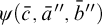 $\psi (\bar {c},\bar {a}",\bar {b}")$
is true, so that we can change our isomorphism to map
$\psi (\bar {c},\bar {a}",\bar {b}")$
is true, so that we can change our isomorphism to map $\bar {x},\bar {y},\bar {z} \mapsto \bar {c},\bar {a}",\bar {b}"$
, and furthermore
$\bar {x},\bar {y},\bar {z} \mapsto \bar {c},\bar {a}",\bar {b}"$
, and furthermore $R^{\mathcal {B}}$
is the same on
$R^{\mathcal {B}}$
is the same on $\bar {x},\bar {y},\bar {z}$
as it was before we made any change. This idea, used in a priority argument, is the core of the proof of the following fact.
$\bar {x},\bar {y},\bar {z}$
as it was before we made any change. This idea, used in a priority argument, is the core of the proof of the following fact.
Theorem 3.2 (Proposition 3.4 of [Reference Harrison-Trainor10]).
Let $\mathcal {A}$
be a structure and R a relation on
$\mathcal {A}$
be a structure and R a relation on $\mathcal {A}$
. Suppose that for each tuple
$\mathcal {A}$
. Suppose that for each tuple $\bar {c}$
there is
$\bar {c}$
there is $\bar {a}$
which is d-free over
$\bar {a}$
which is d-free over $\bar {c}$
. Then the degree spectrum of R strictly contains the c.e. degrees on a cone.
$\bar {c}$
. Then the degree spectrum of R strictly contains the c.e. degrees on a cone.
We do not know whether this condition is also necessary. However if we interpret this for a block function on ${(\omega ,<)}$
, we get the following condition which is simpler as well as both necessary and sufficient.
${(\omega ,<)}$
, we get the following condition which is simpler as well as both necessary and sufficient.
Theorem 3.3. Let f be a block function which is not intrinsically computable on a cone. Then f is intrinsically of c.e. degree on a cone if and only if there are infinitely many blocks that do not embed into a later block.
Proof. First, suppose that there are only finitely many blocks that do not embed into a later block. After some finite initial segment, all blocks that occur embed into some later block. By non-uniformly fixing this initial segment, we can assume that every block embeds into another block. We show that for any tuple $\overline {c}$
, there is some tuple
$\overline {c}$
, there is some tuple $\overline {a}$
which is d-free over
$\overline {a}$
which is d-free over $\overline {c}$
. Given
$\overline {c}$
. Given $\overline {c}$
, let
$\overline {c}$
, let $\overline {a}$
be some f-block of size greater than one such that all its elements are greater than those of
$\overline {a}$
be some f-block of size greater than one such that all its elements are greater than those of $\overline {c}$
. Since we assumed that f was not intrinsically computable, it cannot be the identity almost everywhere and so there must be infinitely many blocks of size greater than one. We claim that
$\overline {c}$
. Since we assumed that f was not intrinsically computable, it cannot be the identity almost everywhere and so there must be infinitely many blocks of size greater than one. We claim that $\overline {a}$
is d-free over
$\overline {a}$
is d-free over $\overline {c}$
.
$\overline {c}$
.
Now, with $\overline {c}$
,
$\overline {c}$
, $\overline {a}$
as above, suppose there is some quantifier-free formula
$\overline {a}$
as above, suppose there is some quantifier-free formula $\varphi (\overline {x}, \overline {u}, \overline {v})$
and tuple
$\varphi (\overline {x}, \overline {u}, \overline {v})$
and tuple $\overline {b}$
such that
$\overline {b}$
such that $\varphi (\overline {c}, \overline {a}, \overline {b})$
is true. We make some simplifying assumptions. First, we may assume that there is no repetition amongst the elements of all of the tuples. Second, by including in
$\varphi (\overline {c}, \overline {a}, \overline {b})$
is true. We make some simplifying assumptions. First, we may assume that there is no repetition amongst the elements of all of the tuples. Second, by including in $\bar {c}$
any elements of
$\bar {c}$
any elements of $\bar {b}$
which are less than the elements of
$\bar {b}$
which are less than the elements of $\bar {a}$
, we may assume that all of the elements of
$\bar {a}$
, we may assume that all of the elements of $\bar {b}$
are greater than all of the elements of
$\bar {b}$
are greater than all of the elements of $\bar {a}$
. And third, we can assume that
$\bar {a}$
. And third, we can assume that $\bar {b}$
consists of n distinct adjacent blocks
$\bar {b}$
consists of n distinct adjacent blocks $\overline {b} = \overline {b}_{1}\overline {b}_{2} \dots \overline {b}_{n}$
with
$\overline {b} = \overline {b}_{1}\overline {b}_{2} \dots \overline {b}_{n}$
with $\overline {b}_1$
the first block after
$\overline {b}_1$
the first block after $\overline {a}$
.
$\overline {a}$
.
Now define $\overline {a}' = \overline {a} + 1$
and
$\overline {a}' = \overline {a} + 1$
and $\overline {b}' = \overline {b} + 1$
. Then
$\overline {b}' = \overline {b} + 1$
. Then $\overline {c} \, \overline {a}' \overline {b}'$
has the same order type as
$\overline {c} \, \overline {a}' \overline {b}'$
has the same order type as $\bar {c},\bar {a},\bar {b}$
and so still satisfies
$\bar {c},\bar {a},\bar {b}$
and so still satisfies $\varphi (\overline {x}, \overline {u}, \overline {v})$
. However the values of f on
$\varphi (\overline {x}, \overline {u}, \overline {v})$
. However the values of f on $\overline {a}$
are not the same as f on
$\overline {a}$
are not the same as f on $\overline {a}'$
as
$\overline {a}'$
as $\overline {a}$
is a block and
$\overline {a}$
is a block and $\overline {a}'$
is not. Furthermore, suppose
$\overline {a}'$
is not. Furthermore, suppose $\psi (\overline {x}, \overline {u}, \overline {v})$
is some existential formula satisfied by
$\psi (\overline {x}, \overline {u}, \overline {v})$
is some existential formula satisfied by $\overline {c}$
,
$\overline {c}$
, $\overline {a}'$
,
$\overline {a}'$
, $\overline {b}'$
. We can again replace this by a quantifier-free formula
$\overline {b}'$
. We can again replace this by a quantifier-free formula $\chi (\overline {x}, \overline {u}, \overline {v}, \overline {w})$
which is satisfied by
$\chi (\overline {x}, \overline {u}, \overline {v}, \overline {w})$
which is satisfied by $\overline {c}$
,
$\overline {c}$
, $\overline {a}'$
,
$\overline {a}'$
, $\overline {b}', \overline {e}'$
for some tuple
$\overline {b}', \overline {e}'$
for some tuple $\overline {e}'$
. Noting that there are no gaps between the elements of
$\overline {e}'$
. Noting that there are no gaps between the elements of $\bar {a}',\bar {b}'$
, we may split
$\bar {a}',\bar {b}'$
, we may split $\bar {e}'$
into
$\bar {e}'$
into $\bar {e}_1'\bar {e}_2'$
where the elements of
$\bar {e}_1'\bar {e}_2'$
where the elements of $\bar {e}_1'$
are less than the elements of
$\bar {e}_1'$
are less than the elements of $\bar {a}'$
and the elements of
$\bar {a}'$
and the elements of $\bar {e}_2'$
are greater than the elements of
$\bar {e}_2'$
are greater than the elements of $\bar {a}'\bar {b}'$
.
$\bar {a}'\bar {b}'$
.
Now let $\overline {a}"$
be the image of
$\overline {a}"$
be the image of $\bar {a}$
in some block into which it embeds, and similarly let
$\bar {a}$
in some block into which it embeds, and similarly let $\bar {b}_1",\ldots ,\bar {b}_n"$
be the images of
$\bar {b}_1",\ldots ,\bar {b}_n"$
be the images of $\bar {b}_1,\ldots ,\bar {b}_n$
in blocks into which they embed, choosing these images sufficiently large that
$\bar {b}_1,\ldots ,\bar {b}_n$
in blocks into which they embed, choosing these images sufficiently large that $\bar {c} < \bar {e}_1' < \bar {a}" < \bar {b}_1" < \bar {b}_2" < \cdots < \bar {b}_n"$
. Finally, choose
$\bar {c} < \bar {e}_1' < \bar {a}" < \bar {b}_1" < \bar {b}_2" < \cdots < \bar {b}_n"$
. Finally, choose $\bar {e}_2"$
larger than all of these. Let
$\bar {e}_2"$
larger than all of these. Let $\bar {e}" = \bar {e}_1' \bar {e}_2"$
.
$\bar {e}" = \bar {e}_1' \bar {e}_2"$
.
Our construction has ensured that $\overline {c} \, \overline {a}" \overline {b}" \overline {e}"$
has the same order type as
$\overline {c} \, \overline {a}" \overline {b}" \overline {e}"$
has the same order type as $\overline {c} \, \overline {a}' \overline {b}' \overline {e}'$
and so
$\overline {c} \, \overline {a}' \overline {b}' \overline {e}'$
and so $\overline {c} \, \overline {a}" \overline {b}"$
satisfies the formula
$\overline {c} \, \overline {a}" \overline {b}"$
satisfies the formula $\psi (\overline {x}, \overline {u}, \overline {v})$
. Moreover, the values of f on
$\psi (\overline {x}, \overline {u}, \overline {v})$
. Moreover, the values of f on $\overline {c} \, \overline {a}" \overline {b}"$
are the same as the values on
$\overline {c} \, \overline {a}" \overline {b}"$
are the same as the values on $\overline {c} \, \overline {a} \, \overline {b}$
. Thus,
$\overline {c} \, \overline {a} \, \overline {b}$
. Thus, $\overline {a}$
is d-free over
$\overline {a}$
is d-free over $\overline {c}$
, as desired. By Theorem 3.2, the degree spectrum of f strictly contains the c.e. degrees on a cone.
$\overline {c}$
, as desired. By Theorem 3.2, the degree spectrum of f strictly contains the c.e. degrees on a cone.
In the other direction, suppose that there are infinitely many f-blocks which embed into no larger f-blocks. We work on the cone on which we can compute $\alpha _f$
and whether a given block embeds into a later block. We will show that, for any X on this cone, if
$\alpha _f$
and whether a given block embeds into a later block. We will show that, for any X on this cone, if $f^{\mathcal {A}}$
is the copy of f in an X-computable copy
$f^{\mathcal {A}}$
is the copy of f in an X-computable copy $(\mathcal {A}, <_{\mathcal {A}})$
of
$(\mathcal {A}, <_{\mathcal {A}})$
of ${(\omega ,<)}$
then
${(\omega ,<)}$
then $f^{\mathcal {A}}$
is of X-c.e. degree. This implies that the degree spectrum of R on a cone is contained in the c.e. degrees. To simplify notation, we will suppress X, assuming that
$f^{\mathcal {A}}$
is of X-c.e. degree. This implies that the degree spectrum of R on a cone is contained in the c.e. degrees. To simplify notation, we will suppress X, assuming that $\alpha _f$
is computable and that we can compute whether a given block embeds into any later block.
$\alpha _f$
is computable and that we can compute whether a given block embeds into any later block.
To show that $f^{\mathcal {A}}$
is of c.e. degree, we will show that for any k it computes the kth element of
$f^{\mathcal {A}}$
is of c.e. degree, we will show that for any k it computes the kth element of $\mathcal {A}$
. This implies that it computes the successor relation on
$\mathcal {A}$
. This implies that it computes the successor relation on $\mathcal {A}$
. Recall that the successor relation on
$\mathcal {A}$
. Recall that the successor relation on $\mathcal {A}$
is always of c.e. degree and computes
$\mathcal {A}$
is always of c.e. degree and computes $f^{\mathcal {A}}$
, so this will imply that
$f^{\mathcal {A}}$
, so this will imply that $f^{\mathcal {A}}$
is of c.e. degree.
$f^{\mathcal {A}}$
is of c.e. degree.
Given k, look in ${(\omega ,<)}$
for a block, all of whose elements are greater than k, which does not embed into any greater block. Suppose that this block is the elements
${(\omega ,<)}$
for a block, all of whose elements are greater than k, which does not embed into any greater block. Suppose that this block is the elements $(\ell ,\ldots ,\ell +m-1)$
of
$(\ell ,\ldots ,\ell +m-1)$
of $\omega $
, so that there are
$\omega $
, so that there are $\ell $
elements less than this block. Let the block type be I. In
$\ell $
elements less than this block. Let the block type be I. In $\mathcal {A}$
, look for a tuple of elements
$\mathcal {A}$
, look for a tuple of elements $a_0 < a_1 < \cdots < a_\ell < \cdots < a_{\ell +m-1}$
of
$a_0 < a_1 < \cdots < a_\ell < \cdots < a_{\ell +m-1}$
of $\mathcal {A}$
such that
$\mathcal {A}$
such that $f^{\mathcal {A}}$
on
$f^{\mathcal {A}}$
on $(a_\ell ,\ldots ,a_{\ell +m-1})$
has block type I. (This means that f on
$(a_\ell ,\ldots ,a_{\ell +m-1})$
has block type I. (This means that f on $(\ell ,\ldots ,\ell +m-1)$
is the same as
$(\ell ,\ldots ,\ell +m-1)$
is the same as $f^{\mathcal {A}}$
on
$f^{\mathcal {A}}$
on $(a_\ell ,\ldots ,a_{\ell +m-1})$
.) Once we find such elements, we know that
$(a_\ell ,\ldots ,a_{\ell +m-1})$
.) Once we find such elements, we know that $a_k$
is the kth element of
$a_k$
is the kth element of $\mathcal {A}$
. This is because block type I does not embed into any later
$\mathcal {A}$
. This is because block type I does not embed into any later $f^{\mathcal {A}}$
-block (and noting that a block cannot embed into a sequence of blocks without embedding into one of them).
$f^{\mathcal {A}}$
-block (and noting that a block cannot embed into a sequence of blocks without embedding into one of them).
3.2 Not all $\Delta ^0_2$
degrees
$\Delta ^0_2$
degrees

In this section we give conditions to determine whether the degree spectrum of a block function on a cone consists of all $\Delta ^0_2$
degrees or whether the degree spectrum is properly contained in the
$\Delta ^0_2$
degrees or whether the degree spectrum is properly contained in the $\Delta ^0_2$
degrees. The key is whether or not an infinite f-coding sequence, defined as follows, exists.
$\Delta ^0_2$
degrees. The key is whether or not an infinite f-coding sequence, defined as follows, exists.
Definition 3.4. Given a block function f on ${(\omega ,<)}$
, we say that a sequence of intervals
${(\omega ,<)}$
, we say that a sequence of intervals $[a_1, b_1], [a_2, b_2], \ldots $
and a collection of maps
$[a_1, b_1], [a_2, b_2], \ldots $
and a collection of maps $\varphi _i \colon [a_i,b_i] \to [a_{i+1},b_{i+1}]$
form an f-coding sequence if they satisfy the following conditions:
$\varphi _i \colon [a_i,b_i] \to [a_{i+1},b_{i+1}]$
form an f-coding sequence if they satisfy the following conditions:
-
(1) Each interval completely contains all f-blocks it intersects, and hence is closed under f and
$f^{-1}$
. -
(2)
$\varphi _i: [a_i, b_i] \to [a_{i+1}, b_{i+1}]$
are non-decreasing embeddings which preserve the ordering. -
(3)
$\varphi _{i+1} \circ \varphi _i \colon [a_i, b_i] \to [a_{i+2},b_{i+2}]$
preserves f. -
(4)
$\varphi _1: [a_1, b_1] \to [a_2, b_2]$
does not preserve f, i.e., there is some
$x \in [a_1,b_1]$
such that
$\varphi _1(f(x)) \neq f(\varphi _1(x))$
. Together with the previous property this implies that none of the
$\varphi _i$
preserves f. -
(5)
$a_{i+1}> b_i$
so that all of the elements of each interval are greater than the elements of the previous interval.


For $i < j$
we write
$i < j$
we write $\varphi _{i \mapsto j}$
for
$\varphi _{i \mapsto j}$
for $\varphi _{j-1} \circ \cdots \circ \varphi _i \colon [a_i,b_i] \to [a_j,b_j]$
. If i and j have the same parity, then
$\varphi _{j-1} \circ \cdots \circ \varphi _i \colon [a_i,b_i] \to [a_j,b_j]$
. If i and j have the same parity, then $f_{i \mapsto j}$
preserves f, and otherwise it does not. Also, the
$f_{i \mapsto j}$
preserves f, and otherwise it does not. Also, the $\varphi _{i \mapsto j}$
compose nicely, i.e.,
$\varphi _{i \mapsto j}$
compose nicely, i.e., $\varphi _{j \mapsto k} \circ \varphi _{i \mapsto j} = \varphi _{i \mapsto k}$
.
$\varphi _{j \mapsto k} \circ \varphi _{i \mapsto j} = \varphi _{i \mapsto k}$
.

Note that a coding sequences consists of intervals in the standard copy $(\omega ,<)$
, not in some other
$(\omega ,<)$
, not in some other $\mathcal {A} \cong (\omega ,<)$
.
$\mathcal {A} \cong (\omega ,<)$
.
This definition can be motivated as follows. Given a $\Delta _2^0$
set X, we want to produce a computable copy
$\Delta _2^0$
set X, we want to produce a computable copy $\mathcal {A}$
of
$\mathcal {A}$
of ${(\omega ,<)}$
such that
${(\omega ,<)}$
such that $f^{\mathcal {A}} \equiv _T X$
. For each e we want to introduce some elements of
$f^{\mathcal {A}} \equiv _T X$
. For each e we want to introduce some elements of $\bar {u}_e$
of
$\bar {u}_e$
of $\mathcal {A}$
coding whether
$\mathcal {A}$
coding whether $e \in X$
. We will build
$e \in X$
. We will build $\mathcal {A}$
by stages, with a finite linear order
$\mathcal {A}$
by stages, with a finite linear order $\mathcal {A}_s$
at each stage, and
$\mathcal {A}_s$
at each stage, and $\mathcal {A}_0 \subseteq \mathcal {A}_1 \subseteq \mathcal {A}_2 \subseteq \cdots $
with
$\mathcal {A}_0 \subseteq \mathcal {A}_1 \subseteq \mathcal {A}_2 \subseteq \cdots $
with $\mathcal {A}$
as the union. At each stage s, we guess that the nth element of
$\mathcal {A}$
as the union. At each stage s, we guess that the nth element of $\mathcal {A}_s$
is really the nth element of
$\mathcal {A}_s$
is really the nth element of $\mathcal {A}$
(hence, the isomorphic image of
$\mathcal {A}$
(hence, the isomorphic image of $n-1 \in {(\omega ,<)}$
). Thus at stage s we have a guess at the values of
$n-1 \in {(\omega ,<)}$
). Thus at stage s we have a guess at the values of $f^{\mathcal {A}}$
on these elements. When e enters or leaves X at a stage, we must insert elements into
$f^{\mathcal {A}}$
on these elements. When e enters or leaves X at a stage, we must insert elements into $\mathcal {A}$
below and/or between the elements of
$\mathcal {A}$
below and/or between the elements of $\bar {u}_e$
to change the guess at the values of
$\bar {u}_e$
to change the guess at the values of $f^{\mathcal {A}}$
on these elements. If, say, e left X, so we added new elements to
$f^{\mathcal {A}}$
on these elements. If, say, e left X, so we added new elements to $\mathcal {A}$
to change the guess at the values of
$\mathcal {A}$
to change the guess at the values of $f^{\mathcal {A}}$
on
$f^{\mathcal {A}}$
on $\bar {u}_e$
, and then later e re-enters X, we must again add new elements to
$\bar {u}_e$
, and then later e re-enters X, we must again add new elements to $\mathcal {A}$
so that the values of
$\mathcal {A}$
so that the values of $f^{\mathcal {A}}$
on
$f^{\mathcal {A}}$
on $\bar {u}_e$
look the same as they did when previously we had
$\bar {u}_e$
look the same as they did when previously we had $e \in X$
. It is important that we cannot just make the values of
$e \in X$
. It is important that we cannot just make the values of $f^{\mathcal {A}}$
on
$f^{\mathcal {A}}$
on $\bar {u}_e$
different every time e enters or leaves X, because then we might be able to compute information about how many times e entered or left X.
$\bar {u}_e$
different every time e enters or leaves X, because then we might be able to compute information about how many times e entered or left X.
An f-coding sequence is set up exactly to perform such a construction. Given a single e, say $e \notin X$
at this stage, we begin with
$e \notin X$
at this stage, we begin with $\bar {u}_e$
being
$\bar {u}_e$
being $[a_1,b_1]$
. Then, when e enters X, we add elements to
$[a_1,b_1]$
. Then, when e enters X, we add elements to $\mathcal {A}$
so that
$\mathcal {A}$
so that $\bar {u}_e$
becomes
$\bar {u}_e$
becomes $\varphi _1([a_1,b_1]) \subseteq [a_2,b_2]$
. When e later leaves X we add elements to
$\varphi _1([a_1,b_1]) \subseteq [a_2,b_2]$
. When e later leaves X we add elements to $\mathcal {A}$
so that
$\mathcal {A}$
so that $\bar {u}_e$
becomes
$\bar {u}_e$
becomes $\varphi _2(\varphi _1([a_1,b_1])) = \varphi _{1 \mapsto 3}([a_1,b_1]) \subseteq [a_3,b_3]$
. We continue in this way until e settles. Of course there is much more to deal with, such as all of the other values of e, and we have not exactly explained why
$\varphi _2(\varphi _1([a_1,b_1])) = \varphi _{1 \mapsto 3}([a_1,b_1]) \subseteq [a_3,b_3]$
. We continue in this way until e settles. Of course there is much more to deal with, such as all of the other values of e, and we have not exactly explained why $X \geq _T f^{\mathcal {A}}$
as there are many other elements of
$X \geq _T f^{\mathcal {A}}$
as there are many other elements of $\mathcal {A}$
. But this is the basic idea.
$\mathcal {A}$
. But this is the basic idea.
Only one infinite coding sequence is necessary to code a $\Delta _2^0$
set as the coding tuples for all values of e can be moved along this same sequence; for this, property (5) is important. Further, we will show that the absence of such a sequence is enough to miss a
$\Delta _2^0$
set as the coding tuples for all values of e can be moved along this same sequence; for this, property (5) is important. Further, we will show that the absence of such a sequence is enough to miss a $\Delta _2^0$
set. This is because, if all coding sequences are finite, then we can produce a
$\Delta _2^0$
set. This is because, if all coding sequences are finite, then we can produce a $\Delta _2^0$
set which changes the value of each element more times than the length of the coding sequence which attempts to determine its value. This idea will be made more formal in the proofs to follow.
$\Delta _2^0$
set which changes the value of each element more times than the length of the coding sequence which attempts to determine its value. This idea will be made more formal in the proofs to follow.
When constructing an f-coding sequence, it will be more convenient to omit (5). We call such a sequence of intervals and maps a weak f-coding sequence. We may occasionally refer to an f-coding sequence as a strong f-coding sequence to emphasize that it is not just a weak f-coding sequence. When the function f is clear, we may simply say a coding sequence. In this section, we will be concerned solely with infinite f-coding sequences, but in the following section we will be concerned with finite f-coding sequences. In those sections we may not always write “infinite” or “finite,” respectively.
By general arguments, one can always turn an infinite weak f-coding sequence into an infinite f-coding sequence.
Lemma 3.5. Let f be a unary function on ${(\omega ,<)}$
, and suppose that f has an infinite weak f-coding sequence. Then f has an infinite (strong) f-coding sequence.
${(\omega ,<)}$
, and suppose that f has an infinite weak f-coding sequence. Then f has an infinite (strong) f-coding sequence.
Proof. Suppose that we have a weak f-coding sequence with intervals $[a_1, b_1], [a_2, b_2], \ldots $
and maps
$[a_1, b_1], [a_2, b_2], \ldots $
and maps $\varphi _i$
. Recall that all of the maps are non-decreasing.
$\varphi _i$
. Recall that all of the maps are non-decreasing.
We say that an element $x \in [a_1,b_1]$
eventually increases to infinity if, for each y, there is some composition of the
$x \in [a_1,b_1]$
eventually increases to infinity if, for each y, there is some composition of the $\varphi $
which, when applied to x, increase it above y. That is, if for every y there is some n such that
$\varphi $
which, when applied to x, increase it above y. That is, if for every y there is some n such that $\varphi _n(\cdots (\varphi _1(x))\cdots )> y$
. If x does not eventually increase to infinity, then there must be some y such that for all sufficiently large n,
$\varphi _n(\cdots (\varphi _1(x))\cdots )> y$
. If x does not eventually increase to infinity, then there must be some y such that for all sufficiently large n, $\varphi _n(\cdots (\varphi _1(x))\cdots ) = y$
. Note that
$\varphi _n(\cdots (\varphi _1(x))\cdots ) = y$
. Note that $b_1$
eventually increases to infinity, as otherwise there would be n such that for all
$b_1$
eventually increases to infinity, as otherwise there would be n such that for all $m \geq n$
the map
$m \geq n$
the map $\varphi _m$
would be the identity, contradicting (4). Also, we note that if x eventually increases to infinity, then so does every
$\varphi _m$
would be the identity, contradicting (4). Also, we note that if x eventually increases to infinity, then so does every $y \geq x$
, and also every y in the same block as x.
$y \geq x$
, and also every y in the same block as x.
Let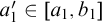 $a_1' \in [a_1,b_1]$
be such that every element of
$a_1' \in [a_1,b_1]$
be such that every element of $[a_1,a_1')$
does not eventually increase to infinity, and every element of
$[a_1,a_1')$
does not eventually increase to infinity, and every element of $[a_1',b_1]$
does eventually increase to infinity. By the above remarks,
$[a_1',b_1]$
does eventually increase to infinity. By the above remarks, $[a_1',b_1]$
is closed under blocks. First, we argue that
$[a_1',b_1]$
is closed under blocks. First, we argue that $\varphi _1$
does not preserve f when restricted to
$\varphi _1$
does not preserve f when restricted to $[a_1',b_1]$
. This is because it does preserve f when restricted to
$[a_1',b_1]$
. This is because it does preserve f when restricted to $[a_1,a_1')$
, as we now argue. There is n even such that for all
$[a_1,a_1')$
, as we now argue. There is n even such that for all $x \in [a_1,a_1'),$
 $$\begin{align*}\varphi_n(\cdots(\varphi_1(x))\cdots) = \varphi_{n+1}(\varphi_n(\cdots(\varphi_1(x))\cdots)).\end{align*}$$
But $\varphi _{n+1} \circ \cdots \circ \varphi _2 = \varphi _{2 \mapsto n+1}$
preserves f since n is even. So
$\varphi _{n+1} \circ \cdots \circ \varphi _2 = \varphi _{2 \mapsto n+1}$
preserves f since n is even. So $\varphi _1$
preserves f on
$\varphi _1$
preserves f on $[a_1,a_1')$
, and so does not preserve f when restricted to
$[a_1,a_1')$
, and so does not preserve f when restricted to $[a_1',b_1]$
.
$[a_1',b_1]$
.
Now since $a_1'$
eventually increases to infinity, there must be some odd n with
$a_1'$
eventually increases to infinity, there must be some odd n with $\varphi _n(\cdots (\varphi _1(a_1')))> b_1$
. (Since
$\varphi _n(\cdots (\varphi _1(a_1')))> b_1$
. (Since $b_1$
is the largest element of its block, this also implies that all elements of any block containing the image of an element
$b_1$
is the largest element of its block, this also implies that all elements of any block containing the image of an element $[a_1',b_1]$
under
$[a_1',b_1]$
under $\varphi _n \circ \cdots \circ \varphi _1$
is also greater than
$\varphi _n \circ \cdots \circ \varphi _1$
is also greater than $b_1$
.) We now replace
$b_1$
.) We now replace $[a_1,b_1]$
by
$[a_1,b_1]$
by $[a_1',b_1]$
and delete all of the blocks
$[a_1',b_1]$
and delete all of the blocks $[a_2,b_2],\ldots ,[a_n,b_n]$
so that the next block after
$[a_2,b_2],\ldots ,[a_n,b_n]$
so that the next block after $[a_1',b_1]$
is
$[a_1',b_1]$
is $[a_{n+1},b_{n+1}]$
. We still have a map
$[a_{n+1},b_{n+1}]$
. We still have a map $\varphi _1^* = \varphi _{1 \mapsto n+1}$
from
$\varphi _1^* = \varphi _{1 \mapsto n+1}$
from $[a_1',b_1]$
to
$[a_1',b_1]$
to $[a_{n+1},b_{n+1}]$
. Now we replace
$[a_{n+1},b_{n+1}]$
. Now we replace $[a_{n+1},b_{n+1}]$
with the smallest interval
$[a_{n+1},b_{n+1}]$
with the smallest interval $[b_{n+1}',a_{n+1}']$
which contains the image of
$[b_{n+1}',a_{n+1}']$
which contains the image of $[a_1',b_1]$
under
$[a_1',b_1]$
under $\varphi _1^*$
and which is closed under blocks. By choice of n, we get that
$\varphi _1^*$
and which is closed under blocks. By choice of n, we get that $a_{n+1}'> b_1$
.
$a_{n+1}'> b_1$
.
Thus we have now obtained

This is a weak f-coding sequence with $a_{n+1}'> b_1$
. By continuing this process, now with the second interval
$a_{n+1}'> b_1$
. By continuing this process, now with the second interval $[a_{n+1}',b_{n+1}']$
, and so on, we eventually obtain an f-coding sequence.
$[a_{n+1}',b_{n+1}']$
, and so on, we eventually obtain an f-coding sequence.
Theorem 3.6. Let f be a block function such that every block, except for finitely many, embeds into some later block. Then the degree spectrum of f, on a cone, is all $\Delta _2^0$
degrees if and only if there is an infinite f-coding sequence.
$\Delta _2^0$
degrees if and only if there is an infinite f-coding sequence.
We prove the two directions of the theorem as separate theorems.
Theorem 3.6A. Let f be a block function such that every block, except for finitely many, embeds into some later block. Then if there is an infinite f-coding sequence then the degree spectrum of f, on a cone, is all $\Delta _2^0$
degrees.
$\Delta _2^0$
degrees.
Proof. Suppose there is an infinite f-coding sequence $[a_1, b_1], [a_2,b_2], [a_3,b_3], \ldots $
with functions
$[a_1, b_1], [a_2,b_2], [a_3,b_3], \ldots $
with functions $\varphi _i$
. We show that, on the cone above
$\varphi _i$
. We show that, on the cone above $\alpha _f$
and this coding sequence, the degree spectrum of f is all
$\alpha _f$
and this coding sequence, the degree spectrum of f is all $\Delta _2^0$
degrees. As usual, we will suppress the base of the cone and assume that
$\Delta _2^0$
degrees. As usual, we will suppress the base of the cone and assume that $\alpha _f$
and this coding sequence are computable. We will also assume, by fixing a finite initial segment, that every block embeds into a later block. Then we must show that the degree spectrum of f is all
$\alpha _f$
and this coding sequence are computable. We will also assume, by fixing a finite initial segment, that every block embeds into a later block. Then we must show that the degree spectrum of f is all $\Delta ^0_2$
degrees. Since the degree spectrum of f is contained in the
$\Delta ^0_2$
degrees. Since the degree spectrum of f is contained in the $\Delta ^0_2$
degrees, we must show that every
$\Delta ^0_2$
degrees, we must show that every $\Delta ^0_2$
is in the degree spectrum of f.
$\Delta ^0_2$
is in the degree spectrum of f.
Fix a $\Delta _2^0$
set X. We will build a computable copy
$\Delta _2^0$
set X. We will build a computable copy $\mathcal {A}$
of
$\mathcal {A}$
of ${(\omega , <)}$
such that
${(\omega , <)}$
such that $f^{\mathcal {A}} \equiv _T X$
. During this construction, the elements we place into the linear order will fall into one of two categories: coding elements and padding elements. Padding elements are elements that are added to move coding elements, and play no other role in the coding. We will have to ensure that the approximation
$f^{\mathcal {A}} \equiv _T X$
. During this construction, the elements we place into the linear order will fall into one of two categories: coding elements and padding elements. Padding elements are elements that are added to move coding elements, and play no other role in the coding. We will have to ensure that the approximation $f^{\mathcal {A}_s}$
to
$f^{\mathcal {A}_s}$
to $f^{\mathcal {A}}$
stays the same on the padding elements; we can do this because every block embeds into a later block. For each
$f^{\mathcal {A}}$
stays the same on the padding elements; we can do this because every block embeds into a later block. For each $e \in \omega $
, there will be some collection of coding elements corresponding to e. We divide these into the initial coding elements which are the elements first chosen to code whether
$e \in \omega $
, there will be some collection of coding elements corresponding to e. We divide these into the initial coding elements which are the elements first chosen to code whether $e \in X$
. It is these elements on which we will check the values of
$e \in X$
. It is these elements on which we will check the values of $f^{\mathcal {A}}$
to determine whether e is in X. When we first start coding whether
$f^{\mathcal {A}}$
to determine whether e is in X. When we first start coding whether $e \in X$
, we will add initial coding elements to
$e \in X$
, we will add initial coding elements to $\mathcal {A}$
corresponding (via the current guess at the isomorphism
$\mathcal {A}$
corresponding (via the current guess at the isomorphism $\mathcal {A} \to {(\omega ,<)}$
) to an interval
$\mathcal {A} \to {(\omega ,<)}$
) to an interval $[a_i,b_i]$
with i even if
$[a_i,b_i]$
with i even if $e \notin X$
or odd if
$e \notin X$
or odd if $e \in X$
. If, at some later stage, we see that e has entered or exited X, we insert elements into
$e \in X$
. If, at some later stage, we see that e has entered or exited X, we insert elements into $\mathcal {A}$
so that these initial coding elements now correspond to elements of some
$\mathcal {A}$
so that these initial coding elements now correspond to elements of some $[a_j,b_j]$
,
$[a_j,b_j]$
, $j> i$
, with the parity of j depending on whether
$j> i$
, with the parity of j depending on whether $e \in X$
or
$e \in X$
or $e \notin X$
; moreover, the elements in this interval that they correspond to should be the images, under the
$e \notin X$
; moreover, the elements in this interval that they correspond to should be the images, under the $\varphi $
’s, of the elements they previously corresponded to. It is also possible that some
$\varphi $
’s, of the elements they previously corresponded to. It is also possible that some $e' < e$
will enter or exit X, causing us to add elements to
$e' < e$
will enter or exit X, causing us to add elements to $\mathcal {A}$
for the sake of
$\mathcal {A}$
for the sake of $e'$
, and thus requiring us to take action for the coding elements for e as well. Because the embeddings
$e'$
, and thus requiring us to take action for the coding elements for e as well. Because the embeddings $\varphi $
might not be surjective, as the construction progresses, the initial coding elements will “gather” other subsequent coding elements. The coding elements for e will be consecutive and we call them the coding segment for e.
$\varphi $
might not be surjective, as the construction progresses, the initial coding elements will “gather” other subsequent coding elements. The coding elements for e will be consecutive and we call them the coding segment for e.
The goal of the construction is to move the coding elements so that the values of $f^{\mathcal {A}}$
on them mirror whether the corresponding e is in X or not, while also ensuring that once padding elements have been added to the structure, the value of
$f^{\mathcal {A}}$
on them mirror whether the corresponding e is in X or not, while also ensuring that once padding elements have been added to the structure, the value of $f^{\mathcal {A}}$
on those elements does not change. Given
$f^{\mathcal {A}}$
on those elements does not change. Given $e' < e$
, the coding segment for e will be greater than the coding segment for
$e' < e$
, the coding segment for e will be greater than the coding segment for $e'$
, so that we can move the segment for e without moving the segment for
$e'$
, so that we can move the segment for e without moving the segment for $e'$
.
$e'$
.
Construction: For each e, starting from stage e where they are defined, we will have the initial coding elements $\bar {u}_e \in \mathcal {A}$
, the full coding segment
$\bar {u}_e \in \mathcal {A}$
, the full coding segment $\bar {v}_e \in \mathcal {A}$
containing
$\bar {v}_e \in \mathcal {A}$
containing $\bar {u}_e$
, and a restraint
$\bar {u}_e$
, and a restraint $r_e = \max _{\mathcal {A}} \bar {v}_e \in \mathcal {A}$
which is the
$r_e = \max _{\mathcal {A}} \bar {v}_e \in \mathcal {A}$
which is the $\mathcal {A}$
-largest element of
$\mathcal {A}$
-largest element of $\bar {v}$
. These are all tuples of
$\bar {v}$
. These are all tuples of $\mathcal {A}$
(not of
$\mathcal {A}$
(not of $(\omega ,<)$
, though they do correspond to elements of
$(\omega ,<)$
, though they do correspond to elements of $(\omega ,<)$
), and we write each tuple in
$(\omega ,<)$
), and we write each tuple in $\mathcal {A}$
-increasing order. The initial coding elements
$\mathcal {A}$
-increasing order. The initial coding elements $\bar {u}_e$
will never change once defined, while the coding segment
$\bar {u}_e$
will never change once defined, while the coding segment $\bar {v}_e$
may have more elements added, and the restraint
$\bar {v}_e$
may have more elements added, and the restraint $r_e$
may increase in the
$r_e$
may increase in the $\mathcal {A}$
order as, when
$\mathcal {A}$
order as, when $\bar {v}_e$
obtains more elements,
$\bar {v}_e$
obtains more elements, $r_e = \max _{\mathcal {A}} \bar {v}_e$
may increase in the
$r_e = \max _{\mathcal {A}} \bar {v}_e$
may increase in the $\mathcal {A}$
-order. The previous sentence is referring to which elements of
$\mathcal {A}$
-order. The previous sentence is referring to which elements of $\mathcal {A}$
these tuples consist of, rather than referring to which elements of
$\mathcal {A}$
these tuples consist of, rather than referring to which elements of $(\omega ,<)$
they correspond to as this may increase throughout the construction. So, for example,
$(\omega ,<)$
they correspond to as this may increase throughout the construction. So, for example, $\bar {u}_e$
is a fixed tuple of
$\bar {u}_e$
is a fixed tuple of $\mathcal {A}$
, but may correspond to increasingly greater tuples from
$\mathcal {A}$
, but may correspond to increasingly greater tuples from $(\omega ,<)$
as more and more elements are added to
$(\omega ,<)$
as more and more elements are added to $\mathcal {A}$
. We will use
$\mathcal {A}$
. We will use $\bar {v}_e[s]$
and
$\bar {v}_e[s]$
and $r_e[s]$
to refer to these elements at stage s. We will always have that if
$r_e[s]$
to refer to these elements at stage s. We will always have that if $e' \leq e$
then
$e' \leq e$
then $\bar {v}_e> r_{e'}$
in the
$\bar {v}_e> r_{e'}$
in the $\mathcal {A}$
-ordering so that the coding segment for e is free of the restraint of
$\mathcal {A}$
-ordering so that the coding segment for e is free of the restraint of $e'$
.
$e'$
.
Recall that at each stage s, given a tuple $\bar {a} \in \mathcal {A}_s$
, such as the tuples
$\bar {a} \in \mathcal {A}_s$
, such as the tuples $\bar {u}_e$
and
$\bar {u}_e$
and $\bar {v}_e$
,
$\bar {v}_e$
, $\pi _s(\bar {a})$
is the corresponding tuple in
$\pi _s(\bar {a})$
is the corresponding tuple in ${(\omega ,<)}$
. We also have
${(\omega ,<)}$
. We also have $f^{\mathcal {A}_s}$
which is the function f on
$f^{\mathcal {A}_s}$
which is the function f on $\mathcal {A}_s$
.
$\mathcal {A}_s$
.
From each stage to the next, we will maintain the following properties:
-
(1) At each stage
$s \geq e$
, the coding elements
$\bar {v}_e$
of
$\mathcal {A}$
correspond to
$\pi _s(\bar {v}_e)$
in
${(\omega ,<)}$
which is an interval
$[a_i,b_i]$
, with i odd if
$e \in X_s$
or i even if
$e \notin X_s$
. -
(2) If at stage
$s \geq e$
the coding elements
$\bar {v}_e[s]$
corresponded (via
$\pi _s \colon \mathcal {A}_s \to {(\omega ,<)}$
) to an interval
$[a_i,b_i]$
, and at stage
$s+1$
the coding elements
$\bar {v}[s+1]$
correspond (via
$\pi _{s+1} \colon \mathcal {A}_s \to {(\omega ,<)}$
) to an interval
$[a_j,b_j]$
, then the coding elements
$\bar {v}_e[s]$
at stage s correspond at stage
$s+1$
to the images, under the
$\varphi $
, of the elements of
${(\omega ,<)}$
that they corresponded to at stage s. That is,
$$\begin{align*}\pi_{s+1}(\bar{v}_e[s]) = \varphi_{i \mapsto j} (\pi_s(\bar{v}_e[s])).\end{align*}$$
-
(3) If, at stage s an element
$a \in \mathcal {A}$
is a padding element, by which we mean that it is not a coding element (i.e., not part of any
$\bar {v}_e[s]$
), then at stage
$s+1$
it is still not a coding element, and
$f^{\mathcal {A}_s}(a) = f^{\mathcal {A}_{s+1}}(a)$
. -
(4) From stage
$s \geq e$
to stage
$s+1$
, elements can only be added to
$\mathcal {A}$
below
$r_e$
if there is
$e' \leq e$
which entered or left X at stage
$s+1$
, i.e., with
$e' \in X_{s} \triangle X_{s+1}$
. Thus, if
$X_{s+1} \upharpoonright \upharpoonright _{e} = X_s \upharpoonright \upharpoonright _e$
,Footnote
7
then the partial isomorphism
$\pi _s \colon \mathcal {A}_s \to {(\omega ,<)}$
does not change at stage
$s+1$
on elements below
$r_e$
.








Stage 0: We begin with $\mathcal {A}_0$
being empty.
$\mathcal {A}_0$
being empty.
Stage s: At this stage in the construction our partial linear order $\mathcal {A}_s$
can be partitioned into a finite number of coding segments and padding blocks, each of which form an interval:
$\mathcal {A}_s$
can be partitioned into a finite number of coding segments and padding blocks, each of which form an interval:
 $$\begin{align*}\bar{p}_0 <_{\mathcal{A}} \bar{v}_0[s] <_{\mathcal{A}} \bar{p}_1 <_{\mathcal{A}} \bar{v}_1[s] <_{\mathcal{A}} \cdots .\end{align*}$$
We add new elements to $\mathcal {A}_s$
to code
$\mathcal {A}_s$
to code $X_{s+1}$
.
$X_{s+1}$
.
We do not do anything to $\bar {p}_0$
. We begin by handling
$\bar {p}_0$
. We begin by handling $\bar {v}_0[s]$
. If
$\bar {v}_0[s]$
. If $X_{s+1}(0) = X_s(0)$
, then we do nothing. But if
$X_{s+1}(0) = X_s(0)$
, then we do nothing. But if $X_{s+1}(0) \neq X_s(0)$
, then we must act. Suppose that
$X_{s+1}(0) \neq X_s(0)$
, then we must act. Suppose that $0 \in X_{s}$
but
$0 \in X_{s}$
but $0 \notin X_{s+1}$
. Then
$0 \notin X_{s+1}$
. Then $\bar {v}_0[s]$
corresponds to the elements of an interval
$\bar {v}_0[s]$
corresponds to the elements of an interval $[a_i,b_i]$
for i even. We insert
$[a_i,b_i]$
for i even. We insert $a_{i+1} - a_i$
new padding elements above the elements of
$a_{i+1} - a_i$
new padding elements above the elements of $\bar {p}_0$
and below the elements of
$\bar {p}_0$
and below the elements of $\bar {v}_0[s]$
. Also add new coding elements (
$\bar {v}_0[s]$
. Also add new coding elements ( $b_{i+1} + a_i - a_{i+1} - b_i$
of them) to ensure that
$b_{i+1} + a_i - a_{i+1} - b_i$
of them) to ensure that $\bar {v}_0[s]$
corresponds, in
$\bar {v}_0[s]$
corresponds, in $\mathcal {A}_{s+1}$
, to
$\mathcal {A}_{s+1}$
, to $\varphi _i(\pi _s(\bar {v}_0[s])) \subseteq [a_{i+1},b_{i+1}]$
. These new elements will be subsequent coding elements; let
$\varphi _i(\pi _s(\bar {v}_0[s])) \subseteq [a_{i+1},b_{i+1}]$
. These new elements will be subsequent coding elements; let $\bar {v}_0[s+1]$
consist of
$\bar {v}_0[s+1]$
consist of $\bar {v}_0[s]$
together with these new elements of
$\bar {v}_0[s]$
together with these new elements of $\mathcal {A}$
. If
$\mathcal {A}$
. If $0 \notin X_s$
but
$0 \notin X_s$
but $0 \in X_{s+1}$
, then we act similarly but move
$0 \in X_{s+1}$
, then we act similarly but move $\bar {v}_0$
from an interval
$\bar {v}_0$
from an interval $[a_i,b_i]$
for i odd to
$[a_i,b_i]$
for i odd to $[a_{i+1},b_{i+1}]$
with
$[a_{i+1},b_{i+1}]$
with $i+1$
even.
$i+1$
even.
Now we have added several elements below $\bar {p}_1$
. We must ensure that the values of f on
$\bar {p}_1$
. We must ensure that the values of f on $\bar {p}_1$
at stage
$\bar {p}_1$
at stage $s+1$
are the same as they were at stage s. For each block making up
$s+1$
are the same as they were at stage s. For each block making up $\bar {p}_1$
, insert new padding elements below the least element of this block and possibly between the elements of this block to move them up to the image of the original f-block in some other f-block into which it embeds. (We use here the fact that each f-block embeds into infinitely many other blocks.) Further, we add enough padding elements on the end to complete these blocks. This ensures that for all padding elements present at stage s, the value of
$\bar {p}_1$
, insert new padding elements below the least element of this block and possibly between the elements of this block to move them up to the image of the original f-block in some other f-block into which it embeds. (We use here the fact that each f-block embeds into infinitely many other blocks.) Further, we add enough padding elements on the end to complete these blocks. This ensures that for all padding elements present at stage s, the value of $f^{\mathcal {A}_{s+1}}$
on these elements at stage
$f^{\mathcal {A}_{s+1}}$
on these elements at stage $s+1$
is the same as it was at stage s.
$s+1$
is the same as it was at stage s.
We continue this process, in turn, with the subsequence coding segments and padding blocks. In increasing order, we ensure that each of these segments from $\mathcal {A}_{s}$
still satisfy our requirements in
$\mathcal {A}_{s}$
still satisfy our requirements in $\mathcal {A}_{s+1}$
. However we must now take into account the fact that we may have already inserted elements.
$\mathcal {A}_{s+1}$
. However we must now take into account the fact that we may have already inserted elements.
-
• Given a padding segment
$\bar {p}_i$
, consider each set of elements which corresponded at stage s to a block. We must make sure that those same elements correspond in
$\mathcal {A}_{s+1}$
to a block of the same type. For each block making up
$\bar {p}_i$
, insert new padding elements below the least element of this block and possibly between the elements of this block to move them up to the image of the original f-block in some other f-block into which it embeds. Further, ensure we add enough padding elements on the end to complete this block. This ensures that for all padding elements present at stage s, the value of
$f^{\mathcal {A}_s}$
on these elements is the same as at stage
$s+1$
. -
• Given
$\bar {v}_e[s]$
the coding segment corresponding to e, first check the value of
$X_{s+1}(e)$
. Even if
$X_{s+1}(e) = X_s(e)$
has not changed, we may have added new elements below
$\bar {v}_e[s]$
so that it no longer corresponds to the same interval
$[a_k,b_k]$
that it did at stage s. Let
$\varphi _{k \mapsto \ell }$
be such that (i)
$\ell $
is even if
$e \in X_{s+1}$
and
$\ell $
is odd if
$e \notin X_{s+1}$
and (ii)
$\ell $
is sufficiently large that by adding elements below and between the elements of
$\bar {v}_e[s]$
that at stage
$s+1$
the segment
$\bar {v}_e[s]$
corresponds to the image, under
$\varphi _{k \mapsto \ell }$
, of
$[a_k,b_k] = \pi _s(\bar {v}_e[s])$
. (Note that (5) in the definition of a coding sequence—the difference between a weak coding sequence and a coding sequence—is key to obtain such an
$[a_\ell ,b_\ell ]$
with
$a_\ell $
large enough to accommodate the new elements that have been added to the linear order below
$\bar {v}_e[s]$
.) Any new elements that were inserted and end up in the new interval are added to the collection of coding elements
$\bar {v}_e[s+1]$
corresponding to e, and the other newly added elements are padding elements. Further, we ensure that enough new coding elements are after the final element to ensure we complete the entire interval, putting these elements in
$\bar {v}_e[s+1]$
as well. Thus
$\bar {v}_e[s+1]$
will now consist of
$\pi _{s+1}^{-1}([a_\ell ,b_\ell ])$
. -
• Finally, we introduce the coding elements corresponding to s. After we have ensured all previously added elements still satisfy the requirements check the value of
$X_{s+1}(s)$
(which we may assume is
$0$
, i.e.,
$s \notin S_{x+1}$
) and identify the next interval of the form
$[a_i, b_i]$
such that i is even if
$s \in X_{s+1}$
and i is odd if
$s \notin X_{s+1}$
, and with
$a_i$
greater than the length of the linear order at this stage. Insert enough new padding elements to the end of the linear order to extend it to have length
$a_i$
, then add
$b_i-a_i+1$
new coding elements corresponding to the interval
$[a_i,b_i]$
. These are the initial coding elements
$\bar {u}_s[s+1]$
for s, and make up the coding segment
$\bar {v}_s[s+1]$
at this stage. This ensures we have satisfied requirement
$R_s$
at stage s.


Verification: First, to see that $\mathcal {A}$
is really a computable copy of
$\mathcal {A}$
is really a computable copy of ${(\omega , <)}$
, observe that for any fixed
${(\omega , <)}$
, observe that for any fixed $a \in \mathcal {A}$
, only finitely many elements are inserted below a. This follows from (4). Because a was added at stage s in the construction, then there can be at most
$a \in \mathcal {A}$
, only finitely many elements are inserted below a. This follows from (4). Because a was added at stage s in the construction, then there can be at most $s-1$
coding blocks below it. An element is only inserted below a if some e corresponding to one of these coding blocks enters or leaves X, with a below the restraint. After these
$s-1$
coding blocks below it. An element is only inserted below a if some e corresponding to one of these coding blocks enters or leaves X, with a below the restraint. After these $s-1$
elements of the
$s-1$
elements of the $\Delta _2^0$
set X stop changing values, elements will stop being inserted below a. Hence, since these are finitely many elements of a
$\Delta _2^0$
set X stop changing values, elements will stop being inserted below a. Hence, since these are finitely many elements of a $\Delta _2^0$
set, this will occur in a finite number of stages.
$\Delta _2^0$
set, this will occur in a finite number of stages.
To show that $f^{\mathcal {A}} \equiv _T X$
, we use the following claim which follows from (2).
$f^{\mathcal {A}} \equiv _T X$
, we use the following claim which follows from (2).
Claim 3.6.1. Suppose that $s < t$
. If, at stage s,
$s < t$
. If, at stage s, $\bar {v}_e[s]$
corresponds to
$\bar {v}_e[s]$
corresponds to $[a_m,b_m]$
and, at stage t,
$[a_m,b_m]$
and, at stage t, $\bar {v}_e[t]$
corresponds to
$\bar {v}_e[t]$
corresponds to $[a_n,b_n]$
, then the elements of
$[a_n,b_n]$
, then the elements of $\bar {v}_e[s]$
corresponds at stage t to the images under
$\bar {v}_e[s]$
corresponds at stage t to the images under $\varphi _{m \mapsto n}$
of the elements they corresponded to at stage s:
$\varphi _{m \mapsto n}$
of the elements they corresponded to at stage s:
 $$\begin{align*}[a_n,b_n] \supseteq \pi_{t}(\bar{v}_e[s]) = \varphi_{m \mapsto n} (\pi_s(\bar{v}_e[s])) = \varphi_{m \mapsto n} [a_m,b_m]. \end{align*}$$
In particular, if m and n have the same parity, then $f^{\mathcal {A}_t}(a) = f^{\mathcal {A}_s}(a)$
. If m and n have opposite parities, then there is
$f^{\mathcal {A}_t}(a) = f^{\mathcal {A}_s}(a)$
. If m and n have opposite parities, then there is $a \in \bar {u}_e$
such that
$a \in \bar {u}_e$
such that $f^{\mathcal {A}_t}(a) \neq f^{\mathcal {A}_s}(a)$
.
$f^{\mathcal {A}_t}(a) \neq f^{\mathcal {A}_s}(a)$
.
Proof. The first part follows from (2) using induction. The second part follows from the definition of a coding sequence, particularly which $\varphi _{m \mapsto n}$
are f-preserving.
$\varphi _{m \mapsto n}$
are f-preserving.
We first use the lemma and (1) to show that $f^{\mathcal {A}} \ge _T X$
. Given some element e run the above construction, which is computable, until stage
$f^{\mathcal {A}} \ge _T X$
. Given some element e run the above construction, which is computable, until stage $e+1$
when the initial coding elements
$e+1$
when the initial coding elements $\bar {u}_e$
corresponding to e are introduced. Now, compute the true value of
$\bar {u}_e$
corresponding to e are introduced. Now, compute the true value of $f^{\mathcal {A}}$
on these elements. If
$f^{\mathcal {A}}$
on these elements. If $f^{\mathcal {A}}$
is the same on
$f^{\mathcal {A}}$
is the same on $\bar {u}_e$
as it was at stage
$\bar {u}_e$
as it was at stage $e+1$
, then
$e+1$
, then $X(e) = X_e(e+1)$
. Otherwise, if
$X(e) = X_e(e+1)$
. Otherwise, if $f^{\mathcal {A}}$
is different on
$f^{\mathcal {A}}$
is different on $\bar {u}_e$
than it was at stage
$\bar {u}_e$
than it was at stage $e+1$
, then
$e+1$
, then $X(e) = 1- X_e(e+1)$
.
$X(e) = 1- X_e(e+1)$
.
Finally, we show that $X \ge _T f^{\mathcal {A}}$
. This uses the lemma as well as properties (1) and (3). Given some element
$X \ge _T f^{\mathcal {A}}$
. This uses the lemma as well as properties (1) and (3). Given some element $a \in \mathcal {A}$
run the above construction until a is added to the linear order. Using (3) if a is added as a padding element then the construction ensures that
$a \in \mathcal {A}$
run the above construction until a is added to the linear order. Using (3) if a is added as a padding element then the construction ensures that $f^{\mathcal {A}}(a)$
does not change and so we take the value at this stage. If a is a coding element corresponding to e then we use (1) and the lemma. We will see that
$f^{\mathcal {A}}(a)$
does not change and so we take the value at this stage. If a is a coding element corresponding to e then we use (1) and the lemma. We will see that $f^{\mathcal {A}}(a)$
takes on one of two values depending on
$f^{\mathcal {A}}(a)$
takes on one of two values depending on $X(e)$
. Say that a first appears in
$X(e)$
. Say that a first appears in $\mathcal {A}$
at a stage s in a coding block
$\mathcal {A}$
at a stage s in a coding block $\bar {v}_e[s]$
, corresponding at that stage to
$\bar {v}_e[s]$
, corresponding at that stage to $[a_i,b_i]$
and with
$[a_i,b_i]$
and with $X_s(e) = k$
. If
$X_s(e) = k$
. If $X(e) = X_s(e) = k$
, then
$X(e) = X_s(e) = k$
, then $f^{\mathcal {A}}(a)$
is the same as it was at stage s. Otherwise, suppose that
$f^{\mathcal {A}}(a)$
is the same as it was at stage s. Otherwise, suppose that $X(e) \neq X_s(e) = k$
. Then, at some stage
$X(e) \neq X_s(e) = k$
. Then, at some stage $t> s$
, we find that
$t> s$
, we find that $X(e) = X_t(e) = 1-k$
. At this stage, a is an element of
$X(e) = X_t(e) = 1-k$
. At this stage, a is an element of $\bar {v}_e[t]$
which corresponds to
$\bar {v}_e[t]$
which corresponds to $[a_j,b_j]$
with j of a different parity from i. Then
$[a_j,b_j]$
with j of a different parity from i. Then $f^{\mathcal {A}}(a)$
is the same as it was at stage t.
$f^{\mathcal {A}}(a)$
is the same as it was at stage t.
Theorem 3.6B. Let f be a block function such that every block, except for finitely many, embeds into some later block. Then if the degree spectrum of f on a cone is all $\Delta _2^0$
degrees then there is an infinite f-coding sequence.
$\Delta _2^0$
degrees then there is an infinite f-coding sequence.
Proof. We work on the cone above $\alpha _f$
(which we suppress) and show that if no infinite f-coding sequences exist then we can produce
$\alpha _f$
(which we suppress) and show that if no infinite f-coding sequences exist then we can produce $\Delta ^0_2$
set C such that there is no computable copy
$\Delta ^0_2$
set C such that there is no computable copy $\mathcal {L}$
of
$\mathcal {L}$
of ${(\omega ,<)}$
with
${(\omega ,<)}$
with $f^{\mathcal {L}} \equiv _T C$
. To do this, we meet the following requirements:
$f^{\mathcal {L}} \equiv _T C$
. To do this, we meet the following requirements:
 $$\begin{align*}R_{e, i, j}: \text{ If } \mathcal{L}_e \cong {(\omega,<)}, \text{ then either } \Phi_i^{f^{\mathcal{L}_e}}\neq C \text{ or } \Psi_j^C \neq f^{\mathcal{L}_e},\end{align*}$$
where $\mathcal {L}_e$
is a computable listing of the (possibly partial) linear orders. The construction is a finite injury priority construction. Given a set X, we make use of the notation
$\mathcal {L}_e$
is a computable listing of the (possibly partial) linear orders. The construction is a finite injury priority construction. Given a set X, we make use of the notation $X[0,\ldots ,k]$
for the sequence
$X[0,\ldots ,k]$
for the sequence $\langle X(0),\ldots ,X(k) \rangle $
.
$\langle X(0),\ldots ,X(k) \rangle $
.
The strategy for $R_{e, i, j}$
is as follows. First, if the eth program fails to code a linear order the requirement is automatically satisfied and so we will assume that at all stages s,
$R_{e, i, j}$
is as follows. First, if the eth program fails to code a linear order the requirement is automatically satisfied and so we will assume that at all stages s, $\mathcal {L}_{e,s}$
is a linear order. When we say that a requirement
$\mathcal {L}_{e,s}$
is a linear order. When we say that a requirement $\mathcal {R}$
places a restraint on C, this means that it is restraining that part of C from changing for the sake of a lower-priority requirement.
$\mathcal {R}$
places a restraint on C, this means that it is restraining that part of C from changing for the sake of a lower-priority requirement. $\mathcal {R}$
itself may cause C to change on the restraint.
$\mathcal {R}$
itself may cause C to change on the restraint.
-
(1) To initialize this requirement choose some x that has not yet been restrained, restrain it, and assign it to this requirement. (This requirement will not cause C to change on any value other than x, and so this is the only function of the restraints placed by the higher-priority requirements.) We begin with
$C(x) = 0$
. We say the strategy is in Phase 0. -
(2) At stage s, if the requirement is in Phase 0, say this requirement requires attention if there are computations
$$\begin{align*}\Phi_{i, s}^{f^{\mathcal{L}_{e, s}}}(x) = 0 = C_s(x) \quad \text{with use } u_0\end{align*}$$
and
$$\begin{align*}\Psi_{j, s}^{C_s}[0, \ldots, m_0] = f^{\mathcal{L}_{e, s}}[0, \ldots, m_0] \quad \text{with use } v_0, \end{align*}$$
where
$m_0 \ge u_0$
is such that all f-blocks that intersect
$[0, \ldots , u_0]$
in
$\mathcal {A}_{e,s}$
, and all elements less than them in
$\mathcal {L}_{e,s}$
, are completely contained in
$[0, \ldots , m_0]$
.When this requirement acts, restrain
$[0, \ldots , v_0]$
in C and define
$C_{s+1}(x) =1$
. Finally, move the requirement to Phase 1. -
(3) At stage s, if the requirement is in Phase
$n+1$
, say this requirement requires attention if there are computations
$$\begin{align*}\Phi_{i, s}^{f^{\mathcal{L}_{e, s}}}(x) = C_s(x) \quad \text{with use } u_{n+1}\end{align*}$$
and
$$\begin{align*}\Psi_{j, s}^{C_s}[0, \ldots, m_{n+1}] = f^{\mathcal{L}_{e, s}}[0, \ldots, m_{n+1}] \quad \text{with use } v_{n+1}, \end{align*}$$
where
$m_{n+1} \ge \max \{m_n, u_{n+1}\}$
such that all f-blocks that intersect the set of elements
${[0, \ldots , \max \{m_n, u_{n+1}\}]}$
, and all elements less than them in
$\mathcal {L}_{e,s}$
, are completely contained in
$[0, \ldots , m_{n+1}]$
.When this requirement acts, restrain
$[0, \ldots , v_{n+1}]$
in C and define
$C_{s+1}(x) = 1-C_s(x)$
. Finally, move the requirement to Phase
$n+2$
.


Construction of C: At stage s of the construction, consider the first s requirements, in order of decreasing priority. If any requirement requires attention then the one with the highest priority acts according to its strategy, injuring and resetting all lower priority strategies. If no requirement acts, then initialize the lowest priority requirement that has not yet been initialized.
Verification: It is not obvious that the construction is a finite injury construction, as even if a requirement $R_{e,i,j}$
is not injured, it appears on the surface that it might go through infinitely many phases. In this case, our approximation for C would also not come to a limit. We will argue by induction on the requirements that each requirement acts only finitely many times and is eventually satisfied. This argument will use the fact that there is no infinite coding sequence.
$R_{e,i,j}$
is not injured, it appears on the surface that it might go through infinitely many phases. In this case, our approximation for C would also not come to a limit. We will argue by induction on the requirements that each requirement acts only finitely many times and is eventually satisfied. This argument will use the fact that there is no infinite coding sequence.
Consider a requirement $R_{e, i, j}$
and assume that after some stage it is no longer injured. If
$R_{e, i, j}$
and assume that after some stage it is no longer injured. If ${\mathcal {L}}_e$
is partial (or not a linear order), then
${\mathcal {L}}_e$
is partial (or not a linear order), then $R_{e, i, j}$
is automatically satisfied and will no longer act after some stage. So we may assume that
$R_{e, i, j}$
is automatically satisfied and will no longer act after some stage. So we may assume that $\mathcal {L}_e$
is a linear order. If there is some n such that the strategy enters Phase n but never enters Phase
$\mathcal {L}_e$
is a linear order. If there is some n such that the strategy enters Phase n but never enters Phase $n+1$
, then we are also done since
$n+1$
, then we are also done since $R_{e,i,j}$
will have acted only finitely many times and will also be satisfied. (Otherwise, if
$R_{e,i,j}$
will have acted only finitely many times and will also be satisfied. (Otherwise, if $\Phi _i^{f^{\mathcal {L}_e}} = C$
and
$\Phi _i^{f^{\mathcal {L}_e}} = C$
and $\Phi _j^C = f^{\mathcal {L}_e}$
, then we would eventually enter Phase
$\Phi _j^C = f^{\mathcal {L}_e}$
, then we would eventually enter Phase $n+1$
.) So it is enough to show that the strategy enters finitely many phases as this will also show that it requires attention finitely many times. To do this we show that if, after a strategy is no longer injured, it enters Phase n for arbitrarily large n then we can produce an infinite f-coding sequence; in fact we produce a weak f-coding sequence and then use Lemma 3.5 to obtain an f-coding sequence.
$n+1$
.) So it is enough to show that the strategy enters finitely many phases as this will also show that it requires attention finitely many times. To do this we show that if, after a strategy is no longer injured, it enters Phase n for arbitrarily large n then we can produce an infinite f-coding sequence; in fact we produce a weak f-coding sequence and then use Lemma 3.5 to obtain an f-coding sequence.
Let $s_n$
be the stage at which the strategy enters Phase n, if it exists, and recall that
$s_n$
be the stage at which the strategy enters Phase n, if it exists, and recall that $v_n$
is the restraint placed at Phase n. We begin by arguing that the restraints are maintained, and that C (up to the restraint) cycles back and forth between two possible configurations depending on whether the phase is odd or even.
$v_n$
is the restraint placed at Phase n. We begin by arguing that the restraints are maintained, and that C (up to the restraint) cycles back and forth between two possible configurations depending on whether the phase is odd or even.
Claim 3.6.1. Let $n'> n$
be of the same parity. Then:
$n'> n$
be of the same parity. Then:
-
(1)
$C_{s_{n'}} [0,\ldots ,v_n] = C_{s_n} [0,\ldots ,v_n]$
. -
(2)
$f^{\mathcal {L}_{e,s_{n'}}}[0,\ldots ,m_n] = f^{\mathcal {L}_{e,s_{n}}}[0,\ldots ,m_n]$
.


Further, for all n,
-
(3)
$f^{\mathcal {L}_{e,s_{n}}}[0,\ldots ,u_n] \neq f^{\mathcal {L}_{e,s_{n+1}}}[0,\ldots ,u_n]$
.

Proof. We check each of (1)–(3).
-
(1) After Phase n, we have restrained the elements
$[0, \ldots , v_n]$
and so, since the requirement is no longer injured by higher priority arguments, the only element in
$[0, \ldots , v_n]$
that can change value is the original x that was restrained for
$R_{e, i, j}$
. However, since n and
$n'$
have the same parity, the construction ensures that
$C(x)$
(whether x is in C) is the same as well. Hence,
$C_{s_{n'}} [0,\ldots ,v_n] = C_{s_n} [0,\ldots ,v_n]$
, as desired. -
(2) By construction we have
$\Phi _j^{C_{s_n}}[0, \ldots , m_n] = f^{\mathcal {L}_{e,s_{n}}}[0, \ldots , m_n]$
and
$\Phi _j^{C_{s_{n'}}}[0, \ldots , m_n] = f^{\mathcal {L}_{e,s_{n'}}}[0, \ldots , m_n]$
. Further, the first computation listed has use
$v_n$
. Since by (1), this use
$v_n$
is the same at Phases n and
$n'$
, the computations
$\Phi _j^{C_{s_n}}[0, \ldots , m_n]$
and
$\Phi _j^{C_{s_{n'}}}[0, \ldots , m_n]$
must be the same as well and so
$f^{\mathcal {L}_{e,s_{n'}}}[0,\ldots ,m_n] = f^{\mathcal {L}_{e,s_{n}}}[0,\ldots ,m_n]$
, as desired. -
(3) By construction
$\Phi _i^{f^{\mathcal {L}_{e,s_{n}}}}(x) = C_{s_n}(x)$
and
$\Phi _i^{f^{\mathcal {L}_{e,s_{n+1}}}}(x) = C_{s_{n+1}}(x)$
but
$C_{s_n}(x) \neq C_{s_{n+1}}(x)$
and so the use of the computation
$\Phi _i^{f^{\mathcal {L}_{e,s_{n}}}}(x)$
must have changed by stage
$s_{n+1}$
, otherwise we would recover the same computation. Since the use is
$u_n$
, we must have
$f^{\mathcal {L}_{e,s_{n}}}[0,\ldots ,u_n] \neq f^{\mathcal {L}_{e,s_{n+1}}}[0,\ldots ,u_n]$
, as desired. here





It will be helpful to consider, at each stage s, the guess $\pi _s \colon \mathcal {L}_{e,s} \to {(\omega ,<)}$
at the isomorphism
$\pi _s \colon \mathcal {L}_{e,s} \to {(\omega ,<)}$
at the isomorphism $\mathcal {L}_{e} \to {(\omega ,<)}$
. Note that (by definition),
$\mathcal {L}_{e} \to {(\omega ,<)}$
. Note that (by definition), $f^{\mathcal {L}_{e,s}}$
is the image of f under
$f^{\mathcal {L}_{e,s}}$
is the image of f under $\pi _s$
.
$\pi _s$
.
Finally, to produce the weak f-coding sequence we proceed as follows:
-
• Let
$[a_0, b_0]$
be the smallest initial segment of
${(\omega ,<)}$
which contains all of the
$\pi _{s_0}$
-images of the elements
$0,\ldots ,u_0$
in
$\mathcal {L}_{e,s_0}$
and all of the blocks which they intersect. Note that all of
$[a_0,b_0]$
is contained within the
$\pi _{s_0}$
-images of
$[0,\ldots ,m_0]$
. -
• Given
$[a_i, b_i]$
, let
$[a_{i+1}, b_{i+1}]$
be the minimal interval in
${(\omega ,<)}$
that contains all of the
$\pi _{s_{i+1}}$
-images of the elements
$0,\ldots ,\max \{m_{i},u_{i+1}\}$
in
$\mathcal {L}_{e,s_{i+1}}$
and all of the blocks which they intersect. Note that all of
$[a_i,b_i]$
is contained within the
$\pi _{s_{i+1}}$
-images of
$[0,\ldots ,m_{i+1}]$
. -
• Define the maps
$\varphi _i: [a_i, b_i] \to [a_{i+1}, b_{i+1}]$
by
$\varphi _i = \pi _{i+1} \circ \pi _{i}^{-1}$
. (The way to think about these maps is that, when
$[a_i,b_i]$
was defined at stage
$s_{i}$
, these elements of
${{(\omega ,<)}}$
corresponded to certain elements of
$\mathcal {L}_e$
. However by stage
$s_{i+1}$
, we have seen more elements enter
$\mathcal {L}_e$
, and now those elements of
$\mathcal {L}_e$
are instead in correspondence with other elements of
${(\omega ,<)}$
, namely some elements of
$[a_{i+1},b_{i+1}]$
. The map
$f_i$
keeps track of how this correspondence has changed. The element of
$\mathcal {L}_e$
that corresponded to
$n \in [a_i,b_i]$
now corresponds to
$f_i(n) \in [a_{i+1},b_{i+1}]$
.)





This sequence satisfies most of the requirements by construction. We just need to ensure that the $\varphi _i$
are not f-preserving but the
$\varphi _i$
are not f-preserving but the $\varphi _{i+1} \circ \varphi _i$
are. But this is exactly the content of Lemma 3.6.1. Hence, assuming we enter Phase n for arbitrarily large n we have produced an infinite weak coding sequence. From an infinite weak coding sequence, using Lemma 3.5 we can produce an infinite coding sequence. Thus, by our assumption about the absence of such a sequence it follows that after a strategy is no longer injured it only enters finitely many phases.
$\varphi _{i+1} \circ \varphi _i$
are. But this is exactly the content of Lemma 3.6.1. Hence, assuming we enter Phase n for arbitrarily large n we have produced an infinite weak coding sequence. From an infinite weak coding sequence, using Lemma 3.5 we can produce an infinite coding sequence. Thus, by our assumption about the absence of such a sequence it follows that after a strategy is no longer injured it only enters finitely many phases.
From this theorem we can easily recover several previous results, such as Theorem 3.10 of [Reference Bazhenov, Kalociński and Wrocławski6].
3.3 An example
Now that we have produced necessary and sufficient conditions for the degree spectrum of a unary function being either all c.e. degrees or all $\Delta _2^0$
degrees on a cone, we know exactly which conditions a unary function must satisfy to have an intermediate degree spectrum and can produce an example.
$\Delta _2^0$
degrees on a cone, we know exactly which conditions a unary function must satisfy to have an intermediate degree spectrum and can produce an example.
Theorem 3.7. There is a computable block function f whose degree spectrum on a cone strictly contains the c.e. degrees and is strictly contained within the $\Delta ^0_2$
degrees. Moreover, the base of the cone is the computable degree, and so the degree spectrum of this function strictly contains the c.e. degrees and is strictly contained within the
$\Delta ^0_2$
degrees. Moreover, the base of the cone is the computable degree, and so the degree spectrum of this function strictly contains the c.e. degrees and is strictly contained within the $\Delta ^0_2$
degrees.
$\Delta ^0_2$
degrees.
Proof. Let $L_k$
be the block corresponding to the loop of length k, i.e., the block isomorphic to
$L_k$
be the block corresponding to the loop of length k, i.e., the block isomorphic to $[1, \ldots , k] \to [1, \ldots , k]$
via
$[1, \ldots , k] \to [1, \ldots , k]$
via $x \mapsto x+1$
for
$x \mapsto x+1$
for $x<k$
and
$x<k$
and $k \mapsto 1$
. Consider the block function f where the odd blocks are given by the sequence
$k \mapsto 1$
. Consider the block function f where the odd blocks are given by the sequence $L_1, L_2, L_3, L_4, L_5, \ldots $
and the even blocks are given by the sequence
$L_1, L_2, L_3, L_4, L_5, \ldots $
and the even blocks are given by the sequence $L_1, L_1, L_2, L_1, L_2, L_3, \ldots $
. An initial segment looks like:
$L_1, L_1, L_2, L_1, L_2, L_3, \ldots $
. An initial segment looks like:
 $$\begin{align*}L_1 + L_1 + L_2 + L_1 + L_3 + L_2 + L_4 + L_1 + L_5 + L_2 + L_6 + L_3 + L_7 + \cdots \end{align*}$$
This function is constructed so that it satisfies the following:
-
• all blocks that occur in the function occur infinitely often,
-
• no two block types embed in another different block type,
-
• no two different block types that occur in the function have the same size, and
-
• no two blocks types are adjacent (in the same order) more than once.
Since each block occurs infinitely often the degree spectrum of f on a cone must contain a non-c.e. degree. To show that the degree spectrum of f on a cone does not contain all $\Delta _2^0$
degrees we show that there is no infinite f-coding sequence. Indeed we will show that any f-coding sequence has length at most five. By Theorems 3.3 and 3.6 this proves the theorem. (For the moreover statement, one must observe that for this particular f no cone is required in the proofs of these theorems.)
$\Delta _2^0$
degrees we show that there is no infinite f-coding sequence. Indeed we will show that any f-coding sequence has length at most five. By Theorems 3.3 and 3.6 this proves the theorem. (For the moreover statement, one must observe that for this particular f no cone is required in the proofs of these theorems.)
Consider any (possibly finite) f-coding sequence $[a_1, b_1], [a_2, b_2], \ldots $
and corresponding maps
$[a_1, b_1], [a_2, b_2], \ldots $
and corresponding maps $\varphi _i$
. We make the following definitions:
$\varphi _i$
. We make the following definitions:
-
(1) Say that
$l_1 < \cdots < l_p$
form a link in an interval
$[a_i,b_i]$
if they form a block of length p in
$[a_i,b_i]$
. Say that this interval witnesses this link. -
(2) Say that a link
$l_1 < \cdots < l_p$
in
$[a_i,b_i]$
is vulnerable in
$[a_j,b_j]$
,
$j> i$
, if the images
$\varphi _{i \mapsto j}(l_1) < \cdots < \varphi _{i \mapsto j}(l_p)$
are no longer contained in a single block and now intersect two or more different blocks. -
(3) Say that a link
$l_1 < \cdots < l_p$
in
$[a_i,b_i]$
is broken in
$[a_j,b_j]$
,
$j> i$
, if some element is inserted between the images
$\varphi _{i \mapsto j}(l_1)$
and
$\varphi _{i \mapsto j}(l_p)$
, i.e., the
$l_r$
are no longer adjacent after applying
$\varphi _{i \mapsto j}$
.


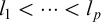


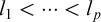


We first claim that either there is a link witnessed in $[a_1,b_1]$
that becomes vulnerable in
$[a_1,b_1]$
that becomes vulnerable in $[a_2,b_2]$
, or there is a link witnessed in
$[a_2,b_2]$
, or there is a link witnessed in $[a_2,b_2]$
that becomes vulnerable in
$[a_2,b_2]$
that becomes vulnerable in $[a_3,b_3]$
. The map
$[a_3,b_3]$
. The map $\varphi _1$
from
$\varphi _1$
from $[a_1,b_1]$
to
$[a_1,b_1]$
to $[a_2,b_2]$
is not f-preserving, and so there is a link
$[a_2,b_2]$
is not f-preserving, and so there is a link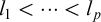 $l_1 < \cdots < l_p$
witnessed in
$l_1 < \cdots < l_p$
witnessed in $[a_1,b_1]$
such that
$[a_1,b_1]$
such that $\varphi _1$
is not f-preserving on these elements. This link forms a block of size p in
$\varphi _1$
is not f-preserving on these elements. This link forms a block of size p in $[a_1,b_1]$
, and f has only one block type of each size, so either the images of
$[a_1,b_1]$
, and f has only one block type of each size, so either the images of $l_1 < \cdots < l_p$
in
$l_1 < \cdots < l_p$
in $[a_2,b_2]$
lie in two different blocks or are contained in some larger block. In the former case, the link
$[a_2,b_2]$
lie in two different blocks or are contained in some larger block. In the former case, the link $l_1 < \cdots < l_p$
has become vulnerable in
$l_1 < \cdots < l_p$
has become vulnerable in $[a_2,b_2]$
. In the second case, let
$[a_2,b_2]$
. In the second case, let $k_1 < \cdots < k_q$
be this larger block in
$k_1 < \cdots < k_q$
be this larger block in $[a_2,b_2]$
containing the images of
$[a_2,b_2]$
containing the images of $l_1,\ldots ,l_p$
. Then
$l_1,\ldots ,l_p$
. Then $k_1 < \cdots < k_q$
is a link witnessed in
$k_1 < \cdots < k_q$
is a link witnessed in $[a_2,b_2]$
which becomes vulnerable in
$[a_2,b_2]$
which becomes vulnerable in $[a_3,b_3]$
. This is because
$[a_3,b_3]$
. This is because $\varphi _{1 \mapsto 3}$
from
$\varphi _{1 \mapsto 3}$
from $[a_1,b_1]$
to
$[a_1,b_1]$
to $[a_3,b_3]$
is f-preserving and so the images of
$[a_3,b_3]$
is f-preserving and so the images of $l_1 < \cdots < l_p$
form a block in
$l_1 < \cdots < l_p$
form a block in $[a_3,b_3]$
; this block is contained in, but not all of, the image of
$[a_3,b_3]$
; this block is contained in, but not all of, the image of $k_1 < \cdots < k_q$
in
$k_1 < \cdots < k_q$
in $[a_3,b_3]$
.
$[a_3,b_3]$
.
Now suppose that we have a link $l_1,\ldots ,l_p$
which is witnessed in
$l_1,\ldots ,l_p$
which is witnessed in $[a_i,b_i]$
and which becomes vulnerable in
$[a_i,b_i]$
and which becomes vulnerable in $[a_{i+1},b_{i+1}]$
. We claim that it must break in either
$[a_{i+1},b_{i+1}]$
. We claim that it must break in either $[a_{i+2},b_{i+2}]$
or
$[a_{i+2},b_{i+2}]$
or $[a_{i+3},b_{i+3}]$
. Indeed, in
$[a_{i+3},b_{i+3}]$
. Indeed, in $[a_{i+1},b_{i+1}]$
the images of the link
$[a_{i+1},b_{i+1}]$
the images of the link $l_1,\ldots ,l_p$
lie in at least two different blocks, and so the same is true in
$l_1,\ldots ,l_p$
lie in at least two different blocks, and so the same is true in $[a_{i+3},b_{i+3}]$
. Moreover, since the map
$[a_{i+3},b_{i+3}]$
. Moreover, since the map $\varphi _{i+1 \mapsto i+3}\colon [a_{i+1},b_{i+1}] \to [a_{i+3},b_{i+3}]$
is f-preserving, in
$\varphi _{i+1 \mapsto i+3}\colon [a_{i+1},b_{i+1}] \to [a_{i+3},b_{i+3}]$
is f-preserving, in $[a_{i+3},b_{i+3}]$
the images of
$[a_{i+3},b_{i+3}]$
the images of $l_1,\ldots ,l_p$
lie in blocks of the same block types. However, since
$l_1,\ldots ,l_p$
lie in blocks of the same block types. However, since $\varphi _{i \mapsto i+2} \colon [a_{i},b_{i}] \to [a_{i+2},b_{i+2}]$
is f-preserving, the images of
$\varphi _{i \mapsto i+2} \colon [a_{i},b_{i}] \to [a_{i+2},b_{i+2}]$
is f-preserving, the images of $l_1,\ldots ,l_p$
form a block in
$l_1,\ldots ,l_p$
form a block in $[a_{i+2},b_{i+2}]$
. Thus—as each
$[a_{i+2},b_{i+2}]$
. Thus—as each $\varphi _j$
is order-preserving—
$\varphi _j$
is order-preserving— $\varphi _{i+1 \mapsto i+3}\colon [a_{i+1},b_{i+1}] \to [a_{i+3},b_{i+3}]$
cannot be the identity. Since each pair of f-blocks only appears adjacent to each other once in f, some element must be inserted between the images in
$\varphi _{i+1 \mapsto i+3}\colon [a_{i+1},b_{i+1}] \to [a_{i+3},b_{i+3}]$
cannot be the identity. Since each pair of f-blocks only appears adjacent to each other once in f, some element must be inserted between the images in $[a_{i+3},b_{i+3}]$
of
$[a_{i+3},b_{i+3}]$
of $l_1$
and
$l_1$
and $l_p$
; thus the link must be broken in
$l_p$
; thus the link must be broken in $[a_{i+3},b_{i+3}]$
if not earlier.
$[a_{i+3},b_{i+3}]$
if not earlier.
Now we argue that after a link is broken, the coding sequence must terminate. Suppose that a link $l_1,\ldots ,l_p$
is witnessed in
$l_1,\ldots ,l_p$
is witnessed in $[a_i,b_i]$
but broken in
$[a_i,b_i]$
but broken in $[a_j,b_j]$
. Then i and j must be of opposite parities, as if they were of the same parity then the map
$[a_j,b_j]$
. Then i and j must be of opposite parities, as if they were of the same parity then the map $\varphi _{i \mapsto j} \colon [a_i,b_i] \to [a_j,b_j]$
would be f-preserving, and the images of
$\varphi _{i \mapsto j} \colon [a_i,b_i] \to [a_j,b_j]$
would be f-preserving, and the images of $l_1,\ldots ,l_p$
would form a block in
$l_1,\ldots ,l_p$
would form a block in $[a_j,b_j]$
, and hence would be a sequence of successive elements. Thus, as i and j have opposite parities, the map
$[a_j,b_j]$
, and hence would be a sequence of successive elements. Thus, as i and j have opposite parities, the map $\varphi _{i \mapsto j+1}$
is f-preserving, so the images of
$\varphi _{i \mapsto j+1}$
is f-preserving, so the images of $l_1,\ldots ,l_p$
in
$l_1,\ldots ,l_p$
in $[a_{j+1},b_{j+1}]$
must form a block of size p as
$[a_{j+1},b_{j+1}]$
must form a block of size p as $l_1,\ldots ,l_p$
did in
$l_1,\ldots ,l_p$
did in $[a_i,b_i]$
. However, in
$[a_i,b_i]$
. However, in $[a_j,b_j]$
and hence in
$[a_j,b_j]$
and hence in $[a_{j+1},b_{j+1}]$
the images of
$[a_{j+1},b_{j+1}]$
the images of $l_1,\ldots ,l_p$
are no longer successive elements, preventing them from forming such a block. Thus the coding sequence must terminate with
$l_1,\ldots ,l_p$
are no longer successive elements, preventing them from forming such a block. Thus the coding sequence must terminate with $[a_j,b_j]$
.
$[a_j,b_j]$
.
Thus we have a link in $[a_1,b_1]$
or
$[a_1,b_1]$
or $[a_2,b_2]$
which becomes vulnerable in
$[a_2,b_2]$
which becomes vulnerable in $[a_2,b_2]$
or
$[a_2,b_2]$
or $[a_3,b_3]$
, and hence broken by
$[a_3,b_3]$
, and hence broken by $[a_5,b_5]$
or before. There can be no more elements of the coding sequence.
$[a_5,b_5]$
or before. There can be no more elements of the coding sequence.
4 Many different intermediate spectra
Now that we know that intermediate degree spectrum are possible, we may ask for a more specific description of these intermediate degree spectra. How many possible intermediate degree spectra are there? Are particular interesting classes of degrees possible degree spectra? In this section, we continue to limit the relations we consider to block functions since this is the simplest case. Even so, we find significant complexity. We will particularly focus on the $\alpha $
-c.e. degrees, whose definition we now recall.
$\alpha $
-c.e. degrees, whose definition we now recall.
Definition 4.1. Let $(\alpha +1,\prec )$
be (a presentation of) a computable ordinal. A set A is
$(\alpha +1,\prec )$
be (a presentation of) a computable ordinal. A set A is $\alpha $
-c.e. if there is a computable approximation function
$\alpha $
-c.e. if there is a computable approximation function $g \colon \omega ^2 \to \{0,1\}$
and a computable counting function
$g \colon \omega ^2 \to \{0,1\}$
and a computable counting function $r \colon \omega ^2 \to \alpha +1$
such that:
$r \colon \omega ^2 \to \alpha +1$
such that:
-
(1) for all x,
$g(x,0) = 0$
, -
(2) for all x,
$\operatorname {\mathrm {rank}}(x,0) = \alpha $
, -
(3) for all x and s,
$\operatorname {\mathrm {rank}}(x,s+1) \preceq \operatorname {\mathrm {rank}}(x,s)$
, -
(4) if
$g(x,s+1) \neq g(x,s)$
then
$\operatorname {\mathrm {rank}}(x,s+1) \prec \operatorname {\mathrm {rank}}(x,s)$
, and -
(5)
$A(x) = \lim _{s \to \infty } g(x,s)$
.






We say that a set is of $\alpha $
-c.e. degree if it is Turing equivalent to an
$\alpha $
-c.e. degree if it is Turing equivalent to an $\alpha $
-c.e. set.
$\alpha $
-c.e. set.
The definition of the $\alpha $
-c.e. sets depends on the chosen the presentation of
$\alpha $
-c.e. sets depends on the chosen the presentation of $\alpha +1$
; indeed, for any
$\alpha +1$
; indeed, for any $\Delta ^0_2$
set, there is some presentation of
$\Delta ^0_2$
set, there is some presentation of $\omega ^2+1$
which makes that set
$\omega ^2+1$
which makes that set $\omega ^2$
-c.e. But for any fixed presentation of
$\omega ^2$
-c.e. But for any fixed presentation of $\omega ^2+1$
, there are
$\omega ^2+1$
, there are $\Delta ^0_2$
sets which are not
$\Delta ^0_2$
sets which are not $\omega ^2$
-c.e. Any ordinal has a computable presentation on a cone, so when working on a cone we do not need to assume that ordinals are computable.
$\omega ^2$
-c.e. Any ordinal has a computable presentation on a cone, so when working on a cone we do not need to assume that ordinals are computable.
Definition 4.2. Let $\mathcal {A}$
be a structure and R a relation on
$\mathcal {A}$
be a structure and R a relation on $\mathcal {A}$
. Let
$\mathcal {A}$
. Let $\alpha $
be a (presentation of) an ordinal. We say that:
$\alpha $
be a (presentation of) an ordinal. We say that:
-
(1) The degree spectrum of R on a cone contains all
$\alpha $
-c.e. degrees if there is an X (which we may assume computes that presentation of
$\alpha $
) such that for all
$Y \geq _T X$
, the degree spectrum of R relative to Y contains all degrees above Y which are
$\alpha $
-c.e. relative to Y. -
(2) The degree spectrum of R on a cone is contained within the
$\alpha $
-c.e. degrees if there is an X (which we may assume computes that presentation of
$\alpha $
) such that for all
$Y \geq _T X$
, the degree spectrum of R relative to Y is contained within the degrees above Y which are
$\alpha $
-c.e. relative to Y.


While these definitions involve a presentation of the ordinal, by the following remark the statements “the degree spectrum of R on a cone contains all $\alpha $
-c.e. degrees” and “the degree spectrum of R on a cone is contained within the
$\alpha $
-c.e. degrees” and “the degree spectrum of R on a cone is contained within the $\alpha $
-c.e. degrees” are well-defined without fixing a presentation.
$\alpha $
-c.e. degrees” are well-defined without fixing a presentation.
Remark 4.3. Let $\alpha $
be an ordinal, and let
$\alpha $
be an ordinal, and let $(P,<_P)$
and
$(P,<_P)$
and $(Q,<_Q)$
be two presentations of
$(Q,<_Q)$
be two presentations of $\alpha +1$
. We write
$\alpha +1$
. We write $\alpha _P$
-c.e. for the
$\alpha _P$
-c.e. for the $\alpha $
-c.e. sets and degrees defined with respect to the presentation P, and similarly for
$\alpha $
-c.e. sets and degrees defined with respect to the presentation P, and similarly for $\alpha _Q$
-c.e. There is a cone on which
$\alpha _Q$
-c.e. There is a cone on which $(P,<_P)$
and
$(P,<_P)$
and $(Q,<_Q)$
are computable, and the
$(Q,<_Q)$
are computable, and the $\alpha _P$
-c.e. sets are the same as the
$\alpha _P$
-c.e. sets are the same as the $\alpha _Q$
-c.e. sets. This cone is the join of the two presentations and an isomorphism between them. Thus working on a cone, it is reasonable to talk about the
$\alpha _Q$
-c.e. sets. This cone is the join of the two presentations and an isomorphism between them. Thus working on a cone, it is reasonable to talk about the $\alpha $
-c.e. sets without reference to presentation. This is a somewhat subtle point in that it is not true that there is a cone on which all presentations are equivalent, but rather that there is in some sense a single presentation up to equivalence in the limit.
$\alpha $
-c.e. sets without reference to presentation. This is a somewhat subtle point in that it is not true that there is a cone on which all presentations are equivalent, but rather that there is in some sense a single presentation up to equivalence in the limit.
For example, let R be a relation on a structure $\mathcal {A}$
. Let
$\mathcal {A}$
. Let $(P,<_P)$
and
$(P,<_P)$
and $(Q,<_Q)$
be any two presentations of
$(Q,<_Q)$
be any two presentations of $\alpha +1$
. Suppose that, on a cone, the degree spectrum of R is equal to the
$\alpha +1$
. Suppose that, on a cone, the degree spectrum of R is equal to the $\alpha _P$
-c.e. degrees. Then, on a cone, the degree spectrum of R will also be equal to the
$\alpha _P$
-c.e. degrees. Then, on a cone, the degree spectrum of R will also be equal to the $\alpha _Q$
-c.e. degrees because on a cone the
$\alpha _Q$
-c.e. degrees because on a cone the $\alpha _P$
-c.e. sets are the same as the
$\alpha _P$
-c.e. sets are the same as the $\alpha _Q$
-c.e. sets. Thus whether or not the degree spectrum of R on a cone is equal to the
$\alpha _Q$
-c.e. sets. Thus whether or not the degree spectrum of R on a cone is equal to the $\alpha $
-c.e. degrees is independent of the presentation of
$\alpha $
-c.e. degrees is independent of the presentation of $\alpha $
chosen, and so we can just say that the degree spectrum of R on a cone is equal to the
$\alpha $
chosen, and so we can just say that the degree spectrum of R on a cone is equal to the $\alpha $
-c.e. degrees.
$\alpha $
-c.e. degrees.
Recall that, while there is no listing of all $\Delta ^0_2$
sets, for each (presentation of a) computable ordinal
$\Delta ^0_2$
sets, for each (presentation of a) computable ordinal $\alpha $
there is a listing of all of the
$\alpha $
there is a listing of all of the $\alpha $
-c.e. sets. The following theorem rules out, for block functions, any degree spectrum that can be listed in such a way other than the c.e. sets.
$\alpha $
-c.e. sets. The following theorem rules out, for block functions, any degree spectrum that can be listed in such a way other than the c.e. sets.
Theorem 4.4. Let f be a block function which is not intrinsically computable and such that, after some initial segment, all blocks embed into some later block. Let $(X_e^A)_{e \in \omega }$
be, uniformly in A, an A-computable list of (computable approximations to)
$(X_e^A)_{e \in \omega }$
be, uniformly in A, an A-computable list of (computable approximations to) $\Delta ^0_2(A)$
sets each of which computes A. Then, for all A on a cone, the degree spectrum of f relative to A contains some degree which is not Turing equivalent to any set in the listing
$\Delta ^0_2(A)$
sets each of which computes A. Then, for all A on a cone, the degree spectrum of f relative to A contains some degree which is not Turing equivalent to any set in the listing $(X_e^A)_{e \in \omega }$
.
$(X_e^A)_{e \in \omega }$
.
Corollary 4.5. Let f be a block function whose degree spectrum on a cone strictly contains the c.e. degrees. Then, for every $\alpha $
, the degree spectrum of f on a cone contains a non-
$\alpha $
, the degree spectrum of f on a cone contains a non- $\alpha $
-c.e. degree.
$\alpha $
-c.e. degree.
Proof of Theorem 4.4.
As usual we work on a cone on which we can compute $\alpha _f$
, and assume without loss of generality that all blocks embed into some later block. Suppose
$\alpha _f$
, and assume without loss of generality that all blocks embed into some later block. Suppose $(X_e)_{e \in \omega }$
is a listing as above with
$(X_e)_{e \in \omega }$
is a listing as above with $X_{e,s}$
being the limit approximation to
$X_{e,s}$
being the limit approximation to $X_e$
. We construct a computable copy
$X_e$
. We construct a computable copy $\mathcal {A}$
of
$\mathcal {A}$
of ${(\omega , <)}$
via finite stages, satisfying the requirements
${(\omega , <)}$
via finite stages, satisfying the requirements
 $$\begin{align*}R_{e, i, j}: \text{ either } \Phi_i^{f^{\mathcal{A}}}\neq X_{e} \text{ or } \Phi_j^{X_{e}} \neq f^{\mathcal{A}}.\end{align*}$$
The construction is a finite injury priority construction.
The strategy for $R_{e, i, j}$
at stage s is as follows:
$R_{e, i, j}$
at stage s is as follows:
-
(1) To initialize this requirement choose some interval
$[a,b]$
which forms an f-block of size greater than one and such that a is greater than the length of the finite linear order
$\mathcal {A}_{s-1}$
. Insert new elements at the end of the linear order so that it has length b and restrain the elements in the interval
$[a,b]$
for this requirement. Call these elements
$l_0, \ldots , l_{b-a}$
. We say that the requirement is in Phase 0. -
(2) At stage s, if the requirement is in Phase 0, we say that this requirement requires attention if there are computations
$$\begin{align*}\Phi_{i, s}^{X_{e, s}}[l_0, \ldots, l_{b-a}] = f^{\mathcal{A}_s}[l_0, \ldots, l_{b-a}] \quad \text{with use } u_0\end{align*}$$
and
$$\begin{align*}\Psi_{j, s}^{f^{\mathcal{A}_s}}[0, \ldots, u_0] = X_{e, s}[0, \ldots, u_0] \quad \text{with use } v_0. \end{align*}$$
When this requirement acts, restrain all blocks in
$\mathcal {A}_s$
which contain or are below some element of the use in the ordering
$<_{\mathcal {A}_s}$
other than the block
$l_0,\ldots ,l_{b-a}$
. When a block is restrained, what this means is that f on this block will never change. However, this does not mean that these elements of
$\mathcal {A}$
have a fixed image in
$(\omega ,<)$
: It may happen that the image in
$(\omega ,<)$
of a restrained block in
$\mathcal {A}$
changes, with the new image being a block into which the old image embeds. The block in
$\mathcal {A}$
becomes possibly larger. These are the only blocks that will be restrained by this requirement. We only need to maintain the values of f on the elements that are in these blocks right now, and not the elements that are added to these blocks later.Now insert one element below the block consisting of the elements
$l_0, \ldots , l_{b-a}$
. Since they formed a block of size greater than one, they no longer form a block. Thus the value of f on these elements has changed.For each block that was restrained, check to ensure the value of f on these elements is the same as when it was restrained. If not, then insert new elements below the least element of this block and possibly between the elements of this block to move them up to the image of the original f-block in some other f-block into which it embeds. Further, ensure we add enough new elements on the end to complete this block. This, ensures that for all restrained elements, the value of
$f^{\mathcal {A}_{s+1}}$
on these elements is the same in stage s. We say that this requirement is in Phase 1. -
(3) At stage s, if the requirement is in Phase
$2n$
for
$n \ge 1$
, we say that this requirement requires attention if there are computations
$$\begin{align*}\Phi_{i, s}^{X_{e, s}}[l_0, \ldots, l_{b-a}] = f^{\mathcal{A}_s}[l_0, \ldots, l_{b-a}] \quad \text{with use } u_{2n}\end{align*}$$
and
$$\begin{align*}\Psi_{j, s}^{f^{\mathcal{A}_s}}[0, \ldots, u_{2n}] = X_{e, s}[0, \ldots, u_{2n}] \quad \text{with use } v_{2n.} \end{align*}$$
In Phase
$2n$
, the elements
$l_0, \ldots , l_{b-a}$
will all be part of the same block (and indeed will be closed under f). When this requirement acts, insert enough new element below the block to make
$l_0, \ldots , l_{b-a}$
now split across two blocks. This changes the value of f on
$l_0,\ldots ,l_{b-a}$
.For each block that was restrained in Phase 0 check to ensure the value of f on these elements has not changed because of the addition of this new element. If it has, then insert new elements below the least element of this block and possibly between the elements of this block to move them up to the image of the original f-block in some other f-block into which it embeds. Further, ensure we add enough new elements on the end to complete this block. This ensures that for all restrained blocks, the value of
$f^{\mathcal {A}_{s+1}}$
on these elements at stage
$s+1$
is the same as at stage s. We say that this requirement is in Phase
$2n+1$
. -
(4) At stage s, if the requirement is in Phase
$2n+1$
for
$n \ge 1$
, we say that this requirement requires attention if there are computations
$$\begin{align*}\Phi_{i, s}^{X_{e, s}}[l_0, \ldots, l_{b-a}] = f^{\mathcal{A}_s}[l_0, \ldots, l_{b-a}] \quad \text{with use } u_{2n+1}\end{align*}$$
and
$$\begin{align*}\Psi_{j, s}^{f^{\mathcal{A}_s}}[0, \ldots, u_{2n+1}] = X_{e, s}[0, \ldots, u_{2n+1}] \quad \text{with use } v_{2n+1.} \end{align*}$$
During Phase
$2n$
,
$l_0,\ldots ,l_{b-a}$
were all part of the same block, while during Phase
$2n+1$
they were split across different blocks. No elements have were inserted in between
$l_0,\ldots ,l_{b-a}$
in transferring from Phase
$2n$
to Phase
$2n+1$
. When this requirement acts, insert enough new elements element below the element
$l_0$
and possibly between the
$l_0, \ldots , l_{b-a}$
so that they are moved up to the image of the block containing
$l_0, \ldots , l_{b-a}$
during Phase
$2n$
in some block into which it embeds. This ensures that the value of f on
$l_0, \ldots , l_{b-a}$
is the same as it was in Phase
$2n$
, and hence different from what it was in Phase
$2n+1$
.For each block that was restrained in Phase 0 check to ensure the value of f on these elements has not changed because of the addition of these new elements. If it has, then insert new elements below the least element of this block and possibly between the elements of this block to move them up to the image of the original f-block in some other f-block into which it embeds. Further, ensure we add enough new elements on the end to complete this block. This ensures that for all restrained blocks, the value of
$f^{\mathcal {A}_{s+1}}$
on these elements at stage
$s+1$
is the same as at stage s. We say this requirement is in Phase
$2n+2$
.


Note that whenever the requirement is acted on we change the value of f on the $l_i$
, breaking the computation that was found at that stage and ensuring that the requirement is again satisfied when we move to the next stage.
$l_i$
, breaking the computation that was found at that stage and ensuring that the requirement is again satisfied when we move to the next stage.
Verification: We use the strategies described above in an injury argument. Since elements are inserted below the $l_i$
corresponding to some requirement only when that requirement or some higher priority requirement requires attention it is enough to check that after a requirement is no longer injured its strategy enters only finitely many phases. This will ensure that this construction produces a copy of
$l_i$
corresponding to some requirement only when that requirement or some higher priority requirement requires attention it is enough to check that after a requirement is no longer injured its strategy enters only finitely many phases. This will ensure that this construction produces a copy of ${(\omega , <)}$
and that all requirements are eventually satisfied, i.e.,
${(\omega , <)}$
and that all requirements are eventually satisfied, i.e., $\mathcal {A}$
is not equivalent to any of the degrees in the listing.
$\mathcal {A}$
is not equivalent to any of the degrees in the listing.
First, we make the following observations about the construction. Let $s_n$
be the stage where the strategy enters Phase n.
$s_n$
be the stage where the strategy enters Phase n.
-
• The value of
$f^{\mathcal {A}_{s_{2n}}}$
is the same on the
$l_i$
assigned to this strategy for all n. -
• The value of
$f^{\mathcal {A}_{s_n}}$
on the blocks which were restrained in Phase 0 is the same for all n.


We now show that $X_{e}$
changes each time we move to another phase but maintains the same value on some interval for all even phases. In the proof of Theorem 3.6B we showed the value of the set we were trying to beat oscillated between two possible values; in this case the set must only have a certain value for even phases but is allowed to vary on odd ones.
$X_{e}$
changes each time we move to another phase but maintains the same value on some interval for all even phases. In the proof of Theorem 3.6B we showed the value of the set we were trying to beat oscillated between two possible values; in this case the set must only have a certain value for even phases but is allowed to vary on odd ones.
Lemma 4.6.
-
(1) For all even n,
$X_{e, s_n}[0, \ldots , u_0] = X_{e, s_0}[0, \ldots , u_0].$
-
(2) For all n,
$X_{e, s_n}[0, \ldots , u_0] \neq X_{e, s_{n+1}}[0, \ldots , u_0]$
.


Proof.
-
(1) Observe that for the computation
$\Psi _{j,s_0}^{f^{\mathcal {A}_{s_0}}}[0, \ldots , u_0] = X_{e, s_0}[0, \ldots , u_0]$
its use, except for possibly the
$l_i$
, is preserved at all stages and so since the value of
$f^{\mathcal {A}_{s_n}}$
is the same for all even n, the use of this computation must be preserved at stage
$s_n$
for all even n so the original computation must hold, i.e.,
$\Psi _{j,s_0}^{f^{\mathcal {A}_{s_0}}}[0, \ldots , u_0] = \Psi _{j,s_0}^{\mathcal {A}_{s_n}}[0, \ldots , u_n]$
and so it follows that
$X_{e, s_n}[0, \ldots , u_0] = X_{e, s_0}[0, \ldots , u_0]$
, as desired. -
(2) The computation
$\Phi _{i, s_0}^{X_{e, s}}[l_0, \ldots , l_{b-a}] = f^{\mathcal {A}_{s_0}}[l_0, \ldots , l_{b-a}]$
found in Phase 0 has use
$u_0$
and so by part (1) holds at stage
$s_n$
for all even n. For each even n,
$l_0, \ldots , l_{b-a}$
are part of the same block in
$\mathcal {A}_{s_n}$
and closed under f, while for each odd n they are not. Thus for all n we have
$f^{A_{s_n}}[l_0, \ldots , l_{b-a}] \neq f^{\mathcal {A}_{s_{n+1}}}[l_0, \ldots , l_{b-a}]$
. Since
$\Phi _{i, {s_n}}^{X_{e, s}}[l_0, \ldots , l_{b-a}] = f^{\mathcal {A}_{s_n}}[l_0, \ldots , l_{b-a}]$
for all n we must have
$\Phi _{i, s_n}^{X_{e, s_n}}[l_0, \ldots , l_{b-a}] \neq \Phi _{i, s_{n+1}}^{X_{e, s_{n+1}}}[l_0, \ldots , l_{b-a}]$
. Hence, the use of the computation must change between stage
$s_n$
and
$s_{n+1}$
. Further, since either n or
$n+1$
is even, the use of one of these computations is
$u_0$
and so we must have
$X_{e, s_n}[0, \ldots , u_0] \neq X_{e, s_{n+1}}[0, \ldots , u_0]$
, as desired.













This lemma tells us that some element in $[0, \ldots , u_0]$
must change value each time the strategy enters a new phase. Now, since X is a
$[0, \ldots , u_0]$
must change value each time the strategy enters a new phase. Now, since X is a $\Delta _2^0$
set, it follows that each finite collection of elements can change only finitely often so this strategy can enter only finitely many stages.
$\Delta _2^0$
set, it follows that each finite collection of elements can change only finitely often so this strategy can enter only finitely many stages.
Despite the apparent difficulty in describing these intermediate degree spectra one way we can attempt to characterize them is by the least computable ordinal $\alpha $
such that their degree spectra contains all
$\alpha $
such that their degree spectra contains all $\alpha $
-c.e. degrees. (Recall that by Remark 4.3 this is independent of the presentations chosen for the ordinals.) To do this we introduce the notion of coding trees to better understand which types of finite coding sequences exist for a given function f. To a given f there will be associated two trees, a maximal coding tree and a minimal coding tree. The rank of the maximal coding tree will help to determine whether there is an
$\alpha $
-c.e. degrees. (Recall that by Remark 4.3 this is independent of the presentations chosen for the ordinals.) To do this we introduce the notion of coding trees to better understand which types of finite coding sequences exist for a given function f. To a given f there will be associated two trees, a maximal coding tree and a minimal coding tree. The rank of the maximal coding tree will help to determine whether there is an $\alpha $
-c.e. degree not contained in the degree spectrum, and the rank of the minimal coding tree will help to determine whether every
$\alpha $
-c.e. degree not contained in the degree spectrum, and the rank of the minimal coding tree will help to determine whether every $\alpha $
-c.e. degree is contained in the degree spectrum.
$\alpha $
-c.e. degree is contained in the degree spectrum.
The reason that we will need two different trees is that there are actually two ways in which we might want to be able to move coding elements in a linear order. The first, which was previously mentioned, is the ability to move the coding elements back and forth between two possible values of f to account for changes in a $\Delta _2^0$
set. The second, which was not as apparent in the case where we had an infinite coding sequence, is the ability to preserve the value of f on the coding sequence while other elements are inserted below them, i.e., the value of f on other coding sequences is changing. So, the rank of the maximal coding tree captures which types of moves are possible when coding only a single element, which is enough for diagonalization, while the minimal coding tree captures which types of moves are possible while ensuring that coding sequences can move independently of each other, which is required for encoding a particular set. However, we will see below that the ranks of the minimal and maximal coding trees only provide an upper and lower bound on the
$\Delta _2^0$
set. The second, which was not as apparent in the case where we had an infinite coding sequence, is the ability to preserve the value of f on the coding sequence while other elements are inserted below them, i.e., the value of f on other coding sequences is changing. So, the rank of the maximal coding tree captures which types of moves are possible when coding only a single element, which is enough for diagonalization, while the minimal coding tree captures which types of moves are possible while ensuring that coding sequences can move independently of each other, which is required for encoding a particular set. However, we will see below that the ranks of the minimal and maximal coding trees only provide an upper and lower bound on the $\alpha $
such that all
$\alpha $
such that all $\alpha $
-c.e. sets can be coded but it can be much more complicated to determine exactly which sets are in the degree spectrum.
$\alpha $
-c.e. sets can be coded but it can be much more complicated to determine exactly which sets are in the degree spectrum.
We recall the rank of a tree.
Definition 4.7. Let T be a well-founded tree. Given $\sigma \in T$
, the rank of
$\sigma \in T$
, the rank of $\sigma $
is defined by:
$\sigma $
is defined by:
-
(1)
$\operatorname {\mathrm {rank}}(\sigma ) = 0$
if
$\sigma $
is a leaf. -
(2)
$\operatorname {\mathrm {rank}}(\sigma ) = \sup \; \{\operatorname {\mathrm {rank}}(\tau ) + 1 \mid \tau \text { child of } \sigma \}$
.
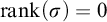


We define $\operatorname {\mathrm {rank}}(T)$
to be the rank of the root node of T, or
$\operatorname {\mathrm {rank}}(T)$
to be the rank of the root node of T, or $\infty $
if T is non-well-founded.
$\infty $
if T is non-well-founded.
Definition 4.8. Let f be a block function on ${(\omega ,<)}$
. We define its maximal coding tree as follows. The elements of the tree will be all finite weak coding sequences, with the empty sequence as the root. Extension on the tree is just extension of coding sequences (including using the same functions
${(\omega ,<)}$
. We define its maximal coding tree as follows. The elements of the tree will be all finite weak coding sequences, with the empty sequence as the root. Extension on the tree is just extension of coding sequences (including using the same functions $\varphi $
.) We call this tree
$\varphi $
.) We call this tree $T_{\max }(f)$
and let the maximal coding rank of f be
$T_{\max }(f)$
and let the maximal coding rank of f be $\operatorname {\mathrm {maxrank}}(f) = \operatorname {\mathrm {rank}}(T_{\max }(f))$
.
$\operatorname {\mathrm {maxrank}}(f) = \operatorname {\mathrm {rank}}(T_{\max }(f))$
.
In Theorem 3.6B we showed that if a block function does not have an infinite f-coding sequence, then its degree spectrum on a cone is not all of the $\Delta ^0_2$
degrees. Here we refine that using the maximal rank of a coding tree to say more about which
$\Delta ^0_2$
degrees. Here we refine that using the maximal rank of a coding tree to say more about which $\Delta ^0_2$
degree is not in the degree spectrum.
$\Delta ^0_2$
degree is not in the degree spectrum.
Theorem 4.9. Let f be a block function such that every block, except for finitely many, embeds into some later block. If $\alpha $
is the rank of the maximal coding tree for f, then on a cone there is some
$\alpha $
is the rank of the maximal coding tree for f, then on a cone there is some $\alpha $
-c.e. degree which is not in the degree spectrum of f.
$\alpha $
-c.e. degree which is not in the degree spectrum of f.
Proof. We work on a cone on which we can compute the usual facts about f as well as a given presentation for $\alpha $
and the maximal coding tree for f together with the ranking function on that tree using that presentation of
$\alpha $
and the maximal coding tree for f together with the ranking function on that tree using that presentation of $\alpha $
for the ranks. The construction here is similar to the construction in Theorem 3.6B. There, we constructed a
$\alpha $
for the ranks. The construction here is similar to the construction in Theorem 3.6B. There, we constructed a $\Delta ^0_2$
set C while diagonalizing against being Turing equivalent to
$\Delta ^0_2$
set C while diagonalizing against being Turing equivalent to $f^{\mathcal {A}_e}$
for copies
$f^{\mathcal {A}_e}$
for copies $\mathcal {A}_e$
of
$\mathcal {A}_e$
of ${(\omega ,<)}$
. We had requirements
${(\omega ,<)}$
. We had requirements
 $$\begin{align*}R_{e, i, j}: \text{ If } \mathcal{L}_e \cong {(\omega,<)}, \text{ then either } \Phi_i^{f^{\mathcal{L}_e}}\neq C \text{ or } \Psi_j^C \neq f^{\mathcal{L}_e}.\end{align*}$$
For each requirement, we chose an element x for which we would change $C(x)$
. The fact that there was no infinite f-coding sequence meant that eventually each
$C(x)$
. The fact that there was no infinite f-coding sequence meant that eventually each $R_{e, i, j}$
would be satisfied and
$R_{e, i, j}$
would be satisfied and $C(x)$
would no longer change; more precisely, we would only change
$C(x)$
would no longer change; more precisely, we would only change $C(x)$
when we were able to extend the (weak) f-coding sequence that we were building.
$C(x)$
when we were able to extend the (weak) f-coding sequence that we were building.
The construction now will be exactly the same, except that we will add a rank function $r(x,s) \colon \omega ^2 \to \alpha + 1$
. Given x, we begin with
$r(x,s) \colon \omega ^2 \to \alpha + 1$
. Given x, we begin with $r(x,0) = \alpha $
. We also maintain at each stage a weak coding sequence
$r(x,0) = \alpha $
. We also maintain at each stage a weak coding sequence $\mathsf {CS}_{x,s}$
with rank in
$\mathsf {CS}_{x,s}$
with rank in $T_{\max }(f)$
of
$T_{\max }(f)$
of $\operatorname {\mathrm {rank}}(\mathsf {CS}_{x,s}) = r(x,s)$
. We begin with
$\operatorname {\mathrm {rank}}(\mathsf {CS}_{x,s}) = r(x,s)$
. We begin with $\mathsf {CS}_{x,0}$
as the empty coding sequence, with rank
$\mathsf {CS}_{x,0}$
as the empty coding sequence, with rank $\alpha = r(x,s)$
in
$\alpha = r(x,s)$
in $T_{\max }(f)$
. If x is never assigned to a requirement, then
$T_{\max }(f)$
. If x is never assigned to a requirement, then $C(x)$
never changes, and we never decrease
$C(x)$
never changes, and we never decrease $r(x,s)$
. Otherwise, we do not change
$r(x,s)$
. Otherwise, we do not change $r(x,s)$
and
$r(x,s)$
and $\mathsf {CS}_{x,s}$
until after x has been assigned to some requirement
$\mathsf {CS}_{x,s}$
until after x has been assigned to some requirement $R_{e, i, j}$
, and then we will only have
$R_{e, i, j}$
, and then we will only have $r(x,s) < r(x,s-1)$
at stages s when
$r(x,s) < r(x,s-1)$
at stages s when $R_{e, i, j}$
changes from one phase to the next; these are also the only stages when
$R_{e, i, j}$
changes from one phase to the next; these are also the only stages when $C_s(x) \neq C_{s-1}(x)$
. The weak coding sequence
$C_s(x) \neq C_{s-1}(x)$
. The weak coding sequence $\mathsf {CS}_{x,s}$
will be the sequence built by
$\mathsf {CS}_{x,s}$
will be the sequence built by $R_{e,i,j}$
in Theorem 3.6. Suppose that we have defined
$R_{e,i,j}$
in Theorem 3.6. Suppose that we have defined $r(x,s-1)$
and
$r(x,s-1)$
and $\mathsf {CS}_{x,s-1}$
and that at stage s the requirement
$\mathsf {CS}_{x,s-1}$
and that at stage s the requirement $R_{e, i, j}$
changes from Phase n to Phase
$R_{e, i, j}$
changes from Phase n to Phase $n+1$
. The weak coding sequence
$n+1$
. The weak coding sequence $\mathsf {CS}_{x,s-1}$
will have been the sequence of length n constructed at Phase n. In moving to Phase
$\mathsf {CS}_{x,s-1}$
will have been the sequence of length n constructed at Phase n. In moving to Phase $n+1$
, we extend this weak coding sequence to a sequence
$n+1$
, we extend this weak coding sequence to a sequence $\mathsf {CS}_{x,s}$
of length
$\mathsf {CS}_{x,s}$
of length $n+1$
as described in the proof of Theorem 3.6. Define
$n+1$
as described in the proof of Theorem 3.6. Define $r(x,s)$
to be the rank of
$r(x,s)$
to be the rank of $\mathsf {CS}_{x,s}$
in the maximal coding tree
$\mathsf {CS}_{x,s}$
in the maximal coding tree $T_{\max }(f)$
. If, at any point, the requirement
$T_{\max }(f)$
. If, at any point, the requirement $R_{e,i,j}$
is injured, then we never again change
$R_{e,i,j}$
is injured, then we never again change $C(x)$
and so never again have to decrease
$C(x)$
and so never again have to decrease $r(x,s)$
. Thus we have shown that the set C built is
$r(x,s)$
. Thus we have shown that the set C built is $\alpha $
-c.e., proving the theorem.
$\alpha $
-c.e., proving the theorem.
Note that the condition given in this theorem is sufficient but not necessary. Indeed, suppose that $f_k$
is the function obtained from f by “removing” the first k blocks of f. Then f and
$f_k$
is the function obtained from f by “removing” the first k blocks of f. Then f and $f_k$
have the same degree spectra, but it is possible that
$f_k$
have the same degree spectra, but it is possible that $\operatorname {\mathrm {maxrank}}(f_k) < \operatorname {\mathrm {maxrank}}(f)$
.
$\operatorname {\mathrm {maxrank}}(f_k) < \operatorname {\mathrm {maxrank}}(f)$
.
Example 4.10. Consider the example f from Theorem 3.7. There, we showed that any f-coding sequence has length at most $5$
. Thus the rank of the maximal coding tree for f is at most
$5$
. Thus the rank of the maximal coding tree for f is at most $6$
(since in the rank of the coding tree we include the empty sequence). Thus by Theorem 4.9 on a cone there is a
$6$
(since in the rank of the coding tree we include the empty sequence). Thus by Theorem 4.9 on a cone there is a $6$
-c.e. degree which is not in the degree spectrum of that function f. Since in that example we can carry out the argument of Theorem 4.9 computably, not working on a cone, there is a 6-c.e. degree which is not in the degree spectrum of f.
$6$
-c.e. degree which is not in the degree spectrum of that function f. Since in that example we can carry out the argument of Theorem 4.9 computably, not working on a cone, there is a 6-c.e. degree which is not in the degree spectrum of f.
We now turn to a condition for the reverse, that is, a coding tree that will allow us to code all $\alpha $
-c.e. sets. This is somewhat more complicated.
$\alpha $
-c.e. sets. This is somewhat more complicated.
Definition 4.11. Let f be a block function on ${(\omega ,<)}$
. Suppose that (a) all but finitely many blocks embed into infinitely many later blocks, or equivalently, the degree spectrum of f strictly contains the c.e. degrees on a cone and (b) there is no infinite f-coding sequence, or equivalently the degree spectrum of f is strictly contained within the
${(\omega ,<)}$
. Suppose that (a) all but finitely many blocks embed into infinitely many later blocks, or equivalently, the degree spectrum of f strictly contains the c.e. degrees on a cone and (b) there is no infinite f-coding sequence, or equivalently the degree spectrum of f is strictly contained within the $\Delta ^0_2$
degrees on a cone.
$\Delta ^0_2$
degrees on a cone.
First, we need an additional definition. Given two coding sequences $\sigma $
and
$\sigma $
and $\tau $
which agree on all but the last interval, which are, say,
$\tau $
which agree on all but the last interval, which are, say, $[a_n, b_n]$
for
$[a_n, b_n]$
for $\sigma $
and
$\sigma $
and $[a_n',b_n']$
for
$[a_n',b_n']$
for $\tau $
, we say that
$\tau $
, we say that $\sigma $
permits
$\sigma $
permits $\tau $
if
$\tau $
if $a_n < a_n'$
and there is a nondecreasing embedding
$a_n < a_n'$
and there is a nondecreasing embedding $\psi $
from
$\psi $
from $[a_n,b_n] \to [a_n',b_n']$
which preserves f and commutes with the maps
$[a_n,b_n] \to [a_n',b_n']$
which preserves f and commutes with the maps $\varphi _{n-1} \colon [a_{n-1},b_{n-1}] \to [a_n,b_n]$
and
$\varphi _{n-1} \colon [a_{n-1},b_{n-1}] \to [a_n,b_n]$
and $\varphi _{n-1}' \colon [a_{n-1},b_{n-1}] \to [a_n',b_n']$
.
$\varphi _{n-1}' \colon [a_{n-1},b_{n-1}] \to [a_n',b_n']$
.

The fact that each f-block embeds into infinitely many later blocks implies that for any coding sequence $\sigma _0$
there is an infinite sequence
$\sigma _0$
there is an infinite sequence $\sigma = \sigma _0, \sigma _1, \sigma _2, \ldots $
such that each
$\sigma = \sigma _0, \sigma _1, \sigma _2, \ldots $
such that each $\sigma _i$
permits
$\sigma _i$
permits $\sigma _{i+1}$
.
$\sigma _{i+1}$
.
We define the minimal coding tree $T_{\min }(f)$
of f as follows. The elements are all finite coding sequences, with the empty sequence as the root. For the maximal coding tree, we used weak coding sequences, but here we use strong coding sequences. Extension on the tree is just extension of coding sequences (using the same functions
$T_{\min }(f)$
of f as follows. The elements are all finite coding sequences, with the empty sequence as the root. For the maximal coding tree, we used weak coding sequences, but here we use strong coding sequences. Extension on the tree is just extension of coding sequences (using the same functions $\varphi $
). Since there is no infinite f-coding sequence this tree is well-founded.
$\varphi $
). Since there is no infinite f-coding sequence this tree is well-founded.
Define, inductively, a ranking $\operatorname {\mathrm {minrank}}$
on
$\operatorname {\mathrm {minrank}}$
on $T_{\min }(f)$
. For a leaf
$T_{\min }(f)$
. For a leaf $\sigma $
, we put
$\sigma $
, we put $\operatorname {\mathrm {minrank}}(\sigma ) = 0$
. Given a non-leaf
$\operatorname {\mathrm {minrank}}(\sigma ) = 0$
. Given a non-leaf $\sigma \neq \varnothing $
, we set
$\sigma \neq \varnothing $
, we set $\operatorname {\mathrm {minrank}}(\sigma ) \geq \alpha $
if there is an infinite sequence
$\operatorname {\mathrm {minrank}}(\sigma ) \geq \alpha $
if there is an infinite sequence $\sigma = \sigma _0, \sigma _1, \sigma _2, \ldots $
such that each
$\sigma = \sigma _0, \sigma _1, \sigma _2, \ldots $
such that each $\sigma _i$
permits
$\sigma _i$
permits $\sigma _{i+1}$
and for each
$\sigma _{i+1}$
and for each $\beta < \alpha $
and each
$\beta < \alpha $
and each $i = 0,1,2,\ldots $
there is
$i = 0,1,2,\ldots $
there is $\tau _i$
a child of
$\tau _i$
a child of $\sigma _i$
such that
$\sigma _i$
such that $\operatorname {\mathrm {minrank}}(\tau _i) \geq \beta $
. Then as usual we set
$\operatorname {\mathrm {minrank}}(\tau _i) \geq \beta $
. Then as usual we set $\operatorname {\mathrm {minrank}}(\sigma )$
to be the greatest
$\operatorname {\mathrm {minrank}}(\sigma )$
to be the greatest $\alpha $
such that
$\alpha $
such that $\operatorname {\mathrm {minrank}}(\sigma ) \geq \alpha $
. We put
$\operatorname {\mathrm {minrank}}(\sigma ) \geq \alpha $
. We put $\operatorname {\mathrm {minrank}}(\varnothing ) = \sup _{\sigma \neq \varnothing } \operatorname {\mathrm {minrank}}(\sigma )+1$
.
$\operatorname {\mathrm {minrank}}(\varnothing ) = \sup _{\sigma \neq \varnothing } \operatorname {\mathrm {minrank}}(\sigma )+1$
.
For each non-root-node $\sigma \neq \varnothing $
, there is an infinite sequence
$\sigma \neq \varnothing $
, there is an infinite sequence $\sigma = \sigma _0,\sigma _1,\sigma _2,\ldots $
such that each
$\sigma = \sigma _0,\sigma _1,\sigma _2,\ldots $
such that each $\sigma _i$
permits
$\sigma _i$
permits $\sigma _{i+1}$
and for each
$\sigma _{i+1}$
and for each $i \operatorname {\mathrm {minrank}}(\sigma _i) \geq \operatorname {\mathrm {minrank}}(\sigma )$
. If
$i \operatorname {\mathrm {minrank}}(\sigma _i) \geq \operatorname {\mathrm {minrank}}(\sigma )$
. If $\operatorname {\mathrm {minrank}}(\sigma )> 0$
this can be seen directly from the definition of
$\operatorname {\mathrm {minrank}}(\sigma )> 0$
this can be seen directly from the definition of $\operatorname {\mathrm {minrank}}$
. If
$\operatorname {\mathrm {minrank}}$
. If $\operatorname {\mathrm {minrank}}(\sigma ) = 0$
this is due to the fact noted above that because each f-block embeds into infinitely many later blocks, for any coding sequence
$\operatorname {\mathrm {minrank}}(\sigma ) = 0$
this is due to the fact noted above that because each f-block embeds into infinitely many later blocks, for any coding sequence $\sigma _0$
there is an infinite sequence
$\sigma _0$
there is an infinite sequence $\sigma = \sigma _0, \sigma _1, \sigma _2, \ldots $
such that each
$\sigma = \sigma _0, \sigma _1, \sigma _2, \ldots $
such that each $\sigma _i$
permits
$\sigma _i$
permits $\sigma _{i+1}$
.
$\sigma _{i+1}$
.
We define $\operatorname {\mathrm {minrank}}(f)$
to be
$\operatorname {\mathrm {minrank}}(f)$
to be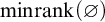 $\operatorname {\mathrm {minrank}}(\varnothing )$
the empty coding sequence which is the root node of
$\operatorname {\mathrm {minrank}}(\varnothing )$
the empty coding sequence which is the root node of $T_{\min }(f)$
.
$T_{\min }(f)$
.
Theorem 4.12. Let f be a block function such that every block, except for finitely many, embeds into some later block. If $\alpha = \operatorname {\mathrm {minrank}}(f)$
is the rank of the minimal coding tree corresponding to f, then the degree spectrum of f contains all
$\alpha = \operatorname {\mathrm {minrank}}(f)$
is the rank of the minimal coding tree corresponding to f, then the degree spectrum of f contains all $\beta $
-c.e. degrees for any
$\beta $
-c.e. degrees for any $\beta < \alpha $
on a cone.
$\beta < \alpha $
on a cone.
Proof. We work on the cone above $\alpha _f$
and the minimal coding tree and its ranking function into a presentation of
$\alpha _f$
and the minimal coding tree and its ranking function into a presentation of $\alpha $
. Suppose X is an
$\alpha $
. Suppose X is an $\beta $
-c.e. set, with
$\beta $
-c.e. set, with $\beta < \alpha $
, given by functions g, r where g is the computable approximation of X and r is ranking function counting the number of mind changes. We construct a computable copy
$\beta < \alpha $
, given by functions g, r where g is the computable approximation of X and r is ranking function counting the number of mind changes. We construct a computable copy $\mathcal {A}$
of
$\mathcal {A}$
of ${(\omega , <)}$
such that
${(\omega , <)}$
such that $f^{\mathcal {A}}$
is Turing equivalent to X. The construction will be almost exactly the same as Theorem 3.6A but we will be much more careful in how we use our coding sequences. In that construction, we had at each stage s certain elements
$f^{\mathcal {A}}$
is Turing equivalent to X. The construction will be almost exactly the same as Theorem 3.6A but we will be much more careful in how we use our coding sequences. In that construction, we had at each stage s certain elements $\bar {v}_e[s]$
of
$\bar {v}_e[s]$
of $\mathcal {A}_s$
which we used to code the value of
$\mathcal {A}_s$
which we used to code the value of $X(e)$
. In particular,
$X(e)$
. In particular, $\bar {v}_e[s]$
corresponded, via the partial isomorphism
$\bar {v}_e[s]$
corresponded, via the partial isomorphism $\pi _s \colon \mathcal {A}_s \to {(\omega ,<)}$
, to an interval
$\pi _s \colon \mathcal {A}_s \to {(\omega ,<)}$
, to an interval $[a_i,b_i]$
in a coding sequence. In Theorem 3.6 these intervals
$[a_i,b_i]$
in a coding sequence. In Theorem 3.6 these intervals $[a_i,b_i]$
were in a fixed infinite f-coding sequence. Now we work within the minimal coding tree. At each stage s, we will have a coding sequence
$[a_i,b_i]$
were in a fixed infinite f-coding sequence. Now we work within the minimal coding tree. At each stage s, we will have a coding sequence $\mathsf {CS}_{e,s} \in T_{\min }(f)$
with
$\mathsf {CS}_{e,s} \in T_{\min }(f)$
with $\operatorname {\mathrm {minrank}}(\mathsf {CS}_{e,s}) \geq r(e,s)$
. The length of
$\operatorname {\mathrm {minrank}}(\mathsf {CS}_{e,s}) \geq r(e,s)$
. The length of $\mathsf {CS}_{e,s}$
will be equal to 1 more than the number of times
$\mathsf {CS}_{e,s}$
will be equal to 1 more than the number of times $X(e)$
has changed value before stage s,
$X(e)$
has changed value before stage s,
 $$\begin{align*}\text{length}(\mathsf{CS}_{e,s}) = 1 + \#\{t < s \; \mid \; X_t(e) \neq X_{t+1}(e) \}.\end{align*}$$
Suppose that $\mathsf {CS}_{e,s}$
consists of intervals
$\mathsf {CS}_{e,s}$
consists of intervals $[a_1,b_1],\ldots ,[a_n,b_n]$
with
$[a_1,b_1],\ldots ,[a_n,b_n]$
with $n= 1 + \#\{t < s \; \mid \; X_t(e) \neq X_{t+1}(e) \}$
. Then we will have
$n= 1 + \#\{t < s \; \mid \; X_t(e) \neq X_{t+1}(e) \}$
. Then we will have $\pi _s(\bar {v}_e[s]) = [a_n,b_n]$
. If at stage
$\pi _s(\bar {v}_e[s]) = [a_n,b_n]$
. If at stage $s+1$
we see that
$s+1$
we see that $X_{s+1}(e) \neq X_s(e)$
then we know that
$X_{s+1}(e) \neq X_s(e)$
then we know that $r(e,s+1) < r(e,s)$
and so we can choose an extension
$r(e,s+1) < r(e,s)$
and so we can choose an extension $\mathsf {CS}_{e,s+1}$
of
$\mathsf {CS}_{e,s+1}$
of $\mathsf {CS}_{e,s}$
with
$\mathsf {CS}_{e,s}$
with $\operatorname {\mathrm {minrank}}(\mathsf {CS}_{e,s+1}) \geq r(e,s+1)$
which adds one more interval
$\operatorname {\mathrm {minrank}}(\mathsf {CS}_{e,s+1}) \geq r(e,s+1)$
which adds one more interval $[a_{n+1},b_{n+1}]$
. We will add elements to
$[a_{n+1},b_{n+1}]$
. We will add elements to $\mathcal {A}$
so that at stage
$\mathcal {A}$
so that at stage $s+1$
,
$s+1$
, $\bar {v}_e[s]$
corresponds to the images in
$\bar {v}_e[s]$
corresponds to the images in $[a_{n+1},b_{n+1}]$
, under
$[a_{n+1},b_{n+1}]$
, under $\varphi _{n}$
, of
$\varphi _{n}$
, of $[a_n,b_n]$
:
$[a_n,b_n]$
:
 $$\begin{align*}\pi_{s+1}(\bar{v}_e[s]) = \varphi_n(\pi_s(\bar{v}_e[s])). \end{align*}$$
The other possibility is that at stage $s+1$
we have
$s+1$
we have $X_{s+1}(e) = X_s(e)$
but some elements have already been added to
$X_{s+1}(e) = X_s(e)$
but some elements have already been added to $\mathcal {A}$
below
$\mathcal {A}$
below $\bar {v}_e[s]$
for the sake of some
$\bar {v}_e[s]$
for the sake of some $e' < e$
. In Theorem 3.6 we had an infinite f-coding sequence and so we had enough room to just move along the sequence to another position
$e' < e$
. In Theorem 3.6 we had an infinite f-coding sequence and so we had enough room to just move along the sequence to another position $[a_j,b_j]$
with j of the same parity as i. Now, we have limited room; instead, we use the permitting aspect of the tree. There is some other coding sequence
$[a_j,b_j]$
with j of the same parity as i. Now, we have limited room; instead, we use the permitting aspect of the tree. There is some other coding sequence $\mathsf {CS}_{e,s+1}$
which is of the same rank and length as
$\mathsf {CS}_{e,s+1}$
which is of the same rank and length as $\mathsf {CS}_{e,s}$
, which agrees with
$\mathsf {CS}_{e,s}$
, which agrees with $\mathsf {CS}_{e,s}$
except for the last interval
$\mathsf {CS}_{e,s}$
except for the last interval $[a_n',b_n']$
, and which is permitted by
$[a_n',b_n']$
, and which is permitted by $\mathsf {CS}_{e,s}$
. There is a non-decreasing and f-preserving map
$\mathsf {CS}_{e,s}$
. There is a non-decreasing and f-preserving map $\psi \colon [a_n,b_n] \to [a_n',b_n']$
. Moreover, we can choose such a coding sequence with
$\psi \colon [a_n,b_n] \to [a_n',b_n']$
. Moreover, we can choose such a coding sequence with $a_n'$
large enough that we can insert elements into
$a_n'$
large enough that we can insert elements into $\mathcal {A}$
so that
$\mathcal {A}$
so that
 $$\begin{align*}\pi_{s+1}(\bar{v}_e[s]) = \psi(\pi_s(\bar{v}_e[s])). \end{align*}$$
This allows us to adjust $\mathcal {A}$
for e without decreasing the rank of the coding sequence. Thus it is not the case that the coding sequences
$\mathcal {A}$
for e without decreasing the rank of the coding sequence. Thus it is not the case that the coding sequences $\mathsf {CS}_{e,s}$
for e are just growing by extensions; rather, there are also lateral moves when the last interval in
$\mathsf {CS}_{e,s}$
for e are just growing by extensions; rather, there are also lateral moves when the last interval in $\mathsf {CS}_{e,s}$
changes. Having given the informal idea of the construction, we will now give the formal construction.
$\mathsf {CS}_{e,s}$
changes. Having given the informal idea of the construction, we will now give the formal construction.
Construction: As in Theorem 3.6: For each e, starting from stage e where they are defined, we will have the initial coding elements $\bar {u}_e \in \mathcal {A}$
, the full coding segment
$\bar {u}_e \in \mathcal {A}$
, the full coding segment $\bar {v}_e \in \mathcal {A}$
containing
$\bar {v}_e \in \mathcal {A}$
containing $\bar {u}_e$
, and a restraint
$\bar {u}_e$
, and a restraint $r_e = \max _{\mathcal {A}} \bar {v}_e \in \mathcal {A}$
which is the
$r_e = \max _{\mathcal {A}} \bar {v}_e \in \mathcal {A}$
which is the $\mathcal {A}$
-largest element of
$\mathcal {A}$
-largest element of $\bar {v}$
. We write each tuple in
$\bar {v}$
. We write each tuple in $\mathcal {A}$
-increasing order. The initial coding elements
$\mathcal {A}$
-increasing order. The initial coding elements $\bar {u}_e$
will never change once defined, while the coding segment
$\bar {u}_e$
will never change once defined, while the coding segment $\bar {v}_e$
may have more elements added, and the restraint
$\bar {v}_e$
may have more elements added, and the restraint $r_e$
may increase in the
$r_e$
may increase in the $\mathcal {A}$
order. We will use
$\mathcal {A}$
order. We will use $\bar {v}_e[s]$
and
$\bar {v}_e[s]$
and $r_e[s]$
to refer to the values at stage s. We will always have that if
$r_e[s]$
to refer to the values at stage s. We will always have that if $e' \leq e$
then
$e' \leq e$
then $\bar {v}_e> r_{e'}$
so that the coding segment for e is free of the restraint of
$\bar {v}_e> r_{e'}$
so that the coding segment for e is free of the restraint of $e'$
.
$e'$
.
At each stage s for each e we will also have $n_e[s]$
which will be one more than the number of changesFootnote
8
in
$n_e[s]$
which will be one more than the number of changesFootnote
8
in $X(e)$
,
$X(e)$
,
 $$\begin{align*}n_e[s] = 1 + \# \{ t < s \; \mid \; X_t(e) \neq X_{t+1}(e) \}\end{align*}$$
and a coding sequence $\mathsf {CS}_{e,s}$
of length
$\mathsf {CS}_{e,s}$
of length $n_e[s]$
and
$n_e[s]$
and $\operatorname {\mathrm {minrank}}(\mathsf {CS}_{e,s}) \geq r(e,s)$
. We will generally write
$\operatorname {\mathrm {minrank}}(\mathsf {CS}_{e,s}) \geq r(e,s)$
. We will generally write $[a_1,b_1],\ldots ,[a_n,b_n]$
and
$[a_1,b_1],\ldots ,[a_n,b_n]$
and $\varphi _1,\ldots ,\varphi _{n-1}$
for the corresponding intervals and maps, taking
$\varphi _1,\ldots ,\varphi _{n-1}$
for the corresponding intervals and maps, taking $n = n_e[s]$
and suppressing e and s for simplicity of notation. Note that
$n = n_e[s]$
and suppressing e and s for simplicity of notation. Note that $n_e[s]$
will be odd if and only if
$n_e[s]$
will be odd if and only if $X_s(e) = 0$
and even if and only if
$X_s(e) = 0$
and even if and only if $X_s(e) = 1$
.
$X_s(e) = 1$
.
Recall that at each stage s, given a tuple $\bar {a} \in \mathcal {A}_s$
,
$\bar {a} \in \mathcal {A}_s$
, $\pi _s(\bar {a})$
is the corresponding tuple in
$\pi _s(\bar {a})$
is the corresponding tuple in ${(\omega ,<)}$
. We also have
${(\omega ,<)}$
. We also have $f^{\mathcal {A}_s}$
which is the function f on
$f^{\mathcal {A}_s}$
which is the function f on $\mathcal {A}_s$
.
$\mathcal {A}_s$
.
From each stage to the next, we will maintain the following properties:
-
(1) At each stage
$s \geq e$
, the coding elements
$\bar {v}_e$
of
$\mathcal {A}$
correspond to
$\pi _s(\bar {v}_e)$
in
${(\omega ,<)}$
which is the last interval
$[a_n,b_n]$
in
$\mathsf {CS}_{e,s}$
. -
(2) Suppose that at stage
$s \geq e$
the coding elements
$\bar {v}_e[s]$
corresponded (via
$\pi _s \colon \mathcal {A}_s \to {(\omega ,<)}$
) to the interval
$[a_n,b_n]$
in the coding sequence
$\mathsf {CS}_{e,s}$
. At stage
$s+1$
:-
(a) if
$X_{s+1}(e) \neq X_s(e)$
, then at stage
$s+1$
the coding elements
$\bar {v}[s+1]$
correspond (via
$\pi _{s+1} \colon \mathcal {A}_{s+1} \to {(\omega ,<)}$
) to the interval
$[a_{n+1},b_{n+1}]$
from the coding sequence
$\mathsf {CS}_{e,s+1}$
which extends
$\mathsf {CS}_{e,s}$
by this interval. The coding elements
$\bar {v}_e[s]$
at stage s correspond at stage
$s+1$
to the images, in the commutative diagram, of the elements of
${(\omega ,<)}$
that they corresponded to at stage s. That is,
$$\begin{align*}\pi_{s+1}(\bar{v}_e[s]) = \varphi_{i \mapsto j} (\pi_s(\bar{v}_e[s])).\end{align*}$$
-
(b) if
$X_{s+1}(e) = X_s(e)$
then at stage
$s+1$
the coding elements
$\bar {v}[s+1]$
correspond (via
$\pi _{s+1} \colon \mathcal {A}_s \to {(\omega ,<)}$
) to an interval
$[a_{n}',b_{n}']$
which is the last interval of the coding sequence
$\mathsf {CS}_{e,s+1}$
of the same length as
$\mathsf {CS}_{e,s}$
, with
$\operatorname {\mathrm {minrank}}(\mathsf {CS}_{e,s+1}) \geq \operatorname {\mathrm {minrank}}(\mathsf {CS}_{e,s})$
, and such that
$\mathsf {CS}_{e,s}$
permits
$\mathsf {CS}_{e,s+1}$
. Let
$\psi $
be the map witnessing this. The coding elements
$\bar {v}_e[s]$
at stage s correspond at stage
$s+1$
to the images of the elements of
${(\omega ,<)}$
that they corresponded to at stage s. That is,
$$\begin{align*}\pi_{s+1}(\bar{v}_e[s]) = \psi (\pi_s(\bar{v}_e[s])).\end{align*}$$
-
-
(3) If, at stage s an element
$a \in \mathcal {A}$
is not a coding element (i.e., not part of any
$\bar {v}_e[s]$
), then at stage
$s+1$
it is still not a coding element, and
$f^{\mathcal {A}_s}(a) = f^{\mathcal {A}_{s+1}}(a)$
. -
(4) From stage
$s \geq e$
to stage
$s+1$
, elements can only be added to
$\mathcal {A}$
below
$r_e$
if there is
$e' \leq e$
which entered or left X at stage
$s+1$
, i.e., with
$e' \in X_{s} \triangle X_{s+1}$
. Thus, if
$X_{s+1} \upharpoonright \upharpoonright _{e} = X_s \upharpoonright \upharpoonright _e$
, then the partial isomorphism
$\pi _s \colon \mathcal {A}_s \to {(\omega ,<)}$
does not change at stage
$s+1$
on elements below
$r_e$
.






















Stage s: At this stage in the construction our partial linear order $\mathcal {A}_s$
can be partitioned into a finite number of coding segments and padding blocks, each of which form an interval:
$\mathcal {A}_s$
can be partitioned into a finite number of coding segments and padding blocks, each of which form an interval:
 $$\begin{align*}\bar{p}_0 <_{\mathcal{A}} \bar{v}_0[s] <_{\mathcal{A}} \bar{p}_1 <_{\mathcal{A}} \bar{v}_1[s] <_{\mathcal{A}} \cdots .\end{align*}$$
We add new elements to $\mathcal {A}_s$
to code
$\mathcal {A}_s$
to code $X_{s+1}$
.
$X_{s+1}$
.
Starting with $\bar {v}_0[s]$
, and continuing in order with
$\bar {v}_0[s]$
, and continuing in order with $\bar {p}_1$
,
$\bar {p}_1$
, $\bar {v}_1[s]$
, and so on, we ensure that each of these segments still satisfy our requirements. However we must now take into account the fact that we may have already inserted elements.
$\bar {v}_1[s]$
, and so on, we ensure that each of these segments still satisfy our requirements. However we must now take into account the fact that we may have already inserted elements.
-
• Given a padding segment
$\bar {p}_i$
, if no elements have been inserted below this segment, then we do not have to do anything. If there have been other elements, then we must act as follows. Consider each set of elements which corresponded at stage s to a block. We must make sure that those same elements correspond in
$\mathcal {A}_{s+1}$
to a block of the same type. For each block making up
$\bar {p}_i$
, insert new padding elements below the least element of this block and possibly between the elements of this block to move them up to the image of the original f-block in some other f-block into which it embeds. Further, ensure we add enough padding elements on the end to complete this block. This ensures that for all padding elements present at stage s, the value of
$f^{\mathcal {A}_s}$
on these elements is the same as at stage
$s+1$
. -
• Given
$\bar {v}_e[s]$
, the coding segment corresponding to e, first check the value of
$X_{s+1}(e)$
. We have two cases.-
– If
$X_{s+1}(e) \neq X_s(e)$
, then
$r(e,s+1) < r(e,s)$
. Choose a coding sequence
$\mathsf {CS}_{e,s+1}$
extending
$\mathsf {CS}_{e,s}$
with
$\operatorname {\mathrm {minrank}}(\mathsf {CS}_{e,s+1}) \geq r(e,s+1)$
, which we can do as
$r(e,s+1) < r(e,s) \leq \operatorname {\mathrm {minrank}}(\mathsf {CS}_{e,s})$
. Let
$[a_{n+1},b_{n+1}]$
be the last interval in
$\operatorname {\mathrm {minrank}}(\mathsf {CS}_{e,s+1})$
. We can choose
$\mathsf {CS}_{e,s+1}$
such that
$a_{n+1}$
is sufficiently large that, by adding elements between and below the elements of
$\bar {v}_e[s]$
, we can have the segment
$\bar {v}_e[s]$
corresponds to the image, under
$\varphi _{k \mapsto \ell }$
, of
$[a_k,b_k] = \pi _s(\bar {v}_e[s])$
. Any new elements that were inserted and end up in the new interval are added to the collection of coding elements
$\bar {v}_e[s+1]$
corresponding to e, otherwise the newly added elements are padding elements. Further, we ensure that enough new coding elements are after the final element to ensure we complete the entire interval, putting these elements in
$\bar {v}_e[s+1]$
as well. Thus we have
$$\begin{align*}\pi_{s+1}(\bar{v}_e[s]) = \varphi_{i \mapsto j} (\pi_s(\bar{v}_e[s])) \end{align*}$$
and
$$\begin{align*}\pi_{s+1}(\bar{v}_e[s+1]) = [a_{n+1},b_{n+1}].\end{align*}$$
-
– If
$X_{s+1}(e) = X_s(e)$
, then we first ask whether some element has already been inserted below
$\bar {v}_e[s]$
. If not, then we do not insert any further elements. If so, say k elements have been inserted below
$\bar {v}_e[s]$
, then we act as follows. We have at this stage a coding sequence
$\mathsf {CS}_{e,s}$
with last interval
$[a_n,b_n]$
. Look for a coding sequence
$\mathsf {CS}_{e,s+1}$
of the same length and rank which is permitted by
$\mathsf {CS}_{e,s}$
, and which has last interval
$[a_n',b_n']$
with
$a_n' \geq a_n + k$
. Let
$\psi $
be the corresponding non-decreasing f-preserving function
$[a_n,b_n] \to [a_n',b_n']$
. By inserting elements below and between the elements of
$\bar {v}_e[s]$
, we can have that the segment
$\bar {v}_e[s]$
corresponds, at stage
$s+1$
, to the image in
$[a_n',b_n']$
, under
$\psi $
, of
$[a_n,b_n] = \pi _s(\bar {v}_e[s])$
. Any new elements that were inserted and end up in the new interval are added to the collection of coding elements
$\bar {v}_e[s+1]$
corresponding to e, otherwise the newly added elements are padding elements. Further, we ensure that enough new coding elements are after the final element to ensure we complete the entire interval, putting these elements in
$\bar {v}_e[s+1]$
as well. Thus we have
$$\begin{align*}\pi_{s+1}(\bar{v}_e[s]) = \psi (\pi_s(\bar{v}_e[s])) \end{align*}$$
and
$$\begin{align*}\pi_{s+1}(\bar{v}_e[s+1]) = [a_{n}',b_{n}'].\end{align*}$$
-
-
• Finally, we introduce the coding elements corresponding to s. After we have ensured all previously added elements still satisfy the requirements check the value of
$X_{s+1}(s)$
(which we may assume is
$0$
,
$s \notin X_{s+1}$
). Choose a coding sequence
$\mathsf {CS}$
of length
$1$
such that
$\operatorname {\mathrm {minrank}}(\mathsf {CS}) \geq \beta \geq r(s,s+1)$
. Since there is an infinite sequence of such coding sequences each permitting the next, we can choose such a coding sequence
$\mathsf {CS}$
such that the last interval
$[a,b]$
of that coding sequence has a greater than the length of the linear order
$\mathcal {A}$
at this stage. Insert enough new padding elements to the end of
$\mathcal {A}$
to extend it to have length a, then add
$b-a+1$
new coding elements corresponding to the interval
$[a,b]$
. These are the initial coding elements
$\bar {u}_s[s+1]$
for s, and make up the coding segment
$\bar {v}_s[s+1]$
at this stage. Set
$\mathsf {CS}_{s,s+1}$
to be this coding sequence
$\mathsf {CS}_{s,s+1} = \mathsf {CS}$
.













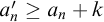











This ends the construction.
Verification: Much of the verification is the same as in Theorem 3.6. For example, to see that $\mathcal {A}$
is really a computable copy of
$\mathcal {A}$
is really a computable copy of ${(\omega , <)}$
we observe as before that for any fixed a there is some e such that elements are only inserted below a when for some stage s and some
${(\omega , <)}$
we observe as before that for any fixed a there is some e such that elements are only inserted below a when for some stage s and some $e' \leq e$
,
$e' \leq e$
, $X_{s+1}(e) \neq X_s(e)$
. Since X is
$X_{s+1}(e) \neq X_s(e)$
. Since X is $\Delta ^0_2$
, these eventually come to a limit, and so only finitely many elements are inserted below a.
$\Delta ^0_2$
, these eventually come to a limit, and so only finitely many elements are inserted below a.
It remains to show that $f^{\mathcal {A}} \equiv _T X$
. This is a little more complicated than in Theorem 3.6 due to the lateral movement from one coding sequence to a coding sequence it permits. The analogue of Claim 3.6.1 is as follows, and is proved in the same way.
$f^{\mathcal {A}} \equiv _T X$
. This is a little more complicated than in Theorem 3.6 due to the lateral movement from one coding sequence to a coding sequence it permits. The analogue of Claim 3.6.1 is as follows, and is proved in the same way.
Lemma 4.13. Suppose that $s < t$
.
$s < t$
.
-
(1) If, for all
$s'$
with
$s \leq s' \leq t$
we have
$X_{s'}(e) = X_{s}(e) = X_t(e)$
, then
$\mathsf {CS}_{e,s}$
is the same length as and permits
$\mathsf {CS}_{e,t}$
, say as witnessed by the f-preserving function
$\psi \colon [a_n,b_n] \to [a_n',b_n']$
on the last intervals of these coding sequences. Moreover,
$$\begin{align*}[a_n',b_n'] \supseteq \pi_{t}(\bar{v}_e[s]) = \psi (\pi_s(\bar{v}_e[s])) = \psi [a_n,b_n]. \end{align*}$$
-
(2) If
$s' \geq s$
is the least stage with
$X_{s'+1}(e) \neq X_{s'}(e)$
then
$\mathsf {CS}_{e,s}$
is the same length (say m) as and is either equal to or permits
$\mathsf {CS}_{e,s'}$
, as witnessed by the f-preserving function
$\psi \colon [a_m,b_m] \to [a_m',b_m']$
on the last intervals of these coding sequences, and
$\mathsf {CS}_{e,t}$
(say of length
$n> m$
) strictly extends
$\mathsf {CS}_{e,s'}$
. (If
$\mathsf {CS}_{e,s}$
and
$\mathsf {CS}_{e,s'}$
are the same then
$\psi $
is the identity.) Moreover,
$$\begin{align*}[a_n,b_n] \supseteq \pi_{t}(\bar{v}_e[s]) = \varphi_{m \mapsto n} \circ \psi (\pi_s(\bar{v}_e[s])) = \varphi_{m \mapsto n} \circ \psi [a_m,b_m]. \end{align*}$$
In particular, if m and n are the same parity then
$\varphi _{m \mapsto n} \circ \psi $
is f-preserving.








First we show that $f^{\mathcal {A}} \ge _T X$
. Given some element
$f^{\mathcal {A}} \ge _T X$
. Given some element $e \in X$
run the above construction, which is computable, until stage
$e \in X$
run the above construction, which is computable, until stage $e+1$
when the initial coding elements
$e+1$
when the initial coding elements $\bar {u}_e$
corresponding to e are added. Now, compute the value of
$\bar {u}_e$
corresponding to e are added. Now, compute the value of $f^{\mathcal {A}}$
on these elements. If
$f^{\mathcal {A}}$
on these elements. If $f^{\mathcal {A}}$
is the same on
$f^{\mathcal {A}}$
is the same on $\bar {u}_e$
as it was at stage
$\bar {u}_e$
as it was at stage $e+1$
, then
$e+1$
, then $X(e) = X_e(e+1)$
. Otherwise, if
$X(e) = X_e(e+1)$
. Otherwise, if $f^{\mathcal {A}}$
is different on
$f^{\mathcal {A}}$
is different on $\bar {u}_e$
than it was at stage
$\bar {u}_e$
than it was at stage $e+1$
, then
$e+1$
, then $X(e) = 1- X_e(e+1)$
.
$X(e) = 1- X_e(e+1)$
.
Finally, we show that $X \ge _T f^{\mathcal {A}}$
. Given some element
$X \ge _T f^{\mathcal {A}}$
. Given some element $a \in \mathcal {A}$
run the above construction until a is added to the linear order. If a is added as a padding element then the construction ensures that
$a \in \mathcal {A}$
run the above construction until a is added to the linear order. If a is added as a padding element then the construction ensures that $f^{\mathcal {A}}(a)$
does not change and so we take the value at this stage. If a is a coding element corresponding to e then
$f^{\mathcal {A}}(a)$
does not change and so we take the value at this stage. If a is a coding element corresponding to e then $f^{\mathcal {A}}(a)$
takes on one of two values depending on
$f^{\mathcal {A}}(a)$
takes on one of two values depending on $X(e)$
. Say that a first appears in
$X(e)$
. Say that a first appears in $\mathcal {A}$
at a stage s in a coding block
$\mathcal {A}$
at a stage s in a coding block $\bar {v}_e[s]$
, corresponding at that stage to
$\bar {v}_e[s]$
, corresponding at that stage to $[a_i,b_i]$
and with
$[a_i,b_i]$
and with $X_s(e) = k$
. If
$X_s(e) = k$
. If $X(e) = X_s(e) = k$
, then
$X(e) = X_s(e) = k$
, then $f^{\mathcal {A}}(a)$
is the same as it was at stage s. Otherwise, suppose that
$f^{\mathcal {A}}(a)$
is the same as it was at stage s. Otherwise, suppose that $X(e) \neq X_s(e) = k$
. Then, at some stage
$X(e) \neq X_s(e) = k$
. Then, at some stage $t> s$
, we find that
$t> s$
, we find that $X(e) = X_t(e) = 1-k$
. At this stage, a is an element of
$X(e) = X_t(e) = 1-k$
. At this stage, a is an element of $\bar {v}_e[t]$
which corresponds to
$\bar {v}_e[t]$
which corresponds to $[a_j,b_j]$
with j of a different parity from i. Then
$[a_j,b_j]$
with j of a different parity from i. Then $f^{\mathcal {A}}(a)$
is the same as it was at stage t.
$f^{\mathcal {A}}(a)$
is the same as it was at stage t.
Remark 4.14. Indeed, the proof can be used to show that all $\alpha $
-computable degrees are contained in the degree spectrum of f, where a set A is
$\alpha $
-computable degrees are contained in the degree spectrum of f, where a set A is $\alpha $
-computable if there is a computable approximation function
$\alpha $
-computable if there is a computable approximation function $g \colon \omega ^2 \to \{0,1\}$
and a computable counting function
$g \colon \omega ^2 \to \{0,1\}$
and a computable counting function $r \colon \omega ^2 \to \alpha $
such that:
$r \colon \omega ^2 \to \alpha $
such that:
-
(1) for all x,
$r(x,0) < \alpha $
, -
(2) for all x and s,
$r(x,s+1) \preceq r(x,s)$
, -
(3) if
$g(x,s+1) \neq g(x,s)$
then
$r(x,s+1) \prec r(x,s)$
, and -
(4)
$A(x) = \lim _{s \to \infty } g(x,s)$
.





The difference is that we do not require that $g(x,0) = 0$
, so that we may begin with
$g(x,0) = 0$
, so that we may begin with $x \notin A$
or
$x \notin A$
or $x \in A$
. An
$x \in A$
. An $\alpha $
-c.e. set is
$\alpha $
-c.e. set is $\alpha $
-computable but not necessarily vice versa. For degrees, the difference is mostly important when
$\alpha $
-computable but not necessarily vice versa. For degrees, the difference is mostly important when $\alpha $
is a limit ordinal.
$\alpha $
is a limit ordinal.
Example 4.15. Consider the function f from Theorem 3.7. It was shown that, given any f-coding sequence $[a_1, b_1], [a_2, b_2], \ldots $
, there must a link which is vulnerable in either
$[a_1, b_1], [a_2, b_2], \ldots $
, there must a link which is vulnerable in either $[a_2, b_2]$
or
$[a_2, b_2]$
or $[a_3, b_3]$
. We show that the minimal coding tree of f has
$[a_3, b_3]$
. We show that the minimal coding tree of f has $\operatorname {\mathrm {minrank}} \leq 3$
by showing any coding sequence with a vulnerable link has rank
$\operatorname {\mathrm {minrank}} \leq 3$
by showing any coding sequence with a vulnerable link has rank $0$
. Consider the case of a coding sequence
$0$
. Consider the case of a coding sequence $[a_1,b_1],[a_2,b_2],[a_3,b_3]$
with a link
$[a_1,b_1],[a_2,b_2],[a_3,b_3]$
with a link $\ell _1,\ldots ,\ell _k$
witnessed in
$\ell _1,\ldots ,\ell _k$
witnessed in $[a_2,b_2]$
which is vulnerable in
$[a_2,b_2]$
which is vulnerable in $[a_3,b_3]$
. (The case of a link witnessed in
$[a_3,b_3]$
. (The case of a link witnessed in $[a_1,b_1]$
which is vulnerable in
$[a_1,b_1]$
which is vulnerable in $[a_2,b_2]$
is similar.) Consider a coding sequence
$[a_2,b_2]$
is similar.) Consider a coding sequence $[a_1, b_1],[a_2,b_2],[a_3',b_3']$
which is permitted by
$[a_1, b_1],[a_2,b_2],[a_3',b_3']$
which is permitted by $[a_1, b_1], [a_2,b_2],[a_3,b_3]$
. The image in
$[a_1, b_1], [a_2,b_2],[a_3,b_3]$
. The image in $[a_3,b_3]$
under
$[a_3,b_3]$
under $\varphi _2$
of the link
$\varphi _2$
of the link $\ell _1,\ldots ,\ell _k$
in
$\ell _1,\ldots ,\ell _k$
in $[a_2,b_2]$
intersects, in
$[a_2,b_2]$
intersects, in $[a_3,b_3]$
, at least two blocks. Since any two blocks appear adjacent to each other in f at most once, the image of these blocks in
$[a_3,b_3]$
, at least two blocks. Since any two blocks appear adjacent to each other in f at most once, the image of these blocks in $[a_3',b_3']$
under
$[a_3',b_3']$
under $\psi $
are not adjacent and so have some element between them. But
$\psi $
are not adjacent and so have some element between them. But $\psi \circ \varphi _2$
is the map
$\psi \circ \varphi _2$
is the map $\varphi _2' \colon [a_2,b_2] \to [a_3',b_3']$
from the coding sequence
$\varphi _2' \colon [a_2,b_2] \to [a_3',b_3']$
from the coding sequence $[a_1, b_1],[a_2,b_2],[a_3',b_3']$
, and so in
$[a_1, b_1],[a_2,b_2],[a_3',b_3']$
, and so in $[a_3',b_3']$
the image of
$[a_3',b_3']$
the image of $\ell _1,\ldots ,\ell _k$
under
$\ell _1,\ldots ,\ell _k$
under $\varphi _2'$
intersects two blocks which have had some element, not in the image of the link, between them. That is,
$\varphi _2'$
intersects two blocks which have had some element, not in the image of the link, between them. That is, $\ell _1,\ldots ,\ell _k$
is actually broken in
$\ell _1,\ldots ,\ell _k$
is actually broken in $[a_3',b_3']$
. Thus the coding sequence
$[a_3',b_3']$
. Thus the coding sequence $[a_1, b_1],[a_2,b_2],[a_3',b_3']$
has no extensions and is of
$[a_1, b_1],[a_2,b_2],[a_3',b_3']$
has no extensions and is of $\operatorname {\mathrm {minrank}}$
zero. Since
$\operatorname {\mathrm {minrank}}$
zero. Since $[a_1, b_1], [a_2,b_2],[a_3,b_3]$
only permits coding sequences of
$[a_1, b_1], [a_2,b_2],[a_3,b_3]$
only permits coding sequences of $\operatorname {\mathrm {minrank}}$
zero, it also has
$\operatorname {\mathrm {minrank}}$
zero, it also has $\operatorname {\mathrm {minrank}}$
zero. Thus
$\operatorname {\mathrm {minrank}}$
zero. Thus $\operatorname {\mathrm {minrank}}(f) \leq 3$
as any coding sequence with three elements has
$\operatorname {\mathrm {minrank}}(f) \leq 3$
as any coding sequence with three elements has $\operatorname {\mathrm {minrank}}$
zero.
$\operatorname {\mathrm {minrank}}$
zero.
It is not hard to show that $\operatorname {\mathrm {minrank}}(f) \geq 3$
so that
$\operatorname {\mathrm {minrank}}(f) \geq 3$
so that $\operatorname {\mathrm {minrank}}(f) = 3$
. Let
$\operatorname {\mathrm {minrank}}(f) = 3$
. Let $\ell < m < n$
. Consider the coding sequences
$\ell < m < n$
. Consider the coding sequences $[a_1,b_1]$
where
$[a_1,b_1]$
where $[a_1,b_1]$
has block type
$[a_1,b_1]$
has block type $L_\ell $
, an
$L_\ell $
, an $\ell $
-loop. For any two such coding sequences, the lesser one permits the greater one. These coding sequences can be extended to coding sequences
$\ell $
-loop. For any two such coding sequences, the lesser one permits the greater one. These coding sequences can be extended to coding sequences $[a_1,b_1],[a_2,b_2]$
where
$[a_1,b_1],[a_2,b_2]$
where $[a_2,b_2]$
has block type
$[a_2,b_2]$
has block type $L_m$
, and m-loop, say under the map
$L_m$
, and m-loop, say under the map $\varphi _1 \colon [a_1,b_1] \mapsto [a_2,a_2 + b_1 - a_1]\subseteq [a_2,b_2]$
. For any two such coding sequences with the same first interval
$\varphi _1 \colon [a_1,b_1] \mapsto [a_2,a_2 + b_1 - a_1]\subseteq [a_2,b_2]$
. For any two such coding sequences with the same first interval $[a_1,b_1]$
, the lesser one permits the greater one. Finally, any such sequence
$[a_1,b_1]$
, the lesser one permits the greater one. Finally, any such sequence $[a_1,b_1],[a_2,b_2]$
extends to a sequence
$[a_1,b_1],[a_2,b_2]$
extends to a sequence $[a_1,b_1],[a_2,b_2],[a_3,b_3]$
where the image of
$[a_1,b_1],[a_2,b_2],[a_3,b_3]$
where the image of $[a_2,b_2]$
in
$[a_2,b_2]$
in $[a_3,b_3]$
is made up of two blocks, one of block type
$[a_3,b_3]$
is made up of two blocks, one of block type $L_\ell $
, and the other of block type
$L_\ell $
, and the other of block type $L_n$
.
$L_n$
. $[a_3,b_3]$
may have further blocks in between these. This shows that any
$[a_3,b_3]$
may have further blocks in between these. This shows that any $[a_1,b_1],[a_2,b_2]$
as above has
$[a_1,b_1],[a_2,b_2]$
as above has $\operatorname {\mathrm {minrank}}$
one, and any
$\operatorname {\mathrm {minrank}}$
one, and any $[a_1,b_1]$
as above has
$[a_1,b_1]$
as above has $\operatorname {\mathrm {minrank}}$
two. Thus
$\operatorname {\mathrm {minrank}}$
two. Thus $\operatorname {\mathrm {minrank}}(f) = 3$
.
$\operatorname {\mathrm {minrank}}(f) = 3$
.
Theorems 4.9 and 4.12 only tell us that on a cone the degree spectrum of this function f contains all 2-c.e. degrees but not all 6-c.e. degrees, but does not give any information about the degrees between these. A more ad-hoc argument can be given to show that, in fact, the degree spectrum of f does not contain all 3-c.e. degrees. This argument relies on the fact that any sequence permitting a vulnerable sequence has rank 0 and so this can be accounted for ahead of time in the priority argument by reserving an element which will force the coding sequence produced by the function to move to one which is permitted by it. However, one could imagine this will not happen more generally for any function of $\operatorname {\mathrm {minrank}}$
three as this argument depends on the number of times one sequence permits a vulnerable sequence before decreasing its maximal rank. In fact, we believe that one could produce an example of a function with minimal rank 3 and maximal rank 6 but whose degree spectrum contains all 4-c.e. degrees. So, the difference between the minimal and maximal ranks arises not from a difference in the lengths of the coding sequences, but from the more complicated behavior underlying which sequences permit each other. We believe that by coming up examples with different permitting behaviours, one might be able to find, e.g., incomparable degree spectra on a cone.
$\operatorname {\mathrm {minrank}}$
three as this argument depends on the number of times one sequence permits a vulnerable sequence before decreasing its maximal rank. In fact, we believe that one could produce an example of a function with minimal rank 3 and maximal rank 6 but whose degree spectrum contains all 4-c.e. degrees. So, the difference between the minimal and maximal ranks arises not from a difference in the lengths of the coding sequences, but from the more complicated behavior underlying which sequences permit each other. We believe that by coming up examples with different permitting behaviours, one might be able to find, e.g., incomparable degree spectra on a cone.
Conjecture 4.16. There are block functions f and g on ${(\omega ,<)}$
whose degree spectra on a cone are incomparable.
${(\omega ,<)}$
whose degree spectra on a cone are incomparable.
We will give some examples in this article but we will focus on cases in which the minimal and maximal coding trees match up at various ordinals $\alpha $
. We say that an ordinal
$\alpha $
. We say that an ordinal $\alpha $
is even if it is of the form
$\alpha $
is even if it is of the form $\lambda + n$
where
$\lambda + n$
where $\lambda $
is a limit ordinal and
$\lambda $
is a limit ordinal and $n \in \omega $
is even; otherwise, we say that
$n \in \omega $
is even; otherwise, we say that $\alpha $
is odd, in which case it is of the form
$\alpha $
is odd, in which case it is of the form $\lambda + n$
with n odd.
$\lambda + n$
with n odd.
Theorem 4.17. Fix $\alpha \geq 6$
even. There is a block function f on
$\alpha \geq 6$
even. There is a block function f on ${(\omega ,<)}$
whose degree spectrum on a cone contains all of the
${(\omega ,<)}$
whose degree spectrum on a cone contains all of the $\beta $
-c.e. degrees for
$\beta $
-c.e. degrees for $\beta < \alpha $
and does not contain all of the
$\beta < \alpha $
and does not contain all of the $\alpha $
-c.e. degrees.
$\alpha $
-c.e. degrees.
Proof. Let $T \subseteq \omega ^{<\omega }$
be a tree of rank
$T \subseteq \omega ^{<\omega }$
be a tree of rank $\alpha $
, with rank function
$\alpha $
, with rank function $\operatorname {\mathrm {rank}} \colon T \to \alpha \cup \{\alpha \}$
. Thus
$\operatorname {\mathrm {rank}} \colon T \to \alpha \cup \{\alpha \}$
. Thus $\operatorname {\mathrm {rank}}(\varnothing ) = \alpha $
is even. We may choose T such that for each
$\operatorname {\mathrm {rank}}(\varnothing ) = \alpha $
is even. We may choose T such that for each $\sigma \in T$
,
$\sigma \in T$
, $\operatorname {\mathrm {rank}}(\sigma )$
has the same parity as the length of
$\operatorname {\mathrm {rank}}(\sigma )$
has the same parity as the length of $\sigma $
, i.e., if
$\sigma $
, i.e., if $\sigma $
is of even length then
$\sigma $
is of even length then $\operatorname {\mathrm {rank}}(\sigma )$
is an even ordinal, and if
$\operatorname {\mathrm {rank}}(\sigma )$
is an even ordinal, and if $\sigma $
is of odd length then
$\sigma $
is of odd length then $\operatorname {\mathrm {rank}}(\sigma )$
is an odd ordinal.
$\operatorname {\mathrm {rank}}(\sigma )$
is an odd ordinal.
Fix some Gödel numbering $\ell $
of the elements of
$\ell $
of the elements of $\omega ^{<\omega }$
. For each
$\omega ^{<\omega }$
. For each $\sigma = \langle a_0,\ldots ,a_n \rangle \in \omega ^{<\omega }$
, with
$\sigma = \langle a_0,\ldots ,a_n \rangle \in \omega ^{<\omega }$
, with $\sigma \neq \varnothing $
, associate with
$\sigma \neq \varnothing $
, associate with $\sigma $
the following block type
$\sigma $
the following block type $B_\sigma $
:
$B_\sigma $
:
 $$\begin{align*}x_0 + L_{2^{\ell({\sigma \upharpoonright 0})+2}} + L_{2^{\ell({\sigma \upharpoonright 1})+2}}+ \cdots + L_{2^{\ell({\sigma \upharpoonright n})+2}} + x_1 + x_2+x_3,\end{align*}$$
where if $|\sigma |$
is even we let
$|\sigma |$
is even we let
 $$\begin{align*}x_0 \to x_3 \to x_2 \to x_1 \to x_1\end{align*}$$
and if $|\sigma |$
is odd we let
$|\sigma |$
is odd we let
 $$\begin{align*}x_0 \to x_3 \to x_2 \to x_1 \to x_2.\end{align*}$$
We call $x_0,x_1,x_2,x_3$
the sandwich elements of the block.
$x_0,x_1,x_2,x_3$
the sandwich elements of the block.
Notice that each of these blocks have different lengths (in base 2 their lengths have 1’s in positions uniquely determined by the initial segments of $\sigma $
) and that each of their lengths are even. Now, we define f as follows: The even blocks are the sequence
$\sigma $
) and that each of their lengths are even. Now, we define f as follows: The even blocks are the sequence $L_1, L_3, L_5, \ldots $
of loops of odd lengths. The odd blocks are given by
$L_1, L_3, L_5, \ldots $
of loops of odd lengths. The odd blocks are given by $B_{\sigma _{1}}, L_{j(1)}, B_{\sigma _{2}}, L_{j(1)}, \ldots $
where
$B_{\sigma _{1}}, L_{j(1)}, B_{\sigma _{2}}, L_{j(1)}, \ldots $
where $\sigma _1, \sigma _2, \ldots $
is a recursive enumeration of the elements of T where each element appears infinitely often. Similarly, j is a recursive enumeration of the odd integers such that each element appears infinitely often but with the additional condition that
$\sigma _1, \sigma _2, \ldots $
is a recursive enumeration of the elements of T where each element appears infinitely often. Similarly, j is a recursive enumeration of the odd integers such that each element appears infinitely often but with the additional condition that $j(i) \le 2i+1$
for all i. As in Theorem 3.7, f satisfies the following properties:
$j(i) \le 2i+1$
for all i. As in Theorem 3.7, f satisfies the following properties:
-
• all blocks that occur in the function occur infinitely often;
-
• no two different block types that occur in the function have the same size;
-
• no two blocks types are adjacent (in the same order) more than once.
There was one property in Theorem 3.7 that now fails: previously, no block type embedded into any other block type, but now there are many block types which embed into each other. The reader should note that the first bullet point is the reason that we include the blocks $L_{j(i)}$
along the odd sequence of blocks, and is what allows the degree spectrum of f on a cone to contain non-c.e. degrees. They play no other role in the proof. The requirement that
$L_{j(i)}$
along the odd sequence of blocks, and is what allows the degree spectrum of f on a cone to contain non-c.e. degrees. They play no other role in the proof. The requirement that $j(i) \le 2i+1$
helps ensure the third bullet point.
$j(i) \le 2i+1$
helps ensure the third bullet point.
Notice that T embeds into the minimal coding tree of f. Given $\sigma \in T$
we can associate to it the coding sequence
$\sigma \in T$
we can associate to it the coding sequence $[a_1, b_1], \ldots , [a_{|\sigma |}, b_{|\sigma |}]$
where
$[a_1, b_1], \ldots , [a_{|\sigma |}, b_{|\sigma |}]$
where $[a_i, b_i]$
is an interval with
$[a_i, b_i]$
is an interval with $a_i> b_{i-1}$
and which is a block of the form
$a_i> b_{i-1}$
and which is a block of the form $B_{\sigma \upharpoonright i}$
. (Note that there is no block for the empty sequence, but rather the root of T maps to the empty coding sequence.) The maps
$B_{\sigma \upharpoonright i}$
. (Note that there is no block for the empty sequence, but rather the root of T maps to the empty coding sequence.) The maps $\varphi _i: B_{\sigma \upharpoonright i} \to B_{\sigma \upharpoonright (i+1)}$
are the natural maps sending each
$\varphi _i: B_{\sigma \upharpoonright i} \to B_{\sigma \upharpoonright (i+1)}$
are the natural maps sending each $x_j$
in one block to the corresponding
$x_j$
in one block to the corresponding $x_j$
in the other block, and sending each loop to the loop of the same length. For each
$x_j$
in the other block, and sending each loop to the loop of the same length. For each $\sigma $
this will be an f-coding sequence; it is important here how we have defined f on
$\sigma $
this will be an f-coding sequence; it is important here how we have defined f on $x_0,\ldots ,x_3$
differently for odd and even
$x_0,\ldots ,x_3$
differently for odd and even $\sigma $
. Also these coding sequences will be in the minimal coding tree since each interval in the sequence is a single block and so, since each block appears infinitely often, is always permitted by some later copy of the block. By Theorem 4.12, the degree spectra of f contain all
$\sigma $
. Also these coding sequences will be in the minimal coding tree since each interval in the sequence is a single block and so, since each block appears infinitely often, is always permitted by some later copy of the block. By Theorem 4.12, the degree spectra of f contain all $\beta $
-c.e. degrees for
$\beta $
-c.e. degrees for $\beta < \alpha $
.
$\beta < \alpha $
.
We consider two possible types of coding sequences. In $[a_1,b_1]$
there must be some element x such that
$[a_1,b_1]$
there must be some element x such that $\varphi _1(f(x)) \neq f(\varphi _1(x))$
. In
$\varphi _1(f(x)) \neq f(\varphi _1(x))$
. In $[a_1,b_1]$
this element is part of a block, say of type I. Consider the image of this block in
$[a_1,b_1]$
this element is part of a block, say of type I. Consider the image of this block in $[a_2,b_2]$
under
$[a_2,b_2]$
under $\varphi _1$
. If the image is split between two different blocks, then we have a link in
$\varphi _1$
. If the image is split between two different blocks, then we have a link in $[a_1,b_1]$
that becomes vulnerable in
$[a_1,b_1]$
that becomes vulnerable in $[a_2,b_2]$
. Otherwise, the image is contained entirely in one block, say of type J. Now this block embeds, by
$[a_2,b_2]$
. Otherwise, the image is contained entirely in one block, say of type J. Now this block embeds, by $\varphi _2$
, in
$\varphi _2$
, in $[a_3,b_3]$
. If the image is split between two different blocks, then we have a link in
$[a_3,b_3]$
. If the image is split between two different blocks, then we have a link in $[a_2,b_2]$
that becomes vulnerable in
$[a_2,b_2]$
that becomes vulnerable in $[a_3,b_3]$
. Otherwise, the entire image is contained in a single block, say of type K. We will concentrate on this case, returning later to the two cases of a link that becomes vulnerable.
$[a_3,b_3]$
. Otherwise, the entire image is contained in a single block, say of type K. We will concentrate on this case, returning later to the two cases of a link that becomes vulnerable.
We may assume, without loss of generality by shrinking intervals, that $[a_0,b_0]$
is a block of type I, and that each
$[a_0,b_0]$
is a block of type I, and that each $[a_{n+1},b_{n+1}]$
is the closure, under blocks, of the image of
$[a_{n+1},b_{n+1}]$
is the closure, under blocks, of the image of $[a_n,b_n]$
under
$[a_n,b_n]$
under $\varphi _n$
. In particular,
$\varphi _n$
. In particular, $[a_1,b_1]$
is a block of type J, and
$[a_1,b_1]$
is a block of type J, and $[a_2,b_2]$
is a block of type K. Since no two distinct block types have the same size, J must be larger than I, and so K must be larger than I. In particular, I must be a block of type
$[a_2,b_2]$
is a block of type K. Since no two distinct block types have the same size, J must be larger than I, and so K must be larger than I. In particular, I must be a block of type $B_{\sigma _1}$
and K of type
$B_{\sigma _1}$
and K of type $B_{\sigma _3}$
for some
$B_{\sigma _3}$
for some $\sigma _1 \prec \sigma _3$
whose lengths have the same parity. Let
$\sigma _1 \prec \sigma _3$
whose lengths have the same parity. Let $x_0,x_1,x_2,x_3$
be the four sandwich elements from I with either
$x_0,x_1,x_2,x_3$
be the four sandwich elements from I with either
 $$\begin{align*}x_0 \to x_3 \to x_2 \to x_1 \to x_1\end{align*}$$
or
 $$\begin{align*}x_0 \to x_3 \to x_2 \to x_1 \to x_2.\end{align*}$$
The only elements of this kind are the four sandwich elements from a block $B_\tau $
. Thus the f-preserving map
$B_\tau $
. Thus the f-preserving map $\varphi _{1 \mapsto 3} \colon [a_1,b_1] \to [a_3,b_3]$
must map the sandwich elements of I to those of K, i.e.,
$\varphi _{1 \mapsto 3} \colon [a_1,b_1] \to [a_3,b_3]$
must map the sandwich elements of I to those of K, i.e.,
 $$\begin{align*}a_1 \mapsto a_3, \qquad b_1-2 \mapsto b_3-2, \qquad b_1-1 \mapsto b_3 - 1, \qquad b_1 \mapsto b_3.\end{align*}$$
Then $\varphi _1$
must map the sandwich elements of I to those of J,
$\varphi _1$
must map the sandwich elements of I to those of J,
 $$\begin{align*}a_1 \mapsto a_2, \qquad b_1-2 \mapsto b_2-2, \qquad b_1-1 \mapsto b_2 - 1, \qquad b_1 \mapsto b_2,\end{align*}$$
and $\varphi _2$
must map the sandwich elements of J to those of K,
$\varphi _2$
must map the sandwich elements of J to those of K,
 $$\begin{align*}a_2 \mapsto a_3, \qquad b_2-2 \mapsto b_3-2, \qquad b_2-1 \mapsto b_3 - 1, \qquad b_2 \mapsto b_3.\end{align*}$$
(For example, if $a_1$
did not map to
$a_1$
did not map to $a_2$
, then we would have
$a_2$
, then we would have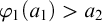 $\varphi _1(a_1)> a_2$
and so
$\varphi _1(a_1)> a_2$
and so $a_3 = \varphi _2(\varphi (a_1))> \varphi _2(a_2) \geq a_3$
.) That is, in the maps
$a_3 = \varphi _2(\varphi (a_1))> \varphi _2(a_2) \geq a_3$
.) That is, in the maps $I \to J \to K$
induced by
$I \to J \to K$
induced by $\varphi _1$
and
$\varphi _1$
and $\varphi _2$
, the sandwich elements are mapped to each other. The map
$\varphi _2$
, the sandwich elements are mapped to each other. The map $\varphi _{2 \mapsto 4} \colon [a_2,b_2] \to [a_4,b_4]$
, since it preserves f, must map the sandwich elements of J to the sandwich elements of another block, say of type M. Moreover, arguing similarly,
$\varphi _{2 \mapsto 4} \colon [a_2,b_2] \to [a_4,b_4]$
, since it preserves f, must map the sandwich elements of J to the sandwich elements of another block, say of type M. Moreover, arguing similarly, $\varphi _3$
must map the elements of K inside of M while mapping sandwich elements to sandwich elements. Continuing in this way, the sequence
$\varphi _3$
must map the elements of K inside of M while mapping sandwich elements to sandwich elements. Continuing in this way, the sequence $[a_1,b_1],[a_2,b_2],\ldots $
must consist of blocks of the form
$[a_1,b_1],[a_2,b_2],\ldots $
must consist of blocks of the form $B_{\sigma _1},B_{\tau _1},B_{\sigma _2},B_{\tau _2},\ldots $
where
$B_{\sigma _1},B_{\tau _1},B_{\sigma _2},B_{\tau _2},\ldots $
where $\sigma _1 \prec \sigma _2 \prec \cdots $
and
$\sigma _1 \prec \sigma _2 \prec \cdots $
and $\tau _1 \prec \tau _2 \prec \cdots $
. Moreover, the lengths of the
$\tau _1 \prec \tau _2 \prec \cdots $
. Moreover, the lengths of the $\sigma _i$
are all of the same parity as each other, and the lengths of the
$\sigma _i$
are all of the same parity as each other, and the lengths of the $\tau _i$
are also of the same parity as each other. None of the
$\tau _i$
are also of the same parity as each other. None of the $\sigma _i$
and
$\sigma _i$
and $\tau _i$
are
$\tau _i$
are $\varnothing $
, the root of T. Thus in T,
$\varnothing $
, the root of T. Thus in T, $\operatorname {\mathrm {rank}}(\sigma _i),\operatorname {\mathrm {rank}}(\tau _i) < \alpha $
.
$\operatorname {\mathrm {rank}}(\sigma _i),\operatorname {\mathrm {rank}}(\tau _i) < \alpha $
.
Now we return to the cases we skipped where there is a link which becomes vulnerable, and argue that any such f-coding sequence has length at most $5$
: For any f-coding sequence
$5$
: For any f-coding sequence $[a_1, b_1], [a_2, b_2], \ldots $
and maps
$[a_1, b_1], [a_2, b_2], \ldots $
and maps $\varphi _i$
, as shown in Theorem 3.7, if there is some link in
$\varphi _i$
, as shown in Theorem 3.7, if there is some link in $[a_i, b_i]$
which is vulnerable in
$[a_i, b_i]$
which is vulnerable in $[a_j, b_j]$
then the link will be broken by
$[a_j, b_j]$
then the link will be broken by $[a_{j+2}, b_{j+2}]$
and so the coding sequence must terminate.
$[a_{j+2}, b_{j+2}]$
and so the coding sequence must terminate.
Thus, in the maximal coding tree, we have certain (finite) maximal paths of length $\leq 6$
, e.g., those consisting of an f-coding sequence where a link becomes vulnerable,Footnote
9
and all other paths are induced by a pair of paths through T. This will imply, since
$\leq 6$
, e.g., those consisting of an f-coding sequence where a link becomes vulnerable,Footnote
9
and all other paths are induced by a pair of paths through T. This will imply, since $\alpha \geq 5$
, that the rank of the maximal coding tree is at most
$\alpha \geq 5$
, that the rank of the maximal coding tree is at most $\alpha $
. Indeed, consider the tree
$\alpha $
. Indeed, consider the tree $T^*$
of pairs of finite sequences
$T^*$
of pairs of finite sequences $\langle \sigma _1,\tau _1,\sigma _2,\tau _2,\dots , \rangle $
of non-root elements of T such that (a)
$\langle \sigma _1,\tau _1,\sigma _2,\tau _2,\dots , \rangle $
of non-root elements of T such that (a) $\sigma _1 \prec \sigma _2 \prec \cdots $
and
$\sigma _1 \prec \sigma _2 \prec \cdots $
and $\tau _1 \prec \tau _2 \prec \cdots $
, (b) the lengths of the
$\tau _1 \prec \tau _2 \prec \cdots $
, (b) the lengths of the $\sigma _i$
are all of the same parity as each other, and (c) the lengths of the
$\sigma _i$
are all of the same parity as each other, and (c) the lengths of the $\tau _i$
are also of the same parity as each other. By (b) and (c), the ranks of the
$\tau _i$
are also of the same parity as each other. By (b) and (c), the ranks of the $\sigma _i$
are either all even or all odd, and similarly for the
$\sigma _i$
are either all even or all odd, and similarly for the $\tau _i$
. Since each
$\tau _i$
. Since each $\sigma _i$
and
$\sigma _i$
and $\tau _i$
is not the root
$\tau _i$
is not the root $\varnothing $
of T, their ranks are all
$\varnothing $
of T, their ranks are all $< \alpha $
. Let
$< \alpha $
. Let $\operatorname {\mathrm {rank}}^*$
be the rank function on this tree
$\operatorname {\mathrm {rank}}^*$
be the rank function on this tree $T^*$
, which is clearly well-founded. Other than the f-coding sequences where a link becomes vulnerable, all f-coding sequences correspond to paths through
$T^*$
, which is clearly well-founded. Other than the f-coding sequences where a link becomes vulnerable, all f-coding sequences correspond to paths through $T^*$
, and so by bounding the rank of
$T^*$
, and so by bounding the rank of $T^*$
we can bound the rank of the maximal coding tree. We prove the following four claims to calculate
$T^*$
we can bound the rank of the maximal coding tree. We prove the following four claims to calculate $\operatorname {\mathrm {rank}}^*(T^*)$
.
$\operatorname {\mathrm {rank}}^*(T^*)$
.
Claim 4.17.1. If $\operatorname {\mathrm {rank}}(\sigma _n)$
is even then
$\operatorname {\mathrm {rank}}(\sigma _n)$
is even then
 $$\begin{align*}\operatorname{\mathrm{rank}}^*(\langle \sigma_1,\tau_1,\sigma_2,\tau_2,\ldots,\tau_{n-1},\sigma_n \rangle) \leq \operatorname{\mathrm{rank}}(\sigma_n)+1,\end{align*}$$
and if $\operatorname {\mathrm {rank}}(\sigma _n)$
is odd then
$\operatorname {\mathrm {rank}}(\sigma _n)$
is odd then
 $$\begin{align*}\operatorname{\mathrm{rank}}^*(\langle \sigma_1,\tau_1,\sigma_2,\tau_2,\ldots,\tau_{n-1},\sigma_n \rangle) \leq \operatorname{\mathrm{rank}}(\sigma_n).\end{align*}$$
If $\operatorname {\mathrm {rank}}(\tau _{n-1})$
is even then
$\operatorname {\mathrm {rank}}(\tau _{n-1})$
is even then
 $$\begin{align*}\operatorname{\mathrm{rank}}^*(\langle \sigma_1,\tau_1,\sigma_2,\tau_2,\ldots,\tau_{n-1},\sigma_n \rangle) \leq \operatorname{\mathrm{rank}}(\tau_{n-1}),\end{align*}$$
and if $\operatorname {\mathrm {rank}}(\tau _{n-1})$
is odd then
$\operatorname {\mathrm {rank}}(\tau _{n-1})$
is odd then
 $$\begin{align*}\operatorname{\mathrm{rank}}^*(\langle \sigma_1,\tau_1,\sigma_2,\tau_2,\ldots,\tau_{n-1},\sigma_n \rangle) \leq \operatorname{\mathrm{rank}}(\tau_{n-1})-1.\end{align*}$$
Proof. We argue inductively. Suppose that we have $\langle \sigma _1,\tau _1,\sigma _2,\tau _2,\ldots ,\tau _{n-1},\sigma _n,\tau _n \rangle $
an extension of rank
$\langle \sigma _1,\tau _1,\sigma _2,\tau _2,\ldots ,\tau _{n-1},\sigma _n,\tau _n \rangle $
an extension of rank $\beta $
extending
$\beta $
extending $\langle \sigma _1,\tau _1,\sigma _2,\tau _2,\ldots ,\tau _{n-1},\sigma _n \rangle $
. We have several cases to check.
$\langle \sigma _1,\tau _1,\sigma _2,\tau _2,\ldots ,\tau _{n-1},\sigma _n \rangle $
. We have several cases to check.
-
• Suppose
$\operatorname {\mathrm {rank}}(\tau _{n-1})$
and
$\operatorname {\mathrm {rank}}(\tau _{n})$
are both even. Then, inductively,
$\beta \leq \operatorname {\mathrm {rank}}(\tau _n)+1$
. Since
$\tau _{n}$
is an extension of
$\tau _{n-1}$
and
$\operatorname {\mathrm {rank}}(\tau _n)$
is at least two less than
$\operatorname {\mathrm {rank}}(\tau _{n-1})$
,
$\beta + 1 \leq \operatorname {\mathrm {rank}}(\tau _n) + 2 \leq \operatorname {\mathrm {rank}}(\tau _{n-1})$
and so
$$\begin{align*}\operatorname{\mathrm{rank}}^*(\langle \sigma_1,\tau_1,\sigma_2,\tau_2,\ldots,\tau_{n-1},\sigma_n \rangle) \leq \operatorname{\mathrm{rank}}(\tau_{n-1}).\end{align*}$$
-
• Suppose that
$\operatorname {\mathrm {rank}}(\tau _{n-1})$
and
$\operatorname {\mathrm {rank}}(\tau _n)$
are both odd. Then, inductively,
$\beta \leq \operatorname {\mathrm {rank}}(\tau _n)$
. Since
$\operatorname {\mathrm {rank}}(\tau _{n})$
is at least two less than
$\operatorname {\mathrm {rank}}(\tau _{n-1})$
,
$\beta + 1 \leq \operatorname {\mathrm {rank}}(\tau _n) + 1 \leq \operatorname {\mathrm {rank}}(\tau _{n-1}) - 1$
and so
$$\begin{align*}\operatorname{\mathrm{rank}}^*(\langle \sigma_1,\tau_1,\sigma_2,\tau_2,\ldots,\tau_{n-1},\sigma_n \rangle) \leq \operatorname{\mathrm{rank}}(\tau_{n-1})-1.\end{align*}$$
-
• Suppose that
$\operatorname {\mathrm {rank}}(\sigma _n)$
is even. Then, inductively,
$\beta \leq \operatorname {\mathrm {rank}}(\sigma _n)$
and so
$\beta +1 \leq \operatorname {\mathrm {rank}}(\sigma _n)+1$
. Thus
$$\begin{align*}\operatorname{\mathrm{rank}}^*(\langle \sigma_1,\tau_1,\sigma_2,\tau_2,\ldots,\tau_{n-1},\sigma_n \rangle) \leq \operatorname{\mathrm{rank}}(\sigma_n)+1.\end{align*}$$
-
• Suppose that
$\operatorname {\mathrm {rank}}(\sigma _n)$
is odd. Then, inductively,
$\beta \leq \operatorname {\mathrm {rank}}(\sigma _n)-1$
and so
$\beta +1 \leq \operatorname {\mathrm {rank}}(\sigma _n)$
. Thus
$$\begin{align*}\operatorname{\mathrm{rank}}^*(\langle \sigma_1,\tau_1,\sigma_2,\tau_2,\ldots,\tau_{n-1},\sigma_n \rangle) \leq \operatorname{\mathrm{rank}}(\sigma_n).\\[-32pt]\end{align*}$$
















Claim 4.17.2. If $\operatorname {\mathrm {rank}}(\tau _n)$
is even then
$\operatorname {\mathrm {rank}}(\tau _n)$
is even then
 $$\begin{align*}\operatorname{\mathrm{rank}}^*(\langle \sigma_1,\tau_1,\sigma_2,\tau_2,\ldots,\sigma_n,\tau_n \rangle) \leq \operatorname{\mathrm{rank}}(\tau_n)+1,\end{align*}$$
and if $\operatorname {\mathrm {rank}}(\tau _n)$
is odd then
$\operatorname {\mathrm {rank}}(\tau _n)$
is odd then
 $$\begin{align*}\operatorname{\mathrm{rank}}^*(\langle \sigma_1,\tau_1,\sigma_2,\tau_2,\ldots,\sigma_n,\tau_n \rangle) \leq \operatorname{\mathrm{rank}}(\tau_n).\end{align*}$$
If $\operatorname {\mathrm {rank}}(\sigma _n)$
is even then
$\operatorname {\mathrm {rank}}(\sigma _n)$
is even then
 $$\begin{align*}\operatorname{\mathrm{rank}}^*(\langle \sigma_1,\tau_1,\sigma_2,\tau_2,\ldots,\sigma_n,\tau_n \rangle) \leq \operatorname{\mathrm{rank}}(\sigma_n),\end{align*}$$
and if $\operatorname {\mathrm {rank}}(\sigma _n)$
is odd then
$\operatorname {\mathrm {rank}}(\sigma _n)$
is odd then
 $$\begin{align*}\operatorname{\mathrm{rank}}^*(\langle \sigma_1,\tau_1,\sigma_2,\tau_2,\ldots,\sigma_n,\tau_n \rangle) \leq \operatorname{\mathrm{rank}}(\sigma_n)-1.\end{align*}$$
Proof. This can be argued similarly to the previous claim.
Claim 4.17.3. If $\operatorname {\mathrm {rank}}(\sigma _1)$
is even then
$\operatorname {\mathrm {rank}}(\sigma _1)$
is even then
 $$\begin{align*}\operatorname{\mathrm{rank}}^*(\langle \sigma_1 \rangle) \leq \operatorname{\mathrm{rank}}(\sigma_1)+1,\end{align*}$$
and if $\operatorname {\mathrm {rank}}(\sigma _1)$
is odd then
$\operatorname {\mathrm {rank}}(\sigma _1)$
is odd then
 $$\begin{align*}\operatorname{\mathrm{rank}}^*(\langle \sigma_1 \rangle) \leq \operatorname{\mathrm{rank}}(\sigma_1).\end{align*}$$
Proof. We have two cases. Suppose $\langle \sigma _1,\tau _1 \rangle $
is an extension of
$\langle \sigma _1,\tau _1 \rangle $
is an extension of $\langle \sigma _1 \rangle $
of rank
$\langle \sigma _1 \rangle $
of rank $\beta $
.
$\beta $
.
-
• If
$\operatorname {\mathrm {rank}}(\sigma _1)$
is even then
$\beta \leq \operatorname {\mathrm {rank}}(\sigma _1)$
and so
$\beta + 1 < \operatorname {\mathrm {rank}}(\sigma _1)+1$
. Thus
$$\begin{align*}\operatorname{\mathrm{rank}}^*(\langle \sigma_1 \rangle) \leq \operatorname{\mathrm{rank}}(\sigma_1)+1.\end{align*}$$
-
• If
$\operatorname {\mathrm {rank}}(\sigma _1)$
is odd then
$\beta \leq \operatorname {\mathrm {rank}}(\sigma _1) - 1$
and so
$\beta + 1 \leq \operatorname {\mathrm {rank}}(\sigma _1)$
. Thus
$$\begin{align*}\operatorname{\mathrm{rank}}^*(\langle \sigma_1 \rangle) \leq \operatorname{\mathrm{rank}}(\sigma_1).\\[-32pt]\end{align*}$$








Claim 4.17.4. Recalling that $\alpha $
is even,
$\alpha $
is even,
 $$\begin{align*}\operatorname{\mathrm{rank}}^*(\varnothing) \leq \alpha.\end{align*}$$
Proof. Suppose that $\langle \sigma _1 \rangle $
is an extension of
$\langle \sigma _1 \rangle $
is an extension of $\varnothing $
of rank
$\varnothing $
of rank $\beta $
. Then we have two cases.
$\beta $
. Then we have two cases.
-
• If
$\operatorname {\mathrm {rank}}(\sigma _1)$
is odd, then
$\beta \leq \operatorname {\mathrm {rank}}(\sigma _1) < \alpha $
. Thus
$\beta +1 \leq \alpha $
and so
$$\begin{align*}\operatorname{\mathrm{rank}}^*(\varnothing) \leq \alpha.\end{align*}$$
-
• If
$\operatorname {\mathrm {rank}}(\sigma _1)$
is even then
$\beta \leq \operatorname {\mathrm {rank}}(\sigma _1) +1$
. Since
$\operatorname {\mathrm {rank}}(\sigma _1)$
is even ordinal, and
$\operatorname {\mathrm {rank}}(\sigma _1) < \alpha $
where
$\alpha $
is also an even ordinal. Thus
$\operatorname {\mathrm {rank}}(\sigma _1) +1 < \alpha $
. Hence
$\beta +1 \leq \alpha $
and so
$$\begin{align*}\operatorname{\mathrm{rank}}^*(\varnothing) \leq \alpha.\\[-34pt]\end{align*}$$








In particular, we have shown that $\operatorname {\mathrm {rank}}^*(T^*) = \operatorname {\mathrm {rank}}^*(\varnothing ) \leq \alpha $
. Thus, since
$\operatorname {\mathrm {rank}}^*(T^*) = \operatorname {\mathrm {rank}}^*(\varnothing ) \leq \alpha $
. Thus, since $\alpha \geq 5$
, we have shown that the rank of the maximal coding tree
$\alpha \geq 5$
, we have shown that the rank of the maximal coding tree $T_{\max }(f)$
is at most
$T_{\max }(f)$
is at most $\alpha $
. By Theorem 4.9, on a cone the degree spectrum of f does not contain all
$\alpha $
. By Theorem 4.9, on a cone the degree spectrum of f does not contain all $\alpha $
-c.e. degrees.
$\alpha $
-c.e. degrees.
We do not know if this can be proved for $\alpha $
an odd ordinal.
$\alpha $
an odd ordinal.
Question 4.18. Is the statement of Theorem 4.17 provable for $\alpha $
an odd ordinal?
$\alpha $
an odd ordinal?
We end this article with several other questions and conjectures. Though we state these for block functions, we are also interested more generally in any relation R on ${(\omega ,<)}$
.
${(\omega ,<)}$
.
Question 4.19. If the degree spectrum on a cone of a block function f contains the non-c.e. degrees, must it contain all $2$
-c.e. degrees?
$2$
-c.e. degrees?
Question 4.20. Is there an infinite descending sequence of degree spectra on a cone of block functions?
Question 4.21. Is there an exact classification of when the degree spectrum of a block function f on a cone contains all of the $\alpha $
-c.e. degrees?
$\alpha $
-c.e. degrees?
Funding
M.H.-T. was partially supported by a Sloan Research Fellowship and by the National Science Foundation under Grant DMS-2153823/DMS-2419591. This work began while J.D. was an REU student at the University of Michigan funded under this grant.


 Open access

