

1. Introduction
In representative democracies, elected officials are expected to enact public policies that reflect their constituents’ preferences. This representation is facilitated when politicians accurately perceive public opinion (Miller and Stokes, Reference Miller and Stokes1963; Stimson et al., Reference Stimson, Mackuen and Erikson1995; Mansbridge, Reference Mansbridge2003).Footnote 1 Moreover, common wisdom suggests that elected politicians must accurately discern what their constituents want to be re-elected (Downs, Reference Downs1957; Fenno, Reference Fenno1977; Mayhew, Reference Mayhew2005). Yet, puzzlingly, recent studies suggest that politicians consistently misperceive their constituents’ preferences, often reporting estimates that widely diverge from those documented in public opinion surveys (Broockman and Skovron, Reference Broockman and Skovron2018; Walgrave et al., Reference Walgrave, Soontjens and Sevenans2022; Pilet et al., Reference Pilet, Sheffer, Helfer, Varone, Vliegenthart and Walgrave2024). Even more worryingly, these errors tend to have a directional bias: Across multiple countries, political systems, and policy issues, politicians consistently perceive public opinion as more conservative than it actually is.
The sources of this “conservative over-estimation” also remain a puzzle. For instance, early research suggested that conservative constituents or interest groups may be more likely to contact politicians (Broockman and Skovron, Reference Broockman and Skovron2018), but later research has not supported this mechanism (Pilet et al., Reference Pilet, Sheffer, Helfer, Varone, Vliegenthart and Walgrave2024). Indeed, the persistence of conservative over-estimation across diverse institutional settings precludes any straightforward “supply-side” explanation. Other studies note that conservative over-estimation is especially pronounced among right-leaning politicians and, thus, may be caused by politicians projecting their own views onto constituents (Sevenans et al., Reference Sevenans, Walgrave, Jansen, Soontjens, Bailer, Brack, Breunig, Helfer, Loewen, Pilet, Sheffer, Varone and Vliegenthart2023; Lucas, Reference Lucas2024).
We argue that new measurement approaches are needed to advance this important literature. In existing work, politicians are invariably asked to summarize their constituents’ preferences with a single point estimate. For example, some studies ask politicians to report what percentage of their constituents support a particular policy (Pilet et al., Reference Pilet, Sheffer, Helfer, Varone, Vliegenthart and Walgrave2024), while others ask politicians to place their average constituent on a number line that represents the left-right ideological spectrum (Belchior, Reference Belchior2014; Kübler, Reference Kübler2024). These point-estimate questions have yielded remarkable insights. At the same time, they have important shortcomings. These questions may not engage the level of effort that politicians invest in discerning public opinion in their day-to-day work (Walgrave et al., Reference Walgrave, Soontjens and Sevenans2022; Durovic and Schnatterer, Reference Durovic and Schnatterer2025). Point-estimate questions sit uneasily with qualitative studies of politicians, which suggest that politicians imagine their constituencies in terms of diverse groups with different preferences, not in terms of the “average” constituent (Fenno, Reference Fenno1977; Walgrave et al., Reference Walgrave, Soontjens and Sevenans2022). Finally, these questions offer limited data to understand how politicians think about their constituencies.
To address these shortcomings, we adapt a new approach to measuring perceptions of public opinion, the “perceived-distribution” task, which allows politicians to draw the full distribution of their constituents’ preferences (Dias et al., Reference Dias, Lelkes and Pearl2025). The perceived-distribution task encourages politicians to think more carefully about public opinion, as they would in their daily responsibilities. It lets politicians report their perceptions of constituents’ preferences in a way that accommodates the differentiated nature of those perceptions. Additionally, it provides more data with which to understand the potential psychological causes of conservative over-estimation. In particular, it enables researchers to observe the order in which politicians think of different constituents, and thus examine whether certain types of constituents (e.g., those who share the politician’s views) are more accessible in politicians’ minds.
Our empirical analysis proceeds in three steps. First, we replicate past research on conservative over-estimation in the context of Canadian municipal politics. Using surveys with over 1,800 municipal politicians and 94,000 citizens, we estimate how much politicians misperceive their constituents’ positions on the left-right ideological spectrum when asked to provide a point estimate of average constituency ideology. Consistent with past research, we find that politicians, and especially right-leaning politicians, substantially over-estimate their constituents’ conservatism (Belchior, Reference Belchior2014; Kübler, Reference Kübler2024).
Second, we use a pre-registered experiment with nearly 800 Canadian municipal politicians to test whether the perceived-distribution task reduces conservative over-estimation. Consistent with our expectations, we find that the arithmetic mean of politicians’ “perceived distributions” is far closer to their average constituent’s actual ideology than their point estimates. Indeed, the perceived-distribution task cuts conservative over-estimation in half, and these accuracy improvements are especially pronounced among right-leaning politicians. The task appears to increase accuracy by both encouraging effortful thinking and allowing politicians to report their perceptions in a way that they find more intuitive. That said, even when drawing distributions, right-leaning politicians continue to over-estimate their constituents’ conservatism, albeit to a lesser extent.
Third, we explore psychological explanations for the asymmetry in conservative over-estimation between left- and right-leaning politicians. We show that politicians begin the perceived-distribution task by considering constituents who are close to their own position on the left-right ideological spectrum. This pattern suggests that self-similar constituents are more accessible in politicians’ minds and, consequently, politicians inadvertently “project” their views onto constituents (Sevenans et al., Reference Sevenans, Walgrave, Jansen, Soontjens, Bailer, Brack, Breunig, Helfer, Loewen, Pilet, Sheffer, Varone and Vliegenthart2023; Lucas, Reference Lucas2024). This projection helps to explain why right-leaning politicians are more prone to conservative over-estimation. Projection effects counterbalance conservative over-estimation among left-leaning and centrist politicians, as these politicians do not sit on the right of the ideological spectrum. Among right-leaning politicians, however, projection effects reinforce conservative over-estimation, because these politicians do sit on the right of the ideological spectrum.
How politicians perceive their constituents is central to most theories of democratic representation (Miller and Stokes, Reference Miller and Stokes1963; Stimson et al., Reference Stimson, Mackuen and Erikson1995; Mansbridge, Reference Mansbridge2003). As such, understanding the size and sources of any biases in these perceptions is central to assessing the health of democracies. Our findings offer two contributions to this literature. First, they suggest that politicians’ perceptions may not be as inaccurate as existing work suggests. This finding has important implications for theories of elite behavior and policy representation. It also helps to reconcile persistent inaccuracies in politicians’ perceptions (Pilet et al., Reference Pilet, Sheffer, Helfer, Varone, Vliegenthart and Walgrave2024) with the fact that democracies tend to enact policies that conform to public opinion (Soroka and Wlezien, Reference Soroka and Wlezien2012; Caughey and Warshaw, Reference Caughey and Warshaw2022). Second, by refining the measurement of politicians’ perceptions, we provide researchers with better tools to understand the sources of these perceptions.
2. Do politicians misperceive public opinion? If so, why?
Political scientists commonly measure voters’ ideologies and policy preferences with ideal points. This convention stretches back to the late 1940s, when spatial models of voting became popular for understanding voter and legislator behavior (Black, Reference Black1948; Downs, Reference Downs1957). Consistent with this tradition, in virtually every study of how politicians perceive public opinion, respondents are asked to summarize the preferences of individual voters with point estimates.Footnote 2 In particular, politicians provide a single quantity in response to questions such as “What percentage of constituents support policy X?” or “Where does the average constituent stand on issue Y?”
Findings based on these point-estimate questions have painted a gloomy picture of elites’ perceptual accuracy. The first study to note the possibility of systematic bias in politicians’ perceptions of constituents was Erikson et al. (Reference Erikson, Luttbeg and Holloway1975). Subsequent large-scale surveys with legislators and legislative staffers have confirmed that politicians misperceive their constituents’ preferences frequently, in some cases making substantively large errors (Broockman and Skovron, Reference Broockman and Skovron2018; Pereira, Reference Pereira2021; Jasko et al., Reference Jasko, LaFree, Piazza and Becker2022; Walgrave et al., Reference Walgrave, Soontjens and Sevenans2022; Pilet et al., Reference Pilet, Sheffer, Helfer, Varone, Vliegenthart and Walgrave2024). Even more worryingly, these errors tend to have a directional bias: Across multiple countries, political systems, and policy issues, politicians tend to perceive public opinion as more conservative than it is (Dekker and Ester, Reference Dekker and Ester1989; Belchior, Reference Belchior2014; Broockman and Skovron, Reference Broockman and Skovron2018; Pilet et al., Reference Pilet, Sheffer, Helfer, Varone, Vliegenthart and Walgrave2024).
Scholars have tried to explain these perceptual errors in different ways. Some have suggested “supply-side” explanations—e.g., that conservative constituents may be more likely to contact politicians (Broockman and Skovron, Reference Broockman and Skovron2018). However, others have not found support for these mechanisms (Pilet et al., Reference Pilet, Sheffer, Helfer, Varone, Vliegenthart and Walgrave2024). Indeed, the remarkable persistence of conservative over-estimation across diverse institutional settings precludes any straightforward “supply-side” explanations. Another class of explanations suggests that politicians may tend to project their views onto constituents (Sevenans et al., Reference Sevenans, Walgrave, Jansen, Soontjens, Bailer, Brack, Breunig, Helfer, Loewen, Pilet, Sheffer, Varone and Vliegenthart2023; Lucas et al., Reference Lucas, Sheffer and Loewen2025). In particular, conservatives appear to exaggerate the commonness of their views (Stern et al., Reference Stern, West, Jost and Rule2014), which aligns with findings that conservative over-estimation is especially pronounced among right-wing politicians (Norris and Lovenduski, Reference Norris and Lovenduski2004; Broockman and Skovron, Reference Broockman and Skovron2018; Pilet et al., Reference Pilet, Sheffer, Helfer, Varone, Vliegenthart and Walgrave2024).
These explanations of politicians’ perceptual errors notwithstanding, the phenomenon itself seems incongruent with common wisdom about politicians’ incentives and policy representation. After all, the re-election prospects of elected officials supposedly depend on their ability to discern what constituents want (Downs, Reference Downs1957; Fenno, Reference Fenno1977; Mayhew, Reference Mayhew2005). Thus, they should be strongly motivated to develop “at least tolerably accurate” perceptions of public opinion (Miller and Stokes, Reference Miller and Stokes1963, 50). Some research also finds that democracies largely enact policies that conform to public opinion (e.g., Soroka and Wlezien, Reference Soroka and Wlezien2012; Caughey and Warshaw, Reference Caughey and Warshaw2022). How can this be true, if politicians misperceive their constituents’ preferences so frequently?
Another explanation for conservative over-estimation is that politicians are fairly accurate assessors of public opinion, but scholars have measured their perceptions in ways that hide this knowledge. First, while most politicians who complete research surveys appear to answer questions sincerely and carefully, the amount of effort that politicians devote to answering point-estimate questions in a survey is almost certainly lower than the effort that they devote to discerning public opinion in their working lives as representatives. Indeed, in the real world, politicians commit substantial time and effort to learning about public opinion (Walgrave et al., Reference Walgrave, Soontjens and Sevenans2022; Durovic and Schnatterer, Reference Durovic and Schnatterer2025) and applying this information when performing representative tasks (Butler and Nickerson, Reference Butler and Nickerson2011). As such, survey-elicited point estimates may under-represent the accuracy of politicians’ perceptions of public opinion, simply because point-estimate questions fail to cognitively engage politicians to the extent that their daily work does (a cognitive effort problem).
Second, the standard approach of using point-estimate questions to gauge public-opinion perceptions sits uneasily with findings from qualitative interviews with politicians. These interviews suggest that politicians find it unnatural to think about public opinion in terms of the point estimates queried in surveys (e.g., Walgrave et al., Reference Walgrave, Soontjens and Sevenans2022). In particular, politicians seemingly struggle to summarize the preferences of different groups with a single point estimate and prefer to think about their constituencies as consisting of different groups with distinct preferences (Fenno, Reference Fenno1977; Walgrave et al., Reference Walgrave, Soontjens and Sevenans2022). Indeed, this perspective may be more practical for politicians, given that different constituents are affected by different issues (Bishin, Reference Bishin2009; Hill, Reference Hill2022; Fastenrath and Marx, Reference Fastenrath and Marx2024) and that politicians must gain support from a variety of groups and citizens.
One recent study confirms that point-estimate questions can distort perceptions of public opinion (Dias et al., Reference Dias, Lelkes and Pearl2025). When placing the “average” Democrat and Republican on the same left-right policy scale, (non-elite) Americans seemed to perceive a gulf between the parties’ views. Yet, when the same respondents were asked to draw the distribution of each party’s preferences, their perceptions of polarization were far more modest and, critically, accurate. Similarly, asking politicians to draw the distribution of their constituents’ preferences may result in a more accurate picture of their perceptions. Such a measurement approach would allow politicians to report their perceptions in a way that better accommodates the differentiated nature of those perceptions. To be clear, politicians are unlikely to think about public opinion explicitly in terms of distributions per se. Yet, given their differentiated views of public opinion, politicians may be able to accurately report the distribution of their constituents’ preferences, even if they fail to summarize these perceptions with a single point estimate (a question-format problem).
3. Data and methods
To examine our research questions, we turn to data from municipal politicians in Canada. Canadian municipal politicians offer a valuable perspective on elite perceptions in that these politicians are directly elected and have wide-ranging policy responsibilities, including policing and public safety, land-use planning and housing, parks and recreation, transportation, and utilities. In addition, Canadian municipal politicians appear to perform similarly to other politicians on perceptual accuracy tasks (McAndrews et al., Reference McAndrews, Lucas, Merkley, Rubenson and Loewen2021; Lucas, Reference Lucas2024).
For our perceptual task, we chose to focus on left-right ideology as opposed to particular policy preferences. This is for three reasons. First, it allows for meaningful between-case comparisons: Few policy issues are relevant to many municipalities, so focusing on ideology allows us to ensure comparability in measurements. Second, many issues likely escape the attention of citizens entirely. In these situations, politicians may rely on abstract perceptions of ideology to impute public opinion about an issue. Indeed, recent research in Canada and other countries has found that left-right ideology plays an important role in municipal policy preferences (Tausanovitch and Warshaw, Reference Tausanovitch and Warshaw2014; Lucas, Reference Lucas2024) and municipal policy-making and representation (de Benedictis-Kessner and Warshaw, Reference de Benedictis-Kessner and Warshaw2016; Warshaw, Reference Warshaw2019; Lucas and Armstrong, Reference Lucas and Armstrong2021). Third, politicians’ perceptions of their constituents’ ideologies exhibit similar biases to their perceptions of citizens’ policy preferences (Belchior, Reference Belchior2014; Kübler, Reference Kübler2024). On page eight of our Supplementary Material, we show that over-estimating the conservatism of constituents’ ideologies is closely related to over-estimating the conservatism of constituents’ specific policy preferences.
3.1. Estimating politicians’ perceptual errors
Examining politicians’ perceptual accuracy requires us to measure politicians’ perceptions, as well as some “ground truth” to which to compare those perceptions. To measure politicians’ perceptions, we rely on survey data from the Canadian Municipal Barometer (CMB), a research partnership that has carried out annual surveys of local politicians in Canada since 2020. The CMB survey is restricted to municipalities above 9,000 in population (a total of 442 municipalities and about 3,800 politicians) and is fielded in January and February of each year. Between 2020 and 2024, response rates for the annual CMB surveys ranged between 20 and 25 percent, comparable to other high-quality surveys of political elites.Footnote 3 On page three of our Supplementary Material, we summarize the samples’ response rates and representativeness on characteristics such as province, gender, and municipal population size. In general, our survey respondents are representative of the full sampling frame on these observable characteristics.
To estimate municipal ideology—i.e., the average ideology of constituents within a municipality—we use a Bayesian implementation of multilevel regression and poststratification (MRP). These models require two kinds of data: (i) individual-level survey responses and (ii) information on the sociodemographic composition of municipal residents. For the first kind of data, we collected public opinion data from a large number of public opinion surveys, each of which contains an ideological self-placement question along with sociodemographic information. These data are drawn primarily from the Consortium on Electoral Democracy’s federal and provincial election studies (Stephenson et al., Reference Stephenson, Harell, Rubenson and Loewen2021) and from the Canadian Municipal Election Study (McGregor et al., Reference McGregor, Anderson, Bélanger, Breux, Lucas, Matthews, Mévellec, Moore, Pruysers, Stephenson and Tolley2021). We describe these survey datasets on page two of our Supplementary Material. All told, we have 94,073 survey responses available to estimate municipal ideology, an unprecedentedly large data source in the Canadian setting.
For the second kind of data, we collected 79 unique sociodemographic indicators from the 2021 Canadian census, including information on income, racial composition, educational attainment, housing stock, population size, population density, age, immigration status, religion, language, occupation type, and commuting patterns. Additionally, we used data on Conservative Party support in Canada’s 2021 federal election, using areal-weighted interpolation to interpolate election results at the polling-station level into municipalities. We provide additional detail on model specification, and validate our MRP estimates, on page four of our Supplementary Material.
3.2. Experimenting with the perceived-distribution task
To examine the effects of our “perceived-distribution task,” we embedded a pre-registered experiment in the 2024 CMB survey, which was fielded between January 8 and February 28, 2024.Footnote 4 A total of 788 politicians completed our study, for a response rate of about 21 percent. In the experiment, we randomized the order in which politicians answered three questions:Footnote 5
(1) Politicians indicated their own position on the left-right ideological spectrum, using the same question as used by the CMB survey since 2020 (ideological self-placement).
(2) Politicians indicated their average constituent’s position on the left-right ideological spectrum, using the same question as used by the CMB survey since 2020 (point-estimate question).
(3) Politicians drew the distribution of their constituents’ positions on the left-right ideological spectrum (perceived-distribution task).
To measure politicians’ perceptions of the distribution of ideology in their municipalities, we use an adapted version of a previously validated task (Dias et al., Reference Dias, Lelkes and Pearl2025). We provide a screenshot of our perceived-distribution task in Figure 1. In this task, politicians place twenty tokens on the left-right ideological spectrum, where each token represents five percent of residents in the respondent’s municipality. Details on how to implement the perceived-distribution task are provided on page 13 of our Supplementary Material.
A filled-out example of the “perceived-distribution” task used in this study.

To measure perceptual errors with respect to politicians’ point estimates, we subtract the municipality’s MRP estimate from the politician’s point estimate. Similarly, to measure perceptual errors with respect to the perceived-distribution task, we calculate the mean of the distribution drawn by each politician. Then, we subtract the municipality’s MRP estimate from this distribution mean.Footnote 6
4. Results
4.1. Conservative over-estimation among municipal politicians in Canada
We first turn to examining how accurately Canadian municipal politicians perceive the average ideology of their constituency, where those perceptions are measured with a typical point-estimate question. Figure 2 summarizes the results from the 2020–2023 CMB surveys, which we conducted with 1,865 municipal politicians in Canada. In each case, the quantity of interest is the difference between a politician’s perception of their average constituent’s ideology and the actual average of their constituents’ self-placements on the ideological spectrum. Positive values represent over-estimates of municipal conservatism, and negative values represent under-estimates of municipal conservatism.
Descriptive overview of politicians’ perceptual errors (2020–2023 CMB surveys). Panel A: Distribution of perceptual-error scores from 1,865 local politicians. Positive values are conservative over-estimates, and negative values are conservative under-estimates. Panel B: Estimates of average perceptual error across distinct methods and years, with 95 percent confidence/credible intervals. Panel C: Perceptual error by politician’s ideological self-placement.

Overall, municipal politicians in Canada tend to over-estimate the conservatism of their constituents. Panel A plots the distribution of these “perceptual error” scores. While this distribution covers the full possible range, about two-thirds of the distribution sits to the right of zero. Panel B provides a statistical test of this tendency, displaying politicians’ average perceptual error across several specifications. All coefficients are positive, substantively large, and reliably distant from zero, indicating a strong tendency toward conservative over-estimation. This is true when we propagate uncertainty in our underlying estimates of municipal ideology through to our calculations of politicians’ perceptual-error scores (“Bayesian”), when we reduce error by averaging individual politicians’ perceptions across multiple annual surveys (“Average”),Footnote 7 when we pool responses across years (“All Years”), and when we calculate separate estimates for each year (labeled by year). The estimates range between 0.53 and 0.71, indicating that municipal politicians tend to over-estimate the conservatism of their constituents by more than 0.5 points.
These are substantively important errors: Roughly 30 percent of politicians place their municipal residents on the wrong side of the left-right midpoint.Footnote 8 Moreover, the average error made by politicians is similar in size to ideological gaps widely understood to be substantively important, such as the ideological gap between men and women (0.5 points in our survey data), the ideological gap between those with and without university degrees (0.36 points in our data), and the ideological gap between Canada’s most left-leaning and right-leaning regions (0.53 points in our data).
Finally, Panel C in Figure 2 replicates past studies in finding that conservative over-estimation is not unique to politicians on the ideological left or right, but is especially pronounced among right-leaning politicians. The dark red line summarizes the average perceptual-error score as we move from politicians on the ideological left to those on the ideological right. While conservative over-estimation appears to be particularly strong among right-leaning politicians, the dark red line is positive even among many left-leaning politicians. Only among the most left-leaning politicians does conservative over-estimation disappear.
In summary, this descriptive analysis provides a valuable replication of past studies among an especially large sample of elected politicians.Footnote 9 Moreover, we argue that these politicians offer a valuable case study for understanding the mechanisms that underpin conservative over-estimation.
4.2. Perceived-distribution task substantially reduces conservative over-estimation
We now turn to our pre-registered experiment, conducted in the 2024 CMB survey, in which we asked 788 municipal politicians in Canada to complete (in random order) both a standard point-estimate question and the perceived-distribution task pictured in Figure 1.
Figure 3 summarizes these results. Panel A shows that politicians’ perceptual-error scores, when derived from the point-estimate question,Footnote 10 are significantly more incorrect than their perceptual-error scores from the perceived-distribution task. On average, politicians over-estimated constituents’ conservatism by 0.67 points when responding to the point-estimate question. However, the arithmetic mean of their perceived distributions only over-estimates conservatism by an average of 0.19 points. Overall, then, the perceived-distribution task cuts perceptual errors by more than half. Moreover, because politicians’ point estimates tend to over-estimate the conservatism of their average constituent’s ideology, the perceived-distribution task substantially reduces conservative over-estimation. In Panel B, we observe that the reduction in conservative over-estimation is particularly substantial among centrist and right-leaning politicians. Left-leaning politicians, who are less susceptible to conservative over-estimation in general (see Panel C in Figure 2 above), benefit less from the perceived-distribution task.
Average perceptual errors by question format and order (2024 CMB survey). Panel A: Average perceptual error for point-estimate question and perceived-distribution task. Panel B: Average perceptual errors by politician’s ideological self-placement. Panel C: Average perceptual error for point-estimate question when completed before versus after perceived-distribution task.

4.3. Why does the perceived-distribution task work?
Why does the perceived-distribution task reduce perceptual errors and conservative over-estimation? At the beginning of this article, we described two general mechanisms. First, survey-elicited point estimates may under-represent the accuracy of politicians’ perceptions of public opinion, simply because point-estimate questions fail to cognitively engage politicians to the extent that their daily work does (a cognitive effort problem). Second, given their differentiated views of public opinion, politicians may struggle to summarize these perceptions with a single point estimate (a question-format problem).
To disentangle these mechanisms, we exploit our randomization of the order in which respondents completed the point-estimate question and the perceived-distribution task. This design allows us to isolate the effects of cognitive effort and question format on perceptual errors. Responses to the point-estimate question, when captured before the perceived-distribution task, benefit from neither added cognitive effort nor the new question format. Responses to the point-estimate question, when captured after the perceived-distribution task, benefit only from added cognitive effort. The perceived-distribution task encourages participants to think more carefully about public opinion, and that effort carries over into the point-estimate question. However, the format of the question remains the same. Finally, responses to the perceived-distribution task benefit from both added cognitive effort and the new question format.
We summarize the results of this question-order experiment in Panel C of Figure 3. We report average perceptual error in responses to the point-estimate question, segmenting by when politicians completed the question: The top (bottom) coefficient depicts perceptual errors among politicians who completed the point-estimate question before (after) the perceived-distribution task. Here, we observe that politicians’ point estimates are significantly less inaccurate when they complete the point-estimate question after the perceived-distribution task. This suggests that the perceived-distribution task reduces perceptual errors, in large part, by encouraging politicians to think harder about public opinion, as they would in their day-to-day work. Indeed, roughly two-thirds of the improvement in perceptual accuracy caused by the perceived-distribution task is reflected in point estimates provided after the perceived-distribution task.
At the same time, even after completing the perceived-distribution task, politicians’ point estimates are significantly less accurate than the means of the perceived distributions they constructed. (Compare the estimates from Panel C of Figure 3 to Panel A of Figure 3.) This result indicates that politicians also struggle to synthesize differentiated perceptions of public opinion into a single, aggregated point estimate. In sum, this analysis provides evidence that the perceived-distribution task reduces perceptual errors via two general mechanisms: encouraging effortful thinking and allowing politicians to report their perceptions in a way that accommodates their differentiated perceptions of public opinion.
4.4. Explaining the ideological asymmetry in conservative over-estimation
When politicians are allowed to represent their perceptions using distributions, their perceptions of public opinion appear much more accurate. Yet, even in the perceived-distribution task, right-leaning politicians still over-estimate the conservatism of their constituents. This asymmetry reflects a more general asymmetry, summarized in Panel C of Figure 2, whereby conservative over-estimation is especially strong among—but by no means exclusive to—right-leaning politicians.
As discussed above, past studies have shown that politicians’ perceptions of public opinion are correlated with their own preferences (Sevenans et al., Reference Sevenans, Walgrave, Jansen, Soontjens, Bailer, Brack, Breunig, Helfer, Loewen, Pilet, Sheffer, Varone and Vliegenthart2023; Lucas, Reference Lucas2024), perhaps reflecting a more general tendency to assume that others hold views similar to one’s own (Bursztyn and Yang, Reference Bursztyn and Yang2022). Unfortunately, point-estimate questions provide limited data—just one data point per politician—to understand the psychological causes of politicians’ perceptions.
An additional benefit to asking politicians to draw the distribution of their constituents’ opinions is that these distributions provide more data to understand why politicians perceive their constituents as they do: By examining how politicians draw the distribution of public opinion—in particular, what parts of the distribution politicians focus on first—researchers can directly observe which constituents are most accessible in politicians’ minds (Dias et al., Reference Dias, Lelkes and Pearl2025). This information is invaluable for understanding the sources of politicians’ perceptual errors, so far as they exist. We leverage the order in which politicians placed tokens in the perceived-distribution task to explore the sources of the asymmetry in conservative over-estimation between left- and right-leaning politicians.
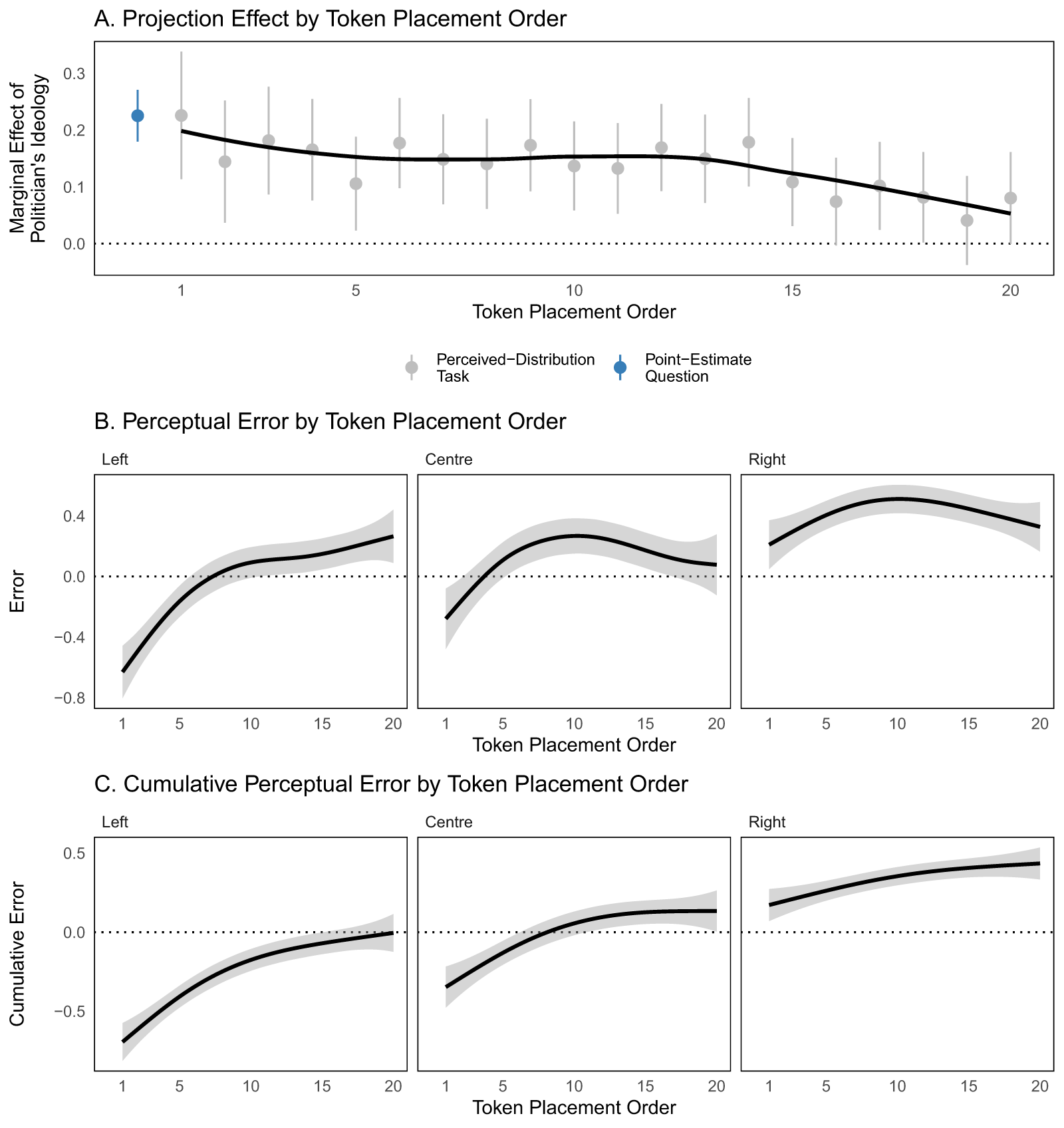
Figure 4 summarizes this analysis. In fact, we find that politicians tend to begin the perceived-distribution task by “projecting” their views onto constituents, but over-represent the number of conservative constituents toward the end of the task.Footnote 11 In Panel A, we plot “projection” effects on the point-estimate question (in blue) and on each token placed in the perceived-distribution task (in gray). This projection effect is measured as the effect of the politician’s own ideological self-placement on their perception of their constituents’ ideologies, net of the MRP estimate of actual municipal ideology. Consistent with past research, we find that projection effects are substantively large and statistically significant in the point-estimate question and in the early stages of the perceived-distribution task. However, these projection effects fade as politicians place additional tokens in the perceived-distribution task, such that tokens at the end of the sequence (Tokens 15–20) exhibit little-to-no projection.
Projection effects and perceptual errors by token placement order. Panel A: Effect of politician’s own ideology on perceived average constituent ideology, shown for the point-estimate question (blue) and for each token placed (1–20; gray). Panel B: Average perceptual error by order of token placement (horizontal axis) and politician’s ideological self-placement. Panel C: Cumulative perceptual error by order of token placement (horizontal axis) and politician’s ideological self-placement.

Panel B of Figure 4 reports politicians’ average perceptual error for each token placed in the perceived-distribution task, segmenting by politician ideology. Left-leaning politicians begin the perceived-distribution task by dramatically under-estimating the conservatism of their constituents, but then move quickly rightward, finishing their sequences with tokens to the right of their constituents’ actual conservatism. Centrist politicians begin with fairly centrist (and, incidentally, accurate) tokens but then quickly move rightward. Right-leaning politicians begin to the right of their constituents and then tend to move even further rightward.
Panel C of Figure 4 summarizes the consequence of this token-placement sequence in the cumulative perceptual error of politicians. Left-leaning politicians begin by dramatically under-estimating conservatism. However, by virtue of their “over-correction” in the rightward direction, ultimately produce perceived distributions whose arithmetic means are quite accurate. The sequence is similar for politicians in the centre. However, right-leaning politicians are most accurate at the beginning of the perceived-distribution task, but then move away from their average constituents’ true ideological position as they place more tokens.
Taken together, these results suggest that ideological asymmetries in conservative over-estimation reflect differences in the interaction between two psychological biases. Politicians seem to complete the perceived-distribution task in a two-stage sequence: They begin by projecting their own ideology onto their constituents, but then fill in their distributions with an excess of conservative exemplars. If projection were the only bias that distorted politicians’ perceptions, politicians on the left would under-estimate constituent conservatism; politicians on the right would over-estimate constituent conservatism; and the overall bias in politicians’ perceptions would be minimal (Bursztyn et al., Reference Bursztyn, Cappelen, Tungodden, Voena and Yanagizawa-Drott2023). However, politicians exhibit both projection effects and a tendency to over-estimate conservatism. Among left-leaning politicians, projection counterbalances conservative over-estimation. Among right-leaning politicians, projection exacerbates conservative over-estimation.
5. Conclusion
Our results reveal that the apparent accuracy of politicians’ perceptions of their constituents’ preferences depends in part on how these perceptions are elicited. Politicians in our study—and especially right-leaning politicians—consistently made large errors when asked to provide point estimates of their constituency’s ideological position. In particular, these politicians regularly over-estimate their constituents’ conservatism, in keeping with findings from other countries and levels of government (Norris and Lovenduski, Reference Norris and Lovenduski2004; Broockman and Skovron, Reference Broockman and Skovron2018; Walgrave et al., Reference Walgrave, Soontjens and Sevenans2022; Pilet et al., Reference Pilet, Sheffer, Helfer, Varone, Vliegenthart and Walgrave2024). However, when these same politicians were asked to draw the distribution of their constituents’ ideologies, the error in their estimates was reduced by more than half.
Several mechanisms could explain the improved accuracy we observe when politicians complete the perceived-distribution task. We have proposed two such mechanisms. First, the perceived-distribution task prompts politicians to think about public opinion more carefully, as they would in their day-to-day work (addressing what we call the cognitive effort problem). Second, the task allows politicians to report their perceptions in a way that accommodates their differentiated perceptions of public opinion (addressing what we call the question-format problem). We leveraged the random order in which politicians completed a typical point-estimate question and our perceived-distribution task to show that both mechanisms likely contribute to politicians’ improved accuracy.
That said, we note that our design is not ideally placed to provide an exhaustive analysis of potential mechanisms. For one, we do not compare politicians’ performance on the perceived-distribution task to that of non-elite citizens. As such, it is unclear whether the “errors” corrected by the task are specific to politicians or common to all humans. It could be that politicians develop domain-specific expertise for discerning public opinion (e.g., Walgrave et al., Reference Walgrave, Jansen, Sevenans, Soontjens, Pilet, Brack, Varone, Helfer, Vliegenthart, van der Meer, Breunig, Bailer, Sheffer and Loewen2023). If politicians possess such expertise—but this expertise is better accessed by the perceived-distribution task, as we argue—then the task’s effect on accuracy should be stronger for politicians than for citizens. By contrast, if the task increases accuracy by encouraging cognitive effort in a more simplistic manner, we might expect politicians and citizens to benefit equally from the perceived-distribution task. Furthermore, other mental processes, beyond the ones we discuss, might also explain why the perceived–distribution task improves accuracy. For example, point estimates may be especially vulnerable to the representativeness heuristic (for examples with politicians, see Stolwijk and Vis, Reference Stolwijk and Vis2021) or prototypical thinking (Dias et al., Reference Dias, Lelkes and Pearl2025). That is, point estimates may overrepresent quickly recalled exemplars that are unrepresentative of citizens in general. Disentangling these mechanisms using designs that allow researchers to decompose domain-general and domain-specific sources of perceptual error is, in our view, a critical priority for future research.
Whatever the mechanism behind our experimental effects, however, our results help to resolve a long-standing puzzle in elite behavior and policy representation research: Why does past research find that politicians misperceive their constituents’ preferences, given that politicians are incentivized to know what their constituents want (Downs, Reference Downs1957; Fenno, Reference Fenno1977; Mayhew, Reference Mayhew2005) and that policy generally follows public opinion (Soroka and Wlezien, Reference Soroka and Wlezien2012; Caughey and Warshaw, Reference Caughey and Warshaw2022)? At least part of the answer appears to be that scholars have measured politicians’ perceptions in ways that hide the true extent of their knowledge.
Nevertheless, even when politicians complete the perceived-distribution task, perceptual errors persist. In particular, centrist and right-leaning politicians continue to over-estimate their constituents’ conservatism. While the magnitude of these over-estimates is much smaller, their persistence suggests that conservative bias is not only a function of how researchers have measured politicians’ perceptions. We have provided evidence that a tendency for politicians to project their views onto constituents (Sevenans et al., Reference Sevenans, Walgrave, Jansen, Soontjens, Bailer, Brack, Breunig, Helfer, Loewen, Pilet, Sheffer, Varone and Vliegenthart2023; Lucas, Reference Lucas2024) helps to explain the large and persistent asymmetry between left-leaning and right-leaning politicians in the magnitude of conservative over-estimation. That said, we have also revealed a marked tendency toward conservative over-estimation among all politicians, across the ideological spectrum.
Importantly, the normative significance of our results depends on how politicians actually think about public opinion in their daily work. Like all studies of politicians’ perceptions, our study necessarily involves a degree of artificiality. However, on the basis of existing work, we have argued that the perceived-distribution task provides a more realistic sense of politicians’ perceptual accuracy than typical point-estimate questions. First, it encourages politicians to think more carefully about public opinion, as they would on the job (Walgrave et al., Reference Walgrave, Soontjens and Sevenans2022; Durovic and Schnatterer, Reference Durovic and Schnatterer2025). Second, it lets politicians report their perceptions of their constituents’ preferences in a way that accommodates the differentiated nature of those perceptions (Fenno, Reference Fenno1977; Walgrave et al., Reference Walgrave, Soontjens and Sevenans2022). As such, our results suggest that politicians’ perceptions of their constituents’ preferences are more accurate than previously believed. However, if what politicians do in reality is more akin to the fast-paced inferences captured by the point-estimate task, the implications of our results are more worrisome.
We see considerable value in future applications of our perceived-distribution task to politicians’ perceptions of citizens’ policy preferences. Where constituents stand on specific policy issues, rather than how they place themselves ideologically, is even more directly related to politicians’ ability to deliver policy responsiveness. Moreover, there is extensive research documenting that politicians misperceive the public’s preferences across a host of policy domains. Testing whether the perceived-distribution task similarly improves politicians’ perceptual accuracy about concrete policy preferences would be an important extension and validation of our findings.
We also see potential in considering the types of constituencies that politicians think about and respond to. It may be that the perceived-distribution task would improve the perceptual accuracy of some politicians more than others, depending on what their constituencies look like. In our study, local politicians were asked to estimate the ideology of all residents in their municipality. It might be the case that politicians at other levels of government, who serve larger and often more heterogeneous constituencies, may benefit even more from thinking about the distribution of public opinion. In systems where politicians are motivated to respond to well-defined party electorates that are ideologically cohesive (as is often the case in proportional representation systems), distributions may not provide much added value over point estimates. Comparatively exploring how different measurement approaches reduce perceptual errors has the potential to uncover differences in the underlying sources of seemingly universal biases, such as conservative over-estimation, that may be otherwise masked.
Finally, we see value in future studies comparing the full distribution of constituents’ preferences to politicians’ perceived distributions. It may be that politicians perceive the average ideology of their constituents with reasonable accuracy, but otherwise misperceive the distribution of perspectives among their constituents. For instance, politicians may over- or under-estimate the spread or diversity of their constituents’ preferences (Dias et al., Reference Dias, Lelkes and Pearl2025). Such misperceptions are potentially important: If politicians under-estimate how many of their constituents are ideologically extreme, they may neglect issues that motivate the most politically active constituents (van der Meer et al., Reference van der Meer, van Deth and Scheepers2009).
Supplementary material
The supplementary material for this article can be found at https://doi.org/10.1017/psrm.2025.10069. To obtain replication material for this article, please visit https://doi.org/10.7910/DVN/QXWMDZ.
Competing interests
The authors declare no competing interests.




 Open access

