


Introduction
The exclusion of people labelled with intellectual and developmental disabilities (IDD) is so entwined with Canada’s history that the realization of “full inclusion” for this population would entail an overhaul and reimagination of its social and political institutions. Full inclusion is the aspiration of the policy project that began with the In Unison report (ESDC 1998), commencing the inclusion era in Canadian disability policy. In the over 25 years since this strategic vision for Canadian disability politics was published, the concepts of social inclusion and disability have become tightly interlocked in the Canadian disability policy discourse. For example, over this period seven Canadian provinces and the federal government have each introduced accessibility policies to eliminate barriers to inclusion for people with disabilities. Moreover, in the inclusion era the largest Canadian IDD advocacy group changed their name to Inclusion Canada, and a federal Minister of Disability Inclusion was named under the final government of Prime Minister Justin Trudeau. Given this interconnectedness of inclusion and disability, this contribution asks: how is social inclusion framed in Canadian IDD policy design?
Social inclusion – defined as “full participation in all aspects of life” (ESDC 1998) – is a normatively attractive concept, specifically in the realm of disability policy, where it has widespread support without much opposition. Consensus on the normative attractiveness of social inclusion contributes to the political appeal of the concept and has made it a consistent target in Canadian disability policy design. Indeed, social inclusion satisfies the criteria of what Pollitt and Hupe (Reference Pollitt and Hupe2011) call a “magic concept” - a pervasive power word that is frequently, uncritically employed by both scholars and practitioners, such as “governance,” “networks,” and “accountability.” They attribute four main characteristics to magic concepts:
-
i). Broadness – both in terms of the scope and multiplicity of possible definitions.
-
ii). Normative attractiveness – both by positive connotation and difficulty to oppose.
-
iii). Implication of consensus - rarely defined, and insulated from incommensurable logics.
-
iv). Global marketability – frequently used by scholars and practitioners.
(see Pollitt and Hupe Reference Pollitt and Hupe2011, p. 643)
At the conceptual level, social inclusion meets all these criteria. It is frequently used without being defined, has broad implications for different theoretical and practical approaches, and is normatively attractive because the opposite – social exclusion – is commonly presented as undesirable. But how does this “magical” quality travel as the conceptual scope is limited by the policy process and social inclusion is operationalized into policy problem definitions, and further into policy designs? This study presents a critical frame analysis of all disability policies in Canada to classify the framing of social inclusion in IDD policy designs. It advances two lines of argumentation. First, at the theoretical level, the concept of social inclusion loses magical qualities such as definitional breadth, normative attractiveness and the implication of consensus as it is operationalized in policy designs. This sets up a second empirical argument, which is that social inclusion is framed in ambiguous and occasionally competing ways in Canadian IDD policy. This ambiguity detracts from the utility of social inclusion policies by burdening policy implementers to determine if, when and how to achieve it.
Social inclusion as a disability policy idea
Before addressing how social inclusion is distilled as a policy idea and framed in disability policy designs, this contribution begins by engaging with the definitional breadth that makes it a “magic” concept and examining the extent of its contestation. First, perhaps more than any other “big idea” that grounds policy, social inclusion is connected to personhood. This is a unique feature of social inclusion, as even big ideas such as poverty reduction or religious freedom, which are also normatively attractive at the conceptual level, are more conducive to politicization and polarization, and thus may generate less widescale consensus than social inclusion (Natili Reference Natili2019; Witte and Green Reference Witte, Christian Green, Shah, Stepan and Toft2012; Yuval-Davis et al. Reference Yuval-Davis, Wemyss and Cassidy2019). By contrast, Ikäheimo (Reference Ikäheimo, Kristiansen, Vehmas and Shakespeare2008) asserts the idea of social inclusion fundamentally requires interpersonal recognition of personhood, and that this recognition is itself a vital dimension of personhood. That is, by aspiring towards an inclusive society we must accept the project of recognizing and accommodating difference, which is a project of accepting personhood, both for others and ourselves. This resonates deeply with the history of disability politics, where the fight for the recognition of disability personhood has been a central focus.
The push for disability personhood is exemplified by the advocacy efforts centred around person-first language, which accelerated leading up to the 1981 International Year of the Disabled. Person-first language – best exemplified by the phrasing people/persons with disabilities – became the primary terminology in the burgeoning field of disability studies, which sought to link the concepts of personhood and disability in the public discourse (see Titchkosky Reference Titchkosky2001). The effectiveness of this discursive distinction was quickly criticized by disability scholars, including Oliver (Reference Oliver1990) who argues that person-first language portrays disability as an appendage rather than an essential component of who disabled people are (p. xiii). This line of argumentation is continued by Titchkosky (Reference Titchkosky2011) who argues that person-first language ascribes value to the person, while devaluing their disability, which by its separation from the individual is constructed as a difference that is both a danger and impediment to personhood (pp. 53–4). Thus, by distinguishing disability from personhood, we deny it as an aspect or dimension of personhood, thereby problematizing inclusion for disabled persons. Despite these critiques from disability studies, person-first language dominates Canadian disability policy discourse.
While the fight for personhood has long been a central focus within disability politics, people with IDD encounter unique barriers relative to other types of disability. Particularly confounding to social inclusion are the barriers of stigma and systemic ableism, which create heightened vulnerability to poverty and the denial of human rights for people with IDD globally (Ditchman et al. Reference Ditchman, Kosyluk, Lee, Jones, Scior and Werner2016; WHO 2011). Another focusing event for policy advocacy around disability personhood occurred in the immediate aftermath of the COVID-19 pandemic when provincial health ministries quickly drafted triage protocols in preparation for potential shortages of hospital beds and ventilators as cases quickly grew. In the Canadian provinces of Ontario and Quebec, the draft protocols allocated ventilator access based on the use of frailty scales, leading disability scholars and advocates to quickly denounce the protocols as ableist and discriminatory (Lemmens and Mykitiuk Reference Lemmens and Mykitiuk2020). In both provinces, public backlashFootnote 1 successfully led to revisions of the draft protocols; however, that such mobilization was necessary to protect the right to medical treatment for a population so adversely affected by COVID-19 (see Brotman et al. Reference Brotman, Sussman, Pacheco, Dickson, Lach, Raymond, Deshaies, Freitas and Milot2021) highlights the precarity of IDD personhood.
Public policy has long recognized the social disadvantages imposed on people with disabilities (see Prince Reference Prince2009; Stone Reference Stone1984). For some people with IDD who rely on accommodations and supports to gain equal access to social functions such as employment and education, strict self-sufficiency is untenable. By contrast, by simply adjusting performative expectations in ways that accommodate IDD diversity the false idealism that underlies existing disability policies would give way to material manifestations of neurodiversity (Erevelles Reference Erevelles2002). Performativity thus has as much to do with the politics of belonging as it does the politics of personhood. Indeed, as Orsini (Reference Orsini2012) argues, for Canada to truly accommodate IDD would require a reconfiguration of the citizenship regime that accommodates neurodiverse performativity. Accommodations can entail the provision of additional supports in key areas of social inclusion, such as classroom assistants to facilitate educational integration or on-site job coaches to support acclimation to a work environment. While these avenues to social inclusion are impeded by austere resource allocations in the provision of services, accommodating IDD performativity becomes more tenable when we begin to take aim at the policy legacies perpetuate social exclusion (Dickson and Linton Reference Dickson and Linton2025). Without this ideational engagement, inclusive disability policy is mired by systemic ableism.
Social inclusion as a policy objective for people with IDD
Within the disability literature, social inclusion has been most commonly associated with the idea of participation through social functioning. The most prominent example of this association is Wolfensberger’s (Reference Wolfensberger1983) “social role valorization” approach, which posits that “normalization” will occur when people with IDD are seen holding valued social roles, such as the worker or student, that challenge exclusionary constructions. Wolfensberger contends that social roles both award a person with a “place” in society and allow them to be situated and defined by others (2000). This perspective is reflected often in the Canadian disability policy literature, which emphasizes employment as an important venue for social inclusion (Hall and Wilton Reference Hall and Wilton2011; Prince Reference Prince2014; Thun Reference Thun2007; Toth and Dewa Reference Toth and Dewa2014). These authors propel the notion that greater access to employment for people with disabilities provides both personal benefits, derived from financial reward and emotional fulfilment, and external benefits from increased public visibility. This latter benefit is especially important to challenging the disadvantaged roles of people with disabilities as excluded or “absent citizens” (Prince Reference Prince2009).
Despite its ubiquity, “social role valorization” has been critiqued for ignoring how older adulthood and other intersectional categories, such as gender or race, problematize the idea of normalization (Walker and Walker Reference Walker and Walker1998). Further critique has pointed to the limited application of normalization discourse to professional interventions, rather than in response to the preferences of people with IDD themselves (Chappell Reference Chappell1992). For example, older adults with IDD are thought to prefer alternative avenues to social inclusion, such as recreational programming or community engagement, which are given less priority within the literature and within disability policy instruments (Salvatori et al. Reference Salvatori, Tremblay and Tryssenaar2003). These preferences are accommodated by divergent understandings of social inclusion outcomes, which include interpersonal communication and meaningful interaction (Amado et al. Reference Amado, Stancliffe, McCarron and McCallion2013; Schalock et al. Reference Schalock, Bonham and Verdugo2008). Yet, the potential of disability policy to address these outcomes has been sparsely addressed in the Canadian literature, creating a significant gap in terms of policy and scholarly knowledge and strategies for practitioners.
One promising report proposed a more broadly-devised definition of social inclusion based on the dimensions of “Access” and “Support” – the latter incorporating interpersonal relationships as a key component (Crawford Reference Crawford2003). This same study put forth an index of social inclusion for people with disabilities in the specific area of employment. While it suggests that this same strategy could be used to measure the domains of access and support for other areas of social inclusion, the reliance on large-n survey data derived from national post-censal disability surveys limits the potential for using similar indicators across other dimensions of social inclusion. In addition, Canada’s national disability surveys are designed to emphasize access to employment and education as key variables of inclusion, which are of greater relevance to younger people with IDD. Finally, owing to the general nature of these instruments, they provide minimal insight into the “support” dimension of social inclusion (see Statistics Canada 2023).
For this reason, the Canadian literature on inclusion for people with IDD has in large part ignored the survey instruments, placing greater value on the experiences of personal support workers in navigating the existing policy landscape to help facilitate social inclusion outcomes (Kelly Reference Kelly2016; Pedlar et al. Reference Pedlar, Hutchison, Arai and Dunn2000). For example, Wilton et al. (Reference Wilton, Schormans and Marquis2018) explore consumption as a key social inclusion domain by providing a thorough analysis of shopping activity by support workers and people with IDD. They emphasize how ideas of performative appropriateness or belonging in consumption spaces – such as shopping malls or grocery stores – can constrain the social inclusion of people with IDD. Simplican et al. (Reference Simplican, Leader, Kosciulek and Leahy2015) conduct a sweeping review of the social inclusion literature before advancing a definition for people with IDD that is based around two domains: interpersonal relationships and community participation. In both domains, they emphasize the importance of integrating feelings, such as that of belonging, alongside robust measures of social inclusion that are associated with measurements of quality of life (see Schalock et al. Reference Schalock, Bonham and Verdugo2008). Overmars-Marx et al. (Reference Overmars-Marx, Thomése and Meininger2017) also apply a relational approach, extending the scope of subjective experiences beyond people with IDD themselves, to include their support staff whose “professional role identity” is a significant determinant of social inclusion outcomes.
By bringing relationality and interpersonal relationships in, the concept of social inclusion gains important analytical breadth, encapsulating the unique experiences of people with IDD. This is reflected in scholarship that incorporates power as a key dimension of social inclusion. Drawing from the fields of critical disability studies, authors in this emergent stream see the persistence of power asymmetry and oppressive social practices as an ongoing barrier to inclusion policy for people with IDD. Simplican (Reference Simplican2022) argues that challenging behaviours such as aggression and self-injury, which are often used to justify the exclusion of people with IDD from social domains, are often a reaction to asymmetries or power imbalances with support staff.
Accounting for power and relationality is a key component of Bigby and Wiesel’s (Reference Bigby and Wiesel2011) work on “encounter” as a valuable dimension of social inclusion. The authors argue that in order to move beyond the ambiguity of “community participation,” policy efforts should focus on the types of encounters people with IDD experience in their daily interactions. This focus on encounter shifts the onus for inclusion beyond the excluded individual and their closest social supports to focus also on increasing the inclusivity of social structures, community spaces and non-disabled strangers (Ibid, p. 266). Once again this requires taking stock of how persistent power imbalances, shared social structures and community spaces perpetuate social exclusion.
It has long been established in Canadian jurisprudence that if a community space is not accessible, then an affected individual cannot be considered to have equal opportunity of access. This precedent was established in 1985 when the Supreme Court of Canada upheld a decision by the Saskatchewan Court of Appeal in the case of Canadian Odeon Theatres Ltd. v. stating that “(a)cts which are neutral on their face, which treat individuals in the same way, are nonetheless prohibited if they have the effect of continuing discriminatory practices.”Footnote 2 Huck, a wheelchair user, instigated the legal complaint after attempting to attend a movie theatre where he was unable to safely transfer to a theatre seat nor easily view the movie from a small designated area at the front of the theatre. While the theatre claimed their sole responsibility was to meet criteria of equal opportunity by providing a film and a space to watch it, the Supreme Court of Canada established that it is discriminatory to provide inaccessible services, creating precedent for Canadian accessibility legislation (Lord Reference Lord2010, p. 117). This is useful for understanding social barriers for people with IDD because power imbalances in social relationships can create disabling outcomes just as inaccessible spaces do.
Methodology
To identify and distinguish between social inclusion policy framings applicable to people with IDD, this study employs the critical frame analysis method (Verloo Reference Verloo2005; Verloo and Lombardo Reference Verloo, Lombardo and Verloo2007). Stemming from interpretivist policy scholarship, critical frame analyis perceives policy as inherently political because policy problems and solutions become analytically legible through the way they are framed. In this way, it expands upon the traditional idea that problem definitions create policy solutions or shape the agenda (Peters Reference Peters2005; Rochefort and Cobb Reference Rochefort and Cobb1993), to focus on how representations of the problem structure the policy discourse, thus shaping the ways a policy is practiced or experienced beyond the scope of policy design (Bacchi Reference Bacchi1999). By taking stock of these discursive dynamics, critical frame analysis is well situated to address the political instrumentality of competing frames, with dominant frames reflecting which actors have the most authority over intractable policy controversies (Schön and Rein Reference Schön and Rein1995). In the present study, critical frame analysis is particularly valuable to assess policy frames both cross-provincially and across multiple governance levels by accounting for the interactive nature of policy design (Verloo Reference Verloo2005, p. 19).
The concept of social inclusion is well suited for critical frame analysis, as it has been applied to numerous groups of actors, in multiple policy contexts (Cushing Reference Cushing2003; Percy-Smith Reference Percy-Smith2000). For people with IDD, social inclusion has been measured through tightly specified, multi-dimensional indicators, with applications in policy-relevant fields such as social work (Schalock et al. Reference Schalock, Bonham and Verdugo2008; Simplican et al. Reference Simplican, Leader, Kosciulek and Leahy2015). However, it is important to note that critical frame analysis does not draw from pre-formulated codes when identifying frames, but rather identifies emergent frames in the analysis stage, which are grounded in the data (Verloo and Lombardo Reference Verloo, Lombardo and Verloo2007). While this approach explicitly relies on interpretation by researchers in identifying framing categories, it allows researchers to better observe the relationship between frames in comparative contexts. In keeping with this methodological strategy, framing categories were open-coded to highlight specific differences in provincial policy design frames of social inclusion for people with IDD.
The broad scope of disability policy allows for a large sample of relevant policies and programs across all ten Canadian provinces. A primary search of Canadian disability policy was achieved by referring to a comprehensive and current disability policy review (McColl et al. Reference McColl, Jaiswal, Jones, Roberts and Murphy2017). Using this review as a starting point, copies of all the legislative acts and program documents listed therein were collected and supplemented in cases where policies were omitted or more current legislation existed. This produced an initial sample of 427 policy documents from the federal and provincial levels. Policies were then excluded from the sample if they only applied to disabilities other than IDD, such as visual impairments or physical disabilities, which reduced the sample to 306 policy documents. The second exclusion criterion was whether policy applied, in broad strokes, to social inclusion as a policy objective, including synonyms such as community participation or social integration, and the removal of specific barriers to inclusion. To this end, some policies with very superficial connections to the concept were included, with the knowledge that non-pertinent policies would be excluded during the frame analysis. Relevant examples include federal student grant policies or provincial adoption acts. This reduced the sample to 181 policy documents.
Following these exclusion criteria, documents were classified by first identifying whether they explicitly mentioned social inclusion and the ways in which this concept was framed, and, in rare instances, how it was defined. All content related to the framing of social inclusion was highlighted on the digital file of each policy document for reference during initial review and documented in a spreadsheet. This was then validated via secondary review from another coder. Despite the general absence of explicit definitions, additional insight into the thematic character of framings was gained by drawing from examples of social inclusion contained within the documents. Where provided, these examples were also highlighted and documented, paying particular attention to the ways in which these policy documents outlined how social inclusion could be achieved. For example, in accessibility policies, the content pertaining to the removal of barriers was coded within the “Community Participation/Removing Barriers” framing category. Where no relevant content was highlighted and documented by the primary and secondary coders, policy documents were removed from the sample.
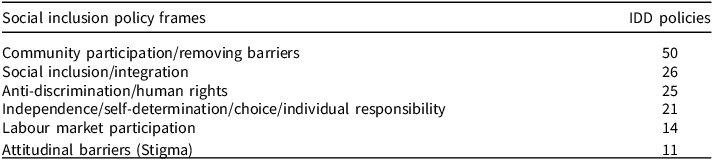
By applying all exclusion criteria, the final sample consisted of 79 documents containing social inclusion policy frames for people with IDD. The frames were open-coded, with 6 major thematic categories emerging through the analysis (see Table 1). The framing categories were coded intuitively, with policy dimensions loosely corresponding to existing multidimensional conceptualizations of social inclusion from the disability policy literature (Schalock et al. Reference Schalock, Bonham and Verdugo2008; Shogren et al. Reference Shogren, Luckasson and Schalock2015). While these prior studies were useful in developing coding categories, they include measures of personal policy outcomes, which are much more specific compared to the broader operationalization of social inclusion in policy design. For example, Shogren et al. (Reference Shogren, Luckasson and Schalock2015, 369) contains 7 personal outcome domains, each with corresponding indicators. Many of these indicators correspond to specific outcomes that would follow policy implementation, such as “meaningful engagement in activities” and “liberty of movement,” that are far more specific than the comparatively broad and ambiguous framing in disability policy design.
Classification and frequency of social inclusion policy frames

The first theme that emerged in the frame analysis corresponds to policy design frames focused on the promotion of “independence, self-determination, choice and/or individual responsibility.” In this framing, the onus for social inclusion is placed on the individual, whose capacity for overcoming exclusion is limited by a lack of opportunities, thus providing the rationale for policy intervention. These policies framed inclusion broadly as the promotion of independence and choice and thus had rather limited practical application to specific activities.
The second frame coded “labour market participation” also emphasizes the provision of opportunities for individuals, but here the focus is directed to active labour market participation. A distinguishing feature of this frame is the emphasis it places on the social value attached to paid employment. For example, this frame was used in numerous disability income support policies to emphasize that effective vocational training and employment supports would reduce uptake on income support. This framing was employed by income support program documents in four provinces: Newfoundland, Ontario, Alberta and British Columbia. In stark contrast to the first frame, the second framing has precise policy applications, but is applicable to a relatively smaller sub-section of people with IDD for whom employment is both a desirable and realistic avenue to social inclusion.
The third frame emerging in the analysis was coded “Community Participation/Removing Barriers.” This frame maintains some focus on individual responsibility, as active participation in society connotes autonomy and agency, however, this frame also acknowledges that society has a role in removing the exclusionary barriers that obstruct participation. In this framing, barriers are understood more as environmental obstacles that can be overcome with accommodations so that people can be included on equal terms. As such, there remains a significant onus on the role of the individual to actively facilitate their participation in the community. Policies in this framing category tended to apply to people with disabilities more broadly, rather than specifically targeting people with IDD. This framing is consistent with the ideas of universal design and reasonable accommodation, popularized by their inclusion in national level documents such as the Americans with Disabilities Act 1990 in the United States. These ideas underpin a broader understanding of inclusion, applicable to all disabled people, which can be used to challenge and remove barriers to community involvement. As with the first frame, this framing has limited policy application to promote social inclusion. However, unlike the first frame, this framing acknowledges that there are significant barriers to social inclusion that must be removed to create opportunities for inclusion. Therefore, while the first three framings tend to “responsibilize” social inclusion by emphasizing the role of people with IDD in actively working towards their own inclusion, there are differences in how personal responsibility is understood.
This is a stark contrast to the fourth and fifth frames, which are focused more squarely on society’s role in perpetuating exclusion. The fourth frame, Anti-Discrimination/Human Rights, focuses on exclusion through discrimination and uses the language of human rights entitlements to prohibit exclusion based on individual characteristics. Outside of provincial human rights acts, this frame was most common in equal employment legislation seeking to prevent discriminatory hiring practices. Its scope is thus smaller than the fifth frame, which targets broader social attitudes that underlie discrimination. Policy in this “attitudinal barriers (stigma)” frame adopts a more holistic approach to social inclusion based around promoting visibility to disrupt ableist stereotypes. The nuanced distinction between these two categories occurs because the framing categories are grounded in the data. Nonetheless, the distinction signals an evolutionary shift from a policy focus on prohibiting discriminatory practices towards challenging ableist ideas.
The final frame that emerged in the coding includes policy documents that either make specific reference to social inclusion or provide a working definition. This framing is the broadest in scope and is the best example of a “rhetorical frame,” given that the other framing categories are definitively “action frames.” Rhetorical frames are associated with a policy debate and provide a sort of normative rationale for action frames (Schön and Rein 1994, p. 32). In this way, the “Social Inclusion/Integration” category most embodies the “magical” elements of the social inclusion concept, as it asserts that inclusion is a worthy policy goal without specifying specific ways to achieve it. Owing to its broad scope, this framing usually occurred alongside other frames within a single policy document. As is evident by the greater number of frames than policies, documents that employed multiple policy frames simultaneously were coded across multiple categories, such that 79 documents contained a total of 147 policy frames. The next section presents key findings from the CFA, facilitating a discussion of the operationalization of the social inclusion concept in the Canadian IDD policy context.
Framing social inclusion in Canadian IDD policy design
Very few documents in the sample provided an explicit definition of social inclusion. For example, in broad legislation, such as the Accessible Canada Act, 2019 (ACA), key definitions are often provided at the outset of the document so that terms, such as “disability” and “barriers” are made clear. Despite being identified as the cornerstone of the Canadian federal government’s “Disability Inclusion Action Plan” (Speech from the throne 2020), the ACA does not define social inclusion, nor does the term “inclusion” appear once in the text. Similarly, Ontario’s Services and Supports to Promote the Social Inclusion of Persons with Developmental Disabilities Act, 2008 (Social Inclusion Act) provides extensive definitions of both “services and supports” and “persons with developmental disabilities” while also omitting a definition of social inclusion, and any use of the term besides the title of the Act.
This lack of explicit social inclusion definitions supports its status as a magic concept, as the breadth of scope limits the need, or even the potential, for definition in policy designs (Pollitt and Hupe Reference Pollitt and Hupe2011). The lack of definitions also supports the common argument in policy framing research that ambiguity in legislative instruments can be politically valuable, specifically when building consensus for intractable policy problems among large networks of policy actors (Schön and Rein Reference Schön and Rein1995; Dekker Reference Dekker2017). The most common framing for policies pertaining to people with IDD was the “Community Participation/Removing Barriers” frame. Part of the preponderance of this frame can be explained by a wave of provincial accessibility legislation designed with the primary intent of providing access to public spaces for people with physical disabilities. In cases where the disability definition in accessibility legislation was sufficiently broad to include people with IDD, the policy was coded in this framing category. As such, it is necessary not to overemphasize the dominance of this frame in terms of its implications for the progress of intellectual disability policy more generally. Qualitatively, many of the instances of this framing had only marginal relevance for people with IDD.
The “Community Participation/Removing Barriers” frame was more commonly employed than the “Social Inclusion/Integration” frame in policies pertaining to people with IDD. It is worth noting this framing was likely propelled by the dominant community participation framing within the In Unison vision paper, put forth by Canada’s first ministers in 1998. This vision paper has been heralded as a key moment where the focus of Canadian disability policy shifted more directly toward the removal of social and structural barriers to social inclusion, informing subsequent provincial strategies (Prince Reference Prince2016). This is reflected in specific policy language, where In Unison’s commitment to “full participation of people with disabilities in all aspects of Canadian society” (ESDC 1998, p. 7) is echoed, almost verbatim, by several policy documents emerging in the immediate aftermath of the vision paperFootnote 3 .
The “Community Participation/Removing Barriers” frame is also historically significant due to its adherence with the social model of disability, thus signaling Canadian disability policy’s formal recognition of disability as something socially constructed rather than individually bound. This shift was first evidenced by the publication of Advancing the Inclusion of People with Disabilities (HRSDC 2002), the first in a series of quasi-annual reports produced by Employment and Social Development Canada (ESDC) to track the progress of the department’s disability inclusion focus following In Unison. While this shift in the framing of disability inclusion was noteworthy at the time, the acceptance of disability as a social rather than individual problem in Canadian public policy was quickly critiqued for the lack of “reciprocity” in policy solutions that were still squarely focused on increasing the includability of disabled persons, rather than the inclusivity of society (Titchkosky Reference Titchkosky, McColl and Jongbloed2006).
This critique remains valid today, as the accessibility focus of Canadian disability policy, has continued to problematize disability as a social phenomenon, while favouring policy solutions that are more individually bound. This was most evident in the frame analysis by the manner with which policy documents discussed attitudinal barriers to inclusion. Whereas the disability policy literature identifies these as the most significant barriers to inclusion for people with IDD, the policy documents less commonly engaged with this frame, with only 11 documents falling within the “Attitudinal Barriers (Stigma)” framing category. Most surprisingly, the documents that did explicitly acknowledge attitudinal barriers were mostly accessibility policies, which gave attitudinal barriers comparatively far less attention than physical and environmental barriers. For example, since its enactment Ontario’s Accessibility for Ontarians with Disabilities Act, 2005 has seen the development of clearly specified standards for physical and environmental accessibility, leading to the removal of barriers to access in spaces such as public buildings and transport. Meanwhile, attitudinal barriers, and the accommodations necessary to overcome them received comparatively little specification in the formal integrated standards (Onley Reference Onley2019), which make no mention of attitudinal barriers and only indirectly address them in a short section on “customer service standards.”Footnote 4 This may reflect a lack of political will for targeting these barriers with policy interventions but may also be a result of attitudinal barriers being addressed by the broader “Social Inclusion/Integration” framing.
The framing analysis shows that “Social Inclusion/Integration” frame appears more frequently in recent policy interventions, specifically in the context of official program literature. Whereas legislative acts in this framing category often simply included the word social inclusion or social integration, the program documents went into much greater detail about how these outcomes should be achieved within existing policy structures. In large part, this is intuitive, given that program documents present more opportunity for discussion of specific aspects of a policy target, but it warrants attention that social inclusion and social integration were not defined in any of the 14 legislative acts. This includes Ontario’s “Social Inclusion Act” and Quebec’s accessibility policy, which both explicitly mention this policy frame in their titles.
By contrast to the increasing popularity of the “Community Participation/Removing Barriers” and “Social Inclusion/Integration” frames, the “Anti-Discrimination/Human Rights” frame appears to be declining in usage. This shift has elsewhere been noted by Prince (Reference Prince2009) who notes that over time Canadian disability advocacy groups have tended to prefer “positive action” legislation – such as accessibility legislation in the mold of the ACA – that takes action against disabling barriers before they arise, rather than anti-discrimination policy that creates significant resource costs in the litigation of individual barriers post hoc (p. 217). This explains why disability advocacy groups have pushed for the establishment of robust accessibility standards, and indeed why the ACA did not materialize until decades after national disability discrimination acts were implemented in Australia, the United Kingdom and the United States (see Prince Reference Prince2010). The shift towards positive action framings over time makes evident the connection between political instrumentality and policy design and elucidates the value of frame analysis as a tool to understand frame (de)institutionalization.
Trends and areas of divergence in policy framing
Through critical analysis of the emergent frames in Canadian IDD policy design, one noteworthy trend and three areas of divergence became apparent. First, a historical trend is the shift towards more ambiguous social inclusion language, occasionally incorporating multiple framings within the same policy design. This tendency towards multiple framings of social inclusion most likely reflects the broad scope of federal and provincial accessibility policies. Indeed, seven accessibility policies comprise half of the 14 policies in the entire sample that employ three or more social inclusion framings concurrently (see Table 2). For example, the ACA employed all but one of the six framings of social inclusion that were detected in the analysis. Given their breadth of scope, and that accessibility policies use very similar wording, it is unsurprising that they employ multiple framings. Moreover, given that accessibility policies are emblematic of a new wave of policies unique to the inclusion era in Canadian disability policy, the presence of multiple frames may portend a shift towards increasing conceptual ambiguity. Nonetheless, the presence of multiple framings is surprising when we consider the emphasis that policy framing literature has placed on the intractability of competing frames (Schön and Rein Reference Schön and Rein1995). This analysis finds numerous cases where competing frames co-exist within the same document, provided the scope is sufficiently broad.
Multiple framings in accessibility policy by year
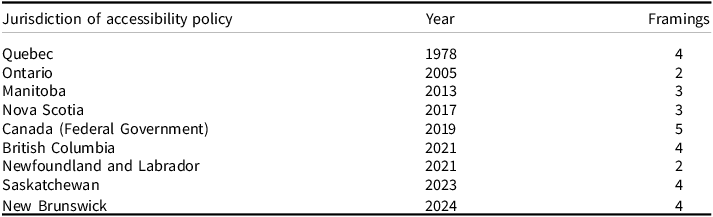
Another viable explanation for the confluence of multiple policy framings in accessibility policies is the limited practical scope they provide for implementation. In policies with precise implications for service delivery (such as those pertaining to direct support, of which 15 out of 27 contained only a single framing) there is a greater impetus for clarity to avoid divergent framing by policy implementers. By contrast, accessibility policies are comparatively less demanding on policy implementers, particularly at the frontlines, as they employ a common strategy of gradually rolling out standards for public organizations and non-profit disability agencies, the latter of which are already leaders in accessibility out of practical necessity. Most importantly for people with IDD, it is worth noting that the standards approach to accessibility policy is meant to be mutually constitutive and present an evolving context, such that ideas of universal design when applied to physical spaces are thought to set the stage for the eventual appearance of more comprehensive accessibility standards addressing pervasive attitudinal barriers (Onley Reference Onley2019). As such, the accessibility focus within Canadian disability policy may eventually give way to a new policy design framing that is more conducive to targeting the social inclusion of people with IDD using specific tools addressed at attitudinal barriers.
Personal vs. societal responsibility
The first significant area of difference in IDD policy designs pertains to who should be responsible for promoting inclusion. Existing scholarship on disability policy in Canada has stressed the individualizing influence of neoliberal approaches to social policy, which emphasize the importance of active citizenship, and reducing dependence on government interventions (Kelly Reference Kelly2016; Prince Reference Prince2009). While independence and self-determination have been important areas of emphasis for IDD advocates historically, in this context, disability policy is thought to place the onus for inclusion squarely on the individual (Titchkosky Reference Titchkosky2011). As such, it is surprising that two of the three least prevalent framing categories were the ones that assigned the most responsibility to individuals with IDD in achieving inclusion: the “Independence/Self-determination/Choice/Individual Responsibility” and “Labour Market Participation” framings.
Indeed, for people with IDD, the onus for social inclusion was far less frequently placed on the individual, in keeping with the social model understanding of disability as something socially constructed, external to individual impairment (Barnes and Mercer Reference Barnes and Mercer2004). This framing is also consistent with discriminatory attitudes, which portray IDD as a “personal tragedy” that happens to an individual and leads to their exclusion (Oliver and Barnes Reference Oliver and Barnes2012). These framings may allow people with IDD to be the beneficiaries of positive social constructions but still construct them as the “deserving poor” who are disadvantaged by neoliberal narratives of individual responsibility (Schneider and Ingram Reference Schneider and Ingram1997). The higher prevalence of social responsibility framings may allow for more diverse policy strategies to promote social inclusion for people with IDD because the greater the consensus that society plays a role in excluding this population, the greater the potential exists for mechanisms to promote social inclusion.
The relatively smaller amount of individual responsibility framings is surprising because wider narratives surrounding disability policy in Canada have been shaped by austerity politics, which prioritize individual responsibility for achieving inclusion over society’s responsibility for accommodating it. Mitrea (Reference Mitrea, Evans and McBride2017) calls this broader narrative “moral austerity,” a pervasive phenomenon that projects the neoliberal impulse towards the “responsibilization” of social citizenship, connecting individuals to governments through a shared need for self-sacrifice. While it is surprising that moral austerity does not dominate Canadian disability policy designs, this narrative may be more likely to appear further down the policy implementation chain. Moreover, the social inclusion focus of policies in the sample may limit the likelihood of moral austerity appearing, with complementary policies, such as the budgeting of developmental services and the options available to service users more likely to reflect individualization.
Provincial variation
The differences between provincial policy frames were often more telling than the similarities. For example, every province had a human rights act with similar anti-discrimination framing of social inclusion for people with disabilities. By contrast, there was significant divergence in framing in a newer wave of policy documents, which offer a broader legislative commitment to social inclusion. In these policy documents there is significant provincial divergence in terms of policy frames, despite seemingly similar wording elsewhere in the documents. For example, Nova Scotia’s Services for Persons with Disabilities (SPD) Program 2012 and Ontario’s “Social Inclusion Act” 2008 both stipulate that social inclusion goals should be worked into annual support plans for people with IDD, while Quebec’s amended, and Manitoba’s more recent accessibility policies frame the same plans as social integration and community participation, respectively.
In practice, these policies behave similarly in terms of how they govern the conduct of support workers; however, the differences in how they frame social inclusion may discursively shape the type of outcomes that implementation actors see fit to pursue (see Dickson Reference Dickson2022). In part, this provides further evidence that framing categories can overlap, with different frames operating within very similar policy designs. But these divergent frames also suggest that there are different understandings of the overarching policy goals at the provincial level, which may be representative of different bureaucratic cultures (Kernaghan Reference Kernaghan2000), or indeed different social attitudes when it comes to IDD. Therefore, drawing out the implications of divergent policy designs requires deeper engagement with provincial differences in policy implementation.
Provincial divergence could also reflect the imposition of distinct norms on broad disability policy and IDD-specific policy frameworks over time. This originates with the Anti-Discrimination/Human Rights framing, which coincides with the first explicit mentions of people with IDD in a social inclusion context in various federal and provincial level human rights acts. From this shared origin, disability policy has evolved in concert with emergent realities of increased provincial autonomy and the increased influence of market logic on social services design (Prince Reference Prince and Puttee2002). The frame analysis demonstrates rather uniform temporal shifts in the dominant policy frames. Once again, this may result from the evolution of disability policy as it has undergone shifts over time, owing in part to the opening of important policy windows. Prominent examples include the creation of Canada’s Charter of Rights and Freedoms in 1982 and the In Unison report, which have offered greater opportunities for social movement influence (Chivers Reference Chivers and Smith2008; Prince Reference Prince2009). However, once again, divergent framing designs between provinces is more reflective of the broader implications of provincial political discourse than representative of how a policy is framed throughout the process by policy actors with a far narrower focus.
Policy areas
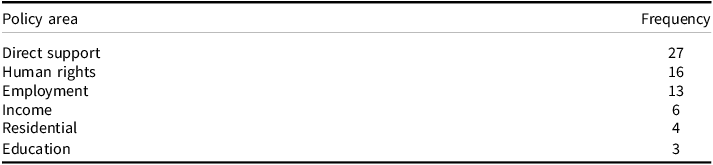
The frame analysis demonstrates that IDD policy covers several policy areas, though employment remains among the most dominant areas for social inclusion policies (see Table 3). The strongest concentration of policies relate to direct support, which encompasses a broad umbrella of services – including recreational activities, transportation, health care and housing – that are key domains of social inclusion for people with IDD (Simplican et al. Reference Simplican, Leader, Kosciulek and Leahy2015). However, this broad scope is not matched by a corresponding deep engagement with the social inclusion concept in policy design, where it is rarely defined and even more rarely connected to specific policy instruments. While employment policies provide numerous types of specific instruments, such as funding for on-site vocational supports or job-skills training, instruments in policy areas such as recreational activities and housing are notably murkier in their design.
Social inclusion framings by policy area

Recreational activities were often mentioned within the community participation framing category, however very few of the legislative acts and program documents went into much detail as to what form these activities take. To the extent that recreational activities were mentioned at all, it was in the context of access to day program and leisure services, but specific mechanisms for increasing participation were mostly absent across the provincial policies. By contrast, employment inclusion policies are remarkably similar across provinces, and are dominated by the “Labour Market Participation” framing category. These policies often refer to “employment supports” in the legislative act or program documentation, echoing language from intergovernmental labour market agreements governing allocation of federal funding transfersFootnote 5 .
Aside from provincial employment policies, and to a lesser extent education policies, most of the policy instruments targeted at other policy areas only superficially relate to people with IDD as a target population. For example, several of the transportation policies employ a sufficiently broad definition of disability that they can be applied to people with IDD, but they are primarily designed for people with mobility disabilities. None of the 37 transportation policies contained a social inclusion frame that applied to people with IDD, and this policy area was absent from the final sample. As such, only the policy areas of employment and education provide significant opportunity for deeper substantive analysis of framing shifts over time. The broadly defined concept of social inclusion is more tightly operationalized in employment and education policies contrasting more “magical” conceptualizations in other policy areas.
Conclusion
When attempting to measure and compare the effectiveness of social inclusion policies, the framings employed in policy design do not provide much explanatory leverage when separated from data on policy implementation. While the findings provide preliminary evidence that the concept of social inclusion loses much of its breadth of meaning as it is operationalized in policy design, this is not altogether surprising given the broad scope of the concept. The majority of Canadian provinces lack a coherent multi-dimensional policy framework for promoting social inclusion. Moreover, where these frameworks exist – such as in Ontario with the “Social Inclusion Act” 2008 – they are narrowly focused with weak accountability mechanisms to promote effective implementation (Dickson Reference Dickson2022; Joffe Reference Joffe2010).
More fascinating are the feedback effects that social inclusion policy designs have on broader understandings of the concept. However, taking stock of these effects requires engagement with how policy relevant actors frame social inclusion for people with IDD. Clearly, at the conceptual level, there is room for a broad range of understandings informed by scholarly contributions from identity politics and critical policy studies. However, prior to policy design, when social inclusion is constructed as a policy problem for a specific population, it is reduced to a small number of policy frames, which are applied substantively to an even smaller number of policy areas. Just as policy problem definition constrains the universe of policy solutions (Rochefort and Cobb Reference Rochefort and Cobb1993), policy designs themselves reflect social attitudes towards specific populations (Schneider and Ingram Reference Schneider and Ingram1997). From this perspective, we observe both where society is becoming more inclusive, and where exclusion is still latently accepted.
This was most evident in the analysis through the lack of policy instruments targeted at attitudinal barriers towards people with IDD. Insofar as stigmatizing attitudes both underlie and reinforce exclusion more generally, people with IDD are under-served by existing policy designs. For groups contending with negative social constructions, policy interventions are vitally important to unlock access to social participation. Consider that for people with IDD, their historical exclusion has reinforced pervasive stereotypes about their capabilities. These stigmatizing social attitudes act as constant barriers to inclusion, and yet they are not meaningfully addressed by existing policy designs. Where attitudinal barriers are mentioned, it is in broad and opaque terms that do not lend to the creation of specific instruments or provide explicit incentives to implementation actors to address them. The framing analysis demonstrates that comparing accessibility policies provides an excellent example of the shortcomings of a design-only approach. If we compare the ACA with the Accessibility for Ontarians with Disabilities Act 2005 (AODA) using policy design only, the former appears far superior to the latter. The ACA employs a much more inclusive definition of disability, commits to adhering the principles of the United Nations Convention on the Rights of Persons with Disabilities, and commits to the involvement of people with disabilities in processes of policy design. However, in terms of current impact, the AODA has greater impact on social inclusion for people with IDD because it has elaborated a more robust set of accessibility standards, while the ACA has not. As such, exclusion is reinforced not only by the limited breadth of existing policy frames, but also by the limited depth of their reach.
This study demonstrates the importance of identifying ambiguity in the deployment of key concepts in policy design. While traditional approaches have linked effective policy design with the clear structuring of a policy problem, ambiguous concepts may be immune to such structuring, thus opening space for constructive competition between ideas and interests during implementation (Peters Reference Peters2018, pp. 116–7). By enabling more flexible coordination between actors and organizations within complex multilevel governance networks, ambiguity in policy design may occasionally produce more democratic outcomes by entrusting implementers who know what is possible with the discretion to turn ideas into action (Fowler Reference Fowler2023). Even within the public service, ambiguous design may create opportunity for more responsive, evidence-based policymaking at the top of the implementation chain, provided sufficient capacity exists (Newman et al. Reference Newman, Cherney and Head2017). As such, the analysis of policy design framing warrants deep engagement with implementation contexts.
Many findings that emerged in this analysis will benefit from additional observations at the implementation stage, specifically where the existing policies are vague and non-descript. For example, recent policies (including accessibility policies) have begun to shift rhetorically away from the community participation paradigm towards more direct engagement with attitudinal barriers and policies designed to empower frontline workers. This reflects a tendency towards active inclusion policies that has been observed elsewhere and corresponds to the increasing popularity of more bottom-up approaches to governance for social policy issues (Künzel Reference Künzel2012). The current study lays bare the failure of policy designs in the inclusion era of Canadian disability policy, which for the past 25 years have rhetorically committed to providing inclusion without articulating action frames to deliver inclusive outcomes. By complementing this analysis with greater insight into how frontline workers use their discretion and, perhaps more importantly, how provincial ministries in charge of IDD services use budgetary discretion to administer these services, it becomes possible to assess whether the active inclusion character of emergent policy designs has the effect of broadening the scope of social inclusion policies.
Data availability statement
This study does not employ statistical methods and no replication materials are available.
Acknowledgements
I wish to acknowledge and thank Dasha Guliak and Adam Willems for their research assistance, and the editorial team and anonymous reviewers for their considerate feedback on the manuscript.
Funding statement
This study was supported by the Social Sciences and Humanities Research Council of Canada under Grant 767-2017-2459.
Competing interests
The author declares none.

 Open access

