


Introduction
The use of incarceration in criminal justice has long been and continues to be an important area of study. It is natural then to examine how these practices may have changed in the face of the COVID-19 pandemic, which has impacted Canada and its criminal justice system so profoundly. In this article, we undertake this work. Specifically, we seek to confirm whether and in what ways COVID-19 pushed criminal courts and criminal justice actors in Ontario to alter their use of incarceration.
To do so, we begin with a brief exploration of incarceration in bail and at sentencing in Canada, followed by a review of the impacts of COVID-19 on custodial facilities. After presenting the methodology employed in this study, we present our results, which are divided into two sections: the first discusses emerging leniency in the use of incarceration while the second reveals a potential reversal of this trend. Subsequently, we discuss the boundaries of what changes may and may not be possible in Ontario’s criminal justice system.
Incarceration in Canada: Bail and Sentencing
Whether pending case resolution, or as a sentence for an individual found guilty of a criminal offence, Canada’s legal framework strongly emphasizes that the use of incarceration should be a last resort (Manson et al. Reference Manson, Healy, Trotter, Roberts and Ives2016). Indeed, section 718 of the Criminal Code of Canada outlines the purposes and principles of sentencing; among other objectives, it states that “an offender should not be deprived of liberty, if less restrictive sanctions may be appropriate in the circumstances” (s 718.2 (d)) and that “all available sanctions, other than imprisonment, that are reasonable in the circumstances … should be considered for all offenders” (s 718.2 (e)). Furthermore, the Canadian Charter of Rights and Freedoms grants individuals a constitutional right not to be denied reasonable bail (11(e)). In this way, there are strong legal imperatives to avoid the use of incarceration unless absolutely necessary.
Of course, while these may constitute tenets of Canada’s justice system, this is not necessarily reflected in practice. Manson and colleagues (Reference Manson, Healy, Trotter, Roberts and Ives2016) explain that incarceration is overused as a sanction, far from the exception in sentencing. Custodial sentences have remained stable for many years, representing roughly one-third of all sentences (Manson et al. Reference Manson, Healy, Trotter, Roberts and Ives2016; Webster and Doob Reference Webster and Doob2007), which is far less exceptional than one might expect.
While the use of incarceration in Canada has remained relatively stable over many decades, the makeup of this population has changed drastically (Manikis and De Santi Reference Manikis and Santi2020). Indeed, those in pretrial detention have outnumbered the number of sentenced individuals since 2004/2005 and this grow is continuing (Malakieh Reference Malakieh2019). Unsurprisingly, then, many have called Canada’s bail system broken (Canadian Civil Liberties Association Reference Association2014; Myers Reference Myers2017; Webster Reference Webster2015; Webster et al. Reference Webster, Doob and Myers2009).
Effects of the Pandemic on the Use of Custodial Facilities
One important reason for attempting to make the use of custody exceptional is that, in many ways, custodial facilities are unhealthy institutions (Burningham Reference Burningham2022; Malakieh Reference Malakieh2020). The relationship between custodial facilities and the health of those within their walls has long been shown to be negative. Rates of communicable diseases and mental health issues are drastically higher among Canada’s prison population compared with those not incarcerated (Johnson et al. Reference Johnson, Bien-Aimé and Dubois2021; Kouyoumdjian et al. Reference Kouyoumdjian, Schuler, Matheson and Hwang2016; Standing Senate Committee on Human Rights [SSCHR] 2021).
Many of these same health issues have been exacerbated by the COVID-19 pandemic (Iftene Reference Iftene, Flood, MacDonnell, Philpott, Theriault and Venkatapuram2020; Sapers Reference Sapers2020). Some authors have detailed the deteriorated conditions in prisons both in Ontario and in Canada more widely (Fayter et al. Reference Fayter, Mario, Chartrand and Kilty2021; SSCHR, Reference Human Rights2021). Most obviously, detainees were exposed to a high risk of catching COVID-19 within prison walls, worsened by a population constantly cycling in and out of provincial facilities (Iftene Reference Iftene, Flood, MacDonnell, Philpott, Theriault and Venkatapuram2020). Quite simply, the public health situation within prison walls was in crisis, putting many at serious risk to a virus that officials knew little about for a significant period of time.
For these reasons, and in an effort to reduce the risk to public health, courts reacted in various ways (Burningham Reference Burningham2022; Statistics Canada Reference Canada2021). Canadian jurisprudence has largely recognized COVID-19 is a serious factor when considering the incarceration of an individual at bail and in sentencing (Burningham Reference Burningham2022; Kerr and Dubé Reference Kerr and Dubé2020, Reference Kerr and Dubé2021). Within months after the emergence of the pandemic in Canada, the courts began addressing whether, when, and why COVID-19 ought to have an impact in these decisions.
Authors highlight strong jurisprudential deference to COVID-19 and the granting of leniency when deciding to incarcerate someone. Burningham explains that “[g]enerally speaking, cases demonstrate a judiciary alive and responsive to COVID-19 concerns, favouring release when possible (for example, in the absence of safety or flight concerns)” (2022, 590). Further, by exploring court decisions available to them in the first year of the pandemic, several authors demonstrate how courts in Ontario took judicial notice of the pandemic; some methods of doing so include granting release on bail more easily due to COVID-19 conditions in jails as well as handing down lighter sentences than offenders might have received absent the pandemic, and offering enhanced credit for pretrial custody (Kerr and Dubé Reference Kerr and Dubé2020, Reference Kerr and Dubé2021; Gorman Reference Gorman2021; Skolnick Reference Skolnick2020).Footnote 1
Notwithstanding this openness to reducing the use of incarceration, some authors have discussed how leniency was not uniform in that it was not always granted in all cases in which incarceration could have been ordered (Kerr and Dubé Reference Kerr and Dubé2020; Myers Reference Myers2021). Indeed, Kerr and Dubé (Reference Kerr and Dubé2020) describe how some Ontario courts have required specific evidence of hardship in prison before granting enhanced pretrial credit rather than taking judicial notice of the impacts of the pandemic on incarceration. Justice Gorman also explains that “[w]hile COVID-19 is a serious consideration, it has not produced a moratorium on incarceration. Nor would such a result be feasible or desirable” (Gorman Reference Gorman2021, 22–23).
Thus, the issue of COVID-19 in custodial facilities does not appear to have had a singular, predictable impact in courts. This suggests that “tensions have emerged” (Burningham Reference Burningham2022, 601) in court rulings between the granting of leniency in the use of incarceration and the status quo; this has resulted in “business as usual” in some courts in which legal norms remain largely unchanged except in some exceptional circumstances (Burningham Reference Burningham2022, 594).
Notwithstanding these rulings, it is commonly held that a gap exists between legal policy and practice (Phelps Reference Phelps2011; Rubin Reference Rubin2019). As such, it is important to review data, however sparse, that can speak to practices in the field during the pandemic.
First, Statistics Canada revealed that provincial and territorial remand populations across the country fell by roughly 24 percent from March to April 2020, but increased by 10 percent from July to September 2020; meanwhile, the sentenced population dropped by about 11 percent from March to April 2020, continuing to decrease slightly through September 2020 (Statistics Canada Reference Canada2021). In this way, though it only addresses data until the autumn of 2020, there appears to have been shifts in the use of incarceration as the pandemic wore on.Footnote 2
Second, in an observational study conducted in the early months of the pandemic, Myers (Reference Myers2021) suggests that bail was relatively unchanged after the onset of the pandemic; specifically, conditions of bail release appear to have been largely similar to pre-pandemic trends. She also suggests that the prevalence of oral arguments on the topic of COVID-19 was low, and that it became rarer as time went on. Through a jurisprudential analysis, Burningham suggests similarly that as “COVID-19 becomes endemic and living with it becomes the ‘new normal’ for judges, it no longer brings with it the same urgency for release” (2022, 596).
In this way, court rulings demonstrate openness to avoiding imprisonment. Nevertheless, incarceration remained a possibility and giving little to no weight to the pandemic remained an option. Further, while court practices have suggested that changes in the level of incarceration occurred in the initial onset of the pandemic, questions have been raised as to how widespread and long-lasting these changes have been.
Conceptual Framework
How change in criminal justice can emerge has been studied from various perspectives. However, recent criminal justice scholarship has begun to pay greater attention to the importance of local actors in kindling, fuelling, or smothering these changes (Garland Reference Garland2018). The agonistic framework as developed by Goodman, Page, and Phelps (Reference Goodman, Page and Phelps2017) is one such approach. It theorizes how friction between justice stakeholders occurs constantly even if, superficially, the criminal justice system appears to be stable. More specifically, it posits that friction between justice stakeholders with differing philosophies is omnipresent and that certain events can allow some parties to gain the upper hand in their struggle to bring about the changes they seek.
They outline three aspects of their framework: 1) “Penal development is the product of struggle between actors with different types and amounts of power” (Goodman et al. Reference Goodman, Page and Phelps2017, 8), 2) “Contestation over how (and who) to punish is constant; consensus over penal orientations is illusory” and 3) “Large-scale trends in the economy, politics, social sentiments … affect (or condition)—but do not determine—struggles over punishment and, ultimately, penal outcomes” (Goodman et al. Reference Goodman, Page and Phelps2017, 13).
Importantly, in later works, they modified the second point to acknowledge that a “conflictual consensus” exists. Specifically, they state that “consensus among agonists helps to explain perceptions of stability, since much of the conflict in any given time and place is over small-scale tweaks to the status quo” (Page et al. Reference Page, Phelps and Goodman2019, 824).
Relatedly, Koehler (Reference Koehler2019) explains that these “small-scale tweaks” do not alter boundaries of acceptable criminal justice practice. Thus, should change arise from friction, the boundaries of acceptable or conceivable change are rarely if ever modified due to a certain level of consensus among stakeholders on what can or ought to be changed in the system.
Stated otherwise, change in the criminal justice system occurs when friction between groups becomes large enough, and when those seeking change avail themselves of an opportunity to press their position. This can come from conditions in society at large such as times of turmoil. However, this change is not typically radical in nature, as the fundamental elements of the system are rarely questioned or pushed against by criminal justice actors.
This approach has several strengths in its approach to studying change in the criminal justice system. First, it places strong emphasis on the roles of individuals in criminal justice change—something that has until relatively recently been underutilized (Garland Reference Garland2018). Further, this approach allows for great latitude for individuality within a larger context bounded by local cultures and larger societal realities. In this way, it helps highlight fracture and variation between stakeholders—something some authors have called for in studying penality (Rubin and Phelps Reference Rubin and Phelps2017). In so doing, this approach highlights the micro, while not ignoring meso- and macrosociological conditions.
Consequently, this flexible framework is well positioned for understanding how change may have come about during the COVID-19 pandemic, and how this struggle to implement change played out in the criminal justice system at that time.
Current Study
Court rulings demonstrated COVID-19 to be an important factor in bail as well as in sentencing, though COVID-19 was not meant to be dispositive in such decisions. However, beyond jurisprudence, there is limited empirical evidence on the topic in Canada, particularly beyond late 2020, despite the pandemic continuing to rage for at least another two years.Footnote 3
This potential discrepancy may not be altogether surprising, as we know that law on the books is not necessarily indicative of law in practice; indeed, we know individuals are responsible for implementing policy and that conflicting views can coexist. It is possible that courts may have mobilized these decisions in various ways or may not have done so at all. Thus, to understand the impacts of COVID-19, we must understand the actions taken by decision-makers on the ground. There is a strong incentive, then, to study how courts grappled with this jurisprudence in practice, as it is through friction between stakeholders that changes can occur or be smothered.
Consequently, this article aims to detail how COVID-19 impacted the use of incarceration in Ontario during the pandemic. We have two objectives in doing so: 1) to confirm and detail how, in practice, there was a break in the way in which Ontario courts used incarceration during the pandemic; and 2) to illuminate potential struggles that occurred between members of the courtroom in the context of such change.
This research will contribute to empirical evidence on the topic of the use of incarceration by courts during the pandemic that is currently underdeveloped. It will contribute more recent data beyond 2020, on which most of the existing literature focuses, and on a more local scale. It will also attend to changes over the course of the pandemic, which some literature has suggested is essential. Further, it will add to our understandings of how of penal change can occur, and to what consequence.
This research will confirm that a notable and persistent break in the use of incarceration occurred due to the onset of the COVID-19 pandemic. Specifically, a noticeable reduction in the use of imprisonment in Ontario was observed both pending trial and at sentencing. While there was considerable consensus on such a move, there were certain actors who appeared to oppose or at least grow weary of the new state of affairs, advocating for the return of the pre-pandemic status quo. Consequently, we suggest that the longevity of changes in the use of incarceration is imperilled.
Methods
This research was undertaken in the context of a larger project exploring adaptations of criminal courts during the COVID-19 pandemic. It uses qualitative and quantitative data collected in Ontario criminal courts. We mobilize three principal data sources: 1) public court and corrections data from Statistics Canada, 2) in-depth interviews, and 3) court observations. To a lesser degree, we lean on information from informal conversations with court actors undertaken during data collection.
First, we make use of data from Statistics Canada.Footnote 4 Specifically, we use quarterly sentencing data from Ontario as well as yearly correctional data to address both our first and second objectives. At the time of writing, data are available from April 2019 until the end of September 2022. It includes all criminal code and other federal statute offencesFootnote 5 as well as offenders sentenced to either provincial or federal facilities. Yearly correctional data are more limited and are only available up to 2021/2022 (i.e. March 2022).
Second, we conducted sixteen virtual in-depth interviews with judges and defence counsel in Ontario between October 2020 and October 2021.Footnote 6 Interviewees were asked a series of questions about their experiences of practising criminal law throughout the COVID-19 pandemic. Specific questions were asked about the sentencing landscape during the pandemic and how it may or may not have differed from before its onset. Interviews were transcribed and analyzed using NVivo software. Using thematic analysis (Clarke et al. Reference Clarke, Braun, Hayfield and Smith2015), we proceeded through a process of open coding to understand the underlying patterns. This was followed by a process of focused coding, targeting instances in which incarceration was discussed (Emerson et al. Reference Emerson, Frets and Shaw2011).
Third, we also integrate data collected during fifty days of observation in sentencing courts and forty-nine days in bail courts across eight Ontario courts between January and October 2021 (Table 1). Observations were conducted remotely, using Zoom, the Justice Video Network,Footnote 7 or, on occasion, conference calls. Over 400 pages of field notes taken during observations were used to create analytic sheets outlining the essential facts of cases in which a bail or sentencing decision was rendered. Though not an exhaustive list, these sheets detailed the date, names of court actors involved, offender characteristics such as age and gender, charges, sentence type and conditions, reasoning for the decision, as well as any mentions of COVID-19 and from whom.
Number of Virtual Court Observation Days and Decisions Rendered

A brief note on Ontario’s correctional facilities will help situate this current research in the larger Canadian context. In the province, there are twenty-five provincial facilitiesFootnote 8 of varying sizes housing roughly one-third of the country’s provincial detainees (Malakieh Reference Malakieh2020). There are also seven federal institutionsFootnote 9 for adults. While observations were undertaken in eight Ontario courts, these interacted with eleven provincial and two federal facilities in the province at least once. This provided a sizeable cross section of different institutions from across the province for analytical purposes. Due to privacy reasons, we do not identify these facilities in this work.
Finally, this analysis is supported by numerous informal conversations with criminal justice actors, as well as court support staff, community practitioners such as victims aid workers, and diversion programme workers. Notes were taken after conversations and total roughly thirty pages. Though they will not be quoted directly, these conversations allowed us to discuss emerging patterns in the data with those knowledgeable about the courts, validating or nuancing what we had previously seen in court or heard from interview participants.
These methods will all be used in conjunction to address our second objective of documenting potential struggle between court actors, while also offering support to our first objective of confirming a break in the use of incarceration. These methods are well suited to the task, as, to fully evaluate the impact COVID-19 had on arguments surrounding the use of incarceration, it is beneficial to incorporate fieldwork methods in which participants can be seen to be mobilizing such arguments and they can explain this mobilization. These will be used to contextualize and reinforce trends found in data from Statistics Canada. However, in some instances, no such statistics exist; as such, these qualitative data will be presented without statistical support. Extra care will be taken in these situations to not generalize or conclude beyond what is reasonable.
These results present common themes emerging from this analysis. Quotes and examples were chosen for their representativity of the data. While the fieldwork data cannot possibly be generalized to all Ontario courts, court actors, nor to every period of the pandemic, they supplement and contextualize the statistical data that we explore. Thus, this analysis is able to advance an understanding of court decision-making when extreme stressors are introduced into the criminal justice system.
Results
Inspired by the agonistic framework and guided by our two objectives, these results are presented in two sections. First, we will explore the emergence of an alternate and more lenient approach to incarceration that differs from the pre-pandemic status quo among court actors. The second section will detail the resistance to such a different approach to incarceration. Both sections will mobilize data collected on the topics of bail and sentencing—two decision points in the criminal justice system that trigger the possibility of being incarcerated. Together, they will demonstrate that a new “conflictual consensus” emerged among court actors after the onset of the COVID-19 pandemic, in which the limits of what was thinkable and unthinkable shifted when deciding on the use of incarceration.
The Push towards Reduced Incarceration
Data confirm that an approach to the use of incarceration that was different from that preceding the pandemic appeared and that it continued past late 2020. Figure 1 graphs the number of admissions to all custodial facilities in Ontario from April 2015 to March 2022Footnote 10 in order to present changes in both the use of pretrial detention and incarceration as a sentence.
The number of admissions to adult custodial facilities in Ontario from 2015/16 to 2021/22
Source: Statistics Canada Table 35–10–0014–01.

Figure 1 shows that, while the number had been declining slowly for a few years prior to the pandemic, new custodial sentences fell by a staggering 49 percent from 17,822 to 9,020 between 2019/2020 and 2020/2021. This number rebounded slightly the following year, increasing by roughly 10 percent by the end of 2021/2022. The number of remand admissions followed a similar trajectory, falling by a remarkable 28.9 percent from 42,629 to 30,331 between 2019/2020 and 2020/2021, then remaining at a similar level until the end of March 2022. Quite simply, this graph indicates that courts were sending far fewer individuals to custodial facilities to await the resolution of their cases or as a sentence.
Importantly, this drop occurred during a time at which it was difficult to know when case resolution might occur, as mass adjournments were common, creating an unprecedented backlog in Ontario’s criminal justice system. Indeed, from April 2020 through March 2022, uncertainty still existed as new waves of COVID-19 overtook Ontario time and time again. With such uncertainty about the state of the pandemic, it is understandable that courts would try to avoid the use of incarceration.
Where Figure 1 suggests increased restraint in the use of incarceration during the pandemic, quarterly data collected by Statistics Canada also support and nuance this.Footnote 11 Figure 2 shows that, in the fiscal quarter preceding the onset of the COVID-19 pandemic (January to March 2020), approximately 4,319Footnote 12 or 33.7 percent of all resolved cases resulted in a custodial sentence.Footnote 13 In the most recent data available, roughly 2,772 people (or 28% of all guilty cases) were given a custodial sentence, though this dipped to as low as 24.9 percent and 25.3 percent in April to June 2021 and January to March 2022, respectively.Footnote 14 Despite a slight rebound in the number of people incarcerated between April and December 2020, a stable level of incarceration, below that preceding the pandemic, has endured until the most recent period of data availability.
Number and proportion of adults sentenced to custody in Ontario courts for all criminal infractions.
Source: Statistics Canada Table 35–10–0176–01.
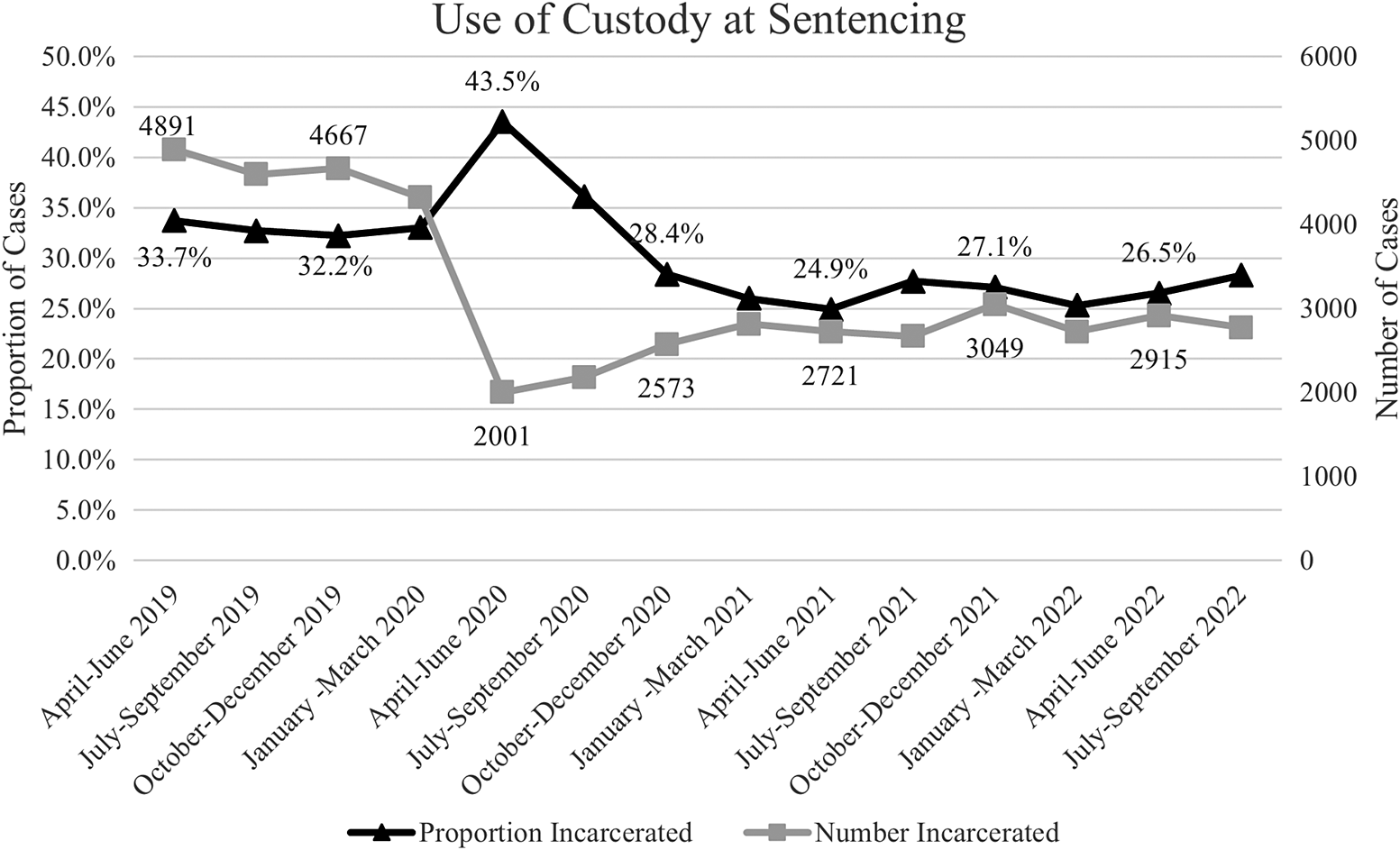
Thus, while a decreasing number of resolved cases in the system is certainly responsible for part of the drop in the raw number of custodial sentences seen in Figures 1 and 2, the decreased proportion of these sentences confirms that there was also a lower relative use of incarceration. This reduced use of incarceration is especially notable given the evolution of public health policy and public attitudes towards the COVID-19 pandemic in Canada.
In addition to the decision to incarcerate at bail or sentencing, it is equally important to investigate the length of custodial sentences in order to understand the use of incarceration during the pandemic more fully. Figure 3 supports the contention of a new, more lenient approach to sentencing that occurred in Ontario’s courts during the pandemic. This continued until at least September 2022.
Number of adults sentenced to custody for all criminal infractions by length of sentence alongside the number of criminal cases completed in Ontario courts.
Source: Statistics Canada Table 35–10–0176–01.
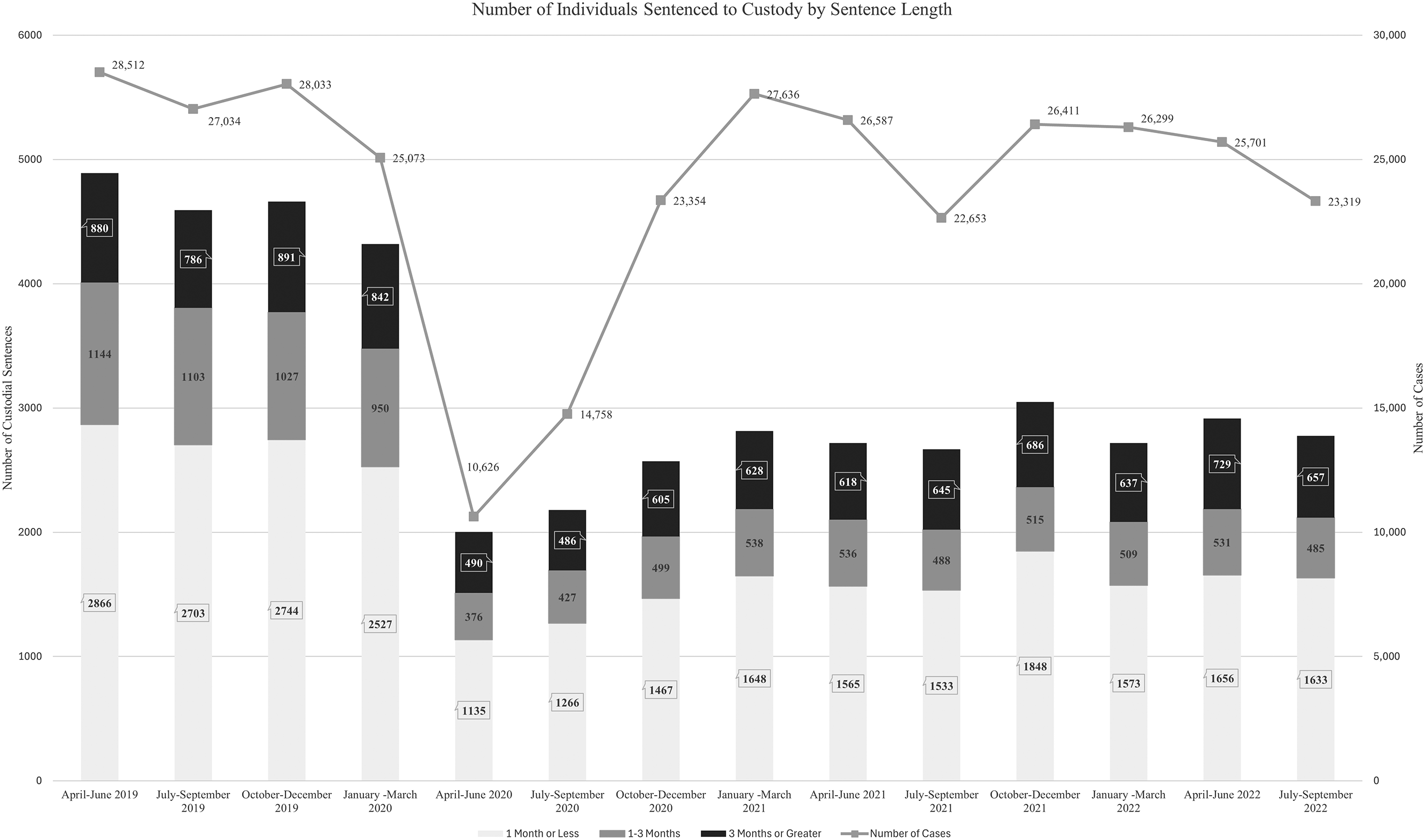
As shown in Figure 2, we see a staggering drop in the number of cases being sentenced to custody at the onset of the pandemic. The number of sentences of thirty days or less and one to three months decreased substantially. Indeed, the numbers were more than halved, with sentences of thirty days or less numbered at 2,527 in the quarter preceding the onset of the pandemic, falling to 1,135 once the pandemic struck; sentences of one to three months fell from 950 to 376. These represent drops of 54 percent and 60 percent, respectively. While the number of these sentences increased as the pandemic wore on, they remained significantly below the levels seen pre-pandemic. In the most recent quarter, sentences of one month or less and one to three months were still noticeably lower than those prior to April 2020 (35% and 49% lower, respectively).
Interestingly, while longer sentences of three months or greater dropped by roughly 42 percent from 842 to 490 at the onset of the pandemic, this was still smaller than those of shorter sentences. Further, while these sentences also remain below pre-pandemic levels, in the most recent quarter, they are only 22 percent below the level seen just before the pandemic. Stated otherwise, of the three groups, sentences of greater than three months are closest to their pre-pandemic levels.
This is perhaps not surprising. Shorter sentences are precisely the cases that one could assume would be reduced during the pandemic. If a short sentence is required, it is likely that public safety is not the greatest issue at sentencing. This is not necessarily the case in those circumstances leading to longer sentences. Logically, then, these shorter sentences might be the cases that could be served in the community under certain circumstances.
Together, these figures demonstrate that, at least at the larger provincial level, there were remarkable decreases in the use of incarceration by Ontario criminal courts as a sentence and pending case resolution. Decreases of 50 percent or greater in the number of cases receiving a custodial sentence were not uncommon as time wore on. Notably, this drop in the number of custodial sentences does not appear to have been solely linked to a decrease in cases in the criminal justice system. There is an important, logical link between the number of cases in the system and the number of custodial sentences rendered; however, the fact that the number of custodial sentences did not increase to pre-pandemic levels when the number of cases returned to these levels indicates that there was an undeniable and continued change in practice. Despite this trend, the above figures show that incarceration levels have begun to increase from pandemic lows even if COVID-19 continues to impact Canada and its custodial facilities.
Fieldwork methods corroborate these province-wide trends. As with the quantitative data, several defence counsel noted that they felt bail decisions were agreed upon more easily than before the pandemic. There was particular emphasis on the reduced need for sureties. One spoke about a client held in pretrial detention during the early days of the pandemic who “wasn’t getting out no way no how. Certainly, wasn’t getting out without a surety.” However, he added that as “[s]oon as the pandemic hit, the crown agreed to release that individual with no surety, as long as he had an address and was going to report by phone to the police on a weekly basis so that we knew he wasn’t disappearing on us. I mean, he was just basically sent on his way which was virtually unheard-of pre-pandemic” (D5).
Here, then, the pandemic pushed crowns to consent to the release of an accused with few conditions when this would not have happened prior to the pandemic.
In terms of sentencing, the most common refrain from interview participants was that sentences rendered during the pandemic accounted for the harsh conditions an accused already faced in jail while in pretrial custody, or the conditions they were liable to suffer should they be incarcerated. More specifically, they attempted to be more lenient, either avoiding incarceration or shortening custodial sentences. These were commonly called “COVID deals” by participants:
So as a result of COVID-19 the crown’s office has been offering what’s called “COVID deals.” They’re deals that essentially are made for COVID in mind to be a little lighter or a little more focused on getting someone out of custody than they necessarily would have been beforehand. So there’s been a level of leniency that was reintroduced in the system that we wouldn’t necessarily have seen before COVID. (D1)
Another stated similarly that he believed “what was also adopted a lot was to take into consideration the pandemic as a mitigating factor in the imposition of the prison sentence to be imposed. This is the approach judges preferred, I believe” (D2, translated from French by authors). Such evaluations came from both defence counsel and judges interviewed; indeed, participants were nearly unanimous in this evaluation.Footnote 15 One judge explained how defence and the crown “made some very reasonable offers to resolve a lot of cases. And a lot of cases are either getting stayed, withdrawn or they’re resolved with reasonable deals” (J5), corroborated by the lower number and proportion of custodial sentences discussed previously. Another provided a closer examination of their thought process when deciding on the potential incarceration of an offender:
At the time [the goal] was to avoid them being in prison in the summer when there were fears that the spread was going to be even greater. When we realized that the second wave was not going to miss us, it was the question “Can we impose a lesser sentence or can we impose a sentence within the community rather than traditional imprisonment” …. Our Court of Appeal has clearly indicated that it is quite justified to impose lesser sentences so that people are less likely to be exposed to the virus. (J2, translated from French by authors)
Similarly, the majority of participants noted that counsel tried very hard to work together and find common ground on files that may otherwise have been contentious. For example, D5 stated that judges and “particularly more liberally inclined judges were coming up with everything but the kitchen sink to keep people from entering the jail and get them out of the jail as quickly as possible” (D5). Further, like every other judge who spoke on sentencing mentioned, one judge interviewed expressed that he “was pleasantly surprised at how hard the parties worked to resolve a number of matters” (J3). Stated otherwise, this judge was pleased that crown and defence endeavoured to reconcile disparate sentencing positions during their negotiations. Thus, given their knowledge of jail conditions, court actors were creative in finding ways to avoid custodial sentences where they judged feasible.
Data from observations, informal conversations, and formal interviews suggest that this more lenient framework—one that avoids incarceration as much as possible even in cases in which it might otherwise be necessary—was conceivable due specifically to the pandemic. Frequently, court actors would utter the seemingly magic words “but for COVID-19” when imposing a “light” sentence that they may not have imposed pre-pandemic. One interviewee described how, particularly for crowns, the pandemic gave tacit permission to act in this way because it would not set a precedent:
It’s almost as if, it’s going to sound strange, but COVID-19 gave them [crown attorneys] a bit of an excuse to take a lighter position and to feel that it wasn’t creating precedent. And that’s fair …. So I think that’s freed them up a bit because they’ve been able to say “Look, but for COVID I would’ve said X but this is COVID-19” and I think that has sort of given them a little bit more freedom. And again, because as a crown … I get it. You have to be able to justify your position to a whole bunch of people. (J3, emphasis in original)
These data make it clear that there was certainly a change in the approach to the use of incarceration. Participants made it clear that great efforts were made in court as well as in resolution discussions to not send individuals into custodial facilities unless they felt it was absolutely necessary. Court actors were aware of the issues of incarcerating individuals during a health crisis, and they changed the way in which they evaluated offenders and the merits of incarceration in any given case. These trends necessarily speak to cooperation and shared understandings of the current pandemic environments. Actors spoke of the exceptional nature of the times and found solutions that may not have been accepted “but for COVID.” While fieldwork was conducted principally throughout 2021, the quantitative sentencing data reaching into 2022 show that this reduced incarceration endures. Importantly, then, this avoidance of incarceration appears to still be holding in Ontario’s criminal justice system. Of course, data on remand admissions are currently only available until March 2022 and, as such, we cannot say whether this reduction in admissions has continued.
The Pull Back to Increased Incarceration
Notwithstanding the emergence of this pandemic-era approach to incarcerating individuals, data also suggest that some individuals on the ground pushed back against this change, if only in some limited ways. Typically, this pushback emerged from crown attorneys, but there were some judges or justices of the peace who also exhibited such tendencies. This struggle between different actors is precisely what the agonistic perspective suggests occurs constantly in the criminal justice system. This was evidenced primarily through field methods rather than quantitative data from Statistics Canada. Nevertheless, this resistance on the ground may serve as a precursor to larger-scale trends that are visible in provincial-level statistics.
Resistance to COVID-19 leniency in the use of incarceration in the bail context was discussed by several defence counsel interviewed. One characterized bail as a disaster generally but “even more so with COVID-19.” She went on to explain that:
at the very beginning [of the pandemic] there was all this case law coming out … and we thought that … submissions about incarcerating people who are at risk and it’s a global pandemic would be convincing and noteworthy for a justice of the peace. And I think it very quickly withered, I don’t think that became a very convincing argument …. So, now I’d say that it’s probably about the same that it was pre-pandemic in terms of rates of release. I don’t think that people are less likely to be detained because of COVID. (D8)
Interestingly another participant corroborated this leniency and its downfall:
I had a lot of consent releases [early on in the pandemic] but now I have noticed more often than before …. Before there was almost a presumption in favour of release. Which of course supposed to be the norm. But now, it is more nuanced now. They are looking at it again and saying, “OK we don’t think this guy should be released, we’re going to have to run show-cause on him.” (D9)
It is noteworthy that this participant characterizes this presumption of release as what bail ought to be normally but insinuates that this is not the case. Nevertheless, this is further confirmation of an initial leniency in the use of incarceration by courtroom actors; nevertheless, they also highlight a certain pushback or weariness to this new state of affairs on the part of some crown attorneys and justices of the peace. Indeed, this suggests that there was a desire to return to pre-pandemic norms in which cases could more easily end in custody.
Several defence counsel made an important addition to this pushback against more liberal bail practices. They were sceptical that bail releases had ever become more frequent or lenient after the onset of the pandemic; instead, they felt that police officers were releasing individuals whom they would not have released prior to the pandemic. One explained that:
[w]hen I went to bail court … I didn’t feel any differences in terms of how the crown would exercise their discretion …. So, for me, I cannot say that because of COVID I’ve seen a change … inside of the courtroom. I’ve seen a change in terms of how the police officers exercise their discretion to release people that would otherwise end up brought to the station or brought in, ultimately to the courthouse to have a justice of the peace determine their release. (D3)
Thus, while there are those who felt bail had become more accessible due to the pandemic, most participants describe the change as minimal, or at the very least short-lived. They felt either that crowns or justices of the peace had never bought into a more lenient approach to incarcerating individuals pending trial or that they simply stopped at some earlier point in the pandemic. In other words, there was a resistance from some actors.
This is not to say that this resistance was widespread. Indeed, notwithstanding potential differences in proportional terms, Figure 1 shows a decrease in the number of bail admissions, at least up until March 2021. This might be attributable to police releasing more individuals rather than courts taking a more lenient approach. Indeed, Myers seems to briefly hint at police releasing more individuals rather than holding them for bail (2021, 15).
Despite noteworthy and at times creative efforts to avoid imposing custody, several participants, judges and defence alike, mentioned that they felt that the strength of COVID-19 as an argument against the incarceration of an offender was waning at the time of data collection. One judge was particularly succinct in summarizing such a phenomenon at sentencing:
I think there was probably a bit of a falling off period where it looked like the pandemic was under control …. And again people get fatigued right? People get tired of hearing the same thing “Ah the lawyers keep saying the same thing about, you know, got to give the guy a better deal or he’s going to go in a middle of a pandemic.” There’s a fatigue about it and I think there was a period of time when the commitment by some people in the process, to using real COVID-geared solutions might have waned a little. (J6)
In this way, they suggest that dedication to avoiding custodial sentences was not what it may have been at the outset of the pandemic. One defence counsel even suggested this “fatigue” set in as early as August 2020. Figure 3 supports this suggestion. While it shows that the number of individuals sentenced to custody decreased remarkably at the outset of the pandemic and remains lower than pre-pandemic levels, it also shows this number began to grow again, at least minimally, in the latest fiscal quarters.
Another aspect of sentencing during the pandemic offers support for the assertion that there was pushback against the pandemic-era leniency when incarcerating offenders. Kerr and Dubé (Reference Kerr and Dubé2021) discussed how some appellate courts in Ontario and beyond provided credit for pretrial custody beyond 1.5 days for every day spent in pretrial custody, known as Duncan credit. In the few cases in which these arguments arose during court observations, however, they were strongly opposed by crown counsel.Footnote 16 This trend was confirmed in interviews.
Of the 107 full sentencing hearings observed, Duncan credit arguments were only made in five. In four of these, credit above 1.5:1 was granted.Footnote 17 Notably, in one of these four, the judge specifically stated that it “should not serve as precedent” (Observation Notes) given the unique factors of the case, strengthening our earlier argument around the importance of avoiding setting precedent at sentencing. In each of these five cases, however, crown attorneys argued the Duncan credit should not be granted, explaining either that pretrial discussions had been predicated on credit of 1.5:1 or that greater credit had already been baked into the resolution agreement. Crowns also demanded that the defence should proffer evidence of uniquely harsh conditions experienced by a detainee to justify this credit.
In a noteworthy exchange during court observations, a crown attorney implied that an accused who had previously been detained during the pandemic had knowledge of these poor jail conditions and thus should not be rewarded with increased, COVID-19-related leniency in their current bail hearing (Observation Notes). While the judge challenged and disavowed the crown’s logic, the fact that it was raised as an argument is suggestive of a thought process that may exist among some crown attorneys.
Similar crown opposition to Duncan credit was also discussed by several interview participants who felt that crown attorneys pushed back against such granting of greater credit: “Well definitely some crowns are not happy with the level of pre-sentence custody that is being attributed. We have been getting some pretty amazing deals where it is two for one … and they [crowns] are kind of arguing against that” (D9).
While only a single judge discussed this topic, he felt that existing legislation did not allow its granting “by statute, a person who is spending time in custody is not entitled to more than 1.5 days credit …. There have been some authorities that have suggested that COVID can change that. And my view, based on the various authorities, that absent a Charter application as a court of statute, I don’t have the jurisdiction to do that” (J3).
Thus, while not expressing opposition to it, this participant felt that there was insufficient jurisprudential guidance at the time of our interview. Nevertheless, taken together, these data suggest that, despite the noted and widely acknowledged conditions of jails during COVID-19 and the possibility of mobilizing Duncan, courts, but especially crown attorneys, appeared reluctant to allow the granting of Duncan credit. However, the infrequency with which it was argued and granted makes more nuanced conclusions difficult.
These extracts have shown that, while there were no explosive conflicts between various members of the courtroom, there were certainly differing points of view and different, evolving approaches to the use of incarceration among court actors during the pandemic. It is these undercurrents of resistance than can, and sometimes do, come to define penal practices more widely.
Discussion
Fulfilling our first objective, these results have shown that there was indeed a break in sentencing practice in Ontario—an opportunity that emerged from the onset of the pandemic and the dire health consequences associated with imprisoning individuals during this time. Both the number and proportion of cases receiving a custodial sentence dropped noticeably and, in 2022, continued to be lower than before the arrival of the pandemic. Participants described “COVID deals” and “coming up with everything but the kitchen sink” to avoid custodial sentences, as one defence lawyer stated. However, we also highlighted potential resistance among certain actors to leniency in the use of incarceration. When some pushed against these new norms, arguing for release on bail, for a non-custodial sentence, or for increased pretrial credit, resistance arose from other actors who could not abide by such decisions. We suggest, like Myers (Reference Myers2021) and Burningham (Reference Burningham2022), that a pandemic fatigue set in among some court actors who may have felt that arguments for avoiding incarceration began to hold less sway.
What these results have highlighted, then, is a low-level struggle between those open to new norms surrounding the use of incarceration and those hesitant or even hostile towards such a change, meeting the second objective of this work. Koehler (Reference Koehler2019) explains that, frequently, struggles in penal development such as those elaborated on here do not move beyond certain presumptively legitimate boundaries—beyond what is “thinkable.” Here, then, we hold that it was thinkable for court actors to temporarily reduce incarceration due to the conditions in custodial facilities, particularly for short sentences, but it was not thinkable for some crown attorneys to solidify this leniency into a precedent that may outlast the pandemic. It was thinkable to reduce the use of custody at the outset of the pandemic but, again, this could not continue indefinitely.
Considering Koehler’s (Reference Koehler2019) idea of thinkable and unthinkable in the context of penal change, Page, Phelps, and Goodman (Reference Page, Phelps and Goodman2019) adapted the agonistic framework to incorporate the idea of a “conflictual consensus” that exists in criminal justice systems. This is to say that, while resistance and contestation are ever-present, there is a tacit agreement about the parameters of the system; again, there is agreement about what is legitimate and conceivable in the system. The framework holds that conflictual consensus hinders radical transformations of the system, keeping change within acceptable boundaries, by “not questioning the legitimacy of the [system]” and making only small, incremental changes (Page et al. Reference Page, Phelps and Goodman2019, 824).
Given the extent of the drop in incarceration, how can we still assert that the change was not radical? We begin by retracing some of the existing boundaries around incarceration in Canada’s criminal justice system. First, restraint in incarceration was not a fringe idea prior to the pandemic. Statute and jurisprudence frequently mention it. Even if, in practice, the exceptional use of incarceration is dubious, as suggested by some authors (Manson et al. Reference Manson, Healy, Trotter, Roberts and Ives2016), there is at least a prima facie legitimacy for court actors to avoid incarceration when possible. However, just as jurisprudence and statute can permit the avoidance of incarceration, it can be mandated or strongly encouraged through these same mechanisms. For example, mandatory minimum penalties can require the imposition of a custodial sentence. Within these boundaries, however, court actors, and crown attorneys especially, possess a great deal of discretion in seeking custody (Manson et al. Reference Manson, Healy, Trotter, Roberts and Ives2016).
With boundaries so wide on the acceptable use of incarceration, radical can only take so many forms. One such possibility might have been suspending the use of incarceration, even temporarily. The data show that this did not occur and sentences, both short and long, continued to be handed down. Further, no actors vocalized the possibility of completely avoiding incarceration during this exceptional time, despite the danger of the pandemic. It is perhaps Justice Gorman who said it most clearly—that a moratorium on incarceration would not be “feasible or desirable” (2021, 21–23), espousing what Burningham characterizes as the “business as usual” approach (2022, 594).
In the current analysis, then, it can be said that the conflict and friction we have discussed operated within a consensual framework surrounding acceptable uses of incarceration. The reductions in incarceration, though unprecedented, were not radical in that they did not truly break beyond acceptable boundaries of practice. We concur with Burningham, who states that “The result [of COVID-19] is far from the dramatic shift in ethos that some called for at the beginning of the pandemic” (Burningham Reference Burningham2022, 596). It did not allow more radical approaches to reducing incarceration, even if restraint in its use grew. Indeed, one participant described the “leniency” in bail during the pandemic as what ought to have been regular practice before the onset of this health emergency.
Stated otherwise, while incarceration became more infrequent during the pandemic, this change only brought its use more in line with what it should be: exceptional. It is our contention that such sparing use of incarceration should not considered a radical change for, if it is, greater concerns emerge about the trajectory of criminal justice moving forward.
Conclusion
These results raise questions about the potential for decarceration movements in Canada. Some have highlighted the strengthening of prison abolition movements during the COVID-19 pandemic in Canada due to the worsening conditions in custodial facilities across the country (Anthony and Chartrand Reference Anthony and Chartrand2022; Chartrand Reference Chartrand2021). However, as these conditions recede, one may question whether these efforts can continue. Indeed, having grown out of the pandemic, it is reasonable to ask whether this leniency might endure or whether it will succumb to those opposing this pandemic-era sentencing framework.
While some trends suggest that the prevalence of incarceration remains lower than pre-pandemic, this could change. Indeed, some authors raise concerns about the longevity of changes emerging from disasters such as the COVID-19 pandemic. While cooperation emerges between various groups alongside new norms (Quarantelli Reference Quarantelli2000; Perry Reference Perry, Rodriguez, Donner and Trainor2017; Vollmer Reference Vollmer2013), these can evaporate with the passing of the disaster, returning relationships and routines to their pre-disaster forms (Wenger Reference Wenger and Quarantelli1978). This may hint that avoidance of incarceration may not endure much longer past the end of the COVID-19 pandemic, as some have suggested is the case internationally (Maruna et al. Reference Maruna, McNaull and O’Neil2022).
The pandemic presented certain individuals with the opportunity to favour decarceration (Chartrand Reference Chartrand2021; Maruna et al. Reference Maruna, McNaull and O’Neil2022); however, it is possible that another event may come to pass only to reinforce the use of incarceration. One need only think of the variety of news stories deploring the so-called soft-on-crime approach that Canada’s criminal justice system allegedly espouses. Recent concern for public safety and leniency in bail following the deaths of police officers in CanadaFootnote 18 is but one recent example of an opportunity taken to demand greater incarceration. It is clear, then, that such events offer fertile ground to undo progress towards decarceration.
For this reason, proponents of this movement must capitalize on the opportunity for positive change if decarceration is their goal. There may be a chance for this new incarceration framework to remain in place should it gain sufficient acceptance and legitimacy among criminal justice actors. Indeed, changes that are beyond the boundaries of acceptability in the criminal justice system are not likely to develop deep roots given that buy-in from the actors on the ground is fundamental for successful implementation of policy change (Campbell Reference Campbell2011; Rubin and Phelps Reference Rubin and Phelps2017; Webster et al. Reference Webster, Sprott and Doob2019).
Of course, buy-in from actors may depend on a variety of factors. One such factor is the utility of a proposed change. Indeed, Feeley explains that one of the impediments to change in criminal justice is that “there is little incentive for those engaged in day-to-day administration of the criminal courts” to do so (Feeley Reference Feeley2013 [1983], 192). Therefore, if an incentive can be found, this could help to ensure buy-in from actors responsible for carrying out a given change in their day-to-day work. For example, if it could be demonstrated that seeking fewer custodial sentences would result in faster and more efficient case resolutions, it is possible that court actors may be more inclined to do so due to the benefit it could bring them.
As such, we contend that those seeking change and reform must seek incentives for those responsible for carrying out said reforms. The current work reinforces these assertions that, without this buy-in, changes will struggle to endure, during an emergency and even beyond. Importantly, buy-in likely requires working within the boundaries of acceptability, which is to say that radical changes may be difficult to implement.
Finding these incentives would ideally be done in partnership with relevant stakeholders, as suggested by Webster, Sprott, and Doob (Reference Webster, Sprott and Doob2019). If collaboration is not possible, then advocates may need to identify potential benefits with support from existing literature. For example, if a link between seeking fewer custodial sentences and decreased litigation and therefore criminal court workloads could be uncovered and highlighted, then this may serve as sufficient incentive for court actors given the widely publicized issues of delay in Canadian criminal courts.
Future research aimed at better understanding the perceptions and values of court actors would provide evidence on how to ensure that court actors might support and enact legal change. While these actors may outwardly support those larger, system-wide values, their own may come into conflict with them, creating a fertile ground for resistance. In understanding and identifying potential areas of consensus and resistance, scholars and other stakeholders may more easily identify potential areas of intervention that are more likely than others to succeed. These may help advocates of decarceration to advance their causes post-pandemic.
Furthermore, future researchers would be well served by monitoring this contestation with particular emphasis on a micro-sociological level. In this way, they can bear witness more easily to the friction that can hide beneath a surface that appears relatively stable, as contended by the agonistic framework. Further, a deeper analysis of COVID-19-era changes as a case study on decarceration and abolitionism would be especially fruitful. If crown attorneys can be incorporated into any such study, this would be particularly illuminating. Nevertheless, once more detailed court data are available, it will be imperative to monitor these statistical trends to identify whether those discussed here have continued or whether they have given way to a more traditional approach to incarceration. This will help to nuance trends found “on the ground.”


 Open access

