





1 Introduction
Throughout, let $p \ge 5$
be a prime. Given a quasi-modular form f on
$p \ge 5$
be a prime. Given a quasi-modular form f on $\operatorname {SL}_2(\mathbb {Z})$
with p-integral rational coefficients and an integer
$\operatorname {SL}_2(\mathbb {Z})$
with p-integral rational coefficients and an integer $m\geq 1$
, let
$m\geq 1$
, let $\omega _{p^m}(f)$
be the weight filtration of f modulo
$\omega _{p^m}(f)$
be the weight filtration of f modulo $p^m$
as defined in (2.1). Iteration of the theta operator
$p^m$
as defined in (2.1). Iteration of the theta operator $\theta $
(defined in (2.7)) yields the extended theta cycle of f modulo
$\theta $
(defined in (2.7)) yields the extended theta cycle of f modulo $p^m$
:
$p^m$
:
 $$ \begin{align*} \Omega_{p^m} f \mathrel{:=} \Big( \omega_{p^m}\bigl( f\bigr),\, \omega_{p^m}\bigl(\theta^{1} f\bigr),\, \;\ldots\;,\, \omega_{p^m}\bigl(\theta^{(p-1)p^{m-1} + m-1} f\bigr) \Big) \text{,} \end{align*} $$
and the periodic subsequence starting with the weight filtration of $\theta ^m f$
is called the (Tate) theta cycle. In the case
$\theta ^m f$
is called the (Tate) theta cycle. In the case $m = 1$
, theta cycles of modular forms are completely understood. As an example of a central application which leverages this detailed understanding we mention Edixhoven’s work [Reference Edixhoven5] on the weight in Serre’s conjecture on modular forms. In a different direction, this understanding leads to the classification [Reference Ahlgren and Boylan1] of Ramanujan congruences for the partition function.
$m = 1$
, theta cycles of modular forms are completely understood. As an example of a central application which leverages this detailed understanding we mention Edixhoven’s work [Reference Edixhoven5] on the weight in Serre’s conjecture on modular forms. In a different direction, this understanding leads to the classification [Reference Ahlgren and Boylan1] of Ramanujan congruences for the partition function.
An integer i, or by extension the quasi-modular form $\theta ^i f $
, is a low point of the cycle if
$\theta ^i f $
, is a low point of the cycle if
 $$ \begin{align*} \omega_{p^m}\big( \theta^{i-1} f \big)> \omega_{p^m}\big( \theta^{i} f \big) \quad\text{and}\quad \omega_{p^m}\big( \theta^{i}f \big) < \omega_{p^m}\big( \theta^{i+1}f \big) \text{.} \end{align*} $$
Further, we say that we have a rise (resp. a fall) at i if
 $$ \begin{align*} \omega_{p^m}\big( \theta^{i}f \big) < \omega_{p^m}\big( \theta^{i+1}f \big) \qquad \Big(\text{resp.} \quad \omega_{p^m}\big( \theta^{i}f \big)> \omega_{p^m}\big( \theta^{i+1}f \big)\Big).\end{align*} $$
The theta cycles modulo p are determined by the positions and weight filtrations of their low points [Reference Jochnowitz6]. There are either one or two low points in a theta cycle modulo p and the remaining part of $\Omega _p(f)$
is highly regular, as illustrated on the left in Figure 1. The behavior of the theta cycle modulo
$\Omega _p(f)$
is highly regular, as illustrated on the left in Figure 1. The behavior of the theta cycle modulo $p^2$
is by contrast more intricate and seemingly erratic, as illustrated on the right. Indeed, only partial results on the isolated points
$p^2$
is by contrast more intricate and seemingly erratic, as illustrated on the right. Indeed, only partial results on the isolated points $i = 1$
[Reference Chen and Kiming4] and
$i = 1$
[Reference Chen and Kiming4] and $i \in p \mathbb {Z}$
or
$i \in p \mathbb {Z}$
or $i \in p-k+1 + p\mathbb {Z}$
[Reference Kim and Lee7] are available. In particular, not a single location of a low point is known.
$i \in p-k+1 + p\mathbb {Z}$
[Reference Kim and Lee7] are available. In particular, not a single location of a low point is known.
The weight filtrations modulo $p = 17$
(on the left) and
$p = 17$
(on the left) and $p^2$
(on the right) of
$p^2$
(on the right) of $\theta ^i \Delta $
, where
$\theta ^i \Delta $
, where $\Delta $
is the normalized cusp form of weight
$\Delta $
is the normalized cusp form of weight $k = 12$
. Filtration values modulo p given for
$k = 12$
. Filtration values modulo p given for $0 \le i \le p$
on the x-axis are connected by a dashed line. Filtrations modulo
$0 \le i \le p$
on the x-axis are connected by a dashed line. Filtrations modulo $p^2$
given for
$p^2$
given for $0 \le i \le p (p-1)$
are represented by a blue line connecting the values. Orange crosses indicate previously known values (in some cases not uniquely determined) for
$0 \le i \le p (p-1)$
are represented by a blue line connecting the values. Orange crosses indicate previously known values (in some cases not uniquely determined) for $i = 1$
[Reference Chen and Kiming4],
$i = 1$
[Reference Chen and Kiming4], $i \in p \mathbb {Z}$
[Reference Kim and Lee7], and
$i \in p \mathbb {Z}$
[Reference Kim and Lee7], and $i \in p - k + 1 + p \mathbb {Z}$
[Reference Kim and Lee7].
$i \in p - k + 1 + p \mathbb {Z}$
[Reference Kim and Lee7].

As one example of the complicated structure which appears, we mention that the theta cycle modulo $p^2$
can have successive falls; this is not possible in the cycle modulo p. An example of this phenomenon occurs for the normalized weight
$p^2$
can have successive falls; this is not possible in the cycle modulo p. An example of this phenomenon occurs for the normalized weight $12$
cusp form
$12$
cusp form $\Delta $
when
$\Delta $
when $p=13$
: we have
$p=13$
: we have
 $$ \begin{align*} \omega_{13^2}\bigl( \theta^{133}\, \Delta \bigr) = 434 \text{,}\quad \omega_{13^2}\bigl( \theta^{134}\, \Delta \bigr) = 280 \text{,}\quad \text{and} \quad \omega_{13^2}\bigl( \theta^{135}\, \Delta \bigr) = 126 \text{.} \end{align*} $$
Here, we determine exact values for weight filtrations in long segments of theta cycles modulo $p^2$
. Our first result provides the exact weight filtration for all
$p^2$
. Our first result provides the exact weight filtration for all $\theta ^if$
with
$\theta ^if$
with $0 \le i \le p$
. A closer inspection of Figure 1 reveals the alignment of the first two low points in the theta cycles modulo p and
$0 \le i \le p$
. A closer inspection of Figure 1 reveals the alignment of the first two low points in the theta cycles modulo p and $p^2$
. Our theorems in particular imply that these low points always occur and that they are the only ones in this range.
$p^2$
. Our theorems in particular imply that these low points always occur and that they are the only ones in this range.
To state the result, recall that $p\geq 5$
and denote by
$p\geq 5$
and denote by $\mathrm {M}_k$
the space of weight k modular forms on
$\mathrm {M}_k$
the space of weight k modular forms on $\operatorname {SL}_2(\mathbb {Z})$
with p-integral rational Fourier coefficients (recall that
$\operatorname {SL}_2(\mathbb {Z})$
with p-integral rational Fourier coefficients (recall that $\mathrm {M}_k=\{0\}$
unless
$\mathrm {M}_k=\{0\}$
unless $k=0$
or
$k=0$
or $k\geq 4$
is even). We will often assume that
$k\geq 4$
is even). We will often assume that $f\in \mathrm {M}_k$
with
$f\in \mathrm {M}_k$
with $0<k<p$
has
$0<k<p$
has $\omega _p(f)=k$
. This assumption simply ensures that f is not a constant multiple of the Eisenstein series
$\omega _p(f)=k$
. This assumption simply ensures that f is not a constant multiple of the Eisenstein series $E_{p-1}\equiv 1\ \pmod p$
.
$E_{p-1}\equiv 1\ \pmod p$
.
Theorem A Suppose that $f\in \mathrm {M}_k$
with
$f\in \mathrm {M}_k$
with $0<k<p$
has
$0<k<p$
has $\omega _p(f)=k$
. Then we have the following exact weight filtrations:
$\omega _p(f)=k$
. Then we have the following exact weight filtrations:
 $$ \begin{align*} \omega_{p^2}\big( \theta^i f \big) &= k \text{,}\quad && \text{if} i = 0 \text{;} \\ \omega_{p^2}\big( \theta^i f \big) &= k + 2i + 2p(p-1) \text{,}\quad && \text{if} 0 < i < p - k + 1 \text{;} \\ \omega_{p^2}\big( \theta^i\, f \big) &= k + 2i + p(p-1) \text{,}\quad && \text{if} i = p - k + 1 \text{;} \\ \omega_{p^2}\big( \theta^i\, f \big) &= k + 2i + 2p(p-1) \text{,}\quad && \text{if} p - k + 1 < i < p \text{;} \\ \omega_{p^2}\big( \theta^i\, f \big) &= k + 2 i + p (p-1) \text{,}\quad && \text{if} i = p \text{.} \end{align*} $$
The next corollary will follow from Theorems A and C.
Corollary B Suppose that $f\in \mathrm {M}_k$
with
$f\in \mathrm {M}_k$
with $0<k<p$
has
$0<k<p$
has $\omega _p(f)=k$
. The first low point of the theta cycle of f modulo
$\omega _p(f)=k$
. The first low point of the theta cycle of f modulo $p^2$
occurs at
$p^2$
occurs at $i = p - k + 1$
and the second at
$i = p - k + 1$
and the second at $i = p$
. Moreover, if
$i = p$
. Moreover, if $0 < i < p-1,$
then
$0 < i < p-1,$
then
 $$ \begin{align*} \omega_{p^2}\big( \theta^{i+1}\, f \big) =\omega_{p^2}\big( \theta^{i}\, f \big) + 2 \quad \text{unless } i=p-k \text{.} \end{align*} $$
Remark
-
(1) The weight filtrations at the first and second low points $i=p-k+1$
,
$i=p$
were determined in [Reference Kim and Lee7], but it was not proved that these are low points.
$i=p-k+1$
,
$i=p$
were determined in [Reference Kim and Lee7], but it was not proved that these are low points. -
(2) The positions of the first low point modulo p and
$p^2$
agree, but unlike the modulo p case, the modulo
$p^2$
weight filtration of the first low point is independent of whether or not f has a
$\mathrm {U}_p$
-congruence modulo p. -
(3) The position of the second low point modulo
$p^2$
matches the position of the second low point for modular forms which do not have a
$\mathrm {U}_p$
-congruence modulo p. -
(4) The analysis in [Reference Jochnowitz6] shows that
$\omega _p(\theta ^{i+1} f) \ne \omega _p(\theta ^{i} f) + 2$
for all
$i \ge 1$
, which is in contrast to the situation modulo
$p^2$
, where a rise of
$2$
is the common case.





Our next result determines a substantial part of the weight filtration modulo $p^2$
of
$p^2$
of $\theta ^if$
for general i and identifies families of low points. Some of them appear at regular intervals, and some appear at what we call exceptional positions. We will consider indices i with
$\theta ^if$
for general i and identifies families of low points. Some of them appear at regular intervals, and some appear at what we call exceptional positions. We will consider indices i with
 $$ \begin{align} np \le i \le np+p - k + 1\text{,} \qquad 1 \le n < p \text{.} \end{align} $$
We call such an index exceptional if it is a solution of the congruence
 $$ \begin{align} i^2 + (k-1) i - n^2 \equiv 0 \quad\pmod{p} \text{.} \end{align} $$
In Corollary D, we will show that these exceptional indices often correspond to low points which disrupt regularity in the theta cycle.
Theorem C Suppose that $f\in \mathrm {M}_k$
with
$f\in \mathrm {M}_k$
with $0<k<p$
has
$0<k<p$
has $\omega _p(f)=k$
. Let i be as in (1.1).
$\omega _p(f)=k$
. Let i be as in (1.1).
-
(1) If i is exceptional, then
$$ \begin{align*} \omega_{p^2}\big( \theta^i\, f \big) \le k + 2i + p (p-1) \text{.} \end{align*} $$
-
(2) If i is not exceptional, then we have the following exact values and nontrivial bounds, where
$i' = i - np$
is the least nonnegative residue of
$i\ \pmod p$
:
$$ \begin{align*} \omega_{p^2}\big( \theta^i\, f \big) &\le k + 2i + p (p-1) \text{,}\quad && \text{if} i' = 0 \text{ (proved in~[7])} \text{;} \\ \omega_{p^2}\big( \theta^i\, f \big) &= k + 2i + p (p-1) \text{,}\quad && \text{if} 0 < i' < n \text{ and} i' \le p - k + 1 - n \text{;} \\ \omega_{p^2}\big( \theta^i\, f \big) &= k + 2i + 2p (p-1) \text{,}\quad && \text{if} n \le i' \le p - k + 1 - n \text{;} \\ \omega_{p^2}\big( \theta^i\, f \big) &\le k + 2i + p (p-1) \text{,}\quad && \text{if} p - k + 1 - n < i' < p - k + 1 \text{;} \\ \omega_{p^2}\big( \theta^i\, f \big) &\le k + 2i + p (p-1) \text{,}\quad && \text{if} i' = p - k + 1 \text{ (proved in~[7])} \text{.} \end{align*} $$



For fixed weight and asymptotically as $p \rightarrow \infty $
, our results provide exact filtration values for 50% of the theta cycle modulo
$p \rightarrow \infty $
, our results provide exact filtration values for 50% of the theta cycle modulo $p^2$
and nontrivial bounds for 100% of it (see Remark 4.2). We illustrate the range of our results for
$p^2$
and nontrivial bounds for 100% of it (see Remark 4.2). We illustrate the range of our results for $f = \Delta $
and
$f = \Delta $
and $p = 59$
in Figure 2.
$p = 59$
in Figure 2.
The weight filtrations modulo $p^2 = 59^2$
of
$p^2 = 59^2$
of $\theta ^i \Delta $
, where
$\theta ^i \Delta $
, where $\Delta $
is the normalized cusp form of weight
$\Delta $
is the normalized cusp form of weight $12$
. Filtration values are given for
$12$
. Filtration values are given for $0 \le i \le p (p-1)$
(on the left) and
$0 \le i \le p (p-1)$
(on the left) and $0 \le i \le 4p$
(on the right) on the x-axis, and are represented by a blue line connecting them. Vertical green lines on the right indicate exceptional low points (see Corollary D). Green shaded areas represent ranges of i for which we prove exact filtration values. Orange shaded areas correspond to ranges of i for which we establish nontrivial upper bounds for the weight filtrations. We do not provide information on filtrations for i in the red shaded areas.
$0 \le i \le 4p$
(on the right) on the x-axis, and are represented by a blue line connecting them. Vertical green lines on the right indicate exceptional low points (see Corollary D). Green shaded areas represent ranges of i for which we prove exact filtration values. Orange shaded areas correspond to ranges of i for which we establish nontrivial upper bounds for the weight filtrations. We do not provide information on filtrations for i in the red shaded areas.

In this case, our results give exact filtration values for more than 33% of the theta cycle modulo $p^2$
and nontrivial bounds for more than 81.6%. If
$p^2$
and nontrivial bounds for more than 81.6%. If $ f = \Delta $
and
$ f = \Delta $
and $p> 1,100$
, then the range increases to more than 49% of exact weight filtrations and more than 99% of nontrivial filtration bounds.
$p> 1,100$
, then the range increases to more than 49% of exact weight filtrations and more than 99% of nontrivial filtration bounds.
In the next corollary, we describe some of the structure of the theta cycle which is forced by Theorem C.
Corollary D Suppose that $f\in \mathrm {M}_k$
with
$f\in \mathrm {M}_k$
with $0<k<p$
has
$0<k<p$
has $\omega _p(f)=k$
.
$\omega _p(f)=k$
.
-
(1) For
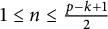
$1 \le n \le \frac {p - k + 1}{2}$
, there is a low point at
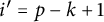
$i = np + p - k + 2 - n$
unless we have
$\omega _{p^2}( \theta ^i\, f) = k+2i + p(p-1)$
and
$\omega _{p^2}( \theta ^{i+1}\, f)=k+2(i+1)$
, in which case there is a low point at
$i+1$
. -
(2) Assume that
$np + n \le i < np + p - k + 1 - n$
and that i is an exceptional index. Then there is a low point at i (which we call an exceptional low point). -
(3) Assume that
$np < i \le np + p - k + 1 - n$
and that i is not an exceptional index. Then i is not a low point. -
(4) Assume that
$np < i < np + p - k + 1 - n$
, that
$i \ne np + n - 1$
, and that neither i nor
$i+1$
is an exceptional index. Then there is a rise by
$2$
at i.










Remark
-
(1) In the range
$0 \leq i < 2p - k + 1,$
the two theorems give exact weight filtrations for
$\theta ^if$
apart from possible exceptional indices. By part (2) of Corollary D and the fact that the index
$i=2p-k$
is not exceptional, it follows that there are exceptional low points at all exceptional indices in this range. -
(2) There are two boundary cases
$i'=0$
and
$i'=p-k+1$
in Theorem C; these indices cannot be exceptional. These cases were studied in detail in [Reference Kim and Lee7], and in many cases, exact values for the filtration are given in [Reference Kim and Lee7, Theorem 1.8]. Here, we give a bound which follows from this result and which applies to all cases. -
(3) The exact filtration values in Theorem C for
$n \le i' \le p - k + 1 - n$
are independent of whether f has a
$\mathrm {U}_p$
-congruence or not. Thus, information on
$\mathrm {U}_p$
-congruences must be encoded in the part of the theta cycle for which we do not have exact filtration values. -
(4) The filtration bounds in Theorem C are quadratic in p, while the bounds in Lemma 2.4 and Remark 2.5 below are cubic in p, and the bounds which follow from Inequality (2.19) are quartic in p.
-
(5) Let f be a modular form as in Theorems A and C. Then Corollary B identifies two low points occurring at regular positions, and the first part of Corollary D identifies
$\left \lfloor \frac {p - k + 1}{2} \right \rfloor $
such low points. All of these occur in the green-shaded areas of Figure 2. -
(6) It would be interesting to determine the number of exceptional low points, which would amount to counting solutions to the congruence
$i^2 + (k-1) i - n^2 \equiv 0 \ \pmod {p}$
with
$n \le i < p - k + 1 - n$
. Heuristically, the number of such solutions should be proportional to p on average as p varies.








We briefly describe some of the new ideas and input which allow us to access a large part of the theta cycle. In the next section, we introduce the factor filtration, a refinement of the weight filtration which plays a key role (all of the results above will follow from our study of the corresponding factor filtrations). Roughly speaking, the factor filtration involves dividing out as many powers of $E_{p-1}\equiv 1\ \pmod p$
as possible before considering the weight filtration. This idea was inspired in part by recent work of the authors with Hanson [Reference Ahlgren, Hanson, Raum and Richter2] in which we prove that every Eisenstein series on
$E_{p-1}\equiv 1\ \pmod p$
as possible before considering the weight filtration. This idea was inspired in part by recent work of the authors with Hanson [Reference Ahlgren, Hanson, Raum and Richter2] in which we prove that every Eisenstein series on $\operatorname {SL}_2(\mathbb {Z})$
has uniformly low factor filtration modulo
$\operatorname {SL}_2(\mathbb {Z})$
has uniformly low factor filtration modulo $p^2$
. In the same paper, we determine a precise expression (2.13) for
$p^2$
. In the same paper, we determine a precise expression (2.13) for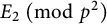 $E_2\ \pmod {p^2}$
; this is another important input here. The starting point for our results is the expansion (2.11) of
$E_2\ \pmod {p^2}$
; this is another important input here. The starting point for our results is the expansion (2.11) of $\theta ^if$
in terms of
$\theta ^if$
in terms of $E_2$
. Our ability to determine the precise factor filtration depends on isolating a group of terms in this expansion which combine to give a unique term of highest factor filtration (we often use the properties of the theta cycle modulo p in order to isolate these terms). When we are unable to isolate such a group of terms, the method still provides a nontrivial bound for the factor filtration. Finally, the weight filtrations are easily determined using Lemma 2.1.
$E_2$
. Our ability to determine the precise factor filtration depends on isolating a group of terms in this expansion which combine to give a unique term of highest factor filtration (we often use the properties of the theta cycle modulo p in order to isolate these terms). When we are unable to isolate such a group of terms, the method still provides a nontrivial bound for the factor filtration. Finally, the weight filtrations are easily determined using Lemma 2.1.
After some preliminaries in Section 2, we prove Theorem A in Section 3. The proofs of Theorem C and Corollaries B and D are more involved and occupy Section 4. In Section 2.4, we discuss the quality of the general bounds which are obtained for filtrations modulo $p^2$
.
$p^2$
.
2 Preliminaries
Let $p \geq 5$
be prime, and let
$p \geq 5$
be prime, and let $\mathrm {M}_k$
be the space of holomorphic weight k modular forms on
$\mathrm {M}_k$
be the space of holomorphic weight k modular forms on $\operatorname {SL}_2(\mathbb {Z})$
with p-integral coefficients. Every
$\operatorname {SL}_2(\mathbb {Z})$
with p-integral coefficients. Every $f \in \mathrm {M}_k$
has a Fourier expansion
$f \in \mathrm {M}_k$
has a Fourier expansion $\sum a(n) q^n$
, and we identify f with this expansion. For even
$\sum a(n) q^n$
, and we identify f with this expansion. For even $k \ge 2,$
let
$k \ge 2,$
let
 $$ \begin{align*} E_k \mathrel{:=} 1 - \frac{2k}{B_{2k}}\, \sum_{n=1}^\infty \sigma_{k-1}(n)\, q^n \end{align*} $$
be the weight k Eisenstein series, which for $k = 2$
is quasi-modular and for
$k = 2$
is quasi-modular and for $k> 2$
is modular.
$k> 2$
is modular.
Let m be a positive integer, and let  be the set of reductions modulo $p^m$
of all elements of all
$p^m$
of all elements of all $\mathrm {M}_k$
, that is, the reductions of their Fourier expansions. If
$\mathrm {M}_k$
, that is, the reductions of their Fourier expansions. If $\overline f =\sum \overline {a(n)}q^n\in \mathcal {M}_{\bullet ,m}$
, then we define the weight filtration
$\overline f =\sum \overline {a(n)}q^n\in \mathcal {M}_{\bullet ,m}$
, then we define the weight filtration
 $$ \begin{align} \omega_{p^m}(\overline f) \mathrel{:=} \inf\big\{ k \mathrel{\;:\;} \overline f \equiv g \quad\pmod{p^m} \text{ for some } g \in \mathrm{M}_k \big\} \text{.} \end{align} $$
Recall that
 $$ \begin{align} E_{p-1}\equiv 1 \quad\pmod p \quad\text{and therefore}\quad E_{p-1}^{p^{m-1}} \equiv 1 \quad\pmod{p^m} \text{.} \end{align} $$
As a refinement of the weight filtration, we introduce the factor filtration, which is defined by
 $$ \begin{align} \widetilde\omega_{p^m}(\overline f) \mathrel{:=} \inf\big\{ k \mathrel{\;:\;} \overline f \equiv E_{p-1}^n\, g \quad\pmod{p^m} \text{ for some } n \ge 0 \text{ and some } g \in \mathrm{M}_k \big\} \text{.} \end{align} $$
By a standard abuse of notation, we will write
 $$ \begin{align*} \omega_{p^m}(f) = \omega_{p^m}(\overline f) \text{,}\qquad \widetilde\omega_{p^m}(f) = \widetilde\omega_{p^m}(\overline f) \end{align*} $$
when  has
has $\overline f=f\ \pmod {p^m}\in \mathcal {M}_{\bullet ,m}$
. From [Reference Swinnerton-Dyer9, Lemma 5], we have
$\overline f=f\ \pmod {p^m}\in \mathcal {M}_{\bullet ,m}$
. From [Reference Swinnerton-Dyer9, Lemma 5], we have $\omega _p(f)=\widetilde \omega _p(f)$
. If
$\omega _p(f)=\widetilde \omega _p(f)$
. If $f_1\in \mathrm {M}_{k_1}$
,
$f_1\in \mathrm {M}_{k_1}$
, $f_2\in \mathrm {M}_{k_2}$
have
$f_2\in \mathrm {M}_{k_2}$
have $f_1, f_2 \not \equiv 0 \ \pmod p$
, then by [Reference Serre8, Theorem 1], we have
$f_1, f_2 \not \equiv 0 \ \pmod p$
, then by [Reference Serre8, Theorem 1], we have
 $$ \begin{align*} f_1 \equiv f_2 \quad\pmod {p^m} \implies k_1\equiv k_2 \quad\pmod{p^{m-1}(p-1)} \text{.} \end{align*} $$
It follows that if $\overline f\in \mathcal {M}_{\bullet ,m}$
is the reduction modulo
$\overline f\in \mathcal {M}_{\bullet ,m}$
is the reduction modulo $p^m$
of a modular form of weight k, and if
$p^m$
of a modular form of weight k, and if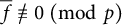 $\overline f\not \equiv 0\ \pmod p$
, then
$\overline f\not \equiv 0\ \pmod p$
, then
 $$ \begin{align} \omega_{p^m}(\overline f) \equiv k \quad\pmod {p^{m-1}(p-1)} \text{.} \end{align} $$
We also have
 $$ \begin{align*} \omega_{p^m}(f) \equiv \widetilde\omega_{p^m}(f) \quad\pmod{p-1} \text{,} \end{align*} $$
which follows from observing that $\omega _{p^m}(\overline {f}) = \omega _{p^m}(E_{p-1}^n g)$
on the right-hand side of (2.3).
$\omega _{p^m}(\overline {f}) = \omega _{p^m}(E_{p-1}^n g)$
on the right-hand side of (2.3).
The next lemma, which follows from the definitions and these facts, allows us to determine the weight filtration from the factor filtration.
Lemma 2.1 Suppose that $\overline f\in \mathcal {M}_{\bullet ,m}$
has
$\overline f\in \mathcal {M}_{\bullet ,m}$
has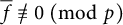 $\overline f \not \equiv 0 \ \pmod {p}$
and that
$\overline f \not \equiv 0 \ \pmod {p}$
and that $\overline f$
is the reduction modulo
$\overline f$
is the reduction modulo $p^m$
of a modular form of weight k. Then
$p^m$
of a modular form of weight k. Then $\omega _{p^m}(\overline f)$
is the smallest integer such that
$\omega _{p^m}(\overline f)$
is the smallest integer such that
 $$ \begin{align} \omega_{p^m}(\overline f) \geq \widetilde\omega_{p^m}(\overline f) \quad\text{and}\quad \omega_{p^m}(\overline f) \equiv k \quad\pmod{p^{m-1}(p-1)} \text{.} \end{align} $$
Proof Let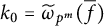 $k_0=\widetilde \omega _{p^m}(\overline f)$
. By definition, there exists
$k_0=\widetilde \omega _{p^m}(\overline f)$
. By definition, there exists $g\in M_{k_0}$
such that
$g\in M_{k_0}$
such that $\overline f\equiv E_{p-1}^ng\ \pmod {p^m}$
for some
$\overline f\equiv E_{p-1}^ng\ \pmod {p^m}$
for some $n\geq 0$
. Letting
$n\geq 0$
. Letting $n'$
be the least nonnegative residue of n modulo
$n'$
be the least nonnegative residue of n modulo $p^{m-1}$
, we see by (2.2) that
$p^{m-1}$
, we see by (2.2) that $\overline f\equiv E_{p-1}^{n'}g\ \pmod {p^m}$
; we also see that
$\overline f\equiv E_{p-1}^{n'}g\ \pmod {p^m}$
; we also see that $n'(p-1)+k_0$
is the integer characterized by (2.5). If
$n'(p-1)+k_0$
is the integer characterized by (2.5). If $\omega _{p^m}(\overline f)\neq n'(p-1)+k_0$
, then by (2.4), we would have the clear contradiction
$\omega _{p^m}(\overline f)\neq n'(p-1)+k_0$
, then by (2.4), we would have the clear contradiction
 $$ \begin{align*} \omega_{p^m}(\overline f)\leq n'(p-1)+k_0-p^{m-1}(p-1)<k_0=\widetilde\omega_{p^m}(\overline f) \text{.}\\[-35pt] \end{align*} $$
We will often use the following bounds for the factor filtration. First, for $\overline f, \overline g\in \mathcal {M}_{\bullet ,m}$
, it is clear from the definition that
$\overline f, \overline g\in \mathcal {M}_{\bullet ,m}$
, it is clear from the definition that
 $$ \begin{align*} \widetilde\omega_{p^m}(\overline f\, \overline g) \leq \widetilde\omega_{p^m}(\overline f) + \widetilde\omega_{p^m}(\overline g) \text{.} \end{align*} $$
Further, if $\overline f$
and
$\overline f$
and $\overline g$
are the reductions of elements of
$\overline g$
are the reductions of elements of $\mathrm {M}_k$
, then we have
$\mathrm {M}_k$
, then we have
 $$ \begin{align} \widetilde\omega_{p^m}(\overline f +\overline g) \leq \max\big\{\widetilde\omega_{p^m}(\overline f), \widetilde\omega_{p^m}(\overline g)\big\} \quad \text{with equality if }\ \widetilde\omega_{p^m}(\overline f) \neq \widetilde\omega_{p^m}(\overline g) \text{.} \end{align} $$
For the equality in (2.6), we argue as follows: Suppose that $k_0=\widetilde \omega _{p^m}(\overline f)>\widetilde \omega _{p^m}(\overline g)$
. Then
$k_0=\widetilde \omega _{p^m}(\overline f)>\widetilde \omega _{p^m}(\overline g)$
. Then $\overline f+\overline g\equiv E_{p-1}^a\left (f'+E_{p-1}g'\right )\ \pmod {p^m}$
for some
$\overline f+\overline g\equiv E_{p-1}^a\left (f'+E_{p-1}g'\right )\ \pmod {p^m}$
for some $f'\in M_{k_0}$
,
$f'\in M_{k_0}$
,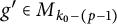 $g'\in M_{k_0-(p-1)}$
. If
$g'\in M_{k_0-(p-1)}$
. If $\widetilde \omega _{p^m}(\overline f+\overline g)<k_0$
, then
$\widetilde \omega _{p^m}(\overline f+\overline g)<k_0$
, then $f'+E_{p-1}g'\equiv E_{p-1}h\ \pmod {p^m}$
for some
$f'+E_{p-1}g'\equiv E_{p-1}h\ \pmod {p^m}$
for some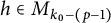 $h\in M_{k_0-(p-1)}$
, which contradicts
$h\in M_{k_0-(p-1)}$
, which contradicts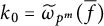 $k_0=\widetilde \omega _{p^m}(\overline f)$
.
$k_0=\widetilde \omega _{p^m}(\overline f)$
.
2.1 The theta operator and Serre derivative
If  , then the action of the theta operator is given by
 $$ \begin{align} \theta\, f \mathrel{:=} q \frac{\mathrm{d} f}{\mathrm{d}\! q}= \sum na(n)q^n \text{.} \end{align} $$
It does not preserve modularity, but it allows for a modular correction, which leads to the Serre derivative: if $f\in \mathrm {M}_k$
, then (since
$f\in \mathrm {M}_k$
, then (since $p\geq 5$
) we have
$p\geq 5$
) we have
 $$ \begin{align} \partial\, f \mathrel{:=} \partial_k\, f \mathrel{:=} \theta\, f - \frac{k}{12} f E_2\in \mathrm{M}_{k+2} \text{.} \end{align} $$
Note that there are two common normalizations; the Serre derivative in [Reference Ahlgren, Hanson, Raum and Richter2] corresponds to $12 \partial $
in this article.
$12 \partial $
in this article.
From (64) of the first part of [Reference Bruinier, van der Geer, Harder, Zagier and Ranestad3], we adopt the modified Serre derivative
 $$ \begin{align} \widehat\partial_k^0\,f \mathrel{:=} f \text{,}\quad \widehat\partial_k^1\,f \mathrel{:=} \partial_k\, f \text{,}\quad \widehat\partial_k^{i+1}\,f \mathrel{:=} \partial_{k+2i} \big( \widehat\partial_k^i\, f \big) - \frac{i (i+k-1)}{12^2} E_4\, \widehat\partial_k^{i-1}\, f \quad \text{for } i \ge 1 \text{.} \end{align} $$
Observe that our notation differs from that in [Reference Bruinier, van der Geer, Harder, Zagier and Ranestad3] in order to accommodate established notation for the theta operator. The modified Serre derivative preserves modularity and p-integrality of Fourier coefficients: if $f \in \mathrm {M}_k$
, then we have
$f \in \mathrm {M}_k$
, then we have
 $$ \begin{align} \widehat\partial^i_k\, f \in \mathrm{M}_{k + 2i} \text{.} \end{align} $$
The theta cycle modulo p was completely described by Jochnowitz (following Tate). Here, we say that f is non-ordinary (at p) if it has a $\mathrm {U}_p$
-congruence modulo p, that is,
$\mathrm {U}_p$
-congruence modulo p, that is, $a(n p) \equiv 0 \ \pmod {p}$
for all
$a(n p) \equiv 0 \ \pmod {p}$
for all $n \in \mathbb {Z}$
, which is equivalent to
$n \in \mathbb {Z}$
, which is equivalent to $\theta ^{p-1}\,f\equiv f\ \pmod p$
. Note that the notion of ordinary and non-ordinary modular forms is usually reserved for eigenforms, and here we extend it to all modular forms.
$\theta ^{p-1}\,f\equiv f\ \pmod p$
. Note that the notion of ordinary and non-ordinary modular forms is usually reserved for eigenforms, and here we extend it to all modular forms.
Proposition 2.2 [Reference Jochnowitz6]
Suppose that $f\in \mathrm {M}_k$
with
$f\in \mathrm {M}_k$
with $0<k<p$
has
$0<k<p$
has $\omega _p(f)=k$
. Then
$\omega _p(f)=k$
. Then
 $$ \begin{align*} \theta^i\, f \equiv \theta^{i-p+1}\, f \quad\pmod{p}\quad \text{for } i\geq p\text , \end{align*} $$
and for $0 \le i < p,$
we have the filtration values
$0 \le i < p,$
we have the filtration values
 $$ \begin{align*} \omega_p\big( \theta^i\, f \big) = \left\{ \begin{aligned} & k + i (p+1) \text{,}\mspace{-4mu} && \text{if} 0 \le i < p - k + 1 \text{;} \\ & k + i (p+1) - (p-k+1)(p-1) \text{,}\mspace{-4mu} && \text{if} p - k + 1 \le i < p \text{ and } f \text{ is ordinary} \text{;} \\ & k + i (p+1) - (p-k+2)(p-1) \text{,}\mspace{-4mu} && \text{if} p - k + 1 \le i < p-1 \\ &&& \text{and } f \text{ is non-ordinary} \text{;} \\ & k=k + i (p+1) - (p+1)(p-1) \text{,}\mspace{-4mu} && \text{if} i=p-1 \text{ and } f \text{ is non-ordinary} \text{.} \end{aligned} \right. \end{align*} $$
We recall two basic facts [Reference Serre8, Lemma 1] and [Reference Swinnerton-Dyer9, Lemma 5]: If $\overline f\in \mathcal {M}_{\bullet ,1}$
, then
$\overline f\in \mathcal {M}_{\bullet ,1}$
, then
 $$ \begin{align*} \omega_p(\overline f^a) &= a\,\omega_p(\overline f) \text{,} \\ \omega_p(\theta\, \overline f) &\leq \omega_p(\overline f)+p+1 \quad \text{with equality unless } \omega_p(\overline f) \equiv 0 \quad\pmod p \text{.} \end{align*} $$
2.2 Expansion of
$\theta ^i\, f$
in
$E_2$


If $f\in \mathrm {M}_k$
, then the quasi-modular form
$f\in \mathrm {M}_k$
, then the quasi-modular form $\theta ^i\, f$
has an expansion in powers of the Eisenstein series
$\theta ^i\, f$
has an expansion in powers of the Eisenstein series $E_2$
. In particular, from (65) of [Reference Bruinier, van der Geer, Harder, Zagier and Ranestad3, Chapter 1], we have the expansion
$E_2$
. In particular, from (65) of [Reference Bruinier, van der Geer, Harder, Zagier and Ranestad3, Chapter 1], we have the expansion

where $\widehat \partial _k$
is the modified Serre derivative in (2.9). For simplicity, we will write
$\widehat \partial _k$
is the modified Serre derivative in (2.9). For simplicity, we will write
 $$ \begin{align*} f_j \mathrel{:=} \widehat\partial_k^j\,f \end{align*} $$
throughout the article when using this formula.
2.3 The weight-
$2$
Eisenstein series modulo
$p^2$


For the duration, we will focus on the case $m=2$
. From [Reference Swinnerton-Dyer9] (see Theorem 2(iii) and Lemma 5), we know that
$m=2$
. From [Reference Swinnerton-Dyer9] (see Theorem 2(iii) and Lemma 5), we know that
 $$ \begin{align} \omega_p(fE_2^n)= \omega_p(fE_{p+1}^n)=\omega_p(f)+n(p+1),\quad n\geq 0\text{;} \end{align} $$
to make full use of (2.11), we need the analog of this fact for factor filtrations modulo $p^2$
. From Theorem 1.2 of [Reference Ahlgren, Hanson, Raum and Richter2] and the remarks which follow (recall that the Serre derivative is normalized differently there), we have
$p^2$
. From Theorem 1.2 of [Reference Ahlgren, Hanson, Raum and Richter2] and the remarks which follow (recall that the Serre derivative is normalized differently there), we have
 $$ \begin{align} E_2 \equiv 12 \partial E_{p-1}\, E_{p-1}^{2p-1} + p E_{p+1}^{p}\, E_{p-1}^{p-2} \quad\pmod{p^2} \text{} \end{align} $$
(note that the right side is a modular form of weight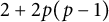 $2+2 p (p-1)$
). Since
$2+2 p (p-1)$
). Since
 $$ \begin{align} 12 \partial E_{p-1} \equiv E_{p+1} \quad\pmod{p}\text{,} \end{align} $$
it follows that
 $$ \begin{align} E_2^n \equiv \big( 12 \partial E_{p-1} \big)^n\, E_{p-1}^{n (2p-1)} + p n E_{p+1}^{n+p-1}\, E_{p-1}^{(n-1)(2p-1)+p-2} \quad\pmod{p^2} \text{.} \end{align} $$
We will need the following result; with $f=1$
and
$f=1$
and $k=0,$
it gives the factor filtration of
$k=0,$
it gives the factor filtration of $E_2^n$
.
$E_2^n$
.
Lemma 2.3 Suppose that $k\geq 0$
, that
$k\geq 0$
, that $\omega _p(f)=k$
, and that
$\omega _p(f)=k$
, and that $n\geq 0$
. Then
$n\geq 0$
. Then
 $$ \begin{align*} \widetilde\omega_{p^2}(pfE_2^n) = k+2n+n(p-1). \end{align*} $$
If, in addition, we have $\widetilde \omega _{p^2}(f)=k,$
then
$\widetilde \omega _{p^2}(f)=k,$
then
 $$ \begin{align*}\widetilde\omega_{p^2}(fE_2^n) &= \begin{cases} k+2n+n (p-1) + (p+1) (p-1) \quad & \text{if } p \mathrel{\nmid} n \text{;} \\ k+2n+n (p-1) \quad & \text{if } p \mathrel{\mid} n \text{.} \end{cases} \end{align*} $$
Proof Note that, for any $f,$
we have
$f,$
we have
 $$ \begin{align} \widetilde\omega_{p^2}(f) \geq \omega_p(f) \quad\text{and}\quad \widetilde\omega_{p^2}(pf) = \omega_p(f) \text{.} \end{align} $$
For $n> 0$
, (2.15) gives
$n> 0$
, (2.15) gives
 $$ \begin{align} fE_2^n \equiv f\big( 12 \partial E_{p-1} \big)^n\, E_{p-1}^{n (2p-1)} + p nf E_{p+1}^{n+p-1}\, E_{p-1}^{(n-1)(2p-1)+p-2} \quad\pmod{p^2} \text{.} \end{align} $$
If $p\mid n,$
then (2.17) gives
$p\mid n,$
then (2.17) gives $\widetilde \omega _{p^2}(fE_2^n)\leq k+n(p+1)$
, while (2.12) and (2.16) give
$\widetilde \omega _{p^2}(fE_2^n)\leq k+n(p+1)$
, while (2.12) and (2.16) give
 $$ \begin{align*} \widetilde\omega_{p^2}(fE_2^n)\geq\omega_p(fE_2^n)=k+n(p+1)=k+2n+n(p-1)\text{,} \end{align*} $$
so the lemma follows in this case.
Suppose that $p\nmid n$
. The factor filtration of the first term on the right side of (2.17) is at most
$p\nmid n$
. The factor filtration of the first term on the right side of (2.17) is at most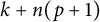 $k+n(p+1)$
, while by (2.12) and (2.16), the factor filtration of the second term is
$k+n(p+1)$
, while by (2.12) and (2.16), the factor filtration of the second term is
 $$ \begin{align*} \omega_p(fE_2^{n+p-1})=k+(n+p-1)(p+1)=k+2n+n(p-1)+(p+1)(p-1)\text{.} \end{align*} $$
By (2.6), we see that
 $$ \begin{align*} \widetilde\omega_{p^2}(fE_2^n)=k+2n+n(p-1)+(p+1)(p-1)\text{.} \end{align*} $$
Finally, if $\omega _p(f)=k \ge 0,$
then
$\omega _p(f)=k \ge 0,$
then
 $$ \begin{align*} \widetilde\omega_{p^2}(pfE_2^n)=\omega_p(fE_2^n)=k+n(p+1)\text{.}\\[-34pt] \end{align*} $$
2.4 First upper bounds for the theta cycle filtrations
Suppose that $f\in \mathrm {M}_k$
with
$f\in \mathrm {M}_k$
with $0<k<p$
has
$0<k<p$
has $\omega _p(f)=k$
. From Proposition 2.2, we see that
$\omega _p(f)=k$
. From Proposition 2.2, we see that $\theta ^i\, f\not \equiv 0\ \pmod p$
for any i. Relation (2.8) together with (2.4) and the expression (2.13) for
$\theta ^i\, f\not \equiv 0\ \pmod p$
for any i. Relation (2.8) together with (2.4) and the expression (2.13) for $E_2$
yield
$E_2$
yield
 $$ \begin{align} \omega_{p^2}\big( \theta^i f \big) \equiv k+2i \quad\pmod{p(p-1)} \text{.} \end{align} $$
Furthermore, (2.8) and (2.13) imply that if $f\in \mathrm {M}_k$
, then
$f\in \mathrm {M}_k$
, then
 $$ \begin{align} \widetilde\omega_{p^2}\big( \theta^i\, f \big) \le \omega_{p^2}\big( \theta^i\, f \big) \le k + 2 i + 2 i p (p-1) \text{.} \end{align} $$
This also follows from the work of Chen–Kiming [Reference Chen and Kiming4, Theorem 1] on the theta operator modulo $p^m$
for general m. The bound (2.19) is however far from optimal, and Lemma 2.3 already yields much improved bounds.
$p^m$
for general m. The bound (2.19) is however far from optimal, and Lemma 2.3 already yields much improved bounds.
Lemma 2.4 Assume that $f \in \mathrm {M}_k$
. Then we have the following bounds on the factor and weight filtrations:
$f \in \mathrm {M}_k$
. Then we have the following bounds on the factor and weight filtrations:
 $$ \begin{align*} \widetilde\omega_{p^2}\big( \theta^i\, f \big) &\le k + 2i + (i + p + 1) (p-1) \text{,} \end{align*} $$
 $$ \begin{align*} \omega_{p^2}\big( \theta^i\, f \big) &\le k + 2i + \big( \big\lceil \tfrac{i + 1}{p} \big\rceil + 1 \big) p (p-1) \text{.} \end{align*} $$
Proof We estimate the factor filtration of each term in the expansion of $\theta ^i\, f$
given in (2.11). By (2.10), we have
$\theta ^i\, f$
given in (2.11). By (2.10), we have $\widetilde \omega _{p^2}(f_j)\leq k+2j$
. From Lemma 2.3, we obtain
$\widetilde \omega _{p^2}(f_j)\leq k+2j$
. From Lemma 2.3, we obtain
 $$ \begin{align*} \widetilde\omega_{p^2}\Big( \big( \widehat\partial_k^j\, f \big) \big( \tfrac{1}{12} E_2 \big)^{i - j} \Big) &\le k + 2j \,+\, 2(i-j) + (i-j + p + 1) (p-1) \\ &= k + 2i + (i-j + p + 1) (p-1) \text{,} \end{align*} $$
and the stated bound for the factor filtration follows from (2.6). The weight filtration is determined using Lemma 2.1 and (2.18).
Remark 2.5 The bounds in Lemma 2.4 are monotone in i. Since
 $$ \begin{align*} \theta^{i + p(p-1)}\, f \equiv \theta^i\, f \quad\pmod{p^2}\quad\text{ for }~i \ge 2, \end{align*} $$
we immediately obtain upper bounds for all i which are cubic in p:
 $$ \begin{align*} \widetilde\omega_{p^2}\big( \theta^i\, f \big) &\le k + 2 (p (p-1) + 1) + (p^2 + 2) (p-1) \text{,} \\ \omega_{p^2}\big( \theta^i\, f \big) &\le k + 2 (p (p-1) + 1) + (p+1) p (p-1) \text{.} \end{align*} $$
This improves the upper bound (2.19), which is quartic in p if $i \asymp p^2$
. Our results replace this by a quadratic upper bound for asymptotically
$i \asymp p^2$
. Our results replace this by a quadratic upper bound for asymptotically $100\%$
of the theta cycle (see Remark 4.2 below).
$100\%$
of the theta cycle (see Remark 4.2 below).
3 Filtrations in the first p-interval
In this section, we prove Theorem A, which will follow from a series of propositions which determine the factor filtrations for all $\theta ^i f $
with
$\theta ^i f $
with $0 \le i \le p$
.
$0 \le i \le p$
.
3.1 Filtrations up to the first low point
Recall that the first low point of the theta cycle modulo p occurs at $i=p-k+1$
(we will show that the same is true modulo
$i=p-k+1$
(we will show that the same is true modulo $p^2$
).
$p^2$
).
Proposition 3.1 Suppose that $f\in \mathrm {M}_k$
with
$f\in \mathrm {M}_k$
with $0<k<p$
has
$0<k<p$
has $\omega _p(f)=k$
. In the range
$\omega _p(f)=k$
. In the range ${0 < i < p - k + 1,}$
we have the factor filtration
${0 < i < p - k + 1,}$
we have the factor filtration
 $$ \begin{align*} \widetilde\omega_{p^2}\big( \theta^i f \big) = k + 2i + (i + p + 1) (p - 1)\text{.} \end{align*} $$
Proof We investigate the factor filtrations of the terms in (2.11). From Lemma 2.3 and the fact that $f_0 = f,$
we have
$f_0 = f,$
we have
 $$ \begin{align} \widetilde\omega_{p^2}\big( f_0 E_2^i \big) = k + 2i + (i + p + 1) (p-1) \text{.} \end{align} $$
Since $\widetilde \omega _{p^2}(f_j) \le k + 2j$
, the factor filtrations of the terms in (2.11) with
$\widetilde \omega _{p^2}(f_j) \le k + 2j$
, the factor filtrations of the terms in (2.11) with $j> 0$
are bounded by
$j> 0$
are bounded by
 $$ \begin{align*} \widetilde\omega_{p^2}\big( f_j\, E_2^{i-j} \big) \le k + 2 j + 2(i-j) + (i-j+p+1) (p-1) = k + 2 i + (i-j+p+1) (p-1) \text{.} \end{align*} $$
Therefore, the factor filtration of (2.11) is dominated by the term (3.1) and the proposition follows from (2.6).
Proposition 3.2 Suppose that $f\in \mathrm {M}_k$
with
$f\in \mathrm {M}_k$
with $0<k<p$
has
$0<k<p$
has $\omega _p(f)=k$
. Then at
$\omega _p(f)=k$
. Then at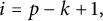 ${i = p - k + 1,}$
we have the factor filtration
${i = p - k + 1,}$
we have the factor filtration
 $$ \begin{align*} \widetilde\omega_{p^2}\big( \theta^i\, f \big) = k + 2 i + i (p-1) = k + i (p+1) \text{.} \end{align*} $$
Proof If $j<i,$
then (since
$j<i,$
then (since $i+k-1=p$
) we have the following bound for the j-th term in (2.11):
$i+k-1=p$
) we have the following bound for the j-th term in (2.11):

For $j = 0,$
this is an equality by (2.12). On the other hand, the term with
$j = 0,$
this is an equality by (2.12). On the other hand, the term with $j = i$
in (2.11) gives
$j = i$
in (2.11) gives
 $$ \begin{align*} \widetilde\omega_{p^2}( f_i ) \le k + 2 i \text{.} \end{align*} $$
Thus, the factor filtration of $\theta ^i f$
is determined again by the term with
$\theta ^i f$
is determined again by the term with $j = 0$
.
$j = 0$
.
3.2 Filtrations between the first and second low points
Here, we determine the factor filtration of $\theta ^i f$
for
$\theta ^i f$
for $p-k+1 < i\leq p$
. (We will show that there is a second low point of the theta cycle at
$p-k+1 < i\leq p$
. (We will show that there is a second low point of the theta cycle at $i=p$
.) We again use (2.11), but the analysis involved is more subtle.
$i=p$
.) We again use (2.11), but the analysis involved is more subtle.
Proposition 3.3 Suppose that $f\in \mathrm {M}_k$
with
$f\in \mathrm {M}_k$
with $0<k<p$
has
$0<k<p$
has $\omega _p(f)=k$
and let
$\omega _p(f)=k$
and let $p - k + 1 < i < p$
. Then we have the factor filtrations
$p - k + 1 < i < p$
. Then we have the factor filtrations
 $$ \begin{align*} \widetilde\omega_{p^2}\big( \theta^i\, f \big) = \begin{cases} k + 2 i + (i+k) (p-1) \text{,}\quad & \text{if } f \text{ is ordinary at}~p;\\ k + 2 i + (i+k-1) (p-1) \text{,}\quad & \text{if } f \text{ is non-ordinary at}~p. \end{cases} \end{align*} $$
Proof Observe that the coefficients in the expansion (2.11) of $\theta ^i\, f$
satisfy
$\theta ^i\, f$
satisfy
 $$ \begin{align} p \mathrel{\Big\|} \frac{(i+k-1)!}{(j+k-1)!} \quad\text{if } j < p - k + 1 \text{.} \end{align} $$
Using this fact with (2.11), (2.14), and (2.15) gives the decomposition
 $$ \begin{align*} \theta^i\, f \equiv p \tilde{f}_1 + p \tilde{f}_2 + \tilde{f}_3 \quad\pmod{p^2}, \end{align*} $$
where

For $\tilde {f}_3$
, we have (recalling that
$\tilde {f}_3$
, we have (recalling that $k<p$
) the factor filtration bound
$k<p$
) the factor filtration bound
 $$ \begin{align*} \widetilde\omega_{p^2}(\tilde{f}_3) \le \max \big\{ k + 2j + (i-j)(p+1) \mathrel{\;:\;} p-k+1 \le j \le i \big\} \leq k + 2i + (i-2) (p-1) \text{.} \end{align*} $$
For $p\tilde f_1$
, we have
$p\tilde f_1$
, we have
 $$ \begin{align*} \widetilde\omega_{p^2}(p\tilde{f}_1)=\omega_p(\tilde{f}_1)\leq\max \big\{ k + 2j + (i-j)(p+1) \mathrel{\;:\;} 0 \le j \le p-k \big\} = k + 2i + i (p-1) \text{.} \end{align*} $$
It remains to examine $p \tilde {f}_2$
. Recalling (2.11) and (3.2), we obtain the following congruence involving modular forms of different weights:
$p \tilde {f}_2$
. Recalling (2.11) and (3.2), we obtain the following congruence involving modular forms of different weights:

Since $p - k + 1 \le i-1 < p-1$
, Proposition 2.2 gives
$p - k + 1 \le i-1 < p-1$
, Proposition 2.2 gives
 $$ \begin{align*} \omega_p\big( \theta^{i-1}\, f \big) = \begin{cases} k + (i-1)(p+1) - (p-k+1)(p-1) \text{,}\quad & \text{if } f \text{ is ordinary at }~p; \\ k + (i-1)(p+1) - (p-k+2)(p-1) \text{,}\quad & \text{if } f \text{ is non-ordinary at }~p. \end{cases} \end{align*} $$
Since the assumptions ensure that $i(i+k-1)\not \equiv 0 \ \pmod p$
, we find using (2.12) that
$i(i+k-1)\not \equiv 0 \ \pmod p$
, we find using (2.12) that
 $$ \begin{align*} \widetilde\omega_{p^2}(p \tilde{f}_2) = \omega_p(\tilde{f}_2) = p (p+1) + \omega_p\big( \theta^{i-1}\, f \big)\text{.} \end{align*} $$
This gives the values
 $$ \begin{align*} \widetilde\omega_{p^2}(p \tilde{f}_2) = \begin{cases} k + 2 i + (i+k)(p-1) \text{,}\quad & \text{if } f \text{ is ordinary at }~p; \\ k + 2 i + (i+k-1) (p-1) \text{,}\quad & \text{if } f \text{ is non-ordinary at}~p. \end{cases} \end{align*} $$
Since these exceed the bounds which we obtained for the factor filtrations of $p \tilde {f}_1$
and
$p \tilde {f}_1$
and $\tilde {f}_3$
, we have
$\tilde {f}_3$
, we have $\widetilde \omega _{p^2}\big ( \theta ^i\, f \big ) = \widetilde \omega _{p^2}(p \tilde {f}_2)$
, which confirms the claimed factor filtrations.
$\widetilde \omega _{p^2}\big ( \theta ^i\, f \big ) = \widetilde \omega _{p^2}(p \tilde {f}_2)$
, which confirms the claimed factor filtrations.
Proposition 3.4 Suppose that $f\in \mathrm {M}_k$
with
$f\in \mathrm {M}_k$
with $0<k<p$
has
$0<k<p$
has $\omega _p(f)=k$
. At
$\omega _p(f)=k$
. At $i = p,$
we have the factor filtration
$i = p,$
we have the factor filtration
 $$ \begin{align*} \widetilde\omega_{p^2}\big( \theta^p\, f \big) = k + 2 p + p (p-1) \text{.} \end{align*} $$
Proof The coefficients in formula (2.11) satisfy

It follows that for some p-adic units $\lambda _0$
and
$\lambda _0$
and $\lambda _j$
, we have
$\lambda _j$
, we have
 $$ \begin{align} \theta^p\, f \equiv p \lambda_0\, f_0 E_2^p + p \tilde{f}_1 + f_p\quad\pmod{p^2} \text{,}\quad\text{where } \tilde{f}_1 \mathrel{:=} \sum_{j=p-k+1}^{p-1} \lambda_j f_j\, E_2^{p-j} \text{.} \end{align} $$
We have $\widetilde \omega _{p^2}(f_p) \leq k+2p$
. For the terms appearing in
$\widetilde \omega _{p^2}(f_p) \leq k+2p$
. For the terms appearing in $\tilde {f}_1$
, we have
$\tilde {f}_1$
, we have
 $$ \begin{align*} \omega_{p}\big( f_j\, E_2^{p-j} \big) \leq k+2j+(p-j)(p+1) = k+p(p+1)-j(p-1) \text{,} \end{align*} $$
from which
 $$ \begin{align*} \widetilde\omega_{p^2}( p \tilde{f}_1 ) \le k + p(p+1) - (p-k+1)(p-1) = k + 2p + (k-1)(p-1) \text{.} \end{align*} $$
Finally, we have
 $$ \begin{align*} \widetilde\omega_{p^2}\big( p \lambda_0 f_0 \, E_2^p \big) = \omega_p\big( f_0 \, E_2^p \big) = k + p (p+1) = k + 2p + p (p-1) \text{.} \end{align*} $$
Since this exceeds the other filtrations, it determines the factor filtration of $\widetilde \omega _{p^2}(\theta ^p\, f)$
.
$\widetilde \omega _{p^2}(\theta ^p\, f)$
.
Proof of Theorem A
Once the factor filtration of $\theta ^if$
is known, the weight filtration is determined using (2.18) and Lemma 2.1. For example, in the range
$\theta ^if$
is known, the weight filtration is determined using (2.18) and Lemma 2.1. For example, in the range ${0 < i < p - k + 1,}$
we have shown that the factor filtration of
${0 < i < p - k + 1,}$
we have shown that the factor filtration of $\widetilde \omega _{p^2}(\theta ^i f)$
is
$\widetilde \omega _{p^2}(\theta ^i f)$
is $k + 2i + (i + p + 1) (p - 1)$
. Since
$k + 2i + (i + p + 1) (p - 1)$
. Since $p<i + p+ 1 < 2p$
, we conclude that the weight filtration must be
$p<i + p+ 1 < 2p$
, we conclude that the weight filtration must be ${k + 2i + 2p (p - 1)}$
. The analysis is similar in the other ranges and we omit the details.
${k + 2i + 2p (p - 1)}$
. The analysis is similar in the other ranges and we omit the details.
4 Filtrations in the first part of each p-interval
In this section, we prove Theorem C and Corollaries B and D. We will always write
 $$ \begin{align} i=np+i' \text{,}\qquad 0<n<p \text{,}\quad 0<i'<p \text{.} \end{align} $$
Recall the definition (1.2) of an exceptional index i. The results will follow from Theorem 4.1, which gives exact values and bounds for factor filtrations when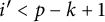 $i'<p-k+1$
.
$i'<p-k+1$
.
Theorem 4.1 Suppose that $f\in \mathrm {M}_k$
with
$f\in \mathrm {M}_k$
with $0<k<p$
has
$0<k<p$
has $\omega _p(f)=k$
, that i and
$\omega _p(f)=k$
, that i and $i'$
are as in (4.1), and that
$i'$
are as in (4.1), and that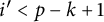 $i'<p-k+1$
.
$i'<p-k+1$
.
-
(1) If
$i' \le (p - k + 1) - n$
and i is not exceptional, then we have (Note that this includes all non-exceptional i with
$$ \begin{align*} \widetilde\omega_{p^2}\big( \theta^i\, f \big) = k + 2 i + (i' + p - n + 1) (p-1)\text{.} \end{align*} $$
$p < i < 2p - k + 1$
.)
-
(2) If
$i'> (p - k + 1) - n$
or if i is exceptional, then we have the bounds
$$ \begin{align*} \tilde\omega_{p^2}\big( \theta^i\, f \big) \le \begin{cases} k + 2i + (i'+k-1) (p-1) \text{,} \quad &\text{if } n = 1 \text{;} \\ k + 2i + (i'+k-2) (p-1) \text{,} \quad &\text{if } n> 1 \text{.} \end{cases} \end{align*} $$





Proof Analyzing the factorials (using, for example, Lucas’ theorem for the binomial coefficients), we find that

Together with (2.11), (2.15), and the inequality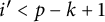 $i'<p-k+1$
, this gives
$i'<p-k+1$
, this gives
 $$ \begin{align} \theta^i\, f \equiv p \tilde{f}_1 + p \tilde{f}_2 + p \tilde{f}_3 + \tilde{f}_4 \quad\pmod{p^2} \end{align} $$
with weight $k + 2i + 2 (i-j) p (p-1)$
modular forms
$k + 2i + 2 (i-j) p (p-1)$
modular forms

For $\tilde {f}_4$
, we have the factor filtration bound
$\tilde {f}_4$
, we have the factor filtration bound
 $$ \begin{align} \widetilde\omega_{p^2}(\tilde{f}_4) \le \max\big\{ k + 2j + (i-j)(p+1) \mathrel{\;:\;} np \le j \le i \big\} = k + 2i + i' (p-1) \text{.} \end{align} $$
Recall that $\widetilde \omega _{p^2}(p \tilde {f}_2)=\omega _p(\tilde {f}_2)$
. We first estimate the contribution to the filtration from the term
$\widetilde \omega _{p^2}(p \tilde {f}_2)=\omega _p(\tilde {f}_2)$
. We first estimate the contribution to the filtration from the term $j = np - k + 1$
. From (2.11), we obtain
$j = np - k + 1$
. From (2.11), we obtain
 $$ \begin{align*} f_{np - k + 1} \equiv \theta^{np - k + 1}\, f \equiv \theta^{n-1 + p - k + 1}\, f \quad\pmod{p} \text{.} \end{align*} $$
If $0< n< k$
, then we have
$0< n< k$
, then we have $p-k+1\le n-1 + p - k + 1<p$
, and Proposition 2.2 (with
$p-k+1\le n-1 + p - k + 1<p$
, and Proposition 2.2 (with $i=n-1+p-k+1$
, while still
$i=n-1+p-k+1$
, while still $j = np - k + 1$
) gives
$j = np - k + 1$
) gives
 $$ \begin{align} \begin{aligned} \omega_p\big( f_j\, E_{p+1}^{i-j} \big) \le{}& k + (n - 1 + p-k+1)(p+1) - (p-k+1) (p-1) + (i-j) (p+1) \\ ={}& k + 2i + (i' +k- n)(p-1) \text{.} \end{aligned} \end{align} $$
If, however, $k\leq n<p$
, we have
$k\leq n<p$
, we have $f_{np - k + 1} \equiv \theta ^{n - k + 1}\, f \ \pmod p$
, so Proposition 2.2 (with
$f_{np - k + 1} \equiv \theta ^{n - k + 1}\, f \ \pmod p$
, so Proposition 2.2 (with $i=n-k+1$
and still
$i=n-k+1$
and still $j = np - k + 1$
) gives
$j = np - k + 1$
) gives
 $$ \begin{align*} \omega_p\big( f_j\, E_{p+1}^{i-j} \big) \le k+(n-k+1)(p+1)+(i-j)(p+1) \text{,} \end{align*} $$
which is less than the bound in (4.5). So the contribution from the term with $j=np-k+1$
is bounded by (4.5).
$j=np-k+1$
is bounded by (4.5).
For the terms with $np - k + 2 \le j \le np - 1$
, each term contributing to
$np - k + 2 \le j \le np - 1$
, each term contributing to $\tilde {f}_2$
has
$\tilde {f}_2$
has
 $$ \begin{align} \begin{aligned} \omega_p\big( f_j\, E_{p+1}^{i-j} \big) &\le k + 2j + (i-j) (p+1) = k + 2i + (i-j) (p-1) \\ &\le k + 2i + (i'+k-2) (p-1) \text{.} \end{aligned} \end{align} $$
The estimate (4.5) is larger than the estimate (4.6) if and only if $n=1$
. Therefore, we obtain
$n=1$
. Therefore, we obtain
 $$ \begin{align} \tilde\omega_{p^2}(p \tilde{f}_2) \le \begin{cases} k + 2i + (i'+k-1) (p-1) \text{,} \quad & \text{if } n = 1 \text{;} \\ k + 2i + (i'+k-2) (p-1) \text{,} \quad & \text{if } n> 1 \text{.} \end{cases} \end{align} $$
Next, we inspect $\tilde {f}_1$
and
$\tilde {f}_1$
and $\tilde {f}_3$
. We omit powers of
$\tilde {f}_3$
. We omit powers of $E_{p-1}$
and hence work with congruences involving modular forms of different weights. We employ Wilson’s theorem, Lucas’ theorem, and the fact that
$E_{p-1}$
and hence work with congruences involving modular forms of different weights. We employ Wilson’s theorem, Lucas’ theorem, and the fact that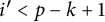 $i'<p-k+1$
to find that
$i'<p-k+1$
to find that

Arguing as in (4.2) and using (2.11) gives
 $$ \begin{align*} \tilde{f}_1\equiv \frac{-n^2}{12} E_{p+1}^p\, \theta^{i-p}\, f \equiv \frac{-n^2}{12} E_{p+1}^p\, \theta^{i'+n-1}\, f \quad\pmod{p}\text{.} \end{align*} $$
For $\tilde {f}_3$
, we observe that there is no contribution from
$\tilde {f}_3$
, we observe that there is no contribution from $j = i$
and use the identity
$j = i$
and use the identity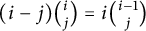 ${(i-j) \binom {i}{j} = i \binom {i-1}{j}}$
to obtain
${(i-j) \binom {i}{j} = i \binom {i-1}{j}}$
to obtain

We conclude that
 $$ \begin{align} \begin{aligned} \tilde{f}_1 + \tilde{f}_3 &\equiv \frac{-n^2}{12} E_{p+1}^p\, \theta^{i'+n-1}\, f + \frac{i(i+k-1)}{12} E_{p+1}^p\, \theta^{i'+n-1}\, f \\ &\equiv \tfrac{1}{12} \big( i^2 + (k-1) i - n^2 \big)\, E_{p+1}^p\, \theta^{i'+n-1}\, f \quad\pmod{p} \text{.} \end{aligned} \end{align} $$
 $$ \begin{align} \widetilde{\omega}_{p^2}\big( p \tilde{f}_2 + \tilde{f}_4 \big) \le{} \begin{cases} k + 2i + (i'+k-1) (p-1) \text{,} \quad & \text{if } n = 1 \text{;} \\ k + 2i + (i'+k-2) (p-1) \text{,} \quad & \text{if } n> 1 \text{.} \end{cases} \end{align} $$
If i is exceptional (i.e., $i^2 + (k-1) i - n^2 \equiv 0 \ \pmod {p}$
), then the term (4.8) vanishes modulo p. Together with (4.3) and (4.9), this gives the claimed bounds in part (2) of the theorem.
$i^2 + (k-1) i - n^2 \equiv 0 \ \pmod {p}$
), then the term (4.8) vanishes modulo p. Together with (4.3) and (4.9), this gives the claimed bounds in part (2) of the theorem.
Now assume that i is not exceptional. If f is ordinary at p, then Proposition 2.2 gives
 $$ \begin{align*} \omega_p\big( \theta^{i'+n-1}\, f \big)= \begin{cases} k + 2i + (i'-n-1)(p-1) - 2 \text{,}\quad & \text{if } i' + n - 1 < p - k + 1 \text{;} \\ k + 2i + (i'-n-p+k-2)(p-1) - 2 \text{,}\quad & \text{if } p - k + 1 \le i' + n - 1 < p \text{.} \end{cases} \end{align*} $$
Furthermore, when $p \le i' + n - 1,$
the same proposition (note that
$p \le i' + n - 1,$
the same proposition (note that $i'+n-p<p-k+1$
) gives
$i'+n-p<p-k+1$
) gives
 $$ \begin{align*} \omega_p\big( \theta^{i'+n-1}\, f \big)=\omega_p\big( \theta^{i'+n-p}\, f \big) = k + 2i + (i'-n-p-2)(p-1) - 2\text{.} \end{align*} $$
Adding $p (p + 1) = (p+2)(p-1) + 2$
in each case gives
$p (p + 1) = (p+2)(p-1) + 2$
in each case gives
 $$ \begin{align*} \widetilde\omega_{p^2}\left(p(\tilde{f}_1 + \tilde{f}_3)\right)= \begin{cases} k + 2i + (i'+p-n+1)(p-1) \text{,}\quad & \text{if } i' + n -1 < p - k + 1 \text{;} \\ k + 2i + (i'-n+k)(p-1) \text{,}\quad & \text{if } p - k + 1 \le i' + n - 1 < p \text{;} \\ k + 2i + (i'-n)(p-1) \text{,}\quad & \text{if } p \le i' + n - 1 \text{.} \end{cases} \end{align*} $$
Similarly, if f is non-ordinary at p, then we obtain
 $$ \begin{align*} \widetilde\omega_{p^2}\left(p(\tilde{f}_1 + \tilde{f}_3)\right)= \begin{cases} k + 2i + (i'+p-n+1)(p-1) \text{,}\quad & \text{if } i' + n -1 < p - k + 1 \text{;} \\ k + 2i + (i'-n+k-1)(p-1) \text{,}\quad & \text{if } p - k + 1 \le i' + n - 1 < p-1 \text{;} \\ k + 2i + (i'-n)(p-1) \text{,}\quad & \text{if } p-1 \le i' + n - 1 \text{.} \end{cases} \end{align*} $$
If $i' + n - 1 < p - k + 1,$
then
$i' + n - 1 < p - k + 1,$
then $i'+k-1<p-n+1$
and the bound in (4.9) is strictly less than the values above, and we find that
$i'+k-1<p-n+1$
and the bound in (4.9) is strictly less than the values above, and we find that
 $$ \begin{align*} \widetilde{\omega}_{p^2}\big( \theta^i\, f \big) = \widetilde\omega_{p^2}\big( p( \tilde{f}_1 + \tilde{f}_3) \big)\, = k + 2i + (i'+p-n+1)(p-1) \text{,} \end{align*} $$
which confirms part (1) of the theorem.
It remains to consider the cases when i is not exceptional and $i' + n - 1 \geq p - k + 1$
. In these cases, the factor filtration of
$i' + n - 1 \geq p - k + 1$
. In these cases, the factor filtration of $p(\tilde {f}_1 + \tilde {f}_3)$
does not dominate the factor filtration in (4.9), and we can deduce only that
$p(\tilde {f}_1 + \tilde {f}_3)$
does not dominate the factor filtration in (4.9), and we can deduce only that
 $$ \begin{align*} \tilde\omega_{p^2}\big( \theta^i\, f \big) \le \begin{cases} k + 2i + (i'+k-1) (p-1) \text{,} \quad & \text{if } n = 1 \text{;} \\ k + 2i + (i'+k-2) (p-1) \text{,} \quad & \text{if } n> 1 \text{.} \end{cases} \end{align*} $$
This completes the proof of the theorem.
Proof of Theorem C
As mentioned above, the statements when $i'=0$
and
$i'=0$
and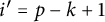 $i'=p-k+1$
are a consequence of [Reference Kim and Lee7, Theorem 1.8]. For the rest, we use Theorem 4.1, Lemma 2.1, and (2.18).
$i'=p-k+1$
are a consequence of [Reference Kim and Lee7, Theorem 1.8]. For the rest, we use Theorem 4.1, Lemma 2.1, and (2.18).
By assumption, we have $4<i'+k<p+1$
. In the cases covered by part (2) of Theorem 4.1, this gives the weight filtration bound
$4<i'+k<p+1$
. In the cases covered by part (2) of Theorem 4.1, this gives the weight filtration bound $k+2i+p(p-1)$
. In the cases covered by part (2), we see that
$k+2i+p(p-1)$
. In the cases covered by part (2), we see that
 $$ \begin{align*} 0<i'+p-n+1<p+1 \text{,} &\quad \text{if } 0<i'<n \text{ and } i'\leq p-k+1-n \text{;} \\ p<i'+p-n+1<2p \text{,} &\quad \text{if }n\leq i'\leq p-k+1-n \text{,} \end{align*} $$
from which the exact weight filtrations follow.
Proof of Corollary B
To show that the second low point occurs at index $p,$
we use Theorems A and C together with the fact that
$p,$
we use Theorems A and C together with the fact that $p+1$
is not an exceptional index. All other assertions follow immediately from Theorem A.
$p+1$
is not an exceptional index. All other assertions follow immediately from Theorem A.
Proof of Corollary D
Part (4) follows from Theorem C since the hypotheses ensure that i and $i+1$
are both contained in one of the two ranges where the filtrations are exactly determined. For part (3), note that under the hypotheses, the filtration at i is exactly determined by the theorem, while the filtration at
$i+1$
are both contained in one of the two ranges where the filtrations are exactly determined. For part (3), note that under the hypotheses, the filtration at i is exactly determined by the theorem, while the filtration at $i-1$
is bounded to be less than the filtration at i.
$i-1$
is bounded to be less than the filtration at i.
To prove part (1), let $i = np+p - k + 2 - n$
be as in the statement. Using both parts of Theorem C, we see that we always have
$i = np+p - k + 2 - n$
be as in the statement. Using both parts of Theorem C, we see that we always have $\omega _{p^2}(\theta ^i f)\leq k + 2i + p(p-1)$
. Since
$\omega _{p^2}(\theta ^i f)\leq k + 2i + p(p-1)$
. Since $2n \le p-k+1$
by hypothesis and
$2n \le p-k+1$
by hypothesis and $k \ge 4,$
it follows that
$k \ge 4,$
it follows that
 $$ \begin{align} k + 2i - p(p-1)\leq (4-k)(p+1)-2n<0 \end{align} $$
from which we conclude using (2.18) that
 $$ \begin{align*} \omega_{p^2}(\theta^i f)=k+2i\quad\text{or}\quad k + 2i + p(p-1)\text{.} \end{align*} $$
The index $i-1$
is not exceptional since
$i-1$
is not exceptional since
 $$ \begin{align*} (i-1)^2 + (k-1)(i-1) - n^2 \equiv n(k-1)\not\equiv 0 \quad\pmod{p} \text{.} \end{align*} $$
Since the hypotheses give $n \leq i'-1 = p-k+1-n$
, it follows from Theorem C that
$n \leq i'-1 = p-k+1-n$
, it follows from Theorem C that
 $$ \begin{align*} \omega_{p^2}(\theta^{i-1} f) = k + 2(i-1) + 2p(p-1) \text{.} \end{align*} $$
From (4.10), we have $k+2(i+1)-p(p-1)\leq 0$
. Note that
$k+2(i+1)-p(p-1)\leq 0$
. Note that $\omega _{p^2}(\theta ^{i+1}\, f)\neq 0$
(equality would imply that
$\omega _{p^2}(\theta ^{i+1}\, f)\neq 0$
(equality would imply that $\theta ^{i+2}\, f\equiv 0\ \pmod p$
which contradicts Proposition 2.2). It follows that
$\theta ^{i+2}\, f\equiv 0\ \pmod p$
which contradicts Proposition 2.2). It follows that
 $$ \begin{align*} \omega_{p^2}(\theta^{i+1} f) \geq k+2(i+1) \text{.} \end{align*} $$
If $\omega _{p^2}(\theta ^{i} \,f)=k+2i$
or
$\omega _{p^2}(\theta ^{i} \,f)=k+2i$
or $\omega _{p^2}(\theta ^{i+1}\, f)\geq k + 2(i+1) + p(p-1),$
then there is a low point at i as claimed. In the remaining case, we have
$\omega _{p^2}(\theta ^{i+1}\, f)\geq k + 2(i+1) + p(p-1),$
then there is a low point at i as claimed. In the remaining case, we have $\omega _{p^2}(\theta ^{i} \,f)=k+2i+p(p-1)$
and
$\omega _{p^2}(\theta ^{i} \,f)=k+2i+p(p-1)$
and $\omega _{p^2}(\theta ^{i+1}\, f)= k + 2(i+1)$
. By (4.10), we have
$\omega _{p^2}(\theta ^{i+1}\, f)= k + 2(i+1)$
. By (4.10), we have $k+2(i+2)-p(p-1)\leq 2$
. Since we cannot have
$k+2(i+2)-p(p-1)\leq 2$
. Since we cannot have $\omega _{p^2}(\theta ^{i+2}\, f)=0$
or
$\omega _{p^2}(\theta ^{i+2}\, f)=0$
or $2$
, it follows that
$2$
, it follows that $\omega _{p^2}(\theta ^{i+2} f)\geq k+2(i+2)$
, which establishes that there is a low point at
$\omega _{p^2}(\theta ^{i+2} f)\geq k+2(i+2)$
, which establishes that there is a low point at $i+1$
in this case.
$i+1$
in this case.
We turn to the proof of part (2). We must show that there is a low point at i whenever i is an exceptional index and $n \le i' \le p - k + 1 - n$
. It is straightforward to check that indices with
$n \le i' \le p - k + 1 - n$
. It is straightforward to check that indices with $i'=n$
or
$i'=n$
or $i'=p-k+1-n$
are not exceptional. It follows that
$i'=p-k+1-n$
are not exceptional. It follows that
 $$ \begin{align*} n\leq i'-1< i'+1\leq p-k+1-n \text{.} \end{align*} $$
The filtration values and bounds in Theorem C show that there is a low point at i unless one of $i-1$
or
$i-1$
or $i+1$
is exceptional and it therefore suffices to show that there are no consecutive solutions
$i+1$
is exceptional and it therefore suffices to show that there are no consecutive solutions $i'$
,
$i'$
, $i'+1$
to the congruence (1.2). This follows since
$i'+1$
to the congruence (1.2). This follows since
 $$ \begin{align*} \big( (i'+1)^{2} + (k-1)(i'+1) - n^{2} \big)- \big( i'^{2} + (k-1)i' - n^{2} \big)= 2i'+ k\text{,} \end{align*} $$
and by the assumptions, the right side is positive, even, and less than $2p$
.
$2p$
.
Remark 4.2 Theorem A and the results in Section 3 provide exact values for the weight and factor filtration of $\theta ^i\, f$
at p positions. Theorems C and 4.1 provide exact values for both filtrations at non-exceptional indices when
$\theta ^i\, f$
at p positions. Theorems C and 4.1 provide exact values for both filtrations at non-exceptional indices when $0 < i' \le p - k + 1 - n$
. Since in each p-interval there are at most two exceptional indices, we have exact values for both filtrations of
$0 < i' \le p - k + 1 - n$
. Since in each p-interval there are at most two exceptional indices, we have exact values for both filtrations of $\theta ^i\, f$
with
$\theta ^i\, f$
with $0 \le i \le p(p-1)$
for at least
$0 \le i \le p(p-1)$
for at least
 $$ \begin{align*} p + \sum_{n=1}^{p-k+1} (p-k-1-n) =p+\frac{(p-k-4)(p-k+1)}2 \end{align*} $$
positions. This is asymptotically 50% of the $p(p-1)$
total number of positions. Similarly, we have bounds for at least
$p(p-1)$
total number of positions. Similarly, we have bounds for at least
 $$ \begin{align*} p + \sum_{n = 1}^{p-1} (p-k+1) = p + (p-k+1)(p-1) \end{align*} $$
positions, which yields asymptotically 100%.
Acknowledgements
We thank Amy Woodall and the referees for many helpful suggestions which improved our exposition.


 Open access

