


Nonviolent civilian-led mass uprisings have challenged authoritarian rule around the world in recent decades, with protests rocking cities as diverse as Algiers, Hong Kong, Khartoum, and Caracas in 2019 alone (see, for example, Chenoweth Reference Chenoweth2020). Yet, historically, most dictators have been ousted by elites in the military and government, not by civilian protesters (Geddes, Wright, and Frantz Reference Geddes, Wright and Frantz2018; Svolik Reference Svolik2012). Although over two-thirds of major nonviolent protest episodes target autocracies, mass uprisings are still relatively rare events in dictatorships, occurring in less than 4 per cent of years under autocratic rule. Nearly 60 per cent of autocratic regimes have never faced a major nonviolent protest campaign. Some regimes, by contrast, face repeated challenges from mass protests. Why are some autocratic regimes more prone to mass uprisings than others, and how does personalization of power in dictatorships affect the onset and outcome of mass uprisings?
Extant theories of civil resistance have yet to fully answer these questions, in part, because this literature has focused more on the strategy and tactics of protesters (see, for example, Ackerman Reference Ackerman2007; Sharp Reference Sharp1973), while “largely neglect[ing] the characteristics of the regimes themselves” (Sutton Reference Sutton2018, i). Some theories of mass uprisings examine structural factors, such as political grievances, resource mobilization, modernization, and political opportunity structures.Footnote 1 Others point to contingent factors, such as collective action trigger events like economic crises or fraudulent elections (see, for example, Brancati Reference Brancati2016), temporal-spatial diffusion (see, for example, Braithwaite, Braithwaite, and Kucik Reference Braithwaite, Braithwaite and Kucik2015; Gleditsch and Rivera Reference Gleditsch and Rivera2017), or the influence of such external actors as major power patrons (see, for example, Ritter Reference Ritter2015) or advocacy networks tied to international nongovernmental organizations (NGOs) (Murdie and Bhasin Reference Murdie and Bhasin2011).
While a substantial literature examines how elections and democratic-looking institutions sustain or undermine authoritarian rule (see, for example, Donno Reference Donno2013; Gandhi Reference Gandhi2008; Knutsen, Nygård, and Wig Reference Knutsen, Nygård and Wig2017), this article refocuses attention on how repressive institutions in dictatorships shapes protest behavior and outcomes (see, for example, Greitens Reference Greitens2016).Footnote 2 Building on strategic theories of collective action and distinctions between different forms of autocratic rule, we make three key claims: first, major nonviolent protest campaigns are relatively less likely in dictatorships with personalized security forces; secondly, personalized security forces are more likely to repress realized protest; and, thirdly, security force personalization reduces the prospects that mass uprisings successfully promote democratic transitions. Thus, our theory explains how a key feature of autocratic rule, that is, a dictator's personal control over the security apparatus, shapes both incentives to protest and responses of security forces, with implications for protest success and failure.
This article makes at least two contributions. First, we help explain why personalist dictatorships are the least likely to democratize when they fall (Geddes, Wright, and Frantz Reference Geddes, Wright and Frantz2014). Although mass uprisings are now the most common method of toppling dictatorships, mass uprisings are still risky, and not all dictatorships are equally vulnerable to them. By showing how some dictators recruit and employ personalized repressive agents to deter and repress nonviolent mass uprisings, we help explain the dearth of democracy in personalism's wake. Despite initial optimism, the Arab Spring uprisings in 2011, for example, only toppled four dictatorships in the region and led to a sustained democratic transition in just one country (Tunisia). Regime continuity and civil war were the most common outcomes of the Arab Spring. We help shed light on these patterns, for the region was awash with personalized security forces that increased state-led repression, leading to an Arab Winter. Even when such forces splintered (as they did in Libya, Syria, and Yemen), democracy did not follow. Our theory and findings contrast starkly with Grundholm (Reference Grundholm2020), who argues that personalist dictators are actually more likely to be ousted in protest episodes.
Secondly, we employ new data on mass protest and the coercive apparatus in dictatorships. Our dependent variables come from the Nonviolent Episodes and Violent Episodes of Resistance (NEVER) dataset (Chin Reference Chin2017), which reconstructs and extends the Nonviolent and Violent Campaigns and Outcomes (NAVCO) 2.0 dataset of Chenoweth and Lewis (Reference Chenoweth and Lewis2013). Both NEVER and NAVCO code “maximalist” protest campaigns/episodes that involve at least 1,000 participants, but NEVER includes nearly three times as many nonviolent episodes as NAVCO and nearly twice as many episodes as the related Mass Episodes of Contention (MEC) data of Chenoweth and Ulfelder (Reference Chenoweth and Ulfelder2017).Footnote 3 By including more less well-known protest episodes, many of which fail, not listed in NAVCO or MEC, the NEVER data reduce potential sample selection bias when explaining the origins and outcomes of mass uprisings.Footnote 4
Our key independent variable is a new measure of security personalization constructed from a Bayesian item response theory (IRT) model of observable indicators that proxy for loyal security agents (Song Reference Song2022).Footnote 5 As all dictatorships exhibit some level of personalism and a dictators' personal power may vary substantially over time, even within regimes (Morgenbesser Reference Morgenbesser2018; Svolik Reference Svolik2012), this measure improves on prior categorical autocratic regime typologies (for example, a personalist regime dummy variable) that are static within regimes (see, for example, Geddes Reference Geddes2003). Further, it isolates the security force—as opposed to the party—aspects of personalization.
We proceed as follows. First, we articulate a theory linking security force personalization to key features of nonviolent mass uprisings, namely, (1) onset, (2) repression, and (3) democratic transition. Secondly, we describe the data and model used to test three of our hypotheses. Thirdly, we present our empirical results, first for onset, then for repression, and finally for democratization. We conclude by discussing implications of our results and avenues for future research.
Personalization and the Strategic Logic of Mass Uprisings
Material, informational, and logistical assets are necessary for a regime to defeat external threats.Footnote 6 Coercive capacity can be modeled as a (possibly budgetary) resource a dictator (the principal) allocates to security forces (the agents of repression), who not only both deter and defend against external threats, but can also threaten to replace the dictator (see, for example, Dragu and Przeworski Reference Dragu and Przeworski2019; Svolik Reference Svolik2012; Tyson Reference Tyson2018). While it is common in empirical studies to conflate material capacity—some function of military size or spending (see, for example, Albertus and Menaldo Reference Albertus and Menaldo2012)—with loyalty, we posit that although leaders may try to “buy” military loyalty with greater funding and material perquisites (Leon Reference Leon2014), the capability to repress and willingness to do so are conceptually distinct.
Coercive capacity means little to a dictator if repressive agents are disloyal. Investing in security forces to deter or suppress a mass uprising poses a moral hazard problem for dictators because these same forces can use their power to oust the leader. The Hashemite dynasty in Iraq, for example, was overthrown in a bloody 1958 coup (the “July 14 Revolution”) after the units that were mobilized to support King Hussein of Jordan, who feared a revolt in Lebanon might spread to his country, instead marched on Baghdad. The royal family, including King Faysal II and the regent ‘Abd al-Ilah, were executed (Ghareeb and Dougherty Reference Ghareeb and Dougherty2013, 505).
Dictators may mitigate this moral hazard problem with nonmaterial mechanisms to prevent coordinated action by security agents or increase loyalty to the leader by more closely linking the fates of the security apparatus with the regime. A dictator's efforts to build a security apparatus that is personally loyal to them may result in security force personalization (Song Reference Song2022), under which security elites are stacked with individuals who are relatively better off with the specific leader in power. For example, dictators may create specially recruited (and often better compensated) counterbalancing security forces that lie outside the regular military hierarchy (see, for example, De Bruin Reference De Bruin2021).Footnote 7 However, security force personalization differs from general institutional coup-proofing, as it aims not only to create coordination obstacles among the security forces, but also to reshape leadership composition of the security apparatus. Personalist rulers often promote or purge senior officers based on personal loyalty, or place co-ethnics, tribal kin, family members, or others with close socio-personal ties in command of security units.Footnote 8 This creates a subgroup of security elites who serve as “personal loyalists” to the dictator that are distinguishable from the “outsider” group of apolitical career officers without personal connections.
We posit that rulers shape the security apparatus to optimally protect themselves from internal and external threats.Footnote 9 Personalizing security forces has at least two benefits from the perspective of the dictator.Footnote 10 The first is coup-proofing. When security agents know that no other agents are loyal, they force the leader to continually trade off coup risk against the risk of external threats (see, for example, Svolik Reference Svolik2012, ch. 5). Personalism provides information to would-be coup-plotters about the likely loyalty of other security units, thus reducing the likelihood of successful coup coordination among security units. If it becomes common knowledge among all security units that the leader has some loyal agents—and the leader knows all security units know—it is safer for the leader to invest in repressive coercive capacity without unduly raising coup risk.
Secondly, personalized security forces are more dependable agents of repression. When considering orders to repress a mass uprising, security agents must weigh the material allocation they expect to receive while the dictator remains in power against their expected payoff should the agents shirk or defect and the regime is ousted (see, for example, Paine Reference Paine2019; Tyson Reference Tyson2018). Personalized security agents (that is, the beneficiaries of the dictator's favoritism) expect a lower payoff from defection and thus have limited “outside options.” Their fate is more closely tied to the fate of the dictator (Geddes, Wright, and Frantz Reference Geddes, Wright and Frantz2018; Song Reference Song2022). Nonpersonalist security agents expect a higher “outside option” payoff and thus have a greater incentive to defect (Zakharov Reference Zakharov2016). This logic suggests that dictators should be more willing to resource personalized security agents to deter mobilization and rely on them to repress external opponents that do mobilize.
To illustrate this strategic logic, consider an example from Iraq. After the Gulf War, when his regime was beleaguered by Shia and Kurdish uprisings and the United States was publicly calling for a military coup, President Saddam Hussein responded by further personalizing his security forces. He created the Special Republican Guard, an internal security force led by his younger son, Qusay, and stacked with co-ethnic Sunnis, members of loyal tribes, and kin from Tikrit (Al-Marashi and Salama Reference Al-Marashi and Salama2008), thus creating an ethnic cleavage between the security agent (Special Republican Guard commanders) and external threat (Shia and Kurdish rebels).Footnote 11 Hussein provided Republican Guardsmen, whom he trusted more not to turn on him, with better equipment and training than the regular army (Quinlivan Reference Quinlivan1999, 144–6, 155–7). The flow of benefits that Hussein's soldiers expected under a post-Hussein regime (the outside option) was low, bolstering their loyalty. In repeated uprisings in the 1990s, mainly Sunni security forces defended their privileged status, “understandably expecting that Hussein's fall would be a tremendous loss for them as well” (Al-Marashi and Salama Reference Al-Marashi and Salama2008, 184). The regime did not therefore end with a coup or mass uprising; rather, it only ended with the US invasion in 2003. The subsequent US decision to purge Baathist officers and disband the Iraqi army only confirmed the fears of Hussein's security agents that they would suffer after Hussein's exit and motivated a Sunni insurgency (Pfiffner Reference Pfiffner2010).
Having sketched our basic logic, we now specify three observable implications of security force personalization for the dynamics, and legacy of mass uprisings under dictatorship:
1. MOBILIZATION EFFECT: Security force personalization lowers the likelihood of the onset of major nonviolent protest episodes, ceteris paribus.
There are two related, but conceptually distinct, reasons to expect fewer mass uprisings in dictatorships with personalized security forces: one is logistical and the other is strategic. First, for all the reasons laid out earlier, dictatorships with personalized security forces loyally engage in more preventive repression than other dictatorships.Footnote 12 As a result, it is harder for dissidents to locate “free spaces” within which they can organize, and opposition leaders find it harder to overcome logistical hurdles and mobilize resources needed to successfully launch an uprising.Footnote 13 According to this logic, personalized security forces are more likely to crush nascent protest movements in their infancy, either by preventing large one-off protests from becoming sustained campaigns or by preventing small protests from becoming full-blown mass uprisings.
Secondly, the expectation that personalized security forces are more likely to respond violently to a mass uprising may deter would-be protesters. First, the presence of loyal agents of repression should make individuals fear more for their own well-being when deciding whether to mount (or join) a protest. Secondly, and just as important, the presence of loyal security agents raises the fear that others will be deterred by expected violence at the hands of the regime's thugs, which would also lower one's assessment of the odds of protest success. Therefore, all else equal, citizens should be more likely to make the strategic decision to stay home. In short, the shadow of future repression deters mass uprisings. The shadow cast by personalized security forces looms larger than that of other security forces, not simply because they engage in more everyday repression, but because they are more likely to defend the regime tenaciously to the end. To the extent personalized security forces instill more fear than other security forces due to their loyalty in repressing, they are more likely to cow populations into sustained submission.Footnote 14
Thus, although mass uprisings are by no means impossible under personalist regimes in general (as a regime category), mass uprisings are less likely within regimes as a dictator personalizes the security force apparatus. Turkmenistan, for example, illustrates how personalization promotes effective preventive repression. At independence in 1991, Turkmenistan exhibited little security force personalization under the Soviet-era security force elites. However, in the years that followed, the Soviet-era leader, Saparmurat Niyazov, cultivated a cult of personality and consolidated his personal control through purges, giving key posts to his Tekke clansmen and promoting personal loyalists under the former KGB, which became a full-blown Ministry of National Security in 2002 (Bohr Reference Bohr and Sally2004). These security forces, in turn, crushed all domestic opposition and drove many dissidents into exile (Leibensperger Reference Leibensperger and Immanuel2009). Protests of a few hundred people in July 1995 were broken up before they could escalate into a full-scale uprising (Pannier Reference Pannier2020). Niyazov became president for life in 1999. After he died in 2006, his successor, Gurbanguly Berdymukhammedov, similarly promoted a personality cult, tapped his extended family to become defense minister, and continued to favor members of his (and Niyazov's) Tekke clan within the security forces (Peyrouse Reference Peyrouse2015). Thus, Turkmenistan has been called “the least likely candidate for a colour revolution” among former Soviet republics (Beacháin and Polese Reference Beacháin and Polese2010, 217).
Our second observable implication of security force personalization for the dynamics of mass uprisings under dictatorship is as follows:
2. REPRESSION EFFECT: Security force personalization increases the level of repression during major nonviolent protest episodes, ceteris paribus.
If deterrence fails, a civilian-led mass uprising occurs, and the dictatorship collapses, the post-exit payoff for loyal security agents is lower than for disloyal agents. Knowing that loyal agents' fates are closely tied to theirs, dictators with loyal agents order repression of mass uprisings. As importantly, loyal security units, especially those that are stacked with co-ethnics of the leader (Makara Reference Makara2013) and that have greater social distance with the opposition (Johnson Reference Johnson2017), are more likely to follow those orders to preserve their privileged status (see, for example, Barany Reference Barany2016; Bellin Reference Bellin2012).Footnote 15 In short, highly personalized security forces are more likely to shoot protesters on the streets.
Now, a potential cost of personalizing security forces is that they may be less competent (Egorov and Sonin Reference Egorov and Sonin2011).Footnote 16 They may perform poorly on the battlefield (Talmadge Reference Talmadge2015) or be ineffective in gathering intelligence, leading to inefficient, indiscriminate repression of the populace (Blaydes Reference Blaydes2018). Such “competency” costs, however, matter less for loyalists' ability to repress mass uprisings, which, in contrast to combat or counter-insurgency, is less a complex military or information-gathering operation than a test of loyalty. As one former mercenary in Libya, who served in a unit under Gaddafi's son in 2011, stated when asked about dispersing protesters in Tripoli: “We would kill three or four in the front of the crowd and they all ran away. It was very easy” (quoted in Gwin Reference Gwin2011). Thus, while loyal security agents may be a liability in countering foreign militaries or rebel groups, they are an asset when shooting unarmed street protesters.
Our logic differs from Ritter and Conrad (Reference Ritter and Conrad2016), who argue that regimes that engage in preventive repression do not step up repression once protest is realized, mainly since the regime realizes that “strong” types that protest anyway cannot be deterred. Instead, they argue that only regimes that do not repress preventively increase repression during uprisings because the regime does not know if protesters are “weak” and can be repressed. We likewise assume that preventive and expected repression by (personalized) security forces deters some but not all protest.Footnote 17 This does not mean that dictators facing a mass uprising yield without a fight. First, dictators cannot discount the possibility that protestors have overestimated their chances of success.Footnote 18 Secondly, responding to realized dissent with further repression affects future payoffs for regime insiders: if the regime remains in power, repression signals its strength and resolve, and deters future dissent.Footnote 19 Finally, the vast majority of regimes respond to mass uprisings with at least some repression (Chenoweth and Stephan Reference Chenoweth and Stephan2011). This should be especially true of personalist dictatorships.
Take Belarus, Europe's “last dictatorship,” for example. By the time of the first color revolution, Serbia's Bulldozer Revolution in 2000, Alexander Lukashenko, who has ruled Belarus since 1994 as an elected autocrat, had managed to personalize security forces significantly more than in Georgia or Ukraine, whose regimes both fell to color revolutions in 2003 and 2004, respectively. Just as in these other cases, a youth movement modeled on Serbia's Otpor, Zubr (Bison), was formed in Belarus in 2001. There were several attempts to foment a mass uprising in Belarus. Prior to 2020, the largest of these protests—drawing some 20,000 protestors—occurred in March 2006 (Beissinger Reference Beissinger2007). All were successfully repressed after a few days of savage repression, in large part, thanks to its security forces that were stacked with personal loyalists, including Lukashenko's eldest son, Viktar. Viktar had not only been Lukashenko's special security adviser since 2005, but also served as a member of the Security Council of Belarus, the main political coordinating body for the security apparatus (Neliupšienė and Beržiūnas Reference Neliupšienė and Beržiūnas2013). During the ongoing 2020–21 protests, the security apparatus has so far shown “no sign of wavering in its commitment” to its strongman, Lukashenko (Higgins Reference Higgins2020). At least 30,000 Belarusians have been arrested, “the most severe repression anywhere in Europe in forty years” (Wilson Reference Wilson2021, 299).
Our third observable implication of security force personalization for the legacy of mass uprisings under dictatorship is as follows:
3. DEMOCRATIZATION EFFECT: Security force personalization decreases the likelihood that major nonviolent protest episodes lead to democratic transitions, ceteris paribus.
Personalization is likely to lead to several dynamics during mass uprisings that pose obstacles to democratization.Footnote 20 First, greater repression by personalized security forces may reduce protesters' nonviolent discipline (Pinckney Reference Pinckney2016), which, in turn, can undermine the opposition's legitimacy, harm the ability of the opposition to receive overt support from the international community (Bob Reference Bob2005), and lead to a “rally around the flag” effect. Secondly, and perhaps more importantly, a dictator's order to repress realized protest may cause personalized security forces to splinter.Footnote 21 By funneling greater privileges and resources to ensure the loyalty of preferred security agents (“winners”), dictators may lose the loyalty of other units (“losers”).Footnote 22 Sidelined elites have better “outside options” (post-exit payoffs) under personalist regimes. Having less to lose should the regime fall, they may seek an accommodation (pact) with the protest opposition in hopes that they may join the winning coalition should the uprising succeed (see, for example, Lee Reference Lee2014). That is to say, different organizations within the security apparatus may have different post-exit payoffs. The handpicked troops of a special presidential guard, for example, will have a worse “outside option” than the regular army, while those with less loyalty will have less to lose should the regime fall, prompting defection.Footnote 23
Security force defections, in general, have long been identified as a leading cause of the success of nonviolent revolutions (see, for example, Chenoweth and Stephan Reference Chenoweth and Stephan2011). However, not all security force defections are equally likely to lead to a peaceful democratic transition. Security force defections differ in numerical extent, type of behavior, and the identity of defectors (Neu Reference Neu2018). As personalized security forces have many troops whose fates are tied to the dictator, it is less likely that the whole security apparatus will defect during a mass uprising. It is far more likely that the security apparatus splinters or fragments, with (more) favored units and senior officers remaining loyal, and some units, junior officers, and/or rank and file defecting.
Such splits in the security apparatus increase the chances of stalemate or civil war rather than a peaceful transition to democracy, as the cases of Syria, Libya, and Yemen during the 2011 Arab Spring suggest. In Syria, which quickly turned into a protracted civil war, immobile wealth assets (for example, housing), sectarian ties, and social isolation produced a midranking officer class in the military that had “few viable options for themselves outside the military in Damascus” and thus viewed protesters as “a threat not only to the regime but also to them personally” (Khaddour Reference Khaddour2015, 5–6). In Libya, members of Gaddafi's own clan that dominated the air force and senior army leadership reportedly remained loyal, in part, because they had “the most to lose from his ouster” (Fahim and Kirkpatrick Reference Fahim and Kirkpatrick2011). Again, low-value outside options cemented loyalty. In Libya, North Atlantic Treaty Organization (NATO) intervention provided the necessary force to defeat personalist security forces. However, even when personalist dictators are ousted, as in Libya, the legacies of personalism—particularly the fragmentation of security forces—continue to dog transitional efforts to democratize.
New Data on Mass Uprisings and Personalization
Outcome
To test these hypotheses, we utilize new data on nonviolent mass uprisings and personalized security forces in dictatorships. Our sample includes all dictatorships from 1946 to 2010, the years with available data on personalization (Geddes, Wright, and Frantz Reference Geddes, Wright and Frantz2018).
To test the mobilization effect, our outcome variable is the onset of major (primarily) nonviolent protest episodes. This binary indicator marks the start of a new major protest episode in a country-year from any of three data sources—NEVER (Chin Reference Chin2017), NAVCO 2.0 (Chenoweth and Lewis Reference Chenoweth and Lewis2013), or MEC (Chenoweth and Ulfelder Reference Chenoweth and Ulfelder2017).Footnote 24 To test the repression effect, our outcome variable is the level of repression during a nonviolent campaign-year, using data from the standardized human rights protection score of Fariss (Reference Fariss2014). We reverse this score such that higher values indicate more state-led repression.Footnote 25 To test the democratization effect, our outcome variable is a binary indicator of democratic transition from Geddes, Wright, and Frantz (Reference Geddes, Wright and Frantz2018).
Figure 1 and Table A-1 in the Online Appendix shows the incidence of protest onsets for all dictatorships during the sample period (1946–2010). Overall, the onset of protest episodes is a relatively rare event, occurring in only 3.8 per cent of all sample years. However, the share of dictatorships that face a nonviolent uprising has increased over the last several decades. As mass uprisings diffuse (see, for example, Braithwaite, Braithwaite, and Kucik Reference Braithwaite, Braithwaite and Kucik2015; Gleditsch and Rivera Reference Gleditsch and Rivera2017), we also observe “waves of protest,” with major protest waves around 1989 and 2011.
Share of dictatorships with nonviolent protest campaigns.

Security Force Personalization
The explanatory variable is a time-varying latent measure of security personalization, which uses a Bayesian IRT model to measure the degree to which the dictator personalizes his security apparatus based on five observable indicators from Geddes, Wright, and Frantz (Reference Geddes, Wright and Frantz2018) and Wright (Reference Wright2021): (1) creation of paramilitary forces that are personally loyal to the dictator; (2) directly controlling the security apparatus; (3) having discretion over appointments to military high office; and both (4) purging and (5) promoting military officers based on personal loyalty.Footnote 26 While loyalist paramilitary groups may not necessarily be those tasked with repressing protesters, the presence of loyalist forces within the security apparatus ensures other units remain loyal by both reducing coup risk and gathering intelligence on the loyalty of units tasked with repressing. Direct control over the security apparatus and power to appoint and promote high officers enable the regime leader to both select agents on loyalty and generate better information on levels of loyalty. Major purges of leadership in the security apparatus signal the leader's power to punish potentially disloyal agents.Footnote 27
Security personalization is related to, but distinct from, other measures of personalism in dictatorships. The conventional static indicators of regime type (Geddes, Wright, and Frantz Reference Geddes, Wright and Frantz2014) do not measure changes in the level of personalism over time within regimes, but rather categorize different autocratic regimes as personalist or not. Personalism, however, is a feature of all autocratic regimes that varies in its extent; our time-varying measure thus provides information on dynamic relationships between the leader and security apparatus (see, for example, Svolik Reference Svolik2012).Footnote 28 We also consider a time-varying measure of party personalization, which is analogously constructed as security personalization but measures a dictator's control over the ruling party apparatus.Footnote 29 Finally, we consider an aggregate measure of personalization that includes both security force and party indicators. Results in the Online Appendix show that party personalization does not drive the results.
Model Specification
The main specification for testing the mobilization effect includes a minimum of potential confounders that, we posit, are not posttreatment outcomes.Footnote 30 First, we employ a survival framework by adjusting estimates for the natural log of time since last protest onset (Carter and Signorino Reference Carter and Signorino2010), assuming protest mobilizers operate in an environment where historical protest episodes structure the opportunity for current protest.Footnote 31
Secondly, we adjust for leader tenure (log) because strategic protest mobilizers may assess the likelihood of protest success by incorporating information about the dictator's type and learning about the dictator over time, or, as Chenoweth and Ulfelder (Reference Chenoweth and Ulfelder2017) posit, leader tenure could promote protest onset since regimes where the leader has remained in office for a very long time are likely to become increasingly unpopular over time. Given dictators act strategically to retain power, surviving in office is essential for observing personalization (as we measure it), and leader tenure is one of a handful of variables that improve forecast accuracy of mass uprising onset.
Finally, we adjust for the number of regional nonviolent campaign onsets (region NVC onsets, log). Regional shocks may spur emulation where there is no recent history of domestic protest (Braithwaite, Braithwaite, and Kucik Reference Braithwaite, Braithwaite and Kucik2015) and where other favorable preconditions for uprisings are absent (Beissinger Reference Beissinger2007). Further, dictators may respond strategically to protests abroad with domestic policy and personnel changes to shore up internal support (Koesel and Bunce Reference Koesel and Bunce2013) and thus mitigate the spread of foreign uprisings. Thus, external protest shapes both the domestic opportunity for mobilization via standard informational diffusion processes (see, for example, Weyland Reference Weyland2014) and dictators' strategic personalization of power to ensure the loyalty of security agents.Footnote 32 We also include a Cold War indicator because foreign powers reacted differently to protest in client states during this period.Footnote 33
This baseline model specification may not capture all plausible confounders, but some standard “controls” may be posttreatment phenomena. For example, dictators strategically manipulate the economy (for example, block innovation) after consolidating personal power to curtail internal rivals' power, depressing economic development in the process (Acemoglu and Robinson Reference Acemoglu and Robinson2000); moreover, dictators strategically purge military rivals when ex ante coup risk is low (Sudduth Reference Sudduth2017). We thus use a sparse specification but test whether adjusting for any of 40 potential confounders alters the findings (they do not [see Figure B-1 in the Online Appendix]).
Estimator
With a binary outcome, we start with an ordinary probit estimator. To account for unit heterogeneity, we model regime-case fixed effects.Footnote 34 After all, dictatorships differ from each other as much as they differ from democracies (Geddes Reference Geddes1999), and regimes arise from distinct historical political economies and colonial histories (Pepinsky Reference Pepinsky2014). Some are preceded by democracy or a long history of coups; others were constructed from the ruins of colonial empires or imposed by foreign military powers. Some have strong militaries or host foreign militaries, but each regime inherits more or less cohesive or exclusive security forces. These differences between regimes both structure opportunities for protest (Boudreau Reference Boudreau2009) and lay the groundwork for personalization (Geddes, Wright, and Frantz Reference Geddes, Wright and Frantz2018). Regime-case fixed effects account for both country-specific historical factors, such as culture, infrastructural power, and colonial history, and regime-specific factors, such as how the regime seized power (including whether it has revolutionary origins), whether it was preceded by democracy, and whether the initial group that seized power drew support from a military junta, a rebel group, or a prior political party.Footnote 35
To account for this heterogeneity, we test a random-effects (RE) estimator.Footnote 36 The RE estimator is more efficient than a fixed unit-effects estimator but may be biased if unit effects are correlated with the explanatory variables. Yet, a fixed-effects estimator also has drawbacks given many regimes (panel units, i) are short-lived (small t). Further, mass uprisings are absent in almost two-thirds of regimes; a fixed-effects estimator will not draw inferences about marginal effects from these regimes.Footnote 37 There are many approaches to dealing with this issue (see, for example, Beck Reference Beck2018; Cook, Hays, and Franzese Reference Cook, Hays and Franzese2018; Mundlak Reference Mundlak1978).Footnote 38 Our preferred estimator follows the spirit of the Mundlak–Chamberlain approach, employing the correlated random-effects (CRE) estimator. Instead of estimating separate intercepts for each panel, we include the unit means of explanatory variables in the model (Wooldridge Reference Wooldridge2002, 488):
 $$Pr( Protest_{i, t}) = \alpha _{\,j[ i] } + \beta _1D_{i, t} + \delta _1\overline {D_i} + \beta _2X_{i, t} + \delta _2\overline {X_i} + \varepsilon _{i, t}; \;\;\alpha _j\sim N( 0, \;\sigma _\alpha ^2 ) \quad {\mkern 1mu} {\kern 1pt} \varepsilon \sim N( 0, \;1) , $$
 where: D i,t is the treatment variable; X i,t are time-varying confounders; and  $\overline {D_i} $ and $\overline {X_i} $ proxy for fixed unit effects. The estimate of β 1 adjusts for the unit means of all right-hand-side (RHS) variables for all regimes (panel units) and not just regimes that experience mass uprisings. The marginal-effects estimates also draw information from cases where no protest onset has occurred (yet) while still accounting for unobserved time-invariant unit effects. Next, we account for common temporal shocks (that is, year effects) by adding year means ( $\overline {D_t} $ and $\overline {X_t} $). Finally, an interactive fixed-effects model allows for the effects of common time shocks to vary across panel units by including $\overline {D_t} \times \overline {D_i} $ and $\overline {X_t} \times \overline {X_i} $ (see Bai Reference Bai2009, 1239–40).Footnote 39 Thus, we compare how more personalized security forces and less personalized security forces influence the onset of nonviolent protests, the repression of realized nonviolent protests, and the prospects of democratization.
Results
In the first model (an ordinary probit), the estimate for security personalization is negative and significant. Next, a random-effects probit yields a slightly larger (absolute) estimate for security personalization. In terms of marginal effects, one standard-deviation increase in security personalization reduces the risk of campaign onset by 1.4 per cent. The confounding-variable estimates, which lack a causal interpretation, are in the expected direction: longer leader tenures and regional NVC onsets are associated with higher protest onset risk. To address bias in the RE estimator if unmodeled unit effects are correlated with the covariates (X it), the third through fifth sets of estimates in Figure 2 report CRE models. The security personalization estimates in the CRE models are larger than in the RE model (estimated marginal effects from CRE models range from −1.7 to −1.8 per cent) but with larger variances. As such, we have little concern that the RE estimator yields an estimate biased away from 0. The latter two CRE models incorporate common time shocks (similar to year fixed effects) and interactive fixed effects (Bai Reference Bai2009).
Personalization and protest onset.

Online Appendix B.1 shows that the main result—security personalization reduces the likelihood of a mass uprising—is robust to adding potential confounders. This result is also robust to: modeling calendar time trends in various ways (see Online Appendix B.5); dropping regions or decades from the sample (see Online Appendix B.6); alternative operationalizations of the dependent variable (see Online Appendix B.7); and dropping covariates (see Online Appendix B.8). The results are also robust to alternative modeling choices, including: semiparametric models (see Online Appendix B.2); fixed-effects linear probability models to control for time-varying confounding (see Online Appendix B.3); Cox duration models (see Online Appendix B.9); and instrumental-variable estimators that address some endogeneity concerns (see Online Appendix B.10).
Personalization and Repression of Mass Uprisings
We now describe two tests of the repression effect on observed protest episodes. First, we test whether the onset of mass uprisings increases repression over prior observed repression, measured by the lagged levels of state-led repression in the three years prior to onset of the mass uprising.Footnote 40 This design accounts for the fact that past repression shapes protest in the first place. If regimes respond to protests with repression, we expect the regime to increase repression relative to the pre-protest levels during this initial period. This specification is as follows:
 $$R_{i, t} = \lambda _1R_{i, t-1} + \lambda _1R_{i, t-2} + \lambda _1R_{i, t-3} + \beta D_{i, t} + \phi _t + \epsilon _{i, t}.$$
In this equation: R i,t−1/t−3 are the three lagged levels of repression prior to each campaign onset; D i,t is security personalization; and ϕ t is a time-period effect. The sample includes 181 distinct campaign onsets in 111 regimes in 81 countries. We estimate Equation 1 with a kernel least-squares estimator (KRLS) that does not make functional form (for example, linear) assumptions and thus helps protect against misspecification bias (Hainmueller and Hazlett Reference Hainmueller and Hazlett2014, 143–4).Footnote 41
Results
Column 1 of Table 1 only adjusts for lagged repression levels and period effects. The (average marginal) effect of security personalism is positive and statistically significant. The estimate of β is slightly larger in Column 2, which adjusts for confounders that are unlikely to be posttreatment: population, regional protests, time since last protest onset, and leader tenure. Our repression results are robust to adding any of 20 other potential confounders (see Online Appendix C.1) or using an alternative measure of repression from the Varieties of Democracy (V-Dem) project (see Online Appendix C.4). Online Appendix C.5 shows this result can be attributed to security personalization, not other aspects of personalism.
Repression during mass uprisings

Notes: A total of 181 protest episodes in 111 regimes in 81 countries, 1946–2010. KRLS. Standard errors in parentheses. * p < 0.05.
A second approach, shown in Column 3 of Table 1, expands the sample to all years of observed protest (331 regime-years), not just the onset year.Footnote 42 This specification includes a measure of (log) campaign (episode) duration up to the observation year. The average marginal effect is still positive and statistically significant but slightly smaller. Figure 3 plots the marginal effect of security personalism on repression by campaign duration, which is large and positive in the first year of the campaign but then drops to (roughly) 0 later in the campaign (by year five).Footnote 43
Security personalization and state repression over time during mass uprisings.

Difference and error-correction models that separately estimate short- and long-term effects of protest episodes also indicate a large positive and significant short-term effect of protest episodes on repression under high security personalization. This suggests loyalty mechanisms in the security forces primarily increase repression in the initial stages of a mass uprising.
Personalization and Democratization
To test the democratization effect, we utilize a binary indicator from the Geddes, Wright, and Frantz (Reference Geddes, Wright and Frantz2018) data on autocracies, which records whether autocratic regime collapse events end in a transition to a new democracy or not. There are a total of 103 such democratic transitions from 1946 to 2010. The sample probability of democratic transition is relatively low, roughly 2 per cent.
Model Specification
The baseline model adjusts for two potential confounders. The first is regime duration (log), as regime stability may depend on how long the regime has survived to date. The second, treated as exogenous throughout, is region NVC onsets, as external diffusion of protest movements may shape both regime stability and security personalism, particularly if the dictator observes regional instability and adjusts his repressive forces accordingly to preempt protest mobilization. We treat each of 280 autocratic regimes as a panel unit.
We use two types of estimators to model democratization. The first is a two-way fixed-effects linear probability model (FE LPM), specified as follows:
 $$Pr( DemocraticTransition) _{i, t} = \alpha + \beta D_{i, t} + \gamma X_{i, t} + \phi _t + \nu _i + \varepsilon _{i, t},$$
where: D i,t is our treatment, security personalism; X i,t are covariates; ϕ t are year effects; ν i are regime-case effects; and ɛi,t is the error term. As in our tests of the mobilization effect, regime-case effects account for all time-invariant, regime-specific factors (observed and unobserved) that might bias results, such as whether the regime is an “informational” (electoral) or “overt” (nonelectoral) autocracy (Guriev and Treisman Reference Guriev and Treisman2020; Schedler Reference Schedler2006). Year effects (ϕ t) account for common time shocks, such as decolonization in the 1960s or the end of the Cold War.
Our second estimator, which also accounts for regime heterogeneity (Wooldridge Reference Wooldridge2002, 487), is a two-way fixed-effects CRE probit model, specified as follows:
 $$Pr( DemocraticTransition) _{i, t} = \alpha + \beta D_{i, t} + \beta _M\overline {D_i} + \gamma X_{i, t} + \gamma _M\overline {X_i} + \varepsilon _{i, t},$$
 where: D i,t is our treatment, security personalism; X i,t are covariates;  $\overline {D_i} $ is the regime-case panel mean of the treatment variable; $\overline {X_i} $ is the unit mean of covariates; and ɛi,t is the error term. As the CRE probit estimator is nonlinear, we apply the “within” transformation to all of the RHS variables to model regime heterogeneity. We also include binary indicators for five-year calendar time periods to account for common time shocks.
Column 1 in Table 2 reports the results from the two-way FE LPM; Column 2 reports the results from the CRE probit model. Both yield negative estimates for security personalization, statistically significant at the 0.05 level, which suggest that a one standard-deviation increase in security personalization decreases the probability of democratic transition by 2.2 to 2.3 per cent (per the average marginal effects reported in the bottom row of the table).
Security personalization and democratization
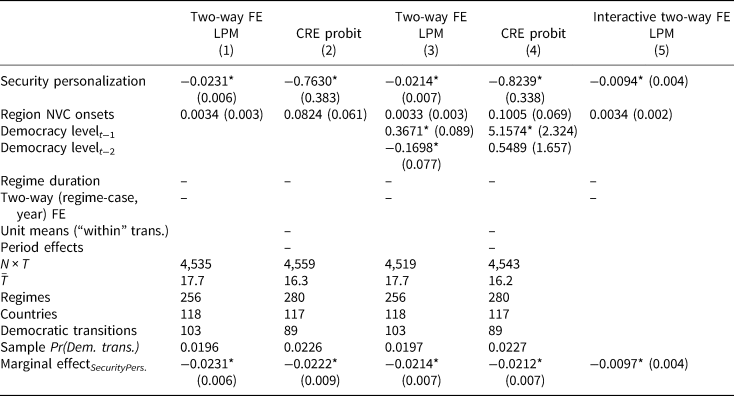
Notes: Sample period: 1946–2010. All specifications adjust for regime duration (log years). Cluster-robust standard errors in parentheses. * p < 0.05.
These results are robust to: adjusting for any of 40 additional covariates (see Online Appendix D.2); altering how we model calendar time and duration time with logs and polynomials (see Online Appendix D.3); altering the panel unit to either the country or the individual leader (see Online Appendix D.4); estimating a Cox model (see Online Appendix D.5); or using an instrumental variables (IV) two-stage least-squares framework that treats security personalism as endogenous to unobserved, leader-specific strategic behavior (see Online Appendix D.6). Further, we show that security personalism does not have a stabilizing effect on other types of regime collapse events, such as regime change coups and rebellions (see Online Appendix D.1). Indeed, the estimates are positive, suggesting possible destabilizing potential for security personalism.
Yet, unobserved country-specific time-varying factors may still bias these estimates. For example, the dictator may partially liberalize the regime, prompting democratic mobilization, and the regime responds, in part, by appointing more loyal security officers. Security personalism, in this case, would not be exogenous to this liberalizing trend that also improves the prospects of democratic transition.Footnote 44 One way to account for such factors is to include time-varying lags of the outcome. Columns 3 and 4 therefore include the first two lags of a measure of the level of democracy, from the Varieties of Democracy polyarchy score.Footnote 45 These democracy lags (t − 1 and t − 2) adjust for liberalizing trends in the regime that may shape both security personalization and the prospects of a democratic transition. The main estimates of interest remain negative and significant in Columns 3 and 4, indicating that our results are robust to these time-varying trends.
Column 5 reports the estimate from a two-way FE LPM with interactive fixed effects that account for country-specific responses to common time shocks (Bai Reference Bai2009), allowing, for example, the end of the Cold War to have different consequences for Eastern European autocracies than for Central Asian ones. The estimate for security personalization is smaller—just under 1 per cent—but still significant at conventional levels.
Our last test is similar to the CRE probit using “within” transformations but, instead of probit, employs a KRLS that relaxes functional form and additive assumptions to estimate pointwise marginal effects for each observation in the data. The estimated average marginal effect from the kernel regression (−1.42 per cent) is smaller than those reported in Table 2 but still statistically significant at the 0.05 level. Figure 4 plots a polynomial curve (that is, nonlinear fit) of the estimated pointwise marginal effects by year. The estimated marginal effect of security personalism on the probability of democratic transition is growing stronger over time: in the 1950s, security personalism decreased the probability of democratization by roughly 1 per cent, but the decrease grows to roughly 2 per cent by the 2000s.
Marginal effect of security personalization on democratization, by year.

Conclusion
While mass uprisings (nonviolent protest episodes) have become the most common path to democracy in the past three decades, historically, they have been relatively rare. Furthermore, even when protest mobilization succeeds in toppling dictatorships, this frequently results not in new democracy, but rather in civil conflict and failed states. Security force personalization, we argue, helps explain these patterns. We present evidence in support of three key hypotheses. First, citizens are less likely to mount a mass uprising against dictatorships with personalized security forces since these regimes have partially mitigated, via loyalty mechanisms, the moral hazard in employing security agents against protesters (the mobilization effect). Secondly, because the fate of personalized security forces is tied more closely to that of the dictator, such forces are relatively more likely to repress realized protest. However, the repression effect only holds during the initial stages of the uprising and diminishes over time. Thirdly, security force personalization makes democracy less likely. This democratization effect has only strengthened over time.
Our theory—which brings the question of loyalty of the state security apparatus to the center in the study of civil resistance—has implications for the prospects of authoritarian survival and democratization. While ample research in the past decade fruitfully explores the institutional sources of authoritarian durability, this article follows the recent turn toward investigating authoritarian coercive forces (see, for example, Blaydes Reference Blaydes2018; Greitens Reference Greitens2016) to examine how loyalty mechanisms—in particular, the personalization of security forces—shape protest mobilization. The dynamic relationship between a dictator and his elite supporters is incredibly difficult to observe and model, but this article makes some progress through using new data to show how personalized security forces deter and repress protest, and thus prevent democratization. Our findings complicate the prevailing view in the literature that personalist regimes, if anything, are more vulnerable to being ousted in mass uprisings (see, for example, Grundholm Reference Grundholm2020) and are thus ripe for nonviolent democratization.
Of course, there are historical cases that do not neatly fit the patterns we demonstrate in this article. For example, in some cases, security personalization fails to deter mass mobilization, the security forces splinter, and democratization follows. Understanding why protests emerge even when citizens face loyal security agents or why democratization results even when security forces splinter remains central to advancing theories of autocratic survival and represents a promising avenue for further research.
Supplementary Material
Online appendices are available at: https://doi.org/10.1017/S0007123422000114
Data Availability Statement
Replication data for this article can be found at: https://doi.org/10.7910/DVN/THQLIH
Acknowledgments
We would like to thank Courtenay Conrad, Mai Hassan, Christopher Sullivan, three anonymous reviewers, and the editor for helpful feedback. Earlier versions of this article were presented at the 2019 International Studies Association Annual Conference and 2019/21 American Political Science Association Annual Conference.
Financial Support
Joseph Wright acknowledges financial support from the Minerva Research Initiative (ONR N000141211004).
Competing Interests
None.


 Open access

