


Introduction
The success of any organization’s innovation efforts has been linked to how ‘open’ their innovation processes are (Chesbrough, Reference Chesbrough2003). However, despite the increase in literature on open innovation (OI), few papers have explored this concept in relation to innovation processes within organizations specifically designed to enact ‘transformative’ social change. This phenomenon, referred to as ‘social innovation’ (SI), is often delivered by social enterprises (SEs). How social innovators adopt ‘openness’ in their work is under-researched (Chesbrough & Di Minin, Reference Chesbrough, Di Minin, Chesbrough, Vanhaverbeke and West2014) despite collaborative approaches being vital to the success of SI (Ayob et al., Reference Ayob, Teasdale and Fagan2016). While acknowledging that SI is a contested term (Ayob et al, Reference Ayob, Teasdale and Fagan2016), we define SI as ‘new ideas (products, services and models) that simultaneously meet social needs (more effectively than alternatives) and create new social relationships or collaborations’ (Social Innovation Exchange, 2010, p. 18).
OSI has been defined as ‘the application of either inbound or outbound open innovation strategies, along with innovations in the associated business model of the organization, to social challenges’ (Chesbrough & Di Minin, Reference Chesbrough, Di Minin, Chesbrough, Vanhaverbeke and West2014, p. 170). This definition draws on Chesbrough’s (Reference Chesbrough2003) seminal work on OI based on porous organizational boundaries allowing ideas to flow inside and outside of the organization. Chesbrough and Di Minin (Reference Chesbrough, Di Minin, Chesbrough, Vanhaverbeke and West2014) however do not comment on the degrees of openness within OSI.
We address this deficit by exploring the relationships between OI and SI, and developing a conceptual model which depicts a spectrum of ‘openness’ within SE. Our model explains the different approaches to delivering social change and answers the research question: How ‘open’ is OSI in SEs? OI theorists have explored ‘how open is innovation?’ (Dahlander & Gann, Reference Dahlander and Gann2010), but this question has yet to be applied to SI. Our contribution is to expand the concept of OSI, to understand the ways in which different approaches to ‘openness’ lead to different ways of achieving social change.
Since little has been published on OSIFootnote 1 we used an exploratory approach (Stebbins, Reference Stebbins2001), consisting of in-depth, longitudinal, qualitative case studies with two Scottish SEs. Both organizations are ‘Limited by Guarantee with Charitable status’ (as is typical for Scottish SEs) and self-identified as being SEs. The principal researcher undertook participant observation for a year, consisting of thirty-two field visits, and, as a volunteer with both SEs, was able to access internal documents (e.g., email exchanges and meeting minutes). This allowed the lead researcher to observe explicit tacit knowledge exchanges. Furthermore, fifteen semi-structured interviews were undertaken with governance actors, founders, and stakeholders. There was, therefore, triangulation of data sources to reinforce the findings from our research (Flick, Reference Flick2004).
This paper proceeds as follows: the next section reviews the literature which is followed by an outline of the methodological approach. We then provide the results from the analysis of the case study data. We close the article by discussing the spectrum of OSI, returning to the literature to deepen our understanding of the findings (Dubois & Gadde, Reference Dubois and Gadde2002) and conclude byemphasizing our contributions to existing knowledge, practice and policy.
Openness in OSI
Chesbrough’s (Reference Chesbrough2003) model of OI and its archetypes of outside-in, inside-out and coupled processes (Gassmann & Enkel, Reference Gassmann and Enkel2004) dominates the limited literature on OSI (Chesbrough & Di Minin, Reference Chesbrough, Di Minin, Chesbrough, Vanhaverbeke and West2014; Wemmer & Koenigstorfer, Reference Wemmer and Koenigstorfer2016). This despite the argument that Chesbrough’s conceptualization of open is not ‘open’ enough, as it relies on exchanges of knowledge principally through intellectual property (IP) (Dahlander & Gann, Reference Dahlander and Gann2010). This conceptualization of OI is exclusively ‘the acquisition of new ideas, patents, products, etc. from outside—often by licensing protected intellectual property’ (von Hippel, Reference von Hippel2010, p. 555)—the ‘controlled’ approach. Alternative frameworks of openness to those inspired by Chesbrough (Reference Chesbrough2003) are based on other uses of ‘open’; e.g., open science, open access and open source (Wikhamn, Reference Wikhamn2013). The term ‘open’ here refers to a way of sharing information ‘free from intellectual property constraints and open to all’ (von Hippel, Reference von Hippel2010, p.555). This latter approach is associated with a knowledge commons and ‘libre’ OI (von Hippel, Reference von Hippel2010; Wikhamn, Reference Wikhamn2013).
We propose these two types of openness become the ends of a spectrum of OSI, echoing that ‘openness’ is used in two distinct ways; ‘libre’ and ‘control’ (Wikhamn, Reference Wikhamn2013). The suggestion that ‘openness’ might be a spectrum on which there are degrees, is widely accepted in the OI literature (Dahlander & Gann, Reference Dahlander and Gann2010). We use three of Wikhamn’s (Reference Wikhamn2013) categories (access to, assumption about and views on knowledge) and apply them to OSI.
Access to Knowledge
The ‘libre’ side of the spectrum proposes access to knowledge as a basic right and users should be able to access knowledge without barriers (such as intellectual property rights (IPR) and paywalls) (Wikhamn, Reference Wikhamn2013). Thus, relating to ‘freedom’ as in liberty not to ‘free’ as in without financial cost (Wikhamn, Reference Wikhamn2013). The only valid restrictions in this model are those which protect the commons, not those which exploit knowledge as a commodity (Ghosh, Reference Ghosh, Hess and Ostrom2007). IPR associated with a ‘libre’ approach are akin to open source or open science whereby barriers do not inhibit access and therefore users can increase and improve knowledge (Bollier, Reference Bollier, Hess and Ostrom2007; von Hippel, Reference von Hippel1986).
Freedom to exclude aligns with a ‘controlled’ OI approach whereby access is restricted using IPR (Wikhamn, Reference Wikhamn2013). Fundamental to ‘controlled’ OI is that knowledge is packaged and commodified for financial reward, not kept secret as in a closed approach (Chesbrough, Reference Chesbrough2003). In this ‘controlled’ approach, a ‘controlling party’ enforces IPR. However, identifying an agreed controlling party is challenging. Furthermore, knowledge can be difficult to exclude people from and this is particularly relevant in the SE context as many innovations are service-based and hard to protect (Link & Siegel, Reference Link and Siegel2007). Whether knowledge should be available to access for anyone or be protected by legal or technical barriers is debatable, particularly for SEs seeking to balance the dual bottom line. Freedom to access could accelerate social impact, whereas freedom to exclude could increase organizations’ financial sustainability (Blundel & Lyon, Reference Blundel and Lyon2015). Thus, access to knowledge relates to the escalation of SI.
Escalating Through Openness or Enhancing by Control
Wikhamn (Reference Wikhamn2013) outlines that freedom to access (on the ‘libre’ side of the spectrum) increases knowledge creation, thus enabling further innovation. The ‘controlled’ approach suggests there should be a financial reward for contributions to innovations and these rewards increase the likelihood that people will contribute to innovation (Ghosh, Reference Ghosh, Hess and Ostrom2007); thus, control can increase the amount of innovation (Wikhamn, Reference Wikhamn2013). Using OSI approach could be a mechanism of diffusing SIs to achieve wider impact as it allows other organizations to use the innovation. Under the ‘controlled’ approach, license/franchise fees become a source of income which, in SEs, would be used to achieve their social mission, and allow them to manage how their innovation is used (e.g., competitors cannot use that information to undermine the existing product or service).
The ‘libre’ argument is that openness acts as a catalyst in diffusing innovation. Hardt and Negri (Reference Hardt and Negri2009) argue that although some have seen privatization of knowledge through IPR as a means of economic freedom, this process is eroding the freedom of the commons. Hess and Ostrom (Reference Hess, Ostrom, Hess and Ostrom2007) focus on escalating the use value of knowledge by granting access to it. Granting access allows a cumulative effect: knowledge can easily be built on. Knowledge can be considered a public good which means that use by one does not subtract from others’ uses. However, while knowledge might be enhanced through access by external actors, the exchange value of the knowledge might decrease if more people have access to it (competitive advantage decreases).
Relational and Transactional Approaches
For Wikhamn, (Reference Wikhamn2013), relational views of knowledge sit on the ‘libre’ side of OI, whereas transactional views are on the ‘controlled’ side. Relational knowledge exchanges rely on trust, relations, legitimacy, and long-term relationships, whereas transactional views of knowledge look at packaging and commodifying knowledge for financial exchange and short-term relationships (Rousseau, Reference Seanor, Bull, Baines and Ridley-Duff1995; Wikhamn, Reference Wikhamn2013). SEs then can base knowledge exchanges on a transactional basis, where the primary outcome is income (with the secondary motivation being social impact) or they can use a relational viewpoint, where the primary outcome is increasing social impact by sharing knowledge. Putting a financial outcome over the social goal could undermine the primary purpose of a SE, e.g., to maximize social impact.
Knowledge as a social phenomenon relates to the ‘libre’ approach and knowledge as packageable is associated with the ‘controlled’ approach. This dichotomy can be associated with tacit versus explicit knowledge. Tacit knowledge is understood as ‘experience, thinking and feelings in a specific context’ formed of people’s ‘mental models, maps, beliefs, paradigms and view points’ as well as ‘know-how and skills that apply to a specific context’ (Popadiuk & Choo, Reference Popadiuk and Choo2006, p. 306). Explicit knowledge can be represented in objects (such as words, numbers, formulas, equipment, documents or models) (Popadiuk & Choo, Reference Randhawa, Wilden and Hohberger2006). Explicit information can be diffused comparatively easily using technology and has established controls (IPR and technological barriers such as encryption) (Bollier, Reference Bollier, Hess and Ostrom2007). Tacit information relies on the person who has that tacit knowledge (Lam, Reference Hess, Ostrom, Hess and Ostrom2000) and therefore can be exclusionary if connection with the ‘knowing subject’ is not possible. Whether an organization uses relational or transactional means of governing their knowledge could depend on whether they are seeking to codify and/or monetize it.
In summary, the literature suggests that there is scope for a spectrum of OSI (Dahlander & Gann, Reference Creswell and Poth2010; Wikhamn, Reference Wikhamn2013) which reflects different approaches to ‘openness’: these can be described as ‘controlled’ and ‘libre.’ Therefore, we have developed the conceptual model shown in Fig. 1. The figure represents two approaches to openness in OSI against the ‘closed’ side of the full spectrum. Chesbrough (Reference Chesbrough2003) emphasized the closed and controlled nature of OSI, while Wikhamn (Reference Wikhamn2013) highlighted the ‘libre’ nature of OI which is represented in Fig. 1. We focus on the levels of openness exploring the space between ‘controlled’ and ‘libre.’
Spectrum of open social innovation model (Authors' own, 2022)

The underlying proposition of Fig. 1 is that the levels of openness could be affected by whether an organization sees knowledge as generating income or maximizing social impact. These two demands are not mutually exclusive: adopting a ‘libre’ approach to OSI could involve income generation, albeit to maintain the commons as open to all. To the best of our knowledge, the distinctive ways in which SEs approach OSI and the mechanisms they adopt, have not been empirically explored, this paper seeks to address this deficit.
Methodology
A qualitative exploratory approach was used in this study as there is little evidence to extract testable hypotheses from (Stebbins, Reference Stebbins2001). Two in-depth, longitudinal case studies were undertaken to illuminate OSI but show different perspectives on the subject under study (Creswell & Poth, Reference Creswell and Poth2018). The cases were chosen with a theoretical replication model (Yin, Reference Yin2018) to give variation across three dimensions—size, locale and sector (Flyvbjerg, Reference Flyvbjerg, Denzin and Lincoln2011). Case Study 1 (CS1) was selected because it is a micro-SE by number of employees and turnover (according to Social Enterprise UK (2017) over 50% of UK SEs in 2017 were micro) and is based in a large city. Case Study 2 (CS2) is based in a rural location and is a small SE by number of employees and turnover. The two SEs operated within differing sectors, one in the arts sector the other in health and social care; sectors which, respectively, represent 14% and 12% of Scotland’s SEs (Scottish Social Enterprise Census, 2017). The period of engagement with CS1 was from December 2017 to March 2019 and CS2 from January 2018 to March 2019. Data were collected using interviews, participant observation and a review of case study documents. Voluntary roles within each organization offered the opportunity to use a participant observation approach to gathering data (O’Connor & Baker, Reference O’Connor and Baker2017). Being a participant observer allowed the researcher to observe instances of knowledge exchange that may have been deemed too informal/insignificant to recount by interviewees and created an environment where the researcher could participate in exchanges of information. In total, 32 fieldwork visits were made across the two case studies. Activities in fieldwork visits ranged from strategic conversations in board meetings and away days, to more coalface activities at community events and groups. Observations were supplemented with interviews and a review of relevant documents from the case study organizations.
In total, 8 people were interviewed as a part of CS1 and 7 people were interviewed as part of CS2. The interview schedules for different interview participant types can be seen in Appendix 1. Each interview lasted between 25 and 80 min, and interviews were conducted between 2017 and 2018. We aimed to capture a diversity of interviewees within each case study; we therefore took a purposive approach to sampling (Patton, Reference Patton2015), interviewing board members, founders, staff members, partners, and beneficiaries—thus taking a ‘one to many’ approach to researching OI (Randhawa et al., Reference Randhawa, Wilden and Hohberger2016, p. 766).
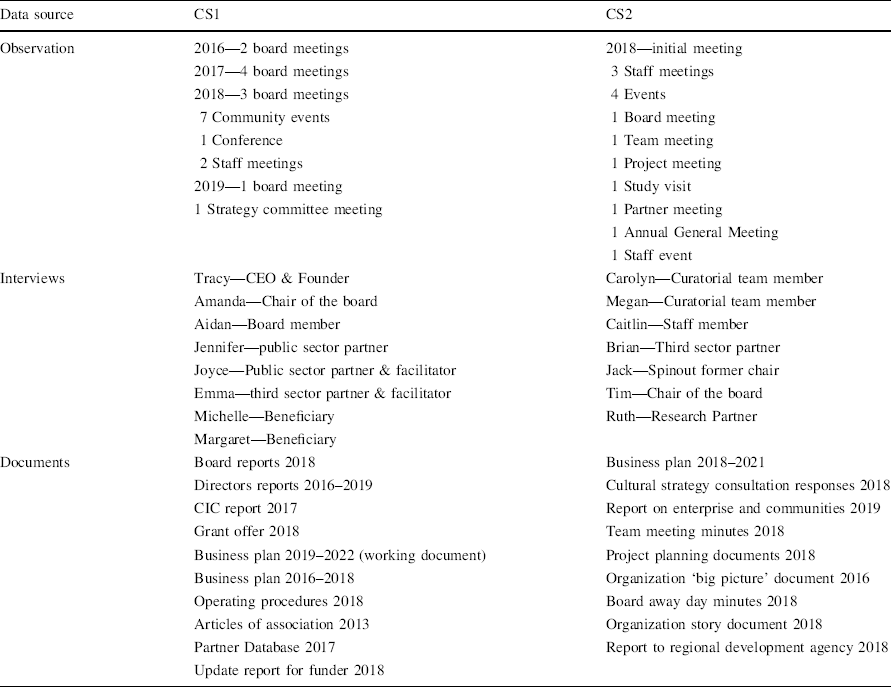
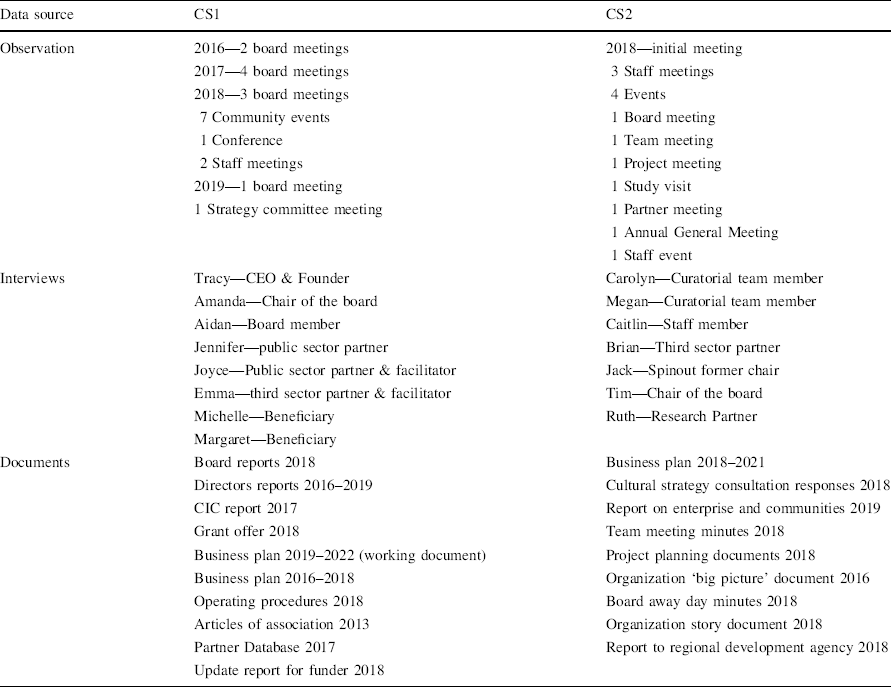
Key documents were used to triangulate the other data (Flick, Reference Flick2004), for example, where meetings were observed, minutes and reports referred to helped to confirm or problematize the researcher’s observations. Data collected are presented in Table 1. Interviewee names have been changed to protect confidentiality.
Data collection (Authors' own, 2022)
Data source |
CS1 |
CS2 |
|---|---|---|
Observation |
2016—2 board meetings 2017—4 board meetings 2018—3 board meetings 7 Community events 1 Conference 2 Staff meetings 2019—1 board meeting 1 Strategy committee meeting |
2018—initial meeting 3 Staff meetings 4 Events 1 Board meeting 1 Team meeting 1 Project meeting 1 Study visit 1 Partner meeting 1 Annual General Meeting 1 Staff event |
Interviews |
Tracy—CEO & Founder Amanda—Chair of the board Aidan—Board member Jennifer—public sector partner Joyce—Public sector partner & facilitator Emma—third sector partner & facilitator Michelle—Beneficiary Margaret—Beneficiary |
Carolyn—Curatorial team member Megan—Curatorial team member Caitlin—Staff member Brian—Third sector partner Jack—Spinout former chair Tim—Chair of the board Ruth—Research Partner |
Documents |
Board reports 2018 Directors reports 2016–2019 CIC report 2017 Grant offer 2018 Business plan 2019–2022 (working document) Business plan 2016–2018 Operating procedures 2018 Articles of association 2013 Partner Database 2017 Update report for funder 2018 |
Business plan 2018–2021 Cultural strategy consultation responses 2018 Report on enterprise and communities 2019 Team meeting minutes 2018 Project planning documents 2018 Organization ‘big picture’ document 2016 Board away day minutes 2018 Organization story document 2018 Report to regional development agency 2018 |
Case studies were analyzed on a case-by-case basis first, before completing a cross-case analysis (Yin, Reference Yin2018). Analysis was undertaken alongside data collection to allow emergent areas of interest to be fully explored in later interviews (Patton, Reference Patton2015). An ‘abductive’ approach to analysis was thus undertaken, with themes (from Fig. 1) identified from the literature compared with emergent themes from the data (Mazzei et al., Reference Mazzei, Teasdale, Calò and Roy2019). This study followed six steps outlined by Braun and Clarke (Reference Braun and Clarke2006) for thematic analysis which included (1) transcription and familiarization, (2) initial code generation, (3) creating, (4) reviewing, (5) defining/naming and (6) reporting themes. The researcher took a systematic combining approach (Dubois & Gadde, Reference Dubois and Gadde2002) where constant comparison between the evidence and literature was used to deepen reflections on the case studies.
Overview of Cases
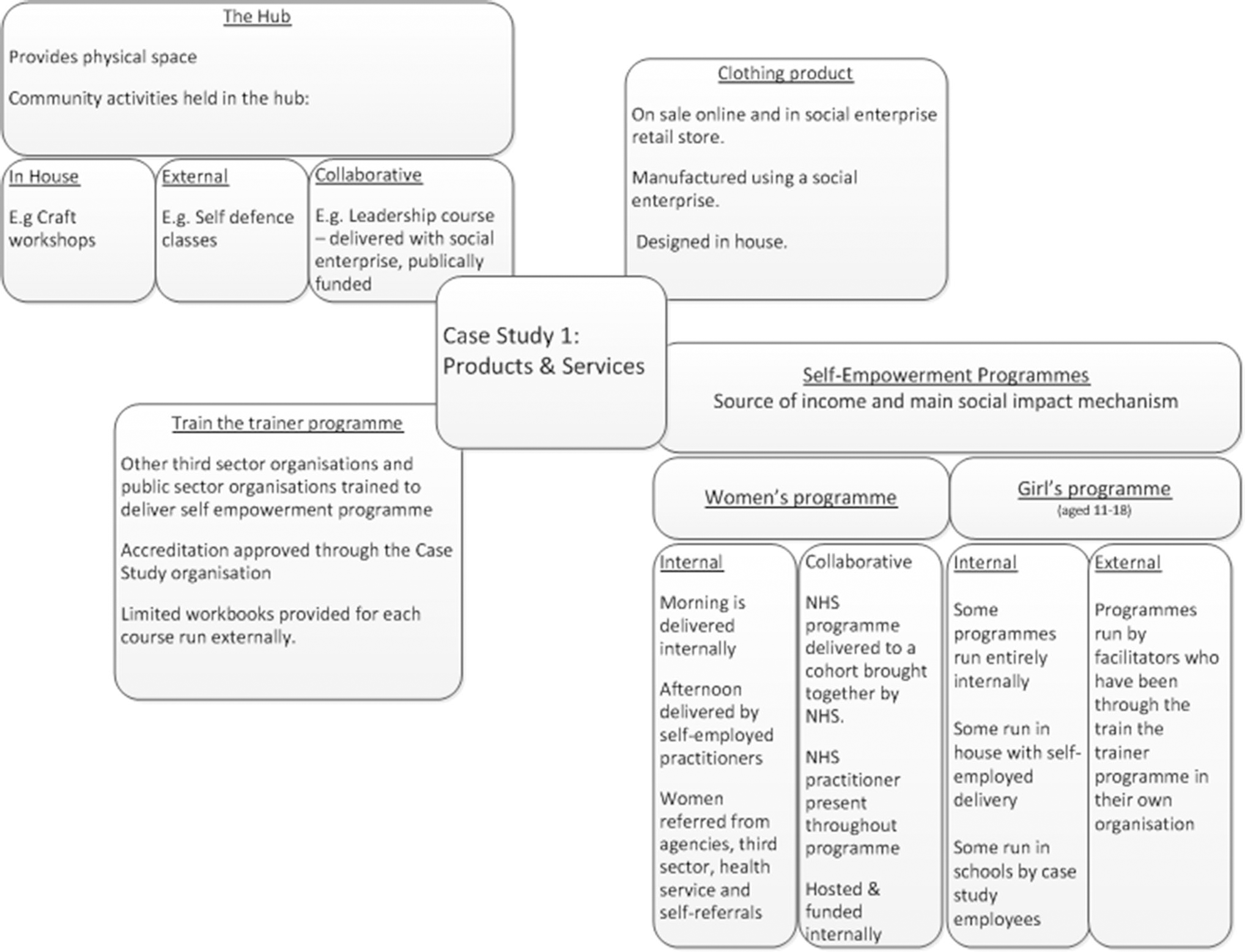
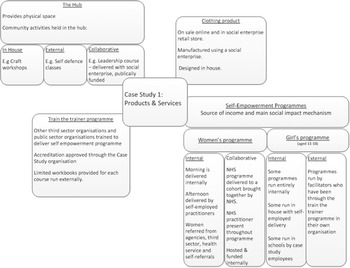
CS1 is a women’s empowerment organization in an urban area of Scotland, founded in 2013. Figure 2 provides an overview of the products and services offered by CS1.
Overview of CS1—co-constructed by lead author with CS1 for business plan (2019–2022)
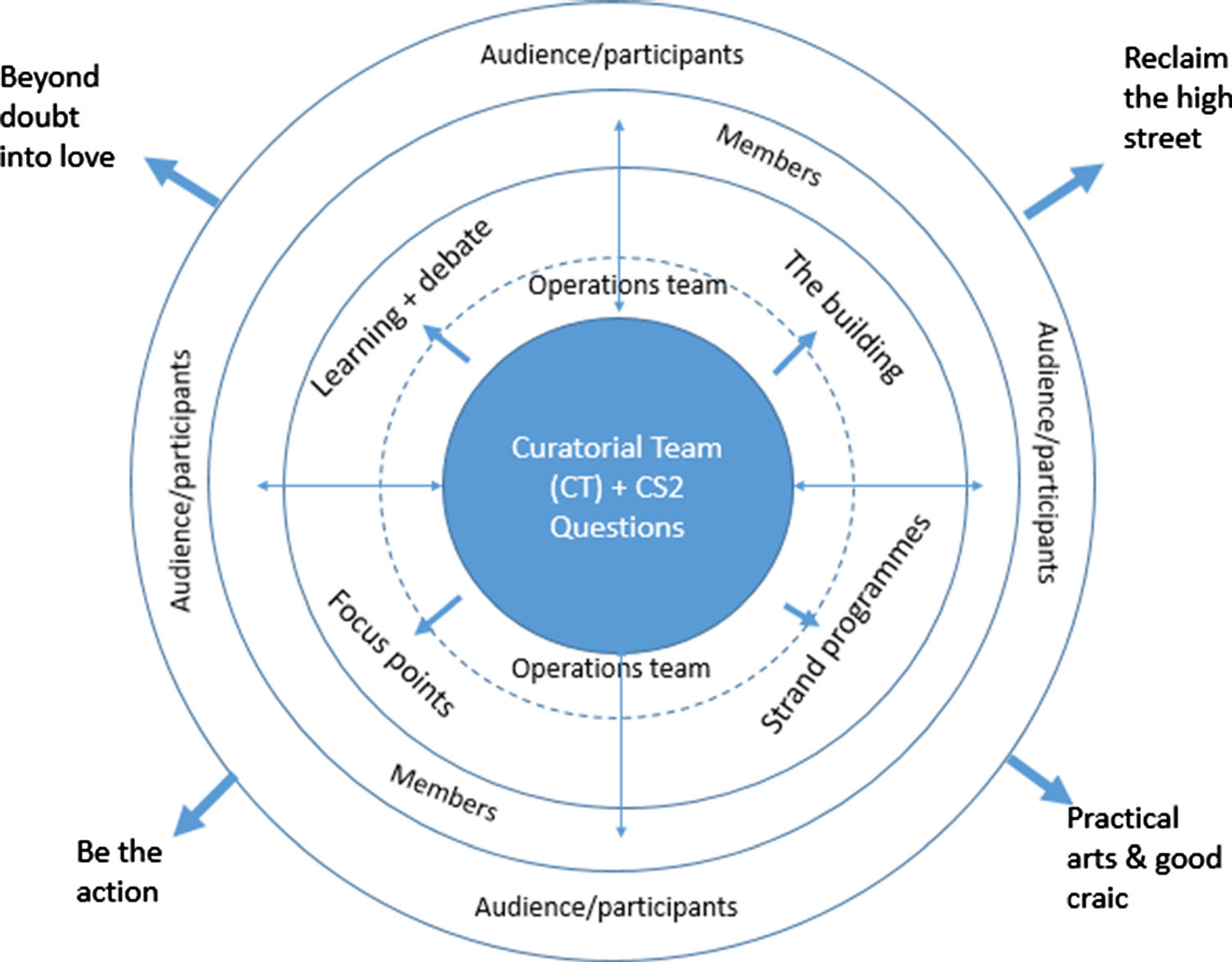
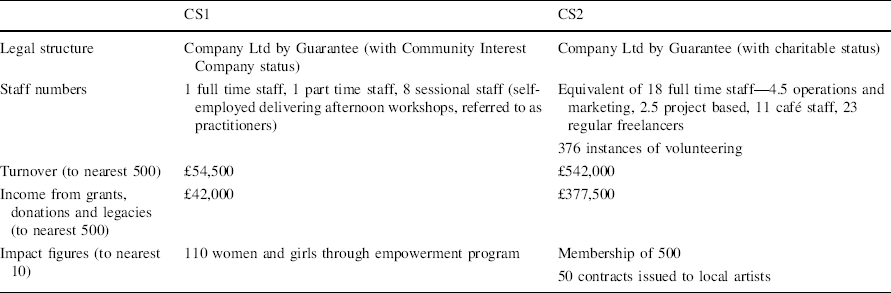
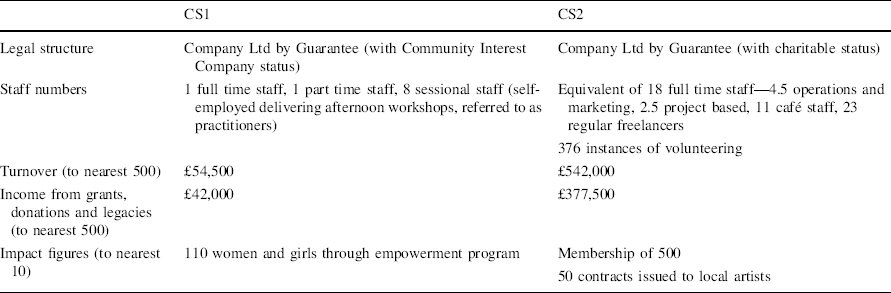
CS2 was founded in 2011 and is a participatory arts organization founded by a collective of local artists. They work on small, time-limited commissions or funded projects as well as long-term services. During the research period the core activities observed and discussed included: café, spoken word events, music events, town fair, consultation events, continuing professional development project for participatory artists and a public arts project. Figure 3 shows how CS2 represents itself. Table 2 provides an overview of the cases.
Visual representation of CS2 (adapted from CS2 business plan 2018–2021)
Overview of cases
CS1 |
CS2 |
|
|---|---|---|
Legal structure |
Company Ltd by Guarantee (with Community Interest Company status) |
Company Ltd by Guarantee (with charitable status) |
Staff numbers |
1 full time staff, 1 part time staff, 8 sessional staff (self-employed delivering afternoon workshops, referred to as practitioners) |
Equivalent of 18 full time staff—4.5 operations and marketing, 2.5 project based, 11 café staff, 23 regular freelancers 376 instances of volunteering |
Turnover (to nearest 500) |
£54,500 |
£542,000 |
Income from grants, donations and legacies (to nearest 500) |
£42,000 |
£377,500 |
Impact figures (to nearest 10) |
110 women and girls through empowerment program |
Membership of 500 50 contracts issued to local artists |
Findings
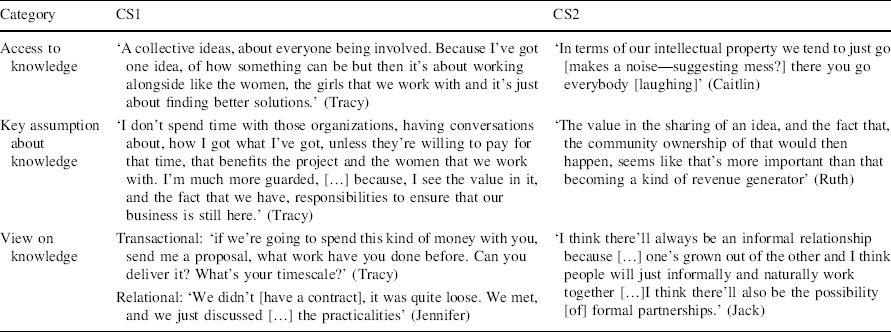
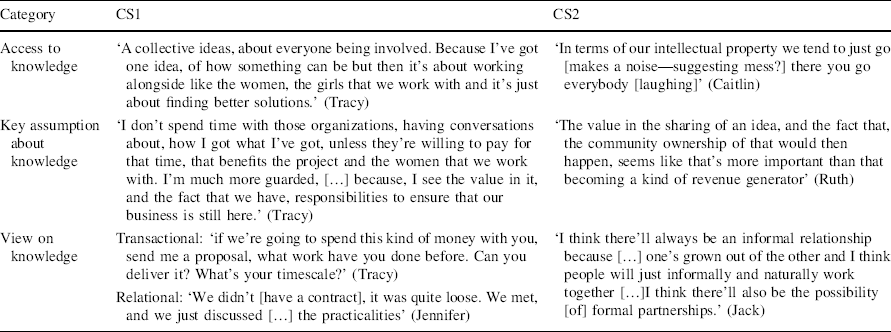
The findings are presented according to three core characteristics: access to, assumptions about and views on knowledge. Illustrative quotes from the semi-structured interviews are contained in Table 3 and are presented throughout the following sections; however, all interview transcripts were coded, alongside observation notes, and reflections were often confirmed with reference to documents.
Illustrative quotes
Category |
CS1 |
CS2 |
|---|---|---|
Access to knowledge |
‘A collective ideas, about everyone being involved. Because I’ve got one idea, of how something can be but then it’s about working alongside like the women, the girls that we work with and it’s just about finding better solutions.' (Tracy) |
‘In terms of our intellectual property we tend to just go [makes a noise—suggesting mess?] there you go everybody [laughing]’ (Caitlin) |
Key assumption about knowledge |
‘I don't spend time with those organizations, having conversations about, how I got what I've got, unless they're willing to pay for that time, that benefits the project and the women that we work with. I'm much more guarded, […] because, I see the value in it, and the fact that we have, responsibilities to ensure that our business is still here.’ (Tracy) |
‘The value in the sharing of an idea, and the fact that, the community ownership of that would then happen, seems like that’s more important than that becoming a kind of revenue generator’ (Ruth) |
View on knowledge |
Transactional: ‘if we’re going to spend this kind of money with you, send me a proposal, what work have you done before. Can you deliver it? What’s your timescale?’ (Tracy) Relational: ‘We didn’t [have a contract], it was quite loose. We met, and we just discussed […] the practicalities’ (Jennifer) |
‘I think there’ll always be an informal relationship because […] one’s grown out of the other and I think people will just informally and naturally work together […]I think there’ll also be the possibility [of] formal partnerships.’ (Jack) |
Access to Knowledge
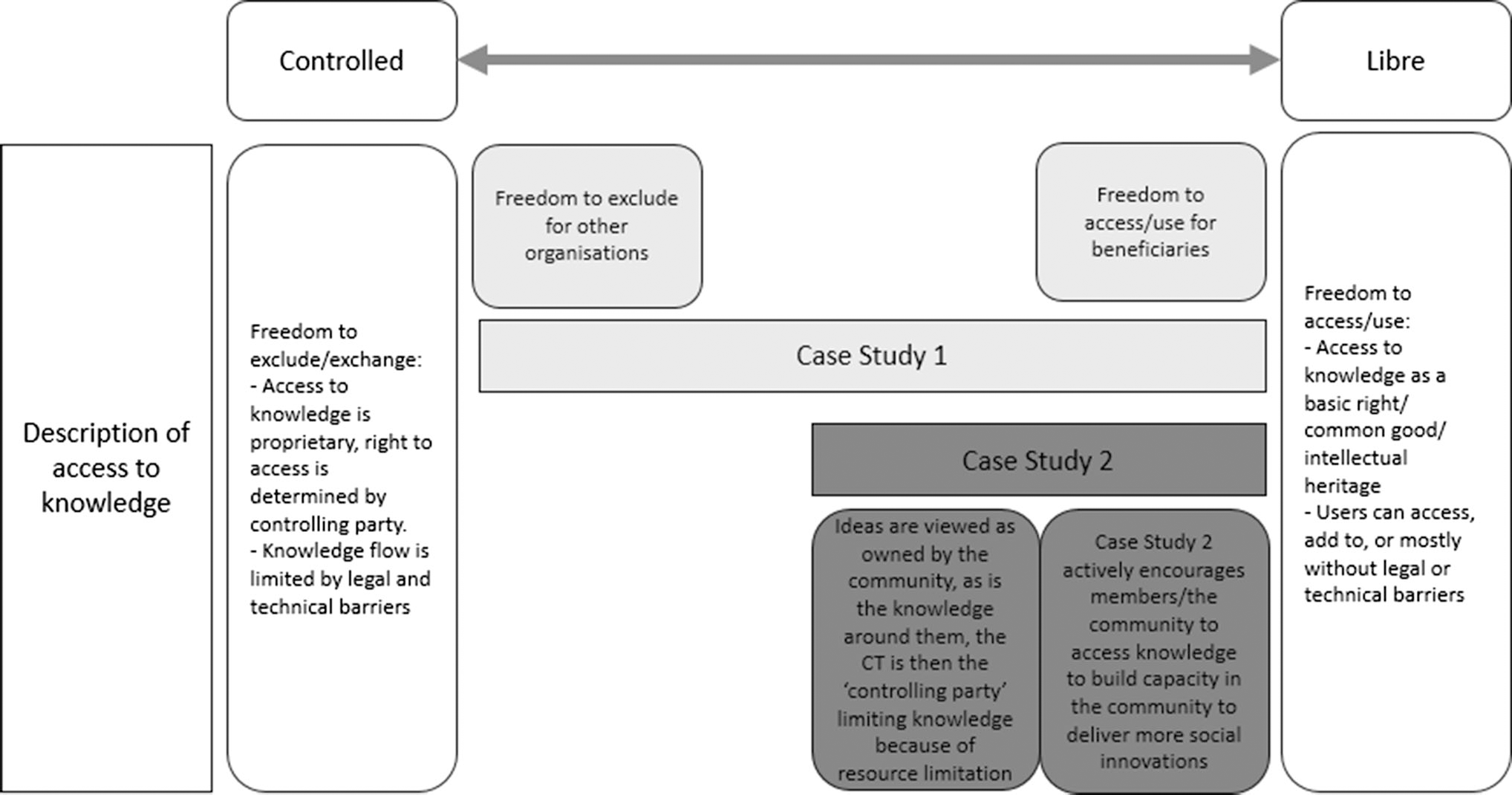
CS1 takes a blended approach to freedom to access or freedom to exclude. They allow freedom to access for their beneficiaries but retain freedom to exclude from other organizations. For other organizations, people within CS1 expect a financial reward for knowledge given (see quote below from Tracy). During board meetings in 2017, the lead researcher was made aware of the non-traditional means of imposing control used by CS1 (minutes of the board meetings confirmed this). This includes limiting the number of printed workbooks shared and a certification process after the course is complete. These are technical barriers, despite technical barriers usually being associated with encryption and paywalls (Bollier, Reference Bollier, Hess and Ostrom2007). From the interview with Tracey (CEO) we can see how this perspective is discussed and linked with the ‘businesslike’ way of thinking about SE (Dart, Reference Dart2004):
I’d be quite up for a conversation if somebody wanted to do the same as what we were doing but pay, for the product, for the time. […] it’s intellectual property and it’s about respect and about value […] We’ve got investment, so we’ve taken debt, and I’ve taken that risk, which means that that needs to be paid back, which means I need to protect the assets […] Because that’s what going to make the business [financially] sustainable. (Tracy)
The freedom to exclude elements of how CS1 manages OSI is tied to the entrepreneurial spirit of the founder, Tracy, who in her interview describes how she has not been afraid to take risks in ways that ‘traditional’ third sector organizations might not have. She mentions taking on loan financing and how this means she must protect her intellectual assets. Although in the quote above, Tracy discusses IP, from observation in board meetings confirmed by the C.I.C. Report (2017), no formal patents are held within CS1.
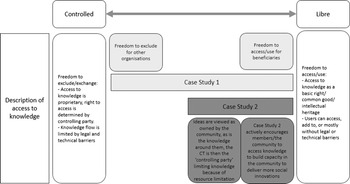
Although CS1 uses a freedom to exclude approach toward sharing innovation information with other organizations, when sharing innovation knowledge with beneficiaries, a freedom to access approach is used. Tracy nurtures beneficiaries with the aim that they will eventually be able to take over elements of the business, meaning she shares knowledge with them. For Tracy this is part of the ethos of her business, as illustrated by quote 1 in Table 3. Depending on the type of relationship (organization or beneficiary) CS1 will take a ‘controlled’ or ‘libre’ approach to gaining access. This is not freedom to access/use for all as within the ‘libre’ approach, protections to maintain the knowledge commons are present. In this way, the approach taken with other organizations could be protecting the commons from over exploitation (e.g., setting up in competition with the original organization).
CS2 employs a default ‘libre’ position; they do not employ legal or technical protections. Ownership of knowledge is important to people in CS2, but they have a different attitude toward ownership than CS1. Within CS2, ownership over project ideas is perceived as having the potential to create elitism over others in the community. This can be seen in the following interview quote:
For us it's really important […], we're as open as possible […] if we contain the ownership of it then we're kind of holding like this sort of elite status over everybody else (Megan)
The quote above suggests that collective ownership of knowledge is a means by which CS2 addresses power and knowledge asymmetries between artists and community members (Eynaud et al., Reference Eynaud, Juan and Mourey2018). Freedom to access is a default stance within CS2; beneficiaries can access, add to or modify knowledge without barriers. The main challenge associated with this approach is the resource intensiveness of sharing information on a one-to-one basis which can be seen in the example from Carolyn’s interview below:
People want to talk, […] I had a conversation with somebody once where, and it was a really good conversation, but […] they kept coming in, and I said, this is my voluntary time, I’m talking to you as an individual artist, who is connected to CS2 […] cause [he] worked for the council […] he’s getting paid for his full day[…] I’m not getting paid for this. I’m committed to it, because I’m used to that freelance work (Carolyn)
The position of each case study is mapped onto the spectrum of openness in the theme of access to knowledge in Fig. 4. These findings highlight that within the category of access to knowledge, organizations can take a blended approach as indicated by CS1 or a more aligned approach as shown by CS2.
Access to knowledge case mapping (Authors' own, 2022)
Assumptions About Knowledge
In CS1, Tracy (the CEO) discussed how she would help other organizations but would want to be compensated for her time and the IP as seen in the interview quote above. Thus, control is enhancing both bottom lines of the SI: the income generated, and the social outcomes achieved by the organization (even if it limits the reach of the SI). Tracy was described by other interviewees (Aidan and Amanda) as a savvy business person who balances the social outcomes with the financial sustainability of the organization. Charging a fee for replication is not always a means of control but can be a way of maintaining the knowledge commons. The fee allows CS1 to protect the existence of their knowledge commons, while new partners can add to and adapt the knowledge to suit their context.
CS2 perceives sharing knowledge with the communities they work with (and the ‘libre’ approach) as a means of meeting their social mission. CS2 is open to sharing their understanding and connections with their community to help them develop. This can be seen in the ways in which they encourage new projects to develop and spin out of their organization, Megan summarizes this ethos below:
[We are] trying to move people’s perceptions from, […] like a bystander’s thing […] to empower them enough to actually just get on and do it themselves (Megan)
This was confirmed by observation notes from the lead researcher’s diary which said:
CS2 aim to start a conversation that allows people to start to lead. (Observation notes, 21/09/18)
The freedom to access for the community escalates innovation, as it builds capacity in the community for people to deliver projects themselves, where CS2 does not have capacity to take all ideas forward. Unlike CS1, they see being ‘proprietary’ with their knowledge as preventing them from being able to ‘make things better for the people in the community’ (Caitlin). CS2 creates value from their knowledge by escalating ideas by allowing members access to the organization’s knowledge, experience and contacts. Some of these ideas then develop into their own entities and become spinout organizations. The placement of each case study is mapped onto a spectrum of openness relating to key assumptions about knowledge and innovation in Fig. 5 again showing a blended approach from CS1 and a more aligned ‘libre’ approach from CS2.
Key assumption about knowledge case mapping (Authors' own, 2022)

Views on Knowledge
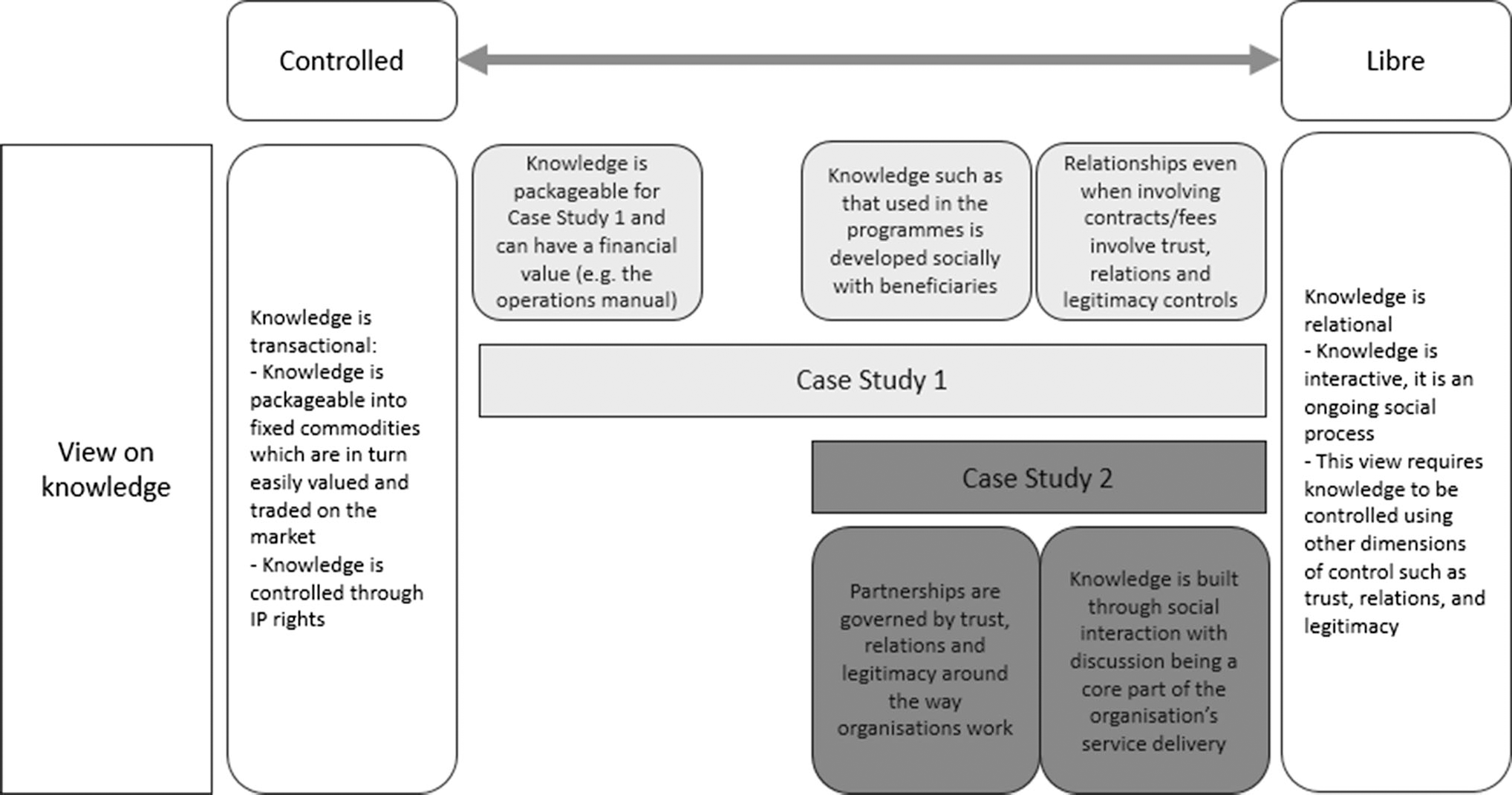
During participant observation of a strategy meeting (2018) it became increasingly clear that CS1 sees knowledge as packageable that it can be codified and sold for a price. From this strategy meeting (2018) the researcher’s notes included reflections on a plan to develop an operations manual, to be used to set up other similar organizations based on CS1’s model. These plans included making their knowledge more explicit as it would be in a written document. However, in practice, there are many examples of knowledge as a social process, particularly when Tracy discusses the development of the workbook used in the young women’s program. Tracy describes a collaborative approach to making the workbook; even in relationships which may at first appear transactional, there are times where mechanisms of trust and relations are also included. There are relationships which are long-term, open-ended elements and include both written and unwritten agreements. Knowledge is seen as packageable, but exchanges are undertaken in a mixture of relational and transactional partnership models. There are ways in which tacit knowledge (such as how to form and manage trust-based relationships) were not discussed as a challenge to the operations manual during the strategy meeting, but the researchers’ notes included a reflection on how this might be captured.
Knowledge production in CS2 is perceived as a collective endeavor through interactions with groups of people inside and outside the organization. There is an implication that if knowledge is a social process, then it belongs to all the people who contributed to building it:
I don't believe in ownership of knowledge. […] I hear this all the time about intellectual property, as if somebody can own that. […] I know you can. And I know there's been legal cases around it but once it's out there. As far as I'm concerned it belongs to everyone (Jack)
Many of the partnerships CS2 has, are governed on an informal basis, with occasional contracts when required (by funders for example). The participant observation sessions showed that CS2 uses their space and events to provoke discussion, developing knowledge through an ongoing social process, for example the café space is used to encourage conversations through participatory artwork such as a booth for conversations with local artists or postcards for reflections. They aim for discussions to promote learning and action in the community. Megan discussed this further in her interview saying the ‘small chatter that happens after events’ is ‘important to a lot of people kick starting the way that they’re changing and thinking about things’ (Megan). Trust facilitated the tacit knowledge exchanges that are the basis of how the organization operates, while CS2 gains income through speakers’ fees their relationship involves long-term, open-ended working arrangements, which feature both written and unwritten agreements. For example, the relationship between Brian (and the Community Trust he represents) and CS2 began through an intermediary organization who suggested that Brian and his organization visit CS2 to learn from them. The intermediary organization provided a fee for CS2 to host the Community Trust; however, the organizations continued a more informal ongoing relationship after this formal arrangement ended. This again suggests a more ‘libre’ way of managing knowledge flow. The positions of each case study are mapped onto the spectrum of openness in relation to the theme of view on knowledge in Fig. 6.
View on knowledge case mapping (Authors' own, 2022)
Discussion
Consistent with the abductive, systematic combining approach (Dubois & Gadde, Reference Dubois and Gadde2002) we now return to the literature, building on our theoretical foundations and seeking more literature to understand the reflections in the findings. Wikhamn’s (Reference Wikhamn2013) spectrum presents two polar ends (‘libre’ and ‘controlled’), developed from categorizing how OI is used in academic literature; however, our empirics deepen this by demonstrating that organizations can be positioned across the spectrum on different categories and within categories. This, we refer to as a blended approach which CS1 used. Despite CS1’s participants’ views on knowledge seemingly reflecting a ‘controlled’ approach, the actions undertaken show a need to constantly ‘control’ to generate income and the desire to empower the women they work with, by allowing them access to the knowledge within the organization. Organizations can take a ‘blended’ approach, using one set of ideals for one group and another for a different relationship/project, described in the OI literature by West (Reference West2003) as ‘hybrid strategies.’ Our research suggests that the levels of openness in SE can be mapped on a spectrum from ‘libre’ to ‘controlled’ (Wikhamn, Reference Wikhamn2013). It could be that an OSI spectrum means that organizations or a sector is not simply ‘open’ or ‘closed’ but could feature degrees of openness which are affected by how knowledge is viewed by people within the organization; particularly whether it should be used to generate income or advance their social mission. The empirical application of a spectrum of openness in OSI has highlighted a nuanced and complex plurality within the sector that echoes Seanor et al.’s (Reference Seanor, Bull, Baines and Ridley-Duff2013) finding that SE cannot be understood as a single narrative.
CS2 uses a ‘libre’ approach to managing their innovation knowledge. They do use their knowledge as a means of generating income, but to protect a commons rather than to generate income. The income generated mainly readdresses the resource intensiveness of sharing tacit information through the ‘knowing subject’ (Lam, Reference Lam2000). Neither organization has a strategic approach to sharing their information; information is shared on an ad hoc basis in keeping with findings from Thomson et al. (Reference Thomson, Whittam and Cairns2016). The organizations rely on a process of ethos matching, where the people they share with are seen to have similar approaches, ideas, and ways of working as themselves to decide who to share information with. This is associated with a relational view of managing partnerships (Rousseau, Reference Rousseau1995). Both organizations discuss an intangible element that is essential to the sharing of their SI; it is more about sharing an approach to working, rather than the policy and procedural nature of their businesses. This insinuates that it is tacit knowledge that the organizations aim to share (Lam, Reference Lam2000). The empirical data presented insinuate organizations do not fit into a box on one side of the spectrum. An obvious reason for this is that organizations are comprised of individuals, who have different viewpoints on knowledge. However, individuals within the organization shape the values and interactions of the organization.
For each case, the way they manage access to knowledge relates to whether they intend to use it to generate income or see it as a public right and release it for social impact. Our findings develop Blundel and Lyon’s (Reference Blundel and Lyon2015, p. 85) statement that if social impact was the dominant consideration, scale would be achieved through a ‘free and open flow of knowledge.’ Conversely, if commercial considerations dominate it would ‘emphasize the need to protect and exploit IP in order to maximize the value at organizational level’ (Blundel & Lyon, Reference Blundel and Lyon2015, p. 85). We extend Blundel and Lyon (Reference Blundel and Lyon2015) by contextualizing how SEs grapple with this complex challenge in a dynamic manner using blended OSI.
The variance present within SE could be related to the different social missions and how this affects their perception of the identity of the organization or their geographical locations. For example, people within CS1 strongly identify the organization as a SE and are influenced by a network of SEs, within which becoming ‘business like’ is part of a strong discourse (Dart, Reference Dart2004; Dey & Teasdale, Reference Dey and Teasdale2016) which the use of IPR is associated with, whereas people within CS2 identify the organization as a participatory arts-based organization, putting their social mission before organizational type. Participatory arts organizations are also discussed in the literature with commons and commoning (Eynaud et al., Reference Eynaud, Juan and Mourey2018), suggesting that the influence of a profession could be the reason for the ‘libre’ approach used in CS2. Attitudes toward openness, alongside an analysis of professional identities would be an interesting area for future study, alongside locale.
CS1 is in a densely populated deprived urban area, where similar organizations are nearby, which causes friction, and increased competition, making the organization wary of being open. CS2, conversely, is based in a small town, where there was a dearth of participatory arts projects, and they remain dominant in that area. It is possible that this lack of threat from competition makes them more open. Although CS2 is not a cooperative or mutual, it does have a membership structure, which influences the degree of openness they have present in the organization. These findings are in keeping with findings from Mazzei (Reference Mazzei2017) and Mazzei et al (Reference Mazzei, Teasdale, Calò and Roy2019) who discuss the role of individuals formed by the context and nature of the locality in which SEs are based as well as different approaches to service user integration in the third sector.
SEs can create a knowledge commons, whereby SI information is shared between likeminded individuals to increase social impact, or they can codify knowledge and create IPR around the SI knowledge to compete by allowing exploitation for profit. How organizations view their knowledge, and how they manage it has an impact not only with implications for the sustainability of the organization, but also levels of trust, and innovation that are present in the organization. Although taking a ‘controlled’ approach to managing innovation knowledge in SE could be said to allow an increase in income, the evidence from the case studies implies that there is a tension pulling organizations toward ‘libre’ means of managing this information. This tension could be caused by a desire to maximize social impact. CS1, who used a blended approach, acknowledges that many organizations who might be interested in their SI ‘packaged’ information would not have the money to buy it. Therefore, to scale their SI, it may be necessary to license the information without a fee.
CS2 highlighted that there is also the ethical question of creating barriers to innovation information which relies heavily on the input of beneficiaries. Both case studies rely heavily on key users and community knowledge (Montgomery, Reference Montgomery2016; von Hippel, Reference von Hippel1986) to create their SIs. There is an ethical question raised by putting up barriers to knowledge that communities helped to create. The knowledge created by communities could be considered a ‘commons’—a resource to which all have a right to access (Wikhamn, Reference Wikhamn2013). Thus, a social dilemma is created around exploiting (through enclosing) the innovation knowledge within a SE to ensure the sustainability of the organization, versus opening innovation knowledge, for the common good, as it was made communally. Putting up barriers to access not only limits the coproduction abilities of the organization which would affect their ability to win public contracts (Mazzei et al, Reference Mazzei, Teasdale, Calò and Roy2019), but could affect their innovativeness (von Hippel, Reference von Hippel1986).
While it could be suggested that the insights gained from this study are particular to the two studies, we argue that it is possible to achieve naturalistic generalization. Naturalistic generalization is where the researcher considers the reader’s direct and vicarious experiences as a source of understanding and through this the reader can identify similarities out of context and bring them to their own experience (Flyvbjerg, Reference Flyvbjerg, Denzin and Lincoln2011; Stake, Reference Stake, Gomm, Hammersley and Foster2000), and thus, the reader can apply the insights beyond the two cases presented to other organizations.
Conclusions
We aimed to understand how ‘open’ is OSI in SE. Our main contributions are threefold: firstly, we add to the limited empirical exploration of OSI which, to date, has focused mainly on Chesbrough’s model of open and closed innovation (Chesbrough & Di Minin, Reference Chesbrough, Di Minin, Chesbrough, Vanhaverbeke and West2014). Secondly, our empirical contribution has been to build on the theories proposed by Chesbrough and Di Minin (Reference Chesbrough, Di Minin, Chesbrough, Vanhaverbeke and West2014) and Wikhamn (Reference Wikhamn2013) to further incorporate how openness is operationalized in a context where ‘social’ is particularly prominent (in SEs). In doing so, we, thirdly, begin to contribute to the theoretical development of OSI by creating a conceptual framework to understand OSI more holistically; our theoretical contribution is furthered by the idea that an organization is not exclusively polarized on their level of openness, as there can be a ‘blended’ approach implied by the case study data.
We found that the approaches of sharing SI information across organizational boundaries are complicated by the dual bottom line of social impact and financial sustainability. While sharing for free can escalate social impact, sharing for a fee can bring much needed income but restrict access to knowledge (Blundell & Lyon, Reference Blundel and Lyon2015). The degree to which OSI is ‘open’ is an under-researched area. The question of how open is innovation has been asked (Dahlander & Gann, Reference Dahlander and Gann2010); however, in extending the question to OSI we unlock new potential in ‘openness.’ Zahra (2007) describes effective strategies for linking theory to entrepreneurial contexts as centering on questioning and probing widely held assumptions about a given theory. This research has questioned the simple dichotomy of open and closed as presented by Chesbrough (Reference Chesbrough2003) by utilizing the context of two Scottish SEs. We provide some empirical evidence which indicates degrees of openness are present in OSI.
Exploring a strategic and pragmatic framework specific to OSI has implications for policy and practice. A shared resource could develop regulatory rules which compensate for time and intellectual input, and attempt to manage elements of competition, while remaining open to those who could use the SI in a new community. In sharing knowledge between organizations, the factors to be considered could be, for use by private/public/third, for use in set geographic areas only, for use in particular communities of interest only, for use for a fee/for free and for use only with prior permission. This has implications for the ways in which social change is achieved in the sense that some may rely on more ‘libre’ ways of sharing and others ‘controlled’ mechanisms using these ‘rights.’
We have proposed a spectrum of OSI in this paper which has implications for organizations involved in social change. Organizations could follow a commercial path of codifying knowledge and utilizing a ‘controlled’ approach to OSI, using IPR to gain new income streams. Within SEs, there is also interest in the ‘libre’ approach from the organizational level in relation to democratizing the SI knowledge to empower beneficiaries to have more access and control. However, a step further can be taken to enhance the benefit gained from information provided by allowing beneficiaries access to the knowledge that they have helped to create.
Our study builds on the limited empirical evidence of OSI available, but is not without limitations. We acknowledge that our findings are based on two case studies, but by utilizing the development of our conceptual model relating to OSI within all third sector organizations more confirmatory studies could further deepen and build our knowledge in this under researched area. A greater understanding of these phenomena within third sector organizations could provide the means for more consistent and improved ways of tackling some of society's most challenging problems.
Acknowledgements
The authors would like to thank Prof. Michael Roy, Dr David Littlewood and Prof Vania Sena for their feedback on earlier versions of this manuscript. An earlier version of this paper was presented at the EMES Conference 2019, and the authors would like to thank those at the conference for their feedback.
Funding
This research did not receive any specific grant from funding agencies in the public, commercial or not-for-profit sectors.
Appendix 1: Topic Guides (with Indicative Follow-Up Questions)
Staff/Board

1. What does OI mean to you? |
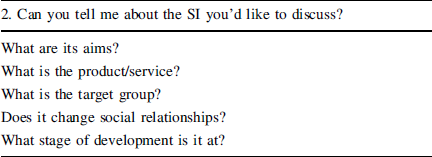
2. Can you tell me about the SI you’d like to discuss? |
|
|---|---|
What are its aims? |
|
What is the product/service? |
|
What is the target group? |
|
Does it change social relationships? |
|
What stage of development is it at? |
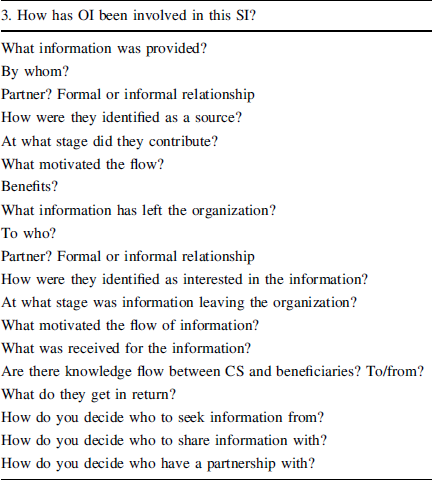
3. How has OI been involved in this SI? |
|
|---|---|
What information was provided? |
|
By whom? |
|
Partner? Formal or informal relationship |
|
How were they identified as a source? |
|
At what stage did they contribute? |
|
What motivated the flow? Benefits? |
|
What information has left the organization? |
|
To who? |
|
Partner? Formal or informal relationship |
|
How were they identified as interested in the information? |
|
At what stage was information leaving the organization? |
|
What motivated the flow of information? |
|
What was received for the information? |
|
Are there knowledge flow between CS and beneficiaries? To/from? |
|
What do they get in return? |
|
How do you decide who to seek information from? |
|
How do you decide who to share information with? |
|
How do you decide who have a partnership with? |
Interview Guide for Partners
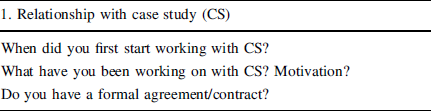
1. Relationship with case study (CS) |
|
|---|---|
When did you first start working with CS? |
|
What have you been working on with CS? Motivation? |
|
Do you have a formal agreement/contract? |
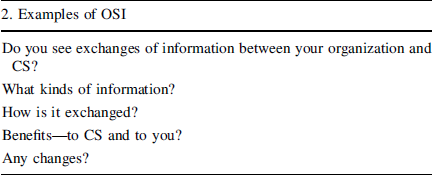
2. Examples of OSI |
|
|---|---|
Do you see exchanges of information between your organization and CS? |
|
What kinds of information? |
|
How is it exchanged? |
|
Benefits—to CS and to you? |
|
Any changes? |
Beneficiaries
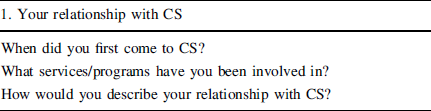
1. Your relationship with CS |
|
|---|---|
When did you first come to CS? |
|
What services/programs have you been involved in? |
|
How would you describe your relationship with CS? |
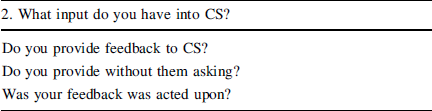
2. What input do you have into CS? |
|
|---|---|
Do you provide feedback to CS? |
|
Do you provide without them asking? |
|
Was your feedback was acted upon? |




 Open access

