


1 Introduction
Many charities need funds. In 2018, Americans gave a total off $427.71 billion to charity, of which 68% came from individual donors (Giving USA, 2019). Research aiming to increase the funds for charities have tried to identify psychological factors that underlie people’s decision to donate (Reference Bekkers and WiepkingBekkers& Wiepking, 2011). How can psychological knowledge be used to increase donations to charitable causes? A method, unit asking (UA), has recently been shown to have a positive effect on increasing donation amounts, creating more scope sensitive donations (Reference Hsee, Zhang, Lu and XuHsee et al., 2013). In UA participants are initially asked to value what amount they would like to donate to one unit, before deciding how much to donate to the complete set of units. Our objective is to examine if the unit asking effect replicates for causes focused on humans in need, and if the method can be extended to causes focused on animal conservation and environmental protection.
1.1 Scope sensitivity
UA is presumed to increase donations by raising participants’ sensitivity to the available quantitative information (the scope). A failure to incorporate scope to an appropriate degree in valuation judgments have been identified for both consumer goods and donations to charities (Reference Chang and PhamChang & Pham, 2018; Reference Desvousges, Johnson, Dunford, Hudson, Wilson, Boyle and HausmanDesvousges et al., 1993; Reference Dickert, Västfjäll, Kleber and SlovicDickert et al., 2015; Reference Hsee and RottenstreichHsee & Rottenstreich (2004); Reference Kogut and RitovKogut & Ritov, 2005). Scope insensitivity describes an inadequate, non- existing, or even inverse sensitivity to the available information about magnitude (scope) during valuation judgments (Reference Kahneman, Ritov and SchkadeKahneman et al., 1999; Reference Kogut and RitovKogut & Ritov, 2005). Perfect scope sensitivity can be described as a linear function, where all goods or recipients have the same value no matter how many there are in total. However, the demarcation between scope sensitivity and insensitivity is not self evident. In situations where a perfect linear scope sensitivity is not shown, there can still be a sensitivity to scope but reflect a nonlinear increase of value. The failure of donors to account for scope when making valuation judgments is a problem for charities in that they do not receive funds that reflect the need of the causes they support.
1.2 Previous research on Unit Asking
Early evidence was found for a method that is similar to UA, which effectively increased sensitivity to scope in valuation of consumer goods (Reference Baron and GreeneBaron & Greene, 1996). In one experiment, Reference Baron and GreeneBaron and Greene (1996) first asked participants to value what they were willing to pay for one unit of a good before stating what they were willing to pay for 10 units of that same good. Later, Reference Hsee, Zhang, Lu and XuHsee et al. (2013) named this procedure UA and showed that this method substantially increased sensitivity to scope in the prosocial domain. UA heavily relies on joint evaluation of information and people’s willingness to be coherent (Reference Hsee, Zhang, Lu and XuHsee et al., 2013). Research on coherence has shown that when an initial anchor value is set, subsequent valuations often remain coherent in relation to that initial anchor (Reference Ariely, Loewenstein and PrelecAriely et al., 2003: Reference Pinto-Prades, Robles-Zurita, Sanchez-Martinez, Abellan-Perpinan and Martinez-PerezPinto-Prades et al., 2017). UA takes advantage of this, by initially asking participants to give a hypothetical monetary amount for helping one unit. Given this anchor, the monetary amounts given to more units should be higher than that of one unit.
In addition to anchoring, the UA method relies on a joint evaluation mode. Research has identified systematic effects of if people evaluate several alternatives simultaneously (joint evaluation) or just one alternative (separate evaluation; Reference HseeHsee, 1996; Reference Kogut and RitovKogut & Ritov, 2005; Reference Pinto-Prades, Robles-Zurita, Sanchez-Martinez, Abellan-Perpinan and Martinez-PerezPinto-Prades et al., 2017; Reference Weaver and GarciaWeaver & Garcia, 2018). Comparing alternatives in joint evaluation mode has been shown to increase sensitivity to scope (Reference HseeHsee, 1996; Reference Kogut and RitovKogut & Ritov, 2005). In UA, the first, hypothetical, valuation of helping one unit serves as a comparison point to the actual valuation of all units. Thus, the method, in addition to coherence, creates a joint evaluation mode that will increase the probability that the donor is sensitive to scope.
1.3 Research question and hypotheses
While the UA method clearly is a potentially important tool to increase donations, so far little research has replicated and extended the initial UA findings (for an exception see Reference SimmonsSimmons, 2013). Thus, our principal research goal is to conduct a direct replication of the original UA findings from Reference Hsee, Zhang, Lu and XuHsee et al., (2013) as well as extend these findings to additional charitable domains.
We expect UA to generate a more scope sensitive valuation and accordingly, closer to a linear function in Willingness-to-donate (WTD) per unit across three domains of charitable giving; children (as in the original study), animals, and the environment.
The research question and these hypotheses, as well as the methodological design described below, were preregistered through AsPredicted (https://aspredicted.org/ih975.pdf) before any collection of data was initiated.Footnote 1
2 Method
2.1 Participants
The participants were recruited during February 2020 through Prolific. A total of 1040 participants responded to the online experiment. To be included in the study participants had to be at least 18 years of age and complete an attention check. The final dataset consisted of one thousand and thirty-nine (N = 1039) participants, after excluding one individual due to failing the attention check. Of the included participants 52.6% were female, 46.2% were male and 1.2% chose to identify as non-binary. Mean age was 36.70 (SD = 13.00). Since one objective with the current study was to replicate the finding of Hsee et al. (2013) we chose to use an all-American sample as in the original study. All participants were fluent in English, which enabled the use of the exact items from the original study (generously supplied by Joe Simmons [2013]). The online experiment took approximately five minutes to complete and all participants received a small monetary compensation for their participation.
2.2 Design
A 2 (UA, control) × 3 (children, animals, environment) design was used. Each charitable domain (children, animals and environment) included both an experimental condition and a control condition. As in the original Hsee et al. (2013) study, no real donations were collected. All donations were hypothetical.
2.3 Materials and procedure
Participants responded to the study through the online survey tool Qualtrics. Initially, participants answered a number of demographic items. Following this, participants were randomised to one of six conditions.
The participants were presented with a scenario, and a question about their WTD to a specific cause. Three scenarios were used, involving either children, animals or the environment. The participants faced with the scenario concerning children were asked to imagine that Christmas is around the corner and were introduced to a kindergarten asking for donations to buy presents for 20 children from low income families. This condition identical to study 1 in Reference Hsee, Zhang, Lu and XuHsee et al. (2013). The participants faced with the animal scenario were introduced to an animal shelter, which recently rescued 20 koalas from a forest fire. The animal shelter is asking for donations to care for these animals, and later reintroduce them to the wild. Lastly, the participants in the environment scenario were told to imagine an organisation fighting forest fires asking for donations to fund their work. In the scenario, the organisation is currently working with fighting forest fires in 20 different locations. In the second and third scenario, the fundamental issue (forest fires) was kept constant. However, we shifted what charitable cause was highlighted. All three domains included a neutral picture of the victim (child, koala, or forest location). The amount of information given to the participants about the cause and charity organisation were equivalent in all scenarios.
In all scenarios, participants in the experimental condition were told that before deciding their total WTD for all 20 units (children, koalas or forest locations), they should explicitly decide how much they hypothetically would be willing to donate to one unit (unit WTD). The participants in the control group were simply asked how much they were willing to donate to all of the 20 units.
Lastly, the participants completed a set of items included for exploratory purposes. These included questions about the impact participants felt their donations would have had in reality, their emotional responses from reading the different scenarios and how often the participants donate money to different charitable causes in real lifes.Footnote 2
3 Results
3.1 Data inspection and preparation
The data were transformed using a log transformation (Log10(WTD+1)) done separately for each condition. In condition one the unit WTD and total WTD of one participant’s response was altered from $10 000 to $100.
3.2 Primary analyses
We expected the total WTD for the unit asking conditions to be significantly greater than the WTD for the control conditions. We conducted a 2(UA vs Control) × 3(domain) ANOVA where a main effect of UA was found, the 521 participants in the three experimental conditions (Mlog = 1.15, SD = 0.72) compared to the 518 participants in the control conditions (Mlog = 1.00, SD = 0.65), demonstrated a significantly higher WTD (F(1, 1033) = 14.25, p < .001; Figure 1). Further a significant main effect of domain was found (F(2, 1033) = 22.38, p <.001), where the children domain was overall higher than the two other domains. However, no significant interaction was found between unit asking and charitable domain (p = .11) (Figures 1 & 2).
Mean Log10 WTD for the experimental and control conditions. Error bars indicate standard error.

Mean Log10 WTD for all conditions. Error bars indicate standard error.

3.3 Exploratory analyses
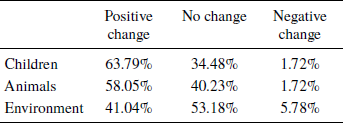
We also examined what proportion of participants in the experimental conditions that had a positive change (as predicted by the UA method) from their unit WTD (1 unit) to their total WTD (20 units). Further, we examined what proportion that had no change and what proportion had a negative change (see Table 1). The proportions were determined by creating a difference variable (total WTD − Unit WTD) and categorizing the values into three groups: positive change (anything over zero), no change (exactly zero) and negative change (anything under zero). The proportions in all domains indicate that although UA is an effective method for increasing donations at group level, it does not affect all participants in the expected direction (see Table 1).
4 Discussion
The current study aims to contribute to the literature on charitable giving by replicating the effect of UA on collecting funds for children, as well as by extending it by investigating if UA can increase donations for charities working with animal conservation and environmental protection. This was done by testing the exact same charity scenario as in Reference Hsee, Zhang, Lu and XuHsee et al. (2013) and by creating and testing equivalent hypothetical scenarios for charities working with animal conservation and environmental protection.
First, our results replicate Reference Hsee, Zhang, Lu and XuHsee et al. (2013), demonstrating that UA effectively increases donations to children in that specific charity scenario. However, our effect size is somewhat smaller than that of the original study. Hsee et al. found ratios of total to control of 2.74 (Study 1), 1.65 (Study 2) and 4.44 (Study 3). Our overall means (before the transformations reported above) were $15.03 for the unit-asking total and $8.25 for the control, yielding a ratio of 1.82.
A difference in temporal proximity could possibly play a part in the difference in effect size between the original and the current study. The data for the original study was collected “shortly before Christmas”, in a time were most people buy Christmas presents . In contrast to Reference Hsee, Zhang, Lu and XuHsee et al. (2013), our data was collected several weeks after Christmas (in February) thus rendering gifts for Christmas less concrete and relevant, leading to a lower effect.
Secondly, our results also extend the application of UA to charities working with animal conservation and environmental causes. While there were level differences in the absolute WTD amounts between conditions (Figure 2), we do not find a significant difference in the UA effect between domains. Thus, we conclude that the UA method can be used for other charitable causes than humans is need.
4.1 Future research
We suggest that the methodological design can be altered in a number of ways to investigate the mechanisms as well as the real life implications of UA. For example, the ratio between the unit and the total could be manipulated. Another way to alter the overall scenario would be to keep the charitable cause constant but change the situation to manipulate the affect richness. This could be done by creating a more severe or acute scenario. The temporal, geographical, and social proximity in the scenario could also be manipulated.
We found that many people are not affected by UA. (A small number of people were even negatively affected by it.) Future research could investigate the contextual circumstances and individual factors that govern the response to the UA intervention. One intriguing possibility is that individual differences in numeracy may mediate the level of scope insensitivity and therefore the UA effect (Reference Dickert, Kleber, Peters and SlovicDickert et al., 2011).
5 Conclusion
The current study aimed to replicate and extend UA to examine if the method would increase donations for different types of charitable causes (children, animals and environment). A significant effect of UA on WTD was found across domains. This research adds to the knowledge on how to increase donations to charities. Further research is needed to see if UA extends to real donations and to identify the mechanisms and boundary conditions of the method .


 Open access

