


Introduction
A fundamental aspect of human rights, dignity, and health is sexual and reproductive health. Individuals and couples who have access to contraception can decide whether and when to have children, spread out pregnancies, and lower the risks associated with unwanted pregnancies for mothers. Contraceptive knowledge and services are essential to human rights and health, according to the World Health Organization, 2023.
However, not everyone is granted equality. The intersections of gender, disability, poverty, stigma, and inadequate health systems frequently result in stacked disadvantage for women with disabilities (Mac-Seing et al., Reference Mac-Seing, Zinszer, Eryong, Ajok, Ferlatte and Zarowsky2020). Women and girls with disabilities face significant obstacles to sexual and reproductive health information and services, such as communication barriers, inaccessible facilities, discriminatory attitudes, and exclusion from mainstream programming, according to global and international policy bodies (Mac-Seing et al., Reference Mac-Seing, Ochola, Ogwang, Zinszer and Zarowsky2021).
These difficulties are significantly more severe in environments with limited resources. Access to family planning depends not just on the availability of services but also on women’s ability to speak with providers, physically visit facilities, acquire correct information, and make reproductive decisions free from stigma or coercion (Saldanha et al., Reference Saldanha, Botfield and Mazza2025). In addition to being refused the practical assistance required to obtain services, women with disabilities may encounter enduring stereotypes that they are asexual, unsuited for relationships, or should not have children (Peta, Reference Peta2017; Stanojkovska Trajkovska and Trajkovska, Reference Stanojkovska Trajkovska and Trajkovska2024). These disparities impair health outcomes as well as autonomy (Akhtar et al., Reference Akhtar, Bhatti and Fredericks2025).
The population’s use of contraceptives in Ghana has improved over time. According to the 2022 Ghana Demographic and Health Survey, the percentage of married women who used modern contraceptives rose from 5% in 1988 to 28% in 2022. (DHS Program) On the other hand, disparities faced by marginalised groups, such as women with disabilities, may be hidden by overall national progress (Abualghaib et al., Reference Abualghaib, Groce, Simeu, Carew and Mont2019). Scholarship from Ghana and other parts of sub-Saharan Africa has consistently demonstrated that poor provider attitudes, exclusion from information, communication difficulties, and inaccessible surroundings are among the obstacles that people with disabilities face when trying to obtain sexual and reproductive health care (Ganle et al., Reference Ganle, Baatiema, Quansah and Danso-Appiah2020).
Little research in Ghana has qualitatively investigated how women with various types of disabilities comprehend, negotiate, and act on contraceptive choices in everyday low-resource contexts, despite the rising body of knowledge on disability and reproductive health. To close that gap, the current study examines how women with disabilities in Apam, Central Region, Ghana, use contraceptives. It looks at how women learn about contraception, what influences uptake and non-use, and how structural disparities affect their reproductive decisions and healthcare experiences. It does this by using qualitative accounts. Women with physical, visual, and hearing impairments are included in the research, which makes it particularly important because it provides insight into both common and disability-specific experiences.
Methods
Study design and participants
To investigate in-depth lived experiences and views of a particular group, this study used a qualitative descriptive design (Dodgson, Reference Dodgson2017). Sixteen women with disabilities in Apam, Central Region, Ghana, participated in semi-structured in-depth interviews. To guarantee the greatest variance in women with disabilities’ type, age, marital status, parity, educational background, and experience with contraception, purposeful sampling was used (Ahmad and Wilkins, Reference Ahmad and Wilkins2025). Women in the Apam municipality who were of reproductive age (15–58) who had a documented physical, sensory, or hearing impairment were eligible to participate. The following women with disabilities categories were represented: visual impairment/blindness (n = 2), physical impairment (n = 9), and hearing impairment/deafness (n = 5). Disability associations, community health workers, and recommendations from nearby non-governmental organisations were used to find participants. Participants had to meet the following requirements to be considered: (i) women with a recognised disabilities; (ii) be at least 15 years old; (iii) live in Apam; and (iv) be prepared to give informed consent. Women with cognitive impairments or severe illnesses were not included.
Study setting
The study was carried out at Apam in Ghana’s Central Region, which is mostly a low-resource area with a combination of semi-urban and rural features. These situations frequently have a reliance on unofficial social networks for health information, a lack of specialised disability services, and unequal access to the health system. Because of these factors, the environment is suitable for comprehending how social context and structural limitations influence women with disabilities’ use of contraception (Fletcher et al., Reference Fletcher, Yee, Ong and Roden2023).
Data collection
A pre-tested semi-structured interview guide created from the body of knowledge on contraceptive use and disability was used to gather data. January 2026 and February 2026 were the dates of data collecting. Awareness of contraceptive techniques, past and present use, perceived barriers and facilitators, contacts with healthcare providers, and suggestions for service improvement were all covered in the handbook. Trained research assistants who were proficient in Fante, Twi, or Ghanaian Sign Language conducted interviews with participants in their preferred languages. A trained sign language interpreter helped deaf people communicate. Each interview was audio recorded with participants’ express consent, lasted between 20 and 45 minutes, and was conducted in a private, comfortable setting to preserve confidentiality. Bilingual research assistants then translated the verbatim transcriptions into English. Back-translation was used to confirm the accuracy and semantic equivalency of translated transcripts. After it was confirmed that no new codes or themes had arisen from the previous three interviews, the final sample of 16 individuals was considered sufficient. Data saturation was tracked iteratively (Guest et al., Reference Guest, Bunce and Johnson2006). Table 1 shows the characteristics of the study participants.
Participants characteristics
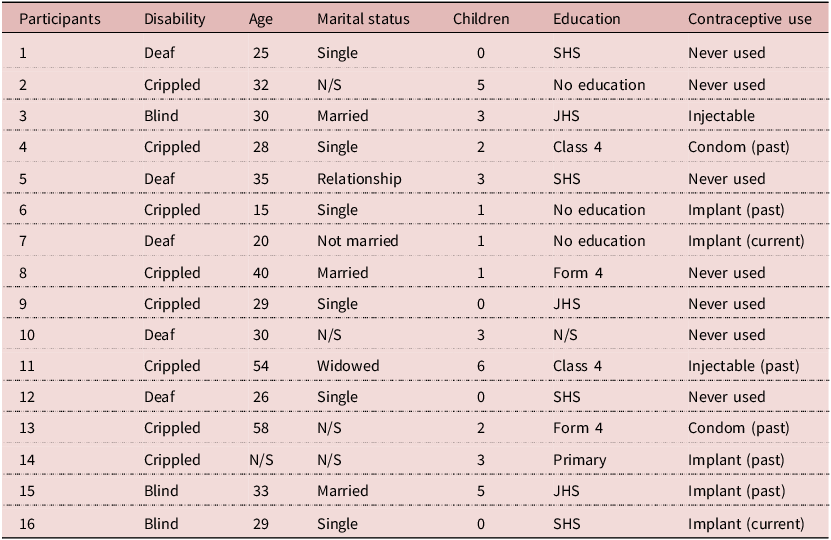
Table 1. Long description
A table with 16 rows and 7 columns detailing the characteristics of participants with disabilities. The columns are labeled Participants, Disability, Age, Marital status, Children, Education, and Contraceptive use. Each row provides specific details for each participant. Row 1: Participant 1, Deaf, 25, Single, 0, SHS, Never used. Row 2: Participant 2, Crippled, 32, N/S, 5, No education, Never used. Row 3: Participant 3, Blind, 30, Married, 3, JHS, Injectable. Row 4: Participant 4, Crippled, 28, Single, 2, Class 4, Condom (past). Row 5: Participant 5, Deaf, 35, Relationship, 3, SHS, Never used. Row 6: Participant 6, Crippled, 15, Single, 1, No education, Implant (past). Row 7: Participant 7, Deaf, 20, Not married, 1, No education, Implant (current). Row 8: Participant 8, Crippled, 40, Married, 1, Form 4, Never used. Row 9: Participant 9, Crippled, 29, Single, 0, JHS, Never used. Row 10: Participant 10, Deaf, 30, N/S, 3, N/S, Never used. Row 11: Participant 11, Crippled, 54, Widowed, 6, Class 4, Injectable (past). Row 12: Participant 12, Deaf, 26, Single, 0, SHS, Never used. Row 13: Participant 13, Crippled, 58, N/S, 2, Form 4, Condom (past). Row 14: Participant 14, Crippled, N/S, N/S, 3, Primary, Implant (past). Row 15: Participant 15, Blind, 33, Married, 5, JHS, Implant (past). Row 16: Participant 16, Blind, 29, Single, 0, SHS, Implant (current).
Data analysis
Clarke and Braun’s (Reference Clarke and Braun2017) reflexive thematic analysis framework, which consists of six systematic phases, was used to analyse the data: (i) familiarising oneself with the data by repeatedly reading the transcripts and noting initial impressions; (ii) generating initial codes by methodically identifying meaningful units across the entire dataset; (iii) searching for themes by compiling related codes into candidate themes; (iv) reviewing and refining themes to ensure internal homogeneity and external heterogeneity; (v) defining and naming themes with clear, analytical narratives; and (vi) creating the final report with rich evidence. NVivo (version 12) qualitative software (QSR International, Melbourne, Australia) was used to manage and organise the data, facilitating the effective retrieval and comparison of coded segments across transcripts.
Several techniques that were in line with Guba and Lincoln (Reference Guba and Lincoln1994) were used to establish rigour and reliability criteria. Long-term interaction with the data, member checking in which a sample of participants checked preliminary results for accuracy, and peer debriefing with an impartial qualitative researcher who was not involved in data collection were all used to assure credibility. The study environment and participant characteristics were thoroughly described, which improved transferability. Maintaining a thorough audit trail that documented every analytical decision, including a reflexivity log where the research team documented and bracketed their positionality and assumptions throughout the inquiry process, helped to ensure dependability and confirmability.
Ethical considerations
The Ghana Health Service Review Board (IRB) granted ethical clearance (ID: DHRCIRB/082/12/25). Local health officials and community leaders were also consulted for permission. A thorough information document outlining the study’s objectives, the voluntary nature of participation, the participants’ freedom to leave at any time without repercussions, and the steps taken to maintain confidentiality and anonymity were given to each participant before each interview. Prior to the start of data collection, all participants provided written informed consent. Participants were given identity codes (such as P12, 26 years, Deaf), and all data was anonymised. All audio recordings and transcripts were safely kept on an institutional system that was password-protected and only the research team could access. The study was carried out completely in compliance with the Declaration of Helsinki’s ethical guidelines.
Results
Four main topics emerged from the analysis of the interviews: (1) information routes and knowledge acquisition; (2) factors influencing the non-utilisation of contraceptives; (3) factors influencing the adoption of contemporary contraceptives; and (4) structural and systemic health disparities. These topics show how interpersonal, systemic, personal, and informational factors influence contraceptive behaviour. Table 2 indicates the summary of emerging themes and subthemes from the thematic analysis.
Themes and subthemes with supporting quotes
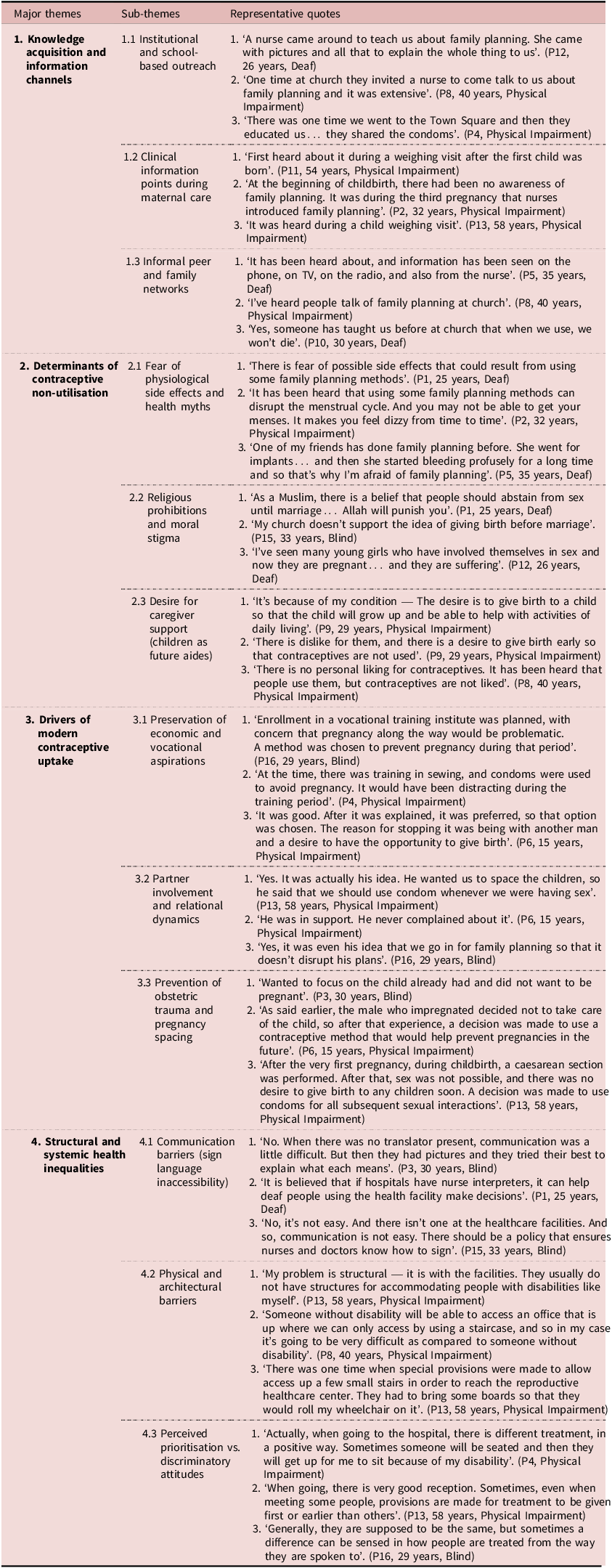
Table 2. Long description
The table presents a structured summary of themes and subthemes derived from interviews regarding contraceptive behavior. It has four main themes: Knowledge acquisition and information channels, Determinants of contraceptive non-utilisation, Drivers of modern contraceptive uptake, and Structural and systemic inequalities. Each theme is divided into sub-themes with representative quotes. The table has four columns: Major themes, Sub-themes, Codes, and Representative quotes. The first row under Major themes lists Knowledge acquisition and information channels, with sub-themes including Institutional acquisition of information, Informal poor and family networks, and others. The second major theme is Determinants of contraceptive non-utilisation, with sub-themes like Fear of physiological side effects and health myths, Religious prohibitions and moral stigma, and Desire for children. The third theme is Drivers of modern contraceptive uptake, with sub-themes such as Preservation of economic and vocational aspirations, Partner involvement and relational dynamics, and Prevention of obstetric complications and pregnancy spacing. The fourth theme is Structural and systemic inequalities, with sub-themes including Communication barriers (sign language inaccessibility), Physical and architectural barriers, and Perceived prioritisation or discriminatory attitudes. Each sub-theme is supported by quotes from interviewees, providing context and examples.
Overview
Theme 1: Knowledge acquisition and information channels
This theme describes how women with disabilities acquired knowledge about family planning and contraception. The results demonstrate that participants obtained information from a variety of sources, including the media, schools, churches, medical institutions, friends, and family. Not all women, though, had equal access to this data. Due to communication difficulties and restricted access to health education, some people’s knowledge was either insufficient or arrived late. This subject demonstrates how having access to contraceptive information is a crucial first step in influencing contraceptive behaviour.
Theme 1.1 Institutional and school-based outreach
Formal educational encounters emerged as an important source of contraceptive knowledge. Participants recalled nurses visiting schools and community spaces with pictures and practical explanations. One deaf participant explained, ‘A nurse came around to talk about family planning. She came with pictures and all that to explain the whole thing’ (P12, 26 years, Deaf). Another participant said, ‘One time at church they invited a nurse to come talk to about family planning and it was extensive’ (P8, 40 years, Physical Impairment). A third described community outreach at the town square where education was combined with condom distribution. These accounts suggest that institutional outreach can play a significant role in bridging information gaps when delivered in accessible ways.
Theme 1.2 Clinical information points during maternal care
For several women, the first meaningful encounter with contraceptive information occurred during maternal or child health visits rather than before their first pregnancy. One participant stated, ‘Heard about it first when going for weighing after the first child was born’. (P11, 54 years, Physical Impairment). Another said ‘When childbirth started, there had been no prior knowledge of family planning. It was during the third pregnancy that nurses introduced family planning’. (P2, 32 years, Physical Impairment). This pattern suggests that contraception education may arrive too late for some women, limiting early prevention of unintended pregnancies.
Theme 1.3 Informal peer and family networks
Participants also reported learning about contraception through media, peers, relatives, and church members. One woman noted, ‘Have heard about it. Some information has been seen on the phone, on TV, on the radio, and also from the nurse’. (P5, 35 years, Deaf). On the other hand, in some situations, religious affiliation also functioned as a media platform for contraceptive use and teaching: ‘Yes, someone talk about it before at church that using it won’t lead to death’. (P10, 30 years, Deaf). These informal channels broaden exposure, but they may also transmit misinformation, especially where formal disability-inclusive counselling is weak.
Theme 2: Determinants of contraceptive non-utilisation
This theme focuses on the reasons why some disabled women chose not to use birth control. The results demonstrate that a variety of factors, such as personal requirements, religious convictions, and fear of side effects, had an impact on non-use. Some women thought that their faith did not accept the use of contraception, while others were concerned about potential health issues. Some ladies wanted children because they thought they would provide for them later in life. This theme demonstrates how beliefs, anxieties, and everyday realities are connected to the non-use of contraceptives.
Theme 2.1 Fear of physiological side effects and health myths
Fear of side effects was one of the most prominent deterrents. Participants associated contraception with menstrual disruption, prolonged bleeding, dizziness, and other harms. One participant said, ‘There is fear of possible side effects that could result from using some family planning methods’. (P1, 25 years, Deaf). Another said ‘One of my friends has done family planning before. She went for implants… and then she started bleeding profusely for a long time and so that’s why I’m afraid of family planning’ (P5, 35 years, Deaf). These narratives indicate that perceptions of risk were often socially transmitted rather than grounded in clinical counselling.
Theme 2.2 Religious prohibitions and moral stigma
Religious beliefs shaped contraceptive behaviour in complex ways. Some participants viewed premarital sexual activity and associated contraceptive use as morally wrong. One participant stated, ‘Being a Muslim, there is a belief that people should abstain from sex until marriage, as Allah will punish such actions’. (P1, 25 years, Deaf)
Another referred to church teachings that ‘My church doesn’t support the idea of giving birth before marriage’ (P15, 33 years, Blind). These findings show how religious morality can discourage open engagement with contraception, particularly among unmarried women.
Theme 2.3 Desire for caregiver support
A notable finding was the idea of childbearing as future security. Some participants with physical impairment explained that they wanted children who could later support them in daily living. One woman said, ‘It’s because of my condition — The desire is to give birth to a child so that the child can grow up and help with activities of daily living’. (P9, 29 years, Physical Impairment). This suggests that contraceptive non-use may sometimes reflect structural vulnerability rather than lack of awareness alone.
Theme 3: Drivers of modern contraceptive uptake
This theme explains the rationale behind the use of contemporary contraceptives by certain women with impairments. According to the research, many women utilised contraception to prevent unintended pregnancies, complete their education or career training, space out births, and safeguard their health. Some women found that using contraception was aided by their partners. This theme demonstrates how women with disabilities make decisions about contraception based on their requirements, aspirations, and desire to enhance their well-being.
Theme 3.1 Preservation of economic and vocational aspirations
Women described using contraception to avoid pregnancy while pursuing vocational training or other life plans. One participant explained, ‘There was a desire to enroll in a vocational training institute, but concern existed that pregnancy during the period would be problematic. A decision was made to adopt a method to prevent pregnancy during that time’. (P16, 29 years, Blind). Another said ‘At the time, there was training in sewing, and the decision to use condoms was made to avoid pregnancy, as pregnancy would have been distracting during the training period’. (P4, Physical Impairment). These accounts illustrate strong reproductive agencies tied to education, productivity, and self-development.
Theme 3.2 Partner involvement and relational dynamics
Supportive partners often facilitate contraceptive use. Participants described partners suggesting spacing or endorsing methods. One woman said, ‘Yes, it was actually his idea. He wanted to space the children, so he said that condoms should be used whenever having sex’. (P13, 58 years, Physical Impairment). Another one said, ‘Yes, it is thought that it was even his idea for family planning to be used so that it would not disrupt his plans’. (P16, 29 years, Blind). However, the broader dataset also shows that partner support was inconsistent, and opposition could act as a barrier.
Theme 3.3 Prevention of obstetric trauma and pregnancy spacing
Some women adopted contraception after difficult pregnancies, childbirth complications, or abandonment by partners. One participant explained that ‘As said earlier, the male who caused the pregnancy decided not to take care of the child, so after that experience, a contraceptive method was chosen to help prevent pregnancies in the future’. (P6, 15 years, Physical Impairment). Another linked her decision to a situation, as she said, ‘After the very first pregnancy, during childbirth, a caesarean section was performed. After that, sex was not possible, and there was no desire to have children soon. Condoms were used for all other sexual interactions’. (P13, 58 years, Physical Impairment). These findings suggest that contraceptive uptake can emerge from a need for physical recovery, child spacing, and protection from repeated vulnerability.
Theme 4. Structural and systemic health inequalities
This theme illustrates how issues with the healthcare system impacted women with disabilities’ usage of contraceptives. Participants cited obstacles such as inadequate sign language assistance, poor communication with medical staff, and unfriendly healthcare facilities for people with disabilities. Additionally, several women were treated unfairly or insensitively by healthcare professionals. This subject demonstrates how obstacles in the healthcare system can make it challenging for women to take contraception even when they wish to.
Theme 4.1 Communication barriers
Communication barriers were particularly severe for deaf participants and for women who required more tailored explanation. Participants repeatedly noted the lack of sign language interpreters in health facilities. One participant said, ‘No, it’s not easy. And there isn’t one at the healthcare facilities. And so, communication is not easy. There should be a policy that ensures nurses and doctors know how to sign’ (P15, 33 years, Blind). Another argued ‘It is believed that having nurse interpreters in hospitals can help deaf people using health facilities make decisions’ (P1, 25 years, Deaf). Communication barriers undermine informed choice and likely reduce confidence in contraceptive counselling.
Theme 4.2 Physical and architectural barriers
Women with physical impairment described inaccessible facilities, stairs without ramps, and the need for improvised assistance. One participant said, ‘My problem is structural – it is with the facilities. They usually do not have structures for accommodating people with disabilities like myself’ (P13, 58 years, Physical Impairment). Another recounted that ‘There was one time when special provisions were made to help access the reproductive healthcare center by allowing movement up a few small stairs. They had to bring some boards so that they would roll my wheelchair on it’ (P13, 58 years, Physical Impairment). Such barriers make service uptake difficult even when women are willing to seek care.
Theme 4.3 Perceived prioritisation versus discriminatory attitudes
Some participants reported respectful treatment or priority service, while others sensed dismissive or discriminatory attitudes. One participant remarked that ‘Actually, when going to the hospital, there is different treatment – in a positive way. Sometimes someone who is seated will get up so that a seat can be given because of the disability’. (P4, Physical Impairment). Yet another sensed difference ‘Generally, they are supposed to be the same, but sometimes you can sense a difference in treatment from the way people talk’. (P16, 29 years, Blind). This inconsistency suggests that care quality often depends on individual provider disposition rather than standardised disability-inclusive practice.
Discussion
This qualitative study provides an in-depth exploration of the awareness, experiences, and factors influencing modern contraceptive use among women with disabilities in Apam, Central Region, Ghana. Through semi-structured interviews with 16 women representing three disability categories – deafness (n = 5), physical impairment (n = 9), and blindness (n = 2) – four overarching themes were identified: (1) barriers to contraceptive utilisation, (2) facilitators of contraceptive use, (3) healthcare system experiences, and (4) recommendations for improved services. The findings reveal a complex landscape wherein individual fears, sociocultural norms, interpersonal dynamics, and health system factors intersect to shape reproductive health outcomes for this marginalised population. This discussion interprets these findings in relation to existing literature, examines their implications for policy and practice, and considers the study’s strengths and limitations.
Principal findings
This study examined how women with disabilities utilise contraceptives in a low-resource environment in Ghana and discovered that a mix of structural, social, interpersonal, and informational factors influence these behaviours. The results demonstrated that how women obtain information, how they understand perceived dangers, the degree of support or opposition from partners and communities, and the accessibility of the health system itself all have an impact on their decisions about contraception. In low- and middle-income settings, where disability-inclusive systems are still inadequate, women with disabilities frequently encounter several barriers to sexual and reproductive health services (Ganle et al., Reference Ganle, Baatiema, Quansah and Danso-Appiah2020; Global Report on Health Equity for Persons with Disabilities, 2022).
One important result is that using contraception does not always follow from awareness of it. Fear of adverse effects, religious beliefs, fertility intentions, and relationship dynamics all acted as mediators in the actual use of family planning, even though many participants had learned about it from schools, community outreach, churches, maternal care visits, peers, and the media. This implies that women with disabilities’ use of contraceptives is a matter of negotiated decision-making within constrictive social and structural contexts rather than just a knowledge gap. Similar trends have been noted in sub-Saharan Africa, where reproductive health outcomes are influenced by the intersections of disability with gender, poverty, stigma, and poor service accessibility (Ganle et al., Reference Ganle, Baatiema, Quansah and Danso-Appiah2020).
The study also emphasises the agency of women in reproduction. Some participants actively utilised contraception despite major obstacles to safeguard their health following challenging reproductive experiences, as well as their plans for education, careers, and pregnancy spacing. This dispels the myth that women with disabilities are uninterested or inert when it comes to making reproductive decisions. Rather, the results demonstrate that women make intentional fertility decisions that align with their goals and lived realities when they receive clear information and supportive treatment (Global Report on Health Equity for Persons with Disabilities, 2022).
Knowledge acquisition and information channels
The results demonstrate that both official and informal sources, such as school outreach, church programmes, nurses during maternal and child welfare visits, family members, peers, radio, television, and mobile phones, provided women with disabilities with information about contraception. This shows that rather than being limited to medical institutions, contraceptive information is socially produced and shared in a variety of contexts (D’Souza et al., Reference D’Souza, Bailey, Stephenson and Oliver2022). This phenomenon is particularly significant in low-resource environments because restricted formal access to disability-inclusive reproductive health education may be partially offset by community and faith-based channels (Sewalem et al., Reference Sewalem, Abuhay and Yadita2026).
On the other hand, the information’s quality and timing seemed inconsistent. Missed possibilities for early preventative education are suggested by the fact that some women claimed to have learned about contraception only after giving birth or during postnatal care (McCance and Cameron, Reference McCance and Cameron2014). Delays in obtaining sexual and reproductive health knowledge can make women more susceptible to unwanted pregnancies and less able to make educated decisions before their sexual debut, partnership, or childbirth (Janighorban et al., Reference Janighorban, Boroumandfar, Pourkazemi and Mostafavi2022). According to the WHO, people with disabilities are often denied access to accessible reproductive health information and comprehensive sexuality education, even though these resources are crucial to achieving their sexual and reproductive rights (Tohit and Haque, Reference Tohit and Haque2024).
Informal networks play a dual role in the dissemination of information. These networks increase awareness, on the one hand. However, in situations where professional counselling is unavailable or infrequent, they may reinforce erroneous or incomplete information. This study’s findings about the impact of socially transmitted views indicate that interventions should go beyond clinic-based counselling to include accessible media platforms, churches, community organisations, and disability associations.
Determinants of contraceptive non-utilisation
In this study, fear of physiological adverse effects and associated health beliefs was a significant deterrent to the use of contraceptives. Concerns over extended bleeding, lightheadedness, irregular menstruation, and potential injury were voiced by participants, frequently based on accounts from friends and family rather than their own experiences. This result is in line with broader findings indicating, in low-resource settings, fear of adverse effects is one of the most frequent causes of contraceptive non-use and cessation (Sedgh et al., Reference Sedgh, Frye, Gemzell-Danielsson, Kapp, Afolabi, Boateng, Mulombe-Phiri, Cameron, Manoj, Iyengar, Winskell, Little, Gibbs, Demise and Bell2025). Myths and anecdotal narratives may fill the void left by women with disabilities’ limited access to disability-appropriate communication and proper counselling, exacerbating these worries (Ganle et al., Reference Ganle, Baatiema, Quansah and Danso-Appiah2020).
Moral stigma and religious bans have also been identified as significant factors influencing non-use. Some participants’ moral opinions on premarital sex and reproductive behaviour were associated with the usage of contraceptives. This illustrates how important religious and social standards are in controlling women’s sexual behaviour in many African contexts (Piper et al., Reference Piper, Fuller, Ayers, Lambert, Sales and Wingood2020). However, the results also demonstrate that religion is not always restrictive, as some women’s use of contraceptives was motivated by their wish to avoid stigmatised premarital pregnancy. This reciprocal position implies that, depending on how reproductive responsibility is presented, religious organisations may either act as obstacles to family planning advocacy or as possible collaborators (Olamide and Olamilekan, Reference Olamide and Olamilekan2025).
The desire for youngsters to become future carers was another significant factor that contributed to non-utilisation. Some women, particularly those with physical limitations, saw childbirth as a practical way to get help with everyday tasks later. This finding is especially significant since it links contraceptive behaviour to deficits in social protection. Fertility may be viewed as a long-term survival strategy in situations where disability support systems are inadequate, in addition to cultural or emotional connotations (Gameiro et al., Reference Gameiro, El Refaie, De Guevara and Payson2019). It follows that increasing the use of contraception among women with disabilities necessitates more than just health education; it also calls for more robust social welfare and disability support systems that lessen reliance on children for future care (Deshpande, Reference Deshpande2016).
Negative societal impact and partner resistance further limit the usage of contraceptives. Peer narratives fostered mistrust of contraception, and some women stated that family planning was opposed by their spouses, boyfriends, or relatives. This illustrates the more general fact that social negotiation, rather than personal control, frequently governs reproductive choices. Household power dynamics often influence women’s reproductive autonomy in sub-Saharan Africa, and this may be more difficult for disabled women who rely on others for financial support, movement, or communication (Darteh et al., Reference Darteh, Dickson and Doku2019; Ganle et al., Reference Ganle, Baatiema, Quansah and Danso-Appiah2020).
Drivers of modern contraceptive uptake
Despite the significant obstacles, individuals also identified distinct elements that encouraged the use of contraceptives. The need to maintain goals for education, employment, and the economy was a major motivator. Contraception was utilised by women to prevent pregnancy-related disruptions to work schedules, skill development, and childcare obligations. According to these narratives, women with disabilities exhibit reproductive agency rather than passivity by actively coordinating fertility decisions with life goals (Król, Reference Król2024).
Another significant enabling factor was structured educational initiatives. Participants appreciated nursing-led church-based education, town-level outreach, and school-based programmes, particularly when the explanations were kind, participatory, and explicit. This shows that easily accessible, interactive education can dispel false information and boost self-assurance while making contraceptive decisions. There is evidence that accessible sexuality education is important for people with disabilities, but it is still not consistently implemented in many settings (Schaafsma et al., Reference Schaafsma, Kok, Stoffelen and Curfs2017; Andreassen et al., Reference Andreassen, Quain and Castell2024).
Support from partners was another crucial enabler. Women were more likely to utilise methods if their partners supported contraception or helped start conversations about spacing and prevention. This demonstrates how contraceptive behaviour in this situation is relational. Therefore, when male involvement supports women’s own reproductive choices rather than overriding them, it may increase the uptake of contraceptives.
Positive provider communication has an impact on uptake as well. When medical professionals gently and properly described contraceptive techniques, women were more likely to accept them. For women with disabilities, patient-centred communication is particularly crucial since it impacts not just understanding but also dignity, trust, and willingness to return for care.
Structural and systemic health inequalities
The results strongly imply that wider disparities in the health system are inextricably linked to contraceptive behaviour among women with disabilities. Particularly for those who needed sign language interpretation or other modified communication help, communication hurdles were a significant obstacle. Women are less able to balance risks, comprehend options, ask questions, and provide really informed consent when communication is difficult. Despite who is emphasising the need for communication accessibility in disability-inclusive health services, many systems still lack it (Kuper et al., Reference Kuper, Azizatunnisa’, Gatta, Rotenberg, Banks, Smythe and Heydt2024).
Access was also limited by architectural and physical restrictions. Participants talked about how staircases, inaccessible layouts, and a lack of infrastructure that is accessible to people with disabilities made it difficult to access services. These obstacles restrict the actual availability of care as well as convenience. If women with mobility limitations are unable to visit and use a contraception service freely and safely, it cannot be deemed accessible. This is consistent with more extensive data showing that physical inaccessibility is still a significant obstacle to sexual and reproductive healthcare for people with impairments in sub-Saharan Africa (Ganle et al., Reference Ganle, Baatiema, Quansah and Danso-Appiah2020).
Participants’ accounts of both discriminatory and supportive treatment demonstrate the varying views of providers. While some women felt valued and welcomed, others felt ignored, impatient, or subtly excluded. Continued use of reproductive health care may be discouraged by such inconsistencies, especially for women who already experience social stigma. The results thus confirm the necessity of institutional changes that encourage respectful care, accountability systems, and training that is sensitive to disabilities (Bunbury, Reference Bunbury2020).
Implications for policy and practice
These findings have significant ramifications for practice and policy in Ghana and other low-resource environments. First, early and accessible contraceptive education for women with disabilities should be provided through community outreach, schools, churches, disability organisations, and regular maternal health visits. Second, healthcare professionals must get training in respectful care, disability-sensitive counselling, and communication support, including access to sign language where necessary. Third, ramps, ground-floor service locations, visible directional assistance, and disability-responsive service organisations should all be used by healthcare facilities to increase accessibility.
Fourth, women who have mobility issues or who are not eligible for facility-based services may benefit most from community-based and home outreach programmes. Lastly, family planning programmes for women with disabilities ought to be connected to more comprehensive social security measures. Contraceptive programmes by themselves will not adequately address the root causes of non-use when childbearing is partially driven by fear of future dependency or neglect. Responses from multiple sectors are consequently required.
Strengths and limitations
This study’s qualitative design, which enables a greater understanding of how women with disabilities interpret contraception within their daily social and structural reality, is one of its main strengths. Compared to studies that solely looked at one impairment group, the inclusion of women from a variety of disability categories also offers a more comprehensive picture of reproductive health experiences.
However, the results are not statistically generalisable because the study is context-specific and based on a small sample. Experiences may also vary depending on the type of disability, age, marital status, place of residence, and past interactions with the healthcare system. Nevertheless, the study provides crucial contextual data for enhancing Ghana’s disability-inclusive family planning practices and policies. Another key limitation of this study is the absence of participants with cognitive impairments, which may limit the generalisability of the findings to populations with cognitive deficits.
Conclusion
This study provides compelling evidence that women with disabilities in Apam, Ghana, experience multiple intersecting barriers to contraceptive use, ranging from individual fears and religious beliefs to partner opposition and health system failures yet also demonstrate agency and responsiveness when provided with accessible information and supportive environments.
The findings underscore the urgent need for a comprehensive, multi-level approach to improving reproductive health services for this population. Such an approach should include: (1) deployment of sign language interpreters and accessible information materials in all healthcare facilities; (2) mandatory disability-sensitivity training for healthcare workers; (3) investment in physical infrastructure to ensure universal accessibility; (4) expansion of community-based outreach and home services; (5) engagement of male partners and religious leaders; (6) strengthening of social protection systems; and (7) robust accountability mechanisms to ensure policy implementation.
Realising the reproductive health rights of women with disabilities is not only a matter of equity but also a prerequisite for achieving universal health coverage and the Sustainable Development Goals. The voices of the women in this study offer a clear roadmap for the changes needed; the challenge lies in translating these insights into sustained, systemic action. According to (Bunbury, Reference Bunbury2020; Ganle et al., Reference Ganle, Baatiema, Quansah and Danso-Appiah2020), women with disabilities will continue to face avoidable disparities in access to and choice over reproductive health care if such adjustments are not made. As one participant said ‘the government should put in place policies that will facilitate easy access for people living with disabilities’. The time for such policies and their faithful implementation is now.
Data availability statement
The data that support the findings of this study are available from the corresponding authors, but restrictions apply to the availability of these data, and so they are not publicly available. The data are, however, available from the corresponding author upon reasonable request.
Acknowledgements
The authors are most grateful to the study participants.
Author contribution
CA and EFOA conceptualised the study, and CA provided study supervision. CA, EFOA, IA, GAA, and AOM were involved in data collection, analysis, and manuscript writing.
Funding statement
No funding.
Competing interests
The authors declare that they have no competing interests.
Ethical standard
The study was conducted in accordance with the Declaration of Helsinki. Ethical clearance was obtained from the Ghana Health Service. Written informed consent was obtained from all participants.
Consent for publication
Not applicable.

 Open access

