





Introduction
International relations are complex, especially when they alternate between conflict and cooperation, such as between Japan and South Korea. Measuring different levels of cooperation allows for a more in-depth understanding, comparisons of different interstate relationships, and predictions of how interstate cooperation develops.
Events reported in news articles are a tool commonly used to measure international relations (Mansfield and Pollins Reference Mansfield and Pollins2009: 256; Schrodt Reference Schrodt1991), but how well can the news reflect interstate cooperation? This study explores how well cooperative events from news articles reflect interstate cooperation, using Japan–Republic of Korea (ROK) government cooperation as an example. Cooperation levels between the governments of Japan and South Korea have varied significantly between 2015 and 2024, making this period representative of Japan–ROK government relations over time and an excellent case study to explore how well news reports can be used to measure cooperation.
Based on the results of this study, the author argues that government cooperation data from news articles obtained from the Global Database of Events, Language and Tone (GDELT) 2.0 reflects the vast majority of relevant events of Japan–South Korea government cooperation adequately. The analysis shows that the vast majority of cooperative government events can be seen as global or local positive extrema in the data on the day they occur.
However, this study also finds examples of cooperative events between the Japanese and the South Korean governments not being reflected adequately in the news. Thereby, the analysis reveals general challenges that arise when using news articles to generate event data. It also demonstrates the complexity of Japan–ROK relations, which can experience both conflict and cooperation within days or eve simultaneously.
In particular, the study reveals three challenges when news articles are used to create cooperation data to measure daily cooperation for quantitative studies. First, underreported cooperative events that do not receive much attention in the international press can generate a negative bias. Second, delayed press reports caused delayed positive extrema of the data, showing relations to be cooperative at a later point after the day when a cooperative event occurred. Third, positive biases were caused when cooperative and conflictual events occurred in one day, or news outlets widely reported past cooperation in addition to cooperative events occurring on a specific day. These challenges demonstrate that the news can underreport or delay reporting Japan–ROK cooperation, making relations appear less cooperative than they are. This may confirm the agenda-cutting theory by Buchmeier (Reference Buchmeier, Nai, Grömping and Wirz2025: 1–3)—that news topics are omitted, delayed, or diminished to keep the public unaware of these topics. However, the news can also promote cooperation by increasingly reporting it, which happened during difficult relations over the period of analysis. This aligns with the agenda-setting theory by McCombs and Shaw (Reference McCombs and Shaw1972)—that news topics are selected and repeatedly reported to influence public perceptions (McCombs and Shaw Reference McCombs and Shaw1972). The challenges also show the limits of using the news to measure daily cooperation for quantitative studies, as the data contain negative and positive biases.
This article is structured as follows: The first section discusses previous research and the second the selected data for this study. The third section examines how well the data reflect Japan–ROK government cooperation from 2015 to 2024. This third section demonstrates that important events for Japan–ROK government cooperation, i.e., security summits, GSOMIA developments, and symbolic diplomacy, are adequately reflected in the GDELT government cooperation data. The Japan–ROK General Security of Military Information Agreement (GSOMIA) allows military information sharing about North Korean missile testing between the Japanese and the ROK governments (Kang and Bang Reference Kang and Bang2017). Symbolic diplomacy includes events such as summits and political exchange or state leaders’ announcements of cooperation to respond to crises (Zhang Reference Zhang2006: 29). The analysis shows that these highly cooperative events of Japan–ROK government relations are reflected as the global maximum in a specific year, and very cooperative events are reflected as local maxima in the data. The fourth section analyzes the limits of the data to adequately reflect Japan–ROK government cooperation. Examples of rare cooperative Japan–ROK events that are not reflected as global or local extrema in the dataset, and the reasons are discussed, revealing general challenges of using news articles to generate cooperation data.
International cooperation in the news
Interstate cooperation is widely studied in the study of international relations (Jervis Reference Jervis1978; Keohane Reference Keohane1984). While many studies investigate how the news reports international conflicts and crises (Auerbach and Bloch-Elkon Reference Auerbach and Bloch-Elkon2005; Thussu and Freedman Reference Thussu and Freedman2003; Weidmann Reference Weidmann2015), studies on cooperation reported in the news are limited. Previous research does find that news reports can positively influence cooperation when media promote conflict resolution (Gilboa Reference Gilboa2009; Jönsson and Karlsson Reference Jönsson and Karlsson2020).
According to agenda-setting theory, news editors select news for publication every day, thereby influencing the perceptions of their audience. Previous research suggests that the mass media engages in agenda-setting, i.e., that news topics are selected to influence their audience (McCombs and Shaw Reference McCombs and Shaw1972: 184–5). In this way, the news offers topics, i.e., an agenda, to the public. Selection of the news topics changes according to time, place, culture, and global economic integration (Pavelka Reference Pavelka2014: 624). Events reported more often in the news were found to have a bigger impact on audiences as compared with others receiving less coverage. In this way, the news influences public perceptions on what is the most important issue on a specific day. While news reports cannot tell people what they should believe, they can create awareness of topics and influence people in regard to what to think or discuss (McCombs Reference McCombs2004: 2–3).
In contrast, according to Buchmeier (Reference Buchmeier, Nai, Grömping and Wirz2025: 1–3), editors can engage in agenda-cutting, i.e., deliberately omitting, delaying, or diminishing news topics. Agenda-cutting does not occur with the intention of excluding topics that are considered of lesser importance, but to keep important or controversial issues off the public agenda.
Past research on Japan–ROK cooperation emphasizes barriers to cooperation resulting from historical differences (Park Reference Park2019), and the role of the United States (Cha Reference Cha2000; Chung Reference Chung2025). Research on Japan–ROK relations in the news is limited to studies on bilateral conflicts, e.g., deteriorating relations in 2019 (Ogata Reference Ogata2020), or debates over historical issues (Ohtsu Reference Ohtsu2014). Mitani (Reference Mitani2011) analyzes the Japanese media discourse before the Japan–ROK normalization talks from 1951 to 1965, concluding that the discourse shifted from predominantly negative reports about South Korea toward an increasing number of cooperative reports of the Japan–ROK relationship and shared anticommunist interests (Mitani Reference Mitani2011).
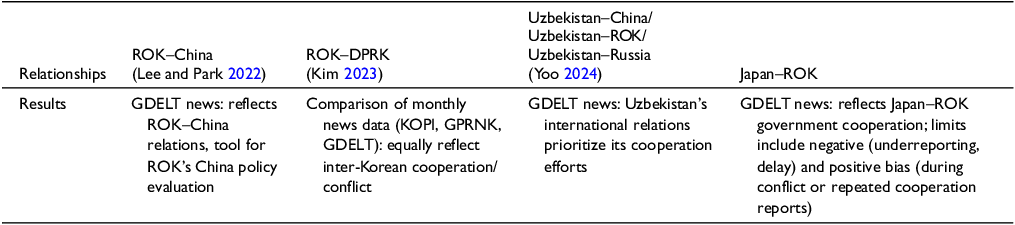
Several studies use news articles from GDELT to analyze Asian international relations, as shown in Table 1. For example, Lee and Park (Reference Lee and Park2022) use news reports from the database to analyze how well they reflect ROK–China relations from 1992 to 2021. The authors show that the news articles adequately reflect the relationship, concluding that the news is a useful tool for analyzing the ROK–China relationship and evaluating constructive South Korean China policies (Lee and Park Reference Lee and Park2022).
Research analyzing GDELT data on Asian international relations

Note: DPRK, Democratic People’s Republic of Korea.
Yoo (Reference Yoo2024) analyzes Uzbekistan’s relations with China, Russia, and the ROK using news reports from GDELT. The analysis reveals that Uzbekistan’s relations with all three countries center around Uzbekistan’s cooperation efforts, such as leader meetings, negotiations, and agreements, which are adequately reflected in news articles. Kim (Reference Kim2023) analyzes how well news reports reflect inter-Korean relations from 1990 to 2021. The author compares monthly event data about inter-Korean relations from news articles from GDELT with two news-based indices for inter-Korean relations. The first index is the Korea Peace Index (KOPI), an index created by JoongAng Ilbo, a major South Korean newspaper, in collaboration with Hanyang University. It contains hand-coded articles from ROK news outlets (Kim Reference Kim2023). The second index is the Index of Geopolitical Risk from North Korea (GPRNK), which is based on South Korean media outlets and was developed by Jung, Lee, and Lee (Reference Jung, Lee and Lee2021). It captures the increasing and decreasing geopolitical risk of North Korea by including events that increase the risk, such as nuclear and missile tests or military confrontations, as well as events that decrease the risk, such as summit meetings and talks. Kim (Reference Kim2023) shows a strong correlation with the monthly data from the KOPI and a strong inverse correlation with the monthly data from the GPRNK. The author concludes that news from GDELT reflects inter-Korean relations as well as the two indices, making news from GDELT a reliable tool for analyzing the relationship.
This article makes several contributions. It is the first study to analyze how well the news reflects Japan–ROK government cooperation. Being one of the few studies to examine interstate cooperation in the news, the analysis contributes to the fields of international relations and communication studies by investigating how government cooperation is reflected in the news. This study contributes to the discussion about theories on agenda-setting and agenda-cutting in the context of Japan–ROK government cooperation. The datasets of news outlets, articles, and article URLs obtained from the GDELT 2.0 Event Database can be used for future studies analyzing Japan–ROK cooperation in the news.
Data
Several public databases collect interstate event data from news articles and assign measurements to the events according to how cooperative or conflictual they are. For example, the GDELT 2.0 Event Database provides nuanced global datasets for interstate interactions such as cooperation. GDELT is a global catalog of events reported in news articles and is updated every 15 minutes. These events are assigned values from the Goldstein Conflict and Cooperation Scale to determine the conflictual or cooperative nature of the event, from −10 for the most conflictual to +10 for the most cooperative events (Goldstein Reference Goldstein1992; The GDELT Project Reference Leetaru2013–Reference Leetaru2022). Reported events are also classified according to over 300 categories of cooperative and conflicting interstate events from the Conflict and Mediation Event Observations Event and Actor Codebook (CAMEO). The CAMEO actor coding system is used to identify actors involved in an event (The GDELT Project Reference Leetaru2013–Reference Leetaru2022; Hopp et al. Reference Hopp2019; Schrodt March Reference Schrodt2012).
The GDELT 2.0 Event Database aims to capture all open news reporting worldwide, including print news as well as TV or radio news transcripts, if available online, excluding social media. GDELT collects articles from over 60,000 global news sources every 15 minutes. The database includes regional, local, and non-Western news outlets (The GDELT Project Reference Leetaru2013–Reference Leetaru2022). GDELT does not provide lists of included news outlets or a distribution of news outlets. An analysis of the mainstream news outlets included in GDELT found that articles from 94.4% of global English-speaking mainstream news outlets are included in the database, with MSN and Reuters as the two top (Hong et al. Reference Hong, Fu, Zhang and Pan2025).
For this study, only cooperative events with Goldstein values from 0.0 to +10 involving the Japanese and the South Korean governments as actors were used. All Goldstein values from classified cooperative CAMEO events reported in news articles in one day were added up to reflect all cooperative events between the Japanese and South Korean governments that day (Schrodt March Reference Schrodt2012: 4–5; Spencer Jamison et al. Reference Spencer Jamison2023: 15).
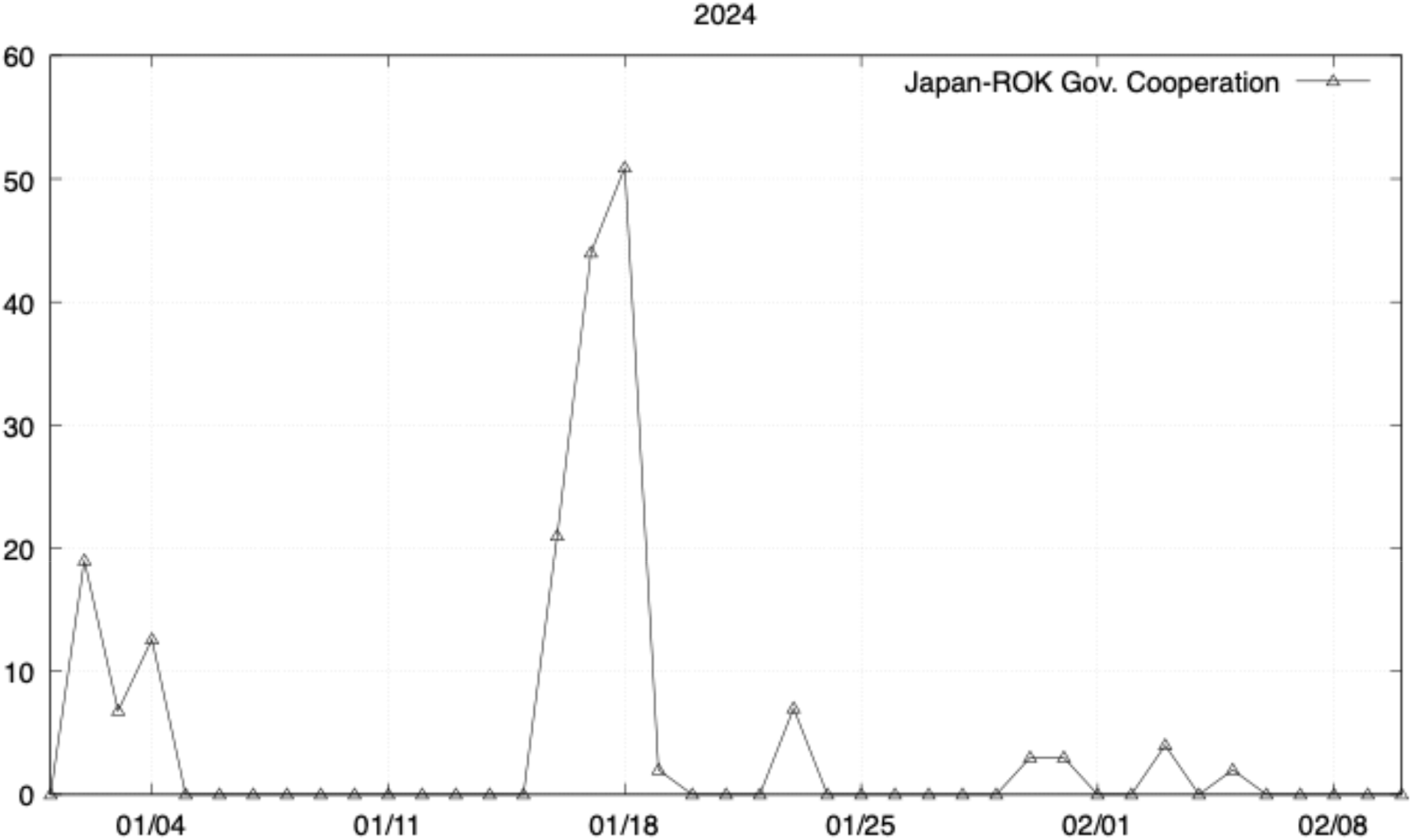
Therefore, the government cooperation data measure daily Japan–ROK government cooperation, with a total of 15,667 references to cooperative events from articles from English-speaking global news outlets from the GDELT 2.0 Database from February 19, 2015, to February 10, 2024. These were the earliest and latest available data points at the time of extracting the data on February 11, 2024. The daily development of the cooperation data is shown in Figures 1–10.
Daily Japan–ROK government cooperation from February 2015 to December 2015.

Daily Japan–ROK government cooperation from January 2016 to December 2016.

Daily Japan–ROK government cooperation from January 2017 to December 2017.

Daily Japan–ROK government cooperation from January 2018 to December 2018.

Daily Japan–ROK government cooperation from January 2019 to December 2019.

Daily Japan–ROK government cooperation from January 2020 to December 2020.

Daily Japan–ROK government cooperation from January 2021 to December 2021.

Daily Japan–ROK government cooperation from January 2022 to December 2022.

Daily Japan–ROK government cooperation from January 2023 to December 2023.

Daily Japan–ROK government cooperation from January 2024 to February 2024.

In total, 15,667 references to cooperative events between the Japanese and the ROK governments in news articles from GDELT were extracted as the original sampling unit and used to create the daily government cooperation data for this study. Of the 15,667 references, 907 were extracted for all days of extraordinarily cooperative events between the two governments, which will be discussed in the next section.
Among the articles extracted from GDELT to create the daily government cooperation data for this study, the top 10 news outlets with most references to cooperative events were The Korea Herald (753 references), The Korea Times (711), the Korean Broadcasting System (KBS) (489), MSN (Microsoft News portal) (378), The Japan Times (361), Yonhap News Agency (332), Yahoo News (317), Nihon Keizai Shinbun (298), The Asahi Shinbun (279), and Japan Broadcasting Corporation (NHK) (246). These top 10 include 3918 references, i.e., 25% of the total 15,667 references. All top 10 outlets are mainstream news outlets, with, respectively, 40% of them based in South Korea (with 2285 references to cooperation) and Japan (1184 references), and 20% in the United States (695 references). The three news outlets with the most references to Japan–ROK government cooperation are Korean news outlets (The Korea Herald, The Korea Times, and KBS) with 1953 references, or 50% of the references of the top 10 outlets.
News editors report selected topics frequently to convince the public of their importance (McCombs and Shaw Reference McCombs and Shaw1972), or engage in agenda-cutting to keep the public unaware of selected topics (Buchmeier Reference Buchmeier, Nai, Grömping and Wirz2025: 1–3). On the basis of these two approaches and the high numbers of references of ROK news outlets among the top 10 outlets, one could conclude that ROK mainstream news outlets tend to promote cooperation more compared with those in the United States or Japan, as they report cooperative events more often.
Of the top 100 news outlets in this study, 73% are mainstream outlets. Representing a majority of 64% of the total 15,667 references, the top 100 include 9950 references to Japan–ROK government cooperation. Among the top 100, 14 outlets are commonly classified as center-left leaning (e.g., The Diplomat, The Asahi Shinbun), 7 as left-leaning (e.g., Rappler, The Guardian), 13 as center-right-leaning (e.g., Today Online, The Dong-A Ilbo), and 16 as right-leaning (e.g., Chosun Ilbo, JoongAng Ilbo). Fifty outlets are classified as center-leaning or of unclear political leaning (e.g., Nihon Keizai Shinbun).
Event databases comparable to GDELT, such as the Conflict and Peace Data Bank (COPDAB), the Correlates of War Project (COW), the Global Event-Data System (GEDS), or the World Event/Interaction Survey Project (WEIS), focus on different time periods before 2015 (Azar Reference Azar1980; The Correlates of War Project 2000–2025; Davies and McDaniel Reference Davies and McDaniel1994; McClelland, Reference McClelland2006). Others have a different focus than government cooperation; for example, the Diffbot Knowledge Graph emphasizes global business interactions, and the Integrated Crisis Early Warning System (ICEWS) monitoring and predicting global crises that require a US response (Tung Reference Tung2025; Lockheed Martin Corporation 2025). ICEWS data are also not publicly available, making GDELT the most appropriate resource to obtain government cooperation data from the news from 2015 to 2024.
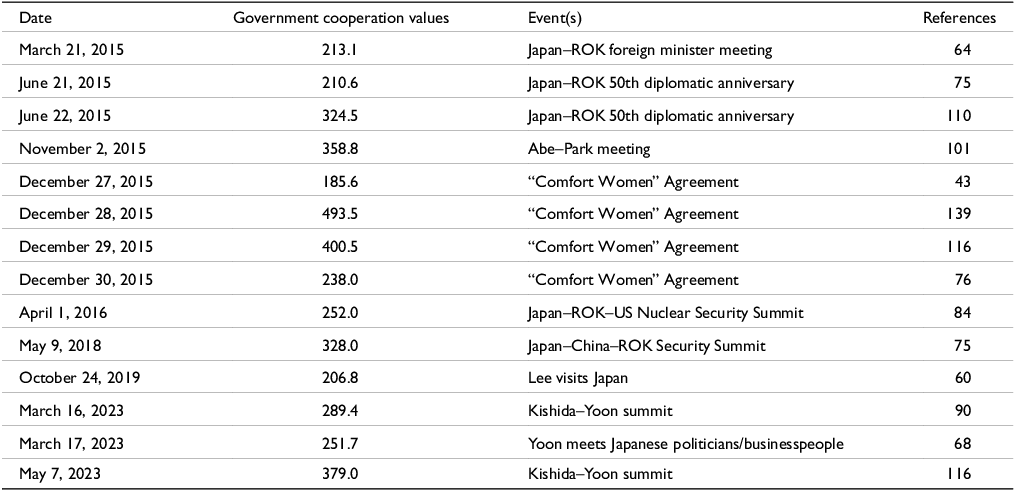
For a cooperative event between the Japanese and the ROK governments in the news articles from GDELT, high values indicate salience in the English-language news on a specific day. A highly salient event leads to a daily cooperation value that is unusually high relative to the rest of the cooperation values. To determine adequate reflection of highly salient cooperative events for this analysis, a percentile-based threshold of above the 99.6th percentile for a daily cooperation value was introduced. Percentile-based thresholds are commonly used for non-normally distributed event data as a non-parametric test (Moore, Notz, and Fligner Reference Moore, Notz and Fligner2012), but such thresholds are absent from international relations or communication studies literature. The threshold of above the 99.6th percentile is based on Biggs (Reference Biggs2016), the only previous sociological study identifying a percentile-based threshold for highly salient large protest events in the news (Biggs Reference Biggs2016: 17). The threshold excludes cooperation that is only moderately high relative to the rest of the cooperation values, e.g., ministerial phone calls, but exposes 11 truly extraordinarily cooperative events, e.g., leader summits or landmark agreements. A total of 1217 references to the 11 cooperative events analyzed in the following section in GDELT articles were extracted on the days of extraordinarily cooperative events, when the cooperation value exceeds the 99.6th percentile threshold. The extraordinarily cooperative events with this threshold are discussed in the following section, marked in Figures 1–10 and shown in Table 2 for events above the threshold with their cooperation values.
Government cooperation values and events above the 99.6th percentile

Source: Data from the GDELT Project (2013–2022).
Japan–ROK government cooperation reflected in the GDELT data
Cooperative events between the Japanese and the ROK governments from 2015 to 2024 include security summits, GSOMIA developments, and symbolic diplomacy. These cooperative events are adequately reflected in the GDELT data, as discussed in this section.
Security summits
The United States, ROK, and Japan held a trilateral Nuclear Security Summit from March 31 to April 2, 2016. They deemed North Korean missile and nuclear tests unacceptable, and agreed to strengthen trilateral cooperation (Ministry of Foreign Affairs of Japan 2016). This important cooperative event is reflected by a global maximum and the highest government cooperation value in 2016 on April 1, 2016, as shown in Figure 2.
On May 9, 2018, the heads of state from Japan, the ROK, and China met in Tokyo for a highly cooperative security summit. They agreed to cooperate for peace and stability in East Asia and North Korean denuclearization (Ministry of Foreign Affairs of Japan 2018). This meeting was the most cooperative event of 2018, as evidenced by a global maximum and the highest government cooperation value in 2018, as shown in Figure 4.
GSOMIA developments
In 2017, South Korea’s leadership changed from Park Geun-hye to Moon Jae-in, leading to a significant change in foreign policy toward Japan. Park’s government had pursued a cooperative approach, signing the Comfort Women Agreement and the GSOMIA. However, Park faced domestic criticism for these agreements, which helped her successor Moon win the presidential election in May 2017. Moon declared the Japan–ROK Comfort Women Agreement invalid in 2017 and threatened to exit the GSOMIA in 2019. Only US recommendations prevented Moon from exiting the GSOMIA. His decision to extend the agreement hours before it expired on November 22, 2019 (Bronza and Podoler Reference Bronza and Podoler2025; Kim Reference Kim2019a) is reflected in the GDELT news. It is marked by two local maxima and the highest government cooperation values in the preceding two months of 2019 on November 22 and 23, as shown in Figure 5.
Four weeks before the GSOMIA extension, ROK Prime Minister Lee visited Japan on October 24, 2019 (Murakami Reference Murakami2019), delivering a personal letter from Moon emphasizing the need for Japan–ROK security cooperation (Kim Reference Kim2019b). With Lee’s visit during tense Japan–ROK relations and Moon’s letter, this day marked the most cooperative point of Japan–ROK government relations in 2019 (Kim Reference Kim2019a), as evidenced by the global maximum in 2019 on that day.
Additionally, articles coded on October 24, 2019, include past cooperative events, e.g., the 2016 GSOMIA signing, or past comments of Moon that he was open to talking with Japan about the semiconductor dispute (Agence France-Presse 2019; Kim Reference Kim2019a). These cooperative events accumulated in the articles, producing a very high cooperation value on October 24, 2019. Therefore, past cooperative events have led to a positive bias and increased the value of the global maximum even further. However, as Lee’s visit was the most cooperative government event in 2019, this does not present an issue.
Yoon Suk-yeol became ROK president on May 10, 2022. Unlike Moon, Yoon adopted a cooperative and forward-looking approach to Japan not focused on different interpretations of history, which were central to the political agenda of Moon’s government. Instead, Yoon described Japan as a partner facing North Korea as a common threat, e.g., in his 2022 National Liberation Day speech. He resumed “shuttle diplomacy,” regular high-level political exchange with Japan (Choi Reference Choi2025).
In contrast to Moon’s reluctant extension of the GSOMIA, Yoon initiated its normalization during a Kishida-Yoon summit on March 16, 2023. Yoon emphasized the need for bilateral information sharing on North Korean missile tests (Choi Reference Choi2025). This summit is marked by a local maximum and the second-highest government cooperation value in 2023 on the day of the summit, as shown in Figure 9. One day after the summit on March 17, Yoon met Japanese high-level politicians, e.g., former Prime Ministers Aso Taro and Suga Yoshihide, and businesspeople (Lee and Lim Reference Lee and Lim2024). Because of these meetings, the cooperation values also show a lower local maximum on March 17, as displayed in Table 2.
Symbolic diplomacy
In 2015, government cooperation between Japan and the ROK was marked by four highly cooperative events of symbolic diplomacy. First, a Japan–ROK foreign minister meeting was held on March 21, 2015. This meeting stands out as highly cooperative, as it was held after a three-year hiatus, and historical differences over Comfort Women were addressed (Kang and Bang Reference Kang and Bang2015b). Therefore, the government cooperation values assume a local maximum and extraordinarily high value in 2015 on March 21, as shown in Figure 1.
Second, Abe and Park attended events to celebrate the 50th anniversary of Japan–ROK diplomatic relations on June 22, 2015 (Kang and Bang Reference Kang and Bang2015a). Therefore, the government cooperation values assumed a local maximum and extraordinarily high value in 2015 on June 22, as shown in Figure 1. Abe and Park attending events to celebrate the diplomatic anniversary was widely reported on June 22, 2015, but also one day before. Therefore, the government cooperation values exceed the 99.6th percentile threshold used to select the events for this study on June 21 and June 22, as shown in Table 2. This reinforces the importance of this event, as the cooperation values reach the threshold when it is reported on both days, with 75 references to the event in articles on June 21 and 110 on June 22, as shown in Table 2.
Third, an Abe–Park meeting was held on November 2, 2015. This significant meeting was their first summit since they had assumed office in 2012 and 2013, respectively (McCurry Reference McCurry2015). A local maximum and high government cooperation value in 2015 marks the event, as Figure 1 shows.
Fourth, Japan–ROK government cooperation reached a historic high in December 2015 with the signing of the Japan–South Korea Comfort Women Agreement, which aimed to permanently resolve the “Comfort Women” debate. This historical cooperative event is adequately reflected in the government cooperation data. A total of 139 references were made to the agreement in the GDELT articles from December 28, the day of signing. Therefore, the cooperation values show a global maximum and the highest cooperation value in 2015 on December 28, the day of the agreement, as shown in Figure 1. As the agreement was widely reported one day before and one and two days after the signing, the government cooperation values not only exceed the 99.6th percentile threshold used to select the events for this study on December 29, 2015, but also on December 27, 29, and 30, as shown in Table 2. This reinforces the importance of this cooperative event, as the cooperation values reached the threshold when it was reported on all four days, with 43 references to the agreement in articles on December 27, 116 references on December 29, and 76 on December 30, as shown in Table 2.
A Kishida–Yoon summit was held on May 7, 2023. As the most cooperative event in 2023, it is reflected as a global maximum in the government cooperation data, as shown in Figure 9. Both sides agreed on closer security and economic cooperation, and Kishida stated his “heart hurts” (Jung Reference Jung2023) when mentioning forced Korean labor during Japan’s occupation of Korea. The exchange during the May 7 visit was highly cooperative, including Kishida’s acknowledgment of Japanese war crimes in South Korea during World War II. This May 7 visit was also well received in both countries. In contrast, the March 16 Kishida–Yoon summit discussed in the previous section had met with strong criticism from the ROK opposition, making this event less cooperative than Kishida’s visit to the ROK on May 7, 2023 (Lee and Lim Reference Lee and Lim2024).
These examples of cooperative events reflected as global and local maxima in the cooperation data between February 2015 and February 2024 show that the news articles reflect the vast majority of cooperative events between the Japanese and the ROK governments. Therefore, Japan–ROK government cooperation, including security summits, GSOMIA developments, and symbolic diplomacy, is adequately reflected in the daily news reports from GDELT.
This analysis confirms the results by Lee and Park (Reference Lee and Park2022), Kim (Reference Kim2023), and Yoo (Reference Yoo2024), finding that GDELT news reports adequately reflect ROK–China relations, inter-Korean relations, and Uzbekistan’s international cooperation, for Japan and the ROK as a new country pair with a focus on government cooperation. Thus, GDELT’s event data provide daily quantitative data for measuring Japan–ROK government cooperation during the analysis period, which could be used to quantify the development of cooperation for statistical analysis.
Investigating the correlation with an independent cooperation index and lag distribution analysis would enhance this article’s claims, but to the best of the author’s knowledge, no comparable independent cooperation index exists that could be used for a meaningful correlation.Footnote 1
To overcome the limitation of the purely qualitative nature of this study, general studies on Japan–ROK cooperation and important events of cooperation were consulted for comparison to determine the reliability of the results. The highly salient events of Japan–ROK government cooperation emphasized by previous studies (Choi Reference Choi2025: 193; Bronza and Podoler Reference Bronza and Podoler2025; Aoki Reference Aoki2021), e.g., the 2015 Comfort Women Agreement, the GSOMIA ratification, Japan–ROK–US trilateral drills, and “shuttle diplomacy,” i.e., foreign minister meetings and Yoon–Kishida summits, align with the global and local maxima in this study.
Limits of the news to reflect Japan–ROK cooperation
The news can fail to adequately reflect Japan–ROK government cooperation, and rare examples of cooperative Japan–ROK events are not reflected as global or local maxima in the GDELT data. This section discusses cooperative events not reflected adequately, and the underlying reasons. Events are not adequately reflected in news articles on the day they occur owing to insufficient references that day, a high number of references a day later, or the news reporting past rather than present cooperation.
This section exposes days during the analysis period when news references to cooperative events were insufficient to reflect the importance of an event. Exemplary articles from GDELT from news outlets on days when cooperative events occurred but were not adequately reflected are cited, along with their specific references to these events. These articles were selected, as the numbers of references and the cooperative events they report are representative examples for days when the GDELT news articles fail to reflect cooperation adequately.
Underreporting
A few cooperative events between the Japanese and the ROK governments were not widely reported in the news, as international interest was lower compared with other Japan–ROK events that occurred days earlier or later. For example, one underreported event consists of a Japan–ROK and a Japan–ROK–US foreign minister meeting in New York on the UN General Assembly sidelines on September 18, 2016. They agreed to strengthen cooperation against North Korea during both meetings and issued a joint statement with this goal after the Japan–ROK–US meeting (Ministry of Foreign Affairs of Japan 2016).
These foreign minister meetings on September 18 were cooperative, as cooperation against North Korea was reaffirmed, but they were not widely reported in the news, as shown by the small number of a total of only five GDELT articles, with a total of 15 references to the meetings on the day they occurred. The meetings are reported in one article by KBS with five references and in one article by the International Business Times with four references (KBS 2016; Kreiter Reference Kreiter2016).
As the meetings were underreported in the news, they were not reflected in the data as a local maximum. Therefore, cooperation data generated from GDELT news articles have a negative bias for the above events. Japan–ROK government relations in 2016 in the news appear less cooperative than they actually were.
These examples of underreported cooperative events suggest a deliberate omission or diminishing of news on Japan–ROK government cooperation. This aligns with agenda-cutting theory, stating that news editors engage in agenda-cutting (Buchmeier Reference Buchmeier, Nai, Grömping and Wirz2025: 1–3) to keep issues off the public agenda and do not promote Japan–ROK government cooperation with their choice of news topics. Another explanation is that the September 18 meetings were less widely reported because they occurred during favorable Japan–ROK relations, making them less newsworthy at the time. This is likely because the September meetings followed the widely reported April 2016 US–ROK–Japan Nuclear Security Summit on North Korea and the August 2016 Japan–China–ROK foreign minister meeting discussed in the section “Security Summits.” This supports Pavelka’s finding that news selection of topics depends on event timing (Pavelka Reference Pavelka2014).
Delayed reporting
News reports of cooperative events between the Japanese and the ROK governments can be delayed, causing global and local maxima in the data after cooperative events. One example of delayed news reports causing a delayed local maximum is a Japan–ROK foreign minister meeting in Hawaii on February 12, 2022, which is clearly a cooperative event. They agreed to increase cooperation against North Korea (Mcavoy Reference McAvoy2022). As shown in Figure 8, the meeting is reflected as a local maximum in February 2022 on February 13, one day after the meeting.
Eight articles in total from GDELT from February 12, 2022, each include one reference to Japan–ROK government cooperation. For example, one article by AP News and one by The Korea Herald each include one reference the foreign minister meeting (Perry Reference Perry2022; The Korea Herald 2022). However, the meeting was widely reported the day after, on February 13, resulting in a local maximum of the cooperation data one day delayed on February 13. In 13 articles from GDELT reporting Japan–ROK cooperation from February 13, there was a total of 37 references to events of Japan–ROK government cooperation. Articles by, e.g., The Korea Times (three references) and NBC4 Washington (two references) among other news outlets, reported the meeting on February 13 (Mcavoy Reference McAvoy2022; The Korea Times 2022).
Another cooperative event with a delayed global maximum is a Japan–ROK–US vice foreign minister meeting on January 5, 2017 (Kang and Cheung Reference Kang and Cheung2017).
Two news articles reporting events of Japan–ROK government cooperation were extracted from GDELT on January 5, 2017. One of them by Yonhap News includes one reference to the vice foreign minister meeting (Yonhap News Agency 2017a). The other article by Beijing Review does not report the meeting, but includes one reference to the 2015 “Comfort Women” Agreement as a past cooperative event (Yongming Reference Yongming2017). With one reference to the vice foreign minister meeting on January 5, one can say that the meeting was not widely reported in the news obtained from GDELT, and therefore not represented in the government cooperation data with a high cooperation value on the day it occurred. However, the meeting produced a global maximum and the highest government cooperation value in 2017 one day after the meeting on January 6, 2017, as Figure 3 shows. On January 6, two articles—one by The Korea Herald and one by Yonhap News—report the vice foreign minister meeting one day after it happened. The Korea Herald article includes five references to the meeting, and the Yonhap News article includes one (The Korea Herald 2017; Yonhap News Agency 2017b). The examples of cooperative events above, being reported in the news a day after they occurred, show the limits of using news articles to generate exact daily cooperation data for accurate measurement of the development of interstate cooperation.
These examples of delayed cooperative events of Japan–ROK government cooperation in the news could result from a deliberate delay of reports on cooperation. This aligns with agenda-cutting theory, which states that news editors keep issues off the public agenda by delaying reports on specific topics. By choosing to delay the reporting of cooperative events, Japan–ROK government cooperation is not highlighted as an important issue; the public remains uninformed and unaware that Japan–ROK government relations are more cooperative than reported in the news. As argued by Buchmeier (Reference Buchmeier, Nai, Grömping and Wirz2025: 4), agenda-cutting can affect political discourse and decision-making (Buchmeier Reference Buchmeier, Nai, Grömping and Wirz2025). Therefore, public perception of the absence of cooperation in Japan and the ROK could have implications for political discourse and foreign political decision-making. This could potentially have negative impacts on Japan–ROK government cooperation, and lead to less cooperation or less public support for cooperation.
Positive bias: Past cooperative events, conflict, and cooperation in one day
The example of the Japan–ROK–US vice foreign minister meeting on January 5, 2017, caused a delayed global maximum on January 6, 2017. However, Japan–ROK government relations on January 6, 2017, were conflictual rather than cooperative. On January 6, South Korea announced plans to install a “Comfort Woman” statue on the disputed Dokdo/Takeshima Islands, Japanese Prime Minister Suga criticized a 2016 “Comfort Woman” statue in Busan, and the ROK foreign minister summoned Japan’s ambassador to discuss the issue (Agence France-Presse [AFP] 2017; Kang and Cheung Reference Kang and Cheung2017). As Japan–ROK relations on January 6, 2017, were conflictual, one would expect the government cooperation value on January 6, 2017, not to assume a very high value and global maximum. Most cooperative Japan–ROK government events are reflected as local and global maxima in the government cooperation data on the day they happen. However, rare events such as the January 5 ministerial meeting are referenced more in the news the following day. This delayed reporting reveals general problems with using the news as a source for exact daily development of interstate cooperation.
Additionally, a positive bias in the government cooperation data can arise from cooperative and conflictual events that occur and are reported in one day, or from news reports including past cooperative events alongside conflictual events. For example, articles from January 6, 2017, report the ministerial meeting on January 5, 2017; the 2015 Comfort Women Agreement; and cooperative comments by Japanese Prime Minister Suga about the importance of South Korea as a neighbor or the state of Japan–ROK relations being regrettable.
In all, 65 references to events of Japan–ROK government cooperation were made in 30 articles from GDELT that report Japan–ROK cooperation on January 6, 2017. Six of the references to cooperative Japan–ROK events were made by one article in The Korea Herald (five references) and Yonhap News (one reference) to the Japan–ROK vice foreign minister meeting held on January 5, 2017. A total of 34 references on January 6 were made to the 2015 “Comfort Women” Agreement in articles by, e.g., CNN (3 references) and Korea JoongAng Daily (1 reference) (Korea JoongAng Daily 2017; Luu Reference Luu2017). On January 6, 25 references were made to cooperative comments by Suga in, e.g., one article by the Daily Mail (3 references) and one by France 24 (2 references) (AFP 2017; News Wires 2017).
These cooperative events, the 2015 Comfort Women Agreement and Suga’s comments, accumulated in the articles and produced a very high cooperation value on January 6, 2017, despite the fact that the debate over “Comfort Women” flared up on that day, and relations were conflictual (AFP 2017; News Wires 2017).
Another example of cooperation and conflict in one day causing a positive bias of the cooperation data was the summoning of the Japanese ambassador by the ROK foreign minister because of differences over Japanese coronavirus disease (COVID) measures on March 6, 2020. (Lee and Oba Reference Lee and Oba2020). The summoning of the ambassador is not a cooperative event, but on the same day, he confirmed he would forward the foreign minister’s message to Japan and attempted to mitigate the differences by publicly expressing regret (Kyodo News Mar 6 2020). Forwarding a message and expressing regret are cooperative events reported in the GDELT news. Expressing regret is classified as a positive event according to the CAMEO event types used to generate the cooperation data for GDELT.Footnote 2
On March 6, 2020, 14 articles from GDELT reported Japan–ROK cooperation, with a total of 24 references to cooperative events. A total of 15 references were to the Japanese ambassador’s statement forwarding the ROK foreign minister’s message, e.g., an article by The Korea Herald includes two references to the statement (Sung-mi Reference Sung-mi2020). Nine references were to the ambassador expressing regret, e.g., an article from Kyodo News includes one reference (Kyodo News 2020). These references were coded as cooperative events, causing a high cooperation value despite Japan–ROK relations being conflictual that day, with the ROK summoning the ambassador over COVID measures. As shown in Figure 6, the ambassador’s statement and expression of regret on the day of the summoning marked a local maximum and the third-highest government cooperation value in 2020 on March 6.
In January 2021, Japan–South Korea relations again experienced cooperation and conflict, with news articles on January 8, 2021, that combined conflicting and cooperative Japan–ROK government relations in one day. On January 8, 2021, the debate over war reparations flared up, with a Seoul Central District Court’s ruling that the Japanese government should pay reparations for Korean forced labor during World War II. The same day, Japan’s foreign ministry summoned the South Korean ambassador to Japan to discuss the issue (Kyodo News 2021). This summoning of the ambassador and the court ruling on January 8, 2021, were not cooperative events, but they were accompanied by several cooperative events reported in the news on this day. Therefore, the government cooperation values have a clear positive bias with a global maximum on January 8, 2021. The reason for this global maximum is that the news articles from January 8 that report the court ruling also report cooperative events occurring on that day, i.e., the ROK ambassador’s mitigation attempts. The ambassador stated the intention to do everything possible to avoid negative effects on Japan–ROK relations from differences over the ruling and by calling for calm responses to the issue. In total, 16 articles from GDELT from January 8, 2021, include 29 references in total to Japan–ROK government cooperation, although Japan–ROK relations were conflictual and cooperative on that day given the differences over the court ruling and the ROK ambassador’s mitigation attempts. Of the 29 references, 15 are made to the ambassador’s mitigation attempts in articles by, e.g., Al Jazeera (2 references) and Kyodo News (1 reference) (Al Jazeera 2021; Kyodo News 2021). A total of 14 references are made to an important past cooperative event, the 2015 “Comfort Women” Agreement, in articles by, e.g., the National Post (1 reference) and National Public Radio (NPR) (1 reference) (Nuyen Reference Nuyen2021; Shin Reference Shin2021).
All cooperative events reported on January 8, 2021, the ambassador’s mitigation attempts and the 2015 “Comfort Women” Agreement, were coded as positive events, which led to a very high government cooperation value and a global maximum in 2021, as shown in Figure 7. These examples demonstrate the limits of using news articles to measure government cooperation when there is conflict and cooperation on the same day, or when cooperation is reported alongside past cooperation.
The examples above show that present Japan–ROK cooperation can be reported alongside past cooperation during Japan–ROK conflict and cause a positive bias in the news when relations are conflictual. This suggests that past cooperative events are repeatedly reported alongside present cooperation to promote cooperation during conflict, which aligns with agenda-setting theory. Therefore, this analysis confirms McCombs and Shaw (Reference McCombs and Shaw1972) and McCombs (Reference McCombs2004) in that news topics are selected and repeatedly reported to influence public perceptions, as events reported more often have a stronger influence on public perceptions, and are deemed as more important. All the above challenges reveal negative and positive biases in the cooperation data. Therefore, when using GDELT news as a measurement of daily cooperation for quantitative studies, these biased data may lead to biased estimations and incorrect conclusions.
Conclusion
This paper has explored the question of how well news articles can reflect interstate cooperation, using Japan–ROK government cooperation from 2015 to 2024 as an example. The analysis revealed that news articles, which were obtained from the GDELT 2.0 Event Database, adequately reflect the vast majority of extraordinarily cooperative events between the Japanese and the South Korean governments as global and local maxima on the day of the events.
For example, the 2015 Comfort Women Agreement or the March 2023 Kishida–Yoon summit presented the most cooperative event between the Japanese and the ROK governments in the respective years. These events are accurately represented in news articles with a global maximum of the cooperation data for the year when they occurred. The examples above and many others discussed in this study show how cooperative events are reflected adequately in news articles. Therefore, the results in this study confirm Lee and Park (Reference Lee and Park2022), Kim (Reference Kim2023), and Yoo (Reference Yoo2024) in that Asian international cooperation is adequately reflected in news reports from GDELT. This analysis has shown that news reports are a useful tool for measuring cooperation, extending the discussion to Japan and the ROK as a new country pair not covered by previous research, and with a specific focus on government cooperation rather than the overall relationship.
Nonetheless, the analysis has found occasional counterexamples showing the limits of news articles to reflect JapanSouth Korea government cooperation. For instance, the Japan–ROK debate over war reparations flared up with a Seoul Central District Court’s ruling on January 8, 2021. The court ruling that Japanese companies should pay war reparations for South Korean forced labor in World War II caused conflictual relations between the Japanese and the South Korean governments on the day of the ruling. However, the cooperation data show a global maximum on January 8, 2021, even though the ruling on this day was not a cooperative event. The reason for this global maximum is that news articles from the same day include cooperative events that occurred on January 8, 2021, and past cooperative events, which were reported on the day.
These rare counterexamples demonstrate general challenges of using news articles to generate event data to reflect international cooperation. The challenges revealed in this analysis are threefold: cooperative events can be (1) underreported, (2) delayed, and (3) reported on the same day as past cooperative events, as well as conflictual events that occur and are reported on that day. These three challenges are not limited to Japan–ROK government cooperation, but present general issues of using news articles to generate event data to measure cooperation. Challenge 1 causes a negative bias for the cooperation data, which makes Japan–ROK government relations appear less cooperative than they are. For challenge 2, delayed reporting of cooperative events causes delayed maxima in the cooperation data, which affects the nuanced measurement of daily cooperation negatively. Challenge 3 causes a positive bias for interstate cooperation, making relations appear more cooperative than they actually are.
The results of this study open up several directions for future research. The challenges that revealed negative and positive biases in the cooperation data raise the question of how the news with its biases can be better operationalized to reflect international cooperation in a more precise way. The implications of underreporting, delayed reporting, and repeatedly reporting cooperation for political discourse and foreign political decision-making would be an interesting subject for future studies.
Statistical analysis in addition to this article’s qualitative matching process of highly cooperative events with Japan–ROK cooperation data provides opportunities for future research. One possibility would be a correlation of Japan–ROK cooperation data with an independent cooperation index, e.g., through lag distribution analysis. Developing such an independent cooperation index suggests great potential for future studies on interstate cooperation.
As this study is limited to cooperation, Japan–ROK conflict in the news is beyond the scope of the analysis. Analyzing how well the news reflects Japan–ROK conflict provides an interesting direction for future research. One of the outcomes of this study, i.e., a positive bias caused by cooperation reported alongside past cooperation and during conflict, can be expected to apply if the same study is conducted using conflictual GDELT data. Present Japan–ROK conflicts and conflicts during cooperation are likely to be reported alongside past conflicts, causing a negative bias, making relations appear more conflictual than they actually are. One can expect this negative bias to be stronger for conflict data, as news tends to report conflict more than cooperation (Jönsson and Karlsson Reference Jönsson and Karlsson2020; Wolfsfeld Reference Wolfsfeld2004).
Given that this study is limited to global English-speaking news sources, the results exclude news sources in other languages. Future studies could investigate how well non-English news sources reflect Japan–ROK cooperation, e.g., by using GDELT news that have been machine-translated with the GDELT Translingual infrastructure (The GDELT Project Reference Leetaru2013–Reference Leetaru2022).
The news outlets in the dataset extracted for this study from GDELT show a strong bias toward mainstream outlets (73% of the top 100 are mainstream outlets) and toward right-leaning outlets (with 16% right-leaning, 7% left-leaning, and 77% centrist or without clear political leaning among the top 100), which presents a limit of this study. Future studies could include more alternative and left-leaning outlets, or explore a geographical focus that includes more outlets beyond news outlets from the ROK, Japan, and the United States.
This study has found that, among the news outlets reporting Japan–ROK government cooperation, the top three with the highest number of references are all ROK mainstream news outlets (The Korea Herald, The Korea Times, and KBS). Of the top 10 outlets, 40% are ROK–based mainstream news outlets, suggesting ROK mainstream news outlets report cooperative events more frequently during the analysis period compared with mainstream news outlets from other countries.
While not investigating how specific outlets report or promote cooperation is a limit of this study, the datasets of news outlets and articles obtained from the GDELT database can be used for future studies investigating how well specific news outlets reflect Japan–ROK cooperation, e.g., Japanese or ROK news outlets, mainstream or alternative news, or news with different political leanings.
Financial support
Not applicable.
Competing interests
The author reports there are no competing interests to declare.
Author Biography
Franziska Schultz is an Assistant Professor of Political Science at Bowling Green State University. She holds a PhD in Japanese Studies from the Department of Japanese Studies at Eberhard Karls Universität Tübingen (University of Tuebingen). Her dissertation “Economic Effects of Political Shocks to Sino-Japanese Relations (2005–2014)” is published within the Springer series “East Asia in the Twenty-first Century”. Franziska Schultz has conducted research in Japan for seven years on a scholarship from the German Institute for Japanese Studies (DIJ), as a Lecturer at Rikkyo University, Tokyo, and as an Adjunct Professor of Political Science at Temple University, Japan Campus.



 Open access

