


10.1 Introduction
The EU’s Audiovisual Media Services Directive (AVMSD) has been the main piece of EU media law for decades.Footnote 1 Since its beginnings as the Television without Frontiers Directive (TWFD),Footnote 2 the Directive has eliminated barriers to free trade in audiovisual media services, mixing this market liberalisation with industrial policy and a dose of cultural protectionism.Footnote 3 When the AVMSD was revised in 2018,Footnote 4 its scope was changed to reflect the fact that audiovisual media services were no longer the only ones delivering audiovisual content. By the end of 2022, the body of EU media law had expanded considerably in response to the well-documented spread of services that disseminate content and compete in the same attention markets as broadcasters and publishers.Footnote 5 The Terrorist Content Online Regulation (TERREG) was adopted in 2021 and the wide-reaching Digital Services Act (DSA) followed in October 2022.Footnote 6 The European Media Freedom Act (EMFA) was adopted in April 2024.Footnote 7
The DSA is horizontal law that aims to ensure ‘a safe, predictable and trustworthy online environment’ for the exercise of fundamental rights.Footnote 8 All hosting services that disseminate content are within the scope of the DSA, including intermediary services and online platforms such as social media and those for disseminating user-generated content. It contains due diligence provisions for very large online platforms and search engines. Though the DSA does not institute a duty of care per se, it does take a risk management approach of the kind called for by Woods and Perrin and by Ullrich.Footnote 9 Very large online platforms and search engines are required to assess the systemic risk of the dissemination of illegal content and ‘negative effects’ in three broad areas. These areas include not only ones in which the negative effects, or harm, might be directly experienced by individual users, such as to their exercise of fundamental rights or personal well-being, but also ones in which there are risks of negative effects on collective or societal functions, such as electoral processes, media freedom and pluralism, or public health. Several of the expected mitigation measures mirror those in the AVMSD.
The EMFA’s purpose stems from the recognition that media freedom and pluralism are not only ‘two of the main pillars of democracy and of the rule of law’ but also essential to a well-functioning internal market.Footnote 10 It aims to correct three ‘market failures’, the first of which is a basket of negative consequences from the gatekeeping role of online platforms. The second is variation in the level of independence afforded to Member State media and regulatory authorities. The third market failure addressed by the EMFA is the disruption of the media services market by bad-actor media services engaged in disinformation and manipulation.Footnote 11
Is this direction of travel merely keeping pace with the new affordances and functionality of different types of media or does it mark a shift in the foundations of media law? It was the public interest in media production, both cultural and economic, and the positive obligations on states inherent in the right to freedom of expression that underpinned the AVMSD,Footnote 12 as well as the EU’s approach to public service media and its creative industry support programme, Creative Europe. Harm and risk may be more essential to the new modus operandi, but as this chapter demonstrates, the concept of harm (and protection from it) is not completely new in EU media law.
This chapter traces the evolution of understandings of harm and its prevention in EU media law since 1989 in order to inform future thinking on EU media law. It provides answers to two questions: what are the understandings and assumptions of harm behind existing EU media laws, and how do they construct responsibility for risk mitigation? It presents the findings from an analysis of the final adopted texts of the 1989 TWFD and the Directives amending it in 2007, 2010, and 2018, the 2021 TERREG, the 2022 DSA, and the 2024 EMFA,Footnote 13 as well as the explanatory memoranda that accompanied the initial proposals for each. A two-part computer-assisted qualitative analysis was conducted.Footnote 14 The first looked at the ways ‘harm’ and synonyms for it, as well as words associated with protection or prevention, were used. The second applied a three-part framework drawn from the policy literature on audiovisual media and online platforms. This included the push/pull distinction among types of media, individual and societal policy aims, and sources of harm.
This chapter is organised around these three themes, with a short note on EU competence in this area beforehand and a discussion of the implications of the findings following. This chapter shows that the distinction between push media and pull media has remained relevant and crucial for the distribution of responsibility for harm prevention, with understandings of what constitutes pushing expanded to include the nature of algorithmically controlled platform systems. It then identifies a gradual move from law aimed at preventing harm to individual consumers to law designed also to prevent harm to society as a collective and to its systems. This chapter provides evidence of an expansion of the understanding of sources of harm that has implications for the type and distribution of responsibility for prevention. In conclusion, it argues that due to the evident shifts in EU media law in the understandings of harm and the distribution of responsibility for preventing harm, the next priorities for EU law should be ensuring that the institutional architecture can effectively enable governance through cooperative responsibility and addressing informational asymmetries among those who should contribute.
10.2 The Boundaries of EU Competences
The shape of EU media law is significantly determined by the fact that the EU has limited competences in the area of media and culture. The media law that exists is linked to the management of the single market. The establishment of broadcasting as an economic activity, rather than a cultural institution, by the Court of Justice of the European Union (CJEU) in 1974 laid the foundation for EEC- and then EU-level policy in this space.Footnote 15 The role of EU law in this area has always been relegated to addressing what is needed for the healthy functioning of media markets. However, this has arguably been stretched to include cultural policy and industrial policy in the media and cultural sectors.Footnote 16 This is evidenced in the unique blend of industrial and cultural policy that is the AVMSD. It also comes to the fore in other interventions such as the Amsterdam Protocol and subsequent communications on state aid in public service broadcasting, as well as in the significant investment into the Creative Europe Programme and its predecessors.Footnote 17
The EU does have clear competences in consumer protection, a feature that has been explicitly in place since the Maastricht Treaty.Footnote 18 It has a treaty-level obligation to ‘promote the interests of consumers and to ensure a high level of consumer protection’Footnote 19 and to take consumer protection into account when developing policy in other areas. This is reflected in EU media law. In concert with the Unfair Commercial Practices Directive,Footnote 20 for example, the AVMSD contains specific rules on commercial communication to protect individual consumers from the advertising of controlled substances, discriminatory commercial communication, and affronts to dignity. It also contains rules to protect minors, who are characterised as vulnerable consumers. The DSA was in large part a response to EU lawmakers’ call for digital services regulation that had consumer protection at its core.Footnote 21 The DSA’s Article 1 aim statement hinges the ‘proper functioning of the internal market’Footnote 22 on effective protection of fundamental rights, highlighting only consumer protection among all those contained in the Charter of Fundamental Rights of the European Union (the Charter).Footnote 23 A foremost purpose of the EMFA is also ensuring the functioning of the EU’s media market. Its recitals present problems of platform gatekeeping, media capture, editorial interference, and misuse of state advertising primarily as posing risks to the fair functioning of the market and the rights of media services to do business, while acknowledging the public interest concerns arising from media’s role in democratic discourse, public participation, and culture.
In summary, the basis for EU media law is primarily in its competences for market regulation, which includes consumer protection and the obligations to respect and protect citizens’ ability to exercise their fundamental rights as set out in the Charter and the Treaty on the Functioning of the European Union. There also has been a history of stretching this to what could be considered cultural policy or at least industrial policy towards the media and cultural industries, and as will be elaborated in what follows, recognition of wider public interests such as media pluralism and linguistic and cultural diversity.
10.3 The Evolving Distinction between Push Media and Pull Media
As it broke down the barriers to cross-border television broadcasting and attempted to create a Europe-wide market for audiovisual production and distribution, the TWFD set out minimum standards aimed at protecting audiences, especially minors. These mirrored standards that were already in place in many jurisdictions and were intended to prevent harm: to minors from exposure to certain content, and to the general public from certain types of advertising. They were rooted in the understanding that television, or linear audiovisual media, was a ‘push’ form of media, one that once switched on offered audience members no control other than the changing of channels.Footnote 24 This made the advertising difficult to avoid and arguably made the content more compelling or, in the case of advertising, more convincing.
Though the word ‘harm’ was not used in the 1989 Directive, it required that television advertising should not cause ‘moral or physical detriment to minors’. The assumption that minors were particularly vulnerable to manipulation from advertising is clear in the text, which refers to their ‘inexperience and credulity’ and the potential for abusing the trust they place in adults around them.Footnote 25 Member States were also required to ensure that all broadcasts do not include ‘programmes which might seriously impair the physical, mental or moral development of minors, in particular those that involve pornography or gratuitous violence’ or incitement to hatred.Footnote 26 Adult viewers/consumers were also protected by bans on advertising that might ‘prejudice respect for human dignity’ or encourage behaviour ‘prejudicial’ to health and safety and to the environment.Footnote 27 Compliance with these outright bans fell under the editorial responsibility of the broadcaster and was to be enforced by the national regulatory authority.
When video-on-demand services were added to the scope of the Directive in 2007, it was acknowledged that such technologies, which were new at the time, ‘give users increased choice and responsibility in their use of audiovisual media services’.Footnote 28 In the later consolidated version an understanding that the push medium of television had a greater impact on society was also explicitly mentioned.Footnote 29 The recital linked this assumption to the CJEU’s decision in the case of Mediakabel BV v Commissariaat voor de Media,Footnote 30 which highlighted the simultaneous transmission to a mass audience inherent in linear television.
The two-tiered approach required stricter rules and regulation of linear services and a light-touch regime for on-demand or ‘pull’ services, reflecting assumptions about control and risk.Footnote 31 Herold explained the logic of the Commission at the time, writing, ‘the rules imposed on broadcasting (push) service remain tougher than those we proposed for non-linear (pull) services. The differing degrees of regulation of content “pushed” by suppliers or “pulled” by users reflects differences in user choice and control and in the likely impact of media services on society.’Footnote 32 Already the two-tiered approach based on the push/pull distinction had changed the distribution of responsibility for preventing harm from content.
Though on-demand services were assumed to bear editorial responsibility for preventing harm, some of the responsibility for preventing exposure to harmful content was shared with the viewer. Since 2007, Member States have been required to ensure that on-demand services that might impair or harm minors are normally not able to be accessed by minors and to comply with the qualitative consumer protection standards for commercial communication and hate speech.Footnote 33 Measures expected to be taken by service providers include encoding, filtering, and labelling. The collection of potential measures includes ones that inhibit access at a technical level and ones that give viewers the information and tools needed to exercise control over the content to which they may be exposed.Footnote 34
As Napoli has argued,Footnote 35 the push/pull distinction has been blurred with the development of online social media because the algorithmic feed functionality of many such platforms means they are as much ‘lean back and consume’ media as television used to be. The 2018 revision of the AVMSD that brought video-sharing platforms (VSPs) into scope appears not to have quite recognised this. It added a third tier to the Directive, one that requires Member States to hold VSPs responsible for taking ‘appropriate measures’ to protect minors from harmful content and the general public from content that is illegal or contains incitement to hatred or violence. It suggests a list of measures that rely heavily on the role of the user in preventing harm,Footnote 36 and that is closer to the expectations for on-demand services than to those for linear television.
In the 2018 revision there does seem to have been recognition of the push nature of the placing of advertising around and in VSP content. Member States must ensure that VSP providers guarantee that all commercial communication they carry complies with the same qualitative rules applicable to commercial communication on audiovisual media services.Footnote 37 There is also apparent acknowledgement of the uniquely invasive nature of targeted advertising that is possible on VSPs. It essentially prohibits VSPs from delivering such advertising to minors by prohibiting the use of their data for such purpose.Footnote 38
The classic push/pull distinction is not evident in the TERREG or the DSA; however, in neither law are the online services in scope treated solely as on-demand services. Drafted after high-profile attacks in which terrorists essentially broadcast using livestream, the TERREG clearly addresses the time sensitivity of removing terrorist content online because of the real-time harm that can be caused by its creation and consumption, in addition to the slower process of radicalisation.Footnote 39 The DSA seems to acknowledge a new kind of pushiness in the way it addresses recommender systems and targeted advertising.
The DSA raises particular concerns with the recommender systems of very large online platforms that have very wide reach, stating: ‘Such recommender systems can have a significant impact on the ability of recipients to retrieve and interact with information online … They also play an important role in the amplification of certain messages, the viral dissemination of information and the stimulation of online behaviour.’Footnote 40
Consequently, the DSA requires transparency, in a form accessible to the consumer, about the parameters given to the algorithms determining their recommendations. This means that consumers should be able to get clear explanations for what they are seeing in feeds, results, or suggestions from the platforms. Arguably the most radical step in the DSA is that very large services are required to conduct assessments of the systemic risk of negative effects from their services in four areas of societal harm that take into account the way their algorithmic systems may contribute to those risks.Footnote 41 The DSA also recognises the ‘serious negative effects’ and amplification of ‘societal harms’ that can arise from targeted advertising that is ‘optimised to match [users’] interests and potentially appeal to their vulnerabilities’.Footnote 42 It reinforces and takes further the steps taken in the AVMSD’s VSP provisions to protect minors from targeted advertising and introduces protections for all consumers by banning profiling and targeting based on the special categories of data set out in Article 9 of the General Data Protection Regulation (GDPR) such as race, religion, sexual orientation, and health.Footnote 43
The push/pull distinction remains evident in EU media law. Push media are still considered to pose the greater risk of harm and, therefore, to be where service providers carry the most responsibility for preventing that harm. At the heart of this distinction remain the differences in the amount of control a consumer has over the content to which they are exposed, and the level of vulnerability of the consumer. When VSPs were brought into the scope of EU media law, the active user was given an even greater role due to the fact that VSPs disseminate user-generated content over which platforms have no editorial responsibility,Footnote 44 but at the same time there was some acknowledgement that VSPs were not entirely pull media and therefore also bore responsibility. With the DSA, we can see a notable expansion of the understanding of what it means to be a push medium. Policymakers seem to have grasped that, as Helberger and colleagues have argued, ‘these contemporary digital choice architectures essentially offer an infrastructure to automate the continuous search for exploitable consumer vulnerabilities’.Footnote 45 The DSA treats the algorithmically curated feeds, search results, and recommendations, as well as the advertising around them, as pushed and the responsibility for preventing harm from them as commensurate.
10.4 From Protecting Individuals to Preventing Harm to Society and Societal Systems
Examination of the EU media laws and their explanatory notes has also revealed a gradual move from addressing potential harm to individual consumers to covering both individual and collective, or societal, harm. This seems to go hand in hand with an apparent shift from an approach based on public interest objectives, which was underpinned by the positive obligations on states stemming from fundamental rights, to a risk management approach underpinned by procedural accountability for preventing harm both to individuals and society.
The TWFD contained some minimum standards aimed at protecting individual consumers, particularly in relation to advertising.Footnote 46 These consumers were minors who might be exposed to content, those who needed to use the right of reply it guaranteed, or each viewer who might encounter incitement content or affronts to their dignity. The only evidence of provisions that seemed aimed at preventing harm on a societal level were those banning advertising that is prejudicial to health, to safety, or to the protection of the environment, which were carried through to the 2018 rules on commercial communication.Footnote 47 However, these provisions do not mention ‘public health’ or ‘public safety’ in a collective sense.
In the 2007 revision of the TWFD into the AVMSD, protection of minors and consumer protection were listed among other public interests that were collective, namely cultural diversity, right to information (which was linked to democracy), media pluralism, and general public awareness and literacy.Footnote 48 These public interest aims were reflected in positive obligations such as European works quotas, the rules on the use of short extracts, and attention to media literacy. These represent a positive rights perspective on freedom of expressionFootnote 49 and on cultural and linguistic diversity.Footnote 50 Collective concerns such as threats to public safety, public health, and national security were matters for Member States and listed as potential reasons for derogations.Footnote 51 There are frequent mentions of the ‘public’ or the ‘general public’ in the texts related to the 2007 revision and the 2010 consolidation. These terms were used to refer to the group of individual viewers and citizens, who needed protection from certain content and the ability to see important events, and who were targeted by audiovisual media services.
It is in the texts surrounding the 2018 AVMSD revision where there is evidence of a slight move in the direction of considering harm at a more societal level and establishing measures to prevent that harm. In the revising Directive, transparency of media ownership is presented as a means of ‘protecting’ freedom of expression, which it refers to as the ‘cornerstone of democratic systems’.Footnote 52 Also, for the first time, the rules on commercial communication are framed as protecting ‘consumers or public health’, which implies the aim of preventing harm to the health of individuals as well as protection for the wider societal system that deals with their health.Footnote 53 This was in reference to the expanded provisions related to the advertising of unhealthy food and beverages and of alcohol.
The TERREG was proposed because of the ‘grave security risks this content entails for society at large’.Footnote 54 Examination of the proposing documents and the final text show that a direct link is clearly made between the exposure of individuals to content and negative effects on the rest of society, such as ‘fear in the general public’, trust in services, and even the actual execution of atrocities. Because the mechanism of incitement can lead to physical violence, TERREG also aims to prevent immanent threat or harm ‘to the life or the physical integrity of a person’.Footnote 55
From the start, the DSA was about both individual consumers and societal or collective concerns, and a link between harm to individuals and consequences to wider society is evident in the DSA. As the explanatory memorandum sets out in the rationales, ‘the use of those services has also become the source of new risks and challenges, both for society as a whole and individuals using such services’.Footnote 56 Where the DSA most clearly addresses harm at a societal level is in its requirements that very large online platforms and search engines undertake systemic risk assessments. These very large services are singled out for additional obligations because of their role in ‘shaping public opinion and discourse, as well as online trade’ and because their advertising-driven design ‘can cause societal concern’.Footnote 57
The DSA requires these large services to assesses and mitigate the risk they pose in four risk areas. These include risk from the dissemination of illegal content; risk from ‘actual or foreseeable negative effects’ on fundamental rights; risk from negative impacts on civic discourse, electoral processes, and public security; and risk in relation to gender-based violence, to minors, or to public and individual health.Footnote 58 The elaboration of fundamental rights highlights individuals’ rights to dignity, privacy, freedom of expression, and consumer protection; the rights of the child; and collective manifestations of the positive obligations stemming from those rights, namely media freedom and pluralism and non-discrimination. The risk that the DSA requires very large platforms to manage is conceived as systemic due to both the number of individuals users that could be harmed and the potential for negative effects on societal systems well beyond the individual users of the services.Footnote 59
The EMFA is the first EU law to directly address the issue of media pluralism and independence. It is intended to mitigate risks to the proper functioning of the internal media market from interferences in the work of journalists, barriers to media services’ ability to do business, and unlevel playing fields. Nevertheless, it also makes an explicit link between the functioning of the media market and the societal role of the media in enabling democratic discourse and public participation, as well as cultural expression.Footnote 60 The positive obligation on states to guarantee effective pluralism and the specific role of news in shaping public opinion with ‘direct impact on democratic participation and societal well-being’Footnote 61 are both invoked as rationales for the Act.
Though earlier EU media law did not ignore societal concerns, these were noted as broad issues of public interest that were primarily the business of Member States. Protections from harm were afforded to individual consumers, especially vulnerable minors. Societal concerns such as media pluralism and cultural and linguistic diversity were addressed through positive or enabling interventions in the market, such as European and independent production quotas. This is notably different from the more recent laws. The DSA explicitly aims to prevent harm to societal systems, including media pluralism, electoral processes, and public security, and the EMFA aims to prevent harm to media industries because of the societal role of media. There is evidence in the 2018 revision of the AVMSD and in TERREG that the turn towards consideration of societal-level harm has not been abrupt. Both link individuals’ exposure to content to potential negative effects on wider society, the former in relation to public health and the later in relation to both public attitudes and public security.
10.5 Sources of Harm: Content, Behaviour, and Design
Fundamental to understandings of harm are assumptions about where it is likely to come from. Common across all the laws examined here is the assumption that harm to consumers can come from exposure to content due to the nature of that content (e.g. pornographic, containing incitement to violence or hatred, terrorist provocation, or marketing of alcohol products). In the more recent laws, additional sources of harm are also addressed, namely user behaviour and service design, and a kind of pollution effect from harmful content beyond those directly exposed seems to be acknowledged.
From the start, the TWFD established rules banning ‘programmes which might seriously impair the physical, mental or moral development of minors’ and required Member States to place restrictions on programmes that are ‘likely to impair’.Footnote 62 These rules remain in place for audiovisual media services as of the time of writing, having been expanded to on-demand services in 2007 and maintained in the 2018 AVMSD.Footnote 63 Bans on content that contains incitement to hatred appear in the TWFD and the AVMSD, with the provision expanded in 2018 to incitement to violence and provocation to commit terrorism.Footnote 64 Even the provisions on VSPs introduced in 2018 focused on content, requiring protection from harmful programmes, user-generated video, and commercial communication.Footnote 65 The TERREG explicitly addresses terrorist content, defining it as content that incites the commission of terrorist offences, solicits a person or group to commit or contribute to terrorism, provides instructions for terrorist acts, or amounts to threat.Footnote 66
The expansion of scope to include VSPs in 2018 introduced a new kind of responsibility for content, and therefore for prevention of harm from that content. VSPs are defined as not having editorial responsibility but deriving an organisational responsibility from their management of the programmes, user-generated videos, and audiovisual commercial communications that are disseminated through their services.Footnote 67 The distinction between content providers with editorial responsibility and hosting services, such as VSPs, is evident also in the TERREG.Footnote 68
As EU media law has been expanded to cover not only services with editorial control and responsibility but also hosting services, such as online platforms, the expectations on services have come to include measures that draw the user into sharing responsibility for mitigating the risk of exposure to such content.Footnote 69 Measures such as tools for classifying the content they upload or reporting the content they see involve users in protecting each other from harm. There is evidence of a new source of harm being acknowledged for which users bear responsibility. As Nash has pointed out, when it comes to online content platforms, it is often the users who create the harm.Footnote 70 Users may create harmful content, attempt to manipulate others through the dissemination of content, or harm others through their behaviour. Harmful user behaviour can range from the undisclosed promotion of products to the harassment and bullying of individuals, or the grooming of young people for terrorism or sexual exploitation. The TERREG and the DSA establish a kind of supervisory responsibility for policing user behaviour and preventing ‘misuse’ of their services.
The explanatory note to the TERREG proposal refers several times to the ‘misuse of the internet’ or the ‘misuse of hosting services’, highlighting an assumption of deliberate user behaviour as a source of harm,Footnote 71 even though its provisions largely target limiting the circulation of and exposure to content as the means of mitigating that harm. The TERREG explicitly covers a narrow category of misuse: the use of services for terrorist purposes.
User behaviour is most clearly and broadly addressed in the DSA, which refers extensively to both ‘misuse’ and intentional manipulation. Its recitals note several types of misuse, such as ‘frequently providing illegal content’Footnote 72 or use for the ‘conduct of illegal activities’.Footnote 73 For very large services it refers to misuse for the rapid spread of disinformationFootnote 74 and intentional or coordinated manipulation ‘including by inauthentic use or automated exploitation’.Footnote 75 The DSA also defines and addresses misuse that can take the form of abuse of mitigation measures intended to prevent harm, such as malicious flagging, abusive notice-issuing, or inauthentic complaints.
The EMFA recognises harm from the misuse or manipulation of media by a particular category of users: political and state actors, such as public authorities or politicians who may act to gain political advantage,Footnote 76 and third-country actors that may engage in campaigns of information manipulation.Footnote 77 Its provisions aim to prevent ‘media capture’, especially of public service media, because of the distorting effect it can have in media markets.Footnote 78 With reference to the DSA, the EMFA also establishes a framework through which national regulatory authorities can engage with the Commission on mitigating the risks of terrorist and foreign interference, especially on very large online platforms.Footnote 79 The need to address user (mis)behaviour seems a natural result of the dissemination of user-generated content on newer services. Issues of media capture and interference have existed for a long time, yet the EMFA is the first element of EU media policy to directly address this.
The DSA also aims to prevent manipulative behaviour by platform providers, particularly what it refers to as ‘dark patterns’ and ‘nudging’ that can impair ‘autonomy, decision-making and choice’.Footnote 80 Its Article 25 prohibits all services in scope from designing, organising, or operating their interfaces ‘in a way that deceives or manipulates the recipients of their service or in a way that otherwise materially distorts or impairs the ability of the recipients of their service to make free and informed decisions’.Footnote 81 The design and functioning of their services and their related systems are the first potential sources of risk named in the DSA’s provisions requiring providers of very large services to undertake systemic risk assessment.Footnote 82
Examining the sample of texts for indications of what constituted sources of harm revealed that the DSA was not entirely novel in addressing this kind of behaviour. A ban on subliminal and surreptitious commercial communication and conditions on sponsorship to prevent it from being manipulative date back to the 1989 TWFD. Rules on product placement, which were added later, initially banned and then allowed in some programmes while setting conditions to prevent media services (in collaboration with advertisers) from placement that would influence editorial independence or be deceitful or manipulative.Footnote 83 Though these rules have focused on commercial incentives related to advertising, there is still evidence that EU media law has long understood one of the potential sources of harm to be the design decisions or behaviour of the service providers.
The evidence indicates that as EU media law has expanded to cover hosting services that disseminate content, the sources of harm addressed by EU law have also been expanded. Exposure to harmful content remains a core concern, with audiovisual services bearing editorial responsibility to prevent exposure, and hosting services, such as VSPs or social media, having a kind of organisational responsibility and sharing responsibility with users. It may be that the recognition of the design and functionality of digital services as a source of harm engenders a responsibility closer to the editorial responsibility of audiovisual media, which have long been banned from surreptitious or manipulative practices. The novel source of harm explicitly noted in the TERREG and the DSA is user behaviour, which comes with supervisory responsibility to mitigate harm from it.
10.6 Conclusion: New Understandings of Harm Require a Path to Effective Cooperative Responsibility
Understandings of harm and the allocation of responsibility for preventing it have evolved considerably since the EU began legislating in the area of media. This chapter has identified two significant shifts. It has demonstrated that EU media law has moved on from coupling a narrow focus on preventing specific harm to individual consumers with positive interventions based on public interest grounds. We now see media law directly addressing harm to individuals as well as harm to wider society and the market. The second shift identified was in the assumptions about where harm was potentially coming from. In the earlier versions of the TWFD and AVMSD, exposure to content was the main source of harm recognised, albeit with a narrow concern for the design of commercial communication. The more recent laws understand the sources of harm to include the design and functionalities of services themselves and the malign intent of users: both individuals and institutions, including states and political actors.
These shifts in the scope of harm addressed by EU media laws were accompanied by changes in how responsibility for preventing or mitigating harm is attributed. As evidenced here, responsibility for preventing harm has become increasingly distributed. The TWFD and early versions of the AVMSD located the duty to prevent harm to consumers within the editorial responsibility of the audiovisual media services. Underpinning this was the understanding that where the prevention of harm is under the control of services, a clear line can be drawn between the responsibility of the service providers and enforcement by regulators that should lead to the prevention of that harm. With the 2018 AVMSD a new kind responsibility was established that reflected the different level of control that VSPs had over the content disseminated on their services. Instead of relying on editorial responsibility, the rules set out an expectation that VSPs have an organisational responsibility to take mitigation measures and provide tools to users as part of cooperative responsibility for managing the risk of harm.Footnote 84 The DSA involves users not only in their own personal protection but also in the prevention of wider societal harms from very large services, and it introduces external auditors, trusted flaggers, civil society stakeholders, and ‘vetted researchers’ into the mix. The EMFA explicitly gives responsibility to researchers and civil society watchdogs to contribute to enforcement.
It seems appropriate to the scale and nature of media and services that responsibility for the prevention of harm is shared or distributed among multiple actors. With this comes the recognition that complete prevention is not likely to be achievable, and hence the approach of EU policy has shifted to risk mitigation. For it to be effective, however, the responsibility needs to be truly cooperative and not only distributed. How to achieve this should be the next priority in thinking about EU media law. Two issues need attention: the institutional architecture operationalising cooperative responsibility and the information asymmetry that persist among actors with responsibility.
The institutional architecture includes the bodies involved and the allocation of responsibility and roles among them. Of course, some of this is already in place. The AVMSD set up a body and mechanism for cooperation among national regulators that was upgraded by the EMFA. The DSA establishes a similar body of Digital Service Coordinators that has meaningful powers, a requirement for external audits, roles for civil society, and a mechanism for vetted researchers to get access to data for the purpose of monitoring and understanding systemic risks. The EMFA also outlines expectations for civil society actors and expert researchers in implementation as monitors and watchdogs. Individual and institutional users are attributed responsibility as well. There are significant imbalances in power and capacity among the various actors, and, very importantly for the prevention of harm, they have differing degrees of control over the sources of risk.
In thinking about EU media law there is a need to consider how to redress the imbalances of power proportionate to the expectations of responsibility and how to design mechanisms to enable cooperation. For example, codes of conduct designed by services and civil society stakeholders can be mechanisms for cooperation and are foreseen as playing a role in risk mitigation under the AVMSD and the DSA. What institutional arrangements are needed to ensure that civil society organisations are involved at an equal level with the services and can engage effectively in monitoring? Another example of a potential cooperation mechanism is in the use of external auditing as prescribed by the DSA. As it is currently set up, the conduct of audits is largely confined to the big auditing companies in a highly concentrated audit market.Footnote 85 How can this process of auditing be made more inclusive? How can users and civil society organisations be brought into the processes?
Another challenge is in precisely defining the roles of the various actors in relation to risk mitigation, and this will need to consider the differing levels of control these actors have and the severity and nature of the harm. For some types of harm, a precautionary approach is merited and the responsibility for mitigating it must necessarily be more concentrated in the hands of those with the power to prevent harm quickly. As this chapter has demonstrated, the distinction between push media and pull media remains as relevant in current EU media law as it was over thirty years ago. It is fundamentally about the extent to which those who might be harmed can prevent that harm, and in EU media law the link between control over the risk of harm and responsibility remains consistent.
In 1989, there was not conclusive evidence that exposure to violent content or surreptitious advertising had negative effects; but because consumers had little control over their exposure to it, the TWFD required those with editorial control to prevent their exposure to it. Where there was an assumed greater risk of harm, such as from illegal hate speech or pornography, outright bans were put in place and services held responsible for compliance. As consumers had more control in relation to pull or on-demand services they also gained more responsibility for preventing harm to themselves (or to minors for whom they are responsible), leading to a lesser need for precaution, except perhaps in relation to vulnerable consumers.
It has been argued that when it comes to protecting the rights of the child,Footnote 86 or preventing negative effects on public health,Footnote 87 there are limits to the reliance on individual choices; in such cases, actions and a precautionary approach are needed. Individual user may be able to protect themselves from exposure to content available on video-on-demand services if given a clear content warning or rating system, but given the new vulnerability of all consumers in the face of platform architecture constructed to exploit their vulnerabilities and the relational asymmetries,Footnote 88 there are limits to the effectiveness of user responsibility across the variety of harms now covered in EU media law.
The DSA addresses this to some extent by requiring very large services to mitigate risks in things they control such as their interface design, organisation, recommender algorithms, and targeting tactics, and through outright bans on targeting based on sensitive personal data. The TERREG and the DSA also seem to represent a precautionary approach to harm to individuals and society from illegal content. They require proactive identification and removal and, bringing in a role for state bodies, they set out rules for responding to illegal content orders. However, among the sources of harm now addressed by EU media law are sources that are external to platform and media services themselves. Mitigating risks of societal harm, such as to democracy, to public health, or to the independence of public media, will require other actors to be heavily involved. What tools will those actors need in order to contribute, and what mechanisms of cooperation are needed to enable that?
Information asymmetry is a contributing factor in the power imbalances that are plaguing the institutional architecture of distributed responsibility for harm prevention. Access to information is very important to all actors that have responsibility for preventing harm, especially wider societal harm. Despite some moves to address information asymmetry, this remains a critical issue for EU media law.
As it distributed some responsibility to users, the AVMSD had some provisions intended to give access to certain information, for example about the content that users were expected to engage in protecting themselves from and about the terms and flagging mechanisms of VSPs. The AVMSD’s approach to VSPs defined the relationship with national regulators as one of procedural accountability, which differed from the responsibility they had over audiovisual media services, but it did not address information asymmetry between the VSPs and the regulators. The DSA in some ways filled that gap but still leaves holes.
A lot is riding on the DSA’s requirements for transparency in certain key areas, its provisions on data access for vetted researchers, and the investigatory powers granted to the national Digital Service Coordinators and to the European Commission.Footnote 89 The EMFA also institutes a media ownership register and some transparency in advertising and audience measurement. In both cases, civil society stakeholders are expected to play significant roles in ensuring effective implementation of the law. While the DSA and the EMFA have created some unprecedented transparency, there are insufficient guarantees of access for civil society to information or other service-produced data and regular public disclosure requirements in EU and Member State law (such as reporting requirements for public service media or regulators). At the same time, the capacity of the vast array of civil society actors and academics who have interest and expertise in all of what is now covered by EU media law is extremely varied. Work needs to be done on what information access and resources are needed by all those with some responsibility for preventing harm and how EU media law can enable it. The foundations are there, but the extent to which cooperative responsibility can mobilise to effectively prevent harm to individuals and to wider society remains to be seen.
11.1 Introduction
Disinformation, an old phenomenon, has experienced a resurgence with new characteristics and significant disruptive capabilities in today’s information landscape, greatly influenced by technology and increasingly dominated by a small number of global digital intermediaries. The potential of the large-scale and easy spread of disinformation online is considered a risk for freedom of expression, in all its aspects and corollaries, and ultimately to democracy,Footnote 1 as well as to humanity.Footnote 2 If combined with other contextual elements, such as the opacity of algorithm-driven online news intermediaries, the dominance of major online platforms, the polarisation of public discourse, and the declining viability of journalism and traditional news outlets, disinformation emerges as an increasingly significant disruptor, threatening fundamental rights, information diversity, electoral integrity, and democracy itself. The picture is even gloomier if we consider how the further spread of disinformation seems one of the main challenges posed by generative artificial intelligence whose development and applications are growing exponentially. From a policy perspective, it is therefore deemed necessary to address this risk to mitigate its impact on public opinion and fundamental rights, while also ensuring the protection of the fundamental right to freedom of expression, which can be compromised by inadequate regulatory interventions.
Addressing disinformation is a challenging task due to the difficulty of defining and identifying disinformation in a clear way, the sheer volume of content online and the speed of its dissemination. To a certain extent, this context makes it inevitable to rely on platforms in addressing such content or behaviour. Furthermore, no one knows what happens behind the walls of large platforms, as access to data for researchers and regulators is limited and much of the information falls under trade secrets. This results in information asymmetry between regulators, especially at the levels of individuals and smaller states, and the online platforms that have positioned themselves as key actors in the online information sphere. When a government cannot know as much about the industry as the industry knows about itself, and where no single actor has all the information needed to understand the problem and all the instruments needed to solve it, various types of ‘decentred regulation’ emerge as solutions.Footnote 3 This ‘decentred understanding of regulation’, as Julia Black has articulated it, moves from state-centred regulation to various forms of self-regulation.Footnote 4 In addition to this, even when forms of more traditional regulation emerge, they need to rely on private actors – in this case online platforms – for enforcement. While such a regulatory shift may be the only means to address the complexity of contemporary challenges, it often itself encounters challenges related to the sufficiency of oversight and the accountability of platforms, especially as these platforms become both the regulated and the regulator and as they make major decisions with impacts on fundamental rights.Footnote 5
In this chapter, we explore the complex interplay between the need to combat disinformation and the importance of safeguarding fundamental rights, particularly media freedom and media pluralism, as essential aspects of freedom of expression and the role of the news media as ‘the fourth estate’. We do this by examining the key European Union instruments in this area, namely the Digital Services Act, the Strengthened Code of Practice on Disinformation, and the European Media Freedom Act. These instruments connect on the matter of curbing disinformation and protecting media freedom, as a key value upon which the EU and other democratic systems are built. The chapter begins by highlighting the key challenges of today’s information environment, such as disinformation and the dominant role of online platforms, which significantly affect media pluralism and citizens’ access to journalistic content. It then outlines the evolution of the EU’s policies and regulations in the area of information integrity. In the final sections, the chapter examines the key elements of the EU’s approach to tackling disinformation, particularly in relation to media pluralism, and the challenges associated with this approach.
11.2 The Contemporary Information Environment: Platforms, Media, and Disinformation
Citizens’ habits around consuming news and information that are critical to forming political opinions have been shifting for some time, in some countries and between younger demographics increasingly favouring digital intermediaries over direct access to news media.Footnote 6 Leading online platforms have stabilised their role as key intermediaries between media outlets, their audiences, and advertisers. Through their content policies, platforms control the visibility of news and media content, strongly influencing its potential for monetisation by advertisers. By distributing the media content, platforms economically benefit from it and at the same time compete with media content providers in the online advertising market. They hold a significant advantage in this competition due to the vast amounts of data they collect, enabling them to better understand and target users and making their services as well as their overall reach more appealing to advertisers. As shown by the European Media Industry Outlook report, platforms such as Facebook and Google capture major shares of digital advertising revenues, while the news media lost more than 20 per cent of their revenues between 2016 and 2021.Footnote 7 Such market dominance and the gatekeeping role of platforms, as corporate actors with limited liability, threaten not only the economic sustainability of the media but also the democratic information environment and media freedom as constitutional values.
The online-platform-driven information environment has given rise to new voices and content creators who may not respect principles of accuracy and verification but who can still significantly influence public opinion. While the diversity of voices facilitated and amplified by online platforms has improved pluralism in the public arena, it has also led to high and globally shared concerns over information overload,Footnote 8 news avoidanceFootnote 9 and information disorder.Footnote 10 Influencers across various platforms are blurring the line between professional and non-professional content, with fewer safeguards to ensure accuracy. This shift contributes to the phenomenon of disinformation: the intentional spread of false or misleading content for economic or political gain. Even when the spread of false or misleading content is unintentional, the effects can still be harmful. As explained by Gershberg and Illing, this is one of democracy’s paradoxes: the more open communication is, the more demagoguery and misinformation follow.Footnote 11 Disinformation, on the other hand, is strategic and coordinated, using technology in harmful ways and exploiting the vulnerabilities of both citizens and the broader information environment.
Online platforms, and in particular social media platforms, have emerged as powerful actors in the information sphere – a new type of entity that cannot be classified as traditional media companies or publishers but also that do not function as neutral technology companies or mere hosting services that could easily fall under the liability rules such as Section 230 of the US Communications Decency Act or the European E-Commerce Directive. In the aftermath of the Cambridge Analytica scandal, concerning the 2016 US presidential elections and the UK’s referendum on leaving the EU in the same year, the potentially disruptive impact of online platforms on democracy and legal responsibility came into the spotlight. Lawmakers began publicly questioning platform leaders – such as Mark Zuckerberg of Facebook (now Meta) – about the legal nature of their services. The responses from platform executives have been confusing and inconsistent:Footnote 12 while claiming that Facebook is a technology company, not a media company,Footnote 13 they have also invoked publisher rights and protections in certain court cases.Footnote 14 Overall, platforms have been relatively more willing to publicly acknowledge responsibility,Footnote 15 but less willing to accept liability for the content and behaviour they mediate and their effects. As detailed by Bertolini et al.:
Responsibility, as typically referred to in the law and policy debate revolving around advanced technologies, is a wider concept than that of liability, and it is often used to denote the moral responsibility of a subject, as defined by the philosophical, sociological or political debate. On the contrary, liability denotes that specific form of legal responsibility that is connected to the violation of a duty that the person held liable was obliged to comply with, or to the infringement of one’s rights.Footnote 16
In the EU framework, the general conditions for platform liability were outlined in the E-Commerce Directive, which provides a liability exemption (Article 14) for service providers primarily acting as hosting services.Footnote 17 The exemption applies if the platform (a) does not have actual knowledge of illegal activity or information, and, in cases involving claims for damages, is not aware of facts or circumstances that make the illegal activity or information apparent; or (b) upon obtaining such knowledge, acts promptly to remove or disable access to the illegal information. Scholars such as Helberger, on the other hand, argue that regulators should view platforms not as mere ‘intermediaries’ but rather as active political actors wielding significant influence over public opinion.Footnote 18
More recent EU regulatory interventions, such as the Digital Services Act, require platforms – in particular those that, because of their size and reach, are very likely exerting an influence on public opinion – to take a more proactive role in combating disinformation and assessing and mitigating other systemic risks to society, democracy, and individuals’ rights and well-being.Footnote 19 This includes any actual or foreseeable negative effect on media freedom and media pluralism deriving from platform use or the very design of their services. Media and journalism play dual roles with respect to disinformation and broader information disorder challenges. They can both contribute to the spread of manipulative narratives through unverified or sensationalised content and serve as a critical tool for combating disinformation by providing accurate, complete information. Trusted, independent media are essential for tackling disinformation, but declining professionalism and economic pressures have often made the media part of the problem. This is why our analysis of EU policy and of the regulatory framework for addressing disinformation and safeguarding the integrity of the information environment considers both the platforms’ duty of care for information integrity and fundamental rights and the role of the media in key anti-disinformation measures.
11.3 Evolution of the EU Regulatory Framework for Information Integrity: From Self-Regulation to Co-regulation and Regulation
Threats to information integrity have become a matter of global concern because access to information is one of the fundamental rights on which many other rights and obligations of individuals in a democratic society are based.Footnote 20 In the EU, the exposure of citizens to disinformation at scale has been recognised as a major challenge for democracies, one that requires a policy response.Footnote 21 However, addressing disinformation is a complex policy task. It first encounters the challenge of disinformation being a multifaceted phenomenon that cannot be easily operationalised and categorised within existing policy frameworks and competencies.Footnote 22 Disinformation can be approached from the angle of national security, election integrity, public health, informed citizenship, and democracy. When addressing disinformation, it is crucial to consider the range of actors involved, each with varying degrees of agency, awareness, and intent. Disinformation spans from illegal activities to legal but harmful speech, often intersecting with the boundaries of freedom of expression. The transnational nature of online disinformation is evident, yet it is deeply influenced by national contexts, legal traditions, and political cultures.
The European Union is at the forefront of policy making to address disinformation, and as such inspires regulatory activities worldwide.Footnote 23 At the core of the EU’s approach in this area is the stated commitment to the protection of fundamental rights, including media freedom and pluralism. This policy area includes various instruments, such as data protectionFootnote 24 and the regulation of political advertising,Footnote 25 as well as development of media literacy skills,Footnote 26 but the strongest emphasis has been on the roles and responsibilities of large online platforms. This is why this analysis focuses on the Code of Practice on Disinformation, the EU’s primary tool for tackling disinformation, which was first adopted in 2018 and revised in 2022.Footnote 27 The 2022 revision includes a commitment to transforming it into a Code of Conduct under the Digital Services Act (DSA) for very large online platforms, signatories of the Code.Footnote 28 This chapter, therefore, analyses relevant provisions of the DSA and its interaction with the European Media Freedom Act (EMFA) concerning the relationship between media, platforms, and disinformation.
11.3.1 Self-Regulatory Framework: (Strengthened) Code of Practice on Disinformation
Self-regulation is often considered more adaptable than formal regulation, and potentially more suitable for addressing evolving challenges, where formal regulation might be overly rigid and intrusive. While there is no unified definition, self-regulation is commonly understood as a regulatory process wherein industry actors establish rules and standards governing their conduct within the industry.Footnote 29 The first policy instrument born under the EU’s approach to tackling disinformation was the 2018 Code of Practice on Disinformation.Footnote 30 It was initiated by the European Commission (government),Footnote 31 and it marked the first instance globally where the industry agreed to self-regulatory standards in response to disinformation. Initially, the Code was signed by Facebook, Google, Twitter, and Mozilla, along with several entities representing the advertising industry. Microsoft and TikTok joined later, and Twitter withdrew after becoming X, illustrating the Code’s fragile nature.
The signatories committed to implementing a set of measures to address the problem of disinformation. These measures revolved around five areas of commitment: (i) scrutiny of ad placements, which focuses on demonetising the dissemination of disinformation; (ii) transparency of political advertising, committing to making political or issue ads clearly labelled and distinguishable and requiring a verification process for those who purchase such ads; (iii) ensuring the integrity of platform services by limiting manipulative behaviours and practices, such as impersonation, malicious deepfakes, and the purchase of fake engagements; (iv) empowering users through media literacy activities, transparency of recommender systems, and user access to tools and information to evaluate the trustworthiness of information sources; (v) empowering the research community by providing and facilitating access to platform data for the study of disinformation and of the effectiveness of measures against it.
Following the initial period of the Code’s implementation, it became clear that its content and implementation framework needed to be revised to allow for appropriate monitoring of its effectiveness and broader impact. The review of the 2018 Code, conducted by the European Regulators Group for Audiovisual Media ServicesFootnote 32 and the European Commission,Footnote 33 highlighted a set of significant shortcomings. These included the lack of clear and consistent definitions of key concepts, starting with the concept of ‘disinformation’, which some platforms approach primarily as content while others observe it as coordinated inauthentic behaviour. Additionally, there were challenges in assessing the activities and their impact due to limited access to functional data from platforms. Key performance indicators (KPIs) had also not been established, making it difficult to measure achievements effectively. To address these issues, an updated version of the Code was introduced in summer 2022, featuring a broader range of signatories, more detailed commitments, and KPIs. This update was designed with the implementation of the Digital Services Act in mind, announcing in the Preamble of the Code of Practice its transformation into the Code of Conduct under the DSA. The Code is intended to serve as a tool for fulfilling the obligation to mitigate the systemic risks posed by disinformation, as outlined in Articles 34 and 35 of the DSA. The 2022 Strengthened Code continues to be a voluntary instrument but it is increasingly co-regulatory, with the European Commission’s involvement in overseeing its implementation.
The primary signatories of the Code continue to be very large online platforms and search engines. However, the 2022 Strengthened Code was expanded to include a broader range of signatories, including civil society groups, fact-checking organisations, and some commercial entities focused on trust and safety in the online environment. News media and journalistic organisations are notably absent.Footnote 34 This questions the effectiveness and wider implications of the instrument, especially as it is integrated withing the DSA as a potential compliance mechanism.
11.3.2 Co-regulation on Disinformation: The Digital Services Act
The Digital Services Act is an EU regulation that came directly into full application across the Union from mid-February 2024. It seeks to enforce consistent rules for intermediary services across the internal market in tackling the spread of illegal content and systemic societal risks such as disinformation. Because disinformation and other forms of manipulation in the public sphere are harmful but not always illegal, this EU Regulation applies a different approach to illegal content as compared to content that is legal but harmful. At the core of such an approach is the need to protect fundamental rights, including freedom of expression of the users of digital services. Among the key concerns and challenges in effectively enforcing the DSA, however, are the complexity of the online environment, the vast volume of content circulating on online platforms, and the challenge of swiftly determining legality or illegality.
Content that is harmful, but not necessarily illegal, as well as a number of systemic risks that represent a challenge to freedom of expression, media pluralism, informed citizenship, and electoral integrity, fall under the duty of care of very large online platforms (VLOPs) and very large online search engines (VLOSEs): those that have more than 45 million users per month in the EU. Article 34 of the DSA outlines the risk assessment obligations for such platforms and search engines, requiring them to identify, analyse, and assess systemic risks arising from the design, operation, or use of their services. These assessments must be conducted at least annually and before deploying functionalities that may critically impact identified risks. The assessments should be specific and proportionate, taking into account the severity and likelihood of systemic risks. The DSA highlights four categories of systemic risks: (1) dissemination of illegal content; (2) negative effects on fundamental rights; (3) negative effects on civic discourse, electoral processes, and public security; and (4) negative effects related to gender-based violence, public health, and minors.
Disinformation is of concern in two out of these four broad categories of systemic risks: it threatens civic discourse and electoral processes, and it undermines fundamental rights such as freedom of expression and access to (accurate) information. Any actual or foreseeable negative effects on media freedom and pluralism are also considered a systemic risk. These negative effects may result from disinformation and manipulative use of platforms services, but also from content moderation policies by large platforms that, in an effort to reduce disinformation, decide to limit the reach of political and media content overall.Footnote 35
In addition to assessing systemic risks, VLOPs and VLOSEs are explicitly required to mitigate them by Article 35 of the DSA. The mitigation measures should be reasonable, proportionate, and effective, considering the impact on fundamental rights. However, this is a completely new area of action for both the platforms and the European Commission, which is supervising and enforcing the DSA for VLOPs and VLOSEs, especially in relation to systemic risk assessment and mitigation. How to operationalise such broad categories of risk, and which standards and benchmarks to use in determining whether a risk exists and if it is systemic, has been largely left to the platforms, at least in the early stages of the DSA’s implementation. Given that platforms are primarily commercial entities and, under the Code of Practice, were unable to agree on a common definition of disinformation, it is reasonable to be concerned about delegating the critical task of assessing systemic risks and fundamental rights to them.
There are certain oversight mechanisms foreseen in relation to risk assessment and mitigation conducted by platforms. Article 37 of the DSA requires VLOPs and VLOSEs to subject themselves and their services to independent audit, at their own expense and at least once a year. However, the methodology for these audits has remained unclear in the first year of the DSA’s implementation. What is known, as required by law, is that audit reports must be shared with the Commission and the Digital Services Coordinator of the platform’s EU establishment. These reports must include the results of the risk assessment and the specific mitigation measures put in place. Additionally, Article 42 mandates that VLOPs and VLOSEs provide transparency reports every six months. Article 40 requires platforms to grant researchers access to data necessary for monitoring and assessing compliance with the DSA, particularly in relation to systemic risk assessment and mitigation.
The implementation of the Code of Conduct on Disinformation must also be measurable and subject to public oversight. General oversight should be conducted by the Commission and a network of competent authorities, with the Digital Service Coordinators (DSCs) serving as the primary authorities designated by Member States. The DSCs collaborate at EU level through the Board for Digital Services and at the national level with other relevant and competent bodies. This is a large network that will take time to fully establish and develop clear processes in an area that is still relatively new to all involved. In cooperation with the DSCs and following public consultations, the Commission may issue guidelines in relation to specific systemic risks and good practice in addressing them. Furthermore, the European Board for Digital Services, in collaboration with the Commission, must annually publish comprehensive reports that identify and assess recurring systemic risks in these platforms and search engines, along with best practices for mitigating these risks, categorised by Member States and the Union as a whole.Footnote 36 Platforms are required to retain supporting documents for their risk assessments for at least three years and to share them with the Commission and the Digital Services Coordinator upon request.Footnote 37
The Commission can also open a formal proceeding or investigation into a potential breach or lack of compliance with DSA obligations, including on risk mitigation; there needs to be justified suspicion, which presupposes a detailed insight into the operation of various platforms that fall under the category of VLOPs and VLOSEs. Platforms are known for their frequent changes of content and policies, which may arise from external pressures including legal requirements, but will seek to align them with their internal economic considerations. Currently, there is a clear information asymmetry between online platforms and most other relevant stakeholders, including the media, regulators, and policymakers, which will be difficult to tackle even with the mechanisms provided by the DSA. Systematic monitoring of platform activities and their impact requires substantial investment and expertise, which many regulators and researchers across the EU may find challenging to acquire. Therefore, as it stands now, the DSA may strengthen platforms’ own supervision of media content, media freedom, and pluralism, especially if strong and systematic public oversight is not fully ensured. The DSA, in the end, together with the Code of Practice on Disinformation, significantly entrusts very large online platforms to define and assess the key concept of European media policy – media freedom and pluralism.
11.3.3 The Other Side of the Coin: The European Media Freedom Act
In spring 2024, a European law that seeks to protect media freedom and pluralism was adopted, which is a groundbreaking achievement in itself given that the EU has limited competences in the area of media policy.Footnote 38, Footnote 39 While the main objective of the European Media Freedom Act (EMFA) is to improve the functioning of the internal media market, it eloquently emphasises the duality of the media business, which is not and cannot be seen as any other business.Footnote 40 In addition to their market dimension, media services play a vital role in safeguarding fundamental rights such as freedom of expression and access to information. When they operate independently and in a pluralistic manner, they foster informed citizenship, which is essential for the functioning of democracy.
The EMFA mostly addresses undue political influences and market conditions for the independent and viable functioning of the media. Some of its key provisions include obligations for media ownership transparency, safeguards to ensure the independence of public service media, nuanced assessment of media market concentrations, and the establishment of the European Board for Media Services to enhance cooperation among national media regulatory authorities. It also establishes an important principle that media content is not just any other content on online platforms and should thus be handled with special care. Article 18 of the EMFA is the only provision at EU level to recognise media and journalism as key democratic institutions that should not be easily restricted by technology companies, which have no editorial responsibility or legal liability for the content they host, unlike the media. As stipulated by Article 18, before a VLOP suspends or restricts the visibility of content from a media service provider (who self-declares as such under a functionality provided by platforms), it must provide a statement of reasons for its decision and allow the media service provider to respond within twenty-four hours. If no response is received and the platform decides to proceed with suspending or restricting visibility, it must promptly inform the media of its decision.
Article 18 of the EMFA contains safeguards to ensure that this special treatment is not misused by actors who do not comply with professional and regulatory standards in one or more EU Member States. Furthermore, the list of media benefiting from this special treatment should be easily publicly available to allow for monitoring of who benefits from this provision. These safeguards were developed as the result of a heated debate around this provision and concerns voiced by experts and stakeholders involved in the area of tackling disinformation.Footnote 41 The concerns primarily revolved around the method of identifying media service providers through self-declaration. There was apprehension that this special treatment, which involves a delay in content moderation, could be exploited by malicious actors, including state-controlled or propagandistic outlets, to spread disinformation, misinformation, and propaganda more effectively. Consequently, such practices could undermine the implementation of the Digital Services Act in assessing and mitigating the risks associated with disinformation.
The final result in the EMFA on Content of media service providers on VLOPs (Article 18) is that the special treatment for media does not apply where providers of very large online platforms suspend the provision of their services or restrict the visibility of media content in compliance with their obligations pursuant to Articles 28 (measures to ensure a high level of privacy, safety, and security of minors), Articles 34 and 35 of the DSA (systemic risk assessment and mitigation), and Article 28b of the Audiovisual Media Services Directive (requiring video-sharing platform providers to protect minors and the general public from harmful and illegal content) or with their obligations relating to illegal content pursuant to Union law. Given the broad definition of systemic risks under the DSA, along with other exceptions, there are very few instances in which the special treatment for media, as outlined in Article 18 of the EMFA, may be applicable. Nevertheless, it remains an important principle that media content is a distinct category on online platforms.Footnote 42 Despite its likely limited impact, this provision in the EMFA upholds media freedom in the environment of online platforms where both the democratic function and the economic sustainability of the media are increasingly under threat due to the growing power of private actors in content moderation and shaping the information sphere.
11.4 Defining, Privileging, and Including Media
The media are crucial actors in the realm of disinformation, capable of both exacerbating the problem when operating with low professional standards, and serving as a key solution when carrying out their democratic task responsibly. It is surprising, therefore, that the media are not part of EU’s key instrument for addressing online disinformation, the Code of Practice on Disinformation. It is unclear whether there was no direct or compelling invitation extended to the media to participate in the Code, or if the media did not perceive themselves as part of this initiative. In any case, a policy instrument promoting self-regulation and multi-stakeholder involvement must be evaluated based on which stakeholders are included, as this significantly impacts the quality of policy solutions and may have broader consequences. By tackling disinformation, the Code implements certain measures that can impact the media and their content in the environment of online platforms, which have become an important gateway to news.
The measures and impact of the entire 2022 Code are important for the media, just as the media are important for the fight against disinformation in both online and offline environments, which increasingly blend. There are several commitments within the Code that can specifically affect the media, their reach on online platforms, and their potential for monetisation. These are primarily ‘indicators of trustworthiness’Footnote 43 and prominence granted to ‘authoritative sources’.Footnote 44 Relevant signatories commit to provide options to integrate, when commercially viable, ‘indicators of trustworthiness’ to guide ad buyers and demonetise disinformation. Such indicators or signals of ‘trustworthiness’ are also seen as empowering users by enhancing the discoverability of reliable content.
According to the Code, users may be given the option to incorporate signals about the ‘trustworthiness’ of media sources into their recommender systems. There are already companies among the Code signatories that provide ‘trustworthiness’ indicators as one of their business offerings (for example, NewsGuard). They were asked to commit to ensuring that information sources undergo reviews transparently, apolitically, without bias, and independently, with disclosed criteria applied equally to all sources to allow independent audits by regulatory authorities. They also agree to implement correction mechanisms and respect the right of publishers to be heard before applying indicators. These measures and commitments of the Code were established without direct involvement from the media, who are not among the Code signatories. This raises questions about the practical implementation of the measures and the criteria for ranking trustworthy sources in feeds or search results, which remain unclear from the Code. Moreover, it is not clear how the ranking policies will apply to all the sources indexed as trustworthy or how they will balance local, national, and transnational media. Given that ranking policies are closely linked with the media’s reach on online platforms, these questions are pertinent for both media economics and the media’s social role.Footnote 45
Another commitment in the Code relevant to the media focuses on promoting ‘authoritative sources on topics of public and societal interest or during crisis situations’ through features such as information panels, banners, pop-ups, maps, and trustworthiness indicators.Footnote 46 However, it remains unclear who will set the criteria for determining which sources are considered ‘authoritative’ and how decisions will be made about which topics are of particular public interest or crisis relevance across the diverse countries and regions where the platform signatories operate. If these decisions are to be made by the signatories, which include platforms, civil society groups, fact-checking organisations, and commercial entities – but notably not the media – this raises concerns about the exclusion of media from this framework.
By encouraging the adoption of codes of conduct, the DSA provides a tool to convert the Code of Practice into a co-regulation mechanism of compliance with systemic risk assessment and mitigation obligations for the VLOPs and VLOSEs. In this way, the current composition and scope of the Code make it a leading approach in platform regulation on disinformation, interplaying with fundamental rights and media freedom in the platform environment. The way in which VLOPs and VLOSEs assess and mitigate the systemic risks under the DSA affects the scope of implementation of Article 18 of the EMFA, a special treatment for the media service providers in content moderation by VLOPs. This is a complex sequence of actions and responsibilities that shape the conditions for freedom of expression and media freedom through different stages. As Helberger warns, ‘social media increasingly determines the conditions by which the legacy media functions’, and due to the shifting power conditions ‘the fourth estate risks increasingly being unable to act independently from platforms’.Footnote 47 This is why it may be problematic when national or supranational policy and legal instruments ‘formalize the role of social media platforms as the governors of much of the speech that is being shared online’.Footnote 48 Once this role is delegated, it is of the utmost importance that sound independent monitoring is provided, to at least partially restore accountability and enhance trust in a mechanism that otherwise could be perceived as opaque and arbitrary.
11.5 The Challenge of Public Oversight
Information asymmetry between online platforms (as information holders) and researchers, regulators, and journalists (as information seekers) is a bottleneck in the attempts to understand the problem of disinformation and the role that online platforms play in it. As noted by Leerssen, ‘information asymmetry represents the very foundation of economic and societal power’ that platforms hold.Footnote 49 The limited access to platform data and the highly specialised expertise required to assess it make it difficult for regulators, researchers, and civil society actors to effectively understand and monitor algorithmic processes and their impacts across the EU. This creates significant challenges in ensuring transparency – a key principle of governance – especially when the assessment of fundamental rights is delegated to private actors. It is also a stumbling block for the development of evidence-based policies and for any effective monitoring of a policy implemented in this area.Footnote 50 This information asymmetry is recognised as a general problem both across the EU and at the global level, but it also contains a dimension of regional asymmetry in data access and oversight potential: some states, public authorities, and researchers obtain better access due to their political power, legal competencies, and research capacities, while others are lagging behind.Footnote 51
Evaluating policy effectiveness and its impact, including unwanted effects, is a crucial aspect of policy-making. The first iteration of the Code of Practice was criticised for having neither ‘clear and meaningful commitments’ nor ‘measurable objectives’.Footnote 52 This later appeared as a key obstacle in assessing the effectiveness and impact of the Code,Footnote 53 and ultimately also its purpose if there is no possibility of oversight. To address this deficiency, the updated 2022 version of the Code entails a set of key performance indicators, organised in two levels: service-level and structural indicators. Service-level indicators are tied to the specific measures adopted under the Code. More specifically, each measure agreed under the Code is accompanied by one or more service-level indicators that define which information or data is to be provided biannually by relevant signatories in order to monitor the implementation and effectiveness of the measure. Structural indicators, on the other hand, are envisioned as a more objective assessment of the disinformation phenomenon and the effectiveness of the Code in suppressing it across time, both in individual EU Member States and in the EU as a whole. These indicators are intended to provide external, independent assessments rather than rely on platforms’ self-reporting. However, as of the writing of this chapter – more than two years after the adoption of the 2022 Code – such indicators have yet to be fully established.Footnote 54
Article 40 of the Digital Services Act now provides a framework for the transparency and access to data that are necessary to monitor and assess compliance with the Regulation by very large online platforms and search engines. Providers of VLOPs and VLOSEs must grant access to data, upon a reasoned request by the Digital Services Coordinator of establishment or the Commission, for the purpose of monitoring and assessing compliance with the Regulation. Such access must be provided in a manner that respects the rights and interests of the platform providers and service recipients, including data protection and confidentiality.Footnote 55 The Digital Service Coordinator or the Commission may also request platforms to explain the design, the logic, the functioning, and the testing of their algorithmic systems, including their recommender systems. Although this is a significant step forward in terms of data access and oversight potential, without effective methods of validating the submitted data and information it still relies significantly on good-faith behaviour by platforms.Footnote 56
What could serve as a validation mechanism to a certain extent would be allowing access to data for diverse and widely distributed researchers and research groups. Access to platform data foreseen under the DSA extends also to ‘vetted researchers’ (including civil society organisations that conduct scientific research in the public interest) who meet specific conditions and conduct research related to systemic risks and the assessment of the adequacy, efficiency, and impacts of risk mitigation measures. While the technical and security considerations of this access should be defined by delegated acts, it is nevertheless a step towards more information symmetry between online platforms and other relevant stakeholders. As such, it is a key precondition for effective monitoring of the online information environment and the effectiveness of policy designs and measures in this area, including against any unwanted consequences that they may provoke.
At the moment, it remains unclear whether and how a dimension of regional asymmetry in data access will be tackled by the DSA and delegated acts.Footnote 57 This is especially important as certain countries in Europe, as shown by the Media Pluralism Monitor,Footnote 58 exhibit relatively high structural risks to media freedom and pluralism – risks that may be exacerbated online and in the realm of online platforms. Very often in such countries researchers have few resources or capabilities to access platform data and to use it for research that can inform and assess policies. Considering the importance of building policies based on evidence, and having in mind the diversity of political and media systems in EU Member States, the data access provided should be inclusive, and local capacities should be strengthened to benefit from such access. Functional data access is the key dimension of transparency of platform operations and is the precondition for any meaningful assessment of the impacts that platforms’ policies, or measures that they implement as a result of EU policies, may have on information environments.
11.6 Conclusions
Tackling online disinformation requires a sophisticated and nuanced approach, recognising both potential risks to democracy and the importance of safeguarding freedom of expression and other fundamental rights. The European Union’s regulatory framework, particularly the Digital Services Act and the European Media Freedom Act, represents a first, sophisticated, and comprehensive effort to manage these challenges by regulating online platforms, on the one hand, and aiming at enhancing media freedom and pluralism on the other. The DSA’s provisions on risk assessments and mitigation for VLOPs and VLOSEs aim to protect the public from disinformation while respecting freedom of expression. The EMFA, in dealing with the relationship between media and VLOPs, specifically aims to uphold media freedom by ensuring that media content is treated with special care in content moderation processes. However, the effectiveness and the interplay of these regulations depend significantly on their reasonable implementation, on ways to assess their effectiveness adequately, and on ways to avoid arbitrary behaviours, practices, and definitions (of media services, of media pluralism) by VLOPSs and VLOSEs. In short, it is of the utmost importance to avoid the implementation of this corpus of regulations ending in a hidden delegation of power to the platforms, leading to the paradox that the law itself that aimed at making platforms more accountable instead strengthens their role and power. Challenges remain, such as ensuring sufficient oversight and accountability of platforms, avoiding the outcome that the implementation of Articles 34 and 35 DSA are simply elements of a shallow compliance, and addressing the complexity introduced by the rapid development of generative artificial intelligence, which complicates the disinformation landscape further. Overall, it is essential that a balanced approach is adopted in the implementation: this approach should involve multiple stakeholders, including platforms, the media, and civil society. As the landscape evolves, ongoing assessment, adaptation of policies, and international cooperation will be crucial to effectively counter disinformation without compromising the essential values of an open society.
12.1 Introduction: The Need for Information Resilience
In the intricate web of European Union (EU) media policies, a convergence of diverse policy interests and narratives takes place. Balancing the need for unified regulations across the Union with the autonomy of Member States to govern their national media landscapes is a key focal point. Moreover, while traditional legacy media sectors such as audiovisual media are subject to EU regulation, the modern media landscape has expanded to include a plethora of digital formats such as text, audio, and user-generated content.
When it comes to public service broadcasting (PSB) and its multimedia counterpart, public service media (PSM),Footnote 1 the EU showcases a tapestry of diverse policy narratives that shape the perception of these media entities within national media landscapes and across the continent. A PSB organisation – a publicly funded but, in theory, independent national broadcaster – is supposed to offer a wide array of programming accessible to all. The Amsterdam Protocol on Public Service BroadcastingFootnote 2 serves as the cornerstone policy framework for PSB in EU Member States. This protocol acknowledges PSB organisations as vital promoters of pluralism that fulfil societal needs; the protocol also addresses concerns of market distortion due to their public funding.
In the past few decades there has been a notable shift towards ‘public service broadcasting beyond broadcasting’,Footnote 3 as public broadcasters increasingly leverage digital technologies to deliver content and services. This evolution has seen many PSB organisations rebrand themselves as public service media,Footnote 4 with a strong presence online and through mobile apps. The term has even made its way into the EU’s policy discussions and, in 2024, into regulation.Footnote 5
In the ever-evolving landscape of media, the advent of digitisation has opened up a world of possibilities for public broadcasters. However, this technological shift has also posed a significant threat to the traditional business models of national commercial media, with advertising revenue increasingly flowing towards global online platforms. Across Europe, commercial competitors have long viewed public service broadcasters as competitors in the national market, emphasising a market-driven perspective on PSM. The difficulties with forging digital business models has only exacerbated the standoff between commercial media and publicly funded PSM.Footnote 6
As national media players battle it out with global platforms for viewership and digital advertising funds, a new and pressing concern has come to the forefront. What began as worries over ‘fake news’ during election campaigns has evolved into a debate about the growing problem of misinformation online. The result is a series of ‘information disorders’Footnote 7 in which conspiracies, hoaxes, false news, and hate speech proliferate on digital platforms worldwide. The EU and its Member States have responded with a series of measures to counter such misinformation, which has the potential to undermine trust in democratic institutions and polarise societies.Footnote 8
Moreover, the spread across several EU countries of the phenomenon of media capture, where governments along with associated or supportive businesses take control of national media outlets including PSM organisations,Footnote 9 adds a new layer of threats to democratic communication in those regions. These captured outlets are mostly used to spread disinformation and propaganda, further undermining the integrity of public discourse.Footnote 10
In the midst of such a rapidly changing media environment, national PSM organisations find themselves navigating uncertain waters. For years, experts have highlighted the lack of a clear policy mandate for PSB organisations in the digital age and warned of the damages that this lack of vision could cause to public-interest-oriented media. PSM advocates have drawn up proposals for policies for a future-oriented PSM mandate and charted propositions for a multimedia presence of PSM in their countries.Footnote 11
After decades of neglect, the EU has changed gear and recently adopted the European Media Freedom Act (EMFA), according to which PSM organisations have a key role to play in upholding European democracy.Footnote 12 The EMFA highlights the significance of PSM as a key pillar of democracy within the EU. The Act emphasises the need for the independence and adequate funding of PSM organisations, which have been longstanding concerns pertaining to the objectivity and public interest orientation of those institutions.
Yet the task of implementing the EMFA’s provisions on PSM organisations, including defining their mandate and responsibilities and deciding on their funding and governing models, rests with individual Member States, with the EU having no concrete role in those processes. This presents a delicate policy conundrum for the EU, as Member States retain autonomy over their respective media landscapes, including the scope of their operations. Early research on PSM policy shows that critics of public media have been pushing for precise delineations of its functions to impede these organisations’ adaptability in an ever-evolving technological and media landscape.Footnote 13 In contrast, PSM organisations in numerous EU Member States have long been entrusted with unique responsibilities, such as delivering educational content and serving minority language communities. Could the EU not provide guidelines for PSM to promote a more specific, potentially EU-wide, mandate that steers these institutions towards bolstering European information resilience, a concept that encompasses societies’ capacity to protect their democratic foundations and fend off misinformation and anti-democratic forces?Footnote 14
Public media is just one piece of the puzzle of how to shield democracy from harm. Information resilience is a multifaceted concept, encompassing societal structures (macro-level), knowledge institutions (meso-level), and individual trust in social and media systems (micro-level). This chapter argues that PSM organisations stand out for their ability to deliver credible and pertinent information to the public, free from political and commercial influences and backed by a strong policy mandate. While the EMFA stipulates that Member States must ensure that their PSM organisations are editorially and functionally independent, the role of PSM can be directly connected to all policies addressing European information resilience.
Section 12.2 of this chapter discusses the current landscape of EU PSM policies, which reveals a nuanced interplay between the lofty ideals of public media’s democratic value and the practical realities of addressing market distortions. Section 12.3 discusses the contrasting scenarios in Finland, a country with a robust PSM environment, and Hungary, where the public broadcaster’s independence has been compromised, to shed light on what the impact of PSM on information resilience can amount to. The chapter concludes with a set of actionable policy recommendations (Section 12.4) aimed at strengthening the role of PSM in improving both European and national information resilience.
12.2 PSM Policy Approaches: Toward Information Resilience?
Media policies within the EU are rooted in a variety of principles and regulations, with PSM being no exception. These policies are primarily influenced by the fundamental ideals outlined in the Treaty of the European Union (TEU), including the safeguarding of human dignity and rights, the advancement of democracy, and the promotion of pluralism.Footnote 15 Additionally, there is a strong emphasis on creating a well-functioning internal market.Footnote 16 The regulations specific to broadcasting reflect these core principles and have a long history within the EU. The key steps in the EU’s audiovisual media policy are the 1989 Television without Frontiers Directive,Footnote 17 which was transformed into the Audiovisual Media Services Directive (AVMSD)Footnote 18 in 2010 and underwent revisions in 2018 to adapt to shifting market and audience dynamics.
An examination of the EU’s current audiovisual policy unveils three distinct policy narratives guiding the sector: securing a well-functioning internal market, promoting technological process, and protecting media pluralism and cultural diversity.Footnote 19 It is thus evident that Member States have different media systems, allowing them to establish specific regulations for their audiovisual sector within the framework of EU legislation.
To begin with, the Amsterdam Protocol on Public Service BroadcastingFootnote 20 focuses solely on the market mandates that public funding may be allocated to broadcasting organisations provided that the concept of PSB is clearly defined within the national framework. Furthermore, broadcasters must adhere to a specific public service mandate. While the EU has the competence to enforce EU state aid rules, including in the field of public service media, EU Member States ought to define the PSM mandate and corresponding funding in conformity with the EU’s state aid guidance. In other words, national public media entities are ultimately determined by individual Member States.Footnote 21
However, media regulation has become increasingly intricate in the age of digitisation. A recent study of legislative acts highlights the proliferation of legal instruments that now cover companies in the media and communications sectors; the convergence of technology has further blurred the lines between traditional media platforms and digital outlets, with many organisations operating across multiple mediums. This shift has posed a challenge for both the EU and national policymakers, who often struggle to address the multifaceted nature of modern media within existing regulatory frameworks. The current state of affairs has been aptly named ‘the European communication (dis)order’ by the authors of the study, underscoring the complexity of the regulatory environment in this ever-evolving industry.Footnote 22
In the midst of this complex landscape, PSM organisations arguably grapple with several severe challenges: ever-evolving technology; the ever-increasing power of global platforms in national markets; and political polarisation and citizens’ diminishing trust in democracy, including democratic communication. The intertwined market and technology challenges are compounded by political and broader obstacles to democratic communication within Member States and across the EU. These hurdles collectively hinder the ability of PSM organisations to improve national information resilience, with far-reaching implications for the EU as a whole.
12.2.1 Market Concerns Meet Ambiguous Approaches to Technology
The longstanding debate surrounding the alleged stifling of domestic commercial competitors by PSB and, more recently, PSM reached new heights with the advent of digitisation.Footnote 23 Despite this, the EU has yet to provide concrete guidelines on how PSM organisations should navigate the digital landscape. Member States have adopted varying approaches to digital development, with some embracing and promoting digital innovation in the provision of PSM, while others initially restricted public media’s online footprint. Furthermore, an amendment to the EU’s state aid regulations in 2009 has raised concerns about the online presence of public media, requiring a comprehensive assessment of their new digital services:
Member States shall assess, based on the outcome of the open consultation, the overall impact of a new service on the market by comparing the situation in the presence and in the absence of the planned new service. In assessing the impact on the market, relevant aspects include, for example, the existence of similar or substitutable offers, editorial competition, market structure, market position of the public service broadcaster, level of competition and potential impact on private initiatives. This impact needs to be balanced with the value of the services in question for society.Footnote 24
The impact of this required assessment on EU Member States’ policies regarding new digital services provided by their PSM has been debated in academic literature. Some scholars have noted the varying approaches to evaluating the impact of new public service activities across different countries,Footnote 25 emphasising the importance of national decision-making in shaping the role of PSM in the digital age. Others argue that these evaluations underscore the influence of private broadcasters and publishers on EU policy.Footnote 26 Nevertheless, debates surrounding PSM and the market are often centred on technology, with some claiming that the internet renders a broad PSM mandate unnecessary, while others warn that PSM may distort the national news industry in a highly competitive digital landscape.Footnote 27 These arguments, which in some cases have not remained only national but have resulted in complaints to the European Commission’s Directorate-General for Competition, suggest a push for establishing limits on the digital presence of PSM in order to avoid potential conflicts with EU state aid rules.Footnote 28
12.2.2 Responses to Political and Democratic Challenges
Debates on the alleged ‘crowding out’ of domestic commercial competitors by PSB organisationsFootnote 29 are often intertwined with narratives of squandered public financing, potentially serving as a rallying cry for broader ideological agendas. Public media entities, ideally pillars of journalistic integrity, find themselves under fire from populist factions. Countries with a long tradition of PSB, such as Italy, Denmark, and Finland, have in the past decades faced opposition, especially from populist political actors. Countries such as Poland, Slovenia, and Slovakia have faced serious attempts at political media capture of PSM organisations.Footnote 30
Concurrently, many countries within the EU, especially in Central and Eastern Europe, have struggled to reform their state media into independent PSB organisations. These endeavours have faced numerous setbacks where government interference has run rampant in the appointment of key people at the helm of public media organisations and in financial controls.Footnote 31 In an alarming trend, public media outlets are increasingly falling victim to media capture,Footnote 32 being transformed into mouthpieces for state propaganda. Where this has been accomplished, public media organisations are no longer public-service-oriented but serve as tools in a larger state-controlled communication machine, amplifying government agendas with alarming efficiency.Footnote 33
Although the main debates about the role of PSB have traditionally revolved around their impact on national media landscapes, both at the national and the EU level, public media policies extend far beyond addressing the transition of legacy media to digital platforms in increasingly competitive media markets. Recently, EU policy documents discussing public media have emphasised their role in enriching the democratic life of the societies within the Union.
The political challenges within the EU, especially those developments that fundamentally threaten democratic debate and decision-making, have not gone unnoticed in the Union’s policies. Enter, for instance, the European Democracy Action Plan (EDAP, 2020)Footnote 34 and its in-depth companion, the Defence of Democracy Package (2023).Footnote 35 These strategic frameworks address a range of challenges, from the surge of extremism to election meddling, the dissemination of misleading information, and escalating attacks on press freedom. While rooted in traditional policy foundations such as the single market and European values, these initiatives emphasise the role of media freedom and the need to combat misinformation.Footnote 36
The introduction of the EMFA was an important move to protect media pluralism and journalistic freedom within the (legacy) media sector. This Act, agreed upon by the EU’s Parliament, Council, and the European Commission in December 2023 and adopted by the Council in March 2024,Footnote 37 mentions the importance of independent PSM. By shifting the focus from broadcasting to PSM, the Act acknowledges the diverse platforms used by these organisations, highlighting that their governance bodies should be free from political influence and that ‘adequate’ funding should be provided to them.Footnote 38 The European Commission’s Rule of Law Report of 2022, citing the Amsterdam Protocol and the 2009 Communication, further reinforces this stance, noting that ‘rules on the independent governance and editorial independence of public service media are key to preventing political interference in this important media sector’.Footnote 39 However, how the EMFA will be implemented at the national level remains an open question, as the EU has limited power to intervene. On the other hand, the EMFA could have presented an opportunity for PSM protection as described in Section 12.2.3.
12.2.3 The Opportunity: PSM and Information Resilience
The essence of the EMFA lies in bolstering information resilience. Drawing on the updated AVMSD and the Strengthened Code of Practice on Disinformation,Footnote 40 it joins a series of regulatory initiatives, including the Digital Services Act package,Footnote 41 in addressing the market and democratic challenges of the digital age. The goal is to create a safe and just information environment for the EU.
In a bid to combat the spread of disinformation and strengthen information resilience in the region, the Union has implemented a series of targeted measures. These include the establishment of EU vs Disinfo,Footnote 42 a platform dedicated to identifying and countering disinformation campaigns that pose a threat to the stability of the Union and its Member States; a set of recommendations designed to protect the integrity and fairness of European elections; and an Action Plan against Disinformation that aligns with national defence and security strategies. The EU has also championed the adoption of the (Strengthened) Code of Practice on Disinformation,Footnote 43 originally conceived as a self-regulatory tool for tech platforms, the online advertising industry, and the fact-checking community, which has since influenced the development of the new Digital Services Act. Furthermore, the EU has spearheaded the creation of the European Digital Media Observatory (EDMO)Footnote 44 to promote closer collaboration among fact-checking organisations, academia, media professionals, and media literacy experts, in conjunction with tech firms and national authorities.
Amidst the plethora of policy instruments crafted by the EU to increase its resilience against foreign information interference and other forms of information manipulation, the absence of a specifically recognised role for PSM in this critical effort is curious. Instead, the policy narrative around independent public media continues to hover at a general level, anchored by its broader cultural and societal importance for the preservation of democracy.
This may be a missed opportunity. The findings from an analysis conducted on national resilience to online disinformation in sixteen countries indicate that a robust PSM system can serve as a crucial bridge between society and the media, effectively reducing audience fragmentation.Footnote 45 Moreover, PSM news commands the highest level of trust,Footnote 46 irrespective of viewership numbers, and the significance of public service media in society is universally recognised, even by those who typically do not consume PSM news content.Footnote 47
Another recent study, assessing PSM in Czechia, Finland, Spain, and the UK,Footnote 48 has underscored the key role played by PSM organisations in combatting disinformation. Despite variations in their roles within national media systems, similarities were found in their programming and services aimed at tackling misinformation, with quality journalism and educational programming emerging as key pillars in each case. The study also revealed a shared expectation across all countries that PSB should actively combat information disorder, despite differences in these organisations’ legacies and roles. It concludes that while only a limited number of specific actions may be transferable between these broadcasters, they can serve as useful tools in the fight against information disorder if adequately supported.
12.3 Missed Chances? Two Country Studies
The pursuit of information resilience provides an appropriate approach to establishing a unified EU-wide role for public media within national media systems. At the same time, information resilience acts as a cornerstone of democracy. Yet the grand declarations within the Amsterdam Protocol regarding the distinct role of PSM, and calls for independence and adequate funding under the EMFA, fall short in guaranteeing the stronghold of public media. The following case studies of two highly different societies and media systems, in Finland and in Hungary, provide insights into the clash between EU regulations and domestic circumstances, as political and commercial entities vie to shape the scope and support of public broadcasting.
12.3.1 Finland: Challenges of a Strong PSM
Finland has earned the title of a ‘media welfare state’,Footnote 49 renowned for its robust editorial independence and commitment to providing universal access to information. At the forefront of upholding these values is the Finnish Broadcasting Company (Yle). As a leader in digital innovation, Finland has secured the top spot in the EU’s Digital Economy and Society Index for 2022,Footnote 50 with Yle spearheading the digital transformation of broadcasting on both local and global scales.Footnote 51
Societal trust is considered a central element in information resilience, supporting and supported by trust in knowledge institutions and interpersonal trust.Footnote 52 According to a 2022 Eurobarometer, 68 per cent of Finns trust their government.Footnote 53 This remarkably high level of trust, compared to the EU average of 34 per cent, is often attributed to both press freedom and Finland’s commendable standing in media literacy.Footnote 54 However, it is noteworthy that Finland’s position in the Reporters without Borders (RSF) World Press Freedom Index declined from the top spot to the fifth in 2024.Footnote 55 This may be due to a number of incidents that have posed challenges to journalistic freedom. Furthermore, societal trust has also experienced a temporary decline. In 2023, the newly formed right-wing government, particularly the populist Finns Party, faced significant criticism during its initial weeks in office; the party’s supporters blamed the mainstream media for biased reporting and accused them of intentionally fabricating scandals surrounding the party.Footnote 56
Yle plays a crucial role in the Finnish media system. While public media organisations have been under commercial and political pressure in many European countries for some time,Footnote 57 Finland stands out as a resilient and mature PSM nation. Yle enjoys a high audience reach and level of trust and receives broad political support from the main parliamentary parties, excluding the populist Finns Party. During the first year of the COVID-19 crisis, Yle garnered exceptionally high levels of trust, with over 90 per cent of Finns considering it a reliable information source.Footnote 58 In a study assessing the significance of PSM for individuals and society, Finland was the top-ranked country among nineteen, highlighting the immense value that audiences place on Yle for both personal and national interests.Footnote 59
Due to its prominence, Yle has frequently faced allegations from private media companies regarding its unfair competitive advantage. In recent years, there have been requests to investigate Yle’s novel digital audio services and their right to personalise content and services.Footnote 60 The most notable development in attempts to curb Yle’s activities can be traced back to 2017, when the Finnish Media Federation, an advocacy organisation representing private companies in the media and printing sectors, filed a complaint with the European Commission.Footnote 61 Their claim centred around Yle’s text-based online content, which they argued violated EU state aid regulations. Subsequently, in 2020, the government contemplated amending the Act on Yleisradio after conducting undisclosed discussions with the Commission’s competition department. This amendment sought to restrict Yle’s mandate to provide text-based web content not directly linked to audiovisual material. An online consultation was conducted during the summer of 2020 to gather public input. Numerous objections to the proposal were raised by professional and civil society organisations, researchers, and individual citizens. A recurring concern expressed in the majority of these statements was that the amendment would curtail freedom of speech and widen disparities in news accessibility.Footnote 62
Despite dissenting opinions, the amendment (159/2022)Footnote 63 was passed. Later, a Finland-based media conglomerate, with operations elsewhere in northern Europe, lodged (and retracted) a complaint regarding Yle’s streaming service with the European Commission. In 2023, a legal counsellor involved in the earlier complaint by the Finnish Media Federation published a book on EU state aid and public broadcasting that concluded with a manifesto about the necessity of amending and limiting Yle’s operations.Footnote 64 These are recent examples of how the market-centric narrative concerning Finnish PSB remains prevalent.
In contrast, public and policy discussions on Yle’s role in national resilience have been notably absent, despite significant events such as the pandemic, the war in Ukraine, and the Finnish membership process to join the North Atlantic Treaty Organisation (NATO). The lack of such considerations is not because Finland is free from information disorder. Following the Russian annexation of Crimea in 2014, the Finnish government recognised foreign disinformation as a problem. More recently, false narratives regarding Finland’s actions against Russia concerning the NATO membership process have emerged.Footnote 65 Nevertheless, despite Finland’s complex geopolitical relationship with Russia, it has not recently experienced extensive foreign disinformation campaigns. Certain global disinformation narratives, such as QAnon and COVID-19-related anti-vaccine and anti-establishment disinformation, have been observed – many of which are literal ‘translations’ from US-based conspiracies also observed elsewhere in Europe.Footnote 66 Furthermore, NORDIS, a hub of the EDMO, has documented similar Nordic disinformation campaigns across multiple countries.Footnote 67
A report on the state of disinformation in Finland highlights that official responses to disinformation have been limited until recently. While there have been recommendations for regulatory measures against disinformation, the Media Policy ProgrammeFootnote 68 has primarily employed a strategy focused on reliable information grounded in media self-regulation, trustworthy news delivery practices, and the provision of services in various languages.Footnote 69 In terms of resilience, the government programme (2023) focuses on cybersecurity technology and training. It reiterates the importance of media literacy and content in different languages in one paragraph,Footnote 70 without addressing the significance of a democratic, diverse, and independent media system as a source of security and resilience. Furthermore, Yle faces new threats, as two government parties (National Coalition Party and Finns Party) proposed a significant decrease, by roughly a quarter, in Yle’s funding.Footnote 71 The leader of the populist right-wing Finns Party, who is also the Speaker of the Parliament, demanded that Yle’s funding be cut partly because of its ‘left-leaning, biased content’.Footnote 72
Additionally, the report on disinformation highlights Yle as a critical stakeholder in Finland. The broadcaster actively combats disinformation through the production of regular news, fact-checking initiatives, and the initiation of other journalistic projects. Yle also assumes significant responsibilities in terms of media coordination, particularly in response to hybrid and information warfare.Footnote 73 Moreover, it is recognised as one of the main long-term stakeholders in the development and provision of media literacy education.Footnote 74
The conclusion is that Finnish PSM organisations are engaged in significant activities that build information resilience without a specific mandate to do so. However, ongoing challenges, including discursive wars that politicians and commercial competitors wage in media publicity against Yle,Footnote 75 as well as concrete policy initiatives, keep eroding the function of Yle.
12.3.2 Hungary: A State Propaganda Media Project
In the past decade, Hungary has experienced significant challenges to press freedom, to the extent that the country is said to showcase ‘a lesson in media control’.Footnote 76 Such development has largely been attributed to the targeted efforts of Fidesz, the political party led by Prime Minister Viktor Orbán, to undermine independent media. Since its return to power in 2010, Fidesz has methodically consolidated its influence over the country’s media landscape. This began with the adoption of a controversial new media law and media constitution in 2010,Footnote 77 which gave the government significant powers to distort the Hungarian media system through control of the media regulator and public service media. This was followed by purges within the public broadcaster and Hungarian media regulator, and then by the redirection of public funds towards media outlets supporting the government.Footnote 78 Additionally, Fidesz has gradually acquired numerous privately owned media companies through a network of oligarchs closely connected to the ruling authorities.
This process has resulted in Hungary being widely regarded as a prime illustration of media capture,Footnote 79 wherein the scope for independent media outlets is significantly diminished, leading to Hungary’s decline to the lowest ranks in media freedom. In 2023, the country’s ranking plummeted to seventy-second place, marking a substantial decline from its relatively respectable twenty-third position in 2010, since when Fidesz has not experienced any electoral losses.
By 2023 there was a significant increase in the acquisition of media companies, which was accompanied by a series of attacks against media outlets and journalists refusing to conform. After the 2018 elections, once again won by Fidesz, a significant consolidation of media assets had occurred. Over 500 media outlets previously controlled by Fidesz oligarchs were transferred to the Central European Press and Media Foundation (KESMA), established and operated by Fidesz’s allies to oversee their media operations.Footnote 80 This level of media centralisation has not been witnessed since the era of communism in Eastern Europe.Footnote 81
Unlike in other European countries, the primary origin of disinformation and propaganda in Hungary lies within the government. In this regard, PSM organisations have been instrumental in facilitating Orbán’s propaganda project. In accordance with the legal revisions implemented in 2010, all Hungarian public media entities, including television and radio channels, as well as the state news agency were amalgamated into a new establishment referred to as MTVA. That year, a significant number of MTVA’s critical journalists were fired.Footnote 82
Since then, with substantial financial injections from the state budget, MTVA has expanded to become the nation’s largest and most influential media conglomerate, propagating an overtly pro-government agenda.Footnote 83 This institution’s editorial direction is closely overseen by the prime minister’s office, which explicitly dictates the manner in which news coverage should be presented. A significant portion of the material produced by MTVA is subsequently disseminated to numerous media outlets aligned with the government to be incorporated into their news broadcasts and digital platforms. In the context of the 2022 electoral campaign, MTVA delivered news coverage that was deemed ‘unbalanced’ and lacking professionalism, with the broadcaster being widely acknowledged for uncritically ‘amplifying Fidesz’s messaging’.Footnote 84
The state broadcaster in Hungary, acting as a conduit for governmental messaging, aligns its foreign policy stance with that of the government. Consequently, in light of the overt friendship between Orbán and Vladimir Putin, the Russian president, the station was transformed into a pro-Russian propaganda outlet following Russia’s invasion of Ukraine in February 2022.Footnote 85 MTVA management has compiled an editorial blacklist with media that should be covered critically,Footnote 86 mostly international non-governmental human rights organisations. Additionally, the government directed its editors to refrain from using content from international news agencies, including Reuters and the Associated Press.Footnote 87 In its role as a government-backed propaganda platform, MTVA operates without the constraints that are faced by public service media outlets in other European nations, such as limitations on their online written content.
However, despite the systematic erosion of democratic institutions by Orbán and Fidesz, the level of social perception and satisfaction with democracy in Hungary does not significantly deviate from that of other EU Member States, which presents a perplexing conundrum, as highlighted in a report by the Bertelsmann Foundation.Footnote 88 According to the Eurobarometer survey conducted in the summer of 2022, trust in the national government has remained relatively steady, at 48 per cent, compared to the autumn of 2019 (48 per cent) and spring of 2020 (46 per cent).Footnote 89 However, when it comes to trust in PSM, Hungary is one of only two nations in Europe (Poland is the other one) where the national PSM organisation is not the most trusted source of news (friends on social media rank first in Hungary).Footnote 90
In general, the European Commission reacted rather late and ineffectively, considering the potential scope of its powers, in addressing media capture in Hungary, failing for example to tie the release of EU funds to respecting media freedom.Footnote 91 It is unlikely that the EMFA will yield significant outcomes in this context.Footnote 92
In summary, PSM in Hungary play a crucial role in the propagation of misinformation. With many private media outlets also under government control, there is a notable absence of opposition to the preferential treatment afforded to Hungarian PSM, a dynamic unparalleled in the European landscape.
12.4 Why and How: Designing PSM Policy for Information Resilience
The EU’s media policies, particularly those concerning public media, lack specific guidelines for the roles and responsibilities of PSB or PSM. This ambiguity is understandable, given the sovereignty of the Member States and the diverse nature of their unique media landscape; consider the contrasting cases of Finland and Hungary presented in this chapter.
Finland exhibits a high level of trust in society and media, particularly in Yle, and upholds freedom of expression. Yet there are underlying issues of polarisation and scepticism among the Finnish population. Despite their high level of media literacy and confidence in their ability to identify disinformation, Finns express doubts in their fellow citizens’ ability to navigate the complexities of digital media. Even young people experience information exhaustion and seek more curated and reliable news sources.Footnote 93 Additionally, political affiliations further exacerbate distrust in the media, particularly among supporters of the Finns Party, who tend to reject mainstream outlets.Footnote 94
In Hungary, the country’s media landscape lacks freedom of expression, positioning it as one of the European laggards in this regard. The government significantly controls most of the media outlets, with the public broadcaster MTVA serving as a propaganda platform. MTVA’s news is disseminated through its raft of radio and television channels as well as the Hungarian national news agency, which falls under the umbrella of MTVA. Hungary’s media landscape presents an intriguing dynamic in terms of its impact on public trust and political behaviour. On the one hand, Fidesz’s continuous electoral success since 2010 appears to be closely linked to the party’s overall control of the media. The government’s propaganda is so potent that Hungarians tend to place their trust in the government and are disinclined to penalise or even recognise its anti-democratic practices. On the other hand, it is perplexing that both Fidesz supporters and opposition voters exhibit low levels of trust in the media, with the former being particularly convinced that an independent press does not exist.Footnote 95
Although the two cases reveal notable differences in terms of press freedom, media trust, and the role of public media within the national media system, both of them show the significant role that these media organisations play in shaping political discourses and informing media policy decisions in Europe. Particularly during times of economic and political instability, when there is a heightened demand for independent and well-funded media outlets, PSM organisations often encounter major challenges. Thus far, the prevailing market-oriented policy discourse and related actions have contributed to the diminishing influence of PSB organisations. The issue of media trust encompasses not only content credibility but also the media institution’s reliability and integrity, such as the PSM organisation in this particular context.Footnote 96
To be sure, the EMFA is a significant departure in the discourse surrounding the recognition of the role of PSM in facilitating democratic communication. The Act duly acknowledges these broadcasters as creators and disseminators of unbiased information, while also acknowledging their vulnerability due to governance structures and funding mechanisms that are susceptible to political influence. As noted, it takes into account market considerations. Still, the level of abstraction can easily make such statements meaningless. The only real power that the EU has had to influence national public media has so far been related to state aid, as seen in the case of Finland. In contrast, the EU has not directly addressed media capture in Hungary, as it has limited powers to do so.
Still, even in such diverse circumstances as in Finland and in Hungary, specific guidelines would not be an aberration but would rather be akin to the responsibilities outlined for platforms and other signatories of the Strengthened Code of Practice on Disinformation.Footnote 97 The Strengthened Code is now referenced in the Digital Services Act (DSA) as one example of the co-regulation of how to assess and mitigate risks by online service providers in the EU.Footnote 98 The Strengthened Code’s activities encompass a wide range of responsibilities, ranging from concrete measures regarding advertising and disinformation, to improving data for researchers, to empowering users’ ability to report disinformation and encouraging their general media literacy, and pursuing collaborations with independent fact-checkers.
Many of the elements of the existing Code – for instance, transparency in the use of AI, literacy efforts, collaborations with other stakeholders – could be included in a similar, voluntary code for PSM organisations in the Member States. While only the Member States could formally designate that PSM include such tasks, this type of ‘checklist’ could prompt Member States to incorporate PSM in their national resilience policies in a comprehensive manner. The EU, or EU-affiliate organisations such as EDMO, could also monitor how PSM organisations are implementing said activities, as has been the case with the Code of Practice on Disinformation.Footnote 99 The monitoring would not and could not result in formal sanctions, but it could inform the EU as well as facilitate knowledge exchange and innovation between PSM organisations in the Member States. The EU’s approach to State Aid and disinformation could even facilitate national investments for PSM to innovate measures to strengthen information resilience, as suggested by the European Commission:
Quality news media – including public media – and journalism play an important role in providing high quality and diverse information and in uncovering, counterbalancing, and diluting disinformation.
Accordingly, there is a need to invest in high quality journalism, to reinforce trust in the key societal and democratic role of quality journalism, and to encourage quality news media to explore innovative forms of journalism.
In that context, State aid may contribute, among other initiatives described in the Communication, to the support of quality journalism, media, and, in particular, public service media as an essential element of a democratic society.Footnote 100
One example of proposed concrete actions already exists in a Resolution of the Parliamentary Assembly of the Council of Europe calling on its member governments to support PSM while also urging PSM organisations to make countering disinformation a priority. The actions proposed in the Resolution include quality and innovative communication practices by PSM, especially regarding news and current affairs; specialised programmes containing analysis and comments regarding disinformation; programming that stimulates critical thinking among audiences; targeted online communication with young people; and projects and collaborations that address information disorder with other PSM organisations and national stakeholders.Footnote 101 The special role of PSM as a standard-setter is also strongly emphasised in the Recommendation of the Committee of Ministers of the Council on quality journalism.Footnote 102
Finally, public value tests, a common practice in Europe, have traditionally evaluated the relevance and position of these broadcasters from a market-oriented perspective: they have been used as a mechanism to assess the impact of new services or significant changes to existing services offered, to ensure that PSM organisations fulfil their public service mandate in a way that provides value to society while balancing market considerations. A recent reconsideration has proposed the adoption of more nuanced, multidimensional assessments based on these broadcasters’ ‘dynamic public value’ in relation to society, the media industry, and individuals.Footnote 103 The establishment of quality criteria centred around information resilience would elucidate these broadcasters’ role in supporting and fortifying democracy within the EU.
12.5 Conclusion
The EU’s lack of vision for PSB and for its multimedia reiteration, PSM, has treated public media as a state aid anomaly and not as an important building block of information resilience. The EU is now starting to recognise this omission and is becoming more vocal about the positive role a well-functioning and independent public media system can play. Stifling PSB’s digital transformation to PSM by limiting its remit to reducing outdated television and broadcasting formats, for instance by offering commercial competitors opportunities to challenge the role of PSM in online text-based news production, does not bode well for the important role of public media in the information disorder.
It has been argued that another narrative for the media field is gaining ground, stemming from the human rights and democracy principles of the Union and supported by, among others, the Council of Europe’s views on the central importance of PSM to democracyFootnote 104 – and that curbing information disorder is essential for democratic communication. Indeed, the holistic approach the EU has set in place in its EDAP, with specific EU-wide legislation (e.g., the DSA Package), proposed support for national media systems (EMFA), and guidelines (the Strengthened Code of Practice), coupled with legislation on artificial intelligence (AI),Footnote 105 is an unparallelled undertaking in scope and scale. However, at the time of writing this chapter (September 2024), it is still unclear how these initiatives, especially the DSA, align with the revised AVSMD – and what the roles, responsibilities, and resources for implementation in individual Member States will be.
The EU would be well advised to rethink its approach and try to embrace the expansion to online and text-based content, and further digital innovations, wherever this is in fulfilment of the public service remit. In the EMFA, the calls for independence and adequate funding are vague markers; concrete action points or tasks for information resilience could create more incentives.
I heard from many sides: there cannot be any common law for media at the European level because there is no media single market. We have 27 separate markets. But the truth is that if the media fail as the protectors of democracy in one, two, three countries, we will have horrible trouble at the European level.Footnote 106
This quote from the Vice-President of the European Commission, Věra Jourová, does not address public media alone, but in the light of the contrasting examples of Finland and Hungary, it could be addressing the status of public media in the EU. To be sure, PSB or PSM alone cannot solve the information disorder problem and restore trust in society, in knowledge institutions, or between individuals and different social groups.
Indeed, it can be argued that the implementation of measures against information disorder may be impeded by national economic and political trends. It is also apparent that trust in public media may not be recoverable in environments where capture is prevalent. Nonetheless, the PSM system remains a potentially valuable tool in most EU countries and warrants support, particularly in the current global communication landscape characterised by independent media outlets’ decline in Europe and beyond,Footnote 107 as well as considering concerns about the increasing influence of AI: among other things, AI can make the process of disseminating disinformation more efficient, widespread, and difficult to detect.Footnote 108 Consequently, public media are actively adopting AI and have the potential to be forerunners in ethical industry standards.Footnote 109
The challenges of AI have been subject to extensive debate in academic discussions.Footnote 110 At present, European societies find themselves at a critical juncture concerning public communication and trust. Despite the immense advances in communications technology, societies with diverse political, economic, and cultural contexts are confronted with emerging disparities in digitally enabled capabilities as well as a decline in the availability of reliable and verified information.Footnote 111 This situation is also applicable to PSM in the EU. PSM organisations can either serve as valuable instruments for European democracies or contribute to the erosion of public trust. To ensure the desired outcome, public media need to be fully integrated into the policy narrative of resilience.
13.1 Introduction: What Is the Extreme Public Sphere?
Violent events involving the far right, including the Charlottesville Unite the Right rally, the Pittsburgh synagogue attacks, and the Christchurch Mosque shootings, led to the removal of several thousands of accounts from some of the most popular online platforms such as Facebook, Instagram, and YouTube. Prominent far-right personalities such as Alex Jones and his Infowars, Milo Yiannopoulos, and Paul Joseph Watson were removed from Facebook, along with Stephen Yaxley-Lennon (known as Tommy Robinson) and other accounts associated with the British far right.Footnote 1 These removals peaked in January 2021, after the US Capitol attack, in a process referred to as the ‘great deplatforming’,Footnote 2 when major platforms removed thousands of accounts, including those of Donald Trump himself.
This ‘deplatforming’ took place in an attempt to limit disinformation and incitement to violence on mainstream platforms such as Facebook and Twitter (now X). However, research suggests that while deplatforming improved the quality of information and communication on these main platforms, it also led to increasing numbers of users joining non-mainstream platforms and to the creation of what we refer to here as the extreme public sphere: a collection of smaller ‘alternative’ platforms that emerged as an infrastructure for the far right and other extremist movements that find themselves excluded from the mainstream.Footnote 3 This extreme public sphere is comprised of platforms that adopt a radicalised version of absolute freedom of speech and for this reason intervene only minimally, if at all, in the content produced by their users. It includes platforms such as Gab, Bitchute, Rumble, and Gettr, which were created by and for the far right, but also ‘co-opted’ platforms such as Telegram, Dlive, and Discord which have both mainstream and far-right users. Collectively, these platforms are referred to as ‘Alt Tech’. We understand Alt Tech as a political media infrastructure for the far right that supports and sustains the extreme public sphere. Research has found that Alt Tech platforms such as Gab and Bitchute contain toxic content,Footnote 4 including hate speech and disinformation.Footnote 5 In this context we ask: is the new regulatory approach of the EU sufficient to address and regulate the extreme public sphere?
In focusing on the extreme public sphere this chapter seeks to identify the regulatory challenges that its existence poses specifically for European policy and regulation of digital media. It begins with a discussion of the specificities of the extreme public sphere and an overview of relevant research findings (Section 13.2). Section 13.3 looks into regulatory developments in Europe: in particular the evolution of platform governance, which combines the voluntary Code of Conduct on countering illegal hate speech onlineFootnote 6 and the Strengthened Code of Practice on disinformationFootnote 7 with the legally binding requirements of the Digital Services Act (DSA).Footnote 8 Section 13.4 identifies three interrelated challenges that the extreme public sphere poses for these regulatory instruments: (i) they are not motivated to act in ways that the regulatory instruments assume, as they are political and not only economic actors; (ii) their diverse business models do not rely on advertising; and (iii) their minimal obligation under the DSA is to remove illegal content when it gets reported to them.Footnote 9 One of the aims of the DSA is to protect and safeguard the operations of a pluralistic but democratic, inclusive, and respectful digital public sphere, balancing freedom of expression and the right to non-discrimination, as alluded to in Recital 3; the operation of Alt Tech presents a serious challenge to achieving this aim. Section 13.5 of this chapter brings all the threads together and discusses a potentially more fruitful avenue to follow for addressing the extreme public sphere.
13.2 Understanding Alt Tech
Research on Alt Tech and the broader information ecosystem has provided crucial insights into the rise and operation of this new breed of platform. The general agreement is that although smaller and fringe platforms have existed for quite some time, Alt Tech as it appears today emerged in the context of the mass deplatforming of far-right and other extremist accounts from the big three platforms: Facebook, YouTube, and Twitter. This deplatforming led prominent accounts and their followers to migrate to smaller platforms or build their own: Alt Tech is therefore seen as an alternative media infrastructure supporting extreme ideologies.Footnote 10 The key characteristic of Alt Tech is a lax approach to content moderation, with an emphasis on an understanding of freedom of expression as almost completely unrestricted speech. Given this absolutist freedom-of-speech approach, it is not surprising that the content they host contains a large volume of hate speech, dis- and misinformation, and other kinds of toxic and problematic speech. Finally, an important attribute shared by most Alt Tech platforms is that they do not have data-intensive business models that rely on the collection of data from users. This in turn is directly connected to their absence of elaborate algorithms and recommendation systems for structuring and guiding the user experience. As we will argue later, this is an important difference between Big Tech and Alt Tech and constitutes one of the challenges for policy.
A series of high-profile violent events driven by the online far right led to increased pressures on platforms to act. Events such as the Unite the Right Rally, the Pittsburgh synagogue terrorist attack, the Christchurch mosque terrorist attack and the events on 6 January 2021 in the US Capitol all contributed to the mass deplatforming of the far right, including several highly prominent accounts, such as the account of former US President Donald Trump. In his groundbreaking article, Rogers studied the effects of deplatforming by tracking the activities of ‘extreme celebrities’, finding that Alt Tech constitutes a viable destination for them even if they have a smaller fanbase there.Footnote 11 Rogers further reports that several of these celebrities of the far right direct users to their personal websites rather than to other social media platforms.Footnote 12 In their study on deplatforming, Ali and colleagues report similar findings: deplatforming results in a migration to alternative platforms, diminishing the reach of those deplatformed but often accompanied by a heightened volume of toxicity.Footnote 13 In sum, there is general agreement that deplatforming (i) leads abusive users to Alt Tech platforms, which (ii) diminishes their reach but (iii) may radicalise those users further, pushing them to more extreme content; additionally, (iv) there is some evidence that extreme users rely on Alt Tech for community-building and use mainstream platforms for propaganda and recruitment.Footnote 14
But deplatforming further led extreme actors to the realisation that dependence on mainstream digital platforms entails the possibility of being entirely cut off from their actual and potential audiences. This threat to their survival, argue Donovan, Lewis, and Friedberg, pushes the extreme right towards creating their own infrastructures.Footnote 15 Donovan and colleagues view the rise of Alt Tech as a form of tactical innovation in response to the calls for ‘no platforming’ for far-right actors, but also enabled some of them to coalesce, organise, and amplify their voices.Footnote 16
For Alt Tech to succeed as tactical innovation for the far right, it had to not only fulfil its purpose of providing a means for identity-building, organisation, and propagation of the ideas of those movements; it also had to ideologically align with the far right. This is reflected in a dual move: appropriating the norm of freedom of speech and giving it a very specific meaning, that of the removal of any limits to the circulation of content; and putting this at the centre of both their overall ideological approach and their new Alt Tech infrastructure. Donovan and colleagues quote Gab’s announcement of the so called Alt-Tech Alliance:Footnote 17 ‘The Free Speech Tech Alliance is a passionate group of brave engineers, product managers, investors and others who are tired of the status quo in the technology industry. We are the defenders of free speech, individual liberty, and truth’.Footnote 18 While in practice Alt Tech platforms have to impose some limits, if only so that their apps can be listed in app stores, this version of absolute freedom of speech animates all of them.
Alt Tech’s combination of absolute freedom of speech as its key value, non-existent or rudimentary moderation practices, and the extremist ideology of far-right groups, which includes white supremacy and deep-seated misogyny,Footnote 19 means that Alt Tech is characterised by high volumes of hate speech, disinformation, conspiracy theories, and other kinds of toxic content. Comparatively speaking, Zannettou and colleagues report that Gab has a much higher prevalence of hate speech than Twitter/X but contains less hate speech than 4chan/pol/.Footnote 20 Using a similar methodology, Trujillo and colleagues found that Bitchute contains more hate speech than Gab, but still less than 4chan.Footnote 21 There is evidence to suggest not only that these kinds of discourses are widespread on Alt Tech platforms but also that they can become increasingly extreme. Dehghan and Nagappa found that content on Gab about vaccination was already verging on the conspiratorial, but as time went on it intensified and became more explicitly political.Footnote 22 For Dehghan and Nagappa this question of depth or degree of extremism is an important element of Alt Tech that should be studied in addition to the spread of extremist content and narratives.Footnote 23
A final important attribute of Alt Tech platforms concerns their business model and associated internal organisation. Most Alt Tech platforms do not rely on the data-intensive model that is central to the very large mainstream platforms. Few, if any, collect any user data at all. Some Alt Tech platforms, for example Gab and Bitchute,Footnote 24 adopt a clear ideological stance in favour of free information flows and decentralisation and, therefore, they do not enclose users in ‘walled gardens’ to collect their data. Others, for example Telegram, put user privacy at the centre of their model. Generally, most of these platforms have two sources of revenue: premium services, for which they charge a monthly subscription (e.g. Telegram and Rumble business accounts), and/or content monetisation, whereby they enable and support content creators in monetising their content so that they can then receive a fee for hosting them (e.g. Bitchute).Footnote 25 Because Alt Tech platforms do not generally collect user data, their algorithms for ordering content tend to be much simpler than those of very large online platforms. On Bitchute and Rumble, which are both video platforms, users viewing content made by a creator will not get recommendations for similar creators or content, as on YouTube, but will get more of the content by the same creator. Any recommendations will be on their landing page and will depend on a mixture of recency and number of views.
To summarise, Alt Tech platforms differ substantially from mainstream digital platforms in their ideological affiliation with the far right, in their adoption of absolute freedom of speech as their key value, and in their business models, which do not rely on user-data extraction or advertising revenues. In this sense, Alt Tech can be seen as a political media infrastructure that sustains the far right and related ideological groupings.Footnote 26 This political function of Alt Tech presents significant challenges for current platform regulation models.
13.3 Platform Regulation
Approaches to platform regulation can be broadly classified in terms of four ideal-typical approaches: (i) authoritarian; (ii) libertarian; (iii) liberal; and (iv) critical.Footnote 27 While these ideal types reflect different underlying values and ideologies, existing regulation combines them, borrowing some elements and discarding others. This section will first present these ideal types and then discuss the European Union’s approach to platform regulation by discussing its Codes of Conduct and Practice and Digital Services Act. It will argue that the EU’s approach borrows from the critical approach in its concerns over data extraction and surveillance capitalismFootnote 28 but for the most part follows a moderate liberal path of co-regulation combined with elements of libertarianism, viewing platforms as rational economic actors that have a stake in regulating themselves.
In her genealogical approach to platform governance and more broadly to internet regulation, Bietti identifies three broad ideological positions: anarcho-libertarianism, liberalism/neoliberalism, and critical conceptions.Footnote 29 Libertarianism is associated with early internet techno-optimism and is typified in John Perry Barlow’s cyberlibertarian manifesto, ‘A Declaration of the Independence of Cyberspace’.Footnote 30 Under this perspective, regulation stifles innovation and state interference is entirely unwelcome. For proponents of this view, the internet is capable of self-governance and it should be left to its own devices. This position constituted more of a utopian techno-optimist narrative, characteristic of the early days of the internet, rather than a fully-fledged view on regulation.
While the internet developed initially without any regulatory interventions, liberal critiques pointed out that the lack of regulation does not guarantee individual freedom. For critics such as Lawrence Lessig, computer code was already structuring cyberspace and in this sense was acting as law.Footnote 31 In the absence of regulation, users/citizens are unprotected and their ability to use the internet can be compromised. From the liberal perspective, regulation is seen as imposing some limits in order to protect individual liberty. Bietti points out that such liberal views tend to oversimplify the issues involved, considering regulation a matter of planning and development of specific technical protocols.Footnote 32 In focusing on these, liberal views eschew questions of power distribution and unpredictable risks. This is where the critical perspectives come in. For such perspectives, technologies are not neutral artefacts but embed power relations and can also shape political realities.Footnote 33 Critics such as Yochai Benkler proposed a peer-to-peer, commons-based governance that would address questions of emerging power dynamics and enclosures on the internet.Footnote 34 Others, such as Barbrook and Cameron, made an explicit connection between the hippy libertarian ideology and the neoliberal approach to markets and the economy. They posited the emergence of a new ideology, the Californian Ideology, specific to the internet and characterised by techno-market solutionism, limited state involvement, and freedom understood in terms of individual preferences.Footnote 35
Bietti convincingly argues that these ideological frameworks underpin current platform regulation.Footnote 36 Similarly, Viejo Otero has shown that there are three approaches to content moderation on digital platforms. The first, freedom-of-speech absolutism, is more or less what we have already identified with respect to Alt Tech.Footnote 37 Second, the liberal position, which is currently in place on large platforms such as Facebook, Instagram, and YouTube, assumes a position of neutrality; some critics have found this to be essentially blind to the realities of racism.Footnote 38 Third, the social justice approach found on some Mastodon servers approaches content moderation from the point of view of silenced communities, not only protecting them but also in certain contexts prioritising their voices.Footnote 39 To these we may add an authoritarian position, which we can associate with the policy of imposing tight controls on social media content that is found in some states, notably Iran and China.Footnote 40
It is this context that saw the emergence of the DSA, the EU Code of Conduct on Countering Illegal Hate Speech Online, and the EU (Strengthened) Code of Practice on Disinformation. These measures represent a distinct European approach that combines various elements from these ideological positions. For Viejo Otero, the European approach is a stronger version of the liberal view:Footnote 41 it seeks to reconcile freedom of expression, enshrined in Article 11 of the EU Charter of Fundamental Rights,Footnote 42 with protection of minorities, recognising specific historical events such as the Holocaust. Like the liberal position, the European approach prioritises the rights of individual users, and in particular their right to freedom of expression and information as found in Article 11 of the Charter and the freedom to conduct a business as found in Article 16. But crucially, the European approach views co-regulation as the optimal perspective,Footnote 43 displaying affinities with both the libertarian and the (neo)liberal positions.
In particular, while the DSA is legally binding for EU Member States, the Codes include both self- and co-regulatory approaches. In self-regulation, such as in the Code of Conduct on Countering Illegal Hate Speech Online, digital platforms that have opted in volunteer to monitor and enforce the Code. In co-regulation, such as in the Strengthened Code of Practice on Disinformation, the European Commission monitors the enforcement of the Code on a regular basis. From the point of view of the European Commission, the Codes constitute a set of expectations that signatories agree to meet. These expectations are important in setting the broad parameters of how to tackle illegal and/or problematic content such as hate speech and disinformation. The Strengthened Code of Practice on Disinformation, in particular, offers a comprehensive set of policies covering (i) demonetisation of disinformation; (ii) labelling of political adverts; (iii) preserving the integrity of the services by removing bots, fake accounts, and the like; (iv) empowering researchers by offering access to data and users through labelling and literacy; (v) monitoring and transparency measures.Footnote 44 The Codes clearly recognise that social media corporations can and should do a lot more to keep their platforms free of illegal hate speech and disinformation; while the Codes are nominally voluntary, they are increasingly concretised as formal obligations and constitute a form of soft law.Footnote 45
In the binding regulatory part, the DSA steps up these efforts. It begins by creating a tiered system, distinguishing between services considered to be ‘mere conduits’, ‘hosting’, and ‘caching’,Footnote 46 and online platforms, which not only host but also disseminate information.Footnote 47 Online platforms in turn are divided into two categories. The first comprises very large online platforms (VLOPs) and search engines (VLOSEs), designated as platforms that have more than 45 million users per month in the EU; the other category comprises platforms with less than 45 million users. While all platforms are subject to the same baseline obligations, VLOPs and VLOSEs have additional, more stringent obligations. These additional obligations are found in Section 5 of the DSA.Footnote 48 For the purposes of this chapter we focus on three categories of obligation, which illustrate most clearly the challenges raised by Alt Tech platforms: risk management; transparency; and independent audits.
For online platforms that are not designated as VLOPs/VLOSEs, there are no specific obligations around risk management and mitigation; this means that by virtue of not being VLOPs/VLOSEs, Alt Tech platforms do not need to assess the risk that their platforms may be hosting illegal content. Recital 104 of the DSA states that ‘risk mitigation measures concerning specific types of illegal content should be explored via self- and co-regulatory agreements’ but does not contain any binding rules.Footnote 49 In contrast, VLOPs/VLOSEs have obligations around the management of systemic risks, such as large-scale manipulative behaviour enabled by algorithmic ordering and recommendation systems. They must conduct periodic risk assessments covering risks around the dissemination of illegal content; negative impact on fundamental rights, civic discourse, and electoral processes; and gender-based violence.Footnote 50 They must then take measures to mitigate these risks, for example through adapting their terms of service and their algorithms.Footnote 51 Smaller platforms are exempted from these obligations. Secondly, while all platforms must publish annual transparency reports on content moderation activities,Footnote 52 VLOPs/VLOSEs must provide more detailed reports every six months, including information on their risk assessment and mitigation measures.Footnote 53 Thirdly, VLOPs/VLOSEs are required to undergo annual independent audits to assess their compliance;Footnote 54 there is no such requirement for smaller platforms.
Further, the DSA retains the same liability regime as the E-Commerce Directive of 2000,Footnote 55 where service providers are not deemed liable for illegal content created by their service users when they do not have actual knowledge of such content or when, upon obtaining such knowledge, they act promptly to remove or to disable access to the illegal content. Article 7 stipulates that these intermediary service providers will remain exempt from liability even if they take measures to detect, remove, or disable access to illegal content, while Article 8 makes clear that these platforms are not under any general obligation to monitor the information they transmit or store. Their obligations begin when they receive orders from relevant authorities to take action against illegal contentFootnote 56 and to provide information about individual users, where this has a legal basis.Footnote 57 Compliance with the DSA is mandatory, and breach of the rules may lead to hefty fines of up to 6 per cent of the annual worldwide turnover of VLOPS/VLOSEs.Footnote 58
There is little doubt that the DSA constitutes a groundbreaking development in the field of digital policy and regulation. Combining self- and top-down regulation and adopting a tiered approach, separating the obligations of VLOPs/VLOSEs from those of smaller platforms, it aims to occupy the medium ground between liberalism and libertarianism, safeguarding freedom of expression while protecting citizens from the pernicious effects of hate speech and disinformation. Moreover, it still affords platforms a significant say in their own regulation. This is because, despite having more obligations under the DSA, platforms still retain a significant degree of autonomy in developing and implementing internal policies for the flow of content on their outlets, selecting trusted flaggers, performing monitoring exercises, and structuring their transparency reports. Finally, platforms still enjoy a degree of protection from liability, since the DSA upholds the liability regime of the E-Commerce Directive.
Importantly, the DSA is essentially a continuation of the E-Commerce Directive and operates as a form of market regulation, looking to harmonise rules concerning platforms while also protecting users/consumers from illegal content.Footnote 59 In this context, platforms are considered rational economic actors that are motivated to act in ways that protect the integrity of their services and thereby protect their users from harm. Platforms are motivated to adhere to regulation because it helps them create a trustworthy and ‘clean’ environment for their service users, including advertisers, small businesses, and individual users. Since both platforms and regulators want to ‘clean up’ platforms, phenomena such as hate speech and disinformation are seen as containable through technological means. These include addressing potential side-effects of their internal design, algorithms, and affordances, and other types of interventions such as, for example, the use of AI to remove or demote certain content and the reliance on trusted flaggers and digital literacy initiatives. While this is likely to hold true of the VLOPs, it is not the case with Alt Tech platforms. Section 13.4 addresses the challenges that Alt Tech poses for the DSA.
13.4 The Challenges of Alt Tech
As we have seen, Alt Tech consolidated its presence as a political media infrastructure in the aftermath of far-right activism and processes of deplatforming that purged far-right extremist accounts from the main digital platforms.Footnote 60 Alt Tech emerged as a tactical innovation to enable far-right movements to continue their activism and propagation of their ideas.Footnote 61 Its internal structure and design features differ substantially from those of the main digital platforms and are geared towards supporting content creators, who tend to be far-right influencers, with minimal intervention in terms of moderation.Footnote 62 Since Alt Tech platforms are in the first instance oriented towards a very specific public, their revenue model is substantially different from that of the main platforms, as they do not collect data for microtargeting. The challenges that Alt Tech poses for the DSA and its approach to regulation stem from these characteristics. Based on these, we can identify the following challenges. Firstly, Alt Tech platforms are not only or primarily economic but also political actors and have altogether very different motivations from those of mainstream digital platforms.Footnote 63 Secondly, as of 16 August 2024, no Alt Tech platform has been designated as a VLOP or VLOSE and therefore none of them has any obligation to audit algorithms or identify systemic risks.Footnote 64 Thirdly, their business model – supporting content creators through micropayments but also venture capital, donations, and subscriptions – makes them unaccountable to advertisers.Footnote 65 Finally, Alt Tech platforms such as Bitchute nominally comply with requirements to have a content moderation system in place and to publish transparency reports.Footnote 66 But this nominal compliance does not mean that the platform is free of hate speech and disinformation. This section elaborates on these challenges and their implications.
The brief exposition of the DSA and the Codes in Section 13.3 of this chapter made the point that these regulatory instruments consider digital platforms as rational economic actors, motivated by profit and having a stake in a ‘clean’ platform in order to attract and retain advertisers. Indeed, the advertiser exodus observed on Twitter/X under Elon Musk shows that most advertisers are looking for properly moderated platforms.Footnote 67 But Alt Tech platforms are not in the first instance acting as economic actors appealing to advertisers. Rather, they operate as political actors motivated by ideology and are addressing a specific category of users who share their worldviews. A central value across all Alt Tech platforms is that of a particular version of free speech, understood as almost unhindered information flows. For example, Gab describes itself as ‘a free speech software company’Footnote 68 and Rumble sees itself as ‘immune to cancel culture’.Footnote 69 This commitment to free speech is not entirely a political one: it is also a means by which they differentiate themselves and attract and keep a specific community of users. As Gillespie has argued, moderation is the commodity that platforms sell,Footnote 70 and this also applies to Alt Tech; in their case, however, they are selling non-interference, minimal or non-existent moderation of content. Since their brand identity is directly entangled with minimal moderation, it is very difficult to see how they could adhere to the spirit if not the letter of the DSA.
The DSA and the Codes expect and stipulate that platforms have a content moderation system in place in order to remove illegal content or content that goes against their terms of service. While some VLOPs have automated systems, smaller platforms rely almost exclusively on user reports. Some Alt Tech platforms, most notably Bitchute and Telegram, have content moderation systems in place where users can flag content for, among other reasons, terrorism, dogpiling, spam, fake accounts, violence, pornography, child abuse, and copyright violations. Bitchute geo-blocks content that is illegal in Europe: for example, incitement to racial hatred or Holocaust denial. But both platforms rely on user reports, and their users tend to agree with the viewpoints and politics of most of the accounts/channels on such platforms and therefore are unlikely to report any but the most problematic content. Indeed, in its 2023 Transparency Report, Bitchute reported that in the first quarter of 2023 it received 2,474 reports for incitement to hatred (which is illegal in the UK, EU, and EEA territories); of these it found that 1,650 were valid reports and actioned them, affecting 11,231 videos.Footnote 71 Bitchute calculates the prevalence of this kind of content at 0.0847 per cent. This does not account for the findings of Trujillo and colleagues that Bitchute contained 4.4 times the number of hate terms encountered on Twitter/X.Footnote 72 While Alt Tech platforms have a content moderation process and meet to a degree the formal requirements of the DSA, they are still likely to host a large volume of problematic content. It can be said that they meet the letter of the DSA in that they have content moderation systems in place, but they do not meet the spirit of the DSA in creating a safe space that upholds fundamental rights.
Even if Alt Tech platforms have some content moderation processes in place, they are under no obligation to audit or check their systems for systemic risks as they are not considered VLOPs. Systemic risk audits for VLOPs are meant to reveal whether their algorithmic systems end up unintentionally diffusing disinformation. In general, platforms’ algorithmic organisation revolves around their profit-making function and is structured in ways that maximise benefit for advertisers while preserving the integrity of the platform’s services.Footnote 73 Because Alt Tech does not rely on advertisers, its algorithmic organisation tends to be different from that of very large online platforms. As already explained, YouTube tends to recommend ‘similar videos’ based on those a user has interacted with before. Bitchute, by contrast, recommends only more videos from the same creator, which then supports creators in building their profiles.Footnote 74 Since Bitchute creators deal primarily in far-right content, this algorithmic system allows them to build a following. While VLOPs are both motivated by their economic activities and regulated by the DSA to control for the popularisation and diffusion of harmful content, Alt Tech platforms rely on providing a service to the ‘ideology entrepreneurs’ of the far right and other extremist movements.Footnote 75 The architecture of Alt Tech platforms and their internal organisation through algorithms reflect precisely this service that they provide to influencers of the far right. While VLOPs and VLOSEs are subject to annual audit obligations,Footnote 76 no audit can lead to any corrections in the case of Alt Tech since their system is calibrated to meet the needs of this particular ideological milieu.
As also mentioned, the business model of most Alt Tech platforms reflects this central service as a political media infrastructure for the far right: rather than relying on advertising income they rely on subscriptions, donations, and micropayments and in some instances on venture capital. For example, Rumble has received funding from Peter Thiel, the chairman of Palantir and a major donor to Donald Trump’s 2016 campaign.Footnote 77 These platforms are therefore accountable not to mainstream advertisers but to these ideological groupings of users, channels/creators, and financial backers.
Finally, the DSA obliges platforms to remove illegal content and the Code expects platforms to improve access to authoritative sources and demote disinformation,Footnote 78 which Code signatories are likely to do because they have a stake in providing a safe and trustworthy platform to their users and advertisers. However, as we have argued, Alt Tech is providing platform services to far-right users and publics who are producing and disseminating exclusionary and discriminatory narratives against certain groups. Even if Alt Tech platforms remove illegal content when it is reported to them and geo-block overtly discriminatory content, as Bitchute does, their users and channels are quick to adapt their narratives so that they are framed as debates, using metonymies, memes, symbols, and other ways to ‘hide in plain sight’, as May and Feldman put it.Footnote 79 The combination of Alt Tech’s operation as a political media infrastructure for the far right and its users’ political views make it very difficult if not impossible to see how the DSA and its co-regulatory approach might work.
The implications of all this include the bifurcation of the public sphere, with the mainstream covered by the DSA and the Codes and an extreme public sphere that can remain almost untouched by regulation provided it meets the minimum requirements. As we have argued, this is because in the DSA, platforms are obliged to take down illegal content only when it is reported by users. Although most VLOPs/VLOSEs are motivated to keep their platforms ‘clean’ and safe to ensure advertiser income, Alt Tech platforms do not share the same incentive; and their users are unlikely to report content they agree with, for example incitement to racial hatred, even if they are illegal. Since these two parts of the digital public sphere are still connected like two communicating vessels, the extreme public sphere will continue to feed its content into the mainstream.
13.5 Conclusion: Is Platform Regulation Enough?
This chapter has focused on the operation of platforms known collectively as Alt Tech. We understand Alt Tech as a political media infrastructure for the far right that supports and sustains the extreme public sphere. The question that animated this chapter concerns the extent to which the DSA is in a position to address the challenge of these platforms. Our analysis of the DSA highlighted the co-regulatory approach taken by the EU and the central understanding of platforms as rational economic actors, motivated to keep their platforms as free as possible from toxic content. This chapter’s discussion of the challenges of Alt Tech has sought to demonstrate that Alt Tech platforms act mainly as political actors, catering to the needs and values of users who are ideologically aligned with the far right and conspiratorial worldviews and who prioritise the value of absolute freedom of expression. Their business model makes them accountable not to advertisers but to these political publics, and they are therefore not sufficiently motivated to design and implement a fully functional content moderation system.
From this analysis we concluded that it is unlikely that the DSA and the Codes can regulate the extreme public sphere effectively. Moreover, it is unlikely that the EU can produce a more stringent form of regulation without contradicting its commitment to fundamental rights and values, such as freedom of expression. The co-regulatory approach is consistent with the liberal ideological commitments and values of the EU, but it inevitably runs into trouble when it comes to regulating the extreme public sphere.
We are not suggesting here that stricter regulation will resolve the challenges posed by Alt Tech. The political character of Alt Tech, and the increasing mainstreaming of some of its far-right narratives,Footnote 80 reveal that these challenges are unlikely to be resolved only at the level of regulation. Rather, a whole-society approach may be necessary to tackle the proliferation of hate speech, conspiracies, disinformation, and all kinds of extremist content. By a whole-society approach we mean an approach that addresses racism, misogyny, and other forms of structural discrimination; an approach that recognises and resolves points of social tension and inequalities that feed far-right narratives; and an approach that aims to increase social trust and political efficacy.
Regulatory approaches to platform governance cannot resolve these tensions on their own but should be seen as part of a whole-society approach and should be nested in that. There are important questions, however, regarding the ultimate effectiveness of regulatory instruments such as the DSA. Its stated goals include the provision of a new set of harmonised rules for addressing and removing illegal content while protecting fundamental rights. There are clear references to the protection of citizens’ right to freely express themselves but not many references to the overall health of the digital public sphere and the potential contribution of toxic (but not illegal) content to political polarisation and fragmentation.Footnote 81 The reluctance of the DSA to name these and its focus on the tip of the iceberg of toxicity (i.e. illegal content) compromises its ability to deliver a healthy digital public sphere.
14.1 Introduction
Disinformation, despite being around for centuries,Footnote 1 is a growing concern in the digital age. Defined as ‘false or misleading content that is spread with an intentionFootnote 2 to deceive or secure economic or political gain and which may cause public harm’,Footnote 3 disinformation has become increasingly prevalent on social media platforms and instant messenger groups.Footnote 4 In view of the potentially significant societal and political implications that its spread can have, including the erosion of public trust in institutions, exacerbation of social polarisation, and manipulation of democratic processes,Footnote 5 policy-makers have discussed and probed different regulatory approaches to tackle such ‘information disorders’.Footnote 6 Traditional approaches, such as state regulation and self-regulation by intermediary platforms and service providers, have shown significant limitations. State regulation, for instance, raises concerns about potential infringement on freedom of speech and the risk of political manipulation of public communication.Footnote 7 On the other hand, self-regulation by platforms often leads to inconsistent enforcement and lacks public accountability.Footnote 8 Co-regulation is being seen as a more balanced and effective approach to disinformation governance in general:Footnote 9 involving a collaborative process between the state and the private sector, this approach combines the strengths of state regulation and self-regulation while mitigating their weaknesses.
While the advantages of co-regulatory settings are indeed generally agreed upon, the approach shows challenges in such areas as disinformation, misinformation,Footnote 10 and malinformation,Footnote 11 where the statements in question might be dubious (and sometimes misleading) but still consist of lawful forms of expressions and are therefore protected by freedom of speech.Footnote 12 Moreover, current co-regulatory approaches aiming at disinformation implicitly assume that false or true statements as well as misleading expressions can always be clearly identified.Footnote 13 This, however, is not the case,Footnote 14 since many forms of relevant information consist of half-truths, decontextualised quotes and facts, or simply opinions.Footnote 15 Without focusing on the notion of disinformation and the process of determining truth – and particularly who has the final say in this process – current co-regulatory frameworks still carry the risk of assigning to either state bodies or private parties the power over who gets to say what online. Given these challenges, this chapter aims to explore potential and necessary advancements in co-regulatory governance structures for dealing with forms of ‘awful but lawful’ content – that is, socially undesired but nevertheless licit expressions – from a social constructivist perspective.
To do this, Section 14.2 discusses the limitations of classic regulatory approaches to governing disinformation online. Section 14.3 shows that while generally better suited to tackle disinformation in a human-rights-considerate way, current co-regulatory schemes carry with them underlying structural risks of interfering with freedom of expression and basic democratic principles and could be prone to misuses of power. Against this background, Section 14.4 develops the basic, procedural, and institutional requirements when it comes to advancements in co-regulation that can overcome the identified structural risks. Finally, Section 14.5 concludes the chapter by summarizing the findings and offering recommendations for future policy development.
14.2 Deficits of State-Based and Self-Regulatory Approaches to Regulating Disinformation Online
The challenge of disinformationFootnote 16 online has traditionally been addressed through two primary regulatory approaches: either state regulation or self-regulation by platforms. However, both these strategies present significant limitations that either hinder their effectiveness or bear risks of misuses of power over public communication.
14.2.1 State Regulation and the Questionability of Defining a ‘State Truth’
State regulation, which involves the government and/or the legislator setting and enforcing rules to control disinformation, has the advantage of legal authority and the ability to impose penalties or other sanctions.Footnote 17 However, this approach raises concerns about potential infringements on freedom of speech – especially in areas where the relevant expression is not illegal, for example forms of disinformationFootnote 18 or legal hate speech.Footnote 19 There is a risk that state regulation of admissible information can lead to censorship of minority or oppositional views or of expressions that are not in line with the views of the people in power.Footnote 20
The reason for these risk potentials is that any legal provision must define disinformation in a way that allows legal consequences to be applied to relevant statements. Regularly, legislators choose to attach sanctions to information that is either false, or misleading, or both, sometimes complemented by a requirement to bear the potential to inflict harm to individuals, to society, or to public order.Footnote 21 In all such cases the state – a regulatory body, a public authority, or, finally, a court – must decide in each case whether a relevant statement is false and/or misleading. This challenges the principle of a consensus-based theory of truth, as the state can unilaterally determine the truth (see Section 14.2.4). This can undermine democratic principles and limit the diversity of ideas and opinions within society.
Moreover, approaches that depend on case-by-case hearings, reasonings, and decisions do not scale. The enforcement of any state regulation on disinformation requires significant resources and often specific domain expertise. Governments would need to invest in monitoring and evaluating information to determine its accuracy and – if required – its potential for harm. This usually is a complex and resource-intensive task, as we can, for instance, observe in court hearings and proceedings.Footnote 22 To cope with huge numbers of cases, the competent public bodies would have to develop heuristics for faster decision-making, potentially undermining an encompassing societal search for truth. Another significant challenge for classic state-led regulation is the global nature of the internet, which means that individual states may have limited ability to regulate content or enforce national laws in cases where an expression originates from outside their jurisdiction.
14.2.2 Self-Regulation as a Liberal Take on the Social Responsibility of Private Actors
Where states have refrained from setting legal provisions to deal with online disinformation, high expectations towards self-regulatory initiatives have been formulated – at times, self-regulatory measures have been almost coerced by public bodies (see Section 14.2.3). Often based on references to their ‘social responsibility’, large platform providers are expected to counter any developments that are publicly discussed as social problems or seen as risks for either individual or collective harm. However, as long as there had been no legal framework obliging the providers to tackle such issues, these indications of responsibility can be seen as ethical arguments.Footnote 23 Platforms may follow these expectations based on voluntary moral considerations, strategic avoidance of future legal provisions,Footnote 24 or economic worries about a platform’s brand value.
Basically, self-regulationFootnote 25 involves platforms setting their own rules and mechanisms to control disinformation. This approach has the advantage of leveraging the platforms’ technical expertise and understanding of their user base.Footnote 26 Plus, the platform providers have the practical means to interfere with both individual communications and the information streams within their services. However, self-regulation is theoretically and empirically known for its significant limitations, including when it comes to tackling disinformation. Where no legal definition of disinformation is given, the platforms will have to come up with definitions themselves, or, alternatively, with alternative criteria in their community standards that allow them to delete or downrank the content in question.Footnote 27 Where a platform chooses to rely on a definition of prohibited content that is based on the dichotomy of true/false, it may become a powerful player that decides on the truth or falsehood of any expression and might be prone to intended or unintended bias, resulting in risk potentials for an open public discourse (see Section 14.2.4). Especially when it comes to large-scale automated decision-making algorithms used by platform providers,Footnote 28 there will be no opportunity to realistically judge every platform decision on a case-by-case basis.Footnote 29
Moreover, platforms have a financial incentive to maximize user engagement,Footnote 30 which can conflict with the goal of reducing disinformation, especially where disinformation’s effectiveness is based on emotionalising content.Footnote 31 This underlying conflict of interest can undermine the effectiveness of self-regulation.Footnote 32 Additionally, platforms might apply their own rules inconsistently, further eroding the credibility and effectiveness of self-regulation. Finally, the lack of public accountability can lead to less transparency in how rules are applied,Footnote 33 undermining trust in the platform and its self-regulation efforts.Footnote 34
14.2.3 Coerced Self-Regulatory Initiatives as Self- or as Co-regulation?
The first systematic approach to tackling disinformation at the EU level was not based on strict industry initiatives but rather on a form of self-regulation that can be seen as somewhat coerced:Footnote 35 the European Commission’s activities in initiating the EU Code of Practice on Disinformation.Footnote 36 Proclaimed as the ‘first time worldwide that industry has agreed, on a voluntary basis, to self-regulatory standards to fight disinformation’, the 2018 Code aimed at implementing measures that the Commission had presented beforehand.Footnote 37 These measures were based on recommendations by a High-Level Expert Group that issued their report in April 2018, making the Code of Practice on Disinformation more of an EU-set proposal that companies could or should sign than an industry initiative.
While the provisions had been introduced by the Commission, the implementation took place within the sphere of the companies that signed the Code. The monitoring of implemented measures based on the Code’s commitments was based on self-reporting mechanisms and a name-and-blame approach; there was neither a dedicated monitoring body nor any options for sanctioning non-compliance with the Code.Footnote 38 In sum, the 2018 Code could be seen as a form of more or less ‘induced self-regulation’,Footnote 39 developed by a political actor, while the implementation and respective monitoring processes were solely up to the signatories.Footnote 40
During the 2020 evaluation of the Code, the assessment report pointed out the success of the instrument (compared to a situation where no measures had been taken at all), but also criticised some aspects: inter alia, the absence of clear definitions and objectives, lack of transparency and accountability, and lack of adequate oversight or opportunities for input from public bodies or other stakeholders. Among the recommendations for further optimisation of the Code has been, inter alia, establishing a co-regulatory framework for the Code 2.0.Footnote 41 And yet, while the updated Code was proposed and signed in 2022 by more than thirty signatories, it still lacks any systematic co-regulatory fundament. While co-regulatory approaches depend on a legal framework and/or a public supervisory authority (either monitoring compliance with the code or supervising a co-regulatory body implementing the Code’s provisions), the updated Code neither shows these aspects, nor is it explicitly embedded in current legal frameworks.Footnote 42 Where the Commission refers to the relevance of signing and adhering to the Code in the context of Art. 34 and 35 DSA, these provisions do not oblige very large online providers (VLOPs) to submit to it, but rather the other way round: VLOPs signing and implementing the Code might use this as a legal argument in discussions about their compliance with Art. 35 DSA. However, they might leave the group of signatories at any time without any direct legal consequences.Footnote 43 And while the Code allows for provisions that aim at better definitions (without touching the notion of disinformation), more transparency, better data access, and more monitoring commitments including key performance indicators,Footnote 44 it still puts the decision on what is disinformation into the sole hands of private actors, co-opting them to regulate legal speech.Footnote 45
14.2.4 The Societal Process of Negotiating Truth and Its Fundamental Relation with Democracy
A situation where powerful actors decide on what is truth contradicts major concepts of truth and neglects its underlying epistemological process. But in both state-based regulation and self-regulatory platform governance, centralised arbiters of truth are emerging who decide on which statements are true and which ones are not. As shown, these decisions may be subjective, bearing a risk of unintended consequences.Footnote 46 A social constructivist perspective can show the reason that such approaches not only are prone to bias and misuse of power but also interfere with democratic theory itself. The consensus theory of truth suggests that statements are considered true because people generally agree upon them: truth is not something that exists independently of human collective decisions, but it arises out of a relationship between a proposition and the way the world is perceived by people.Footnote 47 Acknowledging that truth is subjective and can vary from person to person, this approach recognises that individuals have different perspectives, beliefs, and experiences that shape their understanding of truth. Therefore, society becomes the arena where these different perspectives are discussed and debated and where society ultimately reaches a common understanding.Footnote 48 This perspective underscores the idea that truth is not a static or absolute construct but is continually refined and negotiated through societal communication: truth is socially constructed. Societal consensus is seen as the ultimate arbiter of truth, and social constructivist theory requires society itself to negotiate this consensus.Footnote 49 If truth is the output of collective decision-making, single nodes of decision-making power might weaken or replace this societal negotiation process.
This has implications for democracy. When, in a democratic society, decisions are made through a process of discussion, debate, and agreement among individuals and societal groups, the consensus theory highlights the importance of public discourse in shaping our understanding of truth.Footnote 50 The public sphere, as conceptualized by Habermas, serves as a space where citizens deliberate on matters of common concern, forging a collective will.Footnote 51 The vitality of the public sphere rests on its inclusivity, ensuring that diverse voices, perspectives, and narratives converge to negotiate and thus shape societal truths. However, the efficacy of the public sphere is contingent upon its autonomy from both state and market forces, ensuring that the process of truth negotiation remains organic and uncoerced. While false information may have negative effects on rational discourse and trust in public institutions, so do measures that prune allegedly false statements from public discourse, limiting the remaining statements to those that are deemed true by one single actor (e.g., the state, a public body, or a company). This underlines that the societal process of negotiating the truth value of a dubious claim is a necessary and central part of democratic discourse and collective decision-making.Footnote 52 Otherwise, single actors can shape public discourse according to their own worldviews, forcing their own truth upon everybody else by hindering differing perspectives, beliefs, and experiences from entering the societal negotiation process, potentially resulting in the erosion of public trust.
Consensus-based truth and democracy are deeply intertwined concepts, both emphasizing the collective over the individual, participation over exclusion, and the process over imposition. At the heart of democratic societies lies the principle of pluralism: the diversity of opinions and the free exchange of ideas.Footnote 53 Were a single entity to dictate what is true and false, it would undermine the very essence of democracy. Open public discourse and with it the societal process to negotiate truth can be seen as a structural protection against authoritarianism: by distributing power among its citizens, democracy inherently resists authoritarian tendencies for power to be concentrated in the hands of a few.
As an alternative approach to basing the definition of disinformation on the dichotomy of true/false, some definitions of disinformation name either potentially misleading expressions or statements that might cause harm to either individuals or society.Footnote 54 However, these criteria reveal structurally comparable challenges, as they imply a reality from which information is leading people away,Footnote 55 granting the decision-making entity the power to (indirectly) define reality.
Basing the definition on harm, in contrast, can theoretically be seen as a good starting point for legal measures,Footnote 56 since an infringement of rights empowers the state to take proportionate measures of corrective action.Footnote 57 However, where dubious information is not infringing any individual right or endangering the public order, it can be seen as a legally protected form of expression. When it comes to forms of public harm such as licit racist or offensive speech, expressions that undermine social cohesion, or expressions that weaken trust in democratic or journalistic institutions, the process of defining such harm and applying those interpretations to relevant statements delegates uncertainty about truthfulness toward uncertainty as to whether and to what extent a statement inflicts harm.Footnote 58 The operationalisation of public harm,Footnote 59 or its ‘severity’ or ‘toxicity’,Footnote 60 and the proof of whether harm has been done gives almost as much power to discourse as does the declaration of what truth is, with the single exception that there is no discourse-based necessity to have the society negotiate harm.Footnote 61
In essence, delegating the power to single actors to decide what is ‘true’ and what is ‘false’ in these muddy areas of speech can be seen as rocking the foundation of any societal communication-based consensus theory of truth. Regarding state-controlled or self-regulatory approaches to tackle disinformation, one will either end up with a ministry of truth or a private monopoly that decides at scale about what is true and what is false, especially where state-targeted guardrails are bypassed by delegating decision-making power to private entities.Footnote 62
14.3 Potentials and Risks of Co-regulatory Approaches to Tackling Disinformation Online
Given the limitations and structural challenges discussed in Section 14.2, state regulation and self-regulation fall short as strategies for governing disinformation online. Many authors, therefore, propose the exploration of co-regulation as a better solution:Footnote 63 co-regulation, which involves a collaborative process between the state, the private sector, and sometimes civil society, could combine the strengths of state regulation and self-regulation while mitigating the issues identified here.
14.3.1 Co-regulatory Frameworks: Looking Auspicious, but with a Problematic Heritage
Co-regulation has emerged as a particularly prominent approach in European (audiovisual) policies,Footnote 64 particularly in areas such as commercial communication, protection of minors, and video-sharing platforms.Footnote 65 This regulatory approach relies on indirect state oversight through ex ante assessments of voluntary codes of conduct or via acknowledged self-regulatory bodies supervised by regulators.Footnote 66 One of the key benefits of co-regulation is its potential to balance the power dynamics inherent in the regulation of online media content. By involving multiple stakeholders in the regulatory process, co-regulation can help prevent the concentration of regulatory power in a single entity, whether it be the state or a private platform. This can help mitigate the risks associated with state regulation and the conflicts of interest inherent in self-regulation.
Co-regulation also benefits from the combined expertise of the state and of private platforms. The state brings its legal authority and experience in policy-making, while platforms contribute their technical and content-governance expertise as well as better understanding of their user base than the state possesses, leading to more effective and nuanced regulations that are better suited to the complex and evolving nature of information governance.Footnote 67 Moreover, co-regulation can provide a flexible and adaptive approach to content governance: unlike state regulation, which can be slow to adapt to technological changes, co-regulation allows for regular review and adjustment of regulations.Footnote 68
While co-regulation is deemed a European ‘success model’, and with the Audiovisual Media Services Directive (AVMSD) explicitly emphasizing this approach,Footnote 69 it faces challenges when dealing with lawful but socially undesirable content. First, co-regulatory systems delegate the decision-making power to private entities (which can be seen as problematic in itself), but where public bodies have the final say about a service provider’s (and/or a self-regulatory body’s) compliance with the law when governing disinformation, it is again in the hands of the state to decide on what is true and what is not. Such a decision would address either disinformation content directly, or aspects of the decision-making process of a provider or a co-regulatory body, and thus the content, indirectly. This shows the potential for abuses by either public or private entities – or both, in cases of deliberate or inadvertent collusion – constricting the societal process of negotiating truth.
14.3.2 Consequences for Freedom of Expression and Platform Governance
The problematic aspects shown here have implications for freedom of expression, freedom to inform oneself, and platform governance that is considerate of human rights. From a social constructivist, public-discourse-oriented perspective, it has become clear that neither state-based nor private-company-controlled decision-making regarding the admissibility of a dubious statement is in line with the premise that negotiating truth must be a societal process and must first and foremost lie with societal discourse.
This is not a general issue of all co-regulatory frameworks; in fact, distributed power is a good thing to have when it comes to communication control and content governance. The distinctive aspect in disinformation governance, though, is the missing legal framework that deems specific expressions as illegal (in contrast to, e.g., the advertising of products that are high in fat, salt, and sugar products, content impairing the development of children, commercial communication exploiting the inexperience of minors). Where the legislator explicitly limits freedom of speech for specific kinds of expressions, statements, and opinions, co-regulatory codes or bodies implement, concretise, and enforce those prohibitions. In dealing with disinformation, though, there is no general ban on stating false information or expressing opinions that contain dubious or generally misleading information. Here, the intervention interfering with freedom of speech is based on an act of setting up a state or private entity to rule over truth itself. This calls for an exploration of advanced co-regulatory approaches that can better navigate the complexities of regulating awful but lawful online media content. Such advancements must focus on how to build a co-regulatory governance structure that is based on the outcome of societal negotiations of truth (see Section 14.2.4).
To be clear: there are of course many forms of outright and undoubtedly false or misleading content, and the concept of harmful communication might be a good starting point for tackling mis-, mal-, or disinformation.Footnote 70 The instruments currently chosen to tackle disinformation also seem to reflect awareness that it is better to implement measures on an infrastructural level than to govern single pieces of content.Footnote 71 But even then, all such measures are based on an implied understanding of what ‘false’ or ‘misleading’ content is, where the process of finding or determining consensus regarding the assumed reality and truth is prerequisite for applying such definitions. Leaving this process to single entities is endangering public discourse, and with it democracy. It is understandable that current (co-)regulatory frameworks in disinformation governance circumvent this issue when quick solutions (and political successes) are needed. But it is neglectful not to reflect on the fundamental flaws in current approaches: first, the implication that true and false information is a clearly delineated dichotomy, and second, the misconception that single entities can have the legitimate power to decide on what is true and what is false.Footnote 72
14.4 Requirements for the Advancement of Co-regulatory Frameworks in the Area of Disinformation Governance
As this discussion has shown, shaping co-regulatory frameworks to tackle disinformation is an intricate task that requires careful consideration of power dynamics with a specific focus on the societal process of negotiating truth. Here, a governance approach is needed that combines the strengths of co-regulation with strong links to this societal process. This section looks into the basic, institutional, and procedural requirements that underpin such an advanced co-regulatory framework in the area of disinformation, drawing on concepts from hybrid governance and its intertwined norm-making between legislators, platform providers, regulatory bodies, NGOs, and society at large.
14.4.1 Basic Requirements: Components of an Advanced Co-regulatory Framework
The first provision an advanced co-regulatory framework must set up is the clear differentiation between illegal and legal expressions. Where there is an existing statutory and opinion-agnostic prohibition of specific expressions (e.g., information that is provably false and obviously leads to harm, such as incitement to violence or harmful health information during a pandemic), the above-mentioned challenges for legitimate speech are not applicable. For any form of dubious information that infringes existing laws – for example, personal rights, criminal law provisions, or both – the lawmaker has issued clear directives. A co-regulatory framework might very well include provisions for how to identify and proceed against illegal forms of speech; however, this is not the peculiarity of governing dubious but legitimate statements. When it comes to tackle legal forms of dubious information, the framework proposed in Figure 14.1 should make this circumstance very clear.
Forms of dubious information and their handling in advanced co-regulatory frameworks.
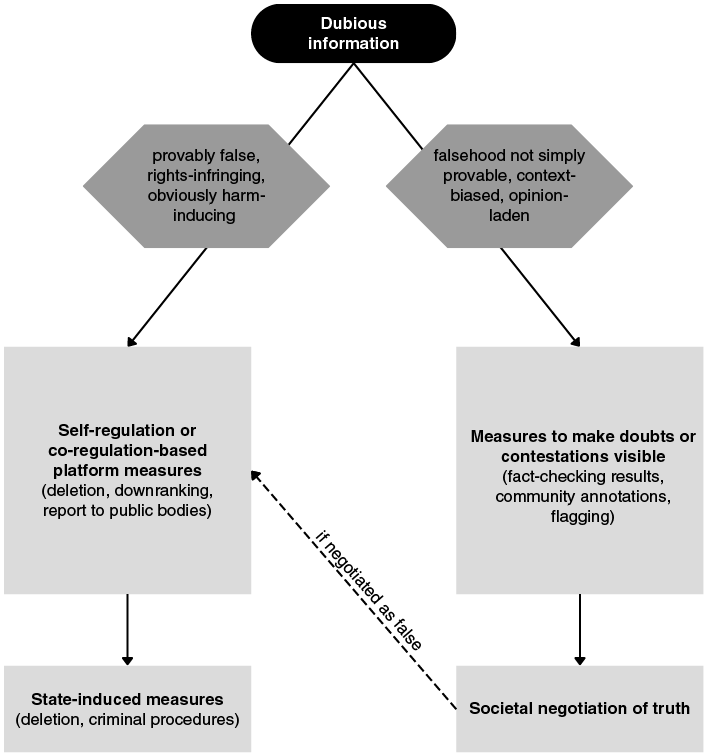
Figure 14.1 Long description
Overview of provisions that a co-regulatory framework might include to identify and proceed with illegal forms of speech. Some of the possible measures involve user comments, user-based tagging or labelling, reporting mechanisms, external fact checks, information correction, or other forms of providing objection or other context information. To encourage and support open public discourse, these measures should always be designed in a way to foster constructive dialogue and debate, for instance, by providing users with tools to evaluate the credibility of sources and information, rather than making unilateral decisions on content removal.
For contested but nevertheless legitimate statements, an advanced co-regulatory framework seems even more complex than current approaches. Based on the concept of hybrid governance, several norm-making players are tightly interacting with each other in these advanced governance structures. Neither the state nor private corporations are ideally positioned to ensure the societal negotiation of truth. As we have shown, the democratic imperative is to decentralize this process, ensuring that the negotiation of truth remains a collective, societal endeavour, free from undue influences on legitimate expressions, be they political or commercial, constructive or shocking. The basic premise of an advanced co-regulatory framework therefore is to appreciate this societal process, decoupling it from handling provable untrue and harmful expressions. This means of establishing and safeguarding public discourse, especially when it comes to disputed but not provably untrue expressions, calls for a legal framework and an infrastructure that enable public discourse to make doubts visible when it comes to digital information.Footnote 73 Where discourse participants can openly discuss controversial statements, and contested information can be clearly identified as such, the recipients of such information can be consciousFootnote 74 of the dispute regarding the truth or alleged falsehood of a statement – enabling the negotiation process that is needed.
Making doubts visible in digital environments means implementing technical features and interfaces that allow for contradiction and discussion.Footnote 75 Some of the possible measures involve user comments, user-based tagging or labelling, reporting mechanisms, external fact checks, information correction,Footnote 76 or other ways of expressing objections or providing contextual information.Footnote 77 To encourage and support open public discourse, these measures should always be designed in a way as to foster constructive dialogue and debate: for instance, by providing users with tools to evaluate the credibility of sources and information, rather than making unilateral decisions on content removal.
This alone will not suffice to tackle potential negative effects. Three other contextual factors play a central role when it comes to the societal handling of contested information: (1) the skills to critically evaluate information in general, (2) the (theoretical) opportunity for citizens to take part in the discourses that negotiate truth, and (3) the ability to comprehend and critically reflect on perceivable doubts or ongoing discussions regarding the truth value of a relevant statement. For the first factor, promoting media literacy from an early age will result in a society that is more discerning and less susceptible to dubious information. For the second, a co-regulatory framework can provide underlying principles when designing features that enable discourse, such as openness, low thresholds for participation, and transparent handling of any reacting user comment. For the third, measures might be clearly visible visual markers (including machine-readable labels), information about the contesting users(s), and highlighting of contesting parties that adhere to specific duties of care, such as fact checkersFootnote 78 or journalistic outlets. Moreover, encouraging the proliferation and accessibility of diverse information sources seems helpful where individuals are exposed to a range of perspectives, leading to them becoming better equipped to (co-) negotiate truth.
Another (albeit indirect) prerequisite for advanced co-regulatory settings are basic standards regarding the transparency of the discourse taking place (see Section 14.4.3). Where platforms have access to data – either specific statements and their distribution networks or articulated doubts regarding a content piece – such data can be used to support the process of societal discourse, for example by providing debates regarding specific statements or naming the accounts publishing them. Open data initiatives could set an example for accessible data regarding public discourse,Footnote 79 as data that is open to the public almost always makes for better and wider control, examination, and dispute.
14.4.2 Institutional Requirements: Decoupling Truth-Finding from Regulatory Interventions
In classic co-regulatory settings, we can observe two different governance structures. In code-based co-regulation, industry players agree on a code that is then referenced in the legal framework and/or monitored by a supervisory body. In an alternative co-regulatory set-up, the lawmaker establishes legal provisions that are then concretised and enforced by an approved co-regulatory body that is monitored by a regulator. In hybrid speech-governance environments, public and private communication rules overlap and interact to a significant degree: the lawmaker’s requirements shape private platform rules, while private platforms interpret and concretise these legal requirements in community standards from a strategic and economic perspective. However, the terms not only implement the legal provisions but also often contain provisions and guidelines that go beyond. Hybrid governance concepts recognize such inextricable links between private and public communication rules in speech regulation on platforms.Footnote 80
In the case of disinformation governance, both the lawmaker and the platforms should refrain from defining disinformation based on the dichotomy of true or false. Instead, one of the basic requirements for co-regulatory frameworks in advanced disinformation governance is to keep the societal process of negotiating truth open and to make doubts visible; any legal framework should therefore focus on providing the foundation for a governance structure and concrete measures that take this into account, either refraining from interfering with this process or supporting and helping society to accomplish it.Footnote 81 The institutional requirements of such a co-regulatory approach involve one or more new entities that facilitate this process by developing and supporting respective measures and by supervising their implementation by providers and/or any third parties (discourse-oriented bodies, or DOBs). While one potential configuration of current hybrid governance systems is the establishment of independent social media councils, these are structurally a little different from the envisaged DOBs. Social media councils usually act as impartial, third-party institutions responsible for overseeing content moderation decisions, developing guidelines and best practice and ensuring that content moderation practices adhere to principles of human rights and due process. By contrast, DOBs identify and oversee tools and measures to facilitate public discourse, enabling communities to make doubts about a specific statement visible. DOBs have an enabling role on an infrastructural level rather than in a case-by-case decision-making body; they support a critical public discourse on private platforms with a focus on negotiating truth.
Besides these entities, the need for classic actors in co-regulation will remain: the state providing the legislative framework, and co-regulatory bodies supervising the implementation of measures in cases of illegal expressions or where false statements have been identified, as shown in Figure 14.2.
Governance structure of an advanced co-regulatory system for disinformation governance.
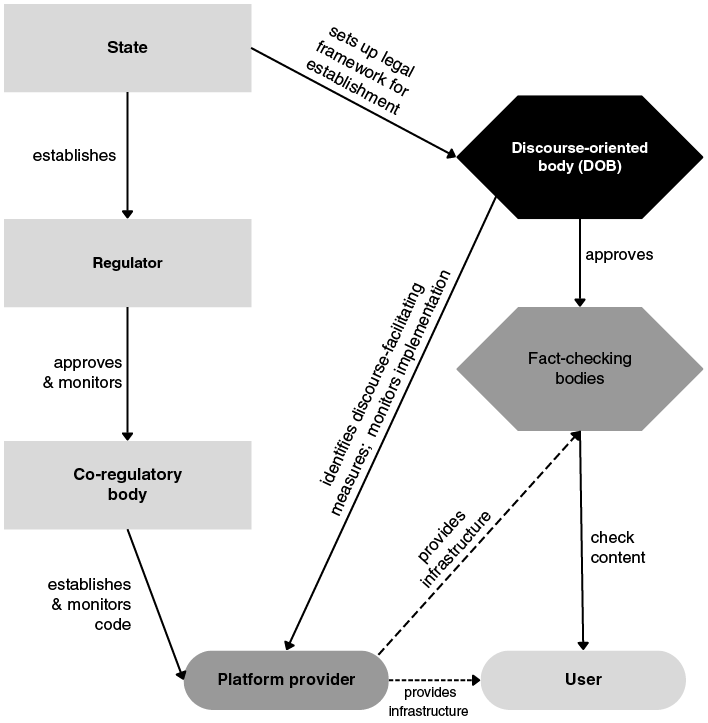
Figure 14.2 Long description
A co-regulatory approach involves one or more new entities that enable facilitating the process of negotiating truth by developing and supporting respective measures and by supervising their implementation on side of providers or/and any third parties, namely: Discourse-Oriented Bodies. Besides these entities the need for classic actors in co-regulation will remain, i.e., the State providing the legislative framework, and co-regulatory bodies supervising the implementation of measures in cases of illegal expressions or where false statements have been identified.
To fulfil its role in such a setting, a DOB should be free from potential influences from either the state or private companies; it has to be independent from external influences, political agendas and organisations, and financial, knowledge-based, or factual dependencies.Footnote 82 Such an institution should be bound to the common good: either through its composition, with internal pluralism or multiple stakeholders,Footnote 83 or by procedure, with for example participatory approaches.Footnote 84 Institutional approaches known from network governance could be fitting for DOBs as well: concepts that emphasise horizontal interactions among a network of equal stakeholders from civil society, academia, the tech industry, user communities, and other relevant sectors, where decision-making relies on consensus, collaboration, and mutual agreement. Alternatively, one could assess whether a form of hybrid institution might work as a DOB: that is, by combining elements of both public and private governance structures a hybrid institution might formally be a public body but still operate with sufficient autonomy.
As a DOB’s main task is to help with and observe the implementation of features on the infrastructural level and of processes on the providers’ organisational level as well as to supervise the discourse-oriented application of such processes, it has to operate with a strong backlink to public interest. This might be realised through strong legal requirements regarding the public remit of such a body, or through organisational requirements concerning public representation or participatory approaches. The active involvement of civil society can provide valuable insights into the societal impacts of disinformation and help ensure that the co-regulatory approach is responsive to the needs and concerns of the public.
While a state- and company-independent, public-interest-bound third party such as a DOB is crucial to overseeing the enabling and support of societal negotiation processes by making doubts perceivable, there will still be a need for a co-regulatory body that monitors compliance, enforces rules, resolves disputes, and ensures transparency and accountability once dubious information has been objectively falsified or has been deemed false on the basis of negotiation. Here, traditional content moderation measures can be foreseen by the legal framework (deletion, downranking, warning labels, profile-related limitations), comparable to existing areas of co-regulation. This also entails supervisory tasks on the part of a regulator that monitors and controls the co-regulatory body’s decisions and actions.
In such a co-regulatory framework aiming at enabling the wider communicative ecosystem, some institutions and stakeholders can be identified to which additional requirements should apply. Where fact-checking organisations can evaluate claims and provide evidence-based assessments of relevant statements, these bodies are an important actor when it comes to identifying and assessing allegedly false claims.Footnote 85 To minimise any structural risk that comes with such a position of power in negotiating truth, fact-checking bodies have to be independent and transparent.Footnote 86 There should not be any dependencies on either state bodies or private companies, and their remit should have a strong public interest orientation to be in line with the societal objectives of public discourse. Stakeholders in media education and awareness-raising, aiming at educating the public about critical thinking, source evaluation, and the basics of journalistic integrity, should also be free from (hidden) political agendas.
When it comes to norm-making and functions within the proposed governance structure, the lawmaker has to set up a legal framework to establish the public interest body explained here as well as a co-regulatory body that supervises the providers’ handling of content that has been identified as false or misleading.Footnote 87 The lawmaker should state the general principles of the framework and should name exemplary measures to facilitate the societal negotiation of truth and making doubts visible. Moreover, the legislator should either stipulate how providers should handle information that has been identified as false or establish a framework where industry develops a code that after an agreement becomes binding within the legal framework.
The DOB is the competent player to (1) concretise, optimise, and extend the legally foreseen instruments and measures that support the public process of negotiating truth, (2) supervise the implementation of negotiation-supporting measures on the side of the providers in a way that is aligned with public interest (both ex ante and ex post), and (3) set up requirements for and approve independent and neutral fact-checking bodies and/or supervise their compliance. On the institutional level the DOB might also consult the regulator as well as the co-regulatory body on relevant topics. This separation of truth-identifying powers ensures that truth-related processes run independently of both state and company interests and interventions.
The regulatory body is needed to supervise the compliance of the providers with the provisions concerning their handling of content that has been identified as false and/or misleading, if the system is based on an industry code (in this case, the regulatory body also would have to approve such a code in advance). Alternatively, the regulator will have to approve and monitor an industry-led co-regulatory body to monitor the providers’ compliance with either legal norms or a code concerning platforms’ governance of content identified as false and/or misleading. In all cases, the supervisory function would encompass ex ante checks of standard operating procedures and technical configurations as well as ex post monitoring of their content governance in practice.
The providers themselves have to implement the requirements and measures developed by the DOB regarding the facilitation of the societal process of negotiating truth, and they also have to implement the legal requirements, measures, and processes regarding content that has been identified as false and/or misleading. These tasks comprise steps to provide technical access not only to infrastructural tools but also to their documentation, as well as access to platform data to be able to assess both the functioning of the negotiation process and the impact of any intervening measures. In this way, a structural decoupling can be established between the societal process of negotiating truth and decisions regarding content that has been identified as being false.
14.4.3 Procedural Requirements: Transparent, Inclusive, and Accountable
The success of such an advanced co-regulatory model is contingent upon a framework of procedural prerequisites. Considering their societal and human rights aspects, these requirements have to ensure that all processes are, inter alia, transparent and all measures fair and accountable.Footnote 88
Transparency involves the open and accessible dissemination of rules, decision-making processes, and outcomes to all relevant stakeholders and the public in general.Footnote 89 This includes clear guidelines on when the truth value of any given information is deemed low or non-existent, the ideal process that leads to such a decision, the responsibilities of each actor in the governance structure, and the sanctions in cases of non-compliance, either in implementing the discourse-enabling measures or in applying countermeasures in cases of statements that have been identified as false. Transparency should also be considered on the part of the regulator, the co-regulatory body, and the providers;Footnote 90 their methodologies, decisions, and justifications should be open to public scrutiny as well as to that of any affected individual.Footnote 91 Providers should present encompassing reports about their implemented measures for supporting the negotiation of truth as well as their application of any measures against statements identified as false. As a public-interest-oriented body, the DOB would also be obliged to act in the most transparent way possible, since it is focused on facilitating open discourse.
Where upholding the societal process of negotiating truth is one of the key objectives, considering inclusiveness as a procedural requirement is pivotal to counter any aggregation of power, especially on the side of the DOB. For public-interest-oriented governance to truly reflect the societal negotiation of truth, it must be participatory in nature. This means actively involving a diverse range of stakeholders, from civil society groups and academia to user communities and marginalized voices. The more stakeholder groups and public interest representatives take part in the DOB’s procedures, the bigger the chance of impartiality. It remains to be seen whether the body could also consider direct forms of participation by the public.
Finally, accountability mechanisms are necessary to ensure that all parties adhere to the rules and that there are consequences for non-compliance.Footnote 92 This would involve public reporting, regular audits, and evaluations. Hybrid governance models, by their very nature, distribute options to review and to point out irregularities among multiple stakeholders, ensuring that stakeholders remain answerable to the public. Platforms could provide feedback mechanisms whereby users can voice concerns about content governance policies, ensuring that platform policies evolve based on collective user input; the same goes for the DOB’s procedures to identify tools and measures to support this societal process. Accountability also directly applies to fact-checking bodies; they have to publish their methodologies and should be open to scrutiny to ensure trustworthiness.
Finally, even an advanced co-regulatory system as proposed here is not immune to errors or oversights. Recognizing this, it is necessary to establish clear redress mechanisms whereby individuals or groups can challenge decisions, seek clarifications, or appeal against perceived injustices.Footnote 93 Regarding appealed content moderation decisions, the usual addressees for redress would be the platform provider first (or a social media council), then the co-regulatory body, then the regulatory body, and finally, the competent court.
14.4.4 Advantages, Challenges, and Open Questions
An advanced co-regulatory framework, where the process of truth negotiation is decoupled from any state or private decisions-making powers, offers advantages over current regulatory approaches. It provides a more nuanced approach to tackling contested information, leaving the process of identifying false statements to society. The collaborative nature of such a hybrid governance model allows for a more adaptable and flexible regulatory framework,Footnote 94 capable of responding to the evolving challenges posed by awful but lawful content. By leaving the process of identifying a statement’s truth-value with society and fact-checking institutionsFootnote 95 and delegating necessary follow-up content decisions to bodies vested in decentralised co-regulatory settings, lawmakers can focus on procedural rules, mitigating the risk of state-controlled limitations on freedom of expression and companies’ decision-making power on what is true and what is not. However, this approach, intended as a starting point for further discussion on disinformation governance, leaves open three major questions.
Who has the final say? When decentralising the decision on whether a statement is true or false, it might happen that the result of the public discourse is ambivalent; the statement is contested but could not be proven wrong. In such cases, one approach could be to give freedom of expression the benefit of the doubt and leave the statement untouched (while still making doubt visible). Another approach could be to give platform providers leeway in how to handle such situations; in this case, redress mechanisms become especially important, but if any potential infringement of freedom of expression would evolve out of such procedures, the affected person would still have the right to approach a court considering their right to be heard. In cases of such disputes or contentious decisions, it would still be a court that has the final say, albeit only after clear hierarchies of decision-making.
How does it scale? As we have shown, current state-based approaches do not scale due to the requirement of context-sensitive, proportional decisions. The sheer volume of digital content coupled with the rapidity of its dissemination pose significant challenges to any governance model in view of dubious claims.Footnote 96 The same goes for decentralized models: participatory frameworks might face comparable hurdles in scaling up to address the vast number of individual communications.Footnote 97 Public discourse is able to tackle larger numbers of posts, but requires time, human resources, and expertise as well,Footnote 98 setting a natural limit of messages that can be checked and/or debated publicly. It will be crucial to address any evolving disparities in the allocation of attention to prevent inconsistencies or power imbalances.
How to consider cross-border issues? Where digital platforms operate in transnational settings that transcend geographical boundaries, the proposed governance model works independently of unique cultural and political environments. Harmonised standards concerning discourse-facilitating measures and procedural guidelines will need to work consistently across different regions. As these apply on an infrastructural level, the challenge of different value systems remains:Footnote 99 the public discourse in one area might differ significantly from another,Footnote 100 and hence it cannot be ruled out that these processes result in different assessments when it comes to the truth value of a statement. However, since rational public discourse uses the same epistemic sources and methods worldwide, it seems that differing results in different public discourses will be the exception. What becomes evident, though, is that the proposed system not only acknowledges but manifests local, national, and regional discourse spaces.
14.5 Summary: DOB is a Free Elf
This chapter has explored the challenges and opportunities associated with disinformation governance, with a particular focus on the potential of advancing current co-regulatory approaches. The central issue with current approaches to tackling disinformation is the implicit assumption that disinformation is something that can be easily identified. Current approaches accumulate decision-making power on the side of either the state or private platform providers, but the democratic ethos, deeply embedded in the annals of political theory, hinges on the principle of open discourse. It is through public debate that societies negotiate their truths, shaping collective realities and shared understandings. This process is not merely a by-product of democratic governance but a foundational pillar upon which democracies are built. Where state bodies or digital platforms are centralised actors deciding on what is true and what is false, regulatory frameworks run into a profound democratic dilemma.
The path forward requires a model that decouples truth-related deliberation from central decision-making, giving the process of negotiating truth (back) to society and ensuring that the power to influence public discourse is not concentrated in the hands of a few. Delving into potential governance structures, this chapter has identified that advancing co-regulatory settings can strike a balance between freedom of expression, freedom of information, and the prevention of societal harms. Structurally decoupled governance models, grounded in democratic principles and societal interests, emphasise the collective negotiation of truth, thus restoring the democratic ethos of open discourse.
The approach suggested here combines elements of state regulation, self-regulation, and the active participation of civil society, creating a form of hybrid governance. The model centrally relies on a public-interest bound DOB that identifies and supervises the implementation of discourse-oriented tools, measures, and procedures with the central objective of enabling the public to make doubts visible. The application of measures regarding content that is deemed false as a result of the negotiation process lies within a traditional co-regulatory set-up: platform providers apply measures, and co-regulatory bodies and/or regulatory bodies supervise their actions.
The co-regulatory approach offers a promising path forward, but it is not without its challenges. Implementing this approach will require careful design and ongoing adjustment to ensure it remains effective and responsive to the evolving nature of disinformation. However, as the digital environment and disinformation policies continue to evolve, there is an increasingly pressing need for innovative regulatory approaches to address the challenges posed by awful but lawful content. Hybrid governance offers a promising solution here that can help strike the right balance between freedom of expression and the mitigation of societal harms. By embracing hybrid governance and fostering public–private cooperation and public-interest-bound institutions, policy-makers, service providers, and stakeholders can work together to build more effective, balanced, and rights-preserving governance structures.
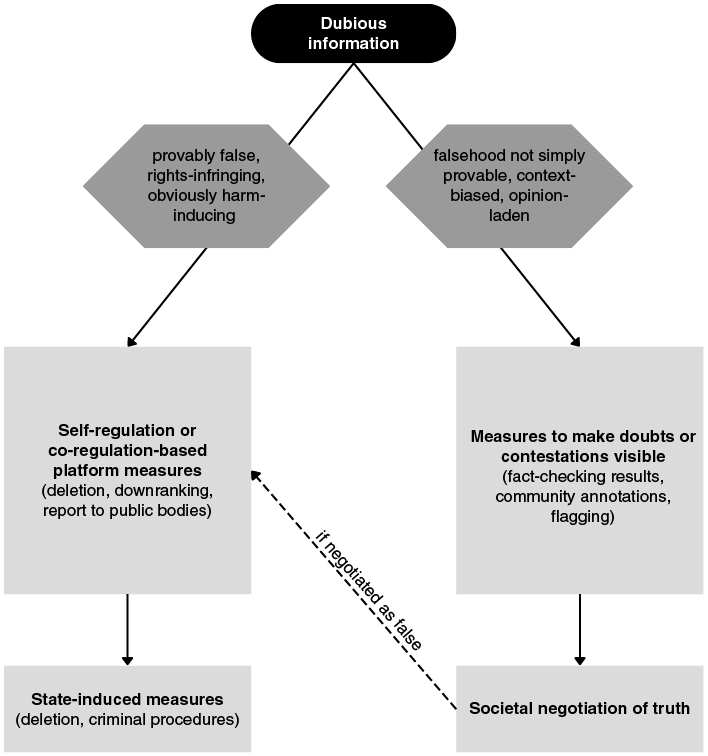
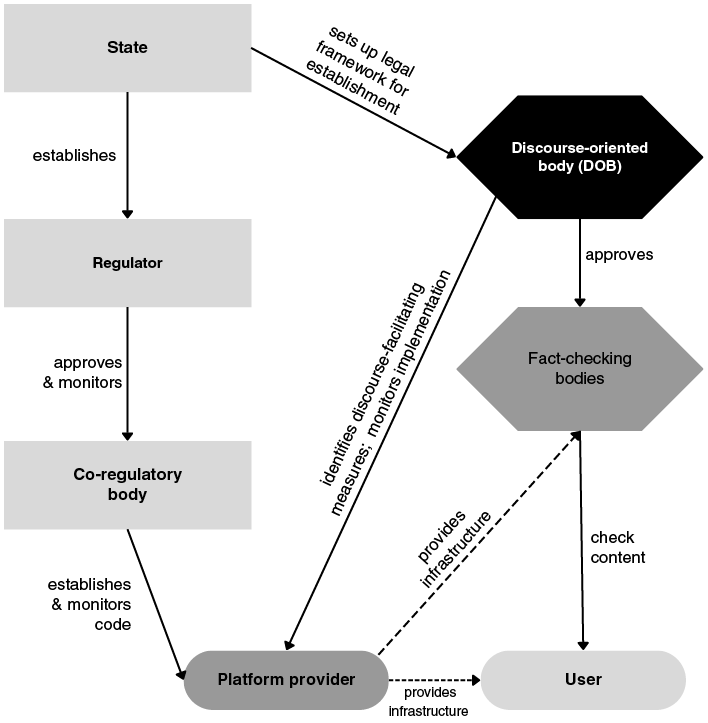

 Open access