





Introduction
The consumer cooperative movement in South Korea emerged in the late 1980s in response to the pressures of international free trade and growing concerns over food safety and national self-sufficiency issues (Jang, Reference Jang and Jang2019, Reference Jang, Herrmann-Pillath and Zhao2024). Civil society activists, particularly those engaged in agriculture, labor, feminist, and environmental movements, played a leading role in initiating and shaping the movement by establishing consumer cooperatives (Jang, Reference Jang and Jang2019). Over the past three decades, four major federations of consumer cooperatives have successfully operated within this landscape. Among them, H-Coop (pseudonym) held particular significance as the first and only feminist-oriented consumer cooperative.
Founded in 1989 by a women’s organization, H-Coop emerged as a grassroots initiative to promote gender equality through everyday practices (Moon, Reference Moon2022). With a focus on empowering ordinary women, particularly homemakers, by providing access to safe, sustainable food, H-Coop encouraged civic and political participation under the slogan “looking at the world through the kitchen.” Despite its symbolic and pioneering role in Korea’s cooperative sector, H-Coop faced long-standing business stagnation (Jang, Reference Jang and Jang2019). While the consumer cooperative sector expanded its business, the H-Coop accumulated persistent financial deficits. Under these circumstances, H-Coop recently announced its dissolution, which sent shockwaves through the broader cooperative sector.
Therefore, based on a qualitative approach, this article seeks to explore the recent collapse of one of Korea’s most prominent consumer cooperatives, H-Coop. Specifically, the study aims to contextualize the case within the broader discourse on the failure of cooperatives and explore whether context and locality-embedded explanations may better account for the decline of H-Coop. Mainly, the article first traces the historical trajectory of H-Coop, highlighting its ideological foundations, organizational evolution, and its position within Korea’s broader cooperative movement. We then focus on the critical elements that lead to a rapid decline, ultimately resulting in its decision to dissolve.
In European and Western countries, where cooperatives have a long-standing institutional history, considerable scholarly attention has been devoted to understanding the causes of cooperative failure. Several key perspectives have emerged. Socioeconomic and institutional scholars emphasize the role of social capital (Putnam, Reference Putnam2001) in sustaining cooperative initiatives, while cultural anthropologists (Attwood & Baviskar, Reference Attwood and Baviskar1987) highlight factors such as member homogeneity and broader cultural contexts. Additionally, governance costs (Hansmann, Reference Hansmann2000), management failure, and levels of member participation (Birchall & Simmons, Reference Birchall and Simmons2004) have been identified as critical to cooperative sustainability.
Although the existing literature on cooperative failure offers valuable theoretical frameworks, it often overlooks the context-specific factors that shape how cooperatives operate and fail in different settings. This gap makes it difficult to fully account for the distinctive challenges encountered by cooperatives like H-Coop in South Korea. Despite the relative success of consumer cooperatives in Korea until recently, the phenomenon of cooperative failure within this context has attracted limited scholarly analysis. H-Coop serves as an especially compelling and unconventional case, having been founded by a women’s rights NGO and developed along a path that significantly diverges from dominant Western European cooperative models. Its eventual collapse thus provides a critical and timely opportunity to reexamine existing theories of cooperative failure.
Building on this perspective, this article argues that the unique institutional, cultural, and historical conditions of South Korea have shaped the persistent tension between the ideals and the financial viability of the consumer cooperative model. In navigating these constraints, H-Coop encountered a series of structural and operational challenges, including declining member participation, organizational and managerial rigidity, and a gradual erosion of its activist identity. As a dual-purpose entity, functioning both as a business and as a social movement, H-Coop’s commercial failure inevitably undermined its broader movement goal as well. The accumulation of these challenges ultimately led to H-Coop’s dissolution in 2025, marking a critical juncture in the history of Korea’s consumer cooperative movement.
This study has two implications. First, through this case, the study is able to assess the applicability of existing theoretical explanations and consider new insights into the failure of cooperatives in the contemporary Korean context. Second, analyzing the challenges and eventual failure that H-Coop has experienced over the years offers valuable and meaningful insights not only for practitioners within Korea’s cooperative sector but also for cooperative stakeholders globally.
Why do some cooperatives fail while others succeed?
Theories explaining the cooperatives stem from diverse academic and philosophical backgrounds (Birchall, Reference Birchall2011). Each disciplinary approach examines the cooperatives from different angles. However, since cooperatives originated and developed primarily in Western Europe, many of these theories are rooted in Eurocentric contexts (Birchall, Reference Birchall1997; Fisher & Nading, Reference Fisher and Nading2021). Among them, much of the previous literature focuses on explaining the success and failure of cooperatives. This article categorizes explanations of cooperative success and failure into three levels of analysis: socioeconomic and institutional environments, organizational structures and management, and members. All these explanations are presented in Table 1.
Factors affecting cooperative success and failure

Table 1. Long description
The table is organized into three columns: Level, Factors, and Explanation.
* Societal and institutional environment level:
- Factor: Strong social capital. Explanation: Societies with strong social bonding and capital foster the success of cooperatives.
- Factor: High level of democratic and egalitarian society. Explanation: Cooperatives are less likely to fail in societies with democratic and equal structures.
- Factor: Supportive legal and financial environment. Explanation: Legal recognition, government support, and respect for civil autonomy drive prosperity.
* Organization level:
- Factor: Governance and management. Explanation: Efficiency is highest when the group with the highest market transaction costs and lowest ownership costs holds control. Conversely, erosion of democracy, lack of professional management, weak incentives, and high debt contribute to downfall or decline.
* Members level:
- Factor: Participation and commitment. Explanation: Financial involvement through investment, purchasing, and profit-sharing leads to success.
Socio-economists and institutional scholars explain the success or failure of cooperatives by emphasizing their embeddedness within specific institutional, political, and sociocultural environments. They commonly argue that cooperatives thrive when they are formed by small, culturally homogeneous groups (Iliopoulos & Valentinov, Reference Iliopoulos and Valentinov2018; Putnam, Reference Putnam2001; Saz-Gil et al., Reference Saz-Gil, Bretos and Díaz-Foncea2021) and supported by appropriate skills, infrastructure, and legal-political frameworks (Attwood & Baviskar, Reference Attwood and Baviskar1987; Ribašauskienė et al., Reference Ribašauskienė, Šumylė, Volkov, Baležentis, Streimikiene and Morkunas2019; Roy et al., Reference Roy, McHugh, Huckfield, Kay and Donaldson2015). Rather than viewing cooperatives as independent entities, this perspective emphasizes their interdependence with broader social contexts. These studies collectively support the notion that social capital, cultural cohesion, and a democratic, civic institutional context have a fundamental influence on cooperative prosperity.
At the organizational level, scholars highlight the roles of governance and management in explaining the success or failure of cooperatives. Among these scholars, Hansmann (Reference Hansmann2000) provides a foundational framework for understanding the topic. Drawing on the cost exchange theory, he argues that cooperatives may fail when governance costs, such as those incurred through collective decision-making, management oversight, and agency problem resolution, exceed the benefits of user ownership. Knupfer and Knupfer (Reference Knupfer, Knupfer and Knupfer2013) identifies another governance problem by examining the rise and fall of an American food co-op. When membership and sales expanded, members often became increasingly disengaged from decision-making, particularly as authority became concentrated in the board. The case shows that the erosion of democracy and member involvement ultimately contributed to the cooperative’s downfall. Moreover, empirical studies on cooperative decline frequently highlight a lack of professionalism, weak incentive structures, management inefficiency, and financial instability as key factors contributing to failure. For instance, Nilsson (Reference Nilsson2018) notes that without trained managers or board members, strategic decisions falter and oversight weakens. Kramper (Reference Kramper2012) further argues that when compensation and rewards are not linked to outcomes, motivation declines, and agency problems intensify. Persistent deficits, operational inefficiency, and growing debts also erode organizational stability and member trust (Kramper, Reference Kramper2012).
At the member’s level, several scholars highlight the importance of member participation and commitment. They argue that, as cooperatives are owned by their members, active member participation is critical to their sustainability. Birchall and Simmons (Reference Birchall and Simmons2004) emphasizes internal member motivation over external factors when explaining cooperative success and failure. They argue that democratic and effective governance relies on the active involvement of committed members who share the cooperative’s values and goals. According to their theory, individuals consider the well-being of others alongside their interests and are motivated more by collective incentives—such as shared purpose and community spirit than by personal gain (Birchall & Simmons, Reference Birchall and Simmons2004; Jang, Reference Jang and Jang2019). To foster meaningful participation, cooperatives must provide organizational support, including feedback, education, and opportunities for members to engage who possess the necessary resources and commitment (Birchall & Simmons, Reference Birchall and Simmons2004).
Previous literature provides valuable insights into the factors that contribute to the success and failure of cooperatives. While existing research provides a deep understanding of these phenomena within Western European cultural and institutional contexts, the Asian perspective remains less explored. Especially in the Korean context, where consumer cooperatives have generally enjoyed relative success until recent years, there has been a notable lack of scholarly focus on understanding the failure or struggles of cooperatives. With the recent decline of one of the major consumer cooperative federations, a more nuanced, context-specific analysis is necessary to better capture the unique challenges and internal processes that lead to such outcomes.
The development trajectory of consumer cooperatives in South Korea
Consumer cooperatives originated with the Rochdale Society of Equitable Pioneers in Britain, especially for underprivileged groups, in 1844. The Rochdale model established core principles of cooperatives, including member ownership, one member–one vote, patronage dividends, and member education (Birchall, Reference Birchall1997, Reference Birchall2011). The model then diffused across Europe and beyond, but national trajectories diverged according to the institutional environment. In the European context, for instance, consumer cooperatives declined in Germany and Austria, while remaining relatively robust in Scandinavian countries (Birchall, Reference Birchall2011).
In a similar vein, the development of consumer cooperatives in South Korea is also influenced by the distinctive institutional context. The emergence of consumer cooperatives in South Korea is closely tied to the societal transition from an authoritarian regime to a democratic society (Jang, Reference Jang and Jang2019, Reference Jang, Herrmann-Pillath and Zhao2024). Following democratization, pioneers mainly from civil society, inspired by farmers, labor unions, environmental activists, and feminist movements, played a central role in founding consumer cooperatives (Jang, Reference Jang, Herrmann-Pillath and Zhao2024). Grounded in their core philosophy and values, consumer cooperatives in South Korea have continuously engaged with broader social, economic, and environmental issues, reflecting their commitment to societal change. These pioneer groups established four federations of consumer cooperatives.
While consumer cooperatives in South Korea vary in their individual histories, backgrounds, and guiding principles, they share several core characteristics (Jang, Reference Jang, Herrmann-Pillath and Zhao2024). In terms of governance, they are member-centered organizations, with their boards of directors often composed predominantly of laywomen members who exhibit a strong commitment to democratic decision-making and participatory governance (Jang, Reference Jang, Herrmann-Pillath and Zhao2024). From an operational standpoint, Korean consumer cooperatives adopt a direct-trade model, sourcing organic products from local farmers and distributing them directly to their members (Jang et al., Reference Jang, Lee, Jeon, Wilson, Webster, Ekberg and Skurnik2024). Furthermore, many of the movement’s key founders were civil society activists closely aligned with civic organizations, positioning consumer cooperatives as socioeconomically driven entities rather than purely market-oriented enterprises. Lastly, South Korean consumer cooperatives are characterized by their adaptive capacity and innovative orientation, learning from both successes and failures to enable continuous organizational development. These characteristics present the context-embedded uniqueness of Korean consumer cooperatives.
Building on these characteristics, consumer cooperatives in South Korea experienced significant growth in the early to mid-2000s, coinciding with the expansion of the eco-friendly agro-food market (Jang, Reference Jang and Jang2019). In addition, the enactment of the Consumer Cooperatives Act in 1999, followed by its revision several times in the 2000s, provided legal legitimacy, enabling consumer cooperatives to expand their operations nationwide. Accompanying the growth of the cooperative business and the strengthening of its legitimacy, a growing body of academic research on consumer cooperatives has emerged within South Korea. Cooperative research has been conducted across various academic disciplines, mainly within the field of management studies.
Although consumer cooperatives in South Korea possess unique characteristics shaped by their specific historical, social, and institutional contexts, much of the existing literature analyzing the success and failure of Korean cooperatives tends to rely on conventional management theories or frameworks developed in Western or European contexts. Consistent with prior studies from Western Europe, research on Korean cooperatives highlights factors such as member commitment (Jung & Choi, Reference Jung, Choi and Jang2019; Shin, Reference Shin2017), organizational culture (Park & Hwang, Reference Park and Hwang2013), leadership (Park & Seo, Reference Park and Seo2024), as well as organizational learning and governance (Lee & Jang, Reference Lee and Jang2023) as key drivers of cooperative success. Conversely, cooperative failures have been attributed mainly to ineffective conflict resolution (Lee et al., Reference Lee, Kang and Lee2022), particularly about financial performance and a lack of professionalism in management.
This article posits that the recent failure of H-Coop presents a unique opportunity to examine cooperative failure within the South Korean context. While some factors identified in existing literature may help explain H-Coop’s decline, other aspects that have been less explored could further enrich the discourse on cooperative success and failure. Therefore, through an in-depth analysis of this case, we aim to investigate how these dynamics are explicitly embedded in the Korean social, cultural, and institutional environment.
A brief history of H-Coop
Before outlining the research methodology, it is important to provide a contextual overview of H-Coop, the focal case of this study. Founded in 1987 to advance the women’s movement, the women’s NGO “Korean Women’s Empowerment Network” (pseudonym, hereafter referred to as K-Association) established the K-Coop (precedent of H-Coop). The key members of K-Association were university-educated women who wanted to engage more women in the feminist movement. Therefore, the decision to organize a consumer cooperative was a pragmatic strategy to attract homemakers who have a great interest in sourcing healthy and safe food for their families and empower them as active feminist activists at the community level. In addition, at that time, interest in organic food was largely concentrated among educated middle-class homemakers who could afford the higher prices and possessed greater awareness of its benefits and social impact (Jang, Reference Jang, Herrmann-Pillath and Zhao2024). Therefore, initially, the primary purpose of K-Coop was to engage these homemakers and spread feminism into the community rather than a cooperative-oriented approach (Moon, Reference Moon2022). As such, the consumer cooperative represents a hybrid model integrating feminist activism into the cooperative movement.
Accordingly, in its early days, K-Coop sought to connect the everyday practices of homemakers, such as consumption and caregiving, with broader feminist objectives. Forming small groups of homemakers was thus essential to sustaining both the business and the cooperative movement. These groups served as key spaces for sharing feminist values, fostering the cooperative’s unique identity, and facilitating the direct trade of eco-friendly agro-food products. Until 1999, K-Coop operated through a group-ordering system, in which 5–10 members in a local community collectively managed the ordering and distribution process. In the absence of physical retail stores, all transactions were conducted through preorders. As a result, operations were highly labor-intensive, relying on phone calls, faxes, and handwritten documentation, which contributed to relatively high administrative and logistical costs. In response to these challenges, K-Coop eventually began allowing individual members to place orders directly. Nevertheless, members continued to maintain strong interpersonal bonds and a shared commitment to the cooperative’s core values.
In the 2000s, K-Coop underwent institutional and social transformation following its formal registration under the 1999 Consumer Cooperatives Act. Amid rising public interest in food safety and eco-friendly products, the K-Coop experienced rapid membership growth, expanding by an average of 16% annually to over 3,000 members in the early 2000s. While basic computer systems were introduced, operational processes remained essentially unchanged, resulting in logistical bottlenecks and decreased member engagement. To address these issues, K-Coop initiated the formation of three autonomous local units and, in 2004, joined a logistics alliance with another Korean consumer cooperative to improve efficiency and sustain growth. Furthermore, in 2005, three local branches of K-Coop were established to expand the business at the community level.
Following the revision of the Consumer Cooperatives Act in 2010, which allowed the legal formation of nationwide cooperative federations, K-Coop Federation was officially established in 2011. As K-Coop intensified its independent organizational structure, the new vision and mission were also launched. This new strategy caused tension and conflict between K-Coop and the K-Association. After prolonged negotiation, K-Coop decided to be independent from the K-Association and changed its name to H-Coop. During this period, tensions with the logistic partner have also increased. Due to unresolved conflicts, H-Coop decided to discontinue its collaboration with its partner and instead pursue an independent logistics system. Furthermore, following the expansion of the eco-friendly product market in Korea, H-Coop aggressively opened its offline shops to pursue economic growth. However, these shifts led to a significant increase in management costs and operational burdens, posing challenges to the cooperative’s sustainability and efficiency.
As of 2025, H-Coop was officially declared bankrupt, following years of sustained financial deficits, diminishing member engagement, generational disconnects, and mounting competition from large-scale retailers. While some interpret its feminist orientation and grassroots legacy as significant contributions to the broader trajectory of Korea’s consumer cooperative movement, others regard its collapse as a dual failure both in the cooperative movement and feminist activism. The ongoing tension between normative ideals and organizational viability offers critical insight into the broader challenges faced by cooperatives operating within the constraints of a neoliberal economic environment.
A case study research method
This study examines the decline of H-Coop and seeks to identify the underlying factors that contributed to its downfall. To analyze this case, we employ a case study method, which is particularly well-suited for examining complex, context-specific phenomena through the collection of in-depth, multisource data, such as interviews, participant observations, audiovisual materials, and internal documents (Creswell & Poth, Reference Creswell and Poth2016). As a methodological strategy, the case study is especially effective for addressing “why” and “how” questions (Yin, Reference Yin2012). Accordingly, this approach is deemed appropriate for exploring the challenges faced by South Korea’s first and only feminist consumer cooperative in navigating the tension between ideological commitments and business viability.
To gather data and examine the case, the authors employed participatory observation and literature review as primary research methods (Creswell & Poth, Reference Creswell and Poth2016; Yin, Reference Yin2012). Significantly, one of the authors has been directly involved with one of H-Coop’s oldest member cooperatives since 2024, serving both as a cooperative member and an observer. Additionally, the same author has been active as a member and board member of the local chapter of the K-Association within the same community. This embedded engagement provided valuable opportunities to observe firsthand how H-Coop operationalized its practices at the community level, navigated ongoing challenges, and ultimately decided to cease operations.
Although the authors have engaged in extensive conversations and interviews with a wide range of H-Coop members across various levels of the federation and member cooperatives, we have deliberately chosen not to cite individual statements or opinions in this paper directly. This decision reflects that H-Coop’s decline is an ongoing process. Therefore, interpretations of the cooperative’s failure are highly diverse and, in some cases, contentious among members. Furthermore, perspectives expressed during interviews have the potential to reignite or deepen internal conflicts among members. To avoid exacerbating these tensions, we have instead drawn on these dialogues as a means of contextual understanding about the trajectory of H-Coop without attributing specific claims or judgments to individual voices.
Instead of directly citing individual interviews, the authors gathered an extensive range of qualitative materials, including official documents, member education resources, meeting minutes, and annual reports. These materials collectively provide insight into the organization’s historical development, core practices, challenges, member engagement, and significant organizational transitions. Of particular importance are the annual general assembly reports of the H-Coop federation, spanning from 1999 to 2023, as well as those of one of its oldest and most active member cooperatives covering the years 2011 to 2023. These comprehensive records, including the financial reports, serve not only as essential empirical sources for this study but also as significant archival contributions to the documentation of South Korea’s cooperative movement. Through a close analysis of these documents, the authors trace the evolution of H-Coop’s business operations and cooperative mission, offering a detailed account of its transformation, decline, and eventual dissolution.
Following the collection of qualitative and quantitative data, the authors conducted a systematic reevaluation of key factors contributing to the decline of H-Coop across institutional, organizational, and membership levels. This process involved multiple rounds of coding and iterative discussions to assess the validity, coherence, and relevance of emerging themes. To enhance the credibility of the analysis, the data were reviewed several times and cross-checked with diverse sources. In addition, preliminary findings were shared with selected H-Coop members, particularly those with long-term involvement, to gather feedback and ensure contextual accuracy in interpreting the cooperative’s decline.
A consumer cooperative business model in South Korea
For members only, be trapped in institutional barriers
In South Korea, the consumer cooperative sector operates under unique institutional constraints. Unlike their counterparts in Europe and other Western countries, where cooperatives are generally allowed to sell products to both members and nonmembers, Korean consumer cooperatives have faced strict legal limitations. When the Consumer Cooperative Act was enacted in 1999, it explicitly prohibited sales to nonmembers, clearly stating that consumer cooperatives should only conduct business with their members (Consumer Cooperatives Act, 2022). The consumer cooperatives in South Korea also have consistently upheld the principle that they operate exclusively for members. This principle has been conceived as a shared norm and taken for granted rule across the sector.
This legal restriction has shaped a distinctive institutional environment for Korean consumer cooperatives. However, in recent years, increasing competition in the eco-friendly agro-food market has prompted Korean consumer cooperatives to advocate for legal reform. In response to continued advocacy and policy requests from the cooperative sector, the law was revised several times in the 2000s. The amendment now allows consumer cooperatives to sell products to nonmembers, but only within 20% of the previous fiscal year’s total sales (Enforcement Rule of the Consumer Cooperatives Act, 2025).
Within this institutional framework, economic participation by members plays a pivotal role in sustaining the business operations of consumer cooperatives in South Korea. In the Korean context, member participation is not merely a normative ideal, as often emphasized in European and Western cooperative traditions, but a crucial determinant of operational and financial viability. Consequently, the four major consumer cooperative federations in Korea have each developed distinct strategies to navigate and adapt to these institutional constraints. Mostly, the primary purpose of their strategies is to integrate the economic participation of members into the diverse activities.
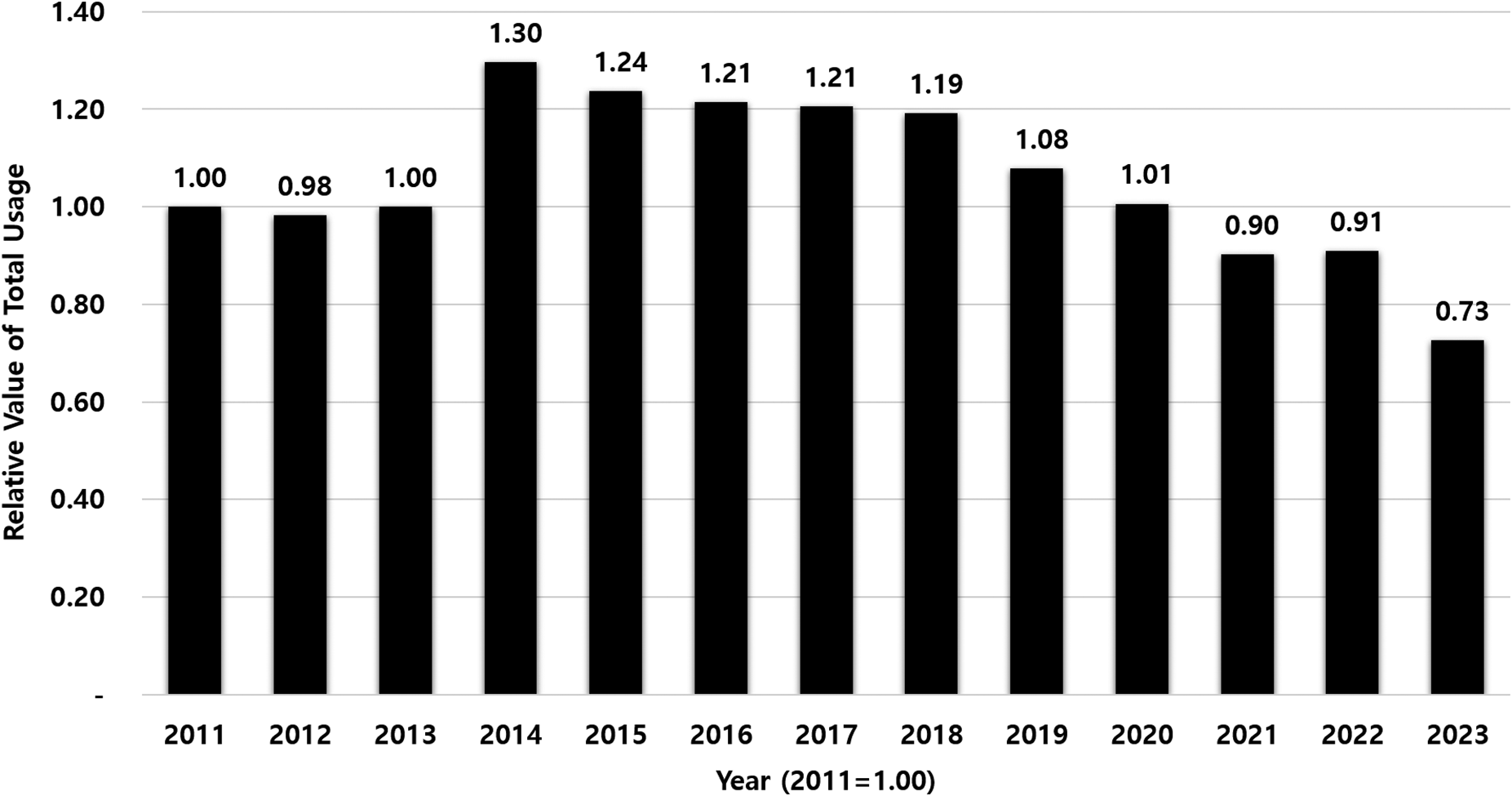
In the same vein, the first key factor explaining H-Coop’s failure is the decline in members’ economic participation. Based on participant observation and conversations with H-Coop members across all levels of governance, we found that the rate of member participation gradually declined, ultimately contributing to the cooperative’s commercial downturn. We collected data on members’ purchasing volume (usage by members) from the annual general assembly reports spanning the years 1999 to 2023. The data show significant changes since the cooperative federation was established in 2011, as illustrated in Figure 1, which depicts how members’ usage levels have changed relative to 2011. Although there was an increase from 2011 to 2014, after 2014, H-Coop members’ economic participation began to stagnate and decline.
The relative value of total usage (purchase) by all members (year 2011 = 1.00).

Fig. 1. Long description
The vertical y-axis is labeled Relative Value of Total Usage and ranges from 0.20 to 1.40 in increments of 0.20. The horizontal x-axis is labeled Year with 2011 equal to 1.00. The chart contains 13 black vertical bars with their specific values printed above each bar.
* 2011: 1.00
* 2012: 0.98
* 2013: 1.00
* 2014: 1.30
* 2015: 1.24
* 2016: 1.21
* 2017: 1.21
* 2018: 1.19
* 2019: 1.08
* 2020: 1.01
* 2021: 0.90
* 2022: 0.91
* 2023: 0.73
The trend shows a sharp increase to a peak in 2014, followed by a steady year-over-year decline, ending at the lowest point in 2023.
This stagnation is particularly notable given that Korean consumer cooperatives experienced rapid growth in the late 2000s. Rising public concern over food safety, coupled with the expansion of the global free trade regime that flooded the domestic market with imported, mass-produced products, drove many consumers to seek alternatives. Popular television programs on health further highlighted the risks of such products, prompting a shift toward eco-friendly options, an area in which consumer cooperatives emerged as key actors. H-Coop, along with other cooperatives, initially benefited from this trend, yet it ultimately failed to sustain active member participation despite the favorable market environment.
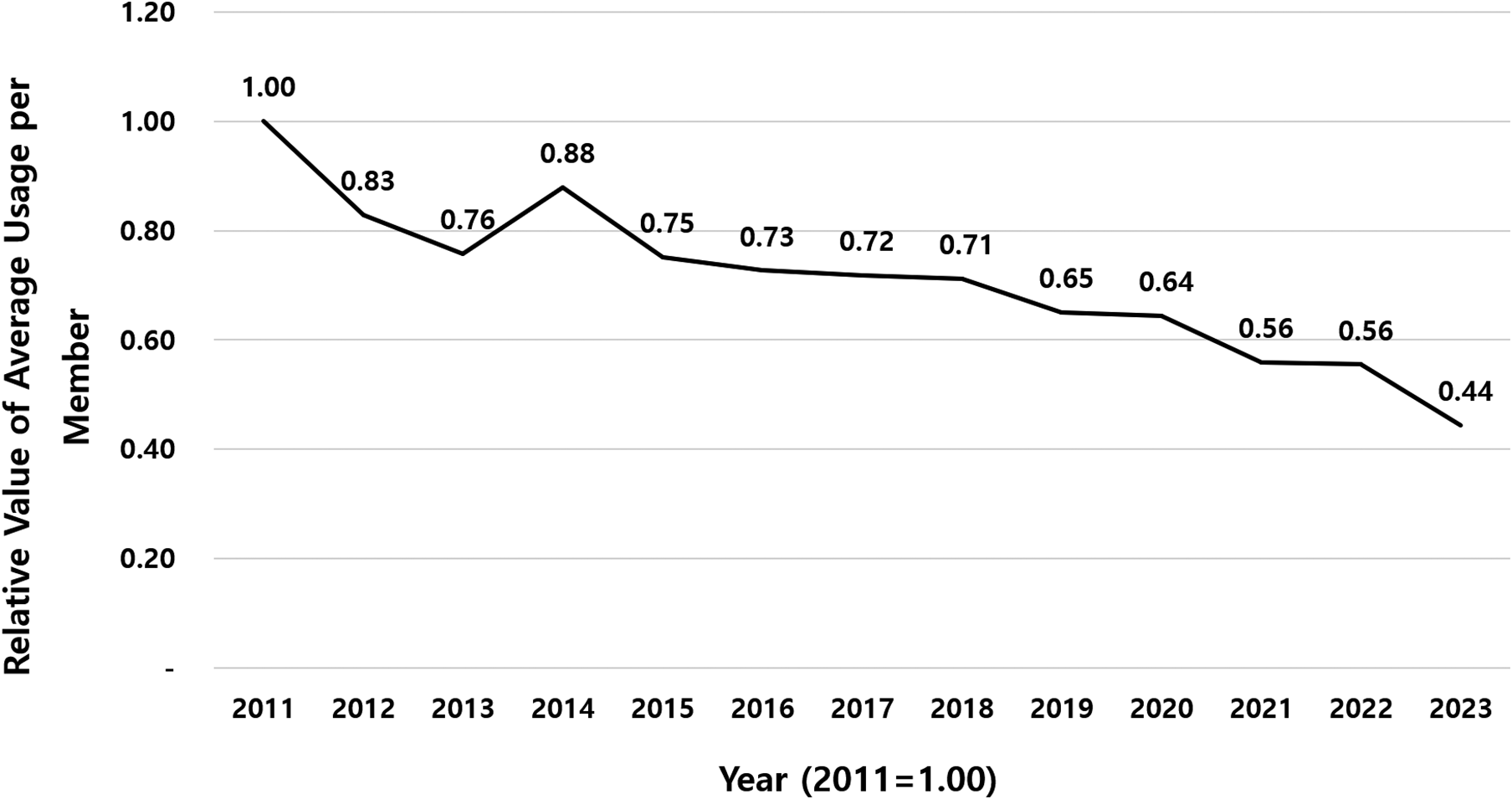
More seriously, the average usage per member, an important indicator of members’ economic participation, declined sharply after 2011. Figure 2 shows how individual members’ economic participation has changed relative to the year 2011. After 2011, the average usage per member began to fall. Although it briefly increased in 2014, it sharply dropped thereafter. Nevertheless, H-Coop chose to take on additional financial burdens by opening numerous new stores. The year 2011 marked a significant turning point, as a nationwide H-Coop federation was established following the revision of the Cooperative Act. Seeking to expand its business, H-Coop engaged in aggressive marketing and rapidly increased its retail presence from just 3 stores in 2006 to 16 by 2011. However, despite this expansion, average usage per member continued to decline, revealing an inefficient and unsustainable business structure.
The relative value of average usage per member (year 2011 = 1.00).

Fig. 2. Long description
The Y-axis is labeled Relative Value of Average Usage per Member with numerical increments of 0.20 from 0.20 to 1.20. The X-axis is labeled Year 2011 equals 1.00 and lists years from 2011 to 2023.
The data line begins at 1.00 in 2011 and shows a general decline with some fluctuations.
* 2011: 1.00
* 2012: 0.83
* 2013: 0.76
* 2014: 0.88 (a brief peak)
* 2015: 0.75
* 2016: 0.73
* 2017: 0.72
* 2018: 0.71
* 2019: 0.65
* 2020: 0.64
* 2021: 0.56
* 2022: 0.56
* 2023: 0.44
The overall trend is a non-linear decrease, ending at less than half of the original 2011 value.
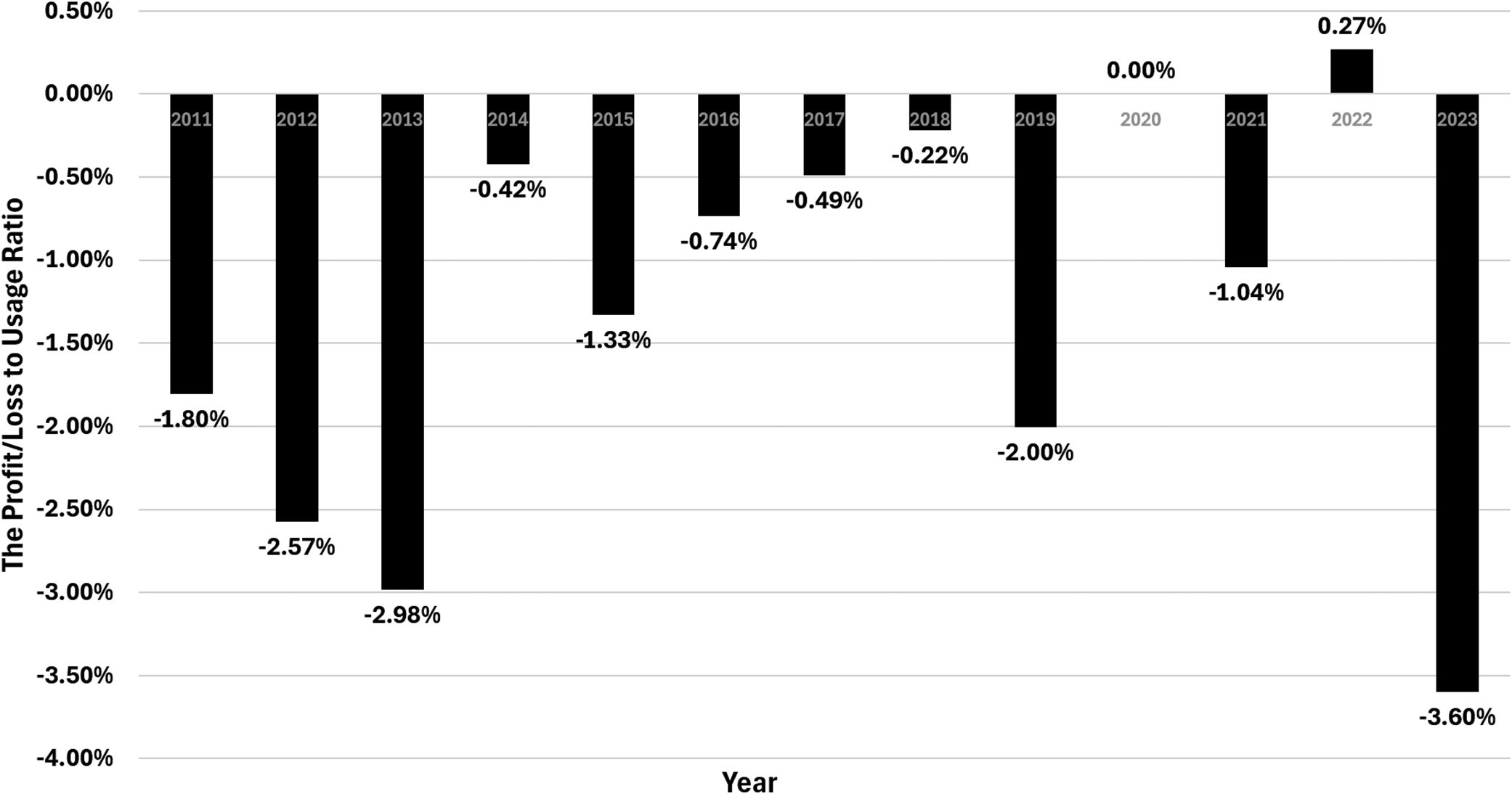
The inefficient and unsustainable business structure is reflected in the trajectory of the loss-to-usage ratio. Profit or loss-to-usage ratio can be read as a sales profit in a general for-profit company. Using 2011 as the baseline, Figure 3 illustrates the trajectory of the profit (loss)-to-usage ratio between 2011 and 2023. For most of this period, the ratio remained negative, reflecting sustained financial deficits. Although a modest surplus was temporarily observed in 2022, overall performance was markedly weak. These patterns indicate that H-Coop consistently failed to achieve adequate profitability relative to its gross sales, thereby evidencing a prolonged structural deficit. Such inefficiency and the lack of a sustainable business model ultimately culminated in escalating debt and contributed to the eventual collapse of H-Coop.
The profit/loss to usage ratio.

Fig. 3. Long description
The vertical Y axis is labeled The Profit forward slash Loss to Usage Ratio and ranges from negative 4.00 percent to 0.50 percent in increments of 0.50 percent. The horizontal X axis is labeled Year and spans from 2011 to 2023.
Thirteen vertical black bars represent the data for each year. The values are as follows.
* 2011: negative 1.80 percent.
* 2012: negative 2.57 percent.
* 2013: negative 2.98 percent.
* 2014: negative 0.42 percent.
* 2015: negative 1.33 percent.
* 2016: negative 0.74 percent.
* 2017: negative 0.49 percent.
* 2018: negative 0.22 percent.
* 2019: negative 2.00 percent.
* 2020: 0.00 percent.
* 2021: negative 1.04 percent.
* 2022: 0.27 percent, the only positive value shown.
* 2023: negative 3.60 percent, the lowest point on the chart.
The first key factor explaining H-Coop’s failure lies in the distinctive institutional context of the Korean consumer cooperative sector, where members’ economic participation is critical for long-term viability. H-Coop’s business grew steadily after the mid-2000s and expanded sharply in the late 2000s. However, following the establishment of the federation, the average purchase per member began to decline. This drop in member participation, coupled with the financial strain of ineffective management strategy (opening numerous stores), ultimately led to mounting losses.
Rigidity under the “eco-friendly only” policy
In addition to institutional constraints, Korean consumer cooperatives have shared norms and a culture that emphasize an “eco-friendly only” policy. The four major federations of Korean consumer cooperatives originated from diverse civil society movements, yet all share a strong environmental orientation (Jang, Reference Jang and Jang2019). While their primary areas of focus differ, their core business model centers on directly selling organic products to members. As such, the environmental commitment to promoting organic farming and agro-food production has become a critical ethical pillar, shaping the shared norms and legitimacy of consumer cooperatives in South Korea (Jang, Reference Jang, Herrmann-Pillath and Zhao2024).
In addition to these historical and cultural contexts, when the Consumer Cooperative Act was enacted in 1999, the types of products that cooperatives were allowed to handle were limited to agricultural products and environmental goods (Enforcement Rule of the Consumer Cooperatives Act, 2025). Although this provision was removed in 2010, food products still constitute a very high proportion of the items handled by consumer cooperatives. Therefore, due to these cultural and institutional characteristics, consumer cooperatives in South Korea have maintained a strong rigidity regarding organic or eco-friendly policies.
This aspect also distinguishes Korean consumer cooperatives from their Japanese counterparts, which are often considered similar. In Japan, consumer cooperatives focus more on local products (Sanchoku) sourced directly from local farmers and distributed to members (Kurimoto, Reference Kurimoto, Altman, Jensen, Kurimoto, Tulus, Dongre and Jang2020). Therefore, the strict adherence to an “eco-friendly only” policy is a unique characteristic of Korean consumer cooperatives. While this feature has helped build a strong reputation of trust among consumers, it has also created rigidity that limits their ability to expand the business.
Similarly, H-Coop has adhered to a strict eco-friendly policy in its business operations. Each season, the cooperative sought to supply members with fresh, eco-friendly agro-food products. As the business expanded, processed foods particularly targeting female homemakers were also developed. The ingredients and production methods were subject to rigorous monitoring to ensure compliance with organic standards. This stringent approach garnered considerable attention and trust from female homemakers, who prioritize food safety above all else.
However, the business model that relies exclusively on the specialized distribution of organic foods has faced increasing challenges in adapting to evolving market conditions. In South Korea, the range of products eligible for organic certification is limited. According to a report by Korea Agro-Fisheries and Food Trade Corporation (2024a), consumers purchase ~14 categories of eco-friendly agricultural products, with fruits and vegetables constituting the largest share in 2023. Given this, it is difficult for a single household to consistently purchase large quantities of fresh produce items.
Furthermore, the distribution channels for eco-friendly agro-food products are diversified. The report indicates that institutional catering, such as school meal programs, accounts for the largest share at 31.7%, followed by small- and medium-sized supermarkets (26.0%), large retailers (16.1%), and consumer cooperatives at only 7.2% (Korea Agro-Fisheries & Food Trade Corporation, 2024b). This fragmented market structure makes it increasingly difficult for consumer cooperatives to compete using an eco-friendly-only business model.
Since the late 2010s, giant e-commerce corporations have intensified the competition in the organic food market. According to the minutes of the 2017 H-Coop annual general assembly, amid rapid e-commerce growth, H-Coop attempted to introduce e-commerce home delivery services. However, its online operations lost competitiveness due to an overly complex user interface, extended delivery lead times, and limited economies of scale. Because of these market shifts, consumer cooperatives must compete with major corporations and for-profit companies that have far more capital in the organic agricultural industry. Under these conditions, relying entirely on a strict eco-friendly business model poses substantial competitive challenges.
Similarly, H-Coop started with 30 product items at its founding and expanded to 682 items by the early 2000s. However, there were inherent limitations in developing fresh food products, which constitute a significant portion of the food category in consumer cooperatives. Since 2011, H-Coop has aimed to develop ~90–100 new products each year to boost sales and increase member engagement. Despite efforts to introduce an average of 60–70 new items annually, these efforts did not translate into substantial sales growth. This outcome reflects the developmental constraints within a limited product range and the lack of adequate infrastructure to support processed food development.
In this situation, the number of producer groups also placed constraints on the flexibility of H-Coop’s business operations. When H-Coop established its federation in 2011, a producer network was also formed. The number of production sites increased from just four in the early 2000s to a total of 223 in 2011. However, due to the strict government-controlled certification system and the lengthy process required to transition to organic farming, the number of available producers remained limited. The number of eco-friendly certified farming households in South Korea has been rapidly increased up to 16.7% (198,891/1,194,715 = eco-friendly certified households/total farming households) in 2009 from 0.9% (11,892/1,280,462) in 2002, and then steadily declined to 5.0% (49,520/999,022) in 2023 (Korea Agro-Fisheries & Food Trade Corporation, 2024b). Moreover, as the four federations of consumer cooperatives shared similar business models, it became increasingly challenging for H-Coop to secure distinctive and competitive producers.
At the same time, H-Coop struggled with an inefficient logistics system. In the eco-friendly agro-food product sector, fast and reliable logistics with sufficient supply capacity are critical to maintaining market competitiveness. Between 2005 and 2010, H-Coop sought to address long-standing inefficiencies in logistics and cost management by forming a logistics alliance with A-Coop (a pseudonym), the largest consumer cooperative federation in South Korea, which possessed nationwide infrastructure and a professional workforce. However, due to ongoing disagreements and rising costs, H-Coop decided in 2011 to terminate the collaboration and establish its own independent outsourced logistics system. This shift, however, significantly increased management expenses and further weakened operational efficiency. Logistics and distribution outsourcing costs accounted for most business expenses. Even as member usage gradually declined, fixed logistics costs had to be maintained, which exacerbated H-Coop’s growing financial deficits. Furthermore, after H-Coop ended its logistics partnership with A-Coop, most of its original producer groups chose to continue their business with A-Coop rather than H-Coop. This forced H-Coop to both develop its own logistics infrastructure and secure new producers from a limited pool of certified organic farmers.
The challenges inherent in the organic business imposed additional pressures on H-Coop’s management, exacerbating the vulnerability of its financial position. Since the establishment of the nationwide federation in 2011, the H-Coop’s liquidity ratio has also exhibited a steady downward trajectory. From 2019 onward, current liabilities have outstripped current assets. Consequently, the liquidity ratio remained marginally above 100 percent until 2018, declined to the 70–80 percent range in 2019, and deteriorated further to 45 percent by 2024, immediately before the H-Coop’s closure. This pattern indicates that H-Coop was no longer capable of absorbing the cumulative financial losses it had continued to incur.
Therefore, we argue that the second critical factor in H-Coop’s failure lies in the rigidity of its business model. While the strict adherence to organic-only principles has historically been a key strength of consumer cooperatives in Korea, increasing market competition and the limited consumption capacity for organic products have turned this principle into a source of inflexibility for H-Coop. Moreover, the inefficiencies in logistics, an essential component of the eco-friendly agro-food business, further undermined H-Coop’s financial soundness.
When cooperative ideal and viability fail each other
As discussed in the previous sections, Korean consumer cooperatives, including H-Coop, have operated within a distinctive institutional and normative context, which inevitably imposes constraints on their business activities. In this setting, continuous member participation and meaningful economic contribution have become crucial factors for the business sustainability of consumer cooperatives.
While consumer cooperatives in European and Western contexts also normatively emphasize member participation, in Korea, the engagement of highly committed members is especially vital. To this end, each consumer cooperative establishes its own identity, values, and norms, which serve as the foundation for communication with members and integration into business practices. These practices, in turn, play a significant role in fostering member interest and economic involvement in the cooperative.
In this regard, H-Coop possessed a clear value system and identity in the past. Unlike other consumer cooperatives primarily established to advance the cooperative movement, H-Coop was founded with the purpose of more broadly spreading feminist activism within the local community through a cooperative business model. Thus, its roots are more deeply embedded in feminist activism than in cooperative business. Preliminary interviews conducted for this study with H-Coop members at various levels, particularly senior managers and long-standing loyal members, revealed that feminism is deeply internalized as a taken-for-granted value and norm within H-Coop.
Aligned with these values, H-Coop actively engaged in various member participation activities initially. Through programs such as feminist schools, parenting education, eco-feminism lectures, and women’s writing classes, H-Coop helped local homemakers recognize that their struggles were not isolated issues but rooted in structural gender discrimination. This growing awareness of individual agency was further channeled into cooperative activities, facilitating vibrant social participation. Throughout these education and advocacy activities, H-Coop members engaged in local community politics and social activities.
Feminist values were also embedded in H-Coop’s practices. For instance, H-Coop identified that although female producers harvested agricultural products, their names were often excluded from sales records. Instead, her husband’s name is often presented on the product, which is a longstanding patriarchal practice in rural communities. To address these problems, H-Coop raised the issues and corrected them with producers that other cooperatives typically did not pursue. Moreover, H-Coop’s solidarity extended beyond national borders, fostering international sisterhoods with women’s cooperatives in Taiwan and Japan. This transnational feminist network persisted from 1999 until H-Coop’s closure. These feminist values and practices distinguished H-Coop from other consumer cooperatives and constituted a central ideal internalized by its founding members and leadership.
However, the shared values and norms within H-Coop began to be challenged as the cooperative sought to assert a more independent identity as a business entity. Following the revision of the Cooperative Act in 2010, H-Coop formally separated from the K-Association and rebranded itself, discontinuing the use of the name K-Coop. With a new vision centered on happiness, the direct organizational and ideological linkage between H-Coop and K-Association became increasingly tenuous. This separation generated internal tensions and conflicts, as longstanding members perceived it as a breakup with the cooperative’s feminist foundations. According to the 2013 annual meeting minutes of H-Coop’s general assembly, some members argued that, as the organization has grown, the original feminist movement ethos has not been sufficiently integrated into its business. Nevertheless, to survive and compete in the expanding organic food market, H-Coop prioritized strengthening its business viability. This strategic shift was evident in its aggressive marketing efforts, including the rapid expansion of offline retail stores after the federation’s establishment in 2011.
The cooperative’s expansion attracted new members. However, participatory observations and interviews revealed an increasing divide between long-term and newer members. Many of the newer members joined primarily to obtain organic or eco-friendly products, with less emphasis on engaging with feminist ideals. Furthermore, the rapid business growth and the proliferation of offline stores constrained the H-Coop federation and local cooperatives’ ability to offer comprehensive educational programs and member activities. While the rebranding aimed to expand the membership base beyond K-Association’s strong feminist identity, education centered on cooperative principles simultaneously weakened. Annual general assembly reports indicate that both K-Association and H-Coop recognized the inadequacy of integrating feminist values into member education or sufficiently promoting cooperative ideals.
Similarly, as H-Coop’s business stagnated, its capacity to develop human capital, specifically activists and staff capable of sustaining the cooperative’s mission, deteriorated. In addition, although Korean society changes rapidly, H-Coop held the traditional way of member activity and education. Although most women started to work in the 2010s, H-Coop still stuck to daytime education or production site visits during weekdays that were suitable only for female homemakers. The 2012 general assembly document also highlighted the need to “differentiate education targets (by group, by year) and develop customized, in-depth training programs,” suggesting that prior educational efforts had been overly generalized.
In addition, given that H-Coop originated primarily as a feminist movement rather than a conventional cooperative business, the authors argue that sufficient practical training in key management competencies such as accounting, information management, marketing, and strategic planning was lacking. Official documents from the 2011 to 2023 general assembly consistently highlighted that board members lacked the necessary skills to interpret financial statements or conduct accounting accurately, and that the technical training necessary for effective management was insufficient.
These deficiencies had tangible consequences. Despite H-Coop’s mounting accumulated deficits and its entry into a state of capital erosion, some board members failed to fully grasp the severity of the crisis or recognize the urgency required to address it. Before conducting this study, preliminary interviews revealed that certain members and board members were aware of existing debt but underestimated its gravity. Such gaps in financial literacy and crisis awareness significantly hindered the organization’s capacity to implement necessary changes. Consequently, weakened member education and participation programs exacerbated a management failure of H-Coop.
This study identifies the third critical factor in H-Coop’s failure as the erosion of its educational mission and the decoupling of values, which weakened the capacities of both members and internal staff. Founded on feminist principles and distinctive practices, H-Coop initially drew strong commitment from loyal members. However, following the federation’s establishment, its pursuit of economic growth and a business identity separate from K-Association created internal tensions. Although feminist values were maintained rhetorically until its closure, in practice, they coexisted uneasily with market-oriented goals and strategy. This gap between ideals and practice diluted H-Coop’s distinctiveness and reduced its ability to secure economic participation from both long-standing and new members. The simultaneous decline of business performance and foundational values ultimately undermined the cooperative’s viability and resilience.
Conclusion
The consumer cooperative movement in South Korea originated in the late 1980s as a response to various social, labor, and environmental challenges. Initiated by diverse civil society organizations, this movement led to the establishment of four federations of consumer cooperatives. Among these, H-Coop holds a distinctive place as the country’s first and only feminist cooperative. For three decades before H-Coop’s dissolution, many cooperative researchers and practitioners considered that the Korean consumer cooperative sector had operated successfully. However, in 2025, H-Coop declared bankruptcy and disbanded its federation, sending shockwaves throughout South Korea’s cooperative sector.
Therefore, this article aims to explore the impactful collapse of Korea’s historically significant consumer cooperative federations. In particular, the study reviews the literature on cooperative success and failure, much of which is rooted in European and Western contexts. Key factors such as socioeconomic institutions, cultural commonalities, social capital, governance and management practices, and member commitment are commonly addressed in these studies, providing useful insights into cooperative outcomes.
Nonetheless, we argue that while existing research offers valuable theoretical frameworks to explain the rise and fall of cooperatives, it often neglects context-specific elements that critically influence cooperatives’ viability. Within the existing cooperative studies based on the Europe-Western context, it is difficult to fully understand the unique challenges faced by cooperatives like H-Coop in South Korea. Although Korean consumer cooperatives had generally experienced relative success until recent years, due to institutional restrictions and unique shared norms and legitimacy, they faced difficulties balancing their ideals with business viability.
Building upon this perspective, this study identifies three primary factors that contributed to H-Coop’s collapse within the unique cooperative environment in South Korea. First, the decline of economic participation of members led to H-Coop’s downfall. Due to regulatory constraints, Korean consumer cooperatives are restricted in sales to nonmembers, limited to only about 20% of the previous year’s turnover. Therefore, active member engagement in purchasing is vital. Despite initial growth, H-Coop experienced a steady decline in members’ economic participation. This decline, combined with financially burdensome management decisions such as the rapid expansion of offline stores, culminated in increasing financial losses that led to the bankruptcy of H-Coop.
Second, the rigidity inherent in the Korean consumer cooperative business model significantly hindered H-Coop’s adaptability. While the exclusive focus on organic products initially served as a competitive advantage, it ultimately imposed severe limitations on business growth. Intensified market competition and the capped demand for organic goods constrained H-Coop’s ability to scale effectively. Furthermore, the high logistics costs associated with organic agricultural products further strained the H-Coop’s financial health. As a result, the deterioration of H-Coop’s financial health accelerated its bankruptcy.
Third, the erosion of education and core values weakened the capacities of members and staff. Initially grounded in strong feminist principles, H-Coop gradually pursued economic growth and a broader identity, creating decoupled ideals and practices. Feminist values remained rhetorical, while market-oriented goals and practices coexisted uneasily, limiting engagement from both long-standing and new members. The decline in business performance further constrained educational initiatives and member activities. Consequently, the simultaneous erosion of values and business viability undermined H-Coop’s overall resilience.
These three factors played a decisive role in the collapse of H-Coop and have also shaped the adverse conditions of the other three consumer cooperative federations in South Korea. Nevertheless, the remaining cooperatives adopted different responses and have thrived through strategic renewal or organizational innovation (Jang, Reference Jang, Herrmann-Pillath and Zhao2024). The H-Coop case, therefore, indicates that when consumer cooperatives, as well as membership-based organizations, confront critical challenges, including reduced member participation, rigid business models, and weakened member commitment, ongoing and adaptive coping actions are necessary.
From this perspective, effective managerial capacity and sufficient resources are considered essential. However, rather than relying on a dichotomous approach, cooperatives need to maintain a balance between ideals and viability. Especially within the institutional context of Korean consumer cooperatives, where members’ economic engagement is closely tied to organizational sustainability, ensuring members’ sense of ownership is important. This highlights the role of continuous innovation in enabling consumer cooperatives to adapt to changing conditions while preserving an appropriate balance between ideals and viability.
This study offers two key implications. First, the case of H-Coop highlights the significance of considering how institutional and cultural factors interact with broader structural dynamics in cooperative theories, which have primarily been developed within Western European contexts. While the unique characteristics of the Korean context help explain H-Coop’s outcomes, they also deepen our understanding of the challenges that cooperatives face on a global scale. Second, analyzing the rise and fall of H-Coop provides valuable lessons for cooperative practitioners and policymakers both in Korea and globally. The case of H-Coop indicates that the viability of cooperatives ultimately relies on the strength and continuity of their membership. While surviving in an advanced capitalist economy can be extremely challenging, cooperatives, as member-owned business, play a crucial role that should not be overlooked. The importance of cooperatives goes beyond simply existing as organizations since they have the potential to contribute to broader social transformations. In this sense, echoing Birchall (Reference Birchall2011, p. 210), the question of “what our world would look like without it” calls for a sustained commitment to cooperative development and continuity.
Funding statement
This work received no external funding.
Competing interests
The authors declare none.


 Open access

