


Hypnotic use is widespread in hospitals but the adverse effects of these drugs are more pronounced in older adults (Reference Gurwitz, Field and AvornGurwitz et al, 2000), with an increased risk of morbidity and falls (Reference Llorente, David and GoldenLlorente et al, 2000; Reference Grimley EvansGrimley Evans, 2003). The British National Formulary (British Medical Association & Royal Pharmaceutical Society, 2003) states: ‘ Hypnotics should be avoided in the elderly’. In addition, the National Service Framework for Older People states that ‘prescribing rates for benzodiazepines should be monitored and reviewed within the local clinical audit programme’ (Department of Health, 2001). We undertook an audit with the aim of reducing hypnotic prescribing on two functional older adults wards at the Queen Elizabeth Psychiatric Hospital in Birmingham.
Method
Over a 6-month period from April 2001 to September 2001 the number of occupied patient bed days were calculated; the data from each ward were added together to give an overall total.
We counted the total number of tablets for each hypnotic prescribed over the 6-month period. Patients prescribed hypnotics as discharge medication were identified. Details of medication pre-admission were found by looking at case notes and in-patient drug charts were consulted in order to determine which patients had been started on a hypnotic while on the ward.
Following the initial part of the audit we set the audit standards: (a) to reduce hypnotic use on the two wards by 20% and (b) that no patients should be discharged while still taking hypnotics.
We designed an educational session which lasted for 1h to outline the problems associated with hypnotic use in the elderly and to give details of alternative strategies to use for insomnia. There was time for discussion and a copy of a sleep hygiene leaflet, ‘The golden rules of sleep’, was given out (Box 1). Although the sessions were based on a lecture style, open discussion and questions were encouraged. The leaflet outlined methods other than the use of hypnotics for dealing with insomnia, such as providing decaffeinated drinks on the ward. The leaflet was adapted from two texts on sleep hygiene (Reference Oswald and AdamsOswald & Adams, 1983; Reference Kale and KaleKale & Kale, 1984). The lecture was incorporated into the 6-monthly induction sessions for all senior house officers. Leaflets were handed out at this lecture. All nursing staff on the two wards studied were identified and invited to one of four small-group teaching sessions run by either one of two of the authors (I.H. or L.C.). These sessions lasted 1h and followed a similar format to those for the senior house officers. Copies of the leaflet were also left on the two wards for staff, patients and their relatives.
Following the educational intervention, we collected identical information to that collected in the pre-intervention period on a monthly basis for 4 months in 2002.
Results
A total of 12 of 25 junior medical staff and 23 of 36 nursing staff attended the teaching sessions (48% and 64% respectively).
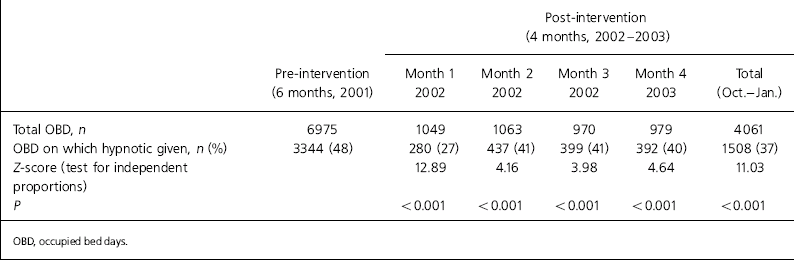
Pre-intervention medication use was 48%. One month post-intervention this use dropped to 27% (Table 1). Hypnotic use increased in subsequent months but remained significantly below pre-intervention levels throughout the 4-month period.
Occupied bed days on which a hypnotic was prescribed
| Post-intervention (4 months, 2002-2003) | ||||||
|---|---|---|---|---|---|---|
| Pre-intervention (6 months, 2001) | Month 1 2002 | Month 2 2002 | Month 3 2002 | Month 4 2003 | Total (Oct.—Jan.) | |
| Total OBD, n | 6975 | 1049 | 1063 | 970 | 979 | 4061 |
| OBD on which hypnotic given, n (%) | 3344 (48) | 280 (27) | 437 (41) | 399 (41) | 392 (40) | 1508 (37) |
| Z-score (test for independent proportions) | 12.89 | 4.16 | 3.98 | 4.64 | 11.03 | |
| P | < 0.001 | < 0.001 | < 0.001 | < 0.001 | < 0.001 | |
In the pre-intervention audit, there were 87 patient discharges from both wards over a 6-month period. In 27 cases the discharges were associated with hypnotic use (31% of all discharges). Of the 27 patients, 9 were taking hypnotics prior to admission. Hence 18 of 87 patients (20%) were discharged with a new hypnotic prescription.
In the post-intervention audit, of the 32 discharges from the wards over a 4-month period, 2 of the patients were on hypnotics prior to admission. There was a significant reduction in the number of patients discharged on a hypnotic that had been started during hospitalisation in the post-audit period (3 of 30, 10% χ2=2.826, P<0.001).
Box 1. The golden rules of sleep
-
• In older adults the sleep architecture is altered.
-
• Older adults have altered perception of the quality of their sleep.
-
• Sleep is affected by physical illness, medication and pain.
-
• Depression, psychosis and dementia can all affect sleep.
-
• Have regular hours for getting up and going to bed.
-
• Plan a regular time to relax and unwind in the evening before going to bed.
-
• Only go to bed when you are sleepy, don't lie in bed awake.
-
• If you are unable to fall asleep go to another room and return only when you feel sleepy.
-
• Regular exercise improves your sleep, but don't exercise within 3 h of bedtime.
-
• Avoid stimulants like tea, coffee, cola drinks and chocolate late in the evening.
-
• Avoid smoking/give it up. Nicotine is a stimulant.
-
• Never use alcohol to help you to sleep.
-
• Sleep in a comfortable room, not too hot or cold.
-
• Avoid distractions like loud noise and bright lights.
-
• Eat meals at regular times and in the evening eat food that is easily digested.
-
• Hunger disturbs sleep. Try a light snack at bedtime, like warm milk and biscuits.
-
• Do not nap during the day.
-
• If you have been prescribed sleeping tablets try not to use them for more than 2 or 3 nights consecutively.
Discussion
A simple educational intervention was successful in reducing both in-patient and discharge use of hypnotic medication. Aiming our intervention at the senior house officers and nursing staff was deliberate. We felt that the majority of prescriptions and pressure for prescriptions came from this area. This assumption is supported by published data (Reference Mahomed, Paton and LeeMahomed et al, 2002). Our results show statistically significant reductions in hypnotic use over time. In the first month following intervention there was a dramatic reduction in in-patient hypnotic use and, although this reduction diminished over time, it remained significantly below baseline throughout. Furthermore, a reduction was also seen in the number of patients discharged with a hypnotic medication. However, we were unable to reach our outcome standard of no discharges on hypnotic medication.
These results are encouraging but should be interpreted within the limitations of this work. The main potential confounding factor was the fact that junior medical staff changed in both the pre-intervention and post-intervention periods. It is conceivable that the changes in hypnotic prescription observed merely reflect differences in prescribing practice between different groups of staff. However, nursing staff remained relatively constant throughout and arguably have considerable influence on hypnotic use, particularly with respect to dispensing of medication as required. In addition, Table 1 suggests the intervention had a demonstrable impact. Second, the intervention took place on two wards in a teaching hospital and so the findings may not be generalisable to other settings. Finally, this was an audit and had no control group. Despite these limitations, a relatively simple educational intervention appears to have been sufficient to raise the profile of this important topic among staff to good effect.
A literature search of Medline and Psychlit using the following search terms: HYPNOTICS; BENZODIAZEPINES; EDUCATION INTERVENTIONS; HOSPITAL; INPATIENT; identified only one study that had attempted to reduce hypnotic use in a hospital setting (Reference Griffith and RobinsonGriffith & Robinson, 1996). However, this study took place in a general hospital rather than a psychiatric hospital. A prescribing policy was developed which was incorporated into the junior doctors’ induction programme. Nursing staff were not selected for education. In primary care an educational intervention leading to a reduction in the prescription of benzodiazepines by general practitioners (Reference De Burgh, Mant and Mattickde Burgh et al, 1995) has been described.
Recent guidelines on hypnotic use have suggested that doctors consider non-medical treatments for insomnia, such as ensuring regular sleep hours, no coffee and alcohol at bedtime, as well as cognitive-behavioural therapy and relaxation, before hypnotics are prescribed. When prescribed, hypnotics should be used in the short term (National Institute for Clinical Excellence, 2004). In our educational session, the staff leaflet on ‘The golden rules of sleep’ advocated that simple sleep hygiene methods should be considered before hypnotics were prescribed or administered. This staff education programme goes some way towards raising awareness of sleep and hypnotic issues and our results show a reduction in hypnotic use.
In summary, this work suggests that a simple educational intervention can lead to significant reductions in hypnotic use. These changes appear to reduce over time and so, in order to sustain the initial impact, the educational package may need to be repeated at regular intervals and could be combined with a prescribed policy intervention, as used by Griffith & Robinson (Reference Griffith and Robinson1996) and the audit cycle repeated.
Declaration of interest
None.
Acknowledgements
We thank Norah Foster, Directorate Lead Nurse, Martin Read, Chief Pharmacist, Elaine Jones, Pharmacist and Alison Moore, Audit Department.


 Open access


eLetters
No eLetters have been published for this article.