

1. Introduction
High-Pressure (HP) metamorphic rocks are key to understand subduction-related processes (e.g. Agard et al. Reference Agard, Yamato, Jolivet and Burov2009; Cheng et al. Reference Cheng, Liu, Vervoort and Lu2015; Di Vincenzo et al. Reference Di Vincenzo, Horton and Palmeri2016). Eclogites can form at different times during the subduction-collision history (e.g. Spalla et al. Reference Spalla, Lardeaux, Dal Piaz, Gosso and Messiga1996), from pre-collisional stages to final continent-continent collision, when continental crust of the lower plate can be subducted even at ultrahigh-pressure (UHP) conditions (e.g. Jolivet et al. Reference Jolivet, Faccenna, Goffé, Burov and Agard2003), thus providing invaluable information on the processes acting at mantle depths during the evolution of orogenic belts. Useful information on the tectonometamorphic evolution of eclogite-bearing units comes through the application of meso- and microstructural analyses, conventional geothermobarometry and forward thermodynamic modelling. Geochronological data add time constraints, framing the P-T evolution of high-pressure tectonometamorphic units in the whole geodynamic process that controls the birth and the evolution of an orogen.
The 40Ar/39Ar method is one of the most used dating techniques when facing metamorphic rocks because it well constrains their thermal history and exhumation information (Di Vincenzo & Palmeri, Reference Di Vincenzo and Palmeri2001; Warren et al. Reference Warren, Smye, Kelley and Sherlock2012). Given their stability at HP and ultra (U)HP conditions, amphiboles and phengitic white micas are usually ideal minerals for 40Ar/39Ar dating.
The reconstructed P-T-t paths of continental HP rocks help to decipher the geodynamic scenario in which they formed, with special regard to their pre- or syn-collisional origin. Eclogites derived from continental crust may form at the end of the subduction of the intervening oceanic lithosphere between two continents, when slices of the continental crust of the lower plate are subducted below crustal depths. When derived from the upper plate, they can also form at the beginning or during the subduction in response to tectonic erosion processes (e.g. Polino et al. Reference Polino, Dal Piaz and Gosso1990; Massonne, Reference Massonne2012) that scrape off slices of the upper plate continental crust and drag them down along the subduction channel (e.g. Clift & Vannucchi, Reference Clift and Vannucchi2004; Vannucchi et al. Reference Vannucchi, Remitti and Bettelli2008).
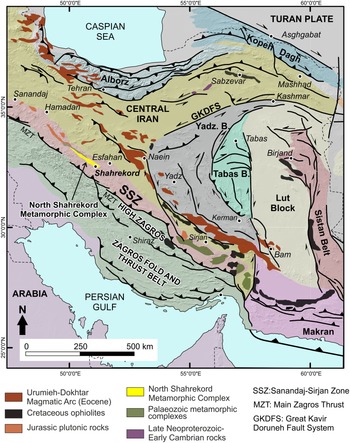
Here we present a multi-disciplinary study on the eclogites of the North Shahrekord Metamorphic Complex (NSMC, Sanandaj-Sirjan Zone, western Iran, Figure 1). The aim of this study is to unravel their Pressure-Temperature-time (P-T-t) path, providing information on the peak P-T conditions and their metamorphic evolution. The timing of the HP metamorphism and subsequent exhumation has been constrained by means of 40Ar/39Ar geochronology on eclogites and amphibolites, their retrogressed counterparts. Reconstructing the evolution of the NSMC eclogites is a key step in the understanding of the geodynamic processes associated with the onset and later stages of the Neo-Tethys subduction in western Iran.
Tectonic scheme of Iran and surrounding areas. Modified after Zanchi et al. (Reference Zanchi, Zanchetta, Berra, Mattei, Javadi and Montemagni2021). The location of the North Shahrekord Metamorphic Complex (NSMC) is highlighted.

Our results provide new P-T-t constraints on the onset and duration of eclogite facies metamorphism and subsequent amphibolite-facies retrogression in the Sanandaj-Sirjan Zone (Figure 1). Furthermore, the new data presented here, together with previously published petrological, geochemical and geochronological data on eclogites- and amphibolite-facies rocks (e.g. Davoudian et al. Reference Davoudian, Genser, Dachs and Shabanian2008, Reference Davoudian, Genser, Neubauer and Shabanian2016; Malek-Mahmoudi et al. Reference Malek-Mahmoudi, Davoudian, Shabanian, Azizi, Asahara, Neubauer and Dong2017; Jamali Ashtiani et al. Reference Jamali Ashtiani, Hassanzadeh, Schmitt, Sudo, Timmerman, Günter and Sobel2020; Maghdour-Mashhour et al. Reference Maghdour-Mashhour, Hayes, Pang, Bolhar, Shabani and Elahi-Janatmakan2021; Wan et al. Reference Wan, Chu, Chen, Zhang, Ao and Talebian2023), refine the geodynamic model for the evolution of the Sanandaj-Sirjan Zone in western Iran. We propose here a new scenario involving the subduction of continental crust induced by the tectonic erosion of the overriding plate.
2. Geological background
The Alpine–Himalayan orogenic belt resulted from the closure of the Neo-Tethys Ocean and consequent continental collision between the Eurasian and the African–Arabian–Indian plates. In the central part of the Neo-Tethys, the collision between Eurasia and Arabia and several continental microplates (i.e. the Cimmerian blocks) caused the formation of the Turkish-Iranian plateau and of the associated orogenic belts during the Mesozoic-Cenozoic (Brunet & Cloetingh, Reference Brunet and Cloetingh2003). The long-lasting convergence between the Eurasian and Arabian plates promoted the formation of the Zagros orogen (Agard et al. Reference Agard, Omrani, Jolivet, Whitchurch, Vrielynck and Spakman2011), which consists of several NW-SE trending tectonic units. These tectonic units from NE to SW are as follows: (i) the Urumieh–Dokhtar Magmatic Arc, an arc mainly composed of Cenozoic plutonic and volcanic rocks (Schröder, Reference Schröder1944; Förster, Reference Förster1974; Berberian & King, Reference Berberian and King1981; Berberian et al. Reference Berberian, Muir, Pankhurst and Berberian1982; Alavi, Reference Alavi1994); (ii) the Sanandaj–Sirjan Zone (SSZ, see Figure 1 in Stöcklin, Reference Stöcklin1968), representing a partially independent magmatic and metamorphic belt exposed to the NE of the Zagros orogen (Agard et al. Reference Agard, Omrani, Jolivet and Mouthereau2005; Mohajjel & Fergusson, Reference Mohajjel and Fergusson2014; Azizi et al. Reference Azizi, Zanjefili-Beiranvand and Asahara2015a, 2015b; Moghadam et al. Reference Moghadam, Khademi, Hu, Stern, Santos and Wu2015; Shakerardakani et al. Reference Shakerardakani, Neubauer, Masoudi, Mehrabi, Liu, Dong, Mohajjel, Monfaredi and Friedel2015; Hassanzadeh & Wernicke, Reference Hassanzadeh and Wernicke2016); (iii) the High Zagros consisting of imbricated tectonic slices of Mesozoic limestones, radiolarites and remnants of obducted ophiolites (Agard et al. Reference Agard, Omrani, Jolivet and Mouthereau2005); (iv) the Zagros Fold-and-Thrust Belt; and (v) the Mesopotamian-Persian Gulf foreland basin (Berberian & King, Reference Berberian and King1981; Alavi, Reference Alavi1994; Mohajjel & Fergusson, Reference Mohajjel and Fergusson2000). The Main Zagros Thrust (MZT) is identified as the suture zone between the Arabian plate and the Cimmerian blocks, with the SSZ that developed in the upper plate during the subduction of the Neo-Tethys Ocean.
The SSZ is located along the southwestern edge of the Iranian plateau (Figure 1), running parallel to the Zagros orogen for about 1500 km from eastern Anatolia to the north-western Makran area (McCall, Reference McCall2002). The SSZ consists of late Neoproterozoic and Pan-African basement (Crawford, Reference Crawford1977; Hassanzadeh et al. Reference Hassanzadeh, Stockli, Horton, Axen, Stockli, Grove, Schmitt and Walker2008; Nutman et al. Reference Nutman, Mohajjel, Bennett and Fergusson2014) that discontinuously crops out beneath Palaeozoic to Neogene metamorphic, igneous and sedimentary units (Agard et al. Reference Agard, Omrani, Jolivet, Whitchurch, Vrielynck and Spakman2011; Jamshidi Badr et al. Reference Jamshidi Badr, Collins, Masoudi, Cox and Mohajjel2013; Mohajjel et al. Reference Mohajjel, Fergusson and Sahandi2003; Mohajjel & Fergusson, Reference Mohajjel and Fergusson2014; Moghadam et al. Reference Moghadam, Khademi, Hu, Stern, Santos and Wu2015; Shakerardakani et al. Reference Shakerardakani, Neubauer, Masoudi, Mehrabi, Liu, Dong, Mohajjel, Monfaredi and Friedel2015; Sheikholeslami, Reference Sheikholeslami2015). The Palaeozoic sedimentary and magmatic record (Alirezaei & Hassanzadeh, Reference Alirezaei and Hassanzadeh2012; Moghadam et al. Reference Moghadam, Khademi, Hu, Stern, Santos and Wu2015) of the SSZ is related to the opening of the Neo-Tethys that was in turn related to the rifting of continental fragments (i.e. the Cimmerian block, Ricou, Reference Ricou1994; Stampfli & Borel, Reference Stampfli and Borel2002; Şengör & Yilmaz, Reference Şengör and Yilmaz1981; Şengör, Reference Şengör1984; Zanchi et al. Reference Zanchi, Malaspina, Zanchetta, Berra, Benciolini, Bergomi, Cavallo, Javadi and Kouhpeyma2015) away from the northern margin of Gondwana during the Permian (Alavi, Reference Alavi1994; Angiolini et al. Reference Angiolini, Zanchi, Zanchetta, Nicora and Vezzoli2013, Reference Angiolini, Zanchi, Zanchetta, Nicora, Vuolo, Berra, Henderson, Malaspina, Rettori, Vachard and Vezzoli2015; Agard et al. Reference Agard, Omrani, Jolivet, Whitchurch, Vrielynck and Spakman2011; Hassanzadeh & Wernicke, Reference Hassanzadeh and Wernicke2016; Mattei et al. Reference Mattei, Cifelli, Muttoni and Rashid2015; Moghadam et al. Reference Moghadam, Khademi, Hu, Stern, Santos and Wu2015; Zanchi et al. Reference Zanchi, Zanchetta, Berra, Mattei, Garzanti and Molyneux2009a). During the Cimmerian orogeny (Late Triassic), these crustal blocks collided with the Eurasian plate following the closure of the Palaeo-Tethys (e.g. Wilmsen et al. Reference Wilmsen, Fursich and Taheri2009; Zanchi et al. Reference Zanchi, Zanchetta, Berra, Mattei, Garzanti and Molyneux2009a; Zanchetta et al. Reference Zanchetta, Berra, Zanchi, Bergomi, Caridroit, Nicora and Heidarzadeh2013a; Zanchi et al. Reference Zanchi, Zanchetta, Balini and Ghassemi2016). Even if the evolution of the Cimmerian blocks after their collision is still not completely resolved (Zanchi et al. Reference Zanchi, Zanchetta, Garzanti, Balini, Berra, Mattei and Muttoni2009b; Zanchi et al. Reference Zanchi, Zanchetta, Berra, Mattei, Javadi and Montemagni2021 and references therein), their northern margin runs along the Palaeo-Tethys suture in north Iran and extends to northern Afghanistan, Pakistan, Pamir, Tibet and China (Angiolini et al. Reference Angiolini, Zanchi, Zanchetta, Nicora and Vezzoli2013, Reference Angiolini, Zanchi, Zanchetta, Nicora, Vuolo, Berra, Henderson, Malaspina, Rettori, Vachard and Vezzoli2015; Zanchetta et al. Reference Zanchetta, Worthington, Angiolini, Leven, Villa and Zanchi2018), and their southern boundary lies along the Neo-Tethys suture, namely the Main Zagros Thrust (MZT).
The switch from a passive continental margin to a continental arc in the SSZ occurred after the Cimmerian orogenic event, during the Late Triassic-Early Jurassic (Hassanzadeh & Wernicke, Reference Hassanzadeh and Wernicke2016; Maghdour-Mashhour et al. Reference Maghdour-Mashhour, Hayes, Pang, Bolhar, Shabani and Elahi-Janatmakan2021), when the Neo-Tethyan NNE-NE-dipping subduction likely started. The Mesozoic to Cenozoic convergence finally led to the collision between the Arabian and the Eurasian plates (Mohajjel et al. Reference Mohajjel, Fergusson and Sahandi2003; Agard et al. Reference Agard, Omrani, Jolivet and Mouthereau2005; Ghasemi & Talbot, Reference Ghasemi and Talbot2006; Moritz et al. Reference Moritz, Ghazban and Singer2006). From the onset of the Neo-Tethys subduction to the collision with Arabia, the SSZ was not only affected by subduction-related magmatism but also by deformative and metamorphic events, mainly of Jurassic age (e.g. Fergusson et al. Reference Fergusson, Nutman, Mohajjel and Bennett2016), recorded in the several metamorphic-magmatic complexes scattered all along the SSZ (Jamshidi Badr et al. Reference Jamshidi Badr, Collins, Masoudi, Cox and Mohajjel2013), the most of them showing greenschist to amphibolite and even eclogite facies conditions (Mohajjel & Fergusson, Reference Mohajjel and Fergusson2000; Sheikholeslami et al. Reference Sheikholeslami, Pique, Mobayen, Sabzehei, Bellon and Emami2008; Ghasemi & Poor Kermani, Reference Ghasemi and Poor Kermani2009; Davoudian et al. Reference Davoudian, Genser, Neubauer and Shabanian2016). Following Sheikholeslami (Reference Sheikholeslami2015), the Jurassic rocks of the SSZ have been affected by, at least, two syn-metamorphic regional deformation phases: the first occurring in the Early Jurassic includes four deformation events; the second one resulted in three deformation events affecting Lower Jurassic turbidites. During the first deformation phase, the metamorphic peak was reached at c. 187-180 Ma (U-Pb dating on Zrn; Fazlnia, Reference Fazlnia2007), whereas the HT peak metamorphism during the second deformational phase was constrained at c. 162 Ma (Sadegh et al. Reference Sadegh, Moeinzadeh and Moazzen2020).
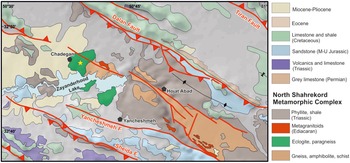
The study area is located in the central SSZ in the North Shahrekord Metamorphic Complex (NSMC) west of Esfahan, belonging to the complexly deformed sub-zone (Figures 1 and 2). Here rare eclogite bodies occur as lenses or small-sized boudins within ortho- and paragneisses derived from the Gondwanan Pan-African basement of Iran (Davoudian et al. Reference Davoudian, Genser, Dachs and Shabanian2008, Reference Davoudian, Genser, Neubauer and Shabanian2016; Nutman et al. Reference Nutman, Mohajjel, Bennett and Fergusson2014). The Gondwanan origin of the SSZ metamorphic belt has been proven (Fergusson et al. Reference Fergusson, Nutman, Mohajjel and Bennett2016) based on zircon ages pertaining to the Pan-African basement, which is exposed in wide areas of Central and Northwestern Iran (e.g. Hassanzadeh et al. Reference Hassanzadeh, Stockli, Horton, Axen, Stockli, Grove, Schmitt and Walker2008; Rahmati-Ilkhchi et al. Reference Rahmati-Ilkhchi, Faryad, Holub, Košler and Frank2011). U-Pb zircon ages also confirmed the Pan-African palaeogeographic affinity of granitic and metamorphic rocks near Golpaygan and around Lake Urumieh in the north-western sector of the SSZ (Fergusson et al. Reference Fergusson, Nutman, Mohajjel and Bennett2016 with references). Pan-African basement ages have been also documented in the central and northern Iranian Cimmerian continental blocks (Fergusson et al. Reference Fergusson, Nutman, Mohajjel and Bennett2016).
Simplified geological map of the NSMC in the Zayanderhood Lake area according to our field surveys and after Davoudian et al. (Reference Davoudian, Genser, Neubauer and Shabanian2016). The intrusion age of the metagranitoid has been constrained to be Ediacaran (Jamali Ashtiani et al. Reference Jamali Ashtiani, Hassanzadeh, Schmitt, Sudo, Timmerman, Günter and Sobel2020). The yellow star shows the location of Chadegan eclogites analysed in this study.

Eclogites of the NSMC occur as metre- to decametre-sized boudins hosted in amphibolites and paragneisses. Other units forming the NSMC consist of low- to very low-grade rocks such as schist, phyllite, marble, slate and metamorphosed sandstone, limestone, shale and volcanic rocks, with a possible Triassic to Jurassic age of the protoliths (U-Pb dating on Zrn; Davoudian et al. Reference Davoudian, Khalili, Noorbehsht, Dachs, Genser and Shabanian2006; Babaahmadi et al. Reference Babaahmadi, Mohajjel, Eftekhari and Davoudian2012).
3. Methods
3.a. Electron microprobe analyses
Electron microprobe analyses (EMPA) were carried out using a JEOL 8200 Super Probe EMP at the Department of Earth Sciences ‘A. Desio’, University of Milano. WDS (wavelength dispersive spectroscopy) quantitative chemical analyses and WDS X-ray elemental maps were performed on carbon-coated petrographic thin sections. Data acquisition was performed using an accelerating voltage of 15 kV, a beam current of 5 nA with a spot size of 3 µm on micas and 1 µm on other minerals. Oxides and natural silicates were used as standards. Analyses were recalculated to atom per formula unit (a.p.f.u.) as follows: garnet analyses were recalculated based on 8 cations and 24 charges; white mica was recalculated based on 11 oxygens and considering all Fe as Fe2+; clinopyroxene data were elaborated following the procedure by Cawthorn & Collerson (Reference Cawthorn and Collerson1974) based on 12 oxygens and considering Fe3+ as the acmite component; amphiboles analyses were recalculated based on 23 oxygens and 13 cations plus K, Na, Ca. Amphibole data were classified and plotted according to Hawthorne & Oberti (Reference Hawthorne and Oberti2007).
3.b. 40Ar/39Ar geochronology
Samples selected for 40Ar/39Ar dating were crushed and sieved in order to separate white mica (in the fraction 250-500 µm) and amphibole (in the fraction 125-250 µm) for stepwise heating experiments. The separates were enriched in white mica and amphibole using a Frantz magnetic separator and handpicked under a stereomicroscope. Mineral separates were then cleaned ultrasonically in deionised water and wrapped in aluminium foil. Samples and standards were irradiated for 30 MWh in a fast neutron flux at the McMaster University Research Reactor (Hamilton, CA). Stepwise heating experiments were performed at the ‘Laboratorio di Geocronologia’ of the University of Milano–Bicocca following the procedure reported in Montemagni & Villa (Reference Montemagni and Villa2021) and Montemagni & Zanchetta (Reference Montemagni and Zanchetta2022). Sample and standards were loaded in a double vacuum resistance furnace attached to a NuInstruments™ Noblesse® noble gas mass spectrometer, equipped with one Faraday collector with a 1011 Ω resistor and two MasCom™ ion counters. The samples were heated in 10 steps for 20 min each at temperatures from 620 °C to 1300 °C. The irradiation intensity factor, J, was interpolated for each sample from the equation defined by the J values of the monitors. The 40K decay constant used for the age calculation was 5.543 × 10⁻⁴ Ma–1 (Steiger & Jäger, Reference Steiger and Jäger1977). To control the vertical flux gradient, monitors of McClure Mountain hornblende (MMhb) were interlayered with the sample disk wraps. The MMhb age was assumed to be 523.98 ± 0.12 Ma (Schoene & Bowring, Reference Schoene and Bowring2006). Data reduction procedures, corrected for mass spectrometer background, ion counter gains, blank measurements, source fractionation and decay of 37Ar since irradiation, were processed in the in-house CalcolAr Excel spreadsheet, in which also all the associated uncertainties are propagated.
3.c. Thermodynamic modelling
Thermodynamic modelling in the SiO2 (46.71 wt%), Al2O3 (15.37 wt%), FeO (10.25 wt%), MgO (8.30 wt%), CaO (10.47 wt%), Na2O (2.97 wt%), K2O (0.87), TiO2 (1.41 wt%), MnO (0.18 wt%), H2O + CO2 (1.80 wt%, LOI in Table 1) compositional system (sample Z5S in Table 1) was performed with the software package Perple_X 7.1.5 (http://www.perplex.ethz.ch; Connolly, Reference Connolly2005), using the thermodynamic database of Holland & Powell (Reference Holland and Powell2011) (hp62ver.dat). The whole rock major elements composition was determined on the best-preserved eclogite (sample Z5S) by ICP-MS analysis at the ACME analytical laboratories (Vancouver, Canada) by Inductively Coupled Plasma Emission Spectrometry (ICP-ES) for major and minor elements and Inductively Coupled Plasma Mass Spectrometry (ICP-MS) for trace elements, including the rare earth elements, after fusion with lithium metaborate/tetraborate and digestion by diluted HNO3. Loss on ignition (LOI) was determined by weight difference after ignition at 1000 °C. Blank analyses were always below the minimum detection limit for each element, and the analytical protocol included the analysis of the reference materials (standards) OREAS184, SO-19, OREAS30A and OREAS262.
Whole rock analyses of eclogites. Major elements are expressed as oxide wt%, trace elements as ppm

Note: LOI: Loss On Ignition; n subscript – normalization to chondrite values (McDonough & Sun, Reference McDonough and Sun1995); ∑LREE – light rare earth element sum; ∑HREE – heavy rare earth elements sum; Eu/Eu* = Eun/RADQ(Smn × Gdn).
We used the following solution models: Gt(W), Chl(W) and Ctd(W) for garnet, chlorite and chloritoid from White et al. (Reference White, Powell, Holland, Johnson and Green2014), Omph(GHP) for clinopyroxene from Green et al. (Reference Green, Holland and Powell2007), CAmph(G) for amphibole from Green et al. (Reference Green, White, Diener, Powell, Holland and Palin2016), Pheng(HP) for white mica from Holland & Powell (Reference Holland and Powell1998), Sp(WPC) for spinel after White et al. (Reference White, Powell and Clarke2002), feldspar from Fuhrman & Lindsley (Reference Fuhrman and Lindsley1988) and cCcM(EF) for carbonate from Franzolin et al. (Reference Franzolin, Schmidt and Poli2011). The H2O-CO2 (CORK) equation of state was taken from Holland & Powell (Reference Holland and Powell1998). Considering the low vol% amount of epidote (only in small inclusions in garnet) and of aegirine component in clinopyroxene, for the sake of simplicity, we considered the total iron in the bulk as Fe2+.
4. Field occurrence and relationships
The NSMC (North Shahrekord Metamorphic Complex) consists of three main tectonometamorphic units (Davoudian et al. Reference Davoudian, Genser, Neubauer and Shabanian2016): an eclogite-bearing unit located in the area of the Zayandeh-Rood Lake, a low-grade unit extending SE of the lake, mainly made of phyllites (Figure 2), and a third unit, mainly consisting of gneisses, amphibolites and schists, cropping out to the east in a tectonic window within the low-grade metamorphic unit. Lenses of weakly deformed metagranitoids of Ediacaran intrusion age (U-Pb on Zrn, Jamali Ashtiani et al. Reference Jamali Ashtiani, Hassanzadeh, Schmitt, Sudo, Timmerman, Günter and Sobel2020) occur in the two units.
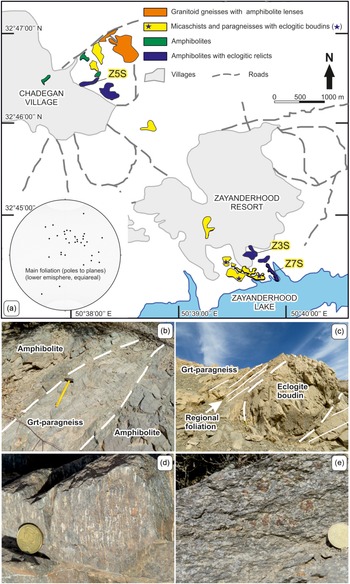
The contacts between the eclogite-bearing unit and surrounding ones are hardly visible due to poor exposures (Figure 3a). Amphibolites of the third unit frequently show a (proto)mylonitic fabric, suggesting that they are in contact with the rocks of the HP unit through a ductile shear zone. Eclogites occur as metre-sized to several decametre-sized boudins within country rocks (Figure 3c), which mainly consist of garnet-bearing paragneiss and granitoid orthogneiss (Figure 3d and 3e). The regional foliation in paragneiss and orthogneiss dips to S-SSW at low to medium angle (Figure 3). Detailed structural relationships within the eclogite-bearing unit of the NSMC are not available since the strong weathering and the dispersed occurrence of outcrops (Figure 3a) significantly hamper their reconstruction in the field. However, where observable, the eclogitic boudins are always hosted in garnet paragneiss (Figure 3c).
(a) Outcrops map of the NSMC rocks in the Chadegan area according to our field surveys. The location of the analysed samples has been reported. Field aspect of eclogites and surrounding rocks: (b) amphibolite layers stretched along the main foliation of the hosting paragneisses; (c) eclogitic boudins hosted in garnet paragneiss. The regional foliation in paragneiss has been highlighted. (d) Eclogite texture as appearing in the field, with a marked foliation and weakly developed compositional layering; (e) Grt-bearing granitoid orthogneisses.

Eclogites display different degrees of retrogression, ranging from almost fresh eclogites with the HP mineral phase assemblage still well preserved, to garnet and epidote amphibolites. Retrogression of the eclogitic lenses is coupled with an increase in deformation, with former boudins that are progressively stretched along the main foliation of the hosting paragneisses (Figure 3b). Eclogitic lenses display a foliation and/or compositional layering developed at small angle with respect to the paragneiss foliation that wraps around the boudins. The mineralogical layering is defined by alternating omphacite-phengite rich and garnet-amphibole rich levels, with the shape preferred orientation of omphacite, phengite and clinozoisite that marks the foliation.
5. Metamorphic evolution of the NSMC eclogites
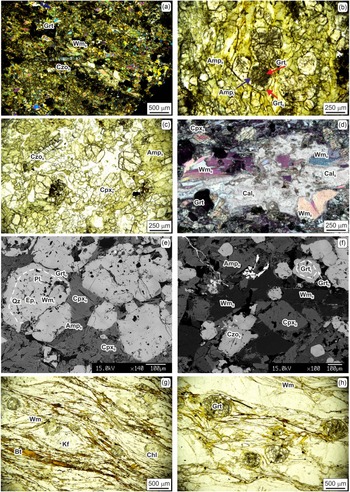
Petrographic observations were performed on all lithologies of the metamorphic complex. Representative microstructures of the main equilibrium phase assemblages are reported in Figure 4. Mineral abbreviations are after Whitney & Evans (Reference Whitney and Evans2010) except for white mica (Wm).
Microphotographs of rock fabrics. (a) The preserved eclogites showing an inequigranular texture, with garnet porphyroblasts of 5-12 mm embedded in a matrix; (b) Garnet porphyroblasts showing inclusions-rich core (GrtI) and clear rim (GrtII); (c) Clinozoisite (CzoII) occurs along the HP foliation in retrogressed eclogite; (d) CalII laths aligned parallel to the eclogitic foliation marked by WmII. Two-mica orthogneisses (g) and garnet-bearing paragneisses (h) showing a foliation made by micas enveloping feldspar (g) or garnet (h) porphyroblasts. (e) Garnet porphyroblasts preserving in their cores minerals of stage I (i.e. pre-eclogitic); (f) Stage II phase assemblage with AmpII + WmII + CpxII + GrtII + CzoII.

Our study was focussed both on fresh or only partially retrogressed eclogite samples (Figure 4a-f), in order to reconstruct the evolution of the equilibrium phase assemblages and to define the P-T evolution of the eclogite-bearing unit of the NSMC. The degree of retrogression after the HP stage is variable from eclogites still almost completely preserving the HP phase assemblage (Figure 4a-b), to eclogites completely retrogressed into epidote amphibolites.
Two-mica orthogneiss (Figure 4g) and garnet-bearing paragneiss (Figure 4h) are also found in the NSMC, either showing a foliation made by micas enveloping feldspar (Figure 4g) or garnet (Figure 4h) porphyroblasts. Most of the orthogneisses were garnet-bearing, as testified by the occurrence of abundant chlorite pseudomorphs after garnet porphyroblasts (Figure 4g).
The preserved eclogites (Figure 4a) are made of omphacite, garnet, white mica, clinozoisite, amphibole, epidote, plagioclase and quartz; rutile and ilmenite are the main accessory phases, whereas apatite and zircon are rare. Calcite also occurs in some samples, in lath-shaped crystals parallel to the omphacite foliation.
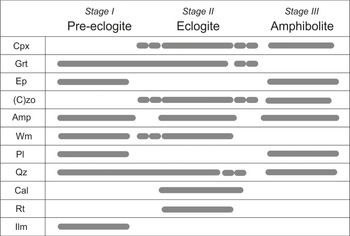
Based on petrographic and microstructural observations, three equilibrium phase assemblages, and relative metamorphic stages, can be reconstructed and summarized as follows (Figure 5):
Reconstructed textural equilibrium phase assemblages derived from microstructural observation for pre-eclogite (I), eclogite (II) and amphibolite (III) metamorphic evolution stages.

(1) pre-eclogite facies preserved as inclusions within garnet cores (stage I in Figure 5); (2) a HP eclogite facies stage (stage II in Figure 5) and (3) a late amphibolite-facies retrogression (stage III in Figure 5). Subscripts of mineral labels refer to the metamorphic stages in which they formed and/or were re-equilibrated.
5.a. Pre-eclogite facies stage (I)
Due to the strong overprint during subsequent deformation and metamorphic recrystallization, most of the mineral assemblages and textures belonging to the pre-eclogite facies metamorphism have been preserved only as inclusions in the cores of garnet porphyroblasts (Figure 5b). The preserved phase assemblage (Figure 5) is represented by:
 $${\rm{Gr}}{{\rm{t}}_{\rm{I}}} + {\rm{Am}}{{\rm{p}}_{\rm{I}}} + {\rm{W}}{{\rm{m}}_{\rm{I}}} + {\rm{E}}{{\rm{p}}_{\rm{I}}} + {\rm{P}}{{\rm{l}}_{\rm{I}}} + {\rm{Qz}} + {\rm{Il}}{{\rm{m}}_{\rm{I}}}.$$
5.b. HP eclogite facies stage (II)
The eclogites display an inequigranular texture, with garnet porphyroblasts of 5-12 mm embedded in a matrix mainly composed of omphacite, amphibole and zoisite. Garnets have frequently an inclusions-rich core (GrtI) and a clear rim (GrtII).
The rim of garnet porphyroblasts (GrtII) appears pre- to syn-kinematic with respect to the HP foliation (Figure 4b), which is individuated by the shape preferred orientation of omphacite (CpxII), amphibole (AmpII) and white mica (WmII). Clinozoisite (CzoII) also occurs along the HP foliation in some samples (Figure 4c) or crosscut the foliation (CzoIII). Calcite also occurs, in lath-shaped crystals parallel to the omphacite and white mica foliation (Figure 4d), likely derived from previous aragonite at HP and subsequently transformed into calcite during decompression (Dey et al. Reference Dey, Sen, Sen and Choudhary2023). Tiny rutile crystals (RtII) occur mainly close to AmpII or along omphacite-garnet interfaces.
The HP eclogite facies were constrained by the phase assemblage (Figure 5):
 $${\rm{Gr}}{{\rm{t}}_{{\rm{II}}}} + {\rm{Cp}}{{\rm{x}}_{{\rm{II}}}} + {\rm{W}}{{\rm{m}}_{{\rm{II}}}} + {\rm{Cz}}{{\rm{o}}_{{\rm{II}}}} + {\rm{Am}}{{\rm{p}}_{{\rm{II}}}} + {\rm{R}}{{\rm{t}}_{{\rm{II}}}} + {\rm{Ca}}{{\rm{l}}_{{\rm{II}}}} + {\rm{Qz}}{\rm{.}}$$
5.c. Amphibolite-facies stage (III)
The retrogression under amphibolites-facies conditions results in the partial substitution of omphacite (CpxII) by pseudomorphic aggregates of amphibole (AmpIII) + plagioclase (PlIII) or diopside (CpxIII) + plagioclase (PlIII), which is evidence of the late partial breakdown of omphacite during water-present decompression after HP metamorphism (O’Brien & Rötzler, Reference O’Brien and Rötzler2003; Martin, Reference Martin2019). Extremely fine-grained diopside + hornblende + plagioclase symplectites grew after the HP Ca-Na-clinopyroxene (CpxII). The amphibole formed at this stage not only occurs in symplectites but also crystallizes in the matrix, partially substituting large AmpII crystals with prismatic habit that were likely aligned along the HP foliation. Epidote (EpIII) has been also observed in some samples. The phase assemblage (Figure 5) is represented by:
 $${\rm{Am}}{{\rm{p}}_{{\rm{III}}}} + {\rm{P}}{{\rm{l}}_{{\rm{III}}}} + {\rm{Cp}}{{\rm{x}}_{{\rm{III}}}} + {\rm{E}}{{\rm{p}}_{{\rm{III}}}} + {\rm{Qz}}{\rm{.}}$$
6. Mineral chemistry
Mineral phases representative of the crystallization/deformation stages reconstructed above were analysed to define the P-T conditions during the whole tectonometamorphic evolution of the NSMC.
X-rays elemental maps of garnet porphyroblasts (Figure 6) show a heterogeneous compositional variation. As shown in Figures 6c and 6d, the microstructural zoning characterized by inclusions-rich cores and clear rims reflects two crystallization events (GrtI and GrtII). Both GrtI and GrtII show a poorly developed chemical zonation, with only a very slight increase of pyrope from cores to rims (Figure 6b). Grossular and spessartine are grossly homogeneous (exception done for microinclusions of the pre-eclogitic stage revealed by some spots). At a closer view, spessartine shows a patchy variation possibly derived from dissolution-precipitation phenomena associated with the occurrence of fluids (e.g. Giuntoli et al. Reference Giuntoli, Lanari and Engi2018; Hyppolito et al. Reference Hyppolito, Cambeses, Angiboust, Raimondo, García-Casco and Juliani2019). Garnet porphyroblasts are frequently fractured, as well observable in the Ca and Mg maps of Figure 6, allowing the penetration of fluids inside them.
WDS X-ray elemental maps of representative garnet porphyroblasts of the NSMC eclogites. Mn-rich cores are visible in both garnet porphyroblasts from samples Z5S (a) and Z7S (b). If Z7S garnet displays a continuous zoning, garnet from sample Z5S displays a patchy zoning, with irregular distribution of Ca and Mn abundances (a). The compositional profile obtained by means of quantitative WDS spot analyses along a line of Figure 6c related to the Mn-content clearly points to a polyphasic growth of garnet porphyroblasts. In the lower part of (c) and (d) the spessartine content is shown with an enlarged vertical scale to see the Sps variation along the profile.

The chemical composition of garnets from eclogites could be summarized as follows: GrtI (garnet cores) consists of Alm52-58Grs29-31Pyr9-15Sps1-7; GrtII (garnet rims) consists of Alm52-60Grs24-30Pyr10-13Sps0-3 (representative EMPA of garnets are reported in Table 2).
Representative EMPA of Grt porphyroblasts of the NSMC eclogites. (I) Garnet cores, (II) garnet rims

† Total iron as FeO.
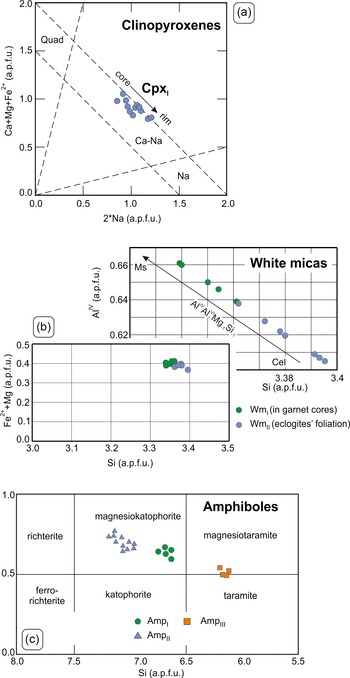
Pre-eclogitic stage mineral phases are only preserved as inclusions in garnet cores (GrtI). Among them, phengitic white mica (WmI) and amphibole (AmpI) are the most useful for the determination of P-T conditions during this stage. WmI has a phengitic composition with Si contents ranging from 3.34 to 3.36 atoms per formula units (a.p.f.u.). Amphiboles included in garnet cores (AmpI) are sodic-calcic, with Si of 6.6-6.7 a.p.f.u. Following the classification scheme of Hawthorne & Oberti (Reference Hawthorne and Oberti2007), they could be classified as magnesio-katophorites. Other minerals of the same stage are epidote (EpI), an almost pure pistacite (Table 2), quartz, ilmenite, and rare plagioclase (PlI) displaying an albitic composition (Table 3). The observed microstructural relationships do not allow to assess if garnet was a stable phase during this stage (as proposed in Figure 5) or grew later, following increasing pressure conditions that lead to the eclogitic stage (Stage II, Figure 5).
Representative EMPA of Cpx, Wm, Amp, Ep, and Pl of the NSCM eclogites. (I) pre-eclogite, (II) eclogite and (III) amphibolite metamorphic evolution stages

† Total iron as FeO; b.d.l.: below detection limit.
CpxII displays composition with a Na content expressed as jadeite from 0.36 to 0.46 mol% (Table 3), with increasing Na from core to rim (Figure 7a), resembling the prograde zonation of garnet. The shape preferred orientation of CpxII, and WmII defines the eclogitic foliation. WmII has higher Si content with respect to WmI (Figure 7b), suggesting higher pressure conditions. The Si content of WmII ranges from 3.36 to 3.40 a.p.f.u., approaching the celadonitic end member. Rare AmpII crystals in eclogite, stable with the other HP mineral phases, also display compositions in agreement with the magnesio-katophorite compositional field (Figure 7d) like AmpI, but with slightly lower Si contents and XMg [Mg/(Mg+Fe2+)] values.
(a) Clinopyroxene (CpxII) composition, rims are enriched in Na. (b) The Si content of phengitic white micas increases from WmI, preserved as inclusion in garnet cores to WmII stable as HP phase. (c) Classification of Ca-Na amphibole composition in eclogites and amphibolites, see text for description.

Eclogites of the NSMC are partially to completely retrogressed under amphibolites-facies conditions. Samples displaying the most complete retrogression during this stage were selected for EMPA. The AmpIII partially replaces AmpII corresponding to a Mg-hornblende (Figure 7c) and its composition significantly differs from previous amphibole generation, becoming more Ca-rich (Figure 7c), plotting within the magnesio-hornblende field. The Na content of AmpIII is lower (0.42-0.45 a.p.f.u.) with respect to AmpII, suggesting that they likely formed already during the exhumation after the pressure peak. AmpII, growing both at the expense of AmpI and in the matrix, has lower Ca and Si (6.15-6.25 a.p.f.u.). Fe-rich epidote (EpIII) is the Al-rich phase in place of garnet, suggesting lower pressure conditions during this stage, i.e. epidote-amphibolite facies.
7. 40Ar/39Ar geochronology
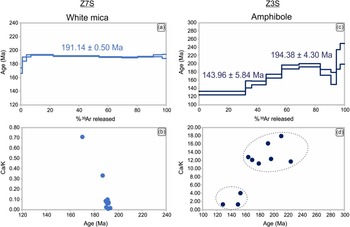
Two samples have been investigated for the determination of the geochronological evolution of the NSMC (Figure 8 and Table 4). White mica separates from an eclogite (sample Z7S) and amphibole (AmpIII) from an amphibolite (Z3S) have been analysed for 40Ar/39Ar dating in order to constrain the timing of the peak pressure and the subsequent retrogression at epidote-amphibolites-facies conditions.
40Ar/39Ar age spectra and Ca/K vs. age diagrams for eclogite Z7S (a, b) and amphibolite Z3S (c, d). Dotted circles in (d) are referred to amphibole generations AmpII and AmpIII.

40Ar/39Ar data. All Ar isotope concentrations are given as mL. K, Ca and Cl concentrations are calculated from the sample mass and the 39Ar, 37Ar and 38Ar concentrations, respectively. 40Ar*=radiogenic 40Ar. All errors are 1σ

White mica (WmII) grows aligned along the eclogitic foliation, so its recrystallization age broadly corresponds to the HP peak stage experienced by the NSMC eclogites. Taking into consideration the flat part of the age spectrum corresponding to homogeneous Ca/K values calculated from the 37Ar/39Ar ratio (Figure 8) and the amount of gas released in the flat part of the spectrum, which corresponds to c. 84% of the total 39Ar released, the age of white mica in Z7S is 191.14 ± 0.50 Ma (Figure 8a, b).
Large amphibole crystals belonging to the AmpIII generation in completely retrogressed eclogites (i.e. amphibolite) have been selected for dating. The Ar release pattern of the Z3S sample (Figure 8c) is quite complex. The staircase pattern is likely related to the mixing trend of two amphibole generations, AmpII and AmpIII, the latter partially overgrown at the expenses of AmpII (see above), showing different Ca/K ratios (Figure 8d). Considering the chemical composition derived from the 37Ar/38Ar, the cluster showing lower Ca/K ratios is referred to be 143.96 ± 5.82 Ma, whereas the cluster with higher Ca/K ratios has 194.38 ± 4.30 Ma. This age distribution accounts for the stability of amphibole during peak pressure condition and subsequent recrystallization with decreasing Ca/K ratio during retrogression. EMPA data indicate that AmpIII has significantly lower Ca/K values with respect to AmpII (Table 3).
8. Thermodynamic modelling and metamorphic evolution
The microstructural analyses and the chemical composition of HP minerals in the studied (not retrogressed) eclogites indicate a prograde metamorphism mainly recorded by two stages of garnet crystallization (core, GrtI, and rim, GrtII), and a subsequent chemical zoning observed both in garnet rims (GrtII) and in omphacite (CpxII). Moreover, the patchy garnet zoning (Figure 6c) was likely due to syn-deformation dissolution and reprecipitation processes mediated by metamorphic fluids. This is evidence of a complex metamorphic history that is difficult to reconstruct in detail from a thermodynamic modelling point of view.
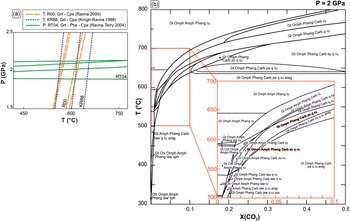
Conventional geothermobarometric calculations have been performed on one of the best-preserved eclogites (Z5S) in order to compare the obtained estimates with the modelling results (e.g. Wei & Clarke, Reference Wei and Clarke2011). The occurrence of coexisting clinopyroxene and garnet stable in the peak metamorphic assemblage (Stage II) allows the use of the Fe-Mg exchange thermometer (Krogh Ravna, Reference Krogh Ravna1988, Reference Krogh Ravna2000) between the two phases. The occurrence of phengite also allows estimating the pressure using the geothermobarometer of Krogh Ravna & Terry (Reference Krogh Ravna and Terry2004) developed for garnet + omphacite + phengite + kyanite + quartz in the KCMASH system. In the quartz stability field, the geothermobarometer consists of three independent reactions cross-cutting each other in a single invariant point (Figure 9a). One of the three reactions is kyanite and quartz-free (2 Grs + Pyr + 3 Al-Cel = 6 Di + 3 Mus), therefore suitable for the kyanite-free eclogites of the NSCM. Minerals (garnet, omphacite and phengite) in textural equilibrium showing no sign of retrogression have been selected and analysed with the EMP (Table 5), and the results are reported in Figure 9a and Table 5. The estimated pressure ranges from 1.90 to 2.15 GPa with T in the 510-600 °C using the Krogh Ravna (Reference Krogh Ravna1988) thermometer. A restricted temperature interval, 510-540 °C, stems instead employing the Krogh Ravna (Reference Krogh Ravna2000) version of the same thermometer.
(a) Results of P-T estimate using conventional geothermobarometry with the composition of mineral pairs reported in Supplementary Material 2 (b) T-X chemical sections of the eclogite Z5S (see composition in the ‘Methods’ section), where X(CO2) = CO2/(CO2 + H2O). The red box is a zoom of the phase assemblages in the range of 500 – 700 °C and X(CO2) between 0 and 0.1. Abbreviations for minerals and compositional end-members after Connolly (Reference Connolly2005).

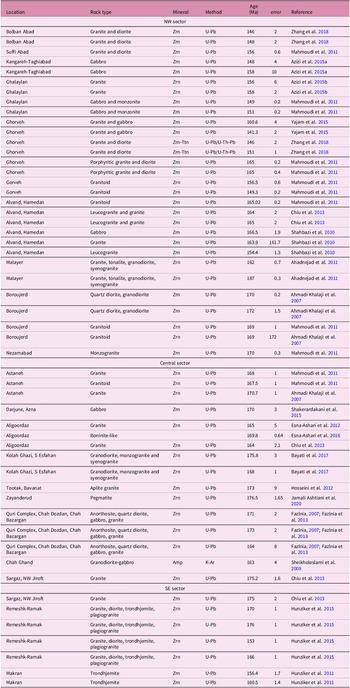
Compilation of ages of Early-Middle Jurassic magmatic activity in the SSZ

With respect to conventional geothermobarometry, the reconstruction using forward modelling is in principle more robust even if the limitations of reliable solid solution models, particularly of amphibole, must be kept into consideration.
In order to check the role of CO2 in the fluid and the stability of carbonates at the peak pressure as shown by the microstructural evidences, we constructed a T-X section of sample S5Z, based on the variation of X(CO2) and temperature, at P = 2 GPa (Figure 9b).
The amount of CO2 strongly influences the stability of zoisite in a short range of temperature (550 – 650 °C, at X(CO2) up to 0.3). We therefore considered the phase assemblage garnet, omphacite, carbonate, quartz, zoisite, and rutile (± amphibole) as the possible mark of P-T range at X(CO2) up to 0.1, as demonstrated by microstructural evidences. The occurrence of amphibole strongly influences the temperature range of the mineral stability (550-600 °C for X(CO2) = 0.01-0.04 or 550-650 °C for X(CO2) = 0.015-0.03). If we assume that amphibole was in equilibrium at the peak and compare the garnet mol% compositions with those retrieved by the thermodynamic modelling (see properties in the Supplementary Material 1), we estimate that the peak P-T conditions recorded by our preserved eclogites range from 550 to 600 °C, at 2 GPa.
9. Discussion
9.a. P-T conditions of metamorphism
The studied samples show peak mineral assemblage and garnet composition compatible with pressures in the range between 1.8 and 2.1 GPa (Figure 9a), considering the conventional thermobarometry. More difficult is the determination of the equilibration temperature that ranges between 500 °C and 650 °C based on the occurrence of CO2 in the fluid that may or may not stabilize carbonates among the HP mineral assemblages, along with the stability of amphibole at peak conditions. In addition, the comparison with experimental works on the phase stability of amphibole + zoisite in mafic assemblages (e.g. Schmidt & Poli, Reference Schmidt and Poli1998; Forneris & Holloway, Reference Forneris and Holloway2003) is in agreement with both the estimated temperatures, being stable between 500 and 700 °C. It must be noted that even if the bulk composition of our studied samples is slightly depleted in SiO2 (46.71 vs 52.4 wt%) and enriched in MgO (8.30 vs 7.1 wt%) with respect to a MORB as reported in the experiments of Schmidt & Poli (Reference Schmidt and Poli1998), in the presence of fluids our phengite-bearing eclogites would have undergone partial melting at 1.8 GPa and 700 °C. The presence of fluids at peak conditions is demonstrated not only by the occurrence of hydrous phases but also by the microstructure of garnet zoning that resembles a coupled dissolution-reprecipitation and diffusional equilibration (Figure 6; Massonne & Li, Reference Massonne and Li2020). However, the microstructures of our samples do not give evidence of such high temperatures and/or related symplectites growing during the retrogression, such as those encountered in the Central Italian Alps, at Borgo (Pellegrino et al. Reference Pellegrino, Malaspina, Zanchetta, Langone and Tumiati2020).
The conditions of the formation of amphibole and clinozoisite-epidote porphyroblasts in eclogites have only rarely been addressed (Massonne, Reference Massonne2012 with references), but P-T conditions around 2 GPa and 600 °C seem to be characteristic for their formation. These P estimates are similar to our data within the analytical error. Massonne (Reference Massonne2012) suggested that the formation of amphibole and clinozoisite in eclogite is typical in subduction settings where deep burial of material from the overriding plate occurred, followed by fluid infiltration responsible for the formation of H2O-bearing HP mineral phases in former anhydrous phase assemblages. After the first hydration, the formation of hydrous porphyroblasts in HP rocks can continue also during their progressive exhumation, following resorption and compositional re-equilibration of existing porphyroblasts and the growth of new ones when the destabilization of hydrous phases occurs in response of P-T variations (e.g. Huang et al. Reference Huang, Kusky, Johnson, Wilde, Wang, Polat and Fu2020, Reference Huang, Wei, Dong and Zhang2023) in dynamic settings like subduction channels.
The eclogites from Dabie Shan in China (Massonne, Reference Massonne2012), Altiplano-Puna plateau in the central Andes (Allmendinger et al. Reference Allmendinger, Jordan, Kay and Isacks1997; Giese et al. Reference Giese, Scheuber, Schilling, Schmitz and Wigger1999), Kaghan Valley in western Himalaya (Lombardo & Rolfo, Reference Lombardo and Rolfo2000; Wilke et al. Reference Wilke, O’Brien, Gerdes, Timmerman, Sudo and Khan2010), Cretaceous eclogites from the Austroalpine domain of the European Alps (e.g. Spalla et al. Reference Spalla, Lardeaux, Dal Piaz, Gosso and Messiga1996; Thöni, Reference Thöni2006; Zanchetta et al. Reference Zanchetta, Poli, Rubatto, Zanchi and Bove2013b) may represent a geodynamic scenario similar to the one given by the eclogites of the North Shahrekord Metamorphic Complex. The clockwise P-T path (Figure 10d) constructed for the eclogite accounts for an initial pre-eclogite stage (stage I) preserved in garnet porphyroblasts, a HP eclogite facies metamorphic stage at 1.90-2.15 GPa and 550-600 °C and a subsequent epidote-amphibolite-facies retrograde stage. The estimated peak conditions fall for temperature in the range (470-630°C) proposed by Davoudian et al. (Reference Davoudian, Genser, Dachs and Shabanian2008) and Davoudian et al. (Reference Davoudian, Genser, Neubauer and Shabanian2016) for the same NSMC eclogites. Our estimated pressures are instead lower by about 0.4-0.6 GPa, as previously calculated pressures are high as 2.5 GPa (Davoudian et al. Reference Davoudian, Genser, Dachs and Shabanian2008; Davoudian et al. Reference Davoudian, Genser, Neubauer and Shabanian2016). We suggest that this higher pressures should be considered only as a maximum as a) the used chemical composition of HP phases was selected to maximize the Na content in omphacite, the Si content in phengite, and the Pyr and Grs activity in garnet; b) the equilibrium phase assemblage on which the used geothermobarometer (Krogh Ravna & Terry, Reference Krogh Ravna and Terry2004) considers the occurrence of kyanite, which is not present in the NSMC eclogites; c) the occurrence of carbonates (calcite and dolomite, Davoudian et al. Reference Davoudian, Genser, Neubauer and Shabanian2016) has not been considered in the geothermobarometric calculations. Regarding these last points, we would stress how the occurrence of a fluid phase not formed only by pure H2O could significantly change the equilibrium phase assemblages as well as the composition of single minerals, as discussed before and shown in Figure 9b.
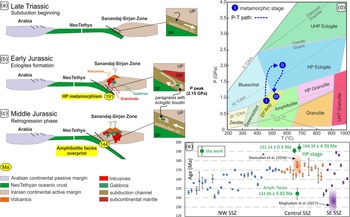
A schematic diagram showing the tectonic evolution of the SSZ from the (a) Late Triassic to the (b) Early and (c) Middle Jurassic. The white arrows in boxes (a, b, c) show the prevalent direction of materials in the subduction channel; the black arrow (a) points to the upper plate-derived rocks dragged in the subduction channel. (d) P-T path (in blue) for our studied eclogites derived from pseudosection modelling and conventional geothermobarometry. (e) Age distribution of magmatic activity in the SSZ. The orange box refers to the age of phengite in the eclogite of the NSMC from Davoudian et al. (Reference Davoudian, Genser, Neubauer and Shabanian2016); the violet box refers to the age of SE Zagros eclogite from Moghadam et al. (Reference Moghadam, Brocker, Griffin, Li, Chen and O’Reilly2017). UP: upper plate; SM: subcontinental mantle; SP: subducting plate.

9.b. Timing and tectonic implications
The eclogites of the NSMC in the SSZ are the only record of Jurassic HP metamorphism identified in the Zagros orogen sensu lato (Davoudian et al. Reference Davoudian, Genser, Neubauer and Shabanian2016), therefore being key rocks to the understanding of subduction-related processes that occurred in this area. The first question is if the 40Ar/39Ar is a sound method to date the metamorphic peak in HP assemblage or if inherited Ar and fluid-aided retrogression could affect the Ar retention or loss. Besides the fact that many workers endeavoured to date HP and UHP metamorphism through 40Ar/39Ar on phengite and amphibole (Halama et al. Reference Halama, Konrad-Schmolke, Sudo, Marschall and Wiedenbeck2014 and references therein), a long discussion about inherited and excess Ar is reported in Villa et al. (Reference Villa, Bucher, Bousquet, Kleinhanns and Schmid2014), who demonstrated that excess Ar was never credibly documented supported also by the absence of a grain size effect and by multichronometry (e.g. Lu-Hf and Rb-Sr). Regarding the fluid-aided retrogression, since the formation of retrograde minerals involves a recrystallization, a complete loss of Ar occurs, even at very low temperature (Maineri et al. Reference Maineri, Benvenuti, Costagliola, Dini, Lattanzi, Ruggieri and Villa2003). Taking into account all these aspects, 40Ar/39Ar on phengite and amphibole is still a robust method for dating high-pressure rocks returning a minimum age of peak metamorphism.
Several contrasting models have been proposed to explain the formation and geodynamic evolution of the SSZ metamorphic belt (Hassanzadeh & Wernicke, Reference Hassanzadeh and Wernicke2016 and references therein; Shafaii Moghadam et al. Reference Moghadam, Li, Li, Stern, Levresse, Santos, Lopez Martinez, Ducea, Ghorbani and Hassannezhad2020; Maghdour-Mashhour et al. Reference Maghdour-Mashhour, Hayes, Pang, Bolhar, Shabani and Elahi-Janatmakan2021; Gharibnejad et al. Reference Gharibnejad, Rosenberg, Agard, Kananian and Omrani2023), mostly concerning the onset of the Neo-Tethys subduction event and the related magmatism without taking into account the occurrence of Lower Jurassic eclogites.
The MORB-like affinity of the NSMC eclogites (Davoudian et al. Reference Davoudian, Khalili, Noorbehsht, Dachs, Genser and Shabanian2006) is testified also by data presented in this work (Table 1). However, no geochronological constraints exist on the protoliths’ age. As the NSMC eclogites, as well as other units forming the SSZ metamorphic belt, show a clear Gondwanan affinity (Fergusson et al. Reference Fergusson, Nutman, Mohajjel and Bennett2016), they should be considered to be originally in an upper plate position during the onset of the subduction of the Neo-Tethys. A mechanism capable to drag slices of continental crust derived from the upper plate at HP conditions should then be invoked to explain the formation of the NSMC eclogites. In the early phases of evolution of an orogen, a primary role may be played by tectonic erosion during subduction. Tectonic erosion has been widely recognized in oceanic subductions (e.g. Von Huene & Scholl, Reference Von Huene and Scholl1991; Barth & Schneiderman, Reference Barth and Schneiderman1996; Clift & Vannucchi, Reference Clift and Vannucchi2004; Clift & Hartley, Reference Clift and Hartley2007; Pastor-Galán et al. Reference Pastor-Galán, Spencer, Furukawa and Tsujimori2021) and rarely documented in continental subduction zones (e.g. Yin et al. Reference Yin, Manning, Lovera, Menold, Chen and Gehrels2007; Lu et al. Reference Lu, Zhang and Mattinson2018) or in back-arc basins (Peng et al. Reference Peng, Yu, Li, Liu, Santosh, Lv, Li, Li and Liu2022). Peng et al. (Reference Peng, Yu, Li, Liu, Santosh, Lv, Li, Li and Liu2022) reported the occurrence of retrograde eclogites, characterized by peak metamorphic mineral assemblages with garnet, omphacite, rutile and quartz, within the Amdo microcontinent in central Tibet. These authors suggest that tectonic erosion associated with the subduction of the Amdo microcontinent beneath the Tethys Ocean accounts for the deep subduction induced by tectonic erosion of the overriding plate. Lu et al. (Reference Lu, Zhang and Mattinson2018) also reported evidence of tectonic erosion related to continental subduction in north-western China. In this scenario, the eclogites from NSMC can thus be interpreted as lithologically heterogeneous tectonic slices derived from the upper plate, eroded and deeply buried via subduction channel on top of the subducting slab (Figure 10a). They subsequently underwent eclogite facies metamorphism (Figure 10b), exhumed along an exhumation channel and (re-)coupled with the crust of the overriding plate experiencing amphibolite-facies metamorphism (Figure 10c).
An additional hypothesis, that is also coherent with the upper plate derivation of the NSMC eclogites, is the subduction of tectonic slices derived from the hyperextended continental margin at the ocean-continent transition (Manatschal et al. Reference Manatschal, Chenin, Haupert, Masini, Frasca and Decarlis2022). However, in order to lean towards this hypothesis, remnants of (meta)sedimentary sequences and fossil structures typical of rifted margins (Manatschal & Chenin, Reference Manatschal and Chenin2023) should have been recognized.
The development of a volcanic arc magmatism (Figure 10a-c) of calc-alkaline affinity either in an island arc setting (i.e. Japan-like arc) or on a continental margin (i.e. Andean-type arc) has been broadly considered as an indirect evidence that subduction of the Neo-Tethys beneath Central Iran began in the Early Jurassic (Fergusson et al. Reference Fergusson, Nutman, Mohajjel and Bennett2016; Hassanzadeh & Wernicke, Reference Hassanzadeh and Wernicke2016) or even at the very end of the Triassic (Berberian & King, Reference Berberian and King1981). Indeed, in addition to ubiquitous Lower Jurassic intrusive bodies (187 Ma the oldest, with a climax around 170 Ma: Figure 10e and Table 5), diffuse coeval calc-alkaline volcanism and volcaniclastic sedimentation became prevalent in the SSZ, which is the key proof of the transition from passive margin sedimentation to the growth of a magmatic arc along an active margin (Hassanzadeh & Wernicke, Reference Hassanzadeh and Wernicke2016). The occurrence of eclogites in the SSZ supports the onset of an active convergent margin on the southwestern side of Central Iran, as was already supposed in the palaeogeographic reconstructions of Berberian & King (Reference Berberian and King1981). They suggested that a subduction zone was active since the Late Triassic and related to the consumption of what they called the ‘High-Zagros Alpine ocean’, dividing Central Iran from Arabia. The subduction margin developed in response to the closure of the Palaeo-Tethys to the north and the accretion of Central Iran to the southern Eurasia margin. Subduction moved from the Palaeo-Tethys suture, after the Eo-Cimmerian orogenic event (Zanchi et al. Reference Zanchi, Zanchetta, Berra, Mattei, Garzanti and Molyneux2009a, Reference Zanchi, Zanchetta, Garzanti, Balini, Berra, Mattei and Muttoni2009b; Zanchetta et al. Reference Zanchetta, Berra, Zanchi, Bergomi, Caridroit, Nicora and Heidarzadeh2013a), to the south. Evidence of the onset of an active margin along the SSZ are the andesitic-basaltic volcanism and granitoid intrusions exposed under the Jurassic and Cretaceous sediments of the SSZ (Berberian & King, Reference Berberian and King1981).
Available data (Figure 10e and Table 5) demonstrate that the magmatic history is continuous in the time span from c. 187 Ma (Ahadnejad et al. Reference Ahadnejad, Valizadeh, Deevsalar and Rezaei-Kahkhaei2011) to c. 141 Ma (Yajam et al. Reference Yajam, Montero, Scarrow, Ghalamghash, Razavi and Bea2015; Figure 10e), with some variations in geochemical affinity (see Maghdour-Mashhour et al. Reference Maghdour-Mashhour, Hayes, Pang, Bolhar, Shabani and Elahi-Janatmakan2021 for an updated review).
The beginning of subduction of the Neo-Tethys started early in the whole SSZ, from the northern to the southern sectors (Sheikholeslami, Reference Sheikholeslami2015), probably starting in the Late Triassic (Figure 10a). Until now, the subduction of the Neo-Tethys beneath the SSZ was traced back up to ca. 185 Ma (Davoudian et al. Reference Davoudian, Genser, Neubauer and Shabanian2016) and 210-192 Ma (Wan et al. Reference Wan, Chu, Chen, Zhang, Ao and Talebian2023), based on the oldest eclogite ages of the NSMC in the central sector of the SSZ. The ages from Wan et al. (Reference Wan, Chu, Chen, Zhang, Ao and Talebian2023) closely match our ages, but have been obtained on rutile grains in which textural equilibrium with other syn-eclogite mineral phases (i.e. garnet and omphacite) is poorly constrained. Moreover, they consider the obtained lower intercept age as representative of peak metamorphism, even if each single age of different rutile grains displays 1σ error always larger than 30 Ma. Phengite in our samples is instead clearly related to peak metamorphism as it is in equilibrium with garnet and omphacite, as testified by microstructural fabric, constraining a minimum age for peak metamorphism. Moreover, we constrain the forward part of the P-T path, corresponding to the onset of subduction.
Magmatism started slightly earlier in the SE SSZ (Figure 10e) around 188-189 Ma (Shafaii Moghadam et al. Reference Moghadam, Brocker, Griffin, Li, Chen and O’Reilly2017). From SE to NW, the onset of subduction-related magmatism becomes younger (Figure 10e), starting only at 155-160 Ma in the NW sector of the SSZ.
Our new petrological and geochronological data testify that Neo-Tethys subduction was active at least since 191-194 Ma (Figures 8a and 10b), in the earliest Jurassic, just after the end of the Eo-Cimmerian orogeny. The oldest robust geochronological data on the onset of a calc-alkaline magmatic activity in the SSZ trace back to ca. 190 Ma (Figure 10). As the onset of volcanic arc magmatism in a supra-subduction setting requires several Myrs or tens of Mrys to flare up (e.g. Stein & Stein, Reference Stein and Stein1992), we should consider 191 Ma as the minimum age of subduction initiation along the SSZ. P-T estimates of the pressure peak recorded by the NSMC eclogites presented in this study, together with the ones of Davoudian et al. (Reference Davoudian, Genser, Dachs and Shabanian2008), suggest a geothermal gradient < 10°C/km, pointing to an already mature subduction zone with a cold thermal regime (Cloos, Reference Cloos1993).
In the Middle Jurassic (Figure 10c), the retrogression phase was going on, developing amphibolites at the expense of the eclogites. This phase is constrained at 144 Ma by 40Ar/39Ar age on amphibole (Figures 8c and 10b). The occurrence of Jurassic metamorphism in the SSZ preceding the Iran-Arabia collision is not limited to the NSMC. At its NW termination, the NSMC is in contact with the Hamadan Phyllite, a metamorphic complex mainly composed of phyllites and micaschists. The occurrence of polyphase deformation and of aluminosilicates such as andalusite, sillimanite and staurolite in several areas of the complex (Mohajjel et al. Reference Mohajjel, Bagarifar, Moinevaziri and Nozaem2006) suggests that the Hamadan Phyllite underwent medium-grade metamorphism. Even if no direct dating is available, the intrusion ages of undeformed granitoids that cluster around 170 Ma (Ahmadi Khalaji et al. Reference Ahmadi Khalaji, Esmaeily, Valizadeh and Rahimpour-Bonab2007; Mahmoudi et al. Reference Mahmoudi, Corfu, Masoudi, Mehrabi and Mohajjel2011) constrain the metamorphism in pre-Middle Jurassic times (Fergusson et al. Reference Fergusson, Nutman, Mohajjel and Bennett2016), so likely almost coeval with the HP event in the NSMC and subsequent amphibolite-facies retrogression.
Our new data imply that the Neo-Tethys subduction began quite before 191 Ma, therefore suggesting a subduction initiation at least 7 Myrs earlier compared to what was supposed previously (Davoudian et al. Reference Davoudian, Genser, Neubauer and Shabanian2016). The age of HP eclogite facies metamorphism therefore preceded the onset of magmatism in the SSZ as should be expected for subduction-related magmatism.
Our results provide the first complete prograde-retrograde P-T-t path of eclogites in the SSZ (Figure 10d), constraining the onset of eclogite facies metamorphism at 191 Ma (Figure 10b) and its duration up to subsequent amphibolite-facies retrogression at 144 Ma (Figure 10c). The subduction of the Neo-Tethys was accompanied by tectonic erosion from the Gondwanan overriding plate (Figure 10a), bringing the upper plate-related material to experience eclogite facies metamorphism (191 Ma, Figure 10b) and subsequent exhumation undergoing amphibolite-facies metamorphism (144 Ma, Figure 10c).
The Sinemurian age of the NSMC eclogites indicates that immediately after the end of the Eo-Cimmerian orogenesis, the subduction of the Neo-Tethys began along the southern border of the Iranian blocks, represented by the SSZ (Fergusson et al. Reference Fergusson, Nutman, Mohajjel and Bennett2016). The NSMC eclogites likely derived from crustal fragment of the upper plate (SSZ) that were scraped off by tectonic erosion by the subducting Neo-Tethys oceanic slab.
Evidence of a post-Cimmerian compression and plate reorganization in the Iranian geodynamic scenario is widespread. A ‘subduction jump’ from the Palaeo-Tethys margin to the Neo-Tethys one, i.e. the SSZ, could explain compressional deformation recorded in several parts of Central Iran in the Early to Middle Jurassic (Bagheri & Stampfli, Reference Bagheri and Stampfli2008; Rahmati-Ilkhchi et al. Reference Rahmati-Ilkhchi, Faryad, Holub, Košler and Frank2011).
10. Conclusions
-
1. The eclogites of the North Shahrekord Metamorphic Complex (NSMC) derive from the Gondwanan continental crust, representing fragments of the upper plate during the Neo-Tethys subduction.
-
2. Three metamorphic stages and a prograde clockwise P–T trajectory are reconstructed for the NSMC eclogites: (a) an initial pre-eclogite stage preserved in garnet porphyroblasts, (b) a HP metamorphic stage at 1.90-2.15 GPa and 550-600 °C in the presence of Na-amphibole + zoisite ± carbonates and (c) a subsequent epidote-amphibolite-facies retrogression.
-
3. 40Ar/39Ar dating of the eclogites constrains the minimum age of peak pressure conditions at 191.14 ± 0.50 Ma, with the amphibolites-facies retrogression that was achieved at 143.96 ± 5.82 Ma. These new data indicate that the onset of Neo-Tethys subduction began at least 7 Myrs earlier than what was previously reported.
-
4. Due to their upper plate derivation and age of metamorphism, we propose that the NSMC eclogites of the SSZ formed in response to tectonic erosion of the Jurassic active margin of Iran, with the Neo-Tethys subduction that started just after the closure of the Palaeo-Tethys suture zone to the north in response of a wide plate reorganization in the Iranian area following the Eo-Cimmerian orogeny.
Supplementary material
The supplementary material for this article can be found at https://doi.org/10.1017/S0016756824000098
Acknowledgements
We are deeply indebted with the Geological Survey of Iran of Teheran, for supporting fieldwork in Chadegan. We are also grateful to F. Berra for discussions and valuable company during the field trip around Chadegan. We thank A. Risplendente (University of Milano) for his support during EMPA and V. Barberini (University of Milano-Bicocca) for her assistance during 40Ar/39Ar dating. We warmly thank the Associate Editor S. Schorn and two anonymous reviewers for their constructive comments which greatly improved the quality of the paper.
Financial support
This work was supported by the Italian Ministry of University and Research (PRIN 2017 – Prot. 2017ZE49E7_005 – The Dynamic Mass Transfer from Slabs to Arcs, N. Malaspina and S. Zanchetta) and by the Project MIUR – Dipartimenti di Eccellenza TECLA, Department of Earth and Environmental Sciences, University of Milano-Bicocca. Samples were partially collected in the frame of the DARIUS PROGRAMME and of the PRIN2010-2011 Italian MIUR project: ‘Birth and death of oceanic basins: geodynamic processes from rifting to continental collision in Mediterranean and Circum-Mediterranean orogens’.
Competing interests
The contact author declares that none of the authors has any competing interests.






 Open access

