


Introduction
The use of D-lysergic acid diethylamide (LSD), a strong hallucinogenic drug, continues to cause concern within the medical profession and particularly in the field of mental health, because of its association with different psychiatric conditions, especially panic reactions, prolonged schizoaffective psychoses and post-hallucinogen perceptual disorder (Reference Abraham and AldridgeAbraham & Aldridge, 1993). There is evidence to suggest that its use has increased in past years, particularly by young people (Reference SankarSankar, 1997; Reference SchwartzSchwartz, 1995). The use of illicit drugs, including LSD, has a particular relevance in forensic psychiatry because substance misuse has been shown consistently to be a significant risk factor for violence and disturbed behaviour (Reference SoykaSoyka, 2000). LSD was the first synthetic hallucinogenic compound, accidentally discovered by a Swiss chemist, Albert Hoffman, in 1943. The first systematic study of the clinical effects of LSD was carried out in 1947 at the University Psychiatric Clinic in Zurich. Its medical use became popular in the USA in the 1950s, when it was used to assist psychotherapy sessions by releasing forgotten memories from childhood. Its abuse first appeared in the 1960s when it became an essential part of the drug scene. In the UK, LSD was proscribed under the 1971 Misuse of Drugs Act. The LSD that is used on the streets appears in different forms, usually adsorbed onto microdots or paper with colourful designs.
The detection of LSD use is a challenge for toxicology laboratories because of the very low concentrations of LSD and its metabolites found in body fluids. LSD is also relatively unstable and sensitive to ultraviolet light and heat. Several methods have been developed for detection of LSD in body fluids, particularly in urine. Such methods include: radioimmunoassays, non-isotopic immunoassays (enzyme-linked immunosorbent assay (ELISA) and enzyme-multiplied immunoassay technique (EMIT)), high performance thin-layer chromatography and gas or liquid chromatography linked to mass spectrometry. Recently, homogeneous immunoassays have become more popular because they are easier to perform and they produce results more quickly. Unfortunately, they are associated with lack of sensitivity and, in particular, lack of specificity (Reference Liu, Liu and GoldbergerLiu, 1995).
A very high incidence of positive LSD results (between 4.5% and 9%) were being found in our patient population, sometimes in cases where it was very unlikely that any illicit drugs had been taken. The interference of other prescribed and non-prescribed drugs in testing for LSD has been documented (Reference Ritter, Cortese and EdwardsRitter et al, 1997; Reference Rohrich, Zorntlein and LotzRohrich et al, 1998), although little research has been done and the information available is sparse.
This small piece of research is important because there seems to be little understanding and knowledge of drug-testing, particularly about possible interference by drugs commonly prescribed in psychiatry, and our work shows how easy it can be to give a false-positive result unless these potential problems are taken into consideration. The repercussions of a false-positive result on any patient, particularly within our type of service, could be quite detrimental for future decision-making and, hence, their future clinical management, so it is even more important to ensure that the risks of false-positive results are minimised.
Background
Around February 1998, there was increasing concern in our regional medium-secure psychiatric unit about the use of LSD by in-patients and its effect on their mental state, particularly when a positive result was obtained after a significant deterioration in a patient's condition. Towards the end of that year, over a period of almost 2 months, there were six positive results involving five patients from a total population of approximately 22, although not everybody on the wards was tested at the same time. During the following 3 months, 10 more positive results were obtained, involving 7 patients in the unit. This led to great concern among members of the medical, nursing and managerial staff who decided to introduce random blanket-testing for all patients in the unit from April 1999. Five blanket-testing sessions were conducted between April and May 1999 with two positive results out of a total of 22 patients (9%) in the first session, and one positive result (4.5%) in the second. The three following blanket-testing sessions gave only negative results in all the patients tested. Following these negative findings, systematic testing was suspended in June 1999. In February 2000, there was another significant change in a patient's mental state and the use of illicit drugs was suspected. One urine sample was sent for testing and it showed a positive result for LSD. The concerns from the previous year returned and random blanket-testing was reintroduced in the unit in February, producing two positive results out of a total of 22 patients (9%).
By this time, there was a strong suspicion that the incidence of positive results was too high and that there had to be an explanation for those findings. We considered various explanations, including the possibility of false-positives because of interference from other substances or prescribed drugs in the test method used. We also questioned the methodology used by the laboratory when carrying out the tests.
The samples taken from our patients were tested in a designated laboratory (Laboratory A) in another city because there are few laboratories around the country which perform LSD tests. The original samples were collected in specific containers and kept refrigerated as required. They were then sent to our local hospital and from there to Laboratory A where the tests were carried out using EMIT, a non-isotopic immunoassay from Dade Behring Diagnostics (2000). The laboratory does not normally perform confirmatory tests when it has a positive result unless this is specifically requested and results are considered to be positive when they are above a cut-off point of drug concentration. During a telephone discussion, it became clear that they were partly aware of certain drugs, particularly chlorpromazine, giving false-positive results, but they claimed to have never previously been told that they had produced false-positive results.
Method
We began with a literature search, using Medline, the Cochrane Library and the National Library of Medicine databases, for previous work done on LSD testing and interference with other drugs. We also contacted another laboratory in the UK to determine the views of other toxicologists on LSD testing. Discussions with a senior toxicologist at the toxicology department of another UK hospital (Laboratory B), which is experienced in LSD testing, confirmed our initial suspicion that certain drugs which are commonly prescribed in psychiatry can interfere with LSD testing. It appeared that confirmatory tests are essential to rule out the high incidence of false positives that occur in such cases, particularly when immunoassay is the only test used. We also contacted the manufacturers of the EMIT test and they provided a list of commonly prescribed drugs that were known by them to cause interference in LSD testing using EMIT.
The initial literature search identified numerous papers on different methods of LSD testing, but only two on interference with testing for LSD. One paper, by Ritter et al (Reference Ritter, Cortese and Edwards1997), was particularly useful. The other paper, by Rohrich et al (Reference Rohrich, Zorntlein and Lotz1998), was also useful although their work was done with intensive care patients only. No systematic reviews had been conducted on this matter, possibly because of the paucity of previous research work.
Because of the surprisingly high rate of positive results, we decided to collect two urine samples from each patient in the unit on two separate occasions and send one sample to the original reference laboratory (Laboratory A) and the other to Laboratory B in order to compare the results from each. Each sample was split, with one aliquot going to Laboratory A and one to Laboratory B. We knew that Laboratory A would only perform a simple immunoassay (EMIT II LSD) and that Laboratory B would perform two initial screening tests (a radioimmunoassay, manufactured by Cozart Biosciences, and an enzyme-immunoassay, produced by Diagnostic Products Corporation) plus a confirmatory test (high performance liquid chromatographic method using fluorometric detection). On two separate occasions, 46 urine samples were taken from 23 patients.
Results and discussion
On the first occasion, three positive results were given by Laboratory A and no positive results by Laboratory B. On the second occasion, there were three positive results again from the samples sent to Laboratory A and only one positive result in those sent to Laboratory B.
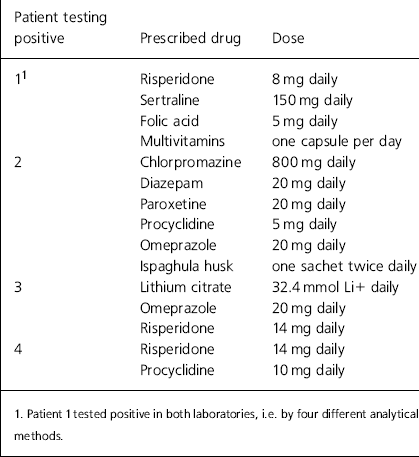
Two patients tested positive in the samples sent to Laboratory A on both occasions. The other two positive results were from two different patients. The patient who gave a positive result when the samples were tested by Laboratory B was one of those testing positive twice at Laboratory A. Table 1 shows the prescribed drugs being taken by patients when they tested positive for LSD.
Prescribed drugs being taken by patients that tested positive for LSD in Laboratory A1
| Patient testing positive | Prescribed drug | Dose |
|---|---|---|
| 11 | Risperidone | 8 mg daily |
| Sertraline | 150 mg daily | |
| Folic acid | 5 mg daily | |
| Multivitamins | one capsule per day | |
| 2 | Chlorpromazine | 800 mg daily |
| Diazepam | 20 mg daily | |
| Paroxetine | 20 mg daily | |
| Procyclidine | 5 mg daily | |
| Omeprazole | 20 mg daily | |
| Ispaghula husk | one sachet twice daily | |
| 3 | Lithium citrate | 32.4 mmol Li+ daily |
| Omeprazole | 20 mg daily | |
| Risperidone | 14 mg daily | |
| 4 | Risperidone | 14 mg daily |
| Procyclidine | 10 mg daily |
According to the list provided by Dade Behring Diagnostics, the manufacturer of the EMIT test, sertraline, chlorpromazine and paroxetine, but not diazepam, can cause cross-reactivity at certain concentration levels when using the EMIT II LSD Assay (Dade Behring Diagnostics, 2000). Folic acid, procyclidine, multivitamins, omeprazole, lithium, ispaghula and risperidone were not listed.
We could confirm that the LSD EMIT assay was associated with a high rate of false-positive results, particularly when used in patients from psychiatric settings. It became evident that in situations where a single type of LSD test is carried out, particularly only the EMIT test, there is a likelihood of more positive results. Since it has been clearly documented that certain prescribed drugs can cause drug interference when testing for LSD, particularly with homogeneous immunoassays, we considered that this was the most likely cause of the high number of positive results given by the first laboratory, i.e. that the patients' prescribed drugs, or their metabolites, may have been responsible for most of the false-positive results by the EMIT test.
We concluded that positive LSD test results should be confirmed by at least one alternative method. We also concluded that any positive result using a single immunoassay method such as the EMIT test, should not be accepted as valid without confirmation, particularly in situations where the subjects are taking other prescribed drugs, as is commonly the case for psychiatric patients. This is particularly important in forensic psychiatric patients, where such findings could have considerable implications in future management decisions and where the legal aspects of their care are much more complex. For that reason, a clear protocol for LSD testing should be considered as a way of minimising the probability of such problems arising in clinical practice. There are considerable clinical, legal and psychological repercussions of falsely giving a positive result for LSD to a patient.
Further research in this area would be very valuable and clear guidelines are necessary for laboratories and services dealing with psychiatric patients that need to be tested for LSD and other illicit drugs. This would be particularly important within the forensic psychiatric services.
Acknowledgements
I would like to thank Mr Frank Tames for his valuable information and advice and Dr A. R. Tomison for his support and comments.


 Open access


eLetters
No eLetters have been published for this article.