


Most economic sociologists agree that economic markets are described, perceived and enacted through profoundly moral frames and narratives; that markets are not just allocative instruments but are also moral products; and that normative conceptions of markets are various and conflicting [Fourcade and Healy Reference Fourcade and Healy2007]. Despite the seeming consensus among sociologists that homo economicus––the utility-maximizing creature presupposed in much neoclassical economic theory––is more a theoretical convenience than an empirical reality, we know little about popular understandings of, and public opinion about, markets.
We focus on Americans’ commitment to markets as a means of distributing a wide range of goods and services, and their willingness to condemn or limit the use of markets on behalf of moral or social values. We ask, first, what can we infer from survey responses about the meanings that people attach to market exchange and the ways that they organize these meanings? Second, what kinds of people are most committed to the use of markets as solutions to social dilemmas and what kinds of people are most willing to regulate, limit, or even ban markets in the interests of noneconomic values?
This paper innovates in distinguishing between construals (meaning structures upon which actors draw to understand domains of social life) and positions (actors’ normative beliefs, given the construals they adopt). We posit that individuals may endorse similar normative positions even if their underlying understandings of a domain differ; and that, by the same token, they may reach different normative conclusions even if in interpretative agreement. For example, Occupy Wall Street protesters and bankers may share a construal, agreeing that self-interested profit seeking and social equality are incompatible, but take different positions on how policy should make tradeoffs between them. A methodological implication of this view, which this paper pursues, is that opinion data are vulnerable to population heterogeneity in construals (not only in positions as is commonly assumed), such that analyses of full samples may lead to misleading conclusions.
We regard different construals as often reflecting interpenetration of institutional boundaries. Sociologists commonly conceptualize social institutions (e.g., the market or the family) as differentiated domains that embody distinct, and internally coherent, standards of value and forms of perception [Friedland and Alford Reference Friedland and Alford1991; Boltanski and Thevenot Reference Boltanski and Thévenot2006; Thornton, Occasio and Lounsbury Reference Thornton, Ocasio and Lounsbury2012]. But individuals crosscut these institutional boundaries: we all have families, we all operate in market society, and many of us attend religious services or participate in politics. We doubt that individuals switch seamlessly between construals as they move across institutional spaces. Rather, drawing on approaches that imply a loose coupling between settings and construals [e.g. Stark Reference Stark2009], we posit that criteria of interpretation and valuation cross institutional boundaries, and that much heterogeneity in construals of the market may be explained by variation in exposure and commitment to such institutions as religion and politics.
After presenting theory and expectations, we test our predictions on a sample of respondents to the 1996 General Social Survey Markets Module, a uniquely appropriate and underexploited resource for the study of attitudes toward markets.Footnote 1 Our analyses proceed in four stages. First, we demonstrate that analyzing the full sample, assuming no population heterogeneity in construals, yields low levels of explained variance and seemingly inconsistent conclusions. Second, we identify three sets of respondents, each subscribing to a different construal of the market, using Relational Class Analysis [Goldberg Reference Goldberg2011], a statistical approach designed to identify subsets of survey respondents among whom responses are associated in similar ways. Third, we analyze the predictors of positive attitudes toward the market within each subset. Finally, we identify the predictors of the construals that pro-market and anti-market individuals adopt.
Our findings enrich classical sociological views of markets as moral projects by demonstrating the diversity of ways in which Americans understand markets. We show not only that economic rationality is socially constructed, but also how different kinds of people construct economic rationality in different ways. Distinguishing between construals and positions, we establish that few Americans either hew to or oppose an extreme neoclassical understanding of the appropriate role of markets in economic life. Once one identifies distinctive construals (but not before), analyses demonstrate that people who benefit most from markets are most likely to support them. But first, most adapt their understanding of the market to their religious and political convictions, in effect constructing versions of the market they find morally tolerable.
Economic rationalities and normative assessments of markets
Whereas economists often view rational, self-interested behavior as a convenient starting point for analysis of economic behavior in market societies, sociologists emphasize the constructedness of economic self-interest and the cultural specificity of markets [Fourcade and Healy Reference Fourcade and Healy2007; Gal Reference Gal2002; Guiso et al. Reference Guiso, Sapienza and Zingales2006; Zelizer Reference Zelizer2007]. From Adam Smith [1759; 1776] onward, classical theorists recognized markets as cultural projects rooted in morality. Weber [Reference Weber1905] famously discerned the roots of economic rationality in religious faith. Polanyi [Reference Polanyi1944] contended that the 18th century model of “market society”—a society in which self-sufficient economic markets in land, labor and commodities carried the main burden of satisfying human needs—was a radically utopian notion that, taken literally, required the political “self-protection of society” to avert disaster.
At the micro level, individual utility functions diverge from the economistic ideal in at least two respects. First, people vary in the extent to which they incorporate the welfare of others into their own utility functions and in the range of others (from one’s family of procreation through one’s community through humanity at large) whose welfare they incorporate [Sen Reference Sen1977]. Second, people vary in the extent to which they treat certain transactions as appropriate for pure market exchange, either making efforts to disguise their economic character [Almeling Reference Almeling2007] or (as in the case of laws forbidding prostitution or organ sales) warranting complete prohibition [Zelizer Reference Zelizer1994].
If calculative rationality is not hard-wired, then where does it originate? Neoinstitutional theory posits a world culture that privileges rationality, pressuring actors to conform [Meyer, Boli, Thomas and Ramirez Reference Meyer, Boli, Thomas and Ramirez1997]. Work on “performativity” focuses on economics itself as an institutional force, producing economic theories that create empirical realities they claim merely to describe [Callon 2007; Frank, Gilovich and Regan Reference Frank, Gilovich and Regan1993].
If economic rationality is socially constructed rather than innate, then it follows that it may be constructed in different ways, of which stylized conceptions of economic rationality represent only one. Thus to understand attitudes toward the market, we must first identify subsets of respondents with varying constructions of economic rationality, inferred from distinctive patterns of associations among indicators of attitudes toward market exchange. We refer to such distinctive patterns as construals.
Construal: Variation in Understandings of the Market
The concept of “construal” may be unfamiliar to sociologists outside of social psychology [Tsoudis and Smith-Lovin Reference Tsoudis and Smith-Lovin2001]. The construct became prominent in cross-cultural research on self-construal (understanding of the self and its relations to other entities) [Markus and Kitayama Reference Markus and Kitayama1991] and spread widely within social and cognitive psychology. Construals vary in abstraction: “situational construals” fill in unknowns in representations of specific events; “high-level construals” comprise abstract representations of entire domains [Ledgerwood, Trope and Liberman 2015]. We explore high-level construals of economic markets, a novel application but consistent with evolving usage.
We prefer the term “construal” to such alternatives as “ideology,” which implies a tighter, more elaborate and more discursively available network of beliefs, or “institutional logic,” which is a property of contexts or domains rather than of persons. Extending construal theory to the study of social attitudes is a natural step: construals are implicit understandings or explicit narratives that entail relations of implication, entailment, opposition and exclusion among beliefs in a domain. Construals differ from attitudes in two ways. First, they refer to patterns of association among attitudes, rather than to attitudes themselves. Second, actors may share construals even when their attitudes differ, so long as they understand attitudes to be related in similar ways. Thus the notion of construal invites a relational approach to attitudes and a distinction between representations and preferences.
We draw on literatures in three areas—economic sociology, institutional logics, and public opinion—to explain why one must identify heterogeneity in construals of the market before trying to explain the positions that people take on the market’s proper role and regulation.
Economic sociology teaches us that no natural affinity exists among particular ideas about markets, exchange behavior and economic policy. Such ideas go together only in so far as people understand and accept a constructed narrative that links them. Neoclassical thought is strongly institutionalized in much of the world, but with distinctive national variations, and many economists deviate from neoclassical orthodoxy [Dobbin Reference Dobbin1993; Fourcade Reference Fourcade2006; Reference Fourcade2009].
Construals of markets are suffused with moral sentiment [Fourcade and Healy Reference Fourcade and Healy2007; Almeling Reference Almeling2007; Anteby Reference Anteby2010]. Markets categorize, naturalize and assign value to classes of behaviors and people. Interpersonal intimacy, bodily products and the natural environment have often been considered too sacred to debase through commodification [Healy Reference Healy2006; Zelizer Reference Zelizer2007; Fourcade 2011]. Market construals differ from one another in the boundaries they prescribe and, by extension, the visions of social order they embody.
Market construals vary historically. Although the rise of markets is neither inexorable [Zelizer Reference Zelizer1988] nor uncontested [Turco Reference Turco2012], the scope of goods subject to market exchange has expanded, encompassing land and labor [Polanyi Reference Polanyi1944], prestige goods once monopolized by status groups [Weber Reference Weber, Roth and Wittich1922: 934-939], and risk [Zelizer Reference Zelizer1983]. Shifts have similarly occurred in understandings of the relationship between market and firms [Fligstein Reference Fligstein1993] and in beliefs about economic inequality and economic policy [McCall Reference McCall2013].
Market construals also vary over space. Cross-national research has documented systematic variation in the use of markets to distribute blood [Titmuss Reference Titmuss1971; Healy Reference Healy2006]; in laws regulating human organ sales [Scheper-Hughes Reference Scheper-Hughes2000]; in cultural understandings of inheritance [Beckert Reference Beckert2008]; and in norms about the interactions of firms in markets [Granovetter Reference Granovetter1995], and between companies and the state [Hamilton and Biggart Reference Hamilton and Biggart1988].
Within societies, actors in different structural locations understand markets in different ways. As Bourdieu notes, to perceive oneself as an actor in an abstract market, one needs to have acquired the proper “dispositions and beliefs […] through early and protracted experience of [the market’s] regularities and necessities” [Bourdieu Reference Bourdieu2005: 8]. “Below a certain threshold” of economic security and education, writes Bourdieu [2000: 27], “rational dispositions cannot be constituted.” It follows that the economic habitus may shape beliefs about the appropriate scope of economic markets, proper behavior in economic exchange, and economic policies.
Institutional logics. Classical sociology [Durkheim Reference Durkheim2014 [1893]; Parsons Reference Parsons1966: 24-25] viewed institutional differentiation as an inexorable feature of human social evolution. The classical economic notion of the market as an institution through which the pursuit of self-interest enhances social welfare implied a radical decoupling of the economic from the religious and political domains. Theories of institutional logics [Bell Reference Bell1976; Friedland and Alford Reference Friedland and Alford1991; Boltanski and Thevenot Reference Boltanski and Thévenot2006; Thornton, Occasio and Lounsbury Reference Thornton, Ocasio and Lounsbury2012] posit that different institutional settings––the economy, the polity, religion, the family––entail contrasting standards of value and forms of perception.Footnote 2 But domain boundaries are never absolute: their relationship is an empirical question and a potential source of conflict and social change [Friedland and Alford Reference Friedland and Alford1991; Stark Reference Stark2009].
How might institutional logics align with individuals’ construals of markets? As properties of institutions, logics are linked to particular settings. But prolonged exposure to an institutional setting may shape market construals by rendering the relevant institutional logic (and the representations, ideas, and symbols associated with it) more salient and chronically activated, even transposing it across domains. Thus participation in market economies affects many psychological dispositions [Lane Reference Lane1991]; and experimental studies find wealthy people better at utility maximizing (in a narrowly economic sense) than people with less exposure to markets [Choi, Kariv, Müller and Silverman Reference Choi, Kariv, Müller and Silverman2014]. Conversely, people consistently exposed and emotionally committed to non-market institutional domains will configure their understandings of the market accordingly.
Public opinion research.The recognition that different respondents organize opinion domains differently, and that variation in constructions may be orthogonal to variation in attitudes, has important implications for opinion survey analysis. Two implicit assumptions, response identity and item fungibility, guide most research that uses survey-based attitude data. By identity we mean the assumption that a given response means the same thing to each respondent who chooses it. This assumption is implicit in the practice of using survey items to compare opinions of different population samples or subsamples. When items are combined into scales (e.g., to examine such constructs as tolerance or economic conservatism) item responses are further treated as fungible in the following sense: respondents who answer affirmatively to, for example, four items on an eight-item scale are believed to hold similar views (at the midpoint of the scale) even if the affirmative responses are to different items. These two assumptions—identity of meaning and fungibility within scales—characterize most attitude research.
But what if a survey item means different things to different respondents? Take, for example, responses to a hypothetical item tapping support for lenient or restrictive immigration policies. Moral evaluations of immigrants may drive the views of some respondents. Responses of others may reflect beliefs about immigration’s economic effects. Because different respondents embed item responses in different networks of beliefs and representations, neither a single scaling strategy nor one causal model will suffice [Ceobanu and Escandell, Reference Ceobanu and Escandell2010].
In a classic paper, Converse [Reference Converse and Apter1964] argued that responses to individual survey items are embedded in broader systems of meaning by which they are constrained. But Converse viewed such constraining structures as largely restricted to educated elites. Educational attainment is typically associated with attitude constraint (i.e., the extent to which beliefs are consistently organized) [Zaller Reference Zaller1992]. But the fact that the responses of educated respondents exhibit more constraint than those of less educated respondents does not necessarily mean that the latter’s views are simply noisy versions of the former’s. Because higher education is a powerful source of identity and socialization [Meyer Reference Meyer1977; Collins Reference Collins1979], one would expect it to structure understandings of many social domains. “Less education,” by contrast, is neither a master identity nor a type of socialization: responses of less educated respondents are likely to be structured by different identities and socializing experiences, the opinion-constraining effects of which will be invisible when respondents are grouped by level of schooling [Kinder Reference Kinder2006; Achterberg and Houtman Reference Achterberg and Houtman2009]. Thus African-Americans with less schooling than whites nonetheless exhibit more constraint in racial attitudes [Carmines and Stimson Reference Carmines and Stimson1982], and religiosity generates high attitude constraint among Evangelical Christians [Jelen Reference Jelen1990].
Institutional foundations of construals and positions
If subsets of Americans understand the market in different ways, along what social axes might these construals diverge? And how might such axes of differentiation vary from identities and experiences that lead respondents to exhibit more or less favorable attitudes towards markets, independent of the construals they embrace? Construal and position taking are closely connected, but we separate them analytically here, discussing influences on construals first and then turning to factors likely to influence normative positions.
Construal. For factors that may shape differing construals, we look to institutionalized social identities that (a) entail orientations at odds with the market, and (b) exhibit relatively high levels of ideological structure due to the prominence of specialists in the codification and alignment of beliefs. By these criteria, two dimensions of social identity should be especially salient.Footnote 3
The first of these is religion. Previous studies have reported that Protestants, especially in congregations influenced by the prosperity gospel, which associates religious faith and freedom with economic individualism and laissez-faire economics, tend to support free-market capitalism [Wuthnow Reference Wuthnow1988; Steensland and Schrank Reference Steensland and Schrank2011]. By contrast, members of more communitarian, less anti-statist faiths, such as Catholics, Jews, and some Mainline Protestants, are often more critical of unbridled capitalism [Barker and Carman Reference Barker and Carman2000]. But even among Evangelicals, support for free-market views is not unqualified: religious leaders of many denominations vigorously repudiate market transactions that challenge traditional visions of the sanctity of life, body and sexual purity [Greely and Hout Reference Greely and Hout2006]. The combination of enthusiasm for laissez-faire capitalism with a willingness to restrict the sphere of market transactions that threaten sacred boundaries leads us to expect that religiously observant respondents, while differing on particular issues, will construe economic rationality in distinctive ways.
Second, we expect political identity to shape the organization of economic attitudes. While no mainstream U.S. political movement questions the centrality of markets to the economic system, conservatives and liberals vary in their willingness to regulate markets, the degree to which they view markets as liberating or coercive, and their support for redistributive policies. Historically, U.S. political conservatives have rejected government intervention both on moral and practical grounds [Friedman Reference Friedman2002; Burns Reference Burns2009]. Nonetheless many pro-market economists support government regulation to correct market failures and make markets more efficient [Fourcade and Healy Reference Fourcade and Healy2007; Weisbrod Reference Weisbrod1964]. In particular, liberal economists ordinarily favor measures like truth-in-lending laws that address information asymmetries, as well as regulations to protect the environment (degradation of which is a negative externality of much economic activity) [Shipan and Lowry Reference Shipan and Lowry2001]. Thus we expect political identity to shape respondents’ economic construals, both by influencing the economic theories they bring to bear and by affecting the permeability of boundaries between the political and economic domains. As with religion, we anticipate that political identities will influence construals directly and will also interact with construals to affect attitudes toward the market.
Positions. People who construe the market similarly may nonetheless evaluate markets vary differently. Some variation will reflect factors peculiar to each construal. More generally, however, we expect factors that enhance people’s ability to reap the market’s rewards to engender support for markets and trust in market institutions.
Four such factors are prominent. The first is income, both an indicator of prior success (or inherited wealth) and a resource that increases access to market rewards [Nau Reference Nau2013]. Much research indicates that the wealthy tend to adopt beliefs that justify their privilege; for example, higher levels of economic inequality increase the tendency of the well-to-do to believe in meritocracy [Newman, Johnston and Lown Reference Newman, Johnston and Lown2014]. Thus we expect that higher incomes will be associated with more positive views of market exchange.
The second factor, race, affects access to jobs, wages, health, decent housing, and treatment by the criminal-justice system [Pager and Shepherd Reference Pager and Shepherd2008]. Although few studies report racial effects on the kinds of attitudes we consider here, previous research demonstrates that African-Americans, upon whom the cost of racial disadvantage falls most heavily, are more likely to attribute poverty to structural factors and less likely than comparable whites to identify as middle class [Kluegel and Smith 1981]. It follows that African-Americans will be less likely to view markets as impersonal, fair and benign and otherwise hold less favorable views of markets than members of other groups.
Gender also affects access to market rewards [Ridgeway Reference Ridgeway2011]. The Victorian ideology of “separate spheres” [Davies and Frink 2010] explicitly portrayed middle-class women as guardians of the home, viewed as a curated space protected from the values of the market. Even as barriers to women’s labor-market participation gradually fell, women have remained disadvantaged both materially and symbolically within the labor market [Petersen and Saporta 2004; Brines Reference Brines1994]. Research suggests that, despite real transformations in women’s labor-market positions [Fernandez Reference Fernandez2013], gendered expectations about market behaviors resist change, and femininity continues to be constructed as antithetical to the calculative rationality of homo economicus [Ridgeway Reference Ridgeway2011]. Moreover, the commodification of the human body––from advertising to prostitution and surrogacy––disproportionately targets women. Women, in other words, are both disadvantaged by the market and culturally constructed as incongruent with it. We therefore expect women to express less favorable attitudes toward markets than men.
A fourth factor is schooling, which is strongly associated with increased earnings and other measures of labor-market success [Hout Reference Hout2012]. Moreover, exposure to formal education socializes students into norms of rationality and individualism that underpin pro-market views [Meyer et al. Reference Meyer, Boli, Thomas and Ramirez1997, Meyer and Bromley Reference Meyer and Bromley2013].
These expectations are consistent with the results of previous research. Sociological studies of popular orientations toward economic fairness and inequality report that Americans’ faith in their economic system is strengthened by formal schooling and economic success [Hochschild Reference Hochschild1981; Kleugel and Smith Reference Kleugel and Smith1981; Osberg and Smeeding Reference Osberg and Smeeding2006]. A study comparing professional economists to laypeople found that formal education, being male, and expecting income growth all increased the extent to which lay views aligned with those of professionals [Caplan Reference Caplan2001].
Data and analytic strategy
Data are from the 1996 Markets Module of the General Social Survey (GSS), a biennial household sample survey fielded on a regular basis since the late 1960s by the University of Chicago’s National Opinion Research Center. The GSS consists of a set of core items asked regularly of all respondents, and changing modules devoted to particular topics. The Markets Module included items on topics of interest to economic sociologists.
Measures of economic orientation
We focus on seven items, summarized in Table 1, that tap normative views of economic exchange. We scale these items so that higher values correspond to a neoclassically oriented pro-market perspective.Footnote 4 The first two items tap normative orientations toward profit making. The first probes respondents’ evaluations of profit maximizing, asking whether it is acceptable for a manufacturer to hold prices constant even when manufacturing costs have declined. The second examines whether respondents perceive profit making as inherently in tension with social welfare. Together they speak to a core principle of neoclassical thought, derived from Adam Smith’s famous dictum that the pursuit of self-interest is not only unobjectionable but can also contribute to the common good.
Economic attitude variables*
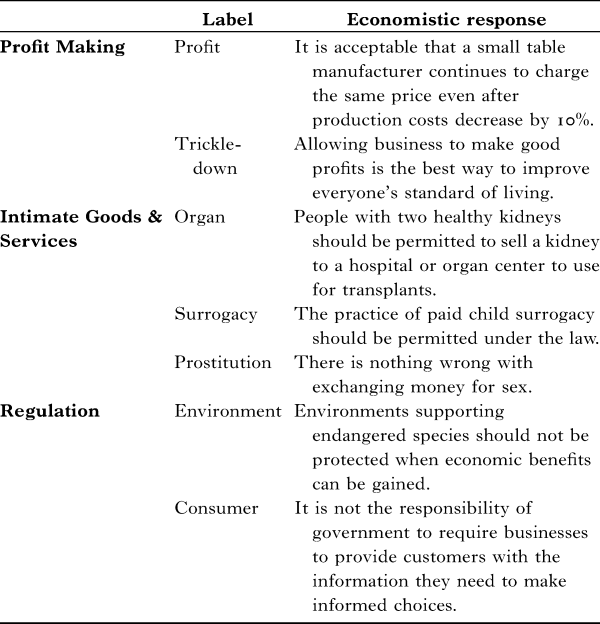
*Wordings of some items reflect rescaling so that higher values were more pro-market. See Appendix A for detailed original wording in the Supplementary material Rubric.
The following three items concern the appropriate role of markets in allocating intimate goods and services: the sale, respectively, of organs, surrogate motherhood and sexual intimacy. In each case, we associate approval of the use of markets with an economistic viewpoint, and opposition with a less economistic way of viewing the world. Each item deals with the appropriateness of trading an intimate good on the market, and all three forms of exchange have elicited strong objections on ethical grounds. There are nonetheless important differences among them. First, each is regarded differently in the eyes of the law. Whereas organ trade and (except in parts of Nevada) prostitution are illegal in the U.S., treatment of surrogacy is mixed.Footnote 5 Cross-nationally, prostitution (as distinct from procuring or brothel proprietorship) is legal in much of the world [ProCon.org 2014], whereas organ sales are illegal in almost every country but Iran, where they are highly regulated [Hippen Reference Hippen2008]. Moreover, objections to these markets reflect a sense of violation of the sacredness of different spheres: whereas organ trade and surrogacy arguably challenge the sanctity of the human body, prostitution is held to contaminate the purity of love and sexual relationships. Finally, while the organ trade is gender blind, women are especially vulnerable to harm from surrogacy and prostitution.
A sixth item examines the sanctity of a non-human realm: the natural environment. Respondents were asked whether endangered species should be protected irrespective of economic considerations. We interpret the acceptance of the subordination of nature to the market as consistent with an economistic perspective. The final item deals with another form of regulation, asking respondents if government should require businesses to provide consumers with information. Government regulation to promote transparency is not inherently antithetical to pro-market opinion, and many economists support it. Culturally and politically, however, neoclassical orthodoxy has been linked to opposition to most forms of government regulation. We therefore treat disagreement with government regulation as an expression of economism.
Other variables
We model variation in economic orientations as a function of several sociodemographic variables (for a detailed description, see Appendix A). Religion is measured on two dimensions. We use Steensland et al.’s [2000] classification of faiths to measure religious identity.Footnote 6 Religiosity is measured as the frequency of attending religious services. Gender is measured by a dummy variable (where 1 = female). Two standard self-identification scales tap political orientation: ideological identity (strong liberal to strong conservative), and partisanship (strong Democrat to strong Republican).
Family income is self-reported (and log-transformed in the following analyses). We also use occupation codes to distinguish between those in white-collar jobs (managers and professionals), and those in blue-collar, agricultural and non-skilled service jobs. We measure education as years of formal schooling.
Additional variables include age in years, which may be related to views of the market due to cohort or aging effects. We measure race with a dichotomous variable, where 1 = African-American. We use region and community size (log transformed) to control for effects of regional subcultures and rural residence, and include a dummy variable that identifies respondents born outside the United States. Finally, we examine marital status and number of children, which previous research indicates can affect one’s economic attitudes [Dahl, Dezso and Ross Reference Dahl, Dezso and Ross2012].
Analytic strategy
Our analytic strategy is quadrapartite. First, we proceed conventionally as if our sample were homogeneous with respect to market construals, assuming that items mean the same thing to all respondents and are fungible within scales. We construct a scale of views consistent with a conservative version of neoclassical economics and examine the predictors of adherence to that scale and agreement with its component items. These models perform poorly, suggesting a lack of structure in respondents’ economic beliefs.
Second, we examine heterogeneity in construals within the full sample. We employ Relational Class Analysis [Goldberg Reference Goldberg2011] to identify sets of respondents who organize opinion domains in similar ways. We identify three subsets of respondents with distinctive patterns of association among attitude items, and construct scales based on the specific form of pro-market attitudes found in each subset, making inferences about the construals that underlie the observed patterns.
Third, we focus upon the sociodemographic predictors of pro-market attitudes, conditional on construal. These models differ from one another and exhibit markedly superior predictive power when compared to models assuming homogeneity within the entire sample. This is the case even though the sample was partitioned solely on the basis of responses to attitude items, without using any information about respondent demographics, religious beliefs, or political identities.
Finally, we look among people who endorse positive and negative views of the market, respectively, and ask what kinds of peoples evince which construals. Americans, we conclude, tend to craft versions of the market consistent with their religious faith and political values.
Results, Pt. 1: Analysis of the full sample
We begin by constructing a stylized homo economicus––a pattern of responses consistent with the theoretical tenets and normative intuitions of neoclassical economics––and ask, first, do such views hang together empirically and, second, what kinds of people support them. (For items and rationales see Table 1, supra, and subsequent text.) To score high on economism, it is not enough that respondents hold a coherent neoclassical perspective on economic affairs. In addition, they must decouple economic beliefs from values (e.g., sacredness or justice) associated with other institutional domains.
Because the homo economicus index is based on responses to all seven constituent items, we impute “don’t know” responses as midpoints on the variable scale.Footnote 7 Each response is normalized on a scale with mean 0 and standard deviation 1, and the responses are averaged. This analysis thus replicates the assumptions of response identity and item fungibility common to most opinion research (see Appendix A for details).
We recognize that economic theory, deftly employed, can justify deviation from what we describe as economistic positions, even among professional economists trained in the neoclassical creed. Nonetheless, we contend that economism exists both as an observable discourse and a set of practices [Jelveh, Kogut and Naidu Reference Jelveh, Kogut and Naidu2014]. Accordingly, we view our stylized homo economicus as a cultural representation and not as an empirical description of either most professional economists’ beliefs or of the inescapable implications of neoclassical theory.
As Figure 1 illustrates, the homo economicus scale is normally distributed, with only a handful of respondents exhibiting either strong support for or rejection of economistic views. Examining correlations among the items that comprise the scale, however, belies the notion that this distribution is driven by individual differences in commitment to a coherent economistic worldview. The scale alpha is a mere 0.325. Of 21 correlations, fewer than half are significantly positive in the predicted direction, and one is unexpectedly negative (people who support the use of markets for surrogacy also favor regulating markets on behalf of environmental protection). Even the significantly positive correlations are mostly weak, with only three exceeding 0.1.
Full sample statistics. On the left, the distribution of the Homo Economicus standardized scale. On the right, correlations between the seven attitudinal variables comprising the scale. Significant correlations are represented by a plus/minus sign, indicating correlation direction. Shades correspond to correlation strength
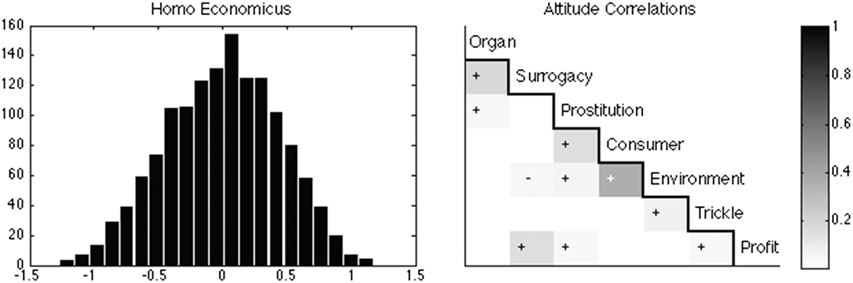
Table 2 reports estimates of a multivariate model wherein the homo economicus scale is regressed on a set of sociodemographic variables. Variance explained (8.6%, adjusted) is modest at best. Of the variables related to access to market rewards only one, gender, is significant, with schooling and economic success unrelated to economic worldview.Footnote 8 Women, as expected, are less likely to endorse economistic views, but only by 0.15 of a standard deviation. Evangelicals are less economistic, and Republicans more economistic, than mainline Protestants or Democrats, respectively. Of the other variables, only parenthood is significantly associated with economism. Analyses of individual items comprising the scale (available upon request) suggest that the items are not fungible (e.g. women object to prostitution, whereas African-Americans oppose surrogacy). Overall, these results provide little direction to the search for the social coordinates of homo economicus. The trail leads to childless, Republican men, but varying and at times contradictory results for specific items suggest that we may have pursued a chimera.
Multivariate OLS model of the Homo Economicus scale
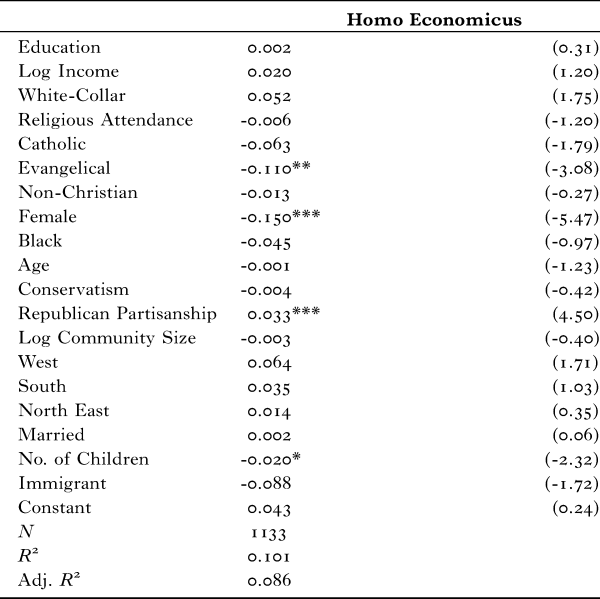
t statistics in parentheses
*p < 0.05, **p < 0.01, ***p < 0.001
Shall we conclude that Americans’ attitudes toward the market are largely unstructured? Not so fast. The weak effects reported above reflect not absence of structure but rather structural heterogeneity underlying Americans’ economic orientations. Only by identifying subsets of respondents who construe the market in distinctive ways can we detect the underlying structure.
Results, Pt. 2: Identifying Distinctive Construals of the Market
We have seen that gss respondents did not, as a group, construct the field of normative economic opinion along lines defined by support for or opposition to neoclassical orthodoxy. Before interpreting these results as evidence of a lack of structure, we ask if they may instead reflect population heterogeneity, with different respondents constructing the field of affinities and oppositions among attitudes toward markets in different ways. Note that people may construe the market similarly but still take opposing normative positions on such matters as profit seeking, paid surrogacy, or trickle-down economics. For example, in The Shock Doctrine, author/activist Naomi Klein [Reference Klein2007] excoriates Milton Friedman and neoclassical economics. Klein and Friedman [Friedman and Friedman Reference Friedman and Friedman1980] share a construal of markets as arenas of unfettered exchange motivated by self-interest. But whereas Friedman sees unregulated markets as liberating, Klein interprets them as inherently destructive.
We thus require an analytic method that can identify subsets of respondents who exhibit distinctive patterns of association among their opinions, without necessarily holding the same views. To this end, we use Relational Class Analysis (RCA) [Goldberg Reference Goldberg2011].Footnote 9 rca generates a proximity matrix among respondents wherein each cell value represents the extent to which the row and column respondents exhibit similar patterns of difference between pairs of item responses. rca then partitions the network into subsets, each of which corresponds to a distinctive construction of an opinion domain. In this analysis, each such subset embodies a different construal of the market domain.
The intuition behind rca is illustrated in Figure 2. (For more methodological detail, see Appendix B in the Supplementary material Rubric.) Imagine a survey that includes three questions of interest. Figure 2’s top row plots the responses of four hypothetical respondents to these questions. The bottom row plots each respondent’s pattern of absolute values of differences between responses, represented as a matrix of size 3 x 3. Matrix cells are shaded, ranging from minimal difference (white) to maximal difference (black). We refer to this as the association matrix. As is clearly visible, despite their different opinions, the first three respondents’ association matrices are very similar. The fourth respondent, in contrast, exhibits a distinct pattern of associations.
Illustration of four hypothetical respondents. The top row illustrates their responses, and the bottom row their resultant association matrices. The network on the right illustrates the proximities between these association matrices. Edge widths correspond to degree of proximity
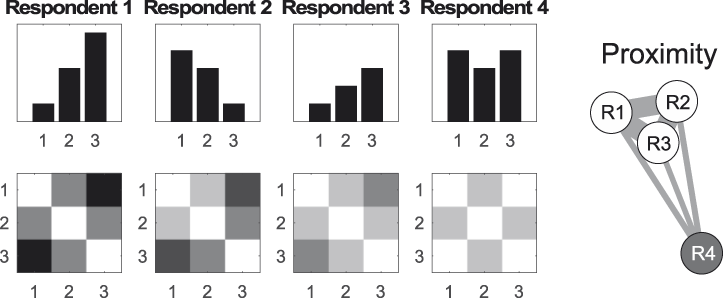
These association matrices represent relationships of entailment and opposition implicit in each respondent’s pattern of responses. They correspond to these respondents’ construals. RCA constructs a proximity matrix between respondents by calculating the distances between their association matrices. This distance corresponds to the cell-by-cell difference between each pair’s respective association matrices. The first three respondents are determined to be close to one another, whereas the fourth is distant from the other three. These distances are illustrated as a network in Figure 2. The network partitioning algorithm concludes that these two sets of respondents comprise different subgroups—as illustrated by different node colors—representing two different construals. Note that the first two respondents espouse diametrically opposed positions. Their construals, however, as reflected in their similar association matrices, are effectively identical.
Following this logic, we used rca to divide the sample into subsets (relational classes) of respondents.Footnote 10 We then conducted principal component analyses (details available upon request) separately for each class, identifying a single dominant factor (by the eigenvalue criterion) in each case. This dominant component represents the underlying axis of attitudinal variability for each set of respondents. Based on these results, we created a scale for each class by summing the seven items (each standardized to a mean of 0 and a standard deviation of 1, and weighted by factor loadings). As we shall demonstrate, each such scale measures respondents’ commitment to the economic marketplace as represented by the dominant construal of the market for that respondent class.
We find that economic opinion is structured by three different construals of the market domain. We employed a new method, developed for this paper, to validate the three-class solution, using Monte Carlo simulation and the gap statistic to evaluate goodness of fit. (See Appendix B for details.) Figure 3 illustrates the correlations between economic attitudes in these three groups. As is clearly visible, these correlations are, on average, substantially stronger and more statistically significant than they were in the full sample (with the median absolute value of correlations for the three classes of 0.324, 0.128, and 0.213, respectively, as opposed to 0.066 for the full sample). Moreover, the structure of associations between economic attitudes in each class is unique.
Attitude correlations in each of the groups produced by RCA. Significant correlations are represented by a plus/minus sign, indicating correlation direction. Shades correspond to correlation strength
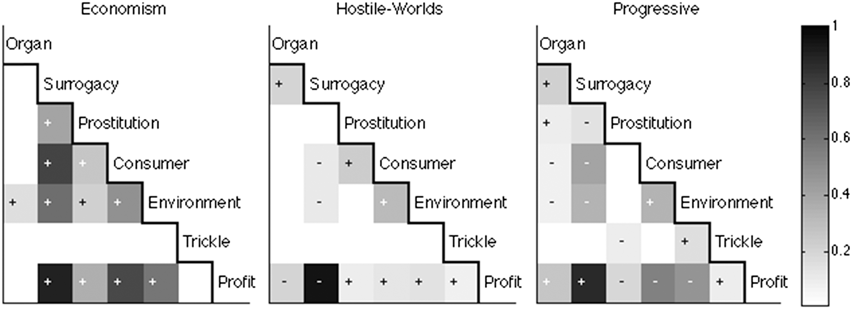
In the first group, to which 20.5% of respondents are assigned, five core variables are correlated with one another, with organ trading only associated with one of these and trickle-down correlated with none. Those who express economistic opinions on any one of the five core attitudes (acceptance of profiteering;Footnote 11 acceptance of paid surrogacy and prostitution; and opposition to consumer or environmental regulation) tend to exhibit economistic views on the others, and those who express anti-market views tend to do so consistently across all core attitudes. This class’s opinions are structured most similarly to the stylized homo economicus scale employed to analyze the full sample. We refer to it as the economistic class.Footnote 12
The two other groups depart from pure economism in different ways. The construal of the second class, to which 39.1% of the sample are assigned, revolves around views of commodifying bodily goods (organs and childbearing) and attitudes towards consumer regulation, environmental regulation and profiteering. Those in this class who espouse economistic views on the latter would place bodily goods outside the purview of the market, whereas those willing to use markets to exchange such goods tend also to support regulation and object to profiteering.Footnote 13 Following Zelizer’s [Reference Zelizer, Neil J. and Swedberg2005] characterization of the view that sacred spaces are founded on social solidarity and sentiment, and therefore stand to be corrupted by market exchange, we refer to this construal as hostile worlds. It appears that for this set of respondents the religious domain penetrates the economic, constraining the full expression of economistic values. For those at the anti-market end of this scale, rejection of profiteering and support for economic regulation combine with a social-liberal/left libertarian opposition to religiously inspired policy constraints on individuals’ control over their own bodies.
The attitudes of the third and (by a hair) largest class of respondents (40.1%) appear to be structured by an opposition between pro-market orientations and restrictive approaches to consumer and environmental regulation. Members of this class who support the commodification of bodily goods and accept profiteering also believe that government should enhance consumer regulation, protect the environment and, to a lesser extent, ban prostitution. They appear to embrace a secular progressive construal. While supporting the rational pursuit of self-interest and denying the sanctity of human goods, they also agree that in market economies the state must protect citizens from exploitation and market failures, and they have faith in government’s capacity to do so. These respondents, it appears, have learned the lessons of Speenhamland [Polanyi Reference Polanyi1944], that markets require political intervention to tame negative externalities. At the other end of this spectrum are a small number of respondents who appear distrustful of government, indifferent to the environment, and largely hostile to market institutions.
Separate principal component analyses of the seven items for each class produced scales reflecting the configuration of pro- and anti-market sentiment given the dominant market construal in each class. Figure 4 illustrates the distribution of respondents in each class on its own scale (dark bars), while showing as well the distribution for members of the other two classes (white bars). Each scale is very strongly bimodal for members of its native class, but follows a bell curve distribution among respondents in other groups. These patterns demonstrate that rca has worked as intended to identify classes of respondents among whom opinion is polarized along a unique dimension captured by its corresponding scale. In so doing, it both confirms our suspicions that weak results on the full sample reflected population heterogeneity, and provides an analytic solution by identifying heterogeneous subsets among whom attitudes are differently aligned.
Distributions of scales produced for each class based on principal component analyses. Dark bars correspond to the distribution in the respective RCA group, and white bars to the distribution in the remainder of the sample
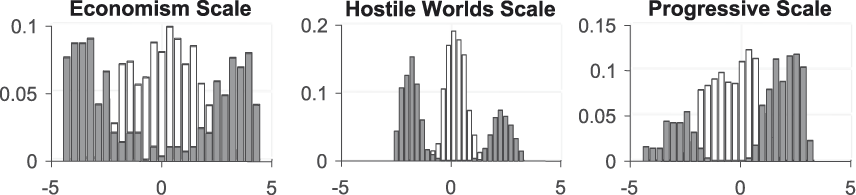
The class whose views are defined by the economism scale is most evenly split between advocates and detractors of the market (as members construe it). Note that respondents who rank high on that scale hew closely to our stylized model of neoclassical homines economici, marking less than one in ten Americans (in 1996) as consistent free-market conservatives. By contrast, looking at those below the mean, 11% were antagonistic to the market on nearly every dimension.
The pro-market wing of the hostile-worlds class (14.3%) support a morally conservative market from which sharp boundaries exclude traffic in bodily goods. At the opposite end of this scale, a larger number (24.7% of all respondents) are social liberals, restrained in their enthusiasm for the market but opposed to moral regulation.Footnote 14
Finally, the class whose views are captured by the progressive scale skews strongly pro-market, with 29.3% taking the view, shared by many mainstream economists, that markets works well, but require regulation of negative externalities. By contrast, their nihilistic counterparts constitute just 11% of the sample.Footnote 15
To summarize: Whereas, in the full sample, relations among items were weak, once we used rca to partition the sample into three classes of respondents, each with its own construal of the market, much more structure is evident. Within each class, the first principal component defines a scale that measures pro-market sentiment. But each scale captures a different kind of pro-market orientation. In the economistic group, this orientation is largely consonant with neoclassical orthodoxy. In the hostile-worlds group, it exempts the human body as sacred and threatened by economic pollution. And in the progressive view, it takes markets to be delicate projects requiring regulatory remedies for predictable market failures.
Results, Pt. 3: Social coordinates of normative positions on the market
What are the social bases of pro-market positions in the three construal classes? We begin by replicating the straightforward analysis reported in Table 2. Rather than modeling the homo economicus scale in the sample as a whole, however, we model the three pro-market scales (induced using rca, as described above) in their respective classes (see Appendix C, Table C1). Given the bimodality of these three scales, we use ordinary least squares (OLS) simply to compare model fit and variance explained, which rises from 10.1% for the full sample (Table 2) to between 12.4 and 25.2% of the variance in the subclass scales, using the same sociodemographic predictors. We separately modeled pro-market attitudes over the entire sample, where the dependent variable is the respondent’s location on the pro-market scale native to the class into which she or he was assigned, and each independent variable interacted with rca class dummies (with the Economism class omitted), to account for variability in the relationship between independent variables and scales across the different construals. The amount of variance explained by this model (available upon request) was 24.6, and the adjusted-R2 was 20.5 (more than twice the adjusted-R2 of 8.6 in the full-sample model assuming population homogeneity). In other words, the subclasses of respondents revealed by rca exhibit markedly more structured attitudes than does the sample as a whole.
Given the bimodality in the class-specific pro/anti-market attitude scales (Figure 3), it is more appropriate to divide each class into subsets who espouse pro- and anti-market positions respectively, and to use multinomial logistic regressions to estimate the effects of sociodemographic attributes on attitudes toward the market within each class. We divide scales into “pro” and “anti” factions at their midpoint, and weight observations by respondents’ magnitude of market support or opposition (measured as the absolute distance of respondents from the midpoint of their respective class scales) to account for variability in attitude strength. As is customary, we report exponentiated coefficients, interpretable in this analysis as risk ratios of assignment to a pro-market subclass relative to an anti-market subclass.Footnote 16
We hypothesized earlier that faith in markets is a product of access to market rewards and socialization. Figure 5 plots the risk ratios of assignment to the pro-market subclass within each construal, as opposed to its anti-market counterpart. Variables included in the model are the same as those in Table 2, but only effects of theoretically salient variables are displayed on Figure 5.
Risk ratios (exponentiated multinomial logistic regression coefficients) and 95% confidence intervals of being assigned to one of the three pro-market subclasses (color coded shapes), relative to assignment into their respective anti-market subclasses, as a function of a one unit increase in sociodemographic variables (y-axis). Light lines with empty shapes represent ratios that are insignificantly different from 1. The x-axis is logarithmically scaled
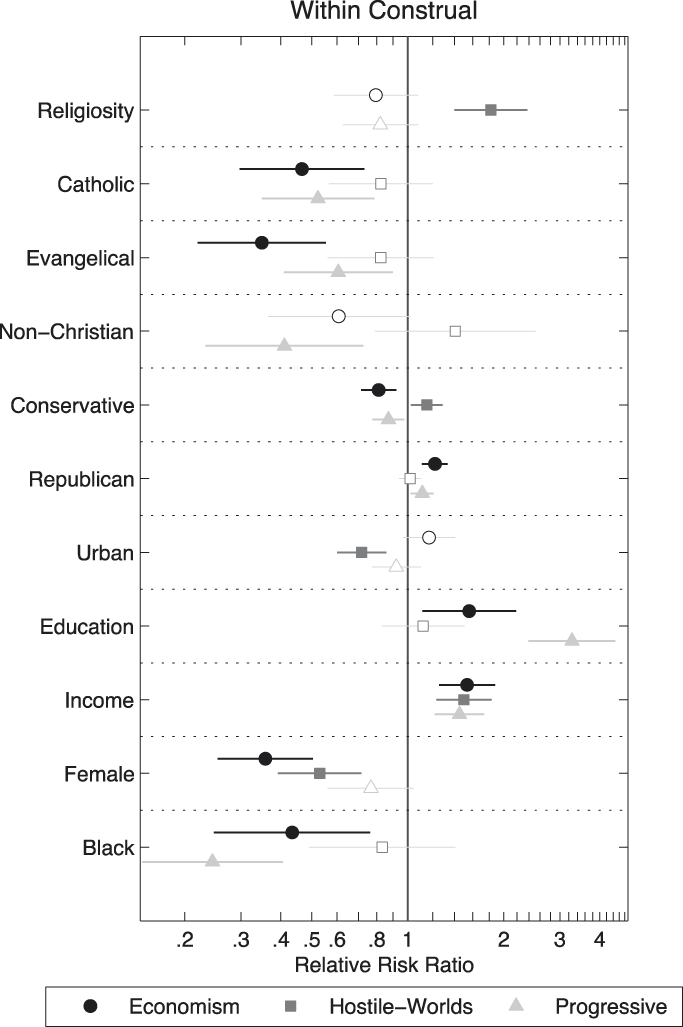
As expected, greater access to market rewards and higher levels of schooling (which entails socialization into dominant economic attitudes) independently predict pro-market orientations, largely irrespective of construal. Income is significantly related to pro-market views for all three construal classes; and education significantly predicts pro-market attitudes for the economistic and progressive classes. Also as predicted, women are significantly less likely than men to express pro-market attitudes in the economistic and hostile-worlds construals; and African-Americans are less likely to endorse pro-market views in all but the hostile-worlds class. Two of the three parameters that fail to operate as predicted reflect the religious inflection of the hostile-worlds construal, which may resonate less with the well-educated and more with African-Americans, who are overrepresented in conservative faith traditions.Footnote 17 The third parameter––gender effects on pro-market views in the progressive class––is not statistically significant, but women in that class are significantly more likely than men to express anti-market positions (p = 0.014, one-tailed).
Other variables shape attitudes only for respondents within certain construal classes; these construal-specific relationships account for much of these models’ explanatory advantage over the full-sample model. Religious views are critical in some but not all construals. For example, church attendance strongly predicts pro-market positions in the hostile-worlds class (where excluding trade in bodily goods renders the market palatable to persons of faith), but not in other classes. Catholics and Evangelicals are more anti-market than others except in the hostile-worlds class, where this antipathy disappears.
Political and ideological identities play a likewise significant role. Consistent with research demonstrating that moral views drove conservative self-definition by the 1990s [Hout Reference Hout1999], conservatism was associated with pro-market positions in the hostile-worlds class, but with anti-market views for other construals. By contrast, Republican partisanship predicted pro-market opinions in every class except hostile worlds.
Figure 6 enables us to look more closely at construal-specific effects of religiosity and political identities, graphically illustrating relationships between church attendance, conservatism, and Republican partisanship (respectively) and espousal of each of the three pro-market construals. The figure shows marginal effects associated with increments in each predictor’s values on the probability of assignment into each of the pro-market subclasses, estimated using multinomial logistic models with the full set of independent variables. (Main effects are plotted with thick lines; confidence intervals are indicated with thin lines and shaded only when effects are statistically significant.)
Marginal effects of Religious Attendance, Political Ideology and Political Partisanship on the probability of assignment into the three pro-market subclasses, as estimated by a multinomial logistic model. Thick lines correspond to main effects (and are styled by subclass), and thin lines outline 95% confidence intervals. Intervals are shaded when the effect is statistically significant
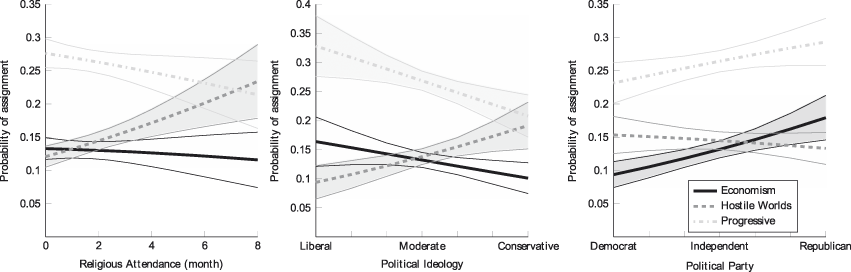
Religious attendance has a strong positive effect on pro-market views for the hostile-worlds construal, nearly doubling the probability of espousing pro-market views for these respondents. By contrast, it has no effect on pro-market attitudes in other construals. Political identities matter as well, with conservatives more likely to adopt pro-market hostile-worlds positions, and liberals inclined toward pro-market progressive views. Republican partisanship produces strongly significant marginal increases in economism, but not in other types of pro-market positions. These patterns reinforce our interpretation that the hostile-worlds and progressive construals reflect porous boundaries between the economic domain and the domains of religion and politics, respectively.
Taken together, these results tell a consistent story: People who benefit from access to the market are more likely to express faith in markets as a social technology. But there is more to it, because this is only the case once people adopt construals of the market consistent with their religious and political identities. Those who benefit from markets have more faith in markets; but their religious and political faiths shapes their understandings of the markets they support. We examine this tendency more closely in the next and final set of analyses.
Results, Pt. 4: What kinds of people gravitate to which construals?
Privilege and socialization explain who is more likely to support the market. But among those who endorse or oppose the market, what explains which construal they adopt? We implemented an additional set of multinomial logistic regressions to predict assignment into subclasses among respondents expressing pro- and anti-market views, respectively, again with a full set of controls. Results are reported in Figure 7 below, with exponentiated coefficients interpreted once again as relative risk ratios.Footnote 18 Whereas in the last section we asked about effects of sociodemographic attributes and religious and political identities on attitudes toward markets within construal sets, in this section we compare all respondents who expressed pro- (or anti-) market views, and look at the effects of attributes and identities on to which of the pro- (or anti-) market construals they were assigned.
Risk ratios and 95% confidence intervals of being assigned to one subclass, relative to another, as a function of a one unit increase in sociodemographic variables (y-axis). Shapes and shades correspond to different subclass pairs. Left panel compares pro-market subclasses to one another, right panel compares anti-market subclasses. Light lines with empty shapes represent ratios that are insignificantly different from 1. The x-axis is logarithmically scaled
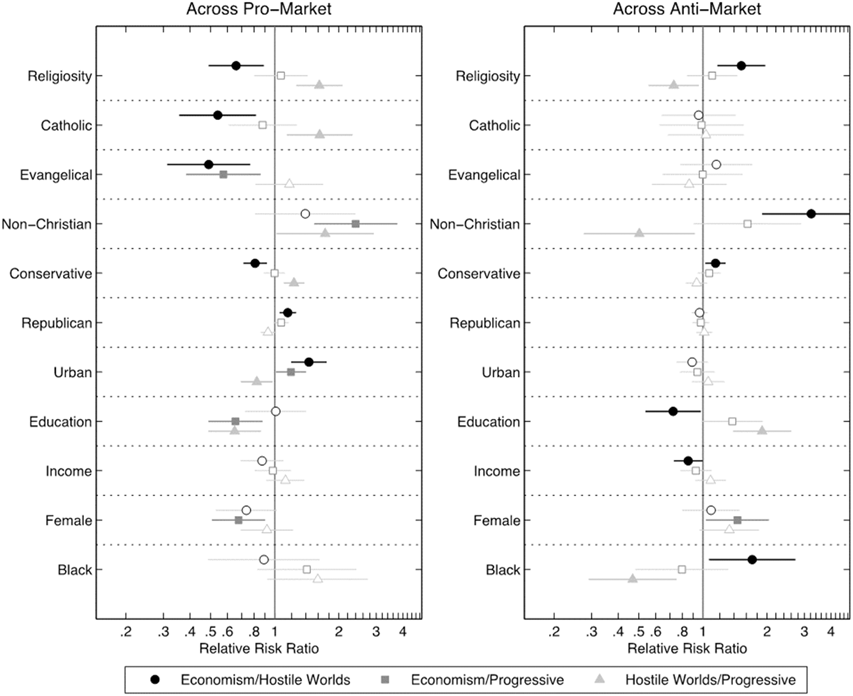
Each comparison to the right of the left-hand variable represents the effect of that variable on the probability of the first as opposed to the second construal in the particular pair. For example, the first line in the pro-market panel, to the right of “religiosity,” indicates that church attendance significantly reduced the probability that a pro-market respondent would be assigned to the economism, as opposed to the hostile-worlds, construal. Put another way, if one is pro-market, the more one attends church, the more likely one is to construe markets as excluding traffic in bodily goods (a conclusion reinforced by the third line to the right of religiosity, which demonstrates that church-going pro-market respondents also prefer the hostile-worlds to the progressive construal). In fact, the odds ratio of a pro-market respondent being assigned to the hostile-worlds class increases by 52 and 62%, respectively, with a one-day increase in weekly religious service attendance, compared to the economistic and progressive pro-market subclasses. To complete the example, the middle line to the right of religiosity, with its empty square, demonstrates that church attendance has no effect on the relative risk of a pro-market respondent adopting the economistic as opposed to the progressive construal.
Consistent with theoretically motivated expectations, religious and political identities are crucial predictors of how pro-market respondents construe the market’s boundaries. The likelihood of a pro-market respondent being assigned to the hostile-worlds construal (i.e., considering intimate goods and services outside the scope of the market) increases not only with church attendance, but also with Catholicism and political conservatism. Similarly, among pro-market respondents, Evangelicals are less likely to adopt the economistic construal, and non-Christians less likely to be assigned to progressivism.
Consistent with our contention that people do not support markets abstractly, but construct markets that their religious and political views permit them to support, access to market rewards and education plays a far less pronounced role in distinguishing among these three pro-market construals than they do in differentiating pro-market from anti-market positions. Education leads pro-market respondents to gravitate towards the progressive construal (economics courses often include material on market failure and regulatory response), and pro-market men are more likely to endorse economistic than progressive construals (consistent with the dominant construction of masculinity as eschewing sentiment on behalf of utilitarian rationality). Otherwise, education, gender, income and race have no significant effects. Differences in pro-market construals, in other words, are shaped more by religious and political orientations than by access to market rewards.
Differences between the three anti-market subclasses (right panel) are subtler. Anti-hostile worlders––who generally oppose unfettered markets, except when applied to intimate goods––are the least church-attending, the least likely to be non-Christian, and the least likely to be African-American, among those embracing anti-market perspectives. Anti-progressives, by contrast, are the least educated among the market critics. It is not surprising that those with the weakest exposure to formal education espouse an anti-market disposition that is suspicious of both the market and of institutions tasked with regulating it. Additional analyses (available on request) reveal that respondents espousing an anti-progressive disposition are the most alienated from market society: they are most likely to agree that the American economic system “needs to be replaced,” and least likely to consider it “the best possible,” compared to members of all other subclasses.
Discussion and conclusions
This paper contributes to the literature on the social and moral constructedness of markets in several ways. First, it confirms empirically that Americans differed not only in their economic beliefs, but also in how those beliefs were organized. The conventional opposition of free-market to anti-free-market economic attitudes proved of limited value in understanding the field of popular economic opinion in the United States. Different subsets of respondents shared different ways of organizing attitudes toward the market, with each subset construing the market in a different way.
Second, our analyses describe these alternative constructions, as they were reflected in responses to attitude items, with greater specificity than has been possible heretofore. We began this paper looking for homines economici––respondents with consistently economistic positions––and found such people to be rarer than we expected. In 1996, fewer than 10% of the U.S. population subscribed to a folk version of the Hayekian worldview that sees markets as efficient and morally neutral (or superior) allocative mechanisms. This small minority consisted largely of high-income, mainline Protestant, Republican men. A roughly equal number (women, people with lower incomes, social conservatives and Democrats) appear to accept the Hayekian construal of what a market economy is, but disagree on its virtues, opposing the market as implacably as their counterparts support it.
Third, our results go beyond previous studies that show the effect of religious faith or political attitudes on specific economic attitudes by examining a broader set of attitudes and, more importantly, demonstrating that religion and ideology work, first, by affecting construals and, second and only then, by influencing attitudes. The finding that most effects of faith and politics are conditional upon construal is a distinctive contribution of this paper.
Fourth, although we have emphasized variation in pro-market views, our research also reveals considerable discontent with or hostility toward markets. Indeed, almost as many respondents were represented in the anti-market as in the pro-market poles of their respective construals. Large minorities of respondents opposed even a basic precept of the market economy, that producers in competitive markets are not obliged to pass savings in factor costs to consumers. The fact that such strong countercurrents lay just beneath the surface of a political culture dominated by allegiance to “free markets,” foreshadowed the availability of many Americans for recruitment into populist or other anti-market social movements.Footnote 19
Finally, even the majority of respondents who endorsed the pro-market poles of their respective construals for the most part rejected pure economism. To be sure, those who benefited most from markets (the wealthy and well educated) tended to support them and those with less access to their rewards (women and African-Americans) held more negative positions. But most supporters of the market engaged in some form of ideological laundering. Some would restrict markets when they impinge on the sacred, excluding exchange in goods and services such as organs or maternal surrogacy that entail commodifying human bodies. For many religiously observant Americans this restriction may be what it takes to render economic conservatism and social conservatism compatible.
Others supported what Polanyi (Reference Polanyi1944) termed the “double movement” of society––the use of market institutions to produce wealth and spur innovation, but the use of government to protect society from the destructive forces that markets unleash. These respondents would shave off the market’s rough edges, endorsing consumer and environmental regulation and opposing prostitution. This construal accomplishes for liberals what the hostile-worlds construal effects for social conservatives: it renders the market palatable, defining a pro-market position consistent with liberal values.
Methodologically, these results underscore the value of acknowledging population heterogeneity in models of attitude formation. Sociodemographic, religious, and ideological measures were associated with attitudes in different ways in the three RCA classes (even though the subsample was partitioned entirely on the basis of responses to attitude items, using no information on respondent attributes). Analysis of the full sample not only underestimated the degree to which economic attitudes are socially patterned, but led to misleading inferences about specific relationships.
Heterogeneity would be less of a problem if one could partition samples based on one or two key attributes. For example, if variation in construals were linked tightly to gender, we could simply conduct separate analyses for men and women and compare the results. But this is distinctly not the case. The three classes have similar distributions on most of the key variables: one-way analysis of variance revealed no significant difference in means for education, gender, frequency of religious attendance, or political ideology among the three subsets of respondents identified by rca. Adoption of each construal is predicted by a unique combination of factors, with no one variable sufficiently dominant to serve as a basis for partitioning.
In sum, then, we draw three methodological lessons:
(1) Heterogeneity in construals of the market economy, as revealed by patterns of association among attitude measures, was sufficiently great that results of analysis of the full sample were misleading, failing to detect structure in the relationship between individual attributes and economic views.
(2) Pace Converse (Reference Converse and Apter1964), heterogeneity did not lie in a dichotomy between rational educated respondents with coherent belief systems and less educated or attentive respondents with disorganized attitudes. Heterogeneity in patterns of response cannot be reduced to differences among demographic subgroups but appears to be produced by complex combinations of identities and life experiences.
(3) Given that heterogeneity is a problem that cannot be addressed only by dividing the sample into demographic subgroups, analysis of attitudes should proceed in two steps, with identification of groups holding different construals preceding efforts to explain particular attitudes. This first step requires the use of a method such as rca to partition the sample based on observed similarities in pairwise relations among item responses.
This approach shifts the thrust of attitude research from the study of opinions to the study of construals: networks of mutually implicated attitudes that together frame and provide narrative consistency to a domain of social life. Of course, we do not believe that the seven items available to us exhaust the most important elements of construals of market society; nor, even if they did, would we equate aggregate associations with individual cognitive structures. Nonetheless, the approach employed in this paper nudges us a bit closer to the goal of using survey responses to make inferences about common patterns in the organization of social knowledge domains.
The data we analyzed were collected two decades ago. Were more recent data available, we assume that some item marginals would have changed, but we doubt that our main findings would differ. Faith in the market is most evident in those sectors of society that the market serves most faithfully, but the relationship is neither simple nor automatic. Instead, before Americans adopt economic attitudes congruent with their material interests, they must first construct a construal of the market consistent with their political values and religious faith. In this way, the institutional logics of religion and politics penetrate those of economic self-interest, producing a diversity of understandings of the market and its effects.
SUPPLEMENTARY MATERIAL
To view supplementary material for this article, please visit https://doi.org/10.1017/S0003975617000558
Acknowledgement
This paper has benefited from feedback received after presentations at the American Sociological Association, University of California at Berkeley, and Duke University, as well as from conversations with Corey Fields, Roger Friedland, Michelle Jackson, Tomás Jiménez, Aliya Saperstein, Hana Shepherd, Cristobal Young, and Viviana Zelizer.



