





Introduction
Since the late 20th century, scholars have debated the concentration of power in party leaders and heads of government across Western liberal democracies (Courtney Reference Courtney1984; Dunleavy and Rhodes Reference Dunleavy and Rhodes1990; Foley Reference Foley1993; Grotz and Kukec Reference Grotz and Kukec2024; Katz and Mair Reference Katz and Mair1994; Mughan and Patterson Reference Mughan and Patterson1992; Müller-Rommel, Vercesi and Berz Reference Müller-Rommel, Vercesi and Berz2022). Overlapping terms and concepts have been developed to clarify the complex, intertwined phenomena fuelling these developments. These include the ‘personalisation’ of political parties, elections, and executive policymaking, whereby increasing emphasis on leaders and their personal attributes comes at the expense of underlying institutions (McAllister Reference McAllister, Dalton and Klingemann2009; Van Aelst, Sheafer and Stanyer Reference Van Aelst, Sheafer and Stanyer2012). In the United States, scholars have documented the ‘centralisation’ of policy advice and decision-making within the presidency, an evolution occurring within a system that already invests constitutional authority in the office of the president (Pfiffner Reference Pfiffner2011; Rudalevige Reference Rudalevige2005). More recently, observers have noted ‘democratic backsliding’ across the globe where constitutional checks, democratic norms, and executive accountability are upended (Druckman Reference Druckman2024; Gessler and Wunsch Reference Gessler and Wunsch2025; Haggard and Kaufman Reference Haggard and Kaufman2021).
In studies of parliamentary governance, a canon of case studies supports a growing consensus that power is increasingly concentrated in the office of the prime minister – a development with implications for public administration, public policy and democratic governance (Aucoin Reference Aucoin2012; Bennister Reference Bennister2012; Brummer Reference Brummer2016; Grube Reference Grube2015; Johansson Reference Johansson2022; Krauss and Nyblade Reference Krauss and Nyblade2005; Mulgan Reference Mulgan2019; Paloheimo Reference Paloheimo2003; Savoie Reference Savoie1999; Walter and Strangio Reference Walter and Strangio2007), although some cases suggest that power oscillates between centralisation and decentralisation (Balmas, Rahat, Sheafer et al. Reference Balmas, Rahat, Sheafer and Shenhav2014). This concentration of power brings advantages of more decisive decision-making, maintaining a coherent policy agenda, clarifying who is responsible and therefore accountable, and enhanced legitimacy in international representation. At the same time, however, governments that cluster power in the prime minister’s office and which are crafted in the leader’s image can undermine institutions, erode collective decision-making, increase electoral volatility, weaken parliament, politicise public administration, and grant leaders greater autonomy in policymaking (McAllister Reference McAllister, Dalton and Klingemann2009; Savoie Reference Savoie1999).
In parliamentary systems, the centralisation of power and personalisation is more appropriately described as ‘prime ministerialisation’ (Dowding Reference Dowding2013; see also Heffernan Reference Heffernan2005). However, the terminology that has taken hold is that of ‘presidentialisation’, whereby prime ministers are simultaneously more visible and powerful within the executive and their parties (Courtney Reference Courtney1984; Poguntke and Webb Reference Poguntke and Webb2005). The term evokes a perceived Americanisation of parliamentary government and politics, not in a formal sense such as direct election or veto power, but in the growing prominence of the head of government, through which power accrues.
The presidentialisation thesis has attracted conceptual criticism. A prime minister already exerts more power over the legislature than a president does (Heffernan Reference Heffernan2005) and, as Bevir and Rhodes (Reference Bevir and Rhodes2006: 686) observe, any prime minister must ‘work in, with and through a complex web of organisations, governments and networks’, with power limited by ‘complex patterns of dependence’. We are sympathetic to Dowding’s (Reference Dowding2013: 617) plea that the term ‘should be expunged from political science vocabulary’, and yet Webb and Poguntke (Reference Webb and Poguntke2013: 649) contend that the analogy is valuable because it captures growing executive power, as well as an alleged mutual autonomy between the leader and the parliamentary party, along with the increasing leader-centredness of electoral politics and trends of centralisation in public administration. While parliamentary systems lack a formal separation of powers, their governance has come to appear presidential: collective cabinet authority has diminished, the personas of individual ministers have given way to the prime minister, and the fusion of parliament and the executive has weakened. They also argue that it holds up even when coalition governments arise (Poguntke and Webb Reference Poguntke and Webb2015). Despite the limitations of this conceptual framework, presidentialisation is widely employed in the literature to refer to the centralisation of power in the office of the prime minister and particularly in the person of the prime minister.
Comparative data are needed to evaluate the claim that prime ministers are assuming roles and behaviours analogous to those of presidents, both in practice and perception. In this article, we ask: to what extent, if any, has the presidentialisation of prime ministers intensified across parliamentary democracies? To answer this research question, we turn to the expertise of hundreds of specialists who study the operation of the executive and legislatures in established parliamentary democracies. Our data combine two waves of expert surveys (Marland, O’Malley and Palavicini Reference Marland, O’Malley and Palavicini2025; O’Malley Reference O’Malley2007) conducted with political scientists specialising in executive and legislative politics across 21 parliamentary democracies. We present descriptive statistics and tests to examine whether expert assessments of prime ministerial power have changed since 1980 and then assess whether common structural predictors explain variation using a multivariate regression. Our findings both enrich and temper the presidentialisation thesis and indicate that further research is warranted about prime ministerialism.
We confirm perceptions of centralisation, but not to the extent or in the manner anticipated by the presidentialisation thesis. Expert opinions challenge the assumption of any uniform or unidirectional rise in executive power within and across parliamentary systems and show that levels of presidentialisation vary across countries. In some cases, individual prime ministers – such as those in Canada and Israel – exert increasing influence over policy, though this influence fluctuates over time and across circumstances. In conducting the first large-N diachronic assessment of the presidentialisation thesis, we provide important nuance in our understanding of power concentration in parliamentary systems and establish a foundation for future research and theory development.
The presidentialisation of prime ministers and executive power
To some extent, the convergence around leadership in politics and government is a natural evolution of the professionalisation of party politics and public administration (Barnard Reference Barnard1938; Goodman Reference Goodman1951). It also reflects a complex interplay of factors that can either strengthen or dilute executive power, including electoral systems, leader personalities, communications, opposition dynamics, belief systems, institutional reforms, resources, international agreements, and policy crises (Dickinson and Lebo Reference Dickinson and Lebo2007; Pfiffner Reference Pfiffner2011; Swinkels Reference Swinkels2020; van Esch and Swinkels Reference van Esch and Swinkels2015). However, in parliamentary systems, a paucity of comparative empirical data has hampered theoretical development in the study of prime ministerial power, which initially relied on detailed historical accounts (Crossman Reference Crossman1972; Jennings Reference Jennings1959; Mackintosh Reference Mackintosh1962) and country-specific descriptive case studies (Hockin Reference Hockin1977; Weller Reference Weller1985), particularly in the United Kingdom. Much of the ensuing scholarly debate has centred on whether governance is dominated by the prime minister or by the cabinet, with no definitive conclusions about overall power trends (Andeweg Reference Andeweg, Weller, Bakvis and Rhodes1997; Diodati, Marino and Carlotti Reference Diodati, Marino and Carlotti2018; King Reference King, Budge and McKay2014). Further, Dunleavy and Rhodes (Reference Dunleavy and Rhodes1990) advanced the idea that a ‘core executive’ of policy actors, such as the civil service and agencies, is also deeply involved in policymaking.
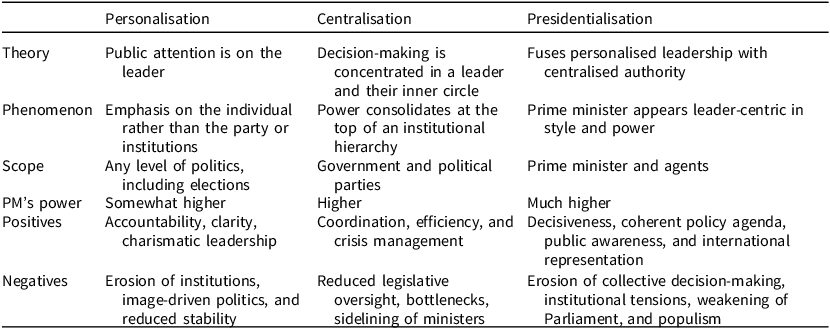
More recently, research on prime ministerial power has focused on ‘institutional stretching’ which describes the mutually reinforcing dynamics of personalisation and centralisation (Strangio, Hart and Walter Reference Strangio, Hart, Walter, Strangio, Hart and Walter2013). This stretching is often referred to as presidentialisation. We argue this phenomenon is distinct from personalisation and centralisation in politics, but is a combination of these two (Table 1). Personalisation emphasises the profile of all types of party leaders, which increases their perceived power and authority (Bennister Reference Bennister2023; Costa Lobo and Curtice Reference Costa Lobo and Curtis2014; Garzia, da Silva and De Angelis Reference Garzia, da Silva and De Angelis2021; Quinlan and McAllister Reference Quinlan and McAllister2022; Rahat and Kenig Reference Rahat and Kenig2018), whereas centralisation refers to the top-down coordination and control of political institutions. In parliamentary democracies, research on centralisation has examined the augmentation of resources, the influence of powerful actors and agencies supporting the prime minister, the hierarchical management of communications, the marginalisation of individual ministers, and the infusion of partisanship within the public service (Allen Reference Allen2003; Aucoin Reference Aucoin2012; Grube Reference Grube2015; Heffernan Reference Heffernan2003; Johansson Reference Johansson2022; Kolltveit Reference Kolltveit2014; Savoie Reference Savoie1999). Presidentialisation provides a framework for understanding how these forces shape executive power in parliamentary democracies. The concepts overlap, and there is some conceptual slippage: personalised politics can occur outside of government, centralisation may take place independently of a leader’s public visibility, and presidentialisation can refer to centralised power in political parties or election campaigns (Bennister and Worthy Reference Bennister and Worthy2024; Webb, Poguntke and Kolodny Reference Webb, Poguntke, Kolodny and Helms2012). There are also problems of observable implications. For instance, presidentialisation expects leaders to take greater control of the party organisation. But Webb and Poguntke (Reference Webb and Poguntke2013) also expect that the leader and the parliamentary party to be increasingly autonomous – with the relationship with the parliamentary party more akin to that of a US president with its congressional party. These two expectations appear to be contradictory, making an up-or-down empirical test of this face difficult. For our purposes, we set aside the party face, which refers to the leader’s growing autonomy from their political party, and the electoral face, which captures the personalisation of election campaigns around individual leaders rather than parties. Our analysis is confined to the executive dimension, with presidentialisation conceptualised as the increasing profile and authority of prime ministerial leadership within government.
Personalisation, centralisation, and presidentialisation in executive politics
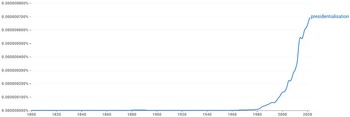
If the conception of prime ministers as presidents is a relatively recent addition to the political science literature, the idea is quite old. Allen (Reference Allen2018: 13) quotes a journalist at the start of the 20th century claiming that the UK prime minister was beginning to resemble a president. In the 1970s, Canadian Prime Minister Pierre Trudeau was alleged to have modelled aspects of his office on the American presidency by centralising decision-making and expanding the Prime Minister’s Office’s authority, size, and visibility (Courtney Reference Courtney1984; Lalonde Reference Lalonde1971; see also McAllister Reference McAllister, Dalton and Klingemann2009: 571). In 1980, the new Taoiseach (Irish prime minister) Charles Haughey’s leadership was described as ‘distinctly presidential, maintaining a tight grip on the levers of political power’ (O’Malley Reference O’Malley1980). While components of presidentialisation were stirring, the term itself was barely used at this point (Figure 1).
Frequency of ‘presidentialisation’ in books, 1800–2022.
Source: Google Books Ngram Viewer https://books.google.com/ngrams.

The concept of presidentialisation gained traction in academia during the 1990s (Foley Reference Foley1993; Mughan and Patterson Reference Mughan and Patterson1992) and was popularised through analyses of Tony Blair’s premiership, which was frequently portrayed as dominated by a singular, authoritative figure, prompting references to the ‘Blair Presidency’ (Allen Reference Allen2003; Bennister Reference Bennister2012; Foley Reference Foley2000; Mughan Reference Mughan2000; Poguntke and Webb Reference Poguntke and Webb2005; Rhodes Reference Rhodes and Walsh2006). Presidentialisation has since become a central, though contested, concept in the study of executive politics and is used to signal increasing concentration of power in parliamentary systems elsewhere (Kefford Reference Kefford2013; Krauss and Nyblade Reference Krauss and Nyblade2005; Palladino Reference Palladino2015), though it is not always invoked when describing expanded prime ministerial power (eg Takenaka Reference Takenaka, Hoshi and Lipscy2021).
Why might presidentialisation be occurring – if it is indeed happening? Scholars have proposed various explanations for the apparent increase in the power of heads of government and, more specifically, prime ministers (Helms Reference Helms2004; Poguntke and Webb Reference Poguntke and Webb2005). The globalisation of politics has shifted many decisions to the transnational level, focusing attention on the head of the political executive as the nation’s principal representative in international affairs and at global summits. As well, the growth and polycentric nature of government heightens the need for a strong leader to coordinate policy and state activities – a phenomenon reminiscent of the ‘iron law of oligarchy’, where specialisation leads to power concentrating in elites (Michels Reference Michels2001 [1911]). Another factor is the transformations in communication technologies that have enabled leaders to engage directly and personally with both mass and niche audiences, turning them into political celebrities, and the conflation of the brands of a government, a party, and its leader (eg Koliastasis and Lilleker Reference Koliastasis and Lilleker2024). There is also the erosion of traditional social cleavages that have reduced party attachment and made voters more responsive to charismatic leaders. Even constitutional reforms intended to strengthen parliamentarism might be insufficient to stem presidentialisation (Raunio and Wiberg Reference Raunio and Wiberg2008).
Many of the forces that appear to centralise power can just as plausibly constrain the chief executive. Cross-national cooperation and supranational governance shift decision-making to transnational arenas, while the proliferation of independent regulatory bodies also removes policy domains from direct executive control. Legislatures can exert authority (Chaisty and Power Reference Chaisty and Power2023), and domestic government has become so large and multifaceted that layers of formalised processes have made prime ministers’ offices more coordinative than commanding (Dunleavy and Rhodes Reference Dunleavy and Rhodes1990). Internet-based communications and social media have enabled unmediated collective action, forcing parties to follow rather than lead political movements and further eroding party leaders’ control over messaging and agenda setting (Bennett and Segerberg Reference Bennett and Segerberg2012). Similarly, the erosion of traditional social cleavages and the rise of polarisation have loosened links with parties and led to party fragmentation, which complicates government formation and reduces executive stability in parliamentary systems. These developments suggest that the forces identified by Poguntke and Webb as causing presidentialisation might have countervailing effects that potentially lead to the erosion of executive power.
The suffix -isation suggests that presidentialisation denotes a process; a series of developments unfolding over time to reach an end. Thus, it is a gradual process that should result in prime ministers becoming more presidential than in the past (Elgie and Passarelli Reference Elgie, Passarelli and Andeweg2020). While there is no single point of origin, either nationally or comparatively, as noted the trend was evident well before the Blair premiership and before the term was coined. Passarelli (Reference Passarelli2015: 1) identifies the ‘presidentialisation’ of executive power as observable since the 1970s, while others trace its emergence to the charismatic and decisive leadership of prime ministers in the 1980s (Foley Reference Foley1993; McAllister Reference McAllister, Dalton and Klingemann2009). The underlying forces of centralisation and personalisation, however, predate these developments – arising respectively after World War II and the advent of television (Foley Reference Foley1993; Poguntke and Webb Reference Poguntke and Webb2005).
Empirical support for presidentialisation is so far underwhelming. Karvonen (Reference Karvonen2010: 20) sees little empirical data for the thesis and believes that its academic proponents rely on ‘gut impressions’. The term is applied inconsistently and is often adapted or modified to suit a researcher’s particular case study (Elgie and Passarelli Reference Elgie, Passarelli and Andeweg2020: 376). This variability is understandable; as Poguntke and Webb (Reference Poguntke and Webb2005: 18) note, ‘certain measures [of presidentialisation] may not travel well from one country to another’, and its form may take different shapes across diverse contexts. For instance, increasingly frequent cabinet reshuffles might be a feature of the thesis in one place, but institutional rules might make that unlikely to be observed in another. As a result, much of the literature consists of country-specific case studies, providing a detailed examination of within that country or a single premiership, but potentially leading researchers to seek signs of presidentialisation rather than systematically testing for it. Still, empirical support for the thesis has been underwhelming (see for instance Chohan and Jacobs Reference Chohan and Jacobs2017; Helms Reference Helms2004; Kolltveit Reference Kolltveit2012). For Elgie and Passarelli (Reference Elgie, Passarelli and Andeweg2020: 377–378), the clearest gaps are that there has been no large-N study and that any studies would need to be time-series, so that we can ‘test the idea that there has been a change over time’.
If the presidentialisation thesis holds, we expect that prime ministers have increasingly consolidated policymaking authority within the executive over time. While we expect this trend to be observable across countries, we also anticipate considerable between-country variation depending on institutional context. Accordingly, we examine changes in prime ministerial power both at the national level and in cross-national comparison.
Research design and data
As noted, we focus exclusively on the executive face of the presidentialisation thesis, which concerns the centralisation of policymaking authority in the hands of the prime minister. To assess the thesis, we examine a prime minister’s capacity to shape policy.
Several obstacles impede comparative testing of this thesis. Leadership decision-making is usually private, leaving observers to largely rely on news coverage to inform their assumptions about the preferences, motivations, and actions of political actors. In-depth conversations with leaders and their agents about the flow of power may be unfeasible while in office; even if a researcher does secure interviews, such as with former officeholders, the participants are bound by confidentiality and may be unable to objectively assess events. In any event, administering in-depth interviews across many countries would be an enormous undertaking. In some cases of extreme policy failure, public inquiries allow us to look inside, but the circumstances are so atypical that they do not represent normal policymaking nor do they enable comparability. Another problem is that leaders face multiple, unique situations. Even within the same country, no two leaders confront the same challenges, and indeed, a leader’s own style fluctuates and evolves. This makes comparison, especially cross-country comparison, very difficult.
Given the challenges of conducting large-N comparative research in executive politics, we use the results of an expert survey to assess prime ministers’ executive power. This study combines two waves of such data: the first, collected by O’Malley (Reference O’Malley2007), covers prime ministers from approximately 1980 to 2002; the second, collected in 2023 and published in Marland, O’Malley and Palavicini (Reference Marland, O’Malley and Palavicini2025), covers the period from circa 2003 to 2023. The data reflect expert opinions about prime ministers in 21 parliamentary democracies, namely Australia, Austria, Belgium, Canada, Denmark, Finland, Germany, Greece, Iceland, Ireland, Israel, Italy, Japan, Malta, the Netherlands, New Zealand, Norway, Portugal, Spain, Sweden, and the United Kingdom.
While the full expert survey questionnaires included multiple items related to prime ministerial leadership, cabinet control, party discipline, and collegiality, this study isolates and analyses the first question in both surveys that directly operationalises the executive face of presidentialisation. Specifically:
Below is a list of recent prime ministers in [country]. Those who governed for more than one time period are differentiated using ‘I’ or ‘II’ (etcetera). How much power do you think each had in terms of getting their preferred policies accepted and enacted? For each, please indicate your views on the 1–9 scale where ‘1’ means you think that particular PM had very little power to influence government policy and get their preferred policies accepted and ‘9’ means you think that PM had a great deal of power to do so.
The question was asked in the two versions of the survey using near-identical wording, allowing for meaningful comparison across time. We recognise that this measure of presidentialisation as power is imperfect: expert surveys are subject to bias and limitations (Curini Reference Curini2009; Marland, O’Malley and Palavicini Reference Marland, O’Malley and Palavicini2025), and we acknowledge that asking to what extent a prime minister had power to advance their preferred policies imperfectly captures just a single dimension of presidentialisation. Nevertheless, it is a reasonable a proxy for presidentialisation over time given that measuring power is notoriously problematic. For instance, assessing ‘effective cabinet management’ or ‘discipline of parliamentary majority’ might also be considered valid measures of prime ministerial power. Conversely, policy control is the output of political battles, whereas some of these other factors might be considered inputs. Expert surveys are especially valuable when alternative data sources are inaccessible or problematic to acquire (Benoit and Laver Reference Benoit and Laver2006) and are therefore used to study difficult concepts such as prime ministerial performance (eg Azzi and Hillmer Reference Azzi and Hillmer2013; Grotz et al. Reference Grotz, Müller-Rommel, Berz, Kroeber and Kukec2021). Our analytic focus is on broad trends and aggregate patterns over time, rather than on the precision of individual ratings, which reduces the sensitivity of our findings to outliers or individual judgements. For further methodological detail, refer to Marland, O’Malley and Palavicini (Reference Marland, O’Malley and Palavicini2025).
Our analysis proceeds in three stages. First, we examine descriptive statistics to identify broad trends in prime ministerial policymaking power across time and countries. This initial step provides a snapshot of the distribution of scores across both survey waves and highlights whether notable shifts, increases, or decreases are visible at the country level between the two periods: 1980–2002 and 2003–2023. Second, we assess whether these changes are statistically significant by conducting paired sample t-tests comparing average prime ministerial power ratings in each country across the two time periods. This step helps us determine whether the shifts observed in the descriptive data represent meaningful temporal change or fall within expected ranges of variation.
Finally, we turn to multivariate regression analysis using the full combined dataset to test whether key institutional variables associated with the presidentialisation thesis can help explain variation in prime ministerial power. Specifically, we model prime ministerial power as a function of: the share of parliamentary seats held by the PM’s party (party strength in the legislature); the share of cabinet posts held by the PM’s party (government type: single-party majority, coalition, etc.); and the effective number of parliamentary parties (ENPP) as a proxy for party system fragmentation. Together, these variables allow us to assess whether structural and institutional conditions long hypothesised to constrain or enhance executive leadership are indeed associated with higher or lower levels of perceived policymaking authority across countries and time. Thus, we expect several institutional variables to be associated with variation in perceived prime ministerial power. Specifically, we should anticipate that prime ministers will score higher when their party holds a greater share of seats in parliament and a larger proportion of cabinet portfolios. Conversely, we would expect lower scores in systems with higher party system fragmentation, as measured by the effective number of parliamentary parties (ENPP).
Results
Our research question explores how prime ministerial power has evolved since the end of the 20th century (approximately 1980 onwards), particularly in terms of the ability of prime ministers to deliver policy outputs. To measure this, we asked participants to estimate the influence of individual prime ministers in getting their preferred policies accepted and enacted. This question, comparable to that asked in the O’Malley (Reference O’Malley2007) study, was measured on a 9-point scale, where 9 indicates that the prime minister had ‘a great deal of power to influence government policy and get their preferred policies accepted and enacted’.
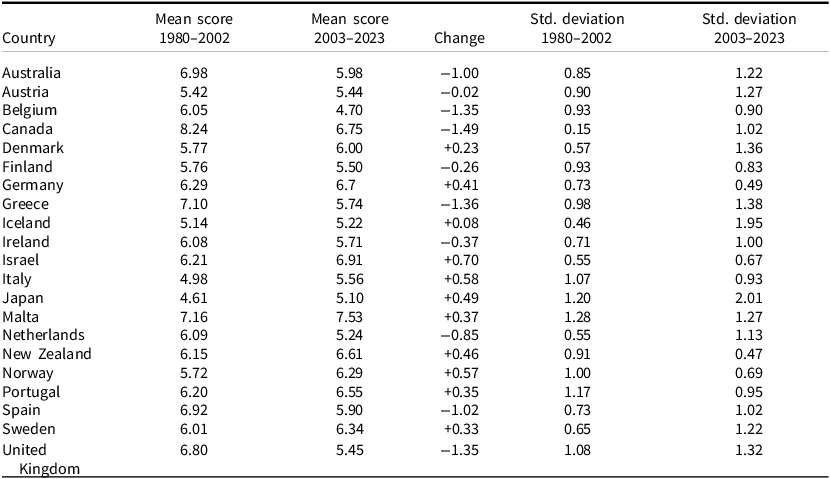
We present the distribution of mean responses about power over policy outputs for each prime ministerial term by country over our four-decade timeline (Tables 2 and 3). In terms of changes over time, the average scores (ie overall mean from all respondents) are slightly lower for the period from circa 2003 to 2023 (5.88) than for the period 1980 to 2002 (6.14).
Country mean scores for PM control of policy (circa 1980 to 2023)
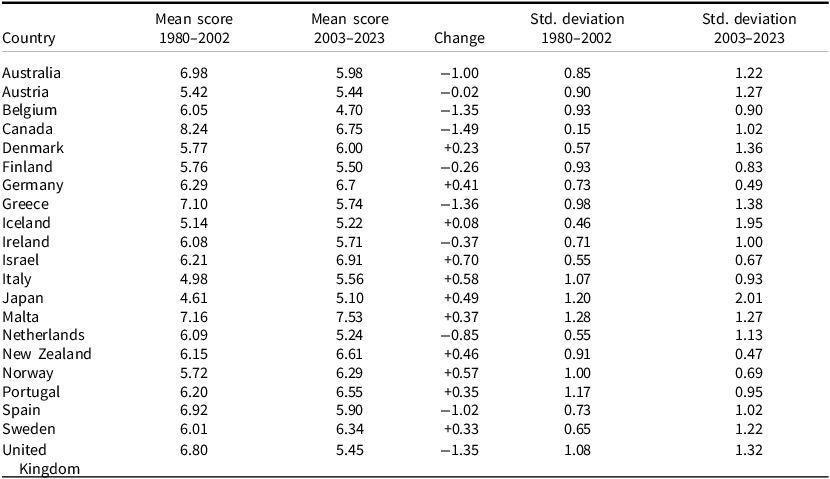
Note: Uses a 1–9 scale where 1 is little power to influence policy and 9 is great deal of power to do so.
Mean scores for PM control of policy by decade

Though it is possible to observe there is no real difference by eyeballing, to assess whether this difference is statistically significant, we conducted a paired t-test. The results indicate a modest decline in prime ministerial power ratings between the two periods, with a mean difference of 0.21 points on the 9-point scale (t = 1.26, p = 0.11).Footnote 1 This slight decrease in prime ministerial power is more noticeable when comparing decades, as scores have decreased slightly over time, with the largest change between the 1990s and 2010s.
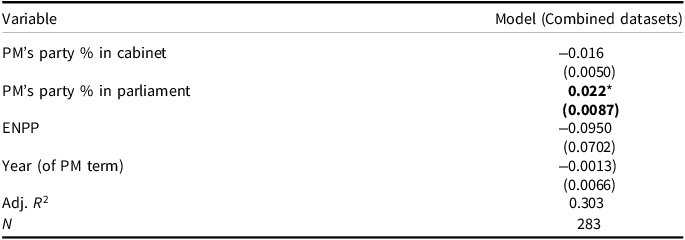
To further assess the presidentialisation thesis, we consider the factors of prime ministerial power over time (Table 4). We estimated an ordinary least squares (OLS) regression based on the combined dataset of expert ratings from the combined waves. The dependent variable is the perceived ability of a prime minister to enact their preferred policies, measured on a 9-point scale. The independent variables reflect likely key components of the sources of a prime minister’s power, including: share of parliamentary seats held by the prime minister’s party, share of cabinet portfolios held by the PM’s party (cabdom), and effective number of parliamentary parties (ENPP), country dummy variables (not reported), and the year when the PM’s term began, as a variable for time.
Prime ministerial power: Regression model
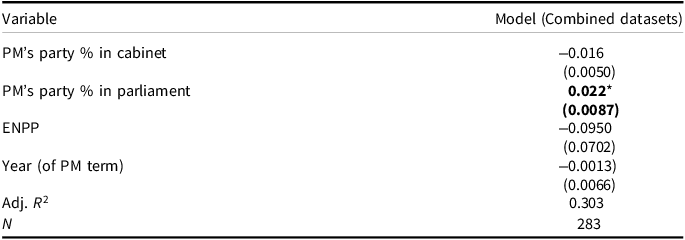
*p < 0.05; **p < 0.01. Robust standard errors in parentheses.
When controlling for country, the results indicate that the prime minister’s share of parliamentary seats remains the best predictor of executive power. The coefficient for the PM’s party percentage in parliament is positive and statistically significant, suggesting that stronger parliamentary majorities are associated with more prime ministerial influence over policy outcomes. By contrast, the share of cabinet seats held by the prime minister’s party shows no meaningful relationship with power, though the effect of party system fragmentation (ENPP) is negative but only marginally significant. Both of these are a function of the size of the PM’s parliamentary party, so the statistical significance of fragmentation is noteworthy. Similarly, the variable for year is not significant. Overall, the model suggests that institutional and temporal factors explain variation in executive strength but do not point to a steady or universal concentration of power. It also suggests that it is the PM’s authority, bolstered by a strong parliamentary majority, rather than mere party control, that drives policy influence.
Discussion
Our findings provide a nuanced but ultimately sceptical perspective on the core claims of the presidentialisation thesis with respect to prime ministerial power. While the theory argues a general and cumulative shift toward greater executive control by prime ministers, particularly over policymaking authority, our analysis shows no consistent trend in this direction. The t-test comparing average PM power scores between the earlier (1980–2002) and later (2002–2023) periods reveals no statistically significant change in executive authority. If anything, the descriptive results suggest a slight decline in prime ministerial policy influence over time, with the average score falling from 6.13 in the earlier period to 5.88 in the later one.
This modest decline, however, also masks substantial cross-national variation. Rather than a steady increase in prime ministerial control across countries, our data reveal a mixed picture in which scores fluctuate across decades and contexts. This variation itself challenges the idea of a uniform structural trend toward presidentialisation. Some of those movements are striking. Both the UK and Australia, traditionally regarded as having dominant prime ministers, have seen a decrease in prime ministerial power. In the case of the UK, this is partly explained by the particularly low score for Theresa May, whose tenure was overshadowed by Brexit (Worthy and Bennister Reference Worthy and Bennister2021). Had Liz Truss, Rishi Sunak, and Keir Starmer been included in the data collection, that might show an even greater decline. In Australia, prime ministers were weakened by severe party infighting that saw sitting prime ministers removed in both the Labor and Liberal parties (Gauja Reference Gauja, Pilet and Cross2014). The variation is most visible when we consider the extreme cases in the dataset: Canada, which experienced the most pronounced decline in prime ministerial policy power over time, and Israel, which saw the most substantial increase. These outliers reveal how national context mediates executive authority and challenge the notion of a uniform trajectory toward greater prime ministerial control.
At first glance, the finding that Canadian prime ministers’ power has been declining is counterintuitive. Scholarly analyses and media accounts of Stephen Harper’s Conservative government (2006–2015) depicted an administration obsessed with message control and the consolidation of power (Brabazon and Kozolanka Reference Brabazon and Kozolanka2018; Martin Reference Martin2011). Party discipline in Canada is so strict that, in the social media era, it has evolved into message discipline, with Members of Parliament expected not only to vote in unison but also to publicly endorse and echo the leader’s messaging. Yet our empirical data invite a reassessment: while majority governments defined the 1980s and 1990s in Canada, the 21st century has been marked by frequent hung parliaments, producing minority governments that significantly constrain prime ministerial power.Footnote 2
Though always the most central political actor, Israel is a country that traditionally had a very weak head of the political executive. Because of this, in the late 1990s an unusual move was made to directly elect the prime minister. This ultimately failed and was abandoned in 2001 and ceased to exist in 2003. Indeed, Hazan (Reference Hazan, Poguntke and Webb2005) argued that prime ministers were becoming gradually stronger already, in part due to the strengthening of the Prime Minister’s Office, at the expense of the Knesset, parties, and ministers. Looking at the legal-constitutional resources, Kenig (Reference Kenig and Hazan2017) is of no doubt that Israeli prime ministers have become stronger due to ongoing institutional changes. However, Israeli prime ministers have been weakened somewhat by the growing fragmentation of the party system, though if the prime minister assumes the co-ordinating role it might give them some more central power over their parties.
The most pronounced dips in average PM power occur in the decades spanning 2002 to 2020, a period marked by significant transformations in the information environment. Although our data do not allow for a definitive explanation, we suggest that shifts in technology and media, including the rise of social media, fragmented news cycles, and 24/7 public scrutiny, may have contributed to the dispersal of political power. In this context, the increasingly centralised control of communication by prime ministerial offices observed in other studies may reflect not enhanced power, but rather a compensatory response to growing structural volatility and fragmentation.
Finally, our regression analysis further questions the presidentialisation thesis, reinforcing the argument that the evidence for a structural or uniform process of presidentialisation remains weak. Although parliamentary dominance contributes to prime ministerial strength, its effects are modest and highly contingent on context. The results highlight substantial cross-national and temporal variation, suggesting that shifts in prime ministerial power reflect country-specific institutional and political dynamics rather than a shared trajectory toward presidential-style leadership. In short, the data point to evolution rather than transformation: prime ministers may have become more visible and electorally central, but their institutional power remains bounded and variable within parliamentary systems.
Conclusion
This study revisited the presidentialisation thesis by examining whether prime ministers have consolidated policymaking power over time across 21 parliamentary democracies. Using expert survey data spanning four decades of prime ministers (1980–2023), we assessed perceived executive authority through a consistent, cross-national measure of prime ministerial policy influence. Contrary to expectations grounded in the presidentialisation literature, our findings offer a different and, in many ways, contradictory picture.
First, the comparison of time periods reveals no statistically significant increase in average prime ministerial power. Indeed, the mean score declines modestly in the post-2000 period. Second, the regression analysis shows that the size of the prime minister’s party is the single most significant predictor of prime ministerial strength and experts’ assessments of executive authority. At a time when we are observing more fragmentation of party representation in parliament, that suggests there should be a downward movement in prime ministerial power.
Taken together, the evidence challenges the idea of a linear or universal move toward presidentialised leadership in parliamentary systems. The most striking finding is the wide cross-national variation in trends. Generally, we can see there is a standardising of prime ministerial power, with traditionally weaker prime ministers becoming more powerful, in part because of institutional changes, but perhaps also for the reasons given in the presidentialisation thesis. Meanwhile, those traditionally strong prime ministers seem to have weakened, perhaps due to the increased constraints placed on executives by courts, international institutions, and increasingly globalised economies.
While our analysis focuses on established parliamentary democracies, the implications of these findings extend beyond the Western context. Recent work by Grotz and colleagues, drawing on expert survey data from post-communist Eastern Europe between 1990 and 2018, examines the same measure of prime ministerial control over policy and arrives at strikingly similar conclusions (Grotz and Kukec Reference Grotz and Kukec2024; Grotz et al. Reference Grotz, Müller-Rommel, Berz, Kroeber and Kukec2021). Their findings likewise reveal no general trend toward increasing or decreasing prime ministerial dominance and identify party strength in parliament as a key driver of variation in executive authority. Taken together, these results suggest that the absence of a linear presidentialisation trend is not unique to long-established democracies but may reflect a more general feature of parliamentary systems across different political and historical contexts. More broadly, this convergence points to the need for future comparative research on prime ministers to move beyond universalising claims about executive empowerment and, instead, focus on the interaction between institutional design, party systems, and contextual constraints across diverse democratic settings.
In sum, our findings suggest that the presidentialisation thesis lacks support – at least when it comes to policymaking authority in parliamentary democracies. Rather than a steady march toward prime ministerial dominance, the picture is one of uneven change, institutional constraints, and national context. Richard Rose’s observation, made when Tony Blair was still an opposition MP, that ‘while there is an ocean of difference between an American president and a prime minister, within the universe of parliamentary democracies there remain substantial differences of degree’ (Reference Rose1991: 9), continues to be relevant for debates on executive power.
Data availability statement
The dataset we use is available from Borealis – University of Alberta. https://borealisdata.ca/dataset.xhtml?persistentId=doi:10.5683/SP3/6TRVBZ.
Funding statement
Funding for this project was made available through the Jarislowsky Chair in Trust and Political Leadership at Acadia University, Canada.
Competing interests
There are no competing interests to report.
Ethical standards
Data collection approved in July 2023 by the Research Ethics Board at Acadia University, Canada, file #REB 23-30. The Artificial Intelligence application Claude was used to format the reference list.


 Open access

