


This project was commissioned by the Department of Health as part of a rolling programme of research to investigate recruitment and retention issues affecting psychiatry.
There has been a shortfall in psychiatrist numbers in the order of 12% in England (Royal College of Psychiatrists, 2004), with geographic and sub-specialty peaks well in excess of that figure. The Department of Health has been well aware of these issues, and commissioned a series of research projects in collaboration with the Royal College of Psychiatrists. One of these projects, carried out with the support of the College's Research and Training Unit, investigated workload and working patterns for consultants, with the aim of better understanding the pressures under which they are working, and what particular stressors are most in need of occupational interventions.
Method
A questionnaire was designed with the help of three specialty-specific focus groups (general adult psychiatry, old age psychiatry and child and adolescent psychiatry) and was sent to a randomly selected group of 500 consultant psychiatrists. This sample was generated using the random sample-generating functionality of SPSS version 11.5 for Windows. Non-responders were sent two reminder letters, the second included a further copy of the questionnaire.
The questionnaire included sections for demographic data, work patterns, roles and responsibilities, job content and work environment. Other sections used validated tools: the Karasek Job Content Questionnaire (JCQ; Reference Karasek, Brisson and KawakamiKarasek et al, 1998), the Maslach Burnout Inventory (MBI; Reference Maslach and JacksonMaslach & Jackson, 1993) and the 12-item version of the General Health Questionnaire (GHQ; Reference GoldbergGoldberg, 1992). The data were analysed using SPSS version 11.5 for Windows.
Karasek Job Content Questionnaire
The JCQ (Reference Karasek, Brisson and KawakamiKarasek et al, 1998) permits the measurement of three aspects/dimensions of job strain:
-
• job control/decision latitude
-
• psychological job demands
-
• social support.
We predicted that low job control/decision latitude along with high job demands might elicit job strain. This relationship between job control and demand might be counteracted by good/high levels of social support (Reference Karasek, Brisson and KawakamiKarasek et al, 1998).
Maslach Burnout Inventory
The MBI (Reference Maslach and JacksonMaslach & Jackson, 1993) is a 22-item, 6-point fully anchored Likert scale which asks respondents to rate statements (on a 0-6 scale) such as ‘I feel emotionally drained from my work’, ‘I have accomplished many worthwhile things in my job’ and ‘I worry my job is hardening me emotionally’. This range of questions assesses the three aspects of burnout - emotional exhaustion, depersonalisation and personal accomplishment. It is important to emphasise that burnout is a continuous variable in which degrees of experienced feelings range from low, to moderate to high, and is not either present or absent. The validity of the MBI has been illustrated in a number of ways: convergent validity, external validity and discriminant validity (Reference Maslach and JacksonMaslach & Jackson, 1993).
General Health Questionnaire (12-item version)
The GHQ-12 (Reference GoldbergGoldberg, 1992) was designed to give an indication as to whether the respondent is exhibiting psychological distress (i.e. that they may be suffering from some kind of psychological illness). A score above the threshold level is indicative that some kind of problem might exist. For the purposes of this report, the threshold is taken as 4 or above. It should be noted that the GHQ-12 is not a diagnostic tool.
Results
There were 185 questionnaire forms returned, giving an adjusted final response rate of 39.1% (after non-responders and late returns are removed from the denominator).
The mean age of the sample was 47 years; 40% were male; 14% trained part-time or working flexibly; 96% worked for the National Health Service, 77% of these working full time. The mean length of time as a consultant was 10 years, and the mean length of time at current trust was 6.6 years. There were 19% of the sample who worked in child and adolescent services, 39% in general adult psychiatry, 14% in old age psychiatry and 27% in other specialties. Two-thirds of the sample worked in in-patient services, 80% in out-patient services, 56% in a community mental health teams (CMHTs) and 8% in assertive outreach.
The working week
The total mean hours worked per week by the consultants in the sample was 44.2 (s.d.=12.8), excluding on call. Consultants worked a mean of 1.9 evenings per week (s.d.=1.6) and 1.7 weekends per month (s.d.=1.4). The mean case-load was 286.9 (s.d.=1419.6).
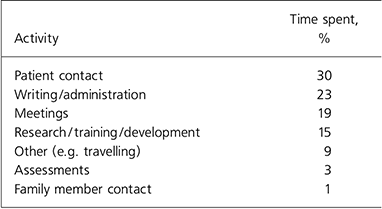
The data provided by respondents enabled working time to be broken down into principal activities (Table 1).
Percentage of time spent according to activity
| Activity | Time spent, % |
|---|---|
| Patient contact | 30 |
| Writing/administration | 23 |
| Meetings | 19 |
| Research/training/development | 15 |
| Other (e.g. travelling) | 9 |
| Assessments | 3 |
| Family member contact | 1 |
Job satisfaction
Respondents were asked to rate their job between 1 ‘satisfying’ and 5 ‘disappointing’. The mean satisfaction value was 2.4, a little below the midpoint on the scale. The data show, however, that 55.8% of respondents scored either 1 or 2, and 21% scored 4 or 5.
General health
Consultants took a mean of 6 days sick leave (s.d.=22) in the previous 12 months. The distribution was, however, markedly skewed, with the median value 1 and the mode 0. They consumed a mean of 12.6 units of alcohol per week (s.d.=11); 16% were consuming more than the recommended weekly allowance; 8% of respondents smoked a mean of 9 cigarettes per day (s.d.=6.7); 6% were taking stress-relieving medication; and 72% reported taking regular exercise (mean of 3.3 times per week).
The mean GHQ-12 score for the sample was 2.2 (s.d.=2.9). There were 25% of respondents who scored greater than the threshold (4), indicating possible psychological distress. The proportion of the general population reaching this threshold is 17% (Department of Health, 1996).
Job content and perceived burden
On the MBI, 17.1% of the sample exhibited a high propensity for burnout overall (high emotional exhaustion, high depersonalisation and low personal accomplishment); 1.1% of the sample show low emotional exhaustion, low depersonalisation and high personal accomplishment. Scores on the MBI were also significantly associated with a high score on the GHQ (high emotional exhaustion: r=0.528, n=176, P<0.01; high depersonalisation: r=0.279, n=177, P<0.01; low personal accomplishment: r=-0.17, n=177, P<0.05).
All three JCQ scales were significantly associated with GHQ scores:
-
• the higher the psychological work demands placed on the consultants, the higher the GHQ-12 scores (r=0.325, n=179, P<0.01)
-
• the lower the level of job control (decision latitude), the higher the GHQ score (r=-0.239, n=168, P<0.01)
-
• the lower the level of social support, the higher the GHQ scores (r=-0.239, n=168, P<0.01).
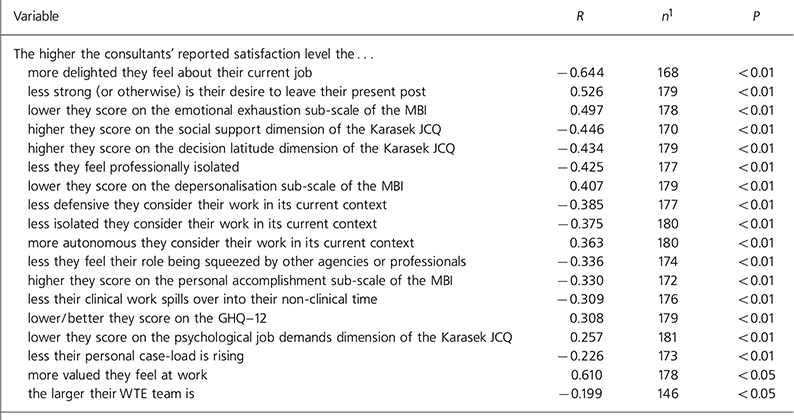
Reported job satisfaction is also significantly associated with a number of key variables (Table 2).
Variables associated with better job satisfaction
| Variable | R | n 1 | P |
|---|---|---|---|
| The higher the consultants' reported satisfaction level the … | |||
| more delighted they feel about their current job | − 0.644 | 168 | <0.01 |
| less strong (or otherwise) is their desire to leave their present post | 0.526 | 179 | <0.01 |
| lower they score on the emotional exhaustion sub-scale of the MBI | 0.497 | 178 | <0.01 |
| higher they score on the social support dimension of the Karasek JCQ | − 0.446 | 170 | <0.01 |
| higher they score on the decision latitude dimension of the Karasek JCQ | − 0.434 | 179 | <0.01 |
| less they feel professionally isolated | − 0.425 | 177 | <0.01 |
| lower they score on the depersonalisation sub-scale of the MBI | 0.407 | 179 | <0.01 |
| less defensive they consider their work in its current context | − 0.385 | 177 | <0.01 |
| less isolated they consider their work in its current context | − 0.375 | 180 | <0.01 |
| more autonomous they consider their work in its current context | 0.363 | 180 | <0.01 |
| less they feel their role being squeezed by other agencies or professionals | − 0.336 | 174 | <0.01 |
| higher they score on the personal accomplishment sub-scale of the MBI | − 0.330 | 172 | <0.01 |
| less their clinical work spills over into their non-clinical time | − 0.309 | 176 | <0.01 |
| lower/better they score on the GHQ-12 | 0.308 | 179 | <0.01 |
| lower they score on the psychological job demands dimension of the Karasek JCQ | 0.257 | 181 | <0.01 |
| less their personal case-load is rising | − 0.226 | 173 | <0.01 |
| more valued they feel at work | 0.610 | 178 | <0.05 |
| the larger their WTE team is | − 0.199 | 146 | <0.05 |
Discussion
Although the findings from this study are instructive, there may be an element of self-report bias, inherent in any survey using self-report as the basis for data collection. The response rate indicates that more consultants did not respond than those who did, and thus the findings must be seen as illustrative rather than definitive. In addition, it might be hypothesised that those suffering from burdens are more likely to respond, to give an outlet to their issues.
Job satisfaction, we would hypothesise, is a useful proxy for job quality and therefore occupational pressures, since it is inversely associated with all of the key negative outcomes of a poor job. A poor or ‘ problem’ post will put its owner under levels of stress and burden that are ultimately likely to lead to ill health and thence attrition. Commissioners and managers must identify these problem posts, and act to reduce the burdens if they are to prevent the loss of key staff.
The findings from the Karasek JCQ show that a significant minority of psychiatrists are operating under the very worst of conditions: high job demands coupled with low support and poor autonomy (as described by the ‘ job strain’ model). This pressure is likely to lead to health problems (Reference Karasek, Brisson and KawakamiKarasek et al, 1998), and this is evidenced by the significant association between the Karasek sub-scales and GHQ-12 caseness.
The data from this study show that consultants are about 1.5 times more likely than the general population to be above the threshold for psychological distress on the GHQ-12. This is not, however, any higher than the equivalent for the primary care workforce of 23%, and lower than that for all doctors and managers of 30% (Reference Calnan, Wainwright and ForsytheCalnan et al, 2001) and community mental health nurses of 35% (Reference Edwards, Burnard and HanniganEdwards et al, 2000). A significant minority of respondents scored a high propensity for burnout on the MBI. This is in itself a cause for concern, but the levels scoring poorly on the depersonalisation scale is a particular issue given the nature of the work they do. Low levels of personal accomplishment were surprising. It had been assumed that reaching a consultant post would be an accomplishment enough to yield higher scores on this scale. It could be hypothesised, however, that the lack of appreciation and recognition from managers, trusts and patients might be having a detrimental effect on respondents' feelings of self-worth, and this is reflected in the personal accomplishment scale.
Findings from this study reported elsewhere (Reference Mears, Pajak and KendallMears et al, 2004) show that more progressive approaches to working can alleviate the occupational burdens faced by consultants. It is also perhaps testament to the resilience of the consultant psychiatrist that the GHQ scores for this group are lower than for other groups, in spite of working in similarly challenging environments. Finally, the role of the consultant psychiatrist is reviewed in New Ways of Working for Psychiatrists (Department of Health, 2005). Parts of this document accord with Mears et al (Reference Mears, Pajak and Kendall2004), encouraging more devolvement of responsibility within the multidisciplinary team, and might, therefore, reduce burdens. This paper also, however, indicates that the consultant role might become more generic in nature, with the potential that this might compromise job satisfaction, as Pajak et al (Reference Pajak, Mears and Kendall2003) have shown that general adult psychiatrists demonstrate significantly lower levels of job satisfaction.
Declaration of interest
This project was funded by the Department of Health.


 Open access


eLetters
No eLetters have been published for this article.