





Impact statement
Common mental disorders (CMDs), such as anxiety and depression, greatly burden women throughout the perinatal period, which includes the time during and after pregnancy. Low- and middle-income countries, such as Pakistan, have a high prevalence of CMDs, though research originating from these countries is limited. This study aimed to estimate the prevalence of CMDs in Rahim Yar Khan (RYK), Pakistan, using the standardized Self-Reporting Questionnaire tool, and to identify factors associated with postpartum mental health. Community-based data collection was performed throughout the first year postpartum, reaching geographically isolated women who are often underrepresented in perinatal research. Our findings show that one in six women experiences CMDs in the first year postpartum, with CMDs during the preconception and antenatal period serving as a significant predictor of postpartum mental health status. Additionally, our findings show that social support factors are significantly associated with maternal mental health status in the first year postpartum. This study demonstrates the high burden of CMDs among perinatal women in RYK, Pakistan, and highlights the need for early identification and management of CMDs via mental health screening during the antenatal period. Women identified as having CMDs or at risk for CMDs may benefit most from protective interventions, including the establishment of strong social support networks and the concurrent promotion of paternal mental health.
Introduction
The perinatal period is a time of immense psychosocial change for individuals experiencing pregnancy and childbirth, creating a particularly vulnerable time for maternal mental health (Biaggi et al., Reference Biaggi, Conroy, Pawlby and Pariante2016; Manolova et al., Reference Manolova, Waqas, Chowdhary, Salisbury and Dua2023). Common mental disorders (CMDs) in the perinatal period refer to symptoms of psychological distress, such as depression, anxiety and/or stress, that can onset or recur during pregnancy or the postpartum period (O’Hara and Wisner, Reference O’Hara and Wisner2014). Perinatal CMDs can have negative impacts on maternal health and can impair maternal–infant bonding (McNab et al., Reference McNab, Dryer, Fitzgerald, Gomez, Bhatti, Kenyi, Somji, Khadka and Stalls2022). Undiagnosed and untreated CMDs during the perinatal period have been associated with adverse birth outcomes, such as preterm birth and low birthweight, and delayed infant development (Szegda et al., Reference Szegda, Markenson, Bertone-Johnson and Chasan-Taber2014; McNab et al., Reference McNab, Dryer, Fitzgerald, Gomez, Bhatti, Kenyi, Somji, Khadka and Stalls2022; Lalani et al., Reference Lalani, Premji, Shaikh, Sulaiman, Yim, Forcheh, Babar, Nausheen and Letourneau2023). Despite the health burden of perinatal CMDs, they often go unaddressed due to the similarity in symptoms caused by hormonal changes in pregnancy and early parenthood (Tripathy, Reference Tripathy2020). Other barriers to diagnosis and treatment include individual factors, such as shame and lack of knowledge, as well as structural factors, such as limited resources and inadequate screening and referral policies (Sambrook Smith et al., Reference Sambrook Smith, Lawrence, Sadler and Easter2019; Webb et al., Reference Webb, Uddin, Constantinou, Ford, Easter, Shakespeare, Hann, Roberts, Alderdice, Sinesi, Coates, Hogg and Ayers2023).
Low- and middle-income countries (LMICs) have a significantly higher prevalence of perinatal CMDs compared to high-income countries (Fisher et al., Reference Fisher, Cabral de Mello, Patel, Rahman, Tran, Holton and Holmes2012; Tripathy, Reference Tripathy2020; Roddy Mitchell et al., Reference Roddy Mitchell, Gordon, Atkinson, Lindquist, Walker, Middleton, Tong and Hastie2023). The World Health Organization (WHO) reports that 10% of pregnant women and 13% of postpartum women experience CMDs globally, whereas LMICs have increased prevalence of 16% and 20%, respectively (World Health Organization, n.d.). Prominent barriers to perinatal mental healthcare in LMICs include an inadequate number of mental health specialists to accommodate the perinatal population, a lack of screening and diagnosis guidelines and stigma among healthcare workers and the community (Baron et al., Reference Baron, Hanlon, Mall, Honikman, Breuer, Kathree, Luitel, Nakku, Lund, Medhin, Patel, Petersen, Shrivastava and Tomlinson2016; Insan et al., Reference Insan, Weke, Rankin and Forrest2022). Despite the relatively greater burden of perinatal CMDs in LMICs, a systematic review found that LMICs were underrepresented among perinatal mental health-related research, with only 8% and 15% of LMICs represented in studies exploring the prevalence of antenatal and postpartum CMDs, respectively (Fisher et al., Reference Fisher, Cabral de Mello, Patel, Rahman, Tran, Holton and Holmes2012).
One study looking at the comorbidity of antenatal anxiety and depression in Pakistan found that 13% of women experienced comorbid anxiety and depression during their pregnancy (Premji et al., Reference Premji, Lalani, Shaikh, Mian, Forcheh, Dosani, Letourneau, Yim and Bhamani2020). However, the research focusing on perinatal comorbid anxiety and depression originating from LMICs is not extensive (Falah-Hassani et al., Reference Falah-Hassani, Shiri and Dennis2017), with much focus solely on depressive symptomatology (Fisher et al., Reference Fisher, Cabral de Mello, Patel, Rahman, Tran, Holton and Holmes2012; Obrochta et al., Reference Obrochta, Chambers and Bandoli2020). A systematic review found that the pooled prevalence of antenatal depression in Pakistan was 37% and the pooled prevalence of postpartum depression was 30%, though significant heterogeneity was found between included studies (Atif et al., Reference Atif, Halaki, Raynes-Greenow and Chow2021). Additionally, most studies are cross-sectional or cohort studies that span a short duration of the perinatal period, which does not allow for assessment of changes in mental health across the perinatal period (Padhani et al., Reference Padhani, Salam, Rahim, Naz, Zulfiqar, Ali Memon, Meherali, Atif and Lassi2024). Commonly reported risk factors of CMDs in LMICs include socioeconomic disadvantage, gender inequality, difficulties in intimate partner relationships, insufficient social support, adverse reproductive and infant outcomes and prior history of mental illness (Fisher et al., Reference Fisher, Cabral de Mello, Patel, Rahman, Tran, Holton and Holmes2012; McNab et al., Reference McNab, Dryer, Fitzgerald, Gomez, Bhatti, Kenyi, Somji, Khadka and Stalls2022; Padhani et al., Reference Padhani, Salam, Rahim, Naz, Zulfiqar, Ali Memon, Meherali, Atif and Lassi2024). However, risk and protective factors of psychological distress vary between studies and may be context-dependent (Fisher et al., Reference Fisher, Cabral de Mello, Patel, Rahman, Tran, Holton and Holmes2012; McNab et al., Reference McNab, Dryer, Fitzgerald, Gomez, Bhatti, Kenyi, Somji, Khadka and Stalls2022).
We aimed to estimate the prevalence of CMDs and determine factors associated with maternal mental health in the first year postpartum in Rahim Yar Khan (RYK), Pakistan. Additionally, we aimed to understand the trajectory of maternal mental health at multiple time points during the perinatal period.
Methods
Study design and population
This is a secondary analysis of data collected from a longitudinal birth cohort study in RYK, Pakistan, from April 2014 to July 2016. RYK is a predominantly rural district and has a major agricultural industry, with a total population of 4.8 million in 2017 (Pakistan Bureau of Statistics, 2017). The birth cohort was embedded in the control arm of a community-based, cluster-randomized trial (CRT), which aimed to estimate the effectiveness of an integrated newborn care kit on neonatal mortality (Turab et al., Reference Turab, Pell, Bassani, Soofi, Ariff, Bhutta and Morris2014; Pell et al., Reference Pell, Turab, Bassani, Shi, Soofi, Hussain, Ariff, Bhutta and Morris2019). Clusters for the CRT were defined as existing principal villages in RYK, to which one or more lady health workers (LHWs) were assigned. LHWs are government-sponsored community health workers who provide primary healthcare and promotion of healthcare service utilization (Hafeez et al., Reference Hafeez, Mohamud, Shiekh, Shah and Jooma2011). In the CRT, all women who were in the third trimester of pregnancy, living in one of the defined clusters and were intending to stay in the study area for at least 1 month postpartum were considered eligible for enrollment in the CRT. There were 150 clusters randomized 1:1 to receive either the integrated newborn care kit (intervention) or the local standard of care (control). Overall, 5,462 pregnant women were screened for participation in the CRT, with 5,451 enrolled (2,663 interventions and 2,788 controls) and 5,370 with complete delivery outcomes ascertained (2,622 interventions and 2,748 controls). Those enrolled in the control arm were invited to participate in a concurrent birth cohort study, which aimed to collect high-quality data on early-life exposures and child outcomes in the first year after birth.
All participants in the CRT, along with their newborns, were prospectively followed during the neonatal period, with home-based data collection visits timed at 1, 3, 7, 14 and 28 days after birth to ascertain neonatal health outcomes. Participants from the birth cohort study completed an additional questionnaire during the 3-day postpartum visit and were also visited at 6 and 12 months after birth. During each of the three birth cohort visits, a comprehensive questionnaire was administered by trained data collectors to obtain sociodemographic characteristics, maternal and child health outcomes, including maternal mental health, and to directly assess the child’s growth. Notably, enrollment into the birth cohort study was initiated in January 2015, 9 months after the launch of the CRT. While all control arm participants from the CRT could enroll in the birth cohort study, participants did not retrospectively complete birth cohort questionnaires if they had already passed the questionnaire administration period at the time of enrolment (e.g., they enrolled in the birth cohort study after 3 days postpartum or 6 months postpartum). Therefore, all participants in the birth cohort study did not complete all three of the questionnaires.
To be eligible for inclusion in this sub-study, participants must have had at least one recorded postpartum mental health measure and had their infant survive until at least 6 months postpartum.
Outcome
During the birth cohort visits, maternal mental health was assessed using the Self-Reporting Questionnaire (SRQ-20). The SRQ-20, developed by the WHO, is used to screen for nonspecific psychiatric symptoms and psychological distress specifically in LMICs (Beusenberg and Orley, Reference Beusenberg and Orley1994). It has previously been validated among perinatal women in LMICs for the detection of CMDs (Hanlon et al., Reference Hanlon, Medhin, Alem, Araya, Abdulahi, Hughes, Tesfaye, Wondimagegn, Patel and Prince2008; Do et al., Reference Do, Bui, Ha, Le, Le, Nguyen, Lakin, Dang, Bui, Le, Tran, Pham and Nguyen2023; Kurbi et al., Reference Kurbi, Abebe, Mengistu, Ayele and Toni2023). Additionally, the SRQ-20 has been translated into the Urdu language and has been validated for use in Pakistan (Rahman et al., Reference Rahman, Iqbal, Waheed and Hussain2003; Ahmer et al., Reference Ahmer, Faruqui and Aijaz2007; Husain et al., Reference Husain, Kiran, Sumra, Naeem Zafar, Ur Rahman, Jafri, Ansari, Husain, Adelekan and Bashir Chaudhry2014). The questionnaire has 20 self-reported yes/no questions regarding the presence of symptoms indicative of psychological distress. A maximum score of 20 can be obtained, with increasing scores indicating poorer mental health. In addition to handling the score discretely, we also dichotomized the score to identify participants who screened positive (CMD+) and screened negative (CMD-) for CMDs. A SRQ-20 score ≥ 9 has previously been used in Pakistan and among the maternal population to identify CMD+ cases, and was used in this analysis, with a SRQ-20 score < 9 indicating CMD- cases (Rahman et al., Reference Rahman, Lovel, Bunn, Iqbal and Harrington2004; Husain et al., Reference Husain, Gater, Tomenson and Creed2006; Khan et al., Reference Khan, Dherani, Chiumento, Atif, Bristow, Sikander and Rahman2017; De Oliveira et al., Reference De Oliveira, Rasheed and Yousafzai2019). A threshold ≥ 7 has also been commonly used among general populations, and was considered in sensitivity analyses to allow for increased sensitivity for the detection of CMD cases (Saeed et al., Reference Saeed, Mubbashar, Dogar, Mumford and Mubbashar2001; Husain et al., Reference Husain, Parveen, Husain, Saeed, Jafri, Rahman, Tomenson and Chaudhry2011).
The SRQ-20 was selected over other mental health assessment tools due to its ease of administration in a community setting. The data collectors for the birth cohort study were not trained mental health professionals, and therefore, a diagnosis tool, such as the Structured Clinical Interview for Diagnostic and Statistical Manual of Mental Disorders-Fifth Edition, was not selected. Compared to disorder-specific screening tools, a nonspecific screening tool such as the SRQ-20 is useful when attempting to identify the severity of psychological distress in a community setting without relying on a clinical diagnosis (Kessler et al., Reference Kessler, Andrews, Colpe, Hiripi, Mroczek, Normand, Walters and Zaslavsky2002). A study conducted in Pakistan among low-income mothers with young children found that the SRQ-20 had better diagnostic accuracy than the Edinburgh Postnatal Depression Scale due to its simplicity (Husain et al., Reference Husain, Kiran, Sumra, Naeem Zafar, Ur Rahman, Jafri, Ansari, Husain, Adelekan and Bashir Chaudhry2014).
At the 3-day postpartum visit, the SRQ-20 was administered twice to retrospectively ascertain mental health data regarding: (a) the period before pregnancy (preconception); and (b) during the pregnancy. The SRQ-20 was administered prospectively during the 6- and 12-month postpartum visits, during which current mental health symptoms were ascertained (Supplementary Figure S1).
Covariates
To determine risk factors for CMD+ cases in the postpartum period, the following covariates were explored: age at childbirth, education level, employment status, adverse childhood experiences, monthly household income, household assets, social support, marital status, family structure in the household (immediate vs. joint), number of household members, husband’s education level, husband’s employment status, participant’s report of husband’s daily happiness level (unhappy vs. happy), living situation (living with husband vs. not living with husband), current breastfeeding status (breastfeeding vs. not breastfeeding), number of pregnancies (primigravida vs. multigravida), number of living children (two or less vs. more than two), history of pregnancy losses (any spontaneous abortions/miscarriages and/or stillbirths vs. none), sex of the newborn (male vs. female) and pregnancy complications (such as anemia, threatening of abortion or preterm labor, discharge and urinary tract infections) (World Health Organization, 2008; Fisher et al., Reference Fisher, Cabral de Mello, Patel, Rahman, Tran, Holton and Holmes2012; Padhani et al., Reference Padhani, Salam, Rahim, Naz, Zulfiqar, Ali Memon, Meherali, Atif and Lassi2024). Covariates were defined a priori based on a literature review.
A quadratic relationship for age at childbirth was explored, due to the hypothesis that mothers who were of younger maternal age or advanced maternal age would experience poorer postpartum mental health (Fisher et al., Reference Fisher, Cabral de Mello, Patel, Rahman, Tran, Holton and Holmes2012; Ahmad et al., Reference Ahmad, Sechi and Vismara2024). Education levels were categorized based on common schooling in Pakistan; none, primary (1 to <6 years), middle (6 to <9 years), secondary (9 to <11 years), higher secondary and more (≥11 years). Adverse childhood experiences were categorized by the number of experiences (none, one, two or more) based on four questions regarding: (a) self-reported happiness during childhood, (b) reported degree of affection from caregivers during childhood, (c) occurrence of physical and/or emotional punishment and (d) death of a parent. Monthly household income categories were based on quintiles (Q) of the average household income, which was converted from Pakistani rupees (PKR) to US dollars (USD), using the September 2015 conversion rate of 104.3485 PKR = 1 USD (Q1: poorest, Q2–4: moderate and Q5: richest). Household assets were determined based on an index of 19 household items, and were generated using principal components analysis (NIPS/Pakistan and ICF 2019; Vyas and Kumaranayake, Reference Vyas and Kumaranayake2006). The first principal component was categorized into quintiles (Q1: poorest, Q2–4: moderate and Q5: richest). Social support was calculated as a discrete score based on four questions regarding: (a) availability of help if issues with money, childcare or accommodations arise; (b) availability of a friend or family member to discuss problems with; (c) availability of a husband/partner to discuss problems with; and (d) frequency of interactions with other perinatal women. The score was then categorized into tertiles and labeled as low, moderate or high social support. Husband’s daily happiness level was reported by participants, who were asked to rank the daily happiness level of their husband as happy every day, happy most days, unhappy more days than happy or unhappy every day. The variable was dichotomized, with the first two options being ranked as happy on a daily basis and the latter two options being categorized as unhappy. Participants who had a pregnancy outcome of live twins or triplets of different sexes were categorized as having a male child for this analysis.
Analysis
Descriptive statistics included median and interquartile range (IQR) for continuous variables with skewed distributions, and frequency and proportions for categorical variables. Characteristics of participants with a complete SRQ-20 series (i.e., completed all four SRQ-20s) compared to those with an incomplete series were compared to assess for systematic biases in study follow-up using Wilcoxon rank-sum tests, Kruskal–Wallis tests or chi-square tests. All analyses were conducted as complete cases.
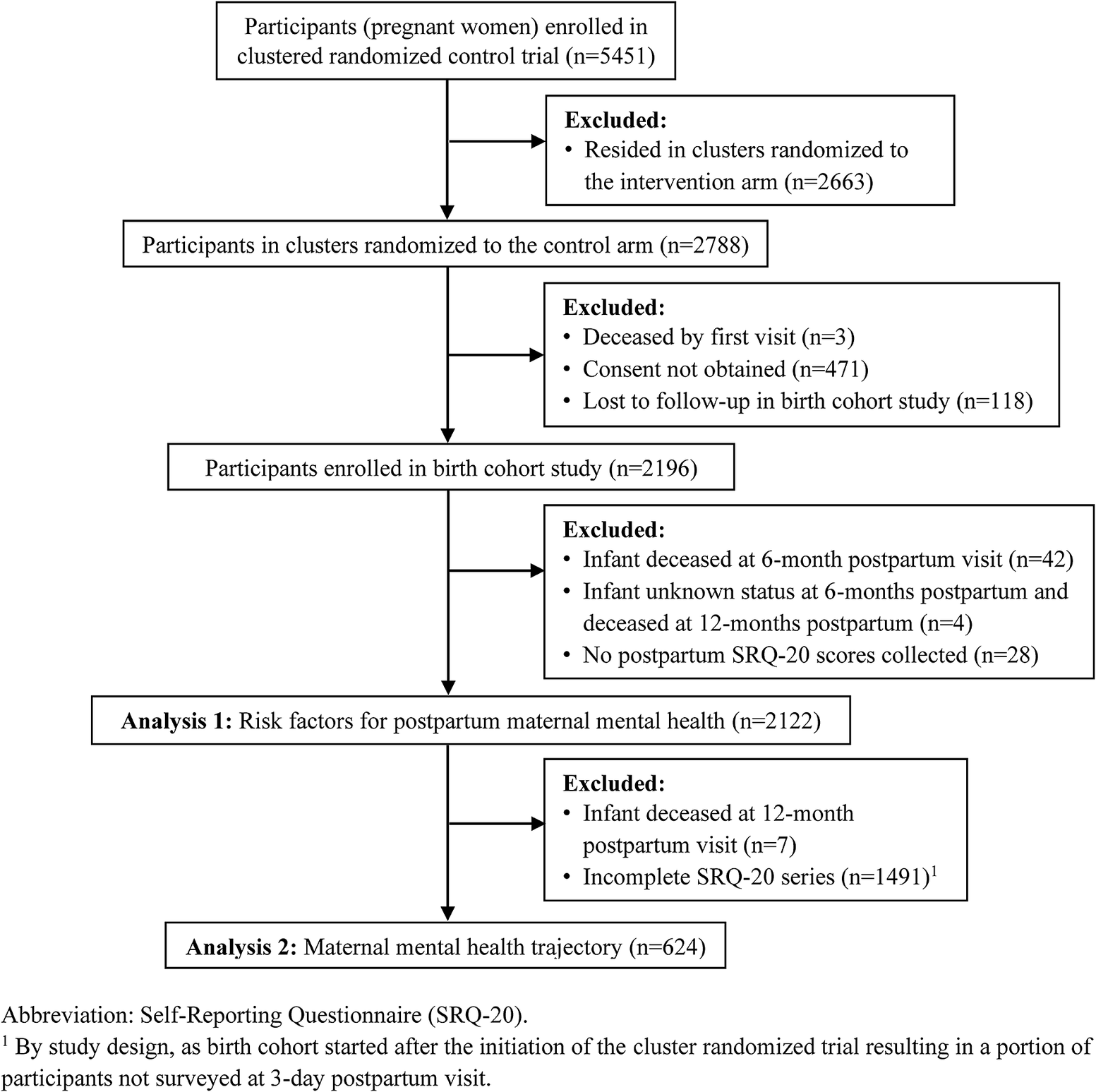
To estimate the prevalence of CMDs and identify factors associated with postpartum CMD status, participants with at least one postpartum SRQ-20 score were considered (n = 2,122) (Figure 1). To conduct the exploratory analysis, a mixed-effects linear regression was used to account for the repeated measurement of the SRQ-20 in the postpartum period and the time-varying nature of some covariates (Wang et al., Reference Wang, Andrinopoulou, Veen, Bogers and Takkenberg2022). Variables with excessive missingness (>10%) or minimal variability (<5%) were not considered in the multivariable regression analysis. The adjusted model was developed using the Hosmer–Lemeshow–Sturdivant method (Hosmer et al., Reference Hosmer, Lemeshow and Sturdivant2013). Bivariate regression analyses were performed to examine the crude association between each covariate and the discrete SRQ-20 score, and covariates associated at the p < 0.2 level were included in the preliminary multivariable model. Covariates not associated at the p < 0.05 level in the preliminary multivariable model were subsequently excluded. Covariates were then re-entered into the model to assess the magnitude of change in beta coefficients, until the change in all beta coefficients was <20% (Hosmer et al., Reference Hosmer, Lemeshow and Sturdivant2013). Finally, transformations of continuous covariates were explored, and the assumptions of linear regression, including heteroskedasticity, were verified.
Flow diagram for participants included in this secondary analysis of maternal mental health status in Rahim Yar Khan, Pakistan.

Descriptions of the trajectory of CMDs during the perinatal period only included participants with a complete SRQ-20 series (i.e., completed all four SRQ-20s; n = 624) (Figure 1). To test the hypothesis that prior CMD history is associated with postpartum CMD status, the relative risk (RR) of postpartum CMD+ cases based on CMD status at prior time points was estimated using adjusted robust Poisson regression models. Given the potential for recall bias due to the retrospective nature of the preconception and antenatal mental health data collection, we chose to dichotomize the preconception and antenatal SRQ-20 scores rather than analyzing them continuously. Models for CMD status at both 6 and 12 months postpartum were analyzed, with CMD status at preceding time points serving as the exposure of interest. All models were adjusted for covariates defined a priori: age at childbirth, education level, household assets, sex of the newborn and number of living children. Sankey plots were used to visualize the trajectory of postpartum CMD status based on preconception and antenatal CMD status. As a sensitivity analysis, these analyses were repeated using a threshold of SRQ-20 ≥ 7.
All statistical tests were performed at the 5% level of significance. The analysis was completed using Stata version 18.0 (StataCorp, 2023).
Results
Participant characteristics
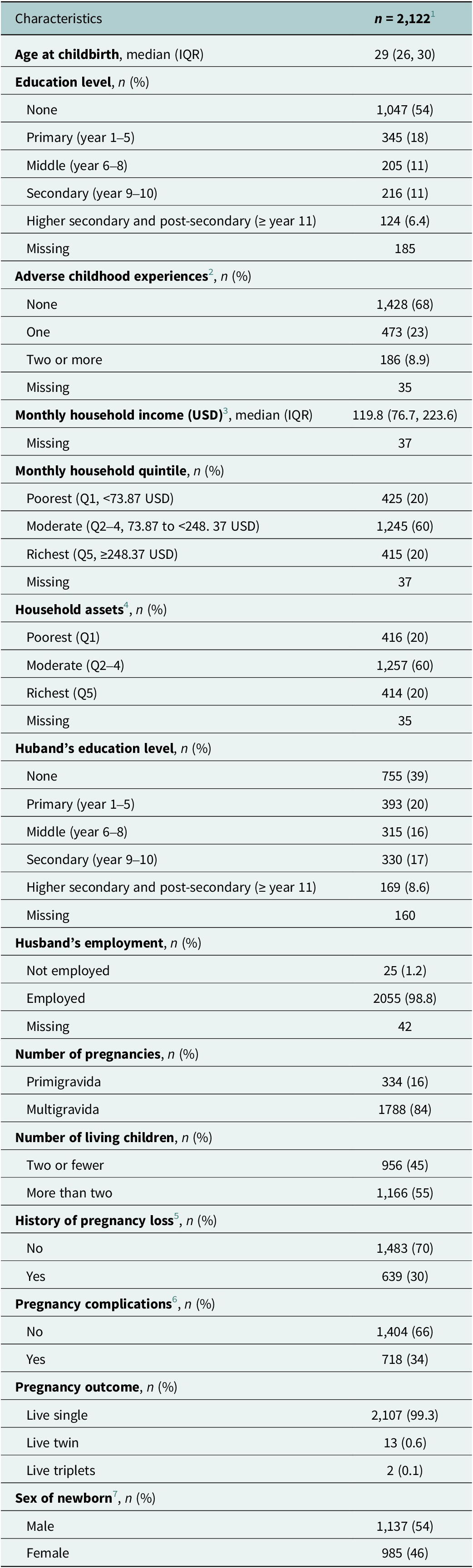
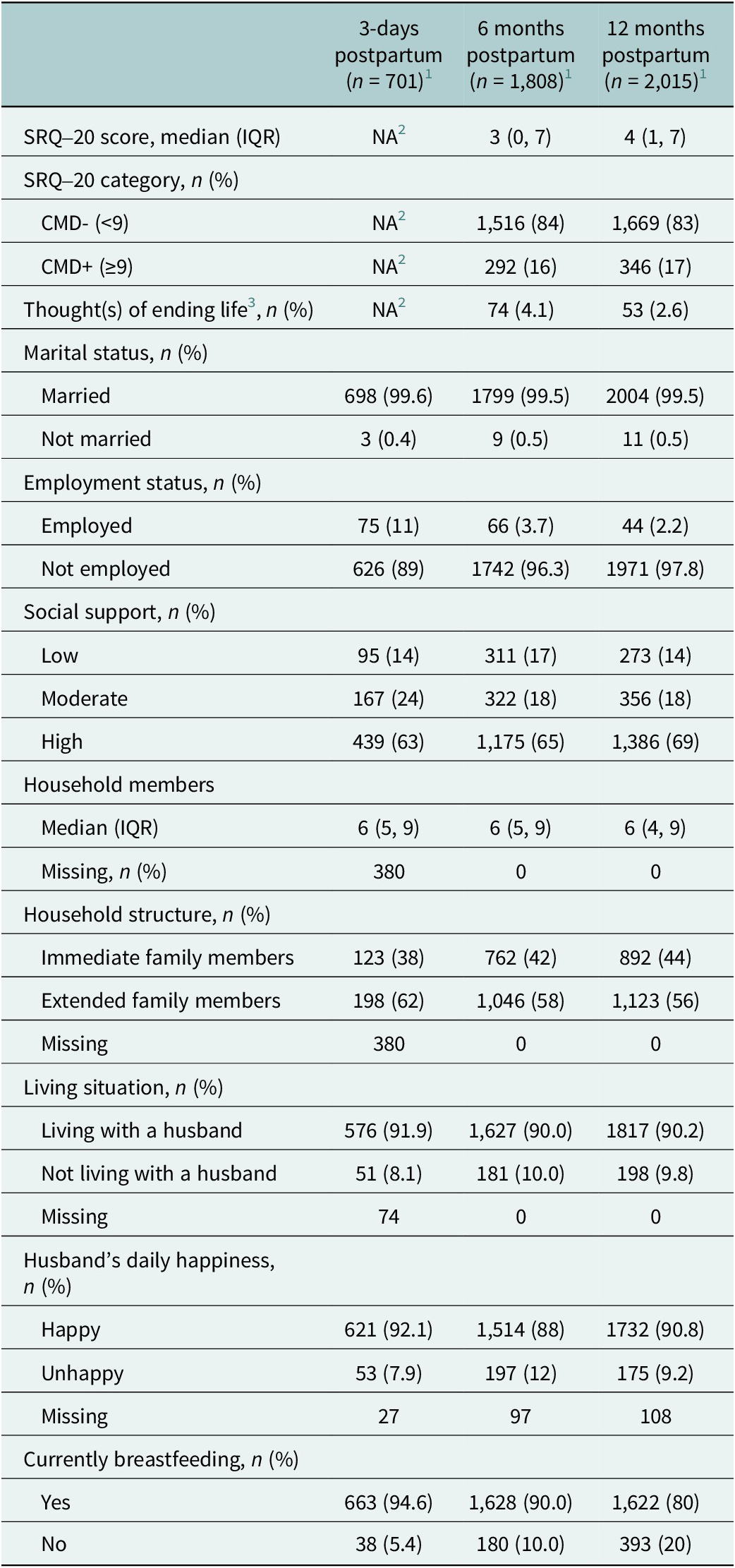
Among mothers who participated in the birth cohort study, 2,122 (96.6%) had infants alive at 6 months postpartum and completed at least one postpartum SRQ-20, and were therefore included in this secondary analysis (Table 1). Mothers who had deceased children within the first year postpartum (n = 53) were excluded from the analysis as they were hypothesized to have systematically worse mental health (Supplementary Table S1). Among participants included in the secondary analysis, the median age at childbirth was 29 years (IQR = 26, 30 years), the median monthly household income was 120 USD (IQR = 77, 224 USD) and most mothers had no formal education (n = 1,047, 54%) (Table 1). Most husbands had at least some formal education (n = 1,207, 62%) and were employed (n = 2,055, 98.8%). The SRQ-20 was completed by 1,808 women at 6 months postpartum and 2,015 women at 12 months postpartum. Overall, potentially time-varying characteristics remained consistent throughout the postpartum period, with the majority of participants being married, unemployed and living with their husband and extended family (Table 2). The characteristics were similar among the subset of participants with a complete SRQ-20 series (n = 624) (Supplementary Tables S2 and S3). Between participants in the birth cohort study with a complete SRQ-20 series (n = 624) versus without (n = 1,572), there were significant differences in maternal age at birth, sex of newborn, maternal education, household income, household assets and adverse childhood experiences (Supplementary Table S4).
Characteristics of mothers included in this secondary analysis

Abbreviations: IQR, interquartile range; USD, US dollar.
1 Percentages calculated using complete-case denominator.
2 Adverse childhood experiences include general perception of childhood, parental/caregiver behavior, emotional and/or physical punishment and parental death.
3 Converted from Pakistani rupees (PKR) to USD using September 2015 conversion rate (104.3485 PKR = 1 USD).
4 Household assets index computed using principal components analysis and then categorized into quintiles.
5 Pregnancy loss includes spontaneous abortions/miscarriages and/or still births.
6 Refers to pregnancy for which the newborn was followed in this study and includes complications, such as anemia, threatening of abortion or preterm labor, discharge and urinary tract infections.
7 Mothers of twins and triplets of different sexes were classified as having a male newborn (n = 10).
Time-varying characteristics of mothers with living infants in this secondary analysis

Abbreviations: CMD−/+, common mental disorder screen-negative/screen-positive; IQR, interquartile range; SRQ-20, Self-Reporting Questionnaire.
1 Percentages calculated using complete-case denominator.
2 SRQ-20 was not administered to prospectively obtain mental health data at 3 days postpartum.
3 Item 17 on the SRQ-20.
Prevalence of CMDs and factors associated with mental health in first year postpartum
The prevalence of CMD+ cases was 16% (n = 292/1,808) at 6 months postpartum and 17% (n = 346/2,015) at 12 months postpartum (Table 2). Among those who completed both the 6- and 12-month postpartum SRQ-20, 6.3% (n = 108/1,701) were CMD+ cases at both time points.
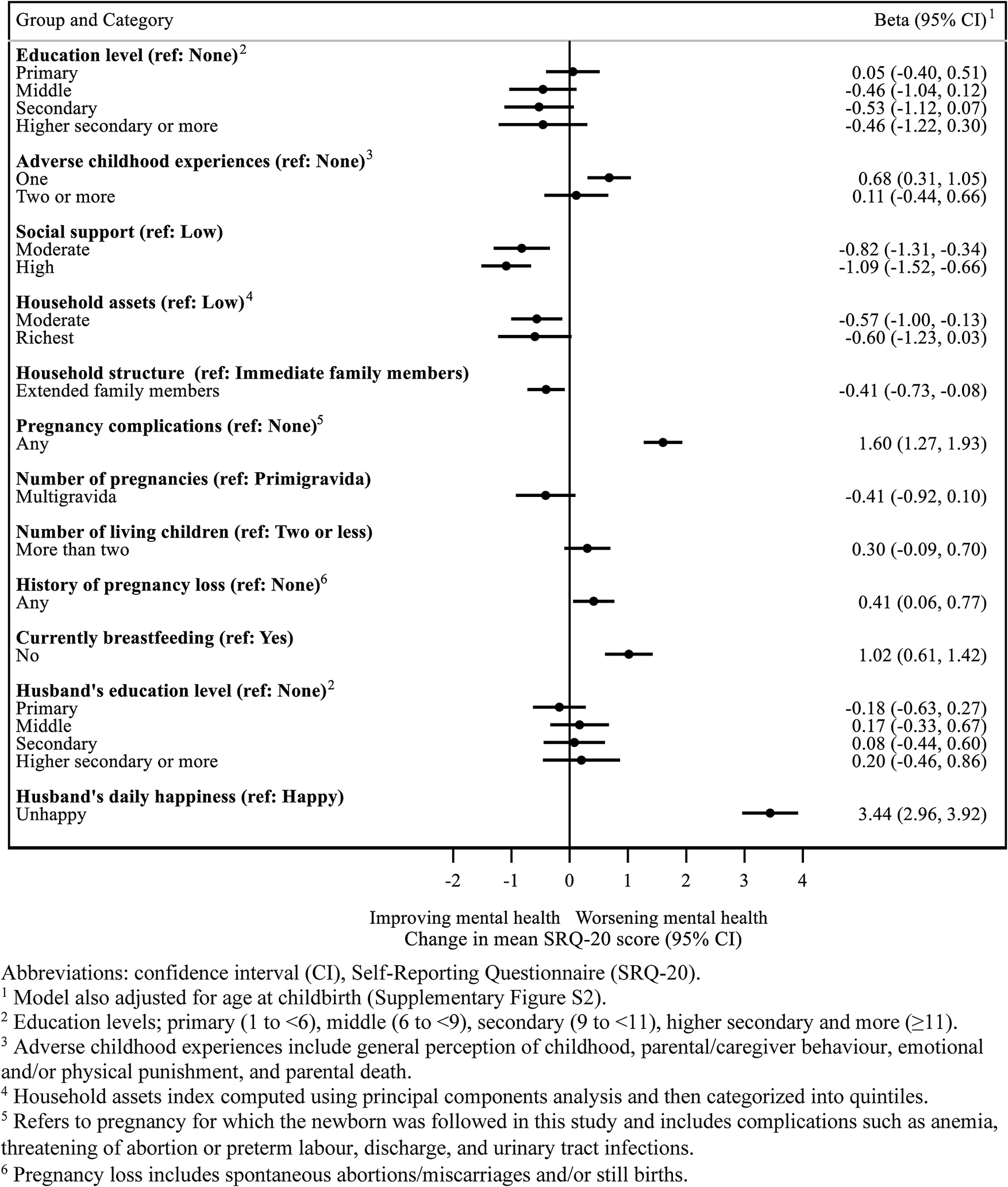
Results of the mixed-effects linear regression model are shown in Figure 2 and Supplementary Table S5 and Supplementary Figure S2. Employment status, husband’s employment status, marital status and pregnancy outcome were not included in the model due to low heterogeneity in response, and sex of the newborn and living situation were not associated at p < 0.2 in initial bivariate analyses and, as such, were not maintained in the multivariable model (Supplementary Table S5). The final model was adjusted for age at childbirth, education level, adverse childhood experiences, social support, household assets, household structure, pregnancy complications, number of pregnancies and living children, history of pregnancy losses, current breastfeeding status, husband’s education level and husband’s daily happiness level.
Coefficient plot for factors associated with mental health at 6 and 12 months postpartum.

Participant reports of their husband being unhappy were most strongly associated with SRQ-20 score, worsening mental health scores by almost 3.5 points (β = 3.44, 95% confidence interval [CI]: 2.96–3.92) compared to participants who reported their husbands to be happy most or all of the time (Figure 2). Experiencing any pregnancy complications was also associated with poorer postpartum mental health, with a 1.6 increase in SRQ-20 score (β = 1.60, 95% CI: 1.27–1.93), as well as not currently breastfeeding (β = 1.02, 95% CI: 0.61–1.42). Other risk factors for poorer postpartum mental health that were of lower magnitude were a history of pregnancy loss (β = 0.41, 95% CI: 0.06–0.77) and having one adverse childhood experience, though the association did not remain significant with two or more adverse childhood experiences. There was a nonlinear increase in SRQ-20 scores with increasing age at childbirth (Supplementary Figure S2). Increasing levels of social support were associated with improved postpartum mental health, with moderate and high levels of social support decreasing average SRQ-20 scores by 0.8 (β = −0.82, 95% CI: −1.31− −0.34) and 1.1 (β = −1.09, 95% CI: −1.52−−0.66) respectively. Living with extended family members was also associated with improved postpartum mental health (β = −0.41, 95% CI: −0.73−−0.08). Both increased household assets and increased education levels were associated with slightly improved mental health, although these associations were not statistically significant.
Trajectory of mental health during the perinatal period
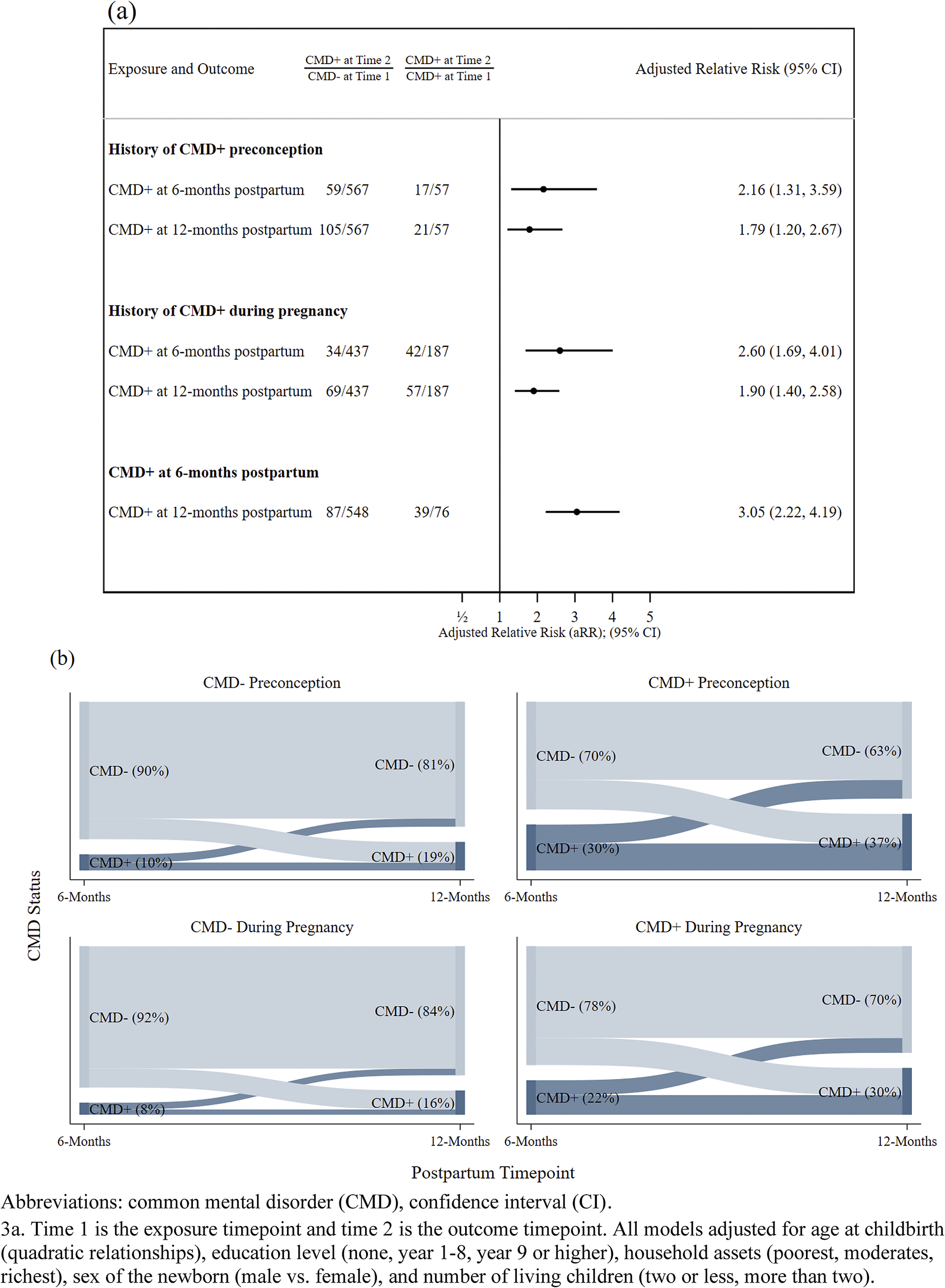
Among participants who completed all four SRQ-20s (n = 624), those who were CMD+ preconception had an increased risk of screening positive at 6 months postpartum (adjusted RR [aRR] = 2.16, 95% CI: 1.31–3.59) and at 12 months postpartum (aRR = 1.79, 95% CI: 1.20–2.67) (Figure 3a). Similarly, participants who were CMD+ during pregnancy had increased risk of screening positive at 6 months postpartum (aRR = 2.60, 95% CI: 1.69–4.01) and at 12 months postpartum (aRR = 1.90, 95% CI: 1.40–2.58). Finally, screening positive at 6 months postpartum was associated with more than triple the risk (aRR = 3.05, 95% CI: 2.22–4.19) of screening positive at 12 months postpartum. A larger proportion of those who were CMD+ preconception subsequently became CMD+ in the postpartum period, compared to participants who were CMD- preconception (Figure 3b). Regardless of CMD status preconception, there was an increase in the proportion who were CMD+ at 12 months postpartum compared to 6 months postpartum. A similar trend was observed for postpartum CMD status based on CMD status during pregnancy. Overall, the highest burden of CMD+ in the postpartum period was observed among those who had a history of CMD+ preconception.
Mental health during the perinatal period. (a) Association between preconception, antenatal and postpartum mental health. (b) Trajectory of postpartum mental health stratified by preconception and antenatal mental health.

Sensitivity analysis of different SRQ-20 threshold
When using the alternative CMD+ threshold of SRQ-20 score ≥7, 25% (n = 454/1,808) scored above the threshold at 6 months postpartum and 29% (n = 580/2,015) at 12 months postpartum (Supplementary Table S6). Notably, 9.0% (n = 162/1,808) scored between the ≥7 and ≥9 thresholds at 6 months postpartum and 11.6% (n = 234/2,015) at 12 months postpartum. The magnitude of association between preconception and antenatal mental health status with postpartum mental health status remained significant when using the ≥7 threshold, although it was lower than that observed with the ≥9 threshold (Supplementary Figure S3). When stratified by preconception and antenatal CMD status, the proportion of participants who scored between 7 and <9 increased from 6 to 12 months postpartum across all groups (Supplementary Figure S4). The group with the largest prevalence of individuals between 7 and <9 was those who had a history of CMD+ preconception.
Discussion
The prevalence of CMDs in RYK was 16% at 6 months postpartum and 17% at 12 months postpartum, comparable to the estimated pooled prevalence of CMDs in LMICs of 19.8% (Fisher et al., Reference Fisher, Cabral de Mello, Patel, Rahman, Tran, Holton and Holmes2012). The prevalence in RYK was higher than the estimated global prevalence of 13% (World Health Organization n.d.), indicating a continued unaddressed burden of CMDs in our study population. Using the alternate threshold of SRQ-20 ≥ 7 increased the prevalence of postpartum CMDs by 9.0% at 6 months postpartum, a portion of whom went on to meet the threshold of ≥9 at 12 months postpartum. The early identification of mild cases of CMDs, which may then go on to develop into more severe cases, highlights the benefit of considering a more sensitive threshold to identify cases of CMDs during screening. Importantly, our study was conducted before the coronavirus disease 2019 (COVID-19) pandemic, which caused increased levels of health- and economic-related stress among pregnant and postpartum women in Pakistan (Ali et al., Reference Ali, Sadique and Ali2020; Rauf et al., Reference Rauf, Zulfiqar, Mumtaz, Maryam, Shoukat, Malik, Rowther, Rahman, Surkan and Atif2021). A cross-sectional survey for pregnant women in Pakistan found that 36% of pregnant women reported that COVID-19 had an impact on their mental health (Shahid et al., Reference Shahid, Javed, Rehman, Tariq, Ikram and Suhail2020). Accordingly, our study may plausibly underestimate the current prevalence of CMDs in this population.
Factors associated with worsening mental health included experiencing adverse childhood events, pregnancy complications, a history of pregnancy loss, a lack of breastfeeding of the infant, and maternal reported unhappiness of the husband. This coincides with existing literature from Pakistan (Yadav et al., Reference Yadav, Shams, Khan, Azam, Anwar, Anwar, Siddiqui, Abbas, Sukaina and Ghazanfar2020), including a cohort study from 2004 to 2005, which found that postpartum depression is associated with nonexclusive breastfeeding (Rahman et al., Reference Rahman, Hafeez, Bilal, Sikander, Malik, Minhas, Tomenson and Creed2015). Notably, the magnitude of association between the husband’s daily unhappiness and poorer maternal mental health was significant. Though not a direct measure of paternal mental health, this suggests the mood and mental health of the father during the postpartum period may be associated with maternal postpartum mental health. Research into postpartum paternal depression has found that fathers who experience depressive symptomatology can withdraw from their family and their caregiver responsibilities, which decreases the psychosocial support available to the mother (Kay et al., Reference Kay, Moulson, Vigod, Schoueri-Mychasiw and Singla2024; Mahmoud et al., Reference Mahmoud, Lakkimsetti, Alverde, Shukla, Nazeer, Shah, Chougule, Nimawat and Pradhan2024). Additionally, postpartum paternal depression can present negative emotions, such as increased irritability and hostility, which can lead to prominent maternal mental health risk factors, such as marital conflict and intimate partner violence (Fisher et al., Reference Fisher, Cabral de Mello, Patel, Rahman, Tran, Holton and Holmes2012; Berry and Monk, Reference Berry and Monk2020; McNab et al., Reference McNab, Dryer, Fitzgerald, Gomez, Bhatti, Kenyi, Somji, Khadka and Stalls2022; Mahmoud et al., Reference Mahmoud, Lakkimsetti, Alverde, Shukla, Nazeer, Shah, Chougule, Nimawat and Pradhan2024). These findings suggest that mental health screening for the husband during the antenatal period could be an avenue of intervention in addressing postpartum maternal mental health.
Many of the protective factors for maternal mental health are related to the support available for the mother, both functionally through household assets, and structurally through living with extended family and social support from friends and family (Leahy-Warren et al., Reference Leahy-Warren, McCarthy and Corcoran2011; Sufredini et al., Reference Sufredini, Catling, Zugai and Chang2022). The 2017–2018 Multiple Indicator Cluster Survey found that 39.7% of RYK’s household population was in Punjab’s lowest wealth quintile, while only 8.2% of RYK’s household population was in the highest wealth quintile (Government of Pakistan and UNICEF, 2018). It has previously been reported that women in Punjab’s lower wealth quintiles were less likely to receive antenatal care and support (NIPS/Pakistan and ICF, 2019). In addition to addressing the wealth disparity to improve the functional support available to perinatal women, targeting a woman’s social support network throughout the perinatal period offers a modifiable risk factor to reduce the severity of CMD-related symptomatology in the postpartum period. Analysis of a longitudinal cohort established in rural Punjab found that participation in a cultural postpartum practice, where new mothers are relieved of household chores and receive additional social support, was associated with fewer major depressive episodes and lower symptom severity at 6 months postpartum (LeMasters et al., Reference LeMasters, Andrabi, Zalla, Hagaman, Chung, Gallis, Turner, Bhalotra, Sikander and Maselko2020). Additional analysis of this cohort found that mother-in-law involvement was associated with a lower prevalence of maternal depression at 3 months postpartum (Chung et al., Reference Chung, Hagaman, Bibi, Frost, Haight, Sikander and Maselko2022). A key part of improving a women’s social support could be to screen for and to address the mental health and happiness of the infant’s father, to ensure they are an avenue of support available to the mother. A randomized control trial conducted in Iran aimed to assess the effect of providing counseling to spouses on the perceived social support of pregnant women. It was found that the pregnant women whose spouses had received counseling had a significantly increased level of perceived social support, compared to the women whose spouses had not received counseling (Mohammadpour et al., Reference Mohammadpour, Mohammad-Alizadeh Charandabi, Malakouti, Nadar Mohammadi and Mirghafourvand2022).
Mothers who retrospectively reported adverse mental health preconception and during pregnancy were more likely to screen positive for CMDs in the postpartum period. For example, participants who were CMD+ during pregnancy had over two and a half times the risk of CMD+ at 6 months postpartum (aRR = 2.60, 95% CI: 1.69–4.01) and approximately double the risk at 12 months postpartum (aRR = 1.90, 95% CI: 1.40–2.58). A North American study estimated the association between antenatal and postpartum psychological distress, and found that antenatal anxiety was associated with a nearly fourfold increase in postpartum anxiety and postpartum stress, as was antenatal depression with postpartum depression (Obrochta et al., Reference Obrochta, Chambers and Bandoli2020). While the results from this analysis were expected, they highlight the strength of a longitudinal design and the value of repeated monitoring of mental health status. Mental health screening during the antenatal period would provide an opportunity to identify those most at risk of experiencing postpartum CMDs; however, RYK does not have any formal screening programs in place. In RYK, 34% of women aged 15–49 years who had a live birth had never received antenatal care, and 89% had never had a postnatal health visit (Government of Pakistan and UNICEF, 2018). A systematic review on perinatal mental health in South Asian countries, including Pakistan, found that key barriers to improving perinatal mental healthcare include limited resources in the healthcare system and health providers’ poor understanding of mental health and its implications (Insan et al., Reference Insan, Weke, Rankin and Forrest2022). Common barriers to accessing healthcare reported by women aged 15–49 years in Punjab were not wanting attend alone, the physical distance of the health facility and obtaining the money and permission for treatment (NIPS/Pakistan and ICF 2019). To address the financial burden of and the geographic disparity in care access, the implementation of antenatal mental health screening and referral could potentially be incorporated into the established LHW program, given their access to the perinatal population in rural and remote areas. Between 2017 and 2018 in RYK, 57% of women who had a live birth in the previous 2 years reported being visited at home by an LHW (Government of Pakistan and UNICEF, 2018). A study conducted in Rawalpindi, Pakistan, explored the impact of a cognitive behavior therapy-based intervention administered by specially trained LHWs during pregnancy and postpartum on maternal depression (Rahman et al., Reference Rahman, Malik, Sikander, Roberts and Creed2008). At both 6 and 12 months postpartum, mothers who received this intervention showed lower depression scores than those in the control arm, demonstrating the potential of utilizing LHWs to administer community-based interventions.
This study has several limitations. First, the retrospective data collection of mental health preconception and during pregnancy may have introduced recall bias to these measures and plausibly could have been confounded by mental health status at the time of interview. Specifically, those with CMDs at the time of completing the questionnaire may have had a distorted perception of their mental health before and during pregnancy, which could have caused reports of poorer mental health status than occurred. Additionally, the retrospective SRQ-20s were administered at 3 days postpartum, which can be a time of immense hormonal changes, and is often characterized by mood swings, anxiety and difficulty sleeping. This altered mental state at the time of questionnaire completion may have further caused poorer perception of mental health at previous time points. Future work would benefit from prospective data collection during the antenatal period and during the initial postpartum period when incident cases of postpartum CMDs can onset. Additionally, despite the SRQ-20 being validated for screening of psychological distress in LMICs, it is unable to differentiate between specific mental disorders. Future work may benefit from the inclusion of instruments to specifically measure anxiety, depression, post-traumatic stress and/or other CMDs. As a secondary analysis, our assessment of risk factors was limited to the covariates available, which meant risk factors commonly cited in the literature, such as intimate partner violence and paternal mental health, could not be directly evaluated. Additionally, the temporality between certain covariates, such as husband’s daily happiness, and the mental health outcome could not be established, therefore limiting any interpretations regarding causality. Future research on this topic in settings such as RYK should focus on prospective longitudinal study designs to better understand the risk factors of poor perinatal mental health and its downstream effects. Despite widespread coverage of the LHW program in RYK, the most remote areas with the poorest outcomes may have had less coverage and may not have been reached in our study. Generalizability of the findings may further be limited as participants with complete versus incomplete SRQ-20 series differed by certain sociodemographic characteristics, but were notably still similar to population statistics from the 2017–2018 Pakistan Demographic Health Survey (NIPS/Pakistan and ICF 2019). Given data collection was conducted from 2014 to 2016, this study may not reflect recent changes in maternal mental health status in RYK, including changes attributable to the COVID-19 pandemic. Nevertheless, a strength of this analysis is the longitudinal nature of data collection, which allowed for repeated measures of maternal mental health throughout the perinatal period. We also considered two thresholds for CMDs, both of which have previously been used in Pakistan to indicate CMD+. This allowed mild cases of CMD+ to be identified and demonstrated their potential progression into more severe cases, highlighting an opportunity for early intervention. Finally, the community-based study design, whereby participants were identified through the LHW program, facilitated the inclusion of women who may not typically interface with the healthcare system to be included in this analysis.
Approximately one in six mothers experiences CMDs in the first year postpartum in RYK, Pakistan. The strong association between antenatal maternal mental health status and postpartum maternal mental health indicates that initiation of mental health screening and programming during the antenatal period would allow for early intervention. Social support counseling should be a key feature of maternal mental health intervention programs in the area.
Open peer review
To view the open peer review materials for this article, please visit http://doi.org/10.1017/gmh.2025.10117.
Supplementary material
The supplementary material for this article can be found at http://doi.org/10.1017/gmh.2025.10117.
Data availability statement
De-identified participant data, which underlie the study results, can be made available upon reasonable request to shaun.morris@sickkids.ca, to investigators whose secondary data analysis study protocol has been approved by an independent research ethics board.
Acknowledgments
The authors would like to thank the participating families who shared their experiences with our team. The authors would also like to thank the data collectors, field supervisors and other research team members, as well as the participating Lady Health Workers and the Lady Health Worker Program, for their contributions to this study.
Author contribution
The CRT and birth cohort study were designed and implemented by LGP, SA, SBS, DGB, ZAB and SKM. The secondary analysis was conceptualized by DSF, LGP, SSP, FM and SKM. Data curation was managed by IAC. The analysis was designed by RRD and DSF. RRD conducted the data analysis, wrote the first draft of the manuscript and led all revisions. All authors read, contributed edits and approved the final version of the manuscript.
Financial support
This work was supported by Grand Challenges Canada (S4 023001), UBS Optimus Foundation (6793_UBSOF) and March of Dimes Basil O’Connor Starter Scholar Research Award (SKM, #5-FY1448).
Competing interests
The authors declare none.
Ethics statement
This analysis was approved by The Hospital for Sick Children Research Ethics Board (No.1000081288).


 Open access


Comments
Dear Professor Judy Bass and Professor Dixon Chibanda,
We would like to submit our original research article titled “Maternal Perinatal Mental Health and Associated Factors During the First Postpartum Year from a Longitudinal Birth Cohort Study in Rahim Yar Khan, Pakistan” for consideration of publication in Cambridge Prisms: Global Mental Health.
Low- and middle- income countries are severely underrepresented in perinatal mental health research despite having a significantly higher burden of perinatal common mental disorders compared to high-income countries. We analyzed maternal perinatal mental health data collected from a community-based, longitudinal birth cohort study conducted in Rahim Yar Khan, Pakistan. The longitudinal study design allowed for repeated measures of maternal mental health throughout the perinatal period, addressing a common limitation of existing cross-sectional studies. Additionally, the community-based approach to data collection allowed for the inclusion of geographically isolated women who are commonly not reached in facility-based perinatal research. We aimed to: 1) estimate the prevalence of common mental disorders and identify factors associated with maternal mental health in the first-year postpartum; and 2) understand the trajectory of maternal mental health at multiple timepoints throughout the perinatal period. The prevalence of common mental health disorders during the first-year postpartum was 16–17%. Factors associated with postpartum mental health included social support, participant-reported daily happiness level of their husband, experiencing pregnancy complications, and breastfeeding. While expected, we also find that poor mental health prior to and during pregnancy were significant predictors for poor mental health in the postpartum period. These findings reinforce the need for maternal perinatal mental health screening, and highlight the importance of promoting social support-related factors during the postpartum period.
We believe our manuscript strongly aligns with the Cambridge Prisms: Global Mental Health agenda, given its focus on a setting lacking adequate mental health screening, diagnosis, and treatment, and exploring potential avenues for routine screening and intervention. We believe that our exploration of the epidemiology of maternal mental health in the context of rural Pakistan will appeal to a broad range of readers including policymakers, mental health practitioners, perinatal health researchers, and other local stakeholders. We confirm that this manuscript has not been published or submitted for publication elsewhere. All authors have approved the manuscript as submitted.
Thank you for your consideration of this manuscript.
Sincerely,
Rohini R. Datta & Dr. Shaun K. Morris