


1. Introduction
The concept of circular economy (CE) has become increasingly relevant in both industry and research (Reference Agyemang, Kusi-Sarpong, Khan, Mani, Rehman and Kusi-SarpongAgyemang et al., 2019). It is an alternative economic model that is designed to replace the prevailing linear economy (Reference Kirchherr, Reike and HekkertKirchherr et al., 2017). In contrast to the take-make-use-waste growth model of the linear economy, the CE contributes to a company’s social, environmental, and economic performance by looping back resources into the economic system (Reference Balkenende, Bocken, Bakker and EgenhoeferBalkenende et al., 2018; Reference Govindan and HasanagicGovindan & Hasanagic, 2018). To align with the principles of the CE, it is essential that business models, processes, and products are designed to slow down, narrow, and close resource cycles (Reference Balkenende, Bocken, Bakker and EgenhoeferBalkenende et al., 2018; Reference Bocken, de Pauw, Bakker and van der GrintenBocken et al., 2016). Such a development of products is described by the design approach of circular product design (CPD) (Reference Bakker, den Hollander, Peck, Balkenende and OffermanBakker et al., 2019; Reference Balkenende, Bocken, Bakker and EgenhoeferBalkenende et al., 2018; Reference Wang, Burke and ZhangWang et al., 2022). It aims to create products that retain their economic value for as long as possible while minimising their environmental impact (Reference Bakker, den Hollander, Peck, Balkenende and OffermanBakker et al., 2019; Reference Balkenende, Bocken, Bakker and EgenhoeferBalkenende et al., 2018; Reference den Hollander, Bakker and Hultinkden Hollander et al., 2017). Product designers can thus make a significant contribution to the transition to a CE by adapting the characteristics of physical products in the early phases of the product development process, therefore improving the structure of the entire value chain (Reference Aguiar, Mesa, Jugend, Pinheiro and de Camargo FioriniAguiar et al., 2022; Reference den Hollanderden Hollander, 2018; Reference Moreno, de los Rios, Rowe and CharnleyMoreno et al., 2016). Although the relevance of design and the influence of product designers in the transition to a CE is emphasised in the literature, the design of most products continues to follow a linear approach and is far from being circular (Reference Haines-Gadd, Bakker, Charnley, Alexander, Pascucci and CharnleyHaines-Gadd et al., 2023; Reference Moreno, de los Rios, Rowe and CharnleyMoreno et al., 2016). This discrepancy raises the question: What challenges do product designers face when designing circular products?
Several studies have already identified barriers and drivers for the implementation of the CE at a strategic level (Reference Agyemang, Kusi-Sarpong, Khan, Mani, Rehman and Kusi-SarpongAgyemang et al., 2019; Reference Takacs, Brunner and FrankenbergerTakacs et al., 2022; Reference Wang, Burke and ZhangWang et al., 2022). However, the barriers at the product design level have not been sufficiently researched (Reference Wang, Burke and ZhangWang et al., 2022). This paper aims to identify the challenges that product designers face in designing circular products through an exploratory literature review. It therefore intends to provide an understanding of the challenges to be overcome and to contribute to the discussion in research.
The remainder of the paper is structured as follows. Section 2 provides an understanding of the terms used in this paper by describing CPD and related terms. An overview of the related work and the highlighted identified research gap are found in Section 3. In Section 4 the research design of this paper is described. Section 5 presents the results in detail. A discussion of these results as well as the limitations of this work and the identified need for further research can be found in Section 6. In conclusion, Section 7 summarises this publication.
2. Theoretical background
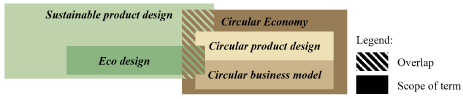
This section sets the foundation for this paper by providing a valid understanding of the terms used. Therefore, related terms of CPD are explained and the relationships between these terms are discussed. The developed valid understanding for this paper is visualised in Figure 1.
Developed valid understanding of this paper

The circular economy (CE) is an alternative economic model that is designed to replace the prevailing linear economy (Reference Kirchherr, Reike and HekkertKirchherr et al., 2017). In contrast to the take-make-use-waste growth model of the linear economy, the CE loops back resources into the economic system (Reference Balkenende, Bocken, Bakker and EgenhoeferBalkenende et al., 2018; Reference Kirchherr, Reike and HekkertKirchherr et al., 2017). The design of circular products and business models permits the regeneration and restoration of resources, ensuring the indefinite preservation of nature while protecting the capacity of the economic system to create wealth (Reference Bocken, de Pauw, Bakker and van der GrintenBocken et al., 2016; Reference den Hollanderden Hollander, 2018; Reference Kirchherr, Reike and HekkertKirchherr et al., 2017). Consequently, the CE contributes to a company’s social, environmental, and economic performance through operating at micro level, meso level and macro level (Reference Kirchherr, Reike and HekkertKirchherr et al., 2017). It is understood as an absolute approach in which waste no longer exists (Reference den Hollanderden Hollander, 2018).
Circular business models represent a novel way of thinking and doing business required in the CE (Reference Bocken, de Pauw, Bakker and van der GrintenBocken et al., 2016). They follow the strategy of slowing down, narrowing, and closing resource cycles (Reference Balkenende, Bocken, Bakker and EgenhoeferBalkenende et al., 2018; Reference Bocken, de Pauw, Bakker and van der GrintenBocken et al., 2016). Circular business models are considered to be the foundation for a CE, which can be adopted through CPD (Reference Aguiar, Mesa, Jugend, Pinheiro and de Camargo FioriniAguiar et al., 2022).
Circular product design (CPD) is a design approach in product development that is based on the principles of CE (Reference Bakker, den Hollander, Peck, Balkenende and OffermanBakker et al., 2019; Reference Balkenende, Bocken, Bakker and EgenhoeferBalkenende et al., 2018; Reference Wang, Burke and ZhangWang et al., 2022). Therefore, it aims to design products, components and materials in such a way that their economic value is retained at their highest for as long as possible while minimising their environmental impact (Reference Bakker, den Hollander, Peck, Balkenende and OffermanBakker et al., 2019; Reference Balkenende, Bocken, Bakker and EgenhoeferBalkenende et al., 2018). The CPD approach encompasses the strategies of design for product integrity and design for recycling (Reference den Hollander, Bakker and Hultinkden Hollander et al., 2017). According to the typology proposed by Reference den Hollander, Bakker and Hultinkden Hollander et al. (2017), product designers should primarily aim to prevent products from becoming obsolete and secondly to ensure recovery with the highest level of integrity at the product and component level (design for product integrity) or at the material level (design for recycling) (Reference den Hollander, Bakker and Hultinkden Hollander et al., 2017). The design for product integrity strategy describes different interventions ordered according to the inertia principle to extend product life, classified as resisting, postponing or reversing obsolescence (Reference Bakker, den Hollander, Peck, Balkenende and OffermanBakker et al., 2019; Reference den Hollander, Bakker and Hultinkden Hollander et al., 2017). Since the recycling of materials implies a loss of function and value, the design for recycling strategy is seen as a last resort option and mandatory requirement for any product to return to the economic system and thus fulfil the absolute characteristic of the CE (Reference Bakker, den Hollander, Peck, Balkenende and OffermanBakker et al., 2019; Reference den Hollander, Bakker and Hultinkden Hollander et al., 2017).
The domain of sustainable product design represents a segment of industrial design, in which products and services are created that take on the additional responsibility of balancing sustainability (Reference den Hollanderden Hollander, 2018). In general, sustainability describes the ability to ensure that a given activity or action is capable of being maintained (Reference Geissdoerfer, Savaget, Bocken and HultinkGeissdoerfer et al., 2017). In terms of sustainable product design, it respects the ability of nature to regenerate at a certain rate or to be maintained at a certain level (Reference Geissdoerfer, Savaget, Bocken and HultinkGeissdoerfer et al., 2017). Furthermore, the objective of sustainable product design is to ensure lasting human well-being and fulfil current needs without compromising the needs of future generations (Reference den Hollanderden Hollander, 2018). Considering these aspects, sustainable product design balances economic, environmental, and social performances (Reference den Hollanderden Hollander, 2018; Reference Moreno, de los Rios, Rowe and CharnleyMoreno et al., 2016).
Eco design is a product design approach that integrates environmental aspects into product design and aims to reduce the environmental impacts throughout a product’s life cycle while maximising economic benefits (Reference Ceschin and GaziulusoyCeschin & Gaziulusoy, 2016; Reference Dekoninck, Domingo, O'Hare, Pigosso, Reyes and TroussierDekoninck et al., 2016). The approach of eco design provides product designers with a range of guiding principles, strategies, and methods, helping them to identify existing problems of the present state of affairs and to solve them by improving incrementally (Reference den Hollander, Bakker and Hultinkden Hollander et al., 2017). Therefore, eco design is considered a relative approach focusing on “not the good, but the less worse or the better” (Reference Faber, Jorna and van EngelenFaber et al., 2005, p. 8).
By taking a look at the terms and the three performances of sustainability, eco design is understood as a part within the domain of sustainable product design, as shown in Figure 1 (Reference den Hollanderden Hollander, 2018; Reference Moreno, de los Rios, Rowe and CharnleyMoreno et al., 2016). This understanding is reinforced since sustainable product design is seen as an extension of eco design, as the latter neglects the social performance (Reference Ceschin and GaziulusoyCeschin & Gaziulusoy, 2016; Reference den Hollanderden Hollander, 2018). A comparison using the sustainability performance also reveals a close relation between sustainable product design and CE, as both consider all three of them (Reference Schöggl, Baumgartner, O'Reilly, Bouchouireb and GöranssonSchöggl et al., 2024). In the literature there is a discussion, whether these two concepts should be understood as overlapping or as part of each other (Reference Dagilienė, Čeičytė‐Pranskūnė, Telešienė, Valušytė and VaržinskasDagilienė et al., 2024; Reference Schöggl, Baumgartner, O'Reilly, Bouchouireb and GöranssonSchöggl et al., 2024). Due to its absolute characteristic, this paper understands CE and therefore CPD as an overlapping concept to sustainable product design, as shown in Figure 1. The absolute characteristic of CPD also serves as a differentiating factor from the linear way of thinking from eco design, where products eventually become waste (Reference den Hollanderden Hollander, 2018). This discrepancy raised the need to at least adapt eco design to a new CE-specific design approach, which is addressed by the approach of CPD (Reference Aguiar, Mesa, Jugend, Pinheiro and de Camargo FioriniAguiar et al., 2022; Reference den Hollanderden Hollander, 2018). Based on this adaptation, this paper argues that there is an overlap between eco design and CPD. This understanding underlines the relevance of also considering literature besides CPD that deals with eco design, sustainable product design and the CE in the subsequent sections of this paper.
3. Related work
CPD is an emerging research area, which is still in an exploratory phase (Reference Aguiar, Mesa, Jugend, Pinheiro and de Camargo FioriniAguiar et al., 2022). While the challenges of CE at the strategic level have been extensively studied, such research at the product level has been sparsely addressed (Reference Jugend, dos Santos, Garrido, Siqueira and MesaJugend et al., 2024; Reference Wang, Burke and ZhangWang et al., 2022). Only a few studies have examined the challenges of CPD (Reference Aguiar, Mesa, Jugend, Pinheiro and de Camargo FioriniAguiar et al., 2022; Reference Jugend, dos Santos, Garrido, Siqueira and MesaJugend et al., 2024; Reference Schöggl, Baumgartner, O'Reilly, Bouchouireb and GöranssonSchöggl et al., 2024; Reference Wang, Burke and ZhangWang et al., 2022). Claiming to be the first study of this kind, Reference Wang, Burke and ZhangWang et al. (2022) examine circumvention measures for identified challenges from a stakeholder perspective (Reference Wang, Burke and ZhangWang et al., 2022). They emphasise that many of the challenges identified are related to the early stages of product development (Reference Wang, Burke and ZhangWang et al., 2022). This relation is reinforced by Reference Aguiar, Mesa, Jugend, Pinheiro and de Camargo FioriniAguiar et al. (2022), who identify fundamental challenges and strategies of CPD in new product development (Reference Aguiar, Mesa, Jugend, Pinheiro and de Camargo FioriniAguiar et al., 2022). It was found that challenges arise particularly in the planning and conceptualisation phase of new product development (Reference Aguiar, Mesa, Jugend, Pinheiro and de Camargo FioriniAguiar et al., 2022). Reference Jugend, dos Santos, Garrido, Siqueira and MesaJugend et al. (2024) prioritise the challenges identified in CPD and find that the challenges are most relevant in the context of external stakeholders (Reference Jugend, dos Santos, Garrido, Siqueira and MesaJugend et al., 2024). In contrast, Reference Schöggl, Baumgartner, O'Reilly, Bouchouireb and GöranssonSchöggl et al. (2024) show that strategic and operational challenges are the most important challenges to overcome in practice (Reference Schöggl, Baumgartner, O'Reilly, Bouchouireb and GöranssonSchöggl et al., 2024). The fact that many of the challenges of CPD occur in the early phases of product development and the high prioritisation of operational challenges highlight the need to investigate the challenges product designers face when designing circular products.
The related work has conducted literature reviews to identify the challenges in CPD. However, most of these studies only consider the literature on CE challenges (Reference Aguiar, Mesa, Jugend, Pinheiro and de Camargo FioriniAguiar et al., 2022; Reference Jugend, dos Santos, Garrido, Siqueira and MesaJugend et al., 2024; Reference Wang, Burke and ZhangWang et al., 2022). An exception is the study of Reference Schöggl, Baumgartner, O'Reilly, Bouchouireb and GöranssonSchöggl et al. (2024), who, in addition to the CE and the CPD, include literature regarding eco design and sustainable product design, which aligns with the valid understanding developed in this paper (Reference Schöggl, Baumgartner, O'Reilly, Bouchouireb and GöranssonSchöggl et al., 2024). When analysing their results, it is noticeable that the integration of the literature on CE and CPD is only sparsely mentioned and discussed. This leads to the conclusion that such literature has so far not been included or only included sparsely underlining the need to take this into account.
The lack of consideration of relevant literature and the need to examine the product designer’s perspective together highlight a gap in research. Therefore, this work builds on the related work to identify the challenges faced by product designers when designing circular products and includes literature corresponding to the understanding developed. This will provide an understanding of the challenges to be overcome in designing circular products, which will contribute to the discussion of the emerging field of research.
4. Research design
This paper aims to identify the challenges that product designers face when designing circular products in order to raise awareness and understanding of these challenges. The research design to achieve this is shown in Figure 2. Based on the valid understanding outlined in Section 2, an exploratory literature review was conducted in the first half of 2024 through an iterative process of gathering publications and filtering them. A thematic analysis was performed to extract data from the publications, code the data and generate themes. This iterative process was conducted until theoretical saturation was reached. The steps of the exploratory literature review and thematic analysis are described in detail below.
Research design of this paper

In order to gather relevant publications, the developed understanding from Section 2 serves as the foundation for the exploratory literature review. One reason for this is that it defines the scope of the search and thus the keywords used to find publications via Scopus. This database was used because it is a meta-database with a large number of peer-reviewed publications. Combining the keywords with the intended identification of challenges results in a search string that is a set of the terms listed in Table 1. In addition, the publications found with the search string and the publications used to develop the valid understanding serve as input for a title-based forward and backward search to expand the gathering of literature. The identification of publications of interest was determined by both the citation-based relevance of the iteratively identified authors as well as their suitability as a contribution to the intention of this paper. In addition to these criteria, the publication date was used as a preference criteria when filtering relevant publications by reading the titles and abstracts.
Search string used in the exploratory literature review

The publications found to be relevant were read in full. At the same time, data was extracted from the publications and initially coded. Following the thematic analysis according to Reference Braun and ClarkeBraun and Clarke (2006), themes were searched for, reviewed, defined, and named based on the initial coding (Reference Braun and ClarkeBraun & Clarke, 2006). This process also took place iteratively, so that the initial coding had to be adapted. The theoretical saturation according to Reference Glaser and StraussGlaser and Strauss (1967) was selected as the cancellation criteria for this paper (Reference Glaser and StraussGlaser & Strauss, 1967). Consequently, the identification of the fundamental challenges in CPD from the product designer’s perspective is considered complete as soon as the extraction of data collected from further publications has repeatedly not provided any new insights (Reference Glaser and StraussGlaser & Strauss, 1967). Therefore, the theoretical saturation was reached using data from 15 relevant publications.
5. Research results
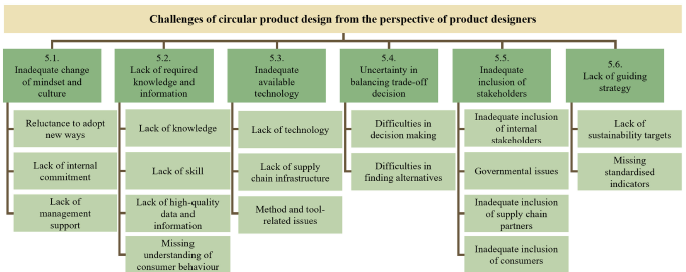
This section presents the identified challenges that product designers face when designing circular products. As shown in Figure 3, these challenges are described by the following six themes: Inadequate change of mindset and culture, lack of required knowledge and information, inadequate available technology, uncertainty in balancing trade-off decisions, inadequate inclusion of stakeholders, and lack of guiding strategy. Each of these challenges is explained in more detail below.
Overview of the identified challenges

5.1. Inadequate change of mindset and culture
A challenge product designers face is the difficulty of leaving the familiar linear path and adopting new ways of thinking and working to design circular products (Reference Haines-Gadd, Bakker, Charnley, Alexander, Pascucci and CharnleyHaines-Gadd et al., 2023; Reference Takacs, Brunner and FrankenbergerTakacs et al., 2022). This difficulty is not only due to a lack of motivation of product designers but also to a resistance to changing the way products are designed (Reference Dekoninck, Domingo, O'Hare, Pigosso, Reyes and TroussierDekoninck et al., 2016). Furthermore, it is necessary for product designers to overcome the reluctance to leave their comfort zone (Reference Dekoninck, Domingo, O'Hare, Pigosso, Reyes and TroussierDekoninck et al., 2016).
Even when overcoming this issue, a change of mindset from product designers is not enough. All employees involved in the product design process need to overcome the reluctance to adopt CPD (Reference Schöggl, Baumgartner, O'Reilly, Bouchouireb and GöranssonSchöggl et al., 2024). The importance of addressing this issue is also reinforced by the literature mentioning a need for a multidisciplinary approach to develop circular products (Reference Dekoninck, Domingo, O'Hare, Pigosso, Reyes and TroussierDekoninck et al., 2016; Reference Schöggl, Baumgartner, O'Reilly, Bouchouireb and GöranssonSchöggl et al., 2024; Reference Wang, Burke and ZhangWang et al., 2022). Internal employees need to overcome the lack of commitment, become aware of the CE, have affirmative action and collaborate with product designers to support them in developing circular solutions (Reference Gedam, Raut, Lopes de Sousa Jabbour, Tanksale and NarkhedeGedam et al., 2021; Reference Jugend, dos Santos, Garrido, Siqueira and MesaJugend et al., 2024). Otherwise, product designers perceive a risk of becoming a sustainability “preacher” within their company (Reference Sumter, Bakker and BalkenendeSumter et al., 2017, p. 6).
In addition, product designers perceive a lack of consistent support from management (Reference Agyemang, Kusi-Sarpong, Khan, Mani, Rehman and Kusi-SarpongAgyemang et al., 2019; Reference Dekoninck, Domingo, O'Hare, Pigosso, Reyes and TroussierDekoninck et al., 2016; Reference Jugend, dos Santos, Garrido, Siqueira and MesaJugend et al., 2024; Reference Schöggl, Baumgartner, O'Reilly, Bouchouireb and GöranssonSchöggl et al., 2024). A lack of commitment on the management level makes it difficult to implement CPD activities (Reference Schöggl, Baumgartner, O'Reilly, Bouchouireb and GöranssonSchöggl et al., 2024). This is prominent when the designed circular products clash with other issues (Reference Dekoninck, Domingo, O'Hare, Pigosso, Reyes and TroussierDekoninck et al., 2016; Reference Govindan and HasanagicGovindan & Hasanagic, 2018). Product designers perceive a higher prioritisation of economic issues by management, which leads to the perception that the design of circular products is no longer supported by management (Reference Dekoninck, Domingo, O'Hare, Pigosso, Reyes and TroussierDekoninck et al., 2016; Reference Govindan and HasanagicGovindan & Hasanagic, 2018; Reference Schöggl, Baumgartner, O'Reilly, Bouchouireb and GöranssonSchöggl et al., 2024). Management often treats sustainability issues as a separate category and assign them a similar or less relevance as cost and time (Reference Schöggl, Baumgartner, O'Reilly, Bouchouireb and GöranssonSchöggl et al., 2024).
5.2. Lack of required knowledge and information
The lack of knowledge and information required to design circular products is a fundamental challenge for product designers (Reference Agyemang, Kusi-Sarpong, Khan, Mani, Rehman and Kusi-SarpongAgyemang et al., 2019; Reference Jugend, dos Santos, Garrido, Siqueira and MesaJugend et al., 2024). It is stated that the majority of a company’s staff and even people who are engaged in sustainability do not understand the concept and terminology of CPD (Reference Dekoninck, Domingo, O'Hare, Pigosso, Reyes and TroussierDekoninck et al., 2016; Reference Haines-Gadd, Bakker, Charnley, Alexander, Pascucci and CharnleyHaines-Gadd et al., 2023). However, they require CPD-specific knowledge to realise the principles of the design approach and the production of circular products in order to turn all these waste materials into something useful again (Reference Agyemang, Kusi-Sarpong, Khan, Mani, Rehman and Kusi-SarpongAgyemang et al., 2019; Reference Jugend, dos Santos, Garrido, Siqueira and MesaJugend et al., 2024). CPD-specific knowledge contains knowledge about environmental requirements, functional and environmental consequences when changing to alternatives, and an awareness of all applicable legislation in all countries where the circular products are sold (Paulson & Sundin, 2019).
In the literature, this issue is also described as a lack of skill, like the ability to apply systems thinking in order to assess the circularity of an idea and design a circular solution (Reference Agyemang, Kusi-Sarpong, Khan, Mani, Rehman and Kusi-SarpongAgyemang et al., 2019; Reference Govindan and HasanagicGovindan & Hasanagic, 2018; Reference Sumter, de Koning, Bakker and BalkenendeSumter et al., 2020). The lack of skills also includes the use of sustainability tools and the ability to interpret provided tool results (Reference Rossi, Germani and ZamagniRossi et al., 2016). To close this gap of knowledge, product designers could rely on gained experience and learn from existing successful examples. However, product designers miss such examples and therefore experiences (Reference Sumter, Bakker and BalkenendeSumter et al., 2017). Accordingly, they are confused about CPD issues, such as the question of whether first linear products should be redesigned, whether the new development of circular products should build on existing linear products, or whether a start from scratch is more suitable (Reference Haines-Gadd, Bakker, Charnley, Alexander, Pascucci and CharnleyHaines-Gadd et al., 2023).
Closely related to the lack of knowledge is the lack of high-quality data resulting in the lack of high-quality information to gain that knowledge (Reference Rossi, Germani and ZamagniRossi et al., 2016). Product designers struggle to find information on environmental impacts of their products, components, and materials (Reference Bey, Hauschild and McAlooneBey et al., 2013; Reference Dekoninck, Domingo, O'Hare, Pigosso, Reyes and TroussierDekoninck et al., 2016). In general, information required for decision-making, like information about alternative materials, is missing (Reference Dekoninck, Domingo, O'Hare, Pigosso, Reyes and TroussierDekoninck et al., 2016). This is often caused by the inadequate sharing of high-quality data and information throughout the supply chain (Paulson & Sundin, 2019). Product designers need to obtain sustainability-related information from suppliers to get an insight into the resources they use in their products (Paulson & Sundin, 2019). Besides receiving information from suppliers, product designers rely on obtaining information from existing and future consumers (Reference Haines-Gadd, Bakker, Charnley, Alexander, Pascucci and CharnleyHaines-Gadd et al., 2023). However, consumers’ willingness to share data and information on product use required to improve circular design varies (Reference Haines-Gadd, Bakker, Charnley, Alexander, Pascucci and CharnleyHaines-Gadd et al., 2023).
In addition, product designers lack an understanding of consumer behaviour. Such an understanding is crucial because designing circular products does not necessarily ensure that consumers will continuously adhere to the intended design concept (Reference Wang, Burke and ZhangWang et al., 2022). The insights of the consumers’ perspective, like the attitudes and the willingness to engage in processes of circular products, are not sufficiently understood and are largely unexplored (Reference Govindan and HasanagicGovindan & Hasanagic, 2018; Reference Haines-Gadd, Bakker, Charnley, Alexander, Pascucci and CharnleyHaines-Gadd et al., 2023). This also includes the identification of consumers who value circular products, understanding how consumers evaluate circular products and the interpretation of consumer needs (Reference Govindan and HasanagicGovindan & Hasanagic, 2018; Reference Jugend, dos Santos, Garrido, Siqueira and MesaJugend et al., 2024; Reference Rossi, Germani and ZamagniRossi et al., 2016)
5.3. Inadequate available technology
Technologies that facilitate product design and the production of circular products are not available or inadequate (Reference Agyemang, Kusi-Sarpong, Khan, Mani, Rehman and Kusi-SarpongAgyemang et al., 2019; Reference Jugend, dos Santos, Garrido, Siqueira and MesaJugend et al., 2024). The development of circular products depends on advanced technologies and concepts, including additive manufacturing, servitization, technologies of digital manufacturing, and technical solutions that are not yet operational, are not marketable, or lack sufficient testing (Reference Aguiar, Mesa, Jugend, Pinheiro and de Camargo FioriniAguiar et al., 2022; Reference Agyemang, Kusi-Sarpong, Khan, Mani, Rehman and Kusi-SarpongAgyemang et al., 2019; Reference Takacs, Brunner and FrankenbergerTakacs et al., 2022). An interdependence between CPD and technology is also stressed by the fact that complex product design is mentioned as a challenge for remanufacturing and recycling technologies (Reference Govindan and HasanagicGovindan & Hasanagic, 2018).
A specific focus on inadequate technology can be found in the lack of or insufficient supply chain infrastructure for reverse resource flows (Reference Haines-Gadd, Bakker, Charnley, Alexander, Pascucci and CharnleyHaines-Gadd et al., 2023; Reference Wang, Burke and ZhangWang et al., 2022). To support the design for a circular product, it is crucial to manage the return of products and resources through reverse supply chains (Reference Haines-Gadd, Bakker, Charnley, Alexander, Pascucci and CharnleyHaines-Gadd et al., 2023; Reference Wang, Burke and ZhangWang et al., 2022). However, these infrastructures are not fully established and designed, resulting in a lack of capacity to loop resources back (Reference Agyemang, Kusi-Sarpong, Khan, Mani, Rehman and Kusi-SarpongAgyemang et al., 2019; Reference Jugend, dos Santos, Garrido, Siqueira and MesaJugend et al., 2024). The reverse logistics in the business-to-consumer market especially has a great potential for improvement (Reference Haines-Gadd, Bakker, Charnley, Alexander, Pascucci and CharnleyHaines-Gadd et al., 2023). Therefore, product designers are often limited in applying strategies for CPD (Reference Haines-Gadd, Bakker, Charnley, Alexander, Pascucci and CharnleyHaines-Gadd et al., 2023; Reference Sumter, Bakker and BalkenendeSumter et al., 2017).
Other issues regarding inadequate technology are method and tool-related aspects (Reference Rossi, Germani and ZamagniRossi et al., 2016). Product designers have difficulties finding and selecting suitable tools for their specific needs (Reference Dekoninck, Domingo, O'Hare, Pigosso, Reyes and TroussierDekoninck et al., 2016; Reference Rossi, Germani and ZamagniRossi et al., 2016). This can be explained by the high amount of specific tools and the lack of selection criteria (Reference Dekoninck, Domingo, O'Hare, Pigosso, Reyes and TroussierDekoninck et al., 2016; Reference Rossi, Germani and ZamagniRossi et al., 2016). Also, the results produced by environmental tools lack reliability (Reference Bey, Hauschild and McAlooneBey et al., 2013). Furthermore, the tools are regarded as excessively formalised and reliant on the availability of a high quantity of high-quality data (Reference Rossi, Germani and ZamagniRossi et al., 2016). Therefore, it is a challenge to find a balance between the simplification of a tool and the potential loss of accuracy, reliability and quality of tool results (Reference Dekoninck, Domingo, O'Hare, Pigosso, Reyes and TroussierDekoninck et al., 2016). In addition, the exchange of the types of data that are important for CPD, like the carbon footprint of resources used, is often not fully supported (Reference Dekoninck, Domingo, O'Hare, Pigosso, Reyes and TroussierDekoninck et al., 2016).
5.4. Uncertainty in balancing trade-off decisions
Another challenge product designers face when designing circular products is balancing various trade-off decisions (Reference Dekoninck, Domingo, O'Hare, Pigosso, Reyes and TroussierDekoninck et al., 2016; Reference Schöggl, Baumgartner, O'Reilly, Bouchouireb and GöranssonSchöggl et al., 2024). One of the trade-off decisions product designers have to deal with is the balance between technical, sustainable, and financial objectives (Reference Schöggl, Baumgartner, O'Reilly, Bouchouireb and GöranssonSchöggl et al., 2024). A change of a material or component to improve the environmental impact can result in an unintended rebound effect (Reference Bey, Hauschild and McAlooneBey et al., 2013). For example, such a change could reduce the chemical content of a product but result in a disproportionate increase in energy consumption in the production process (Reference Bey, Hauschild and McAlooneBey et al., 2013). This is true not only for the change of a material or component but also for the modification of a product characteristic (Reference Rossi, Germani and ZamagniRossi et al., 2016). Such a balancing of trade-off decisions is found to be more complicated by the increasing complexity of products and systems to be developed (Reference Schöggl, Baumgartner, O'Reilly, Bouchouireb and GöranssonSchöggl et al., 2024). Balancing trade-off decisions also occurs between two sustainable objectives, like the extension of a life cycle and the energy usage of the product (Reference Aguiar, Mesa, Jugend, Pinheiro and de Camargo FioriniAguiar et al., 2022). Therefore, even balancing strategies associated with CPD is challenging for product designers (Reference Haines-Gadd, Bakker, Charnley, Alexander, Pascucci and CharnleyHaines-Gadd et al., 2023).
Besides the unintended rebound effects of these trade-off decisions, finding suitable and sustainable alternative materials, components, and processes is an important issue (Reference Bey, Hauschild and McAlooneBey et al., 2013). In today’s dominant linear economy, virgin resources are cheaper, which makes it difficult for product designers to choose sustainable resources instead (Reference Sumter, Bakker and BalkenendeSumter et al., 2017). Also, the uncertainty and concerns about the quality, security, and hygiene of resources from reused or recycled products, as well as the limited availability of these, hinder product designers from choosing these alternative resources or processes (Reference Govindan and HasanagicGovindan & Hasanagic, 2018; Reference Haines-Gadd, Bakker, Charnley, Alexander, Pascucci and CharnleyHaines-Gadd et al., 2023; Reference Ritzén and SandströmRitzén & Sandström, 2017).
5.5. Inadequate inclusion of stakeholders
Due to the holistic nature of the CE, the inadequate inclusion of internal and external stakeholders is a major challenge for product designers (Reference Govindan and HasanagicGovindan & Hasanagic, 2018; Reference Ritzén and SandströmRitzén & Sandström, 2017). The involvement of internal stakeholders requires a multidisciplinary approach, which is reinforced by occurring difficulties in communication and collaboration between different departments and hierarchical levels (Reference Dekoninck, Domingo, O'Hare, Pigosso, Reyes and TroussierDekoninck et al., 2016; Reference Rossi, Germani and ZamagniRossi et al., 2016; Reference Schöggl, Baumgartner, O'Reilly, Bouchouireb and GöranssonSchöggl et al., 2024). Such communication and collaboration difficulties appear in the form of misunderstanding requirements, results, and decisions, which can be explained by the differing expertise of the internal stakeholders (Reference Dekoninck, Domingo, O'Hare, Pigosso, Reyes and TroussierDekoninck et al., 2016; Paulson & Sundin, 2019). Product designers are often incapable of communicating and reasoning performed and future actions, which influences the involvement of other employees (Reference Dekoninck, Domingo, O'Hare, Pigosso, Reyes and TroussierDekoninck et al., 2016; Paulson & Sundin, 2019).
As an external stakeholder, the government influences CPD. The literature indicates that product designers struggle to manage and comply with multiple, conflicting, and varying legislations across borders (Reference Jugend, dos Santos, Garrido, Siqueira and MesaJugend et al., 2024; Paulson & Sundin, 2019; Reference Schöggl, Baumgartner, O'Reilly, Bouchouireb and GöranssonSchöggl et al., 2024; Reference Wang, Burke and ZhangWang et al., 2022). Legislation for circular products differs across countries, local regions, and even different markets (Reference Schöggl, Baumgartner, O'Reilly, Bouchouireb and GöranssonSchöggl et al., 2024; Reference Wang, Burke and ZhangWang et al., 2022). A clear systemic and life cycle-oriented legislation regarding CPD could influence design practices leading to an improved sustainability-related outcome (Reference Jugend, dos Santos, Garrido, Siqueira and MesaJugend et al., 2024; Reference Schöggl, Baumgartner, O'Reilly, Bouchouireb and GöranssonSchöggl et al., 2024). The lack of such legislation leads to difficulties in managing varying certifications for circular products and managing varying requirements for reusable and biodegradable resources (Reference Wang, Burke and ZhangWang et al., 2022).
Another external stakeholder that product designers struggle to integrate is their supply chain partners (Reference Gedam, Raut, Lopes de Sousa Jabbour, Tanksale and NarkhedeGedam et al., 2021). Product designers lack the ability to bring together a required network of such stakeholders to design circular products (Reference Sumter, Bakker and BalkenendeSumter et al., 2017). This is due to a lack of collaboration mechanisms and a lack of sufficient resources to collaborate (Reference Agyemang, Kusi-Sarpong, Khan, Mani, Rehman and Kusi-SarpongAgyemang et al., 2019). In general, product designers depend on suppliers to close the resource loop and to gain knowledge on the recyclability of the materials in their circular products (Reference Haines-Gadd, Bakker, Charnley, Alexander, Pascucci and CharnleyHaines-Gadd et al., 2023; Reference Ritzén and SandströmRitzén & Sandström, 2017). They depend on suppliers and consumers to fulfil the intended requirements of their designed circular products (Reference Haines-Gadd, Bakker, Charnley, Alexander, Pascucci and CharnleyHaines-Gadd et al., 2023; Paulson & Sundin, 2019).
This dependency on consumers leads to another issue, which is that product designers struggle to design circular products that consumers perceive and accept. Product designers have to convince consumers to share and invest in circular products by overcoming their concerns (Reference Aguiar, Mesa, Jugend, Pinheiro and de Camargo FioriniAguiar et al., 2022; Paulson & Sundin, 2019). A perceived poor quality, performance, and safety of recyclable products hinders the demand and acceptance of circular products (Reference Wang, Burke and ZhangWang et al., 2022). Consumer integration into the design process of circular products is therefore mandatory to increase awareness and confidence in circular products (Reference Gedam, Raut, Lopes de Sousa Jabbour, Tanksale and NarkhedeGedam et al., 2021). The lack of involvement of consumers in the design process hinders product designers from providing them with a rationale behind their design decisions (Reference Gedam, Raut, Lopes de Sousa Jabbour, Tanksale and NarkhedeGedam et al., 2021; Reference Haines-Gadd, Bakker, Charnley, Alexander, Pascucci and CharnleyHaines-Gadd et al., 2023). However, consumers perspectives and concerns have not been fully addressed and are unlikely to be quickly improved (Reference Govindan and HasanagicGovindan & Hasanagic, 2018; Reference Wang, Burke and ZhangWang et al., 2022).
5.6. Lack of guiding strategy
The lack of sustainability targets for improvements to guide product designers is another challenge of CPD (Reference Bey, Hauschild and McAlooneBey et al., 2013). A reason for this is found in the different perceptions of responsibilities across various hierarchical levels, different departments, and the supply chain (Reference Ritzén and SandströmRitzén & Sandström, 2017). While the management level sees the responsibility for environmental improvements in the operational positions, these complain about a lack of clear direction from the management (Reference Dekoninck, Domingo, O'Hare, Pigosso, Reyes and TroussierDekoninck et al., 2016; Reference Ritzén and SandströmRitzén & Sandström, 2017). Even if the CE is anchored in the corporate strategy, companies often lack defined targets and a vision of how to achieve them (Reference Dekoninck, Domingo, O'Hare, Pigosso, Reyes and TroussierDekoninck et al., 2016). Hence, product designers often lack a systematic approach or roadmap in CPD (Reference Dekoninck, Domingo, O'Hare, Pigosso, Reyes and TroussierDekoninck et al., 2016). Following a predefined sustainability process, which includes the process itself, the relevance of the process, and the sustainability targets, would also reduce the expertise required (Reference Schöggl, Baumgartner, O'Reilly, Bouchouireb and GöranssonSchöggl et al., 2024).
Another missing guidance is standardised indicators to measure circularity. Missing such indicators makes it difficult for product designers to communicate, report, and monitor CE processes (Reference Gedam, Raut, Lopes de Sousa Jabbour, Tanksale and NarkhedeGedam et al., 2021). In addition, the lack of such indicators makes it difficult to identify environmental improvements that can be followed up on (Paulson & Sundin, 2019). Measuring a product’s circularity must go beyond measuring the carbon footprint and environmental performance of a product through established tools such as life cycle assessment (Reference Haines-Gadd, Bakker, Charnley, Alexander, Pascucci and CharnleyHaines-Gadd et al., 2023).
6. Discussion
The results presented in this paper show that product designers face a variety of challenges when designing circular products. On the one hand, it can be concluded that some challenges relate to the product designers themselves. Examples of this are the lack of necessary knowledge about the CE or the insufficient ability to implement strategies for the design of circular products. The need for product designers to adapt their way of thinking and leave their comfort zone is also a challenge that relates to the product designers themselves. On the other hand, the results show a high dependency on internal and external stakeholders as well as on technologies. An example of this is the dependency on the exchange of data and information along the value chain to be able to make high-quality trade-off decisions when designing circular products. In addition, the results presented emphasise the existence of multiple relations between the challenges. For example, Reference Haines-Gadd, Bakker, Charnley, Alexander, Pascucci and CharnleyHaines-Gadd et al. (2023) point out that product designers’ uncertainty about whether redesigning linear products or starting from scratch is more appropriate can be answered by better involving consumers in the design process (Reference Haines-Gadd, Bakker, Charnley, Alexander, Pascucci and CharnleyHaines-Gadd et al., 2023). Another relation can be seen between the challenge of missing information, the difficulty of making trade-off decisions, and communication. It can be concluded that high-quality information on environmental impacts supports product designers in making trade-off decisions, which facilitates communication with the management level (Reference Bey, Hauschild and McAlooneBey et al., 2013; Reference Haines-Gadd, Bakker, Charnley, Alexander, Pascucci and CharnleyHaines-Gadd et al., 2023).
The results of this paper provide a comprehensive overview of the current challenges described in the literature from the perspective of product designers. In contrast to the studies presented in Section 3, this paper focuses on addressing the challenges from the perspective of product designers. For example, challenges such as the uncertainty and risks of return on investment in new technologies described by Reference Jugend, dos Santos, Garrido, Siqueira and MesaJugend et al. (2024) are neglected (Reference Jugend, dos Santos, Garrido, Siqueira and MesaJugend et al., 2024). In addition, the extended consideration following the developed understanding extended the identified challenges in the aforementioned studies. While for example, the lack of high-quality data and information results from the inclusion of literature regarding eco design, the lack of a CE indicator is missing in all studies mentioned in Section 3.
Nevertheless, this work has some limitations due to the exploratory nature of the literature review. Firstly, keywords may have been neglected in the search string when collecting possible literature. Furthermore, the use of theoretical saturation as cancellation criteria implies that challenges may not have been identified. It can therefore be concluded that a systematic literature review could address these limitations in future research. As the collection of relevant literature was carried out exclusively via the Scopus database, publications from other databases that could potentially contribute to the results of this work are not included.
A future research direction could be the investigation of the relations between the identified challenges in detail. Identifying possible relations and influencing factors could deepen the understanding of the challenges identified and help to address them. Another future research direction could be the investigation of consumer behaviour in the design of circular products, as product designers face multiple challenges depending on consumers. Thus, this work reinforces the relevance of studying consumer behaviour to gain insights on how to increase the acceptance of circular products, as mentioned in the literature before.
7. Summary
Although the CE has gained importance, products remain designed in a linear rather than a circular way. Studies are beginning to analyse the challenges of CPD contributing to that transition. Related work indicated that an identification of challenges from the perspective of product designers and an inclusion of relevant literature in accordance with the developed understanding is crucial but still unexplored. This paper addressed this research gap by beginning with the development of a valid understanding of the related concepts of CPD and their relationship to each other. Building on this, an exploratory literature review and a thematic analysis were used to identify challenges from the literature. It is found that product designers face the following challenges: Inadequate change of mindset and culture, lack of required knowledge and information, inadequate available technology, uncertainty in balancing trade-off decisions, inadequate inclusion of stakeholders, and lack of guiding strategy. The identified challenges were described and discussed in detail. These results help to gain an overview and understanding of the challenges that need to be addressed, which in the long term should promote a transition in the design from linear to circular products. Finally, the literature was analysed for future research directions, which revealed the need to explore the relations between the challenges and the investigation of consumer behaviour.



 Open access

