


1. Introduction
Modern societies are experiencing and will continue to experience major ecological crises in the future (Reference Lenton, Milkoreit, Willcock, Abrams, Armstrong McKay, Buxton, Donges, Loriani, Wunderling, Alkemade, Barrett, Constantino, Powell, Smith, Boulton and DennisLenton et al., 2025; PBScience, 2025). The ecological dimension of these phenomena is in fact only a symptom of deeper societal issues, as evidenced by the disparities in social conditions and contributions to environmental degradations, between regions of different economic levels, largely due to colonialism (Reference Fanning and RaworthFanning & Raworth, 2025). To avoid or deal with ecological crises, discourse is focusing in several ways on the role of technical progress and human organisations: the largely dominant discourse in society is techno-optimistic with a reductionist vision, while academic literature is more sceptical about techno-solutionism and is more based on a holistic approach (Reference Calisto Friant, Vermeulen and SalomoneCalisto Friant et al., 2020).
By questioning the systemic conditions of contemporary technical development and observing its responsibilities in the disruptions mentioned above, low-tech approaches are a way of addressing sustainability, redesigning techniques, modes of development and their integration into society and the environment (Reference Tanguy, Carrière and LaforestTanguy et al., 2023). Developed under the name “low-tech approaches” in France (presented in following section), they are linked to international technocritical thinking, particularly Reference SchumacherSchumacher’s (1973) “intermediate or appropriate technologies” and Reference IllichIllich’s (1973) “tools for conviviality”. The low-tech practices that are developing with this philosophy and which are studied in the literature, mainly concern activities created according to this value system, as alternatives on the margins or outside the dominant system. They then inspire other actors, institutions or other organisations already in operation, who seek to infuse these ideas for the transition or redirection of their system. These practices are referred to here as “integration of low-tech approaches”.
The gap addressed in this article is the lack of studies on the integration of low-tech approaches. The question explored is: while low-tech approaches are mainly described by activities initially structured around these values, how are they integrated when actors draw inspiration from them in industrial contexts?
This article provides an overview of the integration of low-tech approaches through the study of seven cases through semi-structured interviews. It presents the positioning of the cases on the definition of “low-tech approaches”, the motivations for these integrations, and feedback including barriers and enablers. It concludes with a discussion on the challenges of definition, not only of the term “low-tech approach”, but also of their integration, that underpin the sustainability potential of these approaches.
2. Low-tech approaches, background and problematic
The term “low-tech” has several meanings in literature. For example, it can refer to industrial sectors with low R&D expenditure (Reference Hirsch-KreinsenHirsch-Kreinsen, 2008), or simply be the opposite of “high-tech”, referring to low technology products, that are not the most advanced, that are simpler and less sophisticated, and by extension referring to the uses and lifestyles associated with them (Reference Alexander and YacoumisAlexander & Yacoumis, 2018).
In France since the early 2010s, the use of the term “low-tech” has become widespread with a more specific meaning (Reference BérangerBéranger, 2022). The initial interest, driven by influential sources such as Low-Tech Magazine (Reference De DeckerDe Decker, n.d.) and Reference LabLow-Tech Lab (n.d.), was in low technology objects that questioned the direction of technical progress and could contribute to alternative and more desirable lifestyles for a sustainable society. Another influential source was the publication of the book The Low-Tech Era (Reference BihouixBihouix, 2014), which positioned the term “low-tech” as a reaction to a profound problem in the management of planetary resources, and linked it to the ideas of the technocritical philosophy movement, particularly Ivan Reference IllichIllich’s (1973) “tools for conviviality” (which are, in a very simplified way, societal tools, including techniques and institutions, that serve rather than dominate interdependent individuals).
While interest in low technology objects can be found all over the world, for example in frugal innovation initiatives (Reference Radjou, Prabhu and PolmanRadjou et al., 2015), and can be linked to reflections on forms of society, as in Critical Jugaad (Reference ButoliyaButoliya, 2024), the low-tech approaches of the French movement are distinct in terms of the context in which they are developed: mainly within an engineering community, and in a relatively affluent economic and material environment. This is what Reference RoussilheRoussilhe (2022) points out: “Thus, it has always seemed to me that the redefinition of a constrained environment in a context of ‘abundance at its own expense’ was the guiding principle of French low-tech.”.
The practices developed within this movement have attracted a variety of interests. Firstly, to understand how they work and how they are organised, and to facilitate their replication. For example, the Low-Tech Lab’s Investigations (Reference MateusMateus, 2024) analysed the functioning of nine active organisations structured around values similar to low-tech. Reference ChaudemancheChaudemanche (2023) also analysed the characteristics of the business models of several companies close to the low-tech movement. In addition, studies have sought to characterise these low-tech approaches and what they have in common. For example, Reference Tanguy, Carrière and LaforestTanguy et al. (2023) identified seven key principles, divided into three dimensions in which low-tech approaches seek transformation: the technological dimension (decreased resource consumption in technology, new or extended service lives), the social dimension (appropriation, back to basics), and the organisational dimension (collective networks, limited external dependency, context-dependency). Other proposals outside academia are also based on principles, such as useful, accessible and sustainable (Reference LabLow-tech Lab, n.d.) or collective resilience, strong sustainability and cultural transformation (Reference Keller and BournigalKeller & Bournigal, 2021). Low-tech approaches can therefore be seen as a vision for society, for example as a technical development enabling socio-technical systems that are sustainable in the very long term, equitable and convivial (Reference Carrey, Lachaize and CarbouCarrey et al., 2021). Low-tech approaches have also been defined through the value system on which they are based, oriented towards individual and collective autonomy, requiring sustainable socio-technical systems, democratic governance and appropriable artefacts (Reference Gaultier, Masclet and BoujutGaultier et al., 2024). In the same spirit, the Low-Tech Lab’s Investigations identified two aspects in low-tech approaches: 1) a critique of the dominant technological model and the highlighting of alternatives, 2) the goal of reappropriating techniques (knowledge and know-how), needs (the ability to identify and arbitrate them), resources and time (necessary for the above) (Reference MateusMateus, 2024). However, the activities studied in the previously cited works, which represent low-tech approaches, have developed as alternative practices, relatively outside the dominant system and structures.
Thus, secondly, they have inspired reflection on their potential to help existing organisations evolve, which we refer to here as “integration of low-tech approaches”. For example, numerous studies have been produced by various organisations in a range of sectors seeking to define these approaches and how they might be applied in their sectors, including: the French government agency Reference Bloquel, Bonjean, Fangeat, Marry, Forget, Fustec, Habe, Jaeger, Moiroud, Morales and ChabotADEME (2022), in urban planning (Reference Alonzi, Fusberg-Elbaz and MeunierAlonzi et al., 2023; Paris&Co, 2024), or in large companies such as Decathlon, Airbus Atlantic and Orange. Only one study directly addresses the significance of a low-tech approach in industry, through the concept of low-tech industrial ecosystems, identifying themes related to the pooling and self- and co-design of tools, machine maintenance and retrofitting, eco-design, and economic models such as PSS and cooperatives (Reference Durieux, Ben Haim, Sinnig, Vignes and ZuficDurieux et al., 2023).
The question addressed in this article is therefore: while low-tech approaches are mainly described by activities initially structured around these values, how are they integrated when actors draw inspiration from them in industrial contexts?
3. Research method
The objective of this study is to provide an overview of integrations of low-tech approaches in industrial contexts. The aim here is not to contribute to the definition of low-tech approaches, but to see what they enable and what they become when industrial actors draw inspiration from them.
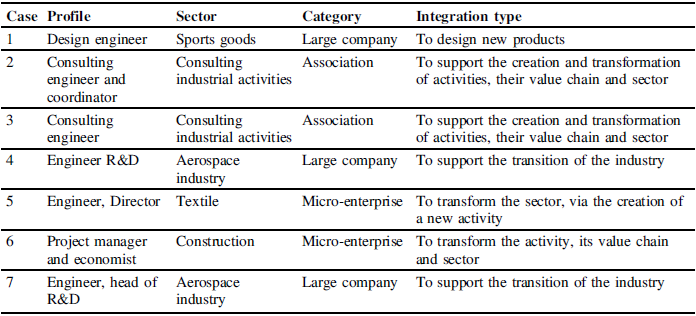
As explained in the background section, cases already studied in literature are activities created following a low-tech value system. Thus, to provide this overview of integrations of low-tech approaches, the analysis needs to consider already operational organisations, integrating low-tech approaches, no matter the level of maturity of this integration. The scope of this study needs to be broad, and the cases diverse (diversity of industrial sectors, type and size of organisations, role of interviewees, type of low-tech integrations). The selected cases are listed in Table 1.
List of the cases studied, showing their diversity

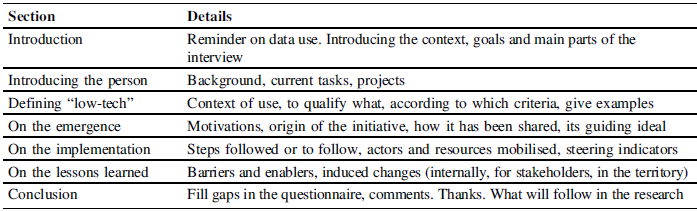
The method for data collection has been semi-structured interviews, conducted in 2025, for a duration of approximately 1 hour 30 minutes each. A summary of the interview guide is provided in Table 2. It focuses first on the meaning of “low-tech” as understood in the case studied, since its definition is very evolving and multifaceted in the low-tech movement. Then the questions concern the project inspired by low-tech approaches, why and how it started. Finally, the goal is to get feedbacks from this integration, its barriers and enablers, and the transformations it brings, internally, for stakeholders, and in the territory.
Guide of the semi-structured interviews

The coding of the transcriptions has been made in two times. Since the cases studied had different levels of maturity in the sections of the interview, a first pass enabled the restructuring of the coding categories initially planned, to make them more relevant. Next, the second pass has been a detailed coding, using the opensource software QualCoder. Finally, data analysis simply consisted of studying the recurrence of codes on each topic, and the various facets that each code could have.
4. Results
The results of this study are presented here in both quantitative and qualitative terms. Note that the small size of the sample and the objective of providing an overview rather than a trend analysis implies a primarily qualitative analysis.
4.1. Positions on defining “low-tech”
As a first element to position the cases studied, the word “low-tech” is generally used as an adjective to describe an approach (60%), a philosophy (20%), a product (13%), or a movement of thoughts and practices (7%). Only two interviewees use it to simply qualify a product, its material or technical characteristics, but they also understand it as qualifying an approach.
Behind these descriptions of “low-tech” as approaches, philosophy and practices, were some recurring criteria, summarised in Figure 1 and detailed below.
Frequency of occurrence of codes in the “low-tech criteria” category

The “local” criterion mainly implies the idea of promoting know-how and skills that are in close geographical proximity. It also relates to the importance of considering vernacular culture and the specificities of the context, especially to identify needs and to design solutions. These intentions are particularly evident in the cases of micro-enterprises, very interested in developing territorial and sectorial cooperation. Nevertheless, the other cases also emphasise this criterion, but more in relation with ideas of resilience: limiting external dependencies and reducing vulnerabilities, through developing a local anchoring and collective networks.
All discourses highlight the theme of “questioning needs” and “debating on what is useful”. The motivations for this are fairly consistent, involving the reduction of resource consumption (material and energy) and therefore the reduction of mass production. However, it is never clearly defined how to assess whether a need is essential or not, or whether something is useful or not. Precisely, actors only state that needs must be defined as closely as possible to users, or within territories (or more generally, at the most appropriate scale according to the principle of subsidiarity).
Certain criteria are focused on products resulting from low-tech approaches. These criteria are mostly about simplicity (often related with ideas from do-it-yourself, manual practices, and non-automated processes), repairability and care (understanding of technics and ability to maintain), and modularity (which is also found at larger scales than products, for example concerning a factory, through adaptability or reconfigurability).
The cases studied seldom mention directly criteria about accessibility, appropriation or autonomy. When they do, it is through criteria previously cited for products characteristics, or through ideas about openness (open access, open source) and replicability, or sometime about financial affordability. However, these criteria are at the core of the project of society in low-tech philosophy, notably with ideas about empowerment and democracy (Reference Gaultier, Masclet and BoujutGaultier et al., 2024; Reference MateusMateus, 2024; Reference Tanguy, Carrière and LaforestTanguy et al., 2023). The cases studied do not seem to have been initially interested in this subject, or this subject might be less personally important to them, less claimed.
Finally, it is noticeable that the actors rely particularly on key words from definitions such as that of Reference Keller and BournigalKeller & Bournigal (2021) (with the main key words: strong sustainability, collective resilience, cultural transformation), or that of Reference LabLow-tech Lab (n.d.) (with the key words: useful, accessible, sustainable).
4.2. Motivations
To begin with, it should be noted that all cases studied are projects that were initiated by people in R&D teams or (and) in strategic roles.
The integrations studied can be split into three categories:
-
1. Adding a new “low-tech” product;
-
2. Creating an activity, more in line with low-tech approaches;
-
3. Transforming the existing activity and its value chain (and potentially its industrial sector).
Motivations differ from one category of integration to another, as shown in Figure 2 and detailed below. This categorisation is more relevant here than categorisation by type of organisation, although the latter is also mentioned in the explanations below.
Frequency of occurrence of codes relating to motivations for each category of integration

First, adding a product to the offer and labelling it as “low-tech” is mostly motivated by the environmental benefits associated with low-tech approaches. This is both to lower the environmental impacts and to ride the trend of ecological labels. Describing the product as “low-tech” would enable it to reach a certain audience and also, potentially, encourage interest in low-tech approaches (without the product itself being derived from such approaches).
Second, cases creating a new activity are also cases from micro-enterprises or associations. These are projects focused on the local development of their sector. Their motivation is both ethic and economic: they know that their practices are more virtuous (environmentally, for job creation, for territorial autonomy and resilience) but they need to relocate their value chain and develop cooperation and mutualisation in order to be economically viable, and to enable other similar practices to flourish. In the ethical part of their motivation are concerns about their territory: the housing crisis and the poor condition of the city’s old buildings, the difficulty for the industrial sector to implement reuse or alternative construction practices, the waste deposits in the city’s port, the absence of sewing industry players in their territory, and the orientation of markets towards industries on the other side of the world with harmful practices, etc.
Third, intentions for transformation are mainly led by consideration of current and future vulnerabilities. These intentions are found both in cases from large companies, associations and micro-enterprises. The vulnerabilities in question include issues relating to material supply, product sales, conflicts over resource use, and more generally, multiple crises (geopolitical, health, economic and energy destabilisation, etc.). The majority of cases mention the COVID-19 pandemic as a trigger: either because they suddenly had time to explore these complex issues and alternatives such as low-tech approaches, or because this crisis highlighted weaknesses in their value chain. This feeling has also been accentuated by later crises, such as the war in Ukraine and the associated energy issues. Faced with these vulnerabilities, there is a desire for an industry that is adaptable to possible future situations. Work on low-tech approaches is therefore combined with prospective studies. For example, there is hope that low-tech approaches “can help us to arbitrate on needs and make informed choices to ensure that our industrial system is capable […] of operating in a context of absolute sustainability and, therefore, resilience” (case 7). Low-tech approaches, in these cases, are then a tool for the optimisation of industry, helping in reducing its vulnerabilities, but also potentially with positive indirect effects (also called “non-objectives”) such as improved working conditions. Similarly, reducing environmental damage is an expected consequence of these approaches, but remains a non-objective, rather marginal in discourses because presupposed and obvious.
4.3. Integration processes
The cases studied are far from being mature integrations: implementation is, at best, in its infancy. As low-tech approaches are fairly recent, this low maturity is both common and logical. Most of what emerges from these case studies concerns the barriers and enablers at the beginning of the integrations, which are presented in this section after a brief summary of the elements related to implementations.
Firstly, there are no specific steps identified for integrating low-tech approaches. All cases mention that initially, one must feel the need for change, and then discover the existing alternatives, such as low-tech approaches, and share these reflections, but then it all depends on the context. Thus, the strategies and focuses of these integrations are diverse: add a special product to the offer or organise an event to showcase the “low-tech” concept, relocate its value chain and launch a collective debate within the local industry to develop cooperation and promote “more low-tech” alternative practices, analyse internal processes and identify constraints and potential improvements inspired by low-tech practices, communicate with actors from other industries to share insights on the unsustainable aspects of their models and imagine transitions for sectors and their norms, etc. The few tools mentioned to support these projects are either for analysing the industrial system (e.g., stress tests, triple capital accounting) or for facilitating collective debate and cooperation (also involving facilitation actors). None of the cases uses indicators to assess the integration of low-tech approaches or to position themselves on a “low-tech spectrum”. Potential indicators of successful integration, which have been mentioned but not yet used, relate to environmental impacts (e.g. life cycle analysis, carbon footprint), the robustness of the industry and society in which it operates (particularly through stress tests), or customer satisfaction and involvement in the project. Indicators focused on the low-tech aspect of the industrial system, or on the level of maturity of integration, would be of interest to interviewees, although they can be difficult to imagine.
Secondly, the barriers and enablers to these integrations, presented in Figure 3 and detailed below, are very common in sustainability initiatives in general (Reference Mallalieu, Isaksson Hallstedt, Isaksson, Watz and AlmefeltMallalieu et al., 2024).
Frequency of occurrence of codes relating to barriers (red) and enablers (green)

Among the barriers identified, the incompatibility of the low-tech paradigm with today’s industry is a fundamental obstacle, and can be seen in several ways. France’s industrial heritage imposes highly deindustrialised regions, hindering efforts to relocate industries. This deindustrialisation, together with centralisation, has made technical professions invisible (mentioned in contrast to China, where industrial workshops are visible from the streets), complicating recruitment in particular. As more virtuous or low-tech practices are generally non-conventional, they fall outside the norm and require much more effort to gain acceptance and certification, in addition to R&D efforts. Also, the actors initiating these integrations of low-tech approaches have no examples to draw on, they feel having to invent everything from scratch. Furthermore, when low-tech approaches encourage greater cooperation, this blocks many players who are locked into individual competitiveness logic. Similarly, the dominant discourse is short-termist, consisting of demands for productivity and performance, whereas low-tech approaches invite reflection on the long term and questioning of production needs. In the need to share this low-tech vision at all levels of the hierarchy and throughout the value chain, low-tech approaches are subject to numerous negative preconceptions. Individuals fear that they represent yet another constraint on their work, forcing them to comply with new criteria. In particular, these approaches can be seen as a threat to the company, under pretexts such as that “what we’ve always done is the only way, there’s no alternative” (case 4). Finally, these projects remain very marginal, both within a large company and within an industrial sector. They are not valued economically and are confronted with practices that are already established, better valued and often less virtuous.
The cases highlight different levers that can be used to address this economic challenge. In larger organisations, innovation or R&D teams have more latitude to address disruptive topics. Smaller ones rely on subsidies, mobilise schools through student projects, or involve social integration organisations in certain activities (which is also part of their ethical approach). Their cooperation and mutualisation initiatives (of equipment, space, skills) are also part of a logic of economic viability. To successfully implement them, it is essential to take into account each voice, each person’s needs and challenges. Furthermore, communication is a lever that includes many aspects. For example, it involves raising awareness of the existence of alternatives, in particular by sharing them with regulatory and certification organisms, to more generally bring about a change in standards. It also involves using alternatives to the term “low-tech”, reserving its use for those who are already familiar with it, so as not to antagonise the listener. This adaptation of discourse, which seeks to reach people’s sensibilities, to adapt to the individual, is also found in arguments based on current or future vulnerabilities (particularly possible regulatory pressures). In this regard, a consensual lever is to take advantage of conjunctures, crises or other triggering events that can break down barriers (just as the COVID pandemic was mentioned among the motivations).
5. Discussion
5.1. Limitations
This work has limitations, particularly due to the sample studied. With seven cases from five different organisations, the sample is not large enough to provide a comprehensive overview nor to identify trends. For example, it does not allow for the characterisation of low-tech approaches integration according to industrial sector or type of organisation, which would nevertheless have been interesting results. As the selection of cases focused on explicit inspiration from low-tech approaches, future research could look at activities that are not centred on this term but which have its characteristics (identifying such activities seems tricky) and may therefore be more mature.
5.2. What is “integrating low-tech approaches”?
The cases studied here do not have the same claims, nor the same ideal for industry, while being grouped together under the term “low-tech”. Low-tech approaches, depending on how they are interpreted, can fuel different ambitions. In this study, some cases are ambiguous in their integration of low-tech approaches: understood and described as responding to systemic issues and therefore leading to systemic transformations, the ambition for their integration is nevertheless reduced to them being an optimisation tool that improves the system without transforming it.
To illustrate this, within the same discourse we find the transformative aspect of low-tech approaches: “There is, of course, a dimension of fair and rational use of resources, within which we are inevitably obliged to question needs and technologies, practices in general, in order to achieve circularity”. And at the same time, finding a utilitarian vision aimed at optimisation rather than transformation: “Can the criteria identified by low-tech improve working conditions, the impact on planetary boundaries, that kind of thing? Can it be used as a tool to address these issues on an industrial scale? […] It is in our interest to use these means [of openness and dissemination of technical culture] to achieve our objectives, whatever they may be, but in a more sober manner. It can even tend towards the economy, even if that is not an objective on our part either”. By extension, all motivations related to improving certain aspects of the system (reducing its vulnerabilities, improving well-being at work, reducing environmental impacts, reducing costs, reducing resource consumption, etc.), however commendable they may be, could potentially fall under this utilitarian view.
This ambiguity presents at least two obvious risks. The first is that the transformation analysed as necessary by low-tech approaches will not take place, and that, on the contrary, the system that is supposed to be transformed will be further consolidated. The second, which has already been analysed many times within the low-tech movement and is a fear shared by many actors, is a recuperation of the term “low-tech”, unpicking it and neutralising its political and transformative power. This second risk is closely linked to the challenges of defining the term “low-tech” and the power struggle that this definition represents (Reference Bloquel, Bonjean, Fangeat, Marry, Forget, Fustec, Habe, Jaeger, Moiroud, Morales and ChabotADEME et al., 2022; Reference BérangerBéranger, 2022; Reference Mateus and RoussilheMateus & Roussilhe, 2023). As with any definition, as illustrated by Lewis Carroll’s character Humpty Dumpty in Through the Looking-Glass (1871): “When I use a word […] it means just what I choose it to mean […] The question is which is to be master - that’s all”.
Among the possible explanations for this duality of discourse, the barriers identified in relation to paradigms may provide some perspective. First, stakeholders cannot directly receive a transformative discourse, forcing interviewees to communicate a toned-down, softer approach. This vision of integration as aiming for optimisation rather than transformation may also stem from these communication issues. But more broadly, such a transformation is unimaginable, with interviewees noting a lack of examples. Imagining and describing a transformative approach to industrial systems, which are highly complex especially because they have been developed over a long period of time, seems very difficult. Finally, the personal attachments and dependencies (in the sense of the ecological redirection theorised by Reference Bonnet, Landivar and MonninBonnet et al. (2021)) of interviewees to the industries that have shaped their lives may also be implicit obstacles to such reflections.
To what extent is considering the transformation of the system a characteristic of the integration of low-tech approaches? This is the key question that emerges from this discussion. Whatever the answer, one common point seems to be the need for systemic thinking, for a critique fuelled by the complexity of the elements and interactions under consideration, which would be a perspective to be shared. This need for a design approach guided by system dynamics is consistent with conclusions from the field of Design for Sustainability, which shows greater potential for sustainability in such approaches (Reference Ceschin and GaziulusoyCeschin & Gaziulusoy, 2019). The need to share this perspective prior to identifying alternative practices to be implemented is also found in the literature, referred to, for example, as the transfer of “know-what” by Reference Mallalieu, Isaksson Hallstedt, Isaksson, Watz and AlmefeltMallalieu et al. (2024). Finally, if low-tech approaches (or Design for Sustainability ones) are indeed characterised by the consideration of systemic transformations, this implies the need to question and support the potential transformation of, among other things: organisational models, value models or economic models, and design practices. On this last point, it should be noted that the role of the designer could evolve significantly, requiring the development of a new ethic (of responsibility, as proposed by Reference ContrerasContreras (2025)) or new skills, such as adopting a systemic and forward-looking approach or being able to facilitate more participatory design processes (Reference Ceschin and GaziulusoyCeschin & Gaziulusoy, 2016).
5.3. Contributions
The contributions of this article lie primarily in the overview it provides of the integrations of low-tech approaches in industrial contexts. Understanding the diversity of interests that these practices and ideas generate can help to define them more clearly and focus efforts on the relevant aspects. In particular, as approaches related to the field of Design for Sustainability, this focus may be on maintaining and developing their potential for strong and absolute sustainability. Another contribution of this article is precisely to address this point in the discussion. Noting in the study’s results an issue surrounding whether integrating low-tech approaches is seen as systemically transformative or not, this article draws a parallel between this question and the conclusions of Design for Sustainability.
6. Conclusion and perspectives
The recent concept of low-tech approaches has attracted interest in recent years, particularly in opposition to the dominant techno-solutionist discourse for sustainability. Low-tech practices are mainly developing as alternatives outside the dominant system but they also naturally inspire movements within structures that are part of the dominant model and seeking to make a transition or redirection. In this article, these inspirations are referred to as “integrations”.
This study highlights the multitude of possible ways to integrate low-tech approaches, through semi-structured interviews conducted in diverse industrial contexts. Although the cases studied broadly agree on their understanding of low-tech approaches, they do not emphasise the same aspects. This is particularly evident in the motivations that lead them to choose one type of integration over another (the three types studied here being the addition of a new product to the offering, the development of a new activity, or the transformation of the industrial system). Because all cases are recent, they have low maturity level of integration and thus can not become the first examples of low-tech approaches widely integrated in industry.
The proposed discussion, on the challenges and consequences of defining what does “integrating low-tech approaches” mean in terms of potential systemic transformations, led to remind that these are approaches of Design for Sustainability that could address any level of innovation. For them to keep their potential towards sustainability, the discussion suggests some research perspectives:
-
• Use more field-based research methods such as action research to study and design support for the integration of low-tech approaches.
-
• Study and support the necessary transformations of designers’ role and practices.
-
• Develop some sort of model for the maturity of integration of low-tech approaches, enabling such an initiative to be positioned, particularly in terms of its potential for sustainable transformation, and possibly guiding it.
What has been presented in this article will be useful for the French low-tech movement, but it is also intended to encourage Design for Sustainability to take an interest in all these technocritical approaches that are developing sporadically everywhere and which bring with them a renewal in design practices, with strong potential for sustainability, and whose integration must therefore be approached with care.
Acknowledgement
The authors thank the seven individuals who generously shared their time and insights during the interviews. The authors are also grateful to Arts et Métiers for supporting this research as part of the ITTAI for a RISing Society project, dedicated to designing tools for territorial innovation towards a more resilient, inclusive, and sustainable society.


 Open access


