


1. Introduction
Humanitarian emergencies are still targeting a significant part of the population worldwide: from conflicts to climate emergencies or other economic causes. The response in many cases is still insufficient: Global Humanitarian Overview (UN OCHA, 2023) estimates that in 2024 almost 300M people are in need and less than 200M people are actually targeted by humanitarian response, with investments to cover the gap up to nearly 30 billion USD. The sector is largely characterized by a diversified landscape of actors, which range from national and international NGOs to UN Agencies as well as technology/solutions providers from the private sectors which work as on-demand suppliers.
UNHRD is for UN Humanitarian Response Depot: it stores and organizes the logistics for humanitarian response goods, shipping them where needed on behalf of UN agencies and other humanitarian entities. Besides, UNHRD also designs and develops new solutions to target needs of different humanitarian emergencies, steered by the indications of donors and other stakeholders in the humanitarian sector.
However, the current model of development and organization cannot be considered any more suitable for the current context, which is inherently complex because of the multifaceted actors of the value chain, the challenging requirements to take care of as well as the changing global scenario characterized by growing needs coupled with the shrinking of funding from donors. Although innovation is recognized at large as a vehicle for advancement, socio-technical and processual fragmentation; robust practices in the response operation resulting into a conservative environment; slow adaptation to new solutions; and segregation from the private market depict the humanitarian sector as an innovation-adverse context, like many other industrial contexts (e.g. construction, the defence industry, etc.). Thus, this paper proposes a framework where innovation management and design studies could contribute to the specificity of the humanitarian sector and its challenges. Specifically, this work presents the first steps of a synergistic research approach to enable innovation and efficiency in the humanitarian response. Stemming from the current trends and limitations, the paper details how UNHRD involved different players to steer innovation and its stakeholders to collaborate and co-design the next solutions for the humanitarian sector. Together with a task force of external experts, UNHRD reshape its innovation processes and facilitate both incremental and radical innovation within an action-research/open-innovation initiative. The next section deepens the description of the humanitarian context: it describes emergency types, the variety of products currently used for responding to emergencies, the stakeholders as already emerged trends and limitations. Section 3 briefly justifies choice of action research as the methodology. Section 4 introduces the new innovation model codeveloped by UNHRD and the task force together with its theoretical foundations, meant to facilitate teaming and collaboration among different stakeholders in innovation processes. Section 5 deep dives into the first building blocks of the innovation model, namely UNHRD Innovation Lab, its accelerator as well as the innovation task force. The conclusion is preceded by a critical analysis of the limitations and opportunities of the context with reference to what the new innovation approach aims at fostering to address them.
2. Relevant background
2.1. Humanitarian emergencies, characteristics, relief items and main actors
Martin et. al. (2014) define humanitarian crisis as: '…any situation in which there is a widespread threat to life, physical safety, health or a basic subsistence that is beyond the coping capacity of individuals and communities in which they reside'. Poor populations are more likely to be more vulnerable to man-made or natural disasters. Within affected communities, typically vulnerable groups include children, pregnant and nursing women, migrants, and displaced people. Although the humanitarian emergency management is generally organised around the four phases of Mitigation, Preparedness, Response, and Recovery, during these emergencies, a Rapid Response Mechanism (RRM) is a mechanism established by the humanitarian sector. This is to facilitate rapid funding, enabling the monitoring of humanitarian action, the conducting of multisector assessments, and the provision of assistance to households facing crisis situations. Support provided through the RRM includes the distribution of essential household items, the provision of shelter, and the implementation of water, sanitation, and hygiene (WASH) interventions in instances where there is a lack of capacity on site. The RRMs frequently collaborate with the UN's “Clusters,” which are established to streamline response coordination. The “Cluster” encompasses humanitarian organizations, UN agencies, and government entities operating within the primary sectors of humanitarian action, such as water, health, logistics, and shelters. This structure facilitates discourse and consensus on methodologies and delineates the roles and responsibilities of diverse humanitarian organizations (Reference HarrisHarris 2021). The humanitarian relief items are products that serve as urgent aid as soon as an emergency occurs and extending for a minimum of two months after the emergency. These items are of different nature and fall into the categories of: food items, non-food items, shelter, individual safety kit, medical aid, water, sanitation and hygiene, basic logistic items, telecommunication and power supply. The products need to be fit for field, i.e. these need to be prepositioned and deployed within 24/48 hours; standardized for prepositioning because of logistic reasons, but adaptable to different socio-climatic contexts; frugal; easy to maintain; with low energy consumption; easy to use; with the potential of triggering and enabling positive social, economic and environmental impact beyond the emergency phase. The current scenario for products, also highlights that this variety of stakeholders makes the humanitarian sector suffer from great socio-technical fragmentation, which reflects onto the processes of aid delivery. WHO (2023) explains that beyond the affected communities and individuals, many different actors are stakeholders for innovation: local communities, governments, local or international nongovernmental organizations, UN agencies, inter-agencies, donors, cluster-based organizations, logistic, programme-based groups, field responders, coordinators, advisors, etc.. WHO (2023) also explains that these have different roles and sometimes they cover several of the following functions/roles: coordination, technical expertise, protection of people; implementation of the humanitarian action, funding, staffing, etc.
2.2. Humanitarian response trends, standards and current limitations
Bruder and Baar (Reference Bruder and Baar2024) explain that the extent, scope, and complexity of the problems for the international humanitarian action increase together with governments' and humanitarian organizations' operational and budgetary deficiencies. According to Humanitarian Response Plans (HRPs) for many regions and nations, despite a steady increase in absolute financing for humanitarian relief, its expanding needs cannot be met (OCHA 2022). And the global coronavirus pandemic worsened the situation (Rush et al. Reference Rush, Marshall, Bessant and Ramalingam2021). Both the increasing needs and resources scarcity triggered the humanitarian sector for a radical change to deliver better aid (Finnigan and Farkas Reference Finnigan and Farkas2019). Then, the humanitarian sector invested more heavily in innovation in the last decade, seeking new and more efficient solutions to address humanitarian crises and narrow the funding gap. Yet, while ‘innovation’ has become a prominent concept in the humanitarian sector, a counternarrative has formed that decries innovation’s seeming inability to bring about transformational change in the sector (Bruder and Baar, (Reference Bruder and Baar2024).
Given these premises, the proposed research should both ensure the affected populations to actively participate in innovation agendas and processes, i.e. through participatory design, which should also see the collaboration of the other actors in a strengthening effort. The creation of an innovation ecosystem increases coordination, knowledge exchange, and bundling of resources for innovation, which might also improve the quality and quantity of the findings, while boasting funding that innovation actors invest in innovations that are explicitly catering to the needs of affected populations. This synergy also facilitates evidence-based approaches and data-driven decision-making, for the operationalisation of appropriate innovations while finding a balance in products design between the need for prefabrications, standardization and prepositioning, and the call for environmental and social adaptability.
3. Methodological approach: action-research
Given the impellent and concurrent need for UNHRD to develop an effective innovation strategy and the research need of exploring the innovation dynamics in the humanitatian sector, the activities are structured coherently with the Action Research approach, as it bridges the gaps between theory and practice by gounding theories in a real world-experience, while attaing direct tangible results.
Kurt Lewin (Reference Lewin1946) introduced this as a distinct research methodology in the mid-20th century. He proposed that social issues are best addressed through a cyclical process of inquiry that directly involves stakeholders in both diagnosing problems and implementing solutions, as stakeholders are essential to bring relevant knowledge and viewpoints which enrich quality and strengthen effectiveness and efficiency of the innovation process. The suitability to address issues that regards the society is one of its strengths to conduct research in the humanitarian field. In addition, rather than separating theory from practice, Greenwood and Lewin (Reference Greenwood and Levin1998) argued that research should be conducted with and for participants, not merely on them, and stressed the importance of a systematic, participatory approach where researchers and practitioners collaboratively engage in a dynamic cycle of planning, action, observation, and reflection. Rather than treating these steps as a linear sequence, the process moves dynamically, enabling participants to refine their approaches as they learn from each stage. Therefore, the general approach for the research is structured as for Figure 1, where colours reflect an adaptation of the research steps proposed by Blessing and Chakrabarti (Reference Blessing and Chakrabarti2009): Research clarification (Steps 1,2,3), Descriptive Study 1 (Steps 4,5,6) and Prescriptive Study (Step 7).
The main steps of the Action Research approach

Beyond the definition of the general objectives presented in Section 2 (Step 1 - Fig. 1), this research approach has been chosen as it fosters collaboration and participation: researchers do not operate at a distance but engage directly with the individuals and groups affected by the issues under investigation. Moreover, action research is meant to target the social, cultural, and institutional circumstances in which problems emerge, it offers interventions finely attuned to their immediate context, which is essential to tackle emergency response issues (Steps 2, 3 and 4). Finally, action research aims not only at understanding a given situation, but also—indeed primarily—at transforming it (e,g, through case studies as for Steps 5 and 6). Its purpose is inherently practical and change-oriented, seeking to generate knowledge that leads directly to meaningful improvements in social or organizational life. Such characteristics results into the immediate application of the findings and the possibility to estimate the usefulness of the proposed intervention/solution (Step 7). Moreover, despite action research does not ensure the generalizability of findings beyond the specific sector in which the research has been conducted, the humanitarian context in which UNHRD aims at interacting with already targets the whole set of relevant stakeholders contributing or receiving emergency response. Despite well-tailored to support open innovation initiatives, its management suffers from the complexity of the scenario, making it troublesome to manage and coordinate time and human resources among co-innovators as well as their mindsets, which reflects personal, professional or local biases (e.g. Coghlan and Brannick (Reference Coghlan and Brannick2014)). The methods used within this approach are mixed, such as data collection from real humanitarian case studies and database, stakeholders questionnaires and interviews, roundtable with experts, co-design strategies, application of the strategies to product development as case study, feedback collection, and visits of relevant sites of operations and logistic. The expected outcome is to define and test an ad-hoc strategy to support innovation in the humanitarian sector. The work presented is an on-going step of the research design proposed. After conducting the first 4 steps the authors are looking into testing the proposed work presented here and test it as a step of the action research proposed.
4. Conceptual model development
4.1. Theoretical foundations
Innovating products aimed at this context is not trivial, due to the very specific features that characterize it. First, humanitarian operations involve a quite complex value chain: cross-sectoral and not confined by traditional boundaries of industry, sector, or discipline. Second, the stakeholders in this ecosystem express quite challenging technical requirements for products and ask for solutions that are inherently collaborative, scalable and systemic. In fact, these products must be deployed and operated effectively in difficult environmental conditions, by a broad range of operators without technical expertise. Then, cost must be kept at the lowest possible level while reducing the environmental impact of such items throughout their lifecycle. This means that solutions and technologies employed in apparently similar fields, such as the defence industry, might not really be usable. Third, the market for humanitarian response items is - fortunately - quite limited, so that it is difficult to generate economies of scale that may justify spending a significant amount of specific effort in R&D and product development. On the basis of studies of innovation dynamics in similar sectors, such as the design and construction industry and green energy, we identify three main relevant and promising conceptual pillars, in view of introducing a systematic approach to innovation in this particular context: “innovation ecosystems”, “open innovation” and “participatory design”. Many years of demonstration projects and literature proved these approaches to be beneficial in various fields, as they help overcome the socio-technical fragmentation and the conservatism, e.g in design, construction, and green energy (Reference WesheWeshe et al. 2023). The rationale for selecting these three pillars must be found in the inherent specificity of the humanitarian sector and its challenges, and how principles of those can help overcoming the barriers to innovation, mentioned in Section 2. Innovation ecosystem can help overcome inherent humanitarian socio-technical fragmentation; open innovation can support widening the outreach of knowledge and stakeholder heterogeneity and participatory design can help introducing culture of change in a standard operation-based environment, relatively adverse to innovate.
4.1.1. Innovation ecosystems
The concept of innovation ecosystems (Reference Granstrand and HolgerssonGranstrand and Holgersson, 2020) provides a compelling framework for understanding how diverse actors can interact within a shared environment to co-create, test, and scale solutions. Grounded in principles of systems/platform theory, open innovation, and participatory/co-design, innovation ecosystems offer a structured lens for addressing the multifaceted nature of humanitarian innovation. At their core, innovation ecosystems represent a networked, interdependent set of actors, resources, and activities that collectively generate and sustain innovation. Unlike isolated innovation processes, ecosystems convene diverse stakeholders and operate on the principle of dynamic complementarities where individual contributions are increased, and their value amplified through, interaction with other stakeholders within the ecosystem.
The concept of co-evolution further enriches the theoretical understanding of ecosystems. Co-evolution describes the reciprocal adaptation of stakeholders within an ecosystem, where changes in one component—such as the introduction of a new technology—prompt shifts in others. This dynamic interaction fosters holistic solutions by ensuring that individual elements are well integrated and remain aligned with evolving needs and contexts. This framework is especially relevant for humanitarian contexts, where solutions must transcend singular objectives and instead address interlocking dimensions of need. Moreover, it can support the interaction between actors that exhibit significant differences in their institutional nature and decision-making dynamics.
Today, platform-based approaches have the ability to support this interaction and accelerate innovation in the humanitarian sector through their adaptive governance structures, modular architecture and flexible plug-and-play nature (Reference Parker and AlstyneParker and Van Alstyne, 2014). These platforms create collaborative commons across sectors and stakeholders that increase both the novelty and the rate of innovation while dramatically lowering transactions cost for all participants.
4.1.2. Open-innovation
The humanitarian sector is focused on facing extreme emergencies, and the actors operating within this environment are naturally drawn to preferring tried and tested solutions, rather than to manage the risk that is inherently associated with the adoption of new and unproven ones. Furthermore, these same actors are not exposed to the competitive interfirm dynamics that characterize most industries, and this too takes out another traditional incentive to develop and adopt innovations. In this context, the conceptual framework of Open Innovation (Reference ChesbroughChesbrough, 2012) can be a key approach to introduce a higher degree of innovation in the sector.
First, open innovation allows to reach out towards new actors, from universities and research centers to startups, and from individual innovators to student teams, which might bring fresh ideas and a higher degree of diversity to the ecosystem. In fact, Open Innovation increases stakeholder heterogeneity, which can drive innovation through the convergence of multiple perspectives, resources, and capabilities. In this framework, traditional humanitarian actors like NGOs and UN agencies are complemented by non-traditional stakeholders such as startups, academia, and local communities. Startups introduce agility and technological ingenuity, acting as disruptors within the ecosystem. Academia provides theoretical rigor and research-backed insights, contributing foundational knowledge that guides innovation. Affected communities play a critical role as contextual experts, ensuring that solutions are culturally and operationally appropriate. Theoretical models of diversity in innovation ecosystems posit that such heterogeneity enhances both the robustness and creativity of solutions, mitigating the risk of groupthink or insularity
Second, Open Innovation provides a number of well-known and somewhat standardized mechanisms that facilitate the development and adoption of new solutions within a sector, such as startup accelerators, hackathons, corporate challenges, etc.. On the side of providers of innovative ideas, these mechanisms are a systematic playbook to understand needs arising from the market and to finetune and validate solutions. On the side of market actors, they provide a risk-managed pathway that allows them to scout for innovative solutions and progressively test them, starting with the development of preliminary concepts, eventually moving on to PoC (Proof of Concept) projects, then to pilot projects and, finally, to full-scale adoption. Open Innovation programs are quite well known in the corporate sector, where their implementation has led both to successes and failures (Reference Dabic, Daim, Bogers and MentionDabic et al, 2023). Their introduction in the humanitarian sector is quite challenging, because the associated ecosystem is - as previously mentioned - quite fragmented and lacks a coordinating organization with sufficient clout. Moreover, the market opportunity provided to innovators is not particularly large. This might reduce the incentives to innovators to participate or, even worse, it might lead to a phenomenon of adverse selection. So, it is necessary to design an Open Innovation program in such a way that participants are attracted by the right incentive set, such as the possibility of signalling their contribution to a noteworthy cause, or framing the humanitarian context as a “beachhead” market from which the innovator might eventually move on and attack broader and more profitable markets.
4.1.3. Participatory design / co-design
Finally, the complexity of the ecosystem makes it so that new products must align the needs and requirements emerging from different stakeholders (Reference Cantamessa, Montagna and CasciniCantamessa et al., 2016). In fact, the innovative products and solutions being conceived and developed by UNHRD will have to be (i) manufactured by a supplier, (ii) managed operationally by UNHRD (i.e., listing it among the available solutions, marketing it to NGOs, dealing with the logistics), (iii) acquired by a UN Agency or by a partner NGO, (iv) deployed in the field jointly by the Agency/NGO and/or by authorities in the region affected by the emergency, and (v) ultimately be used by the members of the displaced communities. Each of these stakeholders has its own perspectives and needs and - given the operating context - it is unlikely that any innovative solutions will be adopted, if even one of these actors signals a preference for a traditional and well-tested one. Moreover, the uncommon and extreme nature of the application domain allows to frame the users as “lead users” (Reference HippelVon Hippel, 1986), i.e. as actors who are uniquely able to provide insights on requirements - and eventually to suggest technical solutions - that designers lacking the same contextual experience might find impossible to come up with. All this calls for a participatory design approach to product development, to make sure that these disparate - and potentially conflicting - needs are taken into account from the beginning, that solutions emerging from field experience are duly considered, and that solutions are progressively developed in such a way to gain continuous feedback from the different actors, thus reducing the likelihood of coming up with a failed project.
4.2. Conceptual model
The above conceptual foundations address different perspectives of the problem situation being tackled by UNHRD, but must be integrated in order to be actionable and deliver results. Figure 1 represents the way with which these perspectives have been framed in a single conceptual model, in order to highlight their differences and complementarities, and placing them along the well-known TRL scale.
The conceptual model that integrates Innovation ecosystems, open innovation mechanisms and collaborative approaches with reference to the Technology Readiness Level

Specifically, the Innovation Ecosystem perspective has been used as a general integration framework. Moreover, it has been used to identify the relevant actors, both current and potential, and to generate a systematic analysis of their needs and wants. Thanks to this, it is possible to support the scouting of new participants to the ecosystem and to frame their participation according to a set of incentives that is both attractive to them, and potentially effective for the ecosystem. The Open Innovation perspective has been focused on supporting the ecosystem especially for what concerns more radical innovations, and for testing them up to a PoC/demonstrator level. This choice has been made, because the nature and the practices of OI mechanisms are well-suited to providing a preliminary adaptation of innovative solutions provided by external actors to this complex application domain, but not to complete the product development process. In fact, OI mechanisms are focused on events of relatively short duration, while the development process within the ecosystem will typically be quite lengthy, given the need to validate the proposed solutions to a variety of stakeholders that are geographically dispersed and exhibit significant institutional, cultural, and decision-making variability. Moreover, given the relatively conservative nature of this ecosystem, it has been considered wise to split the development process in a preliminary phase that is somewhat more open to experimenting and freeing it from the burden of having to deal from the start with potential scepticism and/or an overburdening of disparate needs and specifications. Finally, collaborative design methods have been used at the later stage of product development, in order to provide a rigorous methodology and product development discipline to an ecosystem that - to date - operates these activities in a relatively unstructured and occasional way. This methodology will be both used to bring solutions coming from the OI phase to actual development, once they have been tested and validated at the preliminary PoC/demonstrator level. Moreover, it will be used to continuously and systematically engage ecosystem actors in making incremental improvements to products and solutions, based on either issues and ideas arising from their deployment, or on new opportunities arising from suppliers, in a way that can be viewed as a multi-stakeholder variant of Value Analysis.
WFP UNHRD approach to innovation
5.1. WFP UNHRD innovation lab and WFP accelerator
WFP UNHRD conceives innovation as a process to develop reality-based humanitarian needs into a positive social, economic, and environmental impact to build community resilience, and enhance preparedness and response to emergencies. In particular, the UNHRD Lab supports humanitarian partners to conceive, develop, test, deliver and scale supply chain and logistics innovations that incorporate society, environment and technology that will enable them to deliver on their mandates. The WFP UNHRD Innovation Lab is a unit located in Brindisi, Italy and that serves the entire WFP UNHRD Network. This network is composed by five hubs located in Brindisi, Dubai, Kuala Lumpur, Accra, and Panama, and that provide logistic support the humanitarian community to respond to crisis and emergencies. The UNHRD Innovation Lab focuses on two streams of activities concerning with incremental and radical innovation. The incremental innovation activities focus on the constant improvement of the products that UNHRD stocks for its partners. Such activities are technical specification redaction and review, tender evaluation, sample evaluation, market research, packaging design and optimization, LCA analysis, greening design reviews, technical advisory for partners, field support, training for partners, and ensuring that all the products are fit for field, environmentally sustainable, and able to satisfy the needs of the population the humanitarian community serves. These activities generally remain within the domain of the UN agencies and the registered vendor within the UN system, and are dealt through the standard WFP procurement procedures. The radical innovation activities look into the search, acquisition and development of new products to introduce in the humanitarian market of the crisis response. These activities call for a greater involvement of partners, efforts, financial resources, knowledge from private sector and academia, as well as the ability to reach out to these actors. When this is required, the WFP UNHRD Lab relies on the role of the WFP Accelerator to outreach the wider market of the private sector and facilitating the procurement relation with private entities through a mechanism of grant.
5.2. Creation of a multidisciplinary task force for innovation
UNHRD created two task forces, namely: one on Stock and one on Innovation. The former looks into the optimization and the forecasting of existing stock and products. The latter focuses on supporting all the activities of both incremental and radical innovation streams, thus tackling the way/quality of change of products that will be held in the stock for UNHRD for its partners. Both academics and professional experts compose it. Their knowledge, experience, and expertise cover: Innovation Theory, Processes and Procedures; Innovation by Design; Partnership for Innovation; Scale-up and strategic development of innovation; Technological forecasting.
5.3. Regular meetings and targets
The Innovation Task Force is responsible for guiding program guidelines and review processes for UNHRD innovation programs, overseeing proposal calls, selection criteria, project tracking, and performance evaluations. It provides technical input on long-term strategies to foster economic, social, and environmental development, as well as defining economic models to drive sector innovation. The task force advises on strategic partnerships by promoting collaborations, clarifying partner roles, facilitating commercialization, diversifying funding, and assessing program impact. Additionally, it periodically reviews the UNHRD innovation strategy, evaluating objectives, progress, benchmarking against best practices, and implementing necessary adjustments. It also supports the production of scientific outputs framing innovation within the humanitarian context. These activities are sought by regular monthly meeting and two In-Person workshops held on a yearly basis. Moreover, any specific activities related to specific projects development are held and organized depending on needs.
5.4. Design of the new innovation workflow
During the first In-Person workshop, held in July 2024 in Dubai, the Innovation Task Force in conjunction with representatives from UNHRD Innovation Lab and Network, as well as WFP Accelerator co-design, developed a workflow to support all the innovation development activities of the UNHRD Innovation Lab. The workshop was organized around innovation-related topics and organizational constraints, defined by the humanitarian organization, requiring impellent challenges. Firstly, the innovation task force and the humanitarian partners discussed the challenges in round table.
UNHRD new innovation workflow linking accelerator and innovation lab initiatives

Later, individuals prioritized analysed key aspects, issues and solutions before sharing with the group. Then, they selected ‘must haves’ to include in the innovation strategy and its workflow. The participants reviewed the materials once collated to consolidate the outcomes. Based on UHNRD Lab need to backbone the process as an engineering design one, the workflow implements concepts of stakeholders' engagement at specific gate moments, inclusion of private sector and open innovation sharing processes through prototyping experience as a key of both engineering testing and knowledge sharing. The workflow builds upon the Technology Readiness Level (TRL), introducing elements from the Societal Readiness Level (SRL). Moreover, critical gates enable feedback sharing and collection with the partners. The flow ensures the participation of relevant partners from ideation to scale up (Figure 3).
5.5. Stakeholders in the new innovation workflow
These co-X activities describe the actors' involvement according to their mandate, expertise, etc.:
Co-Championing: this includes advisory, strategic support and/or advocate, and participation into Project Board Committee. Relevant actors are, e.g. UN Agencies Representatives; INGO Representatives Clusters leaders, Head of Units, Government representatives, Universities, etc.
Co-Innovating: this covers product engineering and product design activities, technical data management, co-design in culturally diverse environments, tech/design review to ensure fit for field product features, policy design, etc. Its actors are UN Technical and Engineering Depts, UN Sustainability WG, Universities, Private Sector staff, NGOs with design and engineering skills, etc.
Co-implementing: this includes field testing, product operational implementation, scaling-up support, product management and maintenance, feedback on products use and fitness for field. Its actors are UN Regional and Country Offices, National and International NGOs, Governments, or UN Agencies with field implementing capacity, etc.
6. Limitations, UNHRD answers, opportunities and challenges
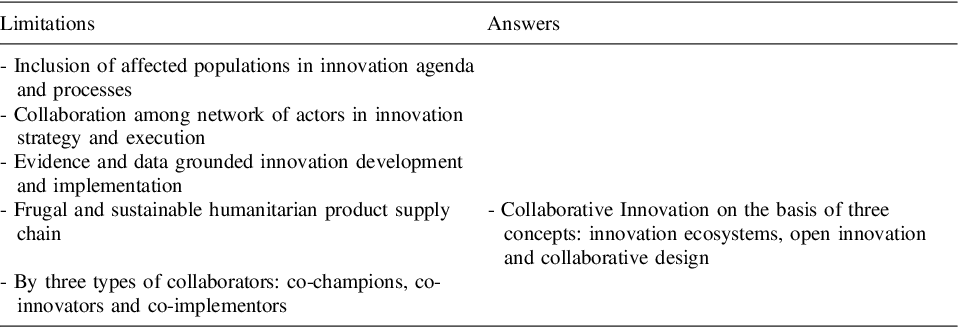
Based on the above, there are a number of limitations that UNHRD/Innovation Lab has to deal with. It is difficult to involve the people it wants to help in the innovation of the aid processes. Collaborating with all parties involved to innovate this aid is also a major challenge where much can still be gained. It is also often not clear which innovation means an improvement, with many different aid situations and parties involved. And, when an innovation is developed, relevant aspects such as costs and sustainability of the aid also play a role. Table 1 (left) overviews these limitations. At the same time, these are an entry point and inspiration for the joint development of involved actor-network improvements. Beyond the three underpinning pillars of innovation (Sect 4.1/4.2/4.3), the literature also offers starting points for the interpretation of human behaviour, activities and collaboration within these conceptual approaches. Co-champions, co-innovators and co-implementors can jointly conceive, design and implement the improvements (Table 1, right).
Strategies to address the existing limitation to innovation in the humanitarian sector

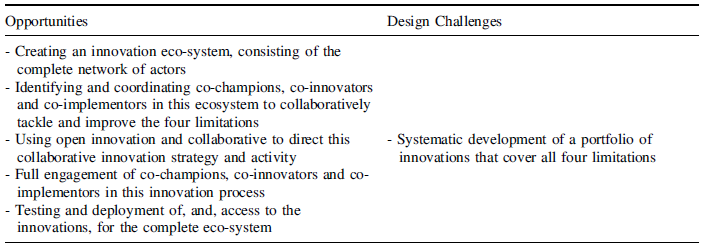
Opportunities and design challenges in the new innovation framework

1 The Double Diamond by the Design Council. Available: https://www.designcouncil.org.uk/our-resources/the-double-diamond/
Based on the presented limitations and answers, opportunities develop. UNHRD/Innovation lab can develop itself as a central entity of an innovation ecosystem in which all actors have a place, function and interest. Within that innovation ecosystem it can identify and coordinate the three co-X roles and focus on directing joint activity to develop innovations with regard to the four limitations. It can use proven concepts such as open innovation and collaborative design to shape these innovations. These opportunities are summarized in the first column of the Table 2. This does not mean, however, that these opportunities are easy to exploit. The four limitations are so complex, multifaceted and changeable that improvement and innovation are a challenging process. A design challenge that plays a role in this is the difficulty of systematically developing a portfolio of innovations that cover all four limitations. Another design challenge is the complete and appropriate involvement of all possible and important co-champions, co-innovators and co-implementors, with all the complexities of differences in interests and insights that come with it. Finally, a complex design challenge is to make innovations workable and applied in the complete eco-system in which, for which and with which UNHRD works. These design challenges are listed in the second column of the table. Moreover, implementation challenges also exist, namely: lack of consistent and constant funding mechanism, political constrains, resistance from existing structure. Yet, there also exist mechanisms to overcome these: the constant sought of alternative findings of various nature (i.e. monetary, knowledge, technology, both from private and public entities); maintaining political neutrality, agility, and efficiency; including other internal units in the innovation cycle from the early phases with the aim of building a sense of co-ownership and knowledge sharing.
7. Conclusion
This paper argues that collaborative innovation in the humanitarian sector is uncharted territory. It discusses a collaborative innovation approach that UNHRD is developing and substantiates that this approach can be used to develop solutions to problems that the humanitarian sector is facing. To this end, it addresses the question of what the core problems are, what possible solutions are from an innovation perspective, what opportunities this offers and what the associated design challenges are. Answers to this network of question are sought and found in the UNHRD co-innovation approach where the combined use of innovation ecosystems, open innovation and collaborative design approaches improve aid delivery. Stakeholders become co-champions, co-innovators and co-implementors under the coordination of UNHRD. The development of this approach follows action research principle and is promising, leading to further action and research to shaping, implementing innovation.



 Open access

