

Introduction
While the Roman army constructed hospitals, valetudinaria, to deal with the injuries and ailments of its troops, no such provision appears to have been made on a regular basis for civilian populations.Footnote 1 Instead doctors practised their art on their own property, in rented premises, or in the homes of their patients; treatment also might have been obtained at temples or the public baths (bathing was itself believed to be curative as well as preventative), while votives found at healing springs suggest that some had a reputation for curing specific diseases, with the work of medical specialists either enhanced or wholly replaced by divine aid.Footnote 2 Healthcare was effectively embedded in the community, and principally in the urban community, with the best professional care available only to those who could afford it. Rural communities may, in contrast, have been reliant on inherited (folk) wisdom for cures, or the sick may have migrated to towns or rural sanctuaries.
Physicians and other medical practitioners are not quite as elusive as their premises, thanks chiefly to epigraphic data. These include stamps for eye salves (collyria) that usually bear a personal name, the type of salve and the eye condition it would treat.Footnote 3 Such stamps have been found in 22 places in Britain and one in Ireland, chiefly towns but also villa, rural and military sites, but whether the 31 names they provide belong to suppliers (developers?) of the salves or to those both preparing them and using them to treat patients remains uncertain.Footnote 4 Other data nearly all come from military sites, or sites with a strong military connection, in northern Britain: two doctors at Chester and one at Binchester, a surgeon at Housesteads, a doctor or medical orderly at Vindolanda, a pharmacist at Carlisle and one at Vindolanda, two veterinarians at Vindolanda, and a mule-physician at London.Footnote 5 The last three are a reminder that veterinarians would have used many of the same tools as medical practitioners treating the human population.
All the above belong within the Roman period and its cultural milieu, but predating them is a British doctor, arguably a male Catuvellaunian from the oppidum of Camulodunum, who was buried at Stanway with a surgical kit and other items definable as having strong ritual and magico-medical connotations.Footnote 6 The contents of the grave led Ralph Jackson to speculate that the man was of druidic status.Footnote 7
The ambiguity of some instruments connected to medical treatment is an obfuscating factor in determining the location of urban doctors’ premises. Even with the material from Pompeii it is possible that groups from some buildings represent domestic first-aid kits rather than professional equipment, or may be instrumentaria carried away from the place in which they were used by medical practitioners attempting to flee the town.Footnote 8 In his Empire-wide inventory of medical instruments in graves, Ernst Künzl suggested that certain artefact types were not enough to define the person with whom they were buried as a physician, surgeon, dentist or pharmacist unless indisputably medical implements were also present.Footnote 9 These multi-functional objects are: ligulae, spoons of various kinds, probes, especially spoon-probes and spatula-probes, stone grinding palettes, pestles and mortars, weighing scales, multi-compartment boxes and copper-alloy tubular containers. To them might be also added the small ceramic pots and bone, metal, glass and boxwood pyxides in which pills, ointments, colourants and creams would have been stored.Footnote 10 Along with other specialists, Künzl defined the principal alternative use of the multi-functional objects (loan tools) as the preparation and application of cosmetics and unguents.Footnote 11 An assessment of the ligulae, spoon-probes and spatula-probes in the Museums’ collection has shown how widespread these objects from Künzl’s list are in an urban setting, emphasising both their usefulness in more than one milieu and their concentration in the town’s western suburb, and this work is summarised below.Footnote 12
Here we present the specifically medical instruments from Roman Colchester in the Museums’ collection and in that of the British Museum, and also include an unusual collyrium stamp from an excavated assemblage that has yet to be formally deposited. The latter provides the first record in Britain for the treatment of a corneal ulcer. The use and disposal of the instruments will be touched upon, as well as the physical problems endured by the town’s population and the treatments other than surgery that might be available. The metal of several of the instruments has been analysed by the University of Reading’s Roman and Early Medieval Alloys Defined (REMADE) project, and the results are presented after the description of the assemblage. Colchester Museums’ method of documenting objects in the collection is detailed below in the Catalogue.
Material and condition
The majority of the instruments are of copper alloy. The iron element of composite items such as scalpels is, as in other collections, usually missing.Footnote 13 The only non-metal objects present are of stone. The state of the metal objects varies, some being well-preserved and stable, others in poor condition and occasionally actively corroding. In the 1970s the main method of cleaning archaeological finds was electrolytic reduction, which could result in the loss of the original surface; this applies here chiefly to objects from Lion Walk, Balkerne Lane and to some extent Culver Street. Less invasive techniques were used from the early 1980s onwards, but the pace of redevelopment meant that only selected items were cleaned using hand-tools and stabilised, with long-term preservation reliant on environmental control.
Copper alloys and iron were, of course, used to make many personal and professional items in the Roman period. The choice of metal for these instruments would have been affected by diverse factors, including the availability and cost of resources, the knowledge, skill and level of specialisation of the makers, the desired form and function of the end product, and the aesthetic and functional preferences of the customer. Classical writers such as Pliny the Elder comment on the remedies that made use of various metals,Footnote 14 although the extent to which these were known or valued by medical practitioners and patients cannot be assessed.
The instruments
The Stanway Doctor’s kit
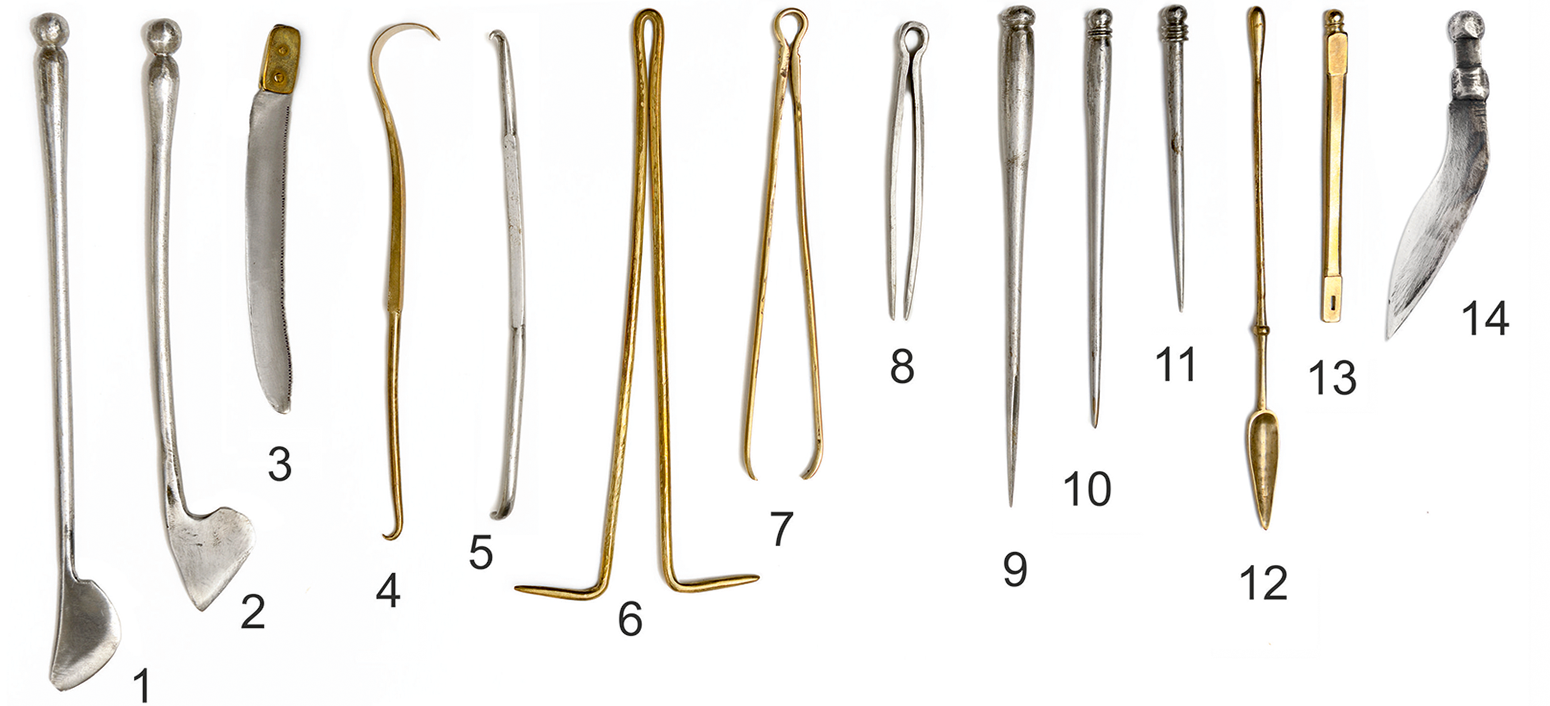
The conquest-period cremation burial of a doctor at Stanway, near Colchester, has been mentioned above. It is, so far, the only contextually secure example of a medical kit from pre-Roman, or Roman, Britain (Fig. 1).Footnote 15 The instruments within the kit share some features with both continental Celtic and Roman implements, but several are sufficiently idiosyncratic to enable Jackson to argue that they were the products of a pre-Roman British workshop that may have lain in the Colchester region.Footnote 16 The kit comprised (1–14): two iron scalpels; a fine iron surgical saw with 14 teeth per centimetre; a small iron knife; two sharp and blunt hooks (retractors), one copper-alloy, the other iron; a copper-alloy sprung ?retractor with long everted tips; a copper-alloy smooth-jawed fixation forceps; an iron forceps/tweezers; three uneyed iron surgical needles; a copper-alloy scoop probe (certainly a continental import); and a copper-alloy handle retaining only traces of its splayed iron operative component, which may have been a blade or scoop.Footnote 17
Replicas by Nodge Nolan† of the instruments in the Stanway Doctor’s kit, 1–14. From left to right: two iron scalpels, iron saw, copper-alloy sharp and blunt hook, iron sharp and blunt hook, copper-alloy ?retractor, copper-alloy forceps, iron forceps/tweezers, three handled ?needles, copper-alloy spoon-probe, copper-alloy handle with fragment of an iron component, iron knife. (Photograph D. Atfield, © Colchester Museums. Not to scale.).

These instruments are not included in the following summary of those from the Roman town or its immediate suburbs. They stand as a benchmark against which to measure the later assemblage.
Scalpels/blunt dissectors
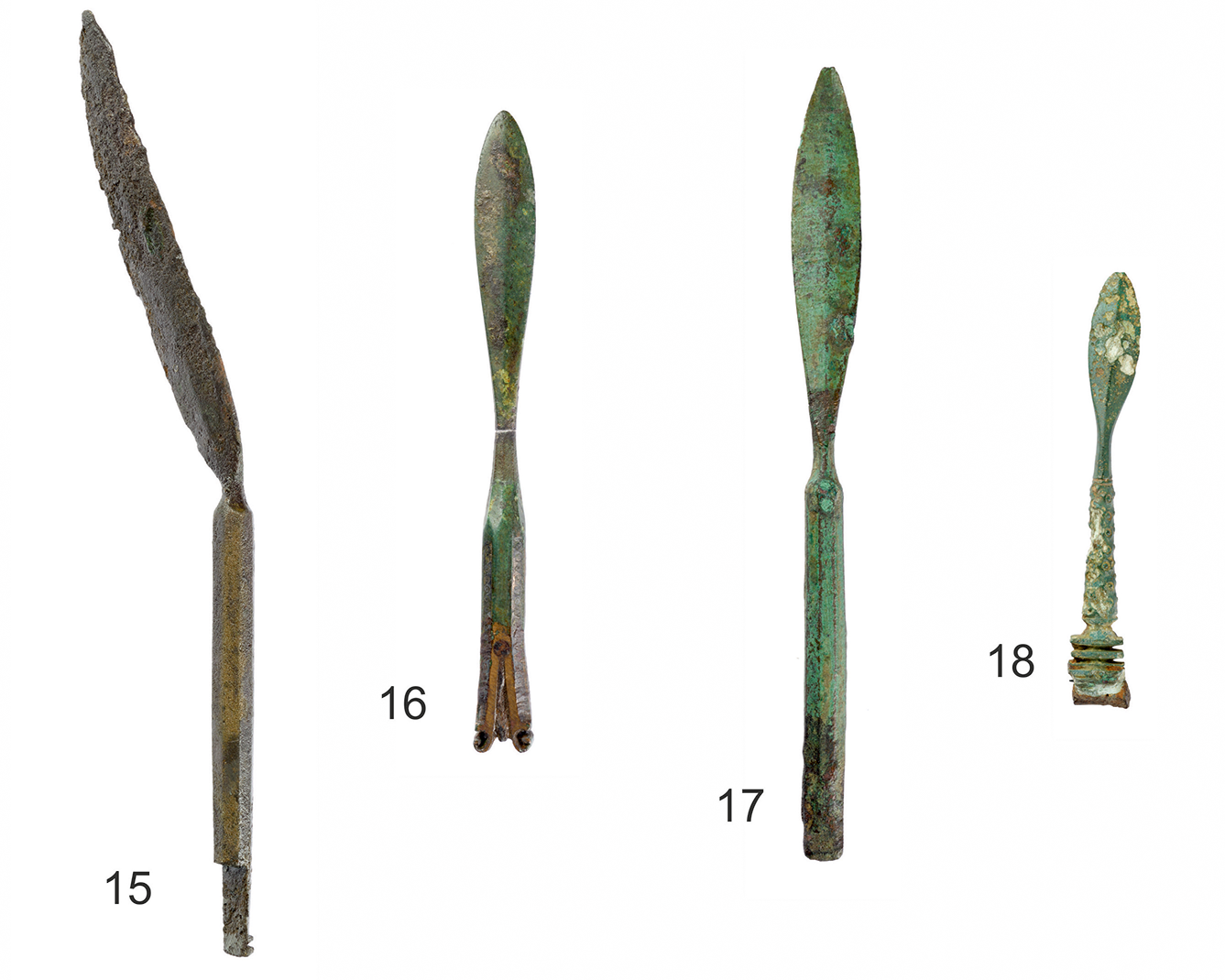
The four scalpels from Colchester all have a copper-alloy handle (or grip) into one end of which an iron blade could be slotted and replaced when necessary, while the other end is developed into a leaf-shaped blunt dissector. The blade was used to make neat incisions and excisions, and the blunt dissector to aid the removal of cysts and other growths or to isolate different elements of soft tissue.Footnote 18
One of the four Colchester scalpels came from a mid Roman pit in the western suburb (Fig. 2, 15).Footnote 19 It has a long polygonal-section copper-alloy handle paralleled by an example from a mid-third-century burial at Kaiseraugst, Switzerland, by other grave finds in France, the Netherlands and the eastern Mediterranean, and from the surgeon’s house at Rimini, all of which suggest that the Colchester find was contemporary with its context.Footnote 20
Copper-alloy scalpels/blunt dissectors, missing their iron blades, 15–18. (Photographs D. Atfield, © Colchester Museums. Scale 2:3.).

Two other scalpels also have a faceted grip (Fig. 2, 16–17). One, a variant of Jackson’s Type II, has ivy or vine scroll decoration on the grip (now very worn). Similar decoration occurs on several scalpel grips, usually of Type I, that have a marked concentration in north-east Gaul and the Rhineland.Footnote 21 The metal with rolled-back terminals lining the keyhole socket for the blade on 16 differs in colour to the rest of the grip, a distinction caused by working and annealing, while the effect is less marked on 17.Footnote 22 It gives the impression that a strip with rolled terminals was used to line the socket. These examples cannot be closely dated but were probably made sometime in the first to second century and could have continued in use well into the third century.Footnote 23
The fourth scalpel is probably of similar date (Fig. 2, 18). Found at St Helena’s School, Sheepen, its blunt dissector is small, and it has Hercules’ club decoration on the grip. Its length, only 58.5 mm, suggests that it might have been used for specific operations calling for restrained incisions, or perhaps when the patient, human or animal, was small? Three scalpels/blunt dissectors only 60 mm long came from the Piazza dell’Anfiteatro at Pompeii, but on each the grip is plain.Footnote 24 The Hercules’ club motif was not frequently used on scalpels, but it does occur on an unprovenanced example in the British Museum and on two from the eastern Mediterranean.Footnote 25 It also appears on other medical instruments and the design might be the origin of the small nodules on a scalpel grip from Augst.Footnote 26 A more direct reference to the demi-god is provided by four scalpel handles from Pompeii that terminate not in a blunt dissector but in a bust of Hercules draped in the skin of the Nemean lion, his image imparting strength to the instrument and its user, and, as the lion frequently symbolised death, representing the surgeon’s ability to overcome life-threatening maladies.Footnote 27 These scalpels are also short, ranging from just 51 to 70 mm, and others in the National Archaeological Museum of Naples are again of much the same size but with non-figurative terminals and of unknown provenance.Footnote 28
Forceps and forceps/tweezers
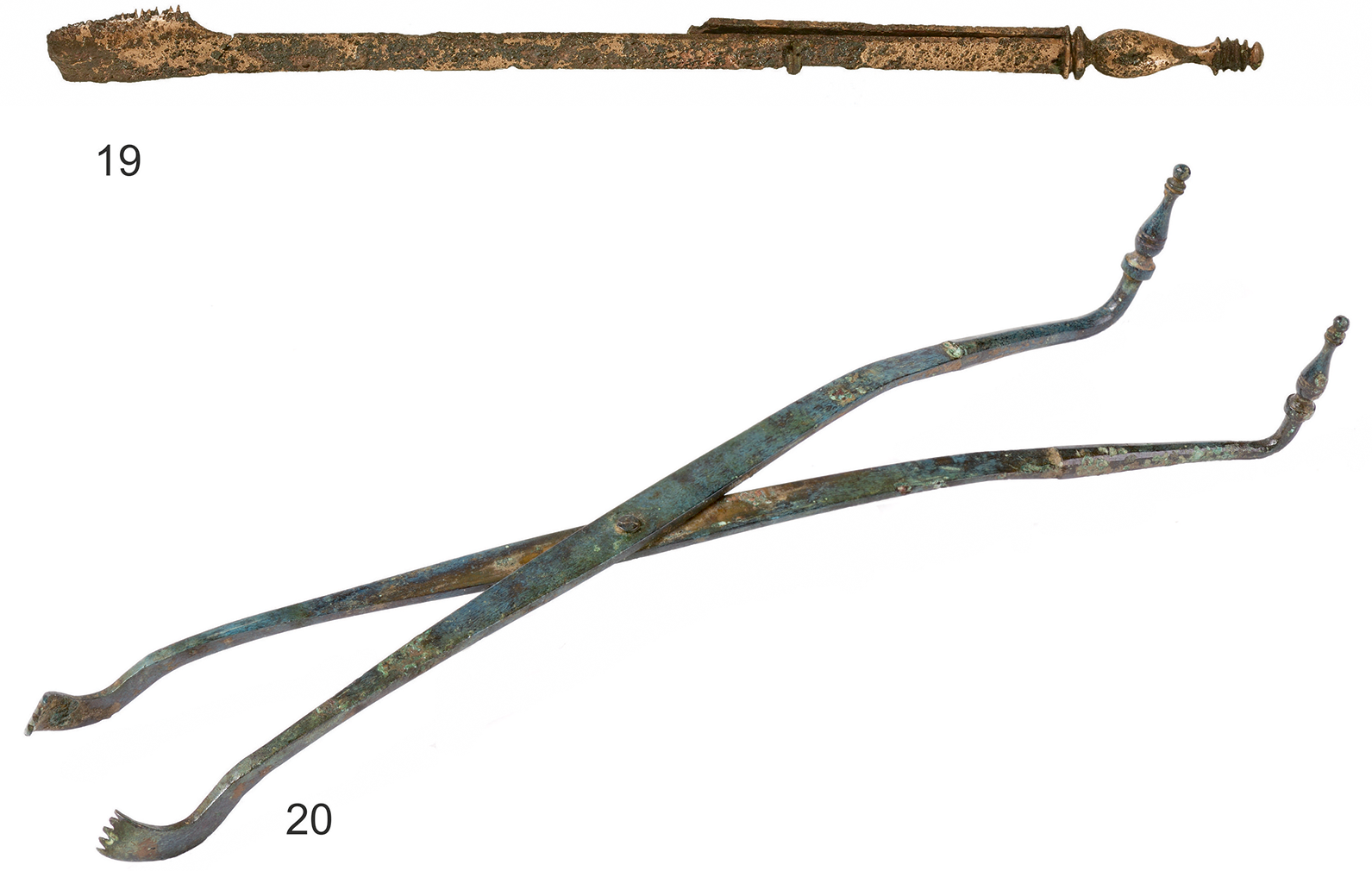
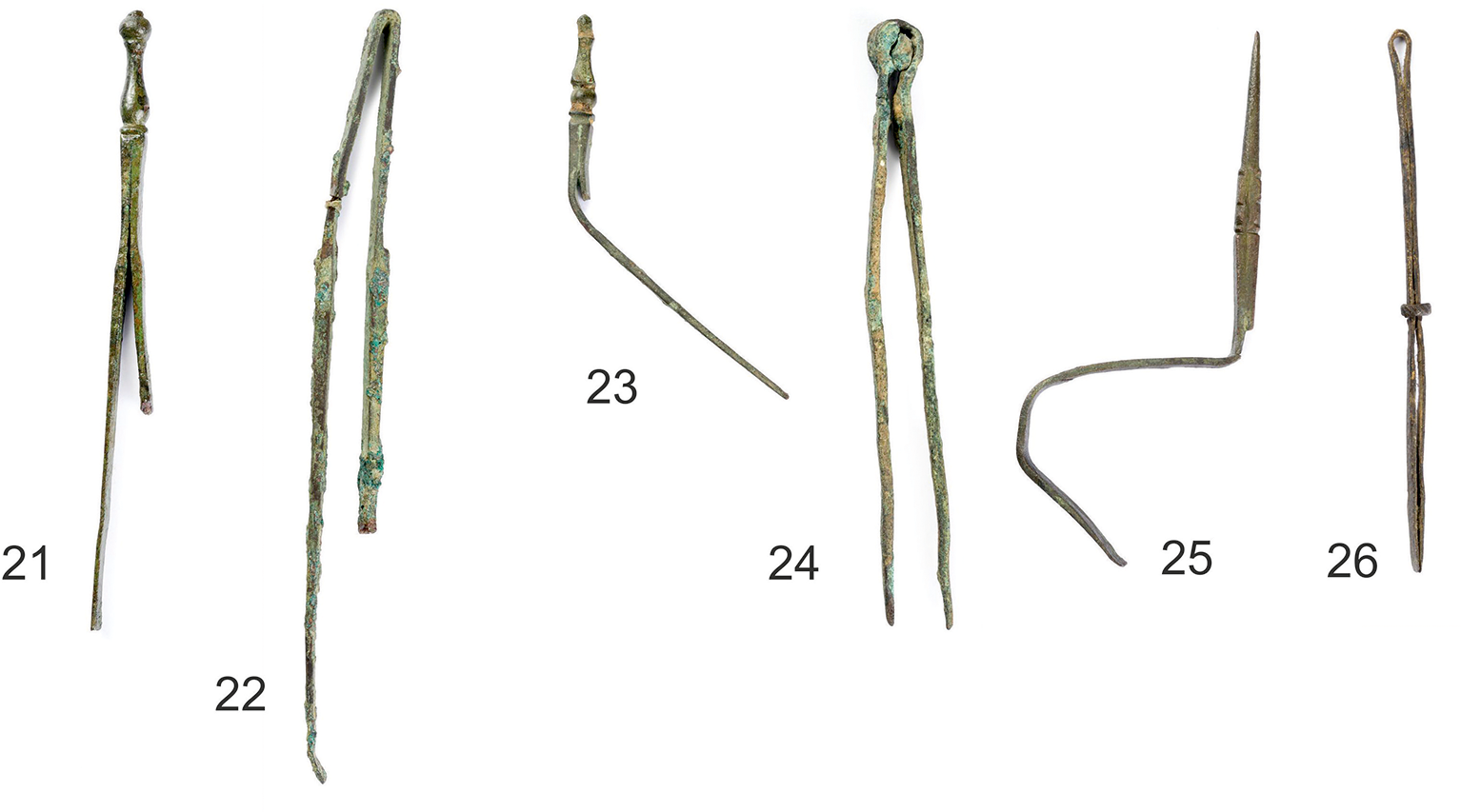
There are several types of forceps from Colchester in the Museums’ collection and one unprovenanced example; none is from a formal excavation. They are: two staphylagra variants (Fig. 3, 19–20), two, probably three, smooth-jawed spring forceps (Fig. 4, 21–23), a pointed-jawed spring forceps (Fig. 4, 24) and a possible needle forceps (Fig. 4, 25).Footnote 29 One of the staphylagra variants, which is in the British Museum’s Pollexfen Collection, is an incomplete, hollow-jawed, toothed spring forceps with the remains of a sliding lock-ring (19); it has been interpreted as a variant of the forceps used to remove the uvula, the fleshy structure hanging at the back of the throat.Footnote 30 The other staphylagra variant, a cross-legged forceps with inturned toothed jaws and angled terminals to the handles (20), may, among other things, have been used for the removal of arrowheads or other projectiles embedded in the body.Footnote 31 Both these variants may have been made locally at the request of a surgeon, but their moulded finials differ little to those on many other medical implements from across the Empire.Footnote 32
Copper-alloy staphylagra variant forceps. 19. hollow-jawed toothed spring forceps, length 198 mm, BM 1870,0402.220. (Photograph © The Trustees of the British Museum, who kindly granted permission to reproduce it here.) 20. toothed cross-legged forceps, length 219 mm. (Photograph D. Atfield, © Colchester Museums. Not to scale.).

Copper-alloy forceps. 21–23. smooth-jawed spring forceps. 24. pointed jawed spring forceps. 25. needle forceps(?). 26. forceps/tweezers with sliding lock-ring. (Photographs D. Atfield, © Colchester Museums. Scale 1:2.).

The smooth- and pointed-jawed spring forceps could have been used in a wide variety of surgical procedures, the latter (24) perhaps being chiefly used for the extraction of splinters, including those of shattered bones, and of foreign bodies lodged in the nose or ear.Footnote 33 The bent spring forceps (23) has a line of tiny punched dots on at least three, probably all four, sides of the square-section baluster-like moulding near the top of the moulded finial. This seems an unlikely position for such fine detailing, but a smooth-jawed spring forceps from Augst has delicate punched decoration in the same place.Footnote 34 They are both of Augst Variant C and may both be the product of one maker. The double-ended needle forceps is a less positive identification. One blade is missing, the other has been severely, and deliberately, bent; the needle is tapered and the square-section handle has notched reel-and-block mouldings (25).
Omitting those that are still attached to small toilet sets and those from excavations yet to be deposited, there are about 60 Roman-period tweezers in the Museums’ collection, and of these the majority will also originally have been part of a toilet set. Half are from sites excavated since 1971. The total excludes some distinctive medieval and post-medieval examples,Footnote 35 but a few of the plainer pieces from post-Roman contexts may not be residual. Generally associated with epilation, tweezers could also serve as medical forceps, with examples the most likely to have been used in surgical procedures being longer than most and/or having a lock-ring around the blades to enable the grips to serve as a clamp.Footnote 36 At least two tweezers in the collection meet these criteria (26–27). One, 96.8 mm long, has a sliding lock-ring midway down the blades, which are very thin and which taper from a narrow spring loop down to flat grips (Fig. 4, 26). Only one 93 mm long blade of the other remains; it has been bent into a curve, no lock-ring survives and the grip is damaged, but it also has a very narrow spring-loop. Less prescriptively, any tweezers of average length might have been used by a medical specialist, as appears to have been the case with a male identified as a healer, perhaps an eye doctor, buried in London’s eastern cemetery in the late third century with tweezers 58 mm long, a spoon-probe and a small black-burnished ware jar of a size suitable for salves.Footnote 37
Hooks (retractors)
Hooks, sharp and blunt, were used to hold open the edges of wounds to allow the surgeon access to the internal tissue and also to hold and move into position growths or tissue, such as tonsils, that needed to be excised.Footnote 38
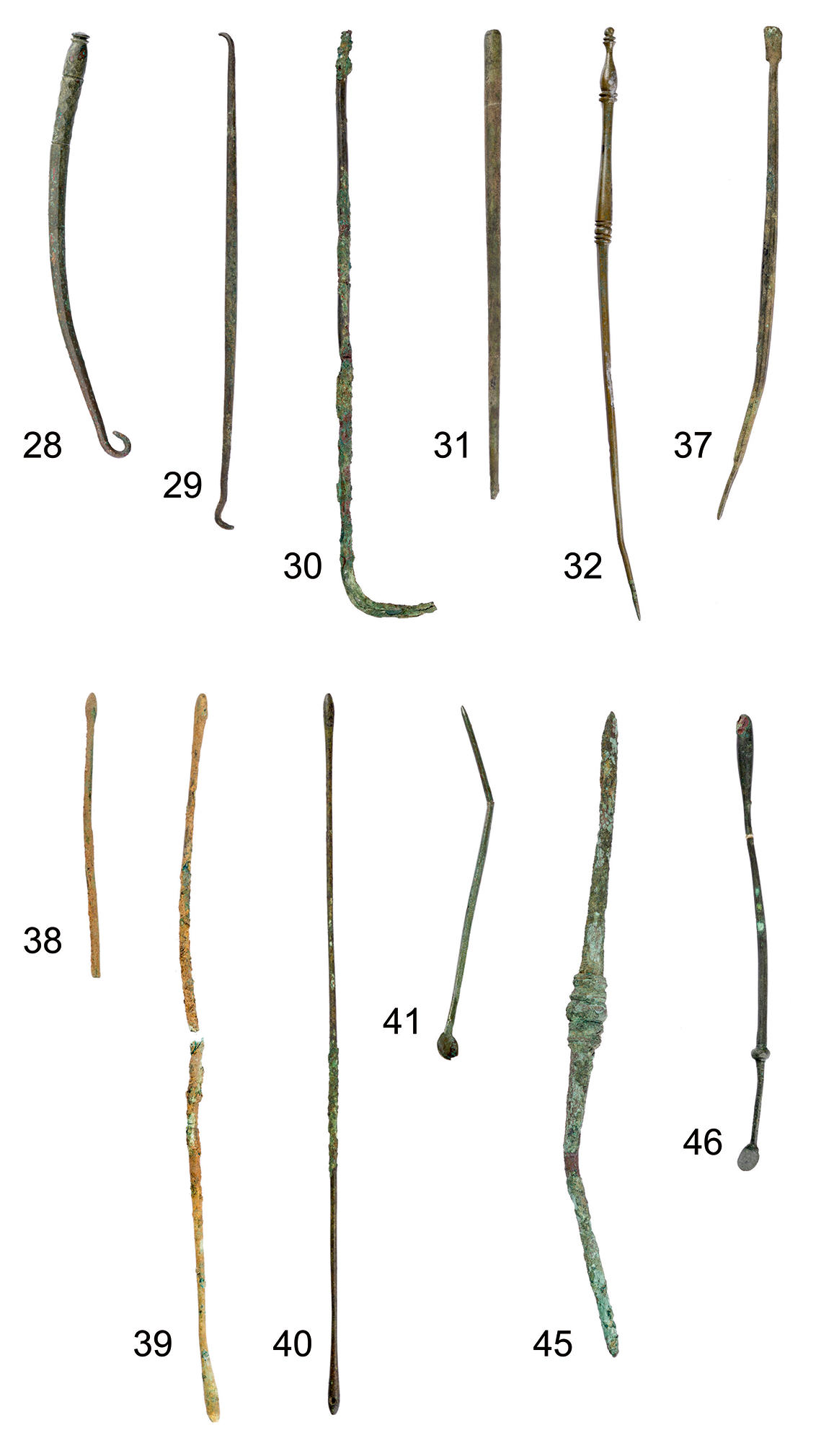
A sharp hook from St Mary’s Rectory (now part of the Mercury Theatre) just inside the town wall near the Balkerne Gate has a grip formed of delicate angular faceting on both a stout baluster at the head and a long zone running down the shaft (Fig. 5, 28).Footnote 39 Sharp hooks with similar decoration come from the South Shields fort, Tyne and Wear, an unprovenanced medical kit from Italy and the large set of equipment in the Doctor’s grave found at Bingen, Germany.Footnote 40 The use of this distinctive design may point to manufacture in a common workshop.
Various copper-alloy medical instruments. 28. sharp hook. 29. double hook(?). 31–32. surgical needles. 37. stylus or cautery/surgical needle. 38–39. dipyrenes. 40. eyed dipyrene. 41. ear-probe. 45. double- or single-ended probe(?). 46. ligula-probe. (Photographs D. Atfield, © Colchester Museums. Scale 1:2.).

One double hook (retractor) is from Colchester Museums’ Joslin collection (Fig. 5, 29). It has one sharp and one blunt terminal, features useful when stripping out varicose veins, as described by Celsus, with sharp hooks holding the sides of the incision apart while a blunt hook lifts the swollen vein so that it can be cut away.Footnote 41 The identification of a second double hook is less certain as both terminals are missing the tip, although at least one was blunt; this instrument has a faceted shaft (Fig. 5, 30).
Needles and cauteries(?)
Surgical needles might be eyed or uneyed. The latter are often referred to as cataract needles and used in a range of procedures calling for a fine sharp point or as cauteries.Footnote 42 An uneyed needle in the Museums’ collection consists of a plain tapering shaft, hollow at the top to take an inserted iron point, with the opening to the hollow being more or less triangular or shield-shaped (Fig. 5, 31). It matches Künzl’s form D3, examples of which have been found in central Italy.Footnote 43 Three others have a decorative finial similar to those on some surgical hooks and other instruments and one has a bead-and-reel grip on the shaft (Fig. 5, 32–34).Footnote 44 One long thin shaft appears to be all that remains of a double-pointed instrument, perhaps a needle or probe (35).Footnote 45 There may be at least one other needle from the town.Footnote 46
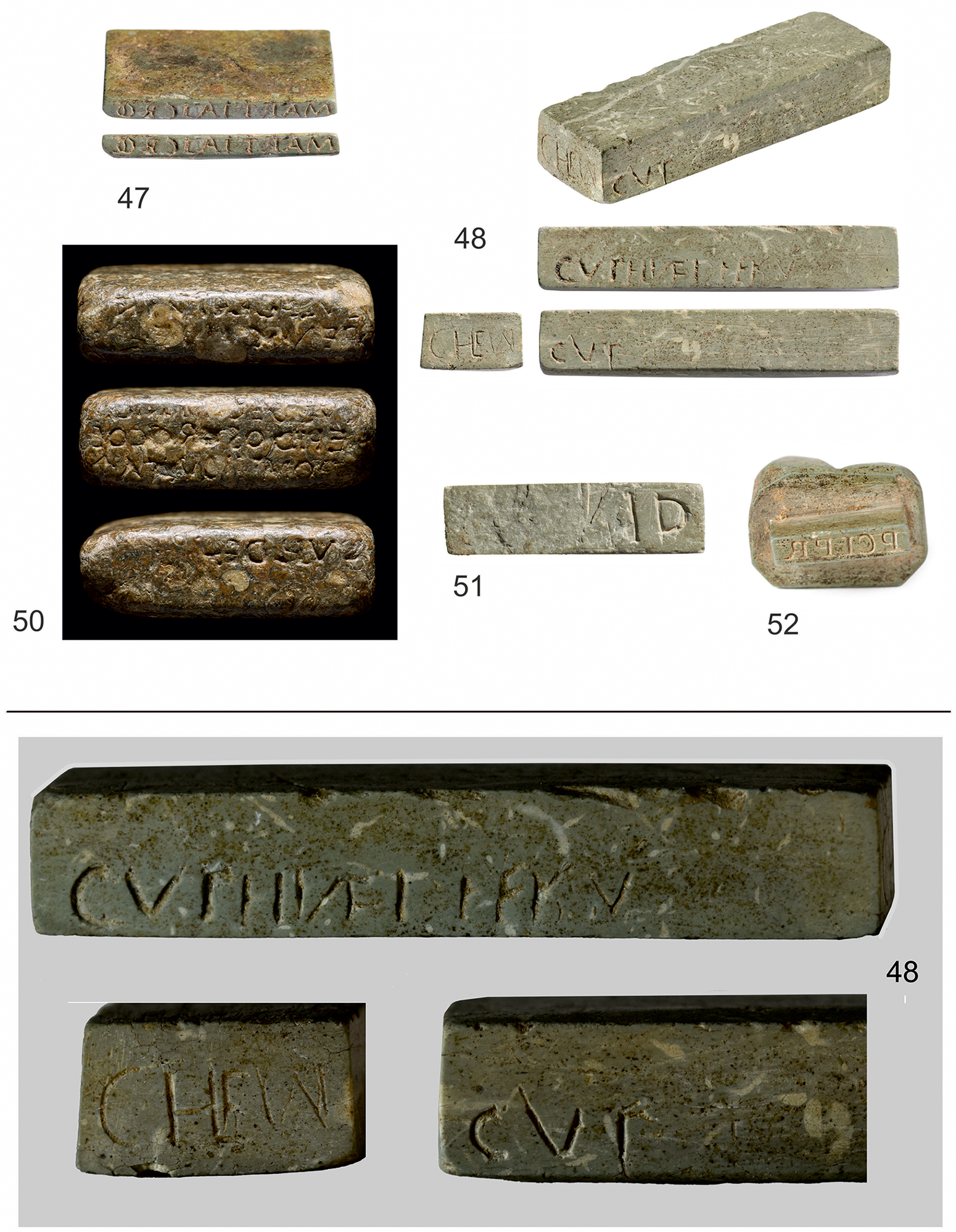
Stone collyrium stamps and possible stamps, 47–48, 50–52. (Top: photographs of 47, 48, 51 and 52 by D. Atfield, © Colchester Museums; 50, BM 1892,0801.1, © The Trustees of the British Museum, who kindly granted permission to reproduce it here. Scale 1:1. Bottom: enlarged working photographs of 48 in bluer light by E. Holloway, © Colchester Archaeological Trust. Not to scale.).

Eyed needles such as 36 are found in medical kits and may have been called upon for suturing or ligation, but they are multi-functional items widely found on occupation sites; some may have been used in hairdressing.Footnote 47 Equally ambiguous are styli, which are again sometimes found in medical kits, perhaps only included as straightforward writing implements, although Jackson has noted that the point could have been used as a probe or surgical needle and the eraser as a lever or cautery.Footnote 48 The styli used on wax tablets are usually made of iron and are not considered here,Footnote 49 but a single copper-alloy example with a faceted shaft below a small eraser and a particularly long rebated point may perhaps have had a medical use (Fig. 5, 37). It was found at 72–74 Lexden Road, one mile from the Roman town and close to both Iron Age and Roman burial areas. Also possibly a cautery is COLEM:2004.266.3, a leaf-shaped spatula missing the end of the shaft. It had been stored in the same box as scalpel/blunt dissector 17 and forceps 21, but in the absence of a secure medical parallel it has been included with the long-handled multi-functional objects discussed elsewhere.Footnote 50
Dipyrenes
Dipyrenes are double-ended olivary probes, their rounded terminals being, at only 2–3.5 mm in diameter, scarcely wider than the instrument’s flexible shaft and considerably narrower than the 4–5.5 mm seen on spoon- or spatula-probes.Footnote 51 They were used in advance of surgery to explore wounds, fractures and fistulae, or as a cautery; pierced (eyed) examples could carry a fine thread for the removal of nasal polyps.Footnote 52
Two of the three dipyrenes in the Colchester collection are from intramural excavated sites: one is from unstratified machine clearance at Culver Street and the other from an early post-Boudican feature on the Gilberd School site on North Hill, now the VIth Form College (Fig. 5, 38–39).Footnote 53 The latter (39) was not initially recognised as a single broken instrument and was published as two separate objects. The recovery of the two parts from a shallow scoop in the ground is suggestive of ritualised disposal. The third dipyrene is pierced at one end; similar examples have been found in other towns (Fig. 5, 40).Footnote 54
Ear-probes and other instruments
Most ligulae have a long shaft ending in a small round flat disc but occasionally this terminal may be dished, a slight distinction that Jackson believed transforms the frequently-found multi-functional ligula into a comparatively rare and specifically medical ear-probe.Footnote 55 There are only four such instruments in the collection (41–44), three of them from intramural excavations: one from Lion Walk (Fig. 5, 41) and two from Culver Street area G.Footnote 56 That so few have been found appears to enhance the distinction between the two scoop forms, but not all medical instrument specialists would necessarily agree with Jackson’s interpretation.Footnote 57 Differences of terminology for flat-scoop ligulae and dished-scoop ear-probes are explored across a wider sample of the literature in N. Crummy and Davis Reference Crummy and Davis2025.
To these four objects may perhaps be added a long, thickish shaft with stout, central moulded grip, tapering towards each end, at least one of which may be broken (Fig. 5, 45). The grip is similar to those on a particularly long ligula/ear-probe from the eastern Mediterranean and on a bone lever/curette from London.Footnote 58
Found at Sheepen in the 1930s, an unusual instrument may perhaps also have a medical use but it is not catalogued here as it has not been located within the Museums’ stores. Described by M.R. Hull as a ligula, the published drawing shows a flat(?) round scoop below a short round shaft, which changes to a rectangular-section handle, broken at the end.Footnote 59 On a complete example from Augst with cupped scoop the long handle terminates in a point (needle-probe?), and on another it is bent over at 90° (hook-probe?), as are the terminals on examples from the Bloomberg site in London, one of which has a flat scoop.Footnote 60 All three British objects and one of those from Augst were stratified in mid–late first-century a.d. Roman contexts. All, apart from the Sheepen fragment, have some form of incised or punched decoration on the handle. This and the scoop link them to an unprovenanced copper-alloy multi-purpose implement in the Römisch-Germanischen Zentralmuseum Mainz, described as a pharmacist’s tool.Footnote 61 It has a round, cupped ear-scoop/ear-probe, a short blade hammered from the scoop’s shaft, a long, decorated rectangular-section handle and nail-cleaner terminal.
Ligula-probe
A copper-alloy ligula-probe from an early Flavian pit on the Culver Street site has an angled disc at one end of a shaft and an olivary probe at the other; slight grooves across the shaft above the disc may be measurement guidelines of some kind (Fig. 5, 46).Footnote 62 As a possibly residual object of pre-Boudican date it may derive from either Colchester Period 1, the legionary fortress, or Period 2, the veterans’ colony. It is considered here to be a medical instrument as such a combination is not frequently found, and, on the basis of its superior workmanship, George Boon came to the same conclusion regarding a ligula-probe from Silchester with a shaft inlaid with silver wire.Footnote 63 An equally superior example from London has a very long and elaborately moulded grip.Footnote 64 Two ligula-probes from Augst are much longer and plainer than both of those from Roman Britain and have been defined as medical ear probes, as has one from Cologne that has the ligula rising from a calyx-like feature above bead-and-reel mouldings, a design that defines Variant C spoon-probes from Augst.Footnote 65 Given the rarity of the form, and the marked distinctions between them and the continental examples, the British ligula-probes may be special commissions.Footnote 66
Collyrium stamps
There are at least four stone stamps for impressing eye salves (collyria) from Colchester, and possibly two more (Fig. 6). Two are from excavated sites in the western suburb outside the Balkerne Gate (47–48), and the third was found somewhere in the town before 1719 and is now lost, although its inscription was recorded (49). A fourth, acquired by the British Museum before 1892, is only probably from Colchester (50). Two other stamps were less certainly used for salves; one is a fragment from the intramural Lion Walk site (51), and the other, from the southern cemetery site at Butt Road, is perhaps a die rather than a stamp (52).Footnote 67 Three (47, 51–52) are made of green steatite, as may be 48, which shows no sign of use and appears to have been trimmed and re-inscribed. The British Museum stamp is probably made from Purbeck marble and, as pieces of architectural cladding made from this stone are very frequently found in Colchester, could represent a local adaptation of a fragment of veneer (50). The stone from which the lost 49 was made is not known.
The names, salves and eye conditions appearing on the stamps are:
47. a) Martialis, saffron salve, and b) Marini (47).Footnote 68
48. a) and b) Cal/–, perhaps Callistus or Callistianus (see Tomlin, dies i and ii below), salve unidentified, and c) for keratitis (see Tomlin, die iii).Footnote 69
49. Quintus Iulius Murranus, a) quince oil (or quince-coloured salve) for clear eyes, and b) balsam drops for blurred vision.Footnote 70
50. Lucius Ulpius Deciminus, a) mild ointment for inflammation of the eye (or salve to be applied with a fine brush for inflammation of the eye), and b) saffron salve (made with) copper oxide for all defects (of the eyes).Footnote 71
The other possible collyrium stamps are:
51. Although reading only –/ID, this fragment is made from green slate and is very possibly from a collyrium stamp. The surviving letters may come from (dia)lepidos, salve made from copper oxide.Footnote 72
52. A stamp or die reading PCLPR, ?P(ublius) Cl(audius/Clodius/Clodianus) Pr(imus). It has an unusual two-lobed handle with the stamp P on one lobe. There is no salve or other descriptive element in this text, but a collyrium stamp bearing the name Publius Clodius or Clodianus is in the British Museum.Footnote 73
Collyrium stamp 48
By R.S.O. Tomlin
The narrow rectangular oculist’s collyrium stamp from the St Mary’s Hospital site (2001.64, SF 455, D1114 L70) was considered by Ralph Jackson to have been produced by cutting down a square stamp, with striations on each face suggesting that all the original dies were erased and some then re-inscribed.Footnote 74 The stone is fine-grained and greyish-green in colour. One long side (considered by Jackson to be an original) has slight angle-bevelling. Measuring 46.7 by 15.3 mm, 8.6 mm thick, the stamp is inscribed on three of its four sides in capital letters retrograde (Fig. 7).
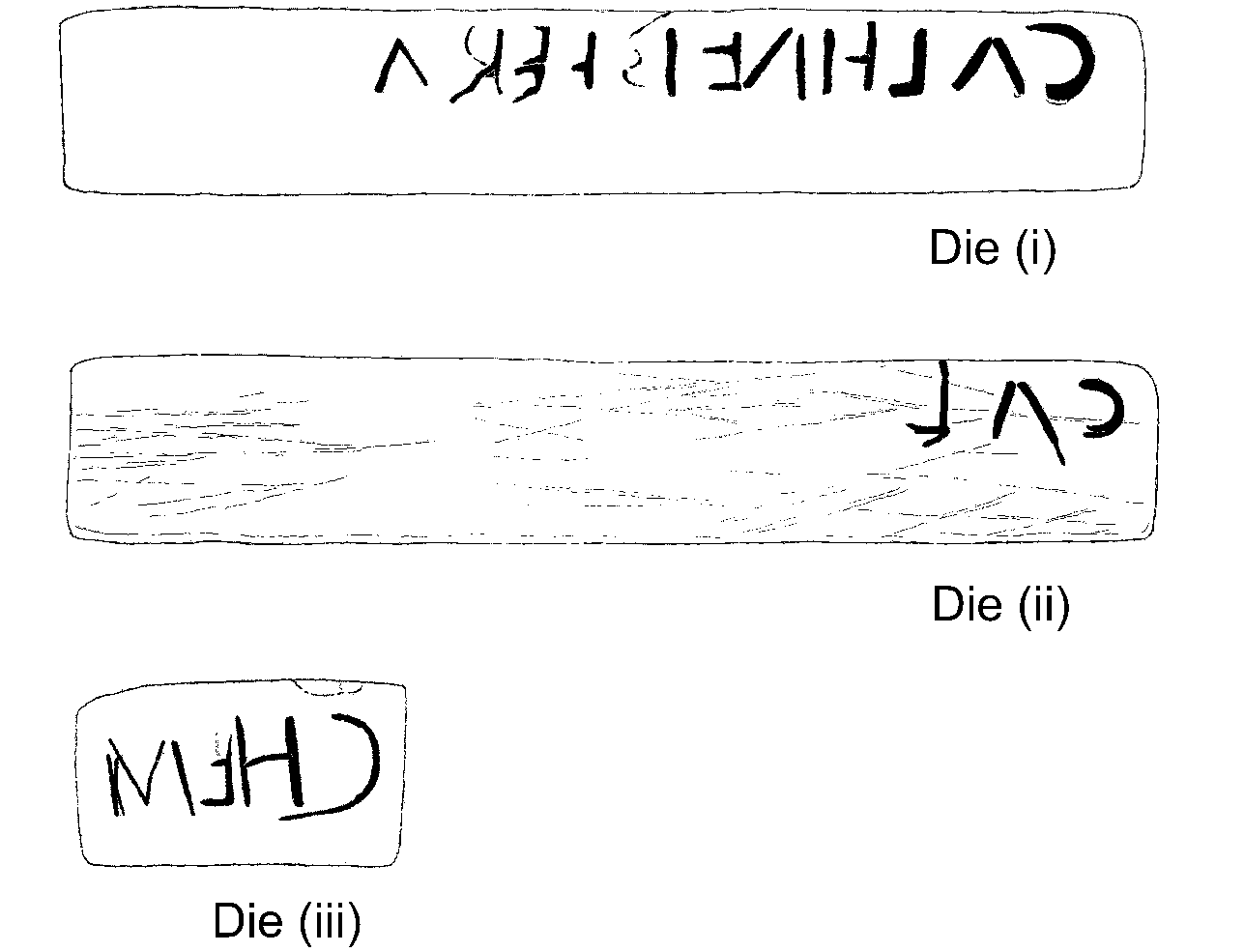
The inscriptions on collyrium stamp 48. (Drawn by R.S.O. Tomlin. Scale 2:1.).

The letters are certainly retrograde; not only because they are retrograde on other oculists’ stamps so as to impress them on a block of collyrium, but because some letters can only be read in reverse, not inverted. For example, N and R in die (i), L (not ‘T’) in (i) and (ii) and M (not ‘W’, which is not a Roman letter) in (iii), with E and C then necessarily reversed.
Most oculists’ stamps have a two-line inscription along at least one of the long sides, the name of the practitioner followed by a note of the remedy and the eye-condition for which it was prescribed. In this stamp, however, the two long-side inscriptions, dies (i) and (ii), occupy less than one line; and die (ii) is obviously an incomplete version of (i). But if they are taken with die (iii), which is a note of the eye-condition, a likely explanation is that they identify only the practitioner and the remedy, both in abbreviated form (see further below).
Die (i)
CɅLḤ͡NEBḤ͡ERɅ
Ʌ A is ‘open’ without cross-bar, an alternative form often found, recalling the cursive form made with just two diagonals.
H H is uncertain, but an H which was never completed seems the best explanation of these two vertical strokes, the first of which has a very short mid-height horizontal stroke which does not meet the second.
͡NE N is ligatured to E; that is, they share a vertical stroke. E is incomplete: there is no trace of the top horizontal stroke, but it can hardly be an inverted F; and the second E has only a vestigial stroke here, as if it had been scratched in outline but was never incised.
B Only the vertical stroke is certain, but there is trace of the double loop of B. This much resembles the trace of the single loop of R, which is a little more defined. The likely explanation is that both letters were lightly scratched onto the stone as a guide to the die-cutter — like the other letters, presumably — but he failed to incise them completely.
H H again is uncertain, but like the first H is apparently two vertical strokes, the first of which has a very short mid-height horizontal stroke which does not meet the second. It must further be assumed that it was ligatured to the next letter, E.
E E is also incomplete, but there is a vestigial top horizontal stroke, and the likely explanation is that the letter was first scratched in outline but, like B and R, was not completed.
R The vertical stroke and diagonal ‘tail’ of R are certain, and there is sufficient trace of its loop. Evidently it was scratched in but not then completed.
Ʌ The final letter is ‘open’ A again. There is no trace of any further letters, even though collyrium stamps regularly have a two-line inscription which fills the whole of one long side. This might mean that the stamp was never completed, but is better seen as evidence of extreme abbreviation.
Die (ii)
CɅL
Only three letters, in the same place (top-right corner, retrograde) of the other long side as the first letters of die (i), of which they are an obvious copy. Perhaps an unfinished attempt at the same inscription, but better seen as the abbreviated name of the practitioner, taken separately.
Die (iii)
CHEM
Four letters on one short side. C and H are certain; E is incomplete; M is made with its fourth stroke repeated. This is not a Latin sequence of letters, but can be seen as a Greek word transliterated and abbreviated to fit the space available. It is the eye-condition for which the collyrium was intended:
(ad) chem(osim), ‘for chemosis’ (keratitis, inflammation of the cornea).
This is the Greek word χημωϲιϲ, found in Greek medical writers and translated by Liddell and Scott as ‘an affection of the eyes, when the cornea swells like a cockle-shell (χημη) so as to impede sight’. In modern terms this is ‘keratitis’ or a corneal ulcer. It is only the second occurrence of the word in Latin, the first being an oculist’s stamp found fifty years ago in Coca, central Spain, which reads: Corneli Alcimi turi|num at(=ad) chemosim | et at(=ad) suppurationes | Corneli Al[ci]mi ica|rium at(=ad) clarita|tem et at(=ad) suffus(iones).Footnote 75 This names Cornelius Alcimus and his two remedies, turinum [salve of frankincense] for chemosis and ‘suppurations’ (pus), and icarium for clear vision and cataracts.
This explanation of die (iii) suggests that the unusually brief inscription in die (i) names only the practitioner and his remedy (or remedies), and not the eye-condition as well. Die (ii), since it repeats CAL as if a word on its own, would then be the practitioner’s name abbreviated, for example Callistus. This is quite a common name of Greek derivation, and is attested as that of the oculist Gaius Iulius Callistus.Footnote 76 Another stamp names the oculist L(ucius) A(…) Callistianus.Footnote 77 Either might be the man named here, but it is rare to find the same oculist on more than one stamp.
If CAL is taken to be the abbreviated name of the oculist, H (if that is indeed the reading) would then introduce his remedy (or remedies). The impossible sequence HN– and the repetition of H suggests it is a word abbreviated to its first letter, and an attractive possibility is hygra, which the medical writer Scribonius Largus defines as a liquid salve used for treating cataracts of the eye, ad suffusiones oculorum, quos Graeci hypochymata dicunt, medicamentum liquidum.Footnote 78 His wording is repeated by Marcellus Empiricus in his chapter of remedies for eye-conditions,Footnote 79 a chapter in which hygra occurs six times with the meaning of ‘eye salve’ or collyrium. This repeated H would then introduce two remedies, abbreviated to NEB and ERA, but they remain as opaque as any darkness of vision (caligo). The many eye-salve recipes listed by Marcellus Empiricus do not include any substance which might be abbreviated to NEB or ERA, nor is there a suitable candidate among the remedies attested on other collyrium stamps.
Analysis of copper-alloy medical instruments from Colchester
By Owen Humphreys, Peter Bray, Kathryn Murphy and Keith Nyakubaya
While the form and function of medical instruments have naturally been the focus of most research, there is growing interest in chemical analysis as a window into their creation. Chemical composition can reveal the connections, knowledge and intentions of their makers and owners. For medical instruments, a large dataset should ultimately allow us to explore how objects ranging from the rare to the ubiquitous were made and distributed within a complex economy and society.
The principal work remains Riederer’s analysis of 225 instruments in the Römisch-Germanisches Zentralmuseum, Mainz, encompassing objects from Europe and the eastern Mediterranean.Footnote 80 La Niece and Hook have recently collected together information from other studies, focusing on a set of associated instruments from Italy in the British Museum.Footnote 81 In Britain, this work remains in its infancy, with little beyond the 17 objects studied by Dungworth.Footnote 82 However, ongoing work by the Roman and Early Medieval Alloys Defined (REMADE) project of the University of Reading has recently examined over 150 medical and long-handled toilet instruments from sites across the UK, including 26 objects from Colchester.
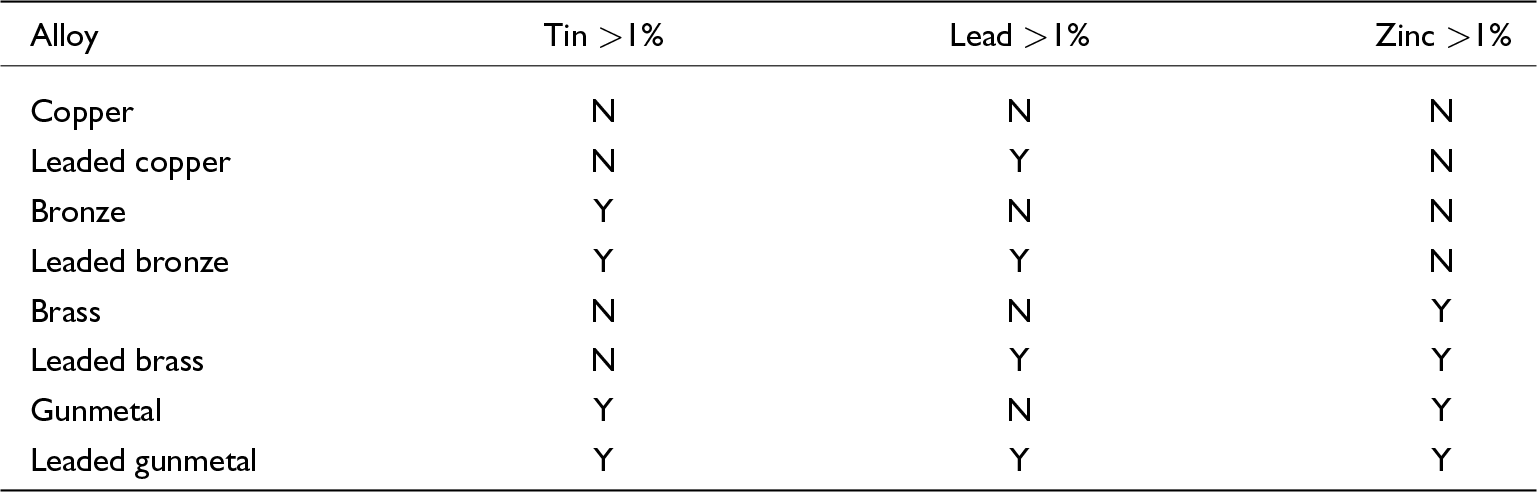
The objects discussed here were analysed with portable X-Ray Fluorescence (pXRF), which gives a quantitative result. Readings were taken of the unabraded surface for 60 seconds using a Niton XL5+ Portable X-Ray Fluorescence Spectrometer. While Riederer employs a complex system of alloy groupings, we consider that a simplified approach (Table 1) is better for facilitating inter-site and diachronic comparison and understanding the metalworking process.Footnote 83
Breakdown of the terminology used for copper alloys. N = not present; Y = present.

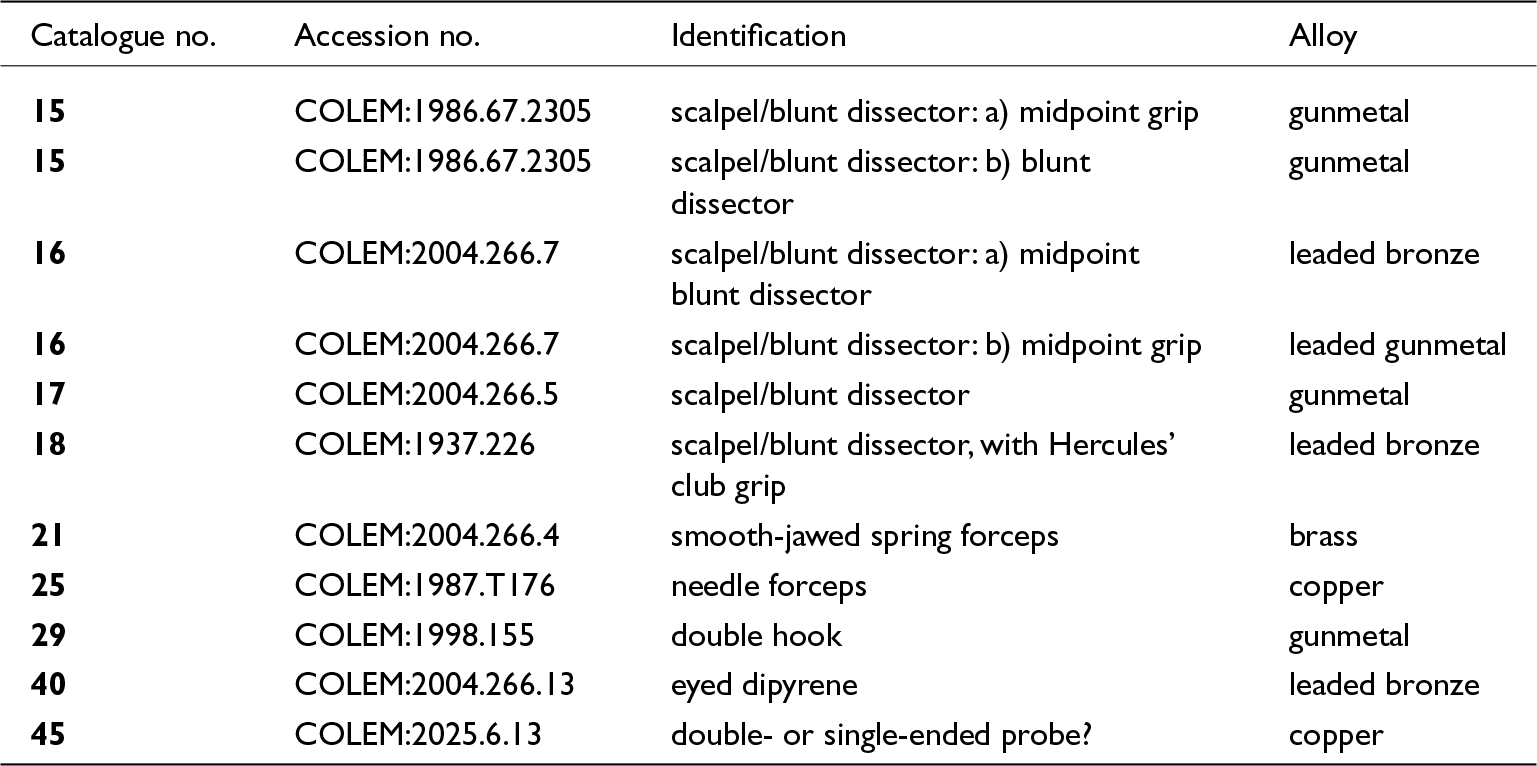
Exploring the data in these terms highlights substantial differences in both major and trace elements between the British finds and those discussed by Riederer,Footnote 84 challenging the notion of centralised production. While he interpreted the range of alloys as representing different price points amongst a contemporary group, the British finds show changes over time. His distinctions between objects of different types can also be expanded to show more specific relationships with object form and technology. Although a small group, the Colchester finds make a significant contribution to this evolving understanding. Nine specialist medical tools are discussed here (Table 2a; see online supplementary material, Appendix 1, for Table 2b, which gives the full detail of the analyses), while 17 long-handled multi-functional instruments, such as ligulae, spoon- and spatula-probes that were more probably used as cosmetic implements, are discussed elsewhere.Footnote 85
Composition of the copper-alloy medical instruments from Colchester.

Both Riederer and La Niece and Hook found that scalpels were highly varied in composition,Footnote 86 and this is borne out in the four analysed handles from Colchester. Two examples with narrow polygonal handles (Fig. 2, 15, COLEM:1986.67.2305; 17, COLEM:2004.266.5) are both unleaded gunmetals, similar to the metal used for long-handled multi-functional instruments.Footnote 87 The other two (Fig. 2, 18, COLEM:1937.226, 16, COLEM:2004.266.7) were leaded, low-zinc gunmetals and bronzes. This broadly corresponds with a distinction seen in an Italian doctor’s set, where (using the alloy groupings in Table 1) the three narrow-handled scalpels of Jackson’s Type II (3.7-9) were unleaded gunmetals and those of Jackson’s Type I (3.1-5) were bronze, leaded bronze and gunmetal.Footnote 88 Another Type II scalpel handle from Egypt also follows this pattern.Footnote 89 This may represent a distinction of manufacturing technique, with the narrower (Type II) examples being wrought while the broader (Type I) were cast.Footnote 90
For the other medical tools, previous work again presents a picture of chemical diversity that is maintained and expanded by the Colchester objects. Eyed dipyrene COLEM:2004.266.13 (Fig. 5, 40) is a leaded bronze, contrasting with examples from London Bloomberg and Italy, both of which are unleaded gunmetals.Footnote 91 Double hook COLEM:1998.155 (Fig. 5, 29) is a high-zinc unleaded gunmetal, contrasting with the hooks from the British Museum’s Italian set, which are a mix of leaded and unleaded bronzes and (dilute) gunmetals.Footnote 92 The smooth-jawed spring forceps COLEM:2004.266.4 (Fig. 4, 21) are a clean medium-zinc brass, while those from the Italian set were leaded bronze.Footnote 93 Needle forceps COLEM: 1987.T176 (Fig. 4, 25) and probe(?) COLEM:2025.6.13 (Fig. 5, 45) are unalloyed copper; a rare material for the manufacture of Roman small finds, but also paralleled in two ligulae from London, and eight more examined by Riederer.Footnote 94
La Niece and Hook relate the different manufacturing methods seen in these instruments to their being produced in small quantities, perhaps to order for individual doctors, by smiths who made a wide range of items.Footnote 95 This may also explain their diverse chemistries, although with such small numbers analysed so far there remains ample room for further work to resolve these differences into regional, chronological or typological patterns, as seems possible for scalpels.
Discussion
Distribution
The 52 instruments catalogued here must be only a tiny proportion of those in use over some 350–400 years of medical care in Colchester. A practitioner’s portable kit might consist of about 10 to 20 items, but around 150 metal instruments, as well as ceramic vessels and stone mortars and pestles, came from the surgeon’s house at Rimini, Italy, where the fire that destroyed the building may have completely consumed any other equipment made from wood, bone or other organic materials.Footnote 96 Some of the Rimini metal items were found in clusters pertinent to specific circumstances, such as surgery or dentistry, apparently having been stored, ready to hand, in wooden boxes or rolls of cloth, providing a context in which to set portable kits found elsewhere.Footnote 97 The low number of instruments from Colchester is emphasised by the Rimini find, but it is also matched on other Romano-British sites, while the town’s acidic soils may account for the absence of wholly ferrous instruments, such as levers, drill bits, fine saws, bone chisels, gouges and dental forceps.Footnote 98
Of Colchester’s 52 items, only forceps/tweezers 27 is from a probable pre-Boudican (a.d. 60–61) context, although some objects stratified in later contexts may be residual. This dating highlights the Late Iron Age origin of the Stanway Doctor’s grave kit, with its mix of imported and British-made instruments.Footnote 99
The locations for the well-provenanced instruments described above are:
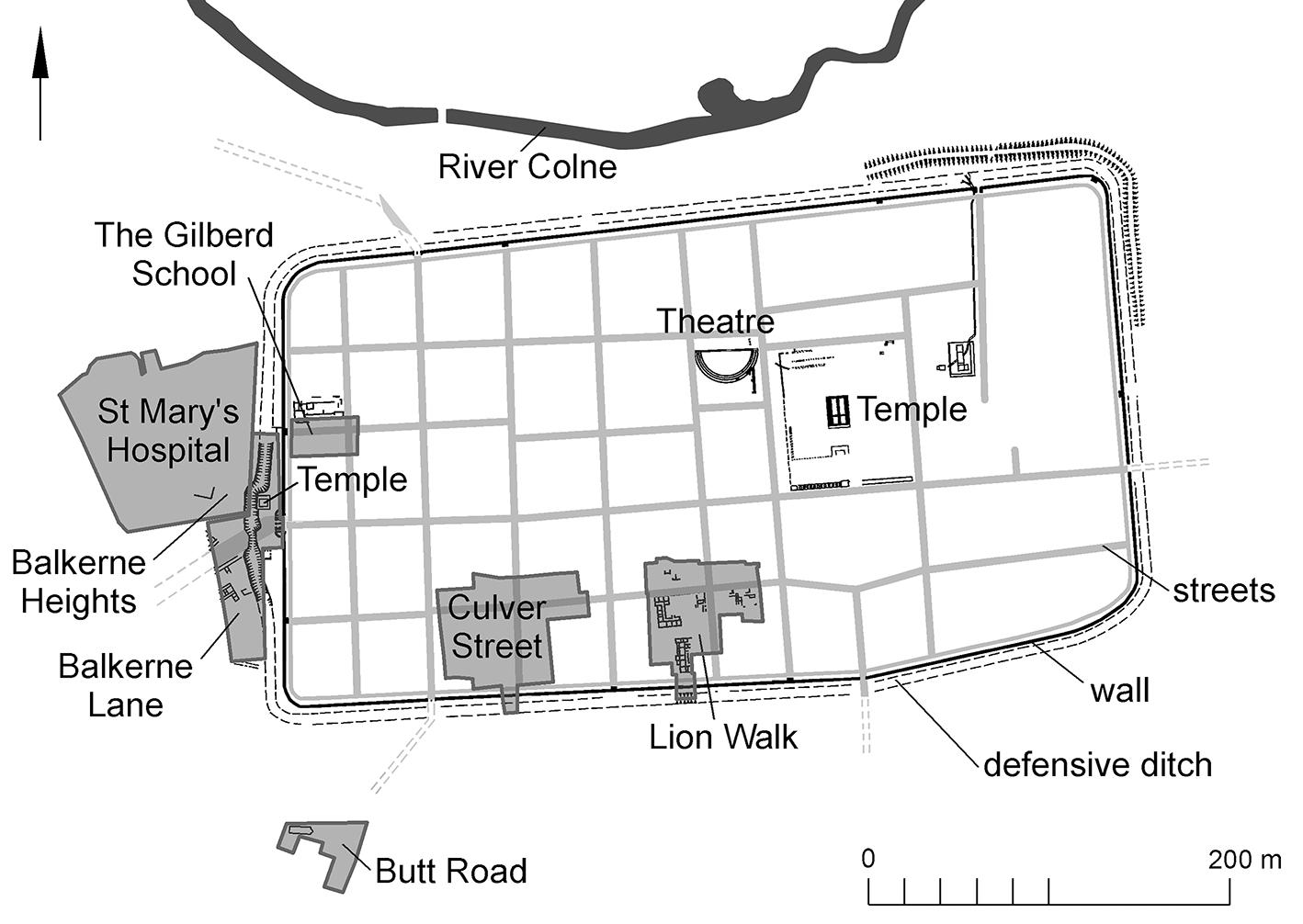
intramural: Lion Walk, ear-probe 41, possible collyrium stamp 51; Gilberd School, dipyrene 39; Culver Street, dipyrene 38, two ear-probes 42–43, ligula-probe 46; St Mary’s Rectory, sharp hook 28; Castle Park, two surgical needles or hooks 32–33.
extramural: Balkerne Lane, scalpel/blunt dissector 15, collyrium stamp 47; St Mary’s Hospital, collyrium stamp 48; Butt Road, die or stamp 52; Colchester Royal Grammar School, Lexden Road, smooth-jawed spring forceps 22; 72–74 Lexden Road, stylus or cautery/needle 37; St Helena’s School, Sheepen Road, scalpel/blunt dissector 18; Sheepen 1970 excavation, forceps/tweezers 27.Footnote 100
Most doctor’s premises have been identified because the instruments have been preserved in situ as a result of catastrophic destruction,Footnote 101 but in Silchester Insula IX a scatter of items in and around the late first- to early second-century Early Roman Timber Building 3 was considered sufficient to identify it as a centre for medical care, including surgery, while the immediately adjacent Early Roman Timber Building 2 may have been the practitioner’s dwelling.Footnote 102 Close examination of the objects around these buildings was triggered by the recovery of a scalpel/blunt dissector and part of a male catheter. The wide scatter of Colchester items listed above does not permit any physicians’ or pharmacists’ premises to be fixed upon with certainty, but the four items from Culver Street, three coming from adjacent areas G and K, and the two from the western suburb just outside the Balkerne Gate (Balkerne Lane, St Mary’s Hospital), may hint at one in those areas (Fig. 8). Spoon-probes, probe fragments, a bone ligula, five tweezers, three glass stirring rod fragments and part of a stone grinding palette could be added to the three items from Culver Street areas G and K, enhancing the possibility of a medical practitioner (oculist?, pharmacist?) working there. Such items are, however, all multi-functional, being associated with the toilette in particular.Footnote 103 As a range of dress accessories contemporary with the early–mid Roman date of the contexts from which the Culver Street implements derive came from the same area, a domestic rather than medical milieu seems the most appropriate source. An alternative might be that many of these objects, both toilet instruments and dress accessories, represent the equipment of a professional beautician.Footnote 104
Roman Colchester, showing the sites mentioned in the text. (Drawn by E. Holloway, © Colchester Archaeological Trust.).

The multi-functional instruments: an overview
Copper-alloy ligulae and spoon-probes present a different picture to that of the unambiguously medical instruments, with 68 of the former and 84 of the latter listed so far in the collection, including those from the St Mary’s Hospital site, which are yet to be deposited in the Museum.Footnote 105 Spatula-probes are less frequent, with only eight certain examples and up to seven others. In addition there are 30 probe fragments, all or most of which will originally have been part of spoon- or spatula-probes. Each of these figures is a minimum, as the small finds from the 1930s and 1970 Sheepen excavations were only selectively published and most of those left unreported have not been examined as part of the current project.Footnote 106 There are no criteria to enable the division of the multi-functional instruments into those used by health-care specialists or other professions, but, as such items appear in medical kits (including that from Stanway; see Fig. 1), at least some of those from Colchester would have been used in the diagnosis or treatment of the sick.
Stone grinding palettes, pestles, mortars and weighing scales are also among the objects defined by Künzl as multi-functional, and examples of all four have been found on sites excavated since 1971.Footnote 107 Eight of the ten palettes are from intramural sites (five of them from Culver Street), one from the western suburb and one from grave fill in the Abbeyfield cemetery south of the town.Footnote 108 Only the latter is complete but most bear the characteristic hollows worn by grinding. Several types of stone were used, ranging from onyx to mudstone and siltstone. To these might be added dark-coloured glass palettes or stands with knob feet. Fragments of at least three came from Sheepen in the 1930s and there are four from more recent intramural excavations.Footnote 109 Most are from pre-Boudican or immediately post-Boudican contexts and some are heat-affected.Footnote 110 Four stone pestles and ten stone mortars have been found, more or less evenly divided between intra- and extramural sites. Again they were made from a variety of stones.Footnote 111 Two fragments of copper-alloy scale pans and part of an equipoise balance are all from intramural sites. Most of these objects are from post-Boudican contexts, but a few are from Boudican destruction debris and would have been used by the inhabitants of the veterans’ colony. There is no substantive indication here that any were used by a pharmacist rather than any other professional or household worker, but note the two balances, ten mortars and associated pestles from the Rimini surgeon’s house, and the prominence of scales and grinding equipment for the production of salves and other medicaments in the doctor’s dispensary illustrated in Roger de Parma’s late twelfth-century Practica Chirurgiae.Footnote 112
Based on a variety of artefacts, Colchester’s Temple 10, which lay in the western suburb just outside the Balkerne Gate, has been suggested as a focus for votive deposition and healing, and a considerable proportion of the ligulae, spoon- and spatula-probes mentioned above came from archaeological excavations and casual finds in that area, which was, however, also used for dumping the town’s waste (Fig. 8).Footnote 113 In this it is a near-equivalent of London’s Walbrook stream, which has been summarised as a focus for both votive deposition and rubbish disposal.Footnote 114 The same ambiguity pertains for the medical instruments from the extra-mural rubbish dump (Schutthügel) outside the fortress at Vindonissa, Switzerland.Footnote 115 A scalpel and two of the collyrium stamps were found in the same area (15, 47, 48), and the presence of the stamps in particular, along with the association with eye-care of the long-handled metal implements, may indicate that an oculist treated patients in or near the temple.Footnote 116 It may similarly be no coincidence that two incomplete surgical needles or hooks (33–34) came from the Castle Park on the eastern side of the town, not far from the Temple of Claudius.
Diseases
The human remains from Colchester rarely give any clue as to the cause of death. The population buried in the successive mid–late Roman Butt Road cemetery ranged from still- or newborn infants to elderly adults and we can only speculate about the reasons for the demise of those whose graves have been excavated, perhaps the most intriguing of which are what appear to be young siblings or other familial pairings interred at the same time, or with little time between them, in double burials.Footnote 117 It seems worth, then, summarising the pathologies that were noted on the human skeletal material at both Butt Road and the nearby Balkerne Heights site and here these are listed in the online supplementary material, Appendix 2.Footnote 118 They fall into the following categories: congenital pathologies, trauma, infection, miscellaneous conditions and neoplastic, autoimmune, metabolic and dental diseases. Some individuals had more than one pathology, but only at Butt Road was one case of periostitis involving the whole skeleton believed to have led to the death of the sufferer, a young adult male.Footnote 119 Apart from possible cases of tuberculosis, not visible here are any of the potentially fatal diseases whose effects are minimised today by preventive measures in childhood, nor any soft-tissue diseases, such as those of the eyes attested by collyrium stamps.
This list can be compared to that for Lankhills, Winchester, 2000–2005, where tuberculosis is only one possible cause of the lesions seen on two infant skulls and the ribs of two adults (supplementary material, Appendix 2).Footnote 120 On balance the two, chiefly contemporary, populations are similar, with the rather fuller list for Lankhills perhaps owing much to the circumstances in which the Butt Road report was produced.Footnote 121 There were amputations, a decapitation and a greater range and incidence of fractures at Lankhills,Footnote 122 but at Butt Road and Balkerne Heights no injuries from a sharp blade that might imply cause of death were recorded. Few of the pathologies at Colchester might have called for the use of surgeon’s tools, and even ante-mortem tooth losses may not have required the use of dental forceps, but where a condition caused pain the skills of a pharmacist may have relieved suffering. Neither population appeared to have suffered a high disease load,Footnote 123 but absent from the data is the incidence of mortality in infancy and, for women, in childbirth. These may perhaps be supplied by studying the age at death. Lankhills shows the peak in infant deaths expected in a pre-modern society but Butt Road was hampered by poor bone preservation.Footnote 124 For women, there was a higher incidence of death among young adult females than males at Butt Road, but at Lankhills only among prime (26–35 years) adult females did deaths exceed those of males.Footnote 125 In neither assemblage were the figures sufficiently robust to allow further conclusions to be drawn.
Herbal medicines and other treatments
As well as a surgical kit, the Stanway Doctor’s grave contained a copper-alloy strainer bowl with a plug of organic debris preserved within its spout. Analysis of the pollens within a portion of this plug showed them to consist chiefly of artemisia, along with some from plants particularly attractive to bees, a result unattributable to the natural pollen rain. Although the artemisia could not be identified to species, both Artemisia vulgaris (mugwort) and Artemisia absinthum (wormwood) can be used in herbal medicine to treat a range of symptoms, their bitterness in the Stanway infusion being offset by the addition of honey, as represented by the other pollens. Given the context and the absence from the plug of any evidence of grape or cereal pollen from wine, ale or beer, the last use of the bowl appears to have been for a medicinal drink.Footnote 126
Both species of artemisia still grow locally today, as well as all the bee-attractive plants represented in the Stanway pollen, and we can assume that the local Romano-British flora would have yielded the ingredients for a range of herbal medicines, with anything lacking being imported.Footnote 127 Pyxides among the medical finds from a shipwreck off the west coast of Italy contained tablets, salves and powders, in some of which were exotic ingredients such as cinnamon, vanilla and cumin, while most of the species identified among the charred plant material from the valetudinarium at Neuss would not be out of place growing wild in the environs of Roman Colchester or cultivated in a pharmacist’s herb garden.Footnote 128 Nevertheless, other than at Stanway, wholly secure archaeological evidence for instances of the medicinal use of wild or cultivated plants is absent not only from Colchester but from across Roman Britain.Footnote 129
As well as the evidence for eye salves provided by collyrium stamps, notes and recipes for medications favoured by some of the Empire’s professional doctors have been preserved, and several books of Pliny the Elder’s Historia Naturalis include folk (or quack) remedies derived from plants, animals, metals, stones and mineral-enriched or thermal waters.Footnote 130 Drinking and bathing in the waters of springs credited with healing properties was practised, although there is no evidence that this was the case at Colchester, where the water is neither mineral-rich nor thermal.Footnote 131 Exercise and massage would have been available at the public baths, where bathing was seen not only as a way of cleansing the body but also curing muscle, tendon or ligament strains, driving off fevers, aiding recovery during convalescence and preventing illness in general.Footnote 132 Colchester’s public baths have yet to be located, but they probably lay close to the spring line, which is on or near the 50-foot contour.Footnote 133 In 1808 workmen excavating a reservoir for the new waterworks at the bottom of Balkerne Hill ‘fell in with the remains of some spacious Roman baths, and earthen pipes of a peculiar construction, for the letting in and out of the waters, with a quantity of Roman pottery’.Footnote 134 The interpretation of this discovery as an extramural bath-house, public or private, has not been confirmed. A late Victorian pumping station now occupies the site and an alternative, made all the more attractive for being a case of site continuity, is that here was a Roman ‘pumping station’. At the top of the hill wooden water-mains running into the town through the Balkerne Gate point to the supply being raised by a pressurised system, the works for which may be represented by the 1808 discovery.Footnote 135 It may be no coincidence that more bath flasks came from the Balkerne Lane site at the top of the hill than from any other 1971–85 excavation.Footnote 136 Although the use of the area for dumping refuse hinders clear interpretation of their source, it has been suggested that three bath flasks from material dumped on late Roman allotments may have come from a nearby bath-house, perhaps from drain clearance.Footnote 137
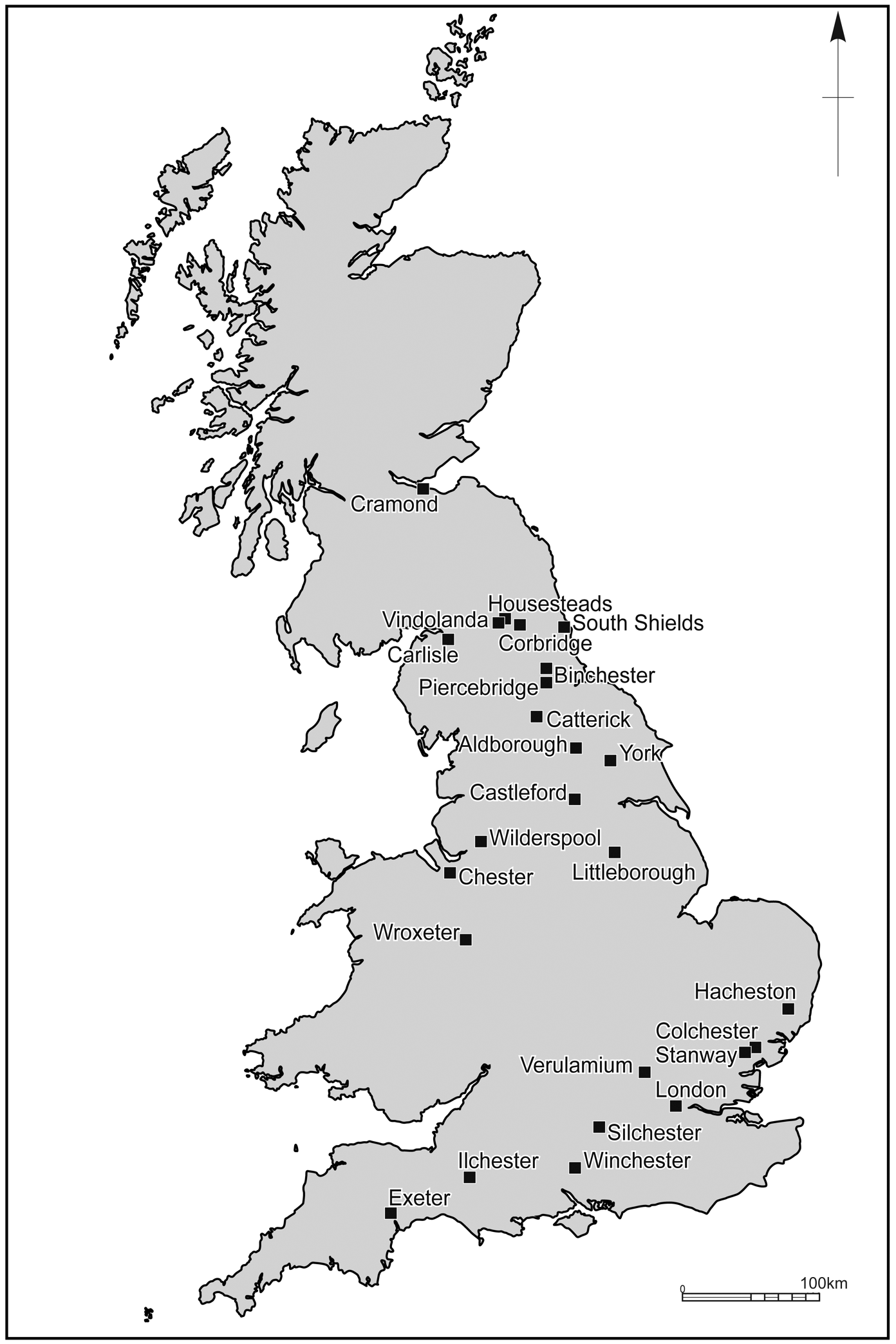
Sites in Roman Britain mentioned in the text. (Drawn by L. Gasparro, © University of Reading.).

Colchester’s medical instruments in context
Extensive research into the medical instruments in the collections of other Romano-British towns is beyond the remit of this Colchester-based study, but observations from published sites across the province can nevertheless be made (Fig. 9).
The Silchester Insula IX material has been mentioned above, but a number of other items were found in the town during the Society of Antiquaries of London’s excavations of the nineteenth and early twentieth century and in terms of form and function they appear to echo the Colchester assemblage.Footnote 138 They consist of a scalpel/blunt dissector, a hook (retractor), a ligula-probe (see above), and a coudée-forceps with a sliding lock-ring, used not only in lithotomy and procedures involving the removal of projectiles or the gripping and lifting of unwanted growths so that they could be cut away, but also perhaps as a clamp to prevent bleeding.Footnote 139 Also present in the historic Silchester collection are objects defined as multi-functional: ligulae, spoon- and spatula-probes, balances, stone grinding palettes and the lid from a multi-compartment box, while some disulphide of arsenic may have been used as an antiseptic rather than a painter’s pigment.Footnote 140
Ralph Jackson’s survey of the material related to healthcare in Roman London again includes items matched at Colchester: scalpels, hooks, needles, forceps, dipyrenes and collyrium stamps, as well as other surgical tools and some multi-functional grinding palettes and spoon- and spatula-probes.Footnote 141 With excavation triggered by development almost constantly taking place in London, the number, and very possibly variety, of these tools will have been greatly augmented since Jackson’s survey.Footnote 142
From Wroxeter, Shropshire, there is a collyrium stamp, a scalpel/blunt dissector and some fragments of shafts/handles that may be all that remains of surgical needles.Footnote 143 A complete, but damaged, surgical needle was found at Ilchester, Somerset.Footnote 144 A collyrium stamp, forceps, scalpel/blunt dissector and an iron cautery came from Verulamium.Footnote 145 Scalpels/blunt dissectors have been found at Exeter in Devon, Hacheston in Suffolk, and Aldborough in Yorkshire, and they are the best represented medical instruments recorded on the Portable Antiquities Scheme (PAS) database (7 scalpels, 2 forceps).Footnote 146 A collyrium stamp and a coudée-type forceps have been found close to the fort at Littleborough, Nottinghamshire.Footnote 147 A collyrium stamp, a double hook and a probable cautery are among the historic collections of the Yorkshire Museum, and there are forceps and tweezers with a sliding lock-ring and what may be a surgical needle with an eye at the point from Castleford, Yorkshire.Footnote 148 At Catterick, again in Yorkshire, there are tweezers with a lock-ring, what may be the handle of a cautery or spatula, and the copper-alloy handle of a possible bone chisel, with only the tang of the iron blade surviving.Footnote 149 At Piercebridge, Co. Durham, there is a scalpel, a fragmentary forceps, an inlaid ligula or surgical needle with a baluster moulding on the terminal and a closely similar fragment from the shaft of what is either another such tool or a cataract needle, but a double-ended probe referred to as a dipyrene is too substantial to merit the description.Footnote 150 The precise find-spot of a surgical needle from Housesteads Roman fort in Northumberland is unknown, but it may have originally been used in the hospital on the site; there is a sharp hook from the South Shields fort, Tyne and Wear, scalpels/blunt dissectors, forceps and a possible needle handle from Corbridge, Northumberland, and a surgical needle and scalpel/blunt dissector from Carlisle, Cumbria.Footnote 151 Doctor’s kits may have been found at the forts at Cramond, near Edinburgh, and Corbridge, and also perhaps in a military context at Wilderspool in Lancashire, but in each case either the provenance and/or the contents of the kit cannot be securely established.Footnote 152
At all these sites and many others, and on the PAS database, there are numerous spoon-probes and ligulae, as well as a few spatula-probes, and some of these instruments may have been used during medical treatment.
Two things are apparent from this admittedly limited survey. First, there are comparatively more finds from the north, often in a military context, and second, that the disposal of specialist medical equipment was not a casual undertaking, especially in civilian settlements. While easily replaced multi-functional items such as ligulae and spoon-probes are common finds in urban centres, the same is not true for scalpels, forceps and other medical tools, with grave and disaster finds providing the bulk of the known Empire-wide assemblage.Footnote 153 We suggest, however, that even though no provincial British museum with a collection founded on antiquarian and archaeological finds is likely to possess as wide a range of the instruments available to healthcare practitioners as those laid out by Jackson, Bliquez or Künzl, an examination of historic collections might nevertheless increase the known holdings of intact or fragmentary medical tools that are less readily recognised than scalpels and forceps.
Conclusion
Gathering Colchester’s medical instruments together, some of them untouched since the late nineteenth or very early twentieth century, has enabled the material culture of healthcare provision in the town to be seen as a coherent group that can be set against that of published urban assemblages and those of other site types, and to be viewed in the context of the wider assemblages from Roman Britain and the Empire. Surgical instruments were not lightly discarded, being tools of an important craft imbued with a distinctive status, therefore their low numbers on excavations makes it difficult to identify doctors’ premises. Stylistic links suggest that most were made in a limited number of continental workshops, while a few idiosyncratic items were probably British, possibly local, products. In addition, we have seen that a new collyrium stamp can provide evidence for an eye problem not previously recorded in Britain, that the names on such stamps were not necessarily those of practising oculists, that few medical professionals are recorded from Roman Britain and that surgery and other forms of healthcare can very rarely be detected in either excavated human remains or with any confidence in the archaeobotanical record. The Stanway Doctor’s kit and the medicinal drink mixed in the strainer bowl deposited in the same burial are emphatic evidence of the healthcare available in the Late Iron Age oppidum of Camulodunum before the establishment of the Roman town, with the kit being in addition a visible form of pre-conquest Gallo-Roman acculturation. Both sit within a wide tradition of medical practitioners being buried with the tools of their craft, which were a sign of status and value, both real and perceived.
We have drawn heavily here upon the work of the late Ralph Jackson, to whom we dedicate this paper. In researching this assemblage we have been awed by the depth of knowledge he displayed in his numerous publications on medical instruments, treatments and many other aspects of healthcare. A list of his works on these subjects is provided in the online supplementary material (Appendix 3), and his wider bibliography is available in Lucerna 68, the Newsletter of the Roman Finds Group.Footnote 154 We have no doubt that the group of instruments gathered together here could be augmented had he been able to spend time examining the many obscure (to us) and often fragmentary artefacts within Colchester Museums’ stores.
Acknowledgements
We are particularly grateful to the REMADE team of the University of Reading for their contribution on the composition of the copper alloys, Roger Tomlin, University of Oxford, for his contribution on collyrium stamp 48, Douglas Atfield for his photography, Emma Holloway of Colchester Archaeological Trust for rubbings and working images of stamp 48 and for Figure 8, and Lilly Gasparro, University of Reading, for Figure 9. Colchester Museums and the Trustees of the British Museum kindly gave permission for photographs of objects in their collections to be reproduced here. We would also like to thank the following for their generous help: Sarah Faulks and Lucia Rinolfi (British Museum), Sophie Stevens and Laurie Straiton (Colchester and Ipswich Museums), Hella Eckardt (University of Reading), Laura Pooley (Colchester Archaeological Trust), Michael Marshall (MOLA), Christine McDonnell (York Archaeological Trust), and the independent researchers Joanna Bird, Hilary Cool, Stephen Greep and Patrick Ottaway. Special thanks are due to Antony Lee (National Museums Scotland) and Lindsay Allason-Jones, who kindly commented on the draft text, much to its benefit. It was also much improved thanks to the valuable comments of the two reviewers.
Supplementary material
The supplementary material for this article can be found at https://doi.org/10.1017/S0068113X26100713.
Catalogue
Colchester Museums accessions are prefixed by COLEM: followed by the year of acquisition or recording and a sequential accession number (e.g. COLEM:1937.226). There may be a further number where more than one object is covered by the accession number (e.g. COLEM:2004.266.7). The same format is used for excavated material, but the year refers to either the date the numeric site code was issued or, for excavations pre-dating that practice, when the material was recorded in the accession registers and listed on the collections database. In those cases the final number is then the site small find number. Thus scalpel/blunt dissector BKC SF 2305 from the Balkerne Lane site, excavated from 1973–76, has been accessioned as COLEM:1986.67.2305.
In the catalogue of the collection amassed by the antiquarian George Joslin, J.E. Price lists among the non-funerary finds many tweezers, ear-scoops, needles, spoons, spoon-probes, spatulas, styli and other instruments that may have had a medical use (Reference Price1888, 78–9, 93–4). Over the many decades since 1893, when the newly established museum acquired the Joslin Collection, most of these objects have lost their original ‘JOS’ accession number, based on that assigned by Price. They have instead been given new (retrospective) accession numbers as and when they were encountered during, for example, documentation audits, exhibition use or store moves. This has also resulted in their Colchester provenance being inferred rather than certain. The same applies to some of the other early acquisitions. Similarly, all objects documented as part of this current project without an original accession number, or that could not be reconciled with entries in the museums’ accession registers, have been given a retrospective ‘parent’ accession number of COLEM:2025.6, as is standard practice for documenting untraced finds. The catalogue compiled for this study can therefore give the misleading impression that most of the artefacts that do not derive from formal archaeological excavations have been only recently acquired and may not be from the town.
1–14. Fig. 1 (replicas). COLEM:1996.34. Surgical kit from the conquest-period Doctor’s grave CF47, Stanway. P. Crummy et al. Reference Crummy and Crummy2007, 201–53; Jackson Reference Jackson and Crummy2007, Reference Jackson2023a, 20. 1. 1996.34.129, iron scalpel with traces of mineral-replaced textile, complete, L 188 mm; 2. 1996.34.49, iron scalpel with traces of mineral-replaced textile, complete, L 169 mm; 3. 1996.34.63–66 and .71, iron saw, complete, approximate L 112 mm; 4. 1996.34.46, copper-alloy sharp and blunt hook (double-ended retractor), complete, L 144 mm; 5. 1996.34.42, iron sharp and blunt hook (double-ended retractor) with traces of mineral-replaced textile, complete, L 140 mm; 6. 1996.34.43, copper-alloy ?retractor, complete, L 166 mm; 7. 1996.34.45, copper-alloy fixation forceps, complete, L 133 mm; 8. 1996.34.78, iron forceps/tweezers, incomplete, L 81 mm; 9. 1996.34.84 and .86, iron handled ?needle with traces of mineral-replaced textile, incomplete, L 127 mm; 10. 1996.34.85, iron handled ?needle with traces of mineral-replaced textile, incomplete, L 109 mm; 11. 1996.34.51, iron handled ?needle with traces of mineral-replaced textile, incomplete, L 55.4 mm; 12. 1996.34.44, copper-alloy scoop-probe, complete, L 132 mm; 13. 1996.34.50. copper-alloy handle with fragment of an iron component, incomplete, L 91.3 mm; 14. 1996.34.39, iron knife, incomplete, L 97.7 mm.
15. Fig. 2. COLEM:1986.67.2305. Colchester. From the Balkerne Lane site, G246 F61, Period 5b clay- and timber-lined pit: CAR 2, 63, fig. 68, 1948. Copper-alloy scalpel/blunt dissector, missing its iron blade. L 128.5 mm.
16. Fig. 2. COLEM:2004.266.7. Colchester? Jackson Reference Jackson2011b. Copper-alloy (leaded bronze/leaded gunmetal) scalpel/blunt dissector, missing its iron blade; there is worn ivy or vine scroll decoration on the grip and the metal lining the socket for the blade differs in colour to the rest of the grip, a distinction caused by working and annealing (La Niece and Hook Reference La Niece, Hook and Jackson2023, 149). L 87.4 mm.
17. Fig. 2. COLEM:2004.266.5. Colchester? Copper-alloy (gunmetal) scalpel/blunt dissector, missing its iron blade and the tip of the blunt dissector; the metal of the socket is affected as on the previous example, although not so markedly. L 108.7 mm.
18. Fig. 2. COLEM:1937.226. St Helena’s School, Sheepen Road, Colchester. Copper-alloy (leaded bronze) scalpel/blunt dissector, missing its iron blade; there is worn Hercules’ club decoration on the grip. L 58.5 mm.
19. Fig. 3. British Museum 1870,0402.220; Pollexfen Collection. Colchester. Jackson Reference Jackson and Krug1994b, 173 no. 20, 185, pl. 2; Reference Jackson and Allason-Jones2011a, 260; Reference Jackson2023a, 113, fig. 120a–b. Copper-alloy hollow-jawed toothed spring forceps (staphylagra variant), incomplete. L 198 mm.
20. Fig. 3. COLEM:1896.5.5. Colchester. Laver Reference Laver1896; Jackson Reference Jackson and Krug1994b, 173 no. 23, 185, pl. 1 (where it is listed as COLEM:1896.178). Copper-alloy toothed cross-legged forceps (staphylagra variant), complete. L 219 mm.
21. Fig. 4. COLEM:2004.266.4. Colchester? Copper-alloy (brass) smooth-jawed spring forceps, incomplete. Most of one blade is missing, as is the end of the other. L 110.9 mm. As Riha Reference Riha1986, Taf. 12, 94–6, Variant C.
22. Fig. 4. COLEM: 2000.166.6493. Colchester Royal Grammar School, Lexden Road. Copper-alloy smooth-jawed spring forceps, incomplete. One blade is intact, the lower part of the other is missing. L 138 mm. As Riha Reference Riha1986, Tafn 12–13, 100–4.
23. Fig. 4. COLEM:2004.242.1. Provenance unknown. Copper-alloy smooth-jawed(?) spring forceps, incomplete. The end of the bent surviving blade is missing. There are vertical lines of punched dots on three, probably all four, sides of the squared baluster on the finial. L bent 78 mm, if straight approximately 88 mm. As Riha Reference Riha1986, Taf. 12, 94–6, Variant C.
24. Fig. 4. COLEM:1987.T148. Colchester? Copper-alloy pointed jawed spring forceps, complete. L 108.6 mm. Not closely paralleled at Augst, where a less well-formed version is Variant B (Riha Reference Riha1986, Taf. 12, 93).
25. Fig. 4. COLEM:1987.T176. Colchester? Copper-alloy (copper) needle forceps(?) with tapered needle. Incomplete; one blade is missing, the other is deliberately badly bent. The square-section handle has notched reel-and-block mouldings. L bent 96.9 mm, if straight 132 mm. No close parallel has been found.
26. Fig. 4. COLEM:PC.18. Colchester? Copper-alloy forceps/tweezers with sliding lock-ring midway down the blades, which are very thin, and taper from the narrow loop to flat grips. L 96.8 mm, maximum width 7.3 mm.
27. COLEM:1986.56.794. Sheepen, Colchester. From the Camulodunum 1970 site (CAM70), site iii, C25 (1). Object not included in the published report, but occupation on site iii dates from c. a.d. 43 to 65: Niblett Reference Niblett1985, 15–20. Copper-alloy forceps/tweezers, incomplete. Only one bent blade survives and its grip is damaged. What remains of the spring-loop at the top is very narrow. L 93 mm.
28. Fig. 5. COLEM:1987.44.12. St Mary’s Rectory, Church Street, Colchester. Sixth road surface, dated to c. a.d. 200. Dunnett Reference Dunnett1971, 68–9, 71, fig. 25, 7. Copper-alloy sharp hook, with blunt finial above a stout baluster and a long grip with delicate angular facets. The lower part of the baluster retains similar but very worn facets, which may originally have completely covered it. L 98.7 mm, maximum diameter of head 5.5 mm.
29. Fig. 5. COLEM:1998.155; Joslin Collection. Colchester. Copper-alloy (gunmetal) double hook, complete. The shaft is plain, one terminal is sharp, the other blunt. L 114.5 mm.
30. Fig. 5. COLEM:2025.6.11. Colchester? Copper-alloy double hook?, incomplete. The plain shaft is bent at one end; the tips of the terminals are missing, but at least one was probably blunt. L 125.5 mm.
31. Fig. 5. COLEM:1997.170. Colchester? Copper-alloy surgical needle, incomplete. A plain shaft tapering to a point; the blunt top is slightly bevelled and pierced to take a replaceable needle. L 108 mm, maximum diameter 4.3 mm. Compare with Künzl Reference Künzl2002, Abb. 4, type D3.
32. Fig. 5. COLEM:2025.6.45. Colchester? Copper-alloy surgical needle, complete, slightly bent/curved. The moulded finial (knob, reel, baluster, two reels) is much like those on some surgical hooks and other instruments, as is the bead-and-reel grip on the shaft. The shaft tapers to the grip, then is wider below it before tapering to the point. L 138 mm.
33. COLEM:2025.6.46. Castle Park, Colchester. Copper-alloy surgical needle or hook, incomplete. Similar to COLEM:2025.6.45 above, but missing the tip. L 104 mm.
34. COLEM:1938.393. A.R.P. (air raid precaution) trenches, Castle Park, Colchester. Colchester. Copper-alloy surgical needle or hook, incomplete. The moulded finial (knob, baluster, reel, larger baluster, two reels) again uses the elements seen on surgical instruments. L 105 mm.
35. COLEM:2025.6.12. Colchester? Copper-alloy thin shaft, incomplete and in very poor condition. It tapers towards each end, one of which is pointed. The tip of the other is bent at a right angle, and is slightly thicker at the break. Perhaps a double-pointed needle? L169 mm. Compare with Künzl Reference Künzl1982, Taf. 75, 10; Jackson Reference Jackson1994a, 215, ill. 227, A56.
36. COLEM:2025.6.40. Colchester? Copper-alloy needle, complete, with long oval eye and long rebated point, now bent. L 123.5 mm. 237 is written in ink on the shaft, a number that also appears on a spoon-probe and some probe fragments (COLEM:1998.162; 2025.6.47.1–3); it may be an early museum acquisition number.
37. Fig. 5. COLEM:1937.94. Monks Horton, Lexden Road, Colchester (now nos 72 and 74). Copper-alloy stylus or cautery/needle, complete. The shaft is faceted; the eraser or cautery is small, the shaft adjacent to it is narrow, and the rebated point is long. L 113.8 mm. Compare with Künzl Reference Künzl1982, 45, fig. 13, 4.
38. Fig. 5. COLEM:1981.1.2067. Colchester. From the Culver Street site, E476 L1, unstratified machine clearance. CAR 6, 463 (fiche), no. 475. Copper-alloy dipyrene, incomplete. L 65 mm, probe D 2.75 mm.
39. Fig. 5. COLEM:1988.44.614 and .617. Colchester. From the Gilberd School site, North Hill, Period 3a scoop. CAR 6, 579 (fiche), nos 100–101. Copper-alloy dipyrene, incomplete. Both terminals remain, but the shaft where it was broken has corroded and the two parts do not fit together (originally published as two separate objects). 1988.44.614, L 77 mm, probe D 3.3 mm; 1988.44.617, L 89 mm, probe D 3.4 mm.
40. Fig. 5. COLEM:2004.266.13. Colchester? Jackson Reference Jackson and Allason-Jones2011a, 258, fig. 19, f. Copper-alloy (leaded bronze) eyed dipyrene, pierced at one end, complete. L167 mm, uneyed probe D 2.7 mm, eyed probe D 2.9 mm.
41. Fig. 5. COLEM:1986.65.405. Colchester. CAR 2, 59, fig. 64, 1897. From the Lion Walk site, B127 Period 4/5, later Roman levels. Copper-alloy ear-probe, complete. L 83.5 mm, dished scoop D 6.5 mm.
42. COLEM:1981.1.4095. Colchester. From the Culver Street site, G2606 F2605, Period 4 pit. CAR 6, 463 (fiche), no. 462. Copper-alloy ear-probe, incomplete. L 88 mm.
43. COLEM:1981.1.4148. Colchester. From the Culver Street site, G2841 L2815, Period 3 or 4 dump, Building 119? CAR 6, 463 (fiche), no. 463. Copper-alloy ear-probe, incomplete. L 103 mm.
44. COLEM:2025.6.48. Colchester? Copper-alloy ear-probe, incomplete. L 85.3 mm, dished scoop 5.7 mm.
45. Fig. 5. COLEM:2025.6.13. Colchester? Copper-alloy (copper) double- or single-ended probe(?) with a thick shaft and stout moulded grip, incomplete. L 148 mm, grip D max 9.8 mm.
46. Fig. 5. COLEM:1981.1.5140. Colchester. From the Culver Street site, K64 F55, Period 3a pit. CAR 6, 154, fig. 5.12, 470. Copper-alloy ligula-probe, complete. There is a wide reel/collar and cross-grooves above the angled flat scoop. L 104 mm, scoop D 5.1 mm.
47. Fig. 6. COLEM:1986.67.3321. Colchester. From the Balkerne Lane site, J194 F13, Period 5b pit. CAR 2, 63, fig. 69, 1951; Jackson Reference Jackson1990b, 279, no. 11. RIB 2446.15. Collyrium stamp of green steatite, complete. Inscribed on the two long sides: a) Martial(is) croc(odes) (Martialis, saffron salve); b) Marini/–, perhaps Marini/–/m (Marinus). 31 by 20 by 2.5 mm.
48. Fig. 6. Not yet deposited in the museum. Colchester. From the St Mary’s Hospital site (2001.64), SF 455, D1114 L70, late second- to third-century accumulation. Jackson Reference Jackson and Crummy2006. Collyrium stamp of grey-green stone (probably green steatite?), incomplete, possibly recut, unworn. See Tomlin, main text, for the reading of the three dies on this item. 46.7 by 15.3 by 8.6 mm, probably originally 48 by 48 by 9 mm.
49. Found before 1719, now lost. Colchester. Jackson Reference Jackson1990b, 279, no. 9. RIB 2446.20. For a more extensive bibliography see RIB. Collyrium stamp of unknown stone, complete. Inscribed on the two long sides: a) Q(uinti) Iul(i) Murrani meli/num ad claritates (Quintus Iulius Murranus’ oil of quince for clearness (of the eyes)); b) Q(uinti) Iul(i) Murrani stactu/m opobalsamat(um) ad ca[l(iginem)(?)] (Quintus Iulius Murranus’ balsam drops for dim sight). 51 by 51 by 6.3 mm.
50. Fig. 6. Colchester? British Museum, 1892,0801.1, Franks Collection. Jackson Reference Jackson1990b, 279, no. 10; Reference Jackson2023a, 129–30, tables 2-3, no. 3.137, fig. 147; RIB 2446.8. Collyrium stamp, possibly of Purbeck marble. Inscribed on three sides: a) L(uci) Ulp(i) Decimin(i)/penicil(lum) le(ne (Lucius Ulpius Deciminus’ mild ointment: for an alternative reading see Jackson Reference Jackson2023a, 129); b) L(uci) Ulp(i) Decimini dia/lepidos crocod(es)/[a]d omnia vitia (Lucius Ulpius Deciminus’ saffron salve (made with) copper-oxide for all defects (of the eyes)); c) L(uci) Ulp(i) Dec(imini). 41 by 41 by 13 mm.
51. Fig. 6. COLEM:1986.65.1529. Colchester. From the Lion Walk site, G44 F28, Period 4 pit. CAR 2, 64, fig. 69, 1953; Hassall and Tomlin Reference Hassall and Tomlin1977, 437, no. 53; RIB 2409.18. Probable collyrium stamp of green slate, incomplete. Fragmentary inscription on long side: –/ID. 35 by 9 by 5 mm.
52. Fig. 6. COLEM:1986.66.290. Colchester. From the Butt Road site, B502 L1, post-Roman topsoil. CAR 2, 64, fig. 69, 1952; Hassall and Tomlin Reference Hassall and Tomlin1977, 437, no. 52; Jackson Reference Jackson1990b, 279, no. 12. Stamp or die of green slate with two-lobed handle, complete. Inscribed PCLPR, ?P(ublius) Cl(audius/Clodius/Clodianus) Pr(imus). One lobe of the handle is inscribed P. 23 by 16 by 22 mm.


 Open access

