





How does affective polarization feel?
After more than a decade of affective polarization research, we know surprisingly little about how affective polarization actually feels. Affective polarization – the strong sympathy for one party relative to one or several others (Iyengar, Sood and Lelkes Reference Iyengar, Sood and Lelkes2012) – is rising in several Western democracies (Garzia, da Silva and Maye Reference Garzia, da Silva and Maye2023) and has become a key concept to describe citizens’ sentiment toward parties and voters (Iyengar et al. Reference Iyengar, Lelkes, Levendusky, Malhotra and Westwood2019; Röllicke Reference Röllicke2023). Prominent observations describe prevailing ‘fear and loathing’ among the mass public (Iyengar and Westwood Reference Iyengar and Westwood2015; Reiljan Reference Reiljan2020) and ‘a poisonous cocktail of othering, aversion and moralization’ (Finkel et al. Reference Finkel, Bail, Cikara, Ditto, Iyengar, Klar, Mason, McGrath, Nyhan, Rand, Skitka, Tucker, Van Bavel, Wang and Druckman2020: 533). In fact, the descriptions of fear and hatred are so ubiquitous that researchers, journalists, and citizens widely overestimate the prevalence of affective polarization (Druckman et al. Reference Druckman, Klar, Krupnikov, Levendusky and Ryan2022; Krupnikov and Ryan Reference Krupnikov and Barry Ryan2022; Moore-Berg et al. Reference Moore-Berg, Ankori-Karlinsky, Hameiri and Bruneau2020).
However, while the field has made important progress toward understanding the causes, consequences, and remedies of affective polarization, we know surprisingly little about how affective polarization feels. Affect is a general valence assessment (i.e., positive vs. negative) but does not allow inferences about the specific emotions (e.g., hopeful vs. proud, anxious vs. angry) an individual feels (Versteegen Reference Versteegen2024). Hence, Bakker and Lelkes (Reference Bakker and Lelkes2024) and Halperin et al. (Reference Halperin, Kretchner, Hirsch-Hoefler and Elad-Strenger2024) called to specify the affect in affective polarization. While a budding line of studies began to do just that, this evidence remains limited to a few emotions (e.g., Berntzen, Kelsall and Harteveld Reference Berntzen, Kelsall and Harteveld2024; Kretchner et al. Reference Kretchner, Elad-Strenger, Hirsch-Hoefler, Orian-Harel and Halperin2024; McLaughlin et al. Reference McLaughlin, Holland, Thompson and Koenig2020; Nguyen, Mayer and Veit Reference Nguyen, Mayer and Veit2022; Renström, Bäck and Carroll Reference Renström, Bäck and Carroll2023) or qualitative insights (e.g., Versteegen Reference Versteegen2024). With this research note, we provide a more encompassing description of how affective polarization feels.
We analyze cross-sectional data from N = 4,794 citizens in Denmark, Germany, Italy, Poland, and the United Kingdom. We asked respondents to identify their primary in-party and out-party and rate their affect toward these parties’ voters with feeling thermometers. Respondents then rated the extent to which they experienced different emotions toward the voters. In contrast to recent research that developed emotion-specific theories primarily toward out-party voters (e.g., Kretchner et al. Reference Kretchner, Elad-Strenger, Hirsch-Hoefler, Orian-Harel and Halperin2024; Renström, Bäck and Carroll Reference Renström, Bäck and Carroll2023), our approach compares the prevalence and relevance of several emotions toward in-party and out-party voters. Moreover, it provides insights into positive emotions, which are, presumably due to the narrative of ‘fear and loathing’ (Iyengar and Westwood Reference Iyengar and Westwood2015; Reiljan Reference Reiljan2020), relatively absent in affective polarization research.
We find that only a few citizens report being worried, anxious, afraid, or scared. Reports of anger, aversion, bitterness, resentment, and hate toward out-party voters are evenly distributed, with similar shares saying that they experience these emotions to an extreme, moderate, or no extent. The most common negative emotions toward out-party voters are disgust and disappointment (also see Kretchner et al. Reference Kretchner, Elad-Strenger, Hirsch-Hoefler, Orian-Harel and Halperin2024). Toward in-party voters, hope, enthusiasm, and pride are common, even though a small share of respondents reports that they feel worry, anxiety, and disappointment toward them. Reports of indifference toward both sides are rare, suggesting that most respondents can describe at least some sense of emotionality toward the camps. The strongest predictors of affective polarization are pride, hope, and enthusiasm (and a lack of indifference) toward in-party voters and – to a lesser extent – aversion, hate, and disgust (and a lack of positive emotions) toward out-party voters. Moreover, we identify heterogeneous patterns in emotional experiences across demographic backgrounds that future research may want to examine.
This research note implies that the experience of affective polarization is more positive and less fearful than often portrayed. This is not to downplay the possibly problematic consequences of affective polarization (e.g., Kingzette et al. Reference Kingzette, Druckman, Klar, Krupnikov, Levendusky and Ryan2021). However, it is vital to acknowledge that affective polarization is not just less prevalent than often assumed (Druckman et al. Reference Druckman, Klar, Krupnikov, Levendusky and Ryan2022; Krupnikov and Ryan Reference Krupnikov and Barry Ryan2022; Moore-Berg et al. Reference Moore-Berg, Ankori-Karlinsky, Hameiri and Bruneau2020) but that it feels more positive than prominent descriptions suggest. Moreover, our findings consolidate the theoretical foundation of the previous results. The link between affective polarization and democratic norms (e.g., Kingzette et al. Reference Kingzette, Druckman, Klar, Krupnikov, Levendusky and Ryan2021), for example, seems intuitive if affective polarization primarily means to feel angry at opponents. However, our results remind us that affective polarization is more than just feeling angry at opponents. These insights on the emotional underpinnings of polarization may help explain why affective polarization does not necessarily undermine democratic norms (e.g., Broockman, Kalla and Westwood Reference Broockman, Kalla and Westwood2023). Likewise, that affective polarization sparks political participation (e.g., Harteveld and Wagner Reference Harteveld and Wagner2023) becomes more intuitive if positive emotions toward the in-party feature centrally in its experience.
Why study emotions in affective polarization?
Iyengar, Sood, and Lelkes (Reference Iyengar, Sood and Lelkes2012) introduced affective polarization as an alternative to ideological polarization. They showed that US citizens are increasingly divided in how warm they feel toward different political camps. The most common operationalization reflects this affective divide (for a discussion of the different measures, see Iyengar et al. Reference Iyengar, Lelkes, Levendusky, Malhotra and Westwood2019), calculating the difference (in two-party systems) or variance (in multi-party systems, see Reiljan Reference Reiljan2020; Wagner Reference Wagner2021) in affect toward the parties (or its voters and politicians; for a discussion of these different targets, see Druckman and Levendusky Reference Druckman and Levendusky2019). This efficient measure enabled an impressive body of evidence on the origins (e.g., Mason Reference Mason2016; Hobolt, Lawall and Tilley Reference Hobolt, Lawall and Tilley2024), generalizability (Reiljan Reference Reiljan2020; Wagner Reference Wagner2021), trends (Garzia, da Silva and Maye Reference Garzia, da Silva and Maye2023), consequences (e.g., Broockman, Kalla and Westwood Reference Broockman, Kalla and Westwood2023; Phillips Reference Phillips2024), and remedies (e.g., Levendusky Reference Levendusky2018) of affective polarization. Yet, it does not specify what affective polarization feels like.Footnote 1
Recently, researchers have begun to study how specific emotions correlate with or even cause affective polarization. Comparing six negative emotions, Kretchner et al. (Reference Kretchner, Elad-Strenger, Hirsch-Hoefler, Orian-Harel and Halperin2024) show that disappointment is most strongly related to affective polarization among US Americans and Jewish Israelis. Presumably inspired by the ‘fear and loathing’ narratives (Iyengar and Westwood, Reference Iyengar and Westwood2015; Reiljan Reference Reiljan2020), however, most scholars focus on fear and anger. Webster, Connors, and Sinclair (Reference Webster, Connors and Sinclair2022), for example, show that Americans become increasingly angry at the out-party and that out-party anger makes them more polarized. Renström, Bäck, and Carroll (2023) find that anger (but not anxiety or fear) predict affective polarization among Swedes and Germans. Berntzen, Kelsall, and Harteveld (Reference Berntzen, Kelsall and Harteveld2024) show that anger and disgust are more strongly associated with partisan animosity than feeling thermometers, and the emotions predict the outcomes to different degrees. Nguyen, Mayer, and Veit (Reference Nguyen, Mayer and Veit2022) show that anger (but not anxiety) predicts affective polarization. These studies suggest that examining discrete emotions can improve our understanding of affective polarization and its consequences.
However, they remain limited to a few and primarily negative emotions (for an exception, see Yu et al. Reference Yu, Wojcieszak, Lee, Casas, Azrout and Gackowski2021). With this research note, we aim to contribute a more encompassing description of what affectively polarized citizens report to experience, assessing more emotions across five countries and various covariates. While the evidence just reviewed might prompt us to state emotion-specific hypotheses (e.g., that anger is more important than fear), our approach is deliberately exploratory, aiming to compare the prevalence and relevance of emotions.
That said, researchers continue to discuss how much various emotions can and should be differentiated. While affect describes a general valence (i.e., positive vs. negative; Bakker, Schumacher and Rooduijn Reference Bakker, Schumacher and Rooduijn2021) toward a target (e.g., a party), emotions are slower, more specific, and partly socially constructed types of affect (Bakker, Schumacher and Rooduijn Reference Bakker, Schumacher and Rooduijn2021; Versteegen Reference Versteegen2024). Hence, it stretches the concept to infer ‘fear and loathing’ (Iyengar and Westwood Reference Iyengar and Westwood2015; Reiljan Reference Reiljan2020) from cold affect, whereas reports of emotions like anger or fear specify this experience.
How many emotions do researchers need to assess, however, to sufficiently specify a citizen’s experience? Psychological theories propose that a number of emotions can be differentiated by their causes and consequences (Frijda, Kuipers and Ter Schure Reference Frijda, Kuipers and Ter Schure1989), such that fear has different causes and consequences than anger (also see Marcus, Neuman and MacKuen Reference Marcus, Neuman and MacKuen2000). This suggests that affective polarization has different consequences depending on whether one feels angry or fearful, a prediction consistent with recent evidence (e.g., Renström, Bäck and Carroll, 2023; Berntzen, Kelsall and Harteveld Reference Berntzen, Kelsall and Harteveld2024). However, as the experience and expression of emotions are socially constructed (Versteegen, Reference Versteegen2024; von Scheve Reference von Scheve2024), reported emotions partly reflect a respondent’s goals. It is, for example, less socially desirable to appear angry than to appear fearful (Versteegen Reference Versteegen2024). Moreover, emotions’ socially constructed nature implies that people can provide very nuanced descriptions (e.g., differentiating fear from anxiety and worry), even if even less nuanced emotional labels are difficult to distinguish empirically (e.g., Rebasso Reference Rebasso2023).
Each degree of differentiation creates empirical insights and challenges. To maximize the insights of our study, we assess emotions with a high level of granularity, letting respondents differentiate between 15 different emotion labels. While we analyze these 15 labels separately, we also discuss the correlations of emotion groups (i.e., anger, fear, enthusiasm) that are empirically distinguishable and more meaningful at other degrees of theoretical differentiation.
Data and methods
To understand how emotions relate to affective polarization, we fielded nationally representative surveys in five European countries in February and March 2023 (N = 4,794). SI1 in the online Supplementary Information provides details on the sample and recruitment. We received ethics approval prior to data collection (see SI2).
We study responses from Denmark, Germany, Italy, Poland, and the United Kingdom. Among others, the countries vary in the number of effective parties (e.g., a two-party plus system in the United Kingdom vs. multi-party systems in all other countries), turnout (e.g., around 50% in Poland vs. around 80% in Denmark; Leininger and Meijers Reference Leininger and Meijers2021), and trends in affective polarization (e.g., an increase in Denmark vs. stability in Italy; Garzia, da Silva and Maye Reference Garzia, da Silva and Maye2023). While we have no theoretical reasons to expect differences between these cases, studying five countries allows us to evaluate the generalizability of our findings in a diverse set of institutional and political settings.
As our cross-sectional design does not allow us to make causal claims, we do not imply causality when discussing the correlations between emotions and affective polarization. This approach reflects our explicitly descriptive aim (Gerring Reference Gerring2012) to describe how affective polarization feels. While causal theories on this link were tested elsewhere (e.g., Renström, Bäck and Carroll, 2023; Webster, Connors and Sinclair Reference Webster, Connors and Sinclair2022), emotions and affect describe affective states (i.e., ‘how someone feels’) and are thus highly endogenous by nature.
Measures
We analyze two sets of questions (see SI3 for an overview of all measures). First, we operationalize affective polarization. Following common practice (Iyengar et al. Reference Iyengar, Lelkes, Levendusky, Malhotra and Westwood2019), we assess affect through respondents’ reported affect with feeling thermometers. Our scales range from 0 to 100, where ratings between 0 and 49 mean unfavorable or cold feelings and ratings between 51 and 100 mean favorable or warm feelings. Importantly, we measure feelings toward voters, not parties or elites. Feelings are usually colder toward elites than toward voters, even if they are highly correlated (Druckman and Levendusky Reference Druckman and Levendusky2019).
Identifying affective polarization poles is more complex in multi-party systems than in two-party systems. Scholars use primarily three operationalizations. The first lets self-declared partisans select their in-party and calculates their affective polarization score by subtracting the mean affect toward out-parties from their affect toward the in-party (partisan score; Reiljan Reference Reiljan2020). The second calculates the mean difference in affect between an individual’s most-liked party and all other parties (mean score; Wagner Reference Wagner2021). The third measures the spread of an individual’s affect for all parties (spread score; Wagner Reference Wagner2021). While all measures help studying affective polarization in multi-party systems, the first is limited to self-declared partisans, and the second and third do not directly capture the tension between the two poles.
Hence, we combine the strengths of these approaches and operationalize affective polarization as follows. We first asked respondents to select one party they support. If they did not pick one, they were prompted to pick one they were ‘more a supporter of than other parties’. Likewise, they were asked to select one party they were against or, in a prompt, ‘more against than other parties’. Afterward, respondents indicated their affect toward the voters of their chosen in-party and out-party with the feeling thermometers described above. With this procedure, we avoid limiting our analysis to self-declared partisans while capturing the tension between poles.Footnote 2 We chose to only assess the most and least-liked parties as it would have been overly demanding for respondents to rate emotion labels for all parties in their respective party systems. While this limits comparability to the spread and mean scores, it is increasingly common to operationalize only blocs or pairs of parties even in multi-party systems (e.g., Gidron, Adams and Horne Reference Gidron, Adams and Horne2023; Reiljan and Ryan Reference Reiljan and Ryan2021) and Kasper, Schumacher and Bakker (Reference Kasper, Schumacher and Bakker2025) recently established the validity of these more parsimonious approaches. In SI4, we explore the frequencies with which respondents chose specific parties as the most or least-liked parties, specifically, as well as the average affect toward all parties.
Second, we measure emotions toward the chosen parties’ voters. One question asked, ‘To what extent do you currently experience each of the following emotions toward voters of the [in-party]?’ Another question asked, ‘To what extent do you currently experience each of the following emotions toward voters of the [out-party]?’ Respondents rated 15 emotion labels in random order (i.e., enthusiastic, hopeful, proud, aversive, hateful, angry, bitter, resentful, scared, worried, afraid, anxious, disgusted, disappointed, indifferent) from 1 (not at all) to 5 (extremely).
We chose these labels to allow respondents to provide detailed descriptions of their experience, reflecting that emotions are partly socially constructed (Versteegen Reference Versteegen2024). However, as discussed above, various theoretical accounts suggest that several of these labels are synonyms for the same emotions (e.g., enthusiasm, anger, and fear), and evidence suggests that more differentiation is unlikely (e.g., Rebasso Reference Rebasso2023). We included indifference, which is usually considered as the absence of emotion (but see Karageorgou, Madoglou and Kalamaras Reference Karageorgou, Madoglou and Kalamaras2024), because it is theoretically interesting if respondents report to feel no emotion toward a group of voters.
Analyses
Reflecting our discussion about differentiating emotions above, we examine the correlation between emotions and affective polarization with various models. First, we present univariate models, regressing affective polarization separately on each of the 15 emotion labels; second, a multivariate model including all 15 labels toward in-party and out-party voters, respectively; third, a model including only emotions toward in-party voters; fourth, emotions only toward out-party voters; fifth, a model including only positive emotions; and sixth, a model including only negative emotions. A seventh model regresses affective polarization on groups of emotions (enthusiasm, anger, anxiety, and indifference) that are based on dimension reduction (i.e., for an inter-item correlation table and an exploratory factor analysis, see SI5). All models use country-fixed effects and control for age, gender, education, and ideology.
The different models test different questions. The multivariate model shows whether an emotion is significantly associated with affective polarization while accounting for other emotions. However, as emotions often co-occur, some may find it more relevant whether an emotion is associated with affective polarization at all – this is shown in the respective univariate model.Footnote 3 The remaining models primarily help evaluate the robustness of the multivariate model.
Results
How do citizens feel?
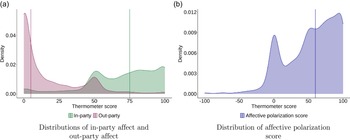
We first describe citizens’ affect toward in-party and out-party voters (for details, see SI6). Figure 1 displays respondents’ affect toward in-party voters (green) and out-party voters (red), as well as the distribution of the affective polarization score (blue). On average, people feel warm toward like-minded voters and more intensely negative toward out-party voters. Consequently, the affective polarization score has a median of 60 points difference between in- and out-party ratings. However, there is a notable minority who feels indifferent to their in- or out-party, resulting in a score of 50.
Distributions of in-party affect, out-party affect, and affective polarization (vertical bars show the mean score).

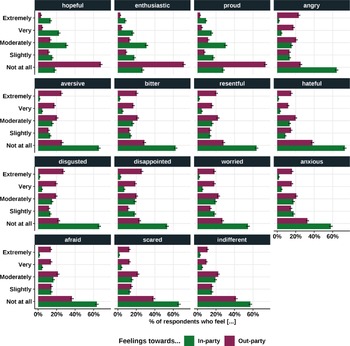
Figure 2 describes respondents’ feelings at a more granular level, displaying the extent to which they report different emotions (SI6 shows the distributions of emotions by in-party and out-party.). Toward in-party voters (green), respondents’ positive emotions are normally distributed, such that most respondents experience ‘moderate’ degrees of hope, enthusiasm, and pride. 24% are even ‘very’ or ‘extremely’ enthusiastic and proud, and 36% feel such strong extents of hope. Negative emotions toward in-party voters are rare, such that about 60% of respondents say they ‘not at all’ experience any negative in-party emotions.
Proportions of agreement to different emotion intensities.

When thinking of out-party voters, citizens clearly do not feel particularly positive about voters from their opposing party. At least two-thirds of respondents are ‘not at all’ proud, enthusiastic, or hopeful. This lack of positive emotions is noteworthy, especially as respondents presumably feel even less positive toward elites (Druckman and Levendusky Reference Druckman and Levendusky2019).
Simultaneously – and this is one of the key findings of this paper – citizens do, on average, not report strong negative emotions about voters of their opposing party either. The modal response for most negative emotions toward out-party voters is ‘not at all’. For example, 25–38% of our respondents state that they are ‘not at all’ angry, aversive, bitter, resentful, or hateful toward opponents, suggesting that large shares of our sample do not experience such ‘aggressive’ types of affect. Likewise, 26–39% report not to be worried, anxious, afraid, or scared ‘at all’. The notable exceptions to this pattern are disgust, disappointment, and indifference, where about 46% of our respondents are ‘very’ or ‘extremely’ disgusted and disappointed by out-party voters, respectively. One in five report to be fully indifferent about opponents.
In sum, respondents clearly are emotional about the parties. Simultaneously, a large share of citizens does not feel aversive or anxious toward them. Especially anxiety-related (i.e., worried, anxious, afraid, scared) emotions seem less prevalent than narratives of ‘fear and loathing’ (Iyengar and Westwood Reference Iyengar and Westwood2015; Reiljan Reference Reiljan2020) let assume. And while we do find that substantial shares of our samples report intense aversion-related emotions (i.e., angry, aversive, bitter, resentful, hateful), similar shares do not feel these emotions at all or only to moderate extents. This matches findings from the United States in that many often picture partisans as more ‘aggressive’ than they actually are (Moore-Berg et al. Reference Moore-Berg, Ankori-Karlinsky, Hameiri and Bruneau2020). Moreover, the prevalence of positive emotions toward in-party voters is reassuringly high.
What emotions correlate with affective polarization?
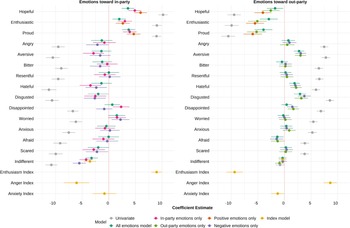
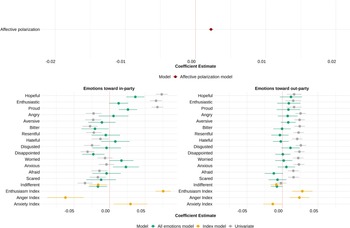
Next, we test how the different emotions correlate with affective polarization. SI7 shows full regression tables for all models (regression tables in SI8 show how emotions correlate with in-party or out-party affect separately).Footnote 4 Figure 3 plots all models pooled across the five samples. When considering each emotion in isolation (see the univariate (gray) models), all emotions characterize affective polarization experiences to some extent: respondents with higher affective polarization scores report more positive emotions and less negative ones toward in-party voters. They also report less positive and more negative ones toward out-party voters. The correlations with anxiety-related emotions are weaker than those of anger- and enthusiasm-related emotions.
Correlations with affective polarization.

When considering multiple emotions simultaneously, the picture becomes more pronounced: the emotions most strongly correlated with affective polarization are positive emotions toward in-party voters, a lack of positive emotions toward out-party voters, and specific anger-related emotions (i.e., aversion, hate, disgust, and partly disappointment) toward out-party voters. This finding is consistent across various multivariate models: when including all 30 labels simultaneously (‘all emotions’, blue), when including only in-party (pink) or out-party emotions (green), and when including only positive (orange) or negative (purple) emotions. The most parsimonious model – which includes enthusiasm, anger, and anxiety indices toward in-party and out-party voters, respectively (see SI5) – yields the same conclusion: affective polarization is best described by enthusiasm-related emotions toward in-party voters and anger-related emotions toward out-party voters, as well as lack of enthusiasm for opponents and no anger toward co-partisans.Footnote 5 Indifference might be considered a proxy of political involvement here, such that the negative correlation between indifference and affective polarization reflects that citizens are more likely to be affectively polarized when they are involved (see Krupnikov and Ryan Reference Krupnikov and Barry Ryan2022).Footnote 6
Who hates, who hopes?
Next, we explore whether the emotional patterns in affective polarization experiences vary by country and demographics. While our approach remains exploratory, further description can identify patterns connecting to previous theories or highlight the need for further theorizing.
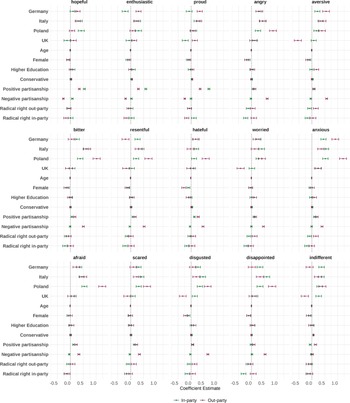
Figure 4 reveals several noteworthy patterns (SI11 provides a regression table). First, respondents in Denmark (the reference category) report the weakest emotions, such that respondents in all other countries report stronger emotions toward the in-party and out-party. Respondents in the countries with the highest affective polarization scores (i.e., Germany and Poland, scoring 70 and 65, respectively, see SI6) tend to report a larger gap between an emotion felt toward in-party voters and the same emotion toward out-party voters. In that sense, they are not just more affectively polarized but also more polarized on the same emotion.
Predicting emotions toward in-party and out-party voters.

Women (vs. men and non-binary people) tend to report less enthusiasm- and anger-related emotions but similarly intense anxiety-related emotions toward both camps. These patterns align with gendered differences in the experience and expression of emotions (e.g., Versteegen Reference Versteegen2024), such that it is considered more appropriate for men to express anger, whereas men are traditionally socialized to hide anxiety. More educated people (i.e., those with a university degree) tend to report somewhat stronger emotions, which may reflect stronger political involvement (see Krupnikov and Ryan Reference Krupnikov and Barry Ryan2022). Overall, however, differences in education are modest. As for age, older people report weaker emotions (see regression tables in SI11), but these differences are substantively small.
What about ideology and partisanship? The survey assessed ideology with a standard left–right item and differentiated between positive and negative partisanship (see SI3). More conservative voters tend to report not only stronger positive and negative emotions toward in-party voters but also more positive ones toward the out-party. Respondents with a stronger positive partisanship tend to report stronger positive and negative emotions toward in-party and out-party voters. This points to a subset of the population that identifies strongly with their in-party and feels strongly about voters of all camps. Negative partisanship is primarily associated with more negative emotions toward out-party voters, reflecting a subsample that primarily dislikes opponents.
Finally, voters tend to report stronger negative emotions toward out-party voters when the out-party is a radical right one (vs. all others, populist radical right parties categorized based on the Chapel Hill Expert Survey (CHES); Rovny et al. Reference Rovny, Polk, Bakker, Hooghe, Jolly, Marks, Steenbergen and Anna Vachudova2025). They also tend to report slightly less negative emotions toward in-party voters if the out-party is a radical right one. In contrast, voters with a radical right in-party tend to experience more pride and fewer negative emotions toward in-party voters compared to voters whose in-party is not a radical right one. These voters do not report systematically different intensities toward out-party voters. Overall, these patterns corroborate that affective polarization toward the radical right is particularly pronounced (Harteveld, Mendoza and Rooduijn Reference Harteveld, Mendoza and Rooduijn2022).
Extension: do emotions help understand possible consequences of affective polarization?
While emotions describe how affective polarization feels, they may also help understand its consequences. Many potential effects of this phenomenon are debated, such as how affective polarization affects turnout (Harteveld and Wagner Reference Harteveld and Wagner2023; Phillips Reference Phillips2024). To probe the implications of emotion-specific measures, we compare how correlations between affective polarization and turnout compare to correlations between emotions and turnout. While turnout is a central element of democracy (e.g., Dahl Reference Dahl2008; Dalton Reference Dalton2008), we test this criterion primarily for data availability reasons. However, as these comparisons may play out differently for other potential correlates of affective polarization, we hope that future research extends this analysis to other criteria, such as democratic norms (e.g., Broockman, Kalla and Westwood Reference Broockman, Kalla and Westwood2023; Kingzette et al. Reference Kingzette, Druckman, Klar, Krupnikov, Levendusky and Ryan2021).Footnote 7 To facilitate comparisons, we rescale all predictors from 0 to 1.
Figure 5 shows that the affective polarization is positively related to turnout (SI12 shows regression tables). However, the emotions add nuance: in univariate models, all emotion labels (but indifference) toward out-party voters are positively related to turnout. Positive emotions toward in-party voters are positively related to turnout, whereas people feeling anger-related emotions, afraid, scared, or indifferent about co-partisans are less likely to vote. When holding emotions constant in multivariate models, primarily hope and pride – and to lesser extents enthusiasm, worry, anxiety, and a lack of bitterness, disappointment, and indifference – for in-party voters are associated with turnout. Emotions toward out-party voters are not statistically significantly associated with turnout in the multivariate model. Based on the index model, enthusiasm and anxiety-related emotions for in-party voters correlate with turnout, as well as a lack of anger-related emotions and indifference. Enthusiasm- and anger-related emotions toward out-party voters are also positively linked to turnout, as well as a lack of anxiety-related emotions and indifference.
Predicting turnout.

These results should not be overinterpreted. They show associations between emotions and turnout and should not be interpreted causally. However, the takeaway from these results is that different emotions are differently associated with turnout – a nuance that is missed when turnout is predicted from a coarse affective polarization measure.
Conclusion
This research note contributes an encompassing description of how affective polarization feels. With a comparative survey across five countries, N = 4,794 citizens, and various emotions, we added comprehensive and generalizable evidence to recent studies on emotions in affective polarization (Berntzen, Kelsall and Harteveld Reference Berntzen, Kelsall and Harteveld2024; Kretchner et al. Reference Kretchner, Elad-Strenger, Hirsch-Hoefler, Orian-Harel and Halperin2024; Nguyen, Mayer and Veit Reference Nguyen, Mayer and Veit2022; Renström, Bäck and Carroll, 2023; Versteegen Reference Versteegen2024).
Our results nuance the prevailing narrative that affective polarization is about fear or anger (Druckman et al. Reference Druckman, Klar, Krupnikov, Levendusky and Ryan2022; Iyengar and Westwood Reference Iyengar and Westwood2015; Moore-Berg et al. Reference Moore-Berg, Ankori-Karlinsky, Hameiri and Bruneau2020; Reiljan Reference Reiljan2020): First, it is vital to note that large shares of our samples report no or only weak anxiety-related emotions (i.e., worried, anxious, afraid, scared) when they think of out-party voters. Anger-related emotions (i.e., angry, aversive, bitter, resentful, hateful, disgusted, disappointed) are more common (in line with Webster, Connors and Sinclair Reference Webster, Connors and Sinclair2022), but even here, similar shares say they experience these anger-related emotions ‘extremely’, ‘moderately’, or ‘not at all’. This suggests a trimodal distribution of polarization, where some experience strong animosity and others feel moderately or even indifferent toward opponents (also see Versteegen, Phillips and Mason Reference Versteegen, Phillips and Mason2025). The most frequent emotions toward opponents are disgust and disappointment. Toward co-partisans, most respondents feel moderately hopeful, enthusiastic, and proud. In-party voters do not get people overly excited, but few feel strong negative emotions toward them. Second, pride, hope, and enthusiasm (and a lack of indifference) toward in-party voters and aversion, hate, and disgust (and a lack of positive emotions) toward out-party voters are most consistently associated with affective polarization. As different conceptualizations of emotions require and allow for different levels of theoretical and empirical differentiation, it is reassuring that our findings are substantively consistent across various model specifications.
Our findings corroborate previous research in many regards, such that many people do feel angry at opponents (e.g., Webster, Connors and Sinclair Reference Webster, Connors and Sinclair2022) and that anger describes affective polarization experiences well (Berntzen, Kelsall and Harteveld Reference Berntzen, Kelsall and Harteveld2024; Renström, Bäck and Carroll, 2023). It also corroborates that affectively polarized citizens are disappointed by opponents (Kretchner et al. Reference Kretchner, Elad-Strenger, Hirsch-Hoefler, Orian-Harel and Halperin2024). Simultaneously, our results are novel in that anxiety-related emotions seem less frequent and less relevant to affective polarization than assumed, whereas positive emotions are reassuringly common among citizens and central to affective polarization.
On the one hand, the results for positive emotions are unsurprising: Theories of partisanship suggested that people support a party because they like it better than others long before scholars started to worry about affective polarization (e.g., Campbell Reference Campbell1980). On the other hand, the results are notable in that ‘fear and loathing’ are not the emotions that describe affective polarization best. While aversion and hate toward out-party voters predict affective polarization, disgust toward them and positive emotions toward in-party voters are at least as important. Moreover, this evidence shows that any form of anxiety does not describe affective polarization well. Further, our results highlight heterogeneity across countries and demographics and illustrate how emotion-level analyses can help understand potential consequences of affective polarization.
We do not mean to suggest that all future affective polarization research should measure single emotions. The common affect thermometers suffice for many research questions, such as on the prevalence and generalizability of the phenomenon. However, our results imply that some studies – such as on the consequences of affective polarization – may benefit from assessing at least some specific emotions.
More practically, our results imply that inferring ‘fear and loathing’ from general affect measures (Iyengar and Westwood Reference Iyengar and Westwood2015; Reiljan Reference Reiljan2020) risks misrepresenting the phenomenon. Again, our results suggest that some partisans experience strong negative emotions (also see Krupnikov and Ryan Reference Krupnikov and Barry Ryan2022). Among a large share of citizens, however, affective polarization is at least as much a divide between positive emotions toward the in-party and the absence of that toward the out-party. This, in turn, has implications for intervention research: from a normative perspective, reducing affective polarization at the mass level seems more urgent if large shares of the population hate their opponents. However, it seems less appropriate when considering that positive emotions toward in-party voters are a large part of their experience. Furthermore, interventions aiming to reduce intense negative emotions targeted at the electorate as a whole may miss the mark if this is simply not how most citizens feel toward their opponents. Instead, we propose that future polarization interventions could either target only the most polarized individuals in the electorate or attempt to reduce affective polarization by promoting positive emotions toward out-group voters.
While this research note provides the first encompassing description of how affective polarization feels, we hope that future studies will replicate and extend our results. Our evidence is limited to five European countries and cross-sectional evidence. While the focus on most and least-liked parties may overestimate emotion intensity, the focus on voters (rather than elites or parties) may underestimate it (Druckman and Levendusky Reference Druckman and Levendusky2019). The focus on voters may further overestimate the prevalence of positive emotions (Druckman and Levendusky Reference Druckman and Levendusky2019).Footnote 8 Hence, we hope that future studies consider various targets toward more parties. We also hope that more studies examine how emotions toward in-and out-parties relate to other relevant political attitudes, such as support for democratic norms (Berntzen, Kelsall and Harteveld Reference Berntzen, Kelsall and Harteveld2024).
Within the scope of the present study, however, affective polarization feels moderately angry, less anxious, and more enthusiastic than previously assumed.
Supplementary material
The supplementary material for this article can be found at https://doi.org/10.1017/S1475676526101170.
Data availability statement
All data and code are publicly available on the Harvard Dataverse: https://doi.org/10.7910/DVN/OMJTCM.
Acknowledgments
For helpful feedback on earlier drafts, we thank Isabella Rebasso, Vin Arcenaux, participants of the PARTISAN workshop, and panelists of the 2025 meetings of EPSA/EPSS and ISPP. We also thank our item translators for their help. Finally, we thank the three anonymous reviewers for their constructive feedback.
Funding statement
This project used funding from the Volkswagen Stiftung as part of the project ‘The (trans)formation of a European sense of solidarity: Visceral politics and social belonging in a comparative European context’. Manos Tsakiris was supported by the NOMIS Foundation Grant for the Centre for the Politics of Feelings.
Competing interests
Katharina Lawall and Peter Luca Versteegen know Editor Markus Wagner, and this paper has been presented in a workshop organized by Markus as part of his PARTISAN-ERC grant. Luca works in the same department as Markus. The authors have no other conflicts of interest to declare.
AI statement
The authors declare that they have used ChatGPT (GPT-4) to enhance the presentation of some figures in this manuscript. AI was not used for any other aspect of the research, including the development of the research question, analysis, interpretation of results, or manuscript writing.
Ethics approval statement
This project was reviewed and approved by the IRB of Royal Holloway University, London (under ref. Full-Review-3172-2022-03-18-12-52-USJT216 and ref. Full-Review-3615-2023-02-13-07-41-USJT216).
Permission to reproduce material from other sources
No materials from other sources have been reproduced in this manuscript.


 Open access

