




Introduction
A desire for hastened death (DHD) is expressed in up to 18% of advanced cancer patients and varies over time (Belar et al. Reference Belar, Martinez and Centeno2021; Breitbart et al. Reference Breitbart, Rosenfeld and Pessin2000; Hatano et al. Reference Hatano, Morita and Mori2021; O’Mahony et al. Reference O’Mahony, Goulet and Kornblith2005; Rosenfeld et al. Reference Rosenfeld, Pessin and Marziliano2014). Factors leading to a DHD include physical symptoms and psychosocial stressors. Physical symptoms contributing to a DHD include pain, dyspnea, fatigue, insomnia, anorexia, and debility. Psychosocial factors that contribute include existential suffering, fear of being a burden on others, poor social support, dependency, hopelessness, loneliness, knowledge of prognosis, and a lack of purpose in life (Belar et al. Reference Belar, Martinez and Centeno2021; Breitbart et al. Reference Breitbart, Rosenfeld and Pessin2000; Hatano et al. Reference Hatano, Morita and Mori2021; Mystakidou et al. Reference Mystakidou, Parpa and Katsouda2006). Given its high prevalence, providers must feel comfortable addressing requests for a hastened death sensitively. However, previous studies have demonstrated that there is a significant amount of uncertainty and variability in response to a patient’s DHD (Galushko et al. Reference Galushko, Frerich and Perrar2016). Formal training regarding communication skills in end-of-life care is often lacking, leading to further distress for both patients and providers when these situations arise.
Many factors contribute to the difficulty in responding to a DHD. Although a widely accepted approach does not currently exist, recent efforts have been undertaken to better define a DHD (Balaguer et al. Reference Balaguer, Monforte-Royo and Porta-Sales2018). Some studies have begun to explore experts’ perspectives, finding them highly variable (Kremeike et al. Reference Kremeike, Frerich and Romotzky2020). It is debated whether proactively addressing a DHD is indicated, though it has not been found to cause further distress (Porta-Sales et al. Reference Porta-Sales, Crespo and Monforte-Royo2019; Voltz et al. Reference Voltz, Boström and Dojan2022). To our knowledge, there is not a current consensus guideline regarding the appropriate approach to the patient expressing a DHD, though one study has proposed a semi-structured clinical approach (Kremeike et al. Reference Kremeike, Frerich and Romotzky2020). Longitudinal studies have found that occurrence of a DHD seems to vary significantly over time (Rosenfeld et al. Reference Rosenfeld, Pessin and Marziliano2014). There is an expanding body of literature on this topic, though many unanswered questions remain. We report a complex case of a DHD with emotional impact on the clinical team.
Case report
Ms. J was a woman in her 60s with lymphoma who endured a long hospitalization related to chimeric antigen receptor T-cell therapy. After an incomplete response, she decided to forego further cancer-directed treatment and was admitted to our acute palliative and supportive care unit (APSCU) with the goal of better symptom control prior to discharge.
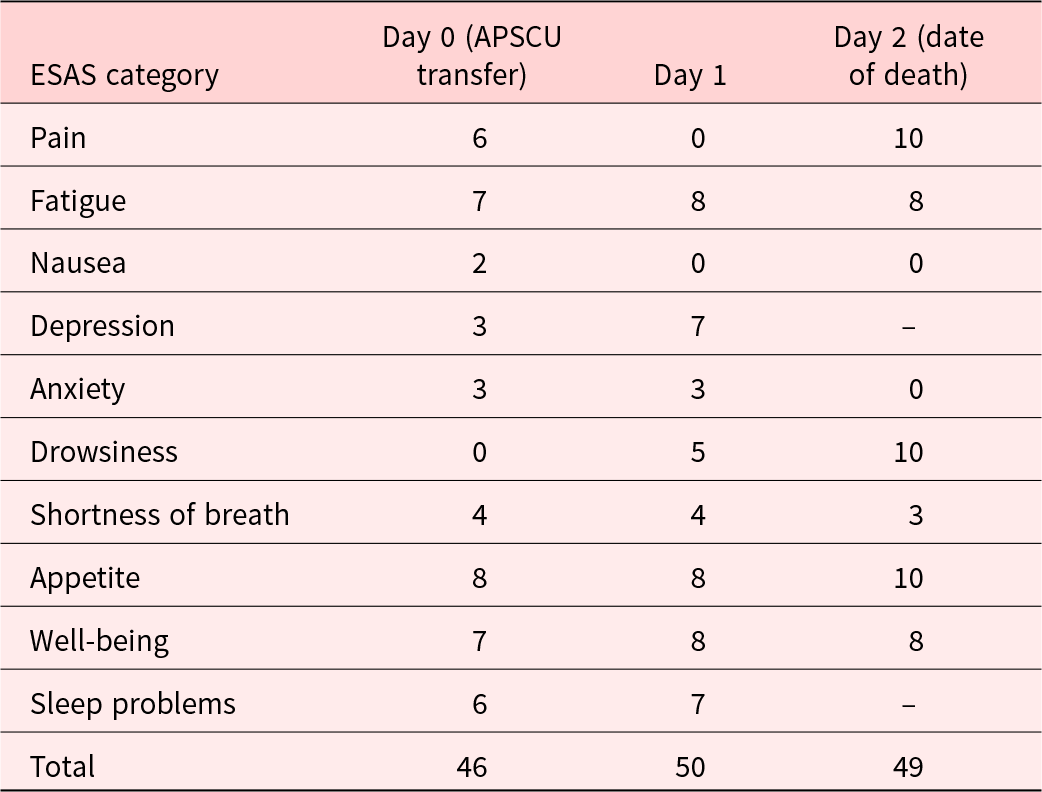
Upon admission, the patient had no evidence of delirium, major depression, or anxiety; however, she reported significant pain and fatigue (Table 1). Ms. J expressed to us that she was ready to die and at peace with her fate and that she desired to hasten her death. She had already made plans to stop eating and drinking that day, sharing that she planned to notify her family of her decision that evening. She mentioned a desire to be asleep until she died and regretted not living in a place where physicians could legally aid in her request. She stated, “I’m done” multiple times. She explained that she had completed her purpose in life, having raised happy children and concluding a successful career. She described her cancer journey, noting that she initially felt as if she would “beat” her disease. She then transitioned to continuing to pursue further treatment to appease her family. She compared her recent life to a game of “Whack-a-mole,” in which each time a new problem came up, it was “whacked” away, but that she was the one suffering the hit each time.
She had 2 clear goals: to “stay clean” and “as pain free as possible.” She appreciated having strong religious faith guiding her decisions, confident that she “[would] be in a better place” after death. Our chaplain inquired if she was still experiencing hunger. When she affirmed that she was, he questioned whether this was God’s way of signaling to her that it is not time yet to die. She voiced concerns over being a burden to her family at home, having witnessed her own mother’s struggle to care for her grandmother prior to her death. When asked what her goals were in leaving the APSCU, she declared that she would like to leave “in a body bag.”
Ms. J’s ESAS scores while under our care in the APSCU

APSCU = acute palliative and supportive care unit; ESAS = Edmonton Symptom Assessment System.
We left our first encounter taken aback by the calm certainty with which she spoke. We felt her prognosis was weeks to months and that she would be discharged from the hospital with home hospice services. We felt that we had just begun discussions with her, and we were looking forward to further exploring her wishes and reaching a disposition plan that would meet her needs.
Overnight, however, Ms. J developed worsening delirium and became less responsive. We initially attempted to treat her condition with an opioid rotation and intravenous fluids; however, she continued to deteriorate throughout the day. During periods of intermittent lucidity, she initially declined palliative interventions such as supplemental oxygen, concerned these would prolong the dying process. She required repeated reassurances that these were intended to ease suffering and would not prolong her life. As her family came to her bedside, they said their final goodbyes, and she asked them to leave. She died that evening, choosing to be alone.
Discussion
Our initial reaction to Ms. J’s blunt declarations was a mixture of awe and discomfort. We interpreted her confidence as an opportunity, choosing to push past any unease and further explore her reasoning. While we initially felt her prognosis would allow a discharge home, she was confident she would die on our unit. While there have been prior presentations of cases of premonition of death (Bramati et al. Reference Bramati, Aldana and Bruera2023a), given her high functional status the day before her death, her swift decline was unexpected. We almost felt that she willed herself to die.
Our approach was to encourage elaboration by posing open-ended questions. Exploration is an important first step when confronted with a DHD, with failure to do so potentially causing the patient to feel more isolated, judged, or abandoned (Branigan Reference Branigan2015). This initial approach also allows distinctions to be made between the emotional acceptance of death and a DHD, with the latter indicating distress worthy of further evaluation. Our goal was to elicit the reasons Ms. J was expressing a wish to die and work toward easing any fears. While we did not overtly attempt to reverse her mindset, we reassured her that we would continue to be there for her and support her in the ways that we could. We worked on building rapport and aligning our goals with hers during our initial encounters. Our interdisciplinary team provided a multi-faceted approach, including physical, psychosocial, and spiritual support. At our institution, the APSCU team provides this diversity, allowing us to address suffering from multiple perspectives.
When a DHD is voiced, a thorough evaluation of suffering is indicated. Uncontrolled physical symptoms, including pain, insomnia, or shortness of breath, should be addressed. While some studies have shown a higher physical symptom burden in those with a DHD (Mystakidou et al. Reference Mystakidou, Parpa and Katsouda2005, Reference Mystakidou, Parpa and Katsouda2006), others have demonstrated no worse physical symptoms (Crespo et al. Reference Crespo, Rodríguez-Prat and Monforte-Royo2020). Further studies have failed to demonstrate a decrease in a DHD despite better pain control (O’Mahony et al. Reference O’Mahony, Goulet and Kornblith2005), suggesting that addressing physical symptoms alone may be insufficient. Psychosocial and existential distress may contribute to a DHD a greater degree (Hudson et al. Reference Hudson, Kristjanson and Ashby2006). Notable psychosocial components include depression, loss of purpose or dignity, and the fear of being a burden to others (Kremeike et al. Reference Kremeike, Frerich and Romotzky2020; Robinson et al. Reference Robinson, Kissane and Brooker2017).
In requesting hastened death, patients may be calling for recognition of their suffering or attempting to regain their autonomy in an otherwise helpless situation (Leboul et al. Reference Leboul, Bousquet and Chassagne2022). Our patient also had a plan to voluntarily stop eating and drinking, often seen as an effort to reclaim control (Rodríguez-Prat et al. Reference Rodríguez-Prat, Monforte-Royo and Balaguer2018). Another approach may be to allow patients reasonable choices within their care, such as choosing between 2 pain regimens or further decreasing clinical monitoring, as able. Ms. J also voiced fears of becoming a burden on her family and losing her dignity as her physical condition declined. In such situations, a family meeting may be a useful intervention to discuss how to provide increased support for the patient and main caregivers near the end of life (Dev et al. Reference Dev, Coulson and Del Fabbro2013).
When present, addressing hopelessness and treating depression is indicated (Breitbart et al. Reference Breitbart, Rosenfeld and Pessin2000; Parpa et al. Reference Parpa, Tsilika and Galanos2019; Rodin et al. Reference Rodin, Lo and Mikulincer2009). If the prognosis allows, starting treatment for depression with pharmacologic and psychotherapy interventions is appropriate. There are multiple, well-studied techniques that help address the underlying psychological factors contributing to a DHD. Group and individual meaning-centered psychotherapy includes 8 dedicated sessions to help patients find meaning in their lives. It has been observed to increase quality of life as well as decrease anxiety, hopelessness, and the DHD (Breitbart et al. Reference Breitbart, Rosenfeld and Pessin2015, Reference Breitbart, Pessin and Rosenfeld2018). Dignity therapy is another method, consisting of a set of questions intended to guide a conversation with a therapist and recorded to provide tangible legacy work. Studies looking at dignity therapy have shown improvements in quality of life, spiritual well-being, and depression (Chochinov et al. Reference Chochinov, Kristjanson and Breitbart2011). Logotherapy is an approach involving multiple sessions focusing on exploring values and needs and setting goals rooted in the philosophy that humans can find meaning under all circumstances. In both individual and group settings, it has decreased loneliness and anxiety about death (Heidary et al. Reference Heidary, Heshmati and Hayes2023). Finally, managing cancer and living meaningfully (CALM) therapy uses 4 domains in a semi-structured fashion to address both practical and existential issues to help patients remain engaged despite living with advanced cancer. CALM has been shown to reduce depressive symptoms and death anxiety while improving spiritual well-being and end-of-life preparation (Sethi et al. Reference Sethi, Rodin and Hales2020). When time is limited, as in the case of Ms. J, interventions based on mindfulness allow connection to the present, enhancing patients’ ability to cope and reducing depressive symptoms (von Blanckenburg and Leppin Reference von Blanckenburg and Leppin2018).
We believe the correct approach is to begin by listening and enquiring rather than providing information intended to sway the patient’s opinion. Clinicians often choose the path of medicine to heal and cure rather than relieve suffering. When Ms. J decompensated, our reflex response was to try and reverse this process. It is tempting to return to the roots of our training, medicalize, and focus on biomedical aspects while forgetting the ruthless reality of death. At the end stages of a chronic disease, our treatment decisions do not meaningfully alter the natural course. Often simply being present and providing empathic listening are the most therapeutic interventions we can offer. In these moments, it is paramount to explore thoughts, validate feelings, and emotionally support our patients and their caregivers. What Ms. J needed the most on her dying day was reassurance that we were respecting her wishes and not prolonging her life. Asking for help and debriefing with other members of the interdisciplinary team can help providers to process stressful encounters (Bramati et al. Reference Bramati, Swan and Urbauer2023b).
Conclusion
A wish for a hastened death is prevalent in the cancer population. Although it is debated whether it should be screened for, once declared, treatable contributing factors should be addressed, including psychological, social, and physical suffering. There is no clear method of approaching a patient with a DHD, but engaging in open discussion, addressing symptoms, and considering the return of patient autonomy are indicated.
Author contributions
A.A. contributed to conception; K.M.A. wrote the manuscript; A.A., K.M.A., and D.G.G. provided the patient care; A.A., D.G.G., and E.B. edited and gave final approval.
K.M.A. and A.A. contributed equally to this work.
Funding
This research received no specific grant from any funding agency in the commercial or not-for-profit sectors.

 Open access

