


While PHEP is a relatively young field, with investment in current systems and infrastructure largely spurred by the 2001 terrorist attacks, increasing disaster risk has brought it into focus.Reference Downey, Brown and Calonge1,Reference Nelson, Lurie, Wasserman and Zakowski2 The recent COVID-19 pandemic highlighted the need for a capable workforce to prepare for and respond to public health emergencies. Yet, professional competencies for the workforce have not been updated since 2010, despite recognition by the developers of those competencies that these models have a 3-5 year life span.Reference Ablah, Weist and McElligott3 A concurrent shortage of PHEP-specific training programs may preclude the development and sustainability of a robust workforce. A 2021 review of educational institutions found only 29 of 191 CEPH-accredited schools have at least 1 program focused on public health training.Reference Randazza, Vickery and Archer4 In light of the dynamic knowledge and skills needed by the PHEP workforce and opportunity to develop training to prepare the workforce accordingly, updated competencies are urgently necessary.
The current US-based PHEP-specific competencies are at least 10 years old. The field itself has changed significantly with evolving approaches, including learnings from the COVID-19 pandemic response and greater emphasis on equity and community partnerships as core elements in preparedness and response.5 Shifts in the field have been highlighted through the Centers for Disease Control and Prevention’s (CDC) update of their PHEP capabilities in 2018, followed by the development of the Public Health Response Readiness Framework, to reflect the changing needs, standards, and demands in PHEP practice.Reference Martinez, Talbert and Romero-Steiner6, Reference Noelte, Kosmos and McWhorter7 In addition, those who work in preparedness may have distinct skill sets than those who participate in a response, and existing PHEP competencies do not make this distinction.
CDC supported Columbia University researchers in the development of a set of competencies (i.e., knowledge, skills, and abilities) for the public health workforce in emergency response in 2002. The researchers solicited input through a Delphi panel of 59 public health and emergency preparedness professionals as well as focus groups with local, state, and federal workers, producing a set of 9 annotated core competencies.Reference Gebbie and Merrill8 In 2007, Hites, et al. posited that training gaps still existed and worked to fill gaps in the initial list through cross-referencing local preparedness and response training objectives.Reference Hites, Lafreniere and Wingate9 The study produced a set of 10 competencies with several objectives within each.
In 2010, the Association of Schools of Public Health, with support from CDC, set out to establish observable and measurable PHEP competencies for the workforce in the US.Reference Ablah, Weist and McElligott3 The 18 competencies from this initiative reflect the results from a 3-round Delphi-like panel of academics and practitioners from federal, tribal, state, and local public health.Reference Ablah, Weist and McElligott3 The competencies sit under 4 domains: model leadership, communicate and model information, plan for and improve practice, and protect worker health and safety.Reference Ablah, Weist and McElligott3
In response to the urgent need to revise the competencies, this study aims to develop a set of competencies that reflect the current needs of the PHEP workforce that can be refined with additional input from the practice and academic communities. This initiative aims to address competencies of specialized preparedness employees (i.e., the PHEP workforce), as well as any staff member who may be assigned to an organizational response structure, rather than basic knowledge for all public health employees.Reference Walsh, Altman and King10
Methods
Recruitment
A purposive sample of PHEP professionals from local and state public health agencies of varying size across all 10 Health and Human Services (HHS) regions was taken. Participants (n=26) were contacted based on their leadership experience in the PHEP workforce (i.e., 3+ years) to ensure adequate knowledge of PHEP practice. Recruitment emails included a standard description of the study and its benefits.
Data Collection
Data was collected in the context of 5 focus groups with 2-5 participants each. Focus groups have successfully been used in studies with similar goals of ascertaining gaps and needs in the workforce.Reference King, North and Larkin11 A focus group facilitation guide with questions on the general needs of the public health workforce for both preparedness and response (Supplement 1) was used to structure the discussion and was adjusted after the first focus group.
Focus groups were hosted and recorded using the Zoom video platform and lasted 1 hour. Participants provided verbal consent for participation and audio recording after hearing a standard consent script. Audio recordings were professionally transcribed and reviewed to ensure accuracy and de-identification by a team member. Data were stored in a secure drive.
Analysis
AM used NVivo 13 (2020, R1) to inductively code transcripts, identifying unique concepts from the data (Supplement 2), formalizing them into “codes,” and applying those codes to subsequent similar concepts throughout the transcripts. Following coding, subcodes of “preparedness” and “response” were applied to coded text. Coded text was reviewed, entered into a matrix, and synthesized to develop competency domains. This study was deemed exempt by the University of Washington Human Subjects Division (STUDY00017809) on April 26, 2023.
Results
Seventeen individuals participated, with 6 from state agencies and 11 from local agencies. Agencies from all 10 HHS regions were represented. Participants’ median years of experience in PHEP was 16.
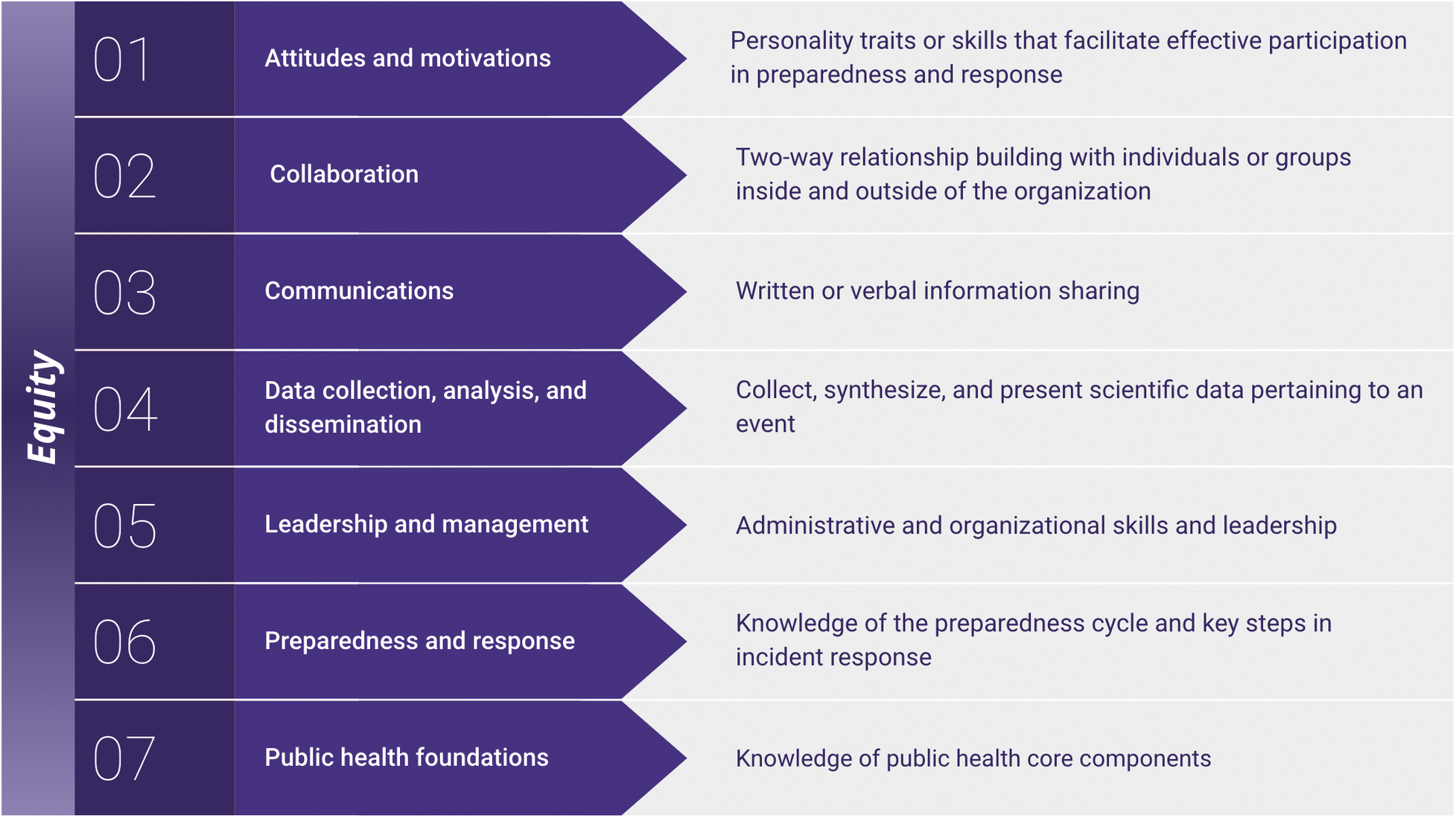
This study identified 7 “competency domains” from the focus group discussions (Figure 1). Equity was a cross-cutting theme that was reflected in all domains. Each domain includes information for both those who contribute to preparedness (i.e., the PHEP workforce) and those who contribute to response (i.e., potentially any public health staff).
Competency domains.
Attitudes and Motivations
Preparedness: The ability to adapt skills and attitudes to meet the needs of different challenges and situations was a common point across the focus group discussions. Participants also noted that the workforce must be willing and able to improve upon and learn new skills.
Response: The workforce must utilize stress and change management in a demanding, dynamic environment. The ability to acknowledge one’s own strengths and limitations was a key attribute that participants described. In addition, the workforce must maintain a commitment to equity and community needs, even in a high-stress environment such as a response setting.
Collaboration
Preparedness: Participants discussed the importance of collaboration with internal team members and external partners to build sustainable relationships, with a focus on advancing equity and social justice through these relationships. Part of this involves developing and mobilizing coalitions to reach a common goal, as well as obtaining buy-in from a diverse range of external partners related to prioritizing public health principles in emergency preparedness.
Response: Participants described building and maintaining trust within teams and with external partners. Demonstrating cultural competency during a response, as well as recognizing and leveraging skill sets and strengths among collaborators, were identified as critical.
Communications
Preparedness: Participants discussed the need for practitioners to communicate effectively, including the ability to organize written information for dissemination, as well as communicate within and across sectors. Practitioners must be able to contribute to situational awareness through inter-agency information sharing of both sensitive and non-sensitive information, as well as communicate clearly to leadership. Practitioners must also negotiate and resolve conflict diplomatically and acknowledge one’s positionality when communicating to those outside of their organization. Educating and advocating for public health preparedness to internal and external partners was another important ability discussed.
Response: Communications skills during a response are similar to those needed for preparedness, with an emphasis on quickly developing protocols and community education materials. Participants noted that practitioners must harness risk communications skills and tailor public health information to the appropriate audience.
Data Collection, Analysis, and Dissemination
Preparedness: Participants described a need for workers to conduct internal and external assessments to identify gaps, needs, and areas for improvement in preparedness. The ability to identify community-specific needs and strengths was highlighted as important. Practitioners must be able to share and present data for effective decision-making.
Response: Participants noted that public health responders must quickly gather information and critically evaluate the quality of data.
Leadership and Management
Preparedness: Participants described necessary leadership skills to include organizing and leading diverse teams and creating an environment that supports mental and physical wellbeing. Participants discussed the need for members of the PHEP workforce to adapt and implement processes and achieve creative solutions with limited resources during the preparedness phase. Other skills included planning, managing, and prioritizing projects and writing and managing grants. Practitioners must also demonstrate working knowledge of administrative and political PHEP needs.
Response: Participants noted that managing a response requires using creativity in problem solving to maximize resources, as well as adapting and expediting administrative processes. Leaders must lead in all directions - both vertically and horizontally.
Preparedness and Response
Preparedness: Participants discussed contributing to a range of planning efforts (e.g., response, contingency, and transition planning), including the ability to identify and implement culturally responsive strategies in planning and ensure community representation. They also highlighted managing resources and supply chains, as well as identifying and addressing areas for improvement. The ability to create and implement internal training and exercises effectively and collaboratively is also critical.
Response: Managing and tracking resources and deployments, utilizing and adapting existing protocols, and considering and anticipating the implications of decisions were all identified as important skills. Similar to preparedness, practitioners emphasized the ability to quickly identify and address areas for improvement.
Public Health Foundations
Preparedness: Participants discussed the importance of having foundational public health knowledge. In particular, practitioners must understand public health principles. To advance equity and social justice, practitioners need to identify social determinants of health and other factors that could exacerbate existing disparities during a disaster. The PHEP workforce must also know the structures of state, local, and federal health jurisdictions and how they interact, as well as how public health integrates into broader emergency preparedness activities.
Response: All public health workers need to know public health roles and responsibilities and how these fit into an emergency response.
Limitations
Participant recruitment used the professional networks of the research team. This allowed for targeted recruitment to gain insights from participants with known experience in the field. However, the small sample size limits the generalizability of findings. The researchers aim to collect input from a broader range of participants in a subsequent project phase. Some focus groups only had 2-3 participants due to several no-shows. This may have limited the inherent benefits of the focus group methodReference Powell and Single12 as well as altered the dynamics within those focus groups. However, the smaller focus groups still provided rich discussions of the topic.
Discussion
These findings indicate evolving needs of the PHEP workforce and associated competencies to adequately address emerging, complex challenges that practitioners face. This study further identifies divergent knowledge, skills, and abilities required for preparedness compared to response, and that competencies should be described as such.
The discussions with current practitioners provided insight into existing shortcomings in the PHEP workforce. While the domains of the 2010 competencies align with some of those identified in this study, participants discussed a few additional competency domains that might enhance PHEP workforce readiness. Specifically, they highlighted the importance of equity and an appropriate attitude and did not emphasize personal preparedness, a contrast to the 2010 competencies. Moreover, they identified the need for specific attributes among the PHEP workforce to prevent and mitigate burnout incited by the pandemic. For example, participants in this study emphasized the need for team members to exhibit flexibility and resilience through challenging situations.
Beyond what was reported in the results, participants discussed implementation for competency development and cited the importance of previous response experience to ensure appropriate expectations for incoming staff. While less critical for participants, training modules (e.g., Incident Command System) were deemed helpful as well. These findings parallel a similar study among CDC staff for whom didactic training was helpful for learning the basics and topical areas, but experiential learning through exercises, shadowing, and first-hand experience was invaluable when going beyond the basics.Reference O’Meara, Sobelson and Trigoso13
Conclusions
This study presents a list of preliminary competencies for the current PHEP workforce, as well as those for general public health staff that may serve in a response. These can be used to inform both education and training for incoming and current PHEP practitioners and all public health staff to ensure effective and equitable preparedness for response to disasters and emergencies. Future steps of this initiative include a comprehensive comparison between the competencies identified in this study and those previously established, namely the Public Health Preparedness & Response Competencies,Reference Ablah, Weist and McElligott3 Core Competencies for Public Health Professionals,14 the Core Competencies for Disaster Medicine and Public Health,Reference Walsh, Subbarao and Gebbie15 and competency models in related fields of disaster medicine and mental health.Reference King, Burkle and Walsh16, Reference King, Larkin and Fowler17 The competency list will then follow a design similar to previous competency development methodologiesReference Subbarao, Lyznicki and Hsu18 and undergo a validation process with a group of experts as well as a broader practitioner and academic audience.
Supplementary material
The supplementary material for this article can be found at http://doi.org/10.1017/dmp.2025.10068.
Author contribution
Ashley Moore contributed to the conception of the project, development and execution of methods, and writing and editing of the manuscript. Resham Patel contributed to the conception of the project, development and execution of methods, and writing and editing of the manuscript. Nicole A. Errett contributed to the conception of the project, development of methods, and editing of the manuscript.
Acknowledgements
The study team acknowledges and appreciates the contributions of Misty Robinson, Southern Nevada Health District; Sundée Winder, Louisiana Department of Health, Office of Public Health; Nate Weed, Washington State Department of Health; Nick Solari, Public Health – Seattle & King County; Karla Combs-Black, Kent County Health Department, Grand Rapids, MI; Cheryl Peterson-Kroeber, Minnesota Department of Health; Bryan Damis, Texas Department of State Health Services; Raymond Barteet, South Carolina Department of Health and Environmental Control Lowcountry Region; Andrew Pickett, Pennsylvania Department of Health; Melissa Marquis, West Hartford-Bloomfield Health District.
Funding statement
None.
Competing interests
None.


 Open access

