

Introduction
As in the previous year, the worldwide Covid-19 pandemic crisis dominated Portuguese politics in 2021. The government was also an official holder of the presidency of the Council of the European Union (EU) for the first semester of the year.
Despite the Covid-19 pandemic, presidential and local elections took place. Notwithstanding considerable negotiations with the other parties, particularly the Portuguese Communist Party/Partido Comunista Português (PCP) and the Left Bloc/Bloco da Esquerda (BE), the Socialist minority government could not get the budget approved. Therefore, early legislative elections were called for the end of January 2022.
Election report
The Presidential Election of 24 January 2021
The campaign for the presidential elections, held in January 2021, started in December of the previous year. The incumbent President, Marcelo Rebelo de Sousa, decided to run for a second time. Rebelo de Sousa was quite a popular President as the regular opinion polls consistently showed that he was the best-placed politician throughout his five years (Expresso, 22 January 2021). Although he was close to the centre-right Social Democratic Party/Partido Social Democrata (PSD), he was quite pragmatic and able to work with the incumbent Socialist minority government of Prime Minister Antonio Costa. Despite differences, both politicians solved many problems through a pragmatic cohabitation.
Overall, there were seven presidential candidates, most endorsed by parties represented in the unicameral national Parliament, the Assembly of Republic.
The incumbent minority Socialist government decided to support Rebelo de Sousa officially. However, unofficially part of the party also endorsed Ana Gomes. She was a member of the Socialist Party/Partido Socialista (PS) and a former Member of the European Parliament between 2004 and 2019.
The main opposition party, PSD, supported Rebelo de Sousa because it was the party's candidate. The conservative Democratic Social Centre-People's Party/Centro Democrático Social-Partido Popular (CDS-PP) also endorsed the incumbent President.
The BE fielded Marisa Matias for the presidential elections. She had been a member of the European Parliament since 2009. The Communists also endorsed its own candidate, João Ferreira, a Member of the European Parliament since 2009, contesting similar issues as the BE.
The two new right-wing parties in Parliament, Enough/Chega! and Liberal Initiative/Iniciativa Liberal (IL) also presented their own candidates. The candidate of IL was Tiago Mayan Gonçalves, who promoted mainly liberal political and economic topics. He was a newcomer and not regarded as part of the establishment. André Ventura, the candidate of the radical right Chega!, was quite loud about national issues. He tended to trade insults with the left-wing BE and other politicians. Ventura is a charismatic leader looking for votes from disaffected sectors of the population. His nationalist discourse mainly targeted the Roma and Sinti communities, and he exploited the prejudices of some groups of voters against them.
Opinion polls predicted that Rebelo de Sousa would win the presidential elections with over 60 per cent of the votes cast. The big unknown was the level of abstention, which had been on the increase, and which candidate would be in second place, fearing that the populist Ventura might get more votes than the Socialist candidate Ana Gomes. All the other candidates were predicted to gain a minor share of the vote.
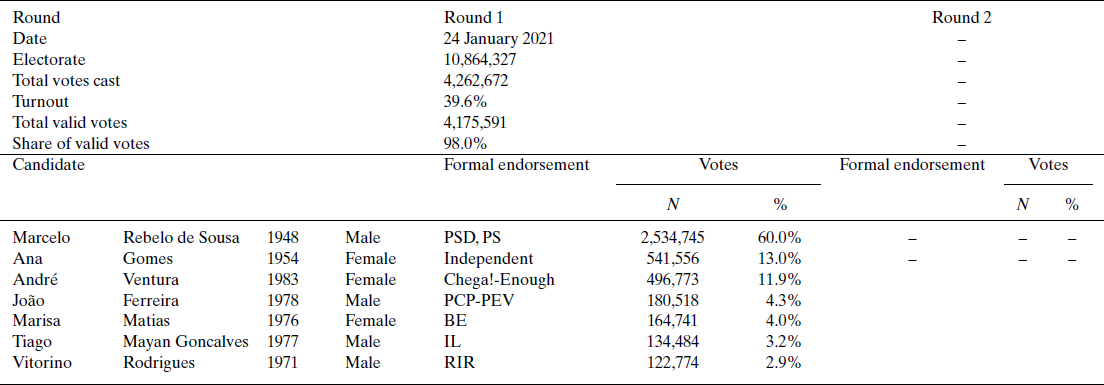
On 24 January, Rebelo de Sousa won comfortably with 60.7 per cent of the vote in the first round (see election results in Table 1). This meant that he was re-elected for the presidency.

The socialist Ana Gomes was able to get second place with 12.97 per cent of the vote. Although the populist André Ventura was just in third place, he got a respectable 11.9 per cent of the vote. Such a victory was regarded as a defeat by all other parties. Ventura got almost half a million votes from an electorate of 10.8 million. In comparison with the 2019 legislative election, he increased his voters sevenfold. This result was a big success for André Ventura and his party.
The other candidates got just a tiny share of the vote. On the left, João Ferreira (PCP) obtained 4.62 per cent, and Marisa Matias (BE) obtained 3.95 per cent. On the right, Tiago Mayan Goncalves (IL) got 3.22 percent. Vitorino Rodrigues (more popularly known as Tino de Rans), leader of the extra-parliamentary green party React–Include–Recycle (RIR, in Portuguese – the acronym means ‘to laugh’), got 2.94 per cent of the vote.
Abstention was higher than support for all the candidates together. In total, 60.76 per cent of eligible voters did not cast a vote. In other words, the candidates were backed by just 39.24 per cent of potential voters. The President of the Republic, Rebelo de Sousa, was elected with the vote of 23.3 per cent of registered voters. Such a result is undoubtedly a significant problem for the legitimacy of Portuguese democracy. With the rise of right-wing populism and the fragmentation of the vote, Portugal is entering a more turbulent phase of politics (Ministerio de Administração Interna, 2021a).
Local elections on 26 September 2021
The political parties began preparing for the local elections scheduled for the end of September throughout the year. Portugal consists of 308 municipalities. For each city, a mayor (presidente da camâra) and the municipality assembly members are elected. Moreover, members of parish assemblies are also elected.
Although the dynamics of local elections are always specific to each municipality, the results are used as an indication of the support held by the national government at the municipal level. If there are significant losses, this may impact the political dynamics at the national level.
Throughout the year, the main discussion was if the Covid-19 pandemic would delay the elections. In the end, the elections took place on 26 September 2021, as planned.
The incumbent Socialist government was keen to repeat the same success as in the 2017 local elections, when they were first in 159 municipalities and with an absolute majority in 148 (Magone Reference Magone2018: 236). Therefore, the pressure was not on the incumbent Socialist government but on the main opposition party, the PSD, under leader Rui Rio. He had to show that he has able to win elections against the incumbent Socialist Party. So far, his electoral record was not very good, and he needed success to silence the opposition against him within the party. Like in previous elections, the PSD teamed up in certain municipalities with the conservative CDS-PP and other smaller right-wing parties.
On the left, the PCP and BE were keen to stop their electoral decline at the local level. The new parliamentary parties Party Persons, Animals and Nature/Partido Pessoas, Animais e Natureza (PAN), Chega! and IL struggled to field enough candidates throughout the country. This fact was particularly problematic for Chega!, which relied too much on the leader André Ventura and had failed to establish a proper national and local structure.
On the day of the elections, the incumbent Socialist government held most of their municipalities. The Socialist Party received 34.22 per cent of the vote (3.6 points less than in 2017) and 148 (–11) city presidencies. There was also a decline in the number of municipalities where the Socialists won an absolute majority to 124 (–18). In contrast, the PSD got 23.24 per cent (partly shared with the CDS-PP) and improved slightly from 98 to 103 presidencies. In another 10 municipalities, the PSD won as part of a centre-right coalition. Overall, it was a positive result for the PSD party leader Rui Rio. Probably, the most significant win was the capital Lisbon. The former European Commissioner Carlos Moedas ran against the Socialist incumbent Fernando Medina and was able to become the mayor of the capital. Also, Coimbra and Braga were won by a PSD-led coalition. In Oporto, the independent movement of Rui Moreira, supported by centre-right parties, was able to win the municipal elections and re-elect its candidate for the presidency.
On the left, the Communists got 8.21 per cent of the vote (–1.24 per cent) and held on to 19 municipalities (–5). This confirmed the continuing decline of the PCP-PEV at the local level. On the right, the conservative CDS-PP got 1.5 per cent of the vote (–1.09) and hold on to six municipal presidencies. As already mentioned, the CDS-PP worked closely with the PSD so that it was able to support other centre-right candidates elsewhere.
The small parliamentary parties BE, Chega!, IL, Free/Livre (L) and PAN got no municipal presidency, just seats in the local assemblies.
In Madeira, the citizen's party Together for the People/Juntos Pelo Povo (JPP), based in Santa Cruz, was able to hold on to the local presidency. Originally, JPP was a citizens group based in Santa Cruz, however they decided then to become a party. Independent lists got 5.54 per cent (–1.25 per cent) and were able to gain control over 19 municipalities (+2).
Overall, the moderate winner of the local elections was the centre-right PSD led by Rui Rio. The big prize for the PSD was gaining the presidency in Lisbon. Turnout was 54 per cent – higher than in presidential elections (MAI 2021b).
Cabinet report
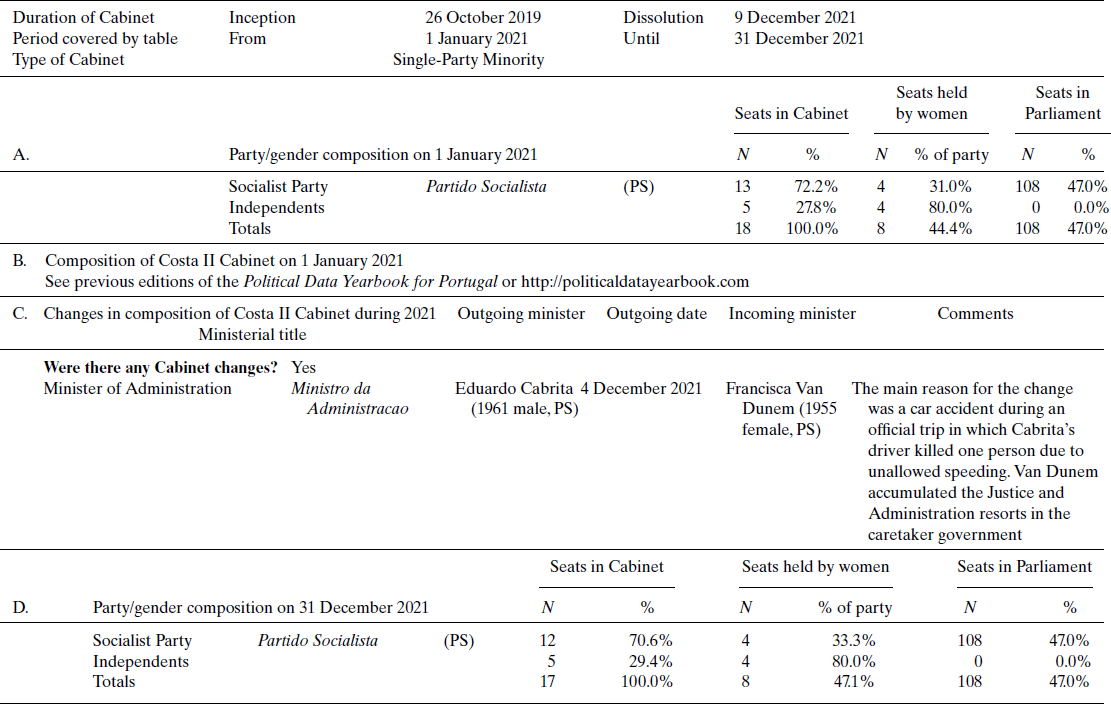
For Cabinet composition data, see Table 2
Cabinet composition of Costa II in Portugal in 2021

Note: The government became a caretaker government on 9 December 2021.
Source: Governo de Portugal (2022).
Crisis management of Covid-19
After the Christmas and New Year holidays, a new wave of Covid-19 infections seriously challenged the ailing health system. The government decided to introduce a significant shutdown at the beginning of the year which was only relaxed in spring. In February, the German government sent medical staff and material supporting the Portuguese fight against Covid-19 provided by the Bundeswehr (the German armed forces). Just in March, there was finally a relaxing of the restrictive measures. Covid-19 would continue to affect economic and political life, but management was substantially improved throughout the year. Portugal implemented an aggressive vaccination campaign, achieving a rate of over 80 per cent of the population.
The Portuguese presidency of the EU
On 1 January, the Portuguese government became the official holder of the Presidency of the Council of the EU. The Portuguese presidency was integrated with a trio with Germany and Slovenia. The presidency has mainly a managerial role in pushing forward the legislative process. The previous German presidency (second half of 2020) had already solved all the complex topics, such as the Brexit dossier leading up to the Trade and Cooperation Agreement between the EU and the UK. Probably the most essential dossier was the final negotiations of the multiannual framework 2021–27 leading up to the additional Next Generation Funding with a package of €750 billion.
Therefore, the Portuguese presidency was a transitional managerial one without significant highlights. However, Prime Minister Antonio Costa was able to organize an exceptionally acclaimed Social Summit in Oporto on 7–8 May. Although the Social Summit was just symbolic, it enhanced the visibility of the EU as a social union as well. At the summit's core was how the EU could successfully implement the European Pillar of Social Rights adopted during the Jean Claude Juncker Commission. Costa has been an essential protagonist in supporting a social dimension of the European internal market (for more information, see Portuguese Presidency of the Council of EU, 2021).
Negotiations with Brussels over the EU recovery and resilience plan for Portugal
In July 2020, the European Council negotiated the new Multiannual Financial Framework (MFF) for 2021–27. Additionally, a unique temporary program called Next Generation provided €750 billion to invest predominantly in green technologies and digitalization. Most of the funding consisted of grants, and just a minor part of loans.
From this package, the Southern European countries received the largest share, particularly Italy and Spain, which had suffered considerably under Covid-19. Such extra funding was achieved after the intensive lobbying of Italy and Spain. Portugal's share amounted to €16.6 billion (€13.9 billion in grants and €2.7 billion in loans). The Portuguese government had to present a viable Recovery and Resilience Plan (RRP), which was approved by the European Commission on 6 June 2021. The European Commission attached very stringent conditions to how the money should be spent and monitored. Moreover, the conditions included reforms in public administration, budgetary policy and the wider public sector, particularly the ailing public companies such as the Portuguese airline TAP (Expresso, 7 May 2021: 8–9).
There were significant criticisms about the way the plan was put together. Apart from the fact that it was centralized around the prime minister, there was a lack of consultation with key stakeholders. Only after the intervention of President Rebelo de Sousa did the government increase the funding for the capitalization and modernization of private enterprises. There was no input from the five indirectly elected regional commissions of development. In short, the plan was biased toward investment in public infrastructures, reproducing past patterns in Portuguese politics (Expresso, Economia 7 May 2021: 16–17; 27 November 2021: 11).
Conflict between the Minister for Defence João Cravinho and the top hierarchy of the military
During May and June, a conflict broke out between the top hierarchy of the military and Minister for Defence João Cravinho, who wanted to centralize the top commando of the armed forces by reducing the power of the top commanders of the three military branches (army, air force and navy). The top military echelon protested against the plans of the minister. Some of the concerns were addressed by Parliament in the bill called Basic Law for the Organization of the Armed Forces (abbreviated as Lobofa), which was promulgated by the President of the Republic on 9 August 2022.
A second conflict erupted at the end of September when the Defence Minister wanted to replace one of the top commanders by suggesting somebody else to the President of the Republic. In the end, President Rebelo de Sousa had to intervene in order to calm down the military.
Dismissal of the government by President Rebelo de Sousa and new early elections
After the rejection of the budget for 2022 (see Parliament report), and after consultation with the political parties and the advisory Council of State, President Rebelo de Sousa called for early elections. After 9 December, Costa's executive became just a caretaker government until the next government after the general elections of 30 January was formed.
Parliament report
The rejection of the budget for 2022
In 2015, Prime Minister Antonio Costa was able to form a parliamentary pact with the left-wing parties, the PCP and the BE, to sustain him in power over the following four years. As a condition, President Anibal Cavaco Silva asked all parties to sign a document committing themselves to positively contribute to political, economic and, above all, budgetary policy stability.
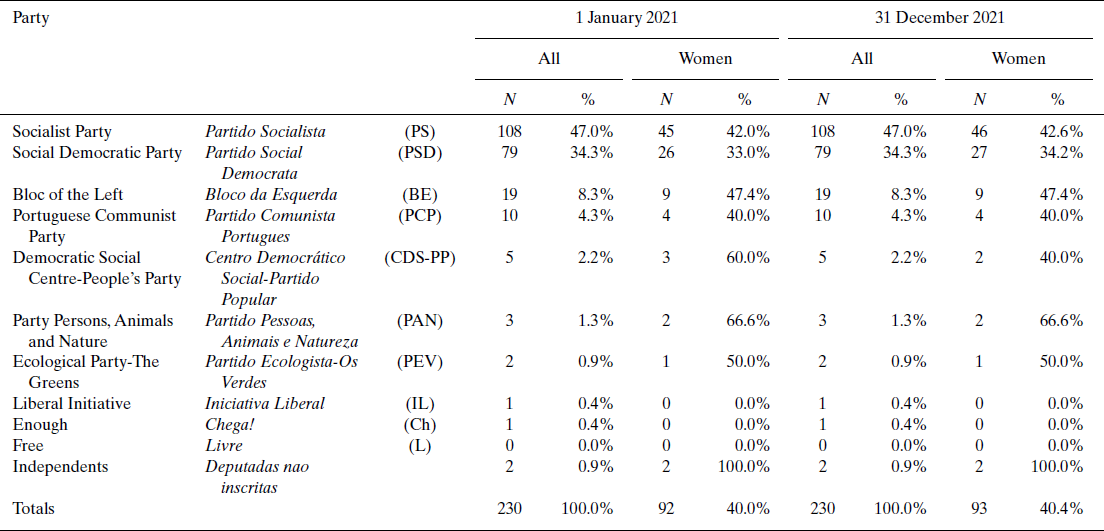
For Parliament composition data, see Table 3.
Party and gender composition of the Parliament (Assembleia da República) in Portugal in 2021

Notes: There are no MPs for Livre because the only one MP became an independent.
Originally PAN got four seats, but one of them became an independent.
Source: Assembleia da República (2021: 3).
Although at the beginning of the term the Socialists integrated well many left-wing measures supporting the disadvantaged of society proposed by the left-wing parties, by the end of the legislative period it had become more flexible and also worked with the centre-right party PSD.
After the 1999 legislative elections, the relationship between the PS and the left-wing PCP and BE deteriorated. The Socialist government had more seats than before the election, but it was still a minority government that dependent on at least one other left-wing party. The budgets for 2020 and 2021 had already been passed with difficulties. There was a slight possibility that the budget for 2022 would not be approved due to the frustration of the two left-wing parties with the Socialist minority government.
The Socialist minority government tried throughout the year to convince the BE and the Communists (PCP-PEV) to support the proposed budget or, at least, to abstain in the vote. The Socialists had 108 seats, but they needed at least eight more to achieve an approval. The abstention of some parties would lower the threshold for approval substantially.
Both left-wing parties BE and PCP-PEV wanted to extract as much as possible for the less advantaged of Portuguese society. However, Finance Minister João Leão was under pressure from Brussels to reduce the budget deficit that had increased due to growing expenditure during the Covid-19 crisis. In 2021, Portugal had a budget deficit of 5.8 per cent of gross domestic product (GDP) (it should be below 3 per cent according to EU fiscal policy rules) and the third largest public debt in the EU (135.1 per cent of GDP) after Greece and Italy (it should be 60 per cent of GDP) (Eurostat, 2022).
Although the government offered the inclusion in the budget of some of the social measures asked by the Communists, such as a modest increase of pensions by €10 and free kindergarten places, the Communists complained that in the previous budget the government had not implemented the social measures agreed with them. Therefore, they argued they did not see the point of negotiating measures that in the end would not be implemented.
The budget was rejected by Parliament on 28 October. The 108 PS MPs voted for the budget, but 120 MPs from the opposition including PCP-PEV, BE, PSD, CDS-PP, Chega! and LI voted against. Five MPs from PAN and the Independent group abstained.
Everything became even more complicated when the President of the Republic Rebelo de Sousa, who was very keen to keep budgetary stability due to the constraints coming from Brussels, threatened to call early elections if the budget were not approved. After the vote, the credibility of President Rebelo de Sousa was under considerable scrutiny, so, after consultation with the Council of State, he called early elections for 30 January 2022. Parliament was dissolved on 5 December.
Resignation of the Minister for Internal Administration, Eduardo Cabrita, on 3 December 2021
Already during the caretaker period, the Minister for Internal Administration, Eduardo Cabrita, resigned after an inquest found out that his driver on an official tour accidentally killed a bystander while driving above the speed limit. Cabrita was replaced by Francisca van Dunem, Minister for Justice, who accumulated the two portfolios until a new government would come to power after the general elections on 30 January 2022.
Political party report
Leadership challenge in the PSD
The announcement of early elections by President Rebelo de Sousa led to the re-emergence of a leadership contest. Paulo Rangel, a Member of the European Parliament, decided to run in the primaries against incumbent Rui Rio. However, Rio was able to beat Rangel. In total, 36,476 members voted in the primaries, of whom 52.43 per cent voted for Rio. Although Rio remained at the helm of the party, the divisions inside the party became quite evident. Therefore, Rio remained contested during the electoral campaign, which had unofficially begun already in December (CNN Portugal, 30 November 2022).
Throughout the year, opinion polls gave a wide lead to the Socialist Party, with an estimated vote share between 38 per cent and 43 per cent, while the main opposition party was estimated to obtain about 27–32 per cent. The last survey of the year conducted by Expresso on 30 December 2021 put the Socialists at 38 per cent and the PSD at 31 per cent. Moreover, the new populist right party Chega! was predicted to become the third largest party with 7 per cent. The left-wing parties PCP-PEV and BE were at 6 per cent and 5 per cent, respectively. The new LI would improve their previous results with 4 per cent, while the green PAN and the conservative CDS-PP would get just 2 per cent each (Expresso, 22 January 2021; Expresso, 30 December 2021: 6–7).
Issues of national politics
The year 2021 was dominated by the presidential elections (January) and local elections (September) (see Election report). Particularly, the local elections were important for the main opposition party PSD and its leader Rui Rio. So far, Rio had difficulties to compete seriously with Prime Minister Antonio Costa and his party.
The main constraining factor was the Covid-19 outbreak at the beginning of the year (see Cabinet report). It affected the electoral process, but also the presidency of the EU in the first half of the year. Moreover, parliamentary work was also affected by the Covid 19 pandemic (see Parliament report).
The rejection of the budget bill in November by most opposition parties created a political crisis. President Marcelo Rebelo de Sousa called for early elections scheduled for 31 January 2022 (see Cabinet report).
Acknowledgments
Open Access funding enabled and organized by Projekt DEAL.

 Open access

