

The beginning of the twenty-first century saw a rapid period of institution-building in regional organisations (ROs) of the Global South. The decade started with the Organisation of American States (OAS) adopting the Inter-American Democratic Charter in 2001. In 2002, the African Union (AU) was established, succeeding the ineffectual Organisation of African Unity (OAU), with its Constitutive Act giving members the right to intervene in grave circumstances of war crimes, genocide and crimes against humanity,Footnote 1 overturning a longstanding non-interference principle that was blamed for the ineffectiveness of the old OAU. In 2004, the League of Arab States established an Arab Charter on Human Rights. In 2007, the ASEAN Charter was established that gave the Association of Southeast Asian Nations (ASEAN) a legal identity for the first time and formalised a set of norms that guided the relations of its members both among themselves and in relation to external states. By 2012, it had adopted the ASEAN Declaration on Human Rights. During this flurry of regional norm-setting, the 2005 World Summit at the UN General Assembly unanimously agreed an array of human rights commitments, including the principle of the ‘responsibility to protect‘ (R2P), as key norms that were universally accepted by its member states.
Yet the period that followed immediately after – involving the first real tests of the extent of these normative commitments in Africa and Southeast Asia – did not result in agreement on the needed courses of action, nor did it establish which norms took precedence in cases of contestation. Instead it exposed the thinness of the commitment to principles such as R2P and considerable disagreement on actions needed in crisis situations.
While AU interventions on the grounds of R2P increased, particularly against non-state actors in Sudan, Somalia, Mali, and so on, this contrasted with the organisation’s stonewalling against intervention in 2011 that would have confronted state actors in Côte d’Ivoire and Libya. While sub-regional organisations such as the Economic Community of West African States (ECOWAS) and the Arab League favoured intervention, and despite the AU’s precedence-setting on the right to intervene as provided for in its Constitutive Act, it nevertheless favoured political mediation and blocked intervention plans in both cases. The (non-)decisions were then overtaken by circumstance as ECOWAS and French forces pushed ahead to intervene directly in Côte d’Ivoire under UN authorisation, while an Arab League-sponsored UN Security Council (UNSC) resolution resulted in NATO intervention in Libya. Meanwhile, despite the acknowledgement of principles of human rights and democratisation in its charter, ASEAN did not change its stance over the longstanding issue of human rights violations in Myanmar, preferring to continue its quiet diplomatic pressures internally, while rebuffing overt pressure externally. Liberal optimism about the inclusion of human rights in the ASEAN Charter dissipated when the ASEAN Intergovernmental Commission on Human Rights and Human Rights Declaration were eventually adopted with no protection, monitoring, or even communication mechanisms.
Taken together, these two sets of observations – rapid formalisation or commitment (possibly short of ‘institutionalisation’) followed by contestation – are difficult for existing theories to explain. Realist theories would have dismissed the charter revisions as ‘theatre’,Footnote 2 pointing out that in actual events, interests would prevail. But that begged the question: Why would member states create new, permanent rules with which they had no intention of complying, and the superficiality of which would be exposed as soon as an actual crisis occurred? How could Muammar Gaddafi, representing one of the ‘big five’ donorsFootnote 3 to the OAU, fail so utterly to achieve his aims of influence in his region? A liberal constructivist account might have described the new Constitutive Act or ASEAN Charter as the tipping point of a norm cascade that would lead to a deepening of respect for human rights and progressive norms, but how could this cascade stumble at virtually its first hurdle in two different regions? Institutional isomorphism would at best explain the creation, but leave the problems of implementation as anomalous or the organisations lacking political will in its theory – without an adequate theoretical treatment of ‘political will’. These puzzles lead to deeper theoretical questions. What explains the acceptance and rejection of norms challenging sovereignty in regional organisations? If structural conditions of member equality hold in the formal rules of the organisations, how do actors exercise differences in power to achieve their normative aims? Further, what normative trajectories or path dependencies develop out of the nature of contestation that takes place, particularly norms that challenge sovereignty?
This book examines the practice of normative contestation over sovereignty in the AU and ASEAN. Norm contestation refers to the ways in which actors ‘dispute the validity, the meaning or the application of norms’.Footnote 4 While increasing attention to normative contestation has taken place in recent years, our understanding still involves several gaps, including the dynamics of contestation in two major regional organisations of the Global South.
In international relations, theories about normativity are young, having emerged barely twenty years ago.Footnote 5 The first wave of norm theorists investigated normative development within a liberal post-Cold War order and, facing a realist orthodoxy, were more concerned with demonstrating that norms had a significant effect at all. With the overarching order ensconced by the collapse of communism and global US hegemony through the 1990s, norms studied in this period seemed to point to the norm ‘cascade’ theory driven by ‘norm entrepreneurs’,Footnote 6 as developed by Risse, Ropp, and Sikkink.Footnote 7 In these models, contestation is a characteristic at the start of the process, but is overcome by the actions of norm entrepreneurs who eventually remove obstacles in a ‘cascade’.
Whereas challenges to this theory emerged,Footnote 8 the alternative models continued to presume the existence of the liberal order, such as that of Amitav Acharya, who offered ‘norm localisation’, a theory on how transnational norms might take root, without investigating where or how the transnational norm originates (perhaps taking a norm cascade as given).Footnote 9 Other approaches to contestation searched for contestation within the meaning of broader norms,Footnote 10 but again such a framework assumed the norm to already be widely accepted, with only the specifics to be determined. Finally, Wiener identifies contestation as an output to fill a legitimacy gap that exists because of tensions between broadly accepted fundamental norms and actually existing rules and practicesFootnote 11 – but permits few pathways to investigate challenges to fundamental norms and requires a specific circumstance (that a legitimacy gap is the fundamental problem facing contestants) and ontological assumption (that competing norms are reconcilable), incongruent with the cases that will be presented.
Non-constructivist approaches such as realist or rational choice theories were relatively uninterested in the qualitative content of norms. Realist approaches are premised on the notion that ‘the logics of consequences dominate the logics of appropriateness’,Footnote 12 i.e. that self-interested, calculated behaviour in the pursuit of states’ goals trumped norms as predictors of their behaviour. Rational choice theories that used mathematical models required cases where cost-benefit analysis was quantifiable, i.e. ‘the conflicts of interest over the distribution of those adjustment costs’,Footnote 13 treating preferences exogenously, and with relatively firm rules of enforcement. Norms that were ambiguous, hard to quantify, or weakly enforced were difficult to model under such conditions.
The contents of political norms were thus left relatively unexplained in realist or rationalist models. Whereas both approaches offered useful tools that might have been brought to bear on the question of norms, namely power (realism) and utility and preference ordering (rational choice), the disinterest left normativity theories in international relations to largely be dominated by discourse analysisFootnote 14 and constructivists,Footnote 15 and thus focused on persuasion or diffusion as mechanisms for transmission.Footnote 16 The efforts to demonstrate normative change, however, left resistance and contestation unexplained: at best they were failures of the scope conditions for change; at worst, they delivered teleological accounts with Whiggish interpretations of history.
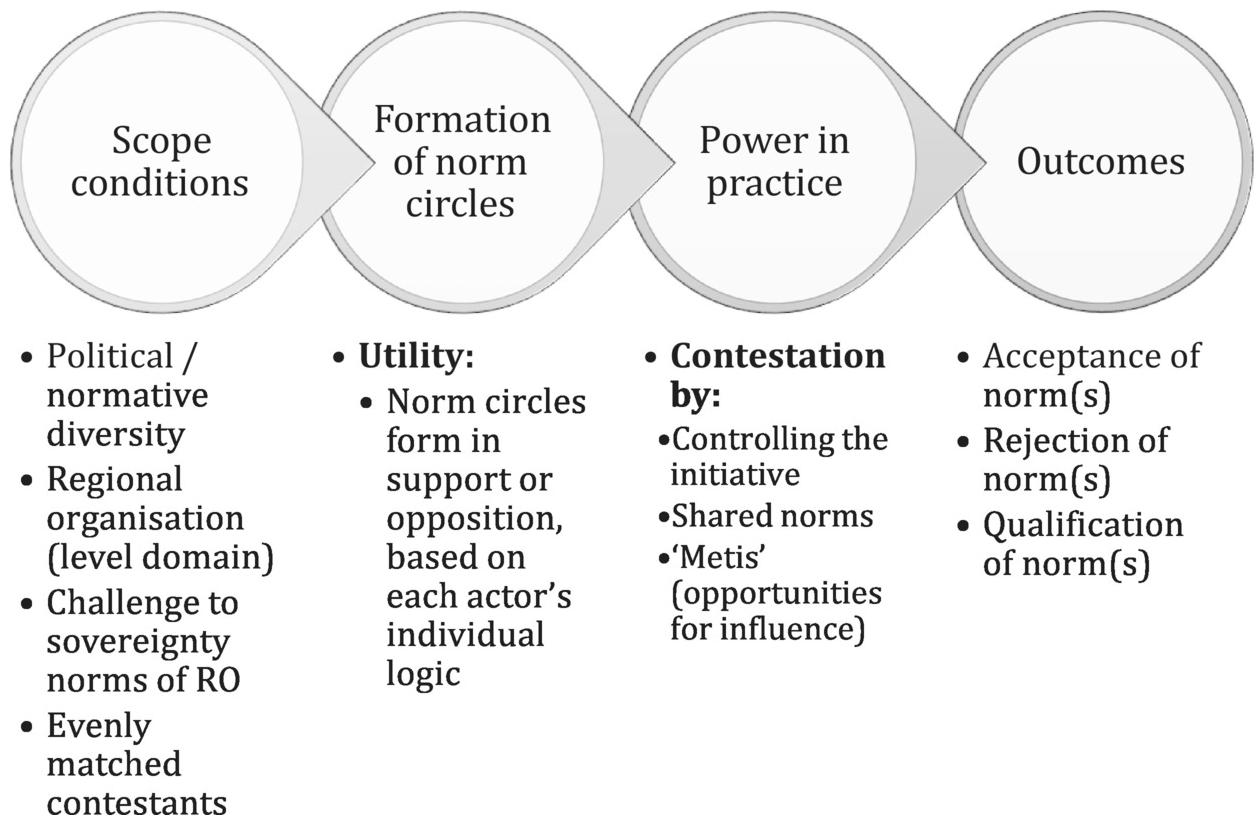
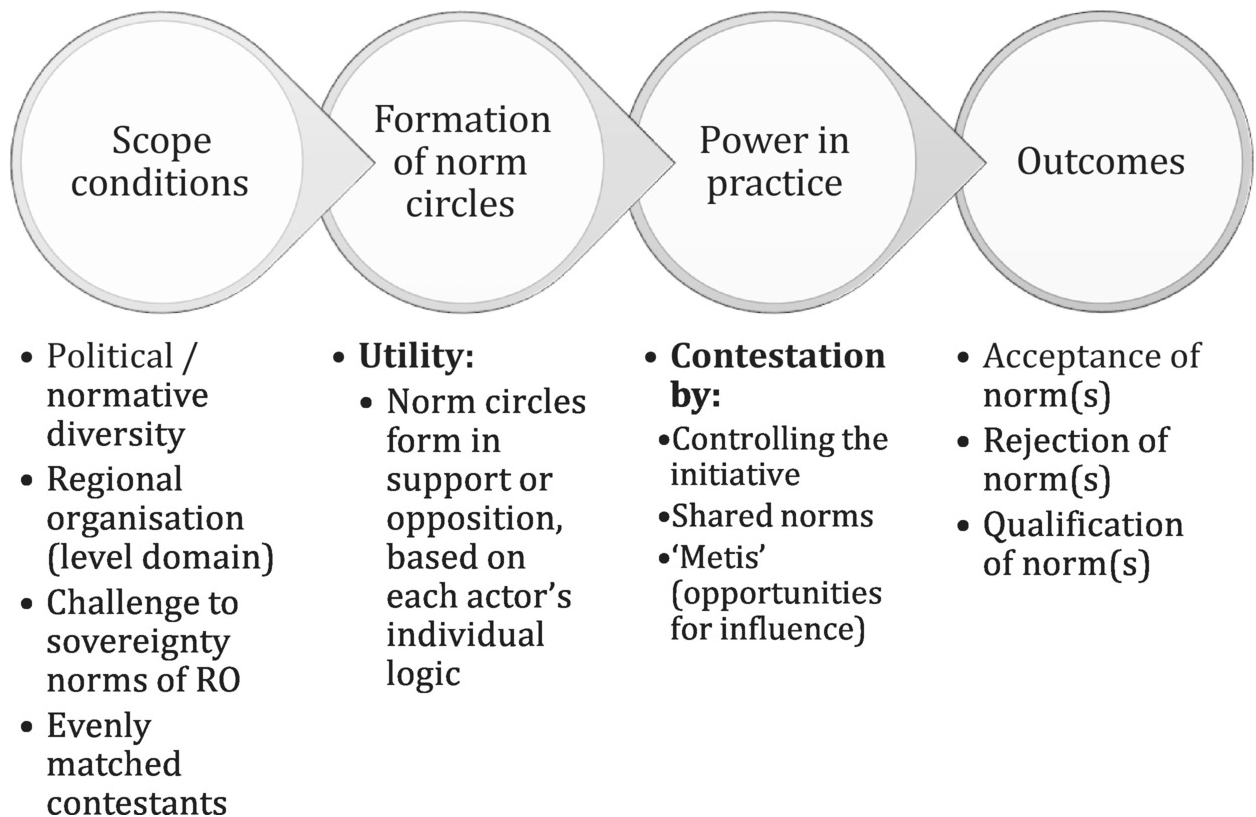
There is now an increasing literature on norm contestation, particularly starting from the recognition that norms contain ambiguities that allow space for contestation.Footnote 17 What these studies hold in common is that effective normative opposition must draw on different sources for legitimacy to contest the norm in question. The practices and presumptions of both protagonists and their opponents must be impartially investigated to understand the outcomes that result. Presuming an overarching normative order tends to skew results, which is precisely why this book focuses on contestation – the ‘critical practice with the purpose of participating in the process of negotiating normativity’.Footnote 18The argument of this book is that in politically diverse ROs where material inequalities are relatively constrained (such as through funding rules, consensus decision-making processes, or individual member votes), when contestation arises, successful norms are determined by a relational notion of power driven by practice (see Figure 1.1). First, a proposal is made that invokes or implies certain norms. Norm circles form according to different actors’ perceived utility of the norms (in relation to their national interests). Next, the competing norm circles contest: if the difference in size is overwhelming, it is unlikely that the smaller norm circle will put up much resistance. However, with more moderate differences in power (especially where domain rules like consensus decision-making provide minority states with significant degrees of power), then the contest is determined by the exercise of competence along three lines: (1) controlling the initiative, (2) the mastery of other shared norms of that domain, and (3) metis, the actors’ skill in ‘obtain[ing] the maximum number of effects from the minimum force’,Footnote 19 that uses contingent opportunities to wield influence and change social relations – in particular, the weight of opinion or distribution of norm circles in favour or opposition to the norms.
Model of contestation.
In searching for a space that is both contested and normative, I have chosen regional organisations in the Global South, wherein normative barriers to entry are thin, and therefore the normative positions of states vary widely. By historical period, I also seek periods of greater normative openness at critical junctures, where norms were rapidly being developed – and two recent periods work particularly well: the transition from the Organisation of African Unity to the African Union from 1999 to 2003, and the period around the establishment of the ASEAN Charter until the ASEAN Human Rights Declaration from 2004 to 2012. The use of ROs from two distinct regions also hopefully avoids the over-specification common in area studies, which obstructs the ability to draw out generalisable characteristics or observations, and sharpens the nature of differentiation between them where variation exists.
Finally, despite studying rather narrow, limited cases of contestation over individual (if sometimes wide-ranging) proposals, each case study has significant implications tracing back to the broad study of regionalism. If the governance of regions is conducted through regimes,Footnote 20 part of which include the clusters of norms that grant regimes both order and legitimacy,Footnote 21 then the study of how these norms came to be accepted or even identity-forming suggests significance beyond the simple explanation of their acceptance, rejection, or qualification. Furthermore, the nature of contestation also suggests important path dependencies in the life cycle of such norms, something that often goes amiss in independent–dependent variable analyses. Given the focus on sovereignty-challenging norm proposals, in studying both failed and successful proposals, this book offers possible explanations for the continued resilience of nation-state sovereignty in a world of regionalisms.
Outline
The current chapter begins with the research question that guides the entire study. This is followed by a review of norms literature, including problems with its application to regional organisations and the Global South more generally. I argue that earlier scholars of normative change have tended to undertheorise opposition to the norm, especially the opposition’s means of resistance and therefore their power, as well as how the norms are selected. In this book, these are central components of the model, though specific to the domain. Chapter 2 then constructs the theoretical framework, stressing an anti-foundationalist account of how norms are selected. This avoids privileging some norms, or treating the preference as fixed and entirely exogenous. I then consider how groups of norm followers or proponents emerge, which I introduce through the ‘norm circle’ following sociologist Dave Elder-Vass. This permits the further specification of several variables, such as their size, power, and their competence in a given domain.
I argue that ‘competence’ is measured by the respective norm circles’ performance in three key areas: (1) controlling the initiative, (2) their mastery of shared norms, and (3) their ability to identify and exert opportunistic possibilities for influence, including bringing material factors back into play, given that the domain of the RO ostensibly excludes this or maintains a putative equality of members. These therefore form the key set of independent variables that affect the outcome of the cases.
I then turn to investigating the two regional organisations – the AU and ASEAN – giving a brief background to their respective normative trajectories, given their historical experiences. From this I select six cases – three from each organisation, and with one of three outcomes: acceptance, rejection, or qualification – for norms that tested the sovereignty of the member states of the RO. The six empirical case studies then follow as individual chapters (3 to 8).
Chapter 9 brings in a comparative lens to look at the relevance of the different factors across the two regions, drawing from all six case studies. It also reviews the empirical evidence against the model’s deductive inferences. The Conclusion (Chapter 10) considers the wider implications of this study against several themes in international relations. First, it shows that competing norms usually represent competing logics that are difficult to reconcile, and this has considerable and underrecognised implications for several linear theories of normative and institutional change. Second, it draws from this notion to the wider impact on comparative regionalism, with the observation that an era where political and economic logics are not aligned will be highly contested. Third, it discusses the impact that contestation has on legitimacy. Finally, it closes with some policy implications.
Norms Literature
Norms are the building blocks of institutions, but before we can investigate institutional change through norms, it is worth exploring theories of normative change. In the 1990s, liberal constructivists faced a realist orthodoxy that asserted that norms did not really matter because ‘clubs can always be trump’,Footnote 22 and this led, among other things, to two characteristics of the empirical cases they studied. First, they sought cases that played down the importance of power, and second, they sought cases where new norms had profound influences on behaviour in international relations. Contested norms tended not to have these characteristics: power was typically a significant factor in contestation, and contested new norms did not necessarily lead to behavioural change, least of all from the norm’s opponents, who may have considered the contest unfinished. Unsuccessful attempts at spreading a norm also went unstudied.
In searching for significant normative change, liberal constructivists sought a ‘winner’ that drove new normative characteristics and behaviours. The most influential theory of norm dynamics suggested that human rights norm acceptance moves through five stages of a ‘spiral’ or ‘cascade’ model: (1) repression, (2) denial, (3) tactical concessions, (4) prescriptive status, and finally, (5) rules-consistent behaviour. Risse et al. argued that the spiral model of human rights adoption might be able to account for broader ‘socio-political change processes, where such change involves norms other than human rights’.Footnote 23 They believed that the phases of their model were shortening, correlating with ‘the growing robustness of international human rights norms and increasing strength of transnational advocacy networks’.Footnote 24
Yet fourteen years later, their review of their case studies was more guarded. By their own admission, some human rights progress has failed, as in the case of Guatemala.Footnote 25 In other cases, such as Uganda, they would surely have withdrawn their claim that President Yoweri Museveni was a ‘“true believer” in human rights’,Footnote 26 as documented by numerous violations in the northern Uganda conflict and the criminalisation of homosexuality. Both Uganda and Guatemala had been cited as examples of states in the latter stages of the spiral, predicting that it was ‘very likely’ that these countries would move from prescriptive status to rules-consistent behaviour regarding human rights.Footnote 27
Instead, they had to deal with setbacks in these and many other cases, including the USA’s use of torture,Footnote 28 while still using the model to argue that the USA eventually returned to a compliant international standard on torture. Conceding they were wrong to expect their model to be unidirectional,Footnote 29 this still left unexplained how normative change in the opposite direction occurred, including what the driving interests, legitimation claims, or assumptions might be for protagonists on the other side. They were also criticised for failing to demonstrate any deepening of human rights changes.Footnote 30
Risse et al. tightened their scope conditions, withdrew their more ambitious claims, but still maintained the salience of their model. However, these beg some questions. Why, if their arguments on the intrinsic properties of the norm are correct,Footnote 31 would human rights progress stall or reverse?Footnote 32 If human rights acceptance is a legitimating factor that drives its acceptance and the global human rights regime is generally strengthening, how can illegitimate acts or pushbacks be carried out so frequently? Under what conditions are norms contested? Thus, models focused on explaining normative change were insufficient for explaining normative contestation, because of their prerequisite for a successful norm to be the subject of analysis. They thus did not adequately theorise resistance to it – a critical question for norm contestation.
A fresh wave of norm research did focus explicitly on norm contestation. Antje Wiener pioneered one aspect of norm contestation, highlighting that the meanings of norms themselves were not fixed and this provided space for disagreements.Footnote 33 Yet Wiener does not tackle the question of how norms succeed or fail, instead using ‘the principle of contestedness as a meta-organising principle of governance’.Footnote 34 For her, the access to contestation drives its legitimacy, and she assumes norm contests can be resolved – an assumption that does not necessarily hold for all cases.Footnote 35 Dietelhoff and Zimmerman suggest another bifurcation between ‘applicatory’ and ‘justificatory’ contestation: applicatory contestation relates to questions about which or whether a norm applies for a given situation, while justificatory contestation looks at what norms the group wants to uphold. The validity of a norm is not questioned under applicatory contestation, but is questioned under justificatory contestation.Footnote 36
Another corrective to the missing theorising of norm resistance comes from Bloomfield’s idea of ‘norm antipreneurs’, ‘actors who defend the entrenched normative status quo against challengers’.Footnote 37 What these cases have in common is a central emphasis on the role of discourse in shaping the norms,Footnote 38 and this leaves relatively interesting questions about power and practice out of the picture.Footnote 39 This emphasis on discourse is not unimportant, but to ignore power and practices would be to overlook what are argued to be central dynamics in, for example, international institutionalFootnote 40 or diplomacyFootnote 41 literature, clearly important characteristics for the study of norms in ROs.
Norms and Power
Risse et al.’s spiral/cascade theory of norm dynamics was probably the most general theory of normative change in international relations, but it tried to explain change without the use of physical power, ascribing influence to the power of the idea, rather than agents. But within a given domain and given the existence of opposition to a norm, power may still be a factor and must be considered accordingly. This section discusses the basis of norm formation to argue that power is intrinsically a part of norms and must be included in a thoroughgoing analysis of normative contestation.
Barnett and Duval define power as ‘the production, in and through social relations, of effects that shape the capacities of actors to determine their own circumstances and fate’.Footnote 42 They further identify four forms of power:
1 compulsory power: the ‘relations of interaction that allow one actor to have direct control over another’;
2 institutional power: ‘when actors exercise indirect control over others, such as when states design international institutions in ways that work to their long-term advantage and to the disadvantage of others’,
3 structural power: ‘the constitution of social capacities and interests of actors in direct relation to one another’; and
4 productive power: ‘the socially diffuse production of subjectivity in systems of meaning and signification’.Footnote 43
These distinctions are important for the study of the establishment of norms, where both the factors for their establishment and their influence tend to be diffuse rather than direct.
As will be discussed later, establishing the domain around the regional organisation delineates institutional and structural power, but suggests the core factors entail forms of productive power. In some cases, institutionalisation of certain norms could be a means of promoting interests through indirect power, which might be understood as embedding an actor’s particular logic of appropriateness over others as a more efficient means of enforcement than physical measures. This nuanced definition of power permits examining the kinds of processes that are overlooked in certain constructivist frameworks.
If norms constrain or enable actors, then changing norms affects the relative distribution of power. While the costs may not be easily quantifiable, this is consistent with the idea that when proposing new norms, there are ‘conflicts of interest over the distribution of those adjustment costs’,Footnote 44 for those furthest from the proposed norms. Norms, once embedded, constitute a diffuse form of power – they form a key component of institutions, defined as ‘systems of established and prevalent social rules that structure social interactions’.Footnote 45 The establishment of norms, then, affects forms of institutional power as defined above.Footnote 46
Thus, if norms affect power relations and attributing power is to politicise it, how are norms generated? Norms, as a component of institutions, comprise elements of both rules and regularities. As Hurrell notes:
[N]orms are identified by regularities of behaviour among actors. Norms reflect actual patterns of behaviour and give rise to expectations as to what will in fact be done in a particular situation … [N]orms reflect patterned behaviour of a particular kind: a prescribed pattern of behaviour which gives rise to normative expectations as to what ought to be done.Footnote 47
A rule may take the logical form, ‘If X, do Y,’Footnote 48 while a regularity would take the form, ‘If X, Y occurs.’ Even a rule to which no one (alive) subscribes would still be a rule – for example, the Babylonian Code of Hammurabi or the grammatical rules of the extinct language Linear B – and requires no intersubjective agreement to exist (though it would need such agreement to be effective, however). As ‘social’ facts, however, norms require intersubjective agreement to have a ‘normative’ character or causal influence. A degree of regularity is thus a necessary component, and the greater its regularity of use, the stronger we would observe that the norm held. Norms can thus be understood to be particular instances of both rules and regularities, that is, equilibria of social expectations. I thus frame a norm as taking the form, ‘If X, one is expected to do Y.’Footnote 49 This leaves open the question of the source of expectation (and its enforcement) which we will look at in the next section discussing norm circles. However, because of the social component not present in conventions or rules, norms occupy a special position in the process of social validation.Footnote 50
Foundational or Anti-Foundational Approaches?
The above formulation renders redundant an additional distinction inserted by constructivists who draw on Fearon (Rule: ‘Do X to get Y’; Norm: ‘Good people do X’)Footnote 51 which sets rules up as instrumentalist (without bounded circumstances) as opposed to norms as ‘moral’ (distinguished from ‘constitutive’ and ‘regulative’ norms, as Searle classifies themFootnote 52). Their source of ‘oughtness’ derives ultimately from morality claims (perhaps via social expectations, whereas this thesis suggests morality is only one of multiple sources of social expectations, and often weaker in pluralist societies), where they understand human rights to be within this subset of moral norms.
Their formulation has several fundamental problems. First, in appealing to morality, they rely on foundationalist principles of natural law in what is purportedly an anti-foundationalist account of norm cycles. That is, trying to explain norms’ success involved a combination of arguments about both the intrinsic properties of the norm (i.e. that humans are destined to accept them as inherently superior), as well as external variables (such as changing preferences through persuasion, building coalitions, and forming a norm cascade). This precludes a theory of norm decline, because the ‘intrinsic’ properties can never dissipate if they are truly intrinsic, and also leads to several contradictions (some mentioned above) and the accusation that they are trying to smuggle in liberal normative values when explaining the global orientation of norms.Footnote 53 The main problem with a foundationalist account of historical norm development is that it privileges ‘good’ norms because morality must be a significant factor, and therefore tends towards the teleological.
Second, in discussing the emergence of norms, Kratochwil observed that ‘all rules and norms are problem-solving devices for dealing with the recurrent issues of social life: conflict and cooperation’,Footnote 54 and growing anthropological research suggests that norms pre-date us as Homo sapiens, being a functional development from the needs of social animals (such as monkeys and apes) to maintain cohesion.Footnote 55 Furthermore, where actors of distinct moral systems meet (for example, Muslims and liberalsFootnote 56), establishing common grounds on utilitarian or contractarianistFootnote 57 rather than deontological principles is more common. Put differently, the incommensurability between different moral systems may be mitigated by agreeing on common goals, rather than trying to reconcile the systems. However, this leaves the normative systems as non-overlapping magisteria. Utility becomes a crucial common language of normative discourse in pluralist settings. If norms exist at the intersection of regularities and rules, and if power drives rule-making, it is utility that drives recurrence, i.e. their regularity: one would not follow or appeal to a norm consistently unless its functions were useful. Anti-foundational approaches are the only consistent means of investigating their spread or contestation without privileging some values.
Even in cases where norm entrepreneurship is an important factor in driving change, utility still plays a role. For example, although the abolition of slavery is often credited to the hard work of abolitionist ‘norm entrepreneurs’,Footnote 58 Mazrui points out that by the late eighteenth century, capitalist economies had already discovered that wage labour was cheaper and more efficient than slave labour, and it is no coincidence that the leading abolitionist states were the most advanced capitalist powers.Footnote 59 News of the Haitian revolution and France’s involuntary abolition of slavery in response would surely have reached British shores, along with the tremendous costs of trying to enforce a slavery regime that the slaves wished to destroy. Thus in empirically observing the establishment and prevalence of norms, their moral content is always only a partial factor in explaining their success (or failure), contingent on other factors that require explaining, even if we have a tendency to ascribe normative change as moral victories. For diverse actors to coalesce around a common norm which they did not hold previously, multiple reasons for the change might be expected.
Recent studies on norm contestation illustrate this point. Sandholtz acknowledges the ambiguity in meaning of norms as a starting point for contestation, then goes further to observe that separate and conflicting bodies of rules can lead to contestation, itself resulting in norm change.Footnote 60 Bloomfield offers ‘norm antipreneurs’ that oppose the standard accounts of progressive activists (‘norm entrepreneurs’), significant for granting opponents of norm entrepreneurs their independent agency.Footnote 61 Gordon introduces elements of law as alternative sources of power in the contest, when authoritarian states use indirect measures in domestic law to suppress human rights activism.Footnote 62 This is expanded in Stimmer and Wisken’s account of norm contestation involving both ‘discursive’ and ‘behavioural’ contestation.Footnote 63 Moses posits two norms – sovereignty and the responsibility to protect – against one another, and reintroduces power, though in a very Foucauldian sense.Footnote 64 Finally, Panke and Petersohn give an account of norm death.Footnote 65 What these studies have in common is that effective opposition to a norm must draw on different sources for legitimacyFootnote 66 to counter the norm in question. The practices and beliefs of both proponents and their opponents must be investigated to understand the outcomes that result.
A measure of a norm’s function is thus expected if norms are constitutive parts of the international order ‘that sustains the elementary or primary goals of the society or states, or international society’.Footnote 67 The corollary is that norm diversity is reflective of what and whose problems they were originated to solve.Footnote 68 If we treat human rights in functionalist terms – as norms that check the relationship between a state and its citizens – the norm’s source of expectation derives not from deontological principles but from different actors’ sets of values and experiences, derived in different ways in pluralist settings. Likewise, while international actors may sometimes make normative decisions based on what they believe to be morally right, they could also make such decisions for instrumental reasons.Footnote 69
It is thus unsurprising that Finnemore and Sikkink recognised domestic mobilisation, regime type, and other structures that shape the nature of power relations in states as key scope conditions.Footnote 70 The emergence of human rights occurs in tandem with changing power relations in a state, the norm and its function (constraining the state) developing together with the mobilisation of actors interested in limiting the state’s power. Yet, in leaving the element of power beneath these conditions untheorised (or attributed largely to the ideational ‘power’ of human rightsFootnote 71), they cannot explain norm dynamics if domestic mobilisation around an external norm does not occur, such as with gay rights struggles in Africa. These tensions they try to resolve by appealing to foundationalist claims (bodily integrity and legal equality of opportunityFootnote 72) of the norms they believe in,Footnote 73 while concurrently trying to explain their ‘success’ in anti-foundationalist termsFootnote 74 – either limiting what they can explain or creating inconsistencies in trying to reach generalisable principles.
Selection, Iteration, and Normativity
Non-foundationalist approaches such as evolutionary models posit that actions that are successful are likely to be repeated, and as they are repeated, they become a norm, avoiding outmoding through disuse. These approaches do not require foundational presuppositions of rationality or morality, since ineffective norms will be selected out of a system (or else the systems themselves collapse and more effective systems remain).Footnote 75 ‘Selection’ in the evolutionary sense could allow for multiple logics to apply, including moral suasion, utility, power, and so on. The reason behind each choice may vary, but it is the repeated iteration of the actions that embed a norm: the consistent preference for a norm (for whatever reason) strengthens it, while failing to select it or to punish non-compliance leads to disuse.Footnote 76 New norms must also fit into an existing ‘norm complex’ of social structures that pre-dates them in order to be selected as solutions.Footnote 77
Rational choice explanations for the existence of norms may be classed in four ways: the coincidence of interests, coercion, cooperation, or coordination equilibria. Coincidence of interest involves private benefits for all parties involved (which may not necessarily be the same). Coercion involves a powerful state threatening or inducing weaker states to follow its lead. Cooperation results from a repeated prisoner’s dilemma in which defection is costly on one side or both. And coordination involves states’ interests converging according to the moves of other states.Footnote 78
The treatment of norms as equilibria in a coordination gameFootnote 79 sheds some light on contestation. In repeated instances of the game, the equilibria giving the greatest Pareto-optimal results should be selected, and demonstrated through practice.Footnote 80 Technically, utility is measured by the actors’ rank-order preferences of the available choices, though because of uncertainty at the decision-making point, one can only have an expected or projected measure of utility.Footnote 81 This suggests that normative contestation could be understood as equilibrium selection problems where multiple equilibria exist. This becomes especially difficult if the actor’s perceived ‘costs’ start to blend into areas such as ideological integrity or social identity, which defy quantification.
While neither evolutionary nor rational choice approaches require social expectation within their models, the norm that proffers the winning strategy or optimal outcome is the one that ought to be followed if the goal is efficiency or maximising utility. Thus, norms that are more beneficial or serve a greater utility than their counterparts (under their models’ scope conditions) are likely to spread and embed themselves. These notions of regularity and selection through utility suggest how norms might spread organically rather than being imposed. Yet the difficulty with these kinds of approaches, especially those involving mathematical modelling, is that they require stable structures in which patterns of relations form. What happens when informality is intentionally built into the process, when there exist more ambiguous relationships between actors, or when the structure itself is endogenous to the contest, is usually not considered amenable to such types of study.
This chapter introduced our puzzle in understanding the advance and retreat of regional checks on sovereignty in the Global South at the outset of the twenty-first century. It then explored the problems in the existing literature with respect to these questions. I argued that power was a significant variable, and that more attention should be given to the iterative character of ‘norms’, requiring repeated selection even if for different reasons (broadly, their ‘utility’ function capable of validity in multiple logics or systems) – that is, an anti-foundational approach. Indeed, the selection of the same norm for very different reasons would arguably demonstrate a strong norm or at least one with great potential. I now turn to constructing the model that will be used to explore the case studies, paying special attention to power, considerations for how it can explain both norm stability and change, and resisting the privileging of certain kinds of norms in order to understand contestation from a more neutral vantage.