





Introduction
Trust in public institutions is widely recognised as a cornerstone of democratic legitimacy (Miller Reference Miller1974). It underpins citizens’ willingness to comply with laws, support public policies, and engage constructively in democratic processes (Hooghe et al. Reference Hooghe, Marien and Pauwels2011; Marien and Hooghe Reference Marien and Hooghe2011; Valgarðsson et al. Reference Valgarðsson, Stoker, Devine, Gaskell, Jennings, Giugni and Grasso2022). A core debate in the study of institutional trust is concerned with its nature, particularly its underlying structure. Previous empirical work has demonstrated that institutional trust – conceptualised more broadly as trust in a variety of public institutions such as the government, the parliament, the civil service, the army, or the police – possesses two seemingly contradictory characteristics. On the one hand, factor analytical studies show that institutional trust is subdomain-specific,Footnote 1 revealing a two-dimensional structure that separates trust in representative institutions (eg political parties) from trust in order institutions (eg the police) (Breustedt Reference Breustedt2018; Fine et al. Reference Fine, Kan and Cauffman2019; Stals et al. Reference Stals, Isac and Claes2024). This means that trust items reflect two underlying attitudes, with people judging groups of institutions ‘on their own turf’ (Proszowska et al. Reference Proszowska, Jansen and Denters2022, p. 510), largely independently of one another. On the other hand, studies departing from item response theory (IRT) show that institutional trust follows a unidimensional hierarchical scale, with order institutions consistently trusted more than representative institutions (Valgarðsson et al. Reference Valgarðsson, Jennings, Stoker, Bunting, Devine, Mckay and Klassen2025; van der Meer and Ouattara, Reference van der Meer and Ouattara2019; Van Deth Reference Van Deth, Zmerli and Van der Meer2017). This means that trust in different institutions appears to tap into the same underlying construct, with institutions differing mainly in their difficulty to be trusted.
Both findings seem to be at odds with each other. While subdomain-specificity demonstrates the independence of trust judgements, the existence of a consistent hierarchy suggests that these trust judgements are interconnected: trust in highly trusted institutions (ie order institutions) are a precondition to trust in less trusted institutions (ie representative institutions). More fundamentally, this tension raises questions regarding the origins of institutional trust structures, as both features resonate with rivalling theoretical perspectives. The subdomain-specificity of trust can be related to the evaluative perspective, which holds that trust is primarily shaped by citizens’ critical assessments of the object’s specific traits and performance (Hardin Reference Hardin2002; Norris Reference Norris2022; van der Meer Reference van der Meer2017; van Elsas Reference van Elsas2015). It implies that institutional trust is object driven. In contrast, the existence of a unidimensional hierarchy corresponds to the expectations of the socialisation perspective. This approach assumes that institutional trust is shaped by the broader political culture and societal narratives, which establish a shared ranking of inherent institutional trustworthiness, largely independent of current institutional performance (Bandura Reference Bandura1977; Inglehart Reference Inglehart1997; Jennings et al. Reference Jennings, Stoker and Bowers2009). It implies that institutional trust is not object driven but ‘an outcome of subjects’ structural and cultural tendencies to be trusting or distrusting’ (van der Meer and Ouattara Reference van der Meer and Ouattara2019, p. 2998).
The development of institutional trust structures plays a critical role in shaping citizens’ capacity to engage with political institutions and, ultimately, in sustaining democratic functioning. That is, democratic legitimacy relies on the presence of vigilant and critical citizens who actively scrutinise institutions and demand accountability from political incumbents (Lenard Reference Lenard2008; Norris Reference Norris2022). Evaluative trust, which emerges from independent assessments of institutional performance, supports such critical engagement. In contrast, unreflective, socially transmitted trust may foster acceptance of institutional authority without scrutiny, potentially reducing accountability. Indeed, if trust structures are largely socialised rather than evaluative, citizens may adopt non-critical trust judgements. This would highlight the need for educational and socialisation strategies that encourage youth to critically assess institutions rather than merely following social scripts. Understanding how and when the structure of institutional trust develops is therefore crucial for assessing which of these two frameworks dominates, or whether they can somehow coexist.
Adolescence, a formative period marked by cognitive, social, and political maturation (Jennings and Stoker Reference Jennings and Stoker2004; Torney-Purta Reference Torney-Purta2004), offers a unique window into this development. Recent studies show that adolescents’ trust levels are considerably more volatile than those of adults (Devine and Valgarðsson Reference Devine and Valgarðsson2024) and that their dispositional baseline of trust has yet to crystallise (la Roi et al. Reference la Roi, van Alebeek and van der Meer2025). Examining adolescents therefore allows us to infer patterns that are likely to persist into adulthood (Devine and Valgarðsson Reference Devine and Valgarðsson2024; la Roi et al. Reference la Roi, van Alebeek and van der Meer2025). If the evaluative approach holds, the subdomain-specificity of institutional trust should not yet be visible at an early age, but appear gradually as individuals acquire more political knowledge and exposure to the performance of institutions. If the socialisation approach holds, the blueprint for institutional trust should be evident early in life, with young adolescents already adhering to a uniform, hierarchical trust pattern based on cultural narratives.
While existing research has explored this question, significant gaps remain. First, most studies on trust formation among adolescents have concentrated on the development of trust levels rather than trust differentiation (Hooghe et al. Reference Hooghe, Marien and de Vroome2012, Reference Hooghe, Dassonneville and Marien2015; la Roi et al. Reference la Roi, van Alebeek and van der Meer2025). This focus treats trust in different institutions as isolated outcomes, overlooking how trust judgements are structured in relation to one another within individuals. Second, while micro-level socialisation through parents, peers, or teachers strongly predicts variation in trust levels among adolescents (Claes and Hooghe Reference Claes and Hooghe2017; Marien Reference Marien2017a; Stals and Ziemes Reference Stals and Ziemes2024), understanding why adults seem to consistently cluster and rank institutions in similar ways, and where this pattern originates, demands a macro-level socialisation framework. Third, earlier work demonstrating that adolescents across various contexts already consistently distinguish between different types of institutions has relied exclusively on cross-sectional data (Fine et al. Reference Fine, Kan and Cauffman2019; Stals et al. Reference Stals, Isac and Claes2024). However, capturing the development of this structure over time to trace socialisation processes at the individual level requires a within-subject design. Finally, existing research has primarily investigated the subdomain-specific aspect while neglecting the hierarchical one. Understanding the empirical tension requires examining both elements in tandem.
The present paper addresses these limitations by examining how the structure of institutional trust develops from early to late adolescence. We use four-wave longitudinal data from the Dutch Adolescent Panel on Democratic Values (DAPDV) (2018–2022), tracking secondary school students from age 12 to 16 (N = 1,092 individuals; N = 3,993 full sample). To examine the structure of institutional trust, we conduct confirmatory factor analysis (CFA) to assess the subdomain-specific aspect and Mokken scaling to assess the hierarchical aspect. In addition, we investigate whether the structure and its development over time varies across relevant sub-groups, defined by school track and political sophistication level (ie political knowledge).
By exploring the origins of this structure, this paper contributes to the literature in two key ways. First, it sheds light on why some public institutions are consistently trusted more than others among the adult population and identifies when this pattern begins to emerge. Second, rather than focussing on micro-level socialisation, it advances a macro-level perspective on political socialisation, deepening our understanding of how dominant cultural narratives shape institutional trust structures similarly across the population and across generations. This knowledge can inform policies aimed at strengthening the relationship between citizens and the institutions that serve them – an essential foundation for a well-functioning democracy.
Literature
Institutional trust: conceptualisation and structure
Institutional trust refers to citizens’ expectations that public institutions will act in ways that serve the public interest and is widely regarded as a vital component of democratic support (Citrin and Stoker Reference Citrin and Stoker2018; Easton Reference Easton1965; Miller Reference Miller1974). It is most commonly conceptualised in relational and evaluative terms: ‘subject A trusts object B to do X’ (Hardin Reference Hardin2002), with ‘subject A’ representing citizens and ‘object B’ referring to public institutions responsible for carrying out collective decisions and services. This definition highlights that trust is shaped by individual predispositions of the trustor and evaluations of the trustee and their performance. In contrast, socio-cultural conceptualisations do not factor in object-driven evaluations. They define institutional trust as a more generalised sense of optimism towards society, rooted solely in the subject’s learned or innate tendencies (Uslaner Reference Uslaner2002).
A key debate in the literature on institutional trust is preoccupied with its structure. Recent factor-analytical studies have established that institutional trust is subdomain-specific (Breustedt Reference Breustedt2018; Fine et al. Reference Fine, Kan and Cauffman2019; Stals et al. Reference Stals, Isac and Claes2024), referring to citizens’ ability to distinguish between different types of institutions when forming their trust judgements. Although these objects are often combined into a single scale under the umbrella term ‘political or institutional trust’, scholars increasingly emphasise that objects differ in nature and that trust in them may reflect distinct underlying attitudes. Empirical studies show that trust in a variety of institutions is best represented by a two-factorial rather than a unifactorial structure (Breustedt Reference Breustedt2018; Dalton, Reference Dalton2004; Newton and Zmerli Reference Newton and Zmerli2011; Norris Reference Norris2022; Rothstein and Stolle Reference Rothstein and Stolle2008). Citizens mostly differentiate between the representative institutions (eg the government and political parties), responsible for drafting legislation, and the order institutions (eg the police and judiciary), tasked with implementing laws and maintaining public order. Whereas the former group is generally perceived as partial, representing specific segments of the population, the latter is seen as impartial, serving all citizens equally (Rothstein and Stolle Reference Rothstein and Stolle2008). Further conceptual refinements differentiate between security institutions (eg law enforcement and the military) and legal institutions (eg courts) based on the unique role of the former in exercising the legitimate use of force and between nation-state institutions and supranational institutions (eg the European Union and the United Nations) (Mari et al. Reference Mari, Gil de Zúñiga, Suerdem, Hanke, Brown, Vilar, Boer and Bilewicz2022; Norris Reference Norris2022).
At the same time, however, IRT studies have shown that trust in different public institutions tends to be structured along a one-dimensional, hierarchical scale of perceived trustworthiness (Newton and Zmerli Reference Newton and Zmerli2011; van der Meer and Ouattara Reference van der Meer and Ouattara2019; van Elsas Reference van Elsas2015; Zmerli and Newton Reference Zmerli, Newton, Zmerli and van der Meer2017). This means that citizens consistently regard some institutions as more trustworthy than others, but produce similar rankings, resulting in a single, ordered scale. In general, citizens tend to place greater trust in order institutions than in representative institutions, with politicians trusted the least (Newton and Zmerli Reference Newton and Zmerli2011; van der Meer and Ouattara Reference van der Meer and Ouattara2019; van Elsas, Reference van Elsas2015; Zmerli and Newton Reference Zmerli, Newton, Zmerli and van der Meer2017). This pattern likely reflects the perception of order institutions as impartial enforcers of universal values and the rule of law, whereas representative institutions are more overtly politically aligned and therefore evoke greater skepticism (Rothstein Reference Rothstein2011). Accordingly, trust in different institutions appears to tap into the same underlying construct, with institutions differing mainly in their difficulty to be trusted rather than evoking fundamentally distinct attitudes.Footnote 2
Both findings represent an inherent tension. While subdomain-specificity implies that people substantially distinguish between institutions – clustering and evaluating them independently based on their distinct characteristics – the existence of a shared hierarchy suggests that trust objects can still be treated as interchangeable indicators of institutional trust, some simply requiring a higher threshold of trust than others.
Trust structure formation among adolescents
While both the subdomain-specific and the hierarchical aspects of institutional trust have been well established in adult populations (Breustedt Reference Breustedt2018; Ouattara Reference Ouattara2025; Rothstein and Stolle Reference Rothstein and Stolle2008; van der Meer and Ouattara Reference van der Meer and Ouattara2019; Zmerli and Newton Reference Zmerli, Newton, Zmerli and van der Meer2017), relatively little is known about their origins and development over time. This is remarkable, as both aspects imply distinct origins and developmental trajectories of institutional trust, each corresponding with a dominant yet competing theory of trust formation: the evaluative and socialisation approach.
The evaluative perspective posits that institutional trust arises from citizens’ critical assessments of institutional performance and output, rather than being a stable trait inherent to the trustor (Hardin Reference Hardin2002; Norris Reference Norris2022; van Elsas Reference van Elsas2015). In this view, citizens should ‘cautiously trust but verify’, meaning to ‘arrive at reasonably accurate and informed predictions about future actions by agents based on their past performance’ (Norris Reference Norris2022, p. 5). Empirical studies show that while citizens are prone to perceptual biases in trust judgements, their institutional trust still reacts to external developments such as political crises, corruption, and democratic quality (Bowler and Karp Reference Bowler and Karp2004; Citrin and Stoker Reference Citrin and Stoker2018; Devine and Valgarðsson Reference Devine and Valgarðsson2024; Mauk Reference Mauk2021; Norris Reference Norris2022; van Erkel and van der Meer Reference van Erkel and van der Meer2016). The subdomain-specific nature of institutional trust reinforces this view by illustrating how citizens differentiate between clusters of objects, using subdomain-specific information, evaluations, and benchmarks.
In contrast, the socialisation perspective argues that institutional trust is primarily a characteristic of the trustor, rather than the trustee. According to this view, trust is not a result of rational evaluations of institutional performance, but rather a learned and stable disposition shaped by cultural norms and values (Bandura Reference Bandura1977; Easton and Dennis Reference Easton and Dennis1969; Inglehart Reference Inglehart1997; Jennings et al. Reference Jennings, Stoker and Bowers2009). During the impressionable years, individuals internalise culturally ingrained perceptions of institutions imparted through family, school, the media, and broader societal contexts (Neundorf and Smets Reference Neundorf and Smets2017). As a result, they learn which institutions are inherently trustworthy or untrustworthy, regardless of their actual performance or output. In other words, this tradition argues that trust judgements reflect what citizens believe institutions are, rather than what they do. The hierarchical, unidimensional structure of institutional trust aligns with this perspective, as it shows a stable, socially learned ranking of institutional trustworthiness that persists independently of short-term institutional performance.
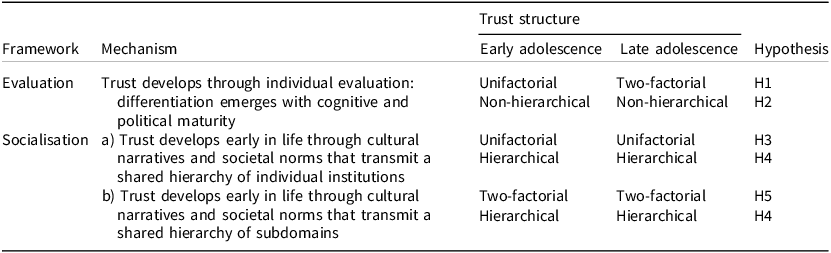
The two theoretical frameworks imply distinct pathways for the development of institutional trust structures during adolescence. From the evaluative perspective, object differentiation is expected to emerge only in late adolescence, as cognitive and political development enables more critical and sophisticated evaluative processes (Hardin Reference Hardin2002). In early adolescence, when individuals have limited first-hand experiences with institutions, they may perceive them as one and the same, trusting them to a similar degree. This undifferentiated trust structure could also reflect generalised trust or non-attitudes (Converse Reference Converse and Apter1964). Importantly, such lack of differentiation also implies a lack of hierarchy: there would be no commonly shared ordering of institutions. As individuals reach late adolescence, increased exposure to political discourse and institutional performance will likely foster a more subdomain-specific trust structure. However, this structure is not necessarily hierarchical. Individuals differ in their evaluative skills and may therefore assign different levels of trust to institutions without consistently ranking them along a single trust scale. In other words, evaluation does not lead to a shared hierarchical structure. Building on this evaluative framework, we hypothesise that various institutional trust indicators should converge on a single latent factor without exhibiting a consistent rank order during early adolescence. As individuals mature, however, trust is expected to evolve into a two-factorial structure, nonetheless remaining non-hierarchical due to variability in evaluative capacities.
Hypothesis 1: Institutional trust follows a unifactorial model during early adolescence, but a two-factorial model during late adolescence.
Hypothesis 2: Institutional trust has a non-hierarchical structure during both early and late adolescence.
The socialisation perspective, by contrast, emphasises the role of macro-level, cultural values in shaping trust structures. From an early age, individuals are exposed to societal norms and cultural narratives that assign varying levels of trustworthiness to different institutions (eg Inglehart Reference Inglehart1997; Jennings et al. Reference Jennings, Stoker and Bowers2009). As a result, trust differentiation is expected to emerge earlier than suggested by the evaluative approach. Early adolescents, having internalised these cultural judgements, are likely to differentiate between institutions in ways that foster a stable and hierarchical pattern of institutional trust. Accordingly, institutions primarily differ in their difficulty to be trusted, while still reflecting one underlying trust construct. We therefore expect trust structures to follow a unifactorial and hierarchical pattern during both early and late adolescence:
Hypothesis 3: Institutional trust follows a unifactorial model during both early and late adolescence.
Hypothesis 4: Institutional trust has a hierarchical structure during both early and late adolescence.
Although the literature often presents the subdomain-specific and hierarchical nature of institutional trust as mutually exclusive features, empirical evidence suggests that they can coexist (Breustedt Reference Breustedt2018; van der Meer and Ouattara Reference van der Meer and Ouattara2019; Zmerli and Newton Reference Zmerli, Newton, Zmerli and van der Meer2017). While this appears paradoxical, we argue that early macro-level socialisation can simultaneously transmit a hierarchical order of institutions and subdomain-specific differentiation. More specifically, adolescents may develop distinct trust attitudes towards the representative and the implementing side of the political system, as these subdomains have unique roles and responsibilities, while also consistently ranking order institutions higher than representative institutions based on cultural narratives. In this sense, the hierarchy exists between the two subdomains of institutional trust rather than between individual trust objects. Under a purely evaluative assumption of institutional trust, such coexistence would only be plausible under two rather unlikely conditions. The first condition would be the presence of consistent, objective performance differences between both subdomains, coupled with the assumption that all citizens – regardless of their political sophistication or experience– perceive and evaluate these differences in equivalent ways. While this assumption unlikely holds among adults, it is even more unlikely among (early) adolescents, who generally lack direct experience with political institutions and whose evaluative capacities are still developing. The second condition would require that the evaluative benchmarks citizens apply when judging institutional performance (eg fairness, efficiency, and responsiveness) are uniform across the population. Even if such uniformity existed, it would still suggest that the observed hierarchy is not a mere outcome of independent evaluations but reflects culturally transmitted standards. This would further indicate that socialisation processes, rather than evaluative reasoning, underpin the hierarchical ordering of institutional trust. Hence, from this macro-level socialisation reasoning, we expect that from early adolescence onwards, the structure of institutional trust follows a hierarchical (hypothesis 4, supra) and two-factorial structure (hypothesis 5, infra). We therefore derive the following fifth hypothesis:
Hypothesis 5: Institutional trust follows a two-factorial model during both early and late adolescence.
Our main theoretical arguments and hypotheses are summarised in Table 1.
Theoretical predictions for the development of institutional trust structures

Data and case selection
To track the development of the structure of trust, the use of longitudinal data that covers respondents from early to late adolescence, and which includes measures of trust in a variety of public institutions is required. For this reason, we rely on the DAPDV (Huijsmans et al. Reference Huijsmans, Mulder, van Slageren, van Alebeek, van den Berg, Kempen, Rosmalen, ten Dam, van der Meer and van de Werfhorst2024). DAPDV (2018–2024) is a panel study assessing democratic values and attitudes among Dutch adolescents in secondary education from age 12. The dataset includes six annual survey waves, monitoring a single cohort of students – enrolled in different school tracks – from their first to their final year of secondary education. Data collection was carried out by the University of Amsterdam and took place based on a two-stage sampling process, in collaboration with more than forty Dutch schools. In line with the General Data Protection Regulation (GDPR), parental informed consent for participation was required for students under the age of 16.
The Netherlands provides a particularly suitable case for studying the development of institutional trust. As a long-established liberal democracy, it combines stable institutions, comparatively high trust levels, and low corruption (Torcal Reference Torcal, Zmerli and van der Meer2017), creating a context in which adolescents are socialised into a political system widely seen as legitimate. Its institutional landscape clearly distinguishes between order institutions (eg police and judiciary) and representative institutions (eg parliament and political parties), making it well suited to test whether young people already differentiate between these subdomains. Against this backdrop, the Netherlands provides a compelling setting to examine not only whether adolescents differentiate between institutional subdomains, but also whether such differentiation reflects early socialisation or evaluative judgement.
The DAPDV sample consists of 2,354 students in year 1. In subsequent waves, the data include 2105 (wave 2), 1,135 (wave 3), 1,533 (wave 4), 1,472 (wave 5), and 650 (wave 6) respondents (N full sample = 3,993; N panel sample = 456).Footnote 3 The third panel wave experienced a marked drop in sample size, with 53.9% of the second-wave respondents retained. This decline was largely due to disruptions caused by the COVID-19 pandemic, including school closures, which complicated data collection efforts. Additionally, students in the pre-vocational track completed their secondary education after the fourth year and subsequently left the panel. We therefore rely on the first four waves (2018–2022; ages 12 to 16) to test our hypotheses. Given our within-person developmental focus, the main analyses are conducted on a restricted panel sample (N = 1,092), including only respondents that participated in at least three of the four waves. Further details on the panel study, including the mode of data collection, panel attrition, and sample representativeness, are provided in online Appendix C.
It is important to note that the DAPDV data collection has paralleled significant external events. The third survey wave was fielded between March and June 2021, during the partial COVID lockdown and immediately following early parliamentary elections. This may have influenced not only the sample size in wave 3 but also trust in institutional authorities, particularly political institutions. In the years preceding the COVID-19 crisis, political trust had been gradually increasing in the Netherlands (van der Meer and van Erkel Reference van der Meer and van Erkel2024). However, this trend was interrupted by a sharp rise in trust in government in response to the onset of the pandemic in March/April 2020, a shift commonly interpreted as a rally ‘round the flag effect’ (van der Meer et al. Reference van der Meer, Steenvoorden and Ouattara2023).Footnote 4 After October 2020, political trust started to decline again. Although the rally effect has mainly influenced trust in representative authorities, the disruptive impact of the pandemic may have temporarily affected (the structure of) trust in other public authorities.
Measures
To ensure comprehensibility for adolescents – especially 12-year-olds from different school tracks – and comparability across waves, the survey assessed respondents’ institutional trust by referring to four public authorities: judges, police officers, politicians (referred to as ‘people who work in politics’), and the army. This choice of operationalisation means that ‘trust in the army’ is the only item that directly measures trust in an institution. Trust in judges, people who work in politics, and police officers were included instead of trust in the courts of justice, the parliament, or the police, as these terms may be too abstract, especially for younger adolescents. Furthermore, while trust in ‘people who work in politics’ does not directly measure trust in a representative institution, prior research supports its use as a proxy for trust in political parties and, more broadly, trust in representative institutions (Marien Reference Marien2011, Reference Marien, Zmerli and van der Meer2017b). Although this measure may reflect attitudes towards individual actors among adults (eg current incumbents), this distinction is likely less salient among adolescents, who may not consistently separate individuals from institutions in their political perceptions due to limited political experience (Marien Reference Marien2011). In each wave, respondents were asked to indicate for each authority to what extent they agree with the statement ‘I have a lot of trust in…’, using a 5-point Likert scale ranging from ‘Strongly disagree’ (0) to ‘Strongly agree’ (4). Answer category ‘Don’t know’ is coded as missing.
In additional analyses, we examine how trust structures evolve among different groups of students, defined by school track and political sophistication. To measure school tracks, we distinguish between pre-vocational (vmbo) and pre-academic (havo and vwo) students. While most students remain within the same track throughout their entire school career, transitions between tracks are possible. We therefore allow respondents’ school track to vary between waves. However, it must be noted that such transitions are rare, suggesting that the groups based on school track can be interpreted as static.Footnote 5 Students who are in mixed tracks (eg vmbo/havo, vmbo/havo/vwo) are excluded from this sub-analysis. Hence, the number of cases in this sub-analysis will be lower than the number of cases in the main analysis.
Next, we also create static categories for political sophistication to ensure that we compare the same individuals within each group over time. Political sophistication is measured using a set of six multiple-choice knowledge questions about (Dutch) politics in waves 2, 3, and 4. An overview of the questions is provided in online Appendix A. The political knowledge score for each wave is determined by the total number of questions answered correctly by respondents in that specific wave. To form the groups, we calculate the average political knowledge score for each respondent across all waves and then determine the overall sample mean. Using the overall sample mean, we categorise respondents into three groups: the least knowledgeable (more than 1 standard deviation below the overall mean), the most knowledgeable (more than 1 standard deviation above the overall mean), and the moderately knowledgeable (scores within 1 standard deviation of the mean). In the sub-analysis, we focus solely on the comparison between the least and most knowledgeable groups for the clearest theoretical contrast, as any differences in trust structures would be most visible between these two extremes. Descriptive statistics are displayed in Appendix B.
Methods
We employ two analytical methods, designed to test the two structural features of institutional trust. In a first step, we explore the factorial structure and its development over time through CFA (Brown Reference Brown2014). More specifically, we estimate and compare three theoretical measurement models of the latent construct institutional trust across each panel wave. The models vary in subdomain-specificity, ranging from an undifferentiated structure of institutional trust to a more differentiated, subdomain-specific representation (see Figure 1). The first model (M1) assumes a unifactorial construct, encompassing all indicators. The second model (M2) defines a two-factorial construct, separating trust in security institutions (ie the army and police officers) from trust in non-security institutions (ie judges and politicians). The third model (M3) assumes a two-factorial construct, separating trust in order institutions (ie the army, police officers, and judges) from trust in representative institutions (ie politicians), while also accounting for correlated errors between trust in the army and police officers. We use theta parameterisation to allow for error covariance. To determine the best-fitting measurement model, we primarily evaluate the root mean square error of approximation (RMSEA) as a model fit index, considering a value below 0.080 as indicative of acceptable fit and below 0.060 as good fit (Brown Reference Brown2014; Wang and Wang Reference Wang and Wang2012). Additionally, we assess factor loadings to gauge the strength of the relationship between the observed items and their underlying factors.
Measurement models of institutional trust.

In a second step, we use Mokken scale analysis to determine whether adolescents’ political trust follows a hierarchical structure. Mokken scaling is a non-parametric scaling technique that identifies whether items measuring a latent trait can be consistently ranked by difficulty – in this case, how easily institutions are trusted (van Schuur Reference van Schuur2003). A hierarchical structure exists if respondents systematically rate some institutions as more trustworthy than others, reflecting a shared, socially learned pattern of trust. Consequently, the greater the proportion of respondents who score high on easier items and low on more difficult items, the more consistent – or homogeneous – the scale. This is quantified by the scalability coefficient H, which ranges from 0 to 1. An H-value above 0.50 indicates a strong Mokken scale, while a scale with an H-value below 0.40 is considered weak (Meijer et al. Reference Meijer, Sijtsma and Smid1990). To examine whether institutional trust follows a consistent rank order over time, we conduct Mokken scale analyses on each wave separately. This allows us to assess whether a hierarchical trust structure exists among adolescents, whether it aligns with adult patterns, and how its strength develops. A stable, strong hierarchy would suggest adherence to socially learned trust patterns, while a weakening scale (H < 0.40) points to the absence of unidimensionality or a consistent hierarchy, indicating either increasing individual differentiation and evaluation, or the presence of non-attitudes and random responding.
In a final step, we further test the socialisation and evaluation approach by examining whether the factorial and hierarchical structure of institutional trust differs across student groups with varying cognitive resources (Korthals et al. Reference Korthals, Schils and Borghans2022). To test this, we focus on two indicators of cognitive resources: school track and political sophistication.
Descriptive results
Figure 2 presents the mean levels of trust in the four state authorities across survey waves. The plot highlights two main points. First, there is a clear differentiation between objects from the very first wave (age 12), with the army and police officers garnering higher trust levels than judges, who are, in turn, more trusted than politicians.Footnote 6 Second, while the distance between the army, police officers, and judges diminishes over time, the disparity between these three order institutions and politicians widens. This finding indicates a grouping effect, particularly visible in waves 3 and 4, with students increasingly differentiating between institutional branches, specifically between order institutions and representative institutions. As a whole, these results provide initial evidence of adolescents’ growing ability to differentiate between various subsystems within the political system and their trustworthiness over time.
Trust means by wave.
Note: N = 1092.

Further, we turn to the mean differences across educational tracks (Figure 3). Again, the data show a clear differentiation in trust in the first wave for both groups. Moreover, we observe a similar trend of increasing differentiation between order and representative institutions among both pre-vocational and pre-academic students. However, this polarity is more pronounced among pre-academic students, even as early as age 12. In addition, pre-vocational students consistently rate the army the highest, while pre-academic students show a shift in wave 4, rating judges highest. Finally, pre-vocational students exhibit lower trust in all authorities, except for the army, compared to pre-academic students.
Trust means by wave and school track.
Note: N (A) = 516; N (B) = 196.

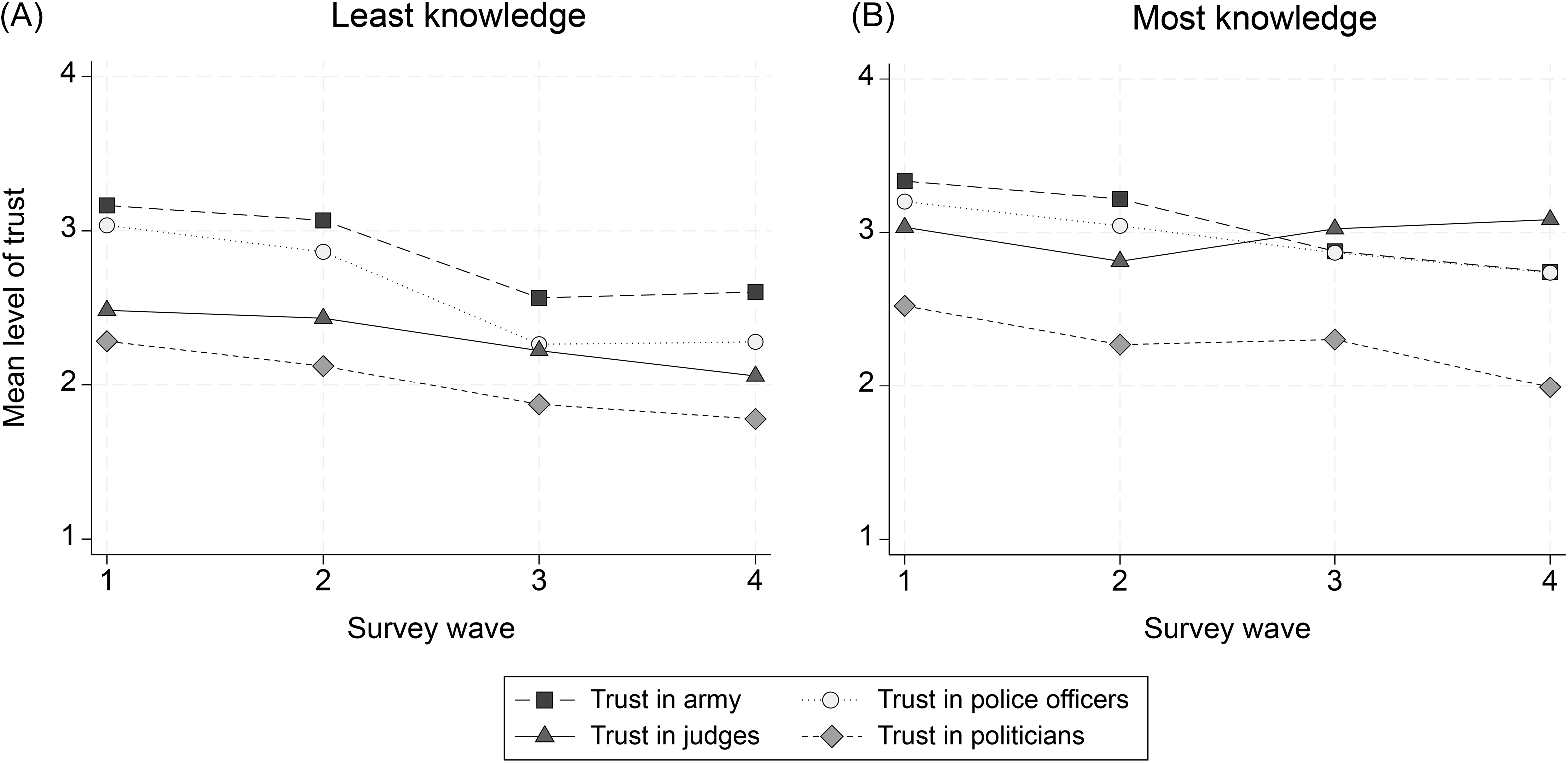
In the last step, we examine differences in trust means across political knowledge groups (Figure 4). We find that high-knowledge students show differentiation between order and representative institutions as early as wave 1, a pattern that persists over time. However, from wave 3 onward, their ranking of order institutions shifts, with judges being rated the highest as opposed to the army. In contrast, low-knowledge students initially recognise similarities between the army and police officers in waves 1 and 2, distinguishing these from the other two authorities. From wave 3 onward, they start distinguishing order and representative institutions more, though less pronounced than high-knowledge students. Additionally, they rate politicians as the least trustworthy and the army as the most trustworthy and maintain this ranking over time.Footnote 7
Trust means by wave and political knowledge.
Note: N (A) = 202; N (B) = 198.

Main results: structures by wave
Building on these preliminary findings, we now turn to the main analyses, which formally test the subdomain-specific and hierarchical nature of institutional trust using CFA and Mokken scale analysis. Table 2 summarises the CFA results for the three measurement models.Footnote 8 The unifactorial model (M1) consistently shows poor fit (RMSEA > 0.080) and performs significantly worse than the two-factorial models. This indicates that institutional trust is best represented by models reflecting shared traits between institutions (M2 and M3) across all waves. In early adolescence, students are still developing more critical and sophisticated evaluative processes and have limited first-hand experiences with institutions. Hence, the emergence of a differentiated, two-factorial structure, already at the age of 12, suggests that early cultural learning shapes trust structures rather than subdomain-specific evaluations. Therefore, H1 and H3 are rejected, and H5 is supported.
CFA results by wave (model fit)

Note: Best-fitting model(s) per wave in bold.
Yet, while the two-factorial models consistently outperform the one-factorial model, there is no persistent pattern in which of them (security versus non-security, or order versus representative) provides the better fit. In wave 1, both models yield borderline acceptable fit. In wave 2, both models achieve similar acceptable fit. In wave 3, M3 achieves perfect fit, while M2 remains strong (RMSEA = 0.035). In wave 4, fit declines for both models, with M3 slightly outperforming M2. These fluctuations – although small – suggest that adolescents’ trust structures are two-dimensional, yet dynamic, aligning with research on the malleability of political attitudes during adolescence (eg Devine and Valgarðsson Reference Devine and Valgarðsson2024; la Roi et al. Reference la Roi, van Alebeek and van der Meer2025).
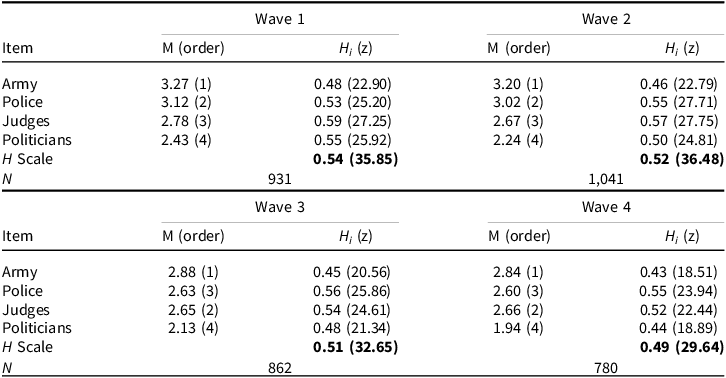
Next, the Mokken scale analysis (Table 3) reveals a strong hierarchical structure (0.40 < H < 0.60) across all waves. In wave 1, the scale demonstrates a good fit (H = 0.54), indicating a consistent rank order in institutional trust already among 12-year-olds. The army emerges as the most trusted authority, followed by police officers and judges, with politicians consistently being the least trusted – a pattern mirroring the adult population (van der Meer and Ouattara, Reference van der Meer and Ouattara2019). Furthermore, this hierarchy remains remarkably stable over time (H = 0.54 in wave 1; H = 0.49 in wave 4). While trust in judges slightly surpasses that in police officers by wave 3, the relative positions of the army and politicians remain unchanged.Footnote 9, Footnote 10 These findings again underscore the presence of a culturally determined trust ‘blueprint’, as a clear hierarchy exists from early adolescence onwards. This evidence supports H4 and rejects H2.
Mokken scale results by wave

Taken together, the evidence of a two-factorial model alongside a strong hierarchical scale suggests that adolescents’ trust structures are predominantly shaped by culturally transmitted scripts of trustworthiness.
Additional results: structures by wave and cognitive resources
Having identified the main patterns in our data, we will now conduct additional analyses to explore whether the development of institutional trust structures differs between student groups with varying cognitive resources (Korthals et al. Reference Korthals, Schils and Borghans2022). Our central expectation is that, if the early differentiation primarily reflects culturally ingrained beliefs about institutional trustworthiness rather than evaluations of institutional performance, similar patterns should emerge among both high- and low-cognitive-resource groups. However, it is well-known that education improves cognitive abilities and political sophistication, facilitating individuals’ critical deliberation and rational decision-making skills (Mayne and Hakhverdian Reference Mayne, Hakhverdian, Zmerli and van der Meer2017; Norris Reference Norris2022; Steinberg Reference Steinberg2005). Therefore, those with higher cognitive resources may be better equipped to critically assess institutional performance (Hardin Reference Hardin2002; Mayne and Hakhverdian Reference Mayne, Hakhverdian, Zmerli and van der Meer2017), which could lead to earlier differentiation in trust across institutions among these students. In contrast, students with lower cognitive resources may be less likely to meaningfully distinguish between institutions, treating them as interchangeable, potentially leading to a more unidimensional trust pattern. To test this, we focus on two indicators of cognitive resources: school track and political sophistication. The distribution of political knowledge scores by school track is presented in Table B3 (Appendix B).
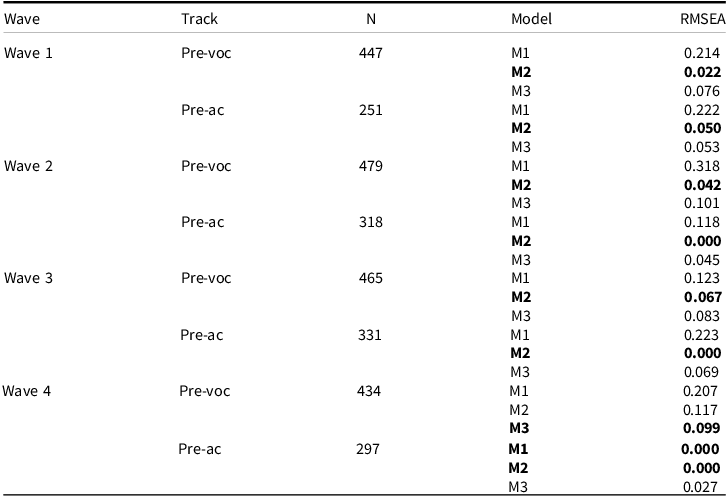
Table 4 presents the CFA results for both school tracks.Footnote 11 First, in line with the patterns observed in our main analysis, the two-factorial models (M2 and M3) consistently provide a better fit than the unifactorial model (M1) among both pre-academic and pre-vocational students. This result offers further support for the socialisation argument, as similar developmental patterns emerge across both groups, starting as early as age 12. Second, pre-vocational students mostly differentiate between security and non-security institutions (M2), while pre-academic students also distinguish between order and representative institutions (M3). While we do not directly test the underlying mechanisms, these differences may reflect varying cultural scripts internalised by both groups, with pre-vocational students adopting a more security-based distinction and pre-academic students distinguishing more broadly between the representative and implementing branches of the state.
CFA results by wave and school track (model fit)

Note: Best-fitting model(s) per wave in bold. Pre-voc = pre-vocational track; Pre-ac = pre-academic track.
It should be noted, however, that in the fourth wave, both groups deviate from these trends. Among pre-vocational students, none of the CFA models reach acceptable fit, although M3 still shows borderline fit (RMSEA < 0.100). Among pre-academic students, M3 maintains good fit (RMSEA = 0.027), but the unifactorial model emerges as a perfect-fitting model alongside M2 (RMSEA = 0.000). Nevertheless, we refrain from substantive interpretations because of two reasons. First, when examining the CFA results in wave 4 using the panel sample (Table F3 in Appendix F), the perfect fit for M1 among pre-academic students is not stable, while M2 and M3 reach acceptable fit among pre-vocational students. Second, among pre-academic students, the pattern does not persist in waves 5 and 6 (Table H1 in Appendix H), where the differentiated models provide a better representation of the data in terms of model fit and factor loadings.
Next, the Mokken scale results, presented in Table 5, reveal a strong hierarchical scale (0.40 < H < 0.60) across both school tracks and all waves. This indicates that students in both tracks consistently maintain a socialised hierarchy of institutional trustworthiness. Furthermore, although both groups produce equal rankings in the first three waves, their rankings diverge in wave 4: pre-vocational students rate the army as most trustworthy, whereas pre-academic students assign their highest trust to judges.
Mokken scale results by wave and track

Note: *H-values below 0.40 indicate a weak scale.
However, while the strength of the scale remains strong among pre-vocational students (H = 0.51 in wave 1; H = 0.52 in wave 4), it decreases among pre-academic students (H = 0.51 in wave 1; H = 0.42 in wave 4). This numerical decrease in scalability – although limited – may point to two underlying trends. First, it could reflect growing individual variation in rank ordering, as some pre-academic adolescents begin to revise inherited trust hierarchies and factor in contemporary performance evaluations based on personal experience and critical reflection. Second, the change could signal stronger alignment within subdomains, with trust in order institutions becoming more closely clustered (ie internally consistent), and increasingly distinct from trust in representative institutions. In this latter scenario, students are further internalising the cultural scripts that have already structured their trust judgements since or even before early adolescence.
The CFA results for political sophistication are presented in Table 6 and closely parallel the findings based on school track.Footnote 12 Low-knowledge students consistently differentiate between security and non-security authorities (M2) across all waves, with M1 and M3 never reaching acceptable model fit. High-knowledge students, however, display more varied patterns, with the best-fitting two-dimensional model shifting across waves. Turning to the Mokken scale analyses, the results seem to replicate the patterns from the school track analysis (Table 7). First, they show a consistently strong hierarchical trust pattern among low-knowledge students, while among high-knowledge students, the scale weakens over time. Second, while all institutions are ranked similarly in the first three waves, in wave 4, pre-vocational students rate the army as most trustworthy, whereas pre-academic students place the highest trust in judges.
CFA results by wave and political knowledge (model fit)

Note: Best-fitting model(s) per wave in bold.
Mokken scale results by wave and political knowledge

Note: *H-values below 0.40 indicate a weak scale.
Taken together, these heterogeneity results confirm that adolescents develop a socialised pattern of institutional trust from an early age on. Both low- and high-cognitive-resource students distinguish between sub-domains and rank institutions, although only high-cognitive-resource students start deviating from the original rank order over time, suggesting greater volatility in their institutional trust structure.
Discussion
Empirical research has long revealed a tension at the heart of institutional trust: it is both subdomain specific and structured along a single hierarchical dimension. As these characteristics align with two competing theoretical perspectives, this tension raises crucial questions about the structure and origins of institutional trust. The evaluative approach interprets subdomain-specificity as evidence that trust stems from individuals’ independent assessments of institutional performance, suggesting that a differentiated trust structure emerges only later in life when individuals gain political knowledge and experience with these institutions. In contrast, the socialisation approach contends that the hierarchical ordering reflects culturally transmitted trust patterns acquired early in life. Resolving this debate requires tracing how these two features develop during individuals’ formative years – a question that, so far, has remained largely unanswered in the literature. We, therefore, employed longitudinal data from the Dutch Adolescent Panel on Democratic Values (2018–2022) to examine the development of the subdomain specific and hierarchical nature of institutional trust during individuals’ formative years (age 12–16), using CFA and Mokken scale analysis. We derive two main findings.
First, from early to late adolescence, trust in public institutions consistently exhibits both subdomain-specificity and a hierarchical structure. Already at age 12 and onwards, adolescents distinguish meaningfully between security and non-security institutions and between order and representative institutions (Breustedt Reference Breustedt2018; Fine et al. Reference Fine, Kan and Cauffman2019; Stals et al. Reference Stals, Isac and Claes2024). In addition, institutional trust follows a clear hierarchical structure throughout adolescence. Across all waves, order institutions consistently rank highest, while representative institutions rank lowest – closely mirroring patterns observed among adults (van der Meer and Ouattara Reference van der Meer and Ouattara2019). Hence, although the literature often frames the subdomain specific and hierarchical structure as mutually exclusive features of institutional trust, our findings suggest that both can coexist. These findings lend strong support to the macro-socialisation perspective, showing that adolescents’ trust structures are predominantly shaped during the formative years of adolescence – and plausibly even earlier – through macro-level, cultural transmission, rather than emerging from evaluative judgements. Second, in general, these patterns hold across different cognitive resource groups (ie school track and political sophistication): both higher- and lower-cognitive-resource students display this subdomain-specific and hierarchical structure of trust, lending further support for the socialisation perspective. Combined, our findings suggest that adolescents do not require high cognitive and political sophistication or extensive political experience to organise trust judgements. The fact that both younger adolescents – whose cognitive and political abilities are still developing (Flanagan Reference Flanagan2013; Steinberg Reference Steinberg2005) – and students from pre-vocational tracks and with lower political knowledge exhibit a differentiated and hierarchically ordered trust pattern – shows that trust structures are largely internalised from an early age through cultural transmission.
Second, despite the early existence of an institutional trust blueprint, over time, its influence decreases among higher-cognitive-resource students while remaining stable among their lower-cognitive-resource peers. That is, by the fourth year of secondary school (age 15–16), the initial hierarchical structure weakens among pre-academic and high politically sophisticated students, suggesting that growing cognitive and political development may enable some adolescents to deviate from the established pattern. This finding aligns with research showing that institutional trust is more volatile during mid-to-late adolescence (Devine and Valgarðsson, Reference Devine and Valgarðsson2024; la Roi et al. Reference la Roi, van Alebeek and van der Meer2025) and further adds that this malleability is especially pronounced among more (politically) sophisticated adolescents.
Our findings have two theoretical implications. First, we show that institutional trust has a clear, socialised blueprint that is already visible in early adolescence and possibly emerges even earlier. Hence, from a young age, individuals distinguish between types of institutions and rank them consistently, long before they are thought to possess the political sophistication and experience to critically assess them (Norris, Reference Norris2022). These findings support our hypothesised macro-level perspective on political socialisation, which emphasises how dominant cultural narratives – transmitted through media, education, and public discourse – shape institutional trust structures across the population and across generations and helps explain why adolescents’ trust structures mirror those of the adult population (van der Meer and Ouattara, Reference van der Meer and Ouattara2019; Zmerli and Newton, Reference Zmerli, Newton, Zmerli and van der Meer2017). Moreover, it suggests that the subdomain-specificity of institutional trust observed in adults may not be strictly evaluative either (Mishler and Rose, Reference Mishler and Rose2001). Instead, both adults and adolescents may regard certain institutions as more trustworthy, not because of their actual performance, but because they are socialised to do so from an early age. Second, recent research shows that baseline levels of institutional trust are formed during the formative years and remain relatively stable in adulthood (la Roi et al. Reference la Roi, van Alebeek and van der Meer2025). Our study adds that these baseline levels are not developed in a vacuum. Instead, adolescents appear to internalise cultural narratives about the inherent trustworthiness of different public institutions from an early age. At the same time, we find that this blueprint loses influence among high-cognitive-resource students during mid-to-late adolescence. While we cannot conclusively identify the mechanisms driving this shift, it likely reflects the emergence of evaluative reasoning among more (politically) sophisticated citizens. Theoretically, this supports a dual-process model of institutional trust development: early cultural imprinting provides the baseline framework, which may later be recalibrated by more sophisticated citizens through individual evaluation.
Several limitations should be acknowledged, pointing to various avenues for future research. First, our findings are based on data from the Netherlands – a high-trusting, consensus-oriented democracy with a specific institutional landscape. It remains an open question whether similar patterns would emerge in more polarised or institutionally distrusted contexts. Comparative, cross-national studies could test the generalisability of our conclusions and explore how different institutional contexts shape trust development elsewhere. Second, while the longitudinal design allowed capturing changes over time, expanding this research to include a broader age range – ideally tracking early adolescents into adulthood – would provide deeper insight into the developmental trajectory of institutional trust during adolescence and the extent to which these structures evolve or stabilise in adulthood. Third, while we may interpret the increasing fluctuations in mid-to-late adolescence as signs of growing evaluative reasoning and the early subdomain-specificity as the product of socialisation rather than evaluation, our data does not permit to test these assumptions directly. Future studies employing experimental methods could offer additional evidence on the evaluative nature of institutional trust during adolescence and its temporal development, by examining how subjective performance evaluations affect institutional trust levels over time (van Elsas Reference van Elsas2015). Finally, it remains unclear to what extent the cultural blueprint adolescents are socialised into is influenced by the performance evaluations of important socialisation agents of adolescents, such as parents, teachers, or media figures. This raises the question of whether the culturally transmitted trust structure reflects enduring normative beliefs about institutional roles, or whether it mirrors the evaluative experiences of past generations. This would make subdomain-specificity a product of inherited social knowledge rather than purely independent evaluation, providing additional evidence of our macro-level socialisation argument.
In sum, our study shows that institutional trust structures in adolescence are shaped early on by socialisation processes, as adolescents reproduce culturally ingrained trust hierarchies. However, our observation of fluctuating trust structures among more (politically) sophisticated students during mid-to-late adolescence might signal the onset of more individualised, evaluative trust formation. Hence, although we cannot directly confirm a dual influence of socialisation and evaluation, our findings suggest that trust development during adolescence is dynamic: early cultural imprinting provides a baseline blueprint, which may subsequently be challenged, reinforced, or modified as cognitive capacities develop and political experiences accumulate. This underscores the importance of early macro-level socialisation processes and educational practices in shaping institutional trust during a critical formative period.
Supplementary material
The supplementary material for this article can be found at https://doi.org/10.1017/S1475676526100917
Data availability statement
The data that support the findings of this study are available from the corresponding author upon reasonable request. The data are not publicly available due to privacy or ethical restrictions. Details on the panel study, including the mode of data collection, panel attrition, and sample representativeness, are provided in online Appendix C.
Acknowledgements
The authors would like to thank Tom van der Meer and the three anonymous reviewers for their valuable feedback on earlier drafts of the manuscript.
Funding statement
Stals acknowledges the financial support of the Research Foundation Flanders (grant number: K1A7N25N). Van Alebeek reports the financial support of the European Research Council (grant number: ERC-CoG 2021 101045653).
Competing interests
The authors declare no potential conflicts of interest with respect to the research, authorship, and publication of this article.
Ethics statement
The DAPDV project received ethics approval from the Amsterdam Institute for Social Science Research of the University of Amsterdam (ERB number 2018-AISSR-9324). The use of GPT-5 complies with the Cambridge University Press Artificial Intelligence (AI) Contributions to Research Content Policy.
Use of AI
The authors used OpenAI’s GPT-5 to assist with language editing. All AI-assisted content was reviewed and edited by the authors, who take full responsibility for the final version of the manuscript.





 Open access

