


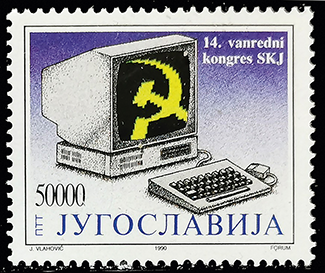
The 1980s ushered in a new era of electronic music in Yugoslavia, a trend that has heavily permeated all spheres of music, not only art but also popular and film music. Although Yugoslavia, as a nonaligned country, welcomed influences from the West even in the earliest decades of the Cold War, after the death of President Tito on May 4, 1980, and the subsequent decline of communist ideals, Western technologies and trends infiltrated mainstream popular culture much more prominently. This was, perhaps, most evident in Yugoslavia’s vibrant, experimental, and internationally acclaimed new wave music scene of the late 1970s and 1980s, characterized by the sound of electronics. The earliest notable example is Oliver Mandić’s (b. 1953) track, “Šuma” [Forest] (1978), an electroacoustic musique concrète experimentation that combines layers of manipulated electronic sounds.Footnote 1 A year later, notable film composer Zoran Simjanović (1946–2021) composed the theme for the nightly news program Dnevnik 2, which aired in Yugoslavia from 1979 to 1992. This iconic electronic theme, synchronized with a digital figure of a rotating globe, illustrated the extent to which digital technologies were infiltrating the cultural life in the country.Footnote 2 The League of Communists of Yugoslavia recognized that technology and the implementation of personal computers symbolized progress, the image of Yugoslavia as a progressive nation that the Party wished to project internationally.Footnote 3 For its 1990 Congress, which would be the country’s last,Footnote 4 the Party promoted its assembly on a postage stamp that featured an image of the hammer and sickle – a communist symbol representing proletarian solidarity between agricultural and industrial workers – displayed on a computer screen, effectively blending the image of traditional communist values and innovation (Figure 6.1).
A postage stamp promoting the XIV Congress of the League of Communists of Yugoslavia [Savez komunista Jugoslavije, SKJ], 1990. Design by Jakša Vlahović.
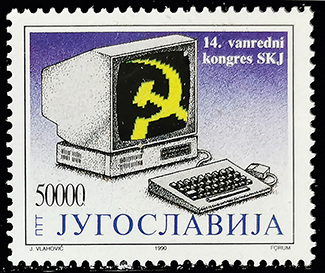
Figure 6.1 Long description
The postage shows a computer with a monitor on top of it and a keyboard in front of it, in black and white. The monitor’s black screen displays a communist symbol in yellow, a hammer and sickle. The background of the stamp is in gradient purple color, white on the bottom, and purple on top. On the top right corner, in white letters, says, The 14th extraordinary congress of the League of Communists of Yugoslavia in Cyrillic. On the bottom left is the value of the stamp in Yugoslav dinars, 50000. Across the bottom is written, Yugoslavia.
New generations of composers at the Faculty of Music of the University of Arts in Belgrade (FMU; formerly the Music Academy) had already been flocking to the Electronic Studio Radio Belgrade since its opening in 1972 to study with Vladan Radovanović and Paul Pignon. Witnessing the success and popularity of the studio, as well as the remarkable achievements of composers writing music in that medium – presenting their works internationally and receiving awards and other accolades – FMU finally understood the potential in supporting a studio of their own. Under the new leadership of Srđan Hofman (1944–2021), who at this time served as Dean of the Faculty of Music and Chair of Composition, and Vice-Dean Zoran Erić (1950–2024), the young composers took a radical step in transforming the once conservative department.
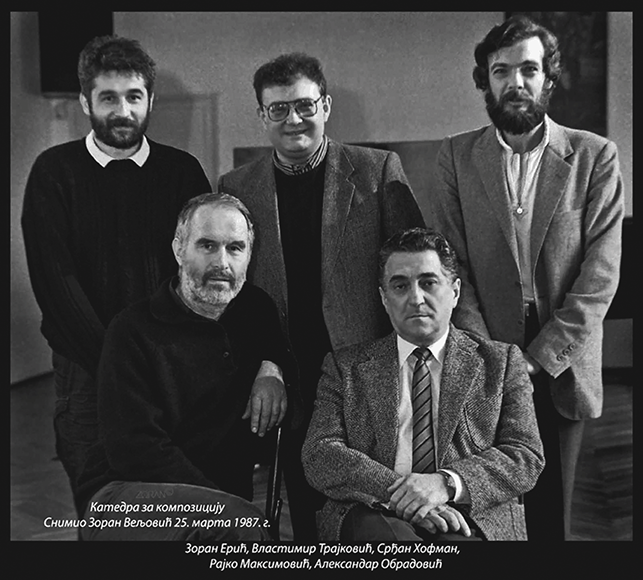
Unlike the traditionalists at FMU who vehemently opposed all forms of modernism (such as Rajko Maksimović, Aleksandar Obradović, and especially Stanojlo Rajičić), Hofman and Erić, who themselves took classes at the EMS Radio Belgrade in the 1980s and composed in the medium, recognized that electronic music was vital to the future of their field (Figure 6.2).Footnote 5 When asked about his colleagues’ opposition and resistance toward electronic music well into the 2010s,Footnote 6 Hofman explained:
Electronic music began as a direct manifestation of the tendency towards the radically novel, the expression of such a tendency, and it is by nature oriented towards exploration and research … It may, however, serve as a mere signifier [that] stands for everything that many of my colleagues considered to be musical blind alleys, misguided attempts with no sense of value, within whose frameworks it was, and still is, simply impossible to compose an artistically valuable work.Footnote 7
The composition faculty at the Faculty of Music in Belgrade, 1987. From left to right, back row: Zoran Erić, Vlastimir Trajković, and Srđan Hofman; front row: Rajko Maksimović and Aleksandar Obradović.
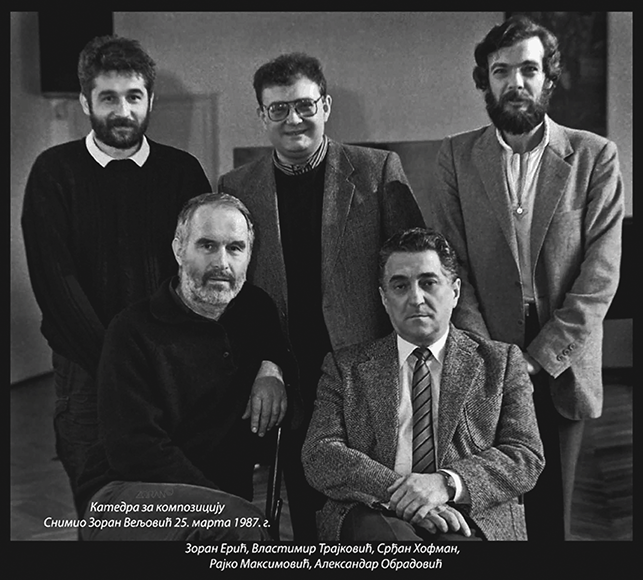
Figure 6.2 Long description
From left to right, back row, standing are Zoran Erić, wearing a dark sweater with a white collar, Vlastimir Trajković in a casual suit, and Srđan Hofman in a casual suit. Seated in the front row are Rajko Maksimović wearing a more casual dark sweater and Aleksandar Obradović in a more formal suit with a tie, with his hands crossed in his lap, looking very stern, while his other colleagues are smiling.
However, at FMU, the issue was not only that older-generation composers on faculty refused to write modern music and use new technological advances; they imposed their own aesthetic values and preferences onto all their students by refusing to accept modernist tendencies within the curriculum. Hofman further elucidates:
When such personal attitudes are transferred from the choice of a musical “language” for one’s own creative work to the imposition of a value system into which all young composers must fit in order to earn recognition, and especially if such personal attitudes are expressed as a tendency to radically revise the history of new music, then we find ourselves in the domain of politics.Footnote 8
Embracing their visionary stand, Hofman and Erić founded the electronic music studio at FMU in 1986 – Tonski studio [Sound Studio], which remained under Hofman’s direction until 2002. While only some fifteen years earlier Obradović turned down Radovanović’s request for FMU to support the founding of an electronic studio in Belgrade, arguing that it would be too expensive, too avant-garde for a traditional institution, and that no one would use it, now the very same institution was home to the first computer-based electronic studio in the country. Such a bold move by Hofman and Erić allowed a new generation of composers to access the newest technologies and techniques and finally to keep up with innovations and trends in the West. As a result, the Faculty of Music suddenly became the producer of progressive and innovative composers in Yugoslavia, among them Nataša Bogojević [Natasha Bogojevich], Vladimir Jovanović, Isidora Žebeljan (1967–2020), Milica Paranosić (b. 1968), and Tatjana Milošević (b. 1970).
Yugoslav composers, and even some from abroad, showcased their new approach to composition, one developed using the personal computer, at the First Festival of Computer Music in Yugoslavia, “Lična muzika” [Personal Music], which took place on June 1–5, 1987, at the Student Cultural Center in Belgrade, organized by the young composer, Miroslav Savić. In 1991, the “Kompjuterska umetnost” [Computer Art] exhibition, held May 8–23 at the Gallery of the Association of Fine Artists of Serbia [Udruženje likovnih umetnika Srbije], displayed the application of the computer and technology across all spheres of the arts.
Tonski Studio and the Transformation of Electronic Music in Yugoslavia
Tonski Studio reshaped the trajectory of electronic music in Yugoslavia. While Radovanović, the founder of the Electronic Studio Radio Belgrade (EMS), already knew many years earlier that the future of electroacoustic music was computerization, realizing such a prospect in the 1970s was too expensive for Yugoslavia. The EMS Radio Belgrade would not receive its first computer until 1987 – an Atari Mega ST2 with synthesizer modules by Yamaha TX816, running on Notator SL. This machine allowed for the creation of algorithmic works based on stochastic principles, as evident in Muzika vatre [Music of fire] (1985–1988) and Saturnalije II (1988) by Marjan Šijanec, a Slovenian composer, engineer, and programmer with prior experience at the National Institute of Chemistry in Ljubljana (Slovenia) and the Vinča Institute of Nuclear Science (Serbia). In addition to developing his own programming language necessary to realize his compositions, Šijanec also introduced a new concept of using the computer as both a musical score and a conductor, and treating the computer, with all its analog and digital segments, as an instrument.Footnote 9
Tonski Studio, on the other hand, was a fully computerized state-of-the-art facility. The year it was founded, in 1986, it started as a modest analog studio with a Yamaha DX7 keyboard, a mixer, an amplifier, and microphones. The following year, the Studio acquired the leading equipment for analog tape recording: three Studer magnetophons (models A 807 and A 810) and a 24-channel mixer. In 1988, Tonski Studio was completely computerized with the acquisition of 32-bit Apple Macintosh II machines with a 24-bit Sound Accelerator soundcard, allowing for analog-digital conversion, working with sound on two channels, and producing CD-quality recordings.Footnote 10 Musicologist Ivana Janković observes that at this time, Tonski Studio was one of the very few Macintosh-equipped studios in Europe, and that while Macs were becoming standard in the US, European studios still preferred a more affordable Atari with a MIDI interface.Footnote 11 Hence, Erić’s vision of and insistence on equipping the Tonski Studio with Macs made the facility the center of Apple-operated machines in Yugoslavia.Footnote 12
Tonski Studio had two primary roles: It introduced new coursework in electronic and computerized music and sound production in its composition curriculum, and it also served as a recording and production studio for classical music that serviced both the FMU faculty and students. The first courses on electronic music at FMU were offered during the 1986–1987 academic year, taught by Hofman and Erić, and then in the 1990s by a new generation of composers and teaching assistants at the FMU – Paranosić, Bogojević, Goran Kapetanović, Svetlana Savić (née Kresić), and Milošević. Đorđe Petrović, a producer of popular music at the Production of Gramophone Records Department of Radio Television Belgrade (PGP–RTB), a major record label in Yugoslavia at the time, was hired as a sound engineer in the Studio. The Faculty of Music also established a guest residency program with composers from abroad, the first one taking place in 1992 with a week-long residency by Neil Rolnick from the US and later by Hans Ulrich Humpert from Germany.Footnote 13
According to Hofman, computerized music, as understood in the 1980s, had wide applications that concerned two genres of composition. First, it applied to vocal, instrumental, and vocal-instrumental compositions that were created as a result of an interactive compositional process employing an algorithm and a statistical model to calculate the values of musical parameters and make decisions for any given work. Second, it assumed a subgenre of electronic music in which compositions are created through interactive compositional process, in which the computer, with an algorithmic program and a statistical model, makes some decisions and calculates values about parameters of music structures and sound synthesis.Footnote 14 Thus, in Hofman’s understanding, computer music does not just participate in generating electronic sounds; rather, the computer has an active role in the compositional process of a work.Footnote 15 This realization shifted the focus of the computer from a means of sound synthesis and sampling to an instrument for real-time performance.
Equipped with advanced computer technology on par with Western Europe and the United States at that time, and with skilled engineers and programmers, a new generation of Yugoslav composers once again flocked to Belgrade, now to Tonski Studio, eager to learn these new technologies and techniques, something that the EMS Radio Belgrade could no longer provide on its obsolete machines. Hence, Tonski Studio of FMU brought Yugoslavia on a level with the newest compositional trends, such as digitalization, sonification, and sampling and allowed the composers to finally “catch up” to the rest of the world in “real time.”
A New Generation of Electronic and Computer Music in Yugoslavia
The beginnings of computer music in Yugoslavia can be traced to avant-gardist Radovanović, who in 1976 envisioned composing a piece using the computer. Unable to realize his vision in Yugoslavia, Radovanović went to the Institute of Sonology in Utrecht (the Netherlands), where he completed his piece Kompjutorija [Computoria] in 1977, using an 18-bit minicomputer PDP-15/20 and POD6 software – an interactive markup language developed by Barry Truax. Computoria, based on a discrete probability distribution, is Stochastic in nature.Footnote 16 Pioneered by Iannis Xenakis two decades earlier (in 1954), Stochastic process in music composition employed probability theory (with mathematical models, such as Markov chain) to introduce randomness and unpredictability into the musical structure that determines various musical parameters, like pitch, duration, and dynamics.Footnote 17 The work was performed on October 17, 1977, in Utrecht.
Radovanović continued to produce computer music projects, completing Undina (1985) for the Talking Back to Media music festival in Amsterdam and Timbral (1987), commissioned by the Mafilm Studios in Budapest. Both are purely electronic music works based only on electronically generated sounds that combine analog Synthi 100 and digital Yamaha DX 7 digital audio signals that were recorded on different technologies, both in Belgrade and abroad. Because Radovanović did not use a sequencer for Undina, he acted both as composer and performer; he performed all sound material in real time while recording it, channel by channel, on a multichannel magnetophon. Timbral manipulation is a dominant feature of both works. In Undina, named after the word in Serbian folklore that refers to a mythical water nymph, Radovanović explored the timbre of female voices and their wave-like motion. In Timbral, more explicitly, Radovanović mixed sound sources vertically rather than horizontally, to make each new timbral event stand out. Here, timbre is not just a musical parameter but a principal structural element.
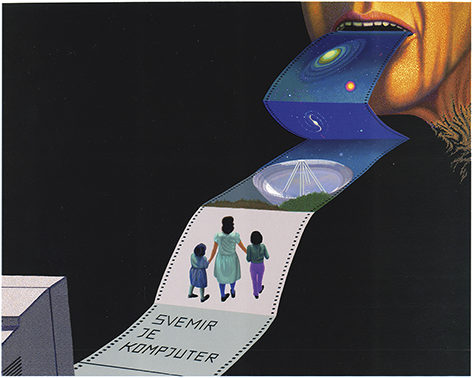
Once EMS Radio Belgrade had obtained its first computer, Radovanović began to use it in most of his sampled-sound compositions, such as Fluks (1989) and Miks (1991), in which he treated sounds originating from other sources in an electronic medium. In addition to his compositions, Radovanović fully embraced the computer in all spheres of his creative output, including a visual graphic, “Svemir je kompjuter” [The universe is a computer] from 1989 (Figure 6.3). In this graphic, Radovanović makes a clear statement on the role of digital technology and the capabilities of a computer – the computer is a universe on its own, but also a means of connecting our (human) universe to that of the computer. On a metaphysical level, Radovanović explains the meaning of this work: “It should be noted that this flow is two-way: As much as the earthly computer produces the assumption of the universe as a computer, so the universe produces the assumption of the computer’s assumption of the universe as a computer.”Footnote 18 Musicologist Milan Milojković speculates that the graphic symbolizes “the position of a man, who is caught between the limits of tradition and the cosmic infinity.”Footnote 19
Vladan Radovanović, Svemir je kompjuter [The universe is a computer], computer graphic realized on Amiga and using Photoshop software, 1989.
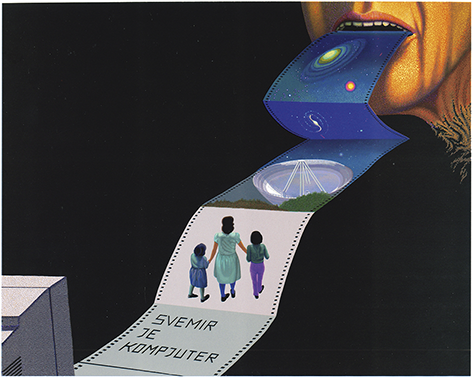
Figure 6.3 Long description
On the bottom left side of the drawing is a computer screen, out of which a long and thin printout of slides in a sequence leads upwards towards the mouth of a woman, in the top right corner of the drawing. The printout is in color, set against the black background. It depicts five images. In the first, the text reading, The Universe is a computer, is written in black ink in the Serbian Latin alphabet. The next image shows a woman from behind, walking with a daughter on each side, holding their hands. They are wearing blue and green dresses. The next slide shows a satellite. The next slide depicts a galaxy, and the last slide depicts a solar system.
Following Radovanović’s creations in the domain of computerized music abroad and the arrival of computers in Tonski Studio (as well as in other private music studios around the country), Yugoslav composers began mastering the new technology during the 1980s, using new methods for sonification, such as employing a joystick to send and activate sound and applying the technique of sampling.
Electronic Music and Sampling at the Tonski Studio
As the first computerized studio in Yugoslavia, Tonski Studio drew a new generation of composers who collectively embraced an expansion of compositional possibilities with new technologies. One key feature of these new compositions was the technique of sampling analog sounds and their processing to generate different types of sonorities. The founders of the studio, Hofman and Erić, and their protégés, a new generation of women composers at the Faculty of Music – Bogojević, Paranosić, Svetlana Savić, and Milošević – defined the new sound of this era.Footnote 20
Like his peers, Hofman belongs to the generation of Yugoslav composers whose initial compositional development was grounded in predominantly neoclassical aesthetics but who were also exposed to diverse modernist phenomena. As Mirjana Veselinović-Hofman observes, Hofman first participated in “propounding,” then “overcoming,” and finally “contesting” the “neoclassical logic in Serbian music.”Footnote 21 Hofman showed an interest in musical modernism in the 1960s, and by 1974 he was attending seminars at Darmstadt and in 1975 in Cologne. His music is characterized by complex, simultaneous, and interwoven processes, which show the influence of both European serialism and extended digital techniques. His Rebus 1 (1988), Rebus 2 (1989), and Uzorci [Samples] (1991), some of the earliest works created at Tonski Studio, exhibit Hofman’s complex synthesis of these influences.Footnote 22
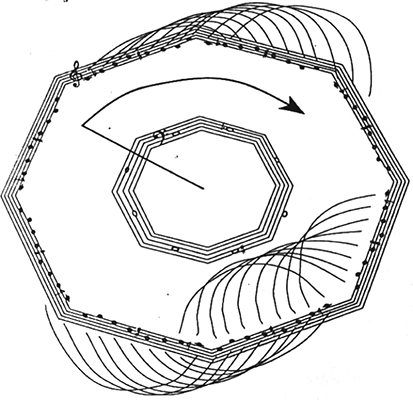
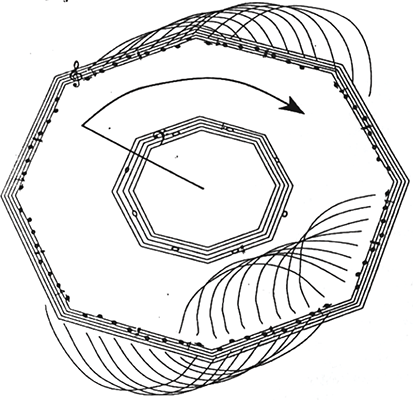
Rebus 1 (for electronics) is based on the principle of integral serialism, with Hofman controlling the melodic, harmonic, rhythmic, and timbral parameters of the piece. The work starts with an “explosion” of a cluster from which eight formations (i.e., sound formulas) emerge – eight motives, each comprising identical eight-note configurations, C, E♭, G, B, G♯, E, D, F. Each configuration features a statement and repetitions of the initial “formula” before splitting into two motives sounding simultaneously. Every time a motive splits, a new timbre is added to the initial one. The introduction of each configuration is signaled by the sound of the “exploding” cluster, but the spectral quality in motivic layering is different in each and the repetitions become shorter until the work dissolves into a whirl, both sonically and visually, as depicted in the score that features all eight formulas, eventually reducing to the basic eight-note motive at the center of the diagram (Example 6.1).
Srđan Hofman, Rebus 1 (1988), the ending.
Example 6.1 Long description
The music staff curves in the shape of an octagon. Each side of the octagon shows eight filled in noteheads with pitches of the row, C, E flat, G, B, G sharp, E, D, F, written in treble clef. Curved lines indicate the rotation of the row: the C of the first octagon maps onto the next pitch, E flat, in the next octagon, which then maps onto the next pitch, G, and so on. Inside this octagon is a smaller one, with each side containing one whole note, one side for each pitch of the row, now written in bass clef.
In the context of Yugoslav music, Rebus 1 was quite avant-garde – no other composer was using integral serialist techniques, let alone in combination with electronic/computer media. The work also draws on traditional elements (such as the thirds relations in the eight-note theme, which, when superimposed, creates triadic sonorities) and minimalist-style repetitions.Footnote 23
Hofman’s Uzorci [Samples] for flute, clarinet, AKAI 1000HD sampler, and Apple Macintosh computer is based, as the title implies, on several recorded musical samples. Specifically, Hofman used nine folk tunes from the Istria region of Croatia and the Homolje region of eastern Serbia, which he copied into the sampler (i.e., he digitized it) from vinyl records and magnetic tape. The folk tunes are sampled as literal musical quotations, hence recognizable, but also subjected to electronic transformations, rendering them unrecognizable. Veselinović-Hofman notes that Hofman selected these samples based on their internal acoustic qualities – melodies whose elements can be spectrally modified to yield a rich array of sonorities, and thus “defolklorizing” selected samples – stripping them of their national identity.Footnote 24
Hofman’s works from this period reflect the general inclinations of Yugoslav composers toward a postmodernist aesthetic that often evokes the past, characterized by the incorporation of musical quotations and folk motives. Postmodernist trends are evident in Erić’s compositions created at the Tonski Studio (and even more so in his works from the 1990s onward). Erić created two notable works at the Studio – Velika crvena mrlja Jupitera [The Great Red Spot of Jupiter] (1990) for amplified harpsichord, percussion, and live electronics, and Abnormalni udarci Dogona [The abnormal beats of the Dogon] (1991) for bass clarinet, prepared piano, computer, and percussion. Both works are from his five-part cycle, Slike haosa [Images of chaos], created between 1990 and 1997.
Erić’s Abnormalni udarci Dogona is also imbued with folk motives, featuring eighteen folk fragments whose manipulation yields eighteen “models.” However, his use of samples differs from Hofman’s approach, since no original material is actually present in Erić’s work. That is, Erić does not use original quotations of any of his samples; rather, he manipulates them into an already “interpreted quotation.”Footnote 25 As such, his composition is based on models of interpreted samples, abstracted from their original context.
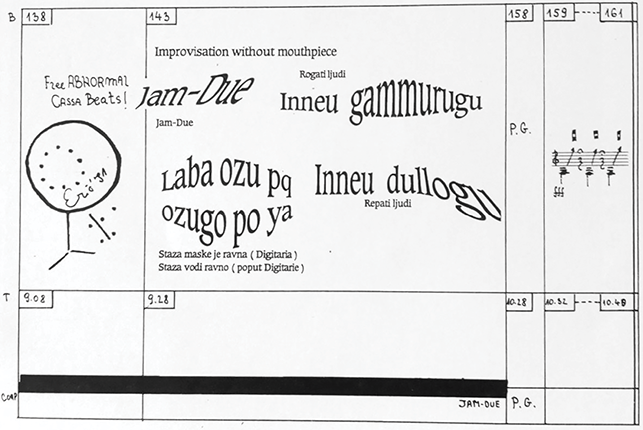
Erić adds another level of originality in his two compositions – both works, created on Macintosh II and a computer-controlled MIDI, also use Design Studio and Adobe Photoshop software to produce a graphic notation score (Example 6.2). Thus, with the addition of computer graphics, Erić conveys to the live performers how to execute certain gestures. In the excerpt in Example 6.2, the page is divided into four columns, one for each instrument. On the left (mark 138), the percussionist is instructed to play “free abnormal cassa [bass drum] beats.” The bass clarinetist is asked to improvise, without a mouthpiece, sounds that evoke the images of various creatures – Jam-Due, inneu gammurugu (men with horns), inneu dullogu (men with tails). The third column denotes the computer part, while the last column is the score for the prepared piano.
Zoran Erić, Abnormalni udarci Dogona [The abnormal beats of the Dogon] (1991), graphic score, 138–161.
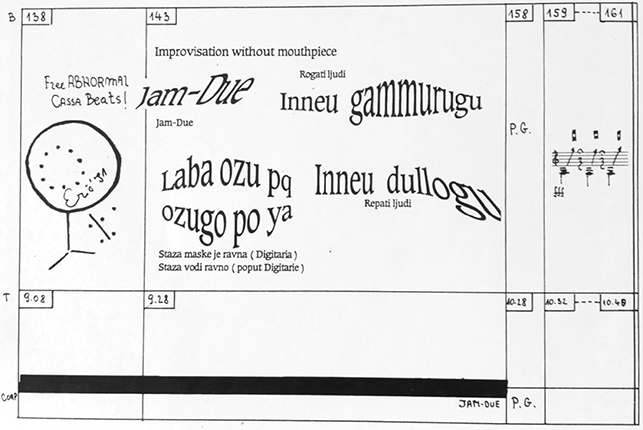
Example 6.2 Long description
The score has four columns and two rows. In the top, the leftmost column is narrow, and has a free-hand drawing of a drumhead (or perhaps a gong) with hand-written words, Free ABNORMAL Cassa Beats! The next column is wide, and features words in different fonts and shapes written across it. Some words are in regular type print, like directions on top that read, Improvisation without mouthpiece, while other words gradually increase in size and change angles and direction. The third column only contains initials P.G., denoting the computer music software part. The last column contains a single staff for the prepared piano part. On the bottom of the score, across the entire length, is a thick dark line indicating the computer part.
Erić’s works are among the earliest examples of live-electronics computer music in Yugoslavia that employ digital communication during the compositional process (such as mapping the MIDI to samples) but also during the performance of the work. The final sound of the composition depends not only on the manner the computer recalls and live-transforms samples but also on the performers’ interpretation of the graphic score and their interaction with the electronics. Milojković remarks that with these two works, Erić introduced a significant level of originality to Serbian (and Yugoslav) compositional practice – by using the computer as an instrument, necessary for the realization and performance of these works.Footnote 26 Erić presented his Abnormalni udarci Dogona and the novel approach to computer composition at the Music Biennale Zagreb in 1991. Occurring only two months before the beginning of the Yugoslav Wars, it would be the final edition of the festival before the disintegration of Yugoslavia, and certainly the last one for Serbian composers for decades to come.Footnote 27
Computer Music Festivals
The year 1991 was significant for Yugoslav composers – it was the last year of national and international collaborations before the collapse of the political state. The “Kompjuterska umetnost” [Computer Art] exhibition took place on May 8–23, 1991, at the Gallery of the Association of Fine Artists of Serbia (ULUS), just one month before the start of the war. It featured a concert of electronic music alongside visual exhibits, animations, and installations. The exhibition initiated the creation of the short-lived Association of Artists of Electronic Media in Yugoslavia, with a large representation of Slovenian composers who at the time resided in Serbia – Franc Curk, Marjan Šijanec, and Slavko Šuklar – and the MGM composer collective comprising Gordana Novaković, Šijanec, and Miroslav Savić. The event was organized by Predrag Šiđanin, who, for his work VirEvropeBeograd, participated from Novi Sad via a telefax projection alongside ten performers from different parts of the world. Other composers featured at this show were Erić (Abnormalni udarci Dogona and Velika crvena mrlja Jupitera), Hofman (Rebus 1 and Rebus 2), Radovanović (Miks and five computer graphics, including Svemir je kompjuter), Milimir Drašković, Boris Kovač, Miroslav Štatkić, Vojin Tišma, and Vladimir Tošić.Footnote 28
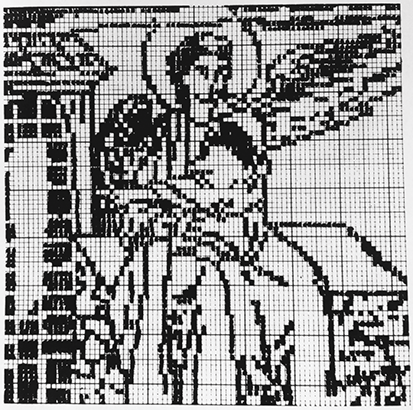
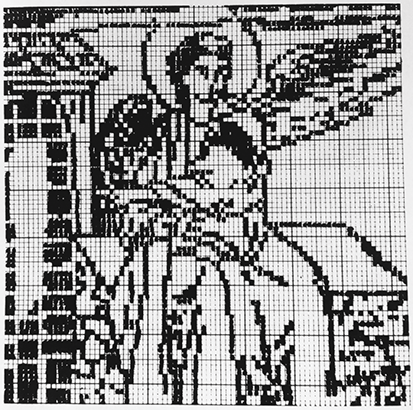
The exhibition featured other innovative approaches to computer composition. Šijanec incorporated twelve algorithms for his piece, Muzika kosmičkih modela [Music of cosmic models] (1988–1989), each generating a distinct piece based on one “cosmic model.” Savić’s audiovisual work Glas anđela [The voice of an angel] (1991) comprised a two-dimensional display of a computer-generated graphic of a renowned Serbian fresco, Anđeo na grobu Hristovom (Beli Anđeo) [Angel at the tomb of Christ (The White Angel)] (Figure 6.4). The synthesis of the audio and visual elements is realized with the colors of the fresco that correspond to a musical interval.Footnote 29
Miroslav Savić, Glas anđela [The voice of an angel] (1991). A computer-generated two-dimensional rendering of the White Angel (Angel at the Tomb of Christ).
On May 23, 1991, the same day the art exhibition ended, a three-day “Festival Muzika u Srbiji: elektroakustička muzika” [The Festival of Musics in Serbia: Electroacoustic Music] was held at the Belgrade International Theater Festival (BITEF), coorganized by the Composers’ Association of Serbia. It was the first time that the composers from two different (and rival) schools of electronic music in Serbia – EMS Radio Belgrade and Tonski Studio of the FMU – jointly presented their works at an all-electronic music event. As such, the festival featured compositions created during the 1970s and 1980s at the EMS, as well as the newest realizations from the Tonski Studio.
However, a few years before either of these festivals took place, and, remarkably, even before the computerization of the Tonski Studio, Miroslav Savić organized the first festival of computer music in Yugoslavia in 1987. Titled “Lična muzika” [Personal Music] to reflect the concept of creating music on personal computers, the event took place on June 1–5, 1987, at the Student Cultural Center in Belgrade (SKC). The SKC report from 1987 notes that the electronic music festival was particularly noteworthy for presenting the newest musical creations on the latest technology, and especially for attracting artists from across Yugoslavia (Đorđe Ilijin, Radovanović, Savić, and Šijanec) and from abroad. Most notably, Lars Gunnar Bodin from EMS Stockholm, a Swedish pioneer in the field of electronic music, and Luuk Trip from the CEM Studio (the Netherlands) gave lectures. Other composers in attendance whose works were also programmed were Serge Verstockt (Belgium), Werner Kaegi (Switzerland), and Larry Austin (US).
Miroslav Savić was one of the most active computer music composers in Serbia in the late 1980s. As editor-in-chief of music programming at the SKC and possessing a keen talent for national and international collaborations, he organized numerous festivals and thus played a pivotal role in the presentation of the newest electronic and multimedia techniques and technologies from abroad to Belgrade audiences. His efforts also allowed Yugoslav composers to be a visible and viable part of the (Western) European network of new, experimental, electronic, and multimedia music.Footnote 30
Conclusion
Musicologist Vesna Mikić postulates that Yugoslavia went through three periods of technological development in music. The first period, taking place between the two world wars, was characterized by the development of electronic musical instruments for use in the arts. The second period was marked by the founding of electronic music studios in Yugoslavia, starting with EMS Radio Belgrade in 1971–1972, as well as by the use of live electronics in the mid 1980s. The third period was signaled in 1986 with the introduction of the computer as an instrument for both the creation and performance of music.Footnote 31
However, just as computer music was gaining momentum in Yugoslavia – with the state-of-the-art computerization of the Tonski Studio and its newest Apple Macintosh machines and cutting-edge music and graphic software, soon followed by the computerization of studios at the EMS Radio Belgrade and other private studios around the country – in June 1991 the brutal decade-long Yugoslav Wars began, resulting in the total disintegration of the country. The wars ended in 2001, following severe economic sanctions imposed on Serbia by the United Nations (which lasted from 1991 until 2000) and the US/NATO-led bombing of Serbia in 1999, leading to yet another period of political, economic, and cultural isolation for Serbia. Unable to maintain the hardware and software technologies, both the Electronic Studio Radio Belgrade and Tonski Studio became dilapidated, and electronic music innovations in the country stalled. The transnational artistic connections that were nurtured through international collaborations and festivals were abruptly cut by the war. With no guest artists coming to Serbia (or the wider region) and thousands of others leaving to escape the ravages of war, the country was drained not only of its economic but also its intellectual power. It would take another decade for the country to recover, but the music scene in Belgrade (as well as in the rest of the country) would never recapture the glory of the prewar period. The most radical music scene in Yugoslavia emerged simultaneously with its technological innovations in the mid 1970s and 1980s – the new avant-gardes – as discussed in the following chapters.

 Open access