





Introduction
Digital mental health interventions (DMHIs) for common psychiatric disorders, such as anxiety, depression, and eating disorders (EDs), hold promise in alleviating the global burden of mental health challenges (Karyotaki et al., Reference Karyotaki, Miguel, Panagiotopoulou, Harrer, Seward, Sijbrandij and Cuijpers2023). Effective mobile and online app-based DMHIs have the potential to surmount obstacles to treatment dissemination, including accessibility, cost, limited availability of professionals trained in evidence-based therapies, and stigma. Moreover, guided self-help digitally delivered cognitive-behavioral therapy (GdCBT), a form of DMHI, offers scalability, enabling a single coach to oversee more individuals than possible using a standard 1:1 model (Sasseville et al., Reference Sasseville, LeBlanc, Tchuente, Boucher, Dugas, Gisele and Gagnon2023).
Such GdCBT typically integrates a supervised bachelor- or master-level individual as a coach. Coaches are trained to support the digital self-help treatment and its components as opposed to fully delivering the treatment. The coach’s role is to answer questions or provide more information that may clarify the value and execution of various digital modules and techniques, facilitate user learning, address obstacles to change, provide reinforcement, motivate continuation, personalize the intervention, and track progress (Werntz, Amado, Jasman, Ervin, & Rhodes, Reference Werntz, Amado, Jasman, Ervin and Rhodes2023). Coach-delivered messages offer the opportunity to gather extensive, insightful textual data to enhance comprehension of the delivered intervention and guide the improvement of forthcoming DMHIs.
As the utilization of GdCBT grows, there is a demand for advanced data analytics capabilities to assess implementation fidelity. Implementation fidelity in GdCBT refers to the degree to which the coaches delivered their guidance according to the trial design and theory of the digital treatment (Patterson, Rossi, Pencer, & Wozney, Reference Patterson, Rossi, Pencer and Wozney2022; Waltz, Addis, Koerner, & Jacobson, Reference Waltz, Addis, Koerner and Jacobson1993). Although various terms are presently used to describe this procedure, such as intervention integrity, protocol adherence, and fidelity, they all emphasize the core concept of providing the guided DMHI as developed or intended (Bellg et al., Reference Bellg, Borrelli, Resnick, Hecht, Minicucci and Ory2004; Borrelli et al., Reference Borrelli, Sepinwall, Ernst, Bellg, Czajkowski, Breger and Orwig2005). Assessment of fidelity is essentially a manipulation check that confirms that the human coach portion of the independent variable was manipulated as intended. Such fidelity provides greater confidence that the study methods were implemented well to test the question of interest and that the treatment was provided as designed (Breitenstein et al., Reference Breitenstein, Gross, Garvey, Hill, Fogg and Resnick2010). Thus, ensuring implementation fidelity strengthens the rigor of a DMHI trial by bolstering both its internal validity (outcomes can be attributed to the treatment) and external validity (outcomes can be generalized across diverse contexts; Toomey et al., Reference Toomey, Hardeman, Hankonen, Byrne, McSharry, Matvienko-Sikar and Lorencatto2020). Sustained implementation fidelity aids in fine-tuning the DMHI, facilitates study reproducibility, and enables the transportability of evidence-based DMHIs to real-world practice settings.
Common components of fidelity shared between therapist-delivered therapy and GdCBT include quality or competence of intervention delivery, adherence to the treatment techniques, and not engaging in proscribed behaviors (Waltz et al., Reference Waltz, Addis, Koerner and Jacobson1993). Examples of quality and adherence in guided self-help would be addressing users’ concerns and goals within the treatment model as well as answering questions about various tools, how they work, and how they are applied. Furthermore, it would include reflecting on progress, rewarding engagement, encouraging autonomy, and tailoring recommendations (Kopelovich, Buck, Tauscher, Lyon, & Ben-Zeev, Reference Kopelovich, Buck, Tauscher, Lyon and Ben-Zeev2024). Preventing prohibited targets would include not reinforcing unconstructive behaviors (e.g. avoidance).
To evaluate fidelity, an independent set of CBT-trained human coders must systematically review a substantial random sample of GdCBT coach’s asynchronous messages to users using an established rubric (Fitzsimmons-Craft et al., Reference Fitzsimmons-Craft, Rojas, Topooco, Rackoff, Zainal, Eisenberg and Newman2023; Ruzek et al., Reference Ruzek, Sadeh-Sharvit, Bunge, Sheperis, Fitzsimmons-Craft, Guinn and Taylor2024). However, this approach to monitoring coach fidelity still runs into the same challenges as examining therapist fidelity in conventional psychotherapy. Human coder training demands extensive hours (Rodriguez-Quintana & Lewis, Reference Rodriguez-Quintana and Lewis2018), with additional time required to address any protocol deviations by the coders (Creed et al., Reference Creed, Salama, Slevin, Tanana, Imel, Narayanan and Atkins2022a, Reference Creed, Kuo, Oziel, Reich, Thomas, O’Connor, Imel, Hirsch, Narayanan and Atkins2022b).
Natural language processing (NLP) may enhance monitoring of guided DMHI implementation fidelity. NLP is a branch of computer science that centers on acquiring, understanding, and generating common human languages, including textual data (Malgaroli, Hull, Zech, & Althoff, Reference Malgaroli, Hull, Zech and Althoff2023). Advanced NLP models learn the meaning, structure, and use of language from extensive text collections, often containing billions of words via transformer-based architectures (Can et al., Reference Can, Marin, Georgiou, Imel, Atkins and Narayanan2016), such as BERT (bidirectional encoder representation transformers) or GPT (generative pre-trained transformer; Ding, Lybarger, Lauscher, & Cohen, Reference Ding, Lybarger, Lauscher and Cohen2022). Using artificial neural networks, these models achieve a core part of deep learning, which comprises interconnecting nodes arranged in layers to perform tasks such as identifying patterns and making predictions. In traditional psychotherapy, neural networks have been used to offer insights into client-therapist interactions (Mosavi, Ribeiro, Sampaio, & Santos, Reference Mosavi, Ribeiro, Sampaio and Santos2023; Nitti, Ciavolino, Salvatore, & Gennaro, Reference Nitti, Ciavolino, Salvatore and Gennaro2010; Flemotomos et al., Reference Flemotomos, Martinez, Chen, Creed, Atkins and Narayanan2021) and in GdCBT to predict process variables, such as engagement (Côté-Allard, Pham, Schultz, Nordgreen, & Torresen, Reference Côté-Allard, Pham, Schultz, Nordgreen and Torresen2023).
NLP, including artificial neural networks, could improve the assessment and prediction of fidelity of GdCBTs by evaluating coach-to-user message content to test adherence to CBT values, assess the frequency of positive, neutral, and negative sentiment words, and address possible aberrations from the established fidelity guidelines (Berkel et al., Reference Berkel, Knox, Flemotomos, Martinez, Atkins, Narayanan and Smith2023). For example, by flagging fidelity deviation cases through NLP-automated analysis, specific feedback to coaches or supervisors could optimize clinical care (Sibley et al., Reference Sibley, Bickman, Atkins, Tanana, Coxe, Ortiz and Page2024). Together, NLP could enhance the prediction of implementation fidelity in coach-guided DMHIs.
NLP sentiment analysis could provide additional insights regarding fidelity. Sentiment analysis entails examining patterns of positive and negative word frequencies of coach-to-user messages (Goldberg et al., Reference Goldberg, Flemotomos, Martinez, Tanana, Kuo, Pace and Atkins2020; Nix, Dozier, Porter, & Ayers, Reference Nix, Dozier, Porter and Ayers2024). Such sentiment analyses might empower investigation of the tone and tenor of coach-to-user messages, including alignment with CBT principles (or lack thereof; Sadeh-Sharvit, Rego, Jefroykin, Peretz, & Kupershmidt, Reference Sadeh-Sharvit, Rego, Jefroykin, Peretz and Kupershmidt2022). For instance, a study found that NLP sentiment analysis yielded an AUC of .708 to predict face to face therapist fidelity (Althoff, Clark, & Leskovec, Reference Althoff, Clark and Leskovec2016). Together, NLP tools can be used to analyze keywords, assess coach fidelity to guided DMHI protocols, provide analytics to optimize coach-to-user messages, and offer a secure place to retain and generate notes.
A recent review found 52 studies that used machine learning (ML; including NLP) to predict clinician implementation fidelity of face-to-face psychotherapies (Ahmadi et al., Reference Ahmadi, Noetel, Schellekens, Parker, Antczak, Beauchamp and Lonsdale2021). These ML methods performed better than random chance. Such studies typically built their ML models by capitalizing on NLP (e.g. linguistic inquiry and word count [LIWC] dictionary) (Pennebaker, Booth, Boyd, & Francis, Reference Pennebaker, Booth, Boyd and Francis2015) to extract speech and related linguistic attributes from psychotherapy recordings or transcripts. Attributes are then analyzed using ML (e.g. ridge regression and maximum entropy Markov model) to predict human ratings. For example, Can et al. (Reference Can, Marin, Georgiou, Imel, Atkins and Narayanan2016) harnessed a Markov model with NLP attributes (e.g. contextual n-grams, meta-features, and similarities) to identify therapist reflections in motivational interviewing (MI) transcripts, attaining 73% accuracy, 93% recall (or sensitivity), and 90% specificity with human coder ratings. Mieskes and Stiegelmayr (Reference Mieskes and Stiegelmayr2018) found that a holistic transcription and attributes derived from NLP and human coder ratings optimally predicted therapy session quality in patients with schizophrenia. Goldberg et al. (Reference Goldberg, Flemotomos, Martinez, Tanana, Kuo, Pace and Atkins2020) utilized a fully automated NLP model and observed that certain therapist speech features had small yet substantial positive correlations with client-reported therapeutic alliance (Spearman’s ρ = .15, p < .05). NLP tools thus offered ways to analyze therapy content without heavily depending on human coders to review the fidelity quality and related metrics. It has been argued that NLP techniques could provide precise representations of human-generated codes and significantly enhance the efficiency and scope of fidelity supervision (Tanana, Hallgren, Imel, Atkins, & Srikumar, Reference Tanana, Hallgren, Imel, Atkins and Srikumar2016).
Although multiple studies have examined fidelity in face-to-face therapies using NLP (Malgaroli et al., Reference Malgaroli, Hull, Zech and Althoff2023), no study has examined ML as a means to assess fidelity to DMHIs (Ahmadi et al., Reference Ahmadi, Noetel, Schellekens, Parker, Antczak, Beauchamp and Lonsdale2021; Mohr, Lyon, Lattie, Reddy, & Schueller, Reference Mohr, Lyon, Lattie, Reddy and Schueller2017). Malgaroli et al. (Reference Malgaroli, Hull, Zech and Althoff2023) found that most NLP studies focused heavily on MI transcripts, with less fidelity research on other psychotherapy types. Most studies also failed to establish internal validity regarding the consistency and precision of NLP-derived fidelity monitoring systems relative to human coder ratings (Malgaroli et al., Reference Malgaroli, Hull, Zech and Althoff2023; Mathur et al., Reference Mathur, Weiss, Neuman, Leurent, Field, Shetty and Patel2023). Further, the best NLP and ML approaches that could model the nuances of coach-to-user messages in GdCBT have not been examined thoroughly (Berkel et al., Reference Berkel, Knox, Flemotomos, Martinez, Atkins, Narayanan and Smith2023; Creed et al., Reference Creed, Salama, Slevin, Tanana, Imel, Narayanan and Atkins2022a). Given the increasingly prevalent adoption and utilization of DMHIs in real-world contexts, such as industry (Torous, Reference Torous2023), it is imperative to devise scalable methods for assessing coach fidelity, as human assessment lacks scalability. These facts underscore the importance of examining and monitoring fidelity (as done by human coders) and determining how to make this process more scalable. Capitalizing on NLP tools might raise the efficiency and effectiveness of this labor-intensive process.
The present study thus harnessed NLP methods to evaluate their utility in automating assessment of the implementation fidelity of GdCBT coaches. Harnessing NLP and ML tools used herein could help clinical supervisors enhance the effectiveness, rigor, and quality of the supervision process. It could improve the current system where much effort is taken to both supervise coaches and train human coders to assess the fidelity of coach-to-user messages. Thus, well-performing NLP and ML algorithms that reliably classify coaches’ actions and inactions and the quality of those behaviors with good predictive accuracy might optimize the supervision time and enhance clinical care.
We examined data collected as part of a two-arm, multi-site RCT (Fitzsimmons-Craft et al., Reference Fitzsimmons-Craft, Rojas, Topooco, Rackoff, Zainal, Eisenberg and Newman2023), in which trained and supervised coaches supported undergraduate student users of a GdCBT program. First, we hypothesized that the coaches would show high implementation fidelity as rated by an external team of human coders. Second, we hypothesized that NLP techniques such as sentiment analysis and ML models capable of taking into account non-linearities and interactions (Polley, Rose, & van der Laan, Reference Polley, Rose, van der Laan, van der Laan and Rose2011) would demonstrate good performance (with AUCs ≥ .70) in predicting coach fidelity (Haynos et al., Reference Haynos, Wang, Lipson, Peterson, Mitchell, Halmi and Crow2021).
Methods
Context
Fidelity monitoring implementation was part of an extensive multi-site RCT aimed at evaluating the efficacy of a transdiagnostic GdCBT for preventing and treating anxiety, depression, or EDs among university undergraduates (Fitzsimmons-Craft et al., Reference Fitzsimmons-Craft, Taylor, Newman, Zainal, Rojas-Ashe, Lipson and Wilfley2021). Undergraduates from 26 universities or colleges received an email invitation to complete screening measures. Those who met the clinical threshold or were at risk for anxiety, depression, or EDs and who were not undergoing any mental health treatment were encouraged to partake in the present RCT. Following voluntary informed consent, interested participants were randomized to receive either the SilverCloud GdCBT program (Bartholmae, Karpov, Dod, & Dodani, Reference Bartholmae, Karpov, Dod and Dodani2023; Fitzsimmons-Craft et al., Reference Fitzsimmons-Craft, Rojas, Topooco, Rackoff, Zainal, Eisenberg and Newman2023; Laboe et al., Reference Laboe, McGinnis, Fennig, Zucker, Wu, Shah and Fitzsimmons-Craft2024; Richards et al., Reference Richards, Duffy, Burke, Anderson, Connell and Timulak2018) or referral information to mental healthcare treatment options offered within their university.
Coaches
Coaches (n = 73) served as guides to the 6-month SilverCloud GdCBT program. They had a modal age of 20–29 years (46%) instead of older age groups (30–39 years: 35%; 40–50 years: 11%; 51+ years: 8%). Most were women (81%) compared to men (16%) and other gender identities (3%). Regarding race, most were White (non-Hispanic; 57%), followed by Asian (24%), did not respond (11%), more than one race (5%), and African American (3%). Regarding clinician/trainee status, none of the coaches were undergraduate students. Most were MA students, followed by doctoral students, and others who were working adults with at least a B.A. degree with an interest in volunteering. Ph.D.-level clinical psychologists trained coaches to understand the core principles of CBT, i.e. what it is, how it works, change mechanisms, and examples of how to articulate CBT principles. The coaches also received extensive standardized training on digital coaching and asynchronous messaging and attained familiarity with the SilverCloud GdCBT program. The coaches also met weekly with a supervisor. Please see Fitzsimmons-Craft et al. (Reference Fitzsimmons-Craft, Rojas, Topooco, Rackoff, Zainal, Eisenberg and Newman2023) for additional information on coach training.
Coders
Sixteen undergraduate research assistants served as coders who rated the quality of coach fidelity. Coders represented a separate group from coaches. They attended weekly meetings to learn about CBT, what it is, how it works, and why it is effective through assigned readings, didactics (Tolin, Reference Tolin2016), and weekly discussions. Ph.D. candidates trained the coders and facilitated these didactics. For instance, coders were taught how CBT differed from supportive psychotherapy (Moncher & Prinz, Reference Moncher and Prinz1991) and to identify when coaches wrote messages that deviated from CBT principles by enabling avoidance patterns, self-sabotaging, or other emotionally driven behaviors. Simultaneously, coders learned how to detect when coaches gave appropriate encouragement to engage with skills taught by the GdCBT program. Further, the lead author created standardized training videos (63 minutes total) on how to review and rate coaches’ messages on implementation fidelity. For example, the degree to which the coaches adhered to the treatment protocol by properly prescribing targets and avoiding any of the prohibited or proscribed targets (Waltz et al., Reference Waltz, Addis, Koerner and Jacobson1993). Coders met with clinical supervisors weekly to discuss and resolve any assigned rating discrepancies. Moreover, coder ratings were regularly checked by then-Ph.D. candidates (GNR and NHZ) with at least three years of CBT practicum training by a licensed Ph.D.-level clinical psychologist (MGN). These coder ratings were also used as feedback during the coach training and supervision process.
Users
In the two-arm RCT (Fitzsimmons-Craft et al., Reference Fitzsimmons-Craft, Taylor, Newman, Zainal, Rojas-Ashe, Lipson and Wilfley2021), 3,381 participants with anxiety, depression, or EDs (with a particular focus on bulimia nervosa and binge ED) were randomly assigned and enrolled in SilverCloud GdCBT at baseline, referred to as “users”. Each user was assigned a coach. On average, users were 20.2 years old (SD = 4.03, range = 18–58). Regarding sex assigned at birth, 73.1% were female, 26.7% were male, and the remaining 0.2% were intersex. Concerning race, 64.2% were White, followed by Asian (14.5%), African American (7.22%), Multiracial (6.54%), American Indian or Alaskan Native (0.8%), and Native Hawaiian or Pacific Islander individuals (0.3%). Regarding ethnicity, 82.2% identified as non-Hispanic, 17.4% were Hispanic, and the remaining 0.4% did not disclose.
Overview of GdCBT
SilverCloud was a scientifically backed GdCBT program for anxiety, depression, and EDs (Benjet et al., Reference Benjet, Albor, Alvis-Barranco, Contreras-Ibáñez, Cuartas, Cudris-Torres and Kessler2023; Fitzsimmons-Craft et al., Reference Fitzsimmons-Craft, Taylor, Graham, Sadeh-Sharvit, Balantekin, Eichen and Wilfley2020; Taylor, Graham, Flatt, Waldherr, & Fitzsimmons-Craft, Reference Taylor, Graham, Flatt, Waldherr and Fitzsimmons-Craft2021). It provided six to eight primary modules for a specific mental health issue, each taking approximately 20 minutes to complete. The modules contained instructional psychoeducation, quizzes, interactive practices, vignettes, and videos. Access to the program spanned six months.
Procedures
Coaches were instructed to send asynchronous messages to users twice weekly during the first two weeks and then once a week from the third week onward. Users were encouraged to engage with weekly lessons (called modules) and had the option to message coaches for clarification on therapy concepts or additional support. Coaches reviewed all user activity and any messages users sent to them. Ph.D.-level clinical psychology supervisors (EEF, ER, CBT, and MGN) taught them how to respond to those messages in ways consistent with CBT principles.
A brief rubric was developed to instruct coders in rating the degree to which each coach adhered to best practices, i.e. did what they were expected to do. Specifically, the outcome of interest in the present study was a consistent coder rating of “yes” instead of “no”, implying that the coach displayed exemplary supportive accountability behaviors (Mohr, Cuijpers, & Lehman, Reference Mohr, Cuijpers and Lehman2011). Examples included managing and reviewing users’ lessons, showing genuine interest in the user as a person, assisting in clarifying and specifying users’ primary concerns or goals, and not reinforcing negative (including self-sabotaging) behavior or mindsets (refer to Supplementary Table S1 for details on the coaching implementation fidelity best practices rubric). The rubric was developed based on best recommendations for GdCBT where the coach personalized therapy skill provision while aiming to ensure that each statement written in the coach-to-user message aligned with CBT principles and theories (Kendall et al., Reference Kendall, Ney, Maxwell, Lehrbach, Jakubovic, McKnight and Friedman2023; Thew, Rozental, & Hadjistavropoulos, Reference Thew, Rozental and Hadjistavropoulos2022). A randomly selected subgroup was coded (Richards et al., Reference Richards, Duffy, Burke, Anderson, Connell and Timulak2018).
A randomizer was created so that coders would rate 15–20% of any one coach’s messages to users every month, which translated to about 560 messages per week. Two coders independently rated all randomly selected coach-to-user messages. Discrepancies in ratings were resolved as far as possible during weekly meetings. Coder ratings were also regularly checked by Ph.D. candidates with at least three years of CBT practicum training by licensed Ph.D.-level clinical psychologists. This concurred with established implementation fidelity practices in face-to-face CBT (Waltz et al., Reference Waltz, Addis, Koerner and Jacobson1993) to minimize “therapist drift” (deviation from the intended protocol; Speers, Bhullar, Cosh, & Wootton, Reference Speers, Bhullar, Cosh and Wootton2022). Supplementary Table S2 offers real examples of coach-to-user messages or utterances pertinent to each fidelity code.
Relatedly, user-to-coach messages were excluded. Only coach-to-user messages were examined, as these messages spoke squarely about the coach’s fidelity to delivering the GdCBT based on CBT principles and the coach’s capacity to implement such content to offer appropriate guidance (Bernstein et al., Reference Bernstein, Weingarden, Wolfe, Hall, Snorrason and Wilhelm2022). Coach-to-user messages directly indicated the coach’s provision of CBT components, individualized feedback, and attempts to initiate and sustain engagement, all of which were vital in the effective delivery of GdCBT (Meyer, Wisniewski, & Torous, Reference Meyer, Wisniewski and Torous2022; Myers et al., Reference Myers, Bryk, Madero, McFarlane, Campitelli, Gills and Glenn2024).
Data analyses step 1: Inter-rater agreement among human coders
Figure 1 offers a schematic diagram of the data analytic steps. Inter-rater agreement between two coders was indexed with the intraclass correlation coefficient (ICC), weighted Cohen’s kappa (κ), and percentage (%) of agreement (Shrout & Fleiss, Reference Shrout and Fleiss1979). We calculated ICC using a 2-way random-effects model and κ values with the irr R package (Gamer, Lemon, Fellows, & Singh, Reference Gamer, Lemon, Fellows and Singh2007).
Schematic diagram of data analytic steps.
Note. ML, machine learning; NLP, natural language processing. Please refer to Supplementary Table S1 for more information on the best coach fidelity rubric codes.

Data analyses step 2: Natural language processing (NLP) sentiment analyses
We employed cutting-edge ML, including NLP, from Scikit-learn, an open-source Python-based library that supports supervised, semi-supervised, and unsupervised ML (Pedregosa et al., Reference Pedregosa, Varoquaux, Gramfort, Michel, Thirion, Grisel and Duchesnay2011). Three R packages – textrecipes (Hvitfeldt, Reference Hvitfeldt2023), tidyverse (Wickham et al., Reference Wickham, Averick, Bryan, Chang, McGowan, François and Yutani2019), and tidytext (Silge & Robinson, Reference Silge and Robinson2016) – were also used to conduct NLP on all coach-to-user message data. The following steps were taken for abstracting data. An interdisciplinary team comprising clinicians, computer scientists, and statisticians carried out these procedures.
Feature engineering. Regardless of the model used, all coach-to-user message data was converted to a numerical format and then partitioned into training and test sets using tenfold nested cross-validation (10F-CV) with the nestedcv (Lewis et al., Reference Lewis, Spiliopoulou, Goldmann, Pitzalis, McKeigue and Barnes2023) R package to prevent data leakage and overfitting (i.e. inadequate external validity or generalizability; Degtiar & Rose, Reference Degtiar and Rose2023). We extracted all words from coach-to-user messages for a total of 13,529 coach-to-user messages that human coders rated. All coach messages were organized into one token (i.e., a meaningful unit of analysis) per row to compute word frequencies to comprehend the tone and content, including the degree of consistency with CBT principles, and to conduct sentiment analysis (Liu, Reference Liu2012).
Sentiment analysis. Sentiment analysis, a subcategory of NLP (Eberhardt et al., Reference Eberhardt, Schaffrath, Moggia, Schwartz, Jaehde, Rubel and Lutz2024), was carried out by counting the positive and negative sentiment words across all coach-to-user messages using three established emotion word dictionaries (or sentiment lexicons): Bing (Liu, Reference Liu2012), AFINN (Nielsen, Reference Nielsen2011), and NRC (Mohammad & Turney, Reference Mohammad and Turney2012). In particular, it examined the extent to which coaches used positive sentiment words, such as “change”, “use”, “exercise”, and “practice”, as well as emotional words (e.g. anger, anticipation, disgust, fear, joy, sadness, surprise, and trust) that conveyed more or less encouraging or supportive tone. It examined whether the frequencies of various sentiment words were important in predicting coach fidelity. By studying the sentiment of coach-to-user messages, we were able to detect whether sentiment word associations and patterns could inform optimal practices for preserving GdCBT integrity (Mieskes & Stiegelmayr, Reference Mieskes and Stiegelmayr2018; Provoost, Ruwaard, van Breda, Riper, & Bosse, Reference Provoost, Ruwaard, van Breda, Riper and Bosse2019). The following step details the models used in harnessing sentiment analysis to predict coach fidelity.
Data analyses step 3: Predictive ML modeling to automate the evaluation of coach fidelity
Supervised ML methods (Becker et al., Reference Becker, van Breda, Funk, Hoogendoorn, Ruwaard and Riper2018) were employed to test the degree to which abstracted coach-to-user message features reliably predicted human coders’ fidelity ratings. It examined whether the coaches consistently achieved their aims at the outset, intermittently, and during most review sessions. The binary outcome was dummy coded (1 = met fidelity versus 0 = did not meet fidelity). We rigorously assessed various ML algorithms to determine their suitability for predicting optimal (versus non-optimal) coach behaviors, guided by CBT theories (Funk et al., Reference Funk, Sadeh-Sharvit, Fitzsimmons-Craft, Trockel, Monterubio, Goel and Taylor2020). The bias-variance trade-off (Geman, Bienenstock, & Doursat, Reference Geman, Bienenstock and Doursat1992; Hastie, Tibshirani, & Friedman, Reference Hastie, Tibshirani and Friedman2009) underscored the delicate balance in model selection. Each ML algorithm assessed the ability to predict coach fidelity via nested 10F-CV (Genuer, Poggi, & Tuleau-Malot, Reference Genuer, Poggi and Tuleau-Malot2010; Varma & Simon, Reference Varma and Simon2006).
We used the Super Learner method to build predictive ML models for detecting coach fidelity (van der Laan, Polley, & Hubbard, Reference van der Laan, Polley and Hubbard2007). Super Learner is an ensemble algorithm employing a stacking process to discern the optimal weighted amalgamation of various ML algorithms using nested CV to minimize the loss function’s value (Polley et al., Reference Polley, Rose, van der Laan, van der Laan and Rose2011). Super Learner’s advantage lies in its capacity to incorporate a diverse optimal weighted array of predictive ML models, often matching or surpassing the top-performing base algorithm (Naimi & Balzer, Reference Naimi and Balzer2018). We harnessed 11 base algorithms to construct the Super Learner. These included Gaussian Naive Bayes, K-Nearest Neighbors, Logistic Regression, Multilayer Perceptron, Decision Tree, Ada Boost, Bagging, Random Forest, Extra Trees, Support Vector Machine, and Super Learner. See online supplemental materials (OSM) for more details on evaluated models. We reported the results of the Super Learner method as well as each individual ML algorithm.
All NLP variables were incorporated for each predictive model without employing any feature selection procedures. We used a nested CV approach to mitigate the optimistic bias in non-nested CV procedures, where the same dataset was used for both hyperparameter tuning and model selection, leading to information leakage and bias (Lewis et al., Reference Lewis, Spiliopoulou, Goldmann, Pitzalis, McKeigue and Barnes2023). Specifically, we performed two 10F-CV loops: the inner CV loops for hyperparameter tuning and the outer CV loops for model evaluation, comparison, and selection (Cawley & Talbot, Reference Cawley and Talbot2010). Prediction performance was assessed via receiver operating characteristic (ROC) analysis, with the area under the ROC curve (AUC) as the evaluation metric. Sensitivity, specificity, positive predictive value (PPV), and negative predictive value (NPV) values were also computed (Pepe, Reference Pepe2003).
Results
Step 1: Inter-rater agreement among human coders about coach fidelity
ICC between raters ranged from .980–.992, κ = .894–1.000, and percentage (%)-agreement = 97.4–100.0. Thus, excellent inter-rater reliability among the human coders indicated consistency in ratings of coach fidelity. Table 1 offers examples of high-fidelity coach-to-user messages, whereas Table 2 presents instances of low-fidelity (or suboptimal) ones. Further, the coders assessed whether coaches fulfilled the compulsory fidelity targets at the beginning of the intervention (Supplementary Table S1 Criteria A score: M = 3.35 out of 4, SD = 0.33) and for most review sessions (Criteria B score: M = 3.12 out of 4, SD = 0.43). Coaches also consistently fulfilled at least 3 of 8 optional behavioral targets when writing each review message (Criteria C score: M = 3.10 out of 8, SD = 1.08). Last, the coaches generally avoided proscribed targets, as reflected by the low scores (Criteria D score: M = 0.01 out of 4, SD = 0.10). Our first hypothesis was thus fully supported.
Examples of high coach-to-user implementation fidelity messages

Note. These examples showed that these coach-to-user messages successfully implemented some of the following fidelity targets (refer to Supplementary Table S1 in the OSM): encouraging autonomy, reflecting progress, using open-ended questions, reinforcing positive steps, providing personalized recommendations, and supporting ongoing engagement.
Examples of suboptimal coach-to-user implementation fidelity messages

Note. These examples showed that these coach-to-user messages failed to implement some of the following fidelity targets (refer to Supplementary Table S1 in the OSM): clarifying user roles or expectations, demonstrating personalization, supporting or encouraging autonomy, reflecting user progress or positive steps, and using open-ended questions.
Step 2: Natural language processing (NLP) sentiment analyses
Figure 2 shows the 20 most frequently used sentiment words in coach-to-user messages. Sentiment words were classified with high consistency across all word lexicons (r values = .943 to .994), as depicted by the correlation matrix in Supplementary Table S3. Moreover, Figure 3 displays the most common positive (e.g. “helpful”, “strong”, and “support”) and negative (e.g. “anxiety”, “depression”, and “symptoms”) sentiment words. Using the Bing lexicon, sentiment word counts were slightly more positive (n = 7,792, 53.7%) than negative (n = 6,710, 46.3%). Using the NRC lexicon, positive sentiments comprised the highest word counts (n = 12,275, 26.3%), followed by these words: “trust” (n = 6,687, 14.3%), a negative sentiment word (n = 5,913, 12.7%), “anticipation” (n = 4,961, 10.6%), “joy” (n = 4,300, 9.2%), “fear” (n = 3,405, 7.3%), “sadness” (n = 3,306, 7.1%), “anger” (n = 2,499, 5.4%), “surprise” (n = 2,036, 4.4%), and “disgust” (n = 1,303, 2.8%). Using the AFINN lexicon, the ratio of positive to negative sentiment words was 4.1.
Top 20 most frequently used words by GdCBT coaches when writing messages to users.
Note. GdCBT, digital cognitive-behavioral therapy, n, frequency (word count).

Frequency of emotion sentiment words using the Bing sentiment lexicon.

Following statistical recommendations to facilitate interpretation (Iacobucci, Posavac, Kardes, Schneider, & Popovich, Reference Iacobucci, Posavac, Kardes, Schneider and Popovich2015), the ordinal fidelity score summed across all domains was binarized to predict above versus below median implementation fidelity. Higher scores indicated better fidelity. All sentiment words extracted from all lexicons had good classification accuracy in predicting coach fidelity across all ML classifiers (Table 3). The best-performing classifiers were Extra Trees (74.48%), Decision Trees (74.41%), and Ada Boost (74.31%). The best-performing Extra Trees classifier had a sensitivity (true positive rate) of 69.54%, specificity (true negative rate) of 66.05%, positive predictive value (PPV; precision) of 67.26%, and negative predictive value (NPV) of 68.37%. Table 4 offers an interpretive summary.
ML predictive performance of sentiment analyses with NLP to predict unique coach implementation fidelity
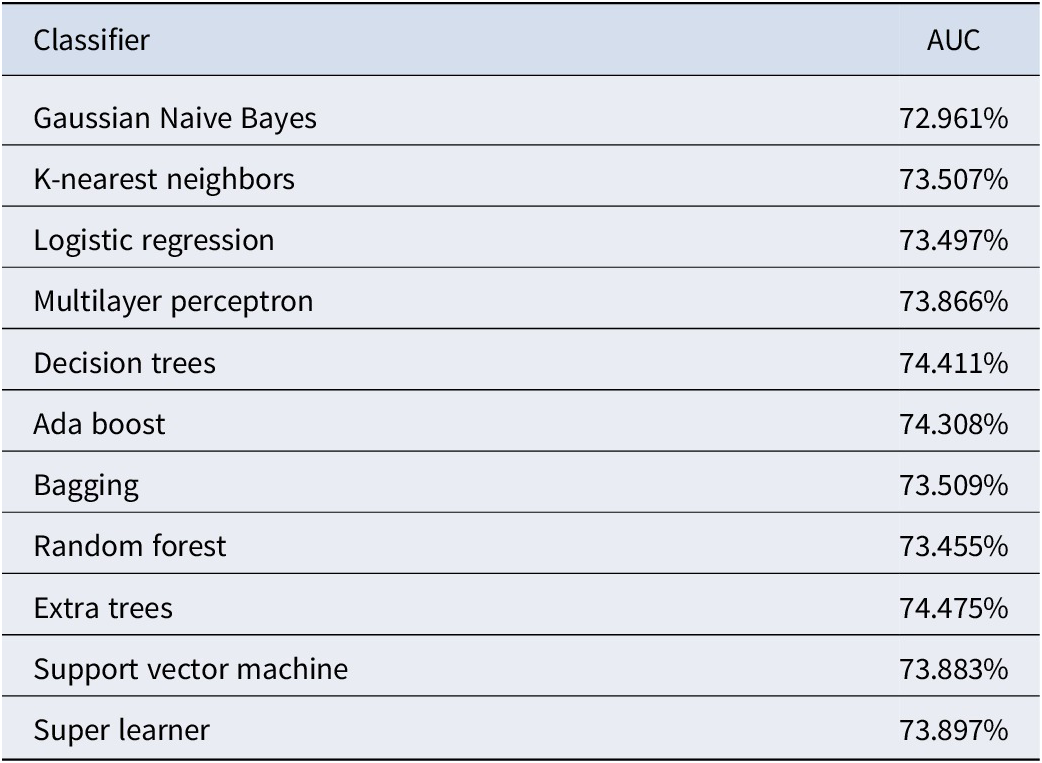
Note. ML, machine learning; NLP, natural language processing; and AUC, area under the receiver operating characteristic curve.
Interpretation of performance metrics in predicting coach implementation fidelity

Note. AUC, area under the receiver operating characteristic curve; d-CBT, digital cognitive-behavioral therapy; PPV, positive predictive value; NPV, negative predictive value.
Step 3: Predictive ML modeling to automate the evaluation of coach fidelity
Table 5 presents the model performance of various classifiers. Based on AUC values, the three worst-performing ML candidate algorithms were Gaussian Naive Bayes (62.97%), Ada Boost (68.83%), and K-nearest neighbors (71.56%). Conversely, the three best-performing ML candidate algorithms were Support Vector Machine (75.14%), Extra Trees (75.614%), and Super Learner (76.06%). The Super Learner thus had a 76.06% likelihood of correctly ranking a randomly chosen case example (i.e. meeting fidelity) higher than a randomly chosen non-case example (i.e. not meeting fidelity). The final Super Learner model achieved sensitivity of 57.04%, specificity of 86.69%, PPV of 71.70%, and NPV of 77.35%. Our second hypothesis was supported.
Model performance of various classifiers to automate the evaluation of coach implementation fidelity

Note. AUC, area under the receiver operating characteristic curve.
Discussion
Prior DMHI studies have evaluated whether regular therapist-to-user emails adhered to prescribed behaviors using human coders (e.g. Hadjistavropoulos, Schneider, Klassen, Dear, & Titov, Reference Hadjistavropoulos, Schneider, Klassen, Dear and Titov2018). We built on such work by testing the promises and shortcomings of ML and NLP (including sentiment analysis) to automate fidelity monitoring in GdCBT. Consistent with expectations, coaches who underwent intensive training and supervision during a meticulously monitored, multi-site RCT (Fitzsimmons-Craft et al., Reference Fitzsimmons-Craft, Taylor, Newman, Zainal, Rojas-Ashe, Lipson and Wilfley2021) showed good implementation fidelity as rated by well-trained and monitored human coders.
Coders rated coaches’ GdCBT messages for alignment with CBT theory to promote skill usage (e.g. exposure therapy) and avoid prohibited actions (e.g. enabling avoidance). Notably, our observed coder inter-rater agreement (.894–1.000) using diverse metrics (ICC, κ, and %-agreement) fell within ranges considered to be excellent (Cicchetti, Reference Cicchetti1994). Our coder ratings were also notably higher than other empirical studies documented by a recent psychotherapy fidelity review (κs = .24–.66; Ahmadi et al., Reference Ahmadi, Noetel, Schellekens, Parker, Antczak, Beauchamp and Lonsdale2021). The excellent inter-rater reliability might be partly because our fidelity rubric had an optimal number of codes (20 codes in total), and all codes were more concrete than abstract. In the psychotherapy fidelity literature, the number of codes varied from two (Xiao, Imel, Georgiou, Atkins, & Narayanan, Reference Xiao, Imel, Georgiou, Atkins and Narayanan2015) to 209 (Gaut, Steyvers, Imel, Atkins, & Smyth, Reference Gaut, Steyvers, Imel, Atkins and Smyth2017). Fewer codes corresponded to improved inter-rater agreement and predictive performance, and the reverse was also true (Ahmadi et al., Reference Ahmadi, Noetel, Schellekens, Parker, Antczak, Beauchamp and Lonsdale2021). Concrete codes, such as ours, were predicted more accurately than abstract, conceptual codes. Our concrete codes covered four classes: targets for the start of the GdCBT (four codes), compulsory targets for most GdCBT sessions (four codes), optional targets for some sessions (eight codes), and proscribed behaviors (four codes). Examples of concrete codes included “Demonstrates interest in the user as a person” and “Reinforces positive steps (even if miniscule)”. Conversely, other fidelity coding systems, such as the 19-code Motivational Interviewing Skill Code (MISC) and 10-code Motivational Interviewing Treatment Integrity (MITI), comprised more abstract codes (e.g. advising, confrontation, and emphasizing autonomy; Atkins, Steyvers, Imel, & Smyth, Reference Atkins, Steyvers, Imel and Smyth2014; Imel, Steyvers, & Atkins, Reference Imel, Steyvers and Atkins2015; Tanana et al., Reference Tanana, Hallgren, Imel, Atkins and Srikumar2016; refer to Supplementary Tables S4 and S5 for more details on these alternative psychotherapy fidelity coding scales). Our fidelity rubric also overlapped somewhat with face-to-face CBT rubrics, such as the 30-code ACE Treatment Integrity Measure (ATIM; Bendall et al., Reference Bendall, Allott, Jovev, Marois, Killackey, Gleeson and Jackson2015), 25-code Cognitive Therapy Adherence and Competence Scale (CTACS; Barber, Liese, & Abrams, Reference Barber, Liese and Abrams2003), 14-code Cognitive Therapy Scale-Revised (CTS-R; Blackburn et al., Reference Blackburn, James, Milne, Baker, Standart, Garland and Reichelt2001), and 88-code Cognitive Processing Therapy (CPT)–Therapist Adherence and Competence Protocol (Marques et al., Reference Marques, Valentine, Kaysen, Mackintosh, Dixon De Silva, Ahles and Wiltsey-Stirman2019; refer to Supplementary Tables S6–S10 for summaries of alternative CBT fidelity measures). These fidelity rubrics garnered mean ICC values that ranged between .57 and .95, with values falling mainly within the .60–.80 range. Despite some overlap between face-to-face CBT and GdCBT, such as feedback, reinforcement, and tailoring to the individual, inter-rater agreement differences between the present and prior studies could also be due to codes specific to GdCBT, such as “Encourages use of SilverCloud”. In addition, compared to briefer rubrics (e.g. the two-code system utilized by Xiao et al., Reference Xiao, Imel, Georgiou, Atkins and Narayanan2015), our 20-code rubric probably enabled a more nuanced evaluation while maintaining concrete instructions sufficient for high agreement. Together, the thorough and concrete, CBT-focused feature of our GdCBT fidelity coding system and high-intensity coder training probably led to the high observed inter-rater reliability.
Further, coach-to-user messages comprised more positive (e.g. “helpful” and “support”) than negative sentiment words (e.g. “anxiety” and “depression”). If replicated, this outcome might indicate that a skew toward more positive than negative sentiment words in coach-to-user communications is integral to ensuring consistency with CBT principles in addition to enhancing therapy conversations (Pérez-Rosas et al., Reference Pérez-Rosas, Sun, Li, Wang, Resnicow and Mihalcea2018). Ongoing research on this phenomenon would further clarify the value of NLP sentiment analysis in maintaining treatment integrity for GdCBT.
Overall, our best-performing predictive ML models achieved acceptable performance metrics (AUC = 75–76%, sensitivity = 57–70%, specificity = 66–87%, PPV = 67–72%, NPV = 68–77%). The optimal models were Extra Trees and Super Learner. Extra Trees, an amalgamation of decision trees that included more randomization in the decision rule development process than AdaBoost, Decision Trees, and Random Forests, possibly decreased variance and enhanced generalizability of the predictive models (Geurts, Ernst, & Wehenkel, Reference Geurts, Ernst and Wehenkel2006). Super Learner is a stacked ensemble ML method that combines predictions from multiple base classifiers using cross-validation to optimize weights and reduce prediction error (van der Laan et al., Reference van der Laan, Polley and Hubbard2007). These ensemble techniques’ stronger rigor and ability to manage complex, non-linear associations likely explained their greater predictive power than other single-component ML algorithms examined herein. Other simpler algorithms (Gaussian Naïve Bayes, Logistic Regression, and K-Nearest Neighbors) likely performed worse with fidelity data due to their strong assumptions about linearity and predictor independence and lack of scalability to big datasets (Beyer, Goldstein, Ramakrishnan, & Shaft, Reference Beyer, Goldstein, Ramakrishnan, Shaft, Beeri and Buneman1999; Ng & Jordan, Reference Ng and Jordan2001). Support Vector Machine might not have performed well due to its sensitivity to hyperparameter tuning (Steinwart, Reference Steinwart2008). In addition, other NLP studies using ML to predict therapist fidelity for face-to-face psychotherapy yielded comparable quality when predicting human coder-rated scores, as reflected by AUCs of .72–.79 (Atkins et al., Reference Atkins, Steyvers, Imel and Smyth2014; Can et al., Reference Can, Marin, Georgiou, Imel, Atkins and Narayanan2016; Gallo et al., Reference Gallo, Pantin, Villamar, Prado, Tapia, Ogihara and Brown2015; Gaut et al., Reference Gaut, Steyvers, Imel, Atkins and Smyth2017). Considerable discussion exists about the most suitable metric in general (Handelman et al., Reference Handelman, Kok, Chandra, Razavi, Huang, Brooks and Asadi2019) and specifically in the context of implementation fidelity (Ahmadi et al., Reference Ahmadi, Noetel, Schellekens, Parker, Antczak, Beauchamp and Lonsdale2021). Based on statistical (Hernández-Orallo, Flach, & Ferri, Reference Hernández-Orallo, Flach and Ferri2012) and practical (Ahmadi et al., Reference Ahmadi, Noetel, Schellekens, Parker, Antczak, Beauchamp and Lonsdale2021) considerations, AUC would take precedence over other metrics for predicting fidelity since it considers the balance between true positive rate and true negative rate. Consistent with this, we found that coaches more often coded for prescribed behaviors than proscribed ones.
Moreover, our study built on prior fidelity studies that utilized ML by testing the generalizability of predictive models to unseen data (i.e. a new context; Ahmadi et al., Reference Ahmadi, Noetel, Schellekens, Parker, Antczak, Beauchamp and Lonsdale2021) using the nested CV approach that prevents data leakage (Lewis et al., Reference Lewis, Spiliopoulou, Goldmann, Pitzalis, McKeigue and Barnes2023). We could only locate a single study that capitalized on ML for motivational interviewing transcripts and tested it on unseen data (Idalski Carcone et al., Reference Idalski Carcone, Hasan, Alexander, Dong, Eggly, Brogan Hartlieb and Kotov2019). Akin to our results, their ML models attained an acceptable degree of concordance with human coder ratings. Data-driven insights might thus enhance clinical supervision and practice by equipping coaches with evidence-based communication techniques to better customize their asynchronous interactions with users. Collectively, automated fidelity coding could be a vital initial step toward achieving effective guided DMHIs that require minimal to no human coders.
From a clinical practice perspective, the present study offers a step toward actionable solutions for enhancing the implementation fidelity of DMHIs. Nevertheless, the necessity for coaches undermines a frequently advocated benefit of DMHIs: their scalability, which involves effortless deployment to diverse global populations with varying economic and ethnic attributes needing good mental healthcare (Hollis et al., Reference Hollis, Falconer, Martin, Whittington, Stockton, Glazebrook and Davies2017). Simultaneously, growing calls for adopting task-sharing approaches (i.e. deploying persons without rigorous background training in psychological theories and techniques as coaches for guided DMHIs; Barnett, Puffer, Ng, & Jaguga, Reference Barnett, Puffer, Ng and Jaguga2023) should not compromise fidelity quality. Eliminating the need for human coders to monitor and maintain fidelity by using sophisticated NLP and ML tools, will provide clinical supervisors deploying scalable DMHIs with more staffing and the ability to re-allocate scarce human resources to serve as human coaches instead.
The current NLP analysis intentionally did not test the association between fidelity and DMHI outcomes because doing so was tangential to the study aims and a separate research question (Malgaroli et al., Reference Malgaroli, Hull, Zech and Althoff2023; Perepletchikova, Reference Perepletchikova2005). Treatment fidelity or integrity – the extent to which a GdCBT coach abided by CBT theories, principles, and planned treatment delivery – was essentially a manipulation check of the internal validity of the coach portion of the GdCBT (Breitenstein et al., Reference Breitenstein, Gross, Garvey, Hill, Fogg and Resnick2010; Perepletchikova, Reference Perepletchikova2005). Methodologists recommend that manipulation check assessments are discriminated theoretically and procedurally from the outcome (Kazdin, Reference Kazdin2021). This aim was achieved using reliable human coders of coach-delivered intervention text as our dependent measure, which is the suggested method of fidelity assessment (Kazdin, Reference Kazdin2017; Vallis, Shaw, & Dobson, Reference Vallis, Shaw and Dobson1986; Waltz et al., Reference Waltz, Addis, Koerner and Jacobson1993). Thus, we focused on testing ML prediction of predetermined gold-standard fidelity metrics, retaining a discrete boundary between fidelity assessment and DMHI outcome evaluation, which aligned with best practice methodological recommendations (Kazdin, Reference Kazdin2021). The question of interest was whether it was possible to forego time-consuming human ratings and instead use an ML algorithm to determine if coaches delivered their messaging with fidelity. Importantly, if fidelity (or ML prediction of fidelity) were associated with outcome, it would not confirm that the ML algorithm predicted coach fidelity. Therefore, studying the relationship between coach fidelity and DMHI outcomes could be a separate direction in the future.
The present study had several limitations. First, as our analyses aggregated coach fidelity ratings throughout the intervention course, future studies on guided DMHIs should examine how fidelity evolves over time using methods that account for the longitudinal data structure of fidelity. Second, DMHIs frequently lack the interactivity of in-person psychotherapy or teletherapy that offers non-verbal cues, as they frequently depend on asynchronous communication and user engagement. On that note, future DMHI studies should determine the value of user-to-coach messages in studying coach fidelity, given that those were excluded from the present analysis but could offer insights about the quality of help users received. Third, future research should compute weighted log-odds ratios or similar metrics for sentiment analysis since specific negative or positive sentiment words (e.g. “terrible” and “excellent”) might yield a more substantial effect than others (e.g. “unhelpful” and “nice”). Fourth, NLP approaches might struggle with comprehending context, implicit meanings, and sarcasm in clinical conversations. Thus, sentiment analysis, although insightful, might not inform the complex nature of therapeutic DMHI conversations. Despite these limitations, the study’s strengths included the novelty and pragmatism of our research question and approach to optimizing the delivery of GdCBTs. Relatedly, our study filled an essential knowledge gap in GdCBT research and practice since a key challenge in assessing coaching effectiveness is the frequent dearth of reporting on implementation fidelity, training protocols, and unique coaching outcomes (Meyer et al., Reference Meyer, Wisniewski and Torous2022).
To conclude, NLP and ML methods (especially SuperLearner and Extra Trees) were dependable approaches for monitoring coach fidelity in guided GdCBT. Most DMHI studies do not examine their fidelity (Schueller & Torous, Reference Schueller and Torous2020). When fidelity was examined, there was reliance on human coders. This can be burdensome and may not be scalable to a clinically meaningful level in a time-efficient fashion. This resource-intensive procedure necessitates plausible NLP and ML solutions. Building on current and existing work (Nook, Hull, Nock, & Somerville, Reference Nook, Hull, Nock and Somerville2022), future research endeavors should leverage NLP and ML techniques with coach-to-user messages and related textual data to predict guided DMHI outcomes (Kuo et al., Reference Kuo, Tanana, Goldberg, Caperton, Narayanan, Atkins and Imel2023), such as symptom trajectories, treatment remission, and response.
Supplementary material
The supplementary material for this article can be found at http://doi.org/10.1017/S0033291725000340.
Data availability statement
The authors will make the raw data underpinning this article’s conclusions accessible without undue restriction.
Acknowledgments
We thank the following research assistants who served as human coders in our implementation fidelity study: Abigail Ransom, Alexa Belnick, Ana Luiza Clever, Cheyna Warner, Elone Mengistu, Jamie Gensbauer, Jessica Ball, Madison Yeoman, Mark Anastasi, Meghan Dellert, Michael Sandela, Natalie Gottret, Noor Lamba, Ramya Jagadeesh, and Yunhao Zhao.
Author contribution
NHZ, GNR, EF-C, ER-A, CBT, DE, DEW, and MGN contributed to the conception and design of the coach implementation fidelity of the present study, as well as drafting, reviewing, and editing of the current manuscript. NHZ, RE, and BF organized and statistically analyzed the database. EF-C, CBT, DE, DEW, and MGN obtained funding. All authors contributed to the current manuscript and approved the submitted version.
Funding statement
The present study received partial funding from the following sources: the U.S. National Institute of Mental Health (R01 MH115128, K08 MH120341), the Penn State Office of Research and Graduate Studies Dissertation Award, the Penn State Susan Welch or Arthur Nagle Family Graduate Fellowship, the National University of Singapore (NUS) Development Grant and Presidential Young Professorship (PYP), and the Association for Behavioral and Cognitive Therapies Leonard Krasner Student Dissertation Award.
Competing interests
The authors declare that the research was conducted without any commercial or financial relationships that could be construed as a potential conflict of interest. In other words, the authors have no conflicts of interest to declare.
Ethical standard
The present study involving human participants was reviewed and approved by Washington University IRB (IRB ID# 202202085). The studies were conducted following the local legislation and institutional requirements. The participants provided their written voluntary informed consent to participate in the present study.


 Open access

