

1. Introduction
Seven years have passed since the United Nations adopted the Sustainable Development Goals (SDGs) as a blueprint for governments, businesses, donors, and civil society to accelerate efforts to ‘end poverty, protect the planet and ensure prosperity for all’. With an estimated US$3.3–4.5 trillion needed annually to achieve the Goals worldwide (UNDOCO, 2018), effective resource allocation and synergistic solutions are critical – an urgency magnified by the devastating impacts of COVID-19 on our societies and economies. The next 12 months present a pivotal opportunity to fast-track alignment, with the UN Convention on Biological Diversity (CBD) set to define a post-2020 Global Biodiversity Framework (GBF) for the conservation and sustainable use of nature, and countries moving to implement their national commitments under the Paris Agreement of the UN Framework Convention on Climate Change (UNFCCC), now that the Paris ‘rulebook’ has been agreed at COP26 in Glasgow, with clear reference to the world's interrelated climate and nature emergencies.
Central to the SDGs is the notion that environmental sustainability underpins economic and social dimensions of development, backed by a wealth of research linking nature to human wellbeing via ecosystem services or, more broadly, ‘nature's contributions to people’ (NCPs) (Dasgupta, Reference Dasgupta2021; Diaz et al., Reference Diaz, Pascual, Stenseke, Martin-Lopez, Watson, Molnar, Hill, Chan, Baste, Brauman, Polasky, Church, Lonsdale, Larigauderie, Leadley, van Oudenhoven, van der Plaat, Schroter, Lavorel and Shirayama2018; IPBES, 2019). Yet the language of the 17 Goals and 169 Targets comprising the SDGs is largely blind to the myriad ways in which nature supports our health and wealth (Reyers & Selig, Reference Reyers and Selig2020). While Goals 14 (Life Under Water) and 15 (Life on Land) recognize the urgent need to conserve, restore, and more sustainably use nature, the lack of clear links between healthy ecosystems and achievement of the other Goals means Goals 14 and 15 have come to be seen by many as simply ‘the environmental goals’ rather than the foundation upon which achievement of the entire SDG agenda depends. As a result, progress on achieving them has been limited, investment is trending in the wrong direction (Sachs et al., Reference Sachs, Schmidt-Traub, Kroll, Lafortune, Fuller and Woelm2020), and nature continues to decline faster than at any time in human history (Brauman et al., Reference Brauman, Garibaldi, Polasky, Aumeeruddy-Thomas, Brancalion, DeClerck, Jacob, Mastrangelo, Nkongolo, Palang, Perez-Mendez, Shannon, Shrestha, Strombom and Verma2020; IPBES, 2019), while ‘business-as-usual’ (BAU) development compounds the problem, providing short-term support for individual Targets while undermining the natural world that supports the totality (e.g. Franks et al., Reference Franks, Davis, Bebbington, Ali, Kemp and Scurrah2014; Ordway et al., Reference Ordway, Asner and Lambin2017).
In this Intelligence Briefing, we argue that only a radical increase in the visibility of nature's role, and its incorporation into planning and implementation, will ensure the SDGs catalyze truly sustainable development. To support this contention, we illuminate nature's role through an assessment of the language of all 169 Targets, alongside a review of documented nature–human well-being linkages. We categorize which of the 169 Targets are dependent upon nature for their achievement, could harm nature if attained through BAU actions, or may synergistically benefit nature through their attainment (Table 1 and Supplementary Materials). Doing so provides insights critical for increasing effectiveness across the SDG agenda regarding where to invest, how to enhance synergies and limit unanticipated impacts, and how to measure success. It also suggests a path for integrating the ‘nature that people need’ to achieve the 2030 Agenda into the CBD's post-2020 GBF.
Definitions of dependent, harm, benefit, and no link categorizations applied to all 169 Targets

Note that categories are not mutually exclusive, except for No link. See Supplementary Materials for details on methods and the list of categorizations for all 169 Targets.
2. Invest in nature to promote sustainable development
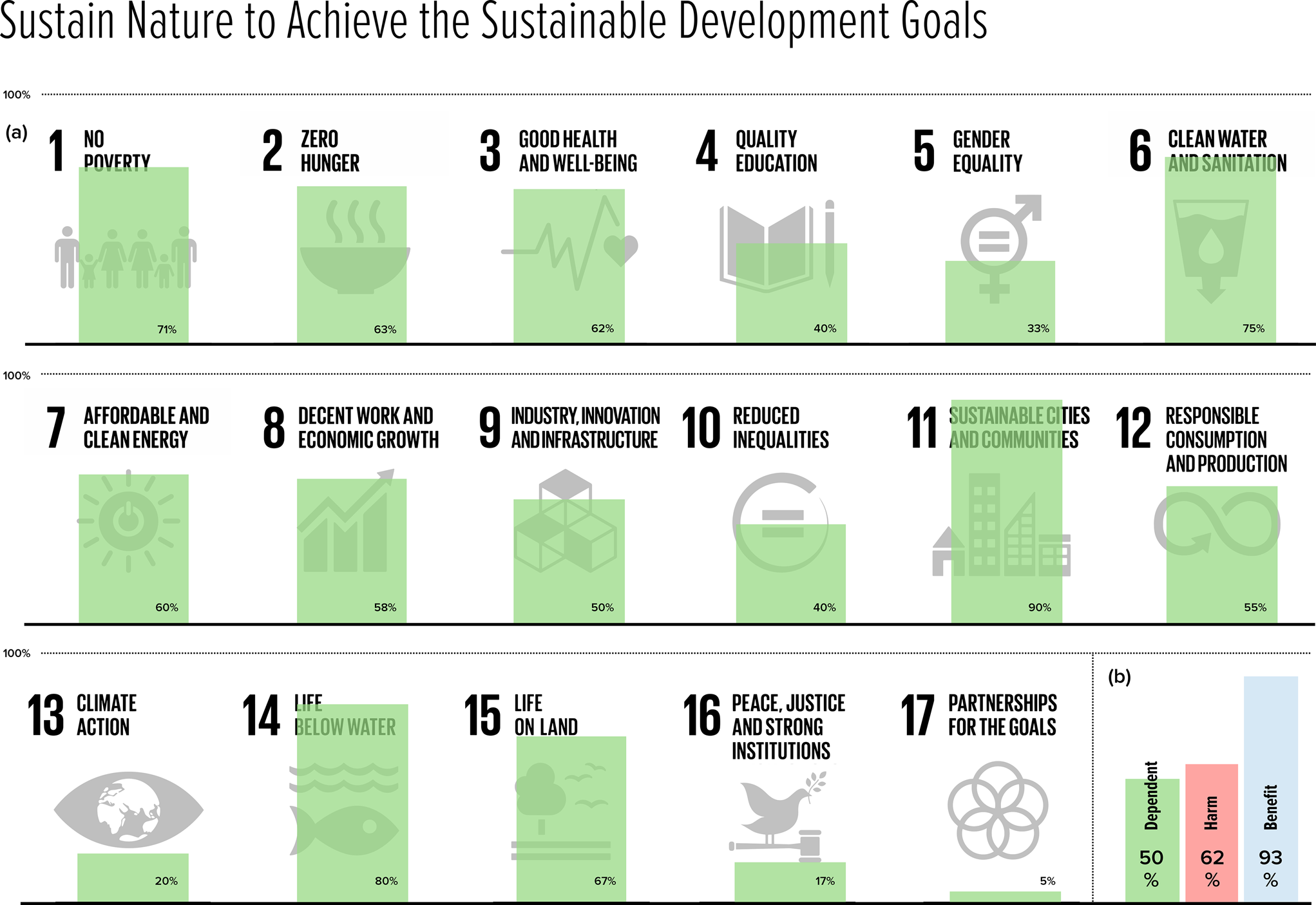
We find that 84 (50%) of the 169 Targets are dependent on nature for their achievement via clearly documented mechanisms (Figure 1). For 24 Targets the relationship is ‘obvious’; either the Target's language relates to nature itself (e.g. Target 15.4 – ensure the conservation of mountain ecosystems) or explicitly references the sustainable use of nature (e.g. 12.2 – achieve the sustainable management and efficient use of natural resources). For most, however (60 Targets), nature's role goes unstated. For example, in many countries mangroves and other coastal ecosystems are critical for protecting vulnerable coastal communities from storm surge and flooding, while forests are vital sources of food and raw materials for people in times of social or economic stress (IPBES, 2019), making their conservation critical for achieving Target 1.5 (build resilience of the poor to climate-related extreme events and other disasters). Similarly, nature's medicine cabinet provides us with compounds used to treat everything from cancer (e.g. vincristine derived from the Madagascar periwinkle) to pain relief (e.g. morphine from the Opium poppy), with new compounds being found all the time (Atanasov et al., Reference Atanasov, Zotchev, Dirsch and Supuran2021; Chivian & Bernstein, Reference Chivian and Bernstein2008) – all vital for progress on 3.4 (reduce premature mortality from non-communicable diseases). Meanwhile, the natural world inspires innumerable innovations in technology – from buildings that replicate termite mounds to more efficiently regulate temperature (Singh et al., Reference Singh, Muljadi, Raeini, Jost, Vandeginste, Blunt, Theraulaz and Degond2019) to the Namib desert beetle's shell that is encouraging new ways to harvest water from mist in water-stressed regions (Brown & Bhushan, Reference Brown and Bhushan2016) – driving progress on 8.2 (achieve higher levels of productivity through innovation). Yet the language of all these Targets, their indicators, and most reporting on implementation progress to date (Sachs et al., Reference Sachs, Schmidt-Traub, Kroll, Lafortune, Fuller and Woelm2020) obscures or ignores nature's role. With the monetary value of nature's benefits to the private sector alone standing at US$44 trillion (WEF, 2020), this is extraordinarily shortsighted. In effect, these dependencies on nature represent a vast, unseen subsidy toward achieving the SDGs that we are failing to track or measure and so cannot effectively steward.
(a) Percentage of SDG Targets under each Goal that are dependent on nature for their achievement and (b) proportion of total 169 SDG Targets that are dependent and could harm or benefit nature through their achievement.
Instead, dependent Targets should be seen as critical opportunities for investing in nature-based solutions (NBS) (Cohen-Shacham et al., Reference Cohen-Shacham, Walters, Janzen and Maginnis2016) for sustainable development. For example, with US$90 trillion expected to be spent globally on infrastructure over the next 15 years, there is growing acknowledgment that investments must prioritize low-carbon projects that retain flexibility under climate change (Browder et al., Reference Browder, Ozment, Rehberger-Bescos, Gartner and Lange2019). Focusing investment on ‘green infrastructure’, for example, that actively leverages nature's regulating functions, provides flexible pathways for rapid and sustainable progress toward Targets in the water sector (6.1 – access to safe & affordable drinking water), sustainable cities and disaster risk reduction (11.5 – reduce number of people affected by disasters) and the design of resilient infrastructure more generally (9.4 – sustainable infrastructure & industries) (Browder et al., Reference Browder, Ozment, Rehberger-Bescos, Gartner and Lange2019; Vorosmarty et al., Reference Vorosmarty, Osuna, Cak, Bhaduri, Bunn, Corsi, Gastelumendi, Green, Harrison, Lawford, Marcotullio, McClain, McDonald, McIntyre, Palmer, Robarts, Szollosi-Nagy, Tessler and Uhlenbrook2018).
3. Implement actions that enhance synergies and reduce unintended consequences
Implicit in the logic of the SDGs is that the Goals are interdependent. Yet despite some progress on mapping specific Target-to-Target interactions (e.g. Lusseau & Mancini, Reference Lusseau and Mancini2019; Scharlemann et al., Reference Scharlemann, Brock, Balfour, Brown, Burgess, Guth, Ingram, Lane, Martin, Wicander and Kapos2020), most links remain poorly described and ignored in practice. Pursuing Targets individually ignores opportunities to capitalize on synergies and risks the achievement of one Target having unanticipated consequences for others. Nature's central role as a mediator of interactions across a host of Targets highlights these risks and opportunities (Scharlemann et al., Reference Scharlemann, Brock, Balfour, Brown, Burgess, Guth, Ingram, Lane, Martin, Wicander and Kapos2020; Wood et al., Reference Wood, Jones, Johnson, Brauman, Chaplin-Kramer, Fremier, Girvetz, Gordon, Kappel, Mandle, Mulligan, O'Farrell, Smith, Willemen, Zhang and DeClerck2018). The good news is achieving the majority of Targets (157; 93%) could potentially benefit nature – either intentionally (32%) or as a ‘knock-on’ consequence (61%). Actions toward Target 5.5 (ensure women's full and effective participation and equal opportunities for leadership), for example, should enhance nature stewardship, as sustainability outcomes of development projects generally improve when women participate (Cook et al., Reference Cook, Grillos and Andersson2019). Similarly, achieving Target 8.4 (improve resource efficiency in consumption and production) could indirectly lessen pressures on nature by reducing the estimated 1.6 billion tons of food waste, from production to retail, each year (FAO, 2019). While unsurprising given the premise of the SDGs, such beneficial outcomes are not written in stone – achieving 15 Targets (9%) using BAU solutions would likely harm nature based on historical precedent, while achieving a further 102 Targets (60%) could benefit or harm nature depending on how they are achieved. These ‘mixed outcome’ Targets point to the urgency of building on existing, and establishing new, environmental safeguards in planning and implementation (e.g. the International Finance Corporation's (IFC) Performance Standards on Social and Environmental Sustainability). In the medium term, we must capitalize on recent progress in mechanisms that value nature as an asset and include it in the balance sheet of nations and corporations, such as Natural Capital Accounting (Hein et al., Reference Hein, Bagstad, Obst, Edens, Schenau, Castillo, Soulard, Brown, Driver, Bordt, Steurer, Harris and Caparros2020), if synergies and trade-offs with nature are to be robustly accounted for.
More broadly, mixed-outcome Targets demonstrate that, in most cases, achievement of the SDGs presents a choice: invest in actions that prioritize short-term wins in support of a single Target, or adapt interventions to harness and conserve nature, fostering longer-term sustainability across linked dependent Targets. Target 2.1 (end hunger) is a prime example: instead of adopting BAU agricultural expansion to boost yields through converting natural habitats and increasing fossil fuel-based inputs, stakeholders could combine best practices in integrated landscape management, close yield gaps on underperforming lands (including through targeted intensification), employ technologies that promote efficiencies in chemical and water inputs, invest in agricultural extension services, and ensure property rights. Such an approach is feasible, cost-effective, and a prerequisite for our food systems to remain within planetary boundaries (Willett et al., Reference Willett, Rockstrom and Loken2019). The result will be synergistic gains in linked dependent Targets, including 2.4 (ensure sustainable food production systems), 6.4 (increase water use efficiency & sustainable withdrawals), and 12.4 (environmentally sound management of chemicals and wastes).
Why are such NBS not leveraged more often? Until now, NBS implementation, at the transformative scale necessary, has faced headwinds, including challenges in quantifying the effectiveness and monetary value of NBS outcomes, as well as path dependency and silo-ed decision-making in many sectors that pitches ‘green’ against ‘grey’ (engineered) solutions, instead of capitalizing on the potential synergies of ‘hybrid’ solutions, and so pushes decision-makers toward BAU development pathways (e.g. Seddon et al., Reference Seddon, Chausson, Berry, Girardin, Smith and Turner2020; Vorosmarty et al., Reference Vorosmarty, Osuna, Cak, Bhaduri, Bunn, Corsi, Gastelumendi, Green, Harrison, Lawford, Marcotullio, McClain, McDonald, McIntyre, Palmer, Robarts, Szollosi-Nagy, Tessler and Uhlenbrook2018). As the science advances, however, and awareness of the multiple benefits of NBS continues to rapidly increase, investment looks set to take off. To help sustain this growing momentum and to track progress in meeting SDG Targets that leverage nature's role, exploit synergies, and reduce trade-offs, fit-for-purpose monitoring systems and indicators are essential.
4. Use integrated monitoring to track nature's role
Recent work has noted the inadequacy of existing SDG indicators for tracking environmental health (Zeng et al., Reference Zeng, Maxwell, Runting, Venter, Watson and Carrasco2020). Yet even more glaring is the lack of indicators that track nature's role in achieving dependent targets. From our review (see Supplementary Materials), of the 241 official SDG indicators, only 11 explicitly track nature's role, just six can be measured using existing methods and data, and only five pertain to Targets beyond Goals 14 and 15. Moreover, the majority of official indicators are uni-dimensional, designed to track progress only toward their parent Target and thus blind to the interconnectedness between Targets. COVID-19 unequivocally demonstrates the risk of ignoring interactions: with the risk of zoonotic spillovers increasing as a result of unsustainable human exploitation of natural habitats and poor management of wildlife and domestic animals, to help prevent future pandemics we must track the relationship between human and ecosystem health (Dobson et al., Reference Dobson, Pimm, Hannah, Kaufman, Ahumada, Ando, Bernstein, Busch, Daszak, Engelmann, Kinnaird, Li, Loch-Temzelides, Lovejoy, Nowak, Roehrdanz and Vale2020). One potential solution is the further development of ‘integrated’ indicators, such as the Ocean Health Index (OHI) (Halpern et al., Reference Halpern, Longo, Hardy, McLeod, Samhouri, Katona, Kleisner, Lester, O'Leary, Ranelletti, Rosenberg, Scarborough, Selig, Best, Brumbaugh, Chapin, Crowder, Daly, Doney and Zeller2012) which tracks progress on multiple socio-ecological goals, within a framework that explicitly integrates nature's support for human well-being. Another is to monitor foundational environmental components essential to multiple SDG Targets; for example, tracking soil health, through monitoring changes in soil organic carbon, could provide a metric for assessing progress on Targets 2.4 (ensure sustainable food production systems), 15.3 (combat desertification), and 13.1 (strengthen resilience and adaptive capacity). Ongoing development of GEOBON's Essential Biodiversity Variable (EBV) and Essential Ecosystem Service Variable (EESV) initiatives, meanwhile, should help harmonize national and global data and reporting on changes in biodiversity and ecosystem service delivery (Cord et al., Reference Cord, Brauman, Chaplin-Kramer, Huth, Ziv and Seppelt2017), offering potential indicators that could be shared across both the SDGs and the GBF. Developing such global monitoring systems and indicators remains challenging however. To accelerate and complement these initiatives and to support broader SDG Target implementation there is an urgent need to develop methodologies and tools that further illuminate nature's role.
5. Map the nature people need
Foremost is the need to rapidly advance efforts to spatially map ecosystems and the NCPs they provide in support of dependent Targets. Until now, such efforts have been limited to individual regions or nations, apply only to a subset of NCPs, or are unable to quantify the amount of NCP being delivered in relation to people's needs. Solving these challenges is vital for exploring spatial synergies and trade-offs among scenarios of BAU development interventions vs NBS, guiding investments to the right places, and identifying stakeholders whose participation is key for delivering equitable and just outcomes. The good news is rapid progress is being made in global spatial mapping of ecosystems providing NCPs: from the role of mangroves and coral reefs in providing coastal protection (Chaplin-Kramer et al., Reference Chaplin-Kramer, Sharp, Weill, Bennett, Pascual, Arkema, Brauman, Bryant, Guerry, Haddad, Hamann, Hamel, Johnson, Mandle, Pereira, Polasky, Ruckelshaus, Shaw, Silver and Daily2019; Jones et al., Reference Jones, Nickel, Srebotnjak, Turner, Gonzalez-Roglich, Zavaleta and Hole2020) and mountain ecosystems in supporting people's lives and livelihoods (Gret-Regamy & Weibel, Reference Gret-Regamy and Weibel2020), to the carbon stored in ecosystems that is ‘irreplaceable’ for achieving the Paris Climate Agreement (Noon et al., Reference Noon, Goldstein, Ledezma, Roehrdanz, Cook-Patton, Spawn, Wright, Gonzalez-Roglich, Hole, Rockstrom and Turner2022), and quantification of the positive links between protected areas globally and the health and wealth of nearby communities (Naidoo et al., Reference Naidoo, Gerkey, Hole, Pfaff, Ellis, Golden, Herrera, Johnson, Mulligan, Ricketts and Fisher2019). Crucially, such mapping exercises are increasingly being linked to the economic implications of losing nature that supports NCP delivery (e.g. Johnson et al., Reference Johnson, Ruta, Baldos, Cervigni, Chonabayashi, Corong, Gavryliuk, Gerber, Hertel, Nootenboom and Polasky2021). Such studies also reveal that priority areas for NCP delivery in support of dependent Targets are widespread (e.g. more than 2.6 million ha of mangroves protect vulnerable coastal people globally (Jones et al., Reference Jones, Nickel, Srebotnjak, Turner, Gonzalez-Roglich, Zavaleta and Hole2020)). Importantly, while overlap with other biodiversity priorities (e.g. threatened species) is substantial, it is far from comprehensive (Girardello et al., Reference Girardello, Santangeli, Mori, Chapman, Fattorini, Naidoo, Bertolino and Svenning2019; Larsen et al., Reference Larsen, Londono-Murcia and Turner2011). This suggests spatial targets for the percentage of Earth we need to conserve, restore, or sustainably manage to achieve our inter-linked global agendas on nature, climate change, and sustainable development will need to be substantial (Dinerstein et al., Reference Dinerstein, Joshi, Vynne, Lee, Pharand-Deschenes, Franca, Fernando, Birch, Burkart, Asner and Olson2020).
6. Harmonize the SDGs with the CBD's post-2020 GBF
The emerging post-2020 GBF represents an immediate opportunity to operationalize the interconnectedness between these global agendas. To do so, we see three key needs: First, while the current ‘first draft’ of the GBF includes a Goal (B) and Targets (8–13) focused on delivery of NCPs (CBD, 2021) – and so begins to explicitly capture key links between nature and dependent SDG targets (including disaster risk reduction, and food and water security) – many countries lack the data or modeling frameworks to robustly evaluate these linkages. Exponentially scaling the mapping work highlighted above is therefore critical for capturing additional NCPs, developing relevant indicators, and targeting implementation actions under both the SDGs and the GBF. Second, the draft Goal and Targets on NCPs are neither quantitative nor spatial. At a minimum, they should specify that it is the places most important for delivering NCPs that should be prioritized for action, alongside the development of indicators that measure their extent and condition (e.g. GEOBON's EESVs). Third, to truly sustain nature – to conserve species and ecosystems, help mitigate climate change, avoid tipping points in the biosphere and support the achievement of dependent SDG Targets and the broader SDG framework – will require, in aggregate, the protection, sustainable management, and restoration of a majority of Earth's lands, oceans, and freshwaters, while at the same time fully addressing issues of justice and equity. The GBF first draft contains three core spatial Targets (Target 1: ‘all land and sea areas under integrated biodiversity-inclusive spatial planning’; 2: ‘at least 20% of degraded ecosystems are under restoration’; and 3: ‘30% of the planet to be protected and conserved’). These are positive commitments and should be applauded – and retained as the GBF text is negotiated and refined – while also recognizing that Targets 2 and 3 reflect current political feasibility and so must be understood as starting points, with ambition increasing through 2030. These spatial Targets should also explicitly include all dimensions of biodiversity – including NCPs – to enhance efficiencies and capture the critical role of species in underpinning ecosystem functions that drive the stocks and flows of NCPs.
As with any negotiated global framework, the choice of issues addressed in the GBF's goals, targets, and indicators will shape the action agendas of countries, companies, and civil society for years to come, influencing where investments flow and for what purpose. Prioritizing synergies across the goals, targets, and indicators of the SDGs and the GBF should improve interoperability, minimize redundancy, and reduce monitoring and reporting burdens, thereby supporting more effective outcomes for people and nature.
7. Conclusions
Though nature's foundational role is implicit in the global vision articulated by the SDGs, to realize that vision it must be made explicit. Essential enabling conditions – from improving governance of the global commons to the removal of perverse economic incentives that prioritize short-term financial returns over resilience (Dasgupta, Reference Dasgupta2021), alongside mobilization and alignment of the requisite financial, technological, and human resources – are all represented in one or more of the SDGs and in many cases mirrored in the GBF. Indeed, this moment represents an opportunity to reset our relationship with planet Earth, from one of unsustainable exploitation of the biosphere to one of stewardship (Rockstrom et al., Reference Rockstrom, Beringer, Hole, Griscom, Mascia, Folke and Creutzig2021), combining local and indigenous knowledge with international technical and financial support, and considering the perspectives of all sectors of our societies and economies – including our most marginalized communities – a prerequisite for delivering equitable and just outcomes. Yet without greater visibility of nature's role in enabling sustainable development we fail to see the forest for the trees. Delivering on the SDGs will be even more challenging in a post COVID-19 world (Naidoo & Fisher, Reference Naidoo and Fisher2020); all the more reason that nature must be the driver of our economic and social recovery, not a victim, if we are to achieve sustainable development for all.
Supplementary material
The supplementary material for this article can be found at https://doi.org/10.1017/sus.2022.5
Acknowledgements
The authors thank Tim Noviello for developing Figure 1, and Arundhati Jagadish and Margot Wood for help in advising on the textual analysis.
Author contributions
DGH and WRT developed the concept; PC led the textual analysis along with AT; all authors contributed to writing and review.
Financial support
This work was supported by a gift from Betty and Gordon Moore.
Conflict of interest
None.
Research data and transparency
All relevant data and methods are available as Supplementary Materials.


 Open access

