


1. Introduction
Climate change continues to accelerate, driven by unsustainable energy use and by unsustainable consumption and production patterns within and across countries (IPCC, 2023). In response, a wide range of sustainability-oriented design interventions (e.g., products, services) have been deployed to support low-carbon development, especially in energy, mobility, and housing (Reference Sethi, Lamb, Minx and CreutzigSethi et al., 2020).
While these interventions hold significant potential to minimise environmental impacts, their potential environmental gains can be offset by triggered negative behavioural and systematic responses, also known as rebound effects (Reference Van der Loo and PigossoVan der Loo & Pigosso, 2024). In the context of this study, rebound effects are defined as the reduction in the potential environmental benefits of a sustainable intervention, caused by behavioural changes influenced by contextual factors (CF), when the intervention is used as it is designed for (adopted from Reference HertwichHertwich, 2005).
While rebound effects have been extensively studied, particularly within economics, a notable gap remains in understanding the behavioural rebound effects, which are caused by behavioural (e.g., social, psychologic) mechanisms that drive these effects (Reference Van der Loo and PigossoVan der Loo & Pigosso, 2024). An example of such mechanism is moral licensing, whereby engaging in an initial pro-environmental behaviour creates a perceived entitlement to subsequently engage in environmentally harmful behaviour (Reference Nash, Whitmarsh, Capstick, Hargreaves, Poortinga, Thomas, Sautkina and XeniasNash et al., 2017). In this study, rebound effects specifically refer to behavioural rebound effects, i.e., those arising from changes in user behaviour following the adoption of an intervention.
Additionally, most rebound effect studies currently concentrate on high-income settings, creating a knowledge gap regarding rebound effects in low-income countries (Reference Andrew and PigossoAndrew & Pigosso, 2024). This is problematic as contextual differences can influence behaviour and potentially lead to distinct behavioural responses following sustainable interventions (Reference Günther, Engel, Hornsey, Nielsen, Roy, Steg, Tam, van Valkengoed, Wolske, Wong-Parodi and HahnelGünther et al., 2025). For example, Reference Mahn, Best, Wang and AbionaMahn et al. (2024) found that higher-income households are more likely to adopt solar PV, highlighting how geography, income, and market access shape adoption. This raises the question of whether such CF also influence behavioural responses after adoption, and how they may affect the extent of rebound effects. This understanding is essential to ensure that sustainable-oriented interventions are not only technically more environmentally friendly, but that they also retain their environmental benefits after adoption by users.
This study addresses the gap of knowledge on how behavioural mechanisms and CF contribute to rebound effects in low- to middle-income countries by developing a framework that helps designers and innovators anticipate and prevent rebound effects during the early stages of solar home system (SHS) development. The study is guided by the following main research question: What are the behavioural mechanisms and contextual factors driving rebound effects in communities adopting solar panels in low- to middle-income countries, and how can these rebound effects be prevented?
To ground this study in a concrete and relevant context, solar home systems (SHS) are selected as a case study for investigating rebound effects in low- to middle-income countries. SHS are widely adopted to provide renewable energy in both high-income countries and low- to middle-income countries (World Bank Group, n.d.) (IRENA, 2025). Although global solar energy capacity is increasing, household electricity consumption patterns and user behaviour in low- and middle-income countries differ from those in high-income countries, potentially resulting in distinct behavioural responses following solar panel adoption (Reference Nguyen, Ratnasiri, Wagner, Nguyen and RohdeNguyen et al., 2024).
2. Background information
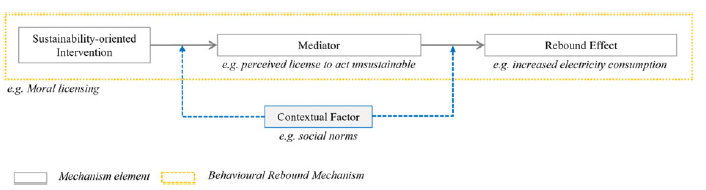
To analyse the CF and behavioural mechanisms, a framework that captures the causal structure through which rebound effects arise is used (Figure 1).
Visual illustration of a behavioural rebound mechanism

In this framework, the SHS functions as the Sustainability-oriented Intervention that can influence a Mediator, a variable that explains how and why rebound effects occur (Reference Baron and KennyBaron & Kenny, 1986). The Contextual Factor describe the external conditions that influence the strength and direction of the mediating effects (adopted from Baron & Kenny, 1986), leading to the Behavioural Rebound Effect. A Behavioural Rebound Mechanism (BRM) can consist of multiple mediators and several CF influencing the relationship between the mechanism elements. The blue dotted arrows indicate the influence of CF on the mechanisms’ causal processes. These influences may either weaken or strengthen the processes, although their presence does not necessarily guarantee their occurrence.
3. Methodology
To systematically investigate the rebound effects in the context of SHS and to support the development of a design-oriented tool for early-stage intervention strategies, this paper follows the Design Research Methodology, developed by Reference Blessing and ChakrabartiBlessing & Chakrabarti (2009).
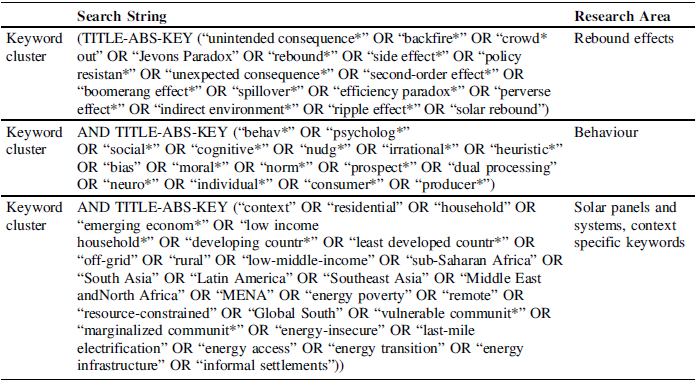
The Descriptive Study – I (DS-I) aims to identify CF influencing BRM. A systematic literature review to identify rebound effects in the context of SHS in both high-income and low- and middle-income countries was employed, following the methodology of Reference Biolchini, Mian, Natali and TravassosBiolchini et al. (2005).
The search string (Table 1) was used in Scopus on 5 April 2025, yielding n = 31 records. Scopus was selected due to its topical relevance and comprehensive coverage of peer-reviewed journals (Reference Falagas, Pitsouni, Malietzis and PappasFalagas et al., 2008).
The search string excluded knowledge areas not relevant to the study (e.g. chemistry, computer science, and mathematics). The inclusion criteria comprised studies focusing on (1) cognitive or social-level rebound mechanisms; (2) household solar PV systems (off-grid, remote, or grid-connected, solar intervention technology); and (3) individual households in low- to middle-income or high-income countries. After applying the inclusion criteria, 12 relevant articles were selected for analysis.
Search string systematic literature review

To expand the identification of possible behavioural changes driving rebound effects in SHS, this study includes the 18 behavioural mechanisms identified by Reference Van der Loo and PigossoVan der Loo & Pigosso (2024), which describe additional behavioural processes underlying rebound effects, triggered by a broad variety of sustainability interventions different from SHS (e.g., energy-efficient cars, recycling nudge). Building on this framework, their review was analysed to identify additional CF influencing these mechanisms, thereby exploring which CF may also be relevant in the context of SHS.
The Prescriptive Study – I (PS-I) explores in further detail the relationship between the CF and the associated BRM through a qualitative relationship matrix analysis (Reference Reed and FurmanReed & Furman, 1992). To assess the relationship and enable prioritisation of the most influential CFs across behavioural mechanisms, an influence score was assigned to each CF-BRM connection based on three dimensions: (1) literature count; (2) presence of SHS context; and (3) strength and direction of the influence. Additionally, a causal-plausibility analysis is conducted to explore theoretically grounded relationships that have not yet been empirically validated but are considered plausible based on logical inference and contextual understanding.
This analysis is carried out by the researcher and reviewed by a behavioural expert to ensure logical consistency and contextual validity. The insights from the matrix are used in the development of a design tool that supports early-stage SHS development by allowing designers to anticipate and mitigate rebound effects.
The development process follows seven key steps: (1) Concept generation and evaluation; (2) Ideation and refinement; (3) Definition of prevention strategy objectives; (4) Identification of existing design strategies; (5) Contextualisation of strategies; (6) Mapping strategies to the BRM, and (7) Formulation of evaluative questions.
The Descriptive Study – II (PS-II) evaluates the design tool developed in the PS-I phase through a critical incident analysis (Reference Hartson and PylaHartson & Pyla, 2019) and observations involving a diverse panel of 10 experts, including four design researchers, three rebound effect experts, a behaviour expert, a context expert and two intended users. The insights are analysed and used to refine and iteratively improve the tool between evaluation sessions, ensuring that feedback directly informs subsequent versions.
4. Results
This chapter presents the results of the systematic literature review (DS-I), followed by the development of the design tool (PS-I), and concludes with the evaluation of the tool (DS-II).
4.1. Rebound effects following solar panel adoption
The findings of the systematic literature review suggest that two main types of rebound effects can occur following the adoption of solar panels. The first rebound effect identified is the direct increase in energy consumption (Reference Deng and NewtonDeng & Newton, 2017; Reference Frondel, Kaestner, Sommer and VanceFrondel et al., 2023; Reference Vélez-Henao and García-MazoVélez-Henao & García-Mazo, 2022; Reference Wang, Feng, Fan and BalezentisWang et al., 2024; Reference Nguyen, Ratnasiri, Wagner, Nguyen and RohdeNguyen et al., 2024; Reference McCarthy and LiuMcCarthy & Liu, 2022; Reference Horne and KennedyHorne & Kennedy, 2022; Reference Qiu, Kahn and XingQiu et al., 2019; Reference Dütschke, Galvin and BrunzemaDütschke et al., 2021). The second rebound effect mentioned by the literature involves re-spending on additional products or services following the adoption of SHS (Reference Dütschke, Galvin and BrunzemaDütschke et al., 2021; Reference Wang, Feng, Fan and BalezentisY. Wang et al., 2024; Reference Galvin, Schuler, Atasoy, Schmitz, Pfaff and KegelGalvin et al., 2022).
4.2. Mapping the CF-BRM connections
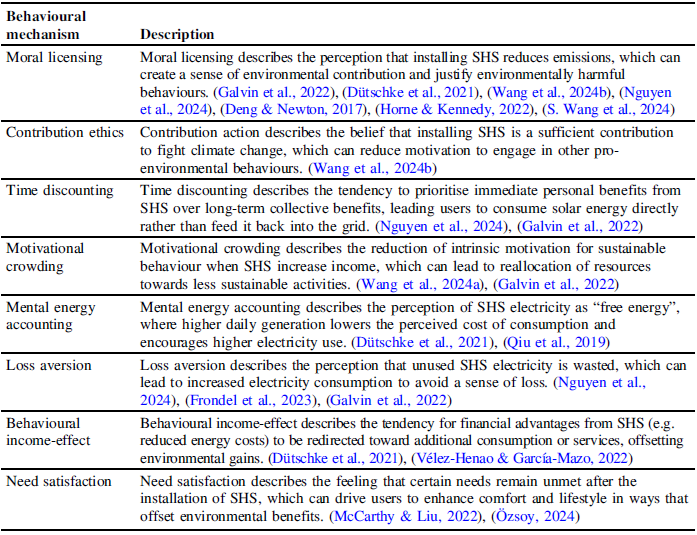
The systematic literature review resulted in the identification of eight CF and eight BRM relevant to SHS in both high-income countries low- to middle-income countries (Table 2).
Behavioural rebound mechanism (adopted from Reference Van der Loo and PigossoVan der Loo & Pigosso, 2024)

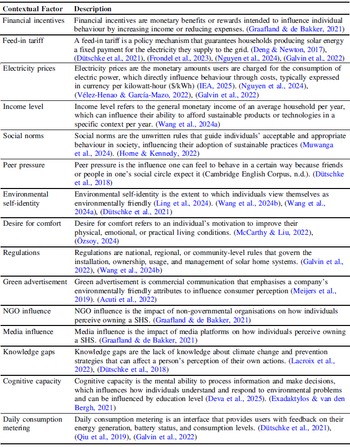
These contextual insights were synthesised with the findings derived from the analysis of the systematic literature review conducted by Reference Van der Loo and PigossoVan der Loo & Pigosso (2024), resulting in a consolidated list of 15 CF that potentially influence rebound effects in SHS adoption (Table 3).
Contextual factors

In the second phase, PS-I, 81 potential new connections were identified through an exploration of which CF and BRM might plausibly interact. These connections were subsequently reviewed by a behavioural expert to strengthen their conceptual validity. However, as they were not yet substantiated by empirical evidence, they were assigned a lower strength score.
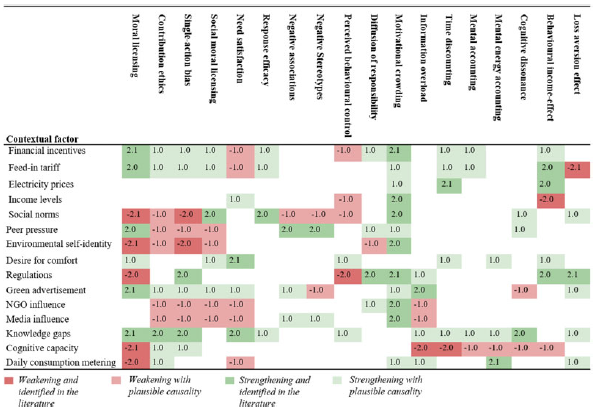
Figure 2 presents the relationships between the CFs and the BRMs with the influence scores. The positive values indicate a strengthening influence, while the negative values indicate a weakening effect. The magnitude of the score reflects the relative strength of the CF’s influence on the BRM based on the literature’s presence of the CFs. This scoring approach enabled a structured understanding of how CF shape behavioural outcomes.
Contextual factor – behavioural rebound mechanism relationship

Figure 2 Long description
A matrix showing the relationship between various contextual factors and behavioral rebound mechanisms. The matrix has 16 rows and 16 columns, each representing different factors and mechanisms. The rows and columns are labeled with specific factors and mechanisms, such as financial incentives, social norms, regulatory measures, and cognitive biases. The matrix uses a color-coded system to indicate the strength and direction of the relationships, with green indicating a strengthening effect, red indicating a weakening effect, and white indicating no significant effect. Notable trends include strong relationships between financial incentives and mental accounting, as well as between regulatory measures and perceived behavioral control. The matrix provides a comprehensive overview of how different contextual factors influence behavioral rebound mechanisms in the context of sustainability-oriented design interventions.
The analysis of the figure indicates that social norms, peer pressure, environmental self-identity, regulations, knowledge gaps, and cognitive capacity are the CF that are strongly influencing the BRM, indicating which CF are most critical to consider when identifying and mitigating rebound effects. Additionally, it shows that a single CF can have both weakening and strengthening effects on distinct BRM, meaning that the influence of CF on BRM is complex and context-dependent, requiring careful consideration in design interventions.
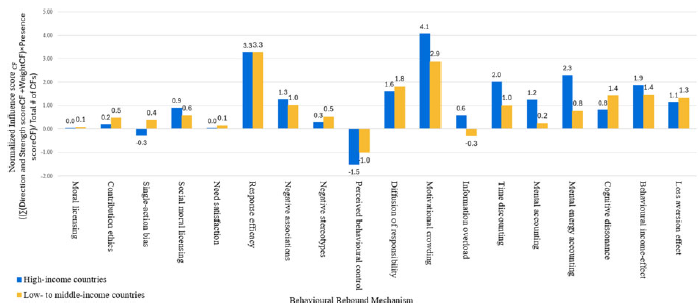
To capture differences in CF across settings (i.e., high- and low-income countries), each factor was multiplied by a presence score, reflecting how strongly it occurs in the given context. The presence score is weighed based on the academic and grey literature, incorporating key sources such as the World Bank, UNCTAD, the World Value Survey, and the International Energy Agency. This calculation produced a final influence score.
Figure 3 presents the average influence scores of the CF on each BRM, highlighting which BRM are more likely to be influenced by CF in high-income countries and which are more affected by CF in low- to middle-income countries.
Contextual comparison of the Influence score on behavioural mechanisms

Figure 3 Long description
Panel A: A bar graph comparing the influence scores of various behavioral mechanisms in high-income and low-to-middle-income countries. The horizontal axis lists different behavioral mechanisms, including mental accounting, commitment devices, social learning, and others. The vertical axis represents the normalized influence score, ranging from negative 1.5 to 5.0. The graph features two sets of bars for each mechanism: blue bars for high-income countries and yellow bars for low-to-middle-income countries. Notable trends include higher scores for mechanisms like social learning and anticipation of regret in high-income countries, while low-to-middle-income countries show higher scores for mechanisms like commitment devices and mental accounting.
Notably, in high-income countries, financial incentives, feed-in tariffs, and environmental self-identity emerged as the strongest contextual influences on rebound mechanisms. In contrast, cognitive capacity and knowledge gaps were more prominent CF in low- to middle-income countries.
4.3. Development of the design tool
Insights from the CF-BRM analysis informed the development of a practical tool to support SHS developers in preventing rebound effects across diverse user contexts.
Through a review of existing design strategies grounded in behavioural science and sustainable design practices, 13 strategies were selected and assessed for their potential to mitigate rebound effects. The evaluation drew on insights from Reference Mckay, Pigosso and McAlooneMcKay et al. (2025) as well as strategies highlighted in the broader literature. The resulting set combines behavioural nudges with context-sensitive design considerations, providing SHS developers with practical approaches to maximise the environmental benefits of solar home systems. To ensure their relevance, the strategies were further reviewed by a rebound effect expert. An example of the linkage between a behavioural mechanism and its corresponding prevention strategy is presented in Figure 4.
Single-action bias prevention strategies – development process

The strategy highlights how integrating education and community engagement can reduce rebound effects. By strengthening knowledge of environmental challenges and embedding sustainable practices in social contexts, interventions are less likely to be undermined by compensatory behaviours.
The tool was developed to help SHS developers identify and understand BRM and offers targeted design strategies to prevent these rebound effects. It was developed in Excel to balance interactivity, ease of use, and accessibility for practitioners (available at DOI 10.11583/DTU.29390822).
Its operation is structured in three main steps, as following described:
-
• Input: the tool begins with a CF-analysis, supported by 15 guiding questions that help users assess how strongly each of the 15 CF is present in the target environment. For example, to assess the environmental self-identity of the users, the following question is proposed: “To what extent does the users’ perception of themselves as environmentally responsible influence their energy-saving behaviours?”. To each question, the user can answer ‘very high’ (5), ‘high’ (4), ‘medium’ (3), ‘low (2)’, ‘very low (1)’, or ‘not applicable (0)’. The responses support the calculation of the presence score, ranging from 1 to 5.
-
• Process: based on the presence and predefined influence scores, the tool identifies the most relevant BRM likely to be triggered within that context. The BRM are presented from highly likely to less likely, supporting easy identification of relevant mechanisms.
-
• Output: for each identified mechanism, the tool suggests targeted design strategies to prevent rebound effects by addressing the specific behavioural responses shaped by the user context. For instance, for the BRM social moral licensing, the design prevention strategy ‘Social recognition system’ is presented, focusing on creating opportunities for users to be recognised for their pro-environmental behaviour to prevent the reduction of further pro-environmental behaviours.
4.4. Evaluation of the design tool
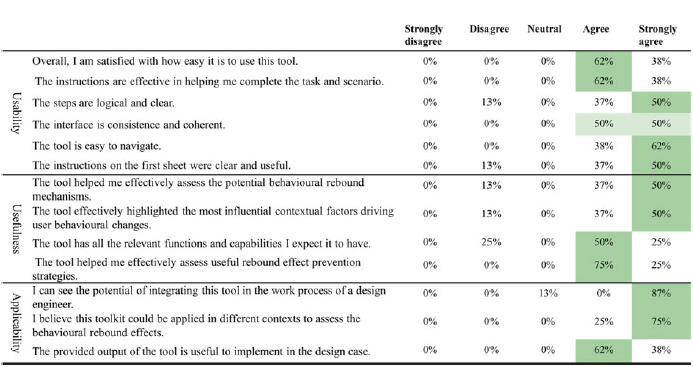
Observations and feedback were captured to evaluate the usability, usefulness and applicability of the design tool, as detailed in Figure 5.
Overall, the tool’s usability is considered satisfactory, with the participants finding the steps, navigation, and instructions clear. The tool’s usefulness was generally affirmed, though one participant disagreed on its expected capabilities, mentioning insufficient guidance. Applicability was rated positively for SHS developers, who can directly influence system design, but was considered more limited in low- and middle-income countries, where companies may prioritise user comfort over sustainability and end users may not prioritise sustainable behaviour.
Evaluation results (n=8)

5. Discussion and conclusion
This study provides new insights into how rebound effects emerge in the context of SHS. It identifies two key rebound effects, driven by eight mechanisms interacting with 15 CF. Building on the framework of Reference Van der Loo and PigossoVan der Loo & Pigosso (2024), the study contributes to the theoretical understanding of rebound effects in the field of design for sustainability and design in development contexts. In addition, it offers a practical design tool that helps SHS developers assess contexts, predict rebound effects, and select prevention strategies, supporting more context-sensitive interventions.
By systematically linking behavioural mechanisms, CF, and design strategies, the study demonstrates how behavioural dynamics can be integrated into sustainability-oriented design research more broadly. The approach offers value in other cases than SHS (e.g., water-saving technologies, electric vehicles) where user behaviour and CF influence the success of sustainability-oriented interventions, thereby strengthening the contribution of design research. Methodologically, the research shows how a structured process, combining literature analysis, logical reasoning, and expert review, can be used to explore rebound effects and translate them into actionable design tools. This methodology could potentially be applied in other sectors (e.g., sustainable mobility, circular product-service systems) to identify context-specific mechanisms and inform the creation of design tools that bridge theory and practice. However, several limitations of this study should be acknowledged. First, the literature review revealed a gap in behavioural-focused research on rebound effects, particularly in low- to middle-income countries, where current studies concentrate on direct rebound effects. This may limit the validity of the identified relationships and the three evaluation dimensions, suggesting further reconsideration as additional evidence emerges. Furthermore, long-term behavioural shifts remain underexplored, and the research framework employed a static representation of the relationships between CF and BRM, failing to capture the dynamic behavioural shifts that occur over time. Moreover, the assumption that BRM occur whenever CF are present may oversimplify real-world behaviours, as the relationship between CFs and BRMs may be non-linear, conditional, or subject to threshold effects, and overlook complex interconnections. Additionally, in low- to middle-income countries, some rebound effects may have desirable socio-economic outcomes, such as stimulating local economic activity through increased use of energy-intensive products, lowering the desire to prevent rebound effects. Future research should address these limitations through empirical testing and refinement of the design tool in diverse geographic and socio-economic contexts, prioritising the collection of primary data on user behaviour after SHS adoption in both low- to middle-income countries and high-income countries, capturing both the likelihood of rebound occurrence and BRM manifestation alongside CF influence. Longitudinal studies are needed to explore dynamic behavioural changes, while the proposed prevention strategies should be tested in operational SHS developments, also accounting for potential rebound effects arising from the strategies themselves. Finally, evaluation in collaboration with a diverse set of SHS developers and policy makers is required to assess the toolkit’s practical relevance, adaptability, and potential for policy integration. These improvements will strengthen the capacity of design research to anticipate and mitigate rebound effects, thereby safeguarding the environmental benefits of sustainability-oriented interventions.
Supplementary material
The Design Tool is available at 10.11583/DTU.29390822. Detailed literature review data is available at the following link: https://doi.org/10.11583/DTU.30195661.v1
Acknowledgement
Co-funded by the European Union (ERC, REBOUNDLESS, 101043931). Views and opinions expressed are however, those of the author(s) only and do not necessarily reflect those of the European Union or the European Research Council. Neither the European Union nor the granting authority can be held responsible for them.


 Open access

