


Impact statement
Biocrust research and development in North America is strong. Almost half of the 868 biocrust publications identified since 1900 focussed on ecological and physiological effects, with emerging fields such as restoration, monitoring and climate change impacts. Not unsurprisingly, a few authors produced a disproportionate number of publications. Potential developments over the next few decades include a focus on biocrust species traits and the development of a global biocrust monitoring network.
Introduction
Over the past half century, there has been a rapid increase in research on biocrusts (syn. Biological soil crusts, microphytic, microbiotic or cryptogamic crusts). Biocrusts are an intimate association between soil particles and different proportions of photoautotrophic (e.g., cyanobacteria, algae, lichens, bryophytes) and heterotrophic (e.g., bacteria, fungi, archaea) organisms living within or immediately above the uppermost millimetres of soil. The resultant living crust covers the soil surface as a coherent layer (Weber et al., Reference Weber, Belnap, Büdel, Antoninka, Barger, Chaudhary, Darrouzet-Nardi, Eldridge, Faist, Ferrenberg, Havrilla, Huber-Sannwald, Issa, Maestre, Reed, Rodriguez-Caballero, Tucker, Young, Zhang, Zhao, Zhou and Bowker2022). Biocrusts play critical roles in soil and ecological processes and are key components of dryland soils.
Much of the pioneering work on biocrusts originated in North America and goes back to the turn of the twentieth century. Yet, despite the large number of publications from North America and their meteoric increase since 2000, there have been relatively few attempts to synthesize the breadth of North American work related to biocrust ecology and management relative to the interest and expenditure given to biocrust research. Notable exceptions is the seminal volume of work on biological soil crusts edited by Belnap and Lange (Reference Belnap and Lange2003) and the more recent revision (Weber et al., Reference Weber, Belnap, Büdel, Antoninka, Barger, Chaudhary, Darrouzet-Nardi, Eldridge, Faist, Ferrenberg, Havrilla, Huber-Sannwald, Issa, Maestre, Reed, Rodriguez-Caballero, Tucker, Young, Zhang, Zhao, Zhou and Bowker2022). However, these do not specifically focus on North America. A range of technical publications have been published in North America by the United States Bureau of Land Management and the United States Geological Survey (e.g., Belnap et al., Reference Belnap, Kaltenecker, Rosentreter, Williams, Leonard and Eldridge2001), as well as biological soil crust field guides (e.g., Rosentreter et al., Reference Rosentreter, Bowker and Belnap2007) and some more regional studies (e.g., Warren et al., Reference Warren, Rosentreter and Pietrasiak2021).
A greater recognition of biocrust research carried out in North America is timely for five reasons. First, many valuable insights into basic biocrust ecology were made at a time when scientific papers and research data were difficult to access due to a lack of cataloguing and/or digitization. Identifying key points in history where significant research was undertaken will draw the attention of current researchers to previously undertaken, yet important work. Second, revisiting some of this earlier seminal work provides opportunities to consider important knowledge gaps that were identified many years ago, but have yet to be formally tested. Third, much of the research conducted more than half a century ago is still extremely valuable because it provides important data that can be used in syntheses and meta-analyses to reveal patterns that can now be more fully explored using more sophisticated statistical procedures. Many of these earlier manuscripts contain data that are still extremely valuable but have not been uploaded into contemporary data repositories. Fourth, many of these early researchers were true science pioneers. It is important for society to make their science more accessible to future generations and also to afford them the proper recognition that they deserve for pursuing research topics that were not particularly fashionable nor accepted by the general community as worthy of study. Finally, it is important to be aware of the successes and failures made over time so that we avoid a repetition of costly research that has previously been undertaken.
In this synthetic review, we provide a qualitative temporal perspective on biocrust research and development in North America, which is defined here as including Canada, the United States of America and Mexico, since 1900. We then use a structured literature search to quantitatively analyse the 868 publications produced over that period. With this information, we draw out some of the critical knowledge gaps in biocrust science and literature and our understanding of these important organisms. In particular, we explore how biocrust research has changed over the past 100 years, the key messages that arise from this research and the opportunities that potentially arise for biocrust research in the next few decades. It is important to note that such a treatment provides only a snapshot of biocrust research since 1990 and is not intended to be a comprehensive treatment of every research paper published over that period. It will, therefore, reflect, to some extent, our perspective on what we think is the important research to draw out.
A brief history of biocrust activity in North America
Basic ecology, natural history and an exploration of ecological mechanisms
Research on biocrusts in North America prior to 1990 was largely confined to early ecological work on algae and their roles in soils (Booth, Reference Booth1941; Shields et al., Reference Shields, Mitchell and Drouet1957; Cameron and Fuller, Reference Cameron and Fuller1960; Durrell and Shields, Reference Durrell and Shields1961). Much of the groundbreaking work on crusts was carried out by these authors and their colleagues, but regrettably, much was never published in peer-reviewed publications. After somewhat of a hiatus between the mid-1960 and 1970s, taxonomic work emerged on the ecology of different crust species, mostly algae (Johansen and Rushforth, Reference Johansen and Rushforth1985) from desert soils (Anderson and Rushforth, Reference Anderson and Rushforth1977; Kleiner and Harper, Reference Kleiner and Harper1977; Anderson et al., Reference Anderson, Harper and Rushforth1982; Rushforth and Brotherson, Reference Rushforth and Brotherson1982). Most studies focussed on species-level effects, with some basic ecology on reactions to grazing (Brotherson et al., Reference Brotherson, Rushforth and Johansen1983) and fire (Johansen, Reference Johansen1993; Marble and Harper, Reference Marble and Harper1989; Cole, Reference Cole1990). Many of these studies also focussed on specific areas (e.g., Canyonlands or Utah).
During this period, we saw the emergence of a new cohort of biocrust researchers. Jayne Belnap commenced her work in the early 1990s and over the next 30 years, made substantial contributions to biocrust ecology, management and conservation. She published over 350 scientific papers and was instrumental in drawing awareness of biocrusts in government agencies and training the current generation of biocrust leaders such as Sasha Reed and Matthew Bowker. She was elected to the US National Academy of the Sciences largely due to her extensive work on biocrusts.
The 1990s saw a continuation of investigation into species- and site-level effects (e.g., Capital Reef National Park, Spence, Reference Spence1991), but it was not until 1992 that we see specific mention of crusts (cryptogamic crusts) from sites in Mexico (Meyer et al., Reference Meyer, García-Moya and Lagunes-Espinoza1992). This period also witnessed the first attempts to examine how crusts affected ecosystem functions such as nitrogen production (Jeffries et al., Reference Jeffries, Klopatek, Link and Bolton1992) and how they interacted with vascular plants (Lesica and Shelly, Reference Lesica and Shelly1992). Substantial interest in crust recovery following grazing-induced disturbance (Belnap, Reference Belnap1993) was spurred by a greater focus on the impacts of livestock grazing, particularly in drylands. Increasing interest in biocrusts led to an important symposium in San Antonio, Texas, in 1991 organized by the American Bryological and Lichenological Society. Many of the papers from this symposium were subsequently published in a Special Edition of the Great Basin Naturalist (StClair and Johansen Reference St. Clair and Johansen1993).
Emerging research over the decade focussed on the impacts of wind (Gillette and Dobrowolski, Reference Gillette and Dobrowolski1993) and water (Williams et al., Reference Williams, Dobrowolski and West1995) erosion on crusts, as well as ecohydrological impacts (Williams et al., Reference Williams, Dobrowolski and West1999). Publications dealing with soil fertility effects (Harper and Pendleton, Reference Harper and Pendleton1993) and the internal structure of crusts (Belnap and Gardner, Reference Belnap and Gardner1993; Belnap, Reference Belnap1996) aimed to understand the specific mechanisms involved in crust organism effects. Surface disturbance caused by mining and other human-induced activities was shown to have major impacts on biological soil crust communities and their recovery (Belnap, Reference Belnap1995). Overgrazing by livestock was shown to increase fire risk by promoting the invasion of fire promoting Eurasian grasses such as Bromus tectorum, with devastating effects on crusts (Kaltenecker et al., Reference Kaltenecker, Wicklow-Howard, Rosentreter, McArthur, Ostler and Wambolt1999). The decade also saw research into the importance of cryptogams and non-vascular plants in polar (Gold and Bliss, Reference Gold and Bliss1995; Dickson, Reference Dickson2000) and cold desert (Freeman and Emlen, Reference Freeman and Emlen1995; Belnap, Reference Belnap1996; Gold, Reference Gold1998) environments in North America.
The need to integrate biological soil crusts into whole-of-system ecology resulted in the first attempts to develop a conceptual framework for crusts in order to review their impacts on ecosystem processes. The first of these was by the ecosystem ecologist Neil West from Utah State University, who reviewed their impacts on ecosystem functions (West, Reference West1990). This highly cited review (890 citations, August 12, 2024) stimulated considerable research in what he called “microphytic crusts” worldwide. More focussed reviews followed in the late 1990s (Evans and Johansen, Reference Evans and Johansen1999) with a greater emphasis on plant science. The decade ended with work on the first attempts to restore biological soil crusts using organic amendments, in particular pelletized cyanobacteria. The focus of this work was to determine the extent to which crustal organisms could survive when distributed and the extent to which they would fix nitrogen (Buttars et al., Reference Buttars, St Clair, Johansen, Sray, Payne, Webb, Terry, Pendleton and Warren1998). Other studies examined whether moss fragments could be useful inocula for degraded soils (Jones et al., Reference Jones, Wicklow-Howard and Pellant1998).
Biocrust function, physiology and climatic drivers
The early 2000s saw an intensification of work on the role of cyanobacteria in desert crusts, the functional role of crusts in ecosystem processes and their utility as experimental systems. We also see a greater use of the term “biocrust” rather than biological soil crust, to describe these organisms. Efforts to reestablish crusts required a more detailed understanding of crust taxa physiology (Stark et al., Reference Stark, Mishler and McLetchie2000) and the role of micronutrients (Bowker et al., Reference Bowker, Belnap, Davidson and Phillips2005; Neff et al., Reference Neff, Reynolds, Belnap and Lamothe2005). Considerable work focussed on the role of the cyanobacterium Microcoleus vaginatus, given its dominance in terms of cover and biomass (Boyer et al., Reference Boyer, Goodale, Jaworski and Howarth2002).
During this period, there was substantial work on how stable, biologically crusted surfaces might alter the germination of both native and exotic plants (Hawkes, Reference Hawkes2004; Serpe et al., Reference Serpe, Orm, Barkes and Rosentreter2006; Deines et al., Reference Deines, Rosentreter, Eldridge and Serpe2007). Of particular concern was the link between biological soil crusts and resistance to invasion by the Eurasian annual grass Bromus tectorum (Belnap et al., Reference Belnap, Phillips and Troxler2006, Belnap and Phillips, Reference Belnap and Phillips2001). This work was then extended to other non-dryland areas in Washington (Parker, Reference Parker2001; Florida, Hawkes and Flechtner, Reference Hawkes and Flechtner2002) and Maine (Dibble et al., Reference Dibble, Miller, Hinds and Fryday2009). Crusts were also recognized as having a major impact on the way that water is retained, transported or infiltrated into the soil (Roundy et al., Reference Roundy, Clair and Johansen2003; Belnap et al., Reference Belnap, Phillips and Troxler2006) and how this activates soil and ecological processes (Belnap et al., Reference Belnap, Miller, Bedford and Phillips2014). These impacts are strongly nuanced and influenced by crust type, substrate, soil texture and even the evolutionary history of grazing (Eldridge et al., Reference Eldridge, Reed, Travers, Bowker, Maestre, Ding, Havrilla, Rodriguez-Caballero, Barger, Weber, Antoninka, Belnap, Chaudhary, Faist, Ferrenberg, Huber-Sannwald, Issa and Zhao2020). Soil texture and vegetation type were shown to influence both the composition of the biocrusts and their susceptibility to disturbances (Belnap et al., Reference Belnap, Kaltenecker, Rosentreter, Williams, Leonard and Eldridge2001; Kaltenecker et al., Reference Kaltenecker, Wicklow-Howard, Rosentreter, McArthur, Ostler and Wambolt1999), with impacts on soil and nutrient loss (Barger et al., Reference Barger, Herrick, Van Zee and Belnap2006). Because of their small size (“ecosystems in miniature”, Belnap et al., Reference Belnap, Hawkes and Firestone2003) and ease of manipulation, biocrust assemblages were used to examine the role of spatial scale (Maestre et al., Reference Maestre, Escudero, Martínez, Guerrero and Rubio2005; Bowker et al., Reference Bowker, Belnap and Miller2006) and their importance as experimental systems.
Given the functional value of crusts in drylands and the impacts of disturbance from off-road vehicles and military manoeuvres (Kade and Warren, Reference Kade and Warren2002; Belnap and Warren, Reference Belnap and Warren2002), there was increasing emphasis on how to monitor crust health (Rosentreter and Eldridge, Reference Rosentreter, Eldridge, Nimis, Scheidegger and Wolseley2002) using a variety of methods such as chlorophyll a content (Bowker et al., Reference Bowker, Belnap and Miller2006) or developmental status (Belnap et al., Reference Belnap, Phillips, Witwicki and Miller2008). Field-based transplanting of bryophytic crusts (Cole et al., Reference Cole, Stark, Bonine and McLetchie2010) and fragments of the lichen Collema (Bowker et al., Reference Bowker, Belnap and Davidson2010a) met with mixed success.
Towards the end of this decade, a growing theme was climate change impacts on biocrust communities, consistent with the global rise in interest in climate change. Research revealed that significant changes in carbon dioxide exchange were likely, with projected changes in temperature and precipitation (Grote et al., Reference Grote, Belnap, Housman and Sparks2010) and that increases in UV levels could enhance biocrust mortality and therefore reduce their function (Belnap et al., Reference Belnap, Phillips, Witwicki and Miller2008). Surprisingly, despite their dominance in drylands, research indicated that organisms in the crust are susceptible to drought-induced stresses (Barker et al., Reference Barker, Stark, Zimpfer, McLetchie and Smith2005).
Exploring molecular approaches, restoration and climate change impacts
From 2020, more publications were dedicated to the examination of the complex structure, composition and function of individual biocrust components (Nelson et al., Reference Nelson, Giraldo-Silva and Garcia-Pichel2021; Nelson et al. Reference Nelson, Giraldo-Silva, Finlay Warsop and Garcia-Pichel2022). Some work focussed on cyanobacterial function (e.g., Richardson et al., Reference Richardson, Kong, Taylor, Le Moine, Bowker, Barber, Basler, Carbone, Hayer, Koch, Salvatore, Sonnemaker and Trilling2022; Nguyen et al., Reference Nguyen, Pombubpa, Huntemann, Clum and Foster2024) with a recognition of the link between biocrust roughness and chlorophyl a concentration (Caster et al., Reference Caster, Sankey, Sankey, Bowker, Buscombe, Duniway and Joyal2021). There was also renewed interest in the quintessential North American arid area moss Syntrichia caninervis as a study system (Silva et al., Reference Silva, Gao, Fisher, Mishler, Ekwealor, Stark, Li, Zhang, Bowker, Brinda, Coe and Oliver2021). Three biocrust reviews were published, focussing on the Great Plains (Warren et al., Reference Warren, Rosentreter and Pietrasiak2021), global issues (Weber et al., Reference Weber, Belnap, Büdel, Antoninka, Barger, Chaudhary, Darrouzet-Nardi, Eldridge, Faist, Ferrenberg, Havrilla, Huber-Sannwald, Issa, Maestre, Reed, Rodriguez-Caballero, Tucker, Young, Zhang, Zhao, Zhou and Bowker2022) and crust microbiology (Garcia-Pichel, Reference Garcia-Pichel2023).
The early 2020s witnessed an increased emphasis on biocrust restoration and how this could overcome the effects of widespread disturbances such as fire and grazing, which increased biocrust mortality (Palmer et al., Reference Palmer, Lawson and Lipson2023, Root et al., Reference Root, Chan, Ponzetti, Pyke and McCune2023) or their ability to fix nitrogen (Adelizzi et al., Reference Adelizzi, O’Brien, Hoellrich, Rudgers, Mann, Camara, Moreira, Darrouzet-Nardi and Stricker2022). The success of regeneration was shown to depend on many factors including soil texture and moisture (Young et al., Reference Young, Reed, Morton and Bowker2024), the stability of the recipient site (Bowker et al., Reference Bowker, Doherty, Antoninka, Ramsey, Dupré and Durham2022), the composition of biocrust inocula (Jech et al., Reference Jech, Day, Barger, Antoninka, Bowker, Reed and Tucker2023; Reeve et al., Reference Reeve, Palmer, Cobb, Pietrasiak and Lipson2023) and the extent to which donor crust is hardened in the field prior to seeding (Bowker et al., Reference Bowker, Doherty, Grover, Antoninka, Durham and Ramsey2023). Pelletization of moss fragments in diatomaceous earth was also attempted in an effort to improve restoration using mosses (Grover et al., Reference Grover, Bowker, Fulé, Sieg and Antoninka2022).
Mixed results were obtained from restoration efforts, and some success was due in part to recovery from grazing (Hilty et al., Reference Hilty, Eldridge, Rosentreter, Wicklow-Howard and Pellant2004). An exciting innovation was the potential to use the surface beneath solar panels that cover large areas of rangeland in western US deserts as biocrust nurseries (Heredia-Velásquez et al., Reference Heredia-Velásquez, Giraldo-Silva, Nelson, Bethany, Kut, González-de-Salceda and Garcia-Pichel2023).
The effects of changing climates on biocrusts continued to fascinate soil ecologists, with modelling results predicting declines in biocrust cover due to changing climates and land-use intensification, resulting in greater global dust concentrations and reduced global radiation (Reed et al., Reference Reed, Delgado-Baquerizo and Ferrenberg2019; Rodriguez-Caballero et al., Reference Rodriguez-Caballero, Stanelle, Egerer, Cheng, Su, Canton, Belnap, Andreae, Tegen, Reick, Poeschl and Weber2022). Warming is also likely to be associated with a biocrust species loss (Antoninka et al., Reference Antoninka, Chuckran, Mau, Slate, Mishler, Oliver, Coe, Stark, Fisher and Bowker2022), changes in composition, reductions in soil stability (Phillips et al., Reference Phillips, McNellis, Howell, Lauria, Belnap and Reed2022) and declines in N-fixing lichens (Collema), thereby leading to lower resistance to invasion by exotic plants (Finger-Higgens et al., Reference Duniway, Fick, Geiger, Hoover, Pfennigwerth, Van Scoyoc and Belnap2022). The increasing frequency of large rainfall events in some areas will likely reduce cyanobacterial biocrusts and their functional roles in drylands (Fernandes et al. Reference Fernandes, Rudgers, Collins and Garcia-Pichel2022).
A bibliometric assessment of publications since 1900
In order to summarize how biocrust research has changed in North America over the past century, we searched Web of Science and Google using relevant keywords (“biological soil crust*,” “biocrust*,” “cryptobiotic crust*,” “biological soil crust*,” “microphytic crust*,” “cryptogam*,” “soil crust*”). From a total of 1,566 scientific publications retrieved, 868 were deemed relevant and organized into 12 categories (climate change, ecology and physiology, environmental, fertility, fire, grazing, management, monitoring, palaeohistory, plants, restoration and soils). Many publications that did not meet our inclusion requirements included studies of soil organisms not specifically related to soil crusts. We acknowledge however that some articles could fit into multiple categories. Additional material published prior to 1970 was obtained by searching the bibliographies of review papers to capture more obscure sources.
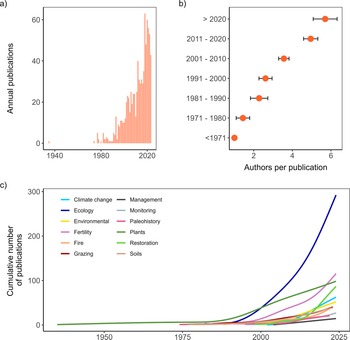
Our analysis reveals a rapid increase in publications, an emphasis on particular topic areas and an increase in the number of authors of biocrust papers over the period. The total number of biocrust publications between 1900 and July 2024 increased exponentially from 2000, with 10 papers in 2000, climbing to 40 in 2012 and 60 papers in 2020 (Figure 1a). Compared with the 1970s (1.44 authors per publication), the average number of authors per publication doubled in the 1990s (2.61 authors per publication) and then increased fourfold by the 2020s (5.7 authors per publication, Figure 1b).
Figure 1. (a) Annual number of publications from January 1990 to July 2024, (b) mean (± 95% CI) number of authors per publication for the decades pre-1971 to post-2020), (c) cumulative biocrust publications from January 1900 to August 2024 for 12 subject areas.

Of the 868 papers identified in the final literature group, two authors (Belnap and Bowker) accounted for 6.1% of all first authors. When we considered all authors of all publications over the period (n = 2053), six authors (Belnap, Bowker, Garcia-Pichel, Reed, Johansen and Barger) were authors on 10% of all papers. Overall, the greatest increase in publications over time occurred for five categories: ecology and physiology, fertility, plants (general botany), restoration and, to a lesser extent, climate change (Figure 1c). The other categories have remained relatively stable over time, suggesting that the study of topics such as the impacts of fire on biocrusts and restoration techniques has largely saturated. Anecdotal evidence however suggests a resurgence in research on these topic areas in countries such as China, where biocrust research is nascent and relatively well funded (Li et al., Reference Li, Hui, Tan, Zhao, Liu and Song2021).
Interestingly, there was a hiatus in biocrust publications between 1938 and 1978. Some of this can be attributed to the fact that early scientists such as Cameron, Fuller, Durrell, Shields and others did not publish in the peer-reviewed literature because they were working in military institutions. Their material was also sometimes published in inaccessible sources. The influence of World War II can also explain inactivity, yet it is interesting that it took some 33 years from the end of this war to resume research on biocrusts. Biocrust studies recommenced with a handful of researchers such as Kimball Harper, David Anderson and others, centred on various institutions in Utah.
Challenges and opportunities
An examination of the literature reveals a number of opportunities and challenges in biocrust research as we move to hotter and drier conditions over the coming 50 years. These relate specifically to greater education and awareness, particularly of the influence of changing climates, methods of using biocrust material for restoration, establishment of a global society to champion the cause of these organisms and a global biocrust network.
The need to overcome “biocrust blindness”
A key challenge in biocrust research is that the constituent organisms are small and difficult to see, due to their small size and colour, which is similar to that of background soils. Furthermore, a dearth of illustrated literature on their taxonomy and an absence of voucher specimens in many herbaria make species-level studies problematic. Often, many biocrust species co-occur in a complex mosaic on the soil surface. This mixed community-level occurrence encourages studies at the community level. Technical keys to biocrusts can be tedious, and most institutes, including herbaria, lack voucher specimens that can be used to aid identification. Although there are some excellent field guides on biocrust taxa (Brodo et al., Reference Brodo, Sharnoff and Sharnoff2001; McCune and Rosentreter, Reference McCune and Rosentreter2007), more formal taxonomic keys are needed and the use of keys is required. More tedious microscopic and chemical testing discourages vascular plant specialists from attempting to identify biocrust organisms.
Most plant ecology programmes at the graduate level focus on vascular plants, and in North America, there is little opportunity to take courses covering the wide range of organisms found in biocrusts. Thus, there is a dire need for greater basic education on biocrust taxonomy and ecology at graduate and industry levels. Industry-based biocrust courses convened by land management agencies in North America have largely been discontinued. Part of the reason is the lack of educators with the requisite skills. For example, most biocrust researchers in North America have only rudimentary skills in biocrust identification even though they are working on functional questions associated with biocrusts. Coupled with this is that truly experienced experts are relatively few, continue to decline and are skewed towards older individuals.
A greater focus on restoration and monitoring
Our assessment of biocrust publications indicates that research on restoration has increased markedly over the past decade. Despite this, there exist a number of important knowledge gaps. First, a challenge for future researchers is to determine the optimal biocrust species to be used in inoculation treatments (Bowker et al., Reference Bowker, Doherty, Grover, Antoninka, Durham and Ramsey2023; Bowker et al., Reference Bowker, Antoninka and Chuckran2020). Some of the practical constraints related to biocrust restoration are being explored by the United States Geological Survey at a farm in Utah. Second, developing optimal practices to ensure field survival of “laboratory-grown” inocula is a major knowledge gap. Third, developing large-scale protocols to spread inocula over large areas is an important knowledge need if restoration needs to be scaled up from laboratory to landscape. The group of Ferran García-Pichel at Arizona State University is pioneering the use of cyanobacteria for large-scale land restoration (e.g., Velasco Ayuso et al., Reference Velasco Ayuso, Giraldo Silva, Nelson, Barger and Garcia-Pichel2017).
The large compositional diversity of species across drylands and the need to standardize biocrust monitoring to assess restoration performance remain a challenge to researchers and practitioners. The United States Bureau of Land Management (BLM), which manages more than 100 million ha, primarily in the western United States, uses an assessment, inventory and monitoring (AIM) strategy across the entire agency. This strategy provides a set of standards for assessing natural resource conditions and trends on BLM-managed public lands. The AIM strategy provides quantitative data and tools to guide and justify policy actions, land uses and adaptive management decisions. This standardized method of monitoring arid land conditions is exciting and allows one to answer biocrust-related research questions with an impressive amount of accessible data.
The need to explore the use of biocrust traits
The many challenges of species-level biocrust studies have led to the widespread adoption of morphological traits of biocrust taxa as a way to describe species groups (Eldridge and Rosentreter, Reference Eldridge and Rosentreter1999). Morphological groups have been proposed as indicators of ecosystem function in biocrusts on the basis that species within a given morphological group possess similar functional traits (Eldridge and Rosentreter, Reference Eldridge and Rosentreter1999). Morphological groups have been shown to be good predictors of the response of biocrusts to disturbance, among other things (Read et al., Reference Read, Duncan, Vesk and Elith2014). Groups based on functional traits such as the ability to sequester carbon and nitrogen and capture sediment and moisture provide an exciting advance on morphological groups, but the development of trait database is still in its infancy (Mallen-Cooper and Eldridge, Reference Mallen-Cooper and Eldridge2016). Yet, there is a need to move this work from morphological groups to traits.
Creating a global-scale trait database for biocrust organisms is possibly less daunting than for vascular plants because many species have broad pan-continental distributions (Bowker et al., Reference Bowker, Antoninka and Durham2017) so that different research groups can share information on these widespread species. A wider use of biocrust traits will enhance our understanding of ecosystem functioning in drylands where biocrusts make up a large component of the surface cover and provide critical ecosystem goods and services (Mallen-Cooper et al., Reference Mallen-Cooper, Bowker, Antoninka and Eldridge2020).
Establish a global biocrust research network and biocrust society
One promising development is the establishment of the first global network of biocrust researchers (CrustNet) supported by the United States National Science Foundation. CrustNet aims to address (1) the determinants of global-scale functional biodiversity of biocrusts; (2) the determinants of the variability and shape of the relationship between biodiversity and ecosystem function across ecosystems; and (3) the effects of biocrust functional biodiversity on ecosystem resistance and resilience to physical disturbance and climate change (https://crustnet.org/index.html). The principal investigators of CrustNet (Matthew Bowker, Anita Antoninka, Javier Ceja Navarro, Sasha Reed and Anthony Darrouzet-Nardi) are well-established active biocrust researchers and are working to establish a global network of sites to answer important questions related to biocrust ecology using standardized protocols. One benefit of CrustNet could be to develop and promote standardized monitoring methodologies for biocrusts that are not currently in existing monitoring programmes such as AIM and the Land Potential Knowledge System (Herrick et al., Reference Herrick, Arnalds, Bestelmeyer, Bringezu, Han and Johnson2016). CrustNet could help improve collaboration among agencies and land managers (Coleman et al., Reference Coleman, Geisen and Wall2024) and lead to better coordination of methods to monitor biocrusts.
With the development of a global network comes a dedicated worldwide society that deals with biocrusts, organizes regular conferences, supports student projects and runs industry training courses, workshops and webinars. Although a biocrust society is yet to form, there is a strong community support and esprit de corps among biocrust researchers, and the biocrust community has met on five occasions, with the first meeting in Germany in 2010, and subsequent meetings in Spain, the USA, Australia and Mexico in 2024. A meeting in China is planned for 2026.
Our bibliometric assessment reveals a trend for greater collaboration among institutions and individuals, as evidenced by an increase in multi-authored manuscripts, often with Western scientists teaming up with those from the Global South (Figure 1b). This trend is likely to increase as more conferences and meetings bring together a range of diverse disciplines from physiologists to taxonomists, ecologists and evolutionary biologists, all using biocrusts as study systems (Bowker et al., Reference Bowker, Maestre and Escolar2010b; Maestre et al., Reference Maestre, Bowker, Eldridge, Cortina, Lázaro, Gallardo, Delgado-Baquerizo, Berdugo, Castillo-Monroy, Valencia, Weber, Büdel and Belnap2016). Global studies are needed to advance our understanding of biocrust function across different landscapes, climatic zones and management regimes.
Conclusions
Our evaluation of the literature indicates that biocrust science in North America is strong and has moved from a niche field to a widely accepted study discipline. Despite the greater emphasis on restoration and the climate impacts on biocrusts, ecological and physiological studies continue to contribute the largest number of annual biocrust publications. Our study has revealed a marked increase in biocrust research and a large number of multi-authored publications, indicating greater collaboration and networking among global researchers. A greater emphasis on trait-based assessment that follows developments in the non-vascular plant field, an extension of laboratory-based restoration studies to the field and greater coordination of biocrust assessment and monitoring methodologies implicit in a global biocrust network are all signs of a healthy and growing biocrust research community.
Acknowledgements
We thank Dr Matthew Bowker and Dr Fernando Maestre for their comments on earlier drafts and for drawing our attention to additional literature. Dr Max Mallen-Cooper drafted the figure.
Author contribution
D.J.E. undertook the data search and R.R. wrote the first draft of the manuscript. Both authors contributed to the final draft.
Competing interests
The authors declare no conflict of interest.

 Open access


Comments
The Editors
Prism Drylands
Dear Editor
I would be pleased if you would consider our manuscript entitled ‘Biocrust research in North America with a focus on drylands: history, insights and opportunities’ as a perspectives piece in prism Drylands.
Biocrusts are an important component of drylands where they moderate environmental conditions and maintain the structure and stability of dryland soils.
Much of the pioneering work on these organisms emanated from North America, defined here as Canada, the United States of America, and Mexico. Much of the early material is largely unknown to the current biocrust community. It is important to acknowledge this previously published information because it can provide important insights into basic biocrust ecology and identify knowledge gaps that have yet to be formally tested. Further, it is important to make this early work more accessible to the current generation given that much of this work was published in sources that are not readily accessed electronically.
In this Perspective piece we use a structured literature review to examine the literature published since 1900 in North America, and document the breadth of this work and its contribution to our understanding of the ecosystem roles of biocrusts. We show that biocrust research field is healthy and strong, and continuing to grow, with almost 1500 scientific papers since 1900.
Our Perspective identifies the need to train more taxonomists, to improve education of the ecological roles of these organisms, and to place more emphasis on trait-based assessment.
The material in this Perspective has not been submitted elsewhere for publication.
Yours sincerely
David Eldridge
For the authors
December 18, 2024