


Introduction
As migration to Western countries increases, debates arise regarding the compatibility of immigrants’ values – particularly their liberal democratic values – with those of non-migrants (SVR 2019). In Germany, for instance, the political right raises the issue of Leitkultur (dominant culture) every few years, insisting that immigrants commit to these values.Footnote 1 In a recent proposition in 2023, the Christian Democrats (CDU) claimed that only Muslims who share the values of the German constitution truly belong to Germany.Footnote 2 Especially when it comes to immigrants from culturally distant countries, some people fear that they could potentially undermine the principles of liberal societies (Koopmans Reference Koopmans2015; Helbling and Traunmüller Reference Helbling and Traunmüller2020). Some politicians even declared an end to multiculturalism (Banting and Kymlicka Reference Banting and Kymlicka2013), and civic integration policies and tests have been introduced to ensure a degree of compatibility in values (Goodman Reference Goodman2010).
Within this context, there is a prevalent assumption that immigrants from non-democratic countries have never learned how a democracy works and are unlikely to change their views on their preferred political system. This perspective corresponds to the settled disposition model (Kiley and Vaisey Reference Kiley and Vaisey2020: 478), which posits that individuals’ values are shaped by early socialisation processes and tend to remain stable. Conversely, those who believe that immigrants can adopt democratic values after moving to a democratic country adhere to the active updating model, suggesting that changing environments continuously shape individuals’ values (Kiley and Vaisey Reference Kiley and Vaisey2020: 478).
This article aims to examine the extent to which liberal democratic values differ between migrants and non-migrants and how these potential differences may be attributed to socialisation processes shaped by distinct political contexts.Footnote 3 By liberal democratic values, we understand people’s normative ideal of liberal democracy and in particular the importance they attribute towards the role of elections, courts and political parties, freedom of speech, and minority protection. If migrants are less supportive of liberal democratic values than non-migrants, can this be explained by structural factors of political socialisation in their countries of origin – such as the political system, political indoctrination in schools, or the media? And do these differences diminish as immigrants integrate into their new country of residence?
It is far from clear to what extent such socialisation processes matter and democratic values differ, as there is research that shows that democratic values are also shared in authoritarian regimes (diffusion effect, Inglehart Reference Inglehart2003; Inglehart and Norris Reference Inglehart and Norris2003; Norris Reference Norris2011) or that migrants have higher democratic values than the average population and therefore decide to leave their authoritarian countries (self-selection effect, Docquier et al. Reference Docquier, Tansel and Turati2020; Auer and Schaub Reference Auer and Schaub2024) and reject the regimes of their countries of origin by expressing democratic values (backlash effect, Lindemann Reference Lindemann2023).
Our knowledge of democratic values among immigrants in Western societies is very limited, whether regarding immigrants in general (Bilodeau et al. Reference Bilodeau, McAllister and Kanji2010; Raschke and Westle Reference Raschke and Westle2018) or specific subgroups by religion (Rafiqi Reference Rafiqi2019) and refugee status (Fuchs et al. Reference Fuchs, Fan and von Scheve2021; SVR 2019). Most research on the political integration of migrants focuses on their political behaviour (Togeby Reference Togeby2004; White et al. Reference White, Nevitte, Blais, Gidengil and Fournier2008; Aleksynska Reference Aleksynska and Vogel2008; Maxwell Reference Maxwell2010; Dollmann Reference Dollmann2022; Goerres et al. Reference Goerres, Mayer and Spies2022) or their social values, which differ from those of the non-migrant population (Diehl et al. Reference Diehl, Koenig and Ruckdeschel2009; Alexander and Welzel Reference Alexander and Welzel2011; Röder Reference Röder2015; Soehl Reference Soehl2017; Tibajev et al. Reference Tibajev, Vartanova, Puthoopparambil, Essen and Strimling2022).
While struggles over values and political issues are part and parcel of a democratic society, potentially dividing migrants and non-migrants or crosscutting these groups, the more relevant question is whether non-migrants and (which groups of) migrants agree on the foundational principles for debating these differences and organising their societies. Many existing studies do not clarify the extent of such an agreement, as they use very general measures of democracy, which may be understood very differently (Inglehart and Norris Reference Inglehart and Norris2003; Jamal Reference Jamal2006; Bilodeau et al. Reference Bilodeau, McAllister and Kanji2010; Raschke and Westle Reference Raschke and Westle2018), or focus on political behaviour, political interest, or party affiliation instead of democratic values (Togeby Reference Togeby2004; White et al. Reference White, Nevitte, Blais, Gidengil and Fournier2008; Aleksynska Reference Aleksynska and Vogel2008; Maxwell Reference Maxwell2010; Voicu and Comşa Reference Voicu and Comşa2014; Dollmann Reference Dollmann2022; Goerres et al. Reference Goerres, Mayer and Spies2022). Therefore, it is important to use a nuanced measure of democratic values to understand what it means exactly when individuals say they are democratic (Carlin Reference Carlin2018; Ulbricht Reference Ulbricht2018; Jacobsen and Fuchs Reference Jacobsen and Fuchs2020; Chapman et al. Reference Chapman, Hanson, Dzutsati and DeBell2024).
Wave 10 of the European Social Survey allows us to achieve this, as it includes a series of items that differentiate between various understandings of democracy across 30 European countries (Ferrin and Kriesi Reference Ferrín and Kriesi2016). We focus on the components of liberal democracy, which were also included in the 2022 Integration Barometer in Germany. Liberal democratic values are often regarded as core dimensions of European or national values (Jacobsen and Fuchs Reference Jacobsen and Fuchs2020: 670) and are essential for the functioning of a liberal democracy (Almond and Verba Reference Almond and Verba1963; Easton Reference Easton1965) and for the transition and consolidation of democratic systems more generally (Linz and Stepan Reference Linz and Stepan1996).
While the European Social Survey covers a large number of European countries, it only includes a limited sample of migrants. In contrast, the Integration Barometer was designed specifically to explore the migrant population in Germany. By separately investigating these two datasets with their respective strengths, we go beyond existing studies in terms of empirical coverage. This allows us to study a wide range of European countries where immigration and debates about migrant integration have played a significant role for several decades. Moreover, we can investigate a broader array of (country-level) explanatory factors. So far, beyond socioeconomic factors, only religiosity and nationality have been examined to explain potential differences in democratic values (Rafiqi Reference Rafiqi2019; Fuchs et al. Reference Fuchs, Fan and von Scheve2021; see also Tibajev et al. Reference Tibajev, Vartanova, Puthoopparambil, Essen and Strimling2022; Debus et al. Reference Debus, Himmelrath and Stecker2023).
Our results indicate that migrants from countries with high levels of democracy, as well as those from countries with low levels of democracy, show very high levels of support for democratic values, on average, comparable to non-migrants. When considering socialisation and acculturation processes and hence the time migrants have spent in their countries of origin and in the destination countries, which may affect structural socialisation – a more differentiated picture emerges. Migrants who lived in countries with low levels of democracy for longer periods before migrating are slightly less likely to support democratic values than those who left their authoritarian country of origin at a younger age. Additionally, support for democratic values among immigrants from less democratic countries increases the longer they reside in democratic destination countries in Europe. This same pattern is observed when analysing different levels of democratic or autocratic indoctrination in schools or the media. Thus, socialisation and adaptation processes play a role; the effects are rather small, though. Migrants who have spent a considerable portion of their lives in less democratic countries still are highly supportive of democratic values. We therefore conclude that fears of conflicts over democratic values between migrants and members of the destination society are unfounded, or at least greatly exaggerated. Furthermore, if initial value gaps exist, they tend to close during adaptation processes. This does, however, not mean that there are no anti-democrats among first-generation migrants or non-migrants. As will be shown, this share is very low and similar in both groups.
Democratic values
It goes without saying that a democracy can only function when people share basic democratic norms (Almond and Verba Reference Almond and Verba1963; Dalton Reference Dalton2007). Shared values can be crucial for social cohesion (Schwartz and Sagie Reference Schwartz and Sagie2000), and it has been argued that democracy can only be sustained within a nation state that guarantees cultural homogeneity (Helbling Reference Helbling2009). This cultural homogeneity does not necessarily imply ethnic or racial homogeneity, and by definition, a democracy should allow and enable a wide variety of political views (Dahl Reference Dahl1971). However, people must share a certain understanding of how a society should be organised (Miller Reference Miller1995: 97). In other words, they need to share the same values of democracy, by which we mean ‘citizens’ normative ideal of democracy, their ideas about what democracy should be’ (Ferrin and Kriesi Reference Ferrín and Kriesi2016: 10, their emphasis).
Surprisingly, little is known about how migrants in Western societies think about democracy and the extent to which they share the same views as non-migrants (Bilodeau et al. Reference Bilodeau, McAllister and Kanji2010; Raschke and Westle Reference Raschke and Westle2018; Rafiqi Reference Rafiqi2019; SVR 2019; Fuchs et al. Reference Fuchs, Fan and von Scheve2021). Most research on the political integration of migrants focuses on political behaviour, political interest, or party affiliation (Togeby Reference Togeby2004; White et al. Reference White, Nevitte, Blais, Gidengil and Fournier2008; Aleksynska Reference Aleksynska and Vogel2008; Maxwell Reference Maxwell2010; Voicu and Comşa Reference Voicu and Comşa2014; Dollmann Reference Dollmann2022; Goerres et al. Reference Goerres, Mayer and Spies2022). However, at the centre of many public controversies is not the question of whether immigrants participate in politics, but whether they share the same values (Banulescu-Bogdan and Benton Reference Banulescu-Bogdan and Benton2017). Democratic values and political behaviour are certainly related, but the former do not always lead to the latter (Ajzen Reference Ajzen1991). Moreover, political participation is not necessarily a reflection of democratic values, as it may also be motivated by non-democratic motives. Finally, the absence of political participation is not always a sign of democratic disinterest but might be due to structural constraints such as a lack of citizenship that may prevent migrants from engaging in political activities such as voting.
Besides research on democratic values and behaviour, some studies have shown that other values differ between non-migrants and various groups of migrants. For example, certain groups of migrants tend to prefer more conservative sexual and reproductive rights than non-migrants (Diehl et al. Reference Diehl, Koenig and Ruckdeschel2009; Tibajev et al. Reference Tibajev, Vartanova, Puthoopparambil, Essen and Strimling2022), hold more negative views on gays and lesbians (Röder Reference Röder2015; Soehl Reference Soehl2017), or are more supportive of patriarchal values (Alexander and Welzel Reference Alexander and Welzel2011). However, Tibajev et al. (Reference Tibajev, Vartanova, Puthoopparambil, Essen and Strimling2022), who examine the largest number of values to date, demonstrate for Sweden that the value structures between migrants and non-migrants are very similar, with both groups often positioned on the same side of the liberal–conservative divide.
Socialisation processes
Ferrin and Kriesi (Reference Ferrín and Kriesi2016: 11) argue that the quality of a country’s democracy reflects how people experience and perceive it. Several studies define the quality of democracy in terms of its performance and show that this impacts democratic support and satisfaction (Wagner et al. Reference Wagner, Schneider and Halla2009; Magalhaes Reference Magalhaes2014). In contrast, we refer not to performance but to the degree of democracy and argue that the actual institutions matter – if they are more democratic, this should enhance people’s support for democratic values. This occurs through political socialisation or processes of institutional learning and experience, which helps individuals understand what democracy entails (Dalton et al. Reference Dalton, Sin and Jou2007: 148). Research has demonstrated that people’s support for democracy increases with their knowledge of it (Cho Reference Cho2014) and as they experience it more (Mattes and Bratton Reference Mattes and Bratton2007).
In addition to various socialisation instances, such as family and friends, which are relevant for everyone, immigrants – unlike non-migrants – have been exposed to (at leastFootnote 4 ) two institutional contexts that may shape their democratic values via a structural-influence path: their country of origin and their destination country. When the regimes in these two contexts differ, the question arises as to which regime is more relevant for shaping the democratic values of immigrants.
Childhood and adolescence are often seen as crucial periods for socialisation into a political culture, for example, at school (Easton and Dennis Reference Easton and Dennis1969; Jennings et al. Reference Jennings, Stoker and Bowers2009). What individuals learn in the education system influences their values beyond their school years (Stubager Reference Stubager2008: 331). The impressionable years of adolescence are particularly important, as individuals begin to engage with political institutions that influence them while they are still developing their political values and positions (Neundorf et al. Reference Neundorf, Smets and García-Albacete2013; Bartels and Jackman Reference Bartels and Jackman2014).
While some scholars argue that political values acquired during this age become crystallised and remain relatively stable throughout life (Inglehart Reference Inglehart2008; Kiley and Vaisey Reference Kiley and Vaisey2020), others demonstrate that socialisation extends beyond these formative years, albeit at a slower pace (Jennings and Markus Reference Jennings and Markus1984; Niemi and Jennings Reference Niemi and Jennings1991; Sears and Funk Reference Sears and Funk1999). Compulsory education is undoubtedly a key moment for children and adolescents to be socialised into a political system. However, media, arts, and culture constitute further channels through which adults are socialised into political systems (Neundorf et al. Reference Neundorf, Nazrullaeva, Northmore-Ball, Katerina Tertytchnaya and Kim2023: 6).
The question arises as to whether the values adopted in less democratic countries and/or in places with high levels of autocratic indoctrination in schools or the media remain stable when people relocate to a democratic country, or whether structural socialisation processes continue, prompting individuals to adapt. Following the first perspective, it can be expected that immigrants from more authoritarian states bring fewer democratic values to their democratic destination countries compared to immigrants from democratic states, and they may also find it more challenging to adapt in a democratic context (Gordon Reference Gordon1964; Berry Reference Berry and Padilla1980; Wimmer and Soehl Reference Wimmer and Soehl2014). In other words, immigrants socialised in more authoritarian environments during their formative years are less likely to support democratic norms than those socialised in democratic regimes (Bilodeau et al. Reference Bilodeau, McAllister and Kanji2010). This corresponds to the settled disposition model (Kiley and Vaisey Reference Kiley and Vaisey2020) or the resistance model (White et al. Reference White, Nevitte, Blais, Gidengil and Fournier2008).
Conversely, from the second perspective of continuous socialisation, immigrants’ values could be shaped by the democratic culture of their destination country as they continually update their values. This aligns with the active updating model (Kiley and Vaisey Reference Kiley and Vaisey2020) or the exposure model (White et al. Reference White, Nevitte, Blais, Gidengil and Fournier2008). From a lifelong learning perspective, socialisation is an ongoing process that helps individuals adapt to new circumstances (Sears Reference Sears and Ichilov1990). The longer immigrants are exposed to a new system, the more they adopt its values (White et al. Reference White, Nevitte, Blais, Gidengil and Fournier2008). For example, in the event of regime change towards greater democracy, individuals develop democratic attitudes to support the new regime (Mishler and Rose Reference Mishler and Rose2002; Dalton et al. Reference Dalton, Sin and Jou2007; see however Claassen Reference Claassen2020). Fuchs-Schündeln and Schündeln (Reference Fuchs-Schündeln and Schündeln2015) show that the longer people live in a democratic system, the more democratic they become. Similarly, it can be expected that adopting democratic values becomes more difficult the longer immigrants have lived in their less democratic country of origin. Pop-Eleches and Tucker (Reference Pop-Eleches and Tucker2020) illustrate that the longer post-Communist citizens were exposed to a communist regime, the stronger their support for left-wing authoritarian values. This leads to the following hypotheses that we like to test in this article:
H1 Immigrants from less democratic countries are less supportive of democratic values than immigrants from more democratic countries or non-migrants in democratic countries.
H2a Support for democratic values among immigrants from less (more) democratic countries decreases (increases) the longer they have been socialised in their countries of origin.
H2b Support for democratic values among immigrants from less democratic countries increases the longer they have been acculturated in democratic countries of destination.
Our arguments, thus far, are based on the assumptions that individuals adopt different political values in varying political contexts and that there is a difference in democratic values between migrants and non-migrants. However, it may also be the case that immigrants from authoritarian states do not differ (much) in terms of democratic values from non-migrants in democratic states, even before they leave their countries. According to the diffusion model, ‘democratic norms and aspirations spread across the globe because of their natural appeal’ (Dalton et al. Reference Dalton, Sin and Jou2007: 148). Consequently, the hypothesised influencing factor – the national institutional contexts – may not be as significant as presumed.
This counterargument is supported by the ‘paradox of democracy’ (Welzel and Moreno-Alvarez Reference Welzel, Moreno-Alvarez, Dalton and Welzel2014), which posits that democracy is endorsed even in its absence, particularly because many autocracies present themselves as democracies (Marquez Reference Marquez2016; Inglehart and Norris Reference Inglehart and Norris2003). Several studies have shown that individuals in democratic and authoritarian systems, across regions of the world, including Muslim and Western countries, share similar democratic values (Inglehart Reference Inglehart2003; Inglehart and Norris Reference Inglehart and Norris2003; Norris Reference Norris2011).
Secondly, even if individuals in authoritarian regimes may differ in their democratic values, this does not necessarily imply that those who migrate to democratic countries do. Emigrants differ from those who remain in their countries of origin regarding factors that also enhance support for democratic values. For example, emigrants tend to be better educated and have higher incomes than the average population in their countries of origin (Belot and Hatton Reference Belot and Hatton2012; Aslany et al. Reference Aslany, Carling, Mjelva and Sommerfelt2021). These factors are also crucial in explaining democratic values (Almond and Verba Reference Almond and Verba1963; Bilodeau et al. Reference Bilodeau, McAllister and Kanji2010), both in democratic and authoritarian countries (Kolczyńska Reference Kołczyńska2020). Furthermore, democratic values may motivate individuals to leave authoritarian regimes. Etling et al. (Reference Etling, Backeberg and Tholen2020) and Helbling and Morgenstern (Reference Helbling and Morgenstern2023) demonstrate that negative perceptions of democracy, the rule of law, and civil liberties in one’s country of residence play an important role in explaining migration aspirations (see also Brücker et al. Reference Brücker, Kunert, Mangold, Kalusche, Siegert and Schupp2016). Additionally, Docquier et al. (Reference Docquier, Tansel and Turati2020) identify the impact of secular and gender equality values on increased migration aspirations. Auer and Schaub (Reference Auer and Schaub2024) show that migrants possess more liberal and pro-democratic values than non-migrants. A study by the German Expert Council for Integration and Migration (SVR 2019: 14-15) reveals that most refugees recognise democratic values, such as equality before the law and equal treatment of minorities, as very important in Germany, noting that they are regarded as more important than in their countries of origin. At the same time, the majority of refugees who perceive such differences report finding it easy to adapt to them.
Lastly, there may also be backlash effects against former regimes. Research has indicated that in countries that transitioned to democracy after long periods of authoritarianism, citizens tend to evaluate the previous regime and the associated parties negatively (Dinas and Northmore-Ball Reference Dinas and Northmore-Ball2019). This effect could also be anticipated for immigrants who moved from a non-democratic to a democratic country, particularly because their decision to emigrate was voluntary (Lindemann Reference Lindemann2023).
Therefore, while we expect the presence of socialisation and acculturation processes, we acknowledge that there are compelling arguments and pertinent evidence suggesting no variation in democratic values among migrants and non-migrants.
Data
Measures of liberal democratic values and datasets
A key problem in measuring attitudes towards an abstract concept like democracy is that individuals may have very different understandings of it. This makes it problematic to directly ask people whether they approve of a democratic system or whether they believe democracies are ineffective at maintaining order, as explored by Inglehart and Norris (Reference Inglehart and Norris2003), Jamal (Reference Jamal2006), and Bilodeau et al. (Reference Bilodeau, McAllister and Kanji2010). Respondents might have different theoretical models of democracy in mind when answering these questions (Carlin Reference Carlin2018; Ulbricht Reference Ulbricht2018; Jacobsen and Fuchs Reference Jacobsen and Fuchs2020; Chapman et al. Reference Chapman, Hanson, Dzutsati and DeBell2024), and general support for democracy may not equate to support for specific democratic values (Ferrin and Kriesi Reference Ferrín and Kriesi2016: 11).
However, such differentiation is important; for example, Chapman et al. (Reference Chapman, Hanson, Dzutsati and DeBell2024) have shown that individuals’ understanding of democracy influences their level of support for it. De Regt (Reference De Regt2013) indicates that Arabs relate democracy more to a prosperous economy than to civil rights, liberties, and gender equality, in contrast to perspectives held in Western societies. Similarly, Lu and Chu (Reference Lu and Chu2021) find that, in developing countries, individuals associate democracy more with its potential benefits than with elections and rights protections (see also Gerber and Chapman Reference Gerber and Chapman2018). Moreover, people sometimes possess ambiguous conceptions of democracy, simultaneously endorsing both democratic and authoritarian values, especially when they are misinformed or less educated (Shin Reference Shin2015; Norris Reference Norris2011; Kirsch and Welzel Reference Kirsch and Welzel2019).
International surveys, such as the World Values Survey and the European Social Survey, have therefore aimed at indirectly measuring individual democratic values (e.g., rule of law, freedom, accountability, representation, etc.) (Shin Reference Shin2015: 10-11; Ferrin and Kriesi Reference Ferrín and Kriesi2016). So far, few studies have used these items to investigate differences in democratic values between migrants and non-migrants. The limited studies that have addressed these issues have typically analysed only general democracy items (Bilodeau et al. Reference Bilodeau, McAllister and Kanji2010) or focused on individual items for very specific immigrant groups. Rafiqi (Reference Rafiqi2019) examines Muslims and Christians in Wave 6 of the World Values Survey, while Fuchs et al. (Reference Fuchs, Fan and von Scheve2021) focus on seven recent refugee groups in Germany. Most of these studies find no or only small differences between migrants and non-migrants. While some indicate that certain groups of migrants, categorised by religion or refugee status, are more supportive of democratic values than non-migrants (Rafiqi Reference Rafiqi2019; Fuchs et al. Reference Fuchs, Fan and von Scheve2021), others suggest that immigrants from authoritarian states demonstrate equal support for democracy as well as for strong leaders and military rule (Bilodeau et al. Reference Bilodeau, McAllister and Kanji2010; Bilodeau Reference Bilodeau2014).
Our aim is to systematically explore whether migrants have different democratic values compared to non-migrants and to explain any potential differences. By separately examining Wave 10 of the European Social Survey (ESS)Footnote 5 and Wave 4 of the Integration Barometer (IB)Footnote 6 in Germany, we cover a wide range of countries and immigrant groups. The ESS Wave 10 was conducted between September 2020 and September 2022 across 30 European countries,Footnote 7 with a sample size of between 1,000 and 2,500 participants in most countries. The survey included a module on participants’ understanding and evaluation of democracy, which extends a module from ESS Wave 6 (Ferrin and Kriesi Reference Ferrín and Kriesi2016).Footnote 8 While interviews in 22 countries were conducted face to face, as in previous waves, nine countries switched to a self-completion mode (online or paper) due to the Covid-19 pandemic.Footnote 9
Several democracy items were integrated into the fourth wave of the Integration Barometer (IB) survey, conducted between November 2021 and July 2022, coinciding with the same period as the ESS Wave 10.Footnote 10 The main advantage of the IB data over the ESS data is its deliberate focus on being representative of the migrant population, thus compensating for the biases present in the ESS data (see below). The IB has been conducted every two years since 2016 by the German Expert Council on Integration and Migration and is characterised by an overrepresentation of respondents with a migration background while also categorising respondents into specific groups of origin.Footnote 11 The survey was conducted using computer-assisted telephone interviews (CATI) and included 7,000 individuals with a migrant background and 8,000 without a migration background living in Germany. Individuals with a migration background are oversampled by using specific quotas for each of the sixteen federal states in Germany.Footnote 12 Their migration background is determined during a screening at the beginning of each interview based on the definition of the German Federal Statistical Office of Germany.Footnote 13
To measure liberal democratic values, we built an index comprising five items, which constitute the liberal democracy module in the ESS Wave 10 survey. Chapman et al. (Reference Chapman, Hanson, Dzutsati and DeBell2024) have shown that individuals who conceptualise democracy in terms of democratic procedures and the protection of liberal rights are more supportive of democracy than those who emphasise redistributive aspects or other policy outcomes. Participants were asked how important they believe it is for democracy in general that national elections are free and fair, that different political parties offer clear alternatives, that the media can freely criticise the government, that the rights of minority groups are protected, and that the courts treat everyone equally. Respondents rated the importance of these aspects on a scale from 0 to 10, where 0 indicates ‘not at all important’ and 10 indicates ‘extremely important’. In the Integration Barometer, the response scale ranged from 0 (‘not very important’) to 3 (‘very important’). Validity tests have shown that these items are highly correlated (alpha of 0.80 for the ESS and 0.79 for the IB).Footnote 14
The ESS has several strengths, including its large country sample and within-country representativeness. However, individuals with migration experience are not specifically sampled, leading to their underrepresentation. In addition, the requirement to speak the host country’s language may bias the sample towards more integrated and better-educated migrants who have been in the country for a longer period. While the IB focuses solely on Germany, it is specifically designed to study the migrant population, making it representative for both individuals with and without a migration background at both the national and regional levels. Moreover, the questionnaire was translated into Russian, English, Turkish, Arabic, Farsi, and Pashto, helping it to mitigate potential biases in the ESS data.
Measures of democratic regimes and indoctrination
Our main explanatory variables are the degree of democracy and indoctrination in the countries of origin. The degree of democracy is measured using three indices from the Varieties of Democracy (V-Dem) project (Coppedge et al. Reference Coppedge, Gerring, Knutsen, Lindberg, Teorell, Altman, Bernhard, Cornell, Fish, Gastaldi, Gjerløw, Glynn, Grahn, Hicken, Kinzelbach, Marquardt, McMann, Mechkova, Neundorf, Paxton, Pemstein, Rydén, von Römer, Seim, Sigman, Skaaning, Staton, Sundström, Tzelgov, Uberti, Wang, Wig and Ziblatt2023).Footnote 15 This dataset includes, among other constructs, three macro-level indices that describe features of democracy in over 200 polities across several centuries: the Electoral Democracy, Liberal Democracy, and Participatory Democracy Indices. The Electoral Democracy Index focuses on aspects of electoral or representative democracy. It measures the extent to which policymakers are responsive to citizens, electoral competition is guaranteed, elections are fair, and political and civil society organisations can operate freely. Additionally, it evaluates whether freedom of expression and independent media allow for alternative views (Coppedge et al. Reference Coppedge, Gerring, Knutsen, Lindberg, Teorell, Altman, Bernhard, Cornell, Fish, Gastaldi, Gjerløw, Glynn, Grahn, Hicken, Kinzelbach, Marquardt, McMann, Mechkova, Neundorf, Paxton, Pemstein, Rydén, von Römer, Seim, Sigman, Skaaning, Staton, Sundström, Tzelgov, Uberti, Wang, Wig and Ziblatt2023: 44). The Liberal Democracy Index also considers electoral democracy and assesses the protection of individual and minority rights against the state, as well as limitations imposed on the majority and government power through civil liberties, a strong rule of law, an independent judiciary, and checks and balances (Coppedge et al. Reference Coppedge, Gerring, Knutsen, Lindberg, Teorell, Altman, Bernhard, Cornell, Fish, Gastaldi, Gjerløw, Glynn, Grahn, Hicken, Kinzelbach, Marquardt, McMann, Mechkova, Neundorf, Paxton, Pemstein, Rydén, von Römer, Seim, Sigman, Skaaning, Staton, Sundström, Tzelgov, Uberti, Wang, Wig and Ziblatt2023: 45). The Participatory Democracy Index combines the Electoral Democracy Index with measures of how citizens participate in electoral and non-electoral political processes through local democratic institutions, civil society organisations, and direct democratic institutions (Coppedge et al. Reference Coppedge, Gerring, Knutsen, Lindberg, Teorell, Altman, Bernhard, Cornell, Fish, Gastaldi, Gjerløw, Glynn, Grahn, Hicken, Kinzelbach, Marquardt, McMann, Mechkova, Neundorf, Paxton, Pemstein, Rydén, von Römer, Seim, Sigman, Skaaning, Staton, Sundström, Tzelgov, Uberti, Wang, Wig and Ziblatt2023: 45). In our dataset, the indices range from 0 (low level of democracy) to 1 (high level of democracy) and are highly correlated (0.98 to 0.99 in both datasets).
While we assume that individuals are socialised differently in political systems that are more or less democratic, we also examine three measures of democratic indoctrination based on indices from the Varieties of Indoctrination (V-Indoc) dataset, which provides measures of indoctrination in education and media worldwide since 1945 (Neundorf et al. Reference Neundorf, Nazrullaeva, Northmore-Ball, Katerina Tertytchnaya and Kim2023). Indoctrination is defined as a ‘deliberate regime-led process of socialising “idealtype” citizens who support the values, principles, and norms of a given regime – whether democratic or autocratic – and who thus voluntarily comply with regime demands and remain loyal in times of crisis’ (Neundorf et al. Reference Neundorf, Nazrullaeva, Northmore-Ball, Katerina Tertytchnaya and Kim2023: 6). The indices measure the content of indoctrination on a scale from democratic (0, participatory, critical, pluralist) to autocratic (1, loyal/obedient, uncritical, single view/ideology).
The index ‘democratic indoctrination content in education’ assesses the democratic or autocratic character of the regime’s doctrine based on core teaching principles and the level of contestation promoted in education. The index ‘patriotic indoctrination content in education’ evaluates the extent of patriotic content in education by focusing on patriotic elements in the curriculum and the celebration of patriotic symbols in schools more generally. Finally, the index ‘patriotic indoctrination content in education and the media’ is an aggregate measure of patriotic indoctrination across education and media, combining the patriotism indicators from both domains. The two patriotism indices are highly correlated (ESS: 0.96, IB: 0.96), and the democracy index shows an inverse correlation with the two patriotism indices (ESS: −0.63 to −0.67, IB: −0.66 to −0.72). In our datasets, the correlation between the V-Dem indices and the V-Indoc indices is moderately strong (ESS: –0,75 to 0.79, IB: −0.79 to 0.75) (see online Appendix Tables A4a and A4b).
Further variables
Both datasets include questions regarding the year of immigration, allowing us to calculate the duration that migrants have lived in both their country of origin and their destination country. Furthermore, we include gender, level of education, religion, and level of religiosity as control variables, as previous research has demonstrated that these factors impact democratic and liberal values (Diehl et al. Reference Diehl, Koenig and Ruckdeschel2009; Norris Reference Norris2011; Wimmer and Soehl Reference Wimmer and Soehl2014; Fuchs et al. Reference Fuchs, Fan and von Scheve2021) (see Appendix Table A5 for detailed operationalisation).
We also control for perceived discrimination. Possible adaptation processes in democratic destination countries may be interrupted when immigrants have limited exposure to the system and are excluded from it. When immigrants experience discrimination, their integration is effectively ‘blocked’ (Alba and Nee Reference Alba and Nee2003; Wimmer and Soehl Reference Wimmer and Soehl2014). Excluded immigrants have fewer opportunities to learn new values and may be reluctant to adopt them, often feeling disappointed and alienated (Schildkraut Reference Schildkraut2005; Fleischmann et al. Reference Fleischmann, Phalet and Klein2011; Raschke and Westle Reference Raschke and Westle2018; Dollmann Reference Dollmann2022; Goenaga Reference Goenaga2022). To evaluate perceived discrimination, we use similar measures from the IB and the ESS. In the IB, respondents were asked to what extent they felt discriminated against based on their origin over the preceding five years. In the ESS, respondents were asked whether they identify as members of a discriminated group.
Samples and analytical strategy
We only include first-generation immigrants in our analyses, which we define as people born and having lived outside the country of destination with at least one parent who was also born outside their current country of destination. We thus have people who have been partly socialised in 119 countries of origin in the ESS and 125 in the IB dataset (see Appendix Figures A2a and A2b for an overview of V-Dem trajectories among countries of origin within our samples).
It is difficult to specify the exact duration of the formative phase of political socialisation. While some argue that the socialisation is most relevant when people are between 12 and 16 years old, others define the age between 15 and 25 as the formative years for political socialisation (Gomez Reference Gomez2022; Lindemann Reference Lindemann2023). We defined political socialisation to start at the age of 14 and attributed survey participants the democracy or indoctrination values of their origin country in that year. We further defined the time of political socialisation spent in the country of origin to be the period between the age of 14 and the age of immigration to the country of destination and the time of adaptation spent in the country of destination to be the period between the year of immigration and the year of the survey. We exclude migrants who immigrated before the age of 16, as they have spent their formative years (almost) entirely in the country of destination and have had only brief exposure to the political system in their country of origin. This leaves us with 2,127 first-generation immigrant respondents in the ESS dataset and 3,927 in the IB dataset. After listwise deletion we run the models with 1,913 and 3,347 respondents (see Appendix Table A6). For robustness reasons, we varied the cut-off year (see Appendix Tables A7a to A7d).
To test our arguments, we first assess potential differences in democratic values between migrants and non-migrants using a descriptive analysis. Subsequently, we examine the impact of political socialisation on the democratic values of first-generation immigrants in the main analyses. In these subsequent steps, we test our hypotheses using multilevel models, which account for the hierarchical structure of our datasets. In both datasets, individuals are nested within their respective countries of origin, with an additional layer in the ESS data in which individuals are simultaneously nested within their countries of destination, accounting for the country variation between the countries in the ESS sample (Werner et al. Reference Werner, Marien and Felicetti2020).
The analytical strategy of our main analyses follows a bottom-up model-building approach (Luke Reference Luke2020: 24), commencing with an unconditional model that does not include any effects besides the random intercepts for immigrants’ country of origin. The null model allows us to assess the variance (intraclass correlation coefficient ICC) accounted for by the random intercepts for immigrants’ country of origin. Subsequently, we introduce explanatory variables at level 1 (fixed effects). Following this, we test interaction effects between the electoral democracy index (V-Dem) or index of democratic indoctrination (V-Indoc) in the country of origin with the duration of residence in the country of destination and the country of origin.
The final model incorporates a random slope for the level of democracy, the level of democratic indoctrination, and the duration of residence in both the country of origin and the destination. The hierarchical model for analyses on European countries (ESS) is based on the premise that individuals are nested within their country of origin and their country of destination, i.e., the European countries in which the ESS survey is conducted. This nesting is important because contextual factors are presumed to influence both the country of origin and the country of destination, even though they are not the focus of this study. Accordingly, we use crossed-random effects models. The analytical model allows for variation within each hierarchical group (i.e., random intercept) and additional variation based on the variables of interest: the democratic setting in the country of origin and the duration of residence in both the country of origin and destination. However, in the ESS data, due to sample size restrictions, we only include a random slope within the country of origin for both measures of political socialisation and the time spent in that country.
All models are estimated using restricted maximum likelihood (REML). Measures of political socialisation are centred at the grand mean,Footnote 16 while the duration of residence in both the country of origin and the destination is scaled by dividing by ten. This scaling improves model estimation by reducing the disparity in predictor ranges.
Results
A preliminary examination of the democratic values in European countries (ESS data) reveals no noteworthy differences between migrants and non-migrants (see online Appendix Figures A1a and A1b as well as Tables A2a and A2b).Footnote 17 Respondents show strong support for democratic values, with mean scores of 8.48 for non-migrants and 8.56 for first-generation immigrants (on a scale from 1 to 10). This pattern is consistent in the IB dataset, where non-migrants have a score of 2.66 and first-generation migrants a score of 2.67 on a scale from 0 to 3.
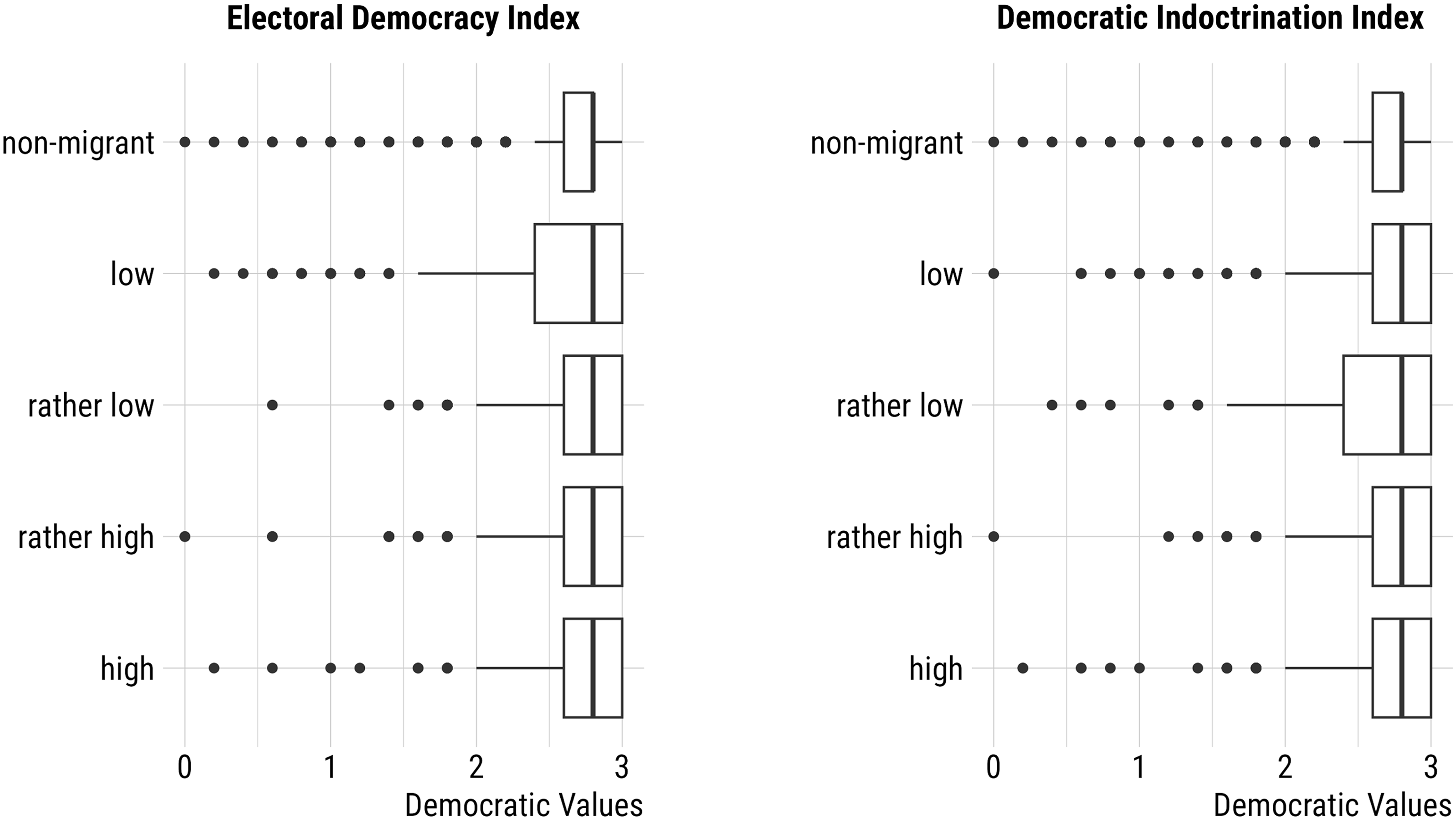
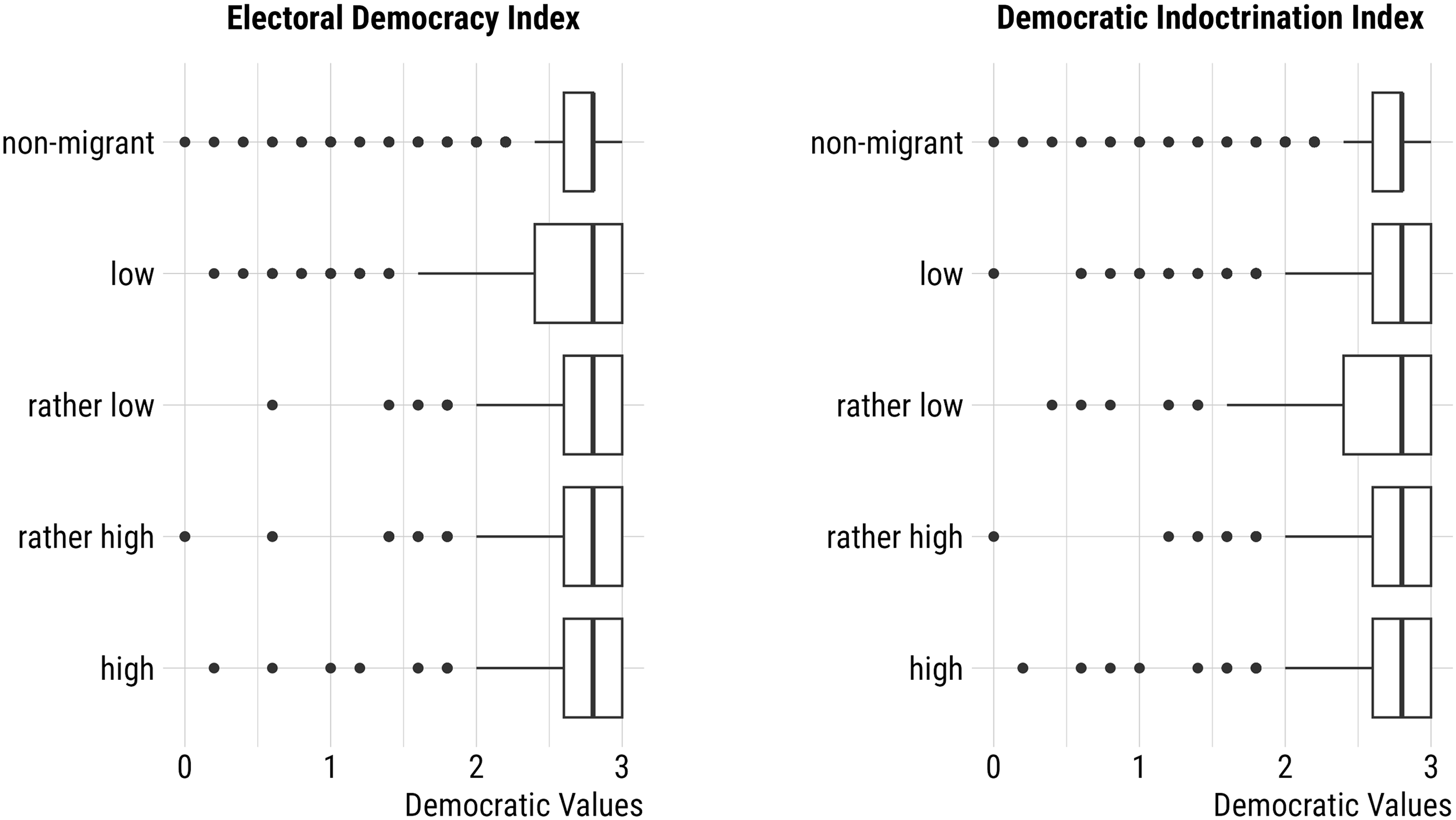
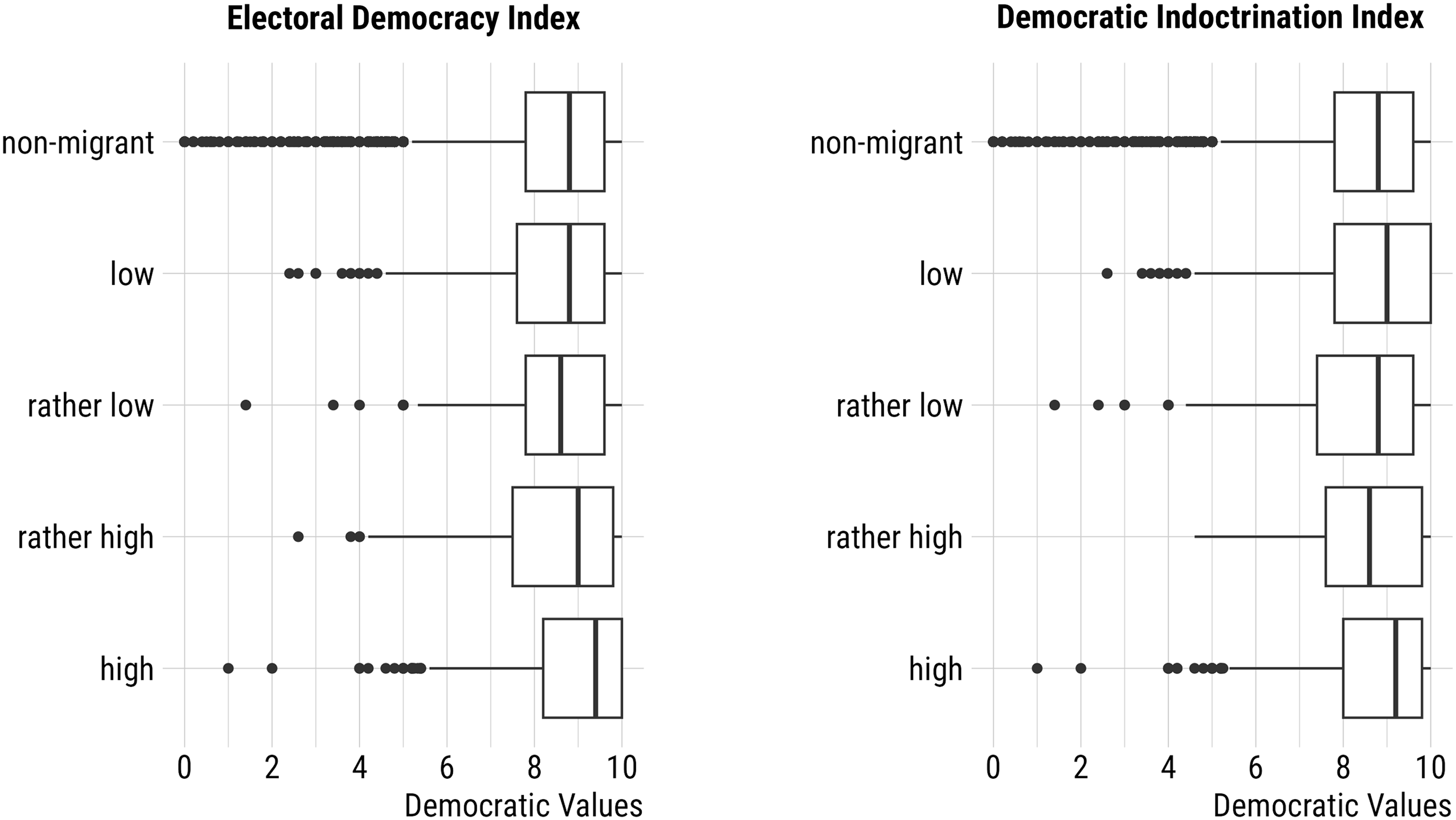
When examining different levels of electoral democracy and democratic indoctrination in their countries of origin (quartiles of the respective measures), we also do not observe any significant variation. Figures 1 and 2 illustrate that individuals with a migration background consistently exhibit high support for democratic values, regardless of the democratic context in their country of origin (for detailed values, see Tables A3a to A3d in the Appendix). Most values cluster in the highest quintile of the liberal democracy scale. Therefore, we do not find support for Hypothesis 1, according to which immigrants from less democratic countries are less supportive of democratic values than immigrants from more democratic countries or non-migrants in democratic countries.
Box plots of democratic values varying between 0 (low) and 3 (high) among non-migrants and migrants from low, rather low, rather high, and high democratic countries (quartiles of the respective policy measures) in Germany (Integration Barometer). The panel on the left differentiates between origin countries according to the Electoral Democracy Index (V-Dem) and the panel on the right according to the Democratic Indoctrination Index (V-Indoc).
Box plots of democratic values varying between 0 (low) and 10 (high) among non-migrants and migrants from low, rather low, rather high, and high democratic countries (quartiles of the respective policy measures) in the countries of the European Social Survey (ESS). The panel on the left differentiates between origin countries according to the Electoral Democracy Index (V-Dem) and the panel on the right according to the Democratic Indoctrination Index (V-Indoc).
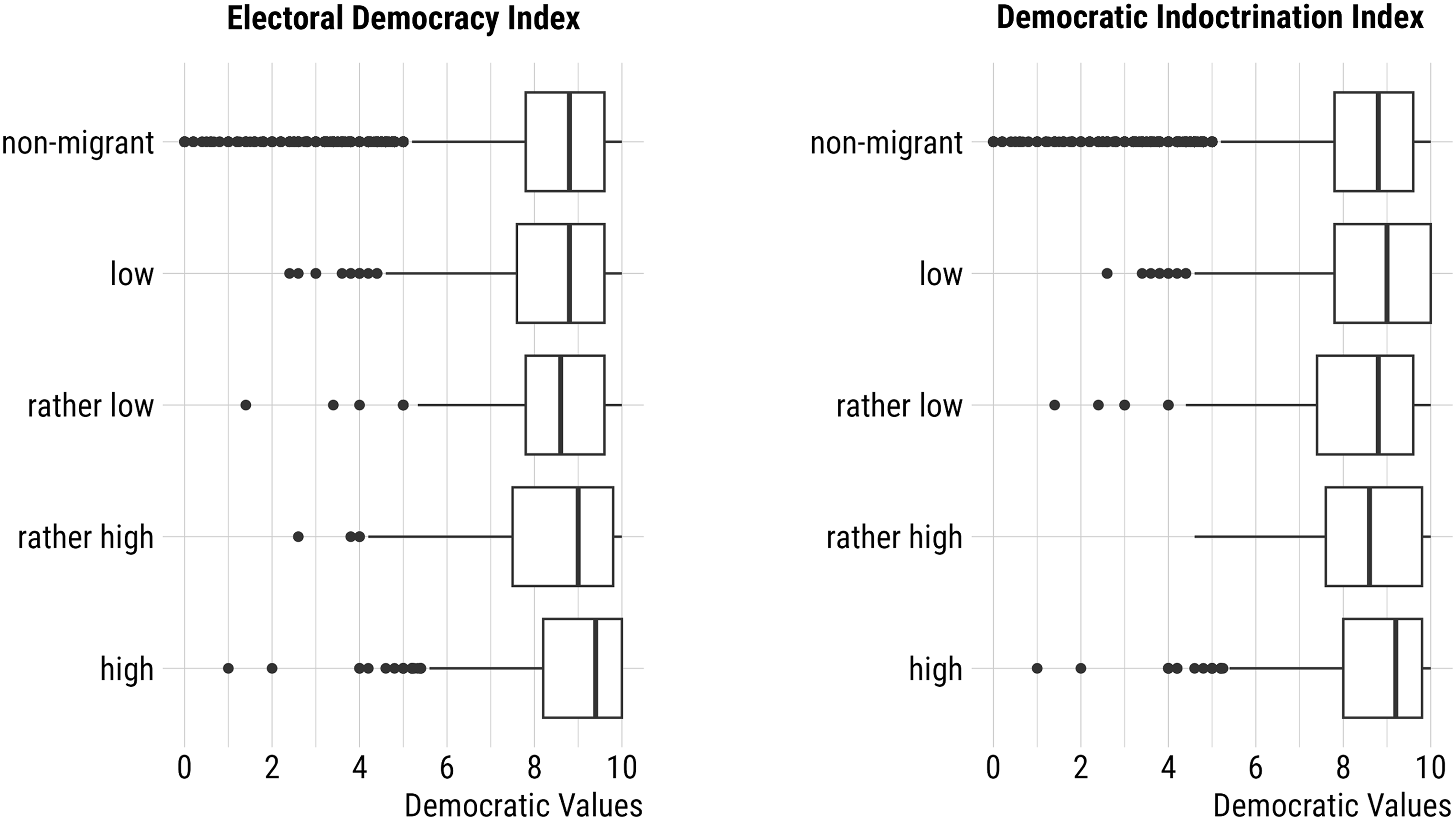
While the mean values do not vary across migrant groups from more or less democratic countries, it could still be that the share of migrants that strongly oppose democratic values varies across groups. As we see in Figures A3a to A3d in the Appendix that display the distributions of the individual items in the two surveys, we do not observe a systematic variation of the shares of very undemocratic persons across different migrant groups.Footnote 18
The lack of variation in democratic values among individuals from different political regimes may be because we did not differentiate between different durations of socialisation. According to our hypotheses 2a and 2b, the duration of socialisation and acculturation in low (high) democratic regimes should decrease (increase) support for democratic values. Descriptive analyses of mean democratic values, which distinguish between different durations of residence in the countries of origin, reveal some fluctuations; however, these are small and do not follow any discernible pattern (see Figures A4a and A4b in the Appendix). To investigate this further, we conducted several regression analyses presented in Tables 1 and 2.
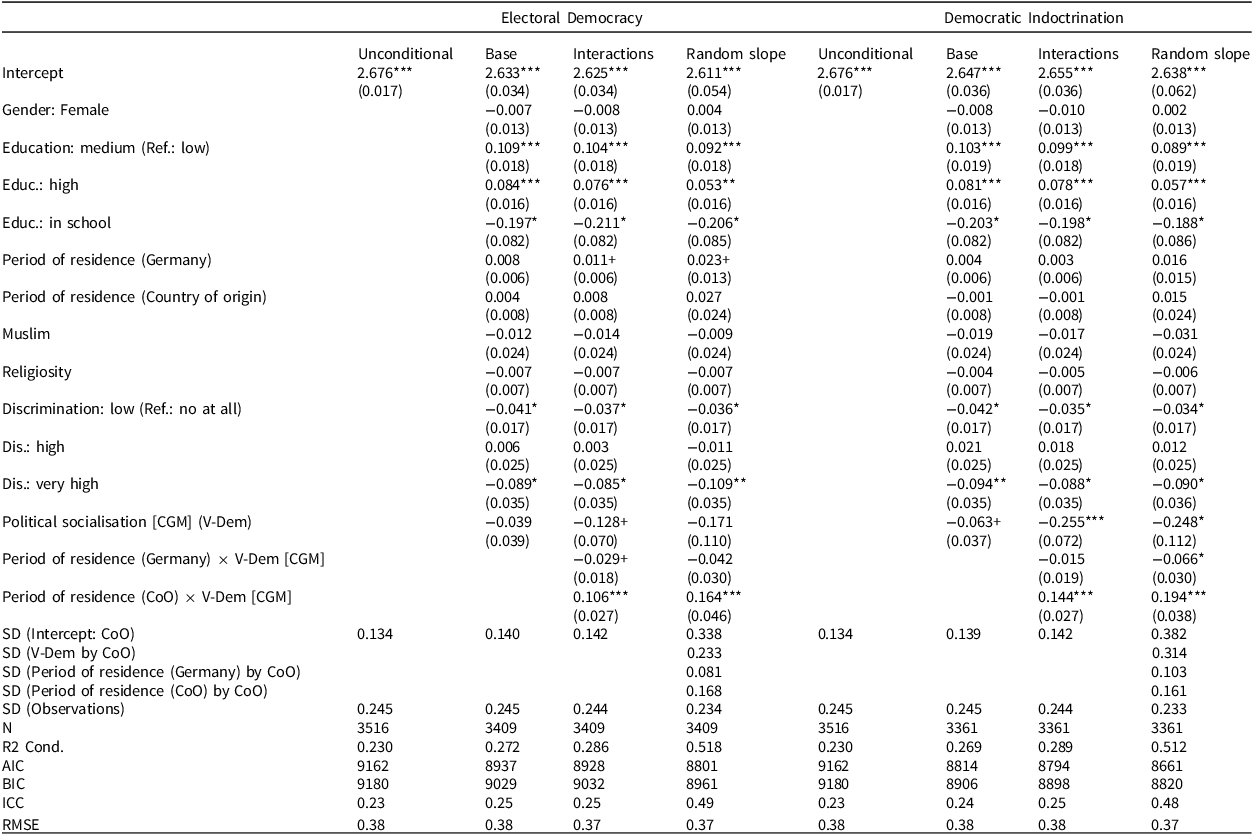
Multilevel model for democratic values, German integration barometer
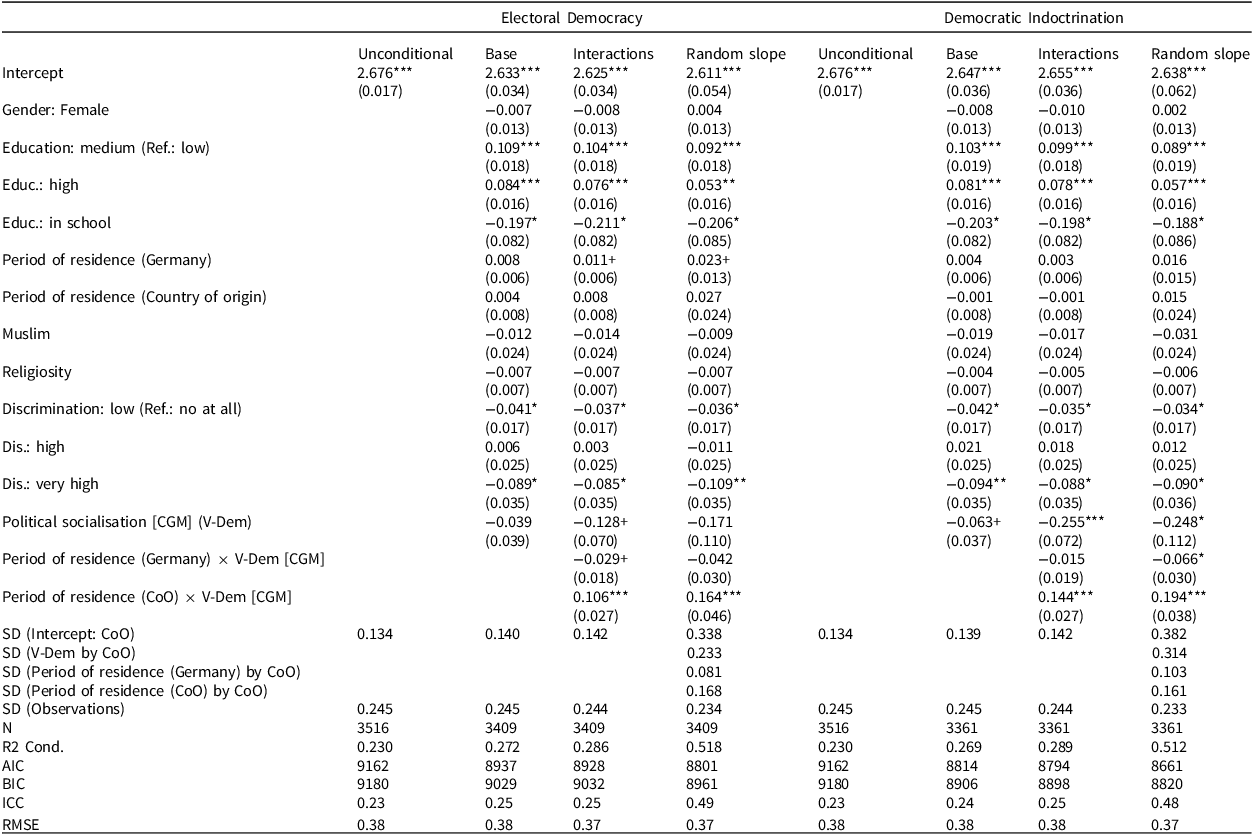
Notes: Linear multilevel regression models, weighted data from the German Integration Barometer. CoO: Country of origin; CGM: centring at the grand mean.
Significance levels: + p < 0.1, * p < 0.05, ** p < 0.01, *** p < 0.001.
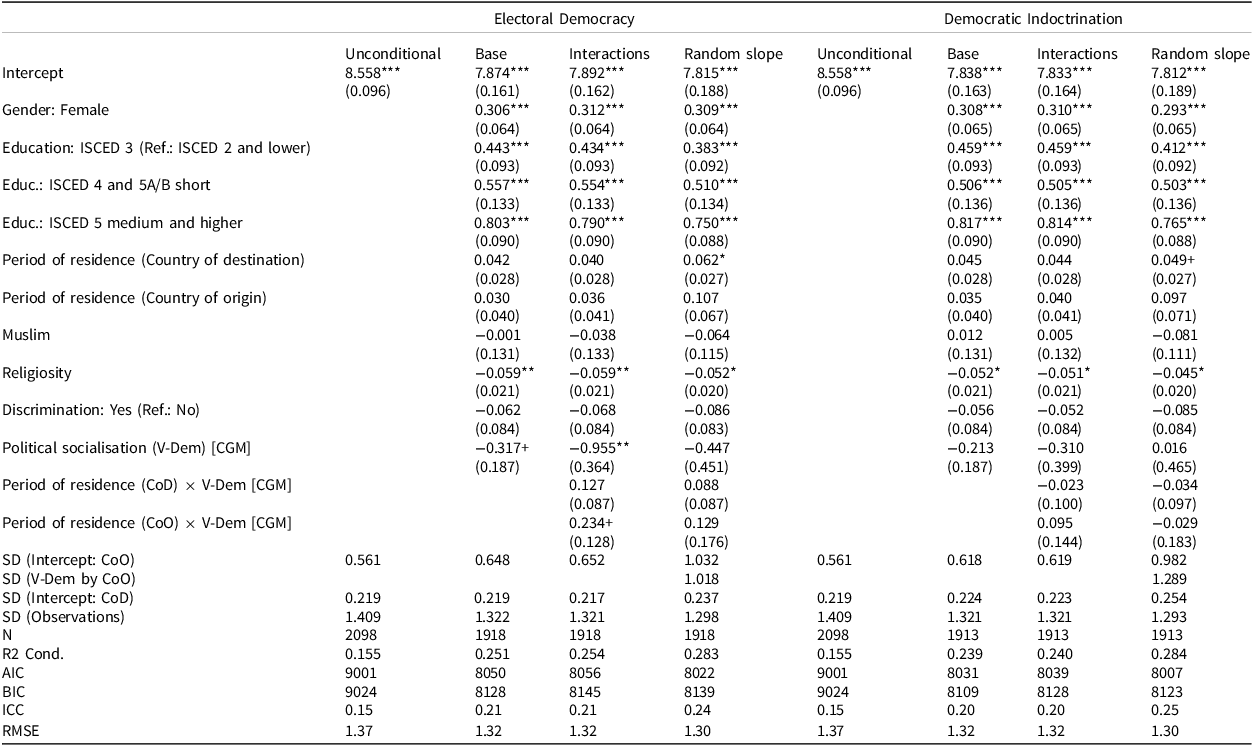
Multilevel model for democratic values (European social survey)
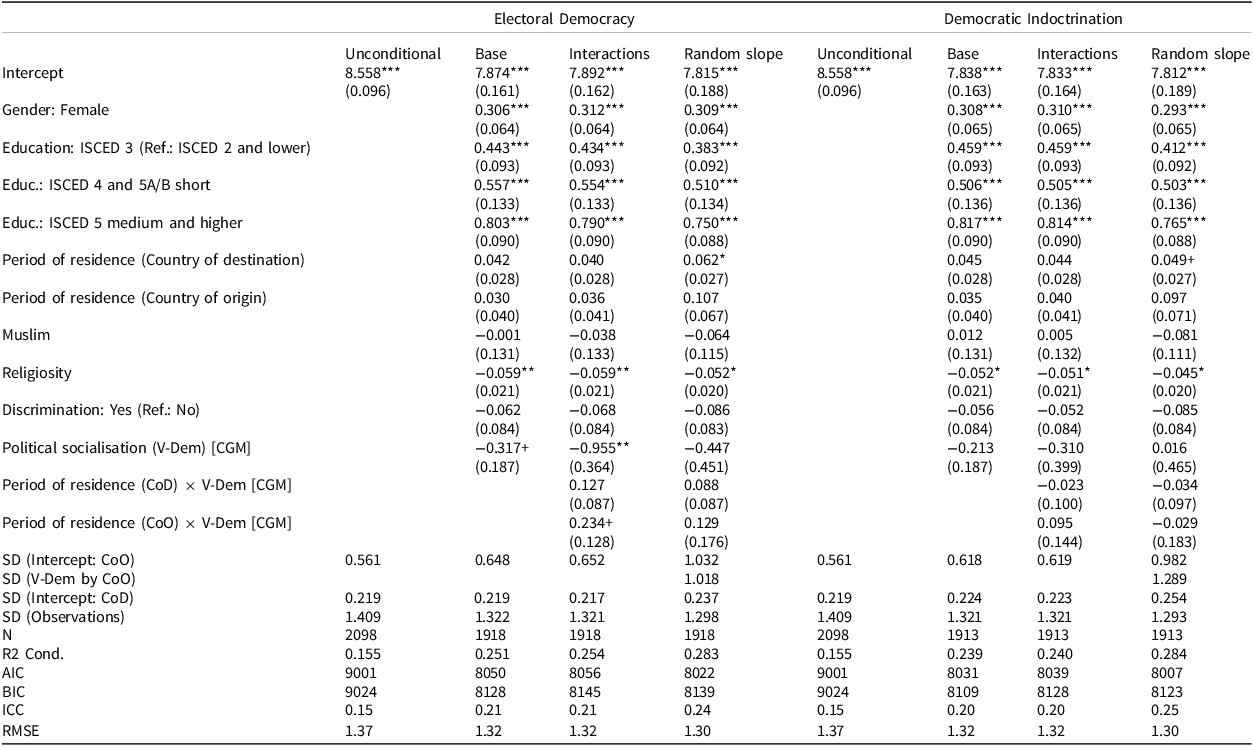
Notes: Linear multilevel regression models, weighted data from the European Social Survey. CoO: Country of origin; CoD: Country of destination; CGM: centring at the grand mean.
Significance levels: + p < 0.1, * p < 0.05, ** p < 0.01, *** p < 0.001.
Table 1 shows the results of consecutive linear multilevel regression models examining democratic values in Germany. In the unconditional model, approximately 23 per cent of the variance in democratic values is attributed to the migrants’ country of origin. The base model, which incorporates fixed effects, indicates that political socialisation in the country of origin has no significant effect. However, when introducing interactions between regime type in the country of origin and the duration of socialisation in both the country of destination and the country of origin, a statistically significant positive effect is observed for the duration of socialisation in the country of origin and electoral democracy. Substituting the measure of electoral democracy with democratic indoctrination does not alter the results. Thus, the model incorporating the interactions demonstrates that the duration of political socialisation in the country of origin influences democratic values. This effect remains robust even with the introduction of random slopes.
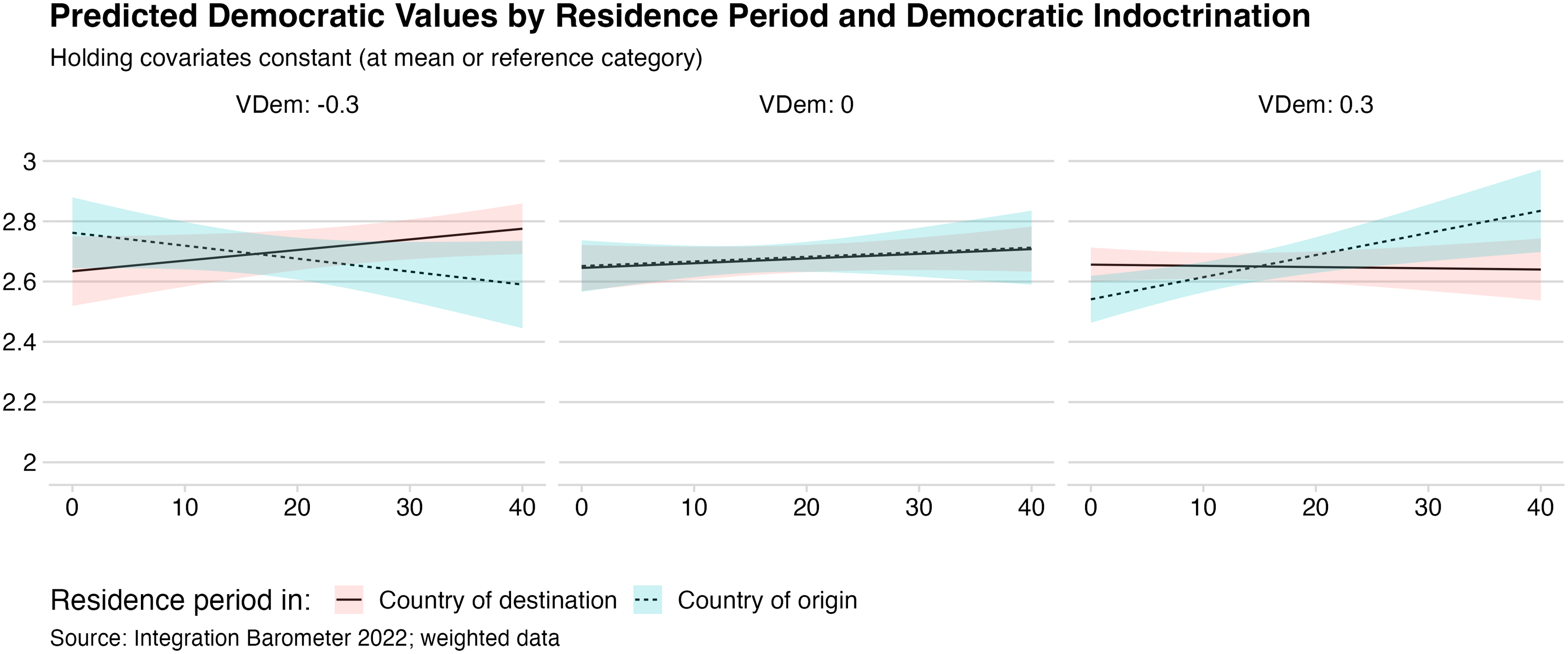
Figures 3a and 3b visually represent the interaction between the regime type of the country of origin and the duration of socialisation in both the country of destination and the country of origin. Figure 3a illustrates that migrants from countries with a low level of electoral democracy who have been acculturated in Germany for an extended period are more likely to support democratic values than their counterparts with a shorter residence period. However, this effect is not statistically significant. Additionally, this relationship is specific to individuals from countries with low levels of electoral democracy. Essentially, there is a ‘democratic dividend’ for migrants from autocratic countries such as, for example, Eritrea, Saudi Arabia, or Iran.
Predicted democratic values plots varying between 0 (low) and 3 (high) by residence duration (years) in origin countries and Germany (Integration Barometer). The panels differentiate between migrants from very low (-0.3 below the mean) and very high (+0.3 above the mean) democratic countries according to the Electoral Democracy Index (V-Dem). Covariates are held constant at the mean or reference category. For improved readability, the residence period has been reverted to the original scale by multiplying it by ten (in years).
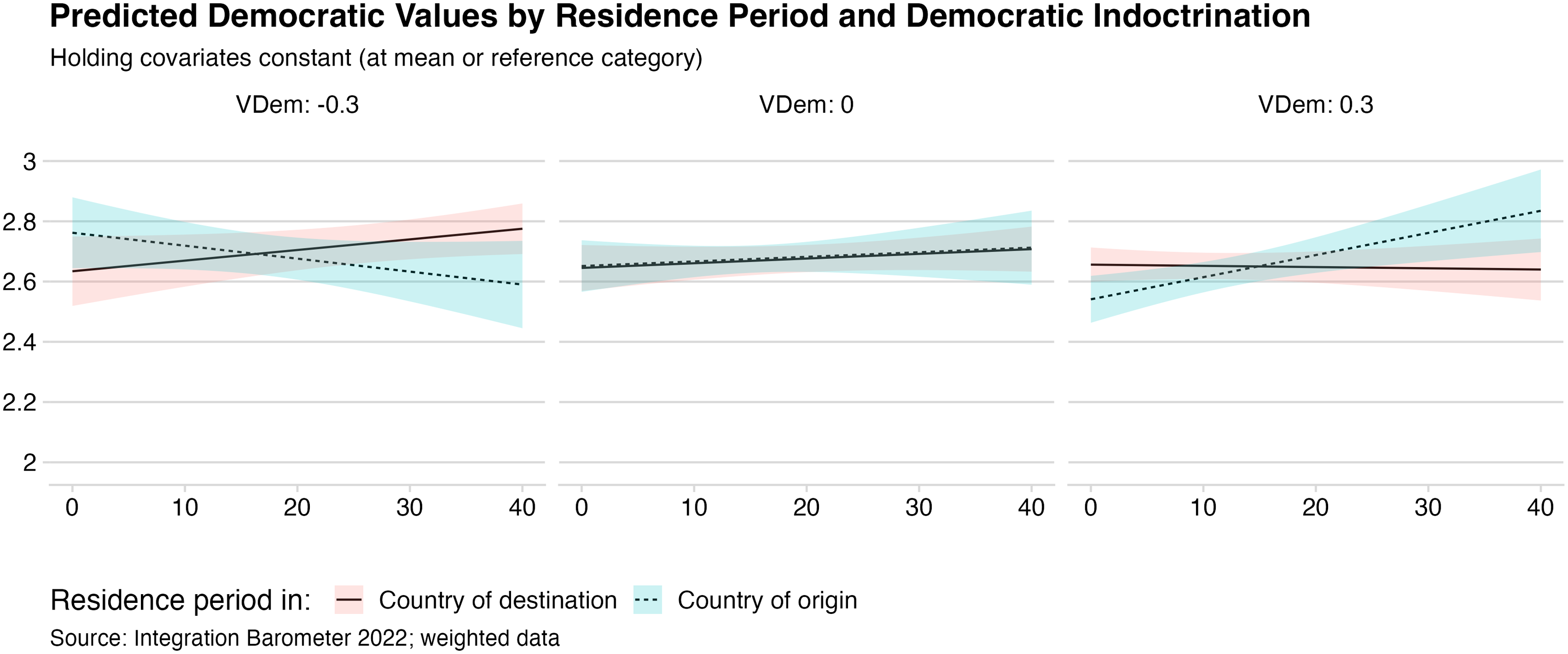
Predicted democratic values plots varying between 0 (low) and 3 (high) by residence duration (years) in origin countries and Germany (Integration Barometer). The panels differentiate between migrants from very low (-0.3 below the mean) and very high (+0.3 above the mean) democratic countries according to the Democratic Indoctrination Index (V-Indoc). Covariates are held constant at the mean or reference category. For improved readability, the residence period has been reverted to the original scale by multiplying it by ten (in years).
Conversely, examining the impact of the duration of socialisation in the country of origin reveals a different pattern. Individuals who spent considerable time in countries with low levels of electoral democracy tend to hold less democratic values compared to those with shorter socialisation periods in their country of origin. This supports Hypothesis 2b. Additionally, migrants who have lived longer in countries with a high level of electoral democracy, such as, for example, India, Turkey, or Romania, are more likely to support democratic values than those who left their country of origin at an earlier age.
Table 2 presents the regression results for the data from the European Social Survey and further supports the visual inspection from Figure 2: we do not find any significant effect related to the level of democracy in the country of origin and thus no support for Hypothesis 1.Footnote 19 The absence of a significant effect concerning the level of democracy in the country of origin supports two distinct arguments: (a) the argument of the ‘paradox of democracy’, which posits that democracy is supported even in its absence and that people share the same democratic values worldwide (Inglehart Reference Inglehart2003; Norris Reference Norris2011), and (b) the argument that emigrants are a self-selected group and differ in their democratic values from those who remain in their country of origin. The data does not allow us to distinguish these two perspectives.
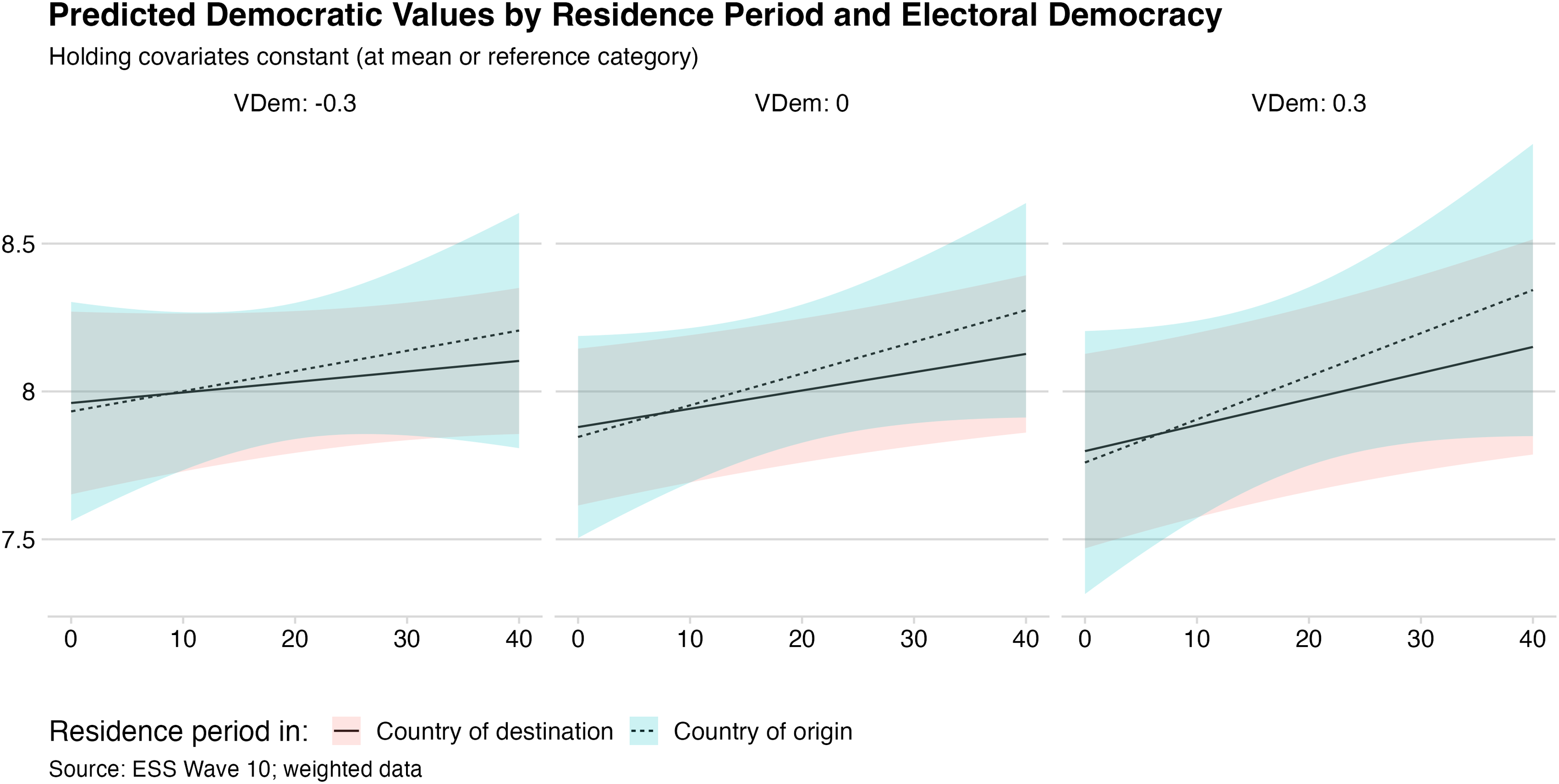
Figures 4a and 4b visualise the effects related to Hypotheses 2a and 2b, which state that the impact of the democratic setting in both the country of origin and the destination country largely depends on each. Given that the countries in the ESS data are all democratic, the destination countries we study are also democratic countries qua causa.Footnote 20
Predicted democratic values plots varying between 0 (low) and 10 (high) by residence duration (years) in origin countries and countries of the European Social Survey (ESS). The panels differentiate between migrants from very low (-0.3 below the mean) and very high (+0.3 above the mean) democratic countries according to the Electoral Democracy Index (V-Dem). Covariates are held constant at the mean or reference category. For improved readability, the residence period has been reverted to the original scale by multiplying it by ten (in years).
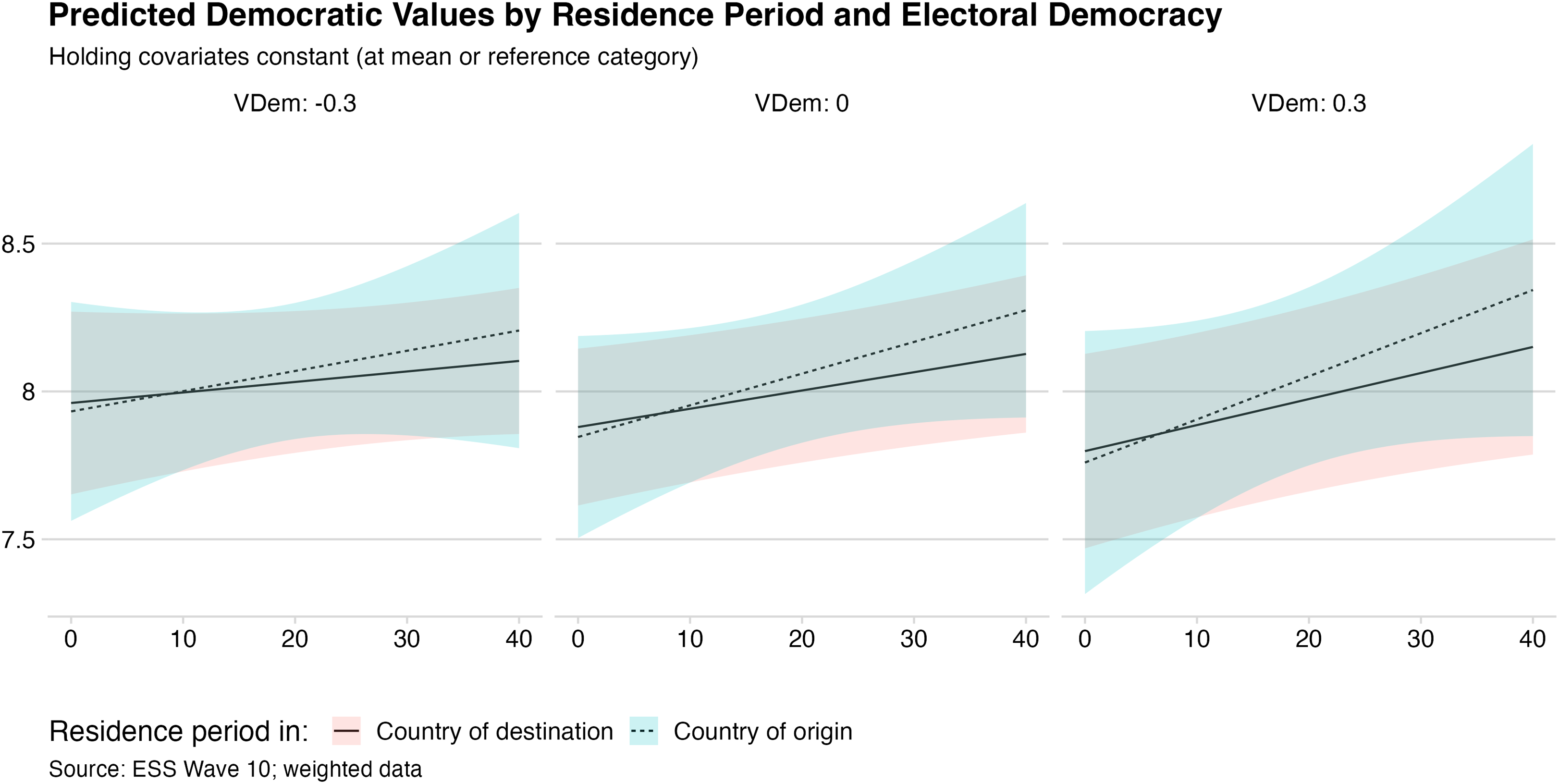
Predicted democratic values plots varying between 0 (low) and 10 (high) by residence duration (years) in origin countries and countries of the European Social Survey (ESS). The panels differentiate between migrants from very low (−0.3 below the mean) and very high (+0.3 above the mean) democratic countries according to the Democratic Indoctrination Index (V-Indoc). Covariates are held constant at the mean or reference category. For improved readability, the residence period has been reverted to the original scale by multiplying it by ten (in years).
Although we do not observe a statistically significant interaction effect, as shown in Table 2, the visualised results indicate patterns of socialisation and acculturation: the longer migrants spend time in a democratic country with high democratic or low patriotic indoctrination, the greater their support for democratic values. Conversely, in autocratic countries of origin, there is only a minimal temporal effect of socialisation on democratic values.
At the same time, acculturation processes are evident. The longer a migrant – especially those from countries with a high level of democracy – resides in a democratic destination country, the greater their support for democratic values.
Robustness
There are three potential threats to identification concerning the cut-off points of socialisation, the internal validity of the measurement of democratic values and the age-period-cohort relationship in our data structure.
First, the definition of the age range for the formative phase of political socialisation varies a lot (12–16 years or 15–25 years; Gomez Reference Gomez2022; Lindemann Reference Lindemann2023), prompting us to adjust the cut-off point for inclusion in the sample. Additional analyses that include migrants with a lower or higher age at immigration (12 or 16 years old) and a different year of the assigned country-level indicator change the sample size but do not affect the results of the main models (see Appendix Tables A7a to A7d).
Second, support for democratic values may be influenced by the political situation in the country of residence at the time of the interview. Although all destination countries in our sample are advanced democracies, satisfaction with democratic institutions may still vary due to factors such as political polarisation, the success of right-wing populist parties, or economic outcomes (Just Reference Just2017; Hoerner and Hobolt Reference Hoerner and Hobolt2020; Daoust and Nadeau Reference Daoust and Nadeau2021). It is possible that individuals struggle to distinguish between their perception of the current democratic situation and their democratic values.
In the European Social Survey, respondents are asked not only how important they consider various aspects, such as free elections, to be for democracy in general, but also how they perceive democracy is working in their country of residence and the extent to which, for example, free elections are applicable in these countries. There appears to be a medium correlation between these two questions, ranging from 0.42 to 0.5. The correlation between the democratic values index and the level of satisfaction with democracy in the country of residence is also relatively weak (first-generation immigrants: 0.1; non-migrants: 0.09). This suggests that individuals do differentiate between their own democratic values and the state of democracy in their country.
Additionally, the format of the questions could mean that the responses to the five democracy questions do not accurately reflect what is important to the respondents themselves. The question regarding the importance of certain aspects for democracy in general may be interpreted as a knowledge-based question. Even if someone does not identify as a democrat, they might still assert that fair elections are important for a democracy, as this reflects a particular conceptualisation of democracy. In the ESS, respondents were also asked how important it is to them to live in a country that is governed democratically. When we restrict our analyses to migrants who express a desire to live in a democracy, we find that the results do not differ meaningfully from those of the full sample (see Appendix Table A8).Footnote 21
Third, an assessment of the age-period-cohort (APC) relationship within the data structure is required to justify the claim that socialisation effects are present, rather than age effects. Given the cross-sectional data structure inherent in both our datasets, we can conclude that there is a detrimental relationship between age and the socialisation period in either the origin or destination country. In other words, an individual who has been socialised in a location for one additional year is also one year older.
Unfortunately, it is not possible to disentangle age and socialisation effects analytically (see Bell Reference Bell2020; Rohrer Reference Rohrer2025). However, the question remains whether age should matter at all. The existing literature is highly limited regarding studies of age effects on democratic values. Huang (Reference Huang2023), focusing on various social values, includes some measures of democratic values and shows no noteworthy age effect for them. Taking the relationship between age and political behaviour as an indicator for age and democratic values, we infer that democratic values exhibit an inverse U-shaped relationship with age (Peterson et al. Reference Peterson, Smith and Hibbing2020). This suggests that the youngest and oldest individuals tend to espouse the least democratic values.
Since we already restrict our sample by excluding individuals younger than 14 years (with variations in the cut-off to 12 and 16 years), we conduct an additional test by limiting the sample to individuals younger than 40 years. However, this restriction effectively halves the sample size and impedes the estimation of multi-level models. Consequently, as an additional check, we use fixed-effect models that rely on cumulative years spent under autocracy in the country of origin as the main explanatory variable. This does not lead to different results (see Appendix Tables A9 and A10). Finally, we have seen in Figures 3a and 3b (but not for the ESS data in Figures 4a and 4b) that the duration effects in authoritarian countries of origin and democratic countries of destination point in different directions, which rules out the possibility of a uniform effect of age on democratic values.
Conclusion
A functioning democracy needs citizens who support democratic norms (Almond and Verba Reference Almond and Verba1963; Easton Reference Easton1965; Dalton Reference Dalton2007). In Western democratic states, some people fear that migrants from less democratic countries could question liberal democratic values and thus put them at risk (Koopmans Reference Koopmans2015; Helbling and Traunmüller Reference Helbling and Traunmüller2020). While there is evidence that democratic norms are universally shared (Inglehart Reference Inglehart2003; Norris Reference Norris2011), some studies show that understandings and support for democracy vary between people from democratic and people from authoritarian regimes (De Regt Reference De Regt2013; Lu and Chu Reference Lu and Chu2021; Chapman et al. Reference Chapman, Hanson, Dzutsati and DeBell2024). It might therefore be that migrants from less democratic countries do not support democratic values to the same extent as migrants from democratic countries or non-migrants in democratic countries.
Our analyses, which cover a large number of European countries and different samples of migrants from various democratic and non-democratic countries, have shown that on average all migrants show very high support for liberal democratic values (at the same level as non-migrants), irrespective of their country of origin and its political regime. Democratic values, although constantly at a relatively high level, do, however, vary among migrants from less democratic countries depending on the length of socialisation in their country of origin and the length of acculturation in the country of destination: support for democratic values decreases the later migrants have left their undemocratic countries but increases again the more time they have spent in democratic destination countries. Overall, these effects are, however, quite small. The fear that migrants from authoritarian regimes are generally undemocratic therefore appears to be unfounded. However, this does not mean that extremist or fundamentalist attitudes among migrants and non-migrants do not pose a challenge to democracies, as several studies have shown (e.g., Koopmans Reference Koopmans2015; Jungkunz et al. Reference Jungkunz, Helbling and Osenbrügge2024a, Reference Jungkunz, Helbling and Isani2024b).
Even though we went beyond earlier studies that looked at general measures of diffuse democracy support and based our analyses on survey questions that asked about specific aspects of liberal democracy, we cannot exclude that people socialised in different political contexts still understand these concepts differently and that people might have different understandings of what, for example, free media and minority protections mean.
Since all participants in both surveys were interviewed in highly democratic countries, it is possible that their answers merely reflect the dominant values to which they are exposed, rather than beliefs they have fully absorbed. However, there is no reason to assume that migrants are more likely to provide socially desirable answers than non-migrants, who have been socialised in a democratic context for a longer period (Raschke and Westle Reference Raschke and Westle2018: 337).
Another study using the same data from the Integration Barometer in Germany indicated that social desirability does not necessarily play a role. It found that respondents with a migration background exhibited significantly more antisemitic attitudes than those without a migration background (Friedrichs and Storz Reference Friedrichs and Storz2022). Antisemitism was particularly pronounced among people with a Turkish background, who represent one of the largest immigrant groups in Germany, and among migrants from countries outside the European Union. If people had a tendency to give socially desirable answers, we would not observe such a pattern, as the rejection of antisemitism is an important norm in Germany. The study also shows that people with a migrant background who were socialised and went to school in Germany are less antisemitic than people who immigrated as adults.
Besides studying support for democratic values, it is necessary to also study how committed people are to these values. There is already plenty of research on migrants’ political behaviour and political interest (Togeby Reference Togeby2004; White et al. Reference White, Nevitte, Blais, Gidengil and Fournier2008; Aleksynska Reference Aleksynska and Vogel2008; Maxwell Reference Maxwell2010; Dollmann Reference Dollmann2022; Goerres et al. Reference Goerres, Mayer and Spies2022). Future research could investigate how democratic values are linked to political behaviour but also what role they play in trade-off situations. Graham and Svolik (Reference Graham and Svolik2020) have shown for the US that people’s commitment to democratic norms is limited and that they ‘are willing to trade off democratic principles for partisan ends’ (2020: 407). The question is then to what extent commitment might depend on one’s experience with democracy and democratic political behaviour.
Moreover, future research should also take a closer look at the mechanisms that may moderate the effects we observe for structural socialisation processes. Our data did not allow us to analyse to what extent people with particularly high support for democratic values have decided to leave their undemocratic countries (self-selection effect), to what extent they express democratic norms to show how much they reject the regimes of their countries of origin (backlash effect), or to what extent democratic norms are already widely shared in authoritarian regimes (diffusion effect).
Supplementary material
The supplementary material for this article can be found at https://doi.org/10.1017/S1475676525100285.
Data availability statement
The data underlying this article are available at https://www.europeansocialsurvey.org/ (ESS data), at https://www.rwi-essen.de/en/forschung-beratung/weitere/forschungsdatenzentrum-ruhr/datenangebot/mikrodaten/svr-integrationsbarometer (IB data) and at https://v-dem.net/data/the-v-dem-dataset/ (V-Dem data).
The replication package can be found here: https://github.com/FabianFox/attitudes-democracy.
Acknowledgements
We like to thank Lukas M. Fuchs for his feedback on an earlier version of this paper. We are also grateful for helpful comments we received at presentations at the Berlin Social Science Center in 2024, the 2024 International Conference of the Council for European Studies in Lyon, and the 2024 Current Directions in Research on Political Support Conference at the University of Duisburg-Essen.
Funding statement
No funding was obtained for this project.
Competing interests
There are no conflicts of interest.


 Open access

