


Introduction
A clear understanding of population change can be difficult to obtain when the relevant data are dispersed across a range of primary sources, especially when these differ widely in scientific rigour and style or format of presentation. This is often the case for species that, for whatever reason, are poorly represented in national monitoring schemes or are difficult to monitor in the field. In this paper we consider how to assimilate data from a range of sources to create a coherent picture of population change and provide an index of change. We illustrate this using data on the changing status of Twite Carduelis flavirostris in England.
A sustained period of decline in the range and size of many of Britain's farmland bird populations (Fuller et al. Reference Fuller, Gregory, Gibbons, Marchant, Wilson, Baillie and Carter1995, Siriwardena et al. Reference Siriwardena, Baillie, Buckland, Fewster, Marchant and Wilson1998, Shrubb Reference Shrubb2003, Newton Reference Newton2004) has coincided with a marked period of agricultural change over the last 60 years (Robinson and Sutherland Reference Robinson and Sutherland2002, Shrubb Reference Shrubb2003). The losses are well-documented (Marchant et al. Reference Marchant, Hudson, Carter and Whittington1990, Fuller et al. Reference Fuller, Gregory, Gibbons, Marchant, Wilson, Baillie and Carter1995, Siriwardena et al. Reference Siriwardena, Baillie, Buckland, Fewster, Marchant and Wilson1998, Fewster et al. Reference Fewster, Buckland, Siriwardena, Baillie and Wilson2000) as these affected species have, for the most part, been well-represented in the long-term data collected by the BTO/JNCC Common Bird Census (Marchant Reference Marchant1983) and its successor, the BTO/JNCC/RSPB Breeding Bird Survey (Joys et al. Reference Joys, Noble and Baillie2003). Widespread concern about these losses has been a spur to a considerable body of research into the reasons underlying these trends (Aebischer et al. Reference Aebischer, Evans, Grice and Vickery2000, Chamberlain Reference Chamberlain2004). The UK government has also adopted a Farmland Bird Index as one of its 15 Quality of Life indicators (Anon 1999) and created a UK Public Service Agreement to reverse these declines by 2020 (Anon 2002, Vickery et al. Reference Vickery, Bradbury, Henderson, Eaton and Grice2004).
The populations of many species considered to be ‘upland birds’ also use farmland for much of the year – variously for nesting, foraging and roosting. As the uplands have not escaped agricultural intensification and other land use changes (Fuller and Gough Reference Fuller and Gough1999, Jenkins and Watson Reference Jenkins and Watson2001, Shrubb Reference Shrubb2003, Brown and Grice Reference Brown and Grice2005), it is entirely possible that there have been parallel losses amongst upland species. However, the population trends of upland species are rather poorly documented (Fuller et al. Reference Fuller, Ward, Hird and Brown2002), largely because upland areas tend to be remote from centres of human population (and thus potential volunteers) and have therefore been poorly represented in volunteer-based long-term schemes. For example, the upland Pennines were represented by just two Common Bird Census plots that had been monitored for a period of ten years or more (Fuller et al. Reference Fuller, Ward, Hird and Brown2002). The evolution of the scheme into the Breeding Bird Survey (BBS) was, in part, in recognition of the need to improve representation in habitats other than woodland and lowland farmland (Baillie et al. Reference Baillie, Marchant, Crick, Noble, Balmer, Beaven, Coombes, Downie, Freeman, Joys, Leech, Raven, Robinson and Thewlis2005).
In England, Twite now breed exclusively in upland areas. While the species is listed as ‘Least Concern’ in the Global IUCN Red List (BirdLife International 2004), in England it is classified as a red-listed Species of Conservation Concern due to historic population declines and range contractions (Gregory et al. Reference Gregory, Wilkinson, Noble, Robinson, Brown, Hughes, Procter, Gibbons and Galbraith2002). It is also a UK Government Biodiversity Action Plan priority species by virtue of its more recent decline. Twite are difficult to survey using non-specific methodologies as they are colonial and conduct most feeding, courtship and display activity well away from the nest site (Gilbert et al. Reference Gilbert, Gibbons and Evans1998). There has been just one national census, leading to an estimate of the size of the British population of 10,000 pairs (Langston et al. Reference Langston, Smith, Brown and Gregory2006). The majority of birds are found in Scotland, where the birds are most numerous in north and north-western coastal areas. There are an estimated 3,500 pairs in Ireland and a small population in Wales (Gibbons et al. Reference Gibbons, Reid and Chapman1993). In England, the main breeding population is located in the South Pennines, where the population is estimated at between 200 and 400 pairs (Brown et al. Reference Brown, Crick and Stillman1995, Batty et al. Reference Batty, Langston and Gregory1999). The only estimate of the British wintering population is of 100,000–150,000 individuals (Lack Reference Lack1986), these predominantly inhabiting coastal saltmarshes and occasionally arable farmland at or near the coast.
There is some good evidence that both the range and numbers of the species have diminished in recent decades (Brown et al. Reference Brown, Crick and Stillman1995, Batty et al. Reference Batty, Langston and Gregory1999, Langston et al. Reference Langston, Smith, Brown and Gregory2006), but much of the evidence for a decline is anecdotal, unpublished or uncollated. This paper attempts to formally document changes in the English Twite population using evidence drawn from unpublished surveys, county avifaunas and county bird reports, as well as our own data collected during fieldwork in the South Pennine Moors Site of Special Scientific Interest (SSSI). We also demonstrate that it is possible to produce a convincing quantitative assessment of population change, through the creation of an index, using data of variable quality drawn from disparate sources. We argue that it may be useful to adopt the approach more widely in assessing change in species or populations poorly represented in bespoke schemes.
Methods
In order to assess change in the distribution and abundance of Twite, we collated and analysed information extracted from county bird reports, county avifaunas and other historical accounts of the status of the species throughout its former range, many of which include reference to the bird's status back to the start of the nineteenth century. Due to the considerable variation in the way data are presented in the various sources, broad abundance categories were used to chart the change in the status of this species in each county (Table 1).
Description of abundance categories used to describe Twite breeding populations in range counties.

More recent changes in abundance and distribution (since 1990) were examined by comparing data collected during survey work covering the known breeding season of this species in the uplands of England (late April to end of July) in 2004 and 2005 with that obtained over the same period in 1990 for the same sites in the South Pennine Moors Special Protection Area (SPA) (which encompasses the South Pennines SSSI and three other SSSIs in the Peak District National Park) (Brown et al. Reference Brown, Crick and Stillman1995). The recent surveys used the same census methods as the originals and are thus directly comparable. Data were plotted onto maps using MapInfo Professional Version 4.1.2. (MapInfo Corporation 1997). We also examined change in Twite numbers in Staffordshire since 1927 using data from Harrison and Harrison (Reference Harrison and Harrison2005), with updates from Staffordshire Bird Reports. Fieldwork carried out by Raine (Reference Raine2006) between the breeding seasons of 2003 and 2005, which consisted of thorough breeding surveys of all suitable breeding habitat in the South Pennine Moors SSSI, was used to generate population estimates for the region.
In 1967 and 1968, detailed surveys of breeding Twite were conducted by the East Lancashire Ornithological Club (Nuttall Reference Nuttall1968). We were able to accurately identify the locations of a significant number of the Twite colonies and Twite nests found during this survey using six-figure grid references (a means of describing locations on UK Ordnance Survey maps to the nearest 100 m). We re-surveyed 43 sites with confirmed Twite colonies in 1967 or 1968 during the known breeding season of this species in either 2004 or 2005. Breeding behaviour was taken to be that described by Gilbert et al. (Reference Gilbert, Gibbons and Evans1998) and was defined as: (i) flight displays over suitable nesting habitat, (ii) birds carrying nesting material into suitable nesting habitat, (iii) the presence of distinct pairs, (iv) the presence of recently fledged young, (v) agitated behaviour at a potential nest site, (vi) a bird reluctant to leave an area where flushed (often circling the surveyor and making alarm calls), or (vii) nests. Twite exhibiting any of these behaviours were assumed to be breeding in the area.
Twite breeding in the north of England, particularly in the South Pennine Moors SPA, spend the winter predominantly on the south and south-east coast of England (Brown and Atkinson Reference Brown, Atkinson, Wernham, Toms, Marchant, Clark, Siriwardena and Baillie2002, Raine et al. Reference Raine, Sowter, Brown and Sutherland2006). We collated the information available concerning trends in the numbers of Twite at known key wintering sites in this area. We obtained information from county bird reports (using highest mid-winter counts between November and February), the Wetland Bird Survey (WeBS), bird observatories and our own extensive surveys conducted during the winters of 2003/04 to 2005/06. Twite are found elsewhere in England in winter, predominantly in north-western coastal areas (Lack Reference Lack1986), but as the majority of these are birds from breeding areas in western Scotland (Raine et al. Reference Raine, Sowter, Brown and Sutherland2006) we have not included them in our study. Neither have we included upland wintering flocks as, historically, the presence of Twite in such areas is rather erratic (Oakes Reference Oakes1953, Orford Reference Orford1973).
There is considerable variation, both between years and between counties, and especially prior to the late 1990s, in the detail provided in county bird reports. Generally, reports give maximum counts, but in some cases only indicate presence or absence and zero counts are but rarely reported. We employed a modelling approach to construct a smoothed population trend from the time-series counts available for some wintering sites. We followed the methodology used by Fewster et al. (Reference Fewster, Buckland, Siriwardena, Baillie and Wilson2000), in which population counts were modelled as the summation of a site factor and a smooth function of a year factor using a generalised additive model (GAM) with a log link and Poisson errors. The model was fitted to the data between the winters of 1964/65 and 2005/06 from five sites in the county of Essex, nine in Lincolnshire, six in Norfolk, two in Cambridgeshire, one in Staffordshire and one in Suffolk. The model used maximum counts between November and February for each site. Following Fewster et al. (Reference Fewster, Buckland, Siriwardena, Baillie and Wilson2000), the degree of freedom was set as 0.3 times the length of the time series (12 for 41 years of data) to fit the GAM and the year 2005 was set as a base year to derive the index measuring relative abundance in each year. Confidence intervals for the indices were estimated using bootstrapping (399 samples). The percentage changes in the estimated index, together with bootstrapped confidence intervals, were also calculated. Modelling was carried out using the code by Fewster et al. (Reference Fewster, Buckland, Siriwardena, Baillie and Wilson2000) using the computer language R (R Development Core Team 2006).
Results
Breeding Grounds
Figure 1 illustrates the changing status of Twite as a breeding bird in each of its known historical breeding-range counties. Only six out of the 12 counties (50%) retained Twite as a breeding species by 2005. The location of each of these counties is shown in Figure 2.
The changing status of breeding Twite in each of its English range counties. Dates represent first or last confirmed breeding record for a county, where known.

Map of England showing the location of counties.

The 2004 and 2005 resurveys of the South Pennine Moors SPA indicate dramatic losses since 1990 (Figure 3). The Peak District National Park occupies much of the southern half of this area, and here numbers fell from 131 pairs in 1990 to just 10 in 2004 with the number of 1-km squares occupied by Twite in the breeding season declining from 88 in 1990 to only seven in 2004 (Carr and Middleton Reference Carr and Middleton2004). These changes represent a fall in both abundance and occupancy of 92.0%. The same trend was evident in the South Pennines SSSI, which occupies much of the northern part of the SPA. Numbers here fell from 219 pairs in 1990 to 57 in 2004/05 (a decline of 74%), with birds recorded in 149 1-km squares in 1990 and 37 in 2004/05, a decline of 77.2%. Over the entire SPA, the number of 1-km squares occupied by Twite fell from 280 in 1990 to 47 in 2004/5, representing an overall loss of 83.2%.
Maps showing distribution of Twite found during upland surveys in the South Pennine Moors SPA in i) 1990 and ii) 2004/05. Each square on the map represents a 1-km grid square where breeding Twite (pairs or colonies not differentiated) were recorded.

Of the 43 colonies known to be occupied by breeding Twite in east Lancashire in 1967 and 1968 that we resurveyed in 2004 and 2005, Twite had apparently been lost from 33 (76.7%) (Table 2). In some cases, colonies of substantial size (as large as 50 pairs) had disappeared in the intervening period. Data concerning year on year changes were available for three upland areas in northern England: the Staffordshire uplands (Figure 4) and two upland Common Bird Census plots in the South Pennine Moors SSSI (Figure 5). These also show a marked decline in Twite numbers, with, additionally, their eventual loss. This is not the first time that the species has been lost from Staffordshire. After more than thirty years of absence, the area was re-colonised in 1967 and numbers increased rapidly to the mid-1980s before declining again to extinction.
Numbers of breeding Twite in Staffordshire, following recolonisation in 1967. Data from Harrison and Harrison (Reference Harrison and Harrison2005) and English Nature South Pennine Moors SPA resurvey (2004/05).

Estimated number of territories km−2 of Twite on two Common Bird Census plots in the English uplands. ‘//’ symbols represent years where no data is available. Data collection on Sutton Moor started in 1972 and both sites were surveyed until 1999. We revisited both sites in 2005.

Comparison of maximum Twite colony size for historical breeding sites in Lancashire and West Yorkshire.

Obtaining an accurate estimate of the size of the South Pennines SPA Twite population is made difficult by the distribution of colonies across a large area of land. Nevertheless, we are confident that we know the location of practically all extant colonies in this area (using a combination of historical records, recent bird sightings and information from local birdwatchers throughout the South Pennines area) and so we have attempted to estimate the size of the total population by summing the lowest and highest number of breeding pairs recorded at each site over the three year study period (Table 3) to derive a minimum and maximum total of, respectively, 126 and 203 pairs. As this estimate incorporates extensive fieldwork conducted between 2003 and 2005 that encompassed all suitable breeding habitat in the entire region, it is probable that the true breeding population of Twite in the area lies somewhere in between these two figures. This also demonstrates the fluctuations in population size that individual colonies experience on a yearly basis.
Lowest and highest population estimates for the South Pennine Moors SPA, calculated by summing the known number of breeding pairs of Twite in all recorded colonies. For site estimates from this study, lowest and highest number of breeding pairs over the three year study period are given. For remaining estimates, which have been acquired from single surveys, the same number of breeding pairs is used in each column.

Wintering grounds
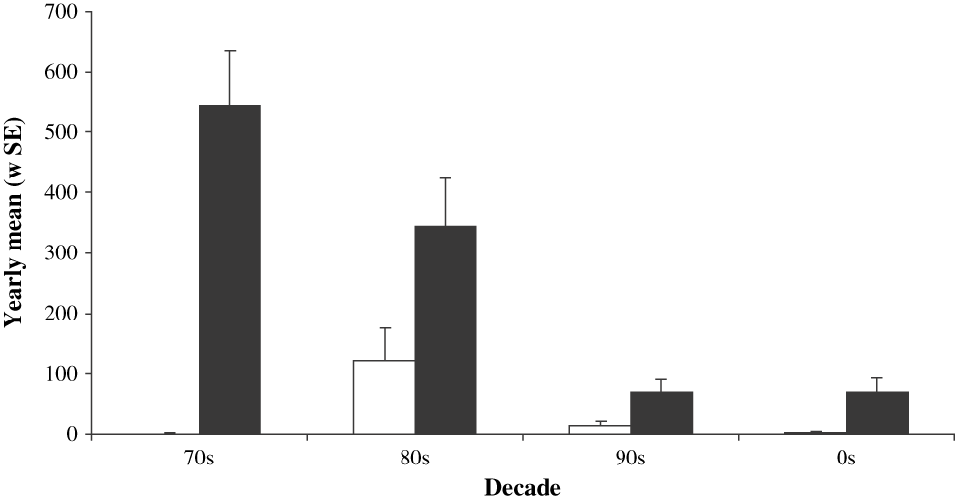
For many decades, Twite have been reported from a number of coastal areas in eastern and south-eastern England, and at a smaller number of inland sites. However, they are now scarce in or absent from many of these areas. Whilst the losses are particularly evident at sites in coastal East Anglia, our assessment of the changes in the numbers recorded at coastal sites in east, south and south-east England indicates that the decline has been more widespread. Our index reveals that the wintering population first increased in the 1960s, but declined extremely rapidly after the mid 1970s (Figure 6). The declines between 1965 and the 2005/2006 winter, 1975 and the 2005/2006 winter and 1985 the 2005/2006 winter were all significant (Table 4). But when the percentage change in the index was calculated for every decade, a significant downward change was only detected between 1985 and 1995 (Table 4), indicating that the decline in this period was particularly severe. We found similar patterns of change in Twite counts from Landguard Bird Observatory in Suffolk and from Gibraltar Point Bird Observatory in Lincolnshire, both migration watch points where birds are enumerated regularly (Figure 7).
Index curve from maximum flock sizes in winter (November–February) for 24 traditional wintering sites on the south and south-east coasts of England. The solid line gives the index curve from a GAM with 12 df, and the dashed lines represent upper and lower 85% bootstrapped confidence limits. Source: WeBS counts (courtesy of David Bingham); County Bird Reports; Brown & Grice, Reference Brown and Grice2005.

Mean (±) number of Twite recorded, by decade, on passage at two coastal migration watch points; Black bars represent Gibraltar Point Bird Observatory (courtesy of Kev Wilson), White bars represent Landguard Bird Observatory (courtesy of Nigel Odin). Note, no data available for Landguard in the 1970s.
Estimated percentage population changes, together with bootstrapped 95% confidence limits, for wintering Twites using output from a GAM with 12 df fitted to maximum flock sizes in winter (November–February) for 24 traditional wintering sites on the south and south–east coasts of England. The percentage change was obtained as 100(I 2 − I 1)/I 1, where I 1 is the index for the earlier year and I 2 is that for the later year. Changes that were significant at the 5% level are in bold.

Twite have long been known to visit some inland sites in winter, although they are more usually scarce or irregular visitors to such areas. Nevertheless, they have occurred in some numbers at a few sites, notably in East Anglia and counties near their breeding grounds. Figure 8 shows data from two such inland wintering sites (there may have been other small historical inland wintering sites, but these two sites were by far the largest and were the best documented with the most consistent datasets available). The Ouse Washes (National Grid Reference TL4685) in Cambridgeshire was once used regularly by Twite in winter, but no birds have been recorded here since 1995. In fact, only six Twite have been recorded in the whole of Cambridgeshire since 1999. By contrast, a flock of 300 individuals was present on the Ouse Washes during the winter of 1976/77. A similar trend is evident at Chasewater (National Grid Reference SK0307), an inland reservoir in Staffordshire. This site, once set in lowland heath, underwent habitat reclamation work (starting in 1974) and is now industrial land. Whether the loss of Twite at this site is related to land-use change or is merely a part of the birds’ wider decline is not known. It is possible that the initial peak in numbers following the start of reclamation may have been due to an increase in the occurrence of seeding weeds on the now heavily disturbed site. Twite are known to feed extensively on disturbed land containing a high density of favoured food plants (such as thistles Cirsium sp. and dandelions Taraxacum officinale) in their South Pennine breeding grounds (Raine Reference Raine2006).
Maximum wintering Twite flock size at two inland wintering sites. (i) Chasewater Reservoir (SK0307), Staffordshire before and after habitat reclamation in 1974 (Source: Harrison and Harrison Reference Harrison and Harrison2005; County Bird Reports). (ii) the Ouse Washes (TL4685), Cambridgeshire (Source: County Bird Reports). ‘//’ symbols represent years where no data is available.

Discussion
In this paper, we have shown that it is possible to present a coherent picture of population change for a species, despite the initial disparity and wide range of data sources available. Understanding population trends is, of course, vital in determining whether a species is in need of urgent conservation action, which in turn can be used to set conservation priorities. In the case of the Twite, we have shown that they have undergone a marked recent decline in both their breeding and wintering grounds in England. In the northern English uplands, where the species once bred regularly and was both widespread and numerous, Twite are now found only in a small part of the South Pennine Moors SPA. This decline appears to have commenced in earnest in the mid-1950s, when the species disappeared first from lowland peatlands, due to a combination of peat extraction, drainage and land claim that altered the habitat to such an extent that these traditional breeding grounds could no longer sustain colonies (Oakes Reference Oakes1953, Newton Reference Newton1972, Brown and Grice Reference Brown and Grice2005) and then from much of its upland range.
Interestingly, data concerning wintering birds on the south and south-east coasts of England, and breeding birds on the two upland Common Bird Census plots and in the county of Staffordshire since 1967 suggest a modest peak in Twite numbers in the late 1960s and early 1970s. Indeed, after Staffordshire was re-colonised, Twite rapidly increased in numbers in that county (Lord and Munns Reference Lord and Munns1970, Harrison et al. Reference Harrison, Dean, Richards and Smallshire1982). Notwithstanding the apparent buoyancy of Twite populations in the South Pennines, the species has now all but disappeared from much of the southern uplands, the northern Pennines, Cumbria, the Cheviots and the Borders (Newton Reference Newton1972, Brown et al. Reference Brown, Crick and Stillman1995).
Our assessments of change are reflected in the observations of others. The first national survey of Twite was conducted in 1999 and led to an estimate of some 10,000 pairs in the UK, with a range lying between 6,000 and 15,000 pairs. This is substantially fewer than the only previous estimates made of 65,000 pairs for Britain and 3,000 for Ireland, derived using information on nesting densities obtained from a small number of locations and the numbers of 10-kilometre squares found occupied by Twite during fieldwork for the 1988–1991 national breeding atlas. Though this earlier estimate is now thought to have been rather over-optimistic, there is corroborative evidence of decline from other sources (Langston et al. Reference Langston, Smith, Brown and Gregory2006, this paper). The range reduction between the 1968–72 and 1988–91 atlases was 1.1% for Britain and as much as 53% for Ireland (Gibbons et al. Reference Gibbons, Reid and Chapman1993) and the 1999 survey identified further losses, notably from Shetland, Orkney, Harris, Lewis, inland Scotland and from the South Pennines.
Furthermore, Carr and Middleton (Reference Carr and Middleton2004) considered that the scale of the decline in the Peak District National Park since 1990 was greater than for any other upland species in this area and Skelcher (Reference Skelcher2002) failed to find any Twite during surveys of moorland fringe and in-bye land in the West Pennines, adjacent to the National Park. The 1999 survey of Twite in the South Pennines indicated a population of some 225 pairs, at the lower end of Brown et al's. (1990) estimate for the area of 200–400 pairs. Strict comparison using data only from areas of overlap indicated a decline of 56.9%, from 415 to 179 pairs (Batty et al. Reference Batty, Langston and Gregory1999). Our failure to find Twite elsewhere in the Pennines, despite a considerable search effort both by ourselves and by many other fieldworkers, indicates strongly that the losses we have documented are not the result of a re-distribution of birds to new colonies.
Furthermore, numbers in the key wintering areas have also declined dramatically in recent decades. In the 1970s and 1980s, large numbers of Twite were reported from a significant number of traditional wintering grounds on the east and south-east coast of England. In the early 1970s there may have been as many as 20,000 to 60,000 Twite wintering along the Wash alone (Wilson Reference Wilson1974), with Davies (Reference Davies1988) estimating a population of 17,000 individuals in 1986 and flocks of 1,000 to 2,500 individuals recorded regularly (Lack Reference Lack1986). These birds were then assumed to have come from the South Pennines, but this assumption is now well-supported by contemporary and more recent ring recoveries (Brown and Atkinson Reference Brown, Atkinson, Wernham, Toms, Marchant, Clark, Siriwardena and Baillie2002, Raine et al. Reference Raine, Sowter, Brown and Sutherland2006).
Throughout the 1980s and 1990s, numbers at key wintering sites fell rapidly and flocks no longer wintered regularly in any inland areas. Numbers of wintering Twite recorded between 2003 and 2005 represent a fraction of the numbers recorded in the mid-1980s. For example, Holbeach Marsh in Lincolnshire held a flock of 5,000 individuals in 1972 and flocks of over 1,000 birds were recorded in several winters in the mid-1980s, yet held no wintering birds during our study (WeBS, County Bird Reports). Hamford Water in Essex showed a similar dramatic reduction, holding 2,000 birds in 1983 but only 45 in 2005. In fact, every single site used for developing an index in this paper experienced dramatic crashes in wintering numbers in the 1980s to present, with the exception of Donna Nook in Lincolnshire. This site still retained a flock of between 100 and 300 individuals during the winters of 2003/04 to 2005/06, which is the same size as that held in 1970 (although there have been fluctuations in the intervening years). This is currently the largest coastal wintering flock known to the authors on either the east or south-east coast of England. While it is conceivable that the loss of wintering flocks may have been counteracted by a concomitant increase in birds wintering in the uplands (perhaps due to milder winters), research carried out by the authors of this paper has shown that while some wintering flocks now remain in the breeding grounds over-winter, these numbers are relatively small and concentrated around artificial feeding sites, and cannot account for the thousands of birds that are no longer present on the south-eastern coast of England in the winter (Raine Reference Raine2006).
It is likely that the losses are related in some way to recent agricultural intensification in the uplands, the pace of which has increased dramatically in England in recent decades (Shrubb Reference Shrubb2003). Indeed, the availability of breeding habitat was found to be the single most important variable in discriminating between historically-occupied sites with and without breeding Twite in the South Pennines (Raine Reference Raine2006), implying that their loss from the historical colonies was associated with habitat loss. However, a marked decline in the extent and quality of coastal wintering sites, particularly those where pioneer salt marsh vegetation has been eroded as sea-levels have risen, may also have had a significant impact on Twite populations (Atkinson Reference Atkinson1998). Future population trajectories may well depend on whether upland breeding grounds are managed in ways that are sympathetic to the ecological requirements of this species and on whether coastal managed re-alignments can be engineered to produce the saltmarsh plants so favoured by Twite in winter.
We believe our example of Twite decline demonstrates that data from disparate sources can be used to present a coherent and quantitative account of population change. The approach might usefully be applied to a number of other species in the UK which are of conservation concern but for which we have a poorly refined quantitative record of change. Candidates might include other species of concern which are poorly represented in national monitoring schemes, such as the Water Rail Rallus aquaticus, Lesser Spotted Woodpecker Dendrocopos minor, Ring Ouzel Turdus torquatus, Grasshopper Warbler Locustella naevia, Marsh Tit Parus palustris, Willow Tit P. montanus and Bearded Tit Panurus biarmicus. In a wider European context, species that might benefit from this approach include Bonelli's Warbler Phylloscopus bonelli, Crested Tit Parus cristatus, Lesser Grey Shrike Lanius minor, Red-billed Chough Pyrrhocorax pyrrhocorax and Orotolan Bunting Emberiza hortulana. These species would benefit from similar efforts to draw together all available historical data to create a cohesive picture of population change, which would in turn serve to highlight and prioritise species for conservation action.
In an international context, the application of the approach is likely to be even more appropriate and applicable as in many countries conservation research is limited (either through funding or human resources). In these cases, the available data are even more likely to be widely dispersed and collected with varying conformity to standard recommended methods. Consideration might be given to recommending how the efforts of visiting ornithologists could be best tailored to complement those of resident ornithologists and how data collected through national recording schemes could more often permit the application of this approach.
Acknowledgements
We are very grateful to Aletta Bonn and the Moors for the Future Partnership, Dave Bingham, Nigel Odin (Landguard Bird Observatory), Kev Wilson (Gibraltar Point National Nature Reserve) and staff at Sandwich Bay Bird Observatory for sharing data. We would also like to thank Carole Showell at the British Trust for Ornithology library and Dr. Stephanie Prior (University of Cambridge) for help with some of the mapping work. We would like to thank the many birdwatchers in the South Penniner Study area who helped with the breeding surveys. They included Peter Grice, Nick Carter, David Sowter, Jim Hodgon and Brian Leecy. Special thanks to Helen Raine (BirdLife Malta) and Dr Simon Gillings (British Trust for Ornithology) for their helpful suggestions during the writing of this manuscript. This project was funded by English Nature and the Bermuda Government, and William Sutherland is supported by the Arcadia Fund.



