

Introduction
Our research concerns the social, economic and cultural effects of abrupt climate change upon prehistoric societies in the ancient Near East. Specifically, we are investigating the repercussions of the so-called 8.2ka event, one of the most pronounced climate change events of the present interglacial. This abrupt cold event, which peaked around 6225 BC, is observed in ice-cores, marine, lacustrine and terrestrial records across the northern hemisphere (Reference Rohling and PälikeRohling & Pälike 2005). The character of the event outside the North Atlantic region however remains much less understood. For the Near East, climate models and proxy data suggest severe drought conditions (Reference Wiersma and RenssenWiersma & Renssen 2006).
The effect of abrupt climate change on prehistoric societies is still inadequately explored. Climate change is frequently linked to societal collapse (Reference Weiss and BradleyWeiss & Bradley 2001; Reference Weninger, Alram-Stern, Bauer, Clare, Danzeglocke, Jöris, Kubatzki, Rollefson, Todorova and AndelWeninger et al. 2006), but evidence is thus far circumstantial, and we need to be aware of the ever-present danger of determinism. Human societies do not simply roll and flow with the climate tide (Reference RosenRosen 2007); societies develop coping mechanisms and are often remarkably resilient. Furthermore, archaeological investigations of human responses to past climate change are highly relevant for our own society facing future climate change (Reference Jansen and SolomonJansen et al. 2007).
Tell Sabi Abyad
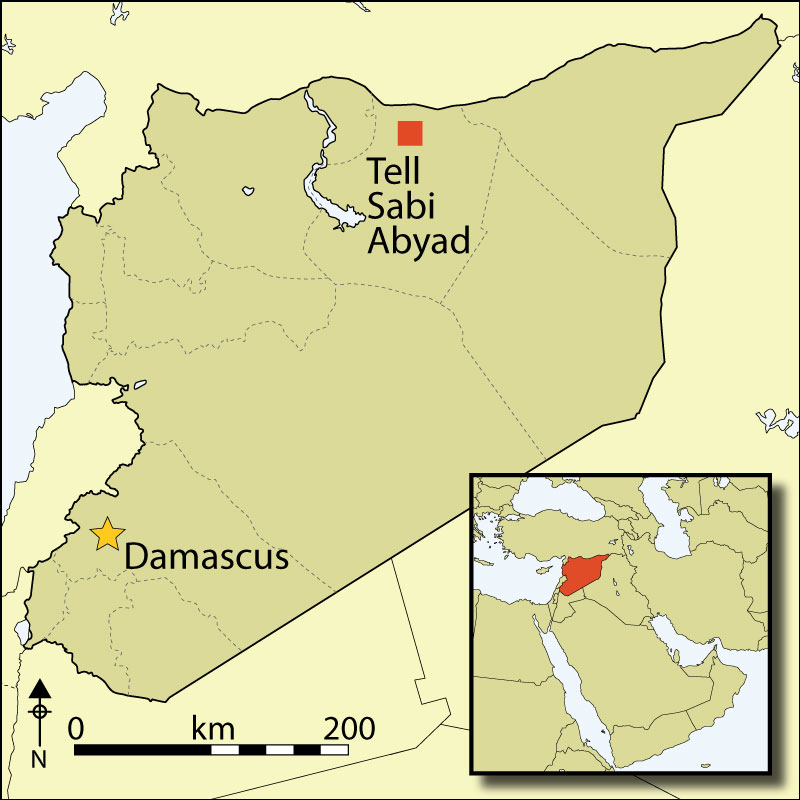
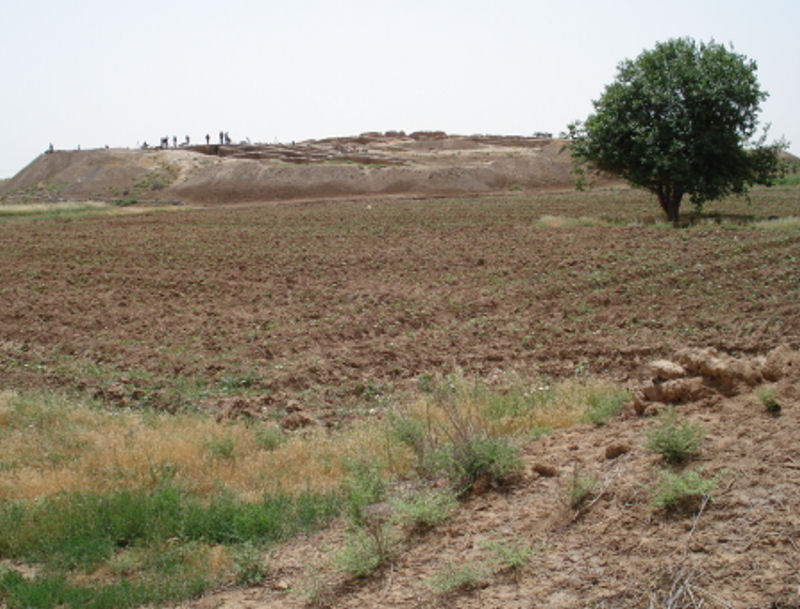
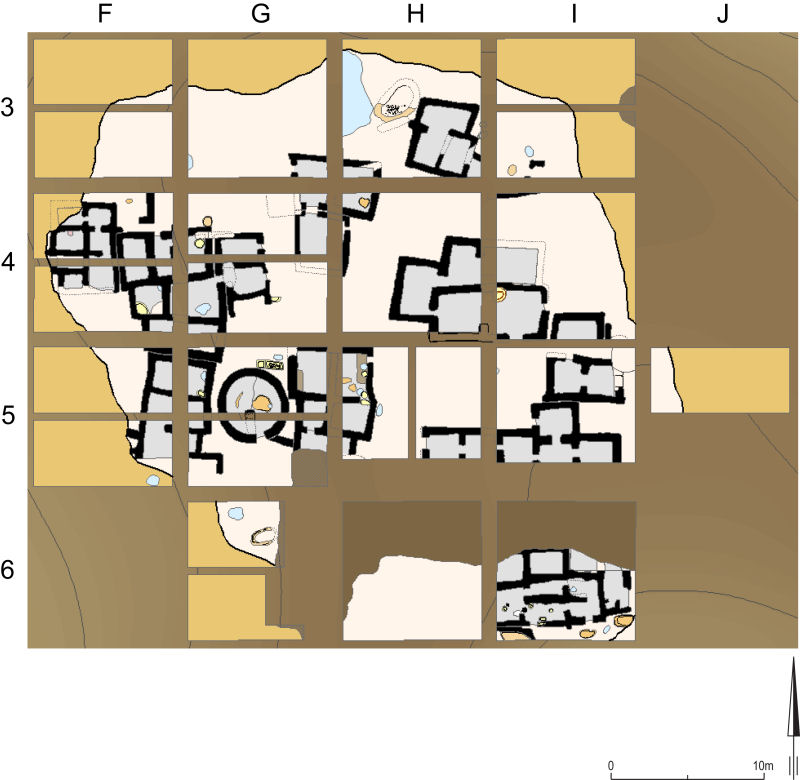
Tell Sabi Abyad (northern Syria), a key-site for the Late Neolithic in Upper Mesopotamia (Figures 1 & 2), was continuously inhabited during the seventh millennium, spanning the 8.2ka event. Many cultural and economic transitions are seen in the archaeological record around 6200 BC. The site as a whole remains occupied, but the village shifts from west to east. The village layout shows new architectural forms (Figure 3). Key changes in animal husbandry occurred, such as the exploitation of sheep and goats for milk and fibre production and the abandonment of pig husbandry in favour of cattle. The number of spindle whorls used for textile production increases substantially. The community transforms from autonomous households to a diversified population of both mobile pastoralists and sedentary agriculturalists. Material culture shows more advanced ceramic storage containers and a new form of cooking ware. There were significant changes in the symbolic role of ceramics too: the start of decoration with abstract, geometric motifs. Other social changes include stamp-seal development in order to control access to goods and denote personal property. There is a technical disinvestment in stone tool production. The circulation of stone axes diminishes markedly (Reference Akkermans, Cappers, Cavallo, Nieuwenhuyse, Ilhamn and OtteAkkermans et al. 2006).
The location of Tell Sabi Abyad in Syria.

The mound seen from the north.

The level A1 village at Tell Sabi Abyad.

Radiocarbon dating and the 8.2ka event
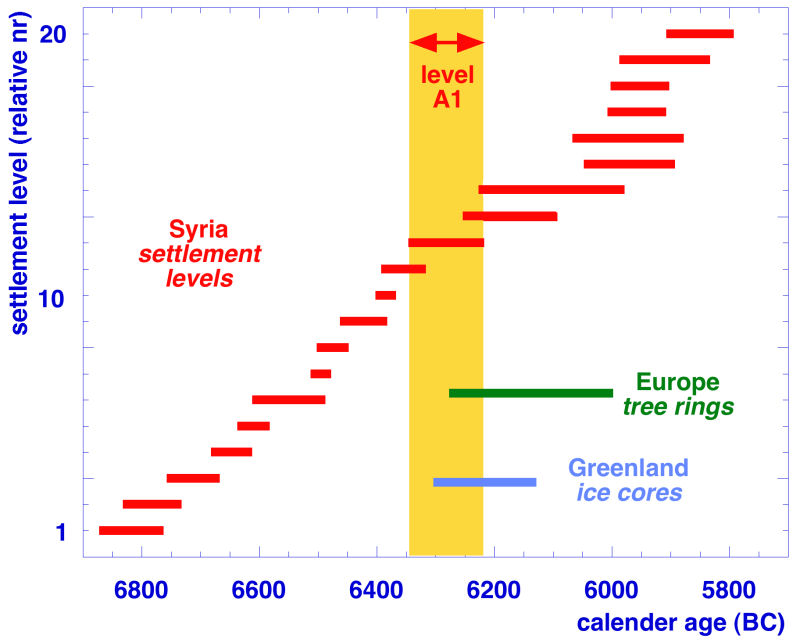
Were these comprehensive changes implemented as a direct result of drought caused by the 8.2ka event? An extensive 14C dating program was undertaken to establish the degree of synchronicity. Statistical analysis of more than 100 dated samples from clear archaeological contexts allows a temporal resolution of 2–3 decades. The resulting absolute date ranges for the occupation levels are shown in Figure 4. The culmination of cultural change peaks in level A1. This is contemporaneous with the 8.2ka event, as observed in the best dated climate records: Greenland ice-cores (Reference Thomas, Wolff, Mulvaney, Steffensen, Johnsen, Arrowsmith, White, Vaighn and PoppThomas et al. 2007) and central European tree-rings (Reference Spurk, Leuschner, Baillie, Briffa and FriedrichSpurk et al. 2002). These provoking results reveal large-scale societal change wholly synchronous with the 8.2ka event during a millennium otherwise characterised by cultural continuity.
High resolution 14C chronology of the archaeological levels from Tell Sabi Ayad, compared with the 8.2ka climate event as observed in Greenland and Europe. All cultural and material changes take place in level A1, contemporaneous with the 8.2ka event.

Evidently, synchronicity does not necessarily imply causality, but we cannot ignore the compelling evidence for substantial cultural change and diversification during climate change in the Late Neolithic. These innovations must have required a strong impetus as they penetrated all realms of life and became manifest within decades. We believe that the 8.2ka climate event was among the forcing factors behind these changes, but in an indirect manner. Our observations counter the 'collapse of cultures' stance with which the archaeological record is currently replete. Ancient societies were able to adapt to variations in weather and climate, as in Upper Mesopotamia, where Late Neolithic villagers coped with drought caused by the 8.2 ka event.
Acknowledgement
This project is funded by the Netherlands Organization for Scientific Research (NWO), dossier 360-62-040.