

5 In search of a national symbol, 1924–1933
Weimar Germany was characterised by an abundance of physical spaces used to commemorate the fallen. By the late 1920s, even small villages usually had a memorial in honour of the soldiers of the Great War. In the cities, a large number of memorials by different sponsors and with a variety of designs and iconographical styles competed for the attention of those who wanted to mourn the dead. Regional variation characterised the rituals around the memorials, depending on the religious composition of the population and the relative strength of the socialist labour movement, to name only the two most important factors. This diversity of styles and rituals makes it hard, if not impossible, to make general statements about the prevalent message of the memorial cult in post-war Germany. What was missing, though, was a central site or unifying symbol that would represent the meaning of death on the battlefields for the German nation as a whole. Many belligerent countries used the notion of an ‘Unknown Soldier’ for precisely this purpose. On Armistice Day in 1920, Britain and France pioneered the burial of an unidentified corpse, at Westminster Abbey and the Arc de Triomphe respectively. These memorial practices were able to rally the nation – amidst political strife and social tensions created by post-war reconstruction – behind a single commemorative symbol.1 In 1921, four other members of the victorious Entente – the USA, Italy, Belgium and Portugal – followed suit and unveiled their own memorials of the Unknown Soldier.2
The power of the symbol of the Unknown Soldier was rooted in the very abstraction it encapsulated. In a quite literal sense, the Unknown Soldier was indeed unknown: it was the unidentified corpse of a person of unknown military rank, regional or social background, and unknown name. As such, it worked like an ‘empty signifier’: it could encapsulate or signify the usually contradictory meanings of dying in the Great War for a nation precisely because it was cleansed from any empirical specificity, apart from the fact that it was the corpse of a soldier. Only as an intrinsically empty signifier could the tomb of the Unknown Soldier be filled and enriched with the diverse imaginations of the nation it was meant to symbolise.3 France and the United Kingdom led the way in employing this powerful symbol, and invented the accompanying annual ritual of the two minutes’ silence during the hour of the armistice on 11 November, as the core of a patriotic cult that could reinvigorate and unify the national polity. Germany, though, was a rare exception from the rule that former belligerent countries used the burial of an Unknown Soldier as the centrepiece of a national memorial cult. This reluctance to embrace the symbol of the inconnu has often been noted, and various explanations have been suggested. German defeat and its specific ‘origins’, at the hands of those very powers who had invented this tradition, has been named as one particular reason why the Republic could not reach a consensus on a specific site at which an Unknown Soldier was to be buried.4
Constructing a Reichsehrenmal
That is certainly true, but should not be overstated, as various defeated countries adopted the ritual: Austria in 1927 and Hungary in 1929, while a monument to the Bulgarian ‘Unknown Soldier’ was unveiled in Sofia in 1928.5 Perhaps more to the point is Reinhart Koselleck’s hint at the ‘federal structure’ of the Reich, which allowed for a limited number of competing regional memorial sites.6 Centrifugal tendencies were deeply embedded in the federal structure of the German polity. Although the republican constitution of Weimar Germany had diminished the institutional strength of regional powers, it had maintained their forum in the form of the Reichsrat, which represented the Länder as a legislature.7 Ultimately, the project of a central national Reichsehrenmal (Reich memorial in honour of the dead) was also delayed and finally ground to a halt amidst the various competing claims and interests of the press, political parties and interest groups.8
While certainly acknowledging the relevance of these explanations, this chapter advances a different argument with regard to the search for a unifying symbol for the commemoration of the fallen in Germany. On the one hand, it will highlight that there was in fact quite substantial German interest in the notion of an ‘Unknown Soldier’ – an interest, though, that never materialised in a memorial built of stone. There were, on the other hand, also intrinsic artistic reasons for the failure of the Reichsehrenmal project, reasons that point to the ubiquity of the chosen core symbol. Only when these two strands of the debate are seen in conjunction is it possible to construct a coherent explanation for the failure to establish one unified national symbol for the fallen German soldiers. The search for such a symbol was the ultimate litmus test as to whether Germany could create its own national style of commemoration like France and the UK – a style that could integrate republicans and their opponents – or whether a contest over symbols and narratives remained the key defining issue. As we will see, the failure of this search was not a foregone conclusion. For once, veterans’ associations from the left and right of the political spectrum could agree on a joint project, and there was wideapread consensus across the country on the style that was to be adopted. However, at the same time the extreme right adopted the notion of the ‘Unknown Soldier’, and thus expropriated a symbol that had initially found strong support by the left.
The starting point for a more concerted effort to find a national memorial was 3 August 1924. On this day, the Reich government conducted an official remembrance ceremony ‘in honour of the victims of the World War’ at the Reichstag in Berlin. Similar ceremonies were conducted in other cities across the Reich. This was in fact the only occasion on which the Republic celebrated the fallen in a unified, nationwide remembrance holiday. There was a strong Reichswehr presence during the ceremony, including speeches by the head and the deputy head of the Protestant and Catholic military chaplaincies respectively. Nevertheless, the ritual also provided ample opportunity to mourn the fallen, not least through the inclusion of two minutes of silence across the country, adopting a central element of the British ritual for Armistice Day.9 On the same day, Reich President Ebert – who had also given a speech in the Reichstag – and Chancellor Wilhelm Marx released a joint statement, which stressed the quest for the ‘freedom and integrity of the fatherland’ as the key ‘legacy’ of the fallen and their sacrifice. On a more civilian note, they also highlighted the plight of the war dependants and the ‘hard destitution’ that the hunger had brought to the home front. Ebert and Marx acknowledged that many memorials for the fallen had been built across the country. But still missing was the ‘Ehrenmal that the German people as a whole owes’ to all those who had died at the front. Finally, they invited voluntary contributions for such a memorial, which, in a ‘simple’ shape, would embody ‘mourning’ for the fallen in the first instance.10
The terminology itself was already indicative of the specific parameters of this project. Throughout the nineteenth century, and particularly since the founding of the nation state in 1871, a whole raft of memorials had been designated to encapsulate the essence of German national identity, ranging from the reconstruction of the medieval cathedral in Cologne to the Völkerschlachtdenkmal near Leipzig, unveiled in 1913, which commemorated the Battle of the Nations against Napoleon in 1813. Following different artistic and iconographical ideas, and offering highly diverse interpretations of who and what constituted Germany, all these projects endeavoured to be the definitive Nationaldenkmal, a memorial that represented the German nation.11 In the wake of the lost war, however, the focus had shifted. Reich government and Reichsrat agreed to pursue the project suggested by Ebert and Marx, and in October 1924, the latter set up a subcommittee for work on a Nationaldenkmal for the fallen of the First World War.12 Yet this term was never used in the ensuing public debates, which instead tapped into the semantics used by Ebert and Marx, who had called the project a Reichsehrenmal. Instead of a Denkmal, which basically intended to commemorate the dead, the Ehrenmal honoured the fallen, and thus implied that they and their deeds had been particularly noble.13
Initially, the response to the appeal was rather mixed. Many press comments were sceptical and questioned whether such a symbolic project was really necessary. Even with regard to the ceremony on 3 August 1924, Vorwärts had noted the refusal of the nationalist combat leagues to support the government, and had asked whether the differing visions of pacifist and militarist circles were at all reconcilable.14 Professional commentators raised similar concerns. Bruno Taut (1880–1938), for instance, was one of the most prolific modernist architects of the Weimar era. Committed pacifist and activist of the revolution in 1918/19, he designed a string of innovative projects throughout the 1920s, most notably two landmark social housing developments in Berlin.15 Writing in 1924, Taut noted the many contradictory opinions and symbolic ideas that had already been voiced. ‘Even if it were possible at least to state the idea more precisely’, he argued, ‘it would remain absolutely insoluble for the artist’ who was meant to implement it. Taut clearly situated the Reichsehrenmal in the tradition of the nineteenth-century Nationaldenkmal when he singled out the Völkerschlachtdenkmal as ‘a monstrous ridiculousness and quixotism of our time’. Every similar ‘attempt to honour the dead through Wucht [overwhelming power]’ would fail in the same way, and would ‘just smash them’. An appropriate commemoration rather had to keep the ‘spirit’ of the fallen alive, as the English had managed with the tomb of the Unknown Soldier and the ritual of two minutes’ silence. But Taut was sure that the Germans would remain sceptical about a ritual that was not of their own making.16
Yet these and other critical arguments did not concern those who inundated the authorities with suggestions for an appropriate site for the Reichsehrenmal and detailed plans for its design. When the subcommittee met with considerable delay for its constitutive meeting on 21 November 1925, no fewer than 64 substantial blueprints had been submitted. By the autumn of 1928, this figure had risen to 300, mostly provided by towns and regional authorities across the Reich.17Charged with the onerous task of collating and evaluating these proposals was the office of the Reichskunstwart, headed by the energetic and outspoken art historian Edwin Redslob. Established in 1920 and responsible for the symbolism and official pageantry of the Republic, the Reichskunstwart reported directly to the Reich Ministry of the Interior. Despite a shortage of financial means and frictions with other administrators at the Reich level, Redslob was a key player in government attempts to shape an appropriate iconography of war remembrance, and had already designed the ritual on 3 August 1924.18
Karl Bröger and the notion of the ‘Unknown Soldier’
While the debate on the national memorial gathered pace, the republican veterans of the Reichsbanner expressed their own ideas on an appropriate symbolism for this project. In July 1924, the Reichsbanner journal reminded its readers that the notion of the ‘Unknown Soldier’ had been invented well before the memorials in Paris, Rome and London were unveiled; a German poet, ‘risen from German labourers’ and closely tied to their battles for recognition, had in fact invented this symbol. This was a reference to a short booklet in the popular series of mass novels published by the Reclam press in Leipzig, printed on low-quality ‘war paper’, which yellowed quickly.19 The book in question was The Unknown Soldier by the worker-poet Karl Bröger, published in 1917. In a series of short vigniettes, Bröger detailed the ‘fate of the common man’ at the front, highlighting how ordinary people from all belligerent countries were in fact the victims of the machinery of total war. But not all hope was lost, as working-class solidarity reached across borders. In one episode, two German soldiers visited one of the survivors of the major pit accident that had happened in Courrières in 1906. At the time, they had rushed to the help of their French comrades with a detachment of other miners from the Ruhr. Now, amidst the catastrophe of war, they wanted to reaffirm the bonds that had then been established.20
This reminder about the German genealogy of the term ‘Unknown Soldier’ was eagerly picked up across the Reichsbanner organisation. Several Gaue urged the executive to consider plans for a memorial for the German Unknown Soldier.21 Yet these deliberations were almost immediately superseded by Ebert’s call for a Reichsehrenmal on 3 August 1924, prompting the republican veterans not to pursue their idea any further. However, as frustration with the slow pace of the official project mounted, the Reichsbanner came back to its original idea. At some point in early 1925, the executive board charged a committee with the explicit task of finding an appropriate design for the memorial. After intensive debates, the committee settled for a garden landscape with the tomb of the Unknown Soldier in its midst, accompanied by a memorial stone.22 On the eleventh anniversary of the beginning of the war, Karl Bröger had an opportunity to explain his choice of title for the booklet he had published in 1917. As he recalled, generals such as Hindenburg and Ludendorff had been celebrated as heroes and examples in so many speeches and publications. Against the backdrop of such hyperbolic nationalist glorification, Bröger was keen to single out the service of those ordinary soldiers who were never known or even mentioned by name. Any resentment against the alien origins of the Unknown Soldier was thus misguided, as ‘the idea belongs to us’.23 Subsequently, Reichsbanner publications never tired of driving home the key message of the ‘army of the nameless’ who made up the republican league: differences of rank should not matter, either in the commemoration of wartime service or in the inexhaustible fight for a democratic polity. Not deference, but altruism was key.24
Yet as in other areas of commemorative activity, the Reichsbanner was not the only veterans’ league that had a stake in the debates on the Reichsehrenmal. Early on the Stahlhelm made clear why it unequivocally rejected the democratic symbol preferred by the Reichsbanner. It conceded that in a ‘formally convincing manner’, the Unknown Soldier was appropriate to epistomise the ‘gigantic struggle of the masses and peoples’, and the fact that it had absorbed and obliterated individuality. But whereas the former enemies sought to find the meaning of violent death in sacrifice for one’s country, a German symbol would already presuppose such meaning. And this meaning was not to be found in any lofty ‘ideals’, but in the stubborn fight for the ‘defence of the country’ against enemy invasion.25 At its core, this was a blunt reiteration of the pre-war notion of German encirclement, which alleged that Germany, situated in the middle of Europe, had to defend itself against enemies in the West and the East who were bent on destroying the newly established nation state. But the Stahlhelm connected this defensive ideology with the artistic idea of a ‘sacred territory’ that should be situated in Thuringia, as it was geographically in the midst of Germany. Thus the Reichsehrenmal should represent, in ‘overwhelming simplicity’, the natural ‘beauty of the Heimat, which the fallen heroes had defended’. To a basically unchanged natural setting, only minimal sculptural elements were to be added, in the form of a sarcophagus with a sculpture of a reclining German soldier.26
This proposal successfully tapped into two cultural constructs that were intimately entwined and firmly embedded in the history of the nineteenth-century nationalist movement. The first construct cultivated the notion of a regionally and locally defined Heimat as the embodiment of everything that was peculiar and worthwhile about the Germans as a nation. It conjured up romantic and very intimate images of specific places and customs. Seen in conjunction, they constituted the wider realm of the nation. Ties to the Heimat – the term is untranslatable; rendering it as ‘homeland’ is grossly misleading – grounded and reinforced nationalist emotions in the concrete setting of a peculiar place.27 The second construct glorified the forest as the key site that epitomised the primordial identity of the German people as a nation. Many nineteenth-century poets, painters and folklore writers had traded in those romantic connotations that turned the deutscher Wald into a powerful symbol of German identity. It was distinctive from the British notion of a ‘landscape’, which clearly showed the effects of centuries of human intervention. But the German forest, while it displayed the primal strength and rugged features of something that was distinctively nature, and not civilisation, was also no complete wilderness.28 In his book Crowds and Power, a wide-ranging study of European nationalist and fascist cultural practices, Elias Canetti has offered a pertinent analysis of the ‘marching forest’ as the key ‘mass symbol’ of the Germans. With its clear vertical lines, thick trunks and geometrical order, the Wald symbolised ‘steadfastness’ and security, and was thus the embodiment of military strength, in many ways almost perceivable as an army of trees.29
Finding a ‘sacred territory’ in the German forest
When the Stahlhelm suggested in July 1925 that a ‘sacred territory’ in the midst of Germany should serve as the national memorial, it referred to an idea that had already emerged during the war. Landscape architect Willy Lange first suggested in 1915 the creation of Ehrenhaine (‘heroes’ groves’) across Germany. At this point, they were primarily meant to provide a substitute for military cemeteries. Lange envisaged planting one tree for each fallen soldier, with a preference for oaks as the established symbol for national strength and endurance.30 Writing to Otto Geßler as acting minister of the interior in December 1925, Stahlhelm leader Franz Seldte expanded on this idea. The German veterans insisted, he claimed, that the memorial should not be built in a ‘big city’. Instead, they wanted to commemorate the fallen in ‘God’s free nature, where their fallen comrades rest’.31 Using this rationale in the debate on the Reichsehrenmal Seldte deliberately tapped into strong anti-urbanist sentiments that were widely held and shared across the political spectrum. Vorwärts justified its rejection of plans to place the memorial in Berlin with the argument that the ‘noisy hustle and bustle of the city of four million people, by far the most Americanised and surely the least primal’ of all towns across the country, would not suit the remembrance. Only amidst the ‘rustle of very old trees’ could an appropriate, ‘more poetic and meaningful’ atmosphere be fostered.32 An architect from Leipzig supported the view that the ‘loud noise and soulless hustle’ of the big city were inappropriate, and that the memorial should be situated in the German forest ‘as the symbol of the essence of Germanness, of German manner and German power’.33 Willy Lange himself, whom Redslob appointed in March 1926 as one of his official artistic advisers on the Reichsehrenmal project, obviously shared the widespread resentment against urbanism. His peculiar version of this dichotomy was presented in utterly racist terms, as he stipulated that a ‘Nordic forest-folk culture’ was threatened by the ‘civilisation of a town-folk miscegenation [Stadtvolk Rassenmischung]’.34
Suggesting the ‘sacred territory’ as the most appropriate solution for the Reichsehrenmal, Stahlhelm leader Franz Seldte could also claim that the other ‘large association of front-line fighters’, the Reichsbanner, supported his plan.35 At this point, in December 1925, the two veterans’ associations had not yet settled for a single site and artistic idea,36 but they both supported the notion of a memorial situated in the open countryside somewhere in Thuringia. This agreement between the two leagues is all the more surprising against the backdrop of their usually acrimonious relationship and the fact that the Reichsbanner presented itself as the democratic alternative to the right-wing combat league. On this occasion, however, the shared commonality of their status as being war veterans apparently outweighed the substantial political disagreement.37 The archival evidence on the background of this cooperation is rather sparse, but according to the Reichsbanner’s own account, the officials of the WeimarKreisdirektion (district administration) were instrumental in facilitating it.
Following initial contacts, they first invited representatives of both leagues to a joint excursion to two alternative sites in the vicinity of Weimar: the Ettersberg, in walking distance from Weimar city centre, and a site near Bad Berka at the intersection of three valleys, which was eighteen kilometres away from Weimar, but connected to national rail traffic via a small-gauge railway.38 Despite the railway link, the Reichsbanner deemed Bad Berka to be less suitable in terms of accessibility. Yet it was ready to leave the ultimate decision to artistic experts, i.e. to Edwin Redslob as the Reich Art Custodian. Then, secondly, the Weimar district officials approached other veterans’ leagues, in particular the Kyffhäuserbund and the Reichsbund jüdischer Frontsoldaten(Reich League of Jewish Front-Line Soldiers; RjF), and were soon able to rally veterans from across the political spectrum in support of the Bad Berka proposal.39 The third and final step was to bring the Reich president on board. Paul von Hindenburg had so far supported the idea to convert the New Guard House (Neue Wache) into a memorial: a classicist building at Unter den Linden in the heart of the capital. But the four veterans’ leagues successfully lobbied him in a meeting on 12 February 1926 to support a ‘Holy Grove’ (Heiliger Hain) at Bad Berka. This was the name and the place of the project on which the veterans had by then agreed.40
The cooperation between the veterans’ associations was, to be sure, never an easy one. Both within the Reichsbanner and the Stahlhelm in particular, reservations about this course of action were voiced. Officially, the Reichsbanner claimed that it had no choice but to collaborate with right-wing organisations on this matter, and that the underlying political differences were not affected. In an apparent attempt to gloss over the difficulty of Reichsbanner support for the Bad Berka project, the journal of the republican league offered its close proximity to Weimar as a ‘higher reason and angle’ to legitimise this option. A memorial for those ‘comrades’ who had fallen for a ‘freer Germany’ could only be situated near the ‘birthplace of the Weimar constitution’. The ‘spirit’ of that constitution, however, had also to be reflected in the design of the memorial, which should be a Mahnmal rather than a Denkmal – a memorial that not only served to commemorate the past, but rather admonished the living to heed the lessons of the past – hammering home the ‘duty’ to work towards a ‘peaceful’ cultural progress of all nations.41 Written on behalf of the Reichsbanner executive, this statement made it clear that the functionaries in Magdeburg were keen not to repeat the mistake many Social Democrats had made in previous years, when they watched from the sidelines while municipal memorials were planned.
Limits of cooperation between Stahlhelm and Reichsbanner
Yet for many rank-and-file members of the republican league, even this limited cooperation with the political right was apparently not easy to stomach. Some of the reasons for this discontent are illuminated in a letter by Paul Toller – a relative of the playwright Ernst Toller – to Paul Levi, member of parliament and a leading representative of the left wing of the Social Democratic Party (SPD). In April 1926, Toller informed Levi about his daily encounters with ‘comrades’ from all social strata, which had clearly revealed the extent of the ‘gulf that exists between leadership and the masses’. A Reichsbanner activist himself, Toller seriously doubted whether it was shrewd political manoeuvering when Otto Hörsing joined the right-wing leagues in their recent meeting with Hindenburg on the Reichsehrenmal issue. Such public posturing was all the more detrimental to rank-and-file members’ morale at a time when the Reichsbanner leadership demanded neutrality with regard to the ongoing debate on the expropriation of the former ruling houses.42 This vexed issue of the expropriation of the former ruling houses, or Fürstenenteignung, which dominated German domestic politics in 1926, had already stretched the patience of Reichsbanner members to the limit.
Throughout the 1920s, former ruling houses had claimed the restitution of property that they had allegedly lost during the revolution. In an attempt to settle these claims once and for all, and to tap into the widespread anti-monarchist sentiment, the German Communist Party (KPD) had called for a referendum on this matter, which the SPD immediately supported, though both parties campaigned separately. A petition in favour of a referendum on expropriation without compensation – quite literally the seizing of assets – in March 1926 gathered 12.5 million votes, 2 million more than the combined vote for the SPD and KPD in the 1924 Reichstag elections. The actual referendum on 20 June 1926 drew even further support far beyond the socialist camp, with 14.5 million votes in favour.43 This referendum on the Fürstenenteignung was the climax of pro-republican mobilisation in Weimar Germany, and its significance should not be overlooked. Thus, it was all the more problematic that the very organisation that had vowed to defend the Republic tied its hands in this matter. The Reichsbanner leadership decided not to campaign for the referendum in accordance with the principle of non-partisanship, as the German Democratic Party (DDP) and the Centre Party did not support it. However, it could not prevent many local branches from openly campaigning in favour of the referendum, not only in Saxony, where neutrality would have finished off any Social Democratic credibility among the many leftist socialist workers, but for instance also in more moderate Schleswig-Holstein.44 In Munich, a speaker in a local Kameradschaft demanded that members should come out in droves for a demonstration ahead of the referendum. Anticipating criticism about the fact that the Reichsbanner had nothing to offer but ‘duty, duty’, he reminded his audience about the war years, when they had had to fulfil their duty for a ‘camarilla of monarchistic and big capitalist’ interests.45
But such populist slogans could surely not close the gap between Reichsbanner leaders and rank-and-file members that had opened up in 1926. Many branches and some Gaue remained highly critical of the project. By and large, they voiced the same reservations that had, for instance, motivated Social Democrats in Württemberg to boycott the state ceremony on 3 August 1924 in Stuttgart altogether. On that occasion, local Social Democrats had highlighted the plight of the workers during the war, and of the war disabled in the present. They doubted the motives of those who talked of ‘national freedom’ during such ceremonies.46 And they openly criticised the state president of Württemberg and member of the German National People’s Party (DNVP) Wilhelm Bazille, who had identified ‘discord’ among the Germans as one major reason for defeat in 1918 in his official speech on 3 August 1924. Social Democrat newspapers juxtaposed this statement with the situation in the Etappe during the war.47 Reinvigorating the notion of Social Democracy as an ‘alternative culture’, the Reichsbund in Stuttgart instead celebrated a summer fair under the motto ‘No more war!’ on 3 August 1924, with local Reichsbanner leader Dr Kurt Schumacher as the main speaker.48 Reichsbanner officials had worked hard to overcome Social Democrat reluctance to engage with the commemoration of the fallen. But when discontent within the organisation about the alliance behind the ‘Holy Grove’ mounted, some regional branches fell back into their previous critical habits.49
Yet internal criticism of the collaboration between the veterans’ leagues was not confined to the Reichsbanner alone. Simmering tensions also came to the fore in the Stahlhelm. Franz Seldte, the founder and head of the association, was ready to strike a rather conciliatory tone in his relations with the Reichsbanner if necessary. He was also on speaking terms with its leader, Otto Hörsing. The second Stahlhelm leader, however – Theodor Duesterberg, who had advanced quickly to the top of an organisation he had only joined in 1923 – took a rather hard-line stance, not only on this occasion. In July 1927, the Stahlhelm Gau in Thuringia forwarded a lengthy rant by a certain First Lieutenant Corsep from Erfurt. Corsep had, as he explained in his letter, voiced his resentment against any cooperation with the Reichsbanner and even more the RjF from the start. In explicitly anti-Semitic language, he railed against the alleged influence of ‘Jewish’ money on the design of this project; against Jewish ‘hegemony’ in national art more generally; and also against the ‘superfluous post’ of the Reich Art Custodian, a mere ‘product of the revolution’. He was, however, not only driven by political antipathy towards the Republic and its supporters; Corsep had also strong misgivings about the chosen symbolism of a ‘death memorial’ in Bad Berka. Such a design struck him as wrong, as not the ‘dead’, but the heroic ‘deeds’ of all German soldiers – dead and alive – should be commemorated. He believed the Stahlhelm should dare to build its own project, not in a ‘remote forest-valley’, but as a ‘stone colossus’ right in the middle of Magdeburg, where it had been founded.50 This is a clear indication that a memorial in the Wald, however closely that symbol was associated with the German nation, was deemed to be too inward-looking and contemplative by radical nationalists. Upon receiving Corsep’s rant, Theodor Duesterberg noted that he had rejected any collaboration with the Reichsbanner and RjF all along, and decided that support for the project should be ‘temporarily suspended’.51
The internal discontent in both major veterans’ leagues contributed to the fact that the implementation of Bad Berka lost momentum in the late 1920s. In 1925, however, the strong initial support of four veterans’ leagues for Bad Berka had secured a majority for that project in the first place, particularly when it was backed up by the highest state representative. Even Edwin Redslob changed tack almost immediately under the impression of the agreement reached between the leagues and Hindenburg. In June 1925, he had publicly come out in support of an idea to put the ‘Unknown Soldier’ centre stage: Redslob suggested building a bridge over the Rhine. In the middle, passers-by would be able to see the memorial to the Unknown Soldier, who would be buried in the river, hidden behind latticework. As Redslob explained, the grave of the Unknown Soldier would turn the bridge ‘into the symbol of a time that wanted to overcome revenge and hatred through the power of the heart’.52 Redslob’s proposal, to be sure, tapped into the traditional mythology of the Rhine as a site of German identity. But his main inspiration had been a visit to Paris, where he had seen the burial site of the inconnu under the Arc de Triomphe, and the play Heinrich of Andernach by pacifist and Reichsbanner activist Fritz von Unruh.53 In this play, the winegrower Heinrich is converted to the cause of reconciliation between France and Germany by an encounter with the Unknown Soldier, who has risen from his grave.54 The Reich Art Custodian’s idea received mostly welcome praise in newspaper articles and personal letters – not least by Fritz von Unruh himself, who saw an opportunity to promote his own work.55
But only a couple of months later, Redslob dropped his plan altogether. In a memorandum to the Reich Minister of the Interior, who was in charge of the whole process, Redslob supported the notion of the ‘Holy Grove’, referring to the ‘united front-line fighters’ expression of their will’ as his main reason for doing so.56 Shortly afterwards, the subcommittee of the Reichsrat, which tried to reconcile the interests of the Länder, followed suit. In January 1926, only the representatives for Bavaria and Thuringia had voted in favour of Bad Berka. By March 1926, only Prussia and Saxony were left as supporters of a memorial at the Neue Wache in Berlin, and Bad Berka had a clear majority among the Reichsrat.57 Nonetheless, that still did not mean a swift decision in favour of Bad Berka. In the spring of 1926, two professors of the Art Academy in Düsseldorf submitted the design for a Toteninsel, or ‘Island of the Dead’, in the Rhine close to the town of Lorch. Connected by a footbridge made of stone, the first of two islands should serve as a gathering space, whereas the second should contain the memorial proper, a simple sarcophagus. The idea appealed to many politicians – including chancellors Hans Luther and Wilhelm Marx, who governed in 1926/7 – and members of the public, as the war had in their view been fought to protect the Rhine as a German river. Once the governor of the Prussian Rhineland province and other dignitaries from the region jumped on board, the campaign for Lorch gathered considerable momentum, and was able to rally the regional Gaue of both Stahlhelm and Reichsbanner to its cause.58
Ultimately, the campaign for a national memorial on the Rhine came to nothing. But it was strong enough to cause considerable delay a final decision, at a time when support for Bad Berka within the veterans’ leagues was disputed, and when even the officials in charge had not finally agreed on procedural matters – for instance, whether the Reichsrat would also be part of the decision-making, or only the Reich government. Even in August 1926, the envoy of the state of Württemberg in Berlin anticipated that it could still ‘take a long time’ before a decision was made.59 Four consecutive Reich Ministers of the Interior dealt with the issue, from Wilhelm Külz (DDP) to Joseph Wirth (Centre Party), before the Reich government finally decided in favour of Bad Berka in March 1931. By this time, however, two other projects had already sidelined the Reichsehrenmal. On 18 October 1927, the Tannenberg Memorial, a vast circular structure reminiscent of a medieval castle, with eight massive towers and a metal cross in its centre, was unveiled in East Prussia. Supported and erected by the private initiative of right-wing circles, it tapped into the myth of the medieval Teutonic Order. Its focus on German domination in the East was also connected with the glory of the victory in a 1914 battle against the Russians somewhere near this site, and with the myth of Hindenburg in particular, who was present at the unveiling ceremony.60
The Neue Wache in Berlin
Two years later, another sideline unfolded in Berlin. Partly frustrated by the slow progress of the decision-making process, and eager to demonstrate that Prussia could act quickly, the Social Democrat Prussian prime minister Otto Braun asked his officials in June 1929 to assess the option of converting the Neue Wache into a Prussian memorial for the fallen. This idea, to be sure, had already been floated during the meandering discussions on the Reichsehrenmal, and was thus nothing that required lengthy deliberation. Five months later, in November, the Prussian cabinet decided accordingly. After an artistic competition, the prize-winning design by architect Heinrich Tessenow was implemented. In minimalist fashion, it reduced the commemoration of the fallen to its abstract core, placing a simple granite cube in the centre of the room, illuminated by daylight flooding in from the ceiling. Only an oak wreath on top of the cube symbolised the link to the German nation, and a stone tablet with the inscription ‘1914–1918’ made the reference to the war explicit.61 Tessenow’s design was a masterpiece of commemorative symbolism in Weimar Germany, and of twentieth-century modernist architecture more generally. Stripping the memorial of any political or monumentalist connotations, it forced the observer to focus on his or her grief and on the meaning of violent death alone. What has been said about the Cenotaph by Edwin Lutyens in London applied even more to Tessenow’s design in Berlin: it was a ‘work of genius largely because of its simplicity’.62
Yet in political terms, this was a missed opportunity. As Otto Braun stressed during the unveiling ceremony on 2 June 1931, the memorial was a deliberate attempt to demonstrate that a democratic Prussia, governed by Social Democrats, could work in altruistic service for the people and the nation. And he highlighted the symbolic fact that the fallen were commemorated at a place where the Prussian army used to house its guard. In his memoirs, Braun recalled that this war memorial for him also served as a symbolic tomb of the ‘militaristic’ traditions of the Prussian monarchy.63 Braun was also personally concerned, as his son had died in the war, and he expressed his own grief. Nonetheless, many former Prussian generals refused to attend the ceremony, and the National Socialist press mocked the apparent inability of the Social Democrat Braun to reach out to nationalist circles. Even worse, though, he perceived the indifference of his own party, which did not send any official delegates, while Vorwärts covered the event only in a short notice on the back pages.64
These parallel developments were a major reason why the preparations for Bad Berka lost momentum, and why the memorial was never built even though the actual design competition began once the cabinet had finally approved of this site in 1931.65 They were, however, not the only reasons why it was effectively impossible to implement a national memorial, at least when it was meant to commemorate the fallen in the context of the deutscher Wald. It should be clear by now that artistic, political, practical and symbolic considerations were deeply entwined in the protracted and wide-ranging search for an appropriate Reichsehrenmal. Arguments about the preferred symbolism of the memorial and its appropriate implementation were surely only one strand of the debate. Yet a closer look at the arguments in favour of a Heiliger Hain in the forest reveals the inherent problems and contradictions of this particular symbolic idea.
We have already highlighted anti-urbanist sentiment as one major reason why both active participants and observers of the debate on the Reichsehrenmal favoured a memorial in the German forest. According to one of the many architects who supplied Edwin Redslob with expert opinions on the preferred form and place of the Reichsehrenmal, the Wald was basically an ideal setting for a memorial site as it would allow visitors to gather in ‘silent commemoration’ and would also facilitate ‘spiritual exchange’. The physical qualities of an environment dominated by huge trunks stood in direct correlation to the rituals of remembrance that were to take place in the shadow of the trees. Thus, the ‘roaring of German male choirs’ would subtly ‘blend with the forest rustle of German oaks, and with the oath of allegiance and the solemn pledge for a strengthening of our people’.66 Nature, in other words, nurtured and underscored the preferred mode of remembrance, which centred on the spiritual renewal of the nation after the catastrophe of war. Such a rendering of the Wald as Reichsehrenmal stressed the holiness of the site and by implication the religious qualities of remembrance it would foster. Not by chance, the memorial forest was often metaphorically described as a ‘dome of nature’. And in the ‘Most Holy’ space of this dome, the ‘grave of the unknown dead’ could be situated, shaped by an artist, but embedded in an arrangement that relished the power of nature.67
The forest as a site of contemplation
Again combining practical and symbolic considerations, many commentators pointed to the fact that a memorial in the forest would not require extensive building work and was thus cost-effective. This would save funds that could be much better used for practical help to the war disabled and dependants. Such demonstrative restraint was all the more advisable as there was a broad agreement on the need to mark a fundamental break with the nineteenth-century tradition of erecting Siegesmale, or ‘victory memorials’, such as the Völkerschlachtdenkmal in Leipzig. Strictly focused on the remembrance of the fallen, a modest Totengedenkmal was envisaged.68 In a remote place, far away from the hustle and bustle of the big cities, the ‘Holy Grove’ would allow for silent contemplation and would thus be a site of ‘serious self-examination [Einkehr]’, which was all the more needed as it was a constant reminder of the ‘seriousness of the world-historical catastrophe’ of the past First World War.69 The list of arguments in favour of a Holy Grove did not stop here. Placing the national memorial in the midst of a German forest would not only foster the general mood of contemplation that was a key prerequisite of any meaningful commemoration; in addition, it would provide a rallying point in a time of bitter conflicts and general divisiveness. ‘Nature was’, after all, ‘neutral, above party and confessional strife’.70 The key to achieving this aim was the active participation such a memorial required. This was at least the opinion of architect Otto Bartning (1883–1959), who was affiliated with Bauhaus ideas and headed a school of architecture in Weimar once Bauhaus moved to Dessau in 1925. Himself an experienced designer of many Protestant churches in Austria and Germany, Bartning was convinced that any sculptural design was bound to fail, and that the memorial had to be situated in a wood. It had to be literally erwandert: requiring every visitor to walk through the forest in order to reach the actual memorial site: ‘Everyone who is used to hiking through nature or has done so in the past knows that precisely through this very practice, step by step, the quarrelling of the present, whether it is based in politics or in aesthetics, ceases to exist, as does the inner conflict of the self.’71 The veterans’ associations insisted that designating a space in the forest as a memorial for the fallen would reveal the essence of the German nation. As ‘Germany’s heart is beating in its forests’, it would be only appropriate ‘to entrust the remembrance of the dead of the Great War to this heart’.72 Expert opinions seconded this view and tapped into romanticist notions of the inward looking nature of German culture. A ‘monumentalist construction’ such as the Völkerschlachtdenkmal, one expert opined in 1925, would work well as a ‘site for festivities’. But it would not be able to ‘strike the deepest chords in the popular soul’, the Volksseele of the Germans, as the Holy Grove in a forest would do.73 The forest at Bad Berka was, to be sure, no Forst or cultivated woodland that had taken shape in order to maximise the number of logs that could be extracted. As the fallen had given what was ‘most holy’ to them – their lives – a space in the deutscher Wald was the ‘most holy’ the contemporaries could give in return to remember their deeds.74
There was, as these few examples from a large number of aide-memoires and opinion pieces confirm, widespread agreement that – in artistic terms – the Reichsehrenmal had to mark a decisive break with the monumentalist ambitions of Wilhelmine memorial art and what was often deemed to be its worst excess, the Völkerschlachtdenkmal. In the wake of military defeat, a more modest and humble approach seemed to be sensible. Most stakeholders in the process of establishing a Reichsehrenmal also agreed that architecture and sculptural art were simply not sufficient as a means to express the sheer magnitude of victims that the war had entailed. Even the sculptor and architect Hermann Hosaeus supported this line of reasoning, although he himself designed about forty local war memorials during the Weimar years and had had tremendous impact on many other projects through his work on the Kyffhäuserbund’s advisory board on memorial art.75 Hosaeus was also in line with many other commentators when he suggested that a grove of honour was by far the best option for the Reichsehrenmal. Revising his earlier criticism of the notion of an Ehrenhain, which he had voiced during the war, he described it as a truly ‘romantic idea’, and insisted that the natural setting, an appropriate area of forest, should be subjected to only an absolute minimum of man-made interference.76
The notion of a Holy Grove had a number of other advantages that explain its popularity in the wide-ranging debates on a national memorial for the fallen. It did not express, as with the nineteenth-century Nationaldenkmäler, any specific conception of the German nation as a polity, be it a participatory, national democratic idea or the notion of ‘national collection’ in a people’s community, which the Völkerschlachtdenkmal had encapsulated.77 Thus, the Holy Grove did not suggest a statement against or in favour of the Republic, and was therefore agreeable across the political camps. In addition, the Heiliger Hain did not necessarily imply any specific reference to the military events of the past war, nor did it invoke any particular higher meaning of the sacrifice of the fallen, other than that it had indeed been a sacrifice. Positively speaking, a national memorial in the natural setting of the forest aimed to offer a space for a ‘silent commemoration’ of the fallen, as Edwin Redslob pointed out in May 1926 in a survey of the existing proposals. As such, it would foster a sense of the sheer ‘scale of the suffering’ during the war, and of the ‘immortality’ (Unvergänglichkeit) of the German people.78 Remembering the fallen was thus contextualised in the inner spirituality of the people, conceived of as a community of the living and the dead. At a time when many medievalist and a few modernist designs for war memorials offered competing interpretations of the most recent past, the Heiliger Hain took a distinctively different approach: the specific trajectory of German history since 1914 was transferred into the indeterminate state of a natural setting. Nature, in other words, replaced history.79 This focus on the Unvergänglichkeit of the German people was reinforced by a preference for the evergreen trees of a coniferous wood. Eschewing oak as the traditional symbol of German strength, most designs suggested the Holy Grove should consist of common spruce.80 Set in a natural environment, the Holy Grove was sometimes also called the ‘living Ehrenmal’.81
Yet in spite of these many qualities of the conceptual core idea, there was one major pitfall to designating a space in the Wald as the Reichsehrenmal: the sheer abundance of possible sites. While the forest was acknowledged as the very embodiment of the mythological qualities of the German nation, it had no specific place in the wider realm of the Reich. The inherent problem of the forest as a symbol was, in other words, its ubiquitous nature. Proponents of almost every coherent and well-matured stretch of forest could claim that ‘theirs’ was the most appropriate for the designated purpose. Hermann Kube and Karl Heicke were two of the experts involved in the assessment of suitable sites, and had – the former as municipal garden director in Hanover, the latter as managing director of the Deutsche Gesellschaft für Gartenkunst – intensive experience with landscaping issues. They expressed the dilemma in these words: ‘Given the richness of our country in beautiful woods, which are our pride, it will not at all be difficult to find an appropriate site; rather, problems will emerge in choosing among the many places which might be suitable for this purpose.’82 At this point, the two experts believed that, solely for practical reasons, Bad Berka was an ‘ideal’ site as it was situated in the midst of Germany and would thus facilitate access.83 But only six months later, Hermann Kube had at least partly changed his mind. He inspected a site near Eisenach, which was deeply anchored in German national mythology owing to its proximity to the Wartburg, at which Martin Luther had sought refuge in 1521/2 during the early stages of his struggle for the Reformation. Kube had left with a very ‘strong impression’, and immediately reconsidered his position vis-à-vis the other proposals.84 Summing up his inspection of eight forest sites altogether in the north of Germany, including Höxter in Westphalia and Goslar in the Harz mountain range, Kube expressed the inherent problem of any assessment. Faced with an ‘abundance of magnificent landscape impressions’ it was impossible to arrive at any ‘precise statement’ that avoided subjective bias. Any decision had to be based on the qualities of what was often called the ‘most sacred’ (Allerheiligste) ideal of the memorial site, preferably an ‘absolutely reclusive’ space in an appropriate woodland setting that alone fostered a ‘serious, solemn mood’.85
Edwin Redslob, who had spent several months travelling across Germany, liaising with mayors and county representatives who all eagerly championed their local forest, shared the sense of exhaustion and frustration among the experts who were trying to identify the most suitable site.86 Returning from an extended trip to Hesse, Saxony and Thuringia, he distinguished no less than six different potential forms that a Holy Grove in the woodland might take, including hilltops, the grove as an island, wide stretches of forest and those situated in a valley. Bad Berka belonged to the latter category, which was in his view able to draw every participant into a commemorative mood during the approach to the site. But it was disadvantageous that this design looked more like an amphitheatrical stage than an actual closed woodland.87 In the end, Redslob’s ‘key criterion’ for an overall assessment was that the preferential site have a ‘connection to the whole of Germany’, both in an ‘idealistic’ sense and with regard to geographical location and accessibility in terms of transport. But even when applying these strict criteria, Redslob was still able to endorse five sites, including woodland near Weimar, Eisenach, Coburg, Reinhardsbrunn and Augustusburg.88
Addressing the same dilemma, another expert suggested opting for Bad Berka, on the grounds that this site would complete the network of national memorials that had already been erected in the centre of Germany. Bad Berka, the argument went, was close to the Kyffhäuser and its memorial for the medieval imperial glory of Emperor Frederick Barbarossa. It also had to be seen in conjunction with the memorial for Hermann the Cheruscan, who had, according to legend, defeated the Romans in the Teutoburg Forest in 9 CE, and with the Niederwald memorial near the Rhine, which commemorated the founding of the Second Empire after the military victory against France in 1871. With the other three memorials, Bad Berka would constitute a ‘rhythmic intersection of four’ commemorative sites. Thus, it would be a symbol for the ‘unity’ and cohesiveness of the German manner.89 The dialectical nature of this kind of reasoning seems a bit far-fetched, and illuminates the tremendous problems contemporary supporters of the Bad Berka site had, even though its core symbol, the forest, undisputedly embodied ‘Germanness’. Speaking in 1925 for the four main veterans’ associations, Franz Seldte had established another, more straightforward reason why the site should be located in the ‘heart’ of Germany; using traditional terminology, he argued that ‘all German tribes [Stämme]’ had equally sacrificed their sons on the battlefield.90
As we know with hindsight, such arguments were not able to accelerate the search for a Reichsehrenmal. In the late 1920s, the years during which the whole process stalled, different responses to the stalemate emerged. In 1928, the journal of the Stahlhelm reported furiously a sketch on the ‘memorial of the Unknown Soldier’ that was performed in one of the many cabaret bars in the west of Berlin. On stage, three figures like ‘caricatures’, representing a mayor, a big industrialist and a military doctor, were about to unveil the statue of a soldier on a plinth. Suddenly, the soldier came to life, moaning and groaning. He started to hurl expletives against the three figures who symbolised the injustice of war, and accused them of war profiteering and hypocrisy. The journal of the nationalist combat league was clearly agitated by this performance, particularly in a city that had allegedly done nothing to honour the fallen, while it was busy renaming streets in a break with the imperial era, just stopping short of unveiling a ‘Barmat Street’ and a ‘Kutisker Place’.91 For the Stahlhelm, such sleaziness and disrespect for the fallen stood in stark contrast to the tomb of the inconnu in Paris. Here, the ‘Comité de la Flamme’, founded in 1924 to service the eternal flame under the Arc de Triomphe, even voiced the demand that every passer-by should bow his head in reverence to the Unknown Soldier.92
The Reichsbanner and its ‘Ehrenmal of the Republic’
Figure 8 Temporary memorial by the Reichsbanner for the celebration of Constitution Day in Berlin near the Brandenburg Gate, 11 August 1929.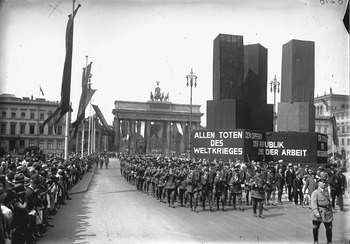
Yet supporters of the Republic were also disappointed by the lack of progress in the search for a national memorial and decided to take things in their own hands, at least temporarily. On 11 August 1929, the Reichsbanner was the key player in the central celebration of the tenth anniversary of the constitution on the streets of Berlin. To be sure, public rallies and other festivities took place in every major city in the country. But it was in the capital where the largest number of Reichsbanner activists took to the streets in a whole weekend of celebrations, which also included ordinary citizens and schools. The city was decked out in black–red–gold, and a heightened police presence ensured that brawls and open attacks on the republican symbols were kept to an absolute minimum.93 Social Democrat newspapers hailed the occasion as a ‘turning point in the history of Germany’,94 or as the ‘great day of the Republic’. For hours, Reichsbanner detachments marched from the Lustgarten to the Brandenburg Gate, symbolising that ‘the advance of the republican mindset is unstoppable’ and truly ‘inexhaustible like a flood’.95 As the centrepiece of this performative display of republican values, they passed by a temporary or ‘ephemeral’ memorial: a fleeting commemorative structure that was not made to last but rather to perish, not a monument, but a moment of remembrance.96
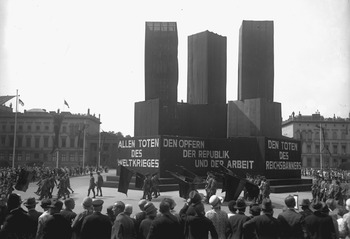
Figure 9 ‘Ehrenmal der Republik’ (‘Monument of the Republic’) in Berlin, 11 August 1929.
Designed by the sculptor Theodor Caspar Pilartz on behalf of the Reichsbanner, it was a wooden construction, the base covered in black–red–gold cloth, with three black pillars rising up seventeen metres. Three separate inscriptions drove home the key point: that the deaths of the fallen soldiers and the incessant struggle of the Reichsbanner activists for the Republic were intimately entwined. The first, ‘Allen Toten des Weltkrieges’ (‘To all the dead of the World War’), again highlighted the genuinely inclusive nature of republican war commemorations. The second, ‘Den Opfern der Republik und der Arbeit’, was ambivalent.97 It could be read as honouring the sacrifice of those who worked for the Republic. But in conjunction with the third, ‘Den Toten des Reichbanners’ (‘To the dead of the Reichsbanner’), and given the double meaning of Opfer in German parlance, which can mean both sacrifice and victim, it could also imply that working-class people had been turned into the victims of those who attacked the democratic system and of the industrial labour process. As the commentator for the Berliner Tageblatt stressed, the ‘daring, simple memorial’ admonished all participants to mourn those who had lost their lives in the ‘lunacy’ of war.98 The abstract, modernist design of the three black pillars with their constructivist shape was indeed striking, but its meaning remained contested. One SPD newspaper described it as a Trauerkatafalk – a ‘catafalque of mourning’.99 An illustrated journal was perhaps closer to the point when it referred to the memorial as the ‘Ehrenmal of the Republic’, thus clearly associating it with the ongoing search for the Reichsehrenmal.100
The protracted search for a national memorial for the fallen reached no conclusion during the Weimar years, because regional interests and the right-wing initiative of the Tannenberg Memorial fragmented and thus delayed the decision-making process. Even the project of a Holy Grove in the heart of Germany came to nothing, after long delays in a design competition for Bad Berka, which was not completed until January 1933. While all of the main veterans’ associations had supported the site since early 1926, the underlying idea itself remained inconclusive. When a stretch of forest could encapsulate the core qualities of the German nation, and allow for a reflection on the loss and sacrifice of the fallen, why take precisely this site, and not any other in the middle of Germany? Recourse to the immensity and immeasurability of the German people, which was founded and replenished through the forces of nature, was one possible strategy to signify the unity of the nation. But it was not the only one. Employing the ‘Unknown Soldier’ as an empty signifier was another. It had, as we have already seen, some proponents in the discourse on the Reichsehrenmal, including the prominent Reichsbanner members Karl Bröger and Fritz von Unruh.
Indeed, the Reich Art Custodian Edwin Redslob insisted that, far from being an alien invention that could never be adapted, the notion of an ‘Unknown Soldier’ was in fact deeply embedded in German cultural history. In 1925, he had himself promoted the idea of burying the Unknown Soldier in the midst of the river Rhine. The united front of the veterans’ associations had soon forced him to drop this plan and to act as a liaison for the competing projects for a Holy Grove. But as an art historian and expert on German cultural history, Redslob continued to be committed to this idea in private, and summarised some of his findings in a memorandum written in 1931. According to his research, the formulation of ‘An unknown soldier’ had already been used on the graves of soldiers from the Napoleonic wars. Furthermore, a tombstone in the Berlin cemetery of the ‘March fallen’ for someone who had died in the barricade fights during the March revolution in 1848 was adorned with the words ‘An unknown man’. Other examples included a resting place dedicated to ‘the remains of the unknown’, which Prince Hermann von Pückler-Muskau included in 1832 in the now world-famous English landscape park he designed in the meadowlands of the river Neisse near Cottbus. Burial crosses in some German towns during the Great War bore the inscription ‘Unknown soldier’. Finally, Redslob was well aware of the fact that Karl Bröger had perhaps not coined but popularised the term with his book from 1917.101
The Unknown Soldier as a nationalist symbol
As these examples demonstrate, Redslob was not interested so much in the aspects of this concept specific to the First World War, particularly the fact that many corpses in no man’s land had literally not been identified, and that the ‘Unknown’ had to be selected from a number of unidentified corpses. For Redslob, the use of the ‘Unknown Soldier’ was basically a fascinating way of avoiding the determination and thus limitation implied in every act of signification. In this perspective, the romantic notion of ineffability allowed an avoidance of the pitfalls of naming, which limited commemoration to one individual, or a multitude of them, without ever addressing the collective as a whole.102 And this was precisely the reason why some right-wing authors adopted the notion of a nameless, ‘unknown’ soldier. One of them was Theodor Reismann-Grone, the publisher of the Rheinisch-Westfälische Zeitung, which acted as a mouthpiece for the interests of Rhenish heavy industry, who was himself a rabid anti-Semite and proponent of völkisch nationalism.103 Using a pseudonym, Reismann-Grone published a booklet in 1921 that the title dedicated ‘To the Unknown Fallen Warrior’. A series of short poetic narratives, it contained some common tropes of radical nationalist war commemoration: the racist outcry about the use of non-white colonial soldiers by the Entente powers; the returning Stormtroop fighters who voiced their disgust about the moral decay at the home front; the idea that the inexhaustible forces of the German people would allow them to wage another fight for the glory of the Reich. The dedication of the text spoke on behalf of the ‘truly poorest of all poor’, in a clear allusion to the famous formulation in Karl Bröger’s wartime poem ‘Bekenntnis’. Yet this ‘mute hero’ had been silenced by the ‘new rulers’ of the Republic and, even worse, the enemies stole the ‘ultimate glory’ of being a nameless hero when they started to honour their own ‘unknown heroism’.104
In Reismann-Grone’svölkisch vision, the Unknown Soldier served as an indictment against the predominance of egoistic interests in the post-war period, which obliterated the altruistic sacrifice of the front-line soldiers and thus made national unity impossible. Other right-wing authors offered a similar reading of the Unknown Soldier as a cipher for the readiness to eradicate one’s own subjectivity in the service of the nation.105 An ‘unknown war volunteer’ who wrote to Redslob in 1925 wanted to adopt this principle for the Reichsehrenmal. All the artists and artisans who were involved in the building of the memorial, it was argued, should remain anonymous, because their names would contaminate the remembrance with their egoism. Ultimately, the memorial should serve only one aim: to commemorate the tremendous effort that ‘the nameless’, i.e. the ‘German people themselves’ had made at the battle and home fronts. Thus, it should be dedicated to ‘the nameless of 1914’.106 The Unknown Soldier was not necessarily always a ‘victor type’, as he was indeed in France, the UK and the USA.107 In its German right-wing permutation, the strength of this symbol rested precisely on the fact that the unknown, nameless soldier was distraught by defeat and the anomic tendencies of post-war society, but could rise from obscurity and humble origins to redeem the nation and to rescue it from domestic strife.
No one encapsulated this rendering of the Unknown Soldier better than Adolf Hitler. Referring to the British version, Hitler was in fact well acquainted with the notion of the Unknown Soldier, as notes for a speech given on 10 May 1922 confirm. He understood and appreciated it as a symbol for his own conviction that the single soldier was only an ‘atom’, whereas the army was an ‘eternal’ entity.108 But it was apparently Joseph Goebbels who started to use the buzzword of the ‘Unknown Stormtrooper’ in 1927, trying to foreground the silent sacrifice of these ‘party soldiers’ for the National Socialist movement. In the same vein, Goebbels and other leading Nazis had referred to Hitler as the ‘unknown soldier’ since 1929.109 Starting with the electoral breakthrough that saw the Nazis become a mass party in 1930, Hitler frequently used the cipher of the ‘Unknown Soldier’ to develop his own populist interpretation of radical nationalism. It marked a decisive break with the Wilhelmine understanding of nationalism and national commemoration, which Hitler repeatedly scorned as the mere formality of raising a toast to the Kaiser and singing the ‘Watch at the Rhine’, the anthem of traditional enmity towards the French.110 In Hitler’s view, the real challenge for nationalist politics was to overcome the deep cleavages in society and politics. And that could only be achieved through a sense of duty and commitment, not by a member of the bourgeoisie, but by someone who was intrinsically connected to the fate of the German people and to their suffering in the post-war period. No one other than a ‘nameless individual’ like the ‘humble front-line soldier in the nameless army of twelve million people’ could accomplish that.111
Healing the wounds of the German nation was what the Nazi mass movement had set out to achieve. In its initial version, Hitler tapped into the party legend of those ‘seven unknown front-line fighters’ who had met in 1919 and who were ‘miraculously’ able to drum up support for a nationalist mass movement.112 Campaigning in the spring of 1932, Hitler had narrowed this version down to praise for nationalist fervour which mainly focused on his own accomplishment. Speaking in Potsdam on 4 April 1932, he referred back to the humble origins of his struggle for the regeneration of the German nation: ‘In the dying days of the World War, I was a nameless soldier and started the fight.’113 A couple of days later, in another speech, Hitler recalled ‘how difficult it had been to arrive at 11 million [voters], starting off as an unknown soldier with seven men’.114 His populist appeal to the German people pitted himself, the ‘unknown, nameless soldier’ who had founded a nationalist mass movement in a time of political upheaval and national degradation, against the elites who ‘ruled over Germany’ and had betrayed their country.115 Germany was indeed different, as a journal of the SA, the Nazi Stormtroopers, stressed in 1940. All belligerent nations of the First World War would ‘pay homage to the Unknown Soldier’. Yet Germany was the ‘only country in which the Unknown Soldier is not dead, but alive’.116
It was neither simply military defeat nor the centrifugal tendencies of the federal political system that caused the lack of a unifying national symbol as the centrepiece of German commemorations of the Great War. Both factors undoubtedly played a role, the latter actually much more so than the former. But they account for the failure to establish a Reichsehrenmal only in an analysis that is narrowly focused on the institutional parameters of the quite complicated decision-making process. For a full understanding of the underlying problems, however, it is necessary to consider the symbolic dimensions of this search for a national memorial. What was needed was a signifier that could function as a capstone for the diverse and often contradictory meanings attached to the war. That was indeed possible, through recourse to an intrinsically Germanic form of nature that signified the strength of the German people. Not least, the Wald had also been the site of the fiercest battles of the Great War, a place in which the forces of nature, technology and human willpower interacted. Ernst Jünger’s novel Das Wäldchen 125, published in 1925, updated the forest as a ‘metaphor’ for German ‘identity’ in the context of a battle in which it was not the outcome, but the very experience of the men who had fought in it, that mattered.117Das Wäldchen 125 had been a German forest because German men battled in it. Back in Germany, it was anything but clear-cut which particular stretch of Wald was best suited to commemorate the sacrifice and suffering of German soldiers.
A Reichsehrenhain in the forest could have been the basis for a specific German style of commemoration. There was broad agreement on the pertinence of the symbol between the republican camp and those who despised the democratic state. Most of the experts who were involved agreed equally on the matter, from supporters of Bauhaus modernism on the left to a an utterly conservative architect such as Willy Lange. The recourse to nature depoliticised the search for a national symbol. Yet the forest as symbol for the root and core of the German manner was soon tangled up in the myriad woodland locations that could claim to have a deep historical connection to the ‘heart’ of the nation. In this matter, the centrifugal tendencies of German federalism could also prevail: a strong alliance between Redslob as the responsible civil servant and the Reichsbanner as the major democratic mass organisation did not materialise as it did, for instance, with regard to the celebration of Constitution Day.118 Judging from the archival record, Redslob acted in rather opportunistic fashion in the matter of the Reichsehrenmal.
Many German observers were suspicious about the ‘Unknown Soldier’, as the Western Allies had quickly turned it into the centrepiece of a successful commemorative ritual in their respective capital cities. Simply emulating it in Berlin was deemed to be inappropriate, all the more so as anti-urbanist feelings were an important undercurrent in the debate on the national memorial. Yet a German Social Democrat war veteran, Karl Bröger, could justifiably claim that he was the first author who had popularised the notion of the Unknown Soldier, which also had precedent in German cultural history as a symbol for the dignity of the nameless humble patriot. In the footsteps of a number of right-wing authors, another war veteran, Adolf Hitler, adopted the name ‘Unknown Soldier’ for his populist agitation both against the Weimar Republic and against the shallow and meaningless patriotism of the Wilhelmine elites. The publicist Hans Schwarz, a proponent of the ‘conservative revolution’, rejected the ‘Unknown Soldier’ in 1930 as the ‘magic coldness of conceptual thinking [Begrifflichkeit]’, and as an egalitarian leveller. Instead of this abstract ‘shadow’, Schwarz argued, the Germans should rather commemorate those students who had sacrificed their lives in the battle of Langemarck in 1914. They were the prototype of a ‘new aristocracy’ that alone could rescue the German nation.119 Hitler, however, was not concerned by these objections, and he had no use for the Langemarck myth with its elitist underpinnings. In his view, the self-determination of the German nation could only be accomplished through the self-denial of a nameless war veteran. Thus, the notion of the Unknown Soldier had travelled from the moderate left to the far right. In 1936, Joseph Goebbels publicly congratulated Karl Bröger on his fiftieth birthday, again referring to the famous words of Germany’s ‘poorest son’. In the same year, a second edition of Bröger’s book on the Unknown Soldier was published.120
1 See Volker Ackermann, ‘“Ceux qui sont pieusement morts pour la France …”: Die Identität des Unbekannten Soldaten’, in Koselleck and Jeismann, Der politische Totenkult, pp. 281–314; Gregory, The Silence of Memory.
2 See Ken Inglis, ‘Entombing Unknown Soldiers: From London and Paris to Baghdad’, History & Memory 5 (Reference Inglis1993), 7–31; for Poland, which followed in 1925 with an Unknown Soldier from the wars of independence in 1918–20, see the subtle analysis by Christof Mick, ‘Der Kult um den “Unbekannten Soldaten” im Polen der Zwischenkriegszeit’, in Martin Schulze-Wessel (ed.), Nationalisierung der Nation und Sakralisierung der Religion im östlichen Europa (Stuttgart: Steiner, Reference Mick and Schulze-Wessel2006), pp. 181–200.
3 Philipp Sarasin, Geschichtswissenschaft und Diskursanalyse (Frankfurt am Main: Suhrkamp, Reference Sarasin2003), pp. 157, 169f., based on Ernesto Laclau, ‘Why Do Empty Signifiers Matter to Politics?’, in Jeffrey Weeks (ed.), The Lesser Evil and the Greater Good (London: Rivers Oram Press, Reference Laclau and Weeks1994), pp. 167–78.
4 Winter, Sites of Memory, p. 28.
5 Snezhana Dimitrova, ‘“Taming the Death”: The Culture of Death (1915–1918) and Its Remembering and Commemorating through First World War Soldier Monuments in Bulgaria (1917–1944)’, Social History 30 (Reference Dimitrova2005), 175–94 (p. 190).
6 Reinhart Koselleck, ‘Einleitung’, in Koselleck and Jeismann, Der politische Totenkult, pp. 9–20 (p. 16).
7 See Büttner, Weimar, pp. 116f.
8 Winfried Speitkamp, ‘“Erziehung zur Nation”: Reichskunstwart, Kulturpolitik und Identitätsstiftung im Staat von Weimar’, in Helmut Berding (ed.), Nationales Bewußtsein und kollektive Identität, Studien zur Entwicklung des kollektiven Bewußtseins in der Neuzeit 2 (Frankfurt am Main: Suhrkamp, Reference Speitkamp and Berding1994), pp. 541–80 (p. 572).
9 See the materials in BArch, R 32, 222; and Kaiser, Von Helden und Opfern, pp. 31–8.
10 See the text in Berliner Volkszeitung no. 366, 3 August 1924: BArch R 8034 II, 7691, fo. 163.
11 See the seminal article by Thomas Nipperdey, ‘Nationalidee und Nationaldenkmal in Deutschland im 19. Jahrhundert’, HZ 206 (Reference Nipperdey1968), 529–85.
12 , ‘Die Errichtung des Reichsehrenmals nach dem Ersten Weltkrieg’, Jahrbuch für westdeutsche Landesgeschichte7 (1981), 359–86 (p. 359).
13 Henrik Hilbig, Das Reichsehrenmal bei Bad Berka: Entstehung und Entwicklung eines Denkmalprojekts der Weimarer Republik (Aachen: Shaker, Reference Hilbig2006), pp. 122f.
14 Vorwärts no. 363, 4 August 1924; Bucher, ‘Errichtung’, p. 361.
15 See Eric D. Weitz, Weimar Germany: Promise and Tragedy (Princeton University Press, Reference Weitz2007), pp. 170–83.
16 , ‘Das Reichsehrenmal für die Kriegsopfer’, Die Baugilde6 (1924), 590.
17 Bucher, ‘Errichtung’, 361; Reich Art Custodian to Reich Minister of the Interior, 10 October 1928: BArch, R 32, 353a, fo. 114.
18 Annegret Heffen, Der Reichskunstwart: Kunstpolitik in den Jahren 1920–1933. Zu den Bemühungen um eine offizielle Reichskunstpolitik in der Weimarer Republik (Essen: Die Blaue Eule, Reference Heffen1986), pp. 231–68; and the biography by Christian Welzbacher, Edwin Redslob: Biografie eines unverbesserlichen Idealisten (Berlin: Matthes & Seitz, Reference Welzbacher2009).
19 ‘Der unbekannte Soldat’, RB no. 4, 1 July 1924.
20 Karl Bröger, Der unbekannte Soldat: Kriegstaten und Schicksale des kleinen Mannes (Leipzig: Reclam, n.d. [1917]), pp. 77ff. It is indicative for the argument presented here that the second and third editions of this booklet were published in 1936 and 1937 respectively.
21 ‘Der unbekannte Soldat’, RB no. 5, 15 July 1924.
22 ‘Reichsehrenmal für die Gefallenen’, ibid. no. 6, 15 March 1926.
23 ‘Der unbekannte Soldat’, ibid. no. 15, 1 August 1925.
24 Hermann Schützinger, ‘Das Heer der Namenlosen’, ibid. no. 5, 1 March 1925; ‘Der unbekannte Soldat’, ibid. no. 8, 15 April 1927; ‘Der unbekannte Soldat’, ibid. no. 42, 2 December 1928.
25 Stahlhelm Bundesleitung, ‘Vorschlag für ein Reichs-Ehrenmal zum Gedächtnis der im Weltkriege gefallenen deutschen Soldaten’, July 1925: BArch, R 43/I, 713, fos. 61f.
26 Ibid.
27 See the classic study by , A Nation of Provincials: The German Idea of Heimat (Berkeley: University of California Press, 1990).
28 Albrecht Lehmann, ‘Der deutsche Wald’, in Hagen Schulze and Etienne François (eds.), Deutsche Erinnerungsorte, 3 vols., Vol. III (Munich: C. H. Beck, Reference Lehmann, Schulze and François2001), pp. 187–200.
29 , Masse und Macht (Frankfurt am Main: Fischer, 1980), p. 190.
30 Mosse, Fallen Soldiers, pp. 87f.
31 Franz Seldte to Otto Geßler, 9 December 1925: BArch, R 32, 357, fos. 13f.
32 ‘Der Kampf um das Reichsehrenmal’, Vorwärts no. 390, 20 August 1926: BArch, R 32, 358a, fo. 14.
33 Hugo Koch to Edwin Redslob, 9 December 1925: BArch, R 32, 354, fos. 65ff.
34 Willy Lange to Edwin Redslob, 19 July 1926: BArch, R 32, 354, fos. 118–25 (quote on fo. 123).
35 Franz Seldte to Otto Geßler, 9 December 1925: BArch, R 32, 357, fo. 13f.
36 See Otto Hörsing to Reich Ministry of the Interior, 10 December 1925: BArch, R 32, 357, fo. 6.
37 The associations of disabled veterans and former POWs, who mostly rejected any memorial in favour of material welfare, were sidelined throughout the whole process. See ‘Protokoll über die auf Veranlassung des Herrn Ministers erfolgte Besprechung mit den Teilnehmern der mit der Frage der Kriegsopfer beschäftigten Verbände am 10. August 1926’: BArch, R 32, 357, fos. 120f.
38 Redslob to Reich Minister of the Interior, 26 March 1926: BArch, R 32, 357, fos. 22f.; on the Bad Berka site see the detailed description by , Das Reichsehrenmal im Walde südlich Bad Berka: Gedanken und Anregungen für die Ausgestaltung (Halle: Vaterländischer Verlag, 1931).
39 ‘Reichsehrenmal für die Gefallenen’; ‘Das Reichsehrenmal’, RB no. 14, 15 July 1926.
40 ‘Ein Ehrenmal für unsere Gefallenen: Die Frontkämpfer beim Reichspräsidenten’, Vossische Zeitung no. 74, 13 February 1926; Hilbig, Reichsehrenmal, pp. 161–3.
41 ‘Reichsehrenmal für die Gefallenen’.
42 Paul Toller to Paul Levi, 9 April 1926: AdsD, NL Paul Levi, 1/PLAA000051.
43 Mommsen, The Rise and Fall of Weimar, pp. 239–42.
44 Voigt, Kampfbünde, pp. 323–42; Stokes, ‘Anfänge’, pp. 338f.
45 ‘Kameradschaftsabend des Reichsbanners Schwarz–Rot–Gold, Schlachthausviertel’, 18 June 1926: StAM, Pol. Dir. 6887.
46 ‘Die Sozialdemokratische Partei und die Ehrung der Toten des Weltkrieges’, Volkszeitung Esslingen no. 180, 4 August 1924; ‘Der Trauertag’, Schwäbische Tagwacht no. 181, 4 August 1924 (quote); both in HStASt, E 130b, Bü 3846.
47 ‘Bazille’s Dolchstoß’, Neckar-Echo Heilbronn no. 181, 5 August 1924.
48 ‘Nie wieder Krieg! Die Gedächtnisfeier der Kriegsopfer Groß-Stuttgarts’, Schwäbische Tagwacht no. 182, 5 August 1924. See Vernon L. Lidtke, The Alternative Culture: Socialist Labor in Imperial Germany (Oxford; New York: Oxford University Press, Reference Lidtke1985).
49 See Hilbig, Reichsehrenmal, pp. 389ff.
50 Corsep to the Erfurt Stahlhelm branch, 19 July 1927: BArch, R 72, 268, fos. 63–6.
51 Note by Theodor Duesterberg, 23 July 1927, and Duesterberg to ‘Stahlhelm, Landesverband Mitteldeutschland’, 9 September 1927 (quote): BArch, R 72, 268, fos. 61f.
52 Edwin Redslob, ‘Das Soldatengrab am Rhein’, Berliner Tageblatt no. 302, 28 June 1925.
53 Ibid.
54 , ‘Heinrich aus Andernach’ (1925), in Sämtliche Werke, 13 vols., Vol. V (Berlin: Haude & Spener, 1991), pp. 7–64.
55 Frankfurter Societäts-Druckerei to Redslob, 7 July 1925, and other materials in BArch, R 32, 361.
56 Edwin Redslob, ‘Denkschrift zu der Frage des Reichsehrenmales’, 15 February 1926: BArch, R 43/I, 713, fos. 150–3 (quote on fo. 153). Welzbacher, Redslob, p. 179 wrongly asserts that Redslob sought out the veterans’ leagues as allies in support of a design he had already developed.
57 Bucher, ‘Errichtung’, pp. 363f.
58 See the press clippings in BArch, R 32, 494; and Bucher, ‘Errichtung’, pp. 365–77.
59 Württembergische Gesandschaft to Württembergisches Staatsministerium, 28 August 1926: HStASt, E 130b, Bü 3840.
60 See Goebel, Great War, pp. 36–8, 127–32.
61 Bucher, ‘Errichtung’, p. 381; on the iconography see Sean A. Forner, ‘War Commemoration and the Republic in Crisis: Weimar Germany and the Neue Wache’, CEH 25 (Reference Forner2002), 513–49 (pp. 536–45). The oak wreath could also be read as the ‘common symbol of reverence to the dead’. See the expert opinion of ‘Ministerialrat Dr Behrendt’, ‘Niederschrift der Sitzung des Begutachtungsaussschusses für den Wettbewerb …, Anlage 2’, 15 July 1930: BArch, R 32, 358, fo. 38.
62 Winter, Sites of Memory, p. 104.
63 Otto Braun, Von Weimar zu Hitler (Hildesheim: Gerstenberg, 1979 [1940]), p. 335.
64 Hagen Schulze, Otto Braun oder Preußens demokratische Sendung (Frankfurt am Main: Propyläen, Reference Schulze1977), p. 657.
65 See Hilbig, Reichsehrenmal, pp. 243–52, 276–92.
66 Architect Hugo Koch to Redslob, 9 December 1925: BArch, R 32, 354, fos. 65ff.
67 Ibid. See also Alfred Bass to Redslob, n.d. [March 1926]: BArch, R 32, 355, fo. 10. Numerous suggestions for the centre of the Holy Grove were made. One example included a fountain design, adorned by a dying warrior who unbuttons his uniform, with a jet of water coming out of his chest collected in a bowl held by a women with two children. See memorandum by Edwin Redslob, 4 June 1926: BArch, R 32, 355, fo. 56. On the trope of the forest as a ‘dome’, conjuring up images of Gothic cathedrals, see and (eds.), Unter Bäumen: Die Deutschen und der Wald (Dresden:Sandstein, 2011), pp. 62, 135.
68 Fritz Hilpert, Das Reichsehrenmal und die Frontkämpfer (Berlin: Deutsche Verlagsgesellschaft für Politik und Geschichte, Reference Hilpert1927), p. 8 (quotes); see also Hermann Kube and Karl Heicke, ‘Kurze gutachtliche Äußerung über das Projekt der Schaffung eines Reichsehrenmals bei Weimar’, 11 January 1926: BArch, R 32, 354, fos. 22–5; Ernst Boerschmann to Redslob, 20 April 1926: ibid., fo. 17.
69 Kube and Heicke, ‘Kurze gutachtliche Äußerung’, fos. 22–5.
70 Applegate, Nation of Provincials, p. 77.
71 Otto Bartning, ‘Gutachten zu der Frage des Reichsehrenmales’, 30 March 1926: BArch, R 32, 354, fos. 7–9.
72 Hilpert, Reichsehrenmal, p. 8.
73 Harry Maaß to Redslob, 3 December 1925: BArch, R 32, 354, fo. 138.
74 Berkaer Blätter für den Reichsehrenhain no. 1, 6 September 1926: HStASt, E 130b, Bü 3840.
75 Hermann Hosaeus, ‘Von der Anlage eines Ehrenhaines im allgemeinen’, 9 July 1926: BArch, R 32, 354, fos. 52f.
76 Ibid. On his earlier criticism see Goebel, Great War, p. 78.
77 See the analysis by Nipperdey, ‘Nationalidee’.
78 Edwin Redslob, ‘Nachtrag zur Denkschrift über das Ergebnis der Prüfung der Vorschläge zum Reichsehrenmal’, 15 May 1926: BArch, R 32, 353a, fos. 46f.
79 On this shift see Wilfried Lipp, Natur–Geschichte–Denkmal: Zur Entstehung des Denkmalbewußtseins der bürgerlichen Gesellschaft (Frankfurt am Main; New York: Campus, Reference Lipp1987), pp. 264f.
80 Hilpert, Reichsehrenmal, p. 8; the core of the Bad Berka site consisted of fir trees: Duesterberg, Reichsehrenmal, p. 4.
81 Karl August Walther, ‘Vom Reichsehrenmal’, 4 January 1926: BArch, R 32, 355, fo. 105; see , Cornelius Gurlitt and Johannes Keßler, Vom Reichsehrenmal (Munich: Callwey, 1926).
82 Hermann Kube and Karl Heicke, ‘Gutachtliche Äußerung über das Projekt der Schaffung eines Reichsehrenhaines’, 11 January 1926: BArch, R 32, 354, fos. 40f.
83 Ibid. The same point was made by Bartning, ‘Gutachten zu der Frage des Reichsehrenmales’.
84 Hermann Kube to Redslob, 25 May 1926: BArch, R 32, 354, fo. 93. Redslob responded the next day, stating that the veterans’ associations disliked the idea of a site near Eisenach as their members would be prone to leave it quickly for the Wartburg, thus destroying the contemplative atmosphere of the Ehrenhain; ibid., fo. 94. Redslob himself reckoned that the vista to the Wartburg, which opened up on one of the footpaths, was ‘a great symbol for the grappling power of German history’. He thus clearly situated the memorial in the Protestant teleology of the German nation state. See Edwin Redslob, ‘Denkschrift über das Ergebnis der in Mitteldeutschland vorgenommenen Prüfung der Vorschläge zum Reichsehrenmal’, 30 April 1926: BArch, R 32, 353a, fo. 25.
85 Hermann Kube to Redslob, 11 June 1926: BArch, R 32, 354, fos. 98ff.
86 See for instance his itinerary for March 1926, in Hilbig, Reichsehrenmal, p. 168.
87 Redslob, ‘Denkschrift über das Ergebnis’, fos. 18–29. See the image of a design for Bad Berka by H. de Fries in Bucher, ‘Errichtung’, p. 372.
88 Redslob, ‘Denkschrift über das Ergebnis’, fo. 29.
89 Ernst Boerschmann to Redslob, 20 April 1926: BArch, R 32, 354, fos. 17–20.
90 Franz Seldte to Otto Geßler, 9 December 1925: BArch, R 32, 357, fos. 13f.
91 ‘Pariser und Berliner Heldenehrung’, Der Stahlhelm no. 6, 5 February 1928. ‘Barmat’ and ‘Kutisker’, the names of two Jewish businessmen at the core of a widely publicised corruption scandal, were right-wing codewords for the moral decay of the republican system. See Martin H. Geyer, ‘Contested Narratives of the Weimar Republic: The Case of the “Kutisker–Barmat Scandal”’, in Canning, Barndt and McGuire, Weimar Publics, pp. 215–35.
92 ‘Pariser und Berliner Heldenehrung’; see Ackermann, ‘Identität’, p. 304.
93 Rossol, Performing the Nation, pp. 66–71.
94 ‘Triumph der Republik’, Lübecker Volksbote no. 186, 12 August 1929.
95 ‘Der große Tag der Republik’, Volksstimme no. 187, 13 August 1929. The Reichsbanner claimed 150,000 participants, but the most reliable estimate is 75,000; Rossol, Performing the Nation, p. 69.
96 On this type see Michael Diers (ed.), Mo(nu)mente: Formen und Funktionen ephemerer Denkmäler (Berlin: Akademie, Reference Diers1993).
97 On this and some other points, my interpretation differs from Rossol, Performing the Nation, p. 70.
98 ‘Die Parade des Volkes’, Berliner Tageblatt no. 377, 12 August 1929.
99 ‘Der große Tag der Republik’.
100 Cover of Volk und Zeit no. 34, 1929, printed in: , and (eds.), Im Namen der Freiheit! Verfassung und Verfassungswirklichkeit in Deutschland (Dresden: Sandstein, 2009), p. 238.
101 Edwin Redslob, ‘Aufzeichnungen über das Grab des Unbekannten Soldaten’, 18 March 1931: BArch, R 32, 353a, fos. 130f. Redslob falsely situated the grave of the ‘unknown’ barricade fighter in the Invalidenfriedhof, and not in the ‘Friedhof der Märzgefallenen’; for details see Manfred Hettling, Totenkult statt Revolution: 1848 und seine Opfer (Frankfurt am Main: S. Fischer, Reference Hettling1998), pp. 17–51.
102 For Poland, see the quote in Mick, ‘Kult’, p. 195.
103 Karl Mews, ‘Dr. Theodor Reismann-Grone’, Beiträge zur Geschichte von Stadt und Stift Essen 79 (Reference Mews1963), 5–32.
104 , Dem unbekannt gefallenen Krieger (Dortmund: Ruhfus, 1921), pp. 5f. On the pseudonym, see the materials in Stadtarchiv Essen, NL Reismann-Grone 652 192.
105 See , Düsseldorfer Passion: Ein deutsches National-Festspiel in zehn Bildern (Munich: Eher, 1933), esp. p. 21; Der unbekannte Soldat erzählt: Von *** (Berlin: Mosse Stiftung, n.d. [1934]), p. 7; , Der unbekannte Soldat: Erlebnisse aus dem Weltkriege (Paderborn: Schöningh, 1934).
106 Letter by ‘an unknown war volunteer’ to Edwin Redslob, 3 October 1925: BArch, R 32, 361, fos. 22f.
107 Rainer Rother, ‘Der unbekannte Soldat’, in Gerhard P. Groß (ed.), Die vergessene Front: Der Osten 1914/15. Ereignis, Wirkung, Nachwirkung (Paderborn: Schöningh, Reference Rother and Groß2006), pp. 353–71 (p. 353).
108 and (eds.), Hitler: Sämtliche Aufzeichnungen 1905–1924 (Stuttgart: DVA, 1980), pp. 640f.
109 See Vappu Tallgren, Hitler und die Helden: Heroismus und Weltanschauung (Helsinki: Suomaleinen Tiedeakatemia, Reference Tallgren1981), pp. 222, 230–2, 234f.; Behrenbeck, Der Kult um die toten Helden, p. 154.
110 See the speeches in Institut für Zeitgeschichte (ed.), Hitler: Reden, Schriften, Anordnungen. Februar 1925 bis Januar 1933, 6 vols., Vol. II.1 (Munich; New York: Saur, 1992–2003), pp. 176, 214.
111 Speech on 7 December 1930, in ibid., Vol. IV.1, p. 151.
112 Speech on 28 November 1930, in ibid., p. 136.
113 Ibid., Vol. V.1, p. 23.
114 Speech on 9 April 1932, in ibid., p. 45.
115 Speech on 2 April 1932, in ibid., p. 7. See also his speech on 5 March 1932, in ibid., Vol. IV.3, p. 182.
116 Die SA, 21 June 1940, quoted in Behrenbeck, Der Kult um die toten Helden, p. 154; for similar quotes from Nazi Party members before 1933 see German Werth, Verdun: Die Schlacht und der Mythos (Bergisch Gladbach: Bastei Lübbe, Reference Werth1982), pp. 521f.
117 See , Das Wäldchen 125: Eine Chronik aus den Grabenkämpfen des Jahres 1918 (1925), in Sämtliche Werke, 23 vols., Vol. I.1 (Stuttgart: Klett–Cotta, 1978), pp. 301–438. It has been translated into English as , Copse 125: A Chronicle from the Trench Warfare of 1918, trans. Basil Creighton (London: Chatto & Windus, 1930). See the brilliant analysis by Heinz-Dieter Kittsteiner, ‘Waldgänger ohne Wald: Bemerkungen zur politischen Metaphorik des deutschen Waldes’, in Bernd Weyergraf (ed.), Waldungen: Die Deutschen und ihr Wald. Ausstellungskatalog der Akademie der Künste (Berlin: Nicolai, Reference Kittsteiner and Weyergraf1987), pp. 113–20 (p. 115).
118 Rossol, Performing the Nation, pp. 18–33, 58–79.
119 , Die Wiedergeburt des heroischen Menschen: Eine Langemarck-Rede vor der Greifswalder Studentenschaft am 11. November 1928 (Berlin: Der Nahe Osten, 1930), pp. 12f.
120 Müller, Für Vaterland und Republik, p. 173.


 Open access