
Skip to main content Accessibility help
×
  • Cited by 22
    • Show more authors
    • You may already have access via personal or institutional login
    • Select format
    • Publisher:
      Cambridge University Press
      Publication date:
      22 September 2009
      07 June 2007
      ISBN:
      9780511481987
      9780521851664
      9780521108348
      Dimensions:
      (247 x 174 mm)
      Weight & Pages:
      0.996kg, 414 Pages
      Dimensions:
      (244 x 170 mm)
      Weight & Pages:
      0.67kg, 416 Pages
    You may already have access via personal or institutional login
  • Selected: Digital
    Add to cart View cart Buy from Cambridge.org

    Book description

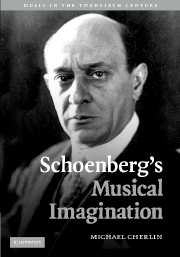
    No composer was more responsible for changes in the landscape of twentieth-century music than Arnold Schoenberg (1874–1951) and no other composer's music inspired a commensurate quantity and quality of technical description in the second half of the twentieth century. Yet there is still little understanding of the correlations between Schoenberg's musical thought and larger questions of cultural significance in and since his time: the formalistic descriptions of music theory do not generally engage larger questions in the history of ideas and scholars without understanding of the formidable musical technique are ill-equipped to understand the music with any profundity of thought. Schoenberg's Musical Imagination is intended to connect Schoenberg's music and critical writings to a larger world of ideas. While most technical studies of Schoenberg's music are limited to a single compositional period, this book traces changes in his attitudes as a composer and their impact on his ever-changing compositional style over the course of his remarkable career.

    Reviews

    "...deserves recognition as one of the most important contributions to the analysis of Schoenberg's music in recent years." --Current Musicology

    Refine List

    Actions for selected content:

    Select all | Deselect all
    • View selected items
    • Export citations
    • Download PDF (zip)
    • Save to Kindle
    • Save to Dropbox
    • Save to Google Drive

    Save Search

    You can save your searches here and later view and run them again in "My saved searches".

    Please provide a title, maximum of 40 characters.
    ×

    Contents

    Bibliography
    Bibliography
    Writings of Arnold Schoenberg
    Arnold Schoenberg, Arnold Schoenberg: A Self Portrait. Schoenberg Nono, Nuria, ed. Belmont Music, 1988
    Arnold Schoenberg, Ausgewählte Briefe, Stein, Erwin, ed. B. Schott's Söhne, 1958
    Schoenberg, Arnold, Fundamentals of Musical Composition, St. Martin's Press, 1967
    Arnold Schoenberg, Stil und Gedanke: Aufsätze zur Musik, Vojtech, Ivan, ed. S. Fisher Verlag, 1976
    Arnold Schoenberg, Structural Functions of Harmony, Stein, Leonard, ed. W. W. Norton, 1969
    Arnold Schoenberg, Theory of Harmony, translated by Carter, Roy E., University of California Press, 1978
    Books and Articles about Schoenberg
    Bailey, Walter B., Programmatic Elements in the Works of Schoenberg. UMI Research Press, 1984
    Berg, Alban, Pelleas und Melisande (nach dem Drama von Maurice Maeterlinck), Symphonische Dichtung für Orchestra von Arnold Schönberg, Op. 5: kurze thematische Analyse. Universal Edition, 1920
    Berg, Albanet al., Arnold Schönberg. R. Piper, 1912
    Leon Botstein, “Schoenberg and the Audience: Modernism, Music, and Politics in the Twentieth Century,” in Schoenberg and His World, Walter Frisch, ed. Princeton University Press, 1999
    Brand, Juliane and Hailey, Christopher, editors, Constructive Dissonance: Arnold Schoenberg and the transformations of twentieth-century culture. University of California Press, 1997
    Brinkmann, Reinhold, Correspondence. The Journal of the Arnold Schoenberg Institute I/3, 182–5
    Brinkmann, Reinhold, “Schoenberg the Contemporary: A View from Behind,” in Constructive Dissonance: Arnold Schoenberg and the transformations of twentieth-century culture. University of California Press, 1997
    Brinkmann, Reinhold and Wolff, Christoph, editors, Music of My Future: The Schoenberg Quartets and Trio. Harvard University Press, 2000
    Cahn, Steven, “The Artist as Modern Prophet: A Study of Historical Consciousness and its Expression in Schoenberg's ‘Vorgefühle, op. 22, no. 4’,” in Schoenberg and Words: The Modernist Years. Garland Publishing (2000), 243–71
    Campbell, Brian G., Text and Phrase Rhythm in Gurrelieder: Schoenberg's Reception of Tradition. Ph.D. dissertation: University of Minnesota, 1997
    Brian G. Campbell, “Gurrelieder and the Fall of the Gods: Schoenberg's Struggle with the legacy of Wagner,” in Schoenberg and Words: The Modernist Years, Cross, Charlotte M. and Berman, Russell A., editors. Garland Publishing, Inc. (2000), 31–63
    Cherlin, Michael, “Dialectical Opposition in Schoenberg's Music and Thought.” Music Theory Spectrum 22/2 (Fall 2000), 157–76
    Michael, Cherlin, “Dramaturgy and Mirror Imagery in Schönberg's Moses und Aron: Two Paradigmatic Interval Palindromes.” Perspectives of New Music 29/2 (Summer 1991), 50–71
    Michael, Cherlin, The Formal and Dramatic Organization of Schoenberg's Moses und Aron. Ph.D. dissertation: Yale University, 1983
    Cherlin, Michael, “Memory and Rhetorical Trope in Schoenberg's String Trio.” Journal of the American Musicological Society 51/3 (Fall 1998), 559–602
    Michael Cherlin, “Motive and Memory in Schoenberg's First String Quartet,” in The Music of My Future: The Schoenberg Quartets and Trio, Brinkmann, Reinhold and Wolff, Christoph, editors. Harvard University Press (2000), 61–80
    Michael, Cherlin, “Schoenberg and das Unheimliche.” The Journal of Musicology 11/3 (Summer 1993), 357–73
    Michael, Cherlin, “Schoenberg's Representation of the Divine in Moses und Aron.” Journal of the Arnold Schoenberg Institute IX/2, 210–16
    Cohn, Richard, “Uncanny Resemblances: Tonal Signification in the Freudian Age.” Journal of the American Musicological Society, 57/2 (2004), 285–323
    Dahlhaus, Carl, Schoenberg and the New Music, translated by Derrick Puffett and Alfred Clayton. Cambridge University Press, 1987
    Fleisher, Robert, “Dualism in the Music of Arnold Schoenberg.” Journal of the Arnold Schoenberg Institute XII/1 (June 1989), 22–42
    Frisch, Walter, The Early Works of Arnold Schoenberg, 1893–1908. University of California Press, 1993
    Frisch, Walter, editor, Schoenberg and his World. Princeton University Press, 1999
    Goldstein, Bluma, Reinscribing Moses: Heine, Kafka, Freud, and Schoenberg in a European Wilderness. Harvard University Press, 1992
    Glenn Gould, “Schoenberg – A Perspective,” in The Glenn Gould Reader, introduction by Page, Tim, editor. Knopf, 1984, 107–22
    Haimo, Ethan, Schoenberg's Serial Odyssey: The evolution of his Twelve-Tone Method, 1914–1928. Oxford University Press, 1990
    Hyde, Martha, “Neoclassic and Anachronistic Impulses in Twentieth-Century Music.” Music Theory Spectrum 18/2 (1996), 200–35
    Keller, Hans, “Schoenberg's Return to Tonality.” Journal of the Arnold Schoenberg Institute V/1, 2–21
    Richard Kurth, “Moments of Closure: Thoughts on the Suspension of Tonality in Schoenberg's Fourth Quartet and Trio,” in Music of My Future: The Schoenberg Quartets and Trio, Brinkmann, Reinhold and Wolff, Christoph, editors. Harvard University Press (2000), 139–60
    Kurth, Richard, “Schönberg and the Bilderverbot: Reflections on Unvorstellbarkeit and Verborgenheit.” Journal of the Arnold Schönberg Center 3 (2003), 332–72
    Kurth, Richard, “Suspended Tonalities in Schönberg's Twelve-tone Compositions.” Journal of the Arnold Schönberg Center 3 (2001), 239–65
    Lacoue-Labarthe, Phillip, Musica Ficta: Figures of Wagner, translated by Felicia McCarren. Stanford University Press, 1994
    Lewin, David, “Generalized Interval Systems for Babbitt's Lists, and for Schoenberg's String Trio.” Music Theory Spectrum 17/1, 81–118
    Lewin, David, “Inversional Balance as an Organizing Force in Schoenberg's Music and Thought.” Perspectives of New Music 6/2 (1968), 1–21
    Lewin, David, “Moses und Aron: Some general remarks and analytic notes for Act I, scene 1.” Perspectives of New Music 6/1, 1–17
    Maegaard, Jan, “Schoenberg's Incomplete Works and Fragments,” in Constructive Dissonance: Arnold Schoenberg and Transformations of Twentieth-Century Culture. University of California Press, 1997, 131–45
    Milstein, Silvina, Arnold Schoenberg: notes, sets, forms. Cambridge University Press, 1992
    Puffett, Derrick, “‘Music that Echoes within one’ for a Lifetime: Berg's Reception of Schoenberg's ‘Pelleas und Melisande.’Music and Letters 76/2 (1995), 209–64
    Rauchhaupt, Ursula, editor. Schoenberg, Berg, Webern: The String Quartets; a documentary study. Deutsche Grammophon Gesellschaft, 1971
    Reich, Willi, Schoenberg: A Critical Biography. Leo Black, trans. Praeger Publishers, 1971
    Ringer, Alexander, Arnold Schoenberg: The Composer as Jew. Oxford University Press, 1990
    Rosen, Charles, Arnold Schoenberg. Viking, 1975
    Simms, Bryan R., The Atonal Music of Arnold Schoenberg: 1908–1923. Oxford University Press, 2000
    Simms, Bryan R. (editor), Schoenberg, Berg, and Webern: A Companion to the Second Viennese School. Greenwood Press, 1999
    Stein, Leonard, “Noting the diagram and soliciting responses as to its meaning.”Journal of the Arnold Schoenberg Institute I/1 (1976), 3–5
    Stuckenschmidt, H. H., Schoenberg: His Life, World and Work. Humphrey Searle, trans. Schirmer, 1978
    Tomlinson, Gary, Metaphysical Song: An Essay on Opera. Princeton University Press, 1999
    Wellesz, Egon, Arnold Schoenberg: The Formative Years, translated by W. H. Kerridge. J. M. Dent and Sons, 1925
    White, Pamela C., Schoenberg and the God-Idea: The Opera Moses und Aron. UMI Research Press, 1985
    Whittall, Arnold, “Schoenberg and the ‘True Tradition’: Theme and Form in the String Trio.” The Musical Times 115, 739–43
    Books and Articles by and about Schoenberg's Contemporaries
    Alter, Robert, Canon and Creativity. Yale University Press, 2000
    Bloom, Harold, “Freud and the Poetic Sublime,” in Poetics of Influence, introduction by John Hollander, edited by Henry R. Schwab, 1988
    Harold, Bloom (editor), Modern Critical Views: Franz Kafka. Chelsea House Publishers, 1986
    Deleuze, Gilles, Difference and Repetition, translated by Paul Patton. Columbia University Press, 1994
    Deleuze, Gilles, Proust and Signs, translated by Richard Howard. University of Minnesota Press, 2000
    Deleuze, Gilles and Félix Guattari, , A Thousand Plateaus: Capitalism and Schizophrenia. University of Minnesota Press, 1987
    Elon, Amos, The Pity of It All: A History of Jews in Germany, 1743–1933. Metropolitan Books (Henry Holt), 2002
    Sigmund Freud, “Beyond the Pleasure Principle,” in The Freud Reader, translated by James Strachey, edited by Gay, Peter. W. W. Norton, 1989
    Sigmund Freud, “On Transience,” in Writings on Art and Literature, edited by Hamacher, Werner and Wellbery, David E.. Stanford University Press, 1997
    Frieden, Ken, Freud's Dream of Interpretation. State University of New York Press, 1990
    Gay, Peter, Freud: A Life for Our Time. W. W. Norton, 1988
    Handelman, Susan A., Fragments of Redemption. Indiana University Press, 1991
    Janik, Allan and Toulman, Stephen, Wittgenstein's Vienna. Simon and Schuster, 1973
    Kafka, Franz, The Castle, translated by Mark Harman. Schocken, 1988
    Franz Kafka, Diaries: 1910–1923, edited by Brod, Max, translated by Martin Greenberg, with the cooperation of Hannah Arendt. Schocken, 1976
    Franz Kafka, Franz Kafka: Ein Lesebuch mit Bildern, edited by Wagenbach, Klaus. Rowohlt Taschenbuch Verlag, 2003
    Kafka, Franz, The Great Short Works of Franz Kafka, translated by Joachim Neugroschel. Simon & Schuster, 2000
    Kafka, Franz, Parables and Paradoxes: Bilingual Edition. Schocken, 1975
    Kafka, Franz, Das Schloss. Fischer Taschenbuch Verlag, 1981
    Kafka, Franz, Tagebücher: 1914–1923. Fischer Taschenbuch Verlag, 1990
    McGuinness, Patrick, Maurice Maeterlinck and the Making of Modern Theatre. Oxford University Press, 2000
    Mendes-Flohr, Paul, German Jews: A Dual Identity.Yale University Press, 1999
    Paddison, Max, Adorno's Aesthetics of Music. Cambridge University Press, 1993
    Rieff, PhilipFreud: The Mind of the Moralist, third edition. University of Chicago Press, 1979
    Robertson, Ritchie, Kafka: Judaism, Politics, and Literature. Oxford University Press, 1985
    Robertson, Ritchie and Timms, Edward, editors, Vienna 1900: from Altenberg to Wittgenstein. Edinburgh University Press, 1990
    Rosenzweig, Franz, The Star of Redemption, translated by William W. Hallo, foreword by N. N. Galtzer. Holt, Rinehart, 1970
    Sachar, Howard M., Dreamland: Europeans and Jews in the Aftermath of the Great War. Knopf, 2002
    Martin Schmidt, Christian, Schönbergs OperMoses und Aron. Schott, 1988
    Georg Simmel, Georg Simmel: On Individuality and Social Forms. Introduction by Levine, Donald N., editor. University of Chicago Press, 1971
    Anton Webern, The Path to New Music, edited by Reich, Willi, translated by Leo Black. Theodore Presser, 1963
    General Background
    Aldwell, Edward and Schachter, Carl, Harmony and Voice Leading, second edition. Harcourt Brace, 1989
    Alter, Robert, Canon and Creativity. Yale University Press, 2000
    Arendt, Hannah, Between Past and Future. The Viking Press, 1961
    Auerbach, Erich, Mimesis: The Representation of Reality in Western Literature, translated by Willard R. Trask. Princeton University Press, 1953
    Milton Babbitt, The Collected Essays of Milton Babbitt, edited by Peles, Stephenet al. Princeton University Press, 2003
    Barker, Andrew, editor, Greek Musical Writings: Harmonic and Acoustic Theory (vol. II). Cambridge University Press, 1989
    Bergson, Henri, Matter and Memory, translated by N. M. Paul and W. S. Palmer. Zone Books, 1991
    William Blake, The Poetry and Prose of William Blake, edited by Erdman, David V., commentary by Harold Bloom. Doubleday, 1965
    Blanchot, Maurice, The Infinite Conversation, translated and with a foreword by Susan Hanson. University of Minnesota Press, 1993
    Blanchot, Maurice, The Work of Fire, translated by Charlotte Mandell. Stanford University Press, 1995
    Bloom, Harold, A Map of Misreading. Oxford University Press, 1975
    Blanchot, Maurice, The Ringers in the Tower: Studies in Romantic Tradition. University of Chicago Press, 1971
    Blanchot, Maurice, Ruin the Sacred Texts: Poetry and Belief from the Bible to the Present. Harvard University Press, 1989
    Burke, Kenneth, A Grammar of Motives. Prentice-Hall, 1945; repr. University of California Press, 1969
    Bywater, I. and Patrick, G. T. W., Heraclitus of Ephesus. Argonaut, 1969
    Carson, Anne, Economy of the Unlost (Reading Simonides of Keos with Paul Celan). Princeton University Press, 1999
    Carson, Anne, Eros the Bittersweet. Princeton University Press, 1986
    Cavell, Stanley, This New Yet Unapproachable America: Lectures after Emerson after Wittgenstein. Living Batch Press, 1989
    Cherlin, Michael, “Hauptmann and Schenker: Two Adaptations of Hegelian Dialectics.” Theory and Practice 13 (1988), 115–31
    Daverio, John, Nineteenth Century Music and the German Romantic Ideology. Schirmer, 1993
    Dodds,, E. R.The Greeks and the Irrational. University of California, 1951
    Frisch, Walter, editor, Schubert: Critical and Analytical Studies. University of Nebraska Press, 1986
    Hans-Georg Gadamer, , Truth and Method, second edition, translation revised by Joel Weinsheimer and Donald G. Marshall. Continuum, 2003
    Gay, Peter, Weimar Culture: The Outsider as Insider. W. W. Norton, 1968
    Guthrie, W. K. C., A History of Greek Philosophy: The earlier Presocratics and the Pythagoreans (vol. I). Cambridge University Press, 1962
    Hartman, Geoffrey H., The Fateful Question of Culture. Columbia University Press, 1997
    Kahn, Charles H., The Art and Thought of Heraclitus. Cambridge University Press, 1979
    Lewin, David, Generalized Musical Intervals and Transformations. Yale University Press, 1987
    Lewin, David, “Music Theory, Phenomenology, and Modes of Perception.” Music Perception 3/4, 327–92
    Lovejoy, Arthur O., Reflections on Human Nature. John Hopkins Press, 1961
    Bernhard Marx, Adolph, Theory and Practice of Musical Composition, translated by H. S. Saroni. Huntington, Mason & Law, 1852
    Nietzsche, Friedrich, Untimely Meditations: On the uses and disadvantages of history for life, translated by R. J. Holindale. Cambridge University Press, 1983
    Paglia, Camille, Sexual Personae: Art and Decadence from Nefertiti to Emily Dickinson. Yale University Press, 1990
    Schorske, Carl, Fin-de-Siècle Vienna. Knopf, 1980
    Schur, David, The Way of Oblivion: Heraclitus and Kafka. Harvard University Press, 1998
    Steiner, George, Language and Silence: Essays on Language, Literature, and the Inhuman. Atheneum, 1970
    Steiner, George, Grammars of Creation. Yale University Press, 2001

    Metrics

    Full text views

    Total number of HTML views: 0
    Total number of PDF views: 0 *
    Loading metrics...

    Book summary page views

    Total views: 0 *
    Loading metrics...

    * Views captured on Cambridge Core between #date#. This data will be updated every 24 hours.

    Usage data cannot currently be displayed.

    Accessibility standard: Unknown

    Why this information is here

    This section outlines the accessibility features of this content - including support for screen readers, full keyboard navigation and high-contrast display options. This may not be relevant for you.

    Accessibility Information

    Accessibility compliance for the PDF of this book is currently unknown and may be updated in the future.
