 Kp
Kp O(n)
O(n)





1. Introduction
Tree-decompositions were introduced by Robertson and Seymour [Reference Robertson and Seymour78], as a key ingredient in their Graph Minor Theory.Footnote
1
Indeed, the dichotomy between minor-closed classes with or without bounded treewidth is a central theme of their work. Tree-decompositions arise in several other results, such as the Erdős-Pósa theorem for planar minors [Reference van Batenburg, Huynh, Joret and Raymond21, Reference Robertson and Seymour79] and Reed’s beautiful theorem on $k$
-near bipartite graphs [Reference Reed76]. Tree-decompositions are also a key tool in algorithmic graph theory, since many NP-complete problems are solvable in linear time on graphs with bounded treewidth [Reference Courcelle37].
$k$
-near bipartite graphs [Reference Reed76]. Tree-decompositions are also a key tool in algorithmic graph theory, since many NP-complete problems are solvable in linear time on graphs with bounded treewidth [Reference Courcelle37].
For a non-null tree $T$
, a
$T$
, a $T$
-decomposition of a graph
$T$
-decomposition of a graph $G$
is a collection
$G$
is a collection $(B_x\;:\;x \in V(T))$
of subsets of
$(B_x\;:\;x \in V(T))$
of subsets of $V(G)$
, henceforth called bags, such that:
$V(G)$
, henceforth called bags, such that:
-
• $B_x\subseteq V(G)$
for each
$x\in V(T)$
,
$B_x\subseteq V(G)$
for each
$x\in V(T)$
, -
• for each edge
$vw \in E(G)$
, there exists a node
$x \in V(T)$
with
$v,w \in B_x$
, and -
• for each vertex
$v \in V(G)$
, the set
$\{ x \in V(T) \;:\; v \in B_x \}$
induces a non-empty (connected) subtree of
$T$
.




The width of such a $T$
-decomposition is
$T$
-decomposition is $\max \{ |B_x| \;:\; x \in V(T) \}-1$
. A tree-decomposition is a
$\max \{ |B_x| \;:\; x \in V(T) \}-1$
. A tree-decomposition is a $T$
-decomposition for any tree
$T$
-decomposition for any tree $T$
. The treewidth of a graph
$T$
. The treewidth of a graph $G$
, denoted
$G$
, denoted $\mathrm {tw}(G)$
, is the minimum width of a tree-decomposition of
$\mathrm {tw}(G)$
, is the minimum width of a tree-decomposition of $G$
. A tree-decomposition of a graph
$G$
. A tree-decomposition of a graph $G$
with width
$G$
with width $\mathrm {tw}(G)$
is said to be optimal. Treewidth is the standard measure of how similar a graph is to a tree. Indeed, a connected graph has treewidth at most 1 if and only if it is a tree. See [Reference Bodlaender20, Reference Harvey and Wood56, Reference Reed and Bailey77] for surveys on treewidth.
$\mathrm {tw}(G)$
is said to be optimal. Treewidth is the standard measure of how similar a graph is to a tree. Indeed, a connected graph has treewidth at most 1 if and only if it is a tree. See [Reference Bodlaender20, Reference Harvey and Wood56, Reference Reed and Bailey77] for surveys on treewidth.
In addition to studying treewidth and optimal tree-decompositions, much recent work has studied tree-decompositions where the subgraph induced by each bag is well structured in some sense. In this direction, Adler [Reference Adler11] introduced the following definition. For a graph parameter $f$
and graph
$f$
and graph $G$
, let tree-
$G$
, let tree- $f(G)$
be the minimum integer
$f(G)$
be the minimum integer $k$
such that
$k$
such that $G$
has a tree-decomposition
$G$
has a tree-decomposition $(B_x\;:\;x\in V(T))$
such that
$(B_x\;:\;x\in V(T))$
such that $f(G[B_x])\leqslant k$
for each node
$f(G[B_x])\leqslant k$
for each node $x\in V(T)$
. Tree-chromatic number tree-
$x\in V(T)$
. Tree-chromatic number tree- $\chi$
was introduced by Seymour [Reference Seymour81] and has since attracted substantial interest [Reference Barrera-Cruz, Felsner, Mészáros, Micek, Smith, Taylor and Trotter18, Reference Huynh and Kim62, Reference Huynh, Reed, Wood and Yepremyan63, Reference Krause, Redzic and Ueckerdt66]. Tree-diameter (under the name ‘tree-length’) was introduced by Dourisboure and Gavoille [Reference Dourisboure and Gavoille48]; variants of this parameter have been widely studied in connection with coarse graph theory [Reference Berger and Seymour19, Reference Dragan49, Reference Dragan and Köhler50, Reference Hickingbotham60, Reference Nguyen, Scott and Seymour75]. Tree-independence number tree-
$\chi$
was introduced by Seymour [Reference Seymour81] and has since attracted substantial interest [Reference Barrera-Cruz, Felsner, Mészáros, Micek, Smith, Taylor and Trotter18, Reference Huynh and Kim62, Reference Huynh, Reed, Wood and Yepremyan63, Reference Krause, Redzic and Ueckerdt66]. Tree-diameter (under the name ‘tree-length’) was introduced by Dourisboure and Gavoille [Reference Dourisboure and Gavoille48]; variants of this parameter have been widely studied in connection with coarse graph theory [Reference Berger and Seymour19, Reference Dragan49, Reference Dragan and Köhler50, Reference Hickingbotham60, Reference Nguyen, Scott and Seymour75]. Tree-independence number tree- $\alpha$
was introduced by Yolov [Reference Yolov86] and independently by Dallard, Milanič and Štorgel in the ‘Treewidth versus clique-number’ series [Reference Dallard, Milanič and Štorgel41–Reference Dallard, Krnc, Kwon, Milanič, Munaro, Štorgel and Wiederrecht44]; it has since been widely studied [Reference Alon, Milanič and Rzażewski16, Reference Choi, Hilaire, Milanič and Wiederrecht23, Reference Dallard, Fomin, Golovach, Korhonen and Milanič39, Reference Dallard, Milanic, Munaro and Yang40, Reference Hickingbotham59, Reference Krause, Redzic and Ueckerdt66, Reference Paloma, Martin, Peter, Karolina, Rzażewsk and Štorgel68, Reference Milanič and Rzażewski72], including the ‘Tree-independence number’ series [Reference Abrishami, Alecu, Chudnovsky, Hajebi, Spirkl and Vušković5, Reference Chudnovsky and Codsi24, Reference Chudnovsky, Codsi, Lokshtanov, Milanic and Sivashankar26, Reference Chudnovsky, Gartland, Hajebi, Lokshtanov and Spirkl28, Reference Chudnovsky, Hajebi, Lokshtanov and Spirkl29, Reference Chudnovsky, Hajebi and Trotignon33], and the ‘Induced subgraphs and tree decompositions’ series [Reference Abrishami, Alecu, Chudnovsky, Hajebi and Spirkl1–Reference Abrishami, Alecu, Chudnovsky, Hajebi, Spirkl and Vušković4, Reference Abrishami, Chudnovsky, Dibek, Hajebi, Rzążewski, Spirkl and Vušković6–Reference Abrishami, Chudnovsky and Vušković10, Reference Alecu, Chudnovsky, Hajebi and Spirkl12–Reference Alecu, Chudnovsky and Spirkl15, Reference Chudnovsky, Codsi, Hajebi and Spirkl25, Reference Chudnovsky, Gartland, Hajebi, Lokshtanov and Spirkl27, Reference Chudnovsky, Hajebi and Spirkl30–Reference Chudnovsky, Hajebi and Spirkl32].
$\alpha$
was introduced by Yolov [Reference Yolov86] and independently by Dallard, Milanič and Štorgel in the ‘Treewidth versus clique-number’ series [Reference Dallard, Milanič and Štorgel41–Reference Dallard, Krnc, Kwon, Milanič, Munaro, Štorgel and Wiederrecht44]; it has since been widely studied [Reference Alon, Milanič and Rzażewski16, Reference Choi, Hilaire, Milanič and Wiederrecht23, Reference Dallard, Fomin, Golovach, Korhonen and Milanič39, Reference Dallard, Milanic, Munaro and Yang40, Reference Hickingbotham59, Reference Krause, Redzic and Ueckerdt66, Reference Paloma, Martin, Peter, Karolina, Rzażewsk and Štorgel68, Reference Milanič and Rzażewski72], including the ‘Tree-independence number’ series [Reference Abrishami, Alecu, Chudnovsky, Hajebi, Spirkl and Vušković5, Reference Chudnovsky and Codsi24, Reference Chudnovsky, Codsi, Lokshtanov, Milanic and Sivashankar26, Reference Chudnovsky, Gartland, Hajebi, Lokshtanov and Spirkl28, Reference Chudnovsky, Hajebi, Lokshtanov and Spirkl29, Reference Chudnovsky, Hajebi and Trotignon33], and the ‘Induced subgraphs and tree decompositions’ series [Reference Abrishami, Alecu, Chudnovsky, Hajebi and Spirkl1–Reference Abrishami, Alecu, Chudnovsky, Hajebi, Spirkl and Vušković4, Reference Abrishami, Chudnovsky, Dibek, Hajebi, Rzążewski, Spirkl and Vušković6–Reference Abrishami, Chudnovsky and Vušković10, Reference Alecu, Chudnovsky, Hajebi and Spirkl12–Reference Alecu, Chudnovsky and Spirkl15, Reference Chudnovsky, Codsi, Hajebi and Spirkl25, Reference Chudnovsky, Gartland, Hajebi, Lokshtanov and Spirkl27, Reference Chudnovsky, Hajebi and Spirkl30–Reference Chudnovsky, Hajebi and Spirkl32].
Liu, Norin, and Wood [Reference Liu, Norin and Wood69] studied tree-tw (and to a lesser extent tree-pw, tree-bw, and tree-td, where $\mathrm {pw}$
,
$\mathrm {pw}$
, $\mathrm {bw}$
, and
$\mathrm {bw}$
, and $\mathrm {td}$
denote pathwidth, bandwidth, and treedepth, respectively). For example, Liu et al. [Reference Liu, Norin and Wood69] showed that for each integer
$\mathrm {td}$
denote pathwidth, bandwidth, and treedepth, respectively). For example, Liu et al. [Reference Liu, Norin and Wood69] showed that for each integer $p$
there is an integer
$p$
there is an integer $c$
such that tree-tw
$c$
such that tree-tw $(G)\leqslant c$
for every
$(G)\leqslant c$
for every $K_p$
-minor-free graph
$K_p$
-minor-free graph $G$
; that is,
$G$
; that is, $G$
has a tree-decomposition such that each bag has treewidthFootnote
2
at most
$G$
has a tree-decomposition such that each bag has treewidthFootnote
2
at most $c$
.
$c$
.
In this paper we study optimal tree-decompositions, but with a focus on the structural properties of their bags. The primary contribution of this paper is to show that graphs in any proper minor-closed class admit optimal tree-decompositions whose bags have bounded treewidth.
First consider planar graphs $G$
. Liu et al. [Reference Liu, Norin and Wood69] showed that
$G$
. Liu et al. [Reference Liu, Norin and Wood69] showed that $G$
has a tree-decompostition with bags of treewidth 3 (that is, tree-tw
$G$
has a tree-decompostition with bags of treewidth 3 (that is, tree-tw $(G)\leqslant 3$
). The treewidth 3 bound here is best possible whenever
$(G)\leqslant 3$
). The treewidth 3 bound here is best possible whenever $G$
contains
$G$
contains $K_4$
, since in any tree-decomposition of
$K_4$
, since in any tree-decomposition of $G$
each clique of
$G$
each clique of $G$
is contained in a single bag, and
$G$
is contained in a single bag, and $\mathrm {tw}(K_4)=3$
. The result of Liu et al. [Reference Liu, Norin and Wood69] gives no bound on the width of this tree-decomposition (and the method used does not relate to the optimal width). We prove the following analogous result with optimal width.
$\mathrm {tw}(K_4)=3$
. The result of Liu et al. [Reference Liu, Norin and Wood69] gives no bound on the width of this tree-decomposition (and the method used does not relate to the optimal width). We prove the following analogous result with optimal width.
Theorem 1. Every planar graph has an optimal tree-decomposition in which every bag has treewidth at most 3.
Theorem1 is proved in Section 4, where in fact we give a more precise description of the bags.
Next consider graphs embeddable in a fixed surface.Footnote
3
Liu et al. [Reference Liu, Norin and Wood69] proved that tree-tw $(G)\in O(g)$
for graphs
$(G)\in O(g)$
for graphs $G$
with Euler genus
$G$
with Euler genus $g$
, and that this
$g$
, and that this $O(g)$
bound is best possible. The next theorem strengthens this result and generalises Theorem1 for graphs embeddable on any fixed surface.
$O(g)$
bound is best possible. The next theorem strengthens this result and generalises Theorem1 for graphs embeddable on any fixed surface.
Theorem 2. Every graph with Euler genus $g$
has an optimal tree-decomposition in which every bag has treewidth at most
$g$
has an optimal tree-decomposition in which every bag has treewidth at most $\max \{4g+2,3\}$
.
$\max \{4g+2,3\}$
.
Theorem2 is proved in Section 5, where we give further properties of the tree-decomposition in Theorem2.
More generally, our next contribution says that graphs in any proper minor-closed class have optimal tree-decompositions with bags of bounded treewidth.
Theorem 3. For any integer $p\geqslant 1$
there exists an integer
$p\geqslant 1$
there exists an integer $c$
such that every
$c$
such that every $K_p$
-minor-free graph has an optimal tree-decomposition in which every bag has treewidth at most
$K_p$
-minor-free graph has an optimal tree-decomposition in which every bag has treewidth at most $c$
.
$c$
.
As mentioned above, Liu et al. [Reference Liu, Norin and Wood69] proved the weakening of Theorem3 with no bound on the size of the bags.
The key idea underlying our first two main results (Theorems1 and 2) is surprisingly simple. Consider a tree-decomposition ${\mathcal{D}}=(B_x\;:\;x\in V(T))$
and a separation
${\mathcal{D}}=(B_x\;:\;x\in V(T))$
and a separation $(A_1,A_2)$
of a graph
$(A_1,A_2)$
of a graph $G$
, such that some bag
$G$
, such that some bag $B_x$
contains
$B_x$
contains $A_1\cap A_2$
, and
$A_1\cap A_2$
, and $B_x$
intersects both
$B_x$
intersects both $A_1\setminus A_2$
and
$A_1\setminus A_2$
and $A_2\setminus A_1$
. Let
$A_2\setminus A_1$
. Let ${\mathcal{D}}_1$
and
${\mathcal{D}}_1$
and ${\mathcal{D}}_2$
be the induced tree-decompositions of
${\mathcal{D}}_2$
be the induced tree-decompositions of $G[A_1]$
and
$G[A_1]$
and $G[A_2]$
, respectively. We can combine
$G[A_2]$
, respectively. We can combine ${\mathcal{D}}_1$
and
${\mathcal{D}}_1$
and ${\mathcal{D}}_2$
to obtain a new tree-decomposition of
${\mathcal{D}}_2$
to obtain a new tree-decomposition of $G$
by adding an edge between the nodes corresponding to
$G$
by adding an edge between the nodes corresponding to $x$
in
$x$
in ${\mathcal{D}}_1$
and
${\mathcal{D}}_1$
and ${\mathcal{D}}_2$
. By repeatedly applying this operation, we can obtain a tree-decomposition of
${\mathcal{D}}_2$
. By repeatedly applying this operation, we can obtain a tree-decomposition of $G$
such that there is no separation
$G$
such that there is no separation $(A_1,A_2)$
of
$(A_1,A_2)$
of $G$
where a bag
$G$
where a bag $B_x$
contains
$B_x$
contains $A_1\cap A_2$
, and
$A_1\cap A_2$
, and $B_x$
intersects both
$B_x$
intersects both $A_1\setminus A_2$
and
$A_1\setminus A_2$
and $A_2\setminus A_1$
; we call such a bag ‘unbreakable’. For graphs embedded on a surface, every cycle that bounds a disc separates the vertices drawn inside the disc from those drawn outside the disc. Thus, if an unbreakabale bag
$A_2\setminus A_1$
; we call such a bag ‘unbreakable’. For graphs embedded on a surface, every cycle that bounds a disc separates the vertices drawn inside the disc from those drawn outside the disc. Thus, if an unbreakabale bag $B$
contains a cycle bounding a disc
$B$
contains a cycle bounding a disc $D$
, then
$D$
, then $B$
must live entirely inside or entirely outside
$B$
must live entirely inside or entirely outside $D$
. This allows us to bound the treewidth of
$D$
. This allows us to bound the treewidth of $B$
, for example by applying the Grid Minor Theorem [Reference Robertson and Seymour79] and observing that every large grid
$B$
, for example by applying the Grid Minor Theorem [Reference Robertson and Seymour79] and observing that every large grid $G$
embedded in the plane has a cycle
$G$
embedded in the plane has a cycle $C$
such that vertices of
$C$
such that vertices of $G$
are embedded both inside and outside the disc bounded by
$G$
are embedded both inside and outside the disc bounded by $C$
. This approach also leads to a proof that every graph with maximum degree at most 3 has an optimal tree-decomposition such that every bag has treewidth at most 3 (Corollary11).
$C$
. This approach also leads to a proof that every graph with maximum degree at most 3 has an optimal tree-decomposition such that every bag has treewidth at most 3 (Corollary11).
For $K_p$
-minor-free graphs, the situation is complicated by the existence of vertices whose neighbourhood have large treewidth. Indeed, if
$K_p$
-minor-free graphs, the situation is complicated by the existence of vertices whose neighbourhood have large treewidth. Indeed, if $G$
is obtained from a planar graph by adding a vertex
$G$
is obtained from a planar graph by adding a vertex $v$
adjacent to all other vertices, then
$v$
adjacent to all other vertices, then $G$
is
$G$
is $K_6$
-minor-free and every set not containing
$K_6$
-minor-free and every set not containing $v$
is unbreakable. We therefore need a more sophisticated method of modifying tree-decompositions in this setting. To this end we introduce the notion of ‘irreducible’ sets. In Section 3, we explain how to obtain optimal tree-decompositions with irreducible bags, and in Section 6 we bound the treewidth of subgraphs of
$v$
is unbreakable. We therefore need a more sophisticated method of modifying tree-decompositions in this setting. To this end we introduce the notion of ‘irreducible’ sets. In Section 3, we explain how to obtain optimal tree-decompositions with irreducible bags, and in Section 6 we bound the treewidth of subgraphs of $K_p$
-minor-free graphs induced on irreducible sets, thus proving Theorem3.
$K_p$
-minor-free graphs induced on irreducible sets, thus proving Theorem3.
1.1 Monotone graph classes
Inspired by the above results for minor-closed classes, it is natural to ask for a given monotone graph class $\mathcal{G}$
, does every graph in
$\mathcal{G}$
, does every graph in $\mathcal{G}$
have an optimal tree-decomposition such that every bag has bounded treewidth? We show that the answer is ‘no’ for a surprisingly simple graph class. A graph is 1-planar if it has a drawing in the plane with at most one crossing on each edge; see [Reference Kobourov, Liotta and Montecchiani65] for a survey on 1-planar graphs. Since every graph has a 1-planar subdivision, 1-planar graphs contain arbitrarily large complete graph minors [Reference Dujmović, Eppstein and Wood51, Reference Hendrey, Karol and Wood58, Reference Hickingbotham and Wood61]. On the other hand, we consider 1-planar graphs to be one of the simplest monotone classes that contains subdivisions of any graph. We show that 1-planar graphs do not have optimal tree-decompositions with bags of bounded treewidth. In fact, the same result holds for tree-decompositions of width within an additive constant of optimal.
$\mathcal{G}$
have an optimal tree-decomposition such that every bag has bounded treewidth? We show that the answer is ‘no’ for a surprisingly simple graph class. A graph is 1-planar if it has a drawing in the plane with at most one crossing on each edge; see [Reference Kobourov, Liotta and Montecchiani65] for a survey on 1-planar graphs. Since every graph has a 1-planar subdivision, 1-planar graphs contain arbitrarily large complete graph minors [Reference Dujmović, Eppstein and Wood51, Reference Hendrey, Karol and Wood58, Reference Hickingbotham and Wood61]. On the other hand, we consider 1-planar graphs to be one of the simplest monotone classes that contains subdivisions of any graph. We show that 1-planar graphs do not have optimal tree-decompositions with bags of bounded treewidth. In fact, the same result holds for tree-decompositions of width within an additive constant of optimal.
Theorem 4.
For any integers $c,w\geqslant 0$
there is a
$c,w\geqslant 0$
there is a $1$
-planar graph
$1$
-planar graph $G$
such that every tree-decomposition of
$G$
such that every tree-decomposition of $G$
with width at most
$G$
with width at most $\mathrm {tw}(G)+c$
has a bag with treewidth greater than
$\mathrm {tw}(G)+c$
has a bag with treewidth greater than $w$
.
$w$
.
This result is proved in Section 7, where we in fact prove a significant strengthening.
Graphs that have tree-decompositions with bounded treewidth bags and with the given width bound

Table 1. Long description
A table with three columns and four rows. The columns are labeled Optimal Width tw(G), Near-optimal Width tw(G) + c, and Asymptotically tight Width O(sqrt(n)). The rows are labeled Proper minor-closed, 1-planar, and Bounded layered treewidth. Row 1: Proper minor-closed, Yes, Yes, Yes. Row 2: 1-planar, No, No, Yes. Row 3: Bounded layered treewidth, No, No, Yes.
In contrast to Theorem4, we show that 1-planar graphs with $n$
vertices have tree-decompositions with width
$n$
vertices have tree-decompositions with width $O(\sqrt {n})$
such that each bag has bounded treewidth (Corollary35). Here the
$O(\sqrt {n})$
such that each bag has bounded treewidth (Corollary35). Here the $O(\sqrt {n})$
width bound is best possible, since the
$O(\sqrt {n})$
width bound is best possible, since the $\sqrt {n}\times \sqrt {n}$
grid graph is planar with treewidth
$\sqrt {n}\times \sqrt {n}$
grid graph is planar with treewidth $\sqrt {n}$
. This shows a marked contrast between the settings of optimal width and
$\sqrt {n}$
. This shows a marked contrast between the settings of optimal width and $O(\sqrt {n})$
width. Moreover, the upper bound holds in the more general setting of graphs of bounded layered treewidth (Lemma31), where we in fact show that the union of any bounded number of bags has bounded treewidth. This material is presented in Section 8.
$O(\sqrt {n})$
width. Moreover, the upper bound holds in the more general setting of graphs of bounded layered treewidth (Lemma31), where we in fact show that the union of any bounded number of bags has bounded treewidth. This material is presented in Section 8.
We conclude the paper in Section 9 by discussing several open problems that arise from our work. Table 1 summarises all our results.
2. Normal, atomic, and refined tree-decompositions
This section introduces some elementary results about tree-decompositions that underpin the main proofs.
Let $(B_x\;:\;x\in V(T))$
be a tree-decomposition of a graph
$(B_x\;:\;x\in V(T))$
be a tree-decomposition of a graph $G$
. If
$G$
. If $B_x\subseteq B_y$
for some edge
$B_x\subseteq B_y$
for some edge $xy\in E(T)$
, then let
$xy\in E(T)$
, then let $T'$
be the tree obtained from
$T'$
be the tree obtained from $T$
by contracting
$T$
by contracting $xy$
into a new vertex
$xy$
into a new vertex $z$
, and let
$z$
, and let $B_z\;:\!=\;B_y$
. Then
$B_z\;:\!=\;B_y$
. Then $(B_x\;:\;x\in V(T'))$
is a tree-decomposition of
$(B_x\;:\;x\in V(T'))$
is a tree-decomposition of $G$
with width equal to the width of
$G$
with width equal to the width of $(B_x\;:\;x\in V(T))$
, and
$(B_x\;:\;x\in V(T))$
, and $|V(T')|\lt |V(T)|$
. To normalise a tree-decomposition means to apply this operation until
$|V(T')|\lt |V(T)|$
. To normalise a tree-decomposition means to apply this operation until $B_x\not \subseteq B_y$
for each edge
$B_x\not \subseteq B_y$
for each edge $xy\in E(T)$
. This process terminates, since each contraction decreases
$xy\in E(T)$
. This process terminates, since each contraction decreases $|V(T)|$
by exactly
$|V(T)|$
by exactly $1$
. A tree-decomposition
$1$
. A tree-decomposition $(B_x\;:\;x\in V(T))$
with
$(B_x\;:\;x\in V(T))$
with $B_x\not \subseteq B_y$
for each
$B_x\not \subseteq B_y$
for each $xy\in E(T)$
is said to be normal. Applying normalisation to an optimal tree-decomposition of a graph
$xy\in E(T)$
is said to be normal. Applying normalisation to an optimal tree-decomposition of a graph $G$
gives a tree-decomposition of
$G$
gives a tree-decomposition of $G$
that is optimal and normal.
$G$
that is optimal and normal.
Say $(B_x\;:\;x\in V(T))$
is a normal tree-decomposition of a graph
$(B_x\;:\;x\in V(T))$
is a normal tree-decomposition of a graph $G$
with
$G$
with $V(G)\neq \varnothing$
. Root
$V(G)\neq \varnothing$
. Root $T$
at an arbitrary node
$T$
at an arbitrary node $r\in V(T)$
. For each edge
$r\in V(T)$
. For each edge $xy\in E(T)$
where
$xy\in E(T)$
where $y$
is the parent of
$y$
is the parent of $x$
, let
$x$
, let $f(xy)$
be any vertex in
$f(xy)$
be any vertex in $B_x\setminus B_y$
(one exists since
$B_x\setminus B_y$
(one exists since $B_x\not \subseteq B_y$
). Thus
$B_x\not \subseteq B_y$
). Thus $f$
is an injection from
$f$
is an injection from $E(T)$
to
$E(T)$
to $V(G-B_r)$
. So
$V(G-B_r)$
. So $|V(G)|-1\geqslant |V(G)|-|B_r|\geqslant |E(T)|=|V(T)|-1$
, and
$|V(G)|-1\geqslant |V(G)|-|B_r|\geqslant |E(T)|=|V(T)|-1$
, and $|V(T)|\leqslant |V(G)|$
. That is, every normal tree-decomposition of a graph
$|V(T)|\leqslant |V(G)|$
. That is, every normal tree-decomposition of a graph $G$
has at most
$G$
has at most $|V(G)|$
bags, which is a well-known fact.
$|V(G)|$
bags, which is a well-known fact.
For a tree-decomposition ${\mathcal{D}}=(B_x\;:\;x\in V(T))$
of a graph
${\mathcal{D}}=(B_x\;:\;x\in V(T))$
of a graph $G$
and a positive integer
$G$
and a positive integer $i$
, let
$i$
, let $n_i({\mathcal{D}})$
be the number of nodes
$n_i({\mathcal{D}})$
be the number of nodes $x\in V(T)$
such that
$x\in V(T)$
such that $|B_x|=i$
, and let
$|B_x|=i$
, and let
 \begin{equation*}{N({\mathcal{D}})} \;:\!=\;(n_{|V(G)|}({\mathcal{D}}),n_{|V(G)|-1}({\mathcal{D}}),\ldots ,n_1({\mathcal{D}})).\end{equation*}
Sometimes $N({\mathcal{D}})$
is called the fatness of
$N({\mathcal{D}})$
is called the fatness of $\mathcal{D}$
. A tree-decomposition
$\mathcal{D}$
. A tree-decomposition $\mathcal{D}$
is atomic if there is no tree-decomposition
$\mathcal{D}$
is atomic if there is no tree-decomposition ${\mathcal{D}}'$
of
${\mathcal{D}}'$
of $G$
such that
$G$
such that $N({\mathcal{D}}')$
is lexicographically less than
$N({\mathcal{D}}')$
is lexicographically less than $N({\mathcal{D}})$
. This concept was implicitly introduced by Thomas [Reference Thomas83] and has since been studied by various authors [Reference Abrishami, Alecu, Chudnovsky, Hajebi and Spirkl3, Reference Chudnovsky, Gartland, Hajebi, Lokshtanov and Spirkl27, Reference Coudert, Ducoffe and Nisse36, Reference Diestel and Müller46, Reference Diestel and Müller47, Reference Erde and Weißauer53, Reference Müller74, Reference Weißauer84].
$N({\mathcal{D}})$
. This concept was implicitly introduced by Thomas [Reference Thomas83] and has since been studied by various authors [Reference Abrishami, Alecu, Chudnovsky, Hajebi and Spirkl3, Reference Chudnovsky, Gartland, Hajebi, Lokshtanov and Spirkl27, Reference Coudert, Ducoffe and Nisse36, Reference Diestel and Müller46, Reference Diestel and Müller47, Reference Erde and Weißauer53, Reference Müller74, Reference Weißauer84].
We implicitly use the following simple lemma throughout the paper.
Lemma 5. Every graph has an atomic tree-decomposition, and every atomic tree-decomposition is normal.
Proof. Let $G$
be a graph. Since every normal tree-decomposition of
$G$
be a graph. Since every normal tree-decomposition of $G$
has at most
$G$
has at most $|V(G)|$
bags, there are finitely many normal tree-decompositions of
$|V(G)|$
bags, there are finitely many normal tree-decompositions of $G$
. So there exists a normal tree-decomposition
$G$
. So there exists a normal tree-decomposition $\mathcal{D}$
of
$\mathcal{D}$
of $G$
that lexicographically minimises
$G$
that lexicographically minimises $N({\mathcal{D}})$
among all normal tree-decompositions of
$N({\mathcal{D}})$
among all normal tree-decompositions of $G$
. Suppose for contradiction that there is a tree-decomposition
$G$
. Suppose for contradiction that there is a tree-decomposition ${\mathcal{D}}'$
of
${\mathcal{D}}'$
of $G$
such that
$G$
such that $N({\mathcal{D}}')$
is lexicographically less than
$N({\mathcal{D}}')$
is lexicographically less than $N({\mathcal{D}})$
. Let
$N({\mathcal{D}})$
. Let ${\mathcal{D}}''$
be obtained by normalising
${\mathcal{D}}''$
be obtained by normalising ${\mathcal{D}}'$
. Then
${\mathcal{D}}'$
. Then $N({\mathcal{D}}'')$
is lexicographically less than
$N({\mathcal{D}}'')$
is lexicographically less than $N({\mathcal{D}})$
, contradicting our choice of
$N({\mathcal{D}})$
, contradicting our choice of $\mathcal{D}$
. This shows that
$\mathcal{D}$
. This shows that $\mathcal{D}$
is an atomic tree-decomposition of
$\mathcal{D}$
is an atomic tree-decomposition of $G$
.
$G$
.
Now suppose that $G$
has an atomic tree-decomposition
$G$
has an atomic tree-decomposition $\mathcal{D}$
that is not normal, and let
$\mathcal{D}$
that is not normal, and let ${\mathcal{D}}'$
be the normalisation of
${\mathcal{D}}'$
be the normalisation of $\mathcal{D}$
. Since normalisation only removes bags from
$\mathcal{D}$
. Since normalisation only removes bags from $\mathcal{D}$
,
$\mathcal{D}$
, $N({\mathcal{D}}')$
is lexicographically less than
$N({\mathcal{D}}')$
is lexicographically less than $N({\mathcal{D}})$
.
$N({\mathcal{D}})$
.
Many of the known properties of atomic tree-decompositions actually hold in the broader setting of refined tree-decompositions, which we now introduce. A tree-decomposition ${\mathcal{D}}'$
of a graph
${\mathcal{D}}'$
of a graph $G$
is a refinement of a tree-decomposition
$G$
is a refinement of a tree-decomposition $\mathcal{D}$
of
$\mathcal{D}$
of $G$
if each bag of
$G$
if each bag of ${\mathcal{D}}'$
is a subset of a bag of
${\mathcal{D}}'$
is a subset of a bag of $\mathcal{D}$
. If
$\mathcal{D}$
. If ${\mathcal{D}}'$
is a refinement of
${\mathcal{D}}'$
is a refinement of $\mathcal{D}$
and not vice versa, then
$\mathcal{D}$
and not vice versa, then ${\mathcal{D}}'$
is a proper refinement of
${\mathcal{D}}'$
is a proper refinement of $\mathcal{D}$
. A tree-decomposition is refined if it is normal and has no proper refinement.
$\mathcal{D}$
. A tree-decomposition is refined if it is normal and has no proper refinement.
Lemma 6. Every atomic tree-decomposition is refined.
Proof. By Lemma5, every atomic tree-decomposition is normal. Suppose for contradiction that ${\mathcal{D}}'$
is a proper refinement of an atomic tree-decomposition
${\mathcal{D}}'$
is a proper refinement of an atomic tree-decomposition $\mathcal{D}$
of a graph
$\mathcal{D}$
of a graph $G$
. Let
$G$
. Let ${\mathcal{D}}''$
be a tree-decomposition of
${\mathcal{D}}''$
be a tree-decomposition of $G$
obtained by normalising
$G$
obtained by normalising ${\mathcal{D}}'$
, and note that
${\mathcal{D}}'$
, and note that ${\mathcal{D}}''$
is also a proper refinement of
${\mathcal{D}}''$
is also a proper refinement of $\mathcal{D}$
. We will show that
$\mathcal{D}$
. We will show that $N({\mathcal{D}}'')$
is lexicographically less than
$N({\mathcal{D}}'')$
is lexicographically less than $N({\mathcal{D}})$
, thus contradicting that
$N({\mathcal{D}})$
, thus contradicting that $\mathcal{D}$
is atomic. To this end, let
$\mathcal{D}$
is atomic. To this end, let $B_x$
be the largest bag of
$B_x$
be the largest bag of $\mathcal{D}$
that is not a subset of any bag of
$\mathcal{D}$
that is not a subset of any bag of ${\mathcal{D}}''$
. Now, for any bag
${\mathcal{D}}''$
. Now, for any bag $B_u$
of
$B_u$
of $\mathcal{D}$
larger than
$\mathcal{D}$
larger than $B_x$
, there is some bag
$B_x$
, there is some bag $B''_{v}$
of
$B''_{v}$
of ${\mathcal{D}}''$
and some bag
${\mathcal{D}}''$
and some bag $B_w$
of
$B_w$
of $\mathcal{D}$
such that
$\mathcal{D}$
such that $B_u\subseteq B''_v\subseteq B_w$
. The second part of Lemma5 implies
$B_u\subseteq B''_v\subseteq B_w$
. The second part of Lemma5 implies $u=w$
, and thus
$u=w$
, and thus $B_u=B''_v=B_w$
.
$B_u=B''_v=B_w$
.
Suppose for contradiction that there is a bag $B''_u$
of
$B''_u$
of ${\mathcal{D}}''$
of size at least
${\mathcal{D}}''$
of size at least $|B_x|$
that is not a bag of
$|B_x|$
that is not a bag of $\mathcal{D}$
. Since
$\mathcal{D}$
. Since ${\mathcal{D}}''$
is a refinement of
${\mathcal{D}}''$
is a refinement of $\mathcal{D}$
, there is a bag
$\mathcal{D}$
, there is a bag $B_v$
of
$B_v$
of $\mathcal{D}$
containing
$\mathcal{D}$
containing $B''_u$
as a proper subset. By the above argument,
$B''_u$
as a proper subset. By the above argument, $B_v$
is also a bag of
$B_v$
is also a bag of ${\mathcal{D}}''$
, contradicting that
${\mathcal{D}}''$
, contradicting that ${\mathcal{D}}''$
is normal. Hence, every bag of
${\mathcal{D}}''$
is normal. Hence, every bag of ${\mathcal{D}}''$
of size at least
${\mathcal{D}}''$
of size at least $|B_x|$
is also a bag of
$|B_x|$
is also a bag of $\mathcal{D}$
. Since every bag of
$\mathcal{D}$
. Since every bag of ${\mathcal{D}}''$
of size at least
${\mathcal{D}}''$
of size at least $|B_x|$
is also a bag of
$|B_x|$
is also a bag of $\mathcal{D}$
but not vice versa and both are normal tree-decompositions,
$\mathcal{D}$
but not vice versa and both are normal tree-decompositions, $N({\mathcal{D}}'')$
is lexicographically less than
$N({\mathcal{D}}'')$
is lexicographically less than $N({\mathcal{D}})$
, a contradiction.
$N({\mathcal{D}})$
, a contradiction.
To the best of our knowledge, refined tree-decompositions have not been explicitly defined in the literature, although several known results about atomic tree-decompositions are in fact proved only using the properties of refined tree-decompositions.
Lemmas5 and 6 imply that every graph has a refined tree-decomposition, which we henceforth use implicitly.
Lemma 7.
For every refined tree-decomposition ${\mathcal{D}}=(B_x\;:\;x\in V(T))$
of a graph
${\mathcal{D}}=(B_x\;:\;x\in V(T))$
of a graph $G$
, for all nodes
$G$
, for all nodes $x,y\in V(T)$
(not necessarily distinct), for any subset
$x,y\in V(T)$
(not necessarily distinct), for any subset $S\subseteq B_y$
, the bag
$S\subseteq B_y$
, the bag $B_x$
intersects exactly one component of
$B_x$
intersects exactly one component of $G-S$
, unless
$G-S$
, unless $x=y$
and
$x=y$
and $S=B_y$
.
$S=B_y$
.
Proof. Since $\mathcal{D}$
is normal,
$\mathcal{D}$
is normal, $B_x$
is not a subset of
$B_x$
is not a subset of $S$
unless
$S$
unless $y=x$
and
$y=x$
and $S=B_y$
. Suppose for contradiction that
$S=B_y$
. Suppose for contradiction that $B_x$
intersects multiple components of
$B_x$
intersects multiple components of $G-S$
, and let
$G-S$
, and let $H_1$
be one such component.
$H_1$
be one such component.
Let $T_1$
and
$T_1$
and $T_2$
be disjoint copies of
$T_2$
be disjoint copies of $T$
, where
$T$
, where $u_i$
is the copy of
$u_i$
is the copy of $u$
in
$u$
in $T_i$
, for each
$T_i$
, for each $u\in V(T)$
and
$u\in V(T)$
and $i\in \{1,2\}$
. Let
$i\in \{1,2\}$
. Let $T'$
be obtained from
$T'$
be obtained from $T_1\cup T_2$
by adding the edge
$T_1\cup T_2$
by adding the edge $y_1y_2$
. Let
$y_1y_2$
. Let $D_1\;:\!=\;V(H_1)\cup S$
and
$D_1\;:\!=\;V(H_1)\cup S$
and $D_2\;:\!=\;V(G)\setminus V(H_1)$
. For each node
$D_2\;:\!=\;V(G)\setminus V(H_1)$
. For each node $u_i\in V(T_i)$
, let
$u_i\in V(T_i)$
, let $B_{u_i}\;:\!=\; B_u \cap V(D_i)$
. So
$B_{u_i}\;:\!=\; B_u \cap V(D_i)$
. So ${\mathcal{D}}'\;:\!=\;(B_u\;:\;u\in V(T'))$
is a tree-decomposition of
${\mathcal{D}}'\;:\!=\;(B_u\;:\;u\in V(T'))$
is a tree-decomposition of $G$
and is a proper refinement of
$G$
and is a proper refinement of $\mathcal{D}$
since
$\mathcal{D}$
since $B_x$
is not a subset of any bag of
$B_x$
is not a subset of any bag of ${\mathcal{D}}'$
. This contradiction completes the proof.
${\mathcal{D}}'$
. This contradiction completes the proof.
The statement and proof of Lemma7 is similar to a result of [Reference Müller74, Lemma 3.8] in the setting of atomic tree-decompositions.
3. Breakability and reducibility
This section introduces the notions of breakable and reducible sets in a graph, which are key tools in the proofs of our main results.
A separation of a graph $G$
is an ordered pair
$G$
is an ordered pair $(A,B)$
such that
$(A,B)$
such that $A,B\subseteq V(G)$
and
$A,B\subseteq V(G)$
and $G=G[A]\cup G[B]$
. The order of
$G=G[A]\cup G[B]$
. The order of $(A,B)$
is
$(A,B)$
is $|A\cap B|$
. A separation
$|A\cap B|$
. A separation $(A,B)$
of a graph
$(A,B)$
of a graph $G$
breaks a set
$G$
breaks a set $S\subseteq V(G)$
if
$S\subseteq V(G)$
if $S\setminus A$
and
$S\setminus A$
and $S\setminus B$
are both nonempty, and
$S\setminus B$
are both nonempty, and $A\cap B\subseteq S$
. A set
$A\cap B\subseteq S$
. A set $S\subseteq V(G)$
is breakable if there exists a separation
$S\subseteq V(G)$
is breakable if there exists a separation $(A,B)$
that breaks
$(A,B)$
that breaks $S$
, otherwise
$S$
, otherwise $S$
is unbreakable.
$S$
is unbreakable.
Lemma 8.
Every bag of every refined tree-decomposition $(B_x\;:\;x\in V(T))$
of a graph
$(B_x\;:\;x\in V(T))$
of a graph $G$
is unbreakable.
$G$
is unbreakable.
Proof. Consider a separation $(A,B)$
of
$(A,B)$
of $G$
and a node
$G$
and a node $y\in V(T)$
such that
$y\in V(T)$
such that $A\cap B\subseteq B_y$
and
$A\cap B\subseteq B_y$
and $B_y\setminus A\neq \varnothing$
. By Lemma7, there is a unique component
$B_y\setminus A\neq \varnothing$
. By Lemma7, there is a unique component $C$
of
$C$
of $G-(A\cap B)$
that intersects
$G-(A\cap B)$
that intersects $B_y$
. Since
$B_y$
. Since $V(C)\cap B\supseteq B_y\setminus A\neq \varnothing$
, we have
$V(C)\cap B\supseteq B_y\setminus A\neq \varnothing$
, we have $V(C)\cap A=\varnothing$
, so
$V(C)\cap A=\varnothing$
, so $B_y\setminus B=\varnothing$
. Thus every bag of
$B_y\setminus B=\varnothing$
. Thus every bag of $(B_x\;:\;x\in V(T))$
is unbreakable.
$(B_x\;:\;x\in V(T))$
is unbreakable.
Together with Lemma6, this yields the following immediate corollary.
Corollary 9. Every bag of every atomic tree-decomposition is unbreakable.
As an aside, breakability leads to the following results about graphs of bounded maximum degree.
Proposition 10.
Given a graph $G$
with maximum degree
$G$
with maximum degree $\Delta$
, every bag of every refined tree-decomposition of
$\Delta$
, every bag of every refined tree-decomposition of $G$
either has size at most
$G$
either has size at most $\Delta +1$
or induces a subgraph of maximum degree at most
$\Delta +1$
or induces a subgraph of maximum degree at most $\Delta -1$
.
$\Delta -1$
.
Proof. Let $\mathcal{D}$
be a refined tree-decomposition of
$\mathcal{D}$
be a refined tree-decomposition of $G$
with width
$G$
with width $\mathrm {tw}(G)$
. Consider a bag
$\mathrm {tw}(G)$
. Consider a bag $B$
of
$B$
of $\mathcal{D}$
. Suppose for the sake of contradiction that
$\mathcal{D}$
. Suppose for the sake of contradiction that $|B|\geqslant \Delta +2$
and there is a vertex
$|B|\geqslant \Delta +2$
and there is a vertex $v\in B$
with degree
$v\in B$
with degree $\Delta$
in
$\Delta$
in $G[B]$
. Thus,
$G[B]$
. Thus, $N_G[v]\subseteq B$
and some vertex in
$N_G[v]\subseteq B$
and some vertex in $B$
is not adjacent to
$B$
is not adjacent to $v$
. Hence
$v$
. Hence $(N_G[v], V(G)\setminus \{v\})$
is a separation of
$(N_G[v], V(G)\setminus \{v\})$
is a separation of $G$
that breaks
$G$
that breaks $B$
, which contradicts Lemma8.
$B$
, which contradicts Lemma8.
Since every graph with at most four vertices or with maximum degree at most 2 has treewidth at most 3, Proposition10 implies:
Corollary 11.
Every graph $G$
with maximum degree at most 3 has an optimal tree-decomposition
$G$
with maximum degree at most 3 has an optimal tree-decomposition $\mathcal{D}$
such that every bag of
$\mathcal{D}$
such that every bag of $\mathcal{D}$
has treewidth at most 3.
$\mathcal{D}$
has treewidth at most 3.
A set $S$
of vertices in a graph
$S$
of vertices in a graph $G$
is reducible if there is a separation
$G$
is reducible if there is a separation $(A,B)$
of
$(A,B)$
of $G$
such that both
$G$
such that both $|(S\cup B)\cap A|$
and
$|(S\cup B)\cap A|$
and $|(S\cup A)\cap B|$
are strictly less than
$|(S\cup A)\cap B|$
are strictly less than $|S|$
, otherwise
$|S|$
, otherwise $S$
is irreducible.
$S$
is irreducible.
Note that if $S$
is breakable, then it is reducible (since
$S$
is breakable, then it is reducible (since $(A\cap B)\setminus S=\varnothing$
). That is, if
$(A\cap B)\setminus S=\varnothing$
). That is, if $S$
is irreducible, then
$S$
is irreducible, then $S$
is unbreakable. Thus, the following lemma strengthens Corollary9.
$S$
is unbreakable. Thus, the following lemma strengthens Corollary9.
Lemma 12.
Every bag of an atomic tree-decomposition $(B_x\;:\;x\in V(T))$
of a graph
$(B_x\;:\;x\in V(T))$
of a graph $G$
is irreducible.
$G$
is irreducible.
Proof. Suppose for contradiction that for some $y\in V(T)$
, there is a separation
$y\in V(T)$
, there is a separation $(A_1,A_2)$
of
$(A_1,A_2)$
of $G$
such that both
$G$
such that both $|(B_y \cup A_1)\cap A_2|$
and
$|(B_y \cup A_1)\cap A_2|$
and $|(B_y\cup A_2)\cap A_1|$
are strictly less than
$|(B_y\cup A_2)\cap A_1|$
are strictly less than $|B_y|$
. Select such a separation of minimum order. In particular, there is no set
$|B_y|$
. Select such a separation of minimum order. In particular, there is no set $S'$
of size smaller than
$S'$
of size smaller than $|A_1\cap A_2|$
that separates
$|A_1\cap A_2|$
that separates $A_1\cap B_y$
from
$A_1\cap B_y$
from $A_1\cap A_2$
, or a smaller order separation can be obtained by taking
$A_1\cap A_2$
, or a smaller order separation can be obtained by taking $S'$
and the vertices in components of
$S'$
and the vertices in components of $G-S'$
intersecting
$G-S'$
intersecting $A_1\cap B_y$
on one side and taking
$A_1\cap B_y$
on one side and taking $S'$
and all remaining vertices on the other. Thus, by Menger’s Theorem, there is a set
$S'$
and all remaining vertices on the other. Thus, by Menger’s Theorem, there is a set $\mathcal{P}_1$
of
$\mathcal{P}_1$
of $|A_1\cap A_2|$
disjoint paths from
$|A_1\cap A_2|$
disjoint paths from $A_1\cap A_2$
to
$A_1\cap A_2$
to $B_y\cap A_1$
in
$B_y\cap A_1$
in $G$
. By construction each of these paths is internally disjoint from
$G$
. By construction each of these paths is internally disjoint from $A_1\cap A_2$
and hence is contained in
$A_1\cap A_2$
and hence is contained in $G[A_1]$
. By symmetry, there is a set
$G[A_1]$
. By symmetry, there is a set $\mathcal{P}_2$
of
$\mathcal{P}_2$
of $|A_1\cap A_2|$
disjoint paths from
$|A_1\cap A_2|$
disjoint paths from $A_1\cap A_2$
to
$A_1\cap A_2$
to $B_y\cap A_2$
in
$B_y\cap A_2$
in $G[A_2]$
.
$G[A_2]$
.
For each $a\in A_1\cap A_2$
, let
$a\in A_1\cap A_2$
, let $w_a$
be the closest vertex to
$w_a$
be the closest vertex to $y$
in
$y$
in $T$
such that
$T$
such that $a\in B_{w_a}$
(meaning that
$a\in B_{w_a}$
(meaning that $w_a=y$
if
$w_a=y$
if $a\in B_y$
). Now, for each
$a\in B_y$
). Now, for each $w\in V(T)$
, define
$w\in V(T)$
, define
 \begin{equation*}B'_w\;:\!=\;B_w\cup \{a\in A_1\cap A_2 \;:\;w\in V(yTw_a)\}.\end{equation*}
Here $yTw_a$
is the
$yTw_a$
is the $yw_a$
-path in
$yw_a$
-path in $T$
. Note that for every vertex
$T$
. Note that for every vertex $u\in V(G)$
, the set
$u\in V(G)$
, the set $\{w\in V(T)\;:$ $u\in B'_w\}$
is a superset of
$u\in B'_w\}$
is a superset of $\{w\in V(T)\;:\;u\in B_w\}$
and induces a subtree of
$\{w\in V(T)\;:\;u\in B_w\}$
and induces a subtree of $T$
, so
$T$
, so $(B'_w\;:\;w\in V(T))$
is a tree-decomposition of
$(B'_w\;:\;w\in V(T))$
is a tree-decomposition of $G$
.
$G$
.
Let $T''$
be the tree with vertex set
$T''$
be the tree with vertex set $V(T)\times \{1,2\}$
such that vertices
$V(T)\times \{1,2\}$
such that vertices $(u,i)$
and
$(u,i)$
and $(w,j)$
are adjacent if
$(w,j)$
are adjacent if $i=j$
and
$i=j$
and $uw\in E(T)$
, or
$uw\in E(T)$
, or $i\neq j$
and
$i\neq j$
and $u=w=y$
. For each
$u=w=y$
. For each $(u,i)\in V(T'')$
, define
$(u,i)\in V(T'')$
, define $B''_{(u,i)}\;:\!=\;B'_u\cap V(A_i)$
. For each
$B''_{(u,i)}\;:\!=\;B'_u\cap V(A_i)$
. For each $i\in \{1,2\}$
, let
$i\in \{1,2\}$
, let $T_i\;:\!=\;T[V(T)\times \{i\}]$
and note that
$T_i\;:\!=\;T[V(T)\times \{i\}]$
and note that $(B''_x\;:\;x\in V(T_i))$
is a tree-decomposition of
$(B''_x\;:\;x\in V(T_i))$
is a tree-decomposition of $G[A_i]$
. Since
$G[A_i]$
. Since $A_1\cap A_2\subseteq B''_{(y,1)}\cap B''_{(y,2)}$
, it follows that
$A_1\cap A_2\subseteq B''_{(y,1)}\cap B''_{(y,2)}$
, it follows that $(B''_x\;:\;x\in V(T''))$
is a tree-decomposition of
$(B''_x\;:\;x\in V(T''))$
is a tree-decomposition of $G$
.
$G$
.
Claim.
For each $(v,i)\in V(T'')$
, we have
$(v,i)\in V(T'')$
, we have $|B''_{(v,i)}|\leqslant |B_v|$
. Furthermore, if equality holds, then
$|B''_{(v,i)}|\leqslant |B_v|$
. Furthermore, if equality holds, then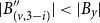 $|B''_{(v,3-i)}|\lt |B_y|$
.
$|B''_{(v,3-i)}|\lt |B_y|$
.
Proof. Let $X_v\;:\!=\;B'_v\setminus B_v$
, and let
$X_v\;:\!=\;B'_v\setminus B_v$
, and let $j\;:\!=\;3-i$
. By construction,
$j\;:\!=\;3-i$
. By construction, $X_v\subseteq (A_1\cap A_2)\setminus B_y$
. For each
$X_v\subseteq (A_1\cap A_2)\setminus B_y$
. For each $a\in X_v$
, consider the path
$a\in X_v$
, consider the path $P_{a,j}$
in
$P_{a,j}$
in $\mathcal{P}_{j}$
that has
$\mathcal{P}_{j}$
that has $a$
as an endpoint. Since both
$a$
as an endpoint. Since both $B_{w_a}$
and
$B_{w_a}$
and $B_y$
contain a vertex of
$B_y$
contain a vertex of $P_{a,j}$
and
$P_{a,j}$
and $v\in V(yTw_a)$
, it follows that
$v\in V(yTw_a)$
, it follows that $B_v$
contains a vertex of
$B_v$
contains a vertex of $P_{a,j}$
. In particular, since
$P_{a,j}$
. In particular, since $a\notin B_v$
, we see that
$a\notin B_v$
, we see that $B_v$
contains a vertex in
$B_v$
contains a vertex in $V(P_{a,j})\setminus (A_1\cap A_2)$
. Thus
$V(P_{a,j})\setminus (A_1\cap A_2)$
. Thus $B_v\setminus A_i$
contains at least
$B_v\setminus A_i$
contains at least $|X_v|$
vertices, and so
$|X_v|$
vertices, and so $|B''_{(v,i)}|= |B_v\cap A_i|+|X_v|\leqslant |B_v|$
. If equality holds, then
$|B''_{(v,i)}|= |B_v\cap A_i|+|X_v|\leqslant |B_v|$
. If equality holds, then $|B_v\setminus A_i|=|X_v|\leqslant |(A_1\cap A_2)\setminus B_y|$
. This means
$|B_v\setminus A_i|=|X_v|\leqslant |(A_1\cap A_2)\setminus B_y|$
. This means
 \begin{equation*}|B''_{(v,j)}|\leqslant |B_v\setminus A_i|+|A_1\cap A_2|\leqslant |(A_1\cap A_2)\setminus B_y| +|A_1\cap A_2|.\end{equation*}
Recall that $|(B_y \cup A_1)\cap A_2|\lt |B_y|$
, meaning
$|(B_y \cup A_1)\cap A_2|\lt |B_y|$
, meaning $|(A_1\cap A_2)\setminus B_y|\lt |B_y\setminus A_2|$
. Thus
$|(A_1\cap A_2)\setminus B_y|\lt |B_y\setminus A_2|$
. Thus
 \begin{equation*}|B''_{(v,j)}|\lt |B_y\setminus A_2|+|A_1\cap A_2|=|(B_y\cup A_2)\cap A_1|\lt |B_y|,\end{equation*}
as required.
Note that $|B''_{(y,1)}|=|(A_1\cap A_2)\cup (B_y\setminus A_2)|\lt |B_y|$
, and similarly
$|B''_{(y,1)}|=|(A_1\cap A_2)\cup (B_y\setminus A_2)|\lt |B_y|$
, and similarly $|B''_{(y,2)}|\lt |B_y|$
. Let
$|B''_{(y,2)}|\lt |B_y|$
. Let $k$
be the maximum integer such that for some
$k$
be the maximum integer such that for some $v\in V(T)$
with
$v\in V(T)$
with $|B_v|=k$
we have
$|B_v|=k$
we have $|B''_{v,1}|\lt k$
and
$|B''_{v,1}|\lt k$
and $|B''_{(v,2)}|\lt k$
(so
$|B''_{(v,2)}|\lt k$
(so $k\geqslant |B_y|$
).
$k\geqslant |B_y|$
).
By the above claim, the number of bags of ${\mathcal{D}}''$
of size
${\mathcal{D}}''$
of size $k'$
equals the number of bags of
$k'$
equals the number of bags of $\mathcal{D}$
of size
$\mathcal{D}$
of size $k'$
for all
$k'$
for all $k'\gt k$
, and
$k'\gt k$
, and ${\mathcal{D}}''$
has strictly fewer bags of size
${\mathcal{D}}''$
has strictly fewer bags of size $k$
than
$k$
than $\mathcal{D}$
. This contradicts the fact that
$\mathcal{D}$
. This contradicts the fact that $\mathcal{D}$
is atomic.
$\mathcal{D}$
is atomic.
Lemma12 highlights the distinction between atomic and refined tree-decompositions, since its proof critically uses the atomic property.
4. Planar graphs
This section proves Theorem1 showing that every planar graph has an optimal tree-decomposition with bags of treewidth 3.
We employ the following definitions introduced by Dehkordi and Farr [Reference Dehkordi and Farr45]. A planar graph $G$
is separable with respect to a plane embedding
$G$
is separable with respect to a plane embedding $\Pi$
of
$\Pi$
of $G$
if there is a cycle
$G$
if there is a cycle $C$
in
$C$
in $G$
such that there is a vertex of
$G$
such that there is a vertex of $G-V(C)$
in the interior of
$G-V(C)$
in the interior of $C$
with respect to
$C$
with respect to $\Pi$
, and there is a vertex of
$\Pi$
, and there is a vertex of $G-V(C)$
in the exterior of
$G-V(C)$
in the exterior of $C$
with respect to
$C$
with respect to $\Pi$
. Otherwise,
$\Pi$
. Otherwise, $G$
is non-separable with respect to
$G$
is non-separable with respect to $\Pi$
. That is, for any cycle
$\Pi$
. That is, for any cycle $C$
in
$C$
in $G$
, all the vertices of
$G$
, all the vertices of $G-V(C)$
are in the interior of
$G-V(C)$
are in the interior of $C$
, or all the vertices of
$C$
, or all the vertices of $G-V(C)$
are in the exterior of
$G-V(C)$
are in the exterior of $C$
.
$C$
.
Let $\Pi$
be a plane embedding of a planar graph
$\Pi$
be a plane embedding of a planar graph $G$
. Suppose that
$G$
. Suppose that $S\subseteq V(G)$
and
$S\subseteq V(G)$
and $G[S]$
is separable with respect to the plane embedding of
$G[S]$
is separable with respect to the plane embedding of $G[S]$
induced by
$G[S]$
induced by $\Pi$
. So there is a cycle
$\Pi$
. So there is a cycle $C$
in
$C$
in $G[S]$
with at least one vertex of
$G[S]$
with at least one vertex of $S$
in the interior of
$S$
in the interior of $C$
, and at least one vertex of
$C$
, and at least one vertex of $S$
in the exterior of
$S$
in the exterior of $C$
. Let
$C$
. Let $A$
be the set of all vertices of
$A$
be the set of all vertices of $G$
in
$G$
in $C$
or in the interior of
$C$
or in the interior of $C$
. Let
$C$
. Let $B$
be the set of all vertices of
$B$
be the set of all vertices of $G$
in
$G$
in $C$
or in the exterior of
$C$
or in the exterior of $C$
. By the Jordan Curve Theorem,
$C$
. By the Jordan Curve Theorem, $(A,B)$
is a separation of
$(A,B)$
is a separation of $G$
that breaks
$G$
that breaks $S$
. So if a set
$S$
. So if a set $S\subseteq V(G)$
is unbreakable, then
$S\subseteq V(G)$
is unbreakable, then $S$
is non-separable with respect to
$S$
is non-separable with respect to $\Pi$
. Lemma8 thus implies:
$\Pi$
. Lemma8 thus implies:
Lemma 13.
Let $\Pi$
be a plane embedding of a planar graph
$\Pi$
be a plane embedding of a planar graph $G$
. For every refined tree-decomposition
$G$
. For every refined tree-decomposition $(B_y\;:\;y\in V(T))$
of
$(B_y\;:\;y\in V(T))$
of $G$
, for each
$G$
, for each $y\in V(T)$
,
$y\in V(T)$
, $G[B_y]$
is non-separable with respect to the embedding of
$G[B_y]$
is non-separable with respect to the embedding of $G[B_y]$
induced by
$G[B_y]$
induced by $\Pi$
.
$\Pi$
.
A planar graph $G$
is non-separable if
$G$
is non-separable if $G$
is non-separable with respect to some plane embedding of
$G$
is non-separable with respect to some plane embedding of $G$
. As illustrated in Figure 1, Dehkordi and Farr [Reference Dehkordi and Farr45] showed that the class of non-separable planar graphs is minor-closed, and that a graph
$G$
. As illustrated in Figure 1, Dehkordi and Farr [Reference Dehkordi and Farr45] showed that the class of non-separable planar graphs is minor-closed, and that a graph $G$
is non-separable planar if and only if
$G$
is non-separable planar if and only if $G$
does not contain
$G$
does not contain $K_1 \cup K_4$
or
$K_1 \cup K_4$
or $K_1 \cup K_{2,3}$
or
$K_1 \cup K_{2,3}$
or $K_{1,1,3}$
as a minor. In fact, Dehkordi and Farrb [Reference Dehkordi and Farr45] provided the following precise structural characterisation: any non-separable planar graph is either outerplanar, or a subgraph of a wheel, or a subgraph of an elongated triangular prism (a graph obtained from the triangular prism
$K_{1,1,3}$
as a minor. In fact, Dehkordi and Farrb [Reference Dehkordi and Farr45] provided the following precise structural characterisation: any non-separable planar graph is either outerplanar, or a subgraph of a wheel, or a subgraph of an elongated triangular prism (a graph obtained from the triangular prism $K_3\square K_2$
by subdividing edges that are not in triangles any number of times).
$K_3\square K_2$
by subdividing edges that are not in triangles any number of times).
Lemma 14.
For every refined tree-decomposition $(B_y\;:\;y\in V(T))$
of a planar graph
$(B_y\;:\;y\in V(T))$
of a planar graph $G$
, for each
$G$
, for each $y\in V(T)$
,
$y\in V(T)$
, $G[B_y]$
is outerplanar, is a subgraph of a wheel, or is a subgraph of an elongated triangular prism.
$G[B_y]$
is outerplanar, is a subgraph of a wheel, or is a subgraph of an elongated triangular prism.
Each graph listed in Lemma14 has treewidth at most 3. So Lemma14 implies the following result, which implies Theorem1.
Non-separable planar graphs: (a) outerplanar, (b) wheel, (c) elongated triangular prism.

Corollary 15.
Every planar graph $G$
has an optimal tree-decomposition
$G$
has an optimal tree-decomposition $(B_x\;:\;x\in V(T))$
such that for each
$(B_x\;:\;x\in V(T))$
such that for each $x\in V(T)$
, the graph
$x\in V(T)$
, the graph $G[B_x]$
is outerplanar, a subgraph of a wheel, or a subgraph of an elongated triangular prism. In particular,
$G[B_x]$
is outerplanar, a subgraph of a wheel, or a subgraph of an elongated triangular prism. In particular, $G[B_x]$
has treewidth at most
$G[B_x]$
has treewidth at most $3$
.
$3$
.
A forthcoming companion paper [Reference Hendrey, Hickingbotham, Hodor and Wood57] gives a more precise structural characterisation than Corollary15, where we drop the requirement of outerplanarity.
5. Graphs on surfaces
This section proves Theorem2 showing that every graph $G$
with Euler genus
$G$
with Euler genus $g$
has an optimal tree-decomposition with bags of treewdith
$g$
has an optimal tree-decomposition with bags of treewdith $O(g)$
. For a graph
$O(g)$
. For a graph $G$
embedded in a surface
$G$
embedded in a surface $\Sigma$
, for distinct vertices
$\Sigma$
, for distinct vertices $a,b\in V(G)$
, two
$a,b\in V(G)$
, two $ab$
-paths
$ab$
-paths $P_1$
and
$P_1$
and $P_2$
in
$P_2$
in $G$
are homotopic if
$G$
are homotopic if $P_1 \cup P_2$
bounds a disc in
$P_1 \cup P_2$
bounds a disc in $\Sigma$
. We use the following lemma of Malnič and Mohar [Reference Malnič and Mohar71] (see Proposition 4.2.7 in [Reference Mohar and Thomassen73] and the discussion that follows).
$\Sigma$
. We use the following lemma of Malnič and Mohar [Reference Malnič and Mohar71] (see Proposition 4.2.7 in [Reference Mohar and Thomassen73] and the discussion that follows).
Lemma 16 [Reference Malnič and Mohar71, Reference Mohar and Thomassen73]. For any graph $G$
embedded in a surface with Euler genus
$G$
embedded in a surface with Euler genus $g\geqslant 1$
, for any distinct vertices
$g\geqslant 1$
, for any distinct vertices $a,b\in V(G)$
, if
$a,b\in V(G)$
, if $\mathcal{P}$
is a set of pairwise internally disjoint
$\mathcal{P}$
is a set of pairwise internally disjoint $ab$
-paths in
$ab$
-paths in $G$
and
$G$
and $|\mathcal{P}| \geqslant 2g+1$
, then
$|\mathcal{P}| \geqslant 2g+1$
, then $\mathcal{P}$
contains a pair of homotopic paths.
$\mathcal{P}$
contains a pair of homotopic paths.
Lemma 17.
For any integer $c\geqslant 2$
, for any graph
$c\geqslant 2$
, for any graph $G$
embedded in a surface with Euler genus
$G$
embedded in a surface with Euler genus $g\geqslant 1$
, for any distinct vertices
$g\geqslant 1$
, for any distinct vertices $a,b\in V(G)$
, if
$a,b\in V(G)$
, if $\mathcal{P}$
is a set of pairwise internally disjoint
$\mathcal{P}$
is a set of pairwise internally disjoint $ab$
-paths in
$ab$
-paths in $G$
and
$G$
and $|\mathcal{P}| \geqslant (c-1)(2g+1)$
, then
$|\mathcal{P}| \geqslant (c-1)(2g+1)$
, then $\mathcal{P}$
contains a set of
$\mathcal{P}$
contains a set of $c$
pairwise homotopic paths.
$c$
pairwise homotopic paths.
Proof. Homotopy between paths in $\mathcal{P}$
is an equivalence relation. If some equivalence class has
$\mathcal{P}$
is an equivalence relation. If some equivalence class has $c$
paths then we are done. Assume each equivalence class at most
$c$
paths then we are done. Assume each equivalence class at most $c-1$
paths. The number of equivalence classes is at least
$c-1$
paths. The number of equivalence classes is at least $2g+1$
. Taking one path from each equivalence class gives
$2g+1$
. Taking one path from each equivalence class gives $2g+1$
pairwise non-homotopic
$2g+1$
pairwise non-homotopic $ab$
-paths, contradicting Lemma16.
$ab$
-paths, contradicting Lemma16.
Lemma 18.
Every embedding of $K_{2,4g+2}$
in a surface of Euler genus
$K_{2,4g+2}$
in a surface of Euler genus $g\geqslant 1$
has a cycle bounding a disc and separating two vertices.
$g\geqslant 1$
has a cycle bounding a disc and separating two vertices.
Proof. Let $n\;:\!=\;4g+2$
. Let
$n\;:\!=\;4g+2$
. Let $a,b$
be the two vertices of degree
$a,b$
be the two vertices of degree $n$
in
$n$
in $K_{2,n}$
. There are
$K_{2,n}$
. There are $n$
internally disjoint
$n$
internally disjoint $ab$
-paths
$ab$
-paths $P_1,\ldots ,P_n$
in
$P_1,\ldots ,P_n$
in $K_{2,n}$
. By Lemma17, three of
$K_{2,n}$
. By Lemma17, three of $P_1,\ldots ,P_n$
are pairwise homotopic. Without loss of generality,
$P_1,\ldots ,P_n$
are pairwise homotopic. Without loss of generality, $P_1,P_2,P_3$
are pairwise homotopic, and there is a disc
$P_1,P_2,P_3$
are pairwise homotopic, and there is a disc $D$
in
$D$
in $\Sigma$
bounded by
$\Sigma$
bounded by $P_1\cup P_2$
with the internal vertex of
$P_1\cup P_2$
with the internal vertex of $P_3$
in the interior of
$P_3$
in the interior of $D$
. Choose
$D$
. Choose $D$
to be minimal with this property. Then no other vertex is in the interior of
$D$
to be minimal with this property. Then no other vertex is in the interior of $D$
. Since
$D$
. Since $n\geqslant 4$
,
$n\geqslant 4$
, $P_1\cup P_2$
is separating.
$P_1\cup P_2$
is separating.
Lemma 19.
For every graph $G$
of Euler genus
$G$
of Euler genus $g\geqslant 1$
, for any
$g\geqslant 1$
, for any $S\subseteq V(G)$
, if
$S\subseteq V(G)$
, if $K_{2,4g+2}$
is a minor of
$K_{2,4g+2}$
is a minor of $G[S]$
, then
$G[S]$
, then $S$
is breakable.
$S$
is breakable.
Proof. Fix an embedding of $G$
in a surface
$G$
in a surface $\Sigma$
of Euler genus
$\Sigma$
of Euler genus $g$
. Let
$g$
. Let $H$
be obtained from
$H$
be obtained from $G[S]$
by contracting each branch set of the
$G[S]$
by contracting each branch set of the $K_{2,4g+2}$
minor. We obtain an embedding of
$K_{2,4g+2}$
minor. We obtain an embedding of $H$
in
$H$
in $\Sigma$
. By Lemma18, there is a cycle
$\Sigma$
. By Lemma18, there is a cycle $C_0$
in
$C_0$
in $H$
bounding a disc and separating two vertices in
$H$
bounding a disc and separating two vertices in $H$
. The branch sets corresponding to
$H$
. The branch sets corresponding to $C_0$
thus contain a cycle
$C_0$
thus contain a cycle $C$
in
$C$
in $G[S]$
bounding a disc
$G[S]$
bounding a disc $D$
and separating two vertices in
$D$
and separating two vertices in $S$
. Let
$S$
. Let $A$
be the set of all vertices of
$A$
be the set of all vertices of $G$
embedded in
$G$
embedded in $D$
(including
$D$
(including $C$
). Let
$C$
). Let $B$
be the set of all vertices of
$B$
be the set of all vertices of $G$
embedded in
$G$
embedded in $\Sigma -D$
plus
$\Sigma -D$
plus $V(C)$
. So
$V(C)$
. So $(A,B)$
is a separation of
$(A,B)$
is a separation of $G$
that breaks
$G$
that breaks $S$
.
$S$
.
We use the following lemma by Malnič and Mohar [Reference Liu and Yoo70] (improving on a previous bound by Leaf and Seymour [Reference Leaf and Seymour67]). A graph $H$
is an apex-forest if
$H$
is an apex-forest if $H-v$
is a forest for some
$H-v$
is a forest for some $v\in V(H)$
.
$v\in V(H)$
.
Lemma 20 [Reference Liu and Yoo70]. For any apex-forest $H$
with
$H$
with $|V(H)|\geqslant 2$
, every
$|V(H)|\geqslant 2$
, every $H$
-minor-free graph has treewidth at most
$H$
-minor-free graph has treewidth at most $|V(H)|-2$
.
$|V(H)|-2$
.
Lemma 21.
For any integer $g\geqslant 1$
, every graph
$g\geqslant 1$
, every graph $G$
with Euler genus at most
$G$
with Euler genus at most $g$
, every refined tree-decomposition
$g$
, every refined tree-decomposition $(B_x\;:\;x\in V(T))$
of
$(B_x\;:\;x\in V(T))$
of $G$
and every
$G$
and every $x\in V(T)$
:
$x\in V(T)$
:
-
•
$G[B_x]$
has no
$K_{2,4g+2}$
minor, and
-
•
$\mathrm {tw}(G[B_x])\leqslant 4g+2$
.



Proof. Lemmas8 and 19 imply that $G[B_x]$
is
$G[B_x]$
is $K_{2,4g+2}$
-minor-free for each
$K_{2,4g+2}$
-minor-free for each $x\in V(T)$
. Since
$x\in V(T)$
. Since $K_{2,4g+2}$
is an apex-forest, by Lemma20, every
$K_{2,4g+2}$
is an apex-forest, by Lemma20, every $K_{2,4g+2}$
-minor-free graph has treewidth at most
$K_{2,4g+2}$
-minor-free graph has treewidth at most $4g+2$
. The result follows.
$4g+2$
. The result follows.
Lemma21 implies Theorem2 (using Theorem1 in the $g=0$
case). Moreover, the
$g=0$
case). Moreover, the $O(g)$
bound on
$O(g)$
bound on $\mathrm {tw}(G[B_x])$
in Theorem2 is best possible, as we now explain. Liu et al. [Reference Liu, Norin and Wood69, Theorem 4.37] showed that for sufficiently large
$\mathrm {tw}(G[B_x])$
in Theorem2 is best possible, as we now explain. Liu et al. [Reference Liu, Norin and Wood69, Theorem 4.37] showed that for sufficiently large $n$
, there is a
$n$
, there is a $256$
-regular
$256$
-regular $n$
-vertex graph
$n$
-vertex graph $G$
with tree-tw
$G$
with tree-tw $(G)\geqslant \frac {n}{4}$
. Let
$(G)\geqslant \frac {n}{4}$
. Let $g$
be the Euler genus of
$g$
be the Euler genus of $G$
. So
$G$
. So $g\leqslant 2 |E(G)|\leqslant 256 n$
. Hence tree-tw
$g\leqslant 2 |E(G)|\leqslant 256 n$
. Hence tree-tw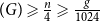 $(G)\geqslant \frac {n}{4} \geqslant \frac {g}{1024}$
. In short, there are graphs
$(G)\geqslant \frac {n}{4} \geqslant \frac {g}{1024}$
. In short, there are graphs $G$
with Euler genus
$G$
with Euler genus $g$
and tree-tw
$g$
and tree-tw $(G)\in \Omega (g)$
. That is, in any tree-decomposition of
$(G)\in \Omega (g)$
. That is, in any tree-decomposition of $G$
(regardless of the size of the bags), some bag induces a subgraph with treewidth
$G$
(regardless of the size of the bags), some bag induces a subgraph with treewidth $\Omega (g)$
. Nevertheless, grid minors in bags can be limited using the following lemma by Geelen, Richter, and Salazar [Reference Geelen, Richter and Salazar54].
$\Omega (g)$
. Nevertheless, grid minors in bags can be limited using the following lemma by Geelen, Richter, and Salazar [Reference Geelen, Richter and Salazar54].
Lemma 22 [Reference Geelen, Richter and Salazar54, Lemma 4]. Let $t,k,n$
be positive integers such that
$t,k,n$
be positive integers such that $n \geqslant t(k+1)$
. Let
$n \geqslant t(k+1)$
. Let $G$
be an
$G$
be an $n \times n$
grid graph. If
$n \times n$
grid graph. If $G$
is embedded in a surface
$G$
is embedded in a surface $\Sigma$
of Euler genus at most
$\Sigma$
of Euler genus at most $t^2-1$
, then some
$t^2-1$
, then some $k \times k$
subgrid of
$k \times k$
subgrid of $G$
is embedded in a closed disc
$G$
is embedded in a closed disc $D$
in
$D$
in $\Sigma$
such that the boundary cycle of the
$\Sigma$
such that the boundary cycle of the $k \times k$
grid is the boundary of
$k \times k$
grid is the boundary of $D$
.
$D$
.
Lemma 23.
For any graph $G$
of Euler genus at most
$G$
of Euler genus at most $g$
, if
$g$
, if $S\subseteq V(G)$
and the
$S\subseteq V(G)$
and the $4\lceil {\sqrt {g+1}\ }\rceil \times 4\lceil {\sqrt {g+1}\ }\rceil$
grid is a minor of
$4\lceil {\sqrt {g+1}\ }\rceil \times 4\lceil {\sqrt {g+1}\ }\rceil$
grid is a minor of $G[S]$
, then
$G[S]$
, then $S$
is breakable.
$S$
is breakable.
Proof. Let $t\;:\!=\;\lceil {\sqrt {g+1}\ }\rceil$
. So
$t\;:\!=\;\lceil {\sqrt {g+1}\ }\rceil$
. So $g\leqslant t^2-1$
, and
$g\leqslant t^2-1$
, and $G$
embeds in a surface
$G$
embeds in a surface $\Sigma$
of Euler genus at most
$\Sigma$
of Euler genus at most $t^2-1$
. Let
$t^2-1$
. Let $k\;:\!=\;3$
and
$k\;:\!=\;3$
and $n\;:\!=\;4t$
. By assumption, the
$n\;:\!=\;4t$
. By assumption, the $n\times n$
grid is a minor of
$n\times n$
grid is a minor of $G[S]$
. Let
$G[S]$
. Let $G'$
be the
$G'$
be the $n\times n$
grid, embedded in
$n\times n$
grid, embedded in $\Sigma$
, obtained from
$\Sigma$
, obtained from $G[S]$
by appropriate contractions and deletions. By Lemma22, some
$G[S]$
by appropriate contractions and deletions. By Lemma22, some $3 \times 3$
subgrid
$3 \times 3$
subgrid $G''$
of
$G''$
of $G'$
is embedded in a closed disc
$G'$
is embedded in a closed disc $D_0$
in
$D_0$
in $\Sigma$
such that the boundary cycle
$\Sigma$
such that the boundary cycle $C_0$
of the subgrid is the boundary of
$C_0$
of the subgrid is the boundary of $D_0$
. Note that
$D_0$
. Note that $G'-V(G'')$
is connected, and that at least
$G'-V(G'')$
is connected, and that at least $3$
or the four corner vertices of
$3$
or the four corner vertices of $G''$
have neighbours in
$G''$
have neighbours in $G'-V(G'')$
. Thus
$G'-V(G'')$
. Thus $G'-V(G'')$
is embedded in
$G'-V(G'')$
is embedded in $\Sigma -D_0$
. The branch sets corresponding to
$\Sigma -D_0$
. The branch sets corresponding to $C_0$
contain a cycle
$C_0$
contain a cycle $C$
in
$C$
in $G[S]$
bounding a disc
$G[S]$
bounding a disc $D$
, where there is at least one vertex of
$D$
, where there is at least one vertex of $S$
in the interior of
$S$
in the interior of $D$
(corresponding to the internal vertex of the
$D$
(corresponding to the internal vertex of the $3\times 3$
grid), and there is at least one vertex of
$3\times 3$
grid), and there is at least one vertex of $S$
in
$S$
in $\Sigma -D$
. Let
$\Sigma -D$
. Let $A$
be the set of all vertices of
$A$
be the set of all vertices of $G$
embedded in
$G$
embedded in $D$
(including the boundary). Let
$D$
(including the boundary). Let $B$
be the set of all vertices of
$B$
be the set of all vertices of $G$
embedded in
$G$
embedded in $\Sigma -D$
plus the vertices on the boundary of
$\Sigma -D$
plus the vertices on the boundary of $D$
. So
$D$
. So $(A,B)$
is a separation of
$(A,B)$
is a separation of $G$
that breaks
$G$
that breaks $S$
.
$S$
.
Lemma23 implies that in addition to the properties in Lemma21, in every refined tree-decomposition of a graph with Euler genus $g$
, the subgraph induced by each bag has no
$g$
, the subgraph induced by each bag has no $4\lceil {\sqrt {g+1}\ }\rceil \times 4\lceil {\sqrt {g+1}\ }\rceil$
grid minor. In particular:
$4\lceil {\sqrt {g+1}\ }\rceil \times 4\lceil {\sqrt {g+1}\ }\rceil$
grid minor. In particular:
Theorem 24.
For any integer $g\geqslant 1$
, every graph
$g\geqslant 1$
, every graph $G$
with Euler genus at most
$G$
with Euler genus at most $g$
has an optimal tree-decomposition
$g$
has an optimal tree-decomposition $(B_x\;:\;x\in V(T))$
, such that for each
$(B_x\;:\;x\in V(T))$
, such that for each $x\in V(T)$
:
$x\in V(T)$
:
-
•
$G[B_x]$
has no
$K_{2,4g+2}$
minor,
-
•
$\mathrm {tw}(G[B_x])\leqslant 4g+2$
, -
•
$G[B_x]$
has no
$4\lceil {\sqrt {g+1}\ }\rceil \times 4\lceil {\sqrt {g+1}\ }\rceil$
grid minor.





6.
$K_p$
-minor-free graphs

This section proves Theorem3, which shows that for fixed $p$
, every
$p$
, every $K_p$
-minor-free graph has an optimal tree-decomposition with bags of bounded treewidth.
$K_p$
-minor-free graph has an optimal tree-decomposition with bags of bounded treewidth.
We begin by defining walls. For positive integers $m$
and
$m$
and $n$
, the
$n$
, the $m\times n$
-grid is the graph with vertex set
$m\times n$
-grid is the graph with vertex set $\{1,\ldots ,m\}\times \{1,\ldots ,n\}$
such that vertices
$\{1,\ldots ,m\}\times \{1,\ldots ,n\}$
such that vertices $(i,j)$
and
$(i,j)$
and $(i',j')$
are adjacent if and only if
$(i',j')$
are adjacent if and only if $|i-i'|+|j-j'|=1$
. The elementary
$|i-i'|+|j-j'|=1$
. The elementary $h$
-wall
$h$
-wall $W_h$
is the graph obtained from the
$W_h$
is the graph obtained from the $2h\times h$
-grid by deleting every edge of the form
$2h\times h$
-grid by deleting every edge of the form $(i,j)(i+1,j)$
with
$(i,j)(i+1,j)$
with $i+j$
even, and then deleting the two vertices of degree
$i+j$
even, and then deleting the two vertices of degree $1$
in the resulting graph. For each
$1$
in the resulting graph. For each $i\in [h]$
, the path of
$i\in [h]$
, the path of $W_h$
induced by the vertices of the form
$W_h$
induced by the vertices of the form $(2i-1,j)$
together with the vertices of the form
$(2i-1,j)$
together with the vertices of the form $(2i,j)$
is a column of
$(2i,j)$
is a column of $W_h$
, and the path induced by the vertices of the form
$W_h$
, and the path induced by the vertices of the form $(j,i)$
is a row of
$(j,i)$
is a row of $W_h$
. An
$W_h$
. An $h$
-wall is a graph that is isomorphic to a subdivision of the elementary
$h$
-wall is a graph that is isomorphic to a subdivision of the elementary $h$
-wall. We always implicitly fix such an isomorphism. We use the following variant of the Grid Minor Theorem of Robertson and Seymour [Reference Robertson and Seymour79].
$h$
-wall. We always implicitly fix such an isomorphism. We use the following variant of the Grid Minor Theorem of Robertson and Seymour [Reference Robertson and Seymour79].
Theorem 25 [Reference Robertson and Seymour79]. There is a function $f$
such that for any integer
$f$
such that for any integer $k\geqslant 1$
, every graph of treewidth at least
$k\geqslant 1$
, every graph of treewidth at least $f(k)$
contains a
$f(k)$
contains a $k$
-wall as a subgraph.
$k$
-wall as a subgraph.
We use the following precursor to the Flat Wall Theorem of Robertson and Seymour [Reference Robertson and Seymour80], which depends on the following definitions. The rows and columns of an $h$
-wall are the paths corresponding to the rows and columns of
$h$
-wall are the paths corresponding to the rows and columns of $W_h$
, respectively. Any graph that is a
$W_h$
, respectively. Any graph that is a $k$
-wall for some
$k$
-wall for some $k$
is a wall, and we say its height is
$k$
is a wall, and we say its height is $k$
. A subwall of
$k$
. A subwall of $W_h$
is a subgraph
$W_h$
is a subgraph $H\subseteq W_h$
such that
$H\subseteq W_h$
such that $H$
is a wall, each column of
$H$
is a wall, each column of $H$
is contained in a column of
$H$
is contained in a column of $W_h$
and each row of
$W_h$
and each row of $H$
is contained in a row of
$H$
is contained in a row of $W_h$
. The subwalls of a wall
$W_h$
. The subwalls of a wall $W$
of height
$W$
of height $h$
are the corresponding subgraphs of
$h$
are the corresponding subgraphs of $W$
. The perimeter of
$W$
. The perimeter of $W_h$
is the unique shortest cycle containing all degree
$W_h$
is the unique shortest cycle containing all degree $2$
vertices, and the perimeter of an
$2$
vertices, and the perimeter of an $h$
-wall
$h$
-wall $W$
is the corresponding cycle of
$W$
is the corresponding cycle of $W$
. Given a wall
$W$
. Given a wall $W$
in a graph
$W$
in a graph $G$
, a subwall
$G$
, a subwall $H$
of
$H$
of $W$
is dividing if every path in
$W$
is dividing if every path in $G$
from
$G$
from $H$
to the perimeter of
$H$
to the perimeter of $W$
contains a vertex in the perimeter of
$W$
contains a vertex in the perimeter of $H$
. For a wall
$H$
. For a wall $W$
, define a distance function
$W$
, define a distance function $\hat {d}_W$
, where
$\hat {d}_W$
, where $\hat {d}_W(v,v)=0$
for all
$\hat {d}_W(v,v)=0$
for all $v\in V(W)$
, and for distinct
$v\in V(W)$
, and for distinct $v,w\in V(W)$
,
$v,w\in V(W)$
, $\hat {d}_W(v,w)$
is the minimum integer
$\hat {d}_W(v,w)$
is the minimum integer $k$
such that for some planar embedding of
$k$
such that for some planar embedding of $W$
there is curve in the plane from
$W$
there is curve in the plane from $v$
to
$v$
to $w$
that intersects only
$w$
that intersects only $k$
points of the drawing (including
$k$
points of the drawing (including $v$
and
$v$
and $w$
).
$w$
).
Theorem 26 [Reference Robertson and Seymour80, (9.3)]. For any integer $p\geqslant 1$
there exists
$p\geqslant 1$
there exists $k,r\geqslant 0$
such that given a wall
$k,r\geqslant 0$
such that given a wall $W$
in a
$W$
in a $K_p$
-minor-free graph
$K_p$
-minor-free graph $G$
and subwalls
$G$
and subwalls $H_1,H_2, \ldots , H_t$
with
$H_1,H_2, \ldots , H_t$
with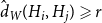 $\hat {d}_W(H_i,H_j)\geqslant r$
for all distinct
$\hat {d}_W(H_i,H_j)\geqslant r$
for all distinct $i,j\in \{1,\ldots ,t\}$
, there is a subset
$i,j\in \{1,\ldots ,t\}$
, there is a subset $X\subseteq V(G)$
of size at most
$X\subseteq V(G)$
of size at most $\binom {p}{2}$
and a subset
$\binom {p}{2}$
and a subset $I\subseteq \{1,\ldots ,t\}$
of size at least
$I\subseteq \{1,\ldots ,t\}$
of size at least $t-k$
such that for all
$t-k$
such that for all $i\in I$
,
$i\in I$
, $H_i$
is dividing in
$H_i$
is dividing in $(G-X)\cup W$
.
$(G-X)\cup W$
.
Lemma 27.
For any integer $p\geqslant 1$
there exists an integer
$p\geqslant 1$
there exists an integer $c_p$
such that for every
$c_p$
such that for every $K_p$
-minor-free graph
$K_p$
-minor-free graph $G$
, every irreducible set
$G$
, every irreducible set $S\subseteq V(G)$
satisfies
$S\subseteq V(G)$
satisfies $\mathrm {tw}(G[S])\leqslant c_p$
.
$\mathrm {tw}(G[S])\leqslant c_p$
.
Proof. Let $r,k\geqslant 0$
be integers as in Theorem26, let
$r,k\geqslant 0$
be integers as in Theorem26, let $p^*=\max \{\binom {p}{2},2r(k+1)+(k+1)(p+2)\}$
, and let
$p^*=\max \{\binom {p}{2},2r(k+1)+(k+1)(p+2)\}$
, and let $c_p=f(p^*)$
, where
$c_p=f(p^*)$
, where $f$
is from Theorem25. Assume that
$f$
is from Theorem25. Assume that $\mathrm {tw}(G[S])\geqslant c_p$
. Our goal is to show that
$\mathrm {tw}(G[S])\geqslant c_p$
. Our goal is to show that $S$
is reducible. By Theorem25,
$S$
is reducible. By Theorem25, $G[S]$
contains a
$G[S]$
contains a $p^*$
-wall
$p^*$
-wall $W$
as a subgraph. As illustrated in Figure 2, in
$W$
as a subgraph. As illustrated in Figure 2, in $W$
there are:
$W$
there are:
-
•
$k+1$
pairwise disjoint subwalls
$H_1,\ldots , H_{k+1}$
, each of height
$p+2$
and disjoint from the perimeter of
$W$
, and -
• for each
$i\in \{1,\ldots ,k+1\}$
there is a set
$\mathcal{C}_i$
of
$r$
pairwise disjoint cycles in
$W$
, each disjoint from
$H_1\cup \ldots \cup H_{k+1}$
, such that each
$C\in \mathcal{C}_i$
separates
$H_i$
and
$\bigcup \{H_j\;:\;j\neq i]\}$
.








Since $W$
is a subdivision of a 3-connected planar graph, by a theorem of Whitney [Reference Whitney85],
$W$
is a subdivision of a 3-connected planar graph, by a theorem of Whitney [Reference Whitney85], $W$
has a unique embedding in the plane (up to the choice of the outerface). In this embedding, any curve in the plane from
$W$
has a unique embedding in the plane (up to the choice of the outerface). In this embedding, any curve in the plane from $H_i$
to
$H_i$
to $H_j$
(for
$H_j$
(for $i\neq j$
) must intersect each cycle
$i\neq j$
) must intersect each cycle $C\in \mathcal{C}_i$
. Thus
$C\in \mathcal{C}_i$
. Thus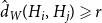 $\hat {d}_W(H_i,H_j)\geqslant r$
, and so by Theorem26 there is some
$\hat {d}_W(H_i,H_j)\geqslant r$
, and so by Theorem26 there is some $X\subseteq V(G)$
of size at most
$X\subseteq V(G)$
of size at most $\binom {p}{2}$
and some
$\binom {p}{2}$
and some $i\in \{1,\ldots , k+1\}$
such that
$i\in \{1,\ldots , k+1\}$
such that $H_i$
is dividing in
$H_i$
is dividing in $(G-X)\cup W$
. Let
$(G-X)\cup W$
. Let $S'$
be the union of
$S'$
be the union of $X$
and the vertex set
$X$
and the vertex set $\mathrm {per}(H_i)$
of the perimeter of
$\mathrm {per}(H_i)$
of the perimeter of $H_i$
. Let
$H_i$
. Let $A$
be the union of
$A$
be the union of $S'$
and the vertex sets of all components of
$S'$
and the vertex sets of all components of $G-S'$
that intersect the perimeter of
$G-S'$
that intersect the perimeter of $W$
. Let
$W$
. Let $B\;:\!=\; V(G)\setminus (A\setminus S')$
. So
$B\;:\!=\; V(G)\setminus (A\setminus S')$
. So $(A,B)$
is a separation of
$(A,B)$
is a separation of $G$
with
$G$
with $A\cap B=S'$
and
$A\cap B=S'$
and $V(H_i)\subseteq B$
. Let
$V(H_i)\subseteq B$
. Let $X_W$
be the vertex set of the perimeter of
$X_W$
be the vertex set of the perimeter of $W$
, and note that
$W$
, and note that $|(S\cup A)\cap B|\leqslant |S|-|X_W|+|X|$
, which is less than
$|(S\cup A)\cap B|\leqslant |S|-|X_W|+|X|$
, which is less than $|S|$
since
$|S|$
since $|X_W|\gt p^*\geqslant \binom {p}{2}\geqslant |X|$
. Likewise
$|X_W|\gt p^*\geqslant \binom {p}{2}\geqslant |X|$
. Likewise $|(S\cup B)\cap A|\leqslant |S|-|V(H_i)|+|S'|$
, which is less than
$|(S\cup B)\cap A|\leqslant |S|-|V(H_i)|+|S'|$
, which is less than $|S|$
since there are at least
$|S|$
since there are at least $p^2$
vertices of
$p^2$
vertices of $H_i$
that are not in the perimeter of
$H_i$
that are not in the perimeter of $H_i$
, there are at most
$H_i$
, there are at most $\binom {p}{2}$
vertices of
$\binom {p}{2}$
vertices of $S'$
that are not in the perimeter of
$S'$
that are not in the perimeter of $H_i$
, and all vertices in the perimeter of
$H_i$
, and all vertices in the perimeter of $H_i$
are in
$H_i$
are in $S\cap S'$
. Thus
$S\cap S'$
. Thus $S$
is reducible, as required.
$S$
is reducible, as required.
Subwalls $H_1,\ldots ,H_{k+1}$
, and cycle collections
$H_1,\ldots ,H_{k+1}$
, and cycle collections $\mathcal{C}_1,\ldots ,\mathcal{C}_{k+1}$
.
$\mathcal{C}_1,\ldots ,\mathcal{C}_{k+1}$
.

Lemmas12 and 27 imply the next result, which implies Theorem3.
Theorem 28.
For any integer $p\geqslant 1$
there exists an integer
$p\geqslant 1$
there exists an integer $c_p$
such that for every
$c_p$
such that for every $K_p$
-minor-free graph
$K_p$
-minor-free graph $G$
, for every bag
$G$
, for every bag $B$
of any atomic tree-decomposition of
$B$
of any atomic tree-decomposition of $G$
, we have
$G$
, we have $\mathrm {tw}(G[B])\leqslant c_p$
.
$\mathrm {tw}(G[B])\leqslant c_p$
.
Much work has gone into optimising the bounds in the Grid Minor Theorem [Reference Chekuri and Chuzhoy22, Reference Chuzhoy34, Reference Chuzhoy and Tan35] and the Flat Wall Theorem [Reference Chuzhoy34, Reference Gorsky, Seweryn and Wiederrecht55, Reference Kawarabayashi, Thomas and Wollan64]. These results imply polynomial bounds for the functions in Theorems25 and 26, and thus for the implicit function in Lemma27 and Theorem 28. See [Reference Gorsky, Seweryn and Wiederrecht55] for an in-depth discussion of these results.
7. 1-planar graphs
This section proves our negative results for 1-planar graphs introduced in Section 1. The following notation is helpful. For a tree $T$
and edge
$T$
and edge $xy\in E(T)$
, let
$xy\in E(T)$
, let $T_{x:y}$
and
$T_{x:y}$
and $T_{y:x}$
be the subtrees of
$T_{y:x}$
be the subtrees of $T-xy$
respectively containing
$T-xy$
respectively containing $x$
and
$x$
and $y$
. For a tree-decomposition
$y$
. For a tree-decomposition $(B_x\;:\;x\in V(T))$
of a graph
$(B_x\;:\;x\in V(T))$
of a graph $G$
and for each edge
$G$
and for each edge $xy\in E(T)$
, let
$xy\in E(T)$
, let ${G_{x:y}}\;:\!=\; G[ \bigcup \{ B_z\setminus B_y \;:\;z\in V(T_{x:y}) \}]$
.
${G_{x:y}}\;:\!=\; G[ \bigcup \{ B_z\setminus B_y \;:\;z\in V(T_{x:y}) \}]$
.
Lemma 29.
Let $c$
be a positive integer,
$c$
be a positive integer, $G$
be a graph and
$G$
be a graph and $S$
be a set of vertices in
$S$
be a set of vertices in $G$
such that for any collection
$G$
such that for any collection $\{\{a_1,b_1\},\ldots , \{a_z,b_z\}\}$
of disjoint pairs of vertices in
$\{\{a_1,b_1\},\ldots , \{a_z,b_z\}\}$
of disjoint pairs of vertices in $S$
, there is a collection
$S$
, there is a collection $\{P_{i,j}\;:\;i\in \{1,\ldots , z\},j\in \{1,\ldots , 2c+4\}\}$
of internally disjoint paths, each internally disjoint from
$\{P_{i,j}\;:\;i\in \{1,\ldots , z\},j\in \{1,\ldots , 2c+4\}\}$
of internally disjoint paths, each internally disjoint from $S$
, such that for each
$S$
, such that for each $i\in \{1,\ldots , z\}$
and
$i\in \{1,\ldots , z\}$
and $j\in \{1,\ldots , 2c+4\}$
the endvertices of
$j\in \{1,\ldots , 2c+4\}$
the endvertices of $P_{i,j}$
are
$P_{i,j}$
are $a_i$
and
$a_i$
and $b_i$
. For any tree-decomposition of
$b_i$
. For any tree-decomposition of $G$
of width less than
$G$
of width less than $|S|+c$
, some bag contains
$|S|+c$
, some bag contains $S$
.
$S$
.
Proof. Consider any tree-decomposition ${\mathcal{D}}=(B_x\;:\;x\in V(T))$
of
${\mathcal{D}}=(B_x\;:\;x\in V(T))$
of $G$
in which no bag contains
$G$
in which no bag contains $S$
. Our goal is to show that
$S$
. Our goal is to show that $\mathcal{D}$
has width at least
$\mathcal{D}$
has width at least $|S|+c$
. For every edge
$|S|+c$
. For every edge $xy\in E(T)$
, orient
$xy\in E(T)$
, orient $xy$
towards
$xy$
towards $x$
if
$x$
if $G_{x:y}$
has more vertices of
$G_{x:y}$
has more vertices of $S$
than
$S$
than $G_{y:x}$
, orient
$G_{y:x}$
, orient $xy$
towards
$xy$
towards $y$
if
$y$
if $G_{y:x}$
has more vertices of
$G_{y:x}$
has more vertices of $S$
than
$S$
than $G_{x:y}$
, and otherwise orient
$G_{x:y}$
, and otherwise orient $xy$
arbitrarily. Let
$xy$
arbitrarily. Let $t_0$
be a sink of the resulting oriented tree, and let
$t_0$
be a sink of the resulting oriented tree, and let $t_1,\ldots ,t_d$
be the neighbours of
$t_1,\ldots ,t_d$
be the neighbours of $t_0$
. For each
$t_0$
. For each $i\in \{1,\ldots , d\}$
, let
$i\in \{1,\ldots , d\}$
, let $S_i\;:\!=\;S\cap V(G_{t_i:t_0})$
, and let
$S_i\;:\!=\;S\cap V(G_{t_i:t_0})$
, and let $S_0\;:\!=\;S\setminus \bigcup \{S_1,\ldots ,S_d\}$
. Without loss of generality,
$S_0\;:\!=\;S\setminus \bigcup \{S_1,\ldots ,S_d\}$
. Without loss of generality, $|S_1|=\max \{|S_1|,\ldots ,|S_d|\}$
.
$|S_1|=\max \{|S_1|,\ldots ,|S_d|\}$
.
First consider the case where $2|S_1|\geqslant |S\setminus S_0|$
. Since
$2|S_1|\geqslant |S\setminus S_0|$
. Since $t_0$
is a sink,
$t_0$
is a sink, $|S_1|\leqslant |S\setminus B_{t_1}|$
. Thus, there are disjoint pairs
$|S_1|\leqslant |S\setminus B_{t_1}|$
. Thus, there are disjoint pairs $\{a_1,b_1\},\ldots ,\{a_{|S_1|},b_{|S_1|}\}$
, where each
$\{a_1,b_1\},\ldots ,\{a_{|S_1|},b_{|S_1|}\}$
, where each $a_i$
is in
$a_i$
is in $S_1$
and each
$S_1$
and each $b_i$
is in
$b_i$
is in $S\setminus B_{t_1}$
. By assumption, there is a set of internally disjoint paths
$S\setminus B_{t_1}$
. By assumption, there is a set of internally disjoint paths $\{P_{i,j}\;:\;i\in \{1,\ldots ,|S_1|\},j\in \{1,\ldots , 2c+4\}\}$
, each internally disjoint from
$\{P_{i,j}\;:\;i\in \{1,\ldots ,|S_1|\},j\in \{1,\ldots , 2c+4\}\}$
, each internally disjoint from $S$
, such that for each
$S$
, such that for each $i\in \{1,\ldots ,|S_1|\}$
and
$i\in \{1,\ldots ,|S_1|\}$
and $j\in \{1,\ldots , 2c+4\}$
the endpoints of
$j\in \{1,\ldots , 2c+4\}$
the endpoints of $P_{i,j}$
are
$P_{i,j}$
are $a_i$
and
$a_i$
and $b_i$
. By the definition of a tree-decomposition,
$b_i$
. By the definition of a tree-decomposition, $B_{t_0}\cap B_{t_1}$
separates
$B_{t_0}\cap B_{t_1}$
separates $S_1$
from
$S_1$
from $S\setminus B_{t_1}$
in
$S\setminus B_{t_1}$
in $G$
, and so
$G$
, and so $B_{t_0}\cap B_{t_1}$
contains a vertex of each of these paths. Since
$B_{t_0}\cap B_{t_1}$
contains a vertex of each of these paths. Since $\{a_1,\ldots ,a_{|S_1|}\}\cap B_{t_0}=\varnothing$
and
$\{a_1,\ldots ,a_{|S_1|}\}\cap B_{t_0}=\varnothing$
and $\{b_1,\ldots ,b_{|S_1|}\}\cap B_{t_1}=\varnothing$
and each path is internally disjoint from
$\{b_1,\ldots ,b_{|S_1|}\}\cap B_{t_1}=\varnothing$
and each path is internally disjoint from $S$
, we have
$S$
, we have $|(B_{t_0}\cap B_{t_1})\setminus S|\geqslant (2c+4)|S_1|$
. Thus,
$|(B_{t_0}\cap B_{t_1})\setminus S|\geqslant (2c+4)|S_1|$
. Thus, $|B_{t_0}|\geqslant |S_0|+(2c+4)|S_1|\geqslant |S_0|+(c+2)|S\setminus S_0|$
. By assumption
$|B_{t_0}|\geqslant |S_0|+(2c+4)|S_1|\geqslant |S_0|+(c+2)|S\setminus S_0|$
. By assumption $S$
is not a subset of
$S$
is not a subset of $B_{t_0}$
, so
$B_{t_0}$
, so $|S\setminus S_0|\geqslant 1$
and
$|S\setminus S_0|\geqslant 1$
and $|B_{t_0}|\geqslant |S|+c+1$
.
$|B_{t_0}|\geqslant |S|+c+1$
.
Now consider the case where $2|S_1|\leqslant |S\setminus S_0|-1$
. Let
$2|S_1|\leqslant |S\setminus S_0|-1$
. Let $\mathcal{X}=\{\{a_1,b_1\},\ldots ,\{a_z,b_z\}\}$
be a maximum sized collection of disjoint pairs of vertices such that each set
$\mathcal{X}=\{\{a_1,b_1\},\ldots ,\{a_z,b_z\}\}$
be a maximum sized collection of disjoint pairs of vertices such that each set $\{a_i,b_i\}$
intersects exactly two sets in
$\{a_i,b_i\}$
intersects exactly two sets in $\{S_1,\ldots ,S_d\}$
. Suppose for contradiction that
$\{S_1,\ldots ,S_d\}$
. Suppose for contradiction that $2z\leqslant |\bigcup \{S_1,\ldots ,S_d\}|-2$
. Then for some
$2z\leqslant |\bigcup \{S_1,\ldots ,S_d\}|-2$
. Then for some $i\in \{1,\ldots ,d\}$
there are at least two vertices
$i\in \{1,\ldots ,d\}$
there are at least two vertices $v$
and
$v$
and $w$
in
$w$
in $S_i$
that are not in a pair in
$S_i$
that are not in a pair in $\mathcal{X}$
, and all vertices in
$\mathcal{X}$
, and all vertices in $S\setminus (S_0\cup S_i)$
are in a pair in
$S\setminus (S_0\cup S_i)$
are in a pair in $\mathcal{X}$
. Since
$\mathcal{X}$
. Since $|S_i|\leqslant |S_1|$
and
$|S_i|\leqslant |S_1|$
and $2|S_1|\lt |S\setminus S_0|$
, we have
$2|S_1|\lt |S\setminus S_0|$
, we have $|S_i|\lt |S\setminus (S_0\cup S_i)|$
, there is a pair
$|S_i|\lt |S\setminus (S_0\cup S_i)|$
, there is a pair $\{a_j,b_j\}$
in
$\{a_j,b_j\}$
in $\mathcal{X}$
that is disjoint from
$\mathcal{X}$
that is disjoint from $S_i$
. Replacing
$S_i$
. Replacing $\{a_j,b_j\}$
by
$\{a_j,b_j\}$
by $\{v,a_j\}$
and
$\{v,a_j\}$
and $\{b_j,w\}$
increases the size of
$\{b_j,w\}$
increases the size of $\mathcal{X}$
, yielding the desired contradiction. Thus,
$\mathcal{X}$
, yielding the desired contradiction. Thus, $2z\geqslant | S_1\cup \ldots \cup S_d|-1=|S\setminus S_0|-1$
. By construction, there is a set of internally disjoint paths
$2z\geqslant | S_1\cup \ldots \cup S_d|-1=|S\setminus S_0|-1$
. By construction, there is a set of internally disjoint paths $\{P_{i,j}\;:\;i\in \{1,\ldots ,z\},j\in \{1,\ldots , 2c+4\}\}$
, each internally disjoint from
$\{P_{i,j}\;:\;i\in \{1,\ldots ,z\},j\in \{1,\ldots , 2c+4\}\}$
, each internally disjoint from $S$
, such that for each
$S$
, such that for each $i\in \{1,\ldots ,|S_1|\}$
and
$i\in \{1,\ldots ,|S_1|\}$
and $j\in \{1,\ldots , 2c+4\}$
the endpoints of
$j\in \{1,\ldots , 2c+4\}$
the endpoints of $P_{i,j}$
are
$P_{i,j}$
are $a_i$
and
$a_i$
and $b_i$
. Note that for distinct
$b_i$
. Note that for distinct $i,j\in \{1,\ldots ,d\}$
, the set
$i,j\in \{1,\ldots ,d\}$
, the set $B_{t_0}$
separates
$B_{t_0}$
separates $S_i$
from
$S_i$
from $S_j$
in
$S_j$
in $G$
. Thus,
$G$
. Thus, $B_{t_0}$
contains an internal vertex of each of these paths, and so
$B_{t_0}$
contains an internal vertex of each of these paths, and so $|B_{t_0}|\geqslant |S_0|+(2c+4)z\geqslant |S_0|+(c+2)(|S\setminus S_0|-1)$
. By assumption
$|B_{t_0}|\geqslant |S_0|+(2c+4)z\geqslant |S_0|+(c+2)(|S\setminus S_0|-1)$
. By assumption $S\not \subseteq B_{t_0}$
, so
$S\not \subseteq B_{t_0}$
, so $|S_1|\geqslant 1$
and
$|S_1|\geqslant 1$
and $|S\setminus S_0|\geqslant 2|S_1|+1\geqslant 3$
. Thus,
$|S\setminus S_0|\geqslant 2|S_1|+1\geqslant 3$
. Thus, $|B_{t_0}|\geqslant (|S|-1)+2(c+1)\gt |S|+c+1$
.
$|B_{t_0}|\geqslant (|S|-1)+2(c+1)\gt |S|+c+1$
.
In both cases, $\mathcal{D}$
has width at least
$\mathcal{D}$
has width at least $|B_{t_0}|-1\geqslant |S|+c$
. Thus, every tree-decomposition of
$|B_{t_0}|-1\geqslant |S|+c$
. Thus, every tree-decomposition of $G$
with width less than
$G$
with width less than $|S|+c$
has a bag containing
$|S|+c$
has a bag containing $S$
.
$S$
.
The following result implies and strengthens Theorem4 by taking $G_0$
to be any graph with sufficiently large treewidth (such as a large complete graph or large grid).
$G_0$
to be any graph with sufficiently large treewidth (such as a large complete graph or large grid).
Theorem 30.
For any integer $c\geqslant 0$
and graph
$c\geqslant 0$
and graph $G_0$
there is a
$G_0$
there is a $1$
-planar graph
$1$
-planar graph $G$
such that every tree-decomposition of
$G$
such that every tree-decomposition of $G$
with width less than
$G$
with width less than $\mathrm {tw}(G)+c$
has a bag
$\mathrm {tw}(G)+c$
has a bag $B$
such that
$B$
such that $G_0$
is a topological minor of
$G_0$
is a topological minor of $G[B]$
.
$G[B]$
.
Proof. Draw $G_0$
in the plane (allowing crossings), and let
$G_0$
in the plane (allowing crossings), and let $H$
be the planarisation of this drawing (that is, introduce a new vertex in
$H$
be the planarisation of this drawing (that is, introduce a new vertex in $H$
at each crossing). We introduce
$H$
at each crossing). We introduce $H$
simply to make it easier to talk about the drawing, it has not no essential role in the construction. Let
$H$
simply to make it easier to talk about the drawing, it has not no essential role in the construction. Let $T^*$
be a rooted spanning tree of the dual of
$T^*$
be a rooted spanning tree of the dual of $H$
. Let
$H$
. Let $f_0,f_1,\ldots , f_s$
be the faces of
$f_0,f_1,\ldots , f_s$
be the faces of $H$
(equivalently, vertices of
$H$
(equivalently, vertices of $T^*$
) ordered so that
$T^*$
) ordered so that $f_s$
is the root of
$f_s$
is the root of $T^*$
, and for each edge
$T^*$
, and for each edge $f_if_j$
in
$f_if_j$
in $T^*$
, if
$T^*$
, if $i\lt j$
then
$i\lt j$
then $f_j$
is the parent of
$f_j$
is the parent of $f_i$
; we denote this edge
$f_i$
; we denote this edge $f_if_j$
by
$f_if_j$
by $e_i$
.
$e_i$
.
We will construct a $1$
-planar graph
$1$
-planar graph $G$
and a set
$G$
and a set $S\subseteq V(G)$
such that
$S\subseteq V(G)$
such that $G[S]$
is a subdivision of
$G[S]$
is a subdivision of $G_0$
. We will then show that
$G_0$
. We will then show that $\mathrm {tw}(G)\leqslant |S|$
and that
$\mathrm {tw}(G)\leqslant |S|$
and that $S$
satisfies the conditions of Lemma29. Let
$S$
satisfies the conditions of Lemma29. Let $V_0$
be the set of vertices of
$V_0$
be the set of vertices of $G_0$
incident to
$G_0$
incident to $f_0$
. For each
$f_0$
. For each $i\in \{1,\ldots ,s\}$
, let
$i\in \{1,\ldots ,s\}$
, let $V_i$
be the set of vertices incident with
$V_i$
be the set of vertices incident with $f_i$
and not incident with any face in
$f_i$
and not incident with any face in $\{f_1,\ldots ,f_{i-1}\}$
. Let
$\{f_1,\ldots ,f_{i-1}\}$
. Let $E_0$
be the set of edges of
$E_0$
be the set of edges of $H$
incident to
$H$
incident to $f_0$
and not dual to edges in
$f_0$
and not dual to edges in $T^*$
, and for each
$T^*$
, and for each $i\in \{1,\ldots ,s\}$
, let
$i\in \{1,\ldots ,s\}$
, let $E_i$
be the set of edges of
$E_i$
be the set of edges of $E(H)\setminus (E_0\cup E_1\cup \cdots \cup E_{i-1})$
that are incident with
$E(H)\setminus (E_0\cup E_1\cup \cdots \cup E_{i-1})$
that are incident with $f_i$
and not dual to the edge
$f_i$
and not dual to the edge $f_if_j$
of
$f_if_j$
of $T^*$
with
$T^*$
with $j\gt i$
. Thus the sets
$j\gt i$
. Thus the sets $E_i$
partition
$E_i$
partition $E(H)$
, and for each
$E(H)$
, and for each $i\in \{1,\ldots , s-1\}$
the edge of
$i\in \{1,\ldots , s-1\}$
the edge of $H$
dual to
$H$
dual to $e_i$
is in
$e_i$
is in $E_j$
where
$E_j$
where $e_i=f_if_j$
with
$e_i=f_if_j$
with $i\lt j$
.
$i\lt j$
.
Iteratively construct $G$
from
$G$
from $G_0$
as follows. First, for each
$G_0$
as follows. First, for each $e\in E_0$
, subdivide the edge-segment of
$e\in E_0$
, subdivide the edge-segment of $G_0$
corresponding to
$G_0$
corresponding to $e$
once. Let
$e$
once. Let $X_0$
be the set of all subdivision vertices introduced in this step, together with
$X_0$
be the set of all subdivision vertices introduced in this step, together with $V_0$
. Now, for each
$V_0$
. Now, for each $v\in X_0$
, and each
$v\in X_0$
, and each $j\in \{0,1,\ldots , s\}$
, create
$j\in \{0,1,\ldots , s\}$
, create $2c+4$
new vertices
$2c+4$
new vertices $a_{v,j,1},a_{v,j,2},\ldots , a_{v,j,2c+4}$
, and draw these vertices in
$a_{v,j,1},a_{v,j,2},\ldots , a_{v,j,2c+4}$
, and draw these vertices in $f_j$
. Draw an edge from
$f_j$
. Draw an edge from $v$
to each of these new vertices that does not cross any edge in
$v$
to each of these new vertices that does not cross any edge in $H$
except those dual to the edges of the path from
$H$
except those dual to the edges of the path from $f_0$
to
$f_0$
to $f_j$
in
$f_j$
in $T^*$
. For each pair of distinct vertices
$T^*$
. For each pair of distinct vertices $v,w\in X_0$
and each
$v,w\in X_0$
and each $y\in \{1,\ldots , 2c+4\}$
, draw an edge from
$y\in \{1,\ldots , 2c+4\}$
, draw an edge from $v$
to
$v$
to $a_{w,0,y}$
in
$a_{w,0,y}$
in $f_0$
. At the final step, we will freely subdivide all edges incident to these newly created vertices, so the number of crossings on these edges is unimportant.
$f_0$
. At the final step, we will freely subdivide all edges incident to these newly created vertices, so the number of crossings on these edges is unimportant.
For $i=1,2,\ldots ,s$
apply the following step. First, for each
$i=1,2,\ldots ,s$
apply the following step. First, for each $e=pq\in E_i$
, subdivide the edge-segment of
$e=pq\in E_i$
, subdivide the edge-segment of $G_0$
corresponding to
$G_0$
corresponding to $e$
once between
$e$
once between $p$
and the first crossing on
$p$
and the first crossing on $e$
starting at
$e$
starting at $p$
, once between
$p$
, once between $q$
and the first crossing on
$q$
and the first crossing on $e$
starting at
$e$
starting at $q$
, and once between each pair of consecutive crossings on
$q$
, and once between each pair of consecutive crossings on $e$
. No future edges will cross
$e$
. No future edges will cross $e$
. Let
$e$
. Let $X_i$
be the the set of all subdivision vertices added to edge-segments corresponding to edges in
$X_i$
be the the set of all subdivision vertices added to edge-segments corresponding to edges in $E_i$
, together with all vertices in
$E_i$
, together with all vertices in $V_i$
. For each
$V_i$
. For each $v\in X_i$
, each
$v\in X_i$
, each $j\in \{i,i+1,\ldots , s\}$
and each
$j\in \{i,i+1,\ldots , s\}$
and each $y\in \{1,\ldots ,2c+4\}$
, create a new vertex
$y\in \{1,\ldots ,2c+4\}$
, create a new vertex $a_{v,j,y}$
and draw this vertex in
$a_{v,j,y}$
and draw this vertex in $f_j$
. Draw an edge from
$f_j$
. Draw an edge from $v$
to each of these new vertices that does not cross any edge in
$v$
to each of these new vertices that does not cross any edge in $H$
except those dual to edges of the path from
$H$
except those dual to edges of the path from $f_i$
to
$f_i$
to $f_j$
in
$f_j$
in $T^*$
. For each pair of distinct vertices
$T^*$
. For each pair of distinct vertices $v\in X_i$
and
$v\in X_i$
and $w\in X_0 \cup \ldots \cup X_i$
and each
$w\in X_0 \cup \ldots \cup X_i$
and each $y\in \{1,\ldots , 2c+4\}$
, draw an edge from
$y\in \{1,\ldots , 2c+4\}$
, draw an edge from $v$
to
$v$
to $a_{w,i,y}$
in
$a_{w,i,y}$
in $f_i$
. These steps may produce arbitrarily many crossings between edges which are not drawn in the image of
$f_i$
. These steps may produce arbitrarily many crossings between edges which are not drawn in the image of $H$
, but we will freely subdivide all such edges in the final step of the construction.
$H$
, but we will freely subdivide all such edges in the final step of the construction.
Let $G'$
be the graph constructed so far. Let
$G'$
be the graph constructed so far. Let $S$
be the set of all vertices in
$S$
be the set of all vertices in $V(G_0)$
together with all subdivision vertices introduced so far (that is, all vertices not of the form
$V(G_0)$
together with all subdivision vertices introduced so far (that is, all vertices not of the form $a_{v,j,y}$
). By construction, the subgraph of
$a_{v,j,y}$
). By construction, the subgraph of $G'$
induced by
$G'$
induced by $S$
is a subdivision of
$S$
is a subdivision of $G_0$
, and every edge in this subgraph is crossed at most once in the entire graph. Subdivide the remaining edges (those incident to vertices of the form
$G_0$
, and every edge in this subgraph is crossed at most once in the entire graph. Subdivide the remaining edges (those incident to vertices of the form $a_{v,j,y}$
) until the resulting graph is
$a_{v,j,y}$
) until the resulting graph is $1$
-planar, and call the final graph
$1$
-planar, and call the final graph $G$
.
$G$
.
We first construct a tree-decomposition of $G'$
. Let
$G'$
. Let $T$
be the star with central vertex
$T$
be the star with central vertex $r$
and leaf-set
$r$
and leaf-set $V(G')\setminus S$
. Set
$V(G')\setminus S$
. Set $B'_r\;:\!=\;S$
and
$B'_r\;:\!=\;S$
and $B'_{w}\;:\!=\;N_{G'}[w]$
for each
$B'_{w}\;:\!=\;N_{G'}[w]$
for each $w\in V(G')\setminus S$
. Since
$w\in V(G')\setminus S$
. Since $V(G')\setminus S$
is an independent set in
$V(G')\setminus S$
is an independent set in $G'$
,
$G'$
, $(B'_x\;:\;x\in V(T))$
is a tree-decomposition of
$(B'_x\;:\;x\in V(T))$
is a tree-decomposition of $G'$
with width
$G'$
with width $|S|$
(since
$|S|$
(since $N_{G'}(w)\subseteq S$
and
$N_{G'}(w)\subseteq S$
and $|B'_{w}| =|N_{G'}[w]| \leqslant |S|+1$
for each
$|B'_{w}| =|N_{G'}[w]| \leqslant |S|+1$
for each $w\in V(G')\setminus S$
). Since
$w\in V(G')\setminus S$
). Since $G$
is a subdivision of
$G$
is a subdivision of $G'$
,
$G'$
, $\mathrm {tw}(G) = \mathrm {tw}(G')\leqslant |S|$
.
$\mathrm {tw}(G) = \mathrm {tw}(G')\leqslant |S|$
.
Now consider an arbitrary collection $\{\{a_1,b_1\},\ldots ,\{a_z,b_z\}\}$
of disjoint pairs of vertices in
$\{\{a_1,b_1\},\ldots ,\{a_z,b_z\}\}$
of disjoint pairs of vertices in $S$
. By construction, for each
$S$
. By construction, for each $i\in \{1,\ldots , z\}$
, there are at least
$i\in \{1,\ldots , z\}$
, there are at least $2c+4$
common neighbours
$2c+4$
common neighbours $a_{v,j,y}$
of
$a_{v,j,y}$
of $a_i$
and
$a_i$
and $b_i$
in
$b_i$
in $G'$
with
$G'$
with $v\in \{a_i,b_i\}$
. Thus there is a collection
$v\in \{a_i,b_i\}$
. Thus there is a collection $\{P_{i,j}\;:\;i\in \{1,\ldots , z\},j\in \{1,\ldots , 2c+4\}\}$
of internally disjoint paths in
$\{P_{i,j}\;:\;i\in \{1,\ldots , z\},j\in \{1,\ldots , 2c+4\}\}$
of internally disjoint paths in $G$
, each internally disjoint from
$G$
, each internally disjoint from $S$
, such that for each
$S$
, such that for each $i\in \{1,\ldots , z\}$
and
$i\in \{1,\ldots , z\}$
and $j\in \{1,\ldots , 2c+4\}$
the endvertices of
$j\in \{1,\ldots , 2c+4\}$
the endvertices of $P_{i,j}$
are
$P_{i,j}$
are $a_i$
and
$a_i$
and $b_i$
. By Lemma29, every tree-decomposition of
$b_i$
. By Lemma29, every tree-decomposition of $G$
of width less than
$G$
of width less than $|S|+c$
(and thus every tree-decomposition of
$|S|+c$
(and thus every tree-decomposition of $G$
of width less than
$G$
of width less than $\mathrm {tw}(G)+c$
) has a bag containing
$\mathrm {tw}(G)+c$
) has a bag containing $S$
.
$S$
.
8. Width
$O(\sqrt {n})$

This section constructs tree-decompositions with bags of bounded treewidth in more general graph classes than those studied above, at the expense that the optimal width condition is relaxed to the asymptotically tight bound of $O(\sqrt {n})$
for
$O(\sqrt {n})$
for $n$
-vertex graphs. In fact, we show that the union of any bounded number of bags induces a subgraph with bounded treewidth.
$n$
-vertex graphs. In fact, we show that the union of any bounded number of bags induces a subgraph with bounded treewidth.
The following definitions are key ingredients to the proofs. A layering of a graph $G$
is an ordered partition
$G$
is an ordered partition $(V_1,\ldots ,V_n)$
of
$(V_1,\ldots ,V_n)$
of $V(G)$
into (possibly empty) sets such that for each edge
$V(G)$
into (possibly empty) sets such that for each edge $vw\in E(G)$
there exists
$vw\in E(G)$
there exists $i\in \{1,2,\ldots ,n-1\}$
such that
$i\in \{1,2,\ldots ,n-1\}$
such that $\{v,w\}\subseteq V_i\cup V_{i+1}$
. The layered treewidth of a graph
$\{v,w\}\subseteq V_i\cup V_{i+1}$
. The layered treewidth of a graph $G$
, denoted by
$G$
, denoted by $\mathrm {ltw}(G)$
, is the minimum nonnegative integer
$\mathrm {ltw}(G)$
, is the minimum nonnegative integer $\ell$
such that
$\ell$
such that $G$
has a tree-decomposition
$G$
has a tree-decomposition $\mathcal{X} = (X_x\;:\;x\in V(T))$
and a layering
$\mathcal{X} = (X_x\;:\;x\in V(T))$
and a layering $(V_1,\ldots ,V_n)$
, such that
$(V_1,\ldots ,V_n)$
, such that $|X_x\cap V_i|\leqslant \ell$
for each bag
$|X_x\cap V_i|\leqslant \ell$
for each bag $X_x$
and layer
$X_x$
and layer $V_i$
. This implies that the subgraph induced by each layer has bounded treewidth, and moreover, a single tree-decomposition of
$V_i$
. This implies that the subgraph induced by each layer has bounded treewidth, and moreover, a single tree-decomposition of $G$
has bounded treewidth when restricted to each layer. In fact, these properties hold when considering a bounded sequence of consecutive layers. Layered treewidth was independently introduced by Dujmović, Morin, and Wood [Reference Dujmović, Morin and Wood52] and Shahrokhi [Reference Shahrokhi82].
$G$
has bounded treewidth when restricted to each layer. In fact, these properties hold when considering a bounded sequence of consecutive layers. Layered treewidth was independently introduced by Dujmović, Morin, and Wood [Reference Dujmović, Morin and Wood52] and Shahrokhi [Reference Shahrokhi82].
The next lemma extends a result of Sergey Norin who proved the $2\sqrt {cn}$
treewidth bound [Reference Dujmović, Morin and Wood52]. Here we choose to present a relatively simple proof rather than optimising the bound on the treewidth of the union of bags.
$2\sqrt {cn}$
treewidth bound [Reference Dujmović, Morin and Wood52]. Here we choose to present a relatively simple proof rather than optimising the bound on the treewidth of the union of bags.
Lemma 31.
Let $G$
be a graph with
$G$
be a graph with $n$
vertices and layered treewidth
$n$
vertices and layered treewidth $c\geqslant 1$
. Then
$c\geqslant 1$
. Then $G$
has a tree-decomposition
$G$
has a tree-decomposition $\mathcal{D}$
with width at most
$\mathcal{D}$
with width at most $2\sqrt {cn}$
, such that the subgraph of
$2\sqrt {cn}$
, such that the subgraph of $G$
induced by the union of any
$G$
induced by the union of any $k$
bags of
$k$
bags of $\mathcal{D}$
has treewidth at most
$\mathcal{D}$
has treewidth at most $(3k+1)c-1$
.
$(3k+1)c-1$
.
Proof. We may assume $c\lt n$
, or else the lemma is satisfied by the trivial tree-decomposition with a single node. Let
$c\lt n$
, or else the lemma is satisfied by the trivial tree-decomposition with a single node. Let $(V_0,V_1,\ldots ,V_m)$
be a layering of
$(V_0,V_1,\ldots ,V_m)$
be a layering of $G$
, and let
$G$
, and let ${\mathcal{D}}\;:\!=\;(B_x\;:\;x\in V(T))$
be a tree-decomposition of
${\mathcal{D}}\;:\!=\;(B_x\;:\;x\in V(T))$
be a tree-decomposition of $G$
, such that
$G$
, such that $|B_x \cap V_i|\leqslant c$
for each
$|B_x \cap V_i|\leqslant c$
for each $x\in V(T)$
and
$x\in V(T)$
and $i\in \{0,1,\ldots ,m\}$
. Let
$i\in \{0,1,\ldots ,m\}$
. Let $p\;:\!=\;\lceil {\sqrt {n/c}}\rceil$
, which is at least
$p\;:\!=\;\lceil {\sqrt {n/c}}\rceil$
, which is at least $2$
since
$2$
since $c\lt n$
. For
$c\lt n$
. For $i\in \{0,1,\ldots ,p-1\}$
let
$i\in \{0,1,\ldots ,p-1\}$
let $\widehat {V}_i\;:\!=\;\bigcup \{V_j:j\equiv i\pmod {p}\}$
. So
$\widehat {V}_i\;:\!=\;\bigcup \{V_j:j\equiv i\pmod {p}\}$
. So $\widehat {V}_0,\widehat {V}_1,\ldots ,\widehat {V}_{p-1}$
is a partition of
$\widehat {V}_0,\widehat {V}_1,\ldots ,\widehat {V}_{p-1}$
is a partition of $V(G)$
, and
$V(G)$
, and $|\widehat {V}_i|\leqslant \frac {n}{p}$
for some
$|\widehat {V}_i|\leqslant \frac {n}{p}$
for some $i\in \{0,1,\ldots ,p-1\}$
. For each component
$i\in \{0,1,\ldots ,p-1\}$
. For each component $C$
of
$C$
of $G-V_i$
, let
$G-V_i$
, let ${\mathcal{D}}_C$
be the tree-decomposition of
${\mathcal{D}}_C$
be the tree-decomposition of $C$
induced by
$C$
induced by $\mathcal{D}$
(so that each of bag in the intersection of some
$\mathcal{D}$
(so that each of bag in the intersection of some $B_x$
with
$B_x$
with $V(C)$
. Each component of
$V(C)$
. Each component of $G-\widehat {V}_i$
is contained within
$G-\widehat {V}_i$
is contained within $p-1$
layers, so
$p-1$
layers, so ${\mathcal{D}}_C$
has width at most
${\mathcal{D}}_C$
has width at most $c(p-1)-1$
. These tree-decompositions can be combined to obtain a tree-decomposition
$c(p-1)-1$
. These tree-decompositions can be combined to obtain a tree-decomposition ${\mathcal{D}}'$
of
${\mathcal{D}}'$
of $G-{V}_i$
of width at most
$G-{V}_i$
of width at most $c(p-1)-1$
. By adding
$c(p-1)-1$
. By adding $V_i$
to every bag of
$V_i$
to every bag of ${\mathcal{D}}'$
, we obtain a tree-decomposition
${\mathcal{D}}'$
, we obtain a tree-decomposition ${\mathcal{D}}''$
of
${\mathcal{D}}''$
of $G$
of width at most
$G$
of width at most $\frac {n}{p}+c(p-1)-1\leqslant 2\sqrt {cn}$
.
$\frac {n}{p}+c(p-1)-1\leqslant 2\sqrt {cn}$
.
Consider arbitrary bags $C_1,\ldots ,C_k$
of
$C_1,\ldots ,C_k$
of ${\mathcal{D}}''$
. By construction, there is a set
${\mathcal{D}}''$
. By construction, there is a set $S\subseteq V(T)$
with
$S\subseteq V(T)$
with $|S|\leqslant k$
such that
$|S|\leqslant k$
such that $C_1\cup \ldots \cup C_k\subseteq X\;:\!=\; \widehat {V}_i\cup \bigcup \{B_x\;:\;x\in S\}$
. We now construct a tree-decomposition of
$C_1\cup \ldots \cup C_k\subseteq X\;:\!=\; \widehat {V}_i\cup \bigcup \{B_x\;:\;x\in S\}$
. We now construct a tree-decomposition of $G[X]$
with width at most
$G[X]$
with width at most $(3k+1)c-1$
, which implies that
$(3k+1)c-1$
, which implies that $\mathrm {tw}( G[C_1\cup \ldots \cup C_k] )\leqslant (3k+1)c-1$
as desired.
$\mathrm {tw}( G[C_1\cup \ldots \cup C_k] )\leqslant (3k+1)c-1$
as desired.
Fix a vertex $r$
of
$r$
of $T$
. Let
$T$
. Let $T_j$
be a copy of
$T_j$
be a copy of $T$
for each
$T$
for each $j\equiv i \pmod {p}$
, where these copies are pairwise disjoint. For each
$j\equiv i \pmod {p}$
, where these copies are pairwise disjoint. For each $x\in V(T)$
, let
$x\in V(T)$
, let $x_j$
be the copy of
$x_j$
be the copy of $x$
in
$x$
in $T_j$
. Let
$T_j$
. Let $P\;:\!=\;(y_0,y_1,\ldots ,y_m)$
be a path, where
$P\;:\!=\;(y_0,y_1,\ldots ,y_m)$
be a path, where $y_j$
is identified with the vertex
$y_j$
is identified with the vertex $r_j$
whenever
$r_j$
whenever $j\equiv i\pmod {p}$
. We obtain a tree
$j\equiv i\pmod {p}$
. We obtain a tree $U\;:\!=\;P\cup \bigcup \{T_j:j\equiv i\pmod {p}\}$
. For each node
$U\;:\!=\;P\cup \bigcup \{T_j:j\equiv i\pmod {p}\}$
. For each node $x_j\in V(U)$
, let
$x_j\in V(U)$
, let
 \begin{equation*}A_{x_j}\;:\!=\; (B_x\cap V_j)\cup \bigcup \{ ( V_{j-1} \cup V_j \cup V_{j+1}) \cap B_z \;:\; z\in S\}.\end{equation*}
For each node $y_j\in V(U)$
with
$y_j\in V(U)$
with $j\not \equiv i\pmod {p}$
, let
$j\not \equiv i\pmod {p}$
, let
 \begin{equation*}A_{y_j}\;:\!=\; \bigcup \{ (V_{j-1} \cup V_j \cup V_{j+1} )\cap B_z \;:\; z\in S\}.\end{equation*}
We now prove that $(A_u\;:\;u\in V(U))$
is a tree-decomposition of
$(A_u\;:\;u\in V(U))$
is a tree-decomposition of $G[X]$
.
$G[X]$
.
Consider a vertex $v\in X$
. Say
$v\in X$
. Say $v\in V_j$
. If
$v\in V_j$
. If $v\in \bigcup \{B_z\;:\;z\in S\}$
and
$v\in \bigcup \{B_z\;:\;z\in S\}$
and $j\bmod {p}$
is in
$j\bmod {p}$
is in $\{i-1,i,i+1\}$
then
$\{i-1,i,i+1\}$
then $v\in A_{x_j}$
for every
$v\in A_{x_j}$
for every $x\in V(T)$
, and
$x\in V(T)$
, and $v\in A_{y_{j-1}} \cup A_{y_{j+1}}$
, and
$v\in A_{y_{j-1}} \cup A_{y_{j+1}}$
, and $v$
is in no other bag
$v$
is in no other bag $A_u$
with
$A_u$
with $u\in V(U)$
. If
$u\in V(U)$
. If $v\in \bigcup \{B_z\;:\;z\in S\}$
and
$v\in \bigcup \{B_z\;:\;z\in S\}$
and $j\bmod {p}$
is not in
$j\bmod {p}$
is not in $\{i-1,i,i+1\}$
then
$\{i-1,i,i+1\}$
then $v\in A_{y_{j-1}} \cup A_{y_j} \cup A_{y_{j+1}}$
, and
$v\in A_{y_{j-1}} \cup A_{y_j} \cup A_{y_{j+1}}$
, and $v$
is in no other bag
$v$
is in no other bag $A_u$
with
$A_u$
with $u\in V(U)$
. Otherwise,
$u\in V(U)$
. Otherwise, $v\not \in \bigcup \{B_z\;:\;z\in S\}$
. Since
$v\not \in \bigcup \{B_z\;:\;z\in S\}$
. Since $v\in X$
, we have
$v\in X$
, we have $j\equiv i \pmod {p}$
, implying
$j\equiv i \pmod {p}$
, implying $v\in A_{x_j}$
whenever
$v\in A_{x_j}$
whenever $v\in B_x$
with
$v\in B_x$
with $x\in V(T)$
, and
$x\in V(T)$
, and $v$
is in no other bag
$v$
is in no other bag $A_u$
with
$A_u$
with $u\in V(U)$
. In each case, the set of bags
$u\in V(U)$
. In each case, the set of bags $A_u$
that contain
$A_u$
that contain $v$
correspond to a connected subtree of
$v$
correspond to a connected subtree of $U$
. Hence
$U$
. Hence $(A_u\;:\;u\in V(U))$
satisfies the vertex-property of tree-decompositions.
$(A_u\;:\;u\in V(U))$
satisfies the vertex-property of tree-decompositions.
Consider an edge $vw$
of
$vw$
of $G[X]$
. So
$G[X]$
. So $v,w\in B_x$
for some node
$v,w\in B_x$
for some node $x\in V(T)$
. Say
$x\in V(T)$
. Say $v\in V_j$
and
$v\in V_j$
and $w\in V_\ell$
. If
$w\in V_\ell$
. If $j,\ell \equiv i \pmod {p}$
, then since
$j,\ell \equiv i \pmod {p}$
, then since $p\geqslant 2$
, we have
$p\geqslant 2$
, we have $\ell =j$
and
$\ell =j$
and $v,w\in A_{x_j}$
. If
$v,w\in A_{x_j}$
. If $j\equiv i \pmod {p}$
and
$j\equiv i \pmod {p}$
and $\ell \not \equiv i \pmod {p}$
, then
$\ell \not \equiv i \pmod {p}$
, then $|j-\ell |=1$
and
$|j-\ell |=1$
and $w\in \cup \{ B_z\;:\;z\in S\}$
, implying that
$w\in \cup \{ B_z\;:\;z\in S\}$
, implying that $v,w\in A_{x_j}$
. If
$v,w\in A_{x_j}$
. If $j\not \equiv i \pmod {p}$
and
$j\not \equiv i \pmod {p}$
and $\ell \not \equiv i \pmod {p}$
, then
$\ell \not \equiv i \pmod {p}$
, then $|j-\ell |\leqslant 1$
and
$|j-\ell |\leqslant 1$
and $v,w\in \cup \{B_z\;:\;z\in S\}$
, implying that
$v,w\in \cup \{B_z\;:\;z\in S\}$
, implying that $v,w\in A_{y_j}$
. Hence
$v,w\in A_{y_j}$
. Hence $(A_u\;:\;u\in V(U))$
satisfies the edge-property of tree-decompositions.
$(A_u\;:\;u\in V(U))$
satisfies the edge-property of tree-decompositions.
Therefore, $(A_u\;:\;u\in V(U))$
is a tree-decomposition of
$(A_u\;:\;u\in V(U))$
is a tree-decomposition of $G[X]$
. Observe that
$G[X]$
. Observe that $|A_{x_j}|\leqslant (3k+1)c$
and
$|A_{x_j}|\leqslant (3k+1)c$
and $|A_{y_j}|\leqslant 3ck$
. Thus, the width of
$|A_{y_j}|\leqslant 3ck$
. Thus, the width of $(A_u\;:\;u\in V(U))$
is at most
$(A_u\;:\;u\in V(U))$
is at most $(3k+1)c-1$
. Hence,
$(3k+1)c-1$
. Hence, $G[X]$
and
$G[X]$
and $G[C_1\cup \ldots \cup C_k]$
have treewidth at most
$G[C_1\cup \ldots \cup C_k]$
have treewidth at most $(3k+1)c-1$
.
$(3k+1)c-1$
.
The next lemma shows the versatility of layered treewidth.
Lemma 32.
Every graph $G$
with layered treewidth
$G$
with layered treewidth $c\geqslant 1$
has a set
$c\geqslant 1$
has a set $S$
of at most
$S$
of at most $\sqrt {cn}$
vertices, such that
$\sqrt {cn}$
vertices, such that $\mathrm {tw}(G[S])\leqslant c-1$
and
$\mathrm {tw}(G[S])\leqslant c-1$
and $G-S$
has a tree-decomposition with width at most
$G-S$
has a tree-decomposition with width at most $\sqrt {cn}$
in which the union of any
$\sqrt {cn}$
in which the union of any $k\geqslant 1$
bags has pathwidth at most
$k\geqslant 1$
bags has pathwidth at most $2ck-1$
.
$2ck-1$
.
Proof. Let $(V_0,V_1,\ldots ,V_m)$
be a layering of
$(V_0,V_1,\ldots ,V_m)$
be a layering of $G$
, and let
$G$
, and let $(B_x\;:\;x\in V(T))$
be a tree-decomposition of
$(B_x\;:\;x\in V(T))$
be a tree-decomposition of $G$
, such that
$G$
, such that $|B_x \cap V_i|\leqslant c$
for each
$|B_x \cap V_i|\leqslant c$
for each $x\in V(T)$
and
$x\in V(T)$
and $i\in \{0,1,\ldots ,m\}$
. Let
$i\in \{0,1,\ldots ,m\}$
. Let $p\;:\!=\;\lceil {\sqrt {n/c}}\rceil$
. Since
$p\;:\!=\;\lceil {\sqrt {n/c}}\rceil$
. Since $n\gt c$
, we have
$n\gt c$
, we have $p\geqslant 2$
. For
$p\geqslant 2$
. For $i\in \{0,1,\ldots ,p-1\}$
, let
$i\in \{0,1,\ldots ,p-1\}$
, let $\widehat {V}_i\;:\!=\;\bigcup \{V_j:j\equiv i\pmod {p}\}$
. So
$\widehat {V}_i\;:\!=\;\bigcup \{V_j:j\equiv i\pmod {p}\}$
. So $\widehat {V}_0,\widehat {V}_1,\ldots ,\widehat {V}_{p-1}$
is a partition of
$\widehat {V}_0,\widehat {V}_1,\ldots ,\widehat {V}_{p-1}$
is a partition of $V(G)$
, and
$V(G)$
, and $|\widehat {V}_i|\leqslant \frac {n}{p}$
for some
$|\widehat {V}_i|\leqslant \frac {n}{p}$
for some $i\in \{0,1,\ldots ,p-1\}$
. Let
$i\in \{0,1,\ldots ,p-1\}$
. Let $S\;:\!=\;\widehat {V}_i$
. Each component
$S\;:\!=\;\widehat {V}_i$
. Each component $C$
of
$C$
of $G-S$
is contained within
$G-S$
is contained within $p-1$
layers, and thus
$p-1$
layers, and thus ${\mathcal{D}}_C\;:\!=\;(B_x\cap V(C): x \in V(T))$
is a tree-decomposition of
${\mathcal{D}}_C\;:\!=\;(B_x\cap V(C): x \in V(T))$
is a tree-decomposition of $C$
with width at most
$C$
with width at most $c(p-1)-1$
. Hence
$c(p-1)-1$
. Hence $G-S$
has a tree-decomposition
$G-S$
has a tree-decomposition ${\mathcal{D}}'$
of width at most
${\mathcal{D}}'$
of width at most $c(p-1)-1\leqslant \sqrt {cn}$
, obtained by combining these tree-decompositions. Let
$c(p-1)-1\leqslant \sqrt {cn}$
, obtained by combining these tree-decompositions. Let $X$
be the union of
$X$
be the union of $k$
bags from
$k$
bags from ${\mathcal{D}}'$
. Then
${\mathcal{D}}'$
. Then $X\subseteq \widehat {X}\;:\!=\;B_{x_1}\cup \ldots \cup B_{x_k}$
for some
$X\subseteq \widehat {X}\;:\!=\;B_{x_1}\cup \ldots \cup B_{x_k}$
for some $x_1,\ldots ,x_k\in V(T)$
. Observe that
$x_1,\ldots ,x_k\in V(T)$
. Observe that $( \widehat {X} \cap (V_0\cup V_1), \widehat {X} \cap (V_1\cup V_2),\ldots , \widehat {X}\cap (V_{m-1}\cup V_m) )$
is a path-decomposition of
$( \widehat {X} \cap (V_0\cup V_1), \widehat {X} \cap (V_1\cup V_2),\ldots , \widehat {X}\cap (V_{m-1}\cup V_m) )$
is a path-decomposition of $G[\widehat {X}]$
with width at most
$G[\widehat {X}]$
with width at most $2ck-1$
. The result follows.
$2ck-1$
. The result follows.
Dujmović et al. [Reference Dujmović, Morin and Wood52] showed that every planar graph has layered treewidth at most 3. Thus Lemmas 31 and 32 imply:
Corollary 33.
Every planar graph with $n$
vertices has:
$n$
vertices has:
-
(a) a tree-decomposition
$\mathcal{D}$
with width at most
$2\sqrt {3n}$
, such that the subgraph of
$G$
induced by the union of any
$k$
bags of
$\mathcal{D}$
has treewidth at most
$9k+2$
, and
-
(b) a set
$S$
of at most
$\sqrt {3n}$
vertices, such that
$\mathrm {tw}(G[S])\leqslant 2$
and
$G-S$
has a tree-decomposition with width at most
$\sqrt {3n}$
in which the union of any
$k\geqslant 1$
bags has pathwidth at most
$6k-1$
.


Dujmović et al. [Reference Dujmović, Morin and Wood52] showed that every graph of Euler genus at most $g$
has layered treewidth at most
$g$
has layered treewidth at most $2g+3$
. Thus Lemmas 31 and 32 implies:
$2g+3$
. Thus Lemmas 31 and 32 implies:
Corollary 34.
Every graph of Euler genus $g$
with
$g$
with $n$
vertices has:
$n$
vertices has:
-
(a) a tree-decomposition
$\mathcal{D}$
with width at most
$2\sqrt {(2g+3)n}$
, such that the subgraph of
$G$
induced by the union of any
$k$
bags of
$\mathcal{D}$
has treewidth at most
$(3k+1)(2g+3)-1$
, and
-
(b) a set
$S$
of at most
$\sqrt {(2g+3)n}$
vertices, such that
$\mathrm {tw}(G[S])\leqslant 2g+2$
and
$G-S$
has a tree-decomposition with width at most
$\sqrt {(2g+3)n}$
in which the union of any
$k\geqslant 1$
bags has pathwidth at most
$2(2g+3)k-1$
.








Layered treewidth is of interest beyond minor-closed classes, since there are several natural graph classes that have bounded layered treewidth but contain arbitrarily large complete graph minors [Reference Dujmović, Eppstein and Wood51, Reference Hendrey, Karol and Wood58, Reference Hickingbotham and Wood61]. Here is one example. A graph $G$
is
$G$
is $(g,\ell )$
-planar if
$(g,\ell )$
-planar if $G$
has a drawing in a surface of Euler genus at most
$G$
has a drawing in a surface of Euler genus at most $g$
with at most
$g$
with at most $\ell$
crossings on each edge. Dujmović et al. [Reference Dujmović, Eppstein and Wood51] showed that every
$\ell$
crossings on each edge. Dujmović et al. [Reference Dujmović, Eppstein and Wood51] showed that every $(g,\ell )$
-planar graph has layered treewidth at most
$(g,\ell )$
-planar graph has layered treewidth at most $(4g+6)(\ell +1)$
. Thus Lemma31 implies the following result:
$(4g+6)(\ell +1)$
. Thus Lemma31 implies the following result:
Corollary 35.
Every $(g,\ell )$
-planar graph with
$(g,\ell )$
-planar graph with $n$
vertices has:
$n$
vertices has:
-
(a) a tree-decomposition
$\mathcal{D}$
with width at most
$2\sqrt {(2g+3)(\ell +1)n}$
, such that the subgraph of
$G$
induced by the union of any
$k$
bags of
$\mathcal{D}$
has treewidth at most
$(2k+1)(4g+6)(\ell +1)-1$
, and
-
(b) a set
$S$
of at most
$\sqrt {(4g+6)(\ell +1)n}$
vertices, such that
$\mathrm {tw}(G[S])\leqslant (4g+6)(\ell +1)-1$
and
$G-S$
has a tree-decomposition with width at most
$\sqrt {(4g+6)(\ell +1)n}$
in which the union of any
$k\geqslant 1$
bags has pathwidth at most
$2(4g+6)(\ell +1)k-1$
.












Note that the $g=0$
and
$g=0$
and $\ell =k=1$
case of Corollary35 says that every 1-planar graph with
$\ell =k=1$
case of Corollary35 says that every 1-planar graph with $n$
vertices has a tree-decomposition with width at most
$n$
vertices has a tree-decomposition with width at most $2\sqrt {6n}$
, such that each bag has treewidth at most
$2\sqrt {6n}$
, such that each bag has treewidth at most $35$
, as promised in Section 1. This treewidth bound can be improved by optimising Lemma31 in the
$35$
, as promised in Section 1. This treewidth bound can be improved by optimising Lemma31 in the $k=1$
case.
$k=1$
case.
Now consider $K_p$
-minor-free graphs where
$K_p$
-minor-free graphs where $p$
is a fixed positive integer. Alon, Seymour, and Thomas [Reference Alon, Seymour and Thomas17] showed that every
$p$
is a fixed positive integer. Alon, Seymour, and Thomas [Reference Alon, Seymour and Thomas17] showed that every $K_p$
-minor-free graph
$K_p$
-minor-free graph $G$
with
$G$
with $n$
vertices has treewidth
$n$
vertices has treewidth $O(\sqrt {n})$
. Liu et al. [Reference Liu, Norin and Wood69] showed that every
$O(\sqrt {n})$
. Liu et al. [Reference Liu, Norin and Wood69] showed that every $K_p$
-minor-free graph
$K_p$
-minor-free graph $G$
has a tree-decomposition such that the subgraph of
$G$
has a tree-decomposition such that the subgraph of $G$
induced by any bag has bounded treewidth. The following theorem combines and generalises these two results.
$G$
induced by any bag has bounded treewidth. The following theorem combines and generalises these two results.
Theorem 36.
For any integer $p\geqslant 1$
there exists
$p\geqslant 1$
there exists $c$
such that every
$c$
such that every $K_p$
-minor-free graph
$K_p$
-minor-free graph $G$
with
$G$
with $n$
vertices has a tree-decomposition
$n$
vertices has a tree-decomposition $\mathcal{D}$
with width at most
$\mathcal{D}$
with width at most $c\sqrt {n}$
, such that the subgraph of
$c\sqrt {n}$
, such that the subgraph of $G$
induced by the union of any
$G$
induced by the union of any $k\geqslant 1$
bags of
$k\geqslant 1$
bags of $\mathcal{D}$
has treewidth at most
$\mathcal{D}$
has treewidth at most $ck$
.
$ck$
.
The proof of Theorem36 employs the following version of the graph minor structure theorem in terms of layered treewidth, due to Dujmović et al. [Reference Dujmović, Morin and Wood52]. If $(B_x\;:\;x\in V(T))$
is a tree-decomposition of a graph
$(B_x\;:\;x\in V(T))$
is a tree-decomposition of a graph $G$
, then for each node
$G$
, then for each node $x\in V(T)$
, the torso at
$x\in V(T)$
, the torso at $x$
is the graph
$x$
is the graph $G\langle {B_x}\rangle$
obtained from
$G\langle {B_x}\rangle$
obtained from $G[B_x]$
by adding edges so that
$G[B_x]$
by adding edges so that $B_x\cap B_y$
is a clique for each edge
$B_x\cap B_y$
is a clique for each edge $xy\in E(T)$
.
$xy\in E(T)$
.
Theorem 37 [Reference Dujmović, Morin and Wood52]. For any integer $p\geqslant 1$
there exists
$p\geqslant 1$
there exists $c$
such that every
$c$
such that every $K_p$
-minor-free graph
$K_p$
-minor-free graph $G$
has a tree-decomposition
$G$
has a tree-decomposition $(B_x\;:\;x\in V(T))$
such that for each
$(B_x\;:\;x\in V(T))$
such that for each $x\in V(T)$
there exists
$x\in V(T)$
there exists $A_x\subseteq B_x$
with
$A_x\subseteq B_x$
with $|A_x|\leqslant c$
and
$|A_x|\leqslant c$
and $\mathrm {ltw}(G\langle {B_x}\rangle -A_x)\leqslant c$
.
$\mathrm {ltw}(G\langle {B_x}\rangle -A_x)\leqslant c$
.
Proof of Theorem
36. Let $(B_x\;:\;x\in V(T))$
be the tree-decomposition of
$(B_x\;:\;x\in V(T))$
be the tree-decomposition of $G$
from Theorem37. For each
$G$
from Theorem37. For each $x\in V(T)$
there exists
$x\in V(T)$
there exists $A_x\subseteq B_x$
such that
$A_x\subseteq B_x$
such that $|A_x|\leqslant c$
and
$|A_x|\leqslant c$
and $\mathrm {ltw}(G\langle {B_x}\rangle -A_x)\leqslant c$
. By Lemma31,
$\mathrm {ltw}(G\langle {B_x}\rangle -A_x)\leqslant c$
. By Lemma31, $G\langle {B_x}\rangle -A_x$
has a tree-decomposition
$G\langle {B_x}\rangle -A_x$
has a tree-decomposition ${\mathcal{D}}_x$
with width at most
${\mathcal{D}}_x$
with width at most $2\sqrt {cn}$
, such that the subgraph of
$2\sqrt {cn}$
, such that the subgraph of $G$
induced by the union of any
$G$
induced by the union of any $k$
bags of
$k$
bags of ${\mathcal{D}}_x$
has treewidth at most
${\mathcal{D}}_x$
has treewidth at most $(3k+1)c-1$
. Add
$(3k+1)c-1$
. Add $A_x$
to every bag of
$A_x$
to every bag of ${\mathcal{D}}_x$
. Now
${\mathcal{D}}_x$
. Now ${\mathcal{D}}_x$
is a tree-decomposition of
${\mathcal{D}}_x$
is a tree-decomposition of $G\langle {B_x}\rangle$
with width at most
$G\langle {B_x}\rangle$
with width at most $2\sqrt {cn}+c$
, such that the subgraph of
$2\sqrt {cn}+c$
, such that the subgraph of $G\langle {B_x}\rangle$
induced by the union of any
$G\langle {B_x}\rangle$
induced by the union of any $k\geqslant 1$
bags of
$k\geqslant 1$
bags of ${\mathcal{D}}_x$
has treewidth at most
${\mathcal{D}}_x$
has treewidth at most $(3k+2)c-1$
. Let
$(3k+2)c-1$
. Let $\mathcal{D}$
be the tree-decomposition of
$\mathcal{D}$
be the tree-decomposition of $G$
obtained as follows. For each edge
$G$
obtained as follows. For each edge $xy\in E(T)$
, let
$xy\in E(T)$
, let $I_{xy}\;:\!=\;B_x\cap B_y$
. Since
$I_{xy}\;:\!=\;B_x\cap B_y$
. Since $I_{xy}$
is a clique in
$I_{xy}$
is a clique in $G\langle {B_x}\rangle$
, there is a bag
$G\langle {B_x}\rangle$
, there is a bag $R_x$
in
$R_x$
in ${\mathcal{D}}_x$
and there is a bag
${\mathcal{D}}_x$
and there is a bag $R_y$
in
$R_y$
in ${\mathcal{D}}_y$
such that
${\mathcal{D}}_y$
such that $I_{xy}\subseteq R_x\cap R_y$
. Add an edge between (the nodes corresponding to the bags)
$I_{xy}\subseteq R_x\cap R_y$
. Add an edge between (the nodes corresponding to the bags) $R_x$
and
$R_x$
and $R_y$
, to obtain a tree-decomposition of
$R_y$
, to obtain a tree-decomposition of $G$
with width at most
$G$
with width at most $2\sqrt {cn}+c \leqslant c'\sqrt {n}$
.
$2\sqrt {cn}+c \leqslant c'\sqrt {n}$
.
Let $\mathcal{C}$
be a set of
$\mathcal{C}$
be a set of $k$
bags in this tree-decomposition. Let
$k$
bags in this tree-decomposition. Let $X\;:\!=\;\bigcup \mathcal{C}$
. For each
$X\;:\!=\;\bigcup \mathcal{C}$
. For each $x\in V(T)$
let
$x\in V(T)$
let $\mathcal{C}_x\;:\!=\;\mathcal{C}\cap {\mathcal{D}}_x$
. As shown above, for each
$\mathcal{C}_x\;:\!=\;\mathcal{C}\cap {\mathcal{D}}_x$
. As shown above, for each $x\in V(T)$
, the subgraph of
$x\in V(T)$
, the subgraph of $G\langle {B_x}\rangle$
induced by
$G\langle {B_x}\rangle$
induced by $\bigcup \mathcal{C}_x$
has a tree-decomposition
$\bigcup \mathcal{C}_x$
has a tree-decomposition $\mathcal{T}_x$
with width at most
$\mathcal{T}_x$
with width at most $(3|\mathcal{C}_x|+2)c-1\leqslant (3k+2)c-1$
. For each edge
$(3|\mathcal{C}_x|+2)c-1\leqslant (3k+2)c-1$
. For each edge $xy\in E(T)$
let
$xy\in E(T)$
let $I_{xy} \;:\!=\; (B_x \cap \bigcup \mathcal{C}_x) \cap (B_y \cap \bigcup \mathcal{C}_y)$
, which is a clique in
$I_{xy} \;:\!=\; (B_x \cap \bigcup \mathcal{C}_x) \cap (B_y \cap \bigcup \mathcal{C}_y)$
, which is a clique in $G\langle {B_x}\rangle$
and in
$G\langle {B_x}\rangle$
and in $G\langle {B_y}\rangle$
(by the definition of torso). So there is a bag
$G\langle {B_y}\rangle$
(by the definition of torso). So there is a bag $R_x$
in
$R_x$
in $\mathcal{T}_x$
and there is a bag
$\mathcal{T}_x$
and there is a bag $R_y$
in
$R_y$
in $\mathcal{T}_y$
such that
$\mathcal{T}_y$
such that $I_{xy}\subseteq R_x\cap R_y$
. Add an edge between (the nodes corresponding to the bags)
$I_{xy}\subseteq R_x\cap R_y$
. Add an edge between (the nodes corresponding to the bags) $R_x$
and
$R_x$
and $R_y$
, to obtain a tree-decomposition of
$R_y$
, to obtain a tree-decomposition of $\bigcup \mathcal{C}$
with width at most
$\bigcup \mathcal{C}$
with width at most $(3k+2)c-1$
.
$(3k+2)c-1$
.
9. Open problems
We conclude by mentioning three open problems that arise from this work:
-
1. Recall that Corollary11 says that every graph with maximum degree at most 3 has an optimal tree-decomposition such that every bag has treewidth at most 3. The following natural question arises: Is there a constant
$c$
such that every graph with maximum degree at most 4 has an optimal tree-decomposition such that every bag has treewidth at most
$c$
? For general tree-decompositions, Liu et al. [Reference Liu, Norin and Wood69] showed that tree-tw
$(G)\leqslant 15$
for every graph
$G$
with maximum degree at most 4, and there is a constant
$c$
such that tree-tw
$(G)\leqslant c$
for every graph
$G$
with maximum degree at most 5. This type of result does not hold for much larger maximum degree. In particular, Liu et al. [Reference Liu, Norin and Wood69] showed that the class of 146-regular
$n$
-vertex graphs (for even
$n$
) has tree-tw
$\Omega (n)$
. -
2. Are there constants
$c,k\geqslant 1$
such that every 1-planar graph
$G$
has a tree-decomposition of width at most
$c\,\mathrm {tw}(G)$
such that each bag has treewidth at most
$k$
? -
3. Can tree-decompositions with bags of small treewidth be used to speed up algorithms? Numerous problems can be solved on
$n$
-vertex graphs
$G$
with time complexity
$2^{O(\mathrm {tw}(G))}n$
via dynamic programming on a tree-decomposition (see [Reference Cygan, Fomin, Kowalik, Lokshtanov, Marx, Pilipczuk, Pilipczuk and Saurabh38]). Can such results be improved using that each bag has bounded treewidth?


Acknowledgements
Thanks to Paul Wollan for helpful discussions on the Flat Wall Theorem. Vida Dujmović independently observed that Lemma31 holds in the $k=1$
case.
$k=1$
case.


 H1,…,Hk+1
 C1,…,Ck+1
 Open access

