

During the 1990 survey by the Belgian Middle Egypt Prehistoric Project of Leuven University, we discovered a Palaeolithic site on top of a hill (figure 1). It was only during the 2003 campaign that we were able to visit the site again. As an important artefact concentration was found, we organised a simple survey with a single small trench. There was no time for a systematic excavation. The site proved to have suffered very extensive destruction by recent quarrying activities, but still some important observations could be made.
Geomorphology and stratigraphy
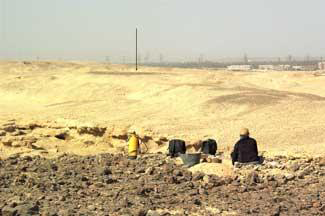
The site is part of the terrace landscape (figure 2) rising out of the floodplain near the village of Al Tiwayrat on the left bank of the Nile, south-west of the Dandara temple near Qena in upper Egypt (26°6.50' NL, 32°43.65' EL), just north of the Taramsa 8 site (Van Peer et al. in press). The new desert road passes at the foot of the hill. The hill is flat and covered with a thin gravel layer, consisting mainly of rounded chert cobbles. The gravel thins out towards the West. When compared to the surface of the Taramsa 8 site, the colour of the surface of the Al Tiwayrat site (figures 2 & 3) is much lighter. This observation might suggest that the surface of Taramsa 8 is much older than the surface of the Al Tiwayrat site.
Satellite image with position of the Al Tiwayrat site (long arrow) and Taramsa 8 (short arrow). Satellite imagery provided courtesy GlobeXplorer.com and Partners. Copyright [2004]. All rights reserved.

Arrow indicating the position of Al Tiwayrat, viewed from the south (Taramsa 8) and the entirely destroyed surface of the site.

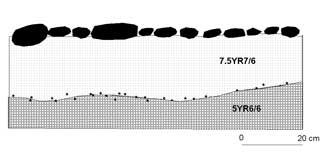
The profile with at its base a concentration of artefacts.

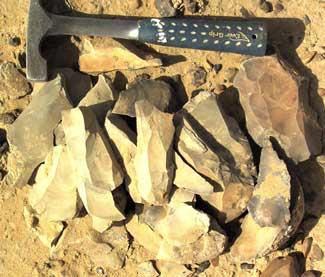
The surface of the hill is entirely disturbed by all kinds of diggings, apparently by local people in search for fine gravel for building purposes. The pits often reach the Pliocene silts below the gravel cover. The gravels are mainly oval light-brown chert cobbles of quite good knapping quality. Dump heaps are scattered over the whole hill surface. On the surface of the south-eastern part of the hill, there is a 80 sq. m badly disturbed concentration of large chert artefacts, which we sampled. Artefacts from this concentration bear the typical brown desert patina (figure 4) but some lack this patina suggesting that they have been removed recently from their original position inside the terrace deposits. Inside the concentration and below a recent dump heap, we cleared a profile in which some material could be found in apparently undisturbed position. The cleared surface is small, about 1.5 sq. m.
The profile (figure 3) from top down is as follows: below the desert pavement with mainly numerous chert cobbles, a 20-30cm thick layer of reddish yellow fine sand (7.5YR 7/6) is present. The sand is quite well consolidated by calcite. Some rare chert cobble fragments are present. The deposit contains very fresh unpatinated artefacts (figure 3), mainly at its base but also scattered inside the sand. Some artefacts are in a horizontal position whereas others are placed vertically. Several artefacts were refitted in the field, suggesting that they did not undergo important postdepositional horizontal disturbances. The sand with the artefacts is resting on a somewhat more intensely coloured reddish yellow (5YR 6/6) granular quartz sand with a pavement of entirely fragmented chert cobbles. Fragmentation of the gravels from this horizon occurred in situ as the fragmented cobbles have preserved their original position. Below, there is an accumulation of chert cobbles belonging to the terrace deposits. At the location of the profile, terrace gravels form only a thin layer.
The lithics
The very restricted survey (table 1) provided a collection of extremely fresh artefacts (figure 3). In addition to the in situ artefacts we also collected some artefacts from the immediate surrounding of our survey profile, which apparently belong to the same assemblage (figure 4). Some of them have no patina and are very fresh, whereas others have the typical brown-black desert patina.
Opposed platform cores 4 Nubian core 1 Blade crests 5 Blades 40 Cortical flakes 22 Flakes 138 Chips 57 Foliate fragment 1 Total 268 Table 1: Artefact inventory
Artefacts collected at the surface.

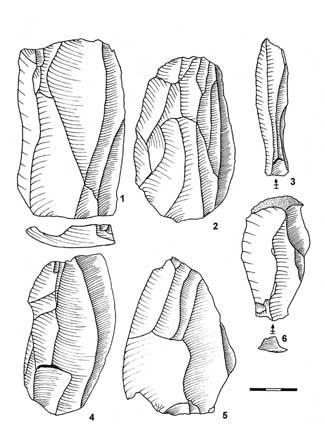
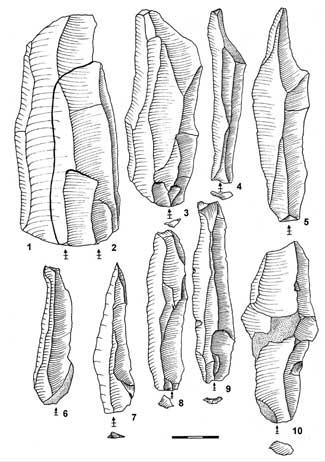
1-2, 4-5: Opposed platform cores for blades; 3: blade; 6: elongated flake, 7-8: core crest; 9-11: blades.

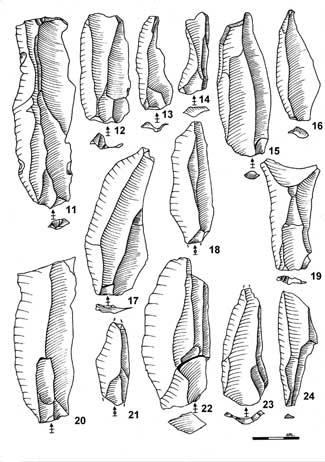
The large cobbles of a light-brown good quality chert from the terrace deposits have been used as raw material. The prehistoric humans apparently preferred large oblong cobbles, 20 - 25cm in length. After decortication, they produced elongated blades from opposed platform cores (figure 5: 1-2, 4-5). Lateral preparation of the core was applied producing crests (figure 5: 7-8). The preparation consisted mainly of large flake removals whereas secondary fine preparation remained very restricted. Such an approach is also evident in the limited number of chips that were found in the profile survey. Apparently both opposed platforms were used alternatively in a similar way (figure 6: 10). The cores attest the production of very robust blades, most often with a thick bulb, which suggests the use of a hard hammer. Blades often have a rectangular shape (figure 5: 11; 6: 1-3, 8-12, 19-20), a result of the alternative flaking from both opposed platforms on cores that generally have parallel sides. Sometimes they have pointed distal ends (6: 4-5, 7, 15-16, 23). Blades were obtained in a continuous reduction without intermediate reshaping of the core as can be learned from the refitted blades (figure 6: 1-2). Blades are 10 to 20cm long, generally 2 to 4cm wide, often with a trapezoidal cross-section, and mostly 1 to 2cm thick. The butt is generally flat, sometimes dihedral or facetted. Levallois technology is missing with the exception of a single Nubian type 1 core in quartz (figure 7: 6) from the surface. Some flakes show some coincidental reminiscence of Nubian debitage (figure 7: 9) or even a more classical Levallois debitage (figure 7: 2 & 4). Tools have not been found, except a fragment of an unpatinated bifacial foliate (figure 7: 1). Fine regular retouches that 'smooth' the edges are absent.
Interpretation and conclusion
In the light of our experience with similar sites in Egypt (Vermeersch 2002; Van Peer & Vermeersch in preparation) we consider the assemblage of Al Tiwayrat as the result of a chert extraction activity, which produced large artefact concentrations in pits or just beside extraction pits. The artefacts were left on the surface and were subsequently integrated in aeolian sand. Here, the aeolian sand is not very thick suggesting that this locality is just outside a possible extraction pit. Similar situations occur at Nazlet Sabaha and at Taramsa 1 (and many other places in the area). The deposition of the artefacts is contemporaneous with an aeolian accumulation, which has been affected by rubification and calcitic consolidation. Such conditions often refer to a deposit that was subjected to interglacial conditions. Indeed, aeolian sand, not subjected to such pedogenesis, often has colours such as light yellowish brown (10YR 7/4). We therefore suggest that the age of the assemblage is somewhere in the Last Interglacial.
The presence of a blade technology might tempt us to correlate the assemblage from Al Tiwayrat with assemblages from the Upper Palaeolithic such as the Shuwikhatian (Vermeersch et al. 2000). The technical approach is however entirely different. The blade technology of Al Tiwayrat might seem to have a better fit with the Taramsan approach (Vermeersch et al. 1997, 2000). Still, we feel that the blade technology of Al Tiwayrat is technically less developed.
1-2 Refitting blades; 3-24: blades.

1: Foliate fragment; 2 Levallois flake; 3-5, 7-9: blades; 6: Nubian core (quartz).