

Maintaining order and enforcing the rule of law stood at the core of the nineteenth-century state, and the expanding bureaucracies steadily extended their reach into everyday life.Footnote 1 Nowhere was this more visible than in the growing presence of professional police forces, both in rural landscapes and in urban centers across continental Europe.Footnote 2 This trend was reflected not only in the establishment and consolidation of the gendarmerie as the primary force for maintaining order in sparsely populated countryside areas,Footnote 3 but also in the state authorities gradually taking over policing tasks in urban centers that had typically been carried out by local government. In this process, provincial capitals and major industrial agglomerations became crucial “laboratories” for state power. Here, the monarchy could forge and refine its police forces, testing their effectiveness and modifying their organization, equipment, and training, so that its officers were better able to confront new forms of crime and the protests of an increasingly mobilized civil society.Footnote 4
As a major urban center of the Habsburg monarchy, Prague had witnessed numerous mass demonstrations and street riots since the mid-nineteenth-century revolutionary upheavals. Although the causes varied, these events consistently triggered political changes and administrative adjustments. A common feature of these mass demonstrations was clashes with law enforcement forces, which usually lasted for a relatively long period of time (several days or even weeks). During this time, protests often degenerated into violent riots, threatening the life, health, and property of non-participating residents. When ordinary means failed to ensure the security of law-abiding citizens, the state was compelled to resort to extraordinary measures. The repeated declaration of a state of emergency and imposition of martial law in Prague, occurring five times between 1848 and 1914, clearly demonstrated the failure of the civil authorities.
In this article, I will focus on the role of the state security guard as the executive arm of law enforcement in Prague during the street riots.Footnote 5 This article argues that the repeated episodes of mass protest and riot in Prague during the final decades of the Habsburg monarchy were crucial not only for shaping the local security apparatus but also for redefining the relationship between the civilian administration, the military, and society at large.Footnote 6 The development of the Prague State Police should be understood as part of the wider process of Habsburg state-building in the constitutional era, in which the presence of a professional civilian force became an indispensable marker of state authority in the urban public sphere. Reforms pursued after 1893 and again after 1897 and 1908 were not solely technical adjustments to manpower or equipment; they embodied the conviction that protest was a predictable and even legitimate form of political expression, and that it was therefore the task of a robust yet civilian-controlled police to contain disturbances without resort to the indiscriminate violence associated with military intervention. The Prague case, therefore, reveals that the strengthening of the police was not a symptom of authoritarian centralization but its very opposite: a deliberate strategy to preserve civil administration, prevent military encroachment, and safeguard the fragile legitimacy of the constitutional state.
Recent scholarship on the history of policing in Europe has emphasized the connection between the emergence of professional police forces and the broader processes of state-building in the nineteenth century. Studies of France and the German states have shown how the consolidation of civilian security forces was integral to the expansion of administrative authority and to the creation of a recognizably modern state apparatus.Footnote 7 In the Habsburg lands, however, the historiography remains more fragmentary: while Vienna has been treated as a model of imperial policing,Footnote 8 other crown-land capitals have received far less attention,Footnote 9 and the role of provincial police forces in shaping the monarchy’s authority has not been systematically examined.Footnote 10 Historians of the Habsburg state have often emphasized its limited capacity, its dependence on negotiation with local elites, and its vulnerability to national conflicts,Footnote 11 but the police have rarely been integrated into these debates. This article argues that the transformation of the Prague State Police, driven by recurring episodes of mass protest and riots in the 1890s and 1900s, reveals a shift in Habsburg state-building: a proactive effort to establish a robust, civilian-controlled police force as a means to contain unrest, preserve civil administration, and maintain legitimacy, thereby complicating the traditional image of a weak or merely reactive late Habsburg state.
Drawing on official sources, particularly reports from the Prague Police Directorate and the Bohemian Governor’s Office, this article examines how Prague’s security forces at the turn of the twentieth century managed to control public space and responded to both spontaneous and organized collective violence, including street riots. It further analyzes how these security forces assessed their performance during street riots and strategically adapted their tactics, equipment, and organizational structure in light of these experiences. This approach will also reveal the state’s attitude towards internal security in important urban centers and the changing position of the police since mass protests likely acted as a crucial catalyst for changes to the state-funded security forces.
Prague occupied a distinct position within the Habsburg monarchy with regard to the organization of public security. As the capital of one of Austria’s wealthiest and largest provinces, yet also one of the most ethnically and socially challenging, it had a security guard corps that had been directly subordinate to the Prague Police Directorate since 1868.Footnote 12 In 1869, the state set up a “state police” in Vienna, the capital of the Habsburg empire and seat of the imperial family,Footnote 13 and also in Trieste (later, for example, in Czernowitz), but everywhere else the basic tasks of maintaining public law and order remained the responsibility of the local self-government. Even in the capital cities of the larger crown lands, such as Moravia and Styria, there was a uniformed guard force organized and funded by the municipality, which cooperated closely with the local state police authorities (i.e., police directorates) in administrative matters.Footnote 14 While financially advantageous for the state, this reliance on municipal police proved to be a critical vulnerability. During major nationalist or political disturbances, the local loyalties of the city-based guard rendered them unreliable, exposing the strategic cost of the state’s fiscal prudence.Footnote 15 Consequently, their intervention was often hesitant, if it occurred at all. Conversely, in Brno, for example, the municipal guard controlled by the German nationalist town hall was excessively harsh in its use of force during clashes with Czech demonstrators.Footnote 16 A similar situation prevailed outside the provincial capitals; almost every municipality paid for its own uniformed guard, commanded by the mayor, but its capacity was limited—in numbers, training, and equipment—and it focused only on routine policing.Footnote 17 In the event of major disturbances, the local guards frequently failed, and the restoration of law and order had to be carried out by state forces under the direction of the district chief, with the use of the gendarmerie. If the latter’s numbers were insufficient, the chief was forced to call in military assistance from the nearest garrison headquarters.Footnote 18
Establishment of the State Police Corps in Prague
The establishment of the state-controlled security guard in Prague resulted directly from the turbulence of 1868. The Emperor’s compromise with the Hungarian political representation in the previous year had resulted in a series of protest actions in Bohemia. Czech politicians were stridently opposed to the government and took every opportunity to demonstrate their resistance, including ostentatious indifference to the Emperor’s visit to Prague in June of that year. In August, the opposition deputies adopted the “Declaration of State,” whereupon demonstrations against the government broke out in Prague and the surrounding areas.Footnote 19 The deliberate inaction of the Prague city guard—loyal to the nationalist Czech city council—provided the government with the perfect pretext. Citing the collapse of local control, the state swiftly declared an emergency, dismissed the Governor, and moved to seize direct command of policing in the capital. The new head of the highest civil authority in Bohemia was a soldier, Field-Marshal-Lieutenant Alexander Koller, who was tasked with bringing order to the crown land and its capital.Footnote 20 On the same day that the state of emergency was declared, the Emperor approved the abolition of the limited powers of the Prague Police Directorate, a decision that transferred the responsibility for public order in the city directly to the state. The Mayor of Prague was to hand the city guard’s equipment and weapons over to the new state force and allow its men to join its ranks. The relevant decree also anticipated the possibility of the Prague municipality defying the order, at which point the gendarmerie was to be deployed in Prague not only from Bohemia, but also from Vienna, Brno, and Ljubljana.Footnote 21
Placing the Prague city guard under the control of the state authorities—once “unreliable elements” had been excluded—marked a major turning point in law and order enforcement in the capital. The Police Directorate thus gained an effective executive component, which could be utilized entirely at its discretion. Although the state had deprived the Prague municipality of one of the most important rights of self-government, namely, control over law and order on its own territory, it considerably relieved the financial burden on the city. In 1868, the guard numbered 400 constables (Wachmänner) and thirty sergeants (Postenführer), who were divided into four district inspectorates headed by a district inspector (Bezirksinspektor), and within them into individual departments attached to police commissariats.Footnote 22 However, the area of police control extended beyond the historical core of Prague (Old Town, New Town, Lesser Town, Hradčany, and Josefov) to include economically and socially integrated neighboring municipalities.Footnote 23 Consequently, uniformed officers also patrolled the rapidly expanding suburbs. Due to the relatively large amount of territory and the increasing population of the Prague metropolitan area, especially of working-class people looking for work in the city’s many industrial plants, the guard was reinforced by an additional 100 men as early as 1869. This was instigated by Koller, who feared possible protests after the lifting of the state of emergency.Footnote 24 This established the security guard strength at 500 officers, consisting of 250 junior constables (Wachmänner), 250 senior constables (Oberwachmänner), and thirty sergeants. The latter category was later renamed guard inspector (Wachinspektor) and reduced to twenty-four. In Prague the constables usually served individually either at permanent posts at important buildings, busy intersections, and squares, or in regular patrols within a clearly defined precinct, while two-man patrols prevailed outside Prague. These covered suburban villages and settlements, which, although now part of the capital, retained their rural character, being only gradually transformed by new housing developments.Footnote 25
In 1872 there was a request for a further strengthening of the guard, due to building expansion especially in the suburbs, together with rapid population growth and its accompanying social problems. However, in this case the Ministry of the Interior rejected it for financial reasons.Footnote 26 In the decades that followed, the Ministry’s approach was shaped by a reluctance to increase expenditure on security and by considerations of the state treasury, which was partly due to the unresolved issue of the financial contribution of the municipalities to policing their territory. While this question was partially addressed for the suburbs and surrounding villages by the Provincial Law of 1874, which provided for a 12 percent compulsory contribution to costs related to public security,Footnote 27 no firm principle could be established for Prague. Because it had imposed its security guard on the capital without the municipality’s consent, the state ultimately had to rely on the goodwill of Prague’s political representation when it came to its contribution to maintaining law and order in the city. It was only in 1884, after a personal meeting between the Police Director and the then mayor, Tomáš Černý, that the municipal leaders approved additional funding.Footnote 28 This apparently contributed to the government’s willingness to increase the force by 100 constables and six inspectors.Footnote 29 However, this was only a fraction of what was required to provide a stronger police presence throughout the district.
According to a review from the end of 1884, more than three quarters of the corps was on the streets every day, which clearly shows that even under normal conditions the Prague Guard did not have the numbers to rotate patrols at individual posts or to provide sufficient rest for men off duty.Footnote 30 The Police Director calculated that a constable had only three to seven hours of personal free time per day, with the remainder spent either on direct policing or on secondary activities (Nebendienste). These included a wide range of duties, such as escorting prisoners, guarding barracks, and monitoring beggars, street performers, and prostitutes. They also assisted at public events—balls, festivals, political meetings, rallies, parades, and funerals—that often spanned the entire city. From the mid-1880s onwards, at the request of the courts or superior authorities, officers also had to monitor potentially dangerous persons suspected of being socialist or anarchist sympathizers. At the same time, they reinforced the under-staffed corps of plainclothes detectives who investigated crimes that fell under the jurisdiction of the Police Directorate.Footnote 31 They assisted the State Attorney’s Office in the confiscation of newspapers and magazines, kept a permanent watch at railway stations and bridges, and, in the summer months, checked empty dwellings whose occupants had left for long-term summer residences.Footnote 32
Prague Police in the Era of Emerging Mass Politics (1890s)
Although the guard was reinforced in 1884, part of the new force was immediately used to establish a guard post in Libeň, which had been fully incorporated into the police district only that year.Footnote 33 It was the growth of the suburban communities that kept the force most occupied. Between 1869 and 1884, the population of Prague itself increased by only 5,148, while the other municipalities of the district acquired 64,275 new inhabitants, which necessitated the establishment of a guard post in Žižkov, the relocation of the commissariat from Vyšehrad to Královské Vinohrady, and the transfer of eighty-two constables and four inspectors from Prague to the commissariats outside the city.Footnote 34 This trend continued in the following years, and between 1884 and 1890 the population of the police district increased by a further 55,818.Footnote 35 In 1890 and again in 1891 the chief inspector of the guard asked the Police Director for an additional number of men, which led the Police Director to appeal to the Governor, who then made a request to the Minister of the Interior. However, the state budget reportedly would not allow for the creation of new posts. The Minister of the Interior advised the Police Directorate to seek reserves in its internal operations, with reference to the fact that many officers were serving as typists, on telegraph duty, in plain clothes, or as liaison officers.Footnote 36 Although this was true, the individuals concerned were usually senior members of the guard who could no longer cope with the physical demands of working directly in the field. As they were under oath, the authorities were able to put them to good use as clerical workers, given the confidential content of messages since the scribes on daily wages (diurnists) posed a greater risk of disclosing official correspondence. Out of a force of 600 officers and thirty guard inspectors, more than forty officers were employed to perform work that was not direct service, and dozens more were routinely absent because of escort roles, secondary duties, or sickness.Footnote 37 According to the Police Director, the actual number of officers on the streets was thus significantly lower than the official number, and the suburban municipalities of Královské Vinohrady, Nusle, Libeň, and Žižkov repeatedly complained about the lack of uniformed officers on the streets.Footnote 38 For example, the whole of Žižkov, which then had over 40,000 predominantly working-class residents, was policed by only thirteen officers under a single inspector.Footnote 39
The demonstrations of 1892 and 1893 exposed both the poor security situation in Prague and the chronic shortage of police officers. These events unfolded against the backdrop of mounting political volatility in Bohemia, which had intensified since the late 1880s, when the dominant Czech party, the Old Czechs, entered into a compromise with German liberal politicians. The arrangement, essentially an administrative division of the land and its provincial authorities, was denounced by the national opposition, the Young Czechs, as a betrayal of the nation. The ensuing campaign of denunciation, culminating in the Old Czechs’ electoral defeat of 1891, revealed the deeper political fragmentation of Czech society.Footnote 40
The representatives of various currents of Czech politics, both radically nationalist-minded students and working-class people inclined towards socialism or anarchism, came together in the so-called progressive movement called Omladina. They were united primarily by their opposition to the Austrian government.Footnote 41 Their protests and other public gatherings of students and working-class youth during these years later formed the basis for charges in the orchestrated Omladina trial, which was meant to suppress the potentially dangerous aspiring political leaders involved. From the perspective of the police, the demonstration near Olšany cemetery on June 18, 1893 was particularly embarrassing, during which protesters clashed with officers, scattering their ranks. Some officers fled and hid among the tombstones until reinforcements arrived from distant commissariats.Footnote 42 Moreover, the Prague Guard lacked the manpower to deal with a demonstration that took place two months later, which was even more audacious, given its timing on the eve of the Emperor’s birthday celebration on August 17. Workers marched through the streets of Prague singing the Red Flag, shouting anti-government slogans, and distributing illegal leaflets, while the Police Directorate were powerless to intervene. Not only that but individual officers who encountered the demonstrators ended up injured, having received blows from stones or sticks.Footnote 43
New Police Director Georg Dörfl reiterated the appeals of his predecessors in office for an increase of 150 men and six inspectors, one third of which was to form a mounted unit.Footnote 44 It is clear that Dörfl’s demand was inspired by Vienna, based on the experience of guards in the capital of the empire.Footnote 45 This contingent was envisioned as a mobile force that could move quickly around the police district and intervene at the point of need. Horse-mounted units would also add firepower to the force and restore the authority of the police, especially with crowds of demonstrators. The transformation of part of the guard into a mounted detachment was accompanied by organizational complications, specifically, the need for suitably trained horses and stables in the Prague agglomeration. Above all, it was associated with much higher costs,Footnote 46 for which Dörfl and the Governor managed to obtain the approval of the Ministry. The recent riots and the clear weakness of the guards in suppressing them provided strong support for their arguments.
When a state of emergency was declared in Prague in September 1893, the Police Director used it also as justification for strengthening the equipment of the men and inspectors. Up until that time, the sabre had been the standard armament of officers on duty, but when they were unexpectedly confronted with an aggressive crowd, it had failed as a deterrent; on the contrary, the moment they drew it, the situation escalated. Only officers who were deployed in a closed formation were armed with Wänzel rifles, which were single-shot weapons, optionally equipped with a bayonet. However, even these proved ineffective in dispersing crowds or in struggles with individuals being arrested. Once again, based on the experience of the Vienna Guard, Dörfl managed to persuade the Ministry in 1893 and had the entire Prague Guard equipped with modern six-shot revolvers.Footnote 47 As had been demonstrated in Vienna, attacking a police officer armed with a revolver presented a greater risk, as he was better able to defend himself. Dörfl argued that such equipment would increase the authority of the force, the safety of the officers, and also boost their courage to take action against dangerous criminals in their daily police duties.Footnote 48
The Emperor approved the increase in the number of guards on October 6, 1893, and subsequently the Police Directorate announced an open selection process and appealed to all district captains in Bohemia to publish the Prague Guard vacancies in their bulletins. Between October 1893 and January 1894, 600 people applied for the 150 new posts, but only ninety-nine were accepted,Footnote 49 which the Police Director attributed to the insufficient competence of many applicants. Either they lacked the necessary physical fitness (ein rüstiger Körperbau) or they were not able to speak or write both the official languages of Bohemia as the organizational status of the guard required.Footnote 50
The most serious obstacle to recruitment was pay, which by 1893 had remained unchanged since the establishment of the guard twenty-five years earlier. A provisional constable earned only 1.20 gulden per day—little more than an unskilled laborer—with wages rising only marginally upon permanent appointment. Advancement was slow, and most men remained on this income for a decade or longer before attaining senior constable rank. Entry was restricted to unmarried men aged 24–35, yet the combination of low salaries and restrictive marriage regulations made it difficult to establish families. These conditions deterred applicants from the middle classes and from among retired non-commissioned army officers, leaving the corps dependent on recruits from working-class backgrounds with limited education. The social consequences were evident: junior officers were often forced into unstable living arrangements, while their senior colleagues struggled to secure adequate housing.Footnote 51 As the chief inspector noted, very few sons of bourgeois families or retired NCOs applied for service in Prague, especially when gendarmes after six years could expect 590 gulden annually compared to just 450 for a constable. Most applicants instead came from occupations such as coachmen, journeymen, and grooms, with minimal schooling and little proficiency in the empire’s two official languages.Footnote 52 Such conditions not only eroded the guard’s social standing but also undermined its capacity to command authority in the city.
Training and professional development did little to compensate for these shortcomings. Although newly sworn constables served provisionally for six months and could be dismissed without cause, this probationary period did not involve systematic instruction. As the Police Director repeatedly admitted, the chronic shortage of manpower meant that recruits were sent directly into service after taking the oath, expected to learn informally from more experienced colleagues.Footnote 53 Yet this generational transfer of knowledge was thwarted by the high turnover within the corps. Between January 1892 and June 1895, the Prague Guard lost 267 men—seventeen through death, twenty-six by dismissal, seventy through retirement, and 154 by voluntary resignation without pension rights. In all, more than a third of the force disappeared within three years. Although recruitment replenished the numbers, the constant departures imposed financial burdens for new equipment and, more seriously, eroded the guard’s store of experience and local knowledge, resources that were virtually impossible to replace.Footnote 54
1897 Riots as an Argument for Reinforcing the Police
The Prague Guard thus entered the crisis year of 1897 plagued by systemic weaknesses. Its official strength of 734 men was a hollow figure that masked the grim reality on the streets, which was inevitably lower due to unfilled vacancies, sickness, and officers on other duties. The guard was responsible for a precinct of seventy-two square kilometers with nearly half a million inhabitants. Consequently, individual constables were thinly spread across a vast area, relying solely on walking or public transport for mutual assistance. The mounted detachment, which was able to travel considerably faster, had only been established a few years earlier and numbered fifty men. Constables served at the limits of physical exhaustion, sometimes with only a few hours of rest, and given the restricted manpower and the need to provide basic services, there was no capacity to train them after they were recruited. Especially, they had no preparation on how to face a crowd or how to act in a close formation.Footnote 55 This lack of instruction was exacerbated by the absence of more experienced men who tended to leave the guard after a few years because of low pay and weariness from the rigors of duty.
The aim of Casimir Badeni, who was appointed Prime Minister in October 1895, was to bring about a major change in Austrian inner politics. Although he succeeded, he did so in a different manner from what he had planned. The final year of Badeni’s premiership had demonstrated the limits of Austrian state power in its confrontation with parliament and, above all, with a politically emancipated public which—partly influenced by its political leaders—was not willing to accept government edicts. His vision of a swift and decisive solution to the language question in Bohemia resulted in a long-term crisis in Austrian internal politics, prefaced by the largest protests and subsequent street riots that Vienna, Prague, and other centers of the German and Czech national movements had hitherto experienced.Footnote 56 While in Vienna and other parts of the Austrian lands there were protests against Badeni’s language ordinances, the largest riots in Prague took place after he left office, which the Czech public interpreted as yet another Habsburg betrayal and a breach of the government’s promise.Footnote 57 The street violence in Prague of late November and early December 1897 lasted several days, during which time troops from the Prague garrison, including cavalry and several battalions of infantry (Figure 1), were called out repeatedly. Yet even the considerable military presence in the city did not prevent the looting and atrocities perpetrated against Prague’s German and Jewish minorities in particular.Footnote 58
Cavalry Attacking Protesters after Declaration of Martial Law in Prague on December 2, 1897. Das interessante Blatt 16, no. 49 (9 December 1897), s. 1.

Figure 1 Long description
A detailed historical illustration showing a chaotic street scene with a large crowd of people and mounted soldiers. The crowd appears densely packed, with individuals wearing period clothing, including hats and suits. Some soldiers on horseback are visible, wielding swords and appearing to control or disperse the crowd. The background features large, ornate buildings and street lamps, suggesting an urban setting. The scene conveys a sense of movement and disorder, with people in various poses of action and reaction.
Order was restored only with the declaration of martial law on 2 December 1897—an intervention that politicians and the Ministry of the Interior deemed both belated and politically costly. Governor Karl Coudenhove was blamed for the failure, and his dismissal was seriously considered. In the end, however, he remained in office; removing him would have been perceived as a triumph for the demonstrators and further eroded the already fragile authority of the state in Prague.Footnote 59
The 1897 riots laid bare the structural weakness of Prague’s police: the guard lacked the manpower both to defend vulnerable sites and to concentrate forces where crowds gathered. The December events thus marked a turning point in thinking about the character of the city’s guard, whose size and organization had been designed for routine policing rather than for major political disturbances. Reliance on the army remained the default solution, yet cooperation between civil and military forces repeatedly proved ineffective.Footnote 60 Officials hesitated to summon troops because doing so signaled their own failure; once deployed, however, military commanders acted independently, without regard for civilian instructions.Footnote 61 Determined to show strength, they rarely held back, often resorting to excessive force—an approach that deepened mistrust between the military and civilian authorities.Footnote 62
The practice of calling in Militärassistenz—troops summoned to aid the civil power—underscored these limitations. Regulations gave army commanders full discretion over tactics and force, effectively turning demonstrations into military operations.Footnote 63 The language of “assistance” disguised the fact that soldiers were trained to combat enemies of the state, not to manage unruly crowds. Predictably, their actions frequently produced casualties, property damage, and deep political resentment.Footnote 64 Public memory of 1848, when Prince Windisch-Graetz had ordered the bombardment of Prague, cast a long shadow, ensuring that each military deployment appeared as a betrayal of constitutional rule. For civilian officials, military interventions were therefore a double defeat: they exposed the weakness of the police while simultaneously undermining public confidence in the state’s ability to govern by civilian means. This dilemma led police directors to press Vienna for a stronger, modernized police corps capable of maintaining order without recourse to the army.
Police Director Dörfl advanced this ambitious vision. He argued that only a sufficiently strong guard could restore order independently, even in times of major protest, thereby safeguarding the authority of civil administration and preventing military excesses. For him, the failures of December 1897 stemmed not only from inadequate numbers but also from the dispersal of men across too wide an area and the absence of a reserve force able to intervene quickly and decisively. Drawing on this experience, he proposed sweeping reinforcement: sixteen additional inspectors and 350 constables (including twenty mounted), an increase of almost 50 percent, along with a new system of precinct inspectors responsible for smaller territories who could act decisively in moments of crisis. This was designed to decentralize command, allowing for a more rapid and flexible response to developing unrest without waiting for orders from a central headquarters.Footnote 65 Initially, his plan met with little support. Governor Coudenhove, still operating within the older framework of routine policing, balked at the costs.Footnote 66 Yet the renewed riots of January and spring 1898 altered his stance. Convinced further violence was inevitable, he abandoned his earlier caution and, together with Dörfl, urged Vienna to authorize an urgent increase of 366 men by the summer.Footnote 67
The recent vivid memory of the riots, coupled with a change in the imperial cabinet, strengthened Prague’s proposals. In March 1898, Franz Thun-Hohenstein had become Prime Minister and caretaker of the Ministry of the Interior. As Coudenhove’s predecessor as Governor of Bohemia, he was well acquainted with the situation in the province and with the plight of the Prague Guard. With the Emperor’s approval, the police force was immediately reinforced with fifty constables and three guard inspectors from June 1, 1898, to be followed by a further seventy-five constables and four guard inspectors from January 1, 1899; an identical increase would take effect from New Year’s Day 1900. In total, the force would grow by 200 constables, eleven guard inspectors, and five newly established precinct inspectors. At the same time, Thun encouraged Coudenhove to submit further proposals should this increase prove insufficient.Footnote 68
Indeed, in October 1899, the Police Director requested that the agreed reinforcements officially scheduled for the beginning of 1900 be implemented immediately. The unrest in Prague and the larger Bohemian towns that followed the revocation of the language ordinances by the Clary government prompted the provincial authorities to call for not only the urgent implementation of the already approved reinforcements, but also a further increase in the number of guards. As the police chief explained, the moment patrols were withdrawn and concentrated in a few key places, the mob was able to rampage elsewhere without hindrance or fear of being confronted.Footnote 69 The objects requiring precautionary guard protection during the expected unrest were located primarily in the very center of the city. German casinos, German theatres, German university buildings, and other centers of German social life could easily become targets of nationalist hostility from the Czech-speaking majority. However, this left citizens and buildings in the suburbs unprotected and without the means to summon effective help. The reinforcements originally planned for January 1, 1900, arrived a month earlier and that same year the constables’ pay was significantly increased by the Act of 1899,Footnote 70 but no further reinforcements would be forthcoming in the following years. Despite repeated requests from the Governor in 1904, 1905, 1906, 1907 and again in April 1908, the Ministry of the Interior consistently invoked fiscal restraint and the need to avoid burdening the budget.Footnote 71 The response was the same in July 1908, which referred the Governor to the following year, with the hope that new funds could be found in the 1910 budget.Footnote 72
1908 Riots as an Argument for Police Reform
Over the years, police jurisdiction expanded, the population grew, and social and national tensions persisted. In addition to policing recurring public events, parades, demonstrations, and national and occupational celebrations, the guard also had to respond to riots and protests arising from the gradual nationalization of the public space. The Czech majority perceived Slavic Prague as their territory and reacted with hostility to overt nationalist displays by the German minority. Both students, especially members of German student organizations such as the Burschenschaften, and politicians played a key role in escalating these national tensions. The first decade of the twentieth century witnessed the rise of new Czech and German party formations, whose strategies aimed at mobilizing the broadened electorate created by universal suffrage—namely, all resident men over the age of twenty-one. Nationalist rhetoric became an important mobilizing tool that even established political parties had to respond to. The possibilities for compromise between the political representations of the two nations of Bohemia were dwindling, and, especially when negotiations ended in stalemate, the “politics” threatened to spill over into the streets.Footnote 73 The street disturbances of the autumn of 1908 were not only fueled by the domestic political situation, in which the Bohemian Land Diet could not properly convene its new institutions after the elections due to obstruction by German deputies, but also by international developments. The so-called Bosnian Crisis, triggered by the Austro-Hungarian annexation of Bosnia and Herzegovina, remained contentious, and the Czech and German publics and their parliamentary representatives adopted completely opposing positions on it.
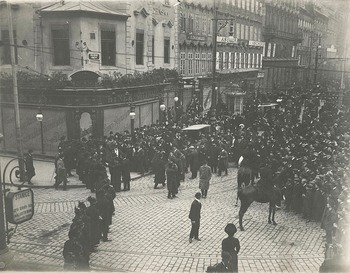
The first clashes took place in October 1908 and were sparked by the Bummels, which were the Sunday walks of German students in association colors along Na Příkopě Street in Prague’s New Town. This student custom became a demonstrative display of the German nationalist presence in the Czech city around the end of the nineteenth century and was perceived by the Czech public—exacerbated by the Czech press—as an outrageous provocation. From October 18, 1908, weekly brawls erupted between Czech protesters, German students, and the security forces. These often spilled into the following days with lower intensity before flaring up again each Sunday.Footnote 74 Although the deployed security detachments with the aid of mounted officers were able to disperse the protesters and protect exposed areas in the city center, the guard’s forces were insufficient when the protesting crowd began to move very quickly to other parts of the city. The Police Directorate even drew reinforcements from rural districts. At the Governor’s request, 1,000 gendarmes were deployed to patrol the most vulnerable areas.Footnote 75 The police eventually adopted an effective tactic of clearing the street entirely on several Sundays, barring public access to the area. In the following weeks they allowed the students to walk on one side of the street, preventing anyone else entering that space (Figure 2). In the meantime, the sixtieth anniversary of the Emperor’s accession to the throne was approaching, which was to be celebrated with pomp throughout the empire, but the street riots and protests in the Bohemian capital continued. After weeks of hesitation, martial law was declared in Prague and the surrounding districts on December 2, 1908 (Figure 3).Footnote 76 Unlike in 1897, there was no mass looting, and state authorities managed to control public space through repeated military deployments—though they could not prevent recurring disturbances, often instigated by Czech and German nationalist politicians.Footnote 77
Police Cordon Closing Off Na Příkopě Street on Sunday, November 1, 1908. The Line of Foot Guards Is Reinforced by Two Mounted Police Officers in the Foreground. Archiv hlavního města Prahy/Prague City Archives, Photograph collection, I 12966.

Figure 2 Long description
The illustration shows a densely packed street scene with a large crowd of people, many wearing hats and suits, appearing to be in a state of chaos or protest. Mounted soldiers on horses are present, some holding swords or rifles, seemingly trying to control or disperse the crowd. The background features tall, ornate buildings with multiple windows and street lamps. The scene conveys a sense of historical unrest or conflict in an urban setting.
Foot Guards Led by an Inspector Closing Off Access to Na Příkopě Street from Havířská Street on Sunday, November 1, 1908. Archiv hlavního města Prahy/Prague City Archives, Photograph collection, I 12977.

Figure 3 Long description
The illustration shows a densely packed crowd of people in a city square, with many individuals wearing hats and formal attire. Soldiers on horseback are visible among the crowd, some holding weapons. The background features large buildings with detailed architectural elements, including windows and columns. Street lamps are also present, adding to the urban setting. The scene conveys a sense of chaos and movement, with people appearing to be in a state of unrest or protest.
A week after the outbreak of the riots, the Governor reflected on the situation in his report to Minister of the Interior and future Prime Minister Richard Bienerth. He pointed out that even if there was calm elsewhere in the police jurisdiction, he could withdraw only 400 officers to threatened areas, who had to both control crowds of several thousand and protect German students. For instance, on Sunday October 25, the guard set up cordons on both sides of Na Příkopě Street, but since 200 officers were assigned to protect the students specifically, the cordon could only consist of a simple chain of men standing shoulder to shoulder. The Governor emphasized that if this chain had not been protected at all times by mounted constables, who kept the rioting crowd at a sufficient distance, the demonstrators could easily have broken through it. He noted that since the guard had to defend more than ninety buildings across the city and suburbs, it was not able to concentrate enough forces to intervene in more than one place at the same time. Given the existing conditions and limited strength of the security forces, he openly admitted he could not guarantee that the situation would not deteriorate further—and his fears were confirmed in the days that followed. At that point Coudenhove stood up for his police chief and reproached the Interior Ministry for failing to understand the complicated situation in Bohemia, especially in Prague. Year after year, the Police Director’s deliberately modest requests for reinforcements were denied, a cycle of official neglect that left the city vulnerable.Footnote 78
It was not until April 1909 that the Police Director Karel Křikava was able to draft a proposal for increasing in the number of officers to a level that would ensure law and order even during large-scale demonstrations and riots.Footnote 79 It provided for two new district inspectors, two precinct inspectors, sixty-three guard inspectors and 390 constables (of whom three inspectors and thirty constables would be assigned to mounted units). The majority (fifty-six inspectors and 280 constables) were to be assigned to reinforce individual precincts and departments, while the remainder was to be kept in reserve. The reserve unit was to be made up of newly recruited officers, who would receive training and education, serving as a rapid response force in the case of unexpected events and as a buffer in the case of prolonged unrest.
Although the Police Director had put forward almost maximalist demands, the memory of the Prague riots, which destroyed the celebration of the imperial jubilee, was so vivid that after several months of negotiations, the government approved them in full.Footnote 80 The expense of this increase was considerable, and the very next month the Minister wrote a strictly confidential letter to the Governor, appealing for his understanding of the situation. He stated that in view of the obstructions in parliament, the government could not expect to pass the bills required to secure the increased revenue for 1910, and therefore only a quarter of the planned increase in the guard would be funded, with the remaining posts postponed pending further developments.Footnote 81
The Governor, however, was not prepared to lose his new posts. Taking advantage of the fact that the letter was addressed to him alone, he apparently withheld this information from the Police Director and had him continue with preparations to accept half of the planned increase from February 1, 1910. When the ministerial decree came on January 28, 1910, confirming the lack of funds and reducing the budget allocation, it was too late.Footnote 82 The Police Director tersely stated that he had already issued the orders for admissions, equipment, and supplies, and had secured new quarters. The Governor’s Office had effectively presented the Ministry with a fait accompli, and, despite considerable resentment, Vienna had no choice but to accept the state of affairs.Footnote 83 The matter was resolved in May 1910, when the government procured a loan for the necessary funds, and by October 1, 1910 the Prague Guard numbered 1,450 members,Footnote 84 an increase of 130 percent over fifteen years. This final expansion allowed a reform of the guard’s organizational model and concept of service. This concerned not only the direct active-duty departments but the newly established reserve detachment in particular. With its creation, new officers received continuous professional training before entering the service for the first time. The Prague police force was now strong enough to deal effectively with mass unrest. Moreover, its material provision was enhanced,Footnote 85 its training was improved, and its discipline was gradually strengthened.Footnote 86 In addition to the rank and file, the number of commanding officers in the guard was also increased—a category of precinct inspector was created (classified as ranks ten and eleven of the state civil service), the number of district inspectors increased to six (class nine) and the commander of the guard, the chief inspector, was promoted to rank class seven with the title of central inspector, with one deputy in class eight reporting to him.
Conclusion
The establishment of the state police guard in the capital of Bohemia primarily aimed to shift policing from municipal administration to the exclusive authority of the central government. From the state’s perspective, the municipal council’s unreliability in directing the police was most evident during nationally or politically motivated unrest, when the Czech-dominated municipality responded only belatedly and without determination. The state-controlled security force created in 1868 was subordinated directly to the Police Directorate; yet its limited strength made military support inevitable when there were major disturbances. Although Prague and its suburbs became one of the most dynamically developing industrial centers in the western Habsburg empire during the latter half of the nineteenth century, with rapid population growth, the number of officers in the guard rose only marginally. The government’s reluctance to expand the Prague Guard’s budget was closely tied to the unresolved question of the municipality’s contribution to financing the city’s policing.
Despite repeated appeals for reinforcements and material improvements, significant reforms in the organization, equipment, and provisioning of the guard were not undertaken until the 1890s. Confronted with the police’s inability to control large-scale protest events, the new Police Director introduced measures modeled on the Vienna Guard. His insistence on increasing the size of the corps reflected a view of protest as a legitimate form of public expression—one that required close surveillance and the capacity for swift, decisive action once legal limits were crossed. The unrest of 1892, and especially the riots of December 1897 and the following months, revealed the guard’s deficiencies in numbers, equipment, and training to manage mass demonstrations and to safeguard the health and property of uninvolved Prague residents. These shortcomings repeatedly compelled military intervention, an outcome the civil administration sought to avoid. Reliance on the army escalated tensions and undermined civil authority, for the Governor’s call for troops openly admitted his inability to manage the crisis.
From this perspective, the Prague Guard needed to be sufficiently numerous, well equipped, armed, and trained not only to carry out routine duties but also to confront protest crowds with confidence. Each effective suppression of unrest and lawful arrest of offenders enhanced the authority of both the guard and the state. At the same time, such demonstrations of strength served as a deterrent to future challenges to public order in a civic space increasingly claimed by political, nationalist, and religious groups.
Therefore, the transformation of the Prague State Police between 1893 and 1910 was not merely a pragmatic response to riot control; it embodied a fundamental reconceptualization of urban order. This new model accepted protest as an unavoidable feature of political life, to be contained by a civilian force rather than crushed by the army. The Prague Guard was repeatedly enlarged and re-equipped in the wake of its failures, but these reinforcements simultaneously strengthened the authority of the civil administration and allowed the military to remain in the barracks. By 1910, the creation of reserve detachments and the professional training of recruits marked a decisive shift in the police’s capacity to act autonomously during mass disturbances. The claim that such reforms prevented the recurrence of riots must, however, be advanced with caution, for only a few years remained before the outbreak of the First World War. The events of the end of June 1912 suggest that the reformed force was indeed able to prevent escalation,Footnote 87 yet the long-term impact of these measures cannot be fully assessed. The reforms of the Prague police thus complicate the image of the late Habsburg state as merely weak or reactive. They illustrate the monarchy’s capacity to innovate in the governance of mass politics, even as national conflicts constrained its authority. In comparative perspective, Prague’s trajectory shows how provincial capitals, no less than imperial centers, were critical sites where the balance between civil authority and military power was tested. After all, the Prague case demonstrates that the expansion of policing was not antithetical to constitutionalism; rather, it was integral to the Habsburg state’s attempt to reconcile the politics of mass protest with the preservation of public order and the legitimacy of civilian authority.
Acknowledgements
This study was supported by project no. 25-17777S of the Czech Science Foundation, “Protest Culture in the Bohemian Lands Between 1890 and 1938.” The author would like to thank the two anonymous reviewers as well as his colleagues from the project team Pavel Horák, Dagmar Hájková, Rudolf Kučera, and David Smrček (all Masaryk Institute and Archives, Czech Academy of Sciences) for their comments and critiques that enhanced the depth and clarity of earlier versions of this article.
Competing interests
The author declares none.
Funding statement
This study was supported by project no. 25-17777S of the Czech Science Foundation, “Protest Culture in the Bohemian Lands Between 1890 and 1938.
Martin Klečacký is a research fellow at the Masaryk Institute and Archives of the Czech Academy of Sciences in Prague. He specializes in the modern political and social history of the Bohemian lands, with a focus on public administration, elite networks, and the social history of civil servants in the late Habsburg empire and interwar Czechoslovakia.



 Open access

