




At the end of October 1854, Clara Schumann travelled to Weimar with a pressed red rose stowed in her belongings. It had come into her possession at some point while visiting her hometown of Leipzig, where she had given two warmly received concerts at the Gewandhaus. These concerts initiated an intense period of concertizing for Schumann, who had only just given birth to her eighth and last child, Felix, and seen her husband, Robert, committed to the asylum at Endenich. By the time she reconnected with Johannes Brahms on 7 November in Hamburg, she had already given concerts in Weimar and Frankfurt am Main, and had found a couple of days to visit her children in Düsseldorf. The rose she carried with her, together with a number of other flowers from her travels, has been preserved thanks to Brahms's gift of a Blumenbuch (‘flower book’) during that stay in Hamburg. This thoughtful gift was a nod to her habit of holding onto flowers for her husband, as well as a medium for Brahms and Clara Schumann to hint at unspoken feelings for one anotherFootnote 2. As she continued to tour around German and other European cities, she filled this book with flowers from concerts, local gardens, friends (especially Brahms) and her children. The collection concludes, touchingly, with laurel leaves laid on Robert's grave on the day of his funeral, and the dedication of the collection to his memory. He would never see the Blumenbuch für Robert.
It is hard to resist the sentimental allure of these flowers. Each appears as a precious relic of a lost, personal memory. They have become unique testaments to the special place that flowers had in her life, as well as tangible reminders of Schumann's feminine otherness in the androcentric German canon. Cuttings like the red rose from Leipzig (Fig. 1), with its still-sharp thorns and vibrant red colour that bleeds onto the surrounding paper, seem to bristle with meaning that still speaks to us today. Redolent of romantic love and sexual desire, the red rose evokes an inexhaustible network of cultural, literary and religious associations: from innocence, virginity and youth to sexual desire, death, loss and rebirth.Footnote 3 This rose is at once a token of love saved for her husband institutionalized in Endenich, a tender reminder of her childhood in Leipzig and lost innocence, a memento mori for herself and husband, and a tribute to the temporary beauty of nature. Indeed, the more we ask of this flower, the more mutable and fugitive its potential messages become.
Red rose from Leipzig, Blumenbuch für Robert, 25 October 1854.Footnote 1

In the introduction to the modern facsimile of the Blumenbuch für Robert, editors Gerd Nauhaus and Ingrid Bodsch link Schumann's flower book to a larger tradition of Stammbücher popular in the nineteenth century. These albums of friendship (liber amicorum), passed between close friends, were often kept by women, who filled them with painted or pressed flowers.Footnote 4 Such albums were just one of the myriad ways that women in the nineteenth century encountered flowers in their lives, especially in the world of books. A new genre of commercial literature, collectively termed ‘sentimental flower books’, entered the book market, offering their presumed readership the specific codes needed to understand a so-called Blumensprache or ‘language of flowers’. Such books were marketed to an audience of women whose bodies and sexuality were commonly represented by flowers during this period. As Beverley Seaton has noted, these floral representations played on familiar stereotypes of women, such as their ‘smallness of stature, fragility of mind and body, and impermanence of beauty’.Footnote 5 Nineteenth-century women would have witnessed a similar conflation of floral and female representations in contemporary literature. The famous blue flower of Novalis's Heinrich von Ofterdingen, the ‘Ur-symbol’ of the early Romantics, is one of numerous examples, symbolizing inspiration, the source of poesy and eternal longing.Footnote 6 The face of the blue flower that first appears to Heinrich in the dream that opens the novel later becomes the face of his beloved, Mathilde. Women were thus caught in a perpetual representational exchange, in which flowers represented women, and women represented flowers.
Given how deeply engrained flowers and floral representations were in nineteenth-century European culture, it is perhaps no surprise that Clara Schumann's own interest in flowers extended beyond her flower books. Around a third of her song settings and choral pieces involve some reference to flowers. In some cases, flowers simply form part of the typical natural landscape of Romantic tropes, alongside trees, mountains, birds, meadows and streams. Yet in many, the flower is the principal addressee of the song, as in ‘Das Veilchen’, ‘Was weinst du, Blümlein’, ‘An einem lichten Morgen’ and ‘Die stille Lotosblume’, perhaps her most well-loved song. All stage some form of encounter with a flower where both poetic speaker and flower are implicitly or explicitly gendered. In this article, I explore how Clara Schumann navigates the floral texts of these four lieder vis-à-vis the cultural, literary and botanical associations with flowers in the nineteenth century as well as the personal flowers of the Blumenbuch für Robert. At the same time, I consider how her encounters with flowers differed from her male counterparts.
The study of floral poetics in Romantic music is not without precedent.Footnote 7 In a 2012 article, Holly Watkins explored how Robert Schumann's Blumenstück (Op. 19) engages both sentimental and Romantic floral poetics.Footnote 8 This distinction also runs along gendered lines, with the sentimental flower books being the female counterparts to male-authored Romantic literature. Yet Watkins observes a difference in how each discourse understands floral symbols, comparing the one-to-one allegoric meanings offered by sentimental flower books to the transcendent symbolism of the flower in the literature of Novalis and E.T.A. Hoffmann. For the media theorist Friedrich A. Kittler, the flower in early-Romantic literature encapsulated what he identified as the ‘originary discourse’ of the period: the a priori source of poetic inspiration for the male artist around 1800. This source is comprised of a symbolic nexus of Nature/Woman/Love – as demonstrated by Novalis's blue flower as the beloved Mathilde – which poets ‘translate’ into literature.Footnote 9 Watkins extends Kittler's discourse analysis to the floral symbolism of sentimental flower books, arguing that these books position real women, as the presumed speakers and interpreters of the language of flowers, as Woman(/Nature/Love). That is, within the Romantic paradigm identified by Kittler, sentimental flower books interpellate women as manifestations of Woman/Nature/Love.Footnote 10
In contrast to Watkins, who espouses an understandable bias for the ineffable Romantic symbolism of flowers, I seek to approach the flowers of Clara Schumann's lieder in a way that reflects how she may have encountered flower symbolism as a middle-class nineteenth-century woman. This does not mean that I indulge in the easy allegories of sentimental literature, which Watkins chastises as ‘the Biedermeier counterpart to Romanticism's more rarefied floral symbolism’.Footnote 11 Rather, I connect the flowers in her lieder to a network of necessarily overlapping discourses, media and historical contexts, reflecting how deeply entwined flowers were in the lives of women like Clara Schumann. In this study flowers emerge as radically mutable symbols that tactfully switch between ineffability and specificity, confounding the classical relationship of signifier to signified.Footnote 12 As the red rose of the Blumenbuch für Robert shows, flowers can paradoxically allude to legible, definitive meanings while also being open to boundless interpretation.
Contemporary books such as Elizabeth Kent's anonymously published Flora Domestica, or The Portable Flower Garden (1823) encapsulate how different ways of understanding flowers collide in a woman-authored work. This horticultural handbook included extensive passages of English poetry alongside instructions on how to care for each flower listed. Kent often chose poetry that simply mentions the flower in question. Her entry for sunflowers, for example, includes references to sunflowers in passages of James Thomson, Thomas Moore, John Clare, Charles Maturin and William Drummond, though with little exegesis beyond matching the flower's physical properties to its representation in poetry.Footnote 13 Many European sentimental flower books such as Charlotte de Latour's hugely popular and influential Le Langage des Fleurs (first published in 1819) similarly included passages of poetry that matched the supposed meaning of each flower.Footnote 14
Throughout the following discussions of ‘Die stille Lotosblume’ (Op. 13, No. 6), ‘An einem lichten Morgen’ (Op. 23, No. 2), ‘Was weinst du, Blümlein’ (Op. 23, No. 1) and ‘Das Veilchen’, I take a self-consciously ‘naïve’ approach to their floral representations.Footnote 15 This means that in place of a suspicious theorization of the ecological symbology of the music and poetry of these songs, I instead examine how the flowers act, form relationships, withhold feelings and communicate with the poetic speaker.Footnote 16 This allows me to place flowers centre stage, and to explore their extroversive network of gendered, botanical, sentimental and poetic associations. It is at this level, I suggest, that Clara Schumann interacts with her flowers, weaving their distinctive mutability into her compositional style. I will show that through her piano accompaniments especially, she is able to reify their desires, protect their stubborn silences and contextualize their speech in relation to the poetic speaker.
Absence and Silence
In a painting by Schumann's contemporary Elisabeth Jerichau-Baumann (1819–1881), a wounded Danish soldier lies injured in bed while a woman holds his hand and reads from a book (Fig. 2). The golden glint on his ring finger suggests that perhaps his caregiver is also his spouse, yet there is a palpable gulf between them. They do not look at one another; instead, she peers into her book while he gazes forlorn at the half-eaten bowl of soup and single plucked red rose on the bedside table. As with the red rose of Schumann's Blumenbuch, this rose could stand for any number of different thoughts, feelings or messages: the fragility of life, the futility of war, the loss of innocence, a wilted and faded love. Tellingly positioned atop an opened envelope, this particular rose functions as a substitute for an unspoken communication between the couple. The soldier stares at the rose searching for meaning, for some secret message enclosed in this tender floral gift, but finds nothing other than a reflection of what he already knows. His companion reveals nothing either to him or to the viewer; she remains as unknowable as the flower.
Elisabeth Jerichau-Baumann, A Wounded Danish Soldier (1865), Statens Museum for Kunst, Denmark

The rose of Jerichau-Baumann's painting reflects the popular nineteenth-century understanding of flowers as a means of communication between genders; one that leaves men grasping at possible meanings, and women able to conceal or defer their true intentions. The idea that men were not privy to the secret codes of flowers also made them a way for women to communicate with each other. Elisabeth A. Petrino, for example, has shown in her study of floral metaphors in the poetry of Frances Sargent Osgood and Emily Dickinson how nineteenth-century women writers were able to invoke flowers as a way of evading explicit reference to sexual behaviour. Both poets were well aware that flowers did not carry specific meanings, as the popular sentimental flower books might have us believe; rather, Petrino argues that flowers constituted a ‘language of gesture that implied meaning through a series of codes rather than through overt statement’.Footnote 17 The inherent irreducibility of flowers to specific meanings made them illusive and deniable mediators of private messages, serving variously to obfuscate and reveal women's true desires.Footnote 18 The rose in Jerichau-Baumann's painting similarly manages to gesture to some type of meaning while the posture of the woman depicted discloses little.
The plethora of sentimental flower books in the nineteenth century like Charlotte de Latour's Le Langage des Fleurs helped establish the notion that flowers could carry encoded messages. Seaton and Jack Goody, among others, trace the inspiration for Latour's language of flowers to an 1809 essay by the Austrian orientalist Joseph von Hammer-Purgstall (1774–1856) titled ‘Sur le langage des fleurs’.Footnote 19 Hammer-Purgstall describes the Turkish selām, an object language used between women within the harem using flowers, as well as other nearby objects such as fruit and perfumes.Footnote 20 Watkins notes that selām, as reported by Hammer-Purgstall, was the ‘self-conscious product of human intervention’; in other words, it was a closed symbolic economy constructed for and used exclusively by the women of the harem.Footnote 21 For Latour and many others in the nineteenth century, however, selām was just one example of a culture that had relearned a pre-existing language of flowers.Footnote 22 They saw it as evidence of a universal flower language, leading many to ascribe moral and religious meanings to the study of flowers. So, while Latour takes up the idea of a one-to-one language of flowers from Hammer-Purgstall in her own Langage, the imagined pre-historic origins of the language prevent her from seeing her own language of flowers as a ‘self-conscious intervention’. Sometimes Latour's flowers even speak directly to women, issuing from nature or some otherworldly source. At other times they are portrayed as speaking to each other.
Scholars are quick to point out the inconsistencies and the futility of the all-too-easy ‘translations’ in this literature. Watkins is unequivocal about language of flowers volumes, seeing their singular definitions as a ‘violation’ of the Romantic value system by ‘converting symbol into sign, metaphor into allegory’.Footnote 23 Such pointed dismissals stem in part from the fact that many people today might still harbour the belief that there are legible and culturally inherited meanings behind flowers of which they are ignorant. Nineteenth-century flower books seem to bolster this belief, offering a comprehensible structure to approach and decode floral significances. But even within this literature, there is little congruence between volumes on the specific meanings of flowers. As Goody writes, ‘the structure is absent, but’, he continues, ‘its felt absence is possibly the result of the appearance of these constructed codes which purport to reveal the hidden “truth” that lies behind surface diversities’.Footnote 24 That is, the evocative and symbolically malleable nature of the flower stems in part from the appearance of or belief in legible meanings. The easy allegories of the popular language of flowers volumes were perhaps not so much a violation of Romanticism but rather its crucial antithesis.
Emanuel Geibel's ‘Die stille Lotosblume’ (‘The silent lotus flower’), first published in 1840 and set by Clara Schumann in 1844, subtly evokes this dialectic of Romantic and sentimental floral poetics in the opening stanza. Glittering, glowing, yet silent, the lotus flower seems laden with Romantic symbolic potential. It is pictured in motion, just as Heinrich's first encounter with the blue flower of his dream caused the flower to move (bewegen) and mutate (verändern).Footnote 25 Yet by referring to the white colour of its petals, Geibel indirectly evokes the sentimental side of floral symbology. Most sentimental flower books included not only indices of flower meanings, but also tables of colour significance; a red rose had a different meaning than a white rose, with white often being associated with virginity. Thus, Geibel's poem begins by constructing the lotus flower as a potentially communicative means. Its silence only confirms its reluctance to speak, and the impossibility of communication.
Emanuel Geibel, ‘Die stille Lotosblume’Footnote 26
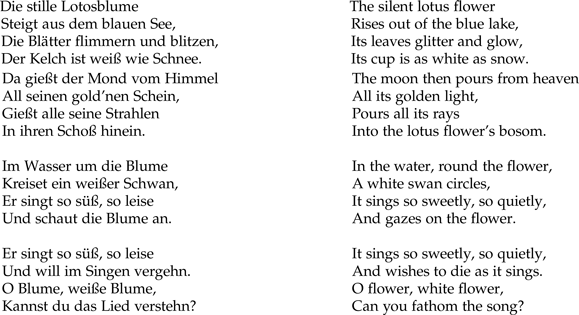
The introduction of the moon in the second stanza, which ‘pour[s] its rays into the lotus flower's bosom’ (Gießt alle seine Strahlen / In ihren Schoß hinein), consequently genders the flower as female. Given that the word ‘Schoß’ can also mean ‘womb’, Geibel introduces a deferred heterosexual sexual desire between a penetrating moon and sexualized lotus flower. In this moment, symbol transforms into metaphor; the flower becomes woman, and a male poetic persona emerges as her yearning lover. A swan then enters as another projection of male desire, gently troubling the serene stillness of the scene. This is even felt on the stress at the beginning of the second line of the third stanza on the word Kreiset, which sends a ripple through the gentle iambic rhythm of the poem. Into the silent void, the swan gently begins to sing in a highly alliterative line – er singt so süß so leise – that places the swan's secret song into the lisping mouth of the poet. Yet the flower remains silent: unknowable to the male poet, the male moon and the male swan. As in Jerichau-Baumann's painting, the flower's abundant potential for meaning promises to mediate the gulf between man and woman. But its stubborn silence stops the flower from revealing its secret messages. Finally, the poet asks the flower directly if it can comprehend the swan's song and his unrequited love: Kannst du das Lied verstehn? This final question for the lotus flower switches the direction of communication issuing now from poetic persona towards the flower.
The most striking aspect of Clara Schumann's setting of Geibel's poem is the quiet magic of her harmonic writing. The scene is set from the beginning with an opening cadential gesture that pauses on a hanging dominant seventh (see Ex. 1). Beginning as if in media res, this half cadence feels like entering a conversation in the middle of someone else's story. Like Geibel's lotus flower, Schumann's opening cadence hints at the potential for communication without saying anything. This feeling is extended throughout the first strophe, in which each phrase ends on the dominant seventh of A-flat. When we do hear the expected tonic, it is always at the beginning of a new stanza (bars 3, 11 and 22), sounding more like a renewed search for clarity than a structural harmonic resolution. At other times (bars 6–7 and 14–15) the dominant seventh (E-flat) mutates into its parallel minor (E-flat minor), intimating the quiet mystery of the lotus flower. Such moments remind us of the mutability of the flower, able to transform itself to something totally opposite just when we think we have figured it out.
It is not until the second half of the song that the harmonic potential of the minor dominant is fully realized. Beginning at bar 26 when the swan begins to sing to the mute flower, the shift to E-flat minor triggers a flat-wise descending progression all the way to C-flat major. This motion bears a passing resemblance to the moment in Robert Schumann's ‘Am leuchtenden Sommermorgen’ from Dichterliebe where there is a harmonic shift from the tonic B-flat major to G major (I to #VI) when the flowers begin to speak. Watkins describes this moment as an ‘enharmonic gateway to another world’: a dream-like world where men are actually able to hear the flowers speak.Footnote 27 Where Robert crosses the flat–sharp threshold to create this gateway, the analogous passage in Clara's song instead sinks further into the flat realm (I to @VI), as if falling into an ever-deeper slumber. This harmonic progression similarly attempts to induce a harmonic gateway to a dream-like world, in the hope the flower might answer the swan, but it yields no flower speech. The song lingers on C-flat for the beginning of the final stanza, as the singer, now in hushed tones, repeats the alliterative singing of the swan. At this moment, the piano separates itself from the melodic outline of the vocal line, bisecting the last stanza with a small interlude. In this last attempt to commune with the flower, the swan's song is pushed further into a musically symbolic space, one without words. Returning on an extended dominant pedal in the tonic (bar 36), the singer re-joins the song with his question for the flower. But it is answered only by a repeat of the song's opening fragmented half cadence: the poet's question remains unanswered.
This harmonically unresolved ending to this song has provided ripe interpretative material for musicologists. Janina Klassen, for one, understands this half cadence as ‘a soft, unsettling echo of an impossible communication of love’.Footnote 28 Janet Schmalfeldt, on the other hand, hears this moment as an expression of Geibel's half-told story, concluding that ‘we will never know whether the lotus blossom succumbs to the swan or remains indifferent to him’.Footnote 29 While both acknowledge a sense of absence at this moment, I argue that this ending is an extension of the ‘felt absence’ expressed throughout Schumann's setting. Schumann achieves this through a careful balancing act between the presence of the male speaker and female flower, where one neither subsumes nor communes with the other. This equilibrium extends not only to the harmonic major–minor turns, but even to the alternation between triplets and duplets in the accompaniment. Such elusive dialectics, whether discursive, gendered, harmonic or rhythmic, are at the heart of the flower's construction as a communicative means in the nineteenth century and its ‘felt absence’. Out of these dialectics, Schumann's lotus flower becomes not so much a passive or unaware recipient of the moon's, swan's or poet's attention; rather, its silence is recalcitrant. She keeps the flower's secrets, while gesturing ever towards the (im)possibility of meaning.
Schumann, ‘Die stille Lotosblume’, op. 13 no. 1

Speech and Agency
In 1853, around a decade after the composition of Op. 13, Schumann once again turned to lieder composition, producing the Op. 23 lieder collection based on poetry from Hermann Rollett's novel Jucunde (Leipzig, 1853) as well as a standalone setting of Goethe's ‘Das Veilchen’.Footnote 30 These songs, many of which centre around floral imagery, would be her last essays in the genre despite living another 43 years. In June 1853, however, Clara Schumann was enjoying a renewed zest for composition. Nancy Reich attributes this to having her own room out of earshot of Robert in their new dwellings on Bilker Straße in Düsseldorf, where they lived from September 1852.Footnote 31 Even though it was becoming harder to ignore Robert's worsening mental illness, this period of composition appears to have been a happy respite. On 22 June she wrote in her diary:
Today I set the sixth song by Rollett, and thus I have collected a volume of songs, which give me pleasure, and have given me many happy hours … There is nothing which surpasses the joy of creation, if only because through it one wins hours of self-forgetfulness, when one lives in a world of sound.Footnote 32
Hermann Rollett was an unusual choice of poet for Clara Schumann, not least because the writing of this now-obscure Austrian author and political exile is by no means considered among the best of the period.Footnote 33 It seems, however, that Robert had read and enjoyed Jucunde at the beginning of 1853, commenting in his own diary that the poems were ‘very musical’.Footnote 34 Reich suspects that this may have inspired Clara to take up the task of setting them to music.Footnote 35 In the end she chose to set six poems from the first part of Rollett's three-part novel, and later published them as her Op. 23. In these settings, Schumann engages not only with the conflation of flowers with women's bodies, but also the flowers’ agential potential in song.
For my purposes here, and because this novel is neither well-known nor readily available, it is worth briefly outlining the plot of this section. We encounter the young poet Brunold as he makes his way through the forest towards a nearby mountain. On his way he happens to pass near the cottage of his recently widowed cousin Jucunde, who he finds singing to herself with a harp. This is a phantasmagorical landscape, where, among the ultra-Romantic tropes of trees, birds, brooks, mountains and flowers, strange and upsetting things occur.Footnote 36 As Brunold continues his walk through the forest, he passes an old hut inhabited by the village fiddler. Brunold finds him obsessively playing over the body of his dying daughter, Magdalena, who has been jilted by a villainous nobleman. He rushes back to Jucunde to fetch a doctor for Magdalena, but he arrives too late. Magdalena dies as her father continues to play his dissonant, psychotic music. As they solemnly return to Jucunde's cottage, she recounts her own sad story of being orphaned and forced to marry her foster father at a young age. It quickly becomes apparent that she now seeks a new husband, ideally in Brunold. While he seems to reject her at first, by the end of the novel they finally unite as a couple.
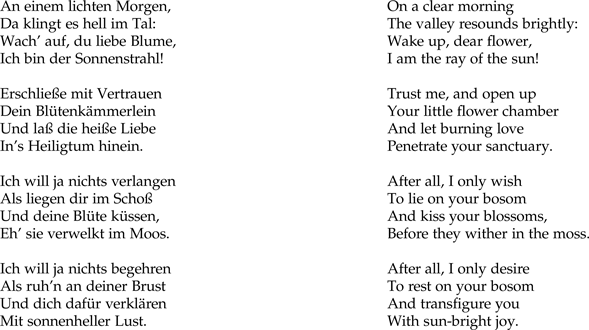
Brunold first encounters Jucunde sonically, as the ‘waves of sound’ (Tonwellen) of her song, ‘An einem lichten Morgen’, drift through the forest.Footnote 37 This song, set as the second in Schumann's Op. 23 collection, bears some similarities to ‘Die stille Lotosblume’ in its floral imagery and projection of sexual desire. In Rollett's poem, a yearning sun describes its wish to consummate his love with a silent and passive flower. But where Geibel concluded his poem with a question for the flower, waiting eternally in vain for an answer, Rollett's sun speaks in the imperative. The sun does not seek an answer from the flower, instead dominating 14 of the poem's 16 lines with its voice. Rollett further emphasized the passivity of the flower through euphemistic language that aligns the flower with the female sexual anatomy. This is especially apparent in the second stanza, in which the sun asks the flower to ‘open confidently your little blossom heart [Blütenkämmerlein] and let my burning love-beams into your holy shrine’. In this patriarchal fantasy, the female flower's passivity to the sun is a sexual passivity.
Rollett, ‘An einem lichten Morgen’Footnote 38
Floral references to sexual organs and sexuality became especially prevalent in the nineteenth century due in part to the widespread reception of the eighteenth-century Swedish botanist Carl Linnaeus (1707–1778). He is famous for popularizing the Latinized taxonomy of plants that is still used today. Central to his work is the observation that flowers have a sexual function, understood through analogy to social-sexual human relations. In his botanical writings, plants had courtships, husbands and wives, even penises and vaginas. As Amy M. King points out, ‘the Linnaeus system articulated a plant morphology that was not unlike human anatomy and physiology, creating a system of representation that went a long way toward conflating the human and the vegetative, and breaking down the notion that the relationship between humans and plants was purely poetic’.Footnote 39 The result of this was the reification of long-held associations of flowers with women and sex.Footnote 40 This conflation of flowers and women became ingrained in the imaginations of nineteenth-century Europeans, as demonstrated in the poetry of Geibel, Rollett and other Romantics.Footnote 41
In ‘An einem lichten Morgen’ the material conflation of the vegetative and human serves literally to objectify women as silent, passive and decorative flowers. But Schumann's approach to this poem subtly challenges the botanical conflation of flower and female body in male-authored literature and criticism. She sets the text to an uncomplicated melody, here with most syllables assigned to a crotchet. In the context of the novel, the singing persona is Jucunde, who, in Schumann's setting, innocently ventriloquizes the male sun's lust for the flower. The luscious piano arpeggios that swell and break around the singer's innocent melody can also be heard as the sound of Jucunde's harp and its Tonwellen described in the novel. Yet the simmering passion of this accompaniment, which threatens at times even to overpower the voice, runs contrary to Rollett's floral and sexual fantasy of Jucunde's passivity. Indeed, this accompaniment is anything but passive.
Despite the technical disparity between the voice and piano parts, they often act in parallel with each other. In the passage shown in Example 2, one can observe how the peaks of the piano's arpeggios meet the same pitches in the voice (bars 8–12), leading to a piano interlude that foreshadows the consequent vocal phrase (bars 13–16). Together the voice and accompaniment tell two sides of the same story, in which the piano reveals the inner desires of the singing persona. In Schumann's rendering of the song, the flower is no longer the passive recipient of the sun's (and Rollett's) lustful glances. With the undulating arpeggiations of her piano accompaniment, Schumann wrests the sexualized flower from Rollett's control, turning them into a sonic force that has the potential to even overwhelm the simple melody that carries Rollett's text. Schumann thereby grants a form of agency to the flower in her accompaniment by reifying the interpellation of Jucunde as the flower and actualizing her sexual reciprocity. As in ‘Die stille Lotosblume’, the flower's silence becomes a musical presence: heard yet unspoken.
Schumann, ‘An einem lichten Morgen’, Op. 23 No. 2, bars 8–20.

Flowers were not always silent, however. They could also break their silences to speak directly to their observers, underscoring another aspect of the nineteenth-century anthropomorphization. This is exactly what happens in ‘Was weinst du, Blümlein’, which opens the Op. 23 lieder collection. In this poem a little flower quickly corrects the poetic speaker who asks why it is weeping, saying that its tears are actually the tears of joy (Freudenträne). The same staged mishearing is repeated in the next two stanzas, as the speaker addresses the brooks and the red sky, which, in speaking, adopt a symbolic trait most commonly associated with flowers. Where Schumann in ‘An einem lichten Morgen’ revealed the subtle agency of a silent flower, here the flower declares its own presence. Schumann's setting shows, however, that direct flower speech can also conceal or reveal meanings depending on the gender of the listener.
Rollett, ‘Was weinst du, Blümlein’Footnote 42

Typically, flower speech, as it appears in the Romantic writings of Novalis, Hoffmann and Heine, can only be heard by men and only in the realm of dreams and hallucinations. Watkins demonstrates this well in her discussion of Robert Schumann's ‘Am leuchenden Sommermorgen’, mentioned above. Within Watkins's Kittlerian perspective, centred on the poetic nexus of Woman/Nature/Love, to have flowers speak in the waking reality of their own worlds would transgress their rarefied symbolic status, becoming precariously akin to the legible phrases proffered by sentimental flower books. If a flower, as part of the transcendental Nature/Woman/Love nexus, is to be a ‘language channel’ of poetic inspiration and creativity, then it has to be ‘dissociated from its usage by actual women and transposed into a mystical realm’.Footnote 43 The Romantic flower is a mediator of the ineffable, rather than a sentimental and material intermediary of human-to-human communication. Robert's ‘enharmonic gateway’, which beckons the speech of the flower, evinces this dissociation.
Clara Schumann's setting of ‘Was weinst du, Blümlein’ differs from this transcendent theorization of flower speech in one fundamental way: in Rollett's novel the ‘singer’ of the text is Jucunde, as in ‘An einem lichten Morgen’, meaning the flower speaks to a woman and not a man. The dissociation of material Woman/Nature/Love from actual women and flower noted by Watkins (via Kittler) is therefore not so clear cut in this text. Likewise, Clara Schumann makes no harmonic distinction between the poetic speaker and the flower, keeping the song largely within the diatonic bounds of A major. Yet this does not mean that Schumann is oblivious to the symbolic potential of flower speech; rather, her setting suggests a different way of approaching the voices of flowers, particularly in its subtle harmonic turns.
Schumann, ‘An einem lichten Morgen’, Op. 23 No. 2, bars 8–20.

At the beginning of the second strophe, on the mention of the ‘blood red sky’, there is an unexpected turn to D minor where in the first strophe there was a D major sonority (see Ex. 3). In addition to being reminiscent of the major–minor juxtapositions in ‘Die stille Lotosblume’, this turn reminds us that, as in Rollett's novel, there is a more sinister side to this seemingly innocent scene. Such moments also bear a resemblance to the reversals of mood (often termed Stimmungsbrücke or Stimmungsbrechnung) in Robert Schumann's settings of Heine.Footnote 44 Benjamin Binder, for example, has interpreted the ‘swapping’ of major and minor in Robert's ‘Dein Angesicht’ as a way the composer carefully tempers the Stimmungsbrücke of this song. Showing in the couple's letters how much Clara distained Robert's use of ironic remarks to temper his true feelings, Binder hears the sudden modal change as capturing ‘Robert's desire to both temper his melancholy and maintain a positive demeanour’.Footnote 45 Perhaps because of her distaste for irony, Clara's modal juxtapositions are not so easily traced to such Stimmungsbrücke. Melinda Boyd, in her discussion of Clara's ‘Er ist gekommen’, interprets its shifts from F minor to A-flat major as a way of ‘differentiat[ing] between male fantasy and female delusion in the text’.Footnote 46 That is, rather than using major–minor turns to capture a sudden change in mood, Clara is more likely to employ the technique to reflect simultaneous or contrasting subject positions.
In ‘Was weinst du, Blümlein’ the sudden turn to D minor in bar 27 triggers a six-bar passage in the tonic minor (A minor) as the poet expresses concern for the red sun, remarking that it looks as if it ‘lay dead in the sea’. This minor-mode passage makes the sky's response back in the tonic major seem all the more joyous as it explains that the red is not blood but the roses that it spreads along its path. Schumann's major–minor juxtaposition emulates the mutability and emotional dialectics of Romantic symbols in Rollett's poem and novel, where sounds of laughter can easily be heard as weeping. This becomes even more apparent when one adds in the missing stanzas that did not make the final cut (indicated in italics above). Figure 3 shows the omitted strophe, dramatically and purposefully crossed out for unknown reasons.Footnote 47 Like the second strophe in the final published song, there is also a modal turn from major to minor, yet it occurs at a later moment. In Example 4 I have placed the missing strophe back (4b) into the song, indicating where in the stanza Schumann switches to the minor mode. This figure highlights how the minor mode creeps further towards the opening of each strophe, lingering longer in what is now the third strophe (4c). Schumann positions these modal turns against the grain of the poetry, defying the formulaic pattern of mishearing in the poem and anticipating a thought that maybe this time round the poetic persona will not mishear the sorrows of nature.
Crossed out strophe of ‘Was weinst du, Blümlein’ in the autograph.Footnote 48

Schumann, ‘Was weinst du, Blümlein’, Op. 23 No. 1, bars 24–32.

These major–minor turns thus do more than represent the essential mutability of flowers: they serve to blend the subject position of the poetic speaker and the symbolic traits of the flowers, plus other symbols that adopt their traits. Rollett's Jucunde is privy to the voices of flowers, and in Clara Schumann's setting, sympathizes with them. In this way, the flower of this song has more in common with the sentimental discourse of flowers, where women are considered to be uniquely able to understand the ‘language of flowers’ to which men are deaf. Indeed, Schumann captures Brunold's inability to commune with the flowers in the fourth song, ‘Auf einem grünen Hügel’. This song has much in common with ‘Was weinst du, Blümlein’ with its simple accompaniment, strophic setting and uncomplicated melody. Unlike the happy flower of the first song, however, its silent red rose and the blue flowers on the little green hill – possibly a burial mound – invoke a tearful response.Footnote 49 They can reflect back only what Brunold projects onto them. Accordingly, there are no glimpses here of the dialectical/modal turns we saw in the first song; Schumann sets the entire song firmly in the minor mode. Taking into account the gender of the characters assigned to the poems of Op. 23, the modal turns of ‘Was weinst du, Blümlein’ comes to represent a feminine perspective on the mutability of flowers not afforded to the male Brunold.
Schumann employs the piano, her own instrument, as a means not only to perform a feminine perspective on floral poetics in ‘An einem lichten Morgen’ and ‘Was weinst du, Blümlein’, but also to animate the emergent agencies of flowers and female subjects beyond their construction in male-authored texts. This is not without precedent in her lieder. For instance, many critics have noted the independence of the piano accompaniment in her song ‘Liebst du um Schönheit’ from the Rückert lieder collection co-authored with Robert.Footnote 50 Boyd sees the accompaniment of this song as a way that Clara Schumann makes ‘explicit’ the ‘implicit’ female gender of the poem's speaker. She takes issue with Rufus Hallmark's assessment of the speaker's gender in this poem, which she believes is largely based on the gender of the song's composer. She argues that the poem's themes of deep, spiritual love over fleeting vanities are apposite to either gender. For Boyd, it is only towards the end of the poem, and its ideals of ‘pure, reciprocal love’ that an implied female speaker emerges. This is emphasized by Schumann in a ‘harmonic acceleration’ towards the words ‘dich liebe ich immerdar’ (‘I will love you forever’), that also breaks away from the gentle rollicking accompaniment of the song.Footnote 51 As Hallmark reveals, even in its own time, critics noted the independence of the accompaniment in her song ‘Liebst du um Schönheit’. A review in the Allgemeine musikalische Zeitung in 1842 complains that ‘the accompaniment becomes more important than the simple melody’, understanding it as an embodiment of a ‘sympathetic soul who is moved by the thoughts the voice expresses’.Footnote 52 Building on this observation, Hallmark understands the accompaniment of this song as the persona of the male beloved addressed by the female speaker/singer.Footnote 53
Actor-Network Theory (ANT) provides a useful vocabulary to conceptualize how Schumann's accompaniments ‘animate’ alternative perspectives in relation to the poetic speaker. ANT's concept of ‘agency’, in particular, characterizes well the result of this animation, where the flower takes on a musical presence or force not necessarily indicated by the text alone.Footnote 54 Such terms come with ANTs characteristically slippery ontology, which blurs the social and disciplinary boundaries between subject and object. While Bruno Latour's work centres around social science methodologies, he has also noted the ways that novelists in particular are able to ‘mix up’ the traits typically ascribed to subjects (and subjectivity) and objects (and objectivity).Footnote 55
This trait exchange is apposite to the nineteenth-century representation of flowers, in which not only are flowers anthropomorphized as women, but women are objectified as flowers. As I have shown especially in the first two songs of Op. 23, Schumann responds sympathetically to this trait exchange, allowing her to animate what seemed at first to be an unremarkable stock symbol of Romantic poetry. The symbolic conflation of women and flowers becomes through her hands and her instrument, a material and psychic conflation. To that end, Schumann's settings defy Kittler's transcendental dissociation of Women from women, Nature from flower, discussed by Watkins. Where Robert engaged with opposing discourses of flowers, Clara Schumann addresses flowers’ material and symbolic ties to women.
Speakers and Authors
My final case study, ‘Das Veilchen’, also features the major–minor juxtapositions that have come to typify Schumann's engagement with the mutability of flowers. Like ‘Was weinst du, Blümlein’, this song begins in an easy, volkstümlich style and without an introduction. We immediately learn that this innocent little violet stands in the meadow unnoticed and with a bowed head. On the word unbekannt, the harmony gently turns from F major to F minor, adding a tinge of pity to the otherwise cheerful introduction of the violet, and foreshadowing its encounter with the beloved shepherdess. Schumann embraces the minor mode completely in the setting of the second stanza, as the poet reveals the inner thoughts of the violet who longs to be noticed by the shepherdess. Turning back to F major for the final stanza, there is one last momentary twist to F minor, as the shepherdess fails to see the poor violet. This time the minor twist reminds us that the violet's longing to be noticed, to be more than unbekannt, is hopeless. Yet the violet still rejoices because it is at least through her foot that it perishes.
Goethe, ‘Das Veilchen’Footnote 56

This song differs from Schumann's other flower-centric lieder for two main reasons. First, the flower's implied gender is not specifically female. Assuming a heteronormative reading the violet's encounter with the shepherdess actually genders the flower instead as male. Second, and perhaps most strikingly, her setting bears a close resemblance to Mozart's setting (K476) of the same text.Footnote 57 This is clear right from the opening melody and accompaniment to the first stanza, which shares a nearly identical opening motif to the Mozart (see Ex. 5). L. Poundie Burstein brings these two elements together in his own reading of the song, noting that Schumann's setting portrays an active, rather than passive, maiden in contrast to Mozart's focus on the male character/violet.Footnote 58 I add to this reading by treating the flower as its own character, enabling a reading of both Mozart and Schumann that engages more closely with the gendered poetics of flowers.
Major–minor turns in ‘Was weinst du, Blümlein’ with omitted strophe

Despite clear similarities between the settings, there has been some doubt about the extent to which Schumann knew of the Mozart. Berthold Litzmann, in his biography of Clara Schumann's life based on her letters and diaries, reports that she did not know of Mozart's setting, and was even embarrassed when Robert pointed out the similarities.Footnote 59 We have to take Litzmann's word for it, as not only does he not quote any diary passage here, but the diary itself is now lost and likely destroyed. The extant marriage diaries, however, tell a different story. In an entry from early February 1841, Clara Schumann reports with enthusiasm on hearing Mozart's setting of ‘Das Veilchen’ performed at the Gewandhaus in Leipzig. She writes, ‘despite its great simplicity the lied moved me – it made a singular impression on me’.Footnote 60 Though this was admittedly 12 years before she decided to put pen to paper on her own setting, Mozart's song was undoubtedly known to her.Footnote 61
Mozart contrasts a major mode setting of the first stanza of Goethe's poem with the tonic minor at the beginning of the second stanza. Rather than a return to the tonic (G major), Mozart veers suddenly to E-flat major at the beginning of the final stanza as the poem describes the ultimate fate of the flower (see Ex. 6). The sudden nakedness of the voice from the line ‘das Mädchen kam’, echoed by piano accompaniment, transforms this passage into a quasi-recitative. In switching momentarily from a lyric to a narrative mode of expression, Mozart performs a separation of the speaker and the flower that was earlier implied through the contrast of the tonic major and tonic minor. The speaker becomes a sympathetic storyteller describing the death of the flower. Mozart's setting returns to G major with the final speech of the flower, collapsing the separation between the speaker and the flower. As the vocal line ascends to a top G, the speaker/singer shares the terrible joy of the flower.Footnote 62 Both flower and speaker are thus coded as male. Mozart adds the lines ‘Das arme Veilchen! Es war ein herzigs Veilchen’ (‘The poor violet! It was a dear sweet violet’) as if to confirm the speaker's embodied empathy with the flower.
Comparison of Mozart's and Schumann's openings to ‘Das Veilchen’

As Table 1 shows, Schumann's setting employs a strikingly similar harmonic outline. But where Mozart launches into a recitative-style passage at the beginning of the final stanza, Schumann recapitulates the opening of her song in the tonic major. Only the aforementioned major–minor turn subtly acknowledges the fate of the violet in the previous stanza. Schumann therefore maintains a subtle distinction between the speaker and flower. While her speaker is similarly sympathetic to the story of the violet, the setting does not perform the separation and eventual melding of subjectivities observed in the Mozart. In Schumann's setting the last words of the flower, beginning ‘Und sterb’ ich denn’ (‘And if I die’), in effect become quoted speech: audible to the speaker but not necessarily twinned with the emotions of the speaker. In deviating from the Mozartian model in this third stanza, Schumann undermines the male camaraderie that initially seemed inherent to Mozart's setting and initially to the poem itself.
Tonal plans of Mozart's and Schumann's ‘Das Veilchen’

While the flower's relationship to the shepherdess confirms its probable male gendering, it is also perfectly possible that the sympathetic poetic speaker could be female.Footnote 63 Indeed, there are moments in Schumann's setting in which the assumed gender of the speaker is called into question. At the end of the first stanza, after the introduction of the shepherdess in the dominant, the piano bursts from its otherwise restrained accompaniment into glittering C major arpeggios (see Ex. 7). At the same time the voice suddenly jumps an octave to a high G, exceeding a possible staid ending on the first degree of the scale. Together the piano and voice rupture the otherwise innocent mood of the song with a drastic gesture on the word ‘sang’. In so doing, the singer's voice momentarily melds with the imagined song of the shepherdess, linking the speaker of the poem to the singing body of the violet's oblivious sweetheart. By announcing the singing of the shepherdess on this loud, prolonged dominant, one would be forgiven for expecting the actual song of the shepherdess in the following stanza, perhaps in F major. But instead we hear the perspective of the violet in a quiet F minor, emphasizing the chasm between the world of the shepherdess and the violet, and substantiating the impossibility of communion between the men and women thematized in other flower lieder.
Mozart, ‘Das Veilchen’, K476, bars 39–51

Schumann, ‘Das Veilchen’, bars 10–22

By maintaining a close sonic relationship to Mozart's ‘Das Veilchen’, Schumann can trouble its male-centric enactment of Goethe's floral poem. As a result, she is also able to introduce a gender dialectic that was largely absent in Mozart, especially through the brief embodiment of the shepherdess's voice. The relationship of the poetic speaker to the violet therefore becomes less obviously differentiated. Her speaker/singer does not completely take on the emotions of the flower. Neither does she grant the flower its own agential force, as in the examples from Op. 23. Perhaps, as in ‘Die stille Lotosblume’, her approach to the song seeks to uphold the flower as a gendered and unreliable communicative means.
What at first appears to be a simple, volkstümlich setting of Goethe's famous flower poem in fact turns out to be a complex mix of implied voices and authors. In many ways, this mixture is innately floral. The mutability of flowers, after all, derives to a large extent from their ability to obfuscate and imply overlapping messages and intentions. Like the red rose of Jerichau-Baumann's painting, the flower is a paradoxically full and empty symbol, overflowing with associations and meanings that humans have poured into it. Flowers are unreliable mediators yet, as Petrino observed in the floral metaphors of Dickinson's and Osgood's poetry, it is precisely this quality that nineteenth-century women authors could use purposely to ‘uncover and hide their true selves simultaneously’.Footnote 64
The Blumenbuch für Robert is a poignant example of how Schumann herself used flowers to convey feelings while still protecting her innermost thoughts. Next to each flower, Schumann records the date and place they were procured and, where appropriate, from whom she had received them. Seldom does she give any more information or personal reflection than this. Each flower is the nexus of a network of personal relationships and unknowable memories, twinned with cultural, literary and perhaps even sentimental associations. Taken together they insinuate personal stories and feelings without revealing too much.
A Blumenbuch entry from July 1856 (Fig. 4) shows well how the assemblage of different people, flowers, places, occasions, thoughts and feelings can fold into one page in this collection. In the top left there is a miniature bouquet sent to her in London from her daughter Elise (born 1843), which Clara has pasted into her Blumenbuch. To the right of this, a rose from her eldest child Marie (born 1841). Both are marked ‘zu Papa's Geburtstag’ (for Papa's birthday) but were sent to their mother all the way in England. Below are evergreen boxwood and holly leaves from the environs of Richmond, where she was staying while giving performances in London. While each might tell their own story – of concern for parents, abroad and hospitalized, or as a souvenir of a place – it is their combination on this page that gestures to a much more complex emotional state. Robert was at death's door when she assembled this page in mid-July and he would be dead before August. It is as if she counteracts the innocent and thornless roses of her children, offered indirectly to their father, with the prickly spines of the holly leaf. Memories of her spouse in Germany are juxtaposed with the common flora of England, emphasizing in their closeness on the page, the physical distance between herself and family.
Flowers received in Richmond, Blumenbuch für Robert, 15 June 1856.Footnote 65

The shared and overlapping authorship evinced in this Blumenbuch and her setting of ‘Das Veilchen’ was also a major force in Schumann's personal and professional life, and has wider implications for the study of her life and career. The Rückert lieder collection published under both Robert's and Clara's names immediately springs to mind. So does the well-known fact that her father, Friedrich Wieck, wrote entries on her behalf in her childhood diaries. The marriage diaries, too, authored by both Robert and Clara, see their voices often blend together. Brian Tucker has pointed out that Robert often used this diary to project his feelings onto her, with phrases beginning with ‘Clara herself knows’.Footnote 66 In such cases, shared authorship, willing or not, required bending to the whims of the men in her life. But Clara would have also known how to tactfully conceal and reveal her innermost thoughts and feelings in these diaries, conscious of prying eyes. Reich, for instance, points out that it was only after she left home for a tour to Paris in 1838 that her diary started to record ‘emotions, reactions and conflicts not found in her correspondence or other documents’.Footnote 67 Shared authorship therefore required the careful management of how she expressed her very subjectivity, deferring it for truly private moments. This guarded subjectivity also became a feature of her playing, too, and did not escape notice from contemporaneous critics. Alexander Stefaniak has tracked the change in the reception of her performances between her adolescent concerts and her 1854–56 concert tour, showing how the likes of Liszt and Hanslick praised her ability to restrain her own individual subjectivity in favour of the authentic performance of male composers’ works.Footnote 68
Schumann's guarded subjectivity in these shared texts was a matter of emotional and professional survival for a woman musician in the nineteenth century. What emerges from these conditions, however, is a unique and distinctly feminine mode of authorship, one that not only selects what to reveal but can also tactically placate the voices and wishes of men. Flowers, particularly those represented in her lieder and Blumenbuch, epitomize this mode of authorship. Their delicate charms give the allusion of naivety while at the same time their radical mutability resists easy interpretation, choosing where necessary to remain silent, especially to male ears. The silences of nineteenth-century women are keenly felt to this day. Julia Novak notes that Schumann's deliberate and imposed silences in her life and writings reflect a larger problem for feminist biographers: ‘the inaccessibility of female experience as a subject of biography’.Footnote 69 Reflecting on similar problems in her biography of Jane Franklin (the sister of Benjamin Franklin), Jill Lepore instead determines to make ‘[Franklin's] silence the object of my investigation rather than an obstacle to it’.Footnote 70 Flowers can be seen as one way of focusing on and thematizing these silences.
Conclusion
You ask me what my flowers said – then they were disobedient – I gave them messages.
Emily DickinsonFootnote 71At the end of July 1856, Clara Schumann returned to Germany and visited Robert in his final days in the asylum at Endenich near Bonn. She had not seen him since his suicide attempt in February 1854, largely at the behest of his doctors, who believed her presence might overexcite and exacerbate his condition.Footnote 72 When he left their home in Düsseldorf for Endenich, Clara had entrusted a bunch of flowers to Dr Hasenclever to be passed on to her husband. In her diary she reports that Robert had handed these flowers out to those who accompanied him in the carriage. Hasenclever returned his flower to her, which she kept ‘with a bleeding heart’.Footnote 73 She would also keep the leaves and flowers picked from the garden at Endenich on 28 July, the last time she saw Robert alive. Preserved still in the Blumenbuch für Robert, these three stems of yarrow and a ghost-white petunia stand out in this collection.Footnote 74 Where usually she added little text by each flower other than a date and place, here she assigns them an unambiguous and painful emotion. Underneath the petunia (see Fig. 5) she writes that it was plucked ‘In tiefsten Schmerzen!’ (‘in the most profound anguish’).Footnote 75
Petunia from the garden at Endenich, Blumenbuch für Robert, 28 July 1856.Footnote 76

‘Leaves from the grave of my Robert’, Blumenbuch für Robert, 31 July 1856.Footnote 77

Throughout this study I have shown flowers to be untameably polysemic, enigmatic and mutable, not only in material collections like the Blumenbuch, but also as artistic and poetic representations. As the above quotation from an 1858 letter by Schumann's trans-Atlantic contemporary Emily Dickinson expresses succinctly, flowers have the ability to communicate something yet also conceal much in their symbolic disobedience. Yet here at the end of the Blumenbuch für Robert and at the extremes of grief, Schumann attempts to control this disobedience by overwhelming the flower with her projected feelings. The posthumous dedication of the Blumenbuch to her husband is similarly a paratextual action that can be seen as an attempt to transform this multi-voiced and polysemic collection into a funeral wreath. Such actions, however, do not necessarily sentimentalize or contradict nineteenth-century floral symbolism. Rather, they show an awareness of how symbolically open flowers can be and their ability to convene on decipherable messages.
The final page of the Blumenbuch für Robert includes no flowers, but instead laurel leaves collected from various wreaths laid on Robert's grave on the day of his funeral (see Fig. 6). In the bottom right corner of the page Clara wrote the following inscription:
I began this book with joyous feeling, that he should enjoy these flowers as little tokens of love! I now close this book with these leaves – Buried with them all my most beautiful hopes.Footnote 78
Again, the profound emotion of the day attempts to reign in the complex authorship, memories and meanings of the Blumenbuch. Yet there is also something familiar about this passage. For one, the metaphor of ‘burying’ emotions in a grave is one we find at the end of Dichterliebe, which ends with the poet placing all his pain (Schmerz) into a great coffin that is cast into the sea. Clara's inscription is also reminiscent of the omitted stanza of ‘Auf einem grünen Hügel’ (Op. 23 No. 4), which depicts a grave where all the poet's joy is buried beneath the roses and blue flowers that lie on the hillock.Footnote 79 Even this moment that seeks to interpret her own flowers is deeply intertextual, gesturing to Robert's most floral song cycle and one of her own flower lieder. It harnesses the distinctly feminine understanding of the mutability of flowers, in which the expression of complex emotions is divested across different discourses, media and subjectivities. Flowers for Clara Schumann were thus more than Romantic symbols or domestic diversions: they represented a mode of self-expression that was complex, defiant, revealing, and, when needed, silent.


 Open access

