

1. Introduction
The Gondwana supercontinent is the result of large-scale amalgamation of continents and microcontinents located within East and West Gondwana. Amalgamation started at the end of the Neoproterozoic period, which led to the formation of the East African orogen (e.g. Stern, Reference Stern1994; Collins & Pisarevsky, Reference Collins and Pisarevsky2005; Stampfli et al. Reference Stampfli, Hochard, Vérard, Wilhem and von Raumer2013; Meinhold et al. Reference Meinhold, Morton and Avigad2013) and consequently records the first stage in the development of the Transgondwanan Supermountain (Squire et al. Reference Squire, Campbell, Allen and Wilson2006). From the northern margin of Gondwana, major terranes split off during Palaeozoic time (Şengör, Reference Şengör, Robertson, Searle and Reis1990 and references therein), moved to the north and were accreted to the Eurasian margin during Triassic and Cenozoic times (e.g. Agard et al. Reference Agard, Omrani, Jolivet, Whitchurch, Vrielynck, Spakman, Monie, Meyer and Wortel2011; Abbo et al. Reference Abbo, Avigad, Gerdes and Güngör2015; Hassanzadeh & Wernicke, Reference Hassanzadeh and Wernicke2016; Stephan et al. Reference Stephan, Kroner and Romer2019). Understanding the exact origin of these Gondwana-derived terranes along the Gondwana margin has been a major geological challenge in the last decade (e.g. Stampfli et al. Reference Stampfli, Hochard, Vérard, Wilhem and von Raumer2013; von Raumer et al. Reference von Raumer, Bussy, Schaltegger, Schulz and Stampfli2013; Stephan et al. Reference Stephan, Kroner and Romer2019; Žák et al. Reference Žák, Svojtka, Gerdjikov, Kounov and Vangelov2021; Fig. 1).
(a) Present-day map showing Gondwana-derived units (GDUs) and further terranes within the Alpine–Himalaya collision orogen (modified from Stampfli et al. Reference Stampfli, Hochard, Vérard, Wilhem and von Raumer2013). GDUs and further terranes mentioned: AL– Alborz; ZG – Zagros; CI – Central Iran; KD – Kopet Dagh; AS – Arabian Shield; NS – Nubian Shield; SSMZ – Sanandaj–Sirjan metamorphic zone; Tu – Turan; Ba – Badakshan; SKu – South Kunlun; NQi – North Qilian; Qi – Qilian; Qa – Qaidam; EKu – East Kunlun; Er – Erlangping; Qin – Qinling; Da – Dabie. Light yellow – post-460 Ma formations; dark green – Hunia terrane (H); light blue – Gondwana.

Although most of the Neoproterozoic palaeogeographic reconstructions place the Iranian microcontinent along the Prototethyan margin of northern Gondwana, which is close to the East African orogen (e.g. Hassanzadeh et al. Reference Hassanzadeh, Stockli, Horton, Axen, Stockli, Grove, Schmitt and Walker2008; Horton et al. Reference Horton, Hassanzadeh, Stockli, Axen, Gillis, Guest, Amini, Fakhari, Zamanzadeh and Grove2008; Fergusson et al. Reference Fergusson, Nutman, Mohajjel and Bennett2016), some new age information and the tectonic setting of the Neoproterozoic rocks indicate that the Iranian microcontinent was originally part of a series of peri-Gondwanan terranes, similar to the Avalonian (640–540 Ma) and Cadomian (616–540 Ma) arc terranes (e.g. Murphy et al. Reference Murphy, Pisarevsky, Nance and Keppie2004; Moghadam et al. Reference Moghadam, Li, Griffin, Stern, Ishizuka, Henry, Lucci, O’Reilly and Ghorbani2020 b; Fig. 1).
The age and nature of the continental crust in Iran have been documented during previous research, including zircon U–Pb ages published over the last two decades that demonstrate the dominance of Pan-African continental crustal material in the Iranian microcontinent, recording widespread late Neoproterozoic subduction-related magmatism (e.g. Ramezani & Tucker, Reference Ramezani and Tucker2003; Hassanzadeh et al. Reference Hassanzadeh, Stockli, Horton, Axen, Stockli, Grove, Schmitt and Walker2008; Rahmati-Illkchi et al. Reference Rahmati-Ilkhchi, Faryad, Holub, Košler and Frank2011; Jamshidi Badr et al. Reference Jamshidi Badr, Collins, Masoudi, Cox and Mohajjel2013; Nutman et al. Reference Nutman, Mohajjel, Bennett and Fergusson2014; Shakerardakani et al. Reference Shakerardakani, Neubauer, Masoudi, Mehrabi, Liu, Dong, Mohajjel, Monfaredi and Friedl2015; Fergusson et al. Reference Fergusson, Nutman, Mohajjel and Bennett2016; Moghadam et al. Reference Moghadam, Griffin, Li, Santos, Karsli, Stern, Ghorbani, Gain, Murphy and O’Reilly2018, Reference Moghadam, Li, Griffin, Stern, Ishizuka, Henry, Lucci, O’Reilly and Ghorbani2020 b). Recent research on amphibolites in the central Sanandaj–Sirjan metamorphic zone (SSMZ) identified Neoarchaean xenocrystic zircons that revealed the presence of hidden Neoarchaean crustal components in Iran (Shakerardakani et al. Reference Shakerardakani, Li, Ling, Li, Tang, Liu and Monfaredi2019).
In addition, detrital zircon data from Neoproterozoic, Palaeozoic and Triassic clastic sediments have recently become available from many different portions of the Iranian microcontinent, such as from the central Alborz, Zagros, northwestern Central Iranian terrane and NE Iran (e.g. Horton et al. Reference Horton, Hassanzadeh, Stockli, Axen, Gillis, Guest, Amini, Fakhari, Zamanzadeh and Grove2008; Etemad-Saeed et al. Reference Etemad-Saeed, Hosseini-Barzi, Adabi, Miller, Sadeghi, Houshmandzadeh and Stockli2015; Honarmand et al. Reference Honarmand, Li, Nabatian, Rezaeian and Etemad-Saeed2016; Zhang et al. Reference Zhang, Xiao, Majidifard, Zhu, Wan, Ao, Chen, Rezaeian and Esmaeili2017; Moghadam et al. Reference Moghadam, Li, Griffin, Stern, Thomsen, Meinhold, Aharipour and O’Reilly2017; Meinhold et al. Reference Meinhold, Hashemi Azizi and Berndt2020; Zoleikhaei et al. Reference Zoleikhaei, Mulder and Cawood2020).
Previous detrital zircon studies indicated that the dominant age population in the upper Neoproterozoic–Cambrian sandstones from the Kahar, Bayandor, Barut, Lalun and Mila formations of the Alborz and Zagros mountains is Neoproterozoic, with a main age peak at 0.6 Ga as well as minor peaks at 1.0 Ga, 1.8 Ga and 2.5 Ga (Horton et al. Reference Horton, Hassanzadeh, Stockli, Axen, Gillis, Guest, Amini, Fakhari, Zamanzadeh and Grove2008). In the central Alborz Mountains, alongside the youngest, prominent (0.55–0.56 Ga) detrital zircon population, 0.9–1.0 Ga, 2.0–2.2 Ga, 2.5–2.7 Ga and 2.9–3.2 Ga age populations appear in the Neoproterozoic sandstones from the Kahar Formation (Etemad-Saeed et al. Reference Etemad-Saeed, Hosseini-Barzi, Adabi, Miller, Sadeghi, Houshmandzadeh and Stockli2015). In addition, Cambrian sandstones of the Lalun Formation reveal similar reoccurring age clusters as observed in the Kahar Formation, dominated by Cryogenian–Ediacaran ages, with pre-Neoproterozoic and Cambrian zircon grains a minor component (Zoleikhaei et al. Reference Zoleikhaei, Mulder and Cawood2020). Some Neoproterozoic sandstones from the Kahar and Bayandor formations in Central Iran are dominated by 0.62–0.64 Ga zircon ages, with minor age populations at 0.82 Ga, 0.92–0.94 Ga, 1.9–2.3 Ga and 2.5–3.0 Ga (Honarmand et al. Reference Honarmand, Li, Nabatian, Rezaeian and Etemad-Saeed2016). The dominant age population from Cambrian sandstones of the Zaigun Formation is Cryogenian to Tonian (Grenvillian) (0.7–0.9 Ga), with subordinate Palaeoproterozoic to Neoarchaean (2.4–2.6 Ga) populations. However, the Triassic Nakhlak Group sandstones of Central Iran show a pronounced age population at c. 240–280 Ma, with subordinate pre-Permian Palaeozoic peaks at c. 320 Ma and 480 Ma. Meinhold et al. (Reference Meinhold, Hashemi Azizi and Berndt2020) suggested sediment supply from the Permian–Triassic magmatic rocks of the Silk Road Arc further north. The Neoproterozoic and Palaeoproterozoic zircons have predominantly rounded shapes suggesting recycling of older sedimentary rocks (Meinhold et al. Reference Meinhold, Hashemi Azizi and Berndt2020). In NE Iran, the Ordovician to Lower Devonian sandstones are characterized by distinct age groups at 2.5 Ga, 0.6–0.8 Ga, 0.5 Ga and 0.4–0.5 Ga, as well as a minor age peak at 1.0 Ga (Moghadam et al. Reference Moghadam, Li, Griffin, Stern, Thomsen, Meinhold, Aharipour and O’Reilly2017).
In this paper, we carry out, for the first time, a coupled U–Pb age and trace-element analysis of detrital zircons from three garnet-micaschist samples (primarily Neoproterozoic–early Palaeozoic in age) distributed along a ∼100 km long central segment of the SSMZ in the Zagros orogenic belt (Fig. 1). For the interpretation of our results, we integrate our new data with the previously published detrital zircon U–Pb data from other Precambrian–Palaeozoic clastic sediments throughout the Alborz, Central Iran and NE Iran. We juxtapose the new detrital U–Pb zircon data with biogeographic evidence to constrain the position of the Iranian microcontinent on the northern Gondwana margin and its relation to the global framework as was recently also postulated by Yang et al. (Reference Yang, Li, Li, Zhu and Lu2020) and Merdith et al. (Reference Merdith, Williams, Collins, Tetley, Mulder, Blades, Young, Armistead, Cannon, Zahirovic and Müller2021). We show that the SSMZ as part of the Iranian microcontinent bears similar detrital zircon age spectra to those known from the Arabian–Nubian shield, in peri-Gondwanan terranes to the west of Iran as well as to those of the South China block in the east.
2. Geological background
Iran is regarded as a fragment of Gondwana and comprises several blocks or domains, e.g. the Alborz and Zagros mountain belts, the Central Iranian plateau and the Kopet Dagh Mountains, that are separated by deep-seated faults or suture zones (e.g. Stöcklin, Reference Stöcklin1968; Berberian & King, Reference Berberian and King1981; Fig. 1). Major areas of exposed crystalline basement rocks with variable dimensions occur within all of the continental tectonic zones in Iran barring the Kopet Dagh Mountains to the northeast.
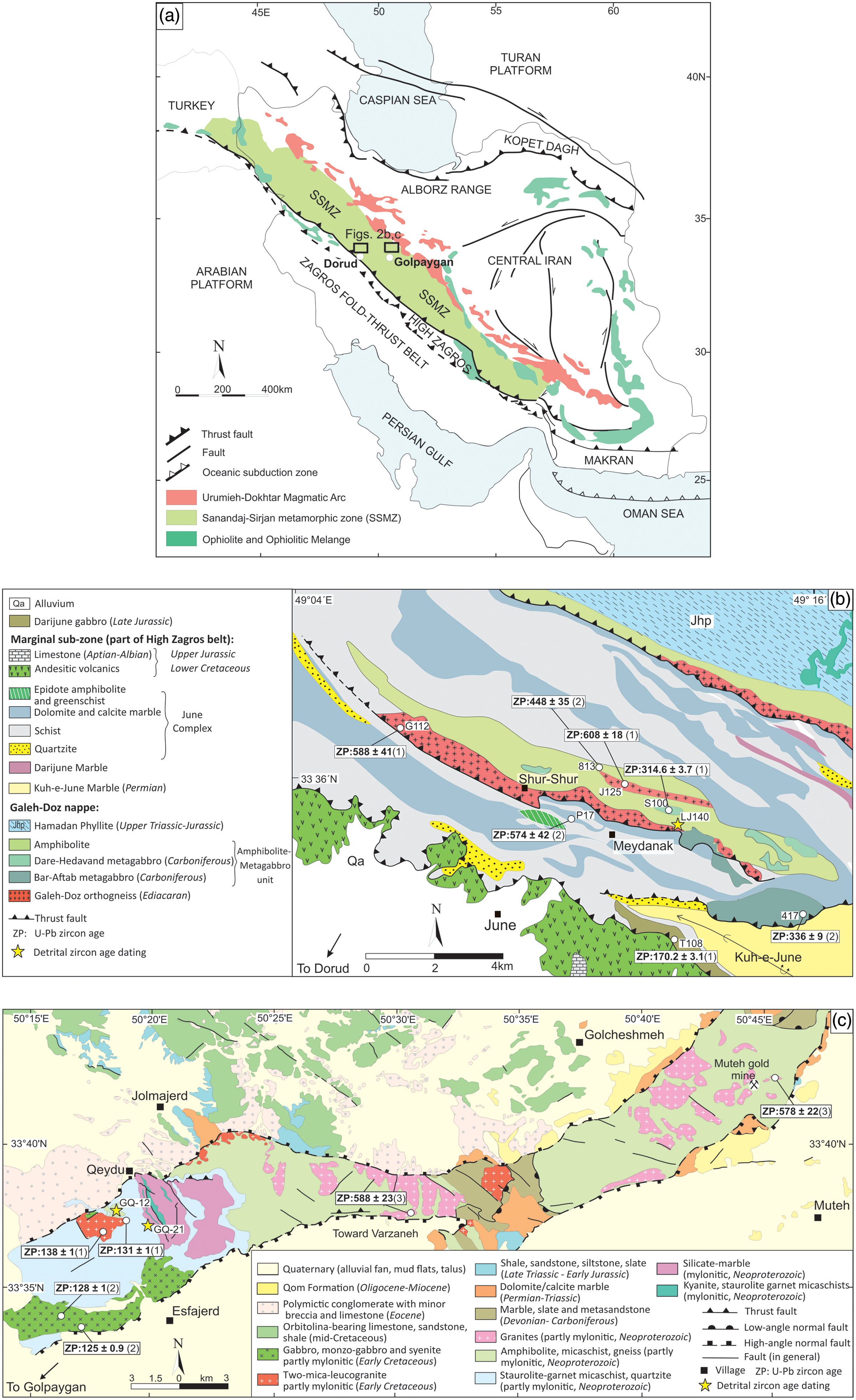
The NW–SE-trending Zagros orogen of western Iran is part of the Alpine–Himalayan orogenic belt and developed as the result of the continental collision between the African–Arabian continent and the Iranian microcontinent (e.g. Berberian & King, Reference Berberian and King1981; Alavi, Reference Alavi1994; Mohajjel et al. Reference Mohajjel, Fergusson and Sahandi2003; Agard et al. Reference Agard, Omrani, Jolivet, Whitchurch, Vrielynck, Spakman, Monie, Meyer and Wortel2011; Mouthereau et al. Reference Mouthereau, Lacombe and Vergés2012). The Zagros Mountains are subdivided into four parallel tectonostratigraphic zones, namely (from NE to SW) the Urumieh–Dokhtar magmatic arc (UDMA), the SSMZ, the Imbricate zone or High Zagros, and the Zagros fold–thrust belt (Stöcklin, Reference Stöcklin1968; Falcon, Reference Falcon and Spencer1974; Alavi, Reference Alavi1994; Fig. 2a).
(a) Main zones under consideration in Iran. (b) Simplified geological map of the Dorud–Azna region and sample location of garnet-micaschist. Ages are given in Ma; sources of data: 1 – Shakerardakani et al. (Reference Shakerardakani, Neubauer, Masoudi, Mehrabi, Liu, Dong, Mohajjel, Monfaredi and Friedl2015); 2 – Fergusson et al. (Reference Fergusson, Nutman, Mohajjel and Bennett2016). (c) Geological map of the Muteh–Golpaygan area and location of investigated samples (modified after Shakerardakani et al. Reference Shakerardakani, Li, Neubauer, Ling, Li, Monfaredi and Wu2020 and references therein). Sources of data: 1 – Shakerardakani et al. (Reference Shakerardakani, Li, Neubauer, Ling, Li, Monfaredi and Wu2020); 2 – unpublished data; 3 – Hassanzadeh et al. (Reference Hassanzadeh, Stockli, Horton, Axen, Stockli, Grove, Schmitt and Walker2008).
The SSMZ forms the innermost crystalline part of the Zagros orogen, where the continental and oceanic units were tectonically juxtaposed against the Arabian plate along the Main Zagros thrust (e.g. Agard et al. Reference Agard, Omrani, Jolivet, Whitchurch, Vrielynck, Spakman, Monie, Meyer and Wortel2011; Hassanzadeh & Wernicke, Reference Hassanzadeh and Wernicke2016). The SSMZ is primarily composed of Precambrian–Palaeozoic metamorphic and sedimentary sequences, which are unconformably overlain by Permian–Triassic marbles, Jurassic phyllites and Aptian–Albian limestones (Stöcklin, Reference Stöcklin1968; Berberian & King, Reference Berberian and King1981). In addition, this zone represents the largest exposure and well-preserved record of key events during late Palaeozoic to middle Cenozoic times, which represent the formation and destruction of the Neotethys Ocean (e.g. Mohajjel et al. Reference Mohajjel, Fergusson and Sahandi2003; Hassanzadeh & Wernicke, Reference Hassanzadeh and Wernicke2016). The SSMZ, Central Iran and (southern and central) Alborz are considered part of the Iranian microcontinent, bearing a similar late Ediacaran–Palaeozoic and Mesozoic stratigraphy (e.g. Hassanzadeh & Wernicke, Reference Hassanzadeh and Wernicke2016; Moghadam et al. Reference Moghadam, Li, Griffin, Stern, Thomsen, Meinhold, Aharipour and O’Reilly2017 and references therein).
3. Geological setting and sampling
3.a. Dorud–Azna area
The Dorud–Azna region is located in the central part of the SSMZ close to the Main Zagros thrust, which is known to comprise a polyphase metamorphic succession (Mohajjel et al. Reference Mohajjel, Fergusson and Sahandi2003; Nutman et al. Reference Nutman, Mohajjel, Bennett and Fergusson2014; Shakerardakani et al. Reference Shakerardakani, Neubauer, Masoudi, Mehrabi, Liu, Dong, Mohajjel, Monfaredi and Friedl2015, Reference Shakerardakani, Neubauer, Bernroider, Finger, Hauzenberger, Genser, Waitzinger and Monfaredi2021; Fig. 2b). Structural studies and our previous U–Pb zircon dating work on this area demonstrated three metamorphic units, which are from footwall to hangingwall (Fig. 2b): (1) the Triassic June Complex, metamorphosed within greenschist-facies conditions; overlain by (2) the amphibolite-grade metamorphic Pan-African Galeh-Doz orthogneiss, which is intruded by some mafic dykes, and (3) the Amphibolite–Metagabbro unit, which includes Carboniferous metagabbro bodies (Shakerardakani et al. Reference Shakerardakani, Neubauer, Masoudi, Mehrabi, Liu, Dong, Mohajjel, Monfaredi and Friedl2015; Fergusson et al. Reference Fergusson, Nutman, Mohajjel and Bennett2016), Carboniferous granitic orthogneiss (Shabanian et al. Reference Shabanian, Davoudian, Azizi, Asahara, Neubauer, Genser, Dong and Lee2020) and undated amphibolites. These units have almost invariably undergone a complex history of repeated shearing, folding and transposition of ductile fabrics, which are associated with polyphase Jurassic and Cretaceous greenschist- to amphibolite-facies metamorphism. In the eastern part, the overlying low-grade metamorphic Triassic sequence is intruded by the Upper Jurassic Darijune gabbro (Shakerardakani et al. Reference Shakerardakani, Neubauer, Masoudi, Mehrabi, Liu, Dong, Mohajjel, Monfaredi and Friedl2015).
The metapelitic rocks studied in this work occur in several small outcrops within the Amphibolite–Metagabbro unit in contact with metagabbro over more than 1 km around Dare-Hedavand village (Fig. 2b). The studied micaschist is brown, exhibits a weak schistosity and consists of garnet, plagioclase, quartz, K-feldspar, biotite and chlorite (Fig. 3a, b).
(a, c, d) Field photographs of schist outcrop sampled in the study and (b) representative photomicrograph of schist. (a) Foliated garnet-micaschist in the Dorud–Azna area. Diameter of coin for scale is 29.3 mm. (b) Large garnet porphyroclasts in the matrix composed of quartz, plagioclase, K-feldspar and biotite. (c, d) Strongly foliated garnet-micaschists of the Muteh–Golpaygan area. Length of hammer for scale is 33 cm.

3.b. Muteh–Golpaygan metamorphic complex
The Muteh–Golpaygan metamorphic complex is located close to the northeastern boundary of the central SSMZ, close to the UDMA within the hinterland of the Zagros orogen (Fig. 2c). The Muteh–Golpaygan metamorphic complex is generally bounded by NE–SW- to E–W-trending high-angle normal faults that dip outward from the centre of the complex and juxtapose it against unmetamorphosed rocks in the hangingwall (Moosavi et al. Reference Moosavi, Mohajjel and Rashidnejad-Omran2014; Shakerardakani et al. Reference Shakerardakani, Li, Ling, Li, Tang, Liu and Monfaredi2019, Reference Shakerardakani, Li, Neubauer, Ling, Li, Monfaredi and Wu2020). Besides rare remnants of Neoarchaean rocks, the Muteh–Golpaygan metamorphic complex comprises mainly Neoproterozoic basement material dominated by granitic orthogneisses and metapelites locally interlayered with marbles along with minor quartzite (e.g. Thiele, Reference Thiele1966; Rachidnejad-Omran et al. Reference Rachidnejad-Omran, Emami, Sabzehei, Rastad, Bellon and Pique2002; Moritz et al. Reference Moritz, Ghazban and Singer2006; Moosavi et al. Reference Moosavi, Mohajjel and Rashidnejad-Omran2014; Hassanzadeh & Wernicke, Reference Hassanzadeh and Wernicke2016). All these lithologies are cross-cut by abundant leucogranitic rocks and dykes in the western part of the complex (Shakerardakani et al. Reference Shakerardakani, Li, Neubauer, Ling, Li, Monfaredi and Wu2020). The Neoarchaean basement of the Muteh–Golpaygan metamorphic complex has recently been constrained by 207Pb–206Pb ages of c. 2.7 and 2.5 Ga from xenocrystic zircons within amphibolite (Shakerardakani et al. Reference Shakerardakani, Li, Ling, Li, Tang, Liu and Monfaredi2019). Unmetamorphic to very low-grade metamorphic Mesozoic and Cenozoic shale, sandstone, siltstone, slate, dolomite and conglomerate units overlie the basement rocks in the study area and are in turn mostly covered by Quaternary rocks.
The depositional age of the metapelitic rocks from the Muteh–Golpaygan metamorphic complex is unknown. The metapelites are dominantly characterized by amphibolite-facies mineral assemblages, including garnet, staurolite and kyanite (Moritz et al. Reference Moritz, Ghazban and Singer2006). K–Ar amphibole ages of c. 156 Ma (Rachidnejad-Omran et al. Reference Rachidnejad-Omran, Emami, Sabzehei, Rastad, Bellon and Pique2002) suggest that metamorphism was predominantly of Late Jurassic age (Moosavi et al. Reference Moosavi, Mohajjel and Rashidnejad-Omran2014; Hassanzadeh & Wernicke, Reference Hassanzadeh and Wernicke2016). Samples GQ-12 and GQ-21 are strongly foliated garnet-micaschists from the Muteh–Golpaygan metamorphic complex (Fig. 3c, d) and consist of biotite, porphyroblastic garnet (up to 1 mm in size), white mica, plagioclase, chlorite and opaque phases.
4. Analytical methods
In this study, we analysed the detrital zircon populations of three garnet-micaschist samples from the SSMZ to gain insight into the provenance of these strata and how it changes through time and along the SSMZ. Two samples, GQ-12 and GQ-21, were collected to the north of the Muteh–Golpaygan metamorphic complex, while the third sample, LJ-140, was collected northeast of the Dorud area (Fig. 2b; online Supplementary Material Table S1). All three samples contain abundant zircon grains.
Zircons were extracted from a garnet-micaschist (sample LJ-140) of the Dorud–Azna region at Salzburg University. About 3 kg of each sample was crushed in a steel disc mill to obtain the ∼50–250 μm sieve fraction. Zircons were concentrated by a standard plastic pan and warm water, Frantz isodynamic magnetic separator and methylene iodide heavy liquid separation procedures, and handpicking under a binocular microscope. A total of 130 zircon grains were dated in situ on an excimer (193 nm wavelength) laser ablation inductively coupled plasma mass spectrometer (LA-ICP-MS) at the State Key Laboratory of Continental Dynamics, Northwest University, Xi´an, China. Trace elements were measured simultaneously. The analytical details follow Liu et al. (Reference Liu, Gao, Diwu and Ling2008) and are described in Appendix 1.
U–Pb and trace-element analysis of a total of 228 detrital zircon grains obtained from two garnet-micaschist samples (GQ-12 and GQ-21) within the Muteh–Golpaygan metamorphic complex was performed at the China University of Geosciences, Beijing by LA-ICP-MS, using the methodology of Song et al. (Reference Song, Niu, Wei, Ji and Su2010). Detrital zircon grains (∼50–200 μm) were separated from crushed rocks using a standard plastic pan and warm water and subsequent magnetic separation and heavy liquid separation followed by handpicking. The analytical details are given in Appendix 2.
For interpretation of the age data, we used the recent version (http://www.stratigraphy.org) of the time-scale calibration proposed by Cohen et al. (Reference Cohen, Finney, Gibbard and Fan2013).
5. Analytical results
Together, we carried out a coupled U–Pb age and trace-element analysis of 362 detrital zircons from three garnet-micaschist samples (primarily Palaeozoic–early Mesozoic in age, see Sections 5.a and 5.b) distributed along a ∼100 km long section of the central SSMZ, and they can be taken as representative of the central part of the SSMZ.
5.a. Detrital zircon ages: Dorud–Azna area
Zircons from sample LJ-140 have crystal lengths of ∼70 to 200 µm. Except those with an early Proterozoic age or with an age at the middle/late Proterozoic boundary, most grains are euhedral or subeuhedral, implying relatively short transport. As shown in representative cathodoluminescence (CL) images (Fig. 4), the majority of the investigated zircon grains exhibit clear inner structures with a broad zoning, an internal oscillatory zoning and very rarely thin bright rims under CL, interpreted as metamorphic overgrowths. Zircons have Th and U contents ranging from 2.06 to 1357 ppm and 34.21 to 2618 ppm, respectively. The Th/U ratios range from 0.10 to 1.78 with a mean value of 0.53, except four spots (Th/U <0.1), indicating that the majority of the zircons are of magmatic origin (Corfu et al. Reference Corfu, Hanchar, Hoskin and Kinny2003; Corfu, Reference Corfu2004).
Cathodoluminescence images of dated zircons from garnet-micaschists of the Dorud–Azna and Muteh–Golpaygan regions. 206Pb–238U age (Ma) is shown for ages <1000 Ma, the 207Pb–206Pb age when older than 1000 Ma. Circles represent analysis spot positions with spot numbers and their ages in Ma.

In total, 134 analyses were obtained for 130 zircon grains from the garnet-micaschist sample; 30 analyses are not considered because of a discordance of >10 %, and 104 grains are subconcordant between 90 and 110 % concordancy (Fig. 5; online Supplementary Material Table S1). The majority of the zircon populations (96 %) contain grouping of 565–700 Ma, 737–805 Ma, 820–915 Ma, 0.93–1.1 Ga, 1.81–2.07 Ga, 2.14–2.5 Ga and one younger, Cambrian age (∼507 Ma). Owing to low Th/U ratios and missing oscillatory zoning, four zircons (507 ± 9 Ma, 586 ± 8 Ma, 692 ± 9 Ma and 702 ± 11 Ma) are interpreted as metamorphic zircons. Only four Archaean ages (<4 %) were discovered (∼2.62, 2.68, 2.73 and 3.24 Ga).
Histograms and Kernel Density Estimations (KDE) for detrital zircon U–Pb ages in the studied samples. (a) Sample from the Dorud–Azna region and (b, c) Samples from the Muteh–Golpaygan region of the central Sanandaj–Sirjan metamorphic zone.

5.b. Detrital zircon ages: Muteh–Golpaygan metamorphic complex
A total of 90 valid age values out of 228 zircon grains were obtained based on whether their U–Pb analyses were concordant or not.
Most zircon grains from the sample GQ-21 are euhedral to subhedral prisms (50 to 150 µm in length) with a clear oscillatory (e.g. spot 50) and/or sector zoning (e.g. spots 41, 87) in CL images and Th/U ratios ranging from 0.11 to 3.13, suggesting that they have a magmatic origin (Figs 4, 6). However, nine zircon grains appear homogeneous in CL images and were recorded to possess low Th/U ratios of 0.03 to 0.07; these characteristics typically imply a metamorphic origin (e.g. Rubatto, Reference Rubatto2002).
Zircon Th/U ratio versus U–Pb ages of the detrital zircons from three garnet-micaschists. Note that most of the zircons from this study reside above 0.1.

Zircon U–Pb analyses yielded diverse age groups, indicating different sources for the zircons (Fig. 5). Six major age populations dominate the GQ-21 detrital zircon grains, with populations at 547–611 Ma, 642–788 Ma, 868–931 Ma, 0.97–1.17 Ga, 1.79–2.07 Ga and 2.36–2.5 Ga. From a total of 40 dated subconcordant zircons, one gave an Ordovician age (∼467 Ma), two gave Cambrian ages (∼505 Ma, 532 Ma) and one gave a Neoarchaean age (∼2.58 Ga; online Supplementary Material Table S1). Six Proterozoic zircons (1787 ± 35 Ma, 1030 ± 52 Ma, 642 ± 4 Ma, 611 ± 5 Ma, 602 ± 5 Ma, 552 ± 4 Ma) are considered to have a metamorphic origin.
With the exception of few sub-rounded zircon grains in sample GQ-12, the vast majority of the zircons are nearly euhedral or subhedral and prismatic (∼50 to 100 µm in length). Many zircons show a clear oscillatory or sector zoning in CL images, and some of them exhibit thin overgrowth rims of weak or no zoning (Fig. 4). The Th/U ratios of the zircons range from 0.10 to 2.03, except four spots (<0.1). The U and Th concentrations range from 75.5 to 2759 ppm and from 18.21 to 2218 ppm, respectively.
The zircon age populations from sample GQ-12 span characteristic intervals of time, namely 200–323 Ma, 383–423 Ma, 559–626 Ma, 808–963 Ma and 1.81–2.5 Ga, displaying a multi-peaked age distribution pattern (Fig. 5). Five out of 50 subconcordant zircons analysed have Jurassic (∼149–200 Ma) ages. This sample yields a small portion (<4 %) of metamorphic zircons (1916 ± 24 Ma, 1808 ± 21 Ma).
5.c. Trace-element chemistry of the zircons
Trace-element compositions of zircon grains can identify the most likely source rock types within which the detrital zircon grains crystallized (e.g. Belousova et al. Reference Belousova, Griffin, O’Reilly and Fisher2002; Hoskin & Schaltegger, Reference Hoskin and Schaltegger2003; Grimes et al. Reference Grimes, Jhon, Kelemen, Mazdab, Wooden, Cheadle, Hanghøj and Schwartz2007, Reference Grimes, Wooden, Cheadle and John2015; Portner et al. Reference Portner, Daczko, Murphy and Pearson2011; Ranjan et al. Reference Ranjan, Upadhyay, Pruseth and Nanda2020). Chondrite-normalized rare earth element (REE) patterns (online Supplementary Material Table S2; Fig. 7) for most of the laser spots of sample LJ-140 indicate features typical for a wide variety of crustal rocks (Hoskin & Schaltegger, Reference Hoskin and Schaltegger2003), with heavy rare earth element (HREE) abundance between 100× and 10 000× chondrite. Spider plots show prominent positive and negative Ce and Eu anomalies, respectively (Fig. 7). The REE patterns, zircon internal textures and high Th/U ratios (Th/U = 0.1–1.78) suggest that a majority of the zircons are typical of magmatic protoliths with mild effects of late-magmatic/metamorphic recrystallization, as indicated by the flat HREE patterns for a few zircons (Fig. 7).
Chondrite-normalized REE patterns for zircons from sample LJ-140. Chondrite data are from McDonough & Sun (Reference McDonough and Sun1995).

Chondrite-normalized REE patterns for zircons from sample GQ-21. Chondrite data are from McDonough & Sun (Reference McDonough and Sun1995).

The chondrite-normalized zircon REE patterns for all age populations of sample GQ-21 show a similar pattern of depleted light rare earth elements (LREEs), progressively increasing HREEs, a prominent positive Ce anomaly and a negative Eu anomaly. These observations are consistent with the textural features indicating zircon growth from melts as a dominant process for the growth of all zircon populations (Rubatto & Hermann, Reference Rubatto and Hermann2007).
Discrimination diagrams using U/Yb or Th/Yb ratios provide a robust method for distinguishing modern zircons crystallized within continental or oceanic crust (Grimes et al. Reference Grimes, Jhon, Kelemen, Mazdab, Wooden, Cheadle, Hanghøj and Schwartz2007, Reference Grimes, Wooden, Cheadle and John2015). Generally, the U/Yb ratio is controlled by the difference in element solubility. Incompatible elements, such as U, are readily soluble in fluids and thus subsequently enriched in continental crust relative to oceanic crust and upper mantle (Grimes et al. Reference Grimes, Jhon, Kelemen, Mazdab, Wooden, Cheadle, Hanghøj and Schwartz2007). Consequently, continental crust is less enriched in incompatible elements, such as Y and Yb, relative to oceanic crust (e.g. Belousova et al. Reference Belousova, Griffin, O’Reilly and Fisher2002; Grimes et al. Reference Grimes, Jhon, Kelemen, Mazdab, Wooden, Cheadle, Hanghøj and Schwartz2007). On the U/Yb versus Hf (and U versus Yb) diagrams, the detrital zircons in both samples plot predominantly in the field of continental zircons; based on available data they are clearly distinct from the field of oceanic crustal zircons (Fig. 8a, b). Furthermore, Grimes et al. (Reference Grimes, Wooden, Cheadle and John2015) have shown that the Nb/Th and Nb/U ratios of zircons reflect the ratios of their host rocks and that zircons from continental arcs have lower Nb/Th and Nb/U ratios compared to zircons in rocks from non-arc settings. Plotting the detrital zircons shows that nearly all of the detrital zircon populations (92–95 %) are enriched in U/Yb ratios and plot in the continental field (Fig. 8a–c). This result cannot be attributed to a homogeneous source region or derivation of detritus from a single source but was considered by Hoskin & Ireland (Reference Hoskin and Ireland2000) to confirm the apparent monotony of REE patterns and abundances in zircons derived from a range of common crustal rock types (Hoskin & Schaltegger, Reference Hoskin and Schaltegger2003).
(a, b) U/Yb versus Hf and U versus Yb concentrations in zircon and expected generalized trends for zircon from variably incompatible element-enriched reservoirs as well as parental melt fractionation (Grimes et al. Reference Grimes, Wooden, Cheadle and John2015). The field labelled ‘Continental Survey’ and lower bound were defined by Grimes et al. (Reference Grimes, Jhon, Kelemen, Mazdab, Wooden, Cheadle, Hanghøj and Schwartz2007). (c) U/Nb proxy for the tectono-magmatic source of igneous zircon. The shaded band represents a ‘mantle-zircon array’ defined by Grimes et al. (Reference Grimes, Wooden, Cheadle and John2015). The upper boundary is placed at the Nb/Yb, U/Yb endpoints (0.0004, 0.02) and (1, 10). Magmatic arc and post-collisional continental zircon are typically offset above the mantle-zircon array. NMORB – normal mid-ocean ridge basalt.

6. Discussion
6.a. Depositional ages
In order to determine the most reliable maximum depositional age for each sample, we utilize four alternate measures of the maximum depositional ages as outlined by Dickinson & Gehrels (Reference Dickinson and Gehrels2009). These include: (1) the age of the youngest single grain within a sample with a 1σ error less than 10 Ma (e.g. Stevens Goddard et al. Reference Stevens Goddard, Trop and Ridgway2018); (2) the youngest graphical peak detrital zircon age controlled by more than one grain age; (3) the calculated weighted mean age of the youngest age peak from an at least three-grain cluster with overlapping ages within the 2σ error and a mean square weighted deviation (MSWD) ≤1; and (4) the weighted average age of the youngest two or more grains that overlap in age at 1σ error.
The oldest sample in this study (sample LJ-140) was collected from the north of the Dorud–Azna region in the central SSMZ (Fig. 2b). The sample displays a prominent peak at 577 ± 9 Ma, which is only ∼10 Ma younger than the Cadomian orthogneiss basement and which is in close contact with the sample (608 ± 18 Ma and 588 ± 41 Ma; Shakerardakani et al. Reference Shakerardakani, Neubauer, Masoudi, Mehrabi, Liu, Dong, Mohajjel, Monfaredi and Friedl2015) implying a tectonic contact between these two lithologies. This 577 Ma age provides the maximum depositional age for this unit. A grain with an age of 507.1 ± 9.41 Ma possesses a low Th/U ratio of <0.1 indicating metamorphic growth, which could be post-depositional.
East of the oldest sample from the central SSMZ, close to the UDMA, two samples (GQ-21 and GQ-12) were collected from the Muteh–Golpaygan metamorphic complex. The first sample (sample GQ-21) is distinguished by its prominent peak near 561 Ma, but it also contains one Middle Ordovician (467 ± 8 Ma) and two Cambrian (505 ± 4 Ma, 532 ± 4 Ma) detrital zircon grains. The weighted mean age for four grains at the prominent peak mentioned above is 552 ± 4 Ma (MSDW = 0.69). The ∼552 Ma age peak for sample GQ-21 is close to the 577 Ma peak of sample LJ-140 from the Dorud–Azna region. The youngest single grain yielding an age of 467 ± 8 Ma (1σ), however, may indicate a younger depositional age.
The second sample from the northwestern part of the Muteh–Golpaygan complex (GQ-12) displays a marked change in provenance to Mesozoic–Palaeozoic sources with main peaks at 230 Ma, 404 Ma, 609 Ma and 1867 Ma (Fig. 5). The youngest peak in this sample is at the Late Triassic – Early Jurassic boundary (205 ± 5 Ma; MSDW = 1.9), and only three zircons are distinctly younger (149 ± 2 Ma, 158 ± 3 Ma and 168 ± 3 Ma) than the rest (>190 Ma). We assume therefore a maximum depositional age of earliest Jurassic for this sample, which is reasonable as metamorphosed Jurassic sediments are widespread within the central SSMZ and represent the metamorphosed cover on the Cadomian basement (e.g. Rachidnejad-Omran et al. Reference Rachidnejad-Omran, Emami, Sabzehei, Rastad, Bellon and Pique2002; Sheikholeslami et al. Reference Sheikholeslami, Bellon, Emami, Sabzehei and Pique2003; Fazlnia et al. Reference Fazlnia, Moradian, Rezaei, Moazzen and Alipour2007; Davoudian et al. Reference Davoudian, Genser, Neubauer and Shabanian2016). As geochronology constrains the age of metamorphism to the Late Jurassic period (156 Ma; Rachidnejad-Omran et al. Reference Rachidnejad-Omran, Emami, Sabzehei, Rastad, Bellon and Pique2002), the depositional age is within the short period between 205 and 156 Ma.
6.b. Provenance
6.b.1. Magmatic history of the SSMZ
Previous studies have provided a wealth of isotopic age constraints for many of the regional and long-lived magmatic events in the SSMZ (Hassanzadeh & Wernicke, Reference Hassanzadeh and Wernicke2016). Although Palaeozoic magmatic rocks are rare in Iran, compared to abundant Mesozoic and Cenozoic magmatism, they record multiphase magmatism during Ordovician–Silurian, Devonian–Carboniferous and Permian times (e.g. Berberian & King, Reference Berberian and King1981; Hassanzadeh & Wernicke, Reference Hassanzadeh and Wernicke2016; Moghadam et al. Reference Moghadam, Li, Griffin, Karsli, Santos, Ottley, Ghorbani and O’Reilly2020 a), suggesting major tectonic events related to the formation of the Palaeotethyan and Neotethyan oceans.
Sample GQ-12 from the northwestern Golpaygan area includes the youngest detrital zircon grains with Proterozoic, Devonian, Carboniferous, Permian and Late Triassic ages. In particular, the Late Triassic U–Pb ages of 205 to 233 Ma are prominent. Sample GQ-21 from the same area yielded grains as young as 467 Ma and lacks significant Carboniferous, Permian and Late Triassic age groups, but bears a significant Neoproterozoic age population.
The continental crust of the SSMZ was thinned during Permian and Triassic times (e.g. Zanchi et al. Reference Zanchi, Zanchetta, Berra, Mattei, Garzanti, Molyneux, Nawab, Sabouri, Brunet, Wilmsen and Granath2009 a,b; Buchs et al. Reference Buchs, Bagheri, Martin, Hermann and Arculus2013; Hassanzadeh & Wernicke, Reference Hassanzadeh and Wernicke2016; Shakerardakani et al. Reference Shakerardakani, Neubauer, Liu, Bernroider, Monfaredi and von Quadt2018). This precludes the possibility that the Late Triassic zircons are of xenocrystic origin through crustal contamination during the ascent of basaltic magmas through the continental crust of the SSMZ. As suggested by Shakerardakani et al. (Reference Shakerardakani, Neubauer, Liu, Bernroider, Monfaredi and von Quadt2018), this basaltic magmatism may have originated from hotspot magmas intruding into the crustal base of the thinned Sanandaj–Sirjan passive margin basement and rising up into shallow levels. The latest Triassic/earliest Jurassic maximum depositional age of sample GQ-12 corresponds in age with the Middle–Upper Triassic to Jurassic sedimentary rocks, which were deposited on the passive continental margin of the Neotethys Ocean (Hassanzadeh & Wernicke, Reference Hassanzadeh and Wernicke2016; Shakerardakani et al. Reference Shakerardakani, Neubauer, Liu, Bernroider, Monfaredi and von Quadt2018). On the other hand, an origin of Triassic zircons from Late Triassic granites of Central Iran cannot be excluded (e.g. Ramezani & Tucker, Reference Ramezani and Tucker2003). Abundant similar Early Triassic to Permian ages were recently reported by Meinhold et al. (Reference Meinhold, Hashemi Azizi and Berndt2020) from Triassic sandstones of Central Iran.
Furthermore, two Carboniferous–early Permian age peaks were recorded for zircons of sample GQ-12, matching the modal age of extensive Carboniferous and earliest Permian granite-gabbro intrusive suites appearing both in the SSMZ and Central Iran, as well as in the Alborz Mountains and NE Iran (e.g. Bagheri & Stampfli, Reference Bagheri and Stampfli2008; Zanchi et al. Reference Zanchi, Zanchetta, Berra, Mattei, Garzanti, Molyneux, Nawab, Sabouri, Brunet, Wilmsen and Granath2009 a,b; Zanchetta et al. Reference Zanchetta, Zanchi, Villa, Poli, Muttoni, Brunet, Wilmsen and Granath2009, Reference Zanchetta, Berra, Zanchi, Bergomi, Caridroit, Nicora and Heidarzadeh2013; Bea et al. Reference Bea, Mazhari, Montero, Amini and Ghalamghash2011; Buchs et al. Reference Buchs, Bagheri, Martin, Hermann and Arculus2013; Saccani et al. Reference Saccani, Azimzadeh, Dilek and Jahangiri2013; Kargaranbafghi et al. Reference Kargaranbafghi, Neubauer and Genser2015; Moghadam et al. Reference Moghadam, Li, Ling, Stern, Santos, Meinhold, Ghorbani and Shahabi2015; Shakerardakani et al. Reference Shakerardakani, Neubauer, Bernroider, von Quadt, Peytcheva, Liu, Genser, Monfaredi and Masoudi2017; Honarmand et al. Reference Honarmand, Li, Nabatian and Neubauer2017; Shabanian et al. Reference Shabanian, Davoudian, Azizi, Asahara, Neubauer, Genser, Dong and Lee2020). Late Palaeozoic rifting of the future Neotethys Ocean formed ribbon continental fragments in Iran that broke away from the northern margin of Gondwana (e.g. Berberian & King, Reference Berberian and King1981; Şengör, Reference Şengör, Robertson, Searle and Reis1990; Agard et al. Reference Agard, Omrani, Jolivet, Whitchurch, Vrielynck, Spakman, Monie, Meyer and Wortel2011; Richards, Reference Richards2015). Subsequently, after a long period of epeirogeny and significant breaks in the sedimentary record during Ordovician–Carboniferous times, the late Carboniferous to early Permian was a period of marine transgression associated with a major extensional phase that affected most parts of Iran (Berberian & King, Reference Berberian and King1981; Alavi-Naini, Reference Alavi-Naini2009).
The available source for the early Permian zircons (sample GQ-12) is dominated by the isolated early Permian anorogenic Hasanrobat pluton (294–288 Ma), which is located south of the Muteh–Golpaygan metamorphic complex and intruded into upper Carboniferous – lower Permian strata (Alirezaei & Hassanzadeh, Reference Alirezaei and Hassanzadeh2012; Honarmand et al. Reference Honarmand, Li, Nabatian and Neubauer2017). The Carboniferous ages of detrital zircons can be explained by subordinate granitic orthogneisses and metagabbros of the region (Shakerardakani et al. Reference Shakerardakani, Neubauer, Masoudi, Mehrabi, Liu, Dong, Mohajjel, Monfaredi and Friedl2015; Fergusson et al. Reference Fergusson, Nutman, Mohajjel and Bennett2016; Shabanian et al. Reference Shabanian, Davoudian, Azizi, Asahara, Neubauer, Genser, Dong and Lee2020).
Vestiges of volcanic activity during Devonian time, mostly restricted to sill-like intrusions, dykes and lava flows interlayered within sedimentary formations, are particularly known in Alborz, Central Iran, the SSMZ, and NE and NW Iran (e.g. Assereto, Reference Assereto1963; Alavi & Bolourchi, Reference Alavi and Bolourchi1973; Lammerer et al. Reference Lammerer, Langheinrich and Manutchehr-Daini1984; Houshmandzadeh et al. Reference Houshmandzadeh, Soheile and Hamdi1990; Wendt et al. Reference Wendt, Kaufmann, Belka, Farsan and Karimi Bavandpur2002, Reference Wendt, Kaufmann, Belka, Farsan and Karimi Bavandpur2005; Derakhshi & Ghasemi, Reference Derakhshi and Ghasemi2015; Ghasemi & Dayhimi, Reference Ghasemi and Dayhimi2015). Early Devonian detrital zircons can be traced from intra-oceanic Palaeotethys subduction and continental-type magmatism (e.g. Ghazi et al. Reference Ghazi, Hassanipak, Tucker, Mobasher and Duncan2001; Zanchetta et al. Reference Zanchetta, Berra, Zanchi, Bergomi, Caridroit, Nicora and Heidarzadeh2013; Moghadam et al. Reference Moghadam, Li, Griffin, Stern, Thomsen, Meinhold, Aharipour and O’Reilly2017). The Early Devonian age population of the Golpaygan detrital zircons is scattered around 404 Ma, but it is unlikely that such zircons could be transported from NE and NW Iran across the Palaeotethys to be deposited in the future SSMZ (Moghadam et al. Reference Moghadam, Li, Griffin, Stern, Thomsen, Meinhold, Aharipour and O’Reilly2017). Paidar-Saravi (Reference Paidar-Saravi1989) described a range of different metavolcanic rocks, including rhyolitic, dacitic and andesitic lava, which are interlayered with schists in the Muteh–Golpaygan metamorphic complex. Rachidnejad-Omran et al. (Reference Rachidnejad-Omran, Emami, Sabzehei, Rastad, Bellon and Pique2002) also mentioned the presence of metarhyolite and metavolcanic tuff. They suggested that metarhyolites together with amphibolites represent a bimodal volcanic suite and, together with the host schist and gneiss, an early Palaeozoic volcano-sedimentary complex. Our field observations show that the undated rhyolitic rocks are interlayered within a Devonian–Carboniferous unit including marble, slate and metasandstone and are located in close contact with schists, orthogneisses and amphibolites in the central part of the Muteh–Golpaygan metamorphic complex. Therefore, we conclude that Early Devonian detrital zircons have mostly local sources.
The same is true for the ages around 600 Ma, which are well known in Palaeozoic and Mesozoic sediments and Precambrian magmatic basement rocks in the SSMZ and Central Iran (e.g. Ramezani & Tucker, Reference Ramezani and Tucker2003: Hassanzadeh et al. Reference Hassanzadeh, Stockli, Horton, Axen, Stockli, Grove, Schmitt and Walker2008; Nutman et al. Reference Nutman, Mohajjel, Bennett and Fergusson2014; Shakerardakani et al. Reference Shakerardakani, Neubauer, Masoudi, Mehrabi, Liu, Dong, Mohajjel, Monfaredi and Friedl2015; Moghadam et al. Reference Moghadam, Griffin, Li, Santos, Karsli, Stern, Ghorbani, Gain, Murphy and O’Reilly2018, Reference Moghadam, Li, Griffin, Stern, Ishizuka, Henry, Lucci, O’Reilly and Ghorbani2020 b; Meinhold et al. Reference Meinhold, Hashemi Azizi and Berndt2020).
Consequently, age populations older than c. 600 Ma are distinctive for the derivation of the SSMZ.
6.b.2. Palaeogeographic relationships of the SSMZ
Detrital zircon geochronology has been widely used as a robust method with which to identify the source of sedimentary rocks (Gehrels, Reference Gehrels2014). It also represents a powerful means of resolving the displacement history of potentially displaced terranes (Gehrels, Reference Gehrels2014). The palaeogeographic relationships of the SSMZ are usually considered to relate to the Arabian–Nubian shield with its Neoproterozoic magmatic arcs and back-arc complexes. Particularly interesting are the age groups of 740–760 Ma and around 826 Ma. Based on our new U–Pb zircon ages, we discuss here two potential relationships: (1) the Arabian–Nubian shield connection and (2), as an alternative, which is also supported by biogeographic relationships, the South China block connection. For comparison, age spectra of these regions are shown in Figure 9.
Compiled histogram and Kernel Density Estimate (KDE) of pre-460 Ma to 1400 Ma detrital zircon U–Pb ages from clastic sediments of the (a) Sanandaj–Sirjan metamorphic zone, and (b) Alborz Mts, Central Iran and NE Iran. (c) Histograms showing the magmatic age distribution in the South China block and (d1) in the Arabian–Nubian shield and its latest Neoproterozoic cover. (d2) Histogram for detrital zircon U–Pb age distribution for Neoproterozoic–Cambrian sedimentary units within the Arabian–Nubian shield. Data sources: (a, b) Shakerardakani et al. (Reference Shakerardakani, Li, Ling, Li, Tang, Liu and Monfaredi2019 and references therein); Meinhold et al. (Reference Meinhold, Hashemi Azizi and Berndt2020); Zoleikhaei et al. (Reference Zoleikhaei, Mulder and Cawood2020). (c) Condon et al. (Reference Condon, Zhu, Bowring, Wang, Yang and Jin2005); Liu et al. (Reference Liu, Gao, Diwu and Ling2008); Compston et al. (Reference Compston, Zhang, Cooper, Ma and Jenkins2008); Dong et al. (Reference Dong, Liu, Santosh, Chen, Zhang, Li, He and Zhang2012); Charvet (Reference Charvet2013); Zhao et al. (Reference Zhao, Zhou, Zheng and Griffin2013); Wang et al. (Reference Wang, Wang and Zhao2013); Li et al. (Reference Li, Li and Li2014 and references therein); Yao et al. (Reference Yao, Li, Li, Li and Yang2014); Du et al. (Reference Du, Guo, Nutman, Wyman, Geng, Yang, Liu, Ren and Zhou2014); Okada et al. (Reference Okada, Sawaki, Komiya, Hirata, Takahata, Sano, Han and Maruyama2014); Lan et al. (Reference Lan, Li, Zhu, Zhang and Li2015 and references therein); Yang et al. (Reference Yang, Wang, Li and Li2016 and references therein); Yang et al. (Reference Yang, Zhu, Condon and Li2017 and references therein); Lan et al. (Reference Lan, Li, Chu, Tang, Yang, Yang, Liu, Jiang and Wang2017); Wang et al. (Reference Wang, Ni, Zhu, Wang, Li, Hu, Lin and Huang2018, Reference Wang, Zhu, Huang, Zhong, Bai, Fan and Yang2019, Reference Wang, Zhou, Chu, Xu, Li, Luo and Guo2020). (d1) Hedge (Reference Hedge1984); Pallister et al. (Reference Pallister, Stacey, Fischer and Premo1988); Stern (Reference Stern1994); Andersen et al. (Reference Andersen, El-Rus, Myhre, Boghdady and Corfu2009); Bea et al. (Reference Bea, Abu-Anbar, Montero, Peres and Talavera2009); Be’eri-Shlevin et al. (Reference Be’eri-Shlevin, Katzir and Whitehouse2009); Ali, B. H. et al. (Reference Ali, Wilde and Gabr2009); Ali, K. A. et al. (Reference Ali, Stern, Manton, Kimura and Khamees2009, Reference Ali, Stern, Manton, Johnson and Mukherjee2010, Reference Ali, Jeon, Andresen, Li, Harbi and Hegner2014, Reference Ali, Kröner, Hener, Wong, Li, Gahlan and Abu El Ela2015); Kennedy et al. (Reference Kennedy, Kozdrój, Kattan, Kozdrój and Johnson2010, Reference Kennedy, Kozdrój, Johnson and Kattan2011 a,b); Morag et al. (Reference Morag, Avigad, Gerdes, Belousova and Harlavan2011); Johnson et al. (Reference Johnson, Andersen, Collins, Fowler, Fritz, Ghebreab, Kusky and Stern2011 and references therein); Augland et al. (Reference Augland, Andresen and Boghdady2012); Johnson et al. (Reference Johnson, Halverson, Kusky, Stern and Pease2013); Robinson et al. (Reference Robinson, Foden, Collins and Payne2014); Yeshanew et al. (Reference Yeshanew, Pease, Whitehouse and Al-Khirbash2015); Hassan et al. (Reference Hassan, Stüwe, Abu-Alam, Klötzli and Tiepolo2016); Kozdrój et al. (Reference Kozdrój, Kennedy, Johnson, Ziółkowska-Kozdrój and Kadi2018 and references therein); Cox et al. (Reference Cox, Foden and Collins2019); Ghanem et al. (Reference Ghanem, McAleer, Jarrar, Hseinat and Whitehouse2020); Abbo et al. (Reference Abbo, Avigad, Gerdes, Morag and Vainer2020); Khudeir et al. (Reference Khudeir, Paquette, Nicholson, Johansson, Rooney, Hamdi, El-Fadly, Corcoran, Malone and El-Rus2021). (d2) Avigad et al. (Reference Avigad, Kolodner, McWilliams, Persing and Weissbrod2003); Morag et al. (Reference Morag, Avigad, Gerdes and Harlavand2012); Li et al. (Reference Li, Abd El-Rahman, Abu Anbar, Li, Ling, Wu and Masoud2018); Abd El-Rahman et al. (Reference Abd El-Rahman, Abu Anbar, Li, Li, Ling, Wu and Masoud2019); Meinhold et al. (Reference Meinhold, Bassis, Hinderer, Lewin and Berndt2021).

6.b.2.a. Correlation of Gondwanan detrital zircon age spectra
The age population clusters at 0.55–0.63 Ga, 0.64–0.78 Ga, 0.80–0.91 Ga, 0.94–1.1 Ga, 1.8–2.0 Ga and 2.1–2.5 Ga are present in nearly all samples (Fig. 5). The percentage of >540 Ma zircons in each sample generally decreases with younger stratigraphic ages, ranging from ∼96 % in the oldest sample to <25 % in the youngest samples. A comparison of the Neoproterozoic and early Palaeozoic detrital zircon age spectra has important implications for the palaeotectonic reorganization at the Gondwana margin. Our data show a significant concentration of detrital zircons at 0.55–0.63 Ga, consistent with ages of widespread Pan-African subduction-related granitic basement in Iran (e.g. Ramezani & Tucker, Reference Ramezani and Tucker2003: Hassanzadeh et al. Reference Hassanzadeh, Stockli, Horton, Axen, Stockli, Grove, Schmitt and Walker2008; Nutman et al. Reference Nutman, Mohajjel, Bennett and Fergusson2014; Shakerardakani et al. Reference Shakerardakani, Neubauer, Masoudi, Mehrabi, Liu, Dong, Mohajjel, Monfaredi and Friedl2015; Moghadam et al. Reference Moghadam, Griffin, Li, Santos, Karsli, Stern, Ghorbani, Gain, Murphy and O’Reilly2018).
The age groups of c. 0.6–0.9 Ga compose ∼35 % of all analysed zircons of samples LJ-140 and GQ-21. Based on ion-microprobe U–Pb analyses of detrital zircon grains from various Neoproterozoic to Cambrian sandstones of the Alborz and Zagros mountains and from the basement of the Central Iranian plateau, Horton et al. (Reference Horton, Hassanzadeh, Stockli, Axen, Gillis, Guest, Amini, Fakhari, Zamanzadeh and Grove2008) proposed that a basal clastic succession representing the earliest sedimentary record in Iran displays a provenance age signature dominated by Pan-African (0.9–0.6 Ga) rocks, which are similar to detrital zircon age spectra for age-equivalent units of the west and south in Israel, Jordan, Egypt and Saudi Arabia in northern Gondwana (e.g. Avigad et al. Reference Avigad, Kolodner, McWilliams, Persing and Weissbrod2003, Reference Avigad, Weissbrod, Gerdes, Zlatkin, Ireland and Morag2015, Reference Avigad, Morag, Abbo and Gerdes2017; Kolodner et al. Reference Kolodner, Avigad, McWilliams, Wooden, Weissbrod and Feinstein2006; Meinhold et al. Reference Meinhold, Bassis, Hinderer, Lewin and Berndt2021). Because of the lack of significant pre-600 Ma detrital zircon ages, these authors have therefore concluded that the main sources were likely located in Pan-African basement provinces of Arabia and Africa, particularly in the Arabian–Nubian shield, although the Iranian basement may have contributed some sediment. In addition, Moghadam et al. (Reference Moghadam, Li, Griffin, Stern, Thomsen, Meinhold, Aharipour and O’Reilly2017) suggested that the 0.6–0.5 Ga old detrital zircons belong to the local Cadomian magmatism in Iran and surroundings or, alternatively, to the Arabian–Nubian shield and other reworked continental crust of Gondwana.
Pre-Neoproterozoic zircons, grouped at c. 0.9–1.1 Ga (Grenvillian), c. 1.8–2.0 Ga (early Proterozoic A) and c. 2.1–2.5 Ga (early Proterozoic B) make up nearly 35 % of the total zircon ages. For the Palaeoproterozoic zircons, there is a plausible origin from the Arabian–Nubian shield and Africa with a juvenile mantle source (Honarmand et al. Reference Honarmand, Li, Nabatian, Rezaeian and Etemad-Saeed2016; Moghadam et al. Reference Moghadam, Li, Griffin, Stern, Thomsen, Meinhold, Aharipour and O’Reilly2017). Variable amounts of ∼980 Ma ages also occur in Palaeozoic sedimentary rocks of Saudi Arabia (Meinhold et al. Reference Meinhold, Bassis, Hinderer, Lewin and Berndt2021), and the Grenvillian population of our samples might have their source there. The Grenvillian detrital zircons first appear in the Alborz and Zagros succession in the upper Neoproterozoic to Cambrian formations (Horton et al. Reference Horton, Hassanzadeh, Stockli, Axen, Gillis, Guest, Amini, Fakhari, Zamanzadeh and Grove2008). Zoleikhaei et al. (Reference Zoleikhaei, Mulder and Cawood2020) recently found a minor population peak at ∼980–1015 Ma in the Cambrian sandstones of the central Alborz. Nutman et al. (Reference Nutman, Mohajjel, Bennett and Fergusson2014) reported a similar age group of 0.9–1.0 Ga with juvenile initial ϵHf values in inherited zircon cores of some Pan-African granitoids in a nearby region of Dorud within the central SSMZ. The provenance of the Grenvillian-age zircons in Central Iran was interpreted as being involved in crustal evolution in an island arc setting, continuing in an active continental margin (Honarmand et al. Reference Honarmand, Li, Nabatian, Rezaeian and Etemad-Saeed2016). In NE Iran, it was suggested that detrital zircons belonging to the Grenvillian-age cluster at c. 1020 Ma might be derived from a basement like that found in a sliver of Sinai basement rocks or lower Palaeozoic sandstones from Libya and Jordan (Be’eri-Shlevin et al. Reference Be’eri-Shlevin, Eyal, Eyal, Whitehouse and Litvinovsky2012; Moghadam et al. Reference Moghadam, Li, Griffin, Stern, Thomsen, Meinhold, Aharipour and O’Reilly2017).
The distribution of c. 1.0 Ga detritus (Meinhold et al. Reference Meinhold, Morton and Avigad2013) was used for the palaeogeographic reconstruction of fragments rifted from Gondwana during Palaeozoic and Mesozoic times. This led to the division of the North African margin of Gondwana, on the basis of zircon age data from Cambrian sandstones, into two separate domains comprising an eastern domain containing 1.0 Ga detrital zircons and a western domain practically devoid of c. 1.0 Ga detrital zircons (Meinhold et al. Reference Meinhold, Morton and Avigad2013). The age population of 1.0 Ga, which is rare in western North Africa (Algeria, Morocco), is more common in the east (Libya, Israel, Jordan), where it was supplied with detritus from the Transgondwanan Supermountain via the Gondwana superfan system (Squire et al. Reference Squire, Campbell, Allen and Wilson2006; Meinhold et al. Reference Meinhold, Morton and Avigad2013; Neubauer, Reference Neubauer2014).
In summary, it can be concluded that the Neoproterozoic detrital zircons from the studied schist samples of the SSMZ could have their origin in the Arabian–Nubian shield. In the further discussion, we examine potential relationships to blocks further east, particularly to the South China block.
The South China block was formed by amalgamation of the Yangtze and Cathaysia blocks at c. 0.85 Ga, followed by anorogenic, rift-related magmatism at c. 820–740 Ma, centring around 850, 820, 800, 780 and 750 Ma, that are coeval with the break-up of the Rodinia supercontinent (e.g. Li et al. Reference Li, Bogdanova, Collins, Davidson, De Waele, Ernst, Fitzsimons, Fuck, Gladkochub, Jacobs, Karlstrom, Lu, Natapov, Pease, Pisarevsky, Thrane and Vernikovsky2008; Li et al. Reference Li, Li, Li, Lo, Wang, Ye and Yang2009, Reference Li, Li and Li2014; Yao et al. Reference Yao, Li, Li, Li and Yang2014; Shu et al. Reference Shu, Yao, Wang, Faure, Charvet and Chen2021). As suggested by Yao et al. (Reference Yao, Li, Li, Li and Yang2014; Fig. 9) and discussed in detail by Li et al. (Reference Li, Li and Li2014), the South China block was most likely an integral part of Gondwanaland during early Palaeozoic time, which matches the palaeomagnetic analysis (Zhang, Reference Zhang2004) and recent plate tectonic reconstructions (Merdith et al. Reference Merdith, Williams, Collins, Tetley, Mulder, Blades, Young, Armistead, Cannon, Zahirovic and Müller2021). Available geological data shows that the South China block has a great affinity with India or Australia. However, the exact position of the South China block in Gondwana has not been well constrained. For instance, detrital zircon age patterns indicate that the South China block was either adjacent to northern India (Li et al. Reference Li, Li and Li2014; Yao et al. Reference Yao, Li, Li, Li and Yang2014) or between India and Australia (Yu et al. Reference Yu, O’Reilly, Wang, Griffin, Zhang, Wang, Jiang and Shu2008; Wang et al. Reference Wang, Zhang, Fan, Zhang, Chen, Cawood and Zhang2010; Duan et al. Reference Duan, Meng, Zhang and Liu2011; Cawood et al. Reference Cawood, Wang, Xu and Zhao2013). Furthermore, the presence of the c. 533 Ma metamorphic event documented in the hornblendite in Cathaysia indicates that the South China block preserves the record of a major Pan-African orogeny, supporting the South China block being an integral part of the Gondwana assembly (Li et al. Reference Li, Lin, Xing, Jiang and He2017). More significantly, it can help to constrain the location of the South China block in Gondwana, suggesting that the South China block (together with Indochina) was most likely connected to northern India by a ‘Pan-African’ collisional orogeny (Li et al. Reference Li, Li and Li2014). Recently, Yang et al. (Reference Yang, Li, Li, Zhu and Lu2020) found pronounced Neoproterozoic and Cambrian detrital zircon age populations from Ediacaran to Cambrian sandstones of the South China block and interpreted these as evidence for amalgamation and collision of the South China block with Gondwana. These authors also noted the similarity of the South block patterns to those of Iran (Fig. 9).
Taken together, the Arabian–Nubian shield is often referred to as the greatest potential source for the major Precambrian–Palaeozoic detrital zircons in the Iranian microcontinent (e.g. Moghadam et al. Reference Moghadam, Li, Griffin, Stern, Thomsen, Meinhold, Aharipour and O’Reilly2017; Zoleikhaei et al. Reference Zoleikhaei, Mulder and Cawood2020). However, we note that the Iranian microcontinent and South China block may have been geographically close, sharing a similar palaeoenvironment on the northern Gondwana margin.
6.b.2.b. Palaeobiogeographic arguments
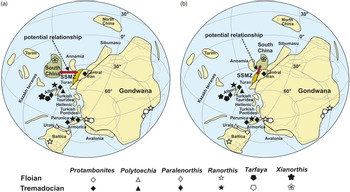
The late Neoproterozoic to early Palaeozoic palaeobiogeographic patterns provide further important constraints on the relative position of the Iranian microcontinent on the northern Gondwana margin. As mentioned before, the SSMZ, Central Iran and (southern and central) Alborz are considered to have been part of the Iranian microcontinent with the Palaeotethys Ocean in the north and the Neotethys Ocean in the south during late Palaeozoic to Mesozoic times. They bear similar upper Ediacaran to Ordovician, Permian and Triassic strata (Hassanzadeh & Wernicke, Reference Hassanzadeh and Wernicke2016). We give details in the following discussion of two scenarios, the classical one (based on Torsvik, Reference Torsvik1998; Fig. 10a) and an alternative scenario, in which the South China block is attached to Gondwana, according to the recent findings of Yang et al. (Reference Yang, Li, Li, Zhu and Lu2020; Fig. 10b), but on the same latitude.
(a) Palaeogeographic reconstruction for the late Tremadocian–Floian stages showing the geographic distribution of rhynchonelliformean brachiopod genera (from Popov et al. Reference Popov, Bassett, Holmer and Ghobadi Pour2009 a, based on Torsvik, Reference Torsvik1998), which occur in the lower part of the Lashkarak Formation (modified from Torsvik, Reference Torsvik1998 and Ghobadi Pour, Reference Ghobadi Pour, Bassett and Deisler2006). Note the potential close neighbourhood of South China and Central Iran/SSMZ at similar latitudes assuming that the units could be freely shifted along latitudes (because of the undetermined longitude). (b) This reconstruction according to Yang et al. (Reference Yang, Li, Li, Zhu and Lu2020) puts the South China block in East Gondwana. Red double arrow indicates the palaeobiogeographic relationships.

The principal terranes that are confirmed or commonly assumed to be placed close to the northeastern to northern margin of Gondwana in early Palaeozoic time include the SSMZ, Alborz and Central Iran terranes of Iran, as well as the Central Afghan terranes and part of the Pamirs, Qiangtang, Lhasa and the Tibetan Himalaya of the Tibetan Plateau, and Sibumasu in southeast Asia (e.g. Stern, Reference Stern1994; Torsvik & Cocks, Reference Torsvik and Cocks2013; Yao et al. Reference Yao, Li, Li, Li and Yang2014; Domeier, Reference Domeier2018). In regard to most palaeogeographic reconstructions, a position of the South China block within the tropical zone of western Gondwana during early Cambrian time is indicated (Kirschvink, Reference Kirschvink, Schopf, Klein and Maris1992; McKerrow et al. Reference McKerrow, Scotese and Brasier1992). Biogeographic studies of the lower Cambrian on the Yangtze Platform of the South China block indicate close relationships with regions of the western margin of Gondwana, in particular with the Tarim Platform, India and Iran and less similarities to Kazakhstan, Australia and parts of West Avalonia (Steiner et al. Reference Steiner, Li, Qian, Zhu and Erdtmann2007).
The palaeogeographic evidence of the Toyonian archaeocyathan reefs in the Alborz Mountains indicates the first record of metazoan reefs in the Toyonian (Cambrian Stage 4) of Iran and adjacent countries (Lasemi & Amin-Rasouli, Reference Lasemi and Amin-Rasouli2007). Metazoan reefs spread along the northern margin of Gondwana, arguing for a common Gondwanan margin, and worldwide, such as Siberia, eastern Canada and Nevada, through the rest of early Cambrian time (e.g. James & Kobluk, Reference James and Kobluk1978; James et al. Reference James, Kobluk, Klapa, Geldsetzer, James and Tebbutt1988; Rowland & Gangloff, Reference Rowland and Gangloff1988; Rowland & Shapiro, Reference Rowland, Shapiro, Kiessling, Flügel and Golonka2002).
Hamdi et al. (Reference Hamdi, Rozanov and Zhuravlev1995) suggested that the middle and upper Cambrian reefs in the Mila Formation of the Alborz Mountains contain a similar sponge genus to that found in the lower middle Cambrian of Australia, the Yangtze Platform in the South China block and the Siberian Platform. Kruse & Zhuravlev (Reference Kruse and Zhuravlev2008) elaborated on this hypothesis by suggesting that the Iranian microcontinent was located along the ‘western’ Gondwana margin adjacent to other central and SE Asian fragments, Arabia, Tibet, India and South China.
More recently, Shahkarami et al. (Reference Shahkarami, Mángano and Buatois2017 a,b) outlined four ichnozones for the clastic sediments of the Soltanieh Formation in the central Alborz Mountains, indicating continuous sedimentation from Ediacaran through Cambrian times. These authors argued that ichnozone 1 in the Alborz Mountains is evidenced by the Treptichnus pedum zone, which is the index fossil for the lowermost Cambrian. This reveals a similar situation for the Ediacaran–Cambrian succession of the Alborz Mountains and eastern Yunnan Province, South China (Zhu, Reference Zhu1997), western Mongolia (Smith et al. Reference Smith, Macdonald, Petach, Bold and Schrag2015), Lesser Himalaya, India (Singh et al. Reference Singh, Lokho, Kishore and Virmani2014) and southern Kazakhstan (Weber et al. Reference Weber, Steiner, Evseev and Yergaliev2013), where the first appearance of the trace fossil T. pedum post-dates the Ediacaran–Cambrian transition. Similarly, Hamdi et al. (Reference Hamdi, Brasier and Zhiwen1989) found evidence of an assemblage of phosphatic layers in the Lower Shale Member in the Alborz Mountains and pointed out the similarities with successions containing a major Tommotian phosphorite horizon nearly contemporaneous across the ‘Proto-/Palaeotethyan’ belt in South China, India, Pakistan, Kazakhstan and Mongolia.
The new late Cambrian species of Siphonotretida recognized in the Alborz is the only known Cambrian representative of the group with distinct characteristics (Popov et al. Reference Popov, Bassett, Holmer and Ghobadi Pour2009 a), different from other siphonotretide genera, e.g. on both sides of the lapetus Ocean in Laurentia and Gondwana (Armorica), and in west Antarctica (Shergold et al. Reference Shergold, Cooper, MacKinnon and Yochelson1976; Popov et al. Reference Popov, Holmer and Miller2002; González-Cómez, Reference González-Gómez2005). The unique features of the late Cambrian Siphonotretida of Iran are also characteristics of most of the Ordovician siphonotretide genera, which likely were rooted originally in high to temperate latitudes of peri-Gondwana (Fig. 10; Havlíček, Reference Havlíček1982; Mergl, Reference Mergl2002; Popov et al. Reference Popov, Ghobadi Pour and Hosseini2008). Popov et al. (Reference Popov, Holmer, Bassett, Ghobadi Pour, Percival, Harper and Servais2013) suggested that it can be typified by those described from the Middle Ordovician of Baltica (Gorjansky, Reference Gorjansky1969; Holmer, Reference Holmer1989) and South China (Zhang, Reference Zhang1995).
Dong et al. (Reference Dong, Repetski and Bergström2004) discussed 13 middle Cambrian through lowermost Ordovician conodont zones in Hunan, South China and their similarities with Iran (Müller, Reference Müller1973) and correlated these with North China, western USA, western Newfoundland and Canada. In addition, the Early–Middle Ordovician palaeobiogeographic patterns of the brachiopod faunas from the Upper Yangtze Platform, South China were documented (Zhan & Jin, Reference Zhan and Jin2014), indicating a close faunal relationship between South China and Iran (Popov et al. Reference Popov, Ghobadi Pour, Bassett and Kebria-ee2009 b).
The Lower Ordovician (Tremadocian) trilobite assemblage, as well as Darriwilian brachiopods in the Alborz, exhibit a close similarity to contemporaneous trilobite faunas of South China (e.g. Ghobadi Pour, Reference Ghobadi Pour, Bassett and Deisler2006; Ghobadi Pour et al. Reference Ghobadi Pour, Vidal and Hosseini-Nezhad2007, Reference Ghobadi Pour, Popov, Kebria-ee Zadeh and Baars2011; Álvaro et al. Reference Álvaro, Ahlberg, Babcock, Bordonaro, Choi, Cooper, Ergaliev, Gapp, Ghobadi Pour, Hughes, Jago, Korovnikov, Laurie, Lieberman, Paterson, Pegel, Popov, Rushton, Sukhov, Tortello, Zhou, Żylińska, Harper and Servais2013; Kebria-ee Zadeh et al. Reference Kebria-ee Zadeh, Ghobadi Pour, Popov, Baars and Jahangiri2015). Ghobadi Pour et al. (Reference Ghobadi Pour, Vidal and Hosseini-Nezhad2007) noted the species Taihungshania miqueli (Bergeron, Reference Bergeron1894), the third diagnosable species, which has been recorded from South China, Turkey and Southern France, indicating North Gondwanan faunal affinities. In the eastern Alborz (Gerd-Kuh section), the lower Tremadocian Asaphellus inflatus–Dactylocephalus and Psilocephalina lubrica zones are characterized by medium diversity trilobite associations with strong links to contemporaneous faunas of South China (Ghobadi Pour et al. Reference Ghobadi Pour, Popov, Holmer, Hosseini-Nezhad, Rasuli, Fallah, Amini and Jahangiri2015 b). In addition, abundant and diverse brachiopods are present throughout the Gerd-Kuh section, and, as Popov & Cocks (Reference Popov and Cocks2017) pointed out, Alborz is one of the few places globally which has a strophomenoid-dominated benthic assemblage in the Middle Ordovician brachiopod fauna, providing the opportunity to investigate the palaeogeographic and climatic control on their initial divergence. These authors suggested that the Australasian (Sibumasu) sector of Gondwana was the primary location of the origin and initial dispersion of the Strophomenoidea, as well as the adjacent terranes and satellite plates of peri-Gondwana, including Alborz, North China and South China (Popov & Cocks, Reference Popov and Cocks2017).
The first occurrence of Late Ordovician trilobites from the High Zagros, has been reported in the middle member of the Seyahou Formation (Ghobadi Pour et al. Reference Ghobadi Pour, Ghavidel-Syooki, Álvaro, Popov and Ehsani2015 a). This formation hosts a trilobite assemblage including Dalmanitina (Dalmanitina) dargazensis, which shows strong affinities with high-to-mid-latitude peri-Gondwanan faunas, and displays close similarities with taxa from the Mediterranean margin of Gondwana (mainly Sardinia and Bohemia/Perunica) and, to a lesser extent, with the Turkish Taurides (Ghobadi Pour et al. Reference Ghobadi Pour, Ghavidel-Syooki, Álvaro, Popov and Ehsani2015 a).
Ameri (Reference Ameri2015) reported a peri-Gondwanan trilobite assemblage from the Kuhbanan Formation at Dahu, north Kerman, which is the most complete fossiliferous upper lower Cambrian – middle Cambrian sequence in Central Iran. The distribution of the Kuhbanan Formation trilobite species (Redlichia Biozone) shows close faunal connections to the Hormoz Formation from South and SW Iran, the Salt Range (Pakistan), the Himalayan region, southern Siberia, Australia and South China (Ameri, Reference Ameri2015).
Popov et al. (Reference Popov, Hairapetian, Ghobadi Pour, Buttler, Evans, Hejazi and Jahangir2014) reported an important record of biotic recovery of benthic faunas in the Llandovery deposits of Iran after the terminal Ordovician mass extinction in temperate and high latitude Gondwana, which is still poorly known in the Mediterranean, North African and Arabian segments of Gondwana. A significant number of taxa from the shallow shelf biofacies indicates clear links to contemporaneous low-latitude faunas, for instance to Laurentia, Baltica and South China (Popov et al. Reference Popov, Hairapetian, Ghobadi Pour, Buttler, Evans, Hejazi and Jahangir2014). The authors proposed the close proximity of the peri-Gondwanan terranes of Central Iran, Kopet Dagh and Afghanistan, owing to the bearing of shallow water faunas during the Aeronian of the Silurian period.
In summary, late Neoproterozoic to the early Silurian faunas, restricted to the same type of palaeoenvironment, are shared by the Iranian microcontinent and South China block and represent key elements to determine their palaeogeographic similarities along the Gondwanan margin (Figs 10, 11). Li et al. (Reference Li, Li and Li2014) and Yang et al. (Reference Yang, Li, Li, Zhu and Lu2020) proposed that the South China block was accreted to East Gondwana during late Neoproterozoic–Cambrian times. Consequently, the Iranian microcontinent including the SSMZ can be considered as being part of the same Cambrian–early Silurian Gondwanan margin. Comparison of detrital zircons show similar age patterns in terranes originating from north of the Arabian–Nubian shield via the Iranian microcontinent to far in the east, along the northern Gondwana margin (Fig. 11).
Global reconstruction for the earliest Cambrian (540 Ma), showing the location along Gondwana of the blocks (modified after Torsvik & Cocks, Reference Torsvik and Cocks2013 and Yao et al. Reference Yao, Li, Li, Li and Yang2014). The red arrows point to the biogeographic and detrital zircon provenance relationships in the reconstruction. West and East Gondwana are separated by the Transgondwanan Supermountain. A – Afghan Terrane; ATA – Armorican Terrane Assemblage; E – Ellsworth-Whitmore Mountains; F – Falkland Islands; MBL – Marie Byrd Land; NZL – New Zealand; Qiang. – Qiantang Terrane; SSMZ – Sanandaj–Sirjan metamorphic zone; TH – Tethyan Himalaya.

7. Conclusions
New detrital U–Pb zircon ages from the SSMZ provide new insights into the palaeogeographic reconstruction of the Iranian microcontinent. Our conclusions are summarized as follows:
(1) The youngest peak and weighted mean ages in the probability diagrams provide geochronological maximum depositional ages for hitherto undated metamorphic units. In particular, detrital zircon ages from the younger garnet-micaschist sample (GQ-12) represent a maximum depositional age of the sediments not older than latest Triassic, consistent with the metamorphosed Jurassic sediments widespread within the central SSMZ.
(2) The reproducibility is remarkable of the age population peak at c. 0.6 Ga, which represents a distinct signal related to the late Neoproterozoic crystalline basement in Iran as well as to the Arabian–Nubian shield and other Pan-African domains in northern Gondwana. The other significant Neoproterozoic age populations in all three samples likely derived from magmatic rocks and/or recycled sedimentary sources, possibly from the eastern Arabian–Nubian shield.
(3) New zircon age data from garnet-micaschists demonstrates the presence of a late Grenvillian age population at c. 0.94 to 1.1 Ga within the SSMZ, which led to deducing the proximity of the Sanandaj–Sirjan zone to distal parts of the ‘Gondwana superfan’ at the northern margins of Gondwana. The Grenvillian detrital age population suggests that the ‘Gondwana superfan’ even spread detrital material far east along the northern Gondwana margin and reached the South China block, where this age group occurs but remains subordinate (e.g. Yang et al. Reference Yang, Li, Li, Zhu and Lu2020).
(4) It is worth noting that further research should focus on more detrital zircon ages from metamorphic clastic rocks and Cambrian–Ordovician sandstones as well as obtaining the biogeographic distribution of Cambrian–Ordovician shallow marine organisms that would also provide better insights into the palaeogeographic reconstruction of the northern Gondwana margin during early Palaeozoic time.
Supplementary material
To view supplementary material for this article, please visit https://doi.org/10.1017/S0016756821000728
Acknowledgements
We gratefully acknowledge constructive comments and suggestions from two anonymous reviewers, which helped to clarify ideas and content. We also thank the editor, Olivier Lacombe, for his encouragement. Farzaneh Shakerardakani acknowledges support via a scholarship from the Afro–Asiatisches Institut Salzburg for her Ph.D. thesis at the Salzburg University, and a PIFI postdoctoral fellowship from the Chinese Academy of Sciences. This study was financially supported by the Strategic Priority Research Programme (B) of the Chinese Academy of Sciences (XDB18030300) to XHL.
Appendix 1. Laser ablation ICP-MS U–Pb analytical techniques, Northwest University, Xi’an
Zircons were separated from the one sample from the Dorud area (LJ-140) in the laboratory of the Geography and Geology Department of Salzburg University, Austria. The selected zircon grains were dated in situ on an excimer (193 nm wavelength) laser ablation inductively coupled plasma mass spectrometer (LA-ICP-MS) at the State Key Laboratory of Continental Dynamics, Northwest University. The ICP-MS used is an Agilent 7500a (with shield torch). The unique shield torch increases analytical sensitivity by a factor of >10 (for example, 4500 cps/ppm 238U at a spot size of 40 µm and laser frequency of 10 Hz), which is important for LA-ICP-MS. The GeoLas 200M laser ablation system (MicroLas, Göttingen, Germany) was used for the laser ablation experiments. Helium was used as the carrier gas. The used spot size and laser frequency were set at 40 µm and 10 Hz, respectively. The data acquisition mode was peak jumping (20 ms per isotope each cycle). Raw count rates were measured for 29Si, 204Pb, 206Pb, 207Pb, 208Pb, 232Th and 238U. U, Th and Pb concentrations were calibrated by using 29Si as an internal standard and NIST SRM 610 as the reference standard. Each analysis consisted of 30 s gas blank and 40 s signal acquisition. High-purity argon was used together with a custom helium filtration column, which resulted in 204Pb and 202Hg being less than 100 cps in the gas blank. Therefore, the contribution of 204Hg to 204Pb as revealed by detrital zircon studies was negligible and no correction was made. 207Pb/206Pb, 206Pb/238U, 207Pb/235U and 208Pb/232Th ratios, calculated using GLITTER 4.0 (Macquarie University), were corrected for both instrumental mass bias and depth-dependent elemental and isotopic fractionation using Harvard zircon 91500 as an external standard. The ages were calculated using Isoplot 3 (Ludwig, Reference Ludwig2003). Our measurement of TEMORA 1 as an unknown yielded a weighted 206Pb–238U age of 415 ± 4 Ma (MSWD = 0.112, n = 24) (Yuan et al. Reference Yuan, Gao, Liu, Li, Günther and Wu2004), which is in good agreement with the recommended ID-TIMS age of 416.75 ± 0.24 Ma (Black et al. Reference Black, Kamo, Allen, Aleinikoff, Davis, Korsch and Foudoulis2003). Analytical details for age and trace and rare earth element determinations of zircons are reported in Yuan et al. (Reference Yuan, Gao, Liu, Li, Günther and Wu2004). Common Pb corrections were made following the method of Andersen (Reference Andersen2002). Because measured 204Pb usually accounts for <0.3 % of the total Pb, the correction is insignificant in most cases.
Appendix 2. Laser ablation ICP-MS U–Pb analytical techniques, China University of Geosciences, Beijing
The separated detrital zircons from two garnet-micaschist samples were embedded in epoxy resin discs and polished down to about half-sections to expose the grain interiors, and then imaged under reflected and transmitted light and by using CL. U(–Th)–Pb analyses of the detrital zircons were carried out on an Agilent-7500a quadrupole inductively coupled plasma mass spectrometry (LA-ICP-MS) coupled with a New Wave SS UP193 laser sampler at the Elemental Geochemistry Lab of the Institute of Earth Sciences, China University of Geosciences, Beijing. For the present work, the laser spot size was set to ∼36 μm for one sample (GQ-21) and to 25 μm for sample GQ-12 with a small size of zircons; the laser energy density was set at 8.5 J cm−2 and repetition rate at 10 Hz. The procedure of laser sampling includes 5-s pre-ablation, 20-s sample-chamber flushing and 40-s sampling ablation. The ablated material is carried into the ICP-MS by the high-purity helium gas stream with a flux of 0.8 L min−1. The whole laser path was fluxed with N2 (15 L min−1) and Ar (1.15 L min−1) in order to increase energy stability. The counting time for U, Th, 204Pb, 206Pb, 207Pb and 208Pb is 20 ms, and is 15 ms for other elements. Calibrations for the zircon analyses were carried out using NIST 610 glass as an external standard and Si as an internal standard. U–Pb isotope fractionation effects were corrected using zircon 91500 (Wiedenbeck et al. Reference Wiedenbeck, Allé, Corfu, Griffen, Meier, Oberli, von Quadt, Roddick and Spiegel1995) as an external standard. The zircon TEMORA (417 Ma, Black et al. Reference Black, Kamo, Allen, Aleinikoff, Davis, Korsch and Foudoulis2003) and Qinghu (159.5 ± 0.2 Ma; Li et al. Reference Li, Tang, Gong, Yang, Hou, Hu, Li, Liu and Li2013) were used as the secondary standards to supervise the deviation of age measurement/calculation. Data reduction was carried out on the software GLITTER (version 4.4, Macquarie University). The common lead correction was made following Andersen (Reference Andersen2002), and Isoplot 3 (Ludwig, Reference Ludwig2003) was used for age calculations and plots of concordia diagrams.




 Open access

