

Miscarriages of justice have occurred as a result of unreliable confessions to the police. Reference Gudjonsson1 The Police and Criminal Evidence Act 1984 (PACE) allows the court to exclude evidence if it is obtained unfairly or would have an adverse effect on the fairness of proceedings. 2 A detainee may be at risk in a police interview if it is considered that conducting the interview could significantly harm the detainee's physical or mental state. Anything the detainee says in the interview may be considered unreliable in subsequent court proceedings because of their physical or mental state. 3 Therefore, fitness to be interviewed assessments are an essential component of the process of ensuring that due process is being followed and that people who are mentally vulnerable are subject to proper safeguards.
Specialist trainees in psychiatry within the UK are routinely requested to assess people detained in police custody. Often, they are also requested to assess detainees’ fitness to be interviewed as part of their assessment. A detainee is deemed fit to be interviewed by the police if the visiting psychiatrist has adequately assessed the detainee's capacity to meaningfully participate in the police interview so that the interview would be deemed reliable (Box 1).
The visiting psychiatrist must conclude that the interview is not likely to adversely affect the detainee's mental state. Functional psychiatric illnesses such as depression and psychotic disorders can impair a detainee's ability to participate in a police interview. Similarly, detainees with suspected intellectual difficulties or organic conditions such as confusional states may also lack the capacity to partake in an interview.
Box 1 Key elements of a police detainee's capacity assessment by a visiting psychiatrist
-
• Does the person understand why they are at a police station?
-
• Does the person know that they are to be interviewed?
-
• Does the person understand the purpose of the interview, i.e. that they are suspected of committing a crime?
-
• Does the person understand the police caution after it has been explained to them carefully?
-
• Can the person understand what is being asked?
-
• Does the person appreciate the significance of any answers they give? In some cases, detainees may admit to anything in order to fulfil their immediate needs, e.g. the ending of the interview.
-
• Is the person capable of deciding whether or not to answer a particular question?
Adapted from Kent & Gunasekaran. Reference Kent and Gunasekaran4
Assessment of fitness is a specialist assessment of capacity in a difficult environment, which requires a knowledge of not only the legal framework (PACE and amendments) but also practical, thorough psychiatric principles of assessment.
A previous survey undertaken in the Yorkshire and Humber Deanery in 1996 aimed to discover the extent of training available to trainee psychiatrists assessing detainees’ fitness to be interviewed by the police. Reference Protheroe and Roney5 Following discussions among colleagues, we discovered that uncertainties about the role of trainee psychiatrists in this area continued and formal training was lacking. We therefore surveyed all higher trainee psychiatrists within our deanery to ascertain their experience of these assessments and the training they had received.
Method
A questionnaire was sent to all higher trainees and middle-grade doctors employed in the Yorkshire and Humber Deanery working on the second on-call rota in all psychiatric subspecialties (n = 70). The questionnaire asked respondents about their experience of fitness to be interviewed assessments that they had carried out in the previous 3 months, the criteria they used, and the training they had received. Replies were anonymous and received via secure email.
Results
We received a total of 45 replies (64%). Almost half of these replies were from middle-grade doctors on the general adult training rotation, a fifth were from doctors on the old age training rotation, and the rest were from trainees on other rotations (learning disability, child and adolescent, psychotherapy, dual trainees). The mean length of middle-grade on-call experience was 20 months (range 3-56).
More than half of the 45 middle-grade doctors (n = 26) had been asked to assess a detainee's fitness to be interviewed by the police at some point in their higher training. Of these, just over a third (n = 10) had undertaken these assessments in the previous 3 months.
Significantly, only a third of all respondents (n = 15) had attended formal teaching specifically on the assessment of fitness to be interviewed, in the form of study days or consultant-led middle-grade teaching sessions. Less than half of all respondents (n = 21) had simply received advice from a consultant or fellow middle-grade colleague. A fifth of respondents (n = 9) had received no training or guidance at all.
Only a fifth of the respondents (n = 9) stated they were aware of local employee guidance in relation to their responsibilities to assess detainees’ fitness to be interviewed. As the comments below demonstrate, there was a varied and inconsistent understanding of these guidelines.
Three-quarters of the respondents (n = 34) stated they were aware of the criteria used to assess a detainee's fitness to be interviewed. Almost half of these stated they used the criteria outlined in psychiatric journals; most frequently quoted was Rix's article on fitness to be interviewed assessments. Reference Rix6
Comments
The following comments reflect the breadth of knowledge and opinion on this aspect of a specialist trainee's role within the police station.
-
• ‘I would feel apprehensive if asked to assess fitness to be interviewed.’
-
• ‘No formal criteria exist.’
-
• ‘They are done by the forensic on-call team.’
-
• ‘The consultant on-call attends.’
-
• ‘… it is not compulsory to carry out these assessments’ (a comment made by four respondents).
-
• ‘… I am not aware of the criteria but would look them up if needed.’
-
• ‘Not compelled to do fitness to be interviewed assessments [as this is] viewed as private practice.’
Pilot training session
In light of the ongoing uncertainties discovered in our survey around a trainee's role in assessing a detainee's fitness to be interviewed, and a lack of formal teaching available, a training session was piloted at a recent Higher Training Committee meeting for the Yorkshire and Humber Deanery. The training was met with universal approval by higher trainees.
The 2-hour training session, facilitated by a consultant forensic psychiatrist, was divided into the following five sections:
-
• an interactive discussion on trainee experiences while carrying out fitness assessments thus far in higher training – a sense of uncertainty while carrying out the task was a prominent theme;
-
• an overview of PACE, including the definition of the vulnerable detainee – i.e. a detainee who, because of their mental state or capacity, may not understand the significance of what is said, of questions or of their replies; 3
-
• • a practical summary of the key elements of a fitness to be interviewed assessment – i.e. the importance of collateral information, the Mental State Examination, including an assessment of capacity, and the importance of adequate documentation within both police and medical records;
-
• a discussion on the common recommendations made after carrying out the assessment – predominantly one of four conclusions are drawn:
-
• the detainee is deemed unfit for interview;
-
• the detainee is likely to be temporarily unfit, e.g. in cases of drug or alcohol intoxication;
-
• the detainee is considered fit to be interviewed but is mentally vulnerable and the presence of an appropriate adult is required (Box 2);
-
• the detainee is fit for interview;
-
-
• a real-life case study that included the anonymous tape recording of a police interview. There are also numerous case vignettes that may be suitable for training purposes (Box 3).
Box 2 Definition of an appropriate adult 3
-
• A relative, guardian or other person responsible for the detainee's care or custody.
-
• A person experienced in dealing with people who are mentally disordered or mentally vulnerable but who is not employed by the police, e.g. an approved social worker.
-
• A responsible adult aged 18 years or over who is not employed by the police.
Box 3 Case vignettes appropriate for use in fitness to interview training
Case A
A man with a known diagnosis of schizophrenia is charged with wounding. Vıtal questions for the psychiatrist include:
-
• Is the man currently psychotic?
-
• Is the man fit to be interviewed?
-
• If the man is symptomatic, are his responses likely to be influenced by delusional beliefs or hallucinatory experiences? (Even though he has symptoms of illness, he could still be fit for interview in the presence of an appropriate adult.)
-
• Is the man's presentation being influenced by drug or alcohol intoxication? If so, is he temporarily unfit for interview?
Case B
A man with intellectual disability has been charged with assault.The psychiatrist must ask the following questions:
-
• Does the man have the capacity to understand what is going on, retain information and understand the police process?
-
• Is the man likely to be suggestible within the stressful environment of police custody, i.e. could his responses be easily influenced by the interviewing officers?
Case C
A 48-year-old woman with a known history of depressive illness confesses to the murder of her baby 20 years earlier, which at the time was recorded as cot death.The psychiatrist must be able to:
-
• accurately assess the woman's mental state for the presence of depression and delusions and note any prominent feelings of guilt;
-
• assess whether the woman is fit to be interviewed – is her confession linked to delusions or pathological guilt?
-
• take into account that false confessions are a potential problem;
-
• arrange for an appropriate adult to be present if the woman is deemed fit to be interviewed;
-
• determine whether the interview process will adversely affect the woman's mental state and, if so, whether and how the interview can proceed;
-
• arrange for any necessary psychiatric care.
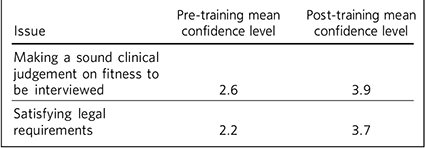
Twenty-two higher trainees attended the pilot training session. Each trainee completed a brief survey before and after the training session. Trainees were asked the following questions on a five-point Likert scale (1, little confidence; 3, reasonably confident; 5, extremely confident):
-
• If a request was made to assess a detainee's fitness to be interviewed, how confident would you feel about making a sound overall clinical judgement on fitness to be interviewed?
-
• If a request was made to assess a detainee's fitness to be interviewed, how confident would you feel about satisfying the legal requirements needed to make a decision on fitness to be interviewed?
Table 1 shows the mean confidence levels of the trainees before and after the training session.
Mean confidence levels (out of 5) of trainees before and after the training session
| Issue | Pre-training mean confidence level |
Post-training mean confidence level |
|---|---|---|
| Making a sound clinical judgement on fitness to be interviewed |
2.6 | 3.9 |
| Satisfying legal requirements |
2.2 | 3.7 |
Trainees were also asked the following ‘yes’ or ‘no’ questions:
-
• Do you feel this teaching was beneficial to your future clinical practice?
-
• Would you want this talk on an annual basis to provide you with a ‘refresher’ and an opportunity to discuss specific problems relevant to the topic?
All trainees answered positively to both questions. Free-text feedback was also positive. Many trainees expressed a desire to attend a similar course at the start of each training year.
Training discussion points
Throughout the interactive discussion, trainees raised some recurring issues. There was a widespread lack of understanding about the legal implications of an unreliable detainee interview, and only one trainee was aware of PACE. Therefore, a detailed discussion on the PACE Codes of Practice was deemed particularly valuable.
The PACE Codes of Practice state that ‘a detainee shall not be interviewed if there is a risk of significant harm to the detainee's physical or mental state’. 3 This concept was considered vague by trainees, who felt uncomfortable about making this judgement with no prior knowledge of the detainee.
Other areas of uncertainty included the role of the appropriate adult, and what disposals are appropriate if a detainee is deemed unfit for interview. There appeared to be a widely held misconception that the presence of an active mental illness was sufficient grounds to deem a detainee unfit for interview. The take-home message that fitness assessments are aimed primarily at assessing a detainee's capacity to reliably partake in an interview seemed to successfully clarify this point.
Consistent with findings from our earlier survey, many trainees questioned whether or not on-call psychiatrists employed by the National Health Service are contractually obliged to carry out fitness to be interviewed assessments for the police. Many trainees questioned whether they would be covered from a medicolegal perspective if an assessment were deemed unlawful. There was general uncertainty about the role of forensic medical examiners in police stations, and the circumstances in which they refer fitness to be interviewed assessments to the on-call psychiatrist appeared to be inconsistent. It was concluded that local service-level agreements and trust policies will determine whether trainees and local psychiatrists will perform fitness to be interviewed assessments in police stations.
Discussion
The results of our survey do not differ markedly from those obtained by the similarly designed survey by Protheroe & Roney carried out in the same deanery in 1996. Reference Protheroe and Roney5
Our survey has revealed that formal training in this area continues to be poor, although there has been almost a sevenfold increase in the number of trainees receiving such training, from 5% in the earlier survey to 33% in our survey. Provision of formal deanery-wide training regarding the criteria, the overall process and local employee guidance in relation to trainee responsibilities in fitness to be interviewed assessments would improve both individual skills and the quality of these assessments overall. Training days should encompass clinical, legal and ethical aspects of dealing with fitness to be interviewed requests.
Our pilot training session aimed to cover all these elements and received positive feedback. Our survey has highlighted that awareness of the available literature in this area among psychiatric trainees is good. We would suggest, however, that this is no substitute for formal training. The results of our pilot training session suggest there is a demand for extended fitness to be interviewed training courses, potentially on an annual basis. We believe that many trainees would value this training opportunity, as few seemed comfortable working in the unfamiliar crossover between prison and mental health services.
The Royal College of Psychiatrists’ curriculum for higher trainees in general psychiatry has specified that an intended learning outcome for ST5 specialist trainees is the assessment and management of a patient in police custody out of hours. 7 This highlights the importance of improving trainee understanding in this clinically relevant field.
Data from the College could also be useful to determine the extent to which trainees have used workplace-based assessments to demonstrate their skills on this topic. We devised a list of specific competencies required to undertake the assessment of fitness to be interviewed (Box 4). These provide a framework around which training days could be designed and may also inform trainers who are asked to complete workplace-based assessments on behalf of their trainees.
As with most survey-based studies, possible limitations include response bias: it is unclear whether or not the experiences of the trainees who did not respond reflect those of the respondents. Local training practices vary considerably within different deaneries in the country. Our survey focuses on only one, albeit large, deanery and therefore the survey's generalisability is potentially limited.
Box 4 Proposed competencies required to undertake the assessment of fitness to be interviewed
-
• Knowledge of the Police and Criminal Evidence Act 1984 and the Codes of Practice in relation to fitness to be interviewed, specifically Annex G, which provides definitions of fitness to be interviewed, mental disorder and mental vulnerability.
-
• An understanding of mental vulnerability within the context of a police interview.
-
• An understanding of how mental disorder can affect an individual who may be subject to formal police interview.
-
• An understanding of the concept of reliable and unreliable interviews.
-
• An understanding that the assessment of fitness to be interviewed is essentially a specialist form of capacity assessment. The ability to perform such a capacity assessment requires not only generic skills required by all psychiatrists but also specific skills in relation to fitness to be interviewed.
-
• An understanding of the roles of various professionals involved in dealing with detainees in police custody, including the police, the forensic medical examiner and the appropriate adult.
-
• The ability to make a clinical judgement in relation to the detainee's fitness to be interviewed and to communicate this formally.
-
• The ability to provide a formal detailed record and understand the important medicolegal consequences of such an assessment.


 Open access


eLetters
No eLetters have been published for this article.