


Introduction
Aphis gossypii Glover (Hemiptera: Aphididae), commonly known as the cotton or melon aphid, is one of the most economically important aphid pests worldwide due to its broad host range, high reproductive potential, and remarkable capacity for rapid adaptation. The species is highly polyphagous, infesting plants from numerous families, including approximately 100 species of crop plants, such as cotton, cucurbits, and horticultural species, causing substantial economic losses. Damage results from direct phloem feeding, which leads to leaf curling, chlorosis, and reduced plant growth, as well as from honeydew secretion that promotes the development of sooty moulds on plant surfaces. In addition, A. gossypii is an efficient vector of more than 50 plant viruses, further increasing its agricultural importance (Blackman and Eastop, Reference Blackman and Eastop2000, Reference Blackman, Eastop, van Emden and Harrington2017).
The pest status of A. gossypii is closely linked to its biological characteristics. In most parts of the world, populations reproduce predominantly by viviparous parthenogenesis, resulting in short generation times, high fecundity, and rapid population growth. However, in Japan and China, there is an annual sexual phase, with overwintering as eggs reported on various unrelated woody plants including Rhamnus ssp., Hibiscus syriacus L., and Citrus species (Inaizumi, Reference Inaizumi1980; Zhang and Zhong, Reference Zhang, Zhong, Campbell and Eikenbary1990; Komazaki and Toda, Reference Komazaki and Toda2008; Komazaki et al., Reference Komazaki, Toda, Shigehara, Kanazaki, Izawa, Nakada and Souda2011). Sexual reproduction and egg overwintering have also been reported for populations in Connecticut, USA and western France (Kring, Reference Kring1959; Thomas et al., Reference Thomas, Boissot and Vanlerberghe-Masutti2012).
The production of winged morphs facilitates dispersal among host plants and cropping systems, while clonal reproduction and the high reproduction rates make possible the rapid fixation and spread of adaptive traits, including insecticide resistance. These features make A. gossypii particularly prone to the evolution of resistance under sustained insecticide selection pressure. Chemical control remains a key component of A. gossypii management in many crops. However, resistance has been reported in field populations or laboratory-selected strains against several major insecticide classes, including organophosphates, carbamates, pyrethroids, and neonicotinoids, as well as flonicamid, sulfoxaflor, and flupyradifurone (Wang et al., Reference Wang, Liu, Yu, Jiang and Yi2002; Amad et al., Reference Amad, Arif and Denholm2003; Herron and Wilson, Reference Herron and Wilson2011; Koo et al., Reference Koo, An, Park, Kim and Kim2014; Foster et al., Reference Foster, Devine, Devonshire, van Emden and Harrington2017; Pan et al., Reference Pan, Zhu, Gao, Nauen, Xi, Peng, Wei, Zheng and Shang2017; Chen et al., Reference Chen, Li, Chen, Ma, Liang, Liu, Song and Gao2017a; Sun et al., Reference Sun, Shaheen, Guo, Shi, Li, Li, Li and Tang2026). Moreover, insecticide resistance traits can differ among A. gossypii host races, underlining that resistance risk and dynamics may vary across cropping systems (Carletto et al., Reference Carletto, Martin, Vanlerberghe-Masutti and Brévault2010). Such resistance has reduced field efficacy and hindered effective population management, underscoring the need for improved resistance monitoring strategies.
Insecticide resistance in A. gossypii has been associated with well-characterised target-site mutations (for review, see Bass and Nauen (Reference Bass and Nauen2023)). Resistance to pirimicarb is linked to the S431F mutation in the acetylcholinesterase gene (ace1), while the A302S mutation in ace1 has been associated with a general insensitivity to organophosphates and carbamates (Andrews et al., Reference Andrews, Callaghan, Field, Williamson and Moores2004). The R81T mutation in the nicotinic acetylcholine receptor (nAChR) β1 subunit, first described in A. gossypii by Shi et al. (Reference Shi, Zhu, Xia, Qiao, Wang and Wang2012), has been functionally linked to neonicotinoid resistance, with different effects for cyano- and nitro-substituted neonicotinoids (Hirata et al., Reference Hirata, Jouraku, Kuwazaki, Kanazawa and Iwasa2017). For pyrethroids, resistance mechanisms involve mutations in the voltage-gated sodium channel (VGSC) gene. The classic kdr (L1014F) mutation has been reported in populations from Australia (Marshall et al., Reference Marshall, Moran, Chen and Herron2012; Suann et al., Reference Suann, Bogema, Chen, Mansfield, Barchia and Herron2015) and China (Wang et al., Reference Wang, Liang, Shang, Yu and Xue2021), while the super-kdr variant (Μ918L) has been recorded in various regions such as Cameroon, China, and Italy (Carletto et al., Reference Carletto, Martin, Vanlerberghe-Masutti and Brévault2010; Chen et al., Reference Chen, Tie, Chen, Ma, Li, Liang, Liu, Song and Gao2017b; Cominelli et al., Reference Cominelli, Chiesa, Panini, Massimino Cocuzza and Mazzoni2024). Recently, another variant of super-kdr (M918V) has been detected in China (Munkhbayar et al., Reference Munkhbayar, Liu, Li and Qiu2021).
Despite extensive evidence of resistance-associated mutations in A. gossypii, molecular data regarding populations from Greece remain lacking. Recent advances in molecular diagnostics, particularly droplet digital PCR (ddPCR), provide highly sensitive and accurate tools for detecting and quantifying resistance alleles, even at low frequencies (Mavridis et al., Reference Mavridis, Papapostolou, Riga, Ilias, Michaelidou, Bass, Van Leeuwen, Tsagkarakou and Vontas2022). In the present study, we developed and implemented ddPCR to detect and estimate the frequency of six known resistance mutations in A. gossypii field populations from Greece: R81T (nAChR β1; neonicotinoids), S431F (ace1; pirimicarb), A302S (ace1; organophosphates/carbamates), A2666V (acetyl-CoA carboxylase; keto–enols), and the sodium-channel mutations L1014F (kdr) and M918L (super-kdr) (pyrethroids). Our objectives were to provide baseline molecular data for Greece and to strengthen resistance monitoring to support sustainable insecticide use in the framework of integrated pest management strategies.
Materials and methods
Aphid samples
A total of 263 A. gossypii samples were collected from citrus, cotton, and cucurbit plantations from various localities in Greece during the growing season of the years 2021–2025. Citrus was surveyed in Peloponnese and Crete, cotton in central Greece, and cucurbits in all aforementioned locations. One aphid sample was collected every two to three trees along the row in each citrus orchard, or every two to three rows and every 5–10 m along the row in cotton and cucurbit crops (fig. 1). In the laboratory, approximately 20 adult apterous parthenogenetic females from each sample were stored in absolute ethanol at −20°C until further use.
Sampling sites in Greece (citrus: Asini, Asprochoma, and Rethymno; cotton: Platykampos, Stefanovikio, and Farsala; cucurbits: Lehonia, Vrinaina, Dimini, Gastouni, Sostis, Kalamata, Aspochoma, Agioi Theodoroi, Tympaki, Ampelouzos, and Knossos).

Figure 1 Long description
The map of Greece displays various sampling sites for agricultural crops. Citrus sampling sites are marked at Asini, Asprochoma and Rethymno. Cotton sampling sites are located at Platykampos, Stefanovikio and Farsala. Cucurbit sampling sites are shown at Lehonia, Vrinaina, Dimini, Gastouni, Sostis, Kalamata, Aspochoma, Agioi Theodoroi, Tympaki, Ampelouzos and Knossos. Each site is marked with a dot, indicating the specific location within Greece.
ddPCR diagnostics
We developed ddPCR diagnostics for the following known resistance mutations, i.e. vgsc: super-kdr M918L and kdr L1014F – pyrethroid resistance; AChE: MACE S431F – dimethyl carbamates resistance and A302S – organophosphate and carbamate resistance; and nAChR: R81T – resistance to nAChR competitive modulators. Regarding the M918L mutation, the mutant probe was designed using a degenerate sequence that detects the two known variants of the mutation (CTG and TTG), but does not discriminate between them. In addition, a molecular diagnostic assay was developed targeting the known in other aphid species, i.e. Myzus persicae (Sulzer) (Hemiptera: Aphididae), acetyl-CoA carboxylase (ACC) A2666V substitution, associated with keto–enol resistance.
Genomic DNA was extracted from pooled adult apterous parthenogenetic females using DNAzol® Reagent (Molecular Research Center, Inc., Cincinnati, OH, USA) in accordance with the manufacturer’s protocol. Each DNA pool consisted of individuals collected from the same host plant species at a single sampling location. DNA quantity was determined using the Qubit™ dsDNA BR Assay (Invitrogen, Carlsbad, CA, USA) with a Qubit 2.0 fluorometer. Extracted DNA samples were stored at −20°C until use.
ddPCR analyses were carried out on the QX200™ Droplet Digital™ PCR System (Bio-Rad Laboratories, Hercules, CA, USA). Reactions were prepared in a final volume of 20 μL containing 1× ddPCR Supermix for Probes (no dUTP) (Bio-Rad), 5 U EcoRI-HF® (New England Biolabs), 5 ng genomic DNA, and the corresponding primers and probes (table 1). Droplet generation, amplification, and assay optimisation procedures followed previously established protocols (Mavridis et al., Reference Mavridis, Papapostolou, Riga, Ilias, Michaelidou, Bass, Van Leeuwen, Tsagkarakou and Vontas2022). Synthetic double-stranded DNA fragments (gBlocks™) were used as controls for ddPCR assays. The fragments contain known copy numbers of either the wild-type or mutant alleles and were employed to optimise assay performance in terms of specificity, sensitivity, fluorescence intensity, and droplet cluster separation (clear discrimination between positive and negative droplets). For each assay, probe concentration, dsDNA quantity, annealing temperature, and number of PCR cycles were optimised. Thermal cycling included an initial denaturation step at 95°C for 10 min, followed by 50 amplification cycles (94°C for 30 s and 47–58°C for 1 min), and a final enzyme deactivation step at 98°C for 10 min (table 2). Fluorescence signal acquisition and primary data analysis were conducted according to Mavridis et al. (Reference Mavridis, Papapostolou, Riga, Ilias, Michaelidou, Bass, Van Leeuwen, Tsagkarakou and Vontas2022). The proportion of the resistant allele in each aphid pool (%RAF) was calculated from droplet counts and subsequently adjusted based on the inferred integer number of alleles per pool. Crop-level resistant allele frequency was estimated by pooling the total number of resistant alleles detected across all pools from a given crop, divided by the total number of alleles examined.
List of primers and probes designed for Aphis gossypii

Table 1 Long description
The table lists oligonucleotides used to genotype six insecticide-resistance loci in Aphis gossypii: kdr L1014F, superkdr M918L, nAChR R81T, Ace1 A302S, Ace1 S431F, and Acc A2666V. For each locus, a forward primer and a reverse primer are given with their full five-prime to three-prime sequences. Each locus also includes two allele-specific probes: a wild-type probe labeled with HEX and a mutant probe labeled with FAM, both shown with an MGB tail. Several probes are marked as reverse-complement, indicating the listed probe sequence is the reverse-complement orientation relative to the target strand. The wild-type and mutant probes are closely matched within each locus and differ at the mutation site to discriminate alleles. One probe sequence includes an ambiguous base code, so exact matching at that position depends on the intended nucleotide mixture.
F, forward; R, reverse; P, probe; Wt, wild-type; Mut, mutant; MGB, Minor Groove Binder.
Optimised primer and probe concentrations, the DNA concentration per reaction, the annealing temperature, the number of cycles for each reaction, and the final protocol applied in the Aphis gossypii ddPCR reactions
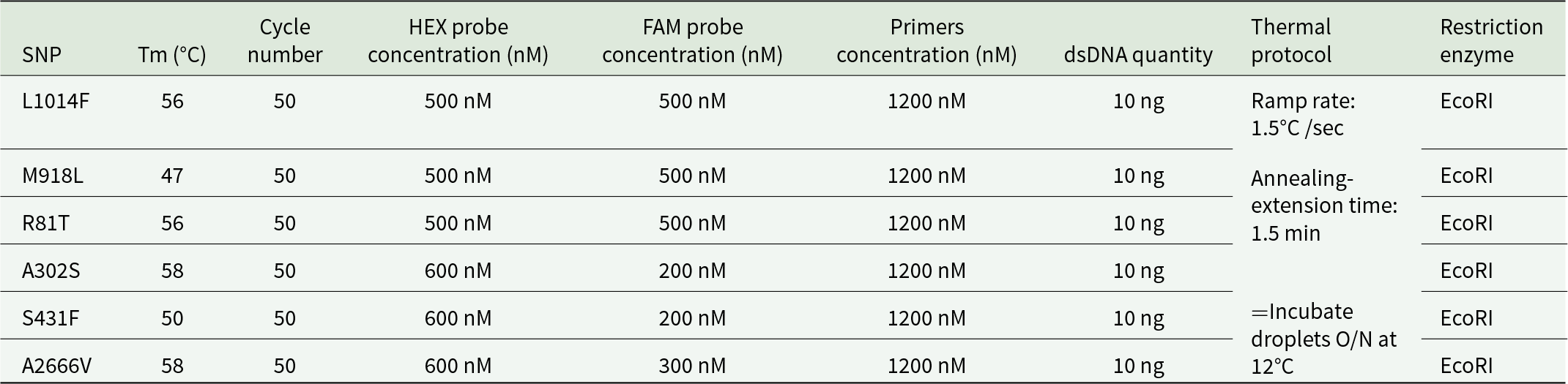
Table 2 Long description
The table lists ddPCR setup parameters for six SNP assays in Aphis gossypii, including annealing temperature, cycle count, probe and primer concentrations, DNA input, thermal protocol notes, and restriction enzyme. All assays use 50 cycles, 1200 nM primers, 10 ng double stranded DNA per reaction, and EcoRI as the restriction enzyme. Annealing temperatures vary from 47 degrees C for M918L to 58 degrees C for A302S and A2666V, with L1014F and R81T at 56 degrees C and S431F at 50 degrees C. Probe concentrations differ by SNP: L1014F, M918L, and R81T use 500 nM for both HEX and FAM, while A302S and S431F use 600 nM HEX with 200 nM FAM, and A2666V uses 600 nM HEX with 300 nM FAM. Thermal protocol is the same for all SNPs, which includes a ramp rate of 1.5 degrees C per second, an annealing extension time of 1.5 minutes and droplets incubation overnight at 12 degrees C.
Results and discussion
Out of the six resistance-associated mutations investigated, four were detected in the studied populations (table 3). The A2666V and L1014F mutations were not recorded in any of the examined populations. Notably, the A2666V mutation has been previously reported in M. persicae (Singh et al., Reference Singh, Cordeiro, Troczka, Pym, Mackisack, Mathers, Duarte, Legeai, Robin, Bielza, Burrack, Charaabi, Denholm, Figueroa, Ffrench-constant, Jander, Margaritopoulos, Mazzoni, Nauen, Ramírez, Ren, Stepanyan, Umina, Voronova, Vontas, Williamson, Wilson, Xi-wu, Youn, Zimmer, Simon, Hayward and Bass2021) and not in A. gossypii. Given that all the other studied mutations have been observed in both M. persicae and A. gossypii and considering the high conservation of the ACC gene region for both species, it is plausible that the A2666V mutation could arise in A. gossypii in the future. Accordingly, a mutant allele-specific probe was designed based on the A2666V codon described in M. persicae. This assay is designed to enable early detection of the A2666V variant in A. gossypii, should the corresponding substitution arise.
Resistant allele frequencies (%) measured by ddPCR in pools of field samples of Aphis gossypii from Greece

Table 3 Long description
The table reports resistant allele frequencies, in percent, measured by ddPCR in pooled adult Aphis gossypii samples from Greece, listed by year, locality, prefecture, crop, and pool size. In citrus samples from 2023 (total 38 aphids), S431F is consistently 50 percent and R81T, A302S, and M918L are all 0 percent. Cotton pools from 2021 to 2022 (total 36) are mostly 0 percent, except Platykampos in 2021 where S431F and M918L are 73.08 percent and A302S is 53.85 percent; the cotton total is 26.39 percent for S431F and M918L and 19.44 percent for A302S, with R81T at 0 percent. Cucurbit pools span 2021 to 2025 (total 189) and show the highest and most variable resistance: S431F is often near fixation (100 percent in multiple sites), while A302S and M918L frequently range from moderate to high values, including 80 and 100 percent at Dimini in 2023 and 70.59 and 91.18 percent at Gastouni in 2024. R81T is generally low but appears in several cucurbit localities, peaking at 50 percent in Dimini (2023) and reaching 44.12 percent in Gastouni (2024). Overall for cucurbits, totals are 75.40 percent for S431F, 39.68 percent for A302S, 48.94 percent for M918L, and 9.26 percent for R81T. Comparisons across crops suggest resistance is most widespread in cucurbits, intermediate in cotton due to one highly resistant field pool, and uniform for citrus with only S431F at 50 percent.
Note: N = number of adult aphids per pool. The mutations A2666V and L1014F were not recorded in any of the sampling localities. For details of sampling sites, see figure 1.
In the three citrus populations, only the S431F mutation was detected, with a total RAF of 50%. Among the cotton populations, only one carried resistance mutations (S431F, A302S, and M918L), which were detected at high frequencies. The total RAF for these three mutations in the cotton populations ranged from 19% to 26%. In contrast, all four resistance mutations were identified in populations from cucurbits. The R81T mutation was present in four out of the 13 populations examined (RAF 10%–50%), which were geographically dispersed from Crete to southern and central mainland Greece (total RAF for cucurbits: 9%). S431F was found in 12 out of 13 populations, while A302S and M918L were detected in 11 out of 13 populations. M918L mutation was fixed in one population, while S431F in seven populations. Generally, S431F, A302S, and M918L were sampled mostly at medium-to-high frequencies, with total RAFs in cucurbits of 75%, 40%, and 49%, respectively. One population from Lehonia (sampled in 2022) was susceptible, as none of the four mutations was recorded. Overall, all four mutations were detected in four populations, three mutations in six populations, and two mutations in two populations.
The present study provides ddPCR-based diagnostics for monitoring six insecticide resistance mutations in A. gossypii. While resistance-associated genetic changes are typically studied using methods like Sanger sequencing, allele-specific PCR, PCR–RFLP, and qPCR, this study demonstrates for the first time the applicability of ddPCR to A. gossypii. The development of these highly sensitive diagnostic tools is important for the effective resistance management of this species, offering a rapid and precise alternative to traditional molecular diagnostics. By providing superior sensitivity and accuracy, as well as the ability to detect low-frequency resistant alleles, ddPCR enables earlier detection of emerging resistance and represents a powerful new tool for proactive, evidence-based resistance management in this aphid pest. It is worth mentioning, however, the limitations of the ddPCR diagnostics. This method does not calculate the number of individuals in each pool that possess the mutations and consequently the number of heterozygotes and homozygotes. In addition, the method requires specialised equipment not available in many laboratories.
Our work is the first comprehensive study on insecticide resistance in this serious aphid pest in Greece. We detected higher levels of resistance in cucurbits than in cotton and citrus crops. Differences in insecticide resistance traits have been reported between populations colonising different host plants (Carletto et al., Reference Carletto, Martin, Vanlerberghe-Masutti and Brévault2010); however, in our case, the most probable explanation lies in the differences in selection pressure and the specific active ingredients used in these three crops. Differences in the frequencies of S431F and M918L among populations from different host plants were also reported in Italy (Cominelli et al., Reference Cominelli, Chiesa, Panini, Massimino Cocuzza and Mazzoni2024). Similar to our results, only S431F was documented in populations from citrus.
An interesting finding is that R81T was detected in distant localities in Greece, albeit in only a few populations. R81T has been frequently reported in aphid populations from the Far East (Koo et al., Reference Koo, An, Park, Kim and Kim2014; Hirata et al., Reference Hirata, Kiyota, Matsuura, Toda, Yamamoto and Iwasa2015; Chen et al., Reference Chen, Li, Chen, Ma, Liang, Liu, Song and Gao2017a) and recently in Italy (Cominelli et al., Reference Cominelli, Chiesa, Panini, Massimino Cocuzza and Mazzoni2024). The frequencies of R81T, S431F, and M918L reported here are comparable to those observed by Cominelli et al. (Reference Cominelli, Chiesa, Panini, Massimino Cocuzza and Mazzoni2024) in Italian populations. Furthermore, the L1014F mutation has not been detected in either of the two countries and has been reported only in Australia (Marshall et al., Reference Marshall, Moran, Chen and Herron2012; Suann et al., Reference Suann, Bogema, Chen, Mansfield, Barchia and Herron2015) and China (Wang et al., Reference Wang, Liang, Shang, Yu and Xue2021).
Given that A. gossypii reproduces asexually in Greece (Margaritopoulos et al., Reference Margaritopoulos, Tzortzi, Zarpas and Tsitsipis2009), low genotypic diversity is expected, similar to observations in populations from Cameroon (Charaabi et al., Reference Charaabi, Carletto, Chavigny, Marrakchi, Makni and Vanlerberghe-Masutti2008). Since asexual resistant genotypes can persist in the field for many years, intense selection pressure from insecticides likely leads to homogenised resistant populations. This could explain the fixation of the S431F mutation in more than half of the populations of cucurbits examined in this study. The diagnostic tools developed in the present study could substantially improve evidence-based decision support systems for aphid control and the management of the resistance issues identified in Greece, particularly in cucurbit crops. However, further research is required, including bioassays with active ingredients where DNA markers are not yet available, to enrich our understanding of the dynamics of the resistance issue in Greek aphid populations.
Acknowledgements
We are grateful to various colleagues and especially the Association of Self-Employed Agronomists of the Prefecture of Ilia, Maria Folia, Phillothei Papadimitriou, Polyxeni Papapetrou, Styliani Malliaraki, and John Sklivakis for assisting with the collection and preparation of aphid samples. This work was implemented within the framework of the National Recovery and Resilience Plan Greece 2.0 with funding from the European Union – NextGenerationEU. Implementing Body: Ministry of Economy and Finance, Special Coordination Service of the Recovery Fund. Call: Promotion of research and innovation, strengthening of basic and applied research. Section: Agriculture and Food Industry – Innovative Plant Protection and Environment, ‘Flagship actions in interdisciplinary scientific areas with a special focus on connecting with the productive sector’. Project: InnoPP – TAEDR-0535675.
Financial support
This work has received funding from the European Union’s Horizon Europe Research and Innovation Programme under grant agreement 101136611. Views and opinions expressed are, however, those of the authors only and do not necessarily reflect those of the European Union. Neither the European Union nor the granting authority can be held responsible for them.
Competing interests
The authors declare that they have no conflicts of interest.