





Introduction
Neurodevelopmental disorders typically manifest early in development and are characterized by learning difficulties, deficits in executive functioning, and/or reduced social skills that result in impairments of personal, social, academic, or occupational functioning (American Psychiatric Association, 2013). Attention-deficit/hyperactivity–impulsivity disorder (ADHD) and autism spectrum disorder (ASD) are among the most common neurodevelopmental disorders. The prevalence of ADHD in childhood is estimated between 5% and 7% (Polanczyk, de Lima, Horta, Biederman, & Rohde, Reference Polanczyk, de Lima, Horta, Biederman and Rohde2007; Polanczyk, Salum, Sugaya, Caye, & Rohde, Reference Polanczyk, Salum, Sugaya, Caye and Rohde2015). In adulthood the prevalence is estimated around 3.5% (Fayyad et al., Reference Fayyad, de Graaf, Kessler, Alonso, Angermeyer, Demyttenaere and Jin2007). ASD is highly persistent with an estimated prevalence of around 1% throughout the lifespan (Lai, Lombardo, & Baron-Cohen, Reference Lai, Lombardo and Baron-Cohen2014; McManus et al., Reference McManus, Bankart, Scott, Purdon, Smith, Bebbington and Meltzer2011). Neurodevelopmental disorders often co-occur with each other and with other psychiatric disorders, both within individuals and within families (American Psychiatric Association, 2013; Chen et al., Reference Chen, Brikell, Lichtenstein, Serlachius, Kuja-Halkola, Sandin and Larsson2017; Ghirardi et al., Reference Ghirardi, Brikell, Kuja-Halkola, Freitag, Franke, Asherson and Larsson2018). Twin and molecular genetic studies have established that shared additive genetic factors play a key role in both the comorbidity and familial co-aggregation of psychiatric disorders (Ask et al., Reference Ask, Cheesman, Jami, Levey, Purves and Weber2021; Friedman, Banich, & Keller, Reference Friedman, Banich and Keller2021; Posthuma & Polderman, Reference Posthuma and Polderman2013; Tick, Bolton, Happé, Rutter, & Rijsdijk, Reference Tick, Bolton, Happé, Rutter and Rijsdijk2016). Compared to these studies, the number of family studies examining the inter-generational transmission of psychiatric disorders is limited. Shedding light on the familial component of psychopathology aids in enhancing etiological understanding. When psychiatric disorders co-occur, the negative consequences that patients and their families experience are worse than the consequences that they experience from each condition alone (Miranda, Berenguer, Colomer, & Rosello, Reference Miranda, Berenguer, Colomer and Rosello2014). Knowledge on the inter-generational transmission of ADHD and ASD can thus also be used for early diagnosis in children and effective prevention of these disorders and their negative consequences (e.g. low educational attainment and social isolation). In a similar way, sound knowledge of familial transmission of neurodevelopmental disorders and psychiatric disorders that have their onset later in life can aid in prevention of the latter.
ADHD and ASD often co-occur (Ghirardi et al., Reference Ghirardi, Brikell, Kuja-Halkola, Freitag, Franke, Asherson and Larsson2018; Ottosen et al., Reference Ottosen, Larsen, Faraone, Chen, Hartman, Larsson and Dalsgaard2019; Polderman, Hoekstra, Posthuma, & Larsson, Reference Polderman, Hoekstra, Posthuma and Larsson2014; van Steijn et al., Reference van Steijn, Richards, Oerlemans, de Ruiter, van Aken, Franke and Rommelse2012). It has been shown that a shared genetic liability at least partly explains the comorbidity and familial co-aggregation of neurodevelopmental disorders (Consortium C-DG of the PG, 2019; Rommelse & Hartman, Reference Rommelse and Hartman2016; Solberg et al., Reference Solberg, Zayats, Posserud, Halmøy, Haavik and Klungsøyr2019). The genetic correlation between ADHD and ASD has been estimated around 0.40 (Consortium C-DG of the PG, 2014, 2019; Demontis et al., Reference Demontis, Walters, Martin, Mattheisen, Als, Agerbo and Neale2019; Grove et al., Reference Grove, Ripke, Als, Mattheisen, Walters and Børglum2019; Solberg et al., Reference Solberg, Zayats, Posserud, Halmøy, Haavik and Klungsøyr2019). This knowledge may be refined by focusing on more homogeneous neurodevelopmental problems. Both ADHD and ASD are highly heterogeneous and it has already been indicated that subdomains within these disorders show different patterns of within-person co-occurrence (Panagiotidi, Overton, & Stafford, Reference Panagiotidi, Overton and Stafford2017). In addition, two studies have examined the shared heritability of neurodevelopmental problems. Both focused on the inattention and hyperactivity–impulsivity subdomains of ADHD and social and communication difficulties and repetitive and restricted behavior subdomains of ASD. The findings indicated that the genetic overlap is strongest between the hyperactivity–impulsivity and the repetitive and restricted behavior subdomain (Ghirardi et al., Reference Ghirardi, Pettersson, Taylor, Freitag, Franke, Asherson and Kuja-Halkola2019; Polderman et al., Reference Polderman, Hoekstra, Posthuma and Larsson2014). While these studies distinguished two ASD subdomains, the current study will differentiate six subdomains of ASD (i.e. reduced contact, reduced empathy, violation of social conventions, reduced social insight, stereotyped behavior, and resistance to change). The inclusion of these additional subdomains increases the specificity of our findings compared to previous research.
Besides occurring together, ADHD and ASD co-occur with other psychiatric disorders. In childhood, they are often comorbid with disruptive behavior disorders, in particular ADHD (Azeredo, Moreira, & Barbosa, Reference Azeredo, Moreira and Barbosa2018; Mandy, Roughan, & Skuse, Reference Mandy, Roughan and Skuse2014; Maughan, Rowe, Messer, Goodman, & Meltzer, Reference Maughan, Rowe, Messer, Goodman and Meltzer2004; Simonoff et al., Reference Simonoff, Pickles, Charman, Chandler, Loucas and Baird2008). The genetic correlation between ADHD and disruptive behavior disorders is also substantial (Azeredo et al., Reference Azeredo, Moreira and Barbosa2018; Faraone & Larsson, Reference Faraone and Larsson2019; Mandy et al., Reference Mandy, Roughan and Skuse2014). In recent years it has become increasingly clear that children with a neurodevelopmental disorder are also at high risk of developing psychiatric disorders that have their onset later in life. In adulthood, ADHD and ASD regularly co-occur with mood, anxiety, and substance use disorders (Chen et al., Reference Chen, Hartman, Haavik, Harro, Klungsøyr, Hegvik and Larsson2018; Libutzki et al., Reference Libutzki, Ludwig, May, Jacobsen, Reif and Hartman2019; Ottosen et al., Reference Ottosen, Larsen, Faraone, Chen, Hartman, Larsson and Dalsgaard2019; Solberg et al., Reference Solberg, Halmøy, Engeland, Igland, Haavik and Klungsøyr2018). It is reasonable to assume that, as for neurodevelopmental and disruptive behavior disorders, a large part of this comorbidity can be attributed to a shared genetic liability, but knowledge on the shared familiality of neurodevelopmental disorders with other psychiatric disorders is limited, while a more detailed focus on neurodevelopmental problems is altogether absent (Consortium C-DG of the PG, 2014, 2019; Consortium TB, 2018; Demontis et al., Reference Demontis, Walters, Rajagopal, Waldman, Grove, Als and Børglum2021; Derks, Vink, Willemsen, van den Brink, & Boomsma, Reference Derks, Vink, Willemsen, van den Brink and Boomsma2014; Solberg et al., Reference Solberg, Halmøy, Engeland, Igland, Haavik and Klungsøyr2018; Wang, Snieder, & Hartman, Reference Wang, Snieder and Hartman2022). In addition, the shared heritability between these disorders has mainly been established by studies of same aged twins and not by multigenerational family studies. Considering that neurodevelopmental, mood, anxiety, and substance use disorders have their onset at different stages of the lifespan, their shared heritability might have been underestimated until now.
All in all, the aims of this study were: (1) to evaluate the familial aggregation of neurodevelopmental problems, the familial co-aggregation among neurodevelopmental problems, and the familial co-aggregation of neurodevelopmental problems with aggressive behavior, depression, anxiety, and substance use and (2) to assess the familiality of neurodevelopmental problems, shared familiality among neurodevelopmental problems, and shared familiality of neurodevelopmental problems with aggressive behavior, depression, anxiety, and substance use. The current study used data from a cross-sectional study implemented in the Lifelines cohort that included 37 688 participants across three generations with an age range from 5 to 91 years. For each participant ADHD subdomains, ASD subdomains, aggressive behavior, depression, anxiety, and substance use were assessed.
Methods
Sample
In the current paper, we analyzed the parent and/or self-report data of an add-on study that was implemented in the Lifelines Cohort Study as part of the EU-funded CoCA consortium research: comorbid conditions of ADHD (Scholtens et al., Reference Scholtens, Smidt, Swertz, Bakker, Dotinga, Vonk and Stolk2015; Stolk et al., Reference Stolk, Rosmalen, Postma, de Boer, Navis, Slaets and Wolffenbuttel2008). Every participant with internet access of the Lifelines Cohort Study was invited to participate in this add-on study. In total, 1643 children (5–12 years old; parent-report), 853 adolescents (13–17 years old; parent and/or self-report), and 39 216 adults (18 + years old; self and/or other-report) filled in a digital survey that assessed the severity, age of onset, and impairment of various psychiatric problems. Compared to the original Lifelines Cohort Study (at baseline), participants in the CoCA add-on study are older (i.e. this is consistent with CoCA being performed around 10 years after the Lifelines baseline assessment) and more often male. Additionally, participants in the add-on study have a higher educational attainment level and socio-economic status, and less often indicate having ADHD themselves and using ADHD medication. However, as all effects are negligible (i.e. the Cohen's d effect sizes range between 0.01 and 0.13; except for a small effect size of d = 0.29 for educational attainment), the CoCA add-on study should still be largely representative of the Northern part of the Netherlands. The Lifelines Cohort Study and the CoCA add-on study were approved by the ethics committee of the University Medical Centre Groningen and all participants signed an informed consent form (Scholtens et al., Reference Scholtens, Smidt, Swertz, Bakker, Dotinga, Vonk and Stolk2015; Stolk et al., Reference Stolk, Rosmalen, Postma, de Boer, Navis, Slaets and Wolffenbuttel2008). The Lifelines Cohort Study is further described in Online Resource 1.
Concerning the CoCA family pedigree structure, for 11 356 (27.2%) participants, it was possible to determine psychopathology status of at least one first-degree relative (FDR). The FDR data contained 2595 sibling pairs and 4399 parent–child pairs. Psychopathology status of a second-degree relative could be assessed for at least 2597 (15.6%) participants. The second-degree relative data contained 243 grandparent–grandchild pairs, 632 aunt/uncle–niece/nephew pairs, and 707 halfsibling pairs.
Measures
Attention-deficit/hyperactivity–impulsivity disorder
Among all participants, ADHD symptoms were assessed with the Dutch version of the ADHD DSM-IV questionnaire (DuPaul, Power, Anastopoulos, & Reid, Reference DuPaul, Power, Anastopoulos and Reid1998; Kooij et al., Reference Kooij, Buitelaar, van den Oord, Furer, Rijnders and Hodiamont2005). The questionnaire indicates the presence or absence of each of the 18 DSM-IV ADHD symptoms during the past 6 months. The Dutch version of the ADHD DSM-IV questionnaire has shown good psychometric properties (Kooij et al., Reference Kooij, Buitelaar, van den Oord, Furer, Rijnders and Hodiamont2005).
Autism spectrum problems
In childhood and adolescence, autism spectrum disorder problems were assessed with the Child Social Behaviour Questionnaire (CSBQ) (Hartman, Luteijn, Moorlag, de Bildt, & Minderaa, Reference Hartman, Luteijn, Moorlag, de Bildt and Minderaa2008). The CSBQ indicates problems among seven subdomains during the past three months: reduced contact, reduced social insight, reduced empathy, violation of social conventions, resistance to change, stereotyped behavior, and violation of communication rules. In adulthood, autism spectrum disorder problems were assessed with the Adult Social Behaviour Questionnaire (ASBQ) (Horwitz et al., Reference Horwitz, Schoevers, Ketelaars, Kan, van Lammeren, Meesters and Hartman2016). The ASBQ indicates problems among six subdomains during the past 3 months: reduced contact, reduced social insight, reduced empathy, violation of social conventions, resistance to change, and stereotyped behavior. The CSBQ and ASBQ have been shown good psychometric properties (Hartman et al., Reference Hartman, Luteijn, Moorlag, de Bildt and Minderaa2008; Hartman, Luteijn, Serra, & Minderaa, Reference Hartman, Luteijn, Serra and Minderaa2006; Horwitz et al., Reference Horwitz, Schoevers, Ketelaars, Kan, van Lammeren, Meesters and Hartman2016).
In short, aggressive behavior was assessed with the aggressive behavior subscale of the Child Behaviour Checklist (CBCL) and the Adult Self Report (ASR) (Achenbach, Ivanova, & Rescorla, Reference Achenbach, Ivanova and Rescorla2017; Achenbach & Rescorla, Reference Achenbach and Rescorla2001). In childhood and adolescence, depression and anxiety were also assessed with the CBCL, in adulthood the Dutch version of the Mini-international Neuropsychiatric Interview (MINI-S) was used (Overbeek & Schruers, Reference Overbeek and Schruers2019). The frequency of substance use was directly assessed as present or absent. Assessments of neurodevelopmental and psychiatric problems are fully described in Online Resource 2.
For part of the statistical analyses (i.e. recurrence risk; see below) binary measures were needed. More information about how participants were classified as having neurodevelopmental and/or psychiatric problems can be found in Online Resource 3.
Analysis
Familial (co-)aggregation was evaluated by estimating the recurrence risk ratio (λ R) introduced by Risch (Reference Risch1990). The recurrence risk ratio is defined as the ratio between the risk in those with an affected FDR and the risk of the total Lifelines population, with λ R > 1 indicating positive familial (co-)aggregation (i.e. elevated risk in those with positive family history). The λ R was estimated using a conditional Cox proportional hazards model, adapted according to Breslow (Reference Breslow1974). The modified model can be used to estimate prevalence ratios in a cross-sectional study by applying an equal follow-up time for all participants and has been shown to produce consistent estimates close to true limits (Barros & Hirakata, Reference Barros and Hirakata2003; Skov, Deddens, Petersen, & Endahl, Reference Skov, Deddens, Petersen and Endahl1998). Specifically, we used the modified marginal model which can handle correlated observations due to familial clustering. This model estimates the mean population hazard function and uses a robust sandwich method to estimate confidence intervals. The modified marginal Cox proportional hazards model has been applied and validated in previous Lifelines studies (Triatin et al., Reference Triatin, Chen, Ani, Wang, Hartman, Nolte and Snieder2023; Wang et al., Reference Wang, Snieder and Hartman2022; Zhang, Thio, Gansevoort, & Snieder, Reference Zhang, Thio, Gansevoort and Snieder2021). Our model was estimated using R3.5.3 software and adjusted for sex, age, and age2 (to account for non-linear age effects).
The terms heritability and genetic correlation imply that familial transmission can solely be attributed to genetics. Unlike twin studies, our study cannot disentangle genetic from shared environmental influences. To address this conflation and the resulting mismatch with heritability estimates from twin studies, we use the terms familiality and familial correlation instead of heritability and genetic correlation (Kendler & Neale, Reference Kendler and Neale2009).
Familiality of one continuous phenotype and shared familiality of two continuous phenotypes were assessed using, respectively, univariate and bivariate residual maximum likelihood-based variance decomposition in linear mixed models implemented in ASReml 4.2 (Gilmour, Gogel, Cullis, & Thompson, Reference Gilmour, Gogel, Cullis and Thompson2016). We assumed a linear mixed model as follows: y = Xb + Za + e, where y is the dependent variable, X is the design matrix of the fixed effects, b are the regression coefficients for the fixed effects, Z is the design matrix of the random effects, a are the familial effects with variance $\sigma _a^2$ , and e are the residuals with variance $\sigma _e^2$
 . The variance components of univariate linear mixed models were subsequently used to calculate the familiality for a single phenotype as $f^2 = \sigma _a^2 /( \sigma _a^2 + \sigma _e^2 )$
 . The variance components of bivariate models were used to calculate phenotypic and familial correlations between two phenotypes as $r_P = \sigma _{p1p2}/\sqrt {\sigma _{p1}^2 + \sigma _{p2}^2 }$
 and $r_F = \sigma _{a1a2}/\sqrt {\sigma _{a1}^2 + \sigma _{a2}^2 }$
 , where σ pa1pa2 is the phenotypic or estimated familial covariance between phenotype one and two, and $\sigma _{pa1}^2$
 and $\sigma _{pa2}^2$
 are the phenotypic or estimated familial variance of phenotype one and two, respectively. The familial effects are estimated using the CoCA family pedigree which includes all family relations among the three generations of CoCA participants.
Singletons (i.e. participants without any relatives in the Lifelines population) were included in the analyses to contribute to the variance estimations and phenotypic correlations, but not to the familial correlations. The significance level of our (shared) familiality estimates was derived from likelihood ratio tests, comparing the (shared) familiality model to a model in which familial variances were constrained to zero.
Results
Familial aggregation and familiality
Familial aggregation and familiality estimates of neurodevelopmental problems are displayed in Table 1. The FDRs recurrence risk ratios (λ R = 2.67 [CI 1.65–4.34] and 4.01 [1.56–10.26]) and familiality estimates (f 2 = 0.33 [s.e. = 0.02] and 0.39 [0.02]) for ADHD and ASD, respectively, were higher than those of their corresponding subdomains. The recurrence risk ratio among the neurodevelopmental problems was lowest for reduced social insight (λ R = 0.96 [CI 0.14–6.76]) and highest for reduced contact (λ R = 3.76 [CI 1.58–8.94]), with similar estimates for inattention (λ R = 2.40 [CI 1.69–3.41]) and hyperactivity–impulsivity (λ R = 2.41 [CI 1.74–3.33]). The familiality of all neurodevelopmental problems was moderate, ranging from 0.22 (reduced empathy) to 0.38 (resistance to change) for ASD, and from 0.28 (inattention) to 0.29 (hyperactivity–impulsivity) for ADHD.
Familial aggregation and familiality of neurodevelopmental problems

ADHD, attention-deficit/hyperactivity disorder; ASD, autism spectrum disorder; CI, confidence interval; s.e., standard error.
*Significant at 0.05 level.
Familial co-aggregation and shared familiality among neurodevelopmental problems
The comorbidity, familial co-aggregation, and shared familiality between neurodevelopmental problems ordered per problem are displayed in Table 2 (see ST2 for the table ordered per type of index). Associations were strongest between neurodevelopmental problems belonging to the same disorder. Specifically, the strongest within-disorder associations were between inattention and hyperactivity–impulsivity (rP = 0.64 [s.e. = 0.003]; λ R = 1.97 [CI 1.46–2.66] and 2.00 [1.48–2.69]; rF = 0.94 [s.e. = 0.03]), and reduced contact, reduced empathy, and reduced social insight (rP = 0.53–0.61; λ R = 1.52–4.62; rF = 0.90–0.91). The weakest within-disorder association was between reduced empathy and stereotyped behavior (rP = 0.35 [s.e. = 0.005]; λ R = 1.48 [CI 0.55–3.94] and 2.08 [0.78–5.53]; rF = 0.73 [s.e. = 0.06]).
Comorbidity, familial co-aggregation, and shared familiality among neurodevelopmental problems
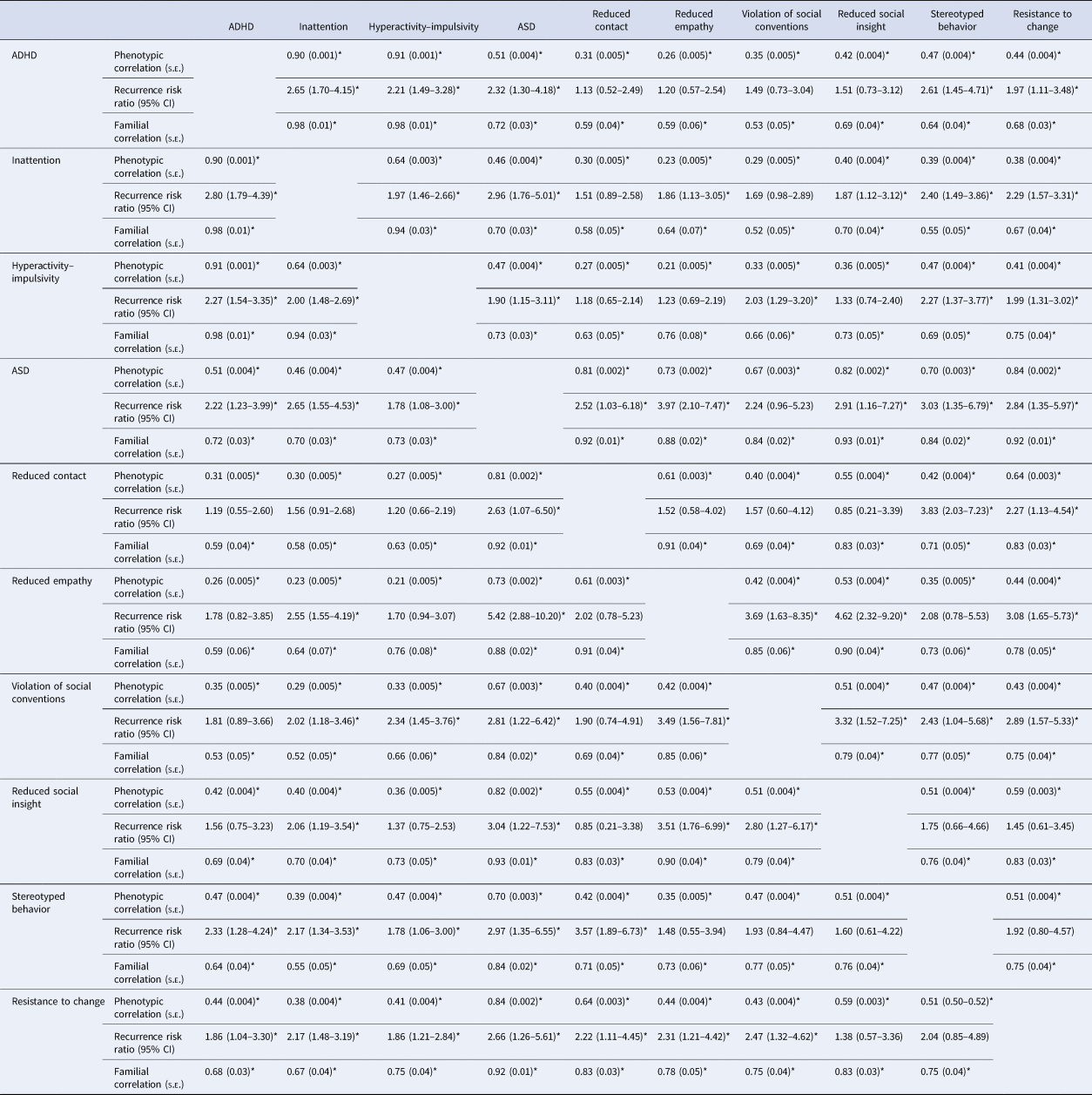
ADHD, attention-deficit/hyperactivity disorder; ASD, autism spectrum disorder; CI, confidence interval; s.e., standard error.
*Significant at 0.05 level. Recurrence risk ratios of two different conditions can be estimated in two ‘directions’, i.e. these estimates are not symmetric. First, the risk of having neurodevelopmental problem one when having a first-degree relative with neurodevelopmental problem two, and second, the risk of having neurodevelopmental problem two when having a first-degree relative with neurodevelopmental problem one. Since correlations do not have a direction, this part of the table is symmetric and phenotypic and familial correlations are displayed twice.
The association between ADHD and ASD was stronger than any associations between their corresponding subdomains (rP = 0.51 [s.e. = 0.004]; λ R = 2.32 [CI 130–4.18] and 2.22 [1.23–3.99]; rF = 0.72 [s.e. = 0.03]). When looking at the subdomains, the strongest cross-disorder associations were between hyperactivity–impulsivity on the one hand and stereotyped behavior (rP = 0.39 and 0.47; λ R = 1.78–2.40; rF = 0.55 and 0.69) and resistance to change (rP = 0.38 and 0.41; λ R = 1.86–2.29; rF = 0.67 and 0.75) on the other hand. The weakest cross-disorder associations included inattention and hyperactivity–impulsivity with reduced contact (rP = 0.53 and 0.61; λ R = 1.18–1.56; rF = 0.90 and 0.91), and inattention with violation of social conventions (rP = 0.29 [s.e. = 0.005]; λ R = 1.69 [CI 0.98–2.89] and 2.02 [1.18–3.46]; rF = 0.52 [s.e. = 0.05]).
Familial co-aggregation and shared familiality of neurodevelopmental problems with other psychiatric problems
The comorbidity, familial co-aggregation, and shared familiality of neurodevelopmental problems with other psychiatric problems are displayed in Table 3 (see ST3 for the table ordered per type of index). All neurodevelopmental problems had the strongest association with aggressive behavior (rP = 0.35–0.56; λ R = 1.50–2.52; rF = 0.60–0.78) and anxiety (rP = 0.13–0.41; λ R = 0.83–2.31; rF = 0.62–0.84), closely followed by depression (rP = 0.13–0.37; λ R = 1.06–2.29; rF = 0.43–0.76). The associations between all neurodevelopmental problems and all types of substance use were weak (rP = 0.01–0.12; λ R = 0.53–1.57; rF = −0.06 to 0.35). Inattention and hyperactivity–impulsivity had the strongest association with drug use (rP = 0.10–0.12; λ R = 0.80–1.47; rF = 0.13–0.25). Reduced empathy had the strongest association with smoking (rP = 0.04 [s.e. = 0.005]; λ R = 1.48 [CI 0.88–2.50]; rF = 0.35 [s.e. = 0.11]).
Comorbidity, familial co-aggregation, and shared familiality between neurodevelopmental problems and aggressive behaviour, depression, anxiety, and substance use
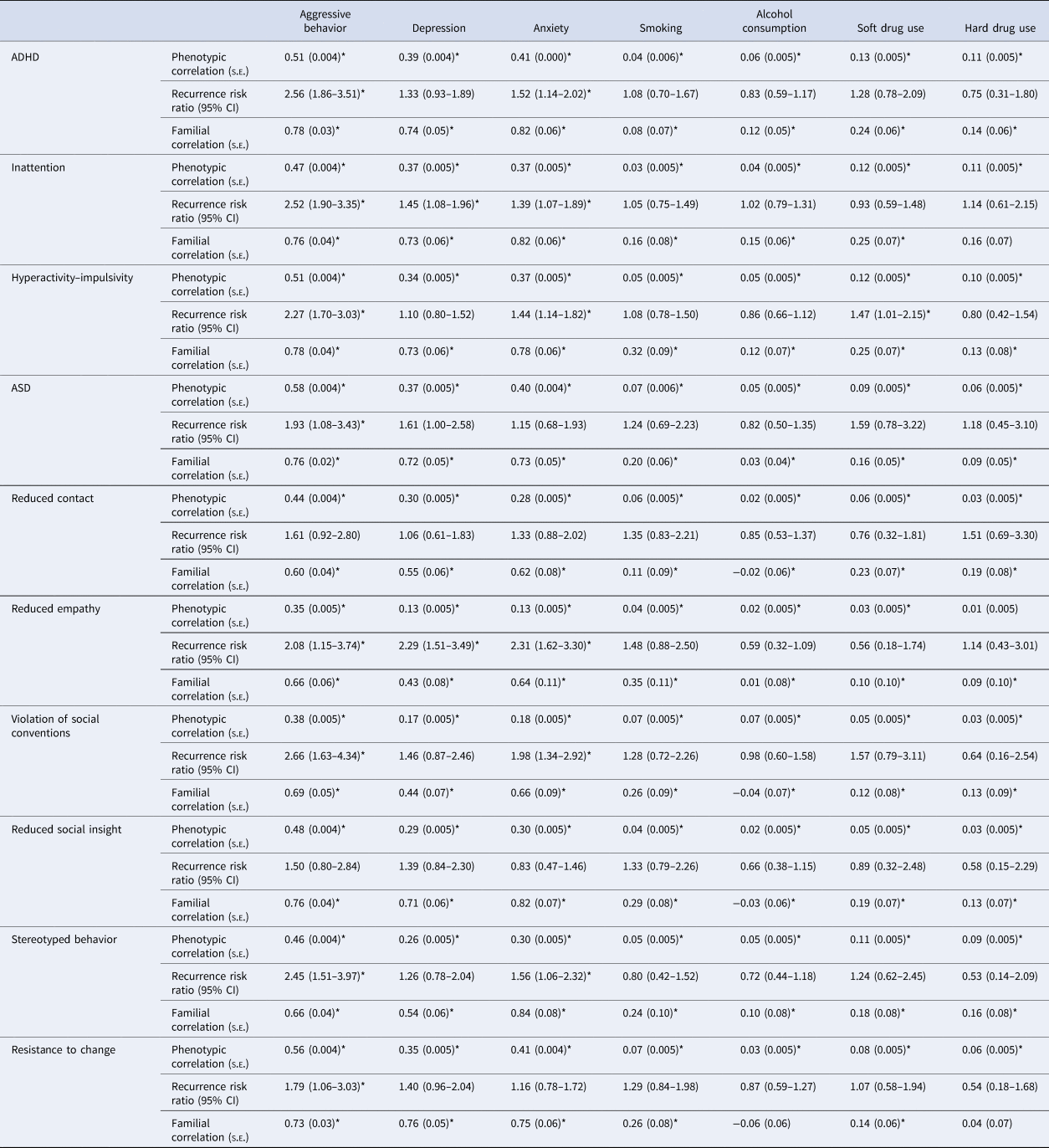
ADHD, attention-deficit/hyperactivity disorder; ASD, autism spectrum disorder; CI, confidence interval; s.e., standard error.
*Significant at 0.05 level.
Discussion
The current study examined the familial (co-)aggregation and (shared) familiality of neurodevelopmental problems (i.e. two ADHD and six ASD subdomains) among each other and with aggressive behavior, depression, anxiety, and substance use. The data were obtained from a cross-sectional study that included 37 688 participants across three generations with an age range from 5 to 91 years. Our study yielded five key findings. First, the familiality of neurodevelopmental problems was moderate (f 2 = 0.22–0.39) and the shared familiality among neurodevelopmental problems and with other psychiatric problems (i.e. except for substance use) substantial (rF = 0.98–0.43). Second, all results for the ADHD and ASD subdomains were rather homogenous with stronger similarities among subdomains belonging to one disorder compared to cross-disorder subdomains. Third, at the family level ASD can be split into reduced contact, reduced empathy, and reduced social insight on the one hand and stereotyped behavior and resistance to change on the other hand, in line with the DSM, with violation of social conventions as a connecting subdomain. Fourth, the comorbidity and shared familiality between ADHD and ASD originates from substantial phenotypic and familial links among all ADHD and ASD subdomains, with the strongest link between the ADHD hyperactivity–impulsivity and the ASD stereotyped behavior and resistance to change subdomains. Fifth, all neurodevelopmental problems had both strong phenotypic and familial links with aggressive behavior, while the links of ADHD and ASD with depression and anxiety mainly existed at the familial level, and the links between neurodevelopmental problems and substance use were weak overall.
We use the terms familiality and familial correlation instead of heritability and genetic correlation because in our study we cannot disentangle genetic from shared environmental effects. However, evidence from twin studies indicates that most familiality is based on heritability, with limited impact from shared environmental factors (Bailey et al., Reference Bailey, Le Couteur, Gottesman, Bolton, Simonoff, Yuzda and Rutter1995; Hettema, Neale, & Kendler, Reference Hettema, Neale and Kendler2001; Larsson, Larsson, & Lichtenstein, Reference Larsson, Larsson and Lichtenstein2004; Levy, Hay, McStephen, Wood, & Waldman, Reference Levy, Hay, McStephen, Wood and Waldman1997; Ronald et al., Reference Ronald, Happé, Bolton, Butcher, Price, Wheelwright and Plomin2006; Sullivan, Neale, & Kendler, Reference Sullivan, Neale and Kendler2000; Wade, Prime, & Madigan, Reference Wade, Prime and Madigan2015). Moreover, the familiality of neurodevelopmental problems reported here (0.22–0.39) is lower than the heritability of ADHD (~0.70) and ASD (~0.80) reported by twin studies (Faraone & Larsson, Reference Faraone and Larsson2019; Ronald & Hoekstra, Reference Ronald and Hoekstra2011; Tick et al., Reference Tick, Bolton, Happé, Rutter and Rijsdijk2016). This would be unlikely if there were strong shared environmental effects. There are multiple factors that may contribute to the lower familiality estimates in our study compared to the heritability estimates reported by twin studies. First, twin studies assume that environmental sharing is the same for monozygotic and dizygotic twins, the equal environment assumption. There is an ongoing debate whether this assumption actually holds. Most previous studies indicate that it does (Derks, Dolan, & Boomsma, Reference Derks, Dolan and Boomsma2006; Kendler, Neale, Kessler, Heath, & Eaves, Reference Kendler, Neale, Kessler, Heath and Eaves1994). Yet, a number of more recent studies (often reanalyzing data of previous studies) have shown that it may not (Dalmaijer, Reference Dalmaijer2020; Felson, Reference Felson2014; Fosse, Joseph, & Richardson, Reference Fosse, Joseph and Richardson2015; Richardson & Norgate, Reference Richardson and Norgate2005; Wolfram & Morris, Reference Wolfram and Morris2023). If the equal environment assumption is violated, this may contribute to the higher heritability reported by twin studies. Two other plausible contributors are rooted in twins having the same age, in contrast to the participants in our multigenerational family study. One contributing factor would be that partly different genetic variants influence neurodevelopmental problems at different ages (i.e. age-by-genotype interaction) (Hardy et al., Reference Hardy, Wills, Wong, Elks, Wareham, Loos and Ong2009; Thapar, Reference Thapar2018). The same genetic variants influence neurodevelopmental problems in same aged twins, while partly different genetic variants influence neurodevelopmental problems in differently aged children and parents. Consequently, the heritability that is captured by twin studies is likely larger than the familiality that is captured by family studies. A second contributor would be that circumstances are more variable across differently aged relatives than across same aged twins (i.e. age and cohort effects). As a result, the genetic and shared environmental effects that are estimated in twin studies are likely larger than the genetic and shared environmental effects that are captured by family studies. Although the three previous factors may contribute to the lower familiality estimates in our study compared to the heritability estimates reported by twin studies, the moderate familiality of ADHD in our study matches the moderate heritability (~0.35) reported by twin studies based on self-reported data in adults (Boomsma et al., Reference Boomsma, Saviouk, Hottenga, Distel, de Moor, Vink and Willemsen2010; Larsson et al., Reference Larsson, Asherson, Chang, Ljung, Friedrichs, Larsson and Lichtenstein2013). This points to the fourth, and in our opinion strongest, contributing factor: the informant switch from parent-report to self-report from adolescence or young adulthood onwards. The influence of this factor is additionally supported by findings that ADHD symptoms showed a similarly low heritability in children if based on self-report and findings that heritability estimates of clinically diagnosed ADHD in adults (which are only partly based on self-report) are similarly high as those based on parent-reported ADHD in children (Chang, Lichtenstein, Asherson, & Larsson, Reference Chang, Lichtenstein, Asherson and Larsson2013; Larsson, Chang, D'Onofrio, & Lichtenstein, Reference Larsson, Chang, D'Onofrio and Lichtenstein2015).
The homogenous results for subdomains belonging to the same disorder are in line with previous findings on the phenotypic and genetic links of neurodevelopmental problems (Ghirardi et al., Reference Ghirardi, Pettersson, Taylor, Freitag, Franke, Asherson and Kuja-Halkola2019; Larsson et al., Reference Larsson, Asherson, Chang, Ljung, Friedrichs, Larsson and Lichtenstein2013; Polderman et al., Reference Polderman, Hoekstra, Posthuma and Larsson2014). Our results additionally support current views that, although ADHD and ASD are strongly linked, the disorders have more unique than shared features, warranting separate diagnostic classifications (Antshel & Russo, Reference Antshel and Russo2019; van der Meer et al., Reference van der Meer, Oerlemans, van Steijn, Lappenschaar, de Sonneville, Buitelaar and Rommelse2012). The two previous studies examining the association between inattention, hyperactivity–impulsivity, social and communication difficulties, and repetitive and restricted behavior found strong phenotypic and genetic associations between hyperactivity–impulsivity and repetitive and restricted behavior and interests (Ghirardi et al., Reference Ghirardi, Pettersson, Taylor, Freitag, Franke, Asherson and Kuja-Halkola2019; Polderman et al., Reference Polderman, Hoekstra, Posthuma and Larsson2014). Likewise, our results indicated that the link between ADHD and ASD is strongest for the ADHD hyperactivity–impulsivity and ASD stereotyped behavior and resistance to change subdomains, the latter together comprising repetitive and restricted behavior and interests. It has been suggested that reduced inhibitory control which is involved in both hyperactive–impulsive and stereotyped behavior may explain the strong association between ADHD and ASD (Craig et al., Reference Craig, Margari, Legrottaglie, Palumbi, de Giambattista and Margari2016; Polderman et al., Reference Polderman, Hoekstra, Posthuma and Larsson2014; Rommelse, Geurts, Franke, Buitelaar, & Hartman, Reference Rommelse, Geurts, Franke, Buitelaar and Hartman2011).
The familial correlations among neurodevelopmental problems and with other psychiatric problems, albeit currently somewhat larger in size, are broadly comparable to the genetic correlations found in previous (behavioral) genetic studies (Azeredo et al., Reference Azeredo, Moreira and Barbosa2018; Consortium C-DG of the PG, 2014, 2019; Demontis et al., Reference Demontis, Walters, Martin, Mattheisen, Als, Agerbo and Neale2019; Pettersson et al., Reference Pettersson, Lichtenstein, Larsson, Song, Agrawal, Børglum and Polderman2019; Solberg et al., Reference Solberg, Zayats, Posserud, Halmøy, Haavik and Klungsøyr2019). The higher familiality in the current study compared to family studies using registered diagnoses may be due to the biases that are inherent to register studies (e.g. failure to register comorbid [secondary] conditions and underdiagnosis of neurodevelopmental disorders in adults) leading to an underestimation of the familial co-aggregation and shared familiality. The higher shared familiality estimates in our study compared to the shared heritability estimates reported by twin studies are likely a result of our family design. Firstly, since we cannot disentangle genetic from shared environmental effects, our familial correlations may include more shared variance. Secondly, as neurodevelopmental disorders and common adult disorders have their peak prevalence in different parts of the lifespan, the predominant use of twin studies when assessing the genetic correlation between disorders may have resulted in an underestimation of the shared heritability among these disorders in previous research (Larsson et al., Reference Larsson, Asherson, Chang, Ljung, Friedrichs, Larsson and Lichtenstein2013; Polderman et al., Reference Polderman, Benyamin, de Leeuw, Sullivan, van Bochoven, Visscher and Posthuma2015; Posthuma & Polderman, Reference Posthuma and Polderman2013). For example, most twin studies focused on ADHD include children, and in these children the prevalence of substance use is by definition low, meaning that the genetic correlation between ADHD and substance use is underestimated compared to family studies in which the prevalence of both ADHD and substance use approximate the prevalence in the general population. Our multigenerational approach covered the full lifespan, ensuring variation in all studied problems, and hereby facilitating the evaluation of their shared familiality.
In contrast to the phenotypic and familial links among the neurodevelopmental problems (i.e. including aggressive behavior), neurodevelopmental problems were associated with depression and anxiety at the familial but not the phenotypic level (Eyre et al., Reference Eyre, Riglin, Leibenluft, Stringaris, Collishaw and Thapar2019). It should first be noted that anxiety, and depression even more, are episodic and we measured their presence during the past months rather than a lifetime prevalence. Although most of our analyses used continuous data, fluctuations in symptoms over time still lead to an underestimation of co-aggregation. That said, the co-occurrence of neurodevelopmental disorders with internalizing disorders may etiologically be more heterogeneous than the co-occurrence of ADHD and ASD or the co-occurrence of depression and anxiety (i.e. the genetic correlations between depression and anxiety are as high as 0.80) (Pettersson et al., Reference Pettersson, Lichtenstein, Larsson, Song, Agrawal, Børglum and Polderman2019; Solberg et al., Reference Solberg, Zayats, Posserud, Halmøy, Haavik and Klungsøyr2019; Wang et al., Reference Wang, Snieder and Hartman2022). The past decades have shown that the etiology of a single disorder is very complex (i.e. the same condition can arise from entirely different pathways and pathways itself comprise many different risk factors and mechanisms with small effects). This etiological complexity increases when different disorders co-occur and, presumably, increases even further when disorders have phenotypically less in common. Future research should establish whether genes shared between ADHD, ASD, depression, and anxiety are involved in more complicated etiological mechanisms than genes shared between ADHD, ASD, and aggressive behavior.
The links of ADHD and ASD with substance use were weak compared to previous findings (Demontis et al., Reference Demontis, Walters, Martin, Mattheisen, Als, Agerbo and Neale2019; Grove et al., Reference Grove, Ripke, Als, Mattheisen, Walters and Børglum2019; Solberg et al., Reference Solberg, Zayats, Posserud, Halmøy, Haavik and Klungsøyr2019). A fundamental difference between the current study and previous studies is that we investigated substance use (i.e. number of cigarettes per day or daily alcohol consumption), whereas most of the previous literature has reported on formally diagnosed substance use disorders. These findings suggest that ADHD co-aggregates more strongly with substance use disorders than substance use, which is more common and accepted in the general population. In line with this explanation, the current study and other studies have found that the link of ADHD with alcohol consumption and smoking is weaker than with more extreme soft and hard drugs use (Demontis et al., Reference Demontis, Walters, Martin, Mattheisen, Als, Agerbo and Neale2019; Grove et al., Reference Grove, Ripke, Als, Mattheisen, Walters and Børglum2019; Solberg et al., Reference Solberg, Zayats, Posserud, Halmøy, Haavik and Klungsøyr2019). The use of more extreme substances may be linked to the high reward and thrill seeking behavior associated with ADHD (Graziano et al., Reference Graziano, Reid, Slavec, Paneto, McNamara and Geffken2015).
An important asset of the current study is that all conditions were measured in all participants, irrespective of whether they received healthcare for the conditions studied here or not. This makes the study representative of the general population, in contrast to more severely affected referred patients used in most multigenerational genetic studies that rely on register data. Our study also had some limitations. First, individuals with ADHD and ASD problems tend to underestimate their symptoms and functional impairments (Adler et al., Reference Adler, Faraone, Spencer, Michelson, Reimherr, Glatt and Biederman2008; Owens, Goldfine, Evangelista, Hoza, & Kaiser, Reference Owens, Goldfine, Evangelista, Hoza and Kaiser2007). It is unlikely that this has had a substantial influence on our findings. That is, the recurrence risk ratio will not have been impacted as we set the sample prevalence to reflect the prevalence in the general population making the prevalence and maximum score of neurodevelopmental problems in the sample independent. Similarly, the variance decomposition method used to estimate familiality and familial correlations mainly depends on the rank order of participants which is stable and independent on the maximum score in the sample. Second, unlike twin studies, our study cannot disentangle genetic from shared environmental influences. To the extent that shared environment plays a role, our (shared) familiality estimates are inflated compared to (shared) heritability reported in twin studies. Third, our neurodevelopmental problems and psychiatric disorders were assessed over the past months. In contrast, most previous studies used a lifetime diagnosis. As already noted above, familial co-aggregation might thus be underestimated in the current study, especially in relation to episodic conditions (e.g. depression) and recurrence risk analyses with dichotomous outcomes (i.e. as this is a yes/no cut-off at one specific moment in time). Finally, affected family members who did not participate in Lifelines may have induced an underestimation of our familial component. For example, more severely affected patients are less likely to participate in research which does not hold for previous studies that were based on whole population registers.
Our study used a multigenerational population cohort and showed that there is a clear (shared) familial component to neurodevelopmental problems, in part shared with other psychiatric problems (except for substance use). This suggests that neurodevelopmental disorders, disruptive behavior disorders, and internalizing disorders share genetic and environmental risk factors. While the familial transmission identified in the current study only hints at shared etiological mechanisms, parsing the heterogeneity of ADHD and ASD into more homogeneous subdomains has yielded findings that could guide future genetic and environmental research.
Supplementary material
The supplementary material for this article can be found at https://doi.org/10.1017/S003329172400309X.
Funding statement
This study made use of the ADHD add-on study of the Lifelines initiative. The Lifelines initiative has been made possible by subsidy from the Dutch Ministry of Health, Welfare and Sport, the Dutch Ministry of Economic Affairs, the University Medical Center Groningen (UMCG), Groningen University and the Provinces in the North of the Netherlands (Drenthe, Friesland, Groningen). The ADHD add-on study has been funded by the European Community's Horizon 2020 Programme under grant agreement number 667302 (CoCA).
Competing interests
H. L. has served as a speaker for Eli-Lilly and has received research grants from Shire. C. A. H. declares honoraria as a speaker for Medice. All other authors report no biomedical financial interests or potential conflicts of interest.


 Open access

