


Politicians spend considerable time, energy, and money attempting to communicate with voters.Footnote 1 Indeed, scholars have long recognized the importance of how politicians present themselves to voters (Fenno Reference Fenno1978). Yet whether voters receive and internalize what politicians attempt to communicate with them – or know any substantive information about candidates for public office – is highly debated. While it is true that voters are often unable to recall candidates’ names or to identify their specific policy positions (Miller and Stokes Reference Miller and Stokes1963; Ahler et al. Reference Ahler, Citrin and Lenz2016; Bawn et al. Reference Bawn, DeMora, Dowdle, Hall, Myers, Patterson and Zaller2019) and generally have limited political knowledge and/or interest in politics (Campbell et al. Reference Campbell, Converse, Miller and Stokes1960; Converse Reference Converse and Apter1964; Delli Karpini and Keeter Reference Delli Karpini and Keeter1996; Marshall and Peress Reference Marshall and Peress2022), others have suggested that voters derive accurate perceptions about candidates even with limited knowledge (Popkin Reference Popkin1994; Lupia Reference Lupia2006) and have shown that voters consistently vote for ideologically proximate candidates (Redlawsk and Lau Reference Redlawsk and Lau1997; Simas Reference Simas2013; Joesten and Stone Reference Joesten and Stone2014; Hirano et al. Reference Hirano, Lenz, Pinkovskiy and Snyder2015; Dassonneville et al. Reference Dassonneville, Nugent, Hooghe and Lau2020).
In this work, we show that voters’ perceptions of a politician’s ideology are strongly related to that politician’s messaging and ideological presentation of self.Footnote 2 Moreover, we show this relationship across multiple election cycles using a novel machine learning approach which accurately classifies the ideology of individual messages sent by congressional candidates and members of Congress, combined with a robust Bayesian estimation of voters’ perceptions of candidate ideology based on evaluations of candidate ideology provided by actual voters. Specifically, we use the information 1,856 politicians communicated to voters through their own social media accounts between 2011 and 2022 combined with 4,964,241 ratings of politician ideology from over 500,000 citizens to evaluate the relationship between the content that politicians produce and voters’ evaluations of the ideological positioning of those politicians.
We show that, on the whole, voters’ perceptions of candidate ideology are highly correlated with what those politicians communicate to voters. This relationship holds even after controlling for other potential sources of information such as incumbent roll-call voting behavior (which have also been linked to voters’ perceptions of incumbent legislators (Jacoby and Armstrong Reference Jacoby and Armstrong2014; Ramey Reference Ramey2016)). Moreover, we find that this relationship is strong even for candidates who have no congressional voting record and are likely otherwise unknown to voters. Overall, our evidence suggests voters’ perceptions of the ideological stances of politicians are strongly aligned with the ideological presentation of self those politicians communicate to the public.
Moreover, our evidence indicates that voter perceptions are most strongly shaped in competitive political environments where there are greater incentives to pay attention to information from politicians. Specifically, we find that there is a stronger relationship between voters’ ideological perceptions of candidates and the ideological content of politicians’ public communications in competitive congressional districts where those candidates are electorally viable. Overall, our evidence suggests that voters’ perceptions of politicians’ ideological positioning is strongly related to how these politicians present themselves ideologically and what they communicate to voters.
Voter Knowledge about Candidates
Although scholars have not looked at the relationship between politicians’ public communications and voters’ perceptions of those candidates directly, there are good reasons to believe that voters internalize and process information that politicians communicate. To begin with, voters consistently support candidates who are the most ideologically proximate (Redlawsk and Lau Reference Redlawsk and Lau1997; Simas Reference Simas2013; Joesten and Stone Reference Joesten and Stone2014; Dassonneville et al. Reference Dassonneville, Nugent, Hooghe and Lau2020).Footnote 3 Similarly, work showing the existence of electoral penalties for more ideologically extreme House candidates implies that voters are able to identify and punish more ideologically extreme candidates at the ballot box (Canes-Wrone et al. Reference Canes-Wrone, Brady and Cogan2002).Footnote 4
There has also been work attempting to discern what voters know about the ideology of politicians (Jacoby and Armstrong Reference Jacoby and Armstrong2014; Boudreau et al. Reference Boudreau, Elmendorf and MacKenzie2015; Hare et al. Reference Hare, Armstrong, Bakker, Carroll and Poole2015; Holman and Lay Reference Holman and Lay2021; Hopkins and Noel Reference Hopkins and Noel2022). This work, however, has focused on voters’ perceptions of the ideology of public officials derived from their behavior in office or the patterns of the donations they receive rather than a candidate’s presentation of self through their messaging.Footnote 5 Ideology, as measured by congressional votes, may be fundamentally different from what a politician wants to portray to their district as it may be constrained by partisan agenda setting power aimed to minimize factionalization within parties and may be designed to unify (and thus polarize) parties (Barton Reference Barton2023). Politicians may choose to highlight their bipartisanship even when their voting records are consistently partisan (Zdechlik Reference Zdechlik2006). Similarly, measuring the ideology of politicians from the donations they receive may not reflect what they communicate on the campaign trail and may not even provide any ideological indicator as ideology measures derived from campaign donations are influenced by partisan and ideologically extreme donors targeting donations to competitive races (Hill and Huber Reference Hill and Huber2017; Tausanovitch and Warshaw Reference Tausanovitch and Warshaw2017; Barber Reference Barber2022; Meisels et al. Reference Meisels, Clinton and Huber2024).
In addition, much of this previous work (using measures of politician ideology derived from sources other than campaign messaging) has focused only on senatorial and presidential candidates, ignoring congressional candidates and specifically excluding non-incumbent senate candidates in uncompetitive races (Peskowitz Reference Peskowitz2019) under the assumption that ‘voters have little basis to evaluate the ideological positions of “sacrificial lamb” candidates’ (Hare et al. Reference Hare, Armstrong, Bakker, Carroll and Poole2015, 769), leaving open the question of what voters know about candidates beyond these high-salience positions. The limited work that has examined voter perceptions of the ideology of candidates for lower-level offices is mixed in its conclusions (Boudreau et al. Reference Boudreau, Elmendorf and MacKenzie2015; Hirano et al. Reference Hirano, Lenz, Pinkovskiy and Snyder2015; Holman and Lay Reference Holman and Lay2021). Furthermore, much of this work has used measures of candidate ideology that limit variation and do not allow for ideological nuance as it only loosely classifies candidates as moderate or ideologically extreme rather than using a full ideological spectrum. Overall, while there is evidence to suggest there is a relationship between what politicians communicate and how voters perceive those candidates, whether voters process and internalize the information that politicians attempt to communicate is still an open question.
Candidate Ideology Communicated
Although some previous work suggests voters may have an incomplete and inaccurate picture of what representatives do (Campbell et al. Reference Campbell, Converse, Miller and Stokes1960; Dancey and Sheagley Reference Dancey and Sheagley2013), voters might be more inclined to base their ideological judgments based on what these politicians say. Indeed, classic studies of representation specifically emphasize the way that members of Congress present themselves to their constituents as a critical component of representation (Mayhew Reference Mayhew1974; Fenno Reference Fenno1978). More recent research has highlighted the importance of message framing as a particularly potent tool for elected officials in shaping constituent evaluations (Grimmer Reference Grimmer2013; Cormack Reference Cormack2016) and that messaging may indeed be more influential than actual policy returns in the minds of constituents (Grimmer, Messing and Westwood Reference Grimmer, Messing and Westwood2012). In addition, elected officials are strategic in their communications to voters, purposefully trying to highlight ways that they are in sync with their districts while hiding ways they are out of sync (Cormack Reference Cormack2016). Elected officials also respond to changes in their districts by updating how they message (Kaslovsky and Kistner Reference Kaslovsky and Kistner2024) and what platforms they use the most (Blum et al. Reference Blum, Cormack and Shoub2023).
In today’s media environment, elite communications are rapid, plentiful, and emerge in real time in response to ongoing political events. Today’s most high-profile legislators are primarily known for their cable news appearances and Twitter tirades, as opposed to their reputation for principled and meticulous policy making. In particular, previous work suggests that social media communication is most likely to be targeted towards voters in general rather than specific audiences (Green et al. Reference Green, Shoub, Blum and Cormack2024). While we would be foolish to suggest that voters are hyper-attentive to politicians’ every social media post, it may be that what politicians communicate has the potential to reach voters more broadly through various means. What politicians communicate publicly may, therefore, be the most visible and easily digestible form of ideological signal to voters, more so than their actual policy making in elected office.
Taken together, the current literature leaves open several questions. First, do voters’ perspectives of candidate ideology align with how politicians attempt to present themselves ideologically? Second, for congressional incumbents with a legislative record, does messaging from incumbents add additional information to how voters view those individuals ideologically? Third, does the extent to which voters use politicians’ ideological presentation of self in their evaluations of politicians’ ideology vary both within and across election cycles, such that campaign messaging in certain types of races, or in particular election contexts, is more or less related to voter perceptions?
Measuring Concepts
In order to test whether voters’ perceptions of politician ideology reflect those politicians’ ideological presentation of self, we need accurate measures of these constructs. Below we outline how we measure (1) voters’ perceptions of candidate ideology and (2) politicians’ ideological presentations of self (what we term messaging ideology) from the content and messaging that politicians communicate to voters.
Measuring Voters’ Perceptions
We use the Cooperative Election Study (CES) survey to build a measure of voters’ perceptions of candidate ideology. The CES (known as the Congressional Cooperative Election Study until 2019) has been asking voters about the ideology of candidates, elected officials, and institutions annually since 2006. Centrally for our study, the CES asks respondents to rate a number of entities (including their two current senators, the current general election candidates for Senate (if any), their current representative in the House of Representatives, and the two major party candidates for their House seat) ideologically on a 1–7 scale (1 Very liberal, 7 Very conservative).
In order for these questions to be useful for us, though, we need to overcome a major flaw – the ideology of voters, and thus their perception of candidates, varies along with the ideology of most of the candidates that they are judging. This can be solved with Aldrich–McKelvey (A-M) scaling as proposed by Aldrich and McKelvey (Reference Aldrich and McKelvey1977). A-M scaling uses the fact that voters rate multiple entities, some of which are common across all voters, to adjust the ratings of each voter. Hare et al. (Reference Hare, Armstrong, Bakker, Carroll and Poole2015) implemented a Bayesian version of A-M scaling which we use here with a few modifications. In particular, we used an ordinal logistic link function similar to Hassell et al. (Reference Hassell, Miles and Reuning2022) and model multiple years of surveys jointly. For each voter we estimate a difficulty ( ${\alpha _i}$
) and discrimination (
${\alpha _i}$
) and discrimination ( ${\beta _i}$
) parameter that connects each voter’s reported candidate ideology to the true ideology (
${\beta _i}$
) parameter that connects each voter’s reported candidate ideology to the true ideology ( ${\theta _j}$
). The probability of
${\theta _j}$
). The probability of ${y_{ij}}$
(the rating of entity
${y_{ij}}$
(the rating of entity $j$
by voter
$j$
by voter $i$
) is:
$i$
) is:
 $$P({y_{ij}}|{\alpha _i},{\beta _i},{\theta _j}t,c) = \left( {\matrix{ {1 - {\rm{logi}}{{\rm{t}}^{ - 1}}\left( {{\alpha _i} + {\beta _i} \cdot {\theta _{jt}} - {\tau_1}} \right)} \hfill & {{\rm{if\;\;\;\;}}{y_{ij}} = 1,} \hfill \cr {{\rm{logi}}{{\rm{t}}^{ - 1}}\left( {{\alpha _i} + {\beta _i} \cdot {\theta _{jt}} - {\tau_{{y_{ij}} - 1}}} \right) - {\rm{logi}}{{\rm{t}}^{ - 1}}\left( {{\alpha _i} + {\beta _i} \cdot {\theta _{jt}} - {\tau_{{y_{ij}}}}} \right)} \hskip -9pt \hfill & {{\rm{if\;\;\;\;}}1 \lt {y_{ij}} \lt 6,} \hfill \cr {{\rm{logi}}{{\rm{t}}^{ - 1}}\left( {{\alpha _i} + {\beta _i} \cdot {\theta _{jt}} - {\tau_6}} \right)} \hfill & {{\rm{if\;\;\;\;}}{y_{ij}} = 7.} \hfill \cr {} \hfill & {} \hfill \cr } } \right.$$
In order to identify ${\theta _{jt}}$
over time we assume that the ideology of candidates follows a robust random walk where the best guess of a candidate’s ideology in time
${\theta _{jt}}$
over time we assume that the ideology of candidates follows a robust random walk where the best guess of a candidate’s ideology in time $t$
is their ideology in time
$t$
is their ideology in time $t - 1$
(Reuning et al. Reference Reuning, Kenwick and Fariss2019). This is a robust random walk as we assume that the jumps between each time period follow a student’s t-distribution with four degrees of freedom. The student’s t-distribution allows sudden larger jumps in between years which might correspond to sudden large changes in a candidate’s perceived position. This is important as we consistently track an individual across chambers and parties. We often see the largest movement when new information about an individual is made public (party changes and changing preferences towards Trump are especially important). In the Supplementary Material, we estimate our measurement model using a normal distribution and show how it differs from our robust model. We also identify the model by placing a positive prior on the
$t - 1$
(Reuning et al. Reference Reuning, Kenwick and Fariss2019). This is a robust random walk as we assume that the jumps between each time period follow a student’s t-distribution with four degrees of freedom. The student’s t-distribution allows sudden larger jumps in between years which might correspond to sudden large changes in a candidate’s perceived position. This is important as we consistently track an individual across chambers and parties. We often see the largest movement when new information about an individual is made public (party changes and changing preferences towards Trump are especially important). In the Supplementary Material, we estimate our measurement model using a normal distribution and show how it differs from our robust model. We also identify the model by placing a positive prior on the ${\beta _i}$
estimates. Our priors for our model are:
${\beta _i}$
estimates. Our priors for our model are:
 $$\!\!\!\!\!\!\!\!\!\!\!\!\!\!\!\!\!\!\!\!\!\!\!\!\!\!\!\!\!\!\!\!\!\!\!\!\!\!\!\!\!\!\!\!\!{\theta _{j1}}\sim {\rm{Normal}}\left( {0,1} \right)$$
 $$\;\;\;\;\;\;\;\;\;\;\;\;\;\;\;\;\;\;\;\;\;\;\;\;{\theta _{jt}}\sim {\rm{Studen}}{{\rm{t}}^{\rm{'}}}{\rm{s\;t}}\left( {{\theta _{j\left( {t - 1} \right)}},\sigma, 4} \right){\rm{\;\;\;\;\;\;\;\;\;\;\;\;\;\;\;\;\;\;\;\;\;\;\;for\;\;}}t \gt 1$$
 $$\;\;\;\;\;\;\;\;\;\;\;\;\;\;\;\;\;\;\;\;\;\;\;\;\;\;\;\;\;\sigma \sim {\rm{Normal}}\left( {0,1} \right){\rm{\;\;\;\;\;\;\;\;\;\;\;\;\;\;\;\;\;\;\;\;\;\;\;\;\;\;\;\;\;\;\;\;\;\;\;\;\;\;where\;}}\sigma \gt 0$$
 $$\!\!\!\!\!\!\!\!\!\!\!\!\!\!\!\!\!\!\!\!\!\!\!\!\!\!\!\!\!\!\!\!\!\!\!\!\!\!\!\!\!\!\!\!\!{\alpha _i}\sim {\rm{Normal}}\left( {0,1} \right)$$
 $$\!\!\!\!\!\!\!\!\!\!\!\!\!\!\!\!\!\!\!\!\!\!\!\!\!\!\!\!\!\!\!\!\!\!\!\!{\beta _i}\sim {\rm{Normal}}\left( {1.5,{\rm{\;}}0.5} \right)$$
 $$\!\!\!\!\!\!\!\!\!\!\!\!\!\!\!\!\!\!\!\!\!\!\!\!\!\!\!\!\!\!\!\!\!\!\!\!\!\!\!\!\!\!\!\!\!{\tau _k}\sim {\rm{Normal}}\left( {0,3} \right).$$
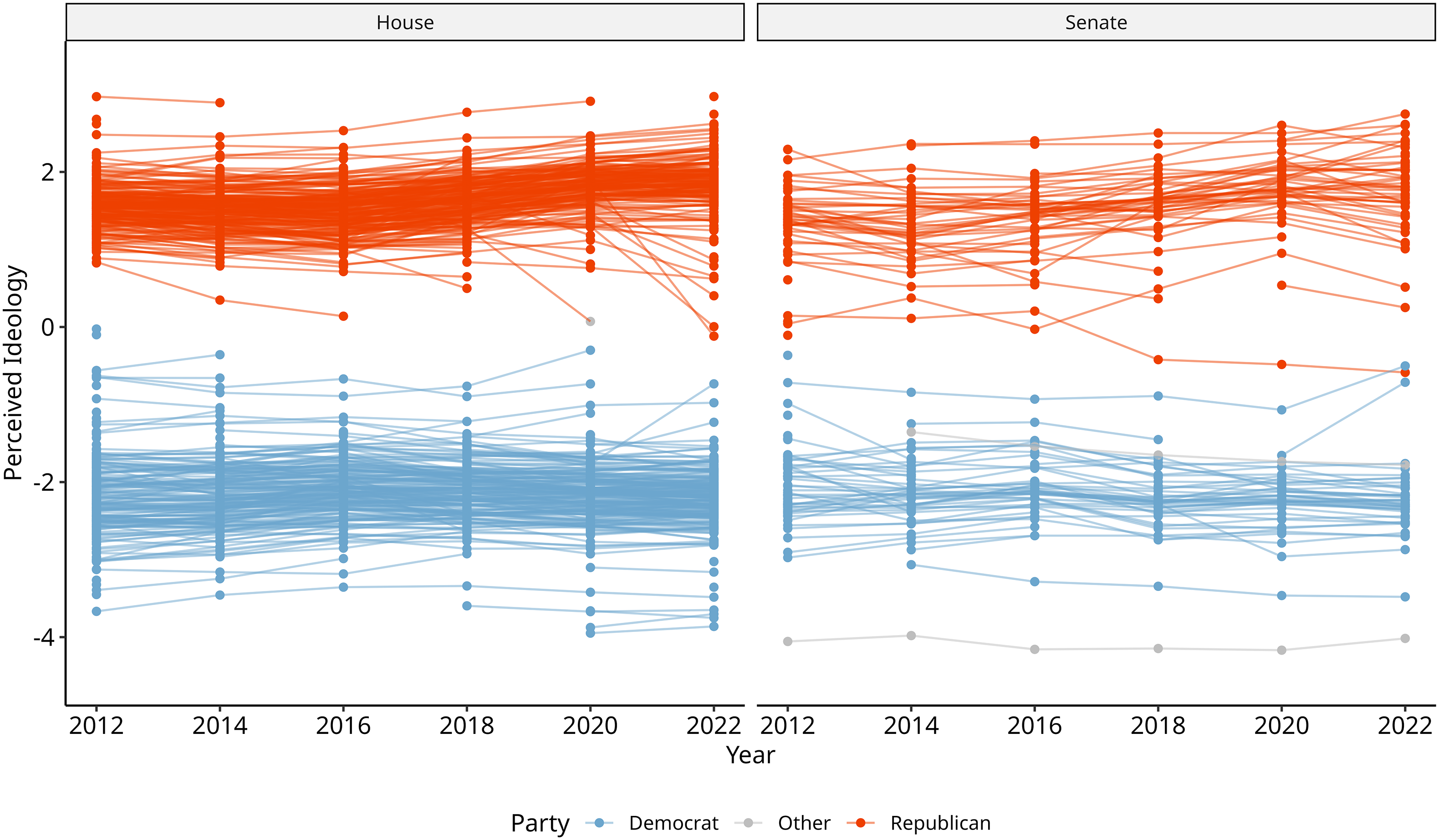
The model is estimated in Stan (Carpenter et al. Reference Carpenter, Gelman, Hoffman, Lee, Goodrich, Betancourt, Brubaker, Guo, Li and Riddell2017) using the Ohio Super Computer (1987) and convergence diagnostics are available in the Supplementary Material. In Figure 1, we plot the perceived ideology of all members of Congress during our time period. Over our time period the public’s perceptions of the Democratic caucus stays relatively constant in both chambers, while perceptions of the ideology of the Republican caucus shifts further to the right.
Perceived ideology of members of Congress.

Measuring Politicians’ Messaging Ideology
Our primary measure of a politician’s messaging ideology (or a politician’s ideological presentation of self) communicated to voters comes from a comprehensive collection of all tweets sent by members of Congress across the 112th to 117th Congresses (2011–22). We combine all tweets from official, campaign, and personal accounts at the member–Congress level to create an accounting of all public-facing Twitter communications sent by a given member of Congress across a two-year congressional cycle.Footnote 6 These tweets were collected, on a rolling basis, beginning in 2018. This resulted in a total of 5,792,575 tweets from 1,585 accounts (retweets are excluded, replies and quote tweets are included, full breakdown by Congress is in the Supplementary Material).Footnote 7
We use Twitter data as our primary source of public-facing communications because previous work has found that, compared to other media of communications, politicians’ communications on Twitter (along with Facebook) are directed towards a general population audience rather than a specific constituency of subset of supporters and thus are most representative of a politician’s overall message (Green et al. Reference Green, Shoub, Blum and Cormack2024).Footnote 8 Twitter is also the most widely used platform among politicians with the greatest volume of communications content which provides for the greatest coverage of incumbent members of Congress and congressional candidates. In contrast, other forms of congressional communication provide less coverage and are aimed at a more specialized audience and may be targeted to emphasize particular appeals or communications aimed at eliciting support among that particular audience (Hassell and Monson Reference Hassell and Monson2016; Green et al. Reference Green, Shoub, Blum and Cormack2024). Given the larger audience and these findings from previous work, there is reason to believe that the content politicians publish on Twitter is representative of their overall ideological presentation of self.
We want to stress, however, that our findings are not merely an artefact of our choice of politician messaging or unique to one particular medium of communication. Our efforts are not merely a test of how voters perceive a politician’s Twitter feed (indeed, to suggest that voters are only attentive to what politicians say on Twitter but not in other contexts would be ridiculous). Rather, we believe that politicians’ communications on Twitter align with their broader messaging strategy to the general population (see also Green et al. Reference Green, Shoub, Blum and Cormack2024) and that these messages filter down to citizens through various pathways, either through the media or advertising or through other heuristics. To that end, for robustness, we also replicate our estimates using Facebook posts from members of Congress (using the same method described below) across the same time period (1,884,888 posts from 1,299 accounts belonging to 775 individual members), with substantively identical outcomes. In addition, we also replicate our central results with the content of campaign websites (provided by Case Reference Case2023), highlighting that the relationship between voter perceptions of politician ideology and how politicians actually present themselves ideologically is not limited to social media content. Replications of our central results using these alternative data sources can be found in the case study in the Supplementary Material and reinforce our argument of the strong relationship between what politicians communicate to voters and how voters perceive those politicians ideologically.
We define messaging ideology in line with traditional definitions of ideology from Converse (Reference Converse and Apter1964, 207) as ‘a configuration of … attitudes in which the elements are bound together by some form of constraint or functional interdependence’. In this sense, politicians whose public political pronouncements are consistently aligned with conservative priorities are more conservative and those whose public communications are more consistently aligned with liberal priorities are more liberal.Footnote 9
Many prior studies have used automated text scaling methods to create ideological estimates of messaging from politicians. These approaches include multinomial inverse regressions (MIR) (for example, Green et al. Reference Green, Shoub, Blum and Cormack2024), naive Bayes (for example, Cowburn and Sältzer Reference Cowburn and Sältzer2025), class affinity models (for example, Kaslovsky and Kistner Reference Kaslovsky and Kistner2024), and Wordfish (for example, Case Reference Case2023). These methods primarily rely on relative partisan word and phrase usage frequency to scale text on a left or right scale. While they are highly correlated with ideology, these approaches ultimately do not measure the actual express concept of ideology and, as such, are susceptible to erroneously capturing non-ideological word usage trends. We offer a detailed case study in the Supplementary Material outlining the potential pitfalls of word-based methods and the advantages of a supervised machine learning approach.
As our explicit interest is on the ideology of communications, as opposed to a measure of semantic similarity or difference between partisan actors, our goal is to specifically measure the ideology of the messages sent by members of Congress and classify specifically for the ideological lean of the content. As such, to measure messaging ideology from each member of Congress using Twitter communications, we use a supervised machine learning approach to estimate message ideology at the tweet level.
To do this, we measure messaging ideology using BERTweet (Nguyen et al. Reference Nguyen, Vu and Nguyen2020), a transformer-based model designed specifically for the processing of social media data, which has been shown to be highly accurate in the classification of congressional social media text (Ballard et al. Reference Ballard, DeTamble, Dorsey, Heseltine and Johnson2022; Heseltine and Dorsey Reference Heseltine and Dorsey2022; Ballard et al. Reference Ballard, DeTamble, Dorsey, Heseltine and Johnson2023). We use BERTweet to train a fine-tuned model of whether a given tweet is ideologically liberal, ideologically neutral, or ideologically conservative. These tweet-level estimates are then aggregated to the candidate level, to provide an overall average ideology score for a candidate within a given two-year congressional time period.Footnote 10
To train and fine-tune these models we begin by randomly sampling 22,591 tweets from the full tweet corpus, subdivided into data specifically corresponding to each presidential administration (7,650 for the 112th to 114th Congresses, 8,075 for the 115th and 116th Congresses, and 6,866 for the 117th Congress). Data are separated by presidential administration due to the important temporal nuance contained within references to policies, political figures, and political developments within a specific time period – criticisms of executive action come from differing ends of the ideological spectrum during the Obama presidency compared to the Trump presidency, for example. This approach has the advantage of not merely resting on words or combinations of words to determine ideology, but also, centrally, accounts for dialectical and temporal nuance within the data.
These tweets were collectively coded by two expert coders, with an overlap of 3,000 tweets between coders (1,500 for the 112th to 114th Congresses, 1,000 for the 115th and 116th Congress, and 500 for the 117th Congress). Each tweet was assigned as liberal (−1), neutral (0), or conservative (1). Overall, the agreement rate between coders was 84 per cent (81 per cent in Congresses 112–114, 88 per cent in 115–116, and 88 per cent in 117). The Krippendorf’s alpha for intercoder reliability was 0.79 for the 112th to 114th Congresses, 0.86 for the 115th and 116th Congresses, and 0.88 for the 117th Congress.Footnote 11 As we rely on a directionally consistent three-category classification, we also test the extent to which, when disagreement occurred, this disagreement was in ideologically opposing directions. Overall, just 0.3 per cent of content classified as liberal by the first coder was classified as conservative by the second coder, and 0.26 per cent of content classified as conservative by the first coder was classified as liberal by the second coder. Collectively then, there was a high degree of consistency and agreement in the coding process.
Based on this coded data, we use an approximate 90–10 split to fine-tune our BERTweet models, training across four epochs with a learning rate of 2e-5, resulting in three temporarily constrained classifiers of tweet ideology. To test the performance of these classifiers, we then classify a further set of 500 double-coded tweets per presidential administration, with discrepancies reconciled, which we set aside for model validation.
Overall, when applied to the validation data, our model for the 112th to 114th Congresses had an accuracy rate of 80 per cent and a weighted F1 score of 0.79. Our model for the 115th and 116th Congresses had an accuracy rate of 82 per cent and a weighted F1 score of 0.82, and our model for the 117th Congress had 82 per cent accuracy and a weighted F1 score of 0.82. Therefore, through this training process, we achieved a high degree of classification accuracy in a manner that is consistent over time.
To create messaging ideology scores for each politician within a given Congress we classify all tweets in the data and then group the data by Congress and by the unique ICPSR number associated with each Twitter handle. Because we are interested in a politician’s overall ideological presentation of self, this means that members with multiple accounts have all tweets combined within a given Congress. We then calculate the average classified messaging ideology score for each ICPSR(member)–Congress pair, with results sitting on a scale between −1 (meaning all tweets were classified as liberal) and 1 (all classified as conservative).
Having created this ideology classification pipeline, we then also apply it to all tweets sent by candidates in the 2020 and 2022 congressional elections (using the 115th to 116th classifier for 2020 and the 117th classifier for 2022). Here we have 899,930 tweets sent by 889 non-incumbent politicians, providing ideological estimates for (a more limited sample) of non-incumbent candidates, for whom the information environment may be more sparse and who lack pre-existing roll-call records for reference.
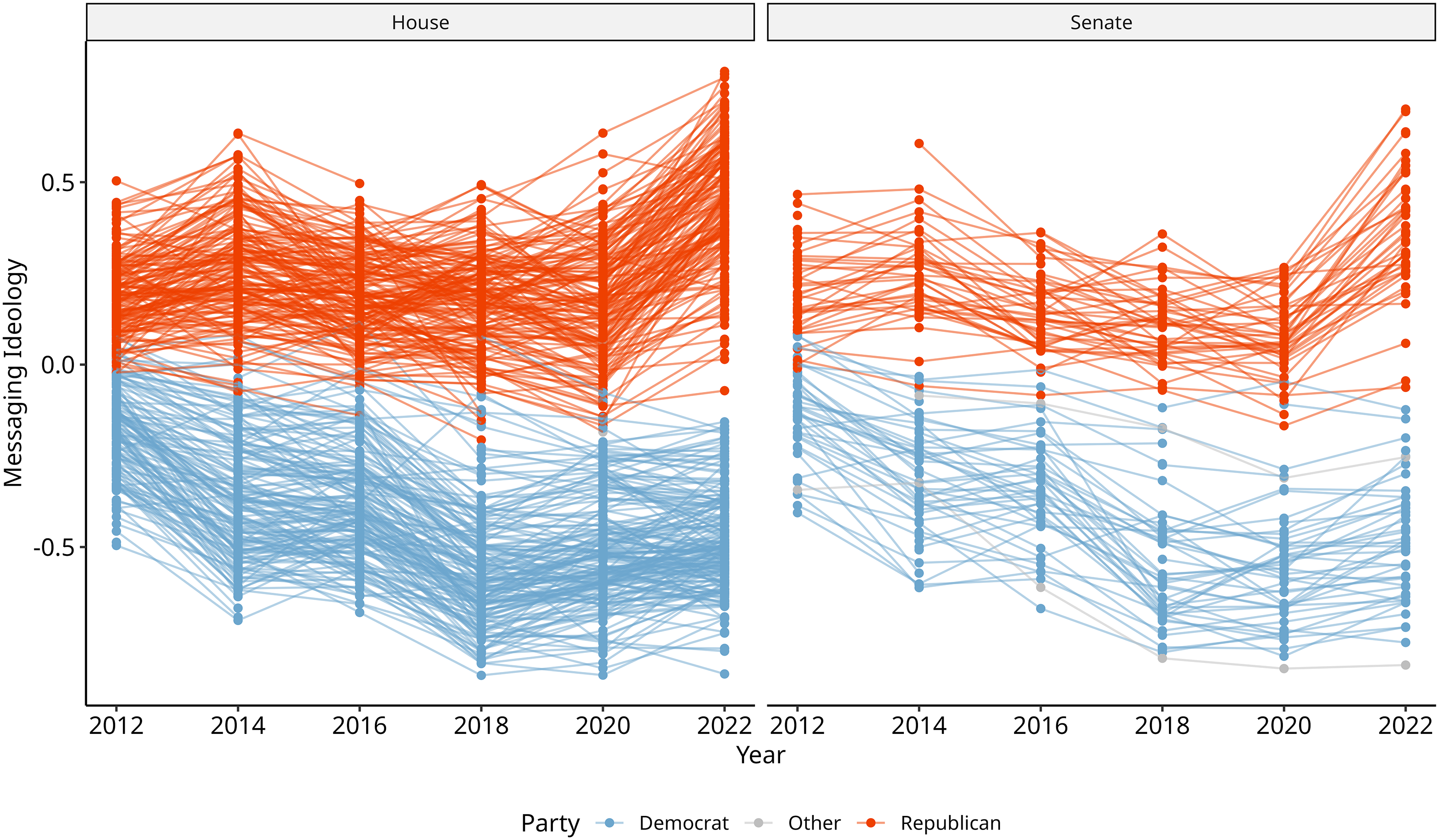
As with our voter perception measure, we show the distribution of messaging ideology scores derived from Twitter, at the member–Congress level, in Figure 2. Offering face validity to our measurement, the two parties are clearly and consistently separated on the respective right and left sides of the ideological spectrum. The measure generally shows the two parties shifting in tandem over time, with scores distributed fairly broadly across the ideological spectrum, and with a small degree of overlap in the ideological center.
Messaging ideology of members of Congress.
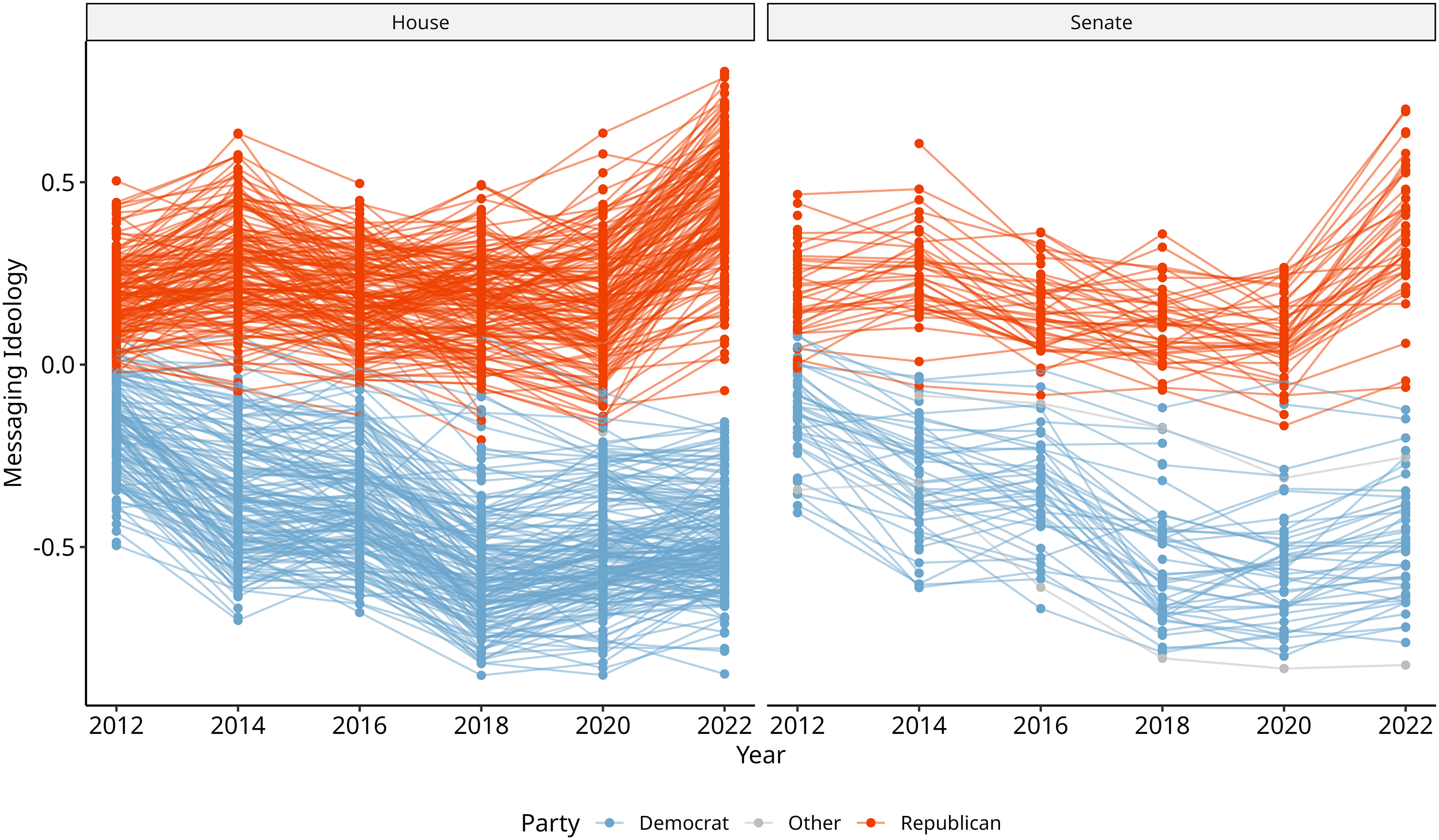
The trends also show relative moderation of messaging from Democrats when they were in the majority during the Obama years and from Republicans when they were in the majority during the Trump years and relative extremism when acting as the opposition. This may seem surprising, especially given the divisive nature of the post-2016 era. This finding is supported by an examination of the validation data (Section C of the Supplementary Material), which is taken from a true random sample of the data and double-coded by human coders. In the validation data only approximately 16 per cent of messages in the 115th and 116th Congresses were conservative in nature, a decrease from 24.4 per cent in the Obama years. For robustness, we also show these same trends over time using alternative classification approaches in Section C2 of the Supplementary Material.
These trends are in line with previous work that has highlighted important changes in party priorities and how they approach campaigning when in the majority or in the minority (Aldrich et al. Reference Aldrich, Ballard, Lerner and Rohde2017; Ballard and Hassell Reference Ballard and Hassell2023; Ballard et al. Reference Ballard, DeTamble, Dorsey, Heseltine and Johnson2023). There is a moderation of messaging while in government, with Republicans turning more towards local affairs, credit claiming, and non-partisan issue areas while in control of the presidency (Heseltine Reference Heseltine2024). In contrast, a shift towards more extreme messaging when in the minority highlights the efforts of minority party members to position themselves in opposition to unpopular policy positions pushed by the majority party. These findings demonstrate the utility of the measure and the differences between legislative ideology and messaging ideology – while Republican policy and voting may have been more conservative during this time period, their messaging was decidedly more centrist in efforts to promote popular and non-controversial governing decisions.
This descriptive insight is important for understanding the potential relationship between messaging and voter perceptions over time, and is specifically highlighted by our approach to measuring message ideology. As the content and topic of messaging remains distinct between the two parties across our time period, automated word-based classification approaches are prone to erroneously creating exaggerated artificial division between the parties, even when the main differentiation between the parties is not based on opposed ideological substance but on issue topic and national/local focus instead.Footnote 12 In effect, then, because our measure is expressly picking up ideology, and thus correctly identifies temporarily constrained differentiation between roll-call voting and messaging ideology, this classification approach in particular helps in gaining important leverage which can be used to determine whether voters are picking up on voting or messaging across the time period covered. To further explore this dynamic and expressly highlight the utility of our classifier relative to other approaches, we also provide a detailed comparison of classification techniques using data from the 115th Congress in the Supplementary Material (Section D).
Campaign Messaging and Voters’ Perceptions
With measures of both the ideology of a politician’s self-presentation and voters’ perceptions of candidate ideology, we estimate a series of models to test the relationship between what politicians communicate (their messaging ideology) and voters’ perceptions of politicians’ ideology. We include summary statistics and bivariate plots for relevant variables in the Supplementary Material. We start by looking at just incumbents running for re-election. Separating incumbents from non-incumbents is important for both theoretical and practical reasons. By the nature of being incumbents, these individuals are more well-known to the public. They are well-known both as individuals (having been in the public eye for a longer time) and as legislators (having had to vote on specific legislation). This provides a harder test of the effect of politician messaging because voters’ perceptions of these candidates should be more grounded and campaign communication has the potential to be swamped by voters’ awareness of incumbents’ previous behaviors in office. As we show in detail below, we find that voters’ perceptions of incumbents are in fact grounded in both what legislators do as legislators and how they present themselves. Importantly, though, we document that the balance between legislative ideology and messaging ideology in informing voter perceptions varies over time and by party.
We subsequently estimate models for non-incumbents. As we noted, one concern about incumbent models is that both messaging ideology and roll-call ideology are measured with error. As such, because these measures are correlated, in models predicting voters’ perceptions of incumbent ideology, the Twitter measure might remain significant even if voters’ perceptions were driven entirely by roll-call behavior. In contrast, voters have much less additional information about non-incumbent politicians. By using instances where voters cannot use a candidate’s congressional voting record (and have little additional information about those candidates generally), we can be more confident that ideological evaluations are directly related to a candidate’s ideological presentation of self. As we show below, we find that a politician’s messaging ideology is correlated with voters’ perceptions of the ideology of that candidate. In addition, we also document important variation in how this relationship varies across the competitiveness of the district or state. In particular, we find the relationship between how candidates present themselves ideologically and how voters perceive them ideologically is strongest in competitive districts, where we might expect voters to pay more attention to politicians’ communications.
Incumbent Models
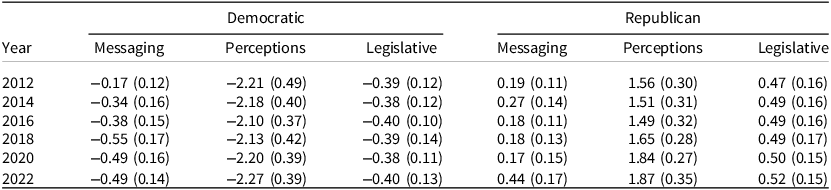
For incumbents, we estimate a model with a candidate’s ideology as perceived by voters as our dependent variable. The main independent variables are the messaging ideology score, as detailed above, and Nokken and Poole’s (Reference Nokken and Poole2004) dynamic measures of legislative ideology, which have been updated and are available from Lewis et al. (Reference Lewis, Poole, Rosenthal, Boche, Rudkin and Sonnet2021). We only include politicians in years where they have tweeted at least twenty-five times as the estimates are noisy for those with a small number of tweets. We begin with a series of nine models that include different subsets of our data, first pooling all incumbents together and then dividing the models by chamber and party.Footnote 13 In addition to legislative ideology and messaging ideology we include indicator variables for the years (from 2012 to 2022), indicators for party when both parties are present, and Cook Political Reports’ Partisan Voting Index (PVI) for the district or state and the square of PVI (in addition we scale PVI from 0 to 1 to make the coefficients more legible).Footnote 14 Including PVI helps to account for the fact that members of Congress in more ideological districts respond to this by communicating in more ideological ways (Kaslovsky and Kistner Reference Kaslovsky and Kistner2024). Table 1 displays the summary statistics (mean and standard deviation) for each of the three main variables for each year and party separately. The standard deviations of both of our main independent variables (messaging ideology and legislative ideology) are approximately the same (around 0.10 to 0.17), making the effect sizes easy to compare.
Yearly summary statistics of measures for incumbents

Note: cells contain the mean with the standard deviation in parentheses.
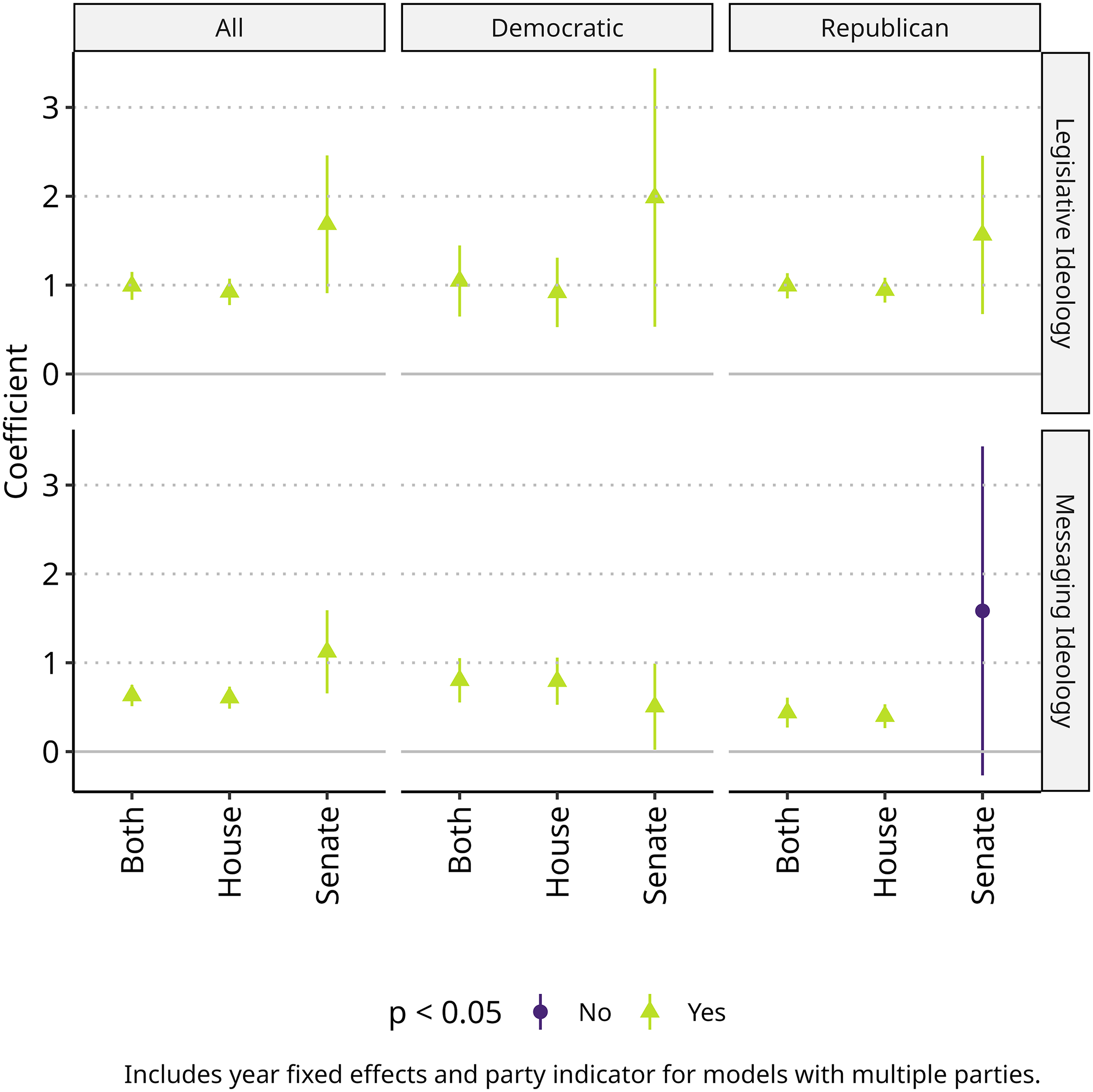
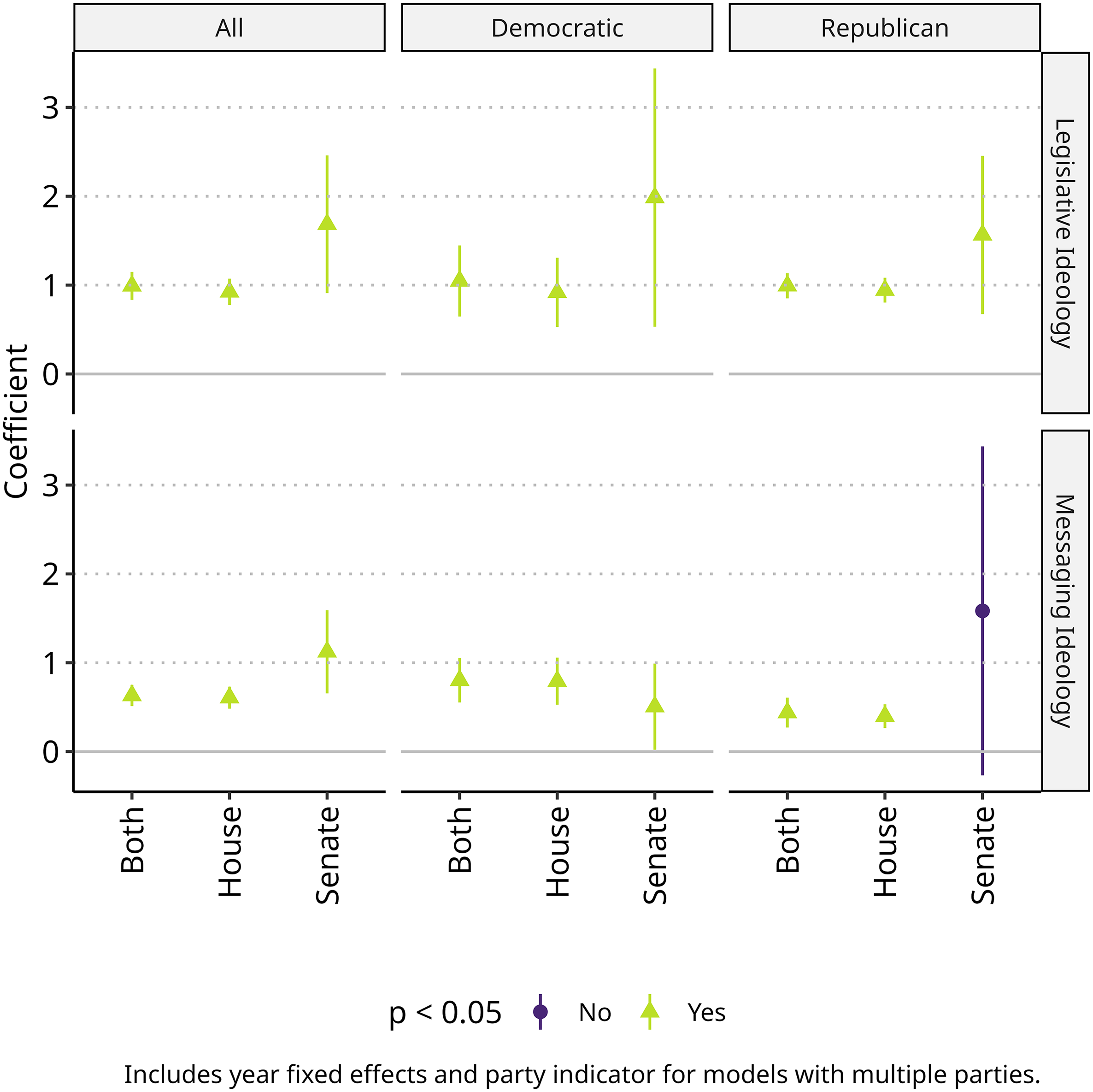
Figure 3 plots the estimated coefficients for just the legislative ideology and messaging ideology measures (along with 95 per cent confidence intervals [CIs]). Each column is a different model with a different subset of data (full model results are in the Supplementary Material). Across every subset of data, the point estimates of the coefficients on legislative ideology are between 0.99 and 1.99 and the 95 per cent CIs do not cross the 0 line. The coefficient on messaging ideology tends to be lower, with the point estimate ranging from 0.44 to 1.58, but the 95 per cent CIs also do not include 0 except for the model of just Republican senators. In the aggregate, we see that voter perceptions of candidates are related to both legislative action and a politician’s ideological presentation of self.
Models predicting voters’ perceptions of ideology by chamber and party.
The aggregate estimates hide interesting variation across the years. Usage of social media has increased during this time period (Dinesh and Odabaş Reference Dinesh and Odaba2023), while, at the same time, traditional media use has declined. Such trends have increased the ability of politicians to communicate directly with voters, meaning that more voters are getting their information directly from candidates or through new media gatekeepers (Popkin Reference Popkin2006). We therefore might expect that the actions of political figures on social media become more informative for how voters view their elected officials.
To examine whether the relationship between messaging ideology and voter perceptions of politician ideology has changed over time, we estimated different models of incumbent ideology perceptions in each congressional election year between 2012 and 2022. We again estimate a model with both parties together (including a dummy variable for party and the Cook PVI and PVI squared) alongside models with just Republicans and just Democrats.Footnote
15
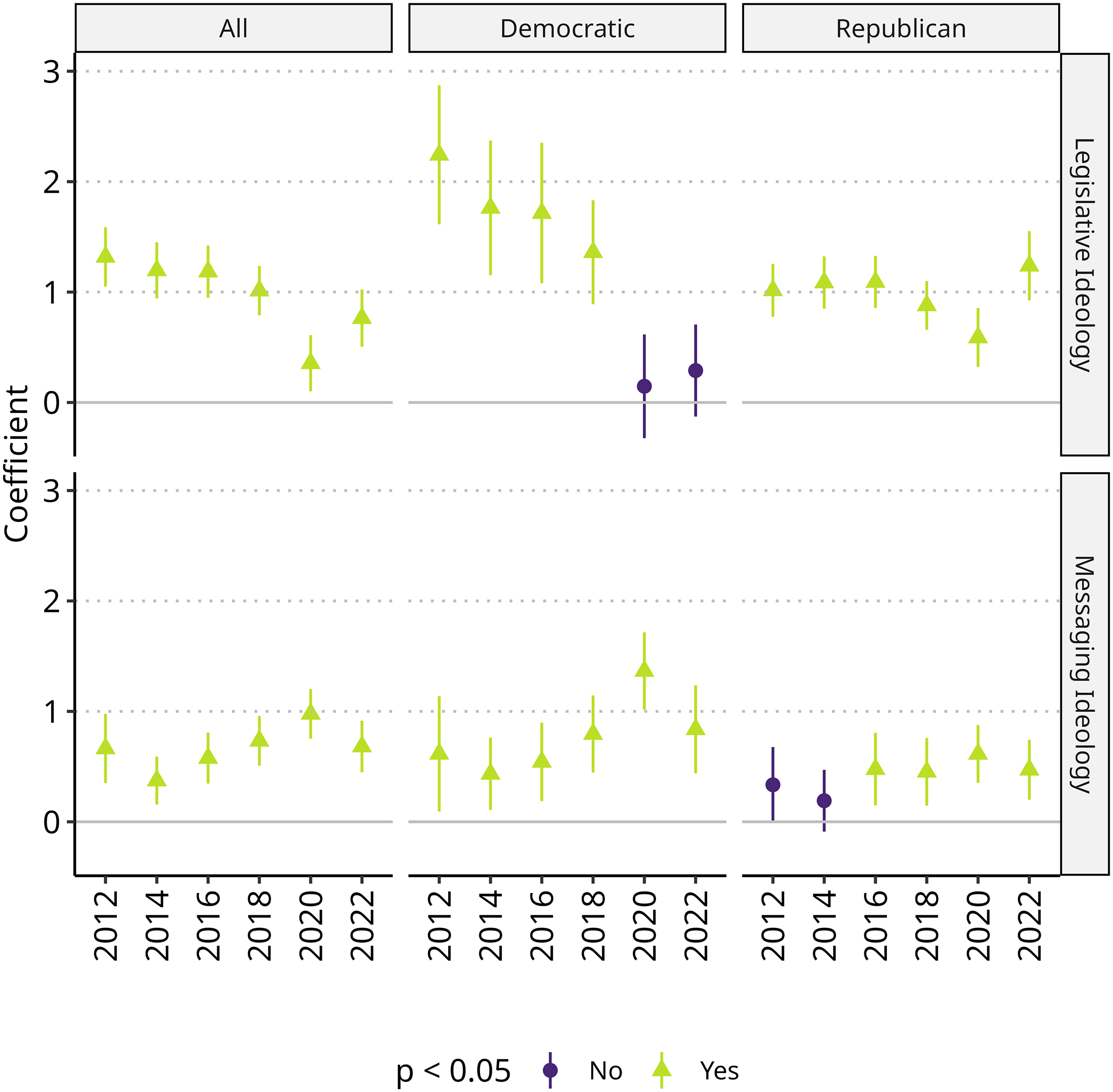
In Figure 4, we show the estimates’ coefficients and 95 per cent CI for legislative ideology (top row) and messaging ideology (bottom row). When pooling both parties we see a general downward trend in the coefficient on ideology derived from legislative actions. In 2012, the coefficient is 1.32 (1.05–1.59 95 per cent CI), while in 2022 it is 0.76 (0.51–1.02 95 per cent CI); the difference between these two coefficients is statistically significant (two-sided hypothesis p-value $ \lt 0.01$
) using the test proposed by Paternoster et al. (Reference Paternoster, Brame, Mazerolle and Piquero1998). The coefficient on messaging ideology does not move significantly; in 2012 it is 0.67 (0.35–0.98 95 per cent CI) while in 2022 it is 0.68 (0.45–0.92 95 per cent CI).
$ \lt 0.01$
) using the test proposed by Paternoster et al. (Reference Paternoster, Brame, Mazerolle and Piquero1998). The coefficient on messaging ideology does not move significantly; in 2012 it is 0.67 (0.35–0.98 95 per cent CI) while in 2022 it is 0.68 (0.45–0.92 95 per cent CI).
Models predicting voters’ perceptions of ideology by year and party.
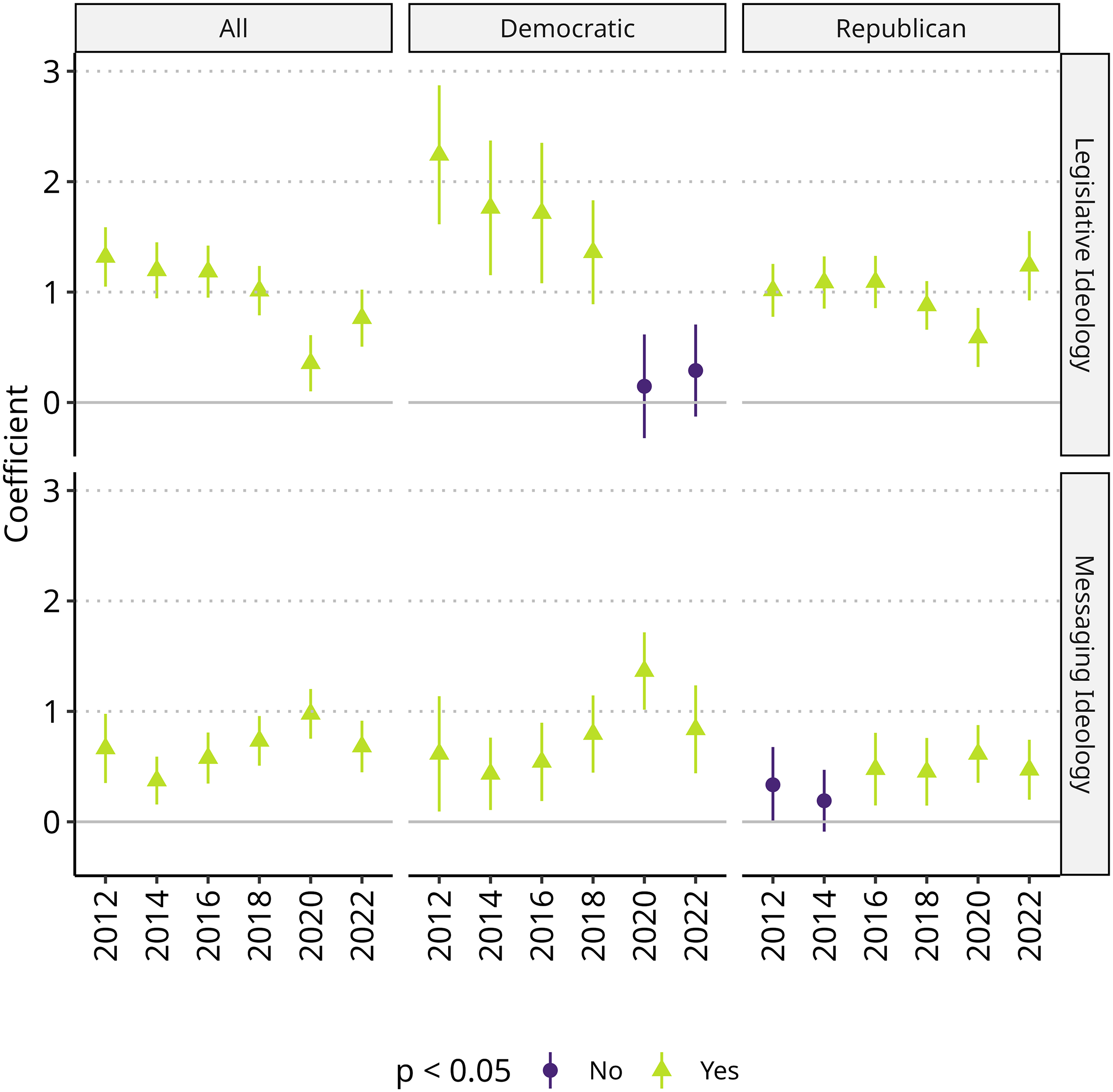
The trend is different, however, between the two parties. The coefficient on messaging ideology and legislative ideology remains relatively constant for the Republican members of Congress. The test of difference between 2012 and 2022 fails to reject the null with p-values of 0.27 and 0.54 for legislative and messaging ideology respectively.
There is, however, a dramatic change for Democrats during this time period. The coefficient on legislative ideology begins at 2.24 (1.61–2.87 95 per cent CI) in 2012 but drops to just 0.29 (−0.13–0.71 95 per cent CI) by 2022. In contrast, the coefficient of messaging ideology moves in the opposite direction, starting at 0.62 (0.09–1.14 95 per cent CI) in 2012 and increasing to 0.84 (0.44–1.24 95 per cent CI) in 2022 (although the difference is not statistically significant). It is worth noting that these changes over time can be the result of multiple factors, including changes in how social media is used by incumbents and changes in broader societal norms around social media.
Candidate Models
As noted above, we might be concerned that because both messaging ideology and roll-call ideology are measured with error and the measures are correlated, in models predicting voters’ perceptions of incumbent ideology, messaging ideology might remain significant even if voters’ perceptions were driven entirely by roll-call behavior. This is especially true because incumbents have an incentive to claim credit specifically for what they have accomplished legislatively. In contrast, non-incumbents do not have a congressional record (or as much other public information about themselves more generally) which voters can draw on to make ideological evaluations.
To model voters’ perceptions of non-incumbent politician ideology we start with simple models regressing voter perceptions on messaging ideology and Cook PVI for the district or state along with an indicator of whether someone is running for the Senate, whether someone is a Democrat, and the year. We do this across the 2020 and 2022 elections, the cycles for which we have available messaging content for all general election candidates.Footnote 16 Table 2 again shows the mean and standard deviation for our ideological measures across our years and parties. These are broadly on the same scale as for the incumbent models.
Yearly summary statistics of measures for candidates

Note: cells contain the mean with the standard deviation in parentheses.
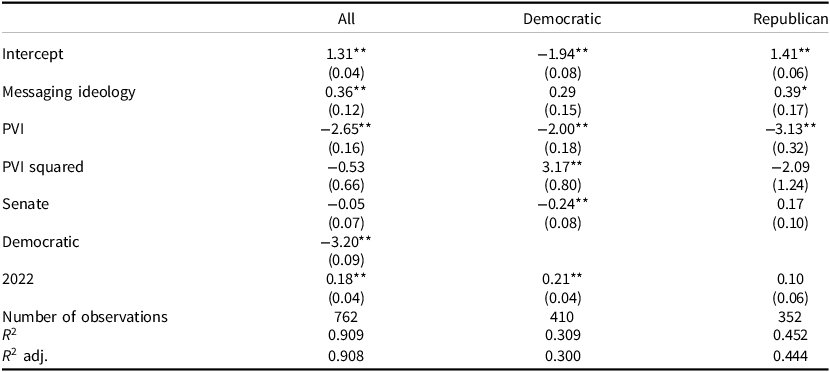
Models of voters’ perceptions of candidate ideology
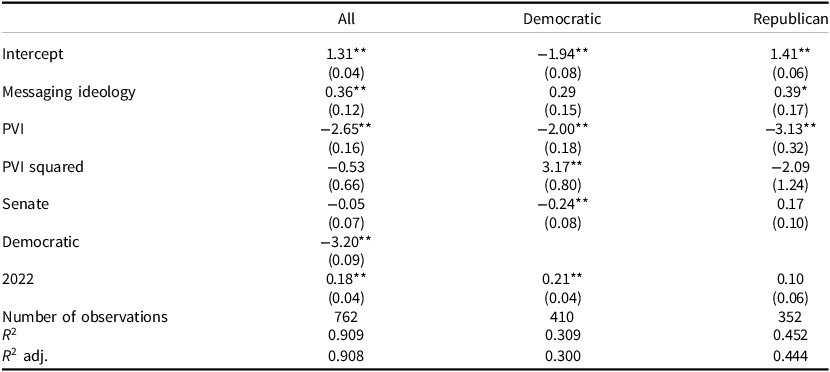
Note: Ordinary least squares coefficients with standard errors in parenthesis * p < 0.05, ** p < 0.01.
Table 3 displays the estimated coefficients for all candidates pooled together as well as two separate models for Democratic and Republican candidates. We find that the coefficient for messaging ideology is positive at 0.26 (0.05–0.47 95 per cent CI) in the model with all candidates; 0.40 (0.05–0.74 95 per cent CI) for Republican candidates; and 0.23 (−0.06–0.51 95 per cent CI) for Democratic candidates. The effect for Republicans is not just significant but also substantively important. An approximate one standard deviation shift in messaging ideology is related to a 10 per cent shift in voter perceptions. Overall, this shows that voter perceptions of politicians’ ideology are indeed related to how politicians present themselves publicly.
However, as before, pooling all candidates in all districts across all years hides important heterogeneities. As noted, not all candidates receive the same degree of attention. Specifically, there are good reasons to believe that voters are less likely to pay attention to candidates running in districts or states that solidly favor the opposite party. In contrast, we expect voters to be most attentive to candidates running in competitive races.Footnote 17 We use PVI as a measure of partisan lean, and expect in general that the messaging ideology coefficient will be at its largest near 0 PVI, likely decreasing for Republican (Democratic) candidates as the PVI leans more heavily Democratic (Republican). Because we have no a priori expectations for the shape of this change or a particular cut-off point we estimate this using a thin plate regression spline.Footnote 18
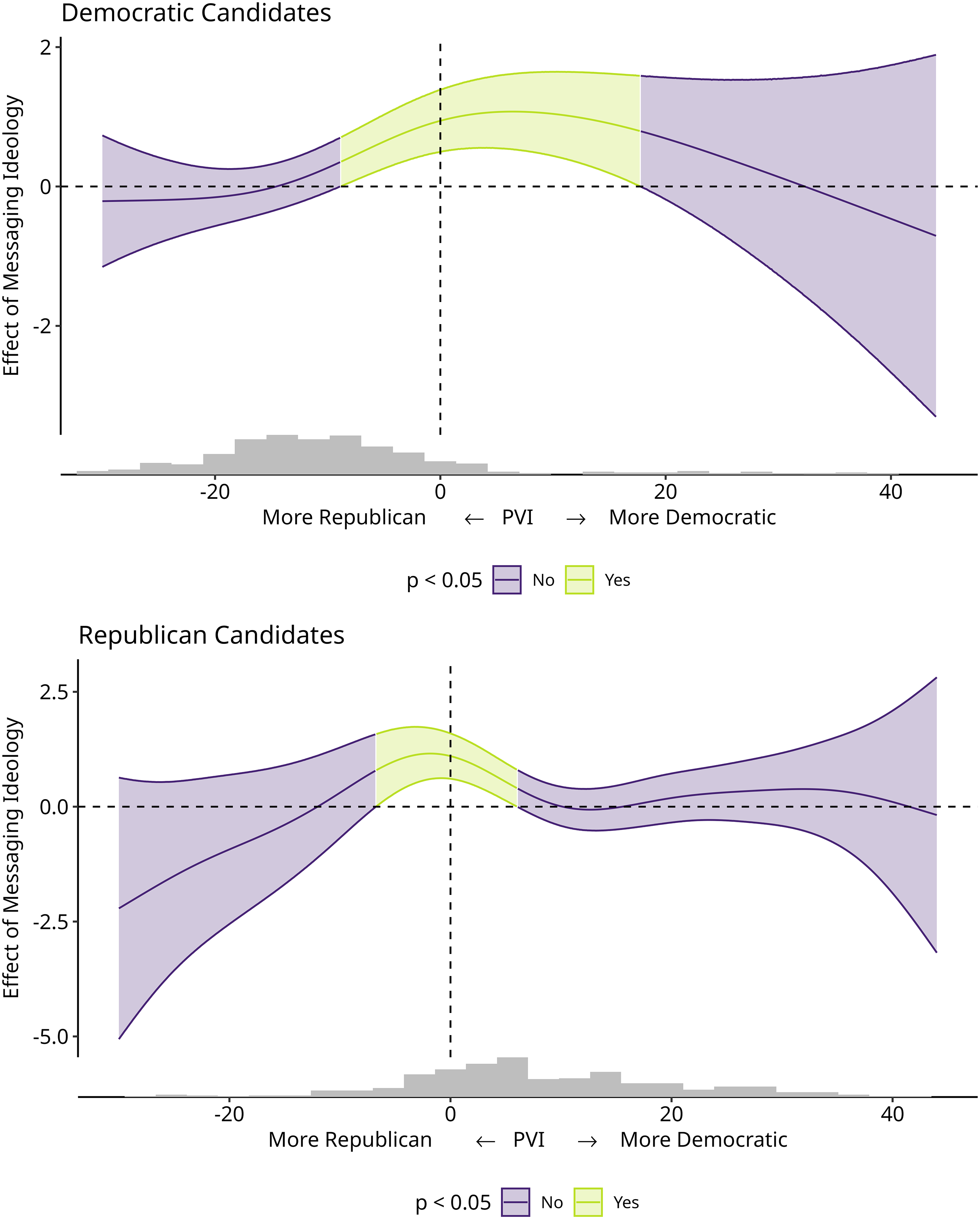
Figure 5 plots the estimated effect of messaging ideology across the range of observed PVI for Democrats (top panel) and Republicans (bottom panel).Footnote 19 The Y-axis is the estimated coefficient value of messaging ideology while the X-axis is the PVI. Below each panel, we show a histogram of the types of districts and states where a candidate was running. From these plots, it can be seen that, across both Republican and Democratic candidates, messaging ideology is related to voter ideology but only across a limited set of districts.
Effect of messaging ideology across PVI.

For Democrats, the messaging ideology coefficient is statistically significant (p-value < 0.05) between a PVI of −8.1 and 20.9. For Republicans the window is smaller, between −7.0 and 6.3. Although the window is larger for Democrats, Democratic candidates have tended to run in more conservative areas during this time period. In practice this means that for 38.8 per cent of Republican candidates there is a relationship between how they present themselves ideologically to voters and how the voters view them, whereas for Democrats only 34.7 per cent of candidates were running in states or districts where the relationship between how politicians present themselves and how voters perceive them was significant and positive.
Overall, however, our results suggest that voters’ perceptions of candidate ideology are most aligned with the messages that campaigns communicate with voters in electorally competitive districts. In districts that are not competitive, the relationship between voters’ perceptions of candidate ideology and the ideology of the actual messages that candidates communicate through social media is more tenuous. Consistent with the idea that voters are most attentive when information is most important in decision making (Popkin Reference Popkin1994), it appears that voters are most attentive to candidate communication in districts where there are opportunities for electoral success for both parties.
Robustness Checks: Just Twitter?
As we note above, it is important to confirm the results are robust to multiple specifications and data sources. Given that it is unlikely that voters are highly attentive to the tweets that politicians provide, our argument is that voters are picking up on the overall messaging that politicians communicate through various media (Twitter included). Although we are unable to identify this specific pathway, we conjecture that candidate messaging could be communicated through media pathways or through social networks as individuals rely on heuristics to make political evaluations. Regardless, there is some evidence that what politicians communicate varies across different communication platforms (Hassell and Monson Reference Hassell and Monson2016; Green et al. Reference Green, Shoub, Blum and Cormack2024) and, as such, it is important to be sure that our results are not the artefact of a single particular medium of communication. To reinforce that our results are not unique to a single source of politician communication, we highlight the results of a series of robustness checks here. Full results for each of the models can be found in the Supplementary Material.
Facebook Ideology
Along with Twitter, previous work has suggested that communications from politicians on Facebook are aimed at a general population audience rather than a particular group or subconstituency (Green et al. Reference Green, Shoub, Blum and Cormack2024).Footnote 20 In Section B.1 in the Online Supplemental Materials we repeat our central test of voters’ perceptions of the ideology of incumbent legislators using all incumbent Facebook posts across the same 2011–22 time period (using the same method to classify Facebook posts as we do Twitter posts). The results are consistent with the effects we find using politicians’ Twitter communications, with Facebook message ideology being a consistent predictor of perceived ideology, with Democratic members in particular seeing the effect of roll-call voting diminishing over time, while the effect of message ideology increases over time.
Candidate Website Ideology
Alternatively, we can measure the ideological content of campaign communication using measures that do not include social media. Specifically, we use measures of ideology developed by Colin Case (Reference Case2023) using the campaign websites of candidates of Congress. These results are similar. Using the website ideology scores for 2020 and 2022 we show, in Section B.2 of the Online Appendix, that, overall, website ideology is positively associated with perceived ideology for both incumbents and challengers. For the effect of candidate web ideology across differing levels of district competition we again see that significant effects occur only in the most competitive races and are insignificant in races with lower levels of electoral competition.
Robustness Checks: Methodological Variations
Lastly, we also want to be confident that our findings are not simply a result of a specific estimation strategy. As we detail below, we also run additional models which provide more confidence that the result is not merely the choice of specific model specifications.
GGUM Legislative Ideology
We might be concerned that the dynamic measure of legislative ideology we use in our models as a control might not accurately identify ideologically extreme candidates by their legislative voting behavior (Duck-Mayr and Montgomery Reference Duck-Mayr and Montgomery2023), which might alter the effects of campaign communications we find in our models. This is not the case. In Section B.3 of the Online Appendix we replicate our results using an ends-against-the-middle Generalized Graded Unfolding Model (GGUM) (Duck-Mayr and Montgomery Reference Duck-Mayr and Montgomery2023) estimation strategy for legislative ideology, which allows for multidirectional disagreement in individual voting decisions (the extremes disagreeing with the center does not imply agreement with the opposite side, for example). Again, the use of this alternative measure as a control for legislative behavior does not significantly affect the relationship between the ideology of politicians’ communication and voters’ perceptions of candidate ideology. Messaging ideology continues to be a significant predictor of voters’ perceptions of candidate ideology.
Random Forest Estimates
There also might be concerns that the changes in coefficient size over time (Figure 4) are a function of changing distributions of the independent and dependent variables. To check that we are identifying real variations in how well messaging ideology and legislative ideology explain voters’ perceptions of candidate ideology over time, we replicate our yearly estimates using a more flexible modeling approach (a random forest) and calculate the mean absolute error using cross-validation. The results of this are in Section B.4 of the Online Appendix. For Democrats a model that includes only the messaging ideology performs worse than a model that includes only legislative ideology at the start of the time period, but by 2020 the messaging-only model performs as well as if not better than the legislative ideology-only model.
Conclusion
Our results here provide clear evidence that voters’ perceptions of candidate ideology are strongly related to the messages that these politicians communicate. Using information communicated to voters via social media from 1,856 candidates and campaigns between 2012 and 2022 and the perceptions of candidate ideology from over 500,000 citizens, we show that voters’ perceptions of candidate ideology are highly accurate and strongly related to a politician’s ideological presentation of self.
Temporally, we find significant changes over time for perceptions of incumbent members of Congress, with the relationship between messaging ideology and voter perceptions of candidate ideology becoming increasingly strong over time for Democratic incumbents, while also becoming entirely unrelated to Democratic voting records. The relationships for Republican incumbents are, however, much more stable across the time period. The extent to which these changes over time reflect broadly applicable changes in how voters perceive Democratic candidates, or whether they are a mere artefact of the Trump era, is an open question (although these trends do continue into the Biden administration). However, regardless of contextual factors that may be behind these shifts, the results nonetheless highlight an important partisan asymmetry which aligns with a general trend of findings reflecting asymmetric shifts in congressional communications in this time period (Ballard et al. Reference Ballard, DeTamble, Dorsey, Heseltine and Johnson2023; Heseltine Reference Heseltine2023).
In addition, among non-incumbent politicians we also find that the relationship between politicians’ messaging and voters’ perceptions of the ideology of those politicians is strongest in districts where the candidates’ parties are competitive. Our results indicate that voters’ perceptions of candidate ideology are more aligned with the actual messages that those candidates for office communicate in districts where there is political competition, while that relationship is more tenuous in non-competitive districts.
Finally, by measuring actual perceptions of candidate ideology, as reported by real voters, combined with the actual ideological lean of individual candidate messages, our analysis also provides a methodological road map for scholars wishing to conduct future research into both politicians’ ideological presentations of self and voter perceptions. Indeed, both measures presented here proved to be highly accurate, robust, and methodologically applicable across time periods and political contexts, opening doors to future avenues of research in the fields of voters’ perceptions and ideological messaging.
Although our research provides strong evidence that voters’ perceptions of politician ideology is related to the messages that politicians communicate, we also recognize the limitations of this research. In particular, our design does not allow us to identify the mechanism by which this information reaches voters. It would be foolish to believe that voters are highly attentive to every piece of specific content that campaigns create and attempt to communicate to voters. In addition, we only examine the use of social media yet there are a variety of other ways that campaigns communicate with voters, including press releases and newsletters. Importantly, different members of Congress are more likely to use different media (Blum et al. Reference Blum, Cormack and Shoub2023).
While we cannot explicitly identify how voters internalize the messaging ideology of candidates, our work does provide some suggestions of where to look. Our findings that the relationships between politicians’ messaging and voters’ perceptions of their ideology are strongest in competitive districts suggest that candidates’ messaging ideology is communicated to voters through other means than candidate communications. Competitive races have significantly more media coverage, campaign activity on the ground, and voter interest, all of which have the potential to be the means by which voters acquire information. Given our inability in this work to demonstrate the specific pathway, we strongly believe that future work would do well to better understand how voters acquire this information, the role the media have in mediating that relationship, and the reliance on other voter shortcuts. While we have shown that voters’ perceptions of politician ideology are strongly linked to how politicians present themselves ideologically, our work, while perhaps suggesting some potential areas to explore, does not specifically test how voters acquire these accurate perceptions.
In that same vein, while we have extended previous work to show how voters’ perceptions of candidate ideology vary across districts with different levels of competitiveness, we believe there is also further work to tease out under what conditions these relationships between what politicians communicate and how voters perceive those politicians are stronger and weaker or more or less accurate. Extending our knowledge of the conditions under which voters receive and process the messages politicians communicate to them can better help us to understand under what circumstances political communications are effective and when voters are able to best understand the choices presented to them. In showing the nature of the relationship between voters’ perceptions and the competitiveness of the congressional districts where candidates are running, we have taken one step in that direction; however, we believe there may well be many other opportunities for future research in these areas.
On the whole, however, our work shows that although voters’ knowledge of political facts may be relatively limited, their perceptions of candidate ideology are largely accurate and aligned with the messages that those politicians communicate to the public. Such a finding illuminates the impact that communications from politicians have on voters and their evaluations and perceptions of candidates for office.
Supplementary Material
To view supplementary material for this article, please visit https://doi.org/10.1017/S0007123425100768
Data Availability Statement
Replication data for this paper can be found in Harvard Dataverse at https://doi.org/10.7910/DVN/GRZZQ1
Acknowledgements
The authors thank Brian Hamel, Libby Jenke, Jamil Scott, and Ryan Vander Wielen for their amiability, affability, and kindness. We are also grateful to Cindy West for her research assistance. Lastly, this project benefited from comments from Stephen Jesse and audience members at a panel at MPSA in 2024 and from members of the American Politics Workshop at Florida State University.
Financial Support
This research received no specific grant from any funding agency, commercial or not-for-profit sectors.
Competing Interests
The authors have no competing interests to disclose.



 Open access

