


1 Introduction
“No matter what happens in the courtroom, it all comes down to emotion (of jury).”
— Boston Legal (2004)In the trolley dilemma, a runaway trolley is headed for five people who will be killed unless steps are taken to stop it. The only way to save them is to hit a switch that will turn the trolley onto an alternate track where it will kill one person instead of five. Should you turn the trolley in order to save five people at the expense of one? According to Reference KimGreene, Sommerville, Nystrom, Darley, & Cohen (2001), most people said yes.
Now consider another problem, the footbridge dilemma. As before, a trolley threatens to kill five people. You are standing next to a large stranger on a footbridge that spans the tracks, in between the oncoming trolley and the five people. In this scenario, the only way to save the five people is to push this stranger off the bridge with your own hands, onto the tracks below. He will die if you do this; however his body will stop the trolley from reaching the others. Should you save the five others by pushing this stranger to his death? Most people say no (Reference KimGreene et al., 2001). The question is “Why not?”
Utilitarianism is defined as the idea that the morally correct course of action is the one that produces the greatest total benefit for all people affected (Reference Sinclair, Knight and ClariSinclair, Knight, & Clari, 2001). From a psychological point of view, utilitarian judgments are defined as endorsing harmful actions that promote the greater good (Reference GreeneGreene, 2007) and judgments favoring the aggregate welfare over the welfare of fewer individuals (Reference Moll and de Oliveira-SouzaMoll & de Oliveira-Souza, 2007).
There are differences between the trolley dilemma and the footbridge dilemma; Greene et al. (2001) labeled them as an impersonal moral dilemma and a personal moral dilemma, respectively. According to Reference Greene and HaidtGreene & Haidt (2002), personal moral violations meet the following criteria: the violation must be likely to cause serious bodily harm, this harm must befall a particular person or set of people, and the harm must not result from the deflection of an existing threat onto a different party. In short, personal moral violation is “ME HURT YOU” (Reference Greene and HaidtGreene et al., 2002); that is I, as an agent, hurt you, a visible person in front of me. If it fails to meet these criteria, the moral violation is impersonal.
Using personal and impersonal moral scenarios, Greene et al. (2001) argued that emotional engagements influence only personal moral situations as opposed to impersonal ones. In addition, it had been shown that moral judgment could be induced by hypnotic disgust (Reference Wheatley and HaidtWheatley & Haidt, 2005). In a subsequent study (Reference Valdesolo and DeStenoValdesolo & DeSteno, 2006), emotion’s role on utilitarian judgment had been supported by inducing positive affect, which resulted in increasing utilitarian judgments. Since then, it has been suggested that the argument that damage to the ventromedial prefrontal cortex (vmPFC) increases utilitarian judgments because the vmPFC damage causes emotional deficits—that is, absence of guilt, shame and empathy (Reference Koenigs, Young, Adolphs, Tranel, Cushman and HauserKoenigs, M., Young, L., Adolphs, R., Tranel, D., Cushman, F., Hauser, M., et al., 2007).
Nonetheless, there are a few empirical studies about people’s individual disposition related to emotion as to utilitarian judgments. It was suggested that judgments would vary from individual to individual (Reference Greene and HaidtBartels, 2008). If tasks and mood induction affect people’s utilitarian judgment, we might think that people’s emotional disposition also affects moral judgment. This research explores the relationship between state emotions and utilitarian judgments through Study 1 and influences of emotional dispositions by using trait emotion scales on utilitarian judgment through Study 2.
2 Study 1: state emotions
A Study 1 was conducted for the following purposes:
-
1) to verify that normal people with no brain damage differ in utilitarian judgments;
-
2) to identify which emotion is evoked by each scenario during judgments.
2.1 Method
2.1.1 Sample and procedure
Two hundred and forty three participants answered a questionnaire: 137 men and 106 women (mean age = 25.19, SD = 6.39). The participants responded to questionnaires through e-mail or on paper. We attempted to include participants with a broad range of ages and multifarious jobs; participants aged from eleven to fifty six comprised not only students from elementary school to graduate school but also the CEO of a small business corporation, housewives, a dance-sports instructor, lawyers, a dealer from a casino, doctors, pharmacists, engineers, teachers, school commissioners, a shop worker and people of various other job descriptions.
2.1.2 Material
Twenty-five personal moral scenarios (Reference KimGreene et al., 2001) were used to assess utilitarian judgment. Since personal moral scenarios have been argued to be influenced by emotion as opposed to impersonal moral scenarios (Reference KimGreene et al., 2001), Study 1 excluded impersonal moral scenarios. The instruction was “These given scenarios describe specific situations. When you answer the questions, please think that you are in this situation, and the person to decide what to do is you.” To encourage choice with no limitation, “No matter what you choose, you will not be punished by law” was added to the instructions. This query additionally asked participants to report the one emotion that the participants most felt during judgment. The participants could choose from among anger, sadness, fear, anxiety, disgust, guilt, shame, surprise, and empathy. If any of those emotions were not what they felt during judgment, the participants could write in the blank. The order of personal moral scenarios was randomized, with the same order for everyone.
2.2 Results
Reported participants’ choices on “appropriate” answers to given situations of scenarios. The results of Study 1 showed that normal people made utilitarian judgments differently; analysis of the number for “appropriate” answers for twenty-five scenarios per person (hereafter, the number) showed that the number ranged from zero to twenty-one among the twenty-five scenarios. Some people did not make utilitarian judgments at all; yet some people made twenty-one utilitarian judgments from the twenty-five situations. The mean of the number was 9.78, median was 10, and standard deviation was 4.02.
Reported emotions that the participants felt during judgment. Table 1 provides information about what the participants felt during judgment in order of most frequently reported: guilt, sadness, disgust, empathy, anger, anxiety, etc. Table 1 shows that disgust, anger and other negative emotions were also evoked during judgments. These results indicate more elaborate negative emotions than have been proposed (Reference KimGreene et al., 2001) for situations where one is confronted by personal moral violations.
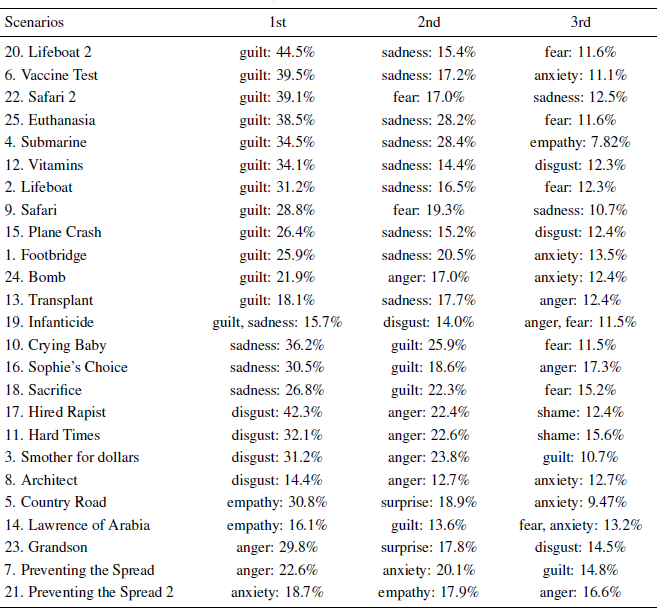
Figure 1 shows the number of scenarios sorted by the emotions reported as the most strongly felt during judgment. Guilt dominated on twelve personal moral scenarios and was followed by sadness, disgust, anger, empathy, and anxiety.
The number of scenarios sorted by most frequently reported emotion during judgment.

2.3 Discussion
It is notable that guilt was the most frequently reported emotion, but the reason is not obvious. Since guilt follows a terrible act that someone has done, the fact that participants’ answers to “the emotion felt during judgment” were often “guilt” calls for attention. Participants could have felt guilty for what they were about to do—sacrifice one person—which means people can feel guilty before they actually hurt someone. But it seems more plausible that the guilt which they reported was post-action emotion, because the question about what they felt during judgment came after the choice. Since participants thought about what they felt after they decided to sacrifice one person, they may have reported guilt because they had to harm someone.
However, it is noteworthy that other emotions were also elicited as dominating emotions while participants made judgments. Even when they decided to kill someone, in half of scenarios some people felt sad, disgusted, angry, empathetic, or anxious rather than guilty. This could mean that the twenty-five personal moral scenarios are not highly homogeneous; people felt different emotions while they were confronted by the situations described in the scenarios and had to make decisions.
It seems that scenarios with the same most commonly reported emotion share some characteristics. Sadness was most dominant in four scenarios in which participants had to kill their own offspring: Infanticide, Crying Baby, Sophie’s Choice, and Sacrifice. The scenarios that elicited disgust most are about choosing drastic action for selfish reasons: hiring a rapist to get your wife’s love back, forcing your daughter to get a job in the child pornography industry, killing a man for insurance money, and throwing a mean boss off the building. Participants seemed to have felt angry most when they saw unjust situations: a grandson who wants to get back at his grandmother for her not giving him allowance and an HIV positive patient trying to infect as many people as possible. It is interesting that the two scenarios that drew participants’ empathy most are totally different. Respondents could empathize with either a bleeding man on the country road or a driver who wants to take him to hospital but worries about his blood ruining the leather car seats. This situation is plausible or at least in the movies. Yet the scenario of a head of a tribe killing a warrior who is about to become the reason of war with another tribe is highly unrealistic. Since the Study 1 questionnaire asked participants only to choose a word for emotion, and because Korean does not have different words for empathy and sympathy, there might be a possibility that participants felt sympathetic to the characters of scenarios. Anxiety was reported as the most strongly felt emotion in Preventing the Spread 2 because participants felt insecure about HIV spread. These diverse emotions reported during judgment suggest that diverse emotions may play a role in judging in a utilitarian way.
Koenigs et al. (2007) suggested that the absence of guilt, shame, and empathy increased the likelihood of utilitarian judgment, yet all of those emotions were elicited by the personal moral scenarios. It is therefore possible that the presence of these emotions also affects utilitarian judgment.
3 Study 2: trait emotions
Previous research (Reference KimGreene et al., 2001) has implied that emotion affects particularly personal moral judgment; yet which individual emotion affects utilitarian judgment has not been investigated. Other research suggested that evoked emotion by hypnosis (Reference Wheatley and HaidtWheatley et al., 2005) and mood induction (Reference Valdesolo and DeStenoValdesolo et al., 2006) could change the degree of moral judgment; yet people’s dispositions toward various emotions has not attracted a great deal of interest. Hence Study 2 was conducted to explore the influence of individual emotion on utilitarian judgment focused on trait emotions.
Considering Koenigs et al. (2007)’s argument that lack of guilt, shame and empathy enhances utilitarian judgment, Study 2 first of all investigates the influence of guilt, shame and empathy on utilitarian judgment. These three self-conscious emotions have been designated “moral affects” (Reference TangneyTangney, 1991). The definitions of guilt and shame were first articulated by Lewis (1971) and subsequently elaborated by Tangney (1992); guilt is an emotion characterized by tension, regret, and remorse about a particular action or inaction. Following a negative outcome, a guilt experience might begin with the thought, “Look at the horrible thing I have done.” Alternatively, shame is an emotion characterized by a sense of shrinking, smallness, worthlessness, and exposure (Reference Tangney, Wagner, Fletcher and GramzowTangney, Wagner, Fletcher, & Gramzow, 1992). Following a negative outcome, a shame experience might begin with “I am a horrible person” (Reference TangneyTangney, 1995).
Since Study 2 focuses on trait emotion, which represents a general emotional tendency, it is different from emotions at a given moment (state emotion). Guilt and shame can be evoked in utilitarian judgment situation as the result of personal moral violation. Therefore, the trait guilt and shame which people usually have in their minds might not affect utilitarian judgments.
On the other hand, the emotional empathic tendency, defined as an individual’s characteristic inclination to respond with emotions similar to those of others who are present (Reference Mehrabian, Young and SatoMehrabian, Young, & Sato, 1988), can have a different effect on utilitarian judgment. Important aspects and influences of empathy have been relatively neglected (Reference PedersenPedersen, 2009). However, in the light of the nature of empathy, one could conjecture that empathy makes it difficult to judge in a utilitarian way because feeling empathetic to a focused person (or soon-to-be sacrificed one) could stand in a way that makes him/her be killed.
In addition to guilt, shame and empathy, highly-aroused emotions such as anger and disgust, reported by participants as what they felt during judgment in the Study 1, could be the reasons why people make utilitarian judgments. Trait anger is defined as a tendency to experience angry feelings in a variety of situations and it may be considered as a temperament and a reaction (Reference SpielbergerSpielberger, 1999). As anger is a highly-aroused emotion related to aggression, anger would be assumed to be a factor that enhances utilitarian judgment, since it is assumed to assist in the performance of acts of personal moral violation.
Disgust is thought to be especially important in shaping moral intuitions (Reference Inbar, Pizarro, Knobe and BloomInbar, Pizarro, Knobe, & Bloom, 2009). Because of the aversive property of disgust toward objects or actions, disgust may act to inhibit utilitarian judgments.
To sum up, hypotheses for Study 2 can be summarized in the following statements.
Hypothesis 1. Trait anger will increase utilitarian judgment.
Hypothesis 2. Trait disgust will decrease utilitarian judgment.
Hypothesis 3. Trait empathy will decrease utilitarian judgment.
Hypothesis 4. Trait guilt will have no association with utilitarian judgment.
Hypothesis 5. Trait shame will show no connection with utilitarian judgment.
3.1 Method
3.1.1 Sample and procedure
Four hundred and seventy participants (two hundred and sixty seven men, two hundred and three women, mean: 21.44 years old, SD: 3.13 years old) answered the study questionnaire. Most participants were undergraduates or graduate students from Seoul National University and undergraduate students from Sogang University. The others were employees of companies and high school teachers including a foreigner. Participants answered the questionnaire on paper or via e-mail.
3.1.2 Measures
The 25 scenarios were the same as in Study 1. In addition, we gave the following trait-emotion measures:
-
1) The Trait Anger Scale (TAS) (Reference Spielberger, Jacobs, Russel and CraneSpielberger, Jacobs, Russel, & Crane, 1983) includes fifteen items that assess the intensity and the frequency of experiencing anger in provoking situations. The Korean translation of the TAS (Reference KimKim, 1999) was used. As with a previous study, the original 4-point scale of the TAS was converted to a 5-point scale. The Cronbach α coefficient was .88 in the present sample.
-
2) The Disgust Scale-Revised (DS-R) (Reference Olatunji, Williams, Tolin, Abramowitz, Sawchuk and LohrOlatunji, B. O., Williams, N. L., Tolin, D. F., Abramowitz, J. S., Sawchuk, C. N., Lohr, J. M., et al., 2007) was translated to Korean for Study 2 and corrected by seven personality psychologists. The original Disgust Scale (Reference Haidt, McCauley and RozinHaidt, McCauley, & Rozin, 1994) is composed of thirty two items, four in each of the seven animal-reminder domains (food, animals, body products, sex, body envelope violations, death, and hygiene), and four tapping magical thinking in relation to these domains (Reference Rozin, Lowery, Haidt and ImadaRozin, Lowery, Haidt, & Imada, 1999). The DS-R consists of three subsections: core disgust, animal-reminder disgust and contamination-based disgust. The DS-R comprises twenty seven items including two fillers on a 5-point scale. The Cronbach α coefficient in the present sample was .88.
-
3) The Emotional Empathic Tendency Scale (EETS) (Reference Mehrabian, Young and SatoMehrabian et al., 1988) is composed of thirty three items and uses a 9-point scale. The Korean translation of the EETS (Reference JungJung, 2006) was used. The Cronbach α coefficient was .81 in the present sample.
-
4) The Adapted Shame and Guilt Scale (ASGS) (Reference HoblitzelleHoblitzelle, 1982) consists of thirty adjectives considered to be either shame or guilt words. The ASGS was translated to Korean for Study 2 to reflect the original meaning and to be understood easily by participants, after reference to the first Korean translation of the ASGS (Reference NamNam, 2008). Subjects were asked to rate how well each of the adjectives described them on a 5-point scale. The Cronbach α coefficient in the present sample was .88 for guilt, .90 for shame and .94 for both combined.
-
5) Twenty-five personal moral scenarios (Reference KimGreene et al., 2001) were used to evaluate people’s tendencies to judge in a utilitarian way. Since previous research maintained that emotion only affect personal moral situation opposed to impersonal moral situation, only personal moral scenarios were used in Study 2. Participants were asked only to choose “appropriate” or “inappropriate” to a given behavior. The instruction was the same as in the Study 1.
3.1.3 Data analysis
The Statistical Analysis System (SAS) 9.3 was used to obtain descriptive statistics results, general linear model results, logistic regression results and reliability analysis. R was used for scatter plots.
3.2 Results
The number of “appropriate” answers of twenty five scenarios per person (the number) was analyzed as a dependent variable. The results of descriptive statistics were similar to the Study 1; the median of the number of participants’ “appropriate” answers was ten and the mean of the number was 9.89, the median was 10, and standard deviation was 4.09. The range of answers was wider than for the Study 1: from zero to twenty-three. Hence, it could be said that people make utilitarian judgments differently, again following the Study 1.
Descriptive statistics of anger, disgust, empathy, guilt and shame are provided in Table 2. Except for empathy (9-point scale), the other variables were assessed on a 5-point scale. These results show that people have different tendencies in experiencing these emotions in general.

Table 3 provides information about inter-correlations of anger, disgust, empathy, guilt, and shame. Disgust and empathy showed a significant correlation of more than .20, as did the correlation of anger and guilt and the correlation of anger and shame. The biggest significant correlation of all was that of guilt and shame.

* p < .01.
** p < .001.
*** p < .0001
As shown in Figure 2, guilt and shame had no relation to the number of “appropriate” responses (p = 0.1109 and 0.3543, respectively). Contrary to previous research that suggests lack of guilt and shame increases utilitarian judgment (Reference Koenigs, Young, Adolphs, Tranel, Cushman and HauserKoenigs et al., 2007), these results could imply that people who have guilt and shame do not necessarily judge in a manner we might characterize as lacking utilitarianism.
Scatter plots of guilt, shame and the number of “appropriate” answers.

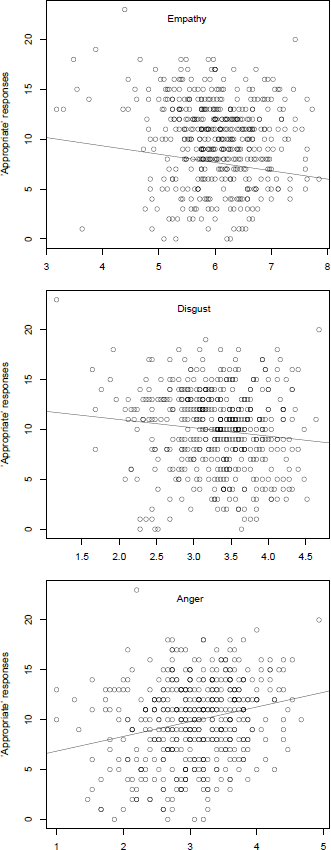
As opposed to guilt and shame, which show no significant relationship with the number of “appropriate” responses, empathy had a negative relationship with the number; so did disgust. And anger had a positive relationship (Figure 3, which contains the results of regressions).
Regression line with scatter plots of empathy (β = −0.74, p <.01), disgust (β = −0.83, p= 0.01), anger (β =1.48, p <.0001) and the number of “appropriate” answers.
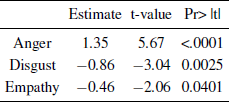
We fit a regression model (General Linear Model, GLM) to investigate the influence of trait emotions on utilitarian judgment after independent variables were standardized. Statistics relating to a GLM model using five emotions (anger, disgust, empathy, guilt, and shame) are provided in Tables 4 and 5. Statistics of GLM that used only significant predictors (anger, disgust, and empathy) are presented in Tables 6 and 7. Another GLM procedure result using the 21 personal moral scenarios that Koenigs et al. (2007) used and results of correlation analysis are provided in appendices.
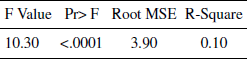
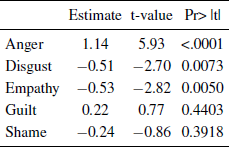
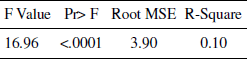
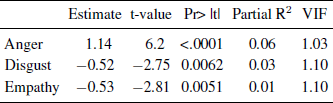
Again, anger increased utilitarian judgment, disgust and empathy decreased utilitarian judgment. Guilt and shame were not significant factors in predicting utilitarian judgment.
Logistic regression results by scenario are shown in Table 8. Trait anger, disgust, and empathy can predict the level of utilitarian judgment in nineteen personal moral scenarios with a statistically significant likelihood ratio (Pr > ChiSq): guilt and shame had no relationship with utilitarian judgment; anger increased utilitarian judgment; and disgust and empathy decreased this choice. These results are the same as those of the GLM procedure, except for one scenario. It is noticeable that trait anger is the dominating predictor of utilitarian judgment; when more than one emotion predicts this decision, anger is one of those. In sum, trait anger is related to fifteen personal moral scenarios. Disgust reduces utilitarian judgment in six personal moral scenarios and empathy diminishes this choice in seven scenarios.
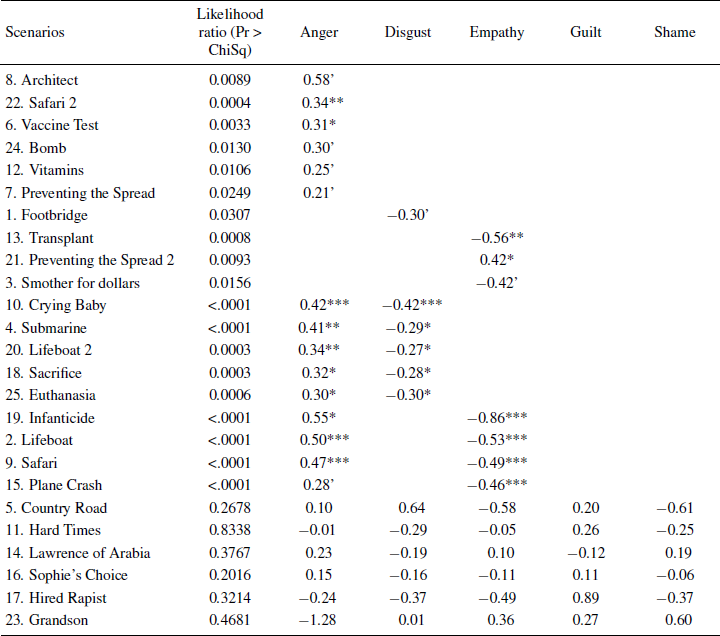
, p < 0.05
* p < 0.01
** p < 0.001
*** p < 0.0001.
3.3 Discussion
As hypothesized, guilt and shame did not show a significant relationship with the extent of the utilitarian judgment. Guilt and shame are usually the results of people doing something bad. Therefore the effect of these emotions on utilitarian judgment seems negligible.
Koenigs et al. (2007) suggested that the absence of guilt, shame, and empathy enhanced utilitarian judgment, but Study 2 showed guilt and shame had no statistically significant relationship with utilitarian judgment. The discrepancy between previous research and Study 2 results can be explained through the measurements Koenigs et al. (2007) used: the Iowa rating scale of personality change (ISPC). The ISPC compares conditions before/after brain damage as assessed by spouses or close friends of patients in thirty categories: irritability, lack of initiative, perseveration, impulsivity, obsessiveness, moodiness, lack of stamina, lack of persistence, lack of planning, inflexibility, poor judgment, anxiety, insensitivity, social inappropriateness, dependency, impatience, “type A” behavior, unemotional, social withdrawal, aggression, indecisiveness, vanity, suspiciousness, apathy, frugality, inappropriate, emotion, manipulativeness, easily overwhelmed, and lack of insight. It seems that none of these is directly related to guilt or shame. Unlike empathy, which could be measured by insensitivity, it appears that the ISPC did not actually measure the guilt and/or shame of patients. As opposed to the ISPC, the Adapted Shame and Guilt Scale (ASGS) directly measured people’s tendency to have guilt and shame in general. Since guilt and shame are self-conscious emotions, self-report by normal people with no brain damage could be a better way to measure guilt and shame. Compared to six patients Koenigs et al. (2007) investigated, the answers of the 470 people in Study 2 may provide more information about the relationship between guilt, shame and utilitarian judgment.
Study 2 results showed that trait empathy was negatively correlated with utilitarian judgment. In the case of a personal moral dilemma, the one person who has to sacrifice even his/her life for other people’s well-being stands out in bold relief. Empathetic people think of the victim’s position and share the victim’s feelings without difficulty. Once people feel themselves to be in the victim’s shoes, they are not able to sacrifice an innocent person no matter how great a profit is obtained. One scenario had positive relationship with empathy, Preventing the Spread 2. Possibly, participants empathized with the millions of people saved from getting HIV, not the person who decided to spread HIV before he goes to jail because we can be the victim of this crime.
Trait anger increased utilitarian judgment. Unlike previous research that emphasized emotion as a factor that hindered the formation of utilitarian judgments, anger, if anything, promoted utilitarian judgment. The reason anger encourages utilitarian judgment can be related to the nature of anger. Because anger is an internal state that regulates our interaction with the environment (Reference del Barrio, Aluja and Spielbergerdel Barrio, Aluja, & Spielberger, 2004), it is elicited when people face unfair circumstances. In a situation where the well-being or survival of many is blocked by one person, the people who have high scores on TAS get easily upset. Therefore they try to rectify the situation by sacrificing the person who is obstructing that well-being. By acting in this utilitarian way, which they believe is the right thing to do, they can feel that as if justice would be done and their internal conflict would be gone as well. Since anger has been a powerful motivation for preventing loss from invaders from an evolutionary point of view, it may play an important role in utilitarian judgment.
Another possible reason why trait anger may affect utilitarian judgment might have to do with the internal instability the situations in scenarios caused. TAS seems to also measure people’s tolerance for criticism and disturbing situations. For example, TAS measures people’s reaction in situations such as getting criticized publicly, being frustrated, falling behind due to another person. Perhaps people having high scores on TAS simply cannot handle these tense situations, which are like the utilitarian judgment scenarios; therefore they can “act out” by removing the reason why they are upset. By doing so—sacrificing someone who is creating unbearable agitation in their mind—they can feel that they would get out of anxious situations.
A third explanation regarding trait anger’s role in utilitarian judgment is connected to the nature of anger as an approach-type harmful behavior. Anger motivates people to get rid of anything that they are not satisfied with, which is required to push somebody at the rushing train.
Trait disgust decreased utilitarian judgment. Disgust may have evolved to discourage us from ingesting noxious or dangerous substances (Reference Rozin, Haidt and McCauleyRozin, Haidt, & McCauley, 2000). The feeling of disgust usually is accompanied by nausea or stomachache or both. In other words, disgust implies strong rejection. In the personal moral dilemma situation, disgust-sensitive people might feel the same way as when they eat rotten fish. Even though greater good will come, sacrificing one person in such scenarios might make disgust-sensitive people get sick. Hence they are unable to judge in a utilitarian way.
The GLM result shows only small effect sizes. However, this is quite typical in the field of personality and individual differences. Since everyone is different due to innate personality and various experiences in their lives, one cannot expect one constant biggest factor to influence their judgments, especially when we count on people’s disposition. Considering that people have different propensities, these results still provide some interesting relationships between emotional disposition and utilitarian judgment.
Another reason that might explain why GLM results did not show very high effect sizes is the decision-making procedure itself. All sorts of factors that we do not know exactly yet can influence judgment. This research investigated only the influence of trait emotions; we do not know what kinds of factors can shape utilitarian judgment and how much they may affect choices. In addition, Study 2 focused on people’s latent emotional disposition that people might not even be aware of. Hence, these results can contribute to our knowledge on how potential emotional disposition—trait emotions—can be related to utilitarian judgment.
The last reason that may affect effect sizes is the way of collecting data about utilitarian judgment. Since personality variables are usually measured by Likert scales that make it easy to get relationships between personality variables statistically, discussion about changing the way of answer to utilitarian judgment occurred among authors. We might have obtained higher effect sizes if we had used Likert scales for both independent variables and the dependent one. However, we valued the nature of decision making itself more, which is to choose one over another, rather than evaluating how appropriate this action is. Likert scale might render statistically stronger results, but it also could have made participants not engage enough to actually choose what to do by just having them think how appropriate the action is.
4 General discussion
This research is about how people’s individual differences relating to emotion and personality influence their utilitarian judgments. To explore the relationship between individual differences in emotions and utilitarian judgments, trait emotion scales were used.
From the Study 2 results, Moll et al.’s (2007) criticism about “emotional blunting” effect of vmPFC damage on utilitarian judgment (Reference Koenigs, Young, Adolphs, Tranel, Cushman and HauserKoenigs et al., 2007) seems to require critical reconsideration. Moll et al. (2007) pointed out that their relatively higher rate of rejecting unfair offers in the Ultimatum game (Reference Koenigs, Young, Adolphs, Tranel, Cushman and HauserKoenigs & Tranel, 2007) indicated that vmPFC-damaged patients do exhibit more emotional choice. However, Moll et al.’s (2007) criticism might originate from an oversimplification of emotions. All emotions are not the same; the emotions that Koenigs et al. (2007) maintained vmPFC damage created a lack of were guilt, shame and empathy. But the absence of those emotions does not necessarily entail the absence of anger and/or frustration, which would seem to be the emotions involved in the rejection of unfair offers. The results of Study 2, that trait anger increases utilitarian judgment, may explain the gap between “emotional blunting” of vmPFC-damaged patients and their higher rejection of unfair offers.
Koenigs et al. (2007)’s emotional deficits caused by vmPFC damage is also subject to question. After considering the rating of their spouses and close friends, Koenigs et al. (2007) argued that vmPFC damage made people have no guilt, shame or empathy. However, the scale that Koenigs et al. (2007) used, the Iowa rating scale of personality change (ISPC), does not provide sufficient information about vmPFC-damaged patients’ individual emotions. The ISPC allows for a choice from four descriptions of patient behavior; spouses or close friends choose the one which is most like the behavior of vmPFC-damaged individual. Even though the ISPC categorizes patients’ insensitivity, it is not designed to assess individual emotions like guilt, shame and empathy. Furthermore, Koenigs et al. (2007) have no independent evidence of their six patients’ original emotions and personality prior to the vmPFC damage. Therefore, the approach used in Study 2 involving individual trait emotions scale of normal people without brain damage and investigating the influence of individual trait emotions on utilitarian judgments might be more valid.
Combining the results of Study 1 and Study 2, it could be said that various emotions are evoked by situations of personal moral violations and people’s tendencies to experience those emotions do influence their moral judgment. However, the diverse emotions that participants reported which they felt during judgment are not the exactly same ones related to their choice; guilt, sadness, disgust, anger, empathy, and anxiety were reported as most strongly felt emotion during judgment, but valid predictors for utilitarian judgment are trait anger, disgust, and empathy. This may be interpreted as meaning that every emotion is different and has its different role in people’s daily lives; some emotions influence decision-making and other emotions do not. People felt guilty because they had to sacrifice one person, but guilt may not affect their judgment itself.
Another topic that might attract people’s attention is the fact that these personal moral scenario situations are unrealistic; it is rare that we experience to choose one of our sons to be killed by the enemy’s leader at war (Sophie’s choice). Some of the scenario situations such as pregnant teenager abandoning her baby (Infanticide) are not unheard of, yet many of those situations are not common. However, we ask ourselves kinds of questions that have the same logic—sacrifice relatively minor things for the greater good—everyday; should we raise health insurance fees to help those who cannot pay for themselves? should you lie to your children to protect them? Personal moral scenarios suppose drastic situations, but they also provide information about what people do when they have to weigh the options seriously mainly because the situations are serious. Therefore, these results can still have rich information as to how people think and feel and what they choose.
Finally, this research suggests that the emotional factors of justice might be anger, disgust and empathy. These notions of justice may be characterized within the following observations. One gets angry at offenders, feels disgusted at what the offenders have done and becomes empathic towards victims. The combination of these factors in different ratios could be the reason why people make utilitarian judgments differently.
This research adds to the recent trend of studies that emphasize affective/intuitive systems of moral judgment. While increasing the trend of emphasizing the role of emotion in moral judgment, this is among a few empirical findings, along with the finding that psychopathic traits predicted a greater proportion of utilitarian responses (Reference Glenn, Koleva, Iyer, Graham and DittoGlenn, Koleva, Iyer, Graham, & Ditto, 2010), based on an approach that views making utilitarian judgments as dependent on individual disposition, not the state caused by tasks or situations.
Appendices
1. Questions in Personal Moral Scenarios (Reference KimGreene et al., 2001)

2. GLM results for twenty-one personal moral scenarios that Koenigs et al. (2007) used
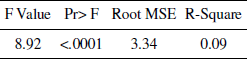


3. Results of correlation analysis

, p < 0.05
* p < 0.01
** p < 0.001
*** p < 0.0001.

, p < 0.05
* p < 0.01
** p < 0.001
*** p < 0.0001.


 Open access

